
Archives

Copyright protocols for restaurant menus

Submission Date

Question

(Question has been slightly modified to maintain anonymity)

We have been digitizing restaurant, hotel and other menus from our historical menu collection and have been following standard copyright protocols – but also making many case-by-case decisions based on things like whether of the establishment still exists, etc. (With only a couple exceptions I made for a faculty member who had permission of the restaurant owners, I haven’t scanned any menus from after 2000.) Our public collection site is used by students and researchers around the world.

My question is: can we scan and put online menus dated after 1977 (and especially more recent – up until 2021) if it is for educational purposes? If we do scan them, would we need permissions from every single chef/owner? The copyright status of menus in general has always seemed murky to me, but I don’t even know where to go to find clear answers for this situation.

Answer

Menus can be works of art.[1]

"Art" of course, is a subjective term, and has no precise, stand-along definition in copyright law.[2]  So more importantly for this discussion, a "menu" can be a composition of such originality and substance, that it is protected by copyright law.

This protection can be for the work as a whole (the entire menu), and/or it can be for individual elements in the work.  It can cover stand-alone elements (such as a cover photo image or flavor text[3] used to describe a signature dish), and, in these days of Slice and Grubhub and Yelp, it can be for the menu as a physical object, or a version published only online.  It can cover the original art in a trademarked logo, whether that art was generated by an independent contractor or employee.

Recent case law illustrates how these protections can be sliced-and-diced, and also shows just how nasty litigation over restaurant copyrights and trademarks can be.[4]  Menus and the logos and information they carry can be the apex of a restaurant's brand, reputation, and intellectual property.  So the member is right to take this concern seriously.

With care, however, the act of creating an online archive of carefully curated restaurant menus, for well-articulated academic purposes, should be able to find protection in the line of "fair use" case law building on the 2nd Circuit's 2015 decision in Authors Guild v. Google,[5] which relates to the creation of online repositories.[6]

As the Court found in that case: The purpose of the copying [to create the online resource] is highly transformative, the public display of text is limited, and the revelations do not provide a significant market substitute for the protected aspects of the originals.

The key to scanning and incorporating menus still under copyright protection into an archival database of menus at a library or educational institution, while taking advantage of the fair use defense set forth in Authors Guild, is to do so in a manner that:

  • Yields an asset that is useful beyond the mere replication of a single menu;
  • Ensures the archive will not enable use of its images in place of a copyright-protected original text or image; and
  • Uses an array of professionally developed standards to confirm and assert the academic and/or cultural value of the archive as a whole, and the inclusion of a particular work in that archive.

There are numerous techniques to achieve this.

First and foremost, the purpose of the archive should be developed and set forth on the archive in clear, well-developed terms. The database should not look like a group of menus simply gathered together by a person who happens to have made a collection of his favorite restaurants.[7] The cultural value and purpose of the collection should be stated in very certain terms, and consistently repeated throughout the archive's pages, cataloging text, and metadata.

Second, the function of the archive should be such that users can demonstrably benefit from the aggregated content and information. For instance, menus should be searchable by geographic region, type of food, notable characteristics, and other relevant factors...giving the aggregated content value beyond what is created by each individual entry.[8]

Third, the archive should adopt a standard approach to assessing and depicting the authorship, ownership, and copyright status of archived works.[9]

Fourth, the images themselves should be created so that a third party using the image cannot create a credible replica of the menu or the original originating restaurant's logo or copyright-protected content. A picture taken with a border, or the use of a watermark indicating that the image is part of the archive are some common ways to do this; technology creates many other and evolving options.

Fifth, since it will help mitigate damage in the event a copyright owner simply refuses to believe an archive has made a "fair use" of their content, the overall approach of the collection should be assessed using your institution's fair use assessment form, and that record should be kept. Why is that?  Being able to demonstrate a good-faith effort to establish that the use is fair can help mitigate damages, and can be a deterrent to a plaintiff pursuing a lawsuit all the way to a verdict.

Sixth, the "Terms and Conditions" of your online archive should feature a process for owners to report good-faith suspicion of copyright infringement, and your institution should have a registered agent as provided by the DMCA.  An example of this type of statement can be found in the DPLA's Terms and Conditions as of April 15, 2021: https://dp.la/about/terms-conditions[10]

Seventh, if you haven't, consider the benefits of registering an agent under the DMCA, and if it's a good move for your institution, register (you can look up and see if your institution already has an agent here: https://www.copyright.gov/dmca-directory/).

And finally, to the extent possible, for steps five, six, and seven, work with your institution's attorney, who can connect all these steps and the academic activity they support with your institution's insurance and risk tolerance.[11]

So, with all that as background, here are my answers to the questions:

Can we scan and put online menus dated after 1977 (and especially more recent – up until 2021) if it is for educational purposes?

Answer: Yes, copyright-protected materials can be duplicated if the use is fair; by following the cautions above, an institution can set itself up to both create a highly useful and important archive, to claim fair use, and to mitigate damages in the event of a worst-case scenario.

If we do scan them, would we need permissions from every single chef/owner?

Answer: if the use is fair, there is no need for permission...and in fact, asking for it could be introduced by a plaintiff as an admission that you concluded you needed permission.

Now, a word of caution on this: if your archive is part of a larger institution, the other departments of that larger institution need to be alerted that just because an image is on your archive, that doesn't mean they can use it for a catalog cover, a web site image, or a poster advertising your institution.  After all, a use that is "fair" for an academic archive might not be so "fair" if it is on a brochure for a program or event (even if the program or event is not subject to a charge).  This is especially true since menus will often feature not only copyright-protected material, but trademarks (which, unlike copyrights, do not expire if they are in continuous use).

The copyright status of menus in general has always seemed murky to me, but I don’t even know where to go to find clear answers for this situation.

Because the menus themselves can be protected by copyright--as well as the individual elements in the menus--that "murkiness" is here to stay. Unless a menu is clearly in the public domain, it is best to assume that it--or some part of it--is subject to copyright, and remember that a restaurant's name and logo are its intellectual property, too.  The reason an archival initiative can make this assumption, and still hope to achieve its objective, is because by carefully and deliberately assembling those individually protected elements, they are creating a broader work with value beyond each individual element.

The value of a collection of menus is likely obvious to librarians, academics, and information managers.  But just as an example of how valuable such a resource can be, even outside the field of scholarship, I'll share a personal anecdote: while working on a case for a neighborhood fighting a fast food drive-thru in their dense, urban neighborhood, I used the New York Public Library's digital collection to find a menu for the "Little Harlem Hotel" in Buffalo NY.  The menu was part of the research we used to make the case that the neighborhood has a history worth fighting for. 

We lost the case,[12] but that menu helped create a vivid argument about the history of the neighborhood and its vibrant legacy, and that argument was energized by the archive.  An online archive of menus can be important in countless ways; finding the right legal recipe to make it happen is worth it.

Thank you for a great question.


[1] If you are skeptical about "menus as art," check out the menu here, and tell me if the rooster doesn't convince you that he could be in a museum.

[2] "Visual art" does, and of course "art" as a general term is used regularly in copyright jurisprudence. But "art" remains a subjective term.

[3] Yep, that's a "flavor text" pun.  Yum.

[4] The 2019 case Khan v Addy's BBQ LLC, (419 F Supp 3d 538), involving former business partners operating BBQ joints in Tea Neck, NJ, and Elmont, NY, shows just how convoluted these things can get.  Another case from 2018, 784 8th St. Corp. v Ruggiero, 2018 US Dist LEXIS 5405 shows how copyright ownership to logos and menus can change based on who did the work; also, it shows that if you are in business with family, it is important to have a good lawyer!

[5] Authors Guild v Google, Inc., 804 F3d 202.  The Supreme Court denied a chance to review this case, leaving the 2nd Circuit's decision intact. 

[6] The database created by Google in the Authors Guild case was not a straightforward online archive like the one described by the member here.  However, the case is still applicable in several important ways.

[7] I know a professional archivist would not do this, but this is a very important distinction.

[8] Other "relevant factors" of which I, a food philistine living in the city that invented Buffalo Wings, and originally from the city that invented Chicken Riggies and Half-Moon cookies, am shamefully unaware.

[9] The approach of the Digital Public Library of America ("DPLA") happens to be my favorite, seen here in this document about the Erie Canal, but is not the only standard out there. What's important is that the institution identified a system that works for it--and then consistently uses that system.

[10] It would be deeply ironic if the DPLA sent me a "cease and desist" for linking to their excellent resources.

[11] Since every archive or library has a different structure and different approach, while inspiration can be drawn from fellow institutions, the final approach and policies should be reviewed by a lawyer for your institution whenever possible.  As just a threshold issue, state-affiliated institutions have different risk considerations than independent not-for-profits.

[12] It hurt to lose, but the damage to the neighborhood hurt more.
Archival materials, Privacy, and FERPA

Submission Date

Question

My institution has a small number of documents in our archives related to previous graduate students. Some are definitely educational records (transcripts, field placement evaluations). Then there are a) letters of recommendation received by the school or written by school faculty/administrators and sent to other schools, b) some correspondence between a student and the school/administration, and other items like c) copies of images or articles from student publications.

The documents span decades.   Most --- but not all--- of these former students are confirmed deceased. Most items in this small group of documents relate to alumni who were/are notable, but in widely varying degrees.

A few of these documents concern a famous alum, who passed away.  An outside researcher is asking about the documents related to that alum, and unfortunately, there are no surviving institutional access policies related to student records or unpublished correspondence in our archives. We want to respect copyright, FERPA, and the alum's estate.

For the educational records, I can't find clear guidance on how long FERPA access restrictions last, but other academic collections seem to allow access 50-75 years after the former student's death.

So, a few questions:

1) When should on-site access to historical educational records be allowed (if ever), with reference to FERPA? What about providing copies of historical educational records?
 

2) When should on-site access to unpublished, non-educational records related to former students be allowed, in reference to state and federal copyright and privacy laws, and possibly FERPA? What about providing copies of these documents?
 

3) Should we take a more risk-averse approach to high-profile alumni materials, or should our policies apply equally to all alums?

Answer

I am always fascinated by the transformation documents can undergo, simply by operation of law, circumstance, or time.  For instance:

  • Documents that are "education records" under FERPA can become simply "records," or "nothing" once the person to whom they pertain has died.[1]
  • Documents that are "private information" under New York's new(ish) SHIELD Act[2] are no longer controlled by the Act if the digital copy is swapped for a copy on paper.
  • Documents that use the "name and likeness" of a deceased performer, currently allowed, will be far more restricted when New York's new Civil Rights Law 50-f, which requires written permission for certain commercial uses, goes into effect on May 29th, 2021.[3]

And of course, documents can be "in" copyright, and "out" of copyright, or restricted due to medical content, or under terms of non-disclosure...restrictions that can shift based on any number of factors. 

An educational institution considering levels of access and use of student-related documents[4] has to consider not only these legal factors, but their unique policies.  Factor in fame,[5] and the stakes get even higher. 

Because of that complexity, I could muse/write/talk on this topic for hours.  But let's focus on the member’s specific questions:

1) When should on-site access to historical educational records be allowed (if ever), with reference to FERPA? What about providing copies of historical educational records?


If a former student is not deceased, there can be NO release of FERPA-protected education records to otherwise barred parties without written, dated consent.

If the former student is known to be deceased—or the passage of time suggests they might be deceased—then the records are no longer protected by FERPA, and that restriction no longer applies.

But as the member points out, there are other considerations.

2) When should on-site access to unpublished, non-educational records related to former students be allowed, in reference to state and federal copyright and privacy laws, and possibly FERPA? What about providing copies of these documents?
 

This is an interesting question because unless the records we're talking about ("related to former students") only contain "directory information,”[6] then they are by definition "education records" under FERPA.[7]  That is because the FERPA is intentionally expansive.  So old bills, dusty admissions files, and antiquated (but often fascinating) "administrative" records, although not "educational," per se, are still barred from release by FERPA if they relate directly to a student.[8]

BUT, as this question implies, FERPA isn't the only thing that could bar or restrict access to old records.  Copyright, privacy laws, and general prudence are all good reasons to not release institutional records unless there is a policy and process for doing so (like a policy for sending transcripts to future employers), or your institution is compelled to release them (like a judicial order or subpoena).

So, while a student will always have access to their records under FERPA, both former students and third parties should by default be barred from access or obtaining copies to records they are not entitled to.

Which brings us to:

3) Should we take a more risk-averse approach to high-profile alumni materials, or should our policies apply equally to all alums?

Many, but not all, educational institutions have internal archives—not formal "Archives" they hold in trust for the public (like the W.E.B. DuBois papers at University of Massachusetts),[9] but rather, materials they regard as important pieces of their institution's history and identity, so deliberately retain.

For some, this may be a complex and far-reaching catalog of institutional history.  For others, it may be simply hanging onto every program for every graduation ceremony.  And of course, for many, it will be special handling of any material that is related to famous or noteworthy alumnae.

Whether formal and well-funded, or informal and not funded,[10] every educational institution's internal archive should have a policy that covers: 1) that the archive exists to transition material from "records" into "archives;" 2) how those materials are selected; 3) how those archival materials are to be preserved; 4) how the archival materials are used and accessed internally; 5) how the archival materials are used and accessed externally; 6) the ethical standards and institutional values being applied in the overall operation of the archive. [11]

If an educational institution has in-house records of such magnitude that they warrant being their own archive (for instance, the Eqbal Ahmad papers at Hampshire College), yes, the development of that archive could warrant its own separate policy.  In that case, unique care would have to be taken to consider not only FERPA, but privacy laws, copyright (the author of an admissions letter is the copyright owner of that admissions letter...not the institution the letter was sent to, even if the institution retains the only physical copy).  

All that said, the end result need not be "risk-averse," so much as "risk-informed:" carefully assessing all the compliance concerns and risks,[12] how does an institution create an archive that suits its stated purpose and conforms to institutional ethics?  Until an institution is confident it has reached the right answer, access to third parties should not be granted, and only need-to-know access should be granted to those within the institution. 

I would like to thank the member for this question, it is a good one.  And I think we may have reached a new milestone at "Ask the Lawyer"—a reply where the footnotes are as long as the reply!

Thanks.  I wish you a well-resourced and culturally rich archive, and continue positive alumnae relations.


[1] See letter of LeRoy Rooker, Director, Family Policy Compliance Office, U.S. Department of Education letter of Date, found at https://studentprivacy.ed.gov/sites/default/files/resource_document/file/LettertoConnecticutStateArchivistRegardingEducationRecordsMay2008.pdf as of February 10, 2021, re-affirming "that the FERPA rights of “eligible students” lapse or expire upon the death of the student based on common law of privacy rights." [NOTE: This link was confirmed as no longer active and removed on 02/25/2022  as part of the routine review of "Ask the Lawyer" materials.]

[2] Text for this law can be found at: https://www.nysenate.gov/legislation/bills/2019/s5575.

[3] I am writing this on February 10, 2021. 

[4] This "Ask the Lawyer" answer does not address the issue of yearbook photos and student-generated art or academic work.  For that, see RAQ #108 and RAQ #91.

[5] What is "fame?"  It's a notion that is taking odd journeys these days.  As I said in footnote #3, I am writing this on February 10, 2021.  Jockeying with the impeachment proceedings for "fame" on the cover of today's digital New York Times: an article about a lawyer who appeared in virtual court as a cat.  I bet he can't wait for his 15 minutes to be over.

[6] "Directory information" includes, but is not limited to, the student's name; address; telephone listing; electronic mail address; photograph; date and place of birth; major field of study; grade level; enrollment status (e.g., undergraduate or graduate, full-time or part-time); dates of attendance; participation in officially recognized activities and sports; weight and height of members of athletic teams; degrees, honors, and awards received; and the most recent educational agency or institution attended.

[7] Here is the actual definition: "...those records that are: (1) Directly related to a student; and (2) Maintained by an educational agency or institution or by a party acting for the agency or institution."

[8] There are exceptions to this, of course...one big one being the records of campus police.

[9] I value this archive because it has letters between W.E.B. DuBois and Mary Talbert, a Buffalo resident who was a stalwart organizer for civil rights and, on the side, historic preservation (she led the effort to save the house of Frederick Douglass).  I read her letters when I need a shot of pragmatic inspiration.

[10] Some "archives" exist because some wonderful employee couldn't bear to see institutional history thrown out, and they got permission to buy some boxes and put the "archives" in the storage closet. 

[11] The "Ask the Lawyer" from November 4, 2020 has more about ethical considerations for archival projects: RAQ #178.

[12] For this question, "risk" is not just legal risk, but relational and reputational risk, too.  After all, it might be legal to share a harsh evaluation from a thesis committee related to the work of a long-dead student...but is there value in doing it?  (Of course, there might be).  Knowing why something is in the archive, and having full confidence in that reason, is just as important as preserving the record in the first place.

Online posting of area drone pictures

Submission Date

Question

One of our member libraries has asked me the following question:

"We'd like to create an online catalog of drone pictures of our area. What do we need to consider? We know people are posting these pictures on Facebook, and we'd like to request permission to collect them all in a catalog on our website. Please let me know any technical issues or legalities we need to keep in mind. I think it's a good idea, but I don't know exactly how to implement it."

Are drone pictures copyright free as they are in other people's properties and cover large areas? Is it legal to post drone pictures without permission?

Thanks for any thoughts on this topic!

Answer

This is a cool idea—aggregating and cataloging drone shots.   Someone fifty years from now will be very, very grateful for that type of work!

But as the member points out, there could be some technical or legal issues, namely: copyright, privacy, and security.  How does the library make sure none of those concerns negatively impact the project?

Let's take those in order.

Legal Concern: Copyright

This one is pretty simple: with one exception, the copyrights to pictures taken by a drone are owned by the operator(s) of the camera, who usually (but not always) is the same person/people flying the drone.  They are never the property of the area photographed (unless the property owner is also the photographer).

What is the "one exception" to that ownership?  If the photographer is taking the drone images as part of their regular job,[1] the copyright will belong to their employer (for example: if the drone shot was taken by the photographer to illustrate a story in a newspaper).[2]

Once the library establishes the copyright owner, the only copyright-related impediment to including the images in the catalog would be if the owner had sold the copyright, or given someone else "an exclusive license," since that would mean they could no longer license the images to your library.  Other than those complications, with the right agreement,[3] permission and use should be simple.


Legal Concern: Privacy & Security

The "copyright" section, above, is fairly simple.  Things are a bit more complex when it comes to privacy and security.

There is a huge array of drone-shot content that I could see risking a violation of privacy or a threat to security.  Here are the most common I could rattle off at a cocktail party:

  • The risk of the images being the result of "Unlawful Surveillance,"[4] which is an “E” Felony in the state of New York.  "Unlawful Surveillance” is (among other things) taking a picture of a person dressing (or undressing) in a place where that person has a “reasonable expectation of privacy” (and they haven't agreed to pose for the picture);[5]
  • The risk of the images being a violation of a person's "right of publicity,"[6] which is using someone's image for commercial purposes without their written authorization.  For instance, if the images were found on a site where they were being used for a commercial purpose.
  • The risk of the images being the result of, or evidence of, trespass, harassment, and other criminal law violations that could result from a person deploying a drone over a residence, business, or area near an airport.

In addition to my "rattle it off" list, I did some research.  If we leave out the restrictions of reconnaissance and targeting drones, there is one other drone-related “no-no” to be wary of:

  • The risk that the images are the result of harassing sea otters.[7]

In most of these concerns, it is not the act of including the images in the catalog that would be the legal issue--but rather, that the images themselves could be proof of a legal violation.  We’ll address that more in the last section.


Legal Concern: FAA-restricted Areas

The Federal Aviation Administration’s rules for academic, hobbyist and other forms of non-military drone use are here:

https://www.faa.gov/uas/public_safety_gov/media/FAA_UAS-PO_LEA_Guidance.pdf. [NOTE: This link was confirmed as no longer active and removed on 02/25/2022  as part of the routine review of "Ask the Lawyer" materials.]

I won't re-hash them, but the FAA does not bar taking pictures—just flying at certain locations and times.[8]  However, all operators--whether hobbyists or professionals--have to avoid certain areas at certain times. 

The FAA maintains a list of those areas, as well as a list of designated recreational UAS flight zones, available here:

https://www.faa.gov/uas/recreational_fliers/where_can_i_fly/airspace_restrictions/

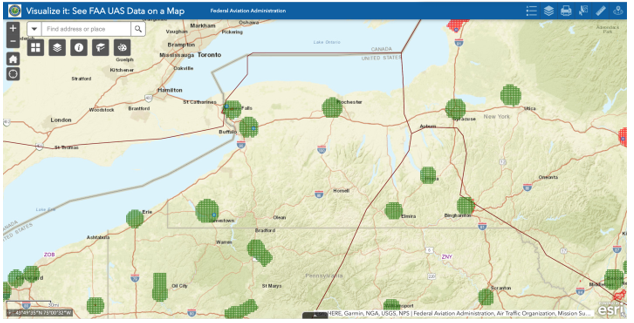
This was so cool, I looked up my part of the state:

Restricted airspace map of Western NY

And now I know where not to fly the drone I don’t own.


Sample License for Use of Drone Pictures

Once you have confirmed that any drone shots your library would like to use are not: the result of or evidence of a crime, taken in forbidden air space,[9] or otter harassment, here is a sample license for securing permission to include them in an online catalog:


IRREVOCABLE, NON-EXCLUSIVE LICENSE

[NAME] ("Photographer"), an individual residing at [ADDRESS], and at least 18 years of age, hereby gives the [NAME LIBRARY] (the "Library") an irrevocable, non-exclusive, transferable license to use an image entitled [TITLE], a copy of which is attached hereto as "A" (the "Image"). The permission to use the Image includes unlimited use in any format now existing or later developed.

Photographer represents and warrants that the Image is their original work and that to the best of their ability to determine the rights of no individual or entity were violated by the creation of the Image.

In consideration of the rights granted herein, Library shall at all times credit Photographer with authorship and ownership of the photo as follows: This image is © [NAME], [YEAR], and is used by the [NAME LIBRARY] with permission from the photographer, who may be reached at [email address].


Signed by Photographer: _________________________.


Signed on behalf of the Library: ___________________________.


A Final Word on Getting "Permission"

This question was pre-packaged to consider issues of permission/legal concern related to images generated via drone, so I have structured it to give primary consideration of those issues.

However, I would be remiss if I didn't stress that when assembling an archive or image collection, worries about permission shouldn't always be a threshold consideration.

Why is that?  If a library or archive crafts the parameters of an image catalog around the purpose of that catalog—around why it is important to gather a certain type of content, within a certain range of criteria—permission might not even be necessary. 

Concerns about permission and legality should not prevent the assembly of a resource that has academic, documentary, or investigative value.[10]  And the more a collection or archive is shaped as a documentary, academic, or investigatory endeavor, the less the subject matter and content can pose legal concerns...or rather, the more protections[11] the project will be able to avail itself of.

Taking advantage of those exemptions starts with having a very clear scope for your project, a written set of ethics, and a statement of purpose for the endeavor. [12]

My takeaway in this final part of the answer?   If your project is of academic, historical, or social value, don't let lack of permission be a roadblock.  Instead, just like the member does in this question, set up a clear scope for your project, and then tackle any reservations head-on.  This will lay the groundwork for a strong archive or catalog.


Posterity will thank you.


[1] Head Photographer at "Drone Shot Weekly?"

[2] Here is the FAA guidance on media use of drones for newsgathering: https://www.faa.gov/about/office_org/headquarters_offices/agc/practice_areas/regulations/interpretations/Data/interps/2015/Williams-AFS-80%20-%20(2015)%20Legal%20Interpretation.pdf [NOTE: This link was confirmed as no longer active and removed on 02/25/2022  as part of the routine review of "Ask the Lawyer" materials.]  It’s interesting: even if using a small drone, such use doesn’t qualify for the “hobby” exception, and the drone should be registered.

[3] Do you need the “right agreement?” See the section of the answer called "Sample Agreement" for an example.

[4] NY Penal Law 250.45

[5] JUST TO BE CLEAR: I have 100% confidence that if a library comes across a creeper nude drone shot, they will not include it in an online catalog!  I am just being thorough.

[6] New York Civil Rights Law Section 50.

[7] Per 50 CFR 18.137: "Unmanned aerial systems or drones must not cause take by harassment of sea otters. Measures for avoidance of take may be required in an LOA, and may include maintaining a minimum altitude and horizontal distance no less than 100 m away from otters, conducting continuous visual monitoring by PSOs, and ceasing activities in response to sea otter behaviors indicating any reaction to drones."

[8] Thank you, THANK YOU to the member who sent this question.  Because of you, I got to read the FAA's guidance to local law enforcement for drone-related incidents, which includes this practical guidance "NOTE: Battery life is typically 20 to 30 minutes." 

[9] By the way, it might not be precisely forbidden for your library to post such images, just as a newspaper or academic publisher might reproduce them for purposes of news or scholarship.  But since those categories come with some higher risks (particularly of being told to cease and desist), it is wise to consider consistency with the purpose and ethics of your archive before including them.

[10] I am not saying to not consider them...just don't let them be project-killers.

[11] Such as fair use, journalism privileges, and recognition of the non-commercial nature of the use.

[12] Links to further "Ask the "Lawyer" content on this specific consideration (ethics as a key component to rock-solid archives) are here: RAQ #172 and RAQ #178.

Archiving images of minors in organizational online collections

Submission Date

Question

Our archive was part of a regional project to initiate, scan, and make available church records from predominantly African American churches within a city. As part of this project, student/graduate assistants went to the particular churches, scanned the historical records as digital files, and provided those files to [our archive] for public access.

My question is in regards to photographs taken of minors and the restrictions for retention and online display. I would not have selected those particular items for retention, but because I was not on-site during the scanning, I have the files as part of the larger record (church programs, organizational records, committees, etc.). We have signed permissions from the church administration for online access and display of their records. In some cases the photographs are from over 20-40 years ago, in some cases they're much more recent. They're taken at private church events, Sunday school classes/activities, and public events--some as part of photo albums and some as individual files.

I'm struggling with how to treat these photographs and any associated records when I know they display minors. Any advice or direction would be greatly appreciated.

Answer

This question is at the vertex of the law and ethics.  What an institution may be positioned to do with archival images legally might not be what our society demands ethically.  And if the issue impacts real people with real feelings, this conflict can lead to legal claims—regardless of solid footing based on precedent and the law.[1]

When it comes to images of children, who can't legally consent to the use of their images, the ethical issues arising from agency, respect, and self-determination are all the more critical.

The member clearly knows this, and is seeking a direction for assessing how to access, catalog, and use them—if at all. The law is often too blunt an instrument to assess ethical questions, but in this case, I believe the legal steps for assessing the use of such such images can provide a framework for the deeper assessment of the ethical considerations[2] .

Below, I will list the "legal" steps an attorney considers when reviewing a museum or archive's acquisition, but focus on the ethical considerations connected to those factors, especially with regard to use of images of children.

1.  Ownership of the Physical Object

This stage is where an institution looks at the provenance of the object and, if that physical object is to be transferred to the institution, addresses the legal priority of making sure the title is "clear."

Ethical considerations: How did the physical object come into existence?  Was the creator a member of the community being documented, an academic, a journalist, or an "outsider?"  Does it appear that parents or guardians were present?  What was the original purpose of the object?  Does any of that information suggest coercion, exploitation, or invasion of privacy?

Or, as the International Council on Archives puts it in Section 7 of their Code:

Archivists...must respect the privacy of individuals who created or are the subjects of records, especially those who had no voice in the use or disposition of the materials.


2.  Ownership of the Copyright

This stage is where an institution looks at the original ownership of the copyright of the image, any transfers of those rights, the use of those rights, if the rights have expired or been transferred to the public domain, and if any of those rights are to be transferred to the institution.

Ethical considerations: Who "owns" the rights to the image?  Are the rights financially valuable?  Have they been put to non-academic, commercial use before, or are they likely to be?  Can your institution accept the rights in a way that limits future commercial exploitation of depicted minors?

Or, as the Society of American Archivists puts it in Section VI of their Code of Ethics:

Archivists may place restrictions on access for the protection of privacy or confidentiality of information in the records.


3.  Manner of Accession

This stage is where an institution looks at the overall package it is acquiring.  In this case, the member has pointed out that the data collection project may have over-stepped some (formal or informal) boundaries.  Other accession challenges can be donor-imposed conditions, environmental factors, and budget concerns.

Or, as the International Council on Archives puts it in Section 2 of their Code of Ethics:

Archivists should appraise records impartially basing their judgment on a thorough knowledge of their institution’s administrative requirements and acquisitions policies.

...and in Section 5 of that same Code:

Archivists negotiating with transferring officials or owners of records should seek fair decisions based on full consideration – when applicable – the following factors: authority to transfer, donate, or sell; financial arrangements and benefits; plans for processing; copyright and conditions of access. Archivists should keep a permanent record documenting accessions, conservation and all archival work done.


4.  Legal Considerations of Content

This stage is where an institution looks for specific concerns caused by the precise content in the materials.  When it comes to pictures of minors, this means assessing if the content is in any way criminal, contains evidence of a crime, if the information suggests they were a ward of the state, if it originated from sealed criminal records, and if the use will in any way be commercial (and thus require permission).

Or, as the Society of American Archives puts it in Section IX of their Code of Ethics:

Archivists must uphold all federal, state, and local laws.


5.  Identity of Person(s) Portrayed

This stage is where an institution looks at the depiction of the real person portrayed in the material and assesses if it poses any additional challenges.

Or, as the Society of American Archives puts it in Section VI of their Code of Ethics:

Archivists strive to promote open and equitable access to their services and the records in their care without discrimination or preferential treatment, and in accordance with legal requirements, cultural sensitivities, and institutional policies.


6.  Alignment with Mission

An archive or museum will always have a mission—or "charitable purpose"—at its core.  This is how it maintains a tax-exempt status, its charter, and its ability to operate.  Does the contemplated use of the content you are focusing on (the images of children) match up with that mission?  Or it is somehow at odds or unaligned with it?

This consideration warrants a repeat of Section 7 of the International Council on Archives Code of Ethics:

Archivists should take care that corporate and personal privacy as well as national security are protected without destroying information, especially in the case of electronic records where updating and erasure are common practice. They must respect the privacy of individuals who created or are the subjects of records, especially those who had no voice in the use or disposition of the materials.


7.  Alignment with Collection Purpose

Just as an archive or museum will always have a mission—or "charitable purpose"—at its core, so will a particular collection have a description that sets out its scope, methods, and purpose.  Does the contemplated use of the content you are focusing on (the images of children) match up with that description?  Or it is somehow extraneous or not quite consistent with it?  If sensitive material is not squarely within the scope of the collection, it shouldn't be there at all.

Or, as the Society of American Archives puts it in Section III of their Code of Ethics:

Archivists should exercise professional judgment in acquiring, appraising, and processing historical materials. They should not allow personal beliefs or perspectives to affect their decisions.


That's great...but what to do?!?

When faced with a sensitive decision like the one posed by the member, a subject-focused analysis based on the above factors is the right way to move ahead, in one of three directions:

  • If there is a decision to accession the materials and facilitate access, a written protocol for handling the sensitivities should be made part of the policies of the collection.
  • If there is a decision to accession but limit access (something archival values generally counsel against) there should be a clear path through the restrictions and a well-documented justification for the limitations.
  • If there is a decision to decline accession, the basis of the decision should be documented in light of the factors impacting the decision.

In this particular case, any of the three above-listed options might be appropriate.  From the brief description provided by the member, it sounds like the photos were joyful documentation of a community by its own members—not exploitive or rooted in dubious practices. 

But even under a "best case scenario"[3] like the one provided by the member, it is appropriate to develop a checklist based on the mission of the institution, and the goals of the collection, to be assured any archival images with minors:

1) will not be subject to commercial exploitation by the institution or a third party accessing the collection (unless there is properly executed permission allowing such use);

2) were not created in a manner inconsistent with the mission, values, and ethics of your institution; or if they were, the collection parameters address those concerns;

3) are included in a manner consistent with the purpose of the collection; and

4) there is a process[4] for any individual or relative to request removal of an image of a depicted minor.  Since such a request would only come after there was a determination that the image was consistent with the values of the institution and fit within the scope of the collection, any evaluation of such a request should be made based on the reasons for the request.


The good news is, the same documentation that shows careful assessment of the ethical factors will help you with any future legal concerns.

And finally, there is one more option for this particular scenario, which is to ask each church to include in their weekly bulletin or routine outreach:

Our church has been selected for inclusion in the ABC institution's online archives. As part of this work, we have provided numerous photos of our events over the years, which include pictures of many of our congregants when they were children. If you have any concerns with your childhood image being included in such a collection, please alert us.  Otherwise, please know that our community records are being preserved for the future!

That way, the church as the original provider of the records can "claw back" any photos that a person might object to, and your archive will have another step in its own records to show it did everything it could to respect people's agency and privacy.

Thank you for a thoughtful question.


[1] A critical example of this issue—use of a person's image in ways that raise question of agency and ethics (to say nothing of basic human decency) is found in the saga of the images of people named Alfred, Fassena, Jem, Renty, Delia, Jack, and Drana, all subjected to enslavement in the 19th century.  The images are commonly called the "Zealey Daguerotypes" and the disputes about them start with how they come into being, as well as how they are used in the present day.  For a good summary of this saga, see https://www.nytimes.com/2020/09/29/books/to-make-their-own-way-in-world-zealy-daguerreotypes.html.

[2] "Established" by recognized authorities, not by me.  My go-to for this will be the Code of Ethics of the Society of American Archivists, found at https://www2.archivists.org/statements/saa-core-values-statement-and-code-of-ethics#code_of_ethics, and the Code of Ethics of the International Council on Archives, found at https://www.ica.org/en/ica-code-ethics.

[3] This "Ask the Lawyer" is only addressing the question about minors...I am not tackling the fact that the rights to the relatively recent photos may be held by still living people, or relatives!

[4] This does not need to be a flagrant "notice and takedown" process; it can be accomplished through a simple statement like: "The ABC Archive [is accredited by/follows the ethics of DEF]; if you are concerned that the depiction of any individual or the inclusion of certain content in this collection is contrary to those ethics, please contact GHI at ### to share your concern."