Public Libraries

School District Public Library Building Permits

Submission Date

Question

We are a school district public library. We own our property. We recently obtained a construction grant and are eager to get our project moving! We have been told we don’t have to get a building permit from our town because we are a school district public library. Is that true? It would be great to not have to worry about a permit.

Answer

Before we dive into this, let’s make one thing very clear: the law in New York State always requires a construction permit! The question is: who issues it?

Confusion on this issue has been caused by “19 NYCRR 1201.2,” the state regulation that specifies which authorities can grant building permits to which types of entities (including schools and libraries).

Most public libraries will fall under sections “(a)” and “(b)” of this regulation. These sections place permitting authority for a private or local government building in the hands of a city, village, town, or county.

However, libraries on property owned by school districts or a regional BOCES will fall under section “(e),” which puts permitting authority for certain projects in the hands of the New York State Education Department (“NYSED”).

The specific wording of the authority given to NYSED is:

(e) The State Education Department shall be accountable for administration and enforcement of the Uniform Code [e.g., issuing building permits] with respect to buildings, premises and equipment in the custody of, or activities related thereto undertaken by, school districts and boards of cooperative educational services [a.k.a. BOCES].

In other words, if the property is owned, leased, or operated by a school district or a BOCES, NYSED will have permitting authority over it. This authority applies to only those libraries that lease property from a school district or a BOCES.

Guidance from NYSED about its permitting process[1] is consistent with this interpretation of the language in section (e).[2]

So, a school district public library needs to work with its municipality for a building permit, unless it is a tenant of a school district or a BOCES.

And now, a note about the library construction process…

Confirming the permitting authority—and who will work with them—is an important first step in the library construction process. When a library designates a person to take point on leading a library construction project, the plan for a positive relationship with the permitting authority should be confirmed early on. If the point person has not done that type of work before, another person[3] with that experience (hopefully with the same permitting authority) should help lead the team.

Thank you for an important question!


[2] Not that it requires much interpretation. As regulations go, this is a model of clarity.

[3] Architect, lawyer, contractor, “owner’s rep,” consultant, board member… it can be anyone, so long as they have the real-world experience.

Is a Public Library Responsible for Patron Conduct Outside the Library?

Submission Date

Question

Our public library has been told by patrons that another patron is following up on interactions at the library, including at the circulation desk, by showing up at the reporting patrons’ homes. Such behavior, if harassing, is against our Code of Conduct. Does our library risk legal liability for this?

Answer

I am sure many a wonderful friendship has been launched at a public library, but for this question, we’ll assume that each of the reported incidents were unwelcome.[1]

To best address this matter and limit liability, the unwelcome nature of the behavior—and the Library’s response—should be documented every step of the way.

For example, the initial report of the first instance can be: Patron A reported that Patron B arrived at their house at ADDRESS on DATE/TIME uninvited to follow up on a conversation at the library on DATE/TIME. Patron A does not welcome this conduct and would like it to not recur.

Because the interaction started at the Library and was related to library services, it is appropriate to respond to this as a Code of Conduct matter, and document it as such.

The follow-up with the offending patron could then be:

Dear Patron B,

The library has received a complaint that on DATE, you sought to continue a conversation at the circulation desk of the library by arriving uninvited at another patron’s home.

If you were invited or did not visit at all, please send us a written response confirming that.

Otherwise: a copy of the Library’s Code of Conduct accompanies this letter. Please take care to not continue Library service interactions in a manner that is not welcome by that person, as it could be considered a violation of the Code.

NAME, you are a valued patron at the library, and we trust this will not be an ongoing concern.

Sincerely,

Library Director

The letter can be reviewed in person with the offending patron or sent by mail or email; that is at the discretion of the Director. The important things are accuracy and timeliness.[2]

It is also important to double-back to the impacted patron and let the know the matter has been addressed. Sample text for that is:

Dear Patron A,

Thank you for sharing your concern about an uninvited visit at your residence by a fellow library patron following an interaction at the library. Please know that the Library has alerted the other patron that such behavior is not consistent with the library’s Code of Conduct. In the event further concerns occur, please let me know immediately.

Sincerely,

Library Director

When a library director has to address this type of thing, they should be aware that such behavior can have many motivations. Some motivations may be malevolent, but others may be worthy of compassion, including loneliness or uncertainty about social boundaries. When it comes to documenting and handling the report, however, the motivation is irrelevant; the goal is to outline the behavior, the rule it violates, and explain the consequences for recurrence.

This type of documentation serves multiple purposes in the legal world.

First, it unambiguously documents the date and time of the occurrence and a key element: that the visit was unwelcome.

Second, that clarity enables a clear articulation of the rules and possible consequences.

Third, it documents that the library has done all it is empowered to do to address this situation. After all, a public library is not law enforcement; it can enforce its own Code of Conduct but cannot police the external activities of others. In fact, a library that tells patrons not to go to places outside the library, at the risk of losing library access, may be violating the First Amendment. Quite the legal tightrope for a library director to walk![3]

Having outlined all this, I will now answer the member’s actual question:

Our question is if the Library would hold any responsibility or liability if anything were to happen based on a conversation that happened at the library but the actions of follow through occurred off library property?

The answer to that will almost always be “No.” Exceptions are:

  • If the library provided the personal information that enabled the visit;[4]
  • If the victim was an employee;[5] or
  • If the activity is part of a larger issue currently under investigation by law enforcement (stalking, harassment, domestic violence, protective order in place, etc.).

When the above legal aspects are involved, a public library is wise to timely consult an attorney to document and determine next steps.

Other than the legal risks, the other big risk in this matter would be reputational: if an incident occurred, the subsequent investigation found out that there had been multiple reported concerns (as is posed by the question), and the library had done nothing, it could negatively affect how the library is regarded by the community.

But again, a public library is not law enforcement; other than barring access to the library, it has limited ability to punish or prevent crime.[6]

So, with all that, the big takeaways for this question are: 

  • All patron complaints related to safety and access should be documented;
  • All incidents relating to safety or access should be addressed so the library is positioned to restrict the access of the offender;
  • Any person facing loss of library access due to a Code of Conduct violation should receive a written notice and a chance to refute the accusation;
  • When legal liability or a risk to safety is involved, it is wise for a library director and/or board bring in back-up.

When a director meets with such a person (who might not have quite the same view of the world as the director), it is wise to have a person there as a notetaker and for safety.

Thank you for an important question.


[1] I don’t mean to imply that showing up at someone’s house uninvited is ever a gateway to friendship. Don’t do that! It’s a bad idea.

[2] Depending on the exact circumstances, an immediate bar may also need to be enacted, rather than just a “written warning.”

[3] But just another day in the life.

[4] I flinched just typing this. I know a librarian would not release information that way!

[5] Library workers being stalked/harassed is why every public library should have a Workplace Violence Prevention Plan. For more on that, see

[6] It’s a bit different when the library is the victim, but this answer doesn’t address that.

Library cards for minors

Submission Date

Question

I’m assuming the age requirement for youth cards varies widely even among NYS libraries, but what are the key determining legal factors which inform how libraries settle on an age range for this policy? I can think of three factors, and libraries likely conflate all of them together. I’d like to extrapolate the real legal concerns so that I can more clearly determine our own library’s circulation policies regarding permission for youth cards.

1. Is the signature to allow for “parent permission” to access the library? Are public libraries legally obligated to obtain parent permission before a child of a certain age accesses library materials or services? I’m assuming that the library would not be liable if, for example, staff allowed an 11-year-old without a library card to read any book they liked within the walls of the library. Does this apply to a child of any age? (I realize unaccompanied minors will eventually come into play). So, by extension, is granting an 11-year-old a library card without parent consent legally permissible?

2. Is the signature an acknowledgement of responsibility for the library materials on behalf of the child? Many library card applications prompt for this specifically, but according to NYS law, is a parent/guardian responsible for library materials checked out to a minor in their care regardless? (If a 15-year-old minor lost library materials or incurred fines or fees, would their parents still be legally responsible even without giving permission for the card?)

3. COPPA and the collection of PII (for online library card signup). Though not required as a non-profit, our library chooses to comply with this policy, requiring parent/guardian consent of online card signup for children 12 and under. Does this mean that a child aged 11 could still, within legal boundaries, apply for a library card in person without collecting consent?

Answer

When advising on a policy or set of terms for a library or library system to adopt for children’s library cards, I ask for the following information:

  • What are the key objectives of offering a child their own card at your library or library system?
  • Does your library need to enforce fines and/or replacement fees?
  • Is there anything accessible via an “adult” card that your library would not offer access to via a “youth” card?
  • How does your library like to work with parents and guardians?
  • Does the card enable more than borrowing materials from the library? (Is it used for computer access, printing, maker space, etc.?)

I ask these questions because in New York State, children can’t enter enforceable contracts, which makes it hard to collect fines and fees. In addition, a lot of the tomfoolery that can lead to a kid losing library privileges can be more easily addressed if the library is in a position to contact that kid’s parent or guardian, but since library records are confidential, the only way to share the information is with informed consent.

“Informed consent” means that when a person signs up for a card, they are informed of the terms (like their parent being a co-signer who is responsible for their replacement fees), and they expressly consent to them.[1]

With that all out there, let’s tackle the member’s questions, starting with the practice of requiring parents/guardians to sign their child’s agreement for a library card.

QUESTION: Is the signature to allow for “parent permission” to access the library?

ANSWER: No, unless the library’s policy[2] sets things up this way. There is no default federal or state law that expressly denies minors access to a NYSED-registered public library.

QUESTION: Are public libraries legally obligated to obtain parent permission before a child of a certain age accesses library materials or services?

ANSWER: There is no default federal or state law that expressly denies public library access to minors.

CAVEAT: Local laws are often oddly specific (and outdated, and unconstitutional) on things like this, so it is possible a local law could require parental consent to get a library card. Whether such a local law would stand up to a legal test is another matter.[3]

QUESTION: I’m assuming that the library would not be liable if, for example, staff allowed an 11-year-old without a library card to read any book they liked within the walls of the library?

ANSWER: “Liability” is a broad word; it covers both criminal and civil (including financial) liability. But if a library is providing an eleven-year-old with access to library materials that were acquired, cataloged, and accessed per library policy, your assumption is correct: there should be no liability.

QUESTION: Does this apply to a child of any age? (I realize unaccompanied minors will eventually come into play).

ANSWER: Yes, regardless of age, there should be no liability for providing access as allowed by the Education Law and library policy.

That said, the younger the child, the more the law will expect that library policy is being used to not create an active hazard. But as the question alludes to, there is a difference between toddlers running amok in the Rare Books room creating physical havoc and a child of any age accessing a print or online copy of American Lion (a Pulitzer Prize-winning book that discusses genocide, slavery, and violence, because it is about the presidency of Andrew Jackson)[4]. One is a physical hazard and a property risk; the other is a simple exercise of the right to read.

QUESTION: So, by extension, is granting an 11-year-old a library card without parent consent legally permissible?

ANSWER: I wouldn’t say “by extension” because that implies an argument needs to be made to provide library privileges to minors. There is NO requirement for parent/guardian consent for a library card unless the library has included it in their own policy (or an oddball local law requires it, which should probably be challenged).

QUESTION: Is the signature [of a parent] an acknowledgement of responsibility for the library materials on behalf of the child?

ANSWER: In and of itself, the signature is simply proof that the adult signing the card agreement accepts whatever terms are in the agreement. So, as reviewed above, if the library or library system issuing the card has made an adult’s acknowledgement of their responsibility a conditions of their child getting a card, then yes.

Along with that accountability, the signature of the parent, along with the informed consent of the child, can be used to put in place things like:

  • Sharing a child’s library records with a parent (being able to answer the question “What books does my kid have out? I have to help him return them.”)
  • Sharing a child’s fine/replacement fee information with a guardian (being able to answer the question “My granddaughter shoveled the walk yesterday so I would pay for the book she lost. How much is it?”)
  • Disclosing and discussing loss of privileges/access (being able to say “As you know, your child doesn’t have computer privileges right now, because he put gum in the all the ports. We look forward to him being back at the keyboard in six months.”)

Many library card applications prompt for this specifically, but according to NYS law, is a parent/guardian responsible for library materials checked out to a minor in their care regardless?

ANSWER: No, except for in cases of extreme intentional damage, where General Obligations Law 3-112 might create that civil (not criminal) liability.[5]

That said, there could be a rogue local law out there. New York is a big place with many odd local laws on the books.

QUESTION: If a 15-year-old minor lost library materials or incurred fines or fees, would their parents still be legally responsible even without giving permission for the card?

ANSWER: No (and not even if they gave permission for the card, unless they also took accountability for fees); the sole exception to that is if the money was due to damage so extreme that a claim could be made under General Obligations Law 3-112.

QUESTION: COPPA and the collection of PII (for online library card signup). Though not required as a non-profit, our library chooses to comply with this policy, requiring parent/guardian consent of online card signup for children 12 and under. Does this mean that a child aged 11 could still, within legal boundaries, apply for a library card in person without collecting consent?

GRATUITOUS COMMENT: In general, public libraries should avoid complying with laws that they don’t have to comply with. COPPA was adopted to protect minors from predatory online commercial behavior; libraries have a completely different (and more rigorous) set of ethics and laws to guard against that concern. That said, it is essential for a library to require and confirm that any commercial vendor or affiliate being used to provide library services is following COPPA.

AND WITH THAT OUT OF THE WAY, HERE IS THE ANSWER: In New York, there is no law barring any person of any age from getting a library card. This means:

  1. anyone from 0 to “whatever” can get a library card; and
  2. no one can tell them “no” (except on a neutral and rational policy basis, like, “We only give cards to people who live in or work in Buffalo,” or, “We require card holders to be able to be held accountable for fines and fees.”).

That being said, libraries that want to impose conditions on youth and require the agreement of a parent/guardian can do so; the trick is to make sure the reason for the adult’s signature, the conditions it imposes on them, and the rights of the youth involved all line up.

Here are just a few examples of how that can be done:

  • Issuing a “Simple Borrowing Card” that enables borrowing at any age, but due to lack of informed consent and no parent/guardian signature of minors, and perhaps lack of additional information (like address), can’t enable certain things (record sharing, fees, fines). For that reason, borrowing privileges might be limited by number of items, to e-resources, or temporary access.
  • Issuing a “Full Privileges Card” that enables full range of privileges for adults or youth, but for those under 18 (and thus harder to hold to account), only given with the cardholder’s informed consent and parent/guardian’s acceptance of fiscal responsibility. Could be set up so the accountability accepted by the co-signing adult disappears at 18.
  • Issuing a “Supported Borrowing Card” that enables full library privileges but, with informed consent of the cardholder, one or more supportive adults agree to help out with managing returns and other responsibilities that require access to confidential library records. This option could be helpful for cardholders who are bad at returning items,[6] adults who may need extra help for any reason, and youth at libraries that don’t need to have an adult on the hook for fines/fees.

Closing thoughts

This topic elicits much passion and strong feelings from many perspectives.

Many parents, of course, want to be engaged in their child’s selection of media, and being a required part of the library card process is one way for them to play that role. Some libraries might choose to encourage this engagement through policy, while other libraries might simply facilitate it as a by-product of requiring a responsible adult on the card to address concerns related to behavior and borrowing.

At the other end of things, children have a right to read and see the world that by nature is beyond the scope of what many parents/guardians envision, while libraries have an obligation to not discriminate on the basis of age when it comes to library access.[7] So while conditions that enable parental engagement can be imposed and parental engagement can be encouraged, such conditions should never do so in a way that unduly burdens library access.[8]

It is a balancing act, but by having clear reasons for requiring parent/guardian signatures and asking for no more than what is required for those reasons is key.

Thank you for a powerful array of questions.


[1] I know I just said people under 18 (in the law, “infants”) cannot sign enforceable contracts. That is broadly true, but informed consent is not about enforcement. It is about making sure someone is aware of their rights, before they consent to sign them away.

[2] Or a weird local law. Always check the local laws!

[3] It would not, so nobody get any bright ideas.

[4] My current reading.

[5] New York’s General Obligations Law 3-112 imposes financial liability on parents and guardians “for damages caused by such infant, where such infant has willfully, maliciously, or unlawfully damaged, defaced or destroyed such public or private property, whether real or personal…” This is also the law that can hold parents responsible for the costs arising from bomb threats made by their kids. Parenting is a risky business.

[6] Right now my 10-year-old is my “library buddy” who makes sure I return my books on time (ish).

[7] Although they can impose reasonable conditions.

[8] Parents and guardians, of course, can limit library access all they want, but the library shouldn’t facilitate that.

Use of library space for private clubs

Submission Date

Question

The board of trustees of a public school district library owns the library building. A private club occupies the entire second floor. The private club has traditionally not paid any rent or utilities, nor has it contributed to the upkeep of the building in any way.

The library, through a public vote of the school district, covers all of the costs of the building. Could the library be in danger of mismanagement of funds or losing its charter?

Answer

What an interesting set-up! If I started a private club,[1] I would totally want it over a library. Or a museum. Either way, very cool.

While cool, the operation of my private club over a school district public library would not be without concerns, because all non-association libraries have to abide by a bar on inurement[2] (which applies to all “charitable” organizations) and Article VIII Section 1 of the New York State Constitution,[3] which bars use of public assets for private use.[4]

That means that my private club could not pay less than fair market value for occupancy, except under some very particular circumstances:

  1. A person deeded the property to the library on the condition that my private club has a permanent right to use it.
  2. The library has arranged an in-kind exchange that is demonstrably worth what it would otherwise have to charge for rent and utilities. For instance, if my private club provides lawn maintenance, etc. roughly equal to the fair market value of the rent.[5]
  3. If the occupancy creates a library mission-related benefit to the public, such as the club running an ESL program or free computer skills clinic during library hours in the space, and the arrangement is confirmed with an agreement.[6] In that type of example, it helps if the private club is also a type of charity.[7]

In the absence of those factors, there is a strong chance the arrangement could run afoul of the law. But would it, as the member asks, create a danger of the library being regarded as mismanaging funds, or of losing its charter from the New York State Education Department (NYSED)?

That answer would depend on several factors, but I can say this: no attorney for the library, once learning of this, without one of the above-listed reasons to justify the arrangement, would feel comfortable saying (much less putting in writing), “Oh, sure, keep the club upstairs! No harm, no foul.”

Instead, the attorney would be nervous because while the threat of charter revocation would be remote (there are usually warnings and time to correct the situation before a charter is revoked by NYSED[8]), these items are of immediate concern:

  1. Violation of bar on inurement (which could be called “financial mismanagement,” among other things).
  2. Violation of the State Constitution’s bar on use of public property for private purposes without payment of fair market value (which could also be called “financial mismanagement,” among other things).
  3. Risk of denial of insurance coverage if tenant causes fire or other property damage.
  4. Risk of denial of insurance coverage if tenant member causes personal injury.
  5. Possible zoning issue.[9]

A willful failure to resolve the above-listed problems, if not remedied, could eventually lead to the type of trouble that could jeopardize a charter.[10]

So, what would I do with a situation like this? It is clear that the matter calls for some homework; if there is any reason that justifies the occupancy, there is still a strong motivation to ensure that the proper insurance coverage and indemnification arrangements are in place. At the same time, there is a “human factor;” if the club has been there forever, and everyone is cool with it (even though it’s not legally cool), making things right without causing a fracas will take research, careful planning, and diplomacy.

The most likely resolution to the research, planning, and diplomacy process would be a lease agreement.

Thank you for a great question!


[1] The dress code in my private club would involve wearing all natural fabrics, and we would be united by a commitment to making the world a better place through gardening and the martial arts (“Spardening”).

[2] Legalese for benefits to an individual or entity other than the not-for-profit, as barred by both the Not-for-Profit Corporation Law and the IRS.

[4] To be clear: association libraries can’t violate the bar on inurement either, but they don’t have to lose sleep over Article VIII.

[5] Not an arrangement to wing; it should be reviewed by lawyers and accountants, so it is well-documented as being in-kind.

[6] See footnote #3.

[7] In New York State, there are many kinds of charities; not all of them are not-for-profit corporations.

[8] Hi NYSED! We know you are tough but fair.

[9] I know this seems like I’m reaching, but trust me, zoning has ruined many a cozy real estate relationship.

[10] I don’t know if NYSED would care about the zoning part. But lots of other entities with power could.

Checking Materials Out to Children Without Parent's Permission

Submission Date

Question

Our library is trying to set some parameters around what we require from a patron in order to check out library materials to them. For adults and teens, this is straightforward: we require they have their library card or a form of identification. We are struggling to find a procedure that works for children when they visit the library without a library card, accompanied by someone who is not their parent or legal guardian. This includes kids who visit the library on field trips or with their daycare, or who come with a friend or extended family member.

We want to have a procedure that balances the rights of minors to read freely, with protection for our library against claims that we have checked out materials to children that the parent/guardian believes to be inappropriate.

Some details about our library's policies:
1. We are a public library and do not restrict borrowing privileges by age group. A card holder is permitted to check out anything in the library, regardless of their age.
2. When a child (birth - age 11) gets a library card, their parent or legal guardian must fill out and sign an application that states: “My child has permission to have a library card. I understand that all library collections, including adult material and internet access, are available to children. I accept responsibility for my child's use of the library and any loss incurred.” This application is retained until the cardholder becomes an adult.[1]

We are not primarily concerned with the financial contract between the library and the parent/guardian, but with the potential fallout if a parent were to become angry that their child was permitted to check something out without their library card. If the card is present — say Dad gave it to Grandma when she offered to bring the kids to the library — we feel somewhat assured by having the parent's signature from the original card application. When the card is NOT present, though, we worry that we're opening ourselves up to problems.

We do have a compassionate/creative internal library card that we occasionally use to check out items to folks when our library's policies (e.g. Requiring a card/ID be present) are interfering with the library's ability to fulfill its mission (e.g. Teen has a book report that's due tomorrow and they didn't bring their wallet). We're concerned that if we used that mechanism to check something out to a younger child whose parent is not with them, we could be accused of using our Public Library Agenda to thwart parents' rights. 

Are we overthinking this?


[1] Small quibble: Per a law that applies to all public libraries (but not to association libraries) the application should be retained for “3 years after card expires or is inactive.”  So, for children who then get an “adult” card at 18, it should be retained until they are 21.  See this requirement in item 595 of the LGS-1 at https://www.archives.nysed.gov/sites/archives/files/lgs-1-2022.pdf.

Answer

First, I'll answer the easy question: No, you are not overthinking this.

For children fortunate enough to be brought to the public library at a young age, the experience is life-altering. They grow as readers and thinkers. They see themselves as part of a community that shares resources. They start to absorb the values of privacy and information access.

All of this is imbued by the library providing and applying the factors listed in the question: the card policy, the rules around borrowing, and how the child's parents and guardians are brought into the mix.

Which brings us to the crux of the member's question:

We want to have a procedure that balances the rights of minors to read freely, with protection for our library against claims that we have checked out materials to children that the parent/guardian believes to be inappropriate.

In New York, the procedure to ensure the library is protected is simple in one way and complex in another.

It is simple because the recipe for the protection referenced is already in the law.

Just like the chemical formula for one of the molecules in lavender[1] is this:

A chemical structure of lavandulol

Description automatically generated

The “formula” for a library to be protected against an assertion that a minor checked out inappropriate material is:

Of course, this is the protection from claims of criminal liability, and as we have seen, claims of criminal liability aren't the only things libraries and library workers need protection from.

So, let's re-examine the question with the idea that “protection” means from coercive tactics and civil liability,[2] not criminal prosecution.

We want to have a procedure that balances the rights of minors to read freely, with protection for our library against claims that we have checked out materials to children that the parent/guardian believes to be inappropriate.

Other than the practices described in the question (parental acknowledgement at the time a card is obtained, confirmation of age), the tactics to do this are far more complex.

How complex? Well, to go back to the chemistry analogy, the above image was for just one molecule. Here is a full suite of molecules in the essential oils of L. angustifolia (lavender): 

A group of chemical formulas

Description automatically generated

As case law shows, the best protection is a complex array of library practices, all working in alignment to create a beautiful whole.

What is that array?

In short, libraries: keep on doing what you do.

That said, if there is one thing to emphasize that could help guard against negative impacts from a parent displeased with a child's library choice, it would be to add to adjust the language in the parental sign-off from this:

“My child has permission to have a library card. I understand that all library collections, including adult material and internet access, are available to children. I accept responsibility for my child's use of the library and any loss incurred.” This application is retained until the cardholder becomes an adult.

To this:

  1. I acknowledge that my child has applied for a library card and will be responsible for following the conditions of that card, including the Library Code of Conduct and Library User Bill of Rights.
  2. I understand that materials and internet access at the library are not restricted by age, and that my child must be accompanied by a responsible adult while in the library until age 13.[3]
  3. I appreciate that if I have any questions or concerns about my child's use of library services, I can contact [ADDRESS] to discuss them confidentially.
  4. [IF NEEDED] I agree to pay all costs incurred by my child due to loss or damage of borrowed materials.

This change in language can do a few things. First, it changes parent/guardian “permission” to get a library card to “acknowledgement” that the child has agency to apply for access; this subtly (or not-so-subtly) removes the implication that a parent must consent for a child to get a library card.[4]

Second, it links the acknowledgement of collection/internet access to the Code of Conduct and the “unaccompanied minors” policy.

Third, by emphasizing how to address concerns, it provides a gateway for concerns to be brought forward in a proactive way.

And finally, if it is a concern, it puts the parent/guardian on the hook for damage fees.

To bring this all home: why is all of this so important?

First, the answer is: this stuff has always been important.

But second: this answer is being written in October 2024. As I write, the wave of coordinated efforts to limit access to library content continues, and children having access to that content is often cited as a motivation for those efforts.[5] While threats of criminal prosecution have been made, the more common tactics are intimidation[6] and threats to curtail funding. Any adjustment a library can make to reduce the chilling effect of those tactics is worth considering.

Thank you for a great question.


[1] I harvested my lavender the day before I wrote this. To get this chemical formula, I checked out the NIH article here: https://www.ncbi.nlm.nih.gov/pmc/articles/PMC8465323/. I learned what my nose had already been telling me: the different varieties in my garden have wildly different ratios of the compounds that make lavender smell so good. 

[2] “Personal injury” in this context would be a claim that the child was injured in some way by exposure to the content; to date, I have found no such claims in case law, but I could see a splashy lawyer trying to make this argument.

[3] Or whatever age is set by the library's “unaccompanied minors” policy.

[4] The question of requiring parental consent to get a library card is a whole other field of lavender.

[5] How much people are “thinking of the children” vs. “trying to control the culture” is not within the scope of this answer, but if you want to take a walk on a sunny day and discuss it, we could put in quite a few miles.

[6] “Intimidation” is a catch-all phrase here for: defamation, harassment, property destruction, retaliation, and service disruption, as well as legal forms of protest (an angry letter to the local paper, a peaceful demonstration, a letter-writing campaign that doesn't defame/threaten).

Publishing a library's budget

Submission Date

Question

Could you please provide the effective date of 8 CRR-NY 90.2?

Are all public libraries required to publish their budgets online on their websites?

Answer

For readers that don’t see Education Department regulations as subtitles to the movie of your life,[1] these questions pertain to the state regulations governing public libraries, which have changed significantly in recent years.

For context, here is the full legal citation hierarchy we are in:

New York Codes, Rules and Regulations

TITLE 8

EDUCATION DEPARTMENT

CHAPTER II. REGULATIONS OF THE COMMISSIONER

SUBCHAPTER D. LIBRARIES

PART 90. PUBLIC AND FREE ASSOCIATION LIBRARIES

§ 90.2 Standards for registration of public, free association and Indian libraries[2]

That’s a deep bowl of citation soup! To avoid having to list it all, it generally gets shortened (as the member has done) to “8 NY-CRR 90.2.” But since “8 NY-CRR 90.2” sounds a bit like a Star Wars droid name, for this answer, let’s go with the “90.2 Requirements.”

This question about the 90.2 Requirements is understandable. Generally, the effective date of a regulation is pretty straightforward, but this one is a tad complex, because while current revision went into effect August 1, 2018,[3] it delayed its effective date as follows:

Any public, free association or Indian library that was registered by the department on or before December 31, 2020, shall meet the following registration requirements by January 1, 2021 to continue to be registered by the department… [emphasis added]

In other words, if you were an existing registered library as of August 1, 2018, you had 2 years and 4 months’ warning to bring things up to snuff; if you were a new library after January 1, 2021, you obtained your original registration under these standards.

This delay provided a chance for existing libraries to budget and plan for meeting the new standards, which was helpful, because as stated above, the 2018 amendment added quite a few requirements.[4]

So, to answer the first question: In legal parlance, the current version was “effective” on August 1, 2018 (the date of the amendment) but went into effect on January 1, 2021.

Which brings us to the next question: Are all public libraries required to publish their budgets online on their websites?

Because this question came linked with the question about the 90.2 Requirements, I believe it is inspired by this new[5] requirement:

(5) annually prepares and publishes a board-approved, written budget, which enables the library to address the community's needs, as outlined in the library's long-range plan of service; [emphasis added]

This use of “publish” is not a defined term,[6] so the mode of publication is not set by the 90.2 Requirements. However, due to the requirement that all registered libraries must conduct their meetings per the Open Meetings Law,[7] the budget likely should be part of a posted board packet.[8]

So, the answer to the second question is: Unless your library has no website, there is a risk of non-compliance with the Open Meetings Law if the budget is not at least posted online 24 hours before the meeting where the board first considers it. After that, how the library chooses to further “publish” it[9] as required by 90.2 is up to the library.

A small plea for accessibility: No matter what form the publication required by the 90.2 Requirements takes, it is wise to ensure it can be converted to large print, Braille, or audio file, for accessibility.

Thank you for two very thoughtful questions!


[1] If at some point you didn’t go to sleep muttering “minimum standards,” “direct access,” or “trustee training,” this means you.

[2] I have been wading in these regs for so long, this is like reading a recipe, but I remember my first law class, when I saw that little wiggly sigil (it means “section”) and wondered if I should go back to studying Russian history.

[3] State Education Department’s memo on the 2018 amendment is here:

https://www.regents.nysed.gov/sites/regents/files/318ced1.pdf.

[4] This change is actually easy to see, because Section 90.2 still lists the “old” standards (in part “a”), and the “new” (in part “b”). Just do a search for “8 NYCRR 90.2” and you’ll see it.

[5] Newish? I am writing this in December, 2024. These regulations no longer have fresh new car smell.

[6] There are all sorts of publication requirements and definitions in state law and regulations. This use doesn’t synch up with any of them.

[7] See Education Law § 260-a.

[8] The Open Meetings Law requires that if an agency has “a regularly and routinely updated website and utilizes a high speed internet connection, such records shall be posted on the website to the extent practicable at least twenty-four hours prior to the meeting.” [OML § 103(e)].

[9] Aside from hard copy, it would be cool to see a budget as a poster, or a Lego tower (remove a brick when you have to cut an item), or a tapestry.

Hiring Interviews and Accommodations

Submission Date

Question

If a prospective employer specifically asks about a candidate’s physical capacity to do a job and they say they can do all of the tasks required, and then notify us afterwards that they need accommodations for things they said they could do without them, are we:

a) by law required to provide them 

OR

b) can we make a decision that the person is not able to do the essential functions of the job and therefore not be allowed to continue in their employment?

Dishonesty in applying for jobs seems grounds for termination, but when it comes to disabilities, I realize it’s a minefield.

Answer

A minefield, indeed.[1]

The first issue in this question is the premise: “If a prospective employer specifically asks about a candidate’s physical capacity to do a job and they say they can do all of the tasks required…”

When interviewing a job applicant, it is perfectly appropriate to ask if they are able to perform the essential functions of the job. Acceptable questions are:

  • Can you type 90 words per minute?
  • Can you weld for an 8-hour workday?
  • Can you read out loud to kids for an hour at a time, even if they interrupt you because they need to use the bathroom?

However, it is important to remember that the answer can honestly be “yes,” whether or not an accommodation is required to be able to perform the task.

In other words, the answer can honestly be “yes”, even if:

  • The typist needs a special keyboard due to carpal tunnel syndrome;
  • The welder needs a special back brace;
  • The reader needs a hearing aid, so they can hear questions from the attendees.

Of course, in the scenario sent in by the member, things are not that simple, since the applicant’s honesty is being questioned (“… they need accommodations for things they said they could do without…”).

Before addressing possible dishonesty, a critical consideration is: how did the applicant happen to say they didn’t need an accommodation? Did the applicant simply say that they can do the tasks (which as we reviewed above is fine, even if they now need an accommodation), or did the employer ask if the applicant needed an accommodation?

If the employer specifically asked, that is where we enter the minefield[2], because there are very limited circumstances where an employer can ask if accommodations are needed.

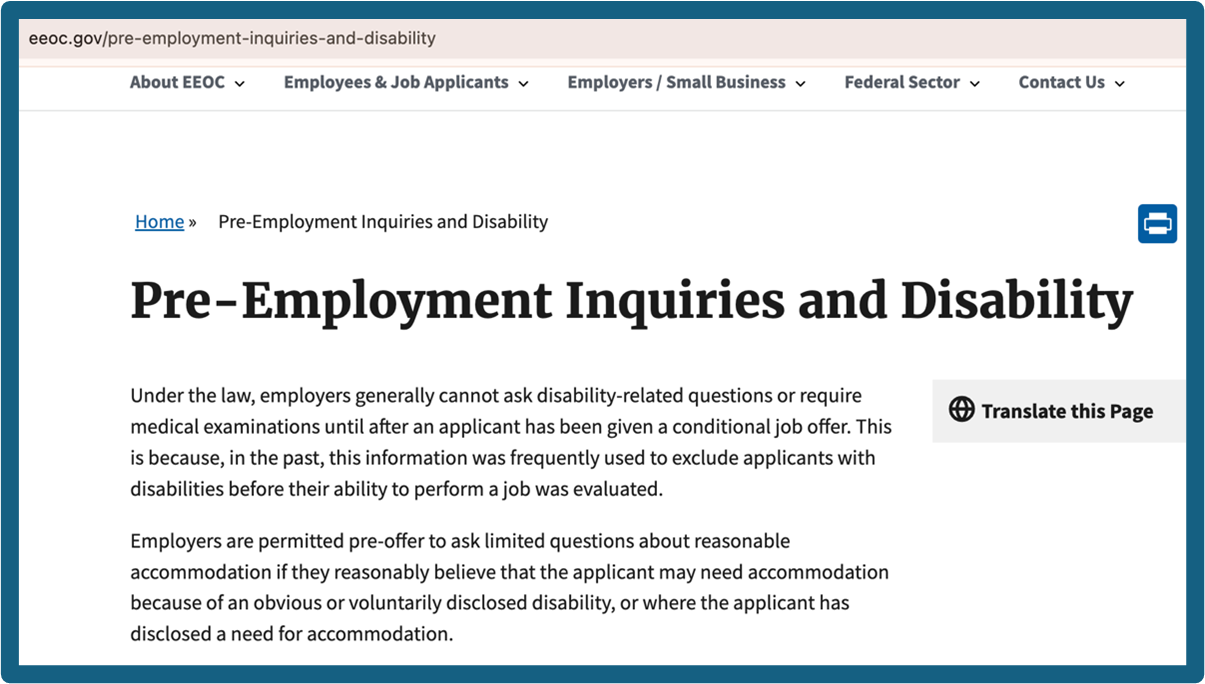
Because this is so high-risk, I am simply going to put a screenshot of the Equal Employment Opportunity Commission’s (EEOC) guidance here:

Screenshot of EEOC.gov page titled Pre-Employment Inquiries and Disability. Text reads Under the law, employers generally cannot ask disability-related questions or require medical examinations until after an applicant has been given a conditional job offer. This is because, in the past, this information was frequently used to exclude applicants with disabilities before their ability to perform a job was evaluated.  Employers are permitted pre-offer to ask limited questions about reasonable accommodation if they reasonably believe that the applicant may need accommodation because of an obvious or voluntarily disclosed disability, or where the applicant has disclosed a need for accommodation.

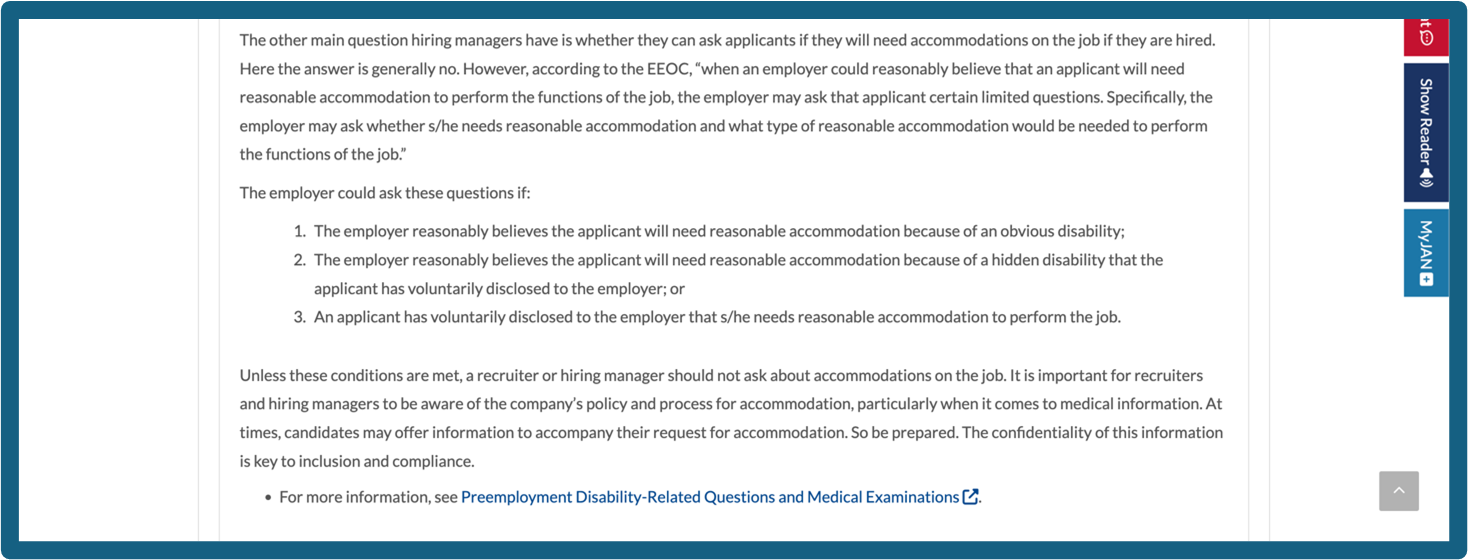
The “Job Accommodation Network,” at AskJAN.org, provides additional guidance on this limited ability to ask applicants about the need for accommodations:

Screenshot from AskJAN.org page titled The JAN Workplace Accommodation Toolkit. Text reads The other main question hiring managers have is whether they can ask applicants if they will need accommodations on the job if they are hired. Here the answer is generally no. However, according to the EEOC, “when an employer could reasonably believe that an applicant will need reasonable accommodation to perform the functions of the job, the employer may ask that applicant certain limited questions. Specifically, the employer may ask whether s/he needs reasonable accommodation and what type of reasonable accommodation would be needed to perform the functions of the job.”  The employer could ask these questions if:      The employer reasonably believes the applicant will need reasonable accommodation because of an obvious disability;     The employer reasonably believes the applicant will need reasonable accommodation because of a hidden disability that the applicant has voluntarily disclosed to the employer; or     An applicant has voluntarily disclosed to the employer that s/he needs reasonable accommodation to perform the job.  Unless these conditions are met, a recruiter or hiring manager should not ask about accommodations on the job. It is important for recruiters and hiring managers to be aware of the company’s policy and process for accommodation, particularly when it comes to medical information. At times, candidates may offer information to accompany their request for accommodation. So be prepared. The confidentiality of this information is key to inclusion and compliance.      For more information, see Preemployment Disability-Related Questions and Medical Examinations Opens in new window..

Why are these excerpts from the EEOC and AskJAN relevant? The only way the issue of accommodations could have been brought up by the employer is if the applicant had an “obvious” disability (two legs in a cast), or the applicant voluntarily disclosed a disability before/during the interview.

After that, if the employee was flat-out dishonest, that is indeed a grave concern.

That said, it is important to remember that disability is not static. A person may need mobility assistance one day and not need it another. A person may be able to hear in certain circumstances and not in others. A person may have low-pain days and high-pain days where they are more easily fatigued. The point of the Americans with Disabilities Act[3] and the New York State Human Rights Law[4] is that people get to work so long as an accommodation can enable them to perform from day-to-day.

The final part of the question is: if the need for an accommodation was not disclosed during the interview, is the employer now “by law required to provide them?”

If the requested accommodation is “reasonable” (which changes from employer to employer[5]), the employer is required to provide the accommodation. This is true even if the employer also has to address the impact of documented dishonesty during a job interview.

This is because dishonesty during a job interview and requesting a disability accommodation occupy two separate legal buckets.

Bucket 1: Dishonesty during a job interview

Dishonesty during an interview would not bar an employee from later getting an accommodation they are entitled to, but it could be a reason to terminate employment. It must be evaluated using the employer’s policy on employee honesty and corrective action.

Bucket 2: A request for disability accommodation

A request for a disability accommodation (even after previously saying one is not needed), simply needs to be addressed as a request for an accommodation. It must be evaluated using the employer’s disability accommodation policy.

The final take-away: if an employer is facing a situation like this scenario, and especially if they were to consider termination the basis of applicant dishonesty, it is wise to work with an HR professional or lawyer to address the situation. That process would start with determining if there was an improper inquiry during the interview, and if there was, if any dishonesty was serious enough to merit a warning or termination.

While that evaluation was pending, accommodations should be provided if they are reasonable.

Thank you for any important question.


[1]I have recently been trying to get away from war metaphors when discussing law. Sports and the arts are helping; “battle plan” is now “playbook,” and “crush your enemies” is sometimes “out-sing the competition.” But since the law is adversarial, it’s a tough fight ongoing rehearsal.

[2] The croquet lawn? The Eugene O’Neill play? “Minefield” is a tough one to replace with a sports or arts analogy.

[3] The ADA applies to employers with over 15 employees and to all government employers.

[4] The Human Rights Law, which bars employment discrimination on the basis of disability, applies to all employers in New York State, regardless of size, and applies much the same approach as the ADA. So, it is wise for all employers in New York to abide by the ADA when addressing accommodation requests by employees.

[5] A good flow chart for assessing accommodation requests during interviews is here: https://askjan.org/articles/Hiring-Process-Reasonable-Accommodation-Flowchart.cfm. A good place to start for assessing employee requests is here: https://askjan.org/toolkit/index.cfm.

Compensation Strategy for Public Libraries

Submission Date

Question

I read the response to the question of whether certain types of libraries must abide by the minimum wage in New York (https://wnylrc.org/raq/minimum-wage-public-library-employees). This includes the mandatory minimum salary paid to professional employees in certain categories who are exempt from overtime, most of whom (in libraries) have master’s degrees. I have to admit, I’m really disturbed that any entity in NYS can get away with paying as low as the federal minimum wage, given what the cost of living has climbed to.

You state that this is legal [for certain libraries] but any library considering this option [should engage an attorney with malpractice insurance to review that library's status under the law and provide a written opinion pertaining only to that library] before embarking on this path. Can you also speak to the potential downsides of choosing to pay less than the NYS minimum wage and minimum exempt salary if you discover you are allowed to do so? Thanks so much.

Answer

Before I answer, let’s confirm: sometimes, base pay (hourly wage or salary) is the only compensation an employee gets, while sometimes, compensation is base pay plus a robust combination of benefits.

For example, a person earning $20 dollars per hour with no benefits might not be better compensated than a person who earns $17 dollars per hour but also gets on-site childcare, sick leave beyond what is required by law, a family health insurance plan, 21 days a year of paid vacation, and tuition assistance for professional development.

How does a public library, with an obligation to properly steward use of taxpayer funds and a fiduciary duty to make decisions based on the best interests of the library, decide what to offer as compensation?

The answer is this: a public library’s approach to compensation should always be based on a library board’s “compensation strategy”—the approach the board takes to using compensation and benefits to achieve the library’s mission.

When developing a compensation strategy, a library board should be thinking:

  • What type of workforce does our library need?
  • What combination of base pay and benefits will attract, retain, and develop that workforce?
  • What key performance indicators show our compensation strategy is working?
  • What external baseline and best practice data should we be gathering to periodically evaluate our compensation strategy?
  • How can we demonstrate the value of these costs to the public?

A public library’s compensation strategy should not be a stand-alone resolution or isolated policy. Signs of it should be seen in budgets, annual reports, committee work, and reports to the community—all signs that a library is thinking about how to nurture its most important resource: people.

Which brings us to the member’s question: “Can you also speak to the potential downsides of choosing to pay less than the NYS minimum wage and minimum exempt salary if you discover you are allowed to do so?”

Yes, I can, and my answer is rooted in what can happen when a public library makes decisions about compensation strategy based on a “how low can we go?” approach, rather than the above-listed factors.

We won’t get into all the downsides, but here are the legal risks posed by paying as little as you can legally get away with:

1. Discrimination claims

When people are not paid what they are demonstrably worth, there is an elevated risk that they will have a credible claim that their underpayment in comparison to others is the result of illegal discrimination.

2. Only otherwise affluent people will be able to work at such a library

If someone can’t make a living wage[1] working at a library, only people who have another source of income will be able to work there. This means working at that library will be off-limits to any person who has been impacted by poverty, creating evidence that could support claims for risk #1, above, and for every other reason on this list.

3. Not aligning with industry standards

Many organizations track employment data[2] to show what the baseline compensation is in different regions, by profession, at different-sized institutions. Having a number that significantly departs from the average can be a factor in every other item on this list, as well as many non-legal concerns such as morale, reputation, and strategic planning.

4. Trouble recruiting and retaining qualified employees

A library is just a room full of books without its employees. If compensation does not attract, retain, and develop a workforce that can achieve the objectives in the strategic plan, budget, or annual report to the community, the board is engineering future failure.[3]

5. Diminished ability to forge relationships with community partners and external funding sources

Other not-for-profit organizations know how to read budgets, and they know the difference between frugality and parsimony.[4] Public libraries who are demonstrably choosing to reduce investment in their workforce impede their own ability to partner with mission-aligned groups and undercut their ability to attract external funding. After all, if an organization doesn’t believe in itself, why should an external partner invest in it?

6. Ongoing impacts

Once a public institution establishes a willingness to reduce itself to the bare minimum, even its allies and advocates will have a tough time arguing for more.

I say this, knowing (and having seen firsthand) that library boards face ENORMOUS pressures to cut budgets whenever they can. And—from the perspective of good governance—they should.

The trick is to be ready to show that a budget that invests in a strong workforce is not wasteful, imprudent, or foolish. By developing and continually re-evaluating its compensation strategy, a board is ready to take on all those who would argue they should pay as little as possible. By giving in to pressure and simply slashing compensation, a board is creating an ongoing cycle of austerity.

7. Increased likelihood of employees needing a union to ensure positive working conditions

Unions are powerful mechanisms for employees to advocate for what they need and SHOULD NEVER BE RESISTED.[5] It is nice if they are brought into the equation as the result of workers feeling empowered, rather than feeling misused.

8. Trouble meeting regulatory requirements

A public library must meet certain regulatory requirements; these requirements vary from library to library. A compensation strategy should be based in part on meeting these requirements, as well as other mission and strategic plan-related objectives set by the board.

Below this answer, we are putting a simple template for developing a compensation strategy. Using this, a library can start to resist external (and internal) pressures to simply slash-and-burn the budget—including pressure to offer minimal wages.

Thank you for an excellent question.


NAME Library Workforce Compensation Strategy Policy


Version: TEMPLATE FOR A NON-ASSOCIATION, NON-UNION LIBRARY


Responsibility for compliance: Board, Personnel Committee


Reviewed: Annually, in MONTH, as part of budget development


Policy

It is the policy of the NAME Library to use a strategic approach to compensation and benefits to achieve the library’s mission.

In developing this Compensation Strategy, the board will continually address:

  • What type of workforce does our library need?
  • What combination of base pay and benefits will attract, retain, and develop that workforce?
  • What key performance indicators show our compensation strategy is working?
  • What external baseline and best practice data should we be gathering to periodically evaluate our compensation strategy?
  • How can we demonstrate the value of these costs to the public?

The board and director will use the below worksheet to answer these questions on a no-less-than-annual basis. This work will be used as the board develops the annual budget, as the board conducts the annual evaluation of the director, as the director conducts the annual evaluation of staff, and as the board and director work to affirm a staffing plan that meets the current and contemplated needs of the library.

WORKSHEET

1. What are our minimum regulatory requirements for operation?

INSERT

2. What are our additional operational commitments?

INSERT

3. What workforce does our library need to meet these requirements and commitments?

Sample answer:

[NOTE: Really, this is just a sample! Every library should have a different answer here, and the person who best knows the answer is the director, informed by the strategic vision of the board. Some libraries need more part-time folks. Others want mostly full-time. Some want new people and new ideas and community connections, while others want to emphasize long-term folks committed to innovation. Make sure your answers meet the need of YOUR library!]

Sample answer:

The Library needs a workforce that meets not only basic requirements but is quantifiably skilled in the “soft skills” of patron service, outreach, and community partnerships.

The Library needs a workforce that is stable, with full-time employees incentivized to stay long-term.

The Library needs a workforce that is able to provide consistent service without too much backup or assistance from part-time or temp workers.

4. What combination of base pay and benefits will attract, retain, and develop that workforce?

Sample answer:

[NOTE: Really, this is just a sample! Every library should have a different answer here, and the person who best knows the answer is the director, informed by the strategic vision of the board. Some libraries will want to take a completely different approach than what is below. Make sure your answers meet the need of YOUR library!]

Because the Library wants to attract a highly qualified applicant pool, it generally starts its pay range at the baseline established by ALA-APA for our type/size/region of library. The top of the range is then set by our reliance on the attributes of the position, with the baseline being increased by up to twenty percent if merited by the position’s impact on Key Performance Indicators.

Because the Library wants to incentivize long-term employment and continuous improvement, it uses a system of percentage increases and merit pay, in addition to cost-of-living adjustments, to effect raises.

Because the Library wants to remain competitive with private organizations that must offer paid sick leave, we offer twelve days of paid sick leave a year to full-time employees, with the amount pro-rated for part-time employees.

Because the Library wants to remain competitive with private organizations that must offer paid family medical leave, we have opted in to New York State’s Paid Family Medical Leave and pay the premiums.

Because the Library wants to remain competitive with governmental organizations offering retirement pensions, we offer and contribute a set percentage to New York State Retirement for all employees.

Because the Library wants to remain competitive with all organizations and incentivize the retention of employees, we offer a baseline of 10 days of paid vacation per year to full-time employees, with one day added for each year of employment.

Because the Library wants to incentivize retention, we offer a bonus at every 5-year mark.

Because the Library wants to ensure that our incentives to remain are earned, we are rigorous about annual performance reviews.

5. What key performance indicators (“KPI’s”) show our compensation strategy is working?

Sample answer:

KPI #1: Community input shows that our community wants more in-person events for children and seniors. We will ensure that employee competencies/experience and duties related to such programming are part of our workforce recruitment and that the experience of those workers is adding value to programs.

>KPI #2: Community input shows that our reference services and assistance identifying reliable sources of information are very valuable. We will ensure employee competencies/experience and duties related to such services are part of our workforce recruitment and track (without patron identification) instances related to this service.


KPI #3: Our strategic plan commits us to building a new library building by 2027. We will ensure that attracting candidates with experience related to moving a library is part of our ongoing workforce recruitment, so that we have those competencies when needed.

6. What external baseline and best practice data should we be gathering to periodically evaluate our compensation strategy?

Sample answer: The Library will use data from ALA-APA to show what similar organizations in similar regions are paying for qualified library professionals and workers, and the Library will identify reasons to justify significant deviations.

When there is a significant deviation showing we pay at least 10% more than baseline, we will identify why this deviation from baseline is important to our obligations, objectives and/or community. When there is a deviation below baseline, we will identify and confirm why this isn’t important to our obligations, objectives and/or community.

7. How can we demonstrate the value of these costs to the public?

Sample answer: The Library will track our programs and KPI’s and highlight the work of our workforce in the annual report to the community, noting when a worker’s experience and commitment has helped make an initiative successful.


[1] MIT’s “Living Wage Calculator” offers living wage statistics for each county and several metropolitan areas in New York State: https://livingwage.mit.edu/states/36/locations

[2] For librarians, the ALA-APA maintains a “Salary Survey Database”

[3] Engineering failure is the opposite of what public library boards are legally obligated to do.

[4] I thought about swapping “being unwisely cheap” for “parsimony” but this is for a library audience, so we’ll go with the fancy word.

[5] Also: resisting them is illegal. Don’t do that! For more information on how to ensure your library board isn’t impeding protected activity (a.k.a. “union busting”), visit https://www.nlrb.gov/about-nlrb/rights-we-protect/the-law/interfering-with-employee-rights-section-7-8a1

Library Line of Credit

Submission Date

Question

A school district public library would like to open up a line of credit so it can get a credit card. Is there a legal reason why this type of library - or, for that matter, any public library (association, school district, municipal, or Indian/Tribal) can only get a debit card and not a credit card? It is understood that best practice would involve a strong policy regarding its use. Is it because a school district public library can not have an open line of credit?

Answer

A line of credit and a credit card are like a paint roller and a paint brush—they might perform the same basic function, but they work differently.

A line of credit or “revolving credit” gives a person or entity the ability to borrow money, without the borrowed money being tied to a particular purchase.

A credit card, on the other hand, is generally for the use of borrowed money to make particular purchases, with each purchase itemized on a borrowing record (i.e., the credit card bill).

This difference is why, generally, an entity subject to New York State’s Local Finance Law[1] must steer clear of the less controlled “roller” effect of a “line of credit,” but can—working with the more precise “brush” of making itemized purchases—use a credit card.

This difference is why some municipal entities can use credit cards but not a line of credit. As the New York State Comptroller put it, rather quaintly, in 1979:[2]

This Departments has expressed the opinion several times that a municipality may not use a multi-purpose credit card (such as VISA) issued by one of the major commercial credit card firms…

Our primary concern in those opinions was that the use of a credit card of this type involves the use of credit of a third party that is... not authorized by the Local Finance Law (Local Finance Law, §§ 20.00, 176.00).

Upon re-examination of this subject, this Department now takes the position that the provisions of section 20.00 and 176.00 of the Local Finance Law were not intended to apply to this type of credit situation. Accordingly, if a “multi-purpose” credit card company is able to comply with the certification of claim requirements… it may issue cards in the name of a town for the use of its employees and officers for, among other things, reimbursable travel expenses incurred in the performance of their duties, provided that claims submitted by such company are paid within a reasonable time to avoid incurring unnecessary service or interest charges. Anything to the contrary, in any prior opinions of this Department is hereby superseded.

So why might a library or municipality be under the impression they can’t use credit? The distinction between “line of credit” and “credit card” isn’t always drawn so clearly. Check out this Comptroller opinion from 1988:[3]

In our opinion, the “line of credit” transaction described above neither complies with the provisions of the Local Finance Law applicable to the issuance of capital notes nor with the provisions applicable to any other type of obligation authorized by section 20.00. Accordingly, we conclude that a line of credit is not an authorized type of municipal debt…

If there is any doubt about the ability of entities subject to the Local Finance Law using credit cards in 2024, we can dispel that doubt by visiting the State Comptroller’s web site, where it says:

Credit Cards

Your local government or school district may authorize designated employees to use a credit card issued in the name of the local government or school district to pay for certain travel and conference expenses.

... and here, where it says:

Cost-Saving Ideas: Credit Card Accountability - Minimizing the Risk of Error, Misuse and Fraud

When employees need to make small one-time purchases, it is often more convenient for them to pay with a credit card than to fill out a procurement request form and wait for it to be approved. This also saves time and energy for procurement staff.

As the member writes, use of credit cards is of course not without restrictions. More information on the “strong policy” entities who must follow local finance law can be found here.

Thank you for an interesting question!


[1] It is highly debatable if public libraries of the type listed here must follow this law (as education corporations, the boards of public libraries have the powers listed in Education Law 226), but we’ll leave it there for now.

[2] 1979 N.Y. Comp. LEXIS 209 *; 1979 N.Y. St. Comp. 36. I was 6. Many of you had not been born or were in a phase of life where you were NOT thinking about fiscal policies. But like the sun and gravity, the good ol’ comptroller was there, as they are now, opining on the mechanics of good government. It’s rather comforting (or perhaps creepy, depending on your perspective about economics).

[3] 1988 N.Y. Comp. LEXIS 41 *; 1988 N.Y. St. Comp. 88. I envision the attorney at the comptroller’s office wearing jam shorts and a Swatch when they wrote this.

Minimum Wage for Public Library Employees

Submission Date

Question

We have 12 employees of the Library. 3 are salaried the rest are minimum wage. Are Library employees subject to NYS DOL Minimum Wage Law as well as the Wage Orders for salaried employees? We are unsure where we would fall. Our funding comes from taxes/aid/grants. We are looking for an answer as soon as you are able as we are preparing our budget for next year. Thank you so much for your help.

Answer

First things first: as private entities (much like private colleges or historical societies) association public libraries in New York are without question subject to both state and federal laws governing minimum wage and overtime, as well as other worker protections that apply to private entities.

So, if you are reading this from the perspective of an association library:

  • Your library MUST pay hourly workers at least the state minimum wage;
  • Your library MUST provide (paid or unpaid) sick leave as required by law;
  • Your library MUST pay time-and-a-half (“overtime”) for any hours over 40 in a standard workweek;
  • Your library MUST offer Paid Family Medical Leave; and
  • Your library MUST disclose the pay range and duties along with published opportunities for hiring and promotion.

Okay. With that out of the way, we’ll handle the slightly more awkward part of this question: do non-association public libraries have to pay state minimum wage?

The answer is tricky. Non-association public libraries[1] are subject to many state and federal laws, but New York Labor Law Article 19, which controls minimum wage, specifically exempts employees of a “municipal government or political subdivision thereof.”[2] It also exempts school district employees (except “non-teaching” employees).[3]

So, the question really is: Is a non-association public library a “municipal government or political subdivision thereof” under Article 19 of the Labor Law (and thus exempt from state minimum wage)?

The law, regulations, case law, and agency[4] guidance are all SILENT AS THE GRAVE as to this question. Scour as I might, I have not found a definitive answer.[5]

More frustratingly, I suspect the answer could vary from library type to library type.

The reason why is summarized in the 2014 case Tongring v. Bronx Cmty. College of the City Univ. of N.Y.:

Although there is no provided definition for “political subdivision,” New York courts engage in a “particularized inquiry into the nature of the [organization] and the statute claimed to be applicable to it” … “to determine whether—for the specific purpose at issue—the public benefit corporation … perform[s] an essential government function … [and therefore] should be treated like the State… ([the] court must consider “the nature of the employing organization” in determining whether an entity is a political subdivision under the New York Labor Law).

How “particularized” does this “inquiry” get? In 2021, in Matter of Executive Cleaning Servs. Corp. v New York State Dept. of Labor, the State Department of Labor argued that a public library was a “political subdivision”, and thus the cleaning company they contracted with had to pay the prevailing wage for the services. Ruling against the Department of Labor, the Court wrote:

The library at issue undoubtedly performs a public function and is closely intertwined with the school district that it serves, but it is not itself “a municipal corporation, school district, district corporation [or] board of cooperative educational services”—the entities that are considered to be “[p]olitical subdivision[s]” of the state for purposes of public contracts (General Municipal Law § 100 [1]; see General Construction Law § 66 [2]).

...

Consequently, we hold that the library at issue is not a public agency within the meaning of Labor Law § 230 (3).

Now, does not being a political subdivision “for the purposes of public contracts” mean a library is not a political subdivision for purposes of Labor Law Article 19?

NO.

Is either Tongring v. Bronx Cmty. College, or Matter of Executive Cleaning Servs., directly applicable to this issue?

NO.

Is there any clear authority on this issue anywhere?

NO.

Because of this dearth of guidance, I have to answer that it is wise not to rule out the application of New York State Labor Law Article 19 unless an attorney retained by a particular library reviews the specific position of that particular library and offers a very particular written opinion advising otherwise.[6] When generating the opinion, the lawyer should consider the library’s “type” as well as the other aspects of the state Labor Law that apply to that library (or don’t apply).

Of course, I wish I could give a more definitive answer. But without more to work with from case law and enforcement guidance, I must urge caution.

Thank you for a frustrating but important question


[1] By which I mean: municipal public libraries, school district public libraries, special district public libraries, and Indian libraries.

[2] Labor Law Article 19, § 651(5) defines “employer” to exclude a “municipal government or political subdivision thereof.”

[3] New York Labor Law § 651(5)

[4] What agencies? The NYS Department of Labor, the NYS Comptroller, the NYS Attorney General.

[5] If you find a definitive answer, please send it in. I am not too proud to take help from the outside.  

[6] Lawyers for municipal libraries might find this case helpful: Vlad-Berindan v. N.Y. City Metro. Transp. Auth., 2016 U.S. Dist. LEXIS 43613.