ADA

New Hires and Vaccination

Submission Date

Question

Can we require new hires at the library to be vaccinated, and if so, how should we word this on the job application, and how are we allowed to ask for proof of vaccination? What if the new hire is not vaccinated because of religious reasons. If the library requires those who are not vaccinated to get COVID tested weekly, does the library have to pay for those tests?

Answer

Underlying all these highly specific questions is one Big Question: Can employers require vaccination? "Ask the Lawyer" addressed the Big Question on December 18, 2020, and that answer is perma-linked at: Staff COVID vaccinations.  For any reader who is new to this issue, or who needs a refresher, please read #186, because this answer uses that background to jump right into things.

And with that, let's jump right into things...

Question: Can we require new hires at a library to be vaccinated?

Answer: Only if the library's safety plan requires it, AND the job description of the specific position contains essential duties that cannot be performed without risk of transmission .[1]

Question: If so, how should we word this on the job application?

Answer: Here is one way:

"The essential duties of this position and the library's safety protocols require vaccination for COVID, therefore, an up-to-date COVID vaccination status is a requirement of this position."

Question: Are we allowed to ask for proof of vaccination?

Answer: Yes, but if you do, the library should have a written plan to maintain confidentially (this should be part of a Safety Plan).

Question: What if the new hire is not vaccinated because of religious reasons?

Answer: If being vaccinated is a "bona fide" occupational requirement of the position (which is what a library does by confirming that the essential duties of the position and the library's safety protocols require vaccination for COVID), a person who is not vaccinated will not become the new hire--regardless of medical or religious reasons.

As the question points out, this is a high-stakes game.  So, it is critical to work with the library's HR consultant or civil service liaison to update the job description so the front-facing work, or collaborative work, that require vaccination for that particular position is genuine.  If the "essential duties" of the position include numerous activities that could be done remotely, or in solitude, it may be that the job can be modified to accommodate either health or religious needs--both of which must be given maximum deference whenever the job requirements and the resources of the library make it possible.

Question: If the library requires those who are not vaccinated to get COVID tested weekly, does the library have to pay for those tests?

Answer:  I am not comfortable endorsing a Safety Plan or any type of procedure that includes a COVID testing requirement based solely on vaccination status.

Here is why:

The EEOC is currently the go-to agency for guidance on balancing privacy, disability, and employment needs when it comes to COVID.

Current EEOC guidance (posted at https://www.eeoc.gov/wysk/what-you-should-know-about-covid-19-and-ada-rehabilitation-act-and-other-eeo-laws) as of August 16, 2021, states [NOTE: This link was confirmed as no longer active and removed on 02/25/2022  as part of the routine review of "Ask the Lawyer" materials.]:

The ADA requires that any mandatory medical test of employees be “job related and consistent with business necessity.” Applying this standard to the current circumstances of the COVID-19 pandemic, employers may take screening steps to determine if employees entering the workplace have COVID-19 because an individual with the virus will pose a direct threat to the health of others. Therefore an employer may choose to administer COVID-19 testing to employees before initially permitting them to enter the workplace and/or periodically to determine if their presence in the workplace poses a direct threat to others. The ADA does not interfere with employers following recommendations by the CDC or other public health authorities regarding whether, when, and for whom testing or other screening is appropriate. Testing administered by employers consistent with current CDC guidance will meet the ADA’s “business necessity” standard. [Emphasis added]

Here's where the COVID daisy-chain begins: the EEOC is basing its notion of "basic necessity" on the guidance from the CDC.

Here is the "current CDC guidance" (posted at https://www.cdc.gov/coronavirus/2019-ncov/symptoms-testing/testing.html) as of August 16, 2021:

Who should get tested for current infection:

  • People who have symptoms of COVID-19.
  • Most people who have had close contact (within 6 feet for a total of 15 minutes or more over a 24-hour period) with someone with confirmed COVID-19.

-Fully vaccinated people should be tested 3-5 days following a known exposure to someone with suspected or confirmed COVID-19 and wear a mask in public indoor settings for 14 days or until they receive a negative test result.

-People who have tested positive for COVID-19 within the past 3 months and recovered do not need to get tested following an exposure as long as they do not develop new symptoms.

  • Unvaccinated people who have taken part in activities that put them at higher risk for COVID-19 because they cannot physically distance as needed to avoid exposure, such as travel, attending large social or mass gatherings, or being in crowded or poorly-ventilated indoor settings.
  • People who have been asked or referred to get tested by their healthcare provider, or statetribal, local or territorial health department.

Nowhere on this list is "unvaccinated employees who report to work as usual." [2] A dilemma, right?

Not as I see it.

As I see it, while we can all find something to complain about in the lurching, evolving guidance from the alphabet soup of EEOC, NYSDOL, OSHA, NYSDOH, WHO and CDC, this current configuration makes perfect sense.

Why? Because this approach achieves balance.  Within these confines, libraries (along with other employers) are positioned to structure job requirements to be as safe as possible--not just for employees, but for the communities they serve.  The structure and requirements, however, must be "bona fide," meaning that personal safety, privacy, freedom of association, and respect for conscience are positioned to be honored, while ensuring they do not gain primacy to the detriment of public safety as a whole.

For these reasons, I will not answer the question as posed.  However, I will answer:

Question: If the library requires employees who trip a current CDC risk factor (showing symptoms, close contact, etc.) to get COVID tested, does the library have to pay for those tests?

Answer: I have found no requirement that an employer pay for a COVID test that is used as a pre-requisite for returning to work.  Of course, for employees who are sick, or on mandatory quarantine, or have been sent home by their employer for tripping a COVID factor, the protections for paid sick leave[3] that were set up earlier in the pandemic still apply.

And I will add this bonus question:

Question: If the library decides to use routine random COVID testing of all on-site employees as part of a Safety Plan, does the library have to pay for those tests?

Answer:  An employer cannot require an employee to pay for a COVID test,[4] and cannot deduct the cost of such a test from a paycheck, so if the employer sets up random testing as part of a Safety Plan, the employer must pay for it.


[1] Bearing in mind all the caveats set forth in Staff Covid Vaccinations.

[2] I suppose an employer could categorize an unvaccinated employee as having "taken part in activities that put them at a higher risk for COVID-19" simply by reporting to work.  But would an employer want to admit to allowing such risk to take place?

[3] Found at https://coronavirus.health.ny.gov/system/files/documents/2021/01/guidanceonuseofcovid-19sickleave_0.pdf

[4] Remember, an employee who is out due to symptoms, exposure, or ordered quarantine can "wait it out" and doesn't have to take a test.


Keeping an Employee Job Open

Submission Date

Question

How long can an association library (or other private museum or archive) hold open a job while an employee is out on disability due to a work-related injury?

Answer

Before answering this question, I have one over-arching comment: the member who sent this inquiry was wise to submit the question when they did; it is not the type of question to be handled without the input of a pro.[1]

Why is that?  This type of situation is, of course, riddled with legal pitfalls.  ADA, FMLA, paid sick leave law, workers' comp law, OSHA, union contract (if relevant), NY Civil Rights law, personal injury law, employee manual compliance...the list of legal considerations is lengthy.

But just as, if not more critical--and often buried in all the legal--is the fact that a place that "fires" a worker after they were injured in the line of duty risks seeming...heartless.  Mean.  Cruel...or at least, unfeeling.

Fortunately, focusing on the human sides of this type of issue (how is the employee doing?  Are they getting everything they need from the library's comp carrier?  Might their doctor clear them for light duty? How has the injury impacted their family? How are co-workers handling the loss of their co-worker's contributions?) will actually build the best framework for taking care of all the details that are "legal."

How can that happen?  With the pro helping them do things like: drafting a leave letter, developing an interim staffing plan, and planning for the employee's return to work, the Board has time to focus on the human factors.

So, how long can a library hold open a job while an employee is out on disability due to a work-related injury?  There are too many factors to give a numerical answer.  This is one where a library, museum, archive, historical society, etc. should seek a professional[2] to get a custom response--enabling leadership to focus their energies on concern for the employee, the workforce, the community, and the library.


[1] The "pro" I refer to does not have to be an attorney.  They can be an experienced HR professional or administrator. 

[2] This is one where your System or your regional council's "Ask the HR Expert" service can be an invaluable resource.

Filling Out Forms for Patrons

Submission Date

Question

We had a patron come in this past week who said that he couldn't see well and also couldn't type or use a mouse, but he needed to certify Unemployment Insurance. He asked the staff member to login with his username and password and do this for him, and the staff member was, understandably, uncomfortable doing it.

I feel like patrons who divulge their personal data to us are doing it of their own accord and our privacy responsibility is to not share that information with others without the consent of the patron.

In this particular case, the patron was offering his information and consenting for us to enter it for him. As such, I don't think this violates any privacy agreement we have made as employees of the library.

The part that I worry about is, could this come back on an employee if they are doing a legal filing for a patron and the filing may be fraudulent? I am optimistic by nature and like to think people have good intentions, but the reality is, I know this happens. I wouldn't want to put an employee in a sticky legal position if they filed what might turn out to be a fraudulent claim for someone.

Do you know of similar situations in other libraries and what, if any, legal ramifications there might be for employees who could be caught in the middle of something like this?

Answer

At first glance, this question seems simple: what are the possible legal risks to a librarian helping a patron fill out a legal document?

But within this question lies another, slightly more complex issue: when does good customer service become an accommodation for a disability?

This "slightly more complex" consideration is brought up by this part of the member's scenario:  "We had a patron come in this past week who said that he couldn't see well...", potentially meaning: the patron could not access the library services (use of the computer and internet) without assistance, because of a disability.

Of course, not every visual limit is a bona fide disability (I have to take off my glasses to read these days, but that does not entitle me, by law, to an accommodation under the ADA).  However, a patron requesting help to access a library service due to "low vision" (meaning that patron cannot view the screen even with corrective lenses), is potentially requesting an accommodation.

This is because "low vision" can be "a physical or mental impairment that substantially limits one or more major life activities," (which is the ADA's definition of a disability).

For patrons with "low vision," an ADA accommodation can take many forms aside from a human-powered solution, including:

  • Ensuring computers have increased operating system font size with large-size computer monitors
  • Screen magnification software
  • Locator dots and/or large print keyboard labels for keyboard navigation
  • External computer screen magnifier[1]

What accommodations a library chooses to offer to someone needing an accommodation to access library services will vary based on that library's size, type, served population, and (of course) budget. [2]  For some libraries, the "human solution" will be the only one available...which creates dilemmas like the one shown in the member's question.

Okay, let's press "pause" on the ADA aspect (we'll come back to it) and return to the original, simple question: what are the possible legal risks of a librarian helping a patron fill out a legal document?

The risks, of course, are that if the patron is accused of fraud, identity theft, or any other illegal activity based on the form's contents, it could lead to complications for the library (and thus, potentially, the employee).

Of course, most types of crimes based on fraud, false personation, and identity theft turn on the awareness and intent of the involved parties. Basically--and this is a big paraphrase--so long as a person can show they had no awareness or intent to help with a crime, they will have a defense against such an accusation...especially if they are performing the action as part of a duty in their job description.

But how can a library avoid such accusations against its employees in the first place?  This is where we take the ADA aspect off "pause," and consider how a library's policies can set firm boundaries for good customer service, while also facilitating accommodations for disability.

How is that done? Many libraries already have a version of this approach, but here's my plain-language version of a policy:

Library employees are here to help patrons use library resources, but librarians and library staff may not interpret, provide guidance, or fill in forms for patrons.

Patrons who need assistance filling in a form or completing a document due to uncertainty about the content are welcome to ask librarians for help locating the instructions or contact information for assistance.

Patrons who need assistance filling in a form or completing a document on the library's computer or other resource as an accommodation for a disability, please alert the Director or [insert alternate, accessible means], so the Library may act on the request per the library's ADA policy.

So, to be clear, my answer to the member's overall question is: to avoid doubt, librarians should never help patrons fill out the answers on legal forms if the help is just part of good customer service.[3]   HOWEVER, librarians absolutely can read the content and type substantive answers on a patron's legal forms if the library decides (and documents) that it is providing the assistance as part of a reasonable accommodation for a disability.

When considering employee-powered assistance as a form of accommodation, part of evaluating the request must be consideration of how it can be fulfilled ethically.  For instance, a person providing an ADA accommodation as an ASL Interpreter must follow the Registry of Interpreters' Code of Ethics[4] (or other professional association).  A person providing an ADA accommodation as a "reader" for a person who is blind or has low vision should not offer guidance or commentary on the content--their role is limited to reading, and perhaps typing, based on verbal prompts from the accommodated party.[5]  A person typing because the library's only keyboard is inaccessible to the patron and the library has no dictation software should similarly only type as an accommodation, and not offer comment or guidance. [6]

Some libraries, looking at the range and requirements for certain types of human-powered accommodations, may decide they do not have the staff capacity to provide such resources.  Others will say (and support by well-developed policy): sure, we can do that, here's how.[7]

The important thing, no matter what the decision is, is to keep a record as to why a library employee (or contractor) would assist a patron with filling out and/or submitting a confidential or legal document.  Since the only reason should be as an accommodation, that reason should be documented in either the policy (for instance, if the library has a standard service) or as an ad hoc request.

Thank you for a very compassionate and thoughtful question.


[1] Many thanks as always to the "AskJAN.org" web site, which lists common disabilities and their accommodations, including the definition and accommodations for "low vision," found here as of June 28,2021: https://askjan.org/disabilities/Low-Vision.cfm.

[2] "Ask the Lawyer" has addressed the various types of libraries’ obligations under the ADA in other answers, such as ADA Compliance When Screening Movies and Oral history transcriptions and the ADA.

[3] Assistance printing, formatting, duplicating, locating a hyperlink, and in general using library technology in furtherance of completing the form is okay.

[4] Found at https://rid.org/ethics/code-of-professional-conduct/.  Are there any libraries with in-house ASL interpreters?  That would be cool.

[5] The National Foundation for the Blind has a helpful article on this here: https://nfb.org//sites/default/files/images/nfb/publications/fr/fr35/1/fr350105.htm.

[6] This is why consideration of ADA access is so critical in procurement of library resources.   As you will see on most ADA-resource sites (like AskJAN.org), most accommodations these days are powered by technology.  Although some still rely on human action (for instance, reading aloud), most do not.  A library that factors these needs into procurement decisions (buying larger screens, or adaptable keyboards) will not only model a practical commitment to ensuring access, but will reduce the need for employees to be the mode of accommodation--lowering the risk of viewing and contributing to the completion and submission of confidential/legal documents.

[7] An example of the types of accommodations offered on the "larger budget" end of things can be seen at NYPL: https://www.nypl.org/accessibility.

Gender neutral restroom signs

Submission Date

Question

Some of my member libraries have questions about the new Gender Neutral Bathroom Legislation:
 

1) Type of signage required to be placed on or near the bathroom door. That is, does the sign have to specify "gender neutral", or, is "bathroom" ok.  Also, can one use a sign that uses symbols (male, female, ADA) rather than sex?


2) Is a library required to have at least one designated male and one designated female bathroom in the building in addition to a gender neutral one? One of my libraries was with 3 bathrooms was told that was the case.


3) Is there a height requirement for braille signs so that individuals who use wheelchairs can reach it?

[This is the part of the legislation that is generating questions: "Such gender neutral bathroom facilities shall be clearly designated by the posting of such on or near the entry door of each facility."]


It will be good to have clarification/interpretation; it sounds like it has to be clearly stated as gender neutral, which likely can be done with signs with the symbols, but you never know.

Thank you in advance for providing clarification on this legislation.

Answer

Above all, "Ask the Lawyer" strives to provide useful, plain-language legal information and analysis for the members of New York's regional library councils.

So before I delve into the background, legal analysis, and compliance tips I would like to offer in response to these questions, here are some useful, plain-language answers:

  • The posted signage must specify that the single-occupancy bathroom is "gender neutral;"
  • Symbols are allowed only if they effectively convey that the bathroom is "gender neutral";
  • Amounts and ratios of toilet facilities depend on the type and size of the library;
  • Yes, there is a defined standard-height requirement for Braille signs designating a public bathroom.

And with that said...let's delve.

Background

First, let's check in with the legislation[1] the member references, which was signed into law in December 2020, and went into effect in March 2021.

Called "AN ACT to amend the civil rights law and the education law, in relation to single-occupancy bathroom facilities," this legislation affects not only bathrooms in public spaces (like bars, restaurants, etc.), but also bathrooms in SUNY, CUNY, and all community colleges.[2]

While the title and the text of the new laws may sound a tad dry, the "legislative memo" that accompanied it left no room for doubt as to the law-makers' aspirations:

Access to public spaces should not be a privilege. A person's sexual orientation and gender identity are not justifications to exclude individuals from public spaces, including bathrooms. The argument that transgender individuals must use the restroom that corresponds with their assigned gender at birth is discriminatory and wrong. New York State has been a safe haven for people from all backgrounds and beliefs, and we must recognize our role as a leader in the fight for transgender rights. Expanding the civil liberties of transgender individuals is a task New York must take up with pride. We must acknowledge that this issue is not about bathrooms, but is instead about fighting for a person's right to exist in the world free from harassment and discrimination. The California legislature recently passed the most progressive bill on bathroom access in the nation. Now is an opportunity for New York to join California in its efforts to protect transgender individuals and expand inclusivity and dignity for all.  Modeled after

California's bill, this act would require all publicly accessible bathrooms, including those in public and private schools, restaurants, bars, mercantile establishments, factories or state-owned or operated buildings, to designate all single occupancy bathrooms as gender neutral.

The memo makes it crystal clear: the intent of the act is to protect civil rights.

This background is important to consider, because as we analyze how to comply with the new laws, the lawmakers' intent--sometimes called the "spirit" of the law--is relevant. 

 Legal Analysis

Any institution that must comply with the Americans with Disabilities Act ("ADA")[3] should use the United States Department of Justice (USDOJ)'s standards for accessible design, including when creating the now-required postings to designate gender-neutral[4]  bathrooms.

The USDOJ's ADA standards are silent about gender-neutral space.  However, they do set parameters for signage, including, as the member writes, use and placement of Braille and signs with "tactile" (can be discerned through touch) elements.

Among what is required (sorry if this language is opaque, I don't write the guidance, I just quote it):

Tactile text descriptors are required for pictograms that are provided to label or identify a permanent room or space. Pictograms that provide information about a room or space, such as "no smoking," occupant logos, and the International Symbol of Accessibility, are not required to have text descriptors.

And

703.4.2 Location. Where a tactile sign is provided at a door, the sign shall be located alongside the door at the latch side. Where a tactile sign is provided at double doors with one active leaf, the sign shall be located on the inactive leaf. Where a tactile sign is provided at double doors with two active leafs, the sign shall be located to the right of the right hand door. Where there is no wall space at the latch side of a single door or at the right side of double doors, signs shall be located on the nearest adjacent wall. Signs containing tactile characters shall be located so that a clear floor space of 18 inches (455 mm) minimum by 18 inches (455 mm) minimum, centered on the tactile characters, is provided beyond the arc of any door swing between the closed position and 45 degree open position.

And

703.4.1 Height Above Finish Floor or Ground. Tactile characters on signs shall be located 48 inches (1220 mm) minimum above the finish floor or ground surface, measured from the baseline of the lowest tactile character and 60 inches (1525 mm) maximum above the finish floor or ground surface, measured from the baseline of the highest tactile character.

Meanwhile, in the State of New York, the State Building Code Section E 107.3 reinforces these signage requirements. [NOTE: This link was confirmed as no longer active and removed on 02/25/2022  as part of the routine review of "Ask the Lawyer" materials.]

What does all this mean?  Ideally, the posted signage designating a gender-neutral, single-occupancy or family assist restroom should have either a pictogram with a tactile element on it, or Braille text descriptors describing the room, and with regard to placement, that sign's center should be no less than four feet and no more than five feet above the floor.

Now, let's talk about symbols (as opposed to words).

What if your library wants to use a symbol (or "pictogram") instead of the phrase "gender-neutral"?  This is a tough one.  If you still have those USDOJ ADA standards open, take a look at how they refer to use of symbols.

First, you'll see that there is a "universal" symbol, set by the International Organization for Standardization (the "ISO"[5]) for designating a bathroom that meets the standards for wheelchair access:[6]

Universal ADA symbol

Use of this "universal" symbol is described in both the USDOJ ADA guidelines, and the NY State Building Code.

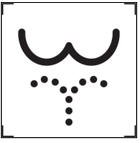
Next, you'll see that the ISO does have a symbol they have developed to designate that a bathroom is "unisex":

Universal unisex symbol

Now, this is just me saying this, so take it with a grain of "persnickety lawyer" salt, but "unisex" is not the same as "gender neutral."  Further, a symbol combining the binary designations for "female" and "male" is not quite consistent with an initiative seeking to respect the innate dignity of people who might not identify with either category.[7]

So, until the ISO develops a symbol for "gender-neutral" that doesn't rely on a binary construct of gender, I advise considering not using a symbol at all (for the "gender-neutral") part.  Give the ISO time to craft a more appropriate pictogram.

That said, if you are a library lucky enough to have a bidet in your single-occupancy, gender-neutral, family-assist bathroom, the ISO might still have an option for the "bidet" part:[8]

Bidet symbol

--Just make sure that as required, the pictogram has a tactile element.

Compliance tips

With the legislative record clearly establishing that this change to the law is about civil rights, and with libraries eager to emphasize their missions of access and inclusivity, the signage for a library's gender-neutral bathroom is a good one to demonstrably get right.

However, as you can see from the "Legal Analysis" above, "getting it right" can be complex. 

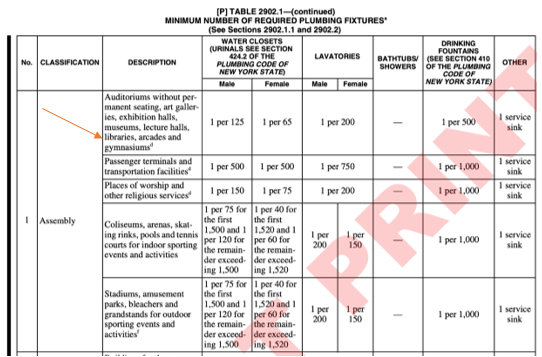
As just a final example of that complexity (and to delve a bit more into one of the member's questions) here is a section of the New York State Building Code's Section 2902, on the prescribed ratio of plumbing facilities for libraries (including total amount of lavatories, amount for men, and amount for women[9]):


Section of NY building code table 2902.1

What is the take-away from this chart?  If your library is struggling with how to designate, plan, or build the right number and/or type of bathrooms, don't be surprised: this stuff is not simple, and it takes consideration of old/new construction, your status as a tenant or building owner, local law, and a host of other factors.  Which is why (in addition to your lawyer), a local architect, or a planner with experience on civic and public assembly spaces, is a good person to reach out to. 

Architects and planners are the people who live and breathe place-making and ordinal signage.  By design, these are professions that think about how people organize buildings, and how people can feel welcome in spaces.  An architect or planner with experience in your area will know exactly how to not only designate the space, but to order the signage, and assess the required number of facilities.  Since there is no "one size fits all" answer to some of these issues, a library needs to consider a custom fit.

If you aren't sure where to start on a quest for an architect or planner, a call to your local "Permits" officer might yield a name or two, and if there is a local college, their librarian might be able to connect you to the "head of planning." 

Conclusion

I have included a lot of analysis in this answer, because in my experience an audience of information management professionals can handle it.

That said, after all the above analysis and commentary, the answers regarding a gender-neutral, single occupancy/family assist bathroom are simple:

  • The posted signage must expressly specify that the single-occupancy bathroom is "gender neutral;"
  • Symbols are allowed if they convey that the bathroom is gender neutral, but (my thoughts) the "official" symbols out there aren't 100% on point, so proceed with caution;
  • Whether or not a library is required to have at least one designated male and one designated female bathroom in their building depends on the type and size of the library; consult a planner or licensed architect in your area if you are unsure;
  • If you order ADA-compliant signage with Braille or a tactile element, affix the center of the sign between four and five feet from the floor, taking care to select a space that meets the USDOJ's requirements.


Thank you so much for a thoughtful array of questions, I was very grateful to be able to spend some time delving into this topic.


[1] On the NY Assembly site here.

[2] If you're thinking "Hey, they left out public schools!", the law impacting those was passed earlier.

[3] See ADA Compliance When Screening Movies for comments on when a library, museum or other institution must comply with the ADA.

[4] Confession:  it is driving me CRAZY that this legislation did not include a hyphen between "gender" and "neutral."  I refuse to continue the mistake and will use a hyphen unless I am directly quoting the law; to do otherwise would be to be "grammar-neutral" (not to be mistaken for a "grammar neutral" which is someone who mediates grammar disputes).

[5] An organization that is "famous" in the same way the G8 or the IMF is "famous": generally known, and pervasively powerful...but not many people can succinctly define what you do on a daily basis.

[6] Find more guidance on standards for using this symbol at ISO here: www.iso.org/obp/ui/#iso:grs:7001:PI_PF_003; the general search tool for international symbols is: https://www.iso.org/obp/ui/#home

[7] Get it together, ISO!

[8] Seriously, I am not kidding.  It's right here.

[9] Section 2902 also states that any single-occupancy bathroom may be deducted proportionately from gender ratios.  It's almost like they knew what was coming!

Requiring COVID Tests for Employees

Submission Date

Question

Can an employer require a negative COVID test before an employee comes to work? We have discussed it on our [public library system] member directors list but have not come up with a clear yes or no answer.

Answer

Here's something positive and affirming I can say: it's possible that the members expressing different opinions on the member directors' list are actually all correct.

That’s because, while I can't give one "clear yes or no answer" to this question, I can give five...five answers based on different scenarios about the facts "before an employee comes to work," including their symptoms, COVID exposure, and the safety measures needed to reduce the risk of COVID transmission in their workplace.

Here the five scenarios are:

Scenario 1

Yes, an employer must (and therefore, can) require a COVID test before an employee returns to work,[1] if the employee reports symptoms as part of routine screening.[2]


Scenario 2

Yes, an employer must (and therefore, can) require a COVID test before an employee returns to work, if an employee is symptomatic upon arrival at work or becomes sick with COVID-19 symptoms while at the workplace, absent close or proximate contact with a person with COVID-19.[3]


Scenario 3

No, an employer does not have to, and has no basis to, require a negative COVID test before an employee comes to work, if the employee is working 100% remotely at home or in a location not at all controlled or at the direction of the employer.[4]


Scenario 4

No, an employer may not require a negative COVID test before an employee comes to work, IF the employee has a medical basis to not be tested; without a negative test, however, if certain screening factors were tripped (such as those in item 2, above) the employer will have to enforce other prescribed measures to comply with state requirements and reduce the risk of transmission within the workplace, such as a mandatory quarantine.[5]


Scenario 5

Yes, an employer can require a negative COVID test before an employee comes to work, if an established safety plan based on applicable OHSA guidance and the employee's job duties warrant that level of caution.[6]


Conclusion

I am not surprised you were unable to find a clear answer from a single reliable source, as these five scenario-based answers had to be cobbled together from two separate documents from the New York State Department of Health, which when combined, require employers to:

"Implement mandatory health screening assessment (e.g. questionnaire, temperature check) before employees begin work each day and for essential visitors, asking about (1) COVID-19 symptoms in past 14 days, (2) positive COVID-19 test in past 14 days, and/or (3) close contact[7] with confirmed or suspected COVID-19 case in past 14 days. Assessment responses must be reviewed every day and such review must be documented."

AND

"An individual who screens positive for COVID-19 symptoms must not be allowed to enter the office and must be sent home with instructions to contact their healthcare provider for assessment and testing." [emphasis added]

AND

"If an employee tests positive for COVID-19, regardless of whether the employee is symptomatic or asymptomatic, the employee may return to work upon completing at least 10 days of isolation from the onset of symptoms or 10 days of isolation after the first positive test if they remain asymptomatic."

AND

"If an employee has had close or proximate contact with a person with COVID-19 for a prolonged period of time AND is experiencing COVID-19 related symptoms, the employee may return to work upon completing at least 10 days of isolation from the onset of symptoms."

AND

"If an employee has had close or proximate contact with a person with COVID-19 for a prolonged period of time AND is not experiencing COVID-19 related symptoms, the employee may return to work upon completing 14 days of self-quarantine."

AND

"If an employee is symptomatic upon arrival at work or becomes sick with COVID-19 symptoms while at the workplace, absent close or proximate contact with a person with COVID-19, the employee must be separated and sent home immediately and may return to work upon completing at least 10 days of isolation from the onset of symptoms OR upon receipt of a negative COVID-19 test result." [emphasis added]."


And there you have it. I am not sure if this will make things clearer, but hopefully I have added some clarity to the uncertainty. 


[1] In this case "work" means the "work site," as in an established office or location controlled by the employer where an employee will report to work, or a site they are directed to appear at.  For this question, "work site" does not mean a home office or other space the employer does not control/send the employee to.

[2] This answer is based on the combined effect of the New York State Department of Health requirements here and  here.

[3] This answer is based on based on the combined effect of the New York State Department of Health requirements here and here.

[4] I know I covered this in footnote #1, but it bears repeating: based on the published guidance, NY employers are required to conduct mandatory screenings to reduce the transmission of COVID in areas they are responsible for, and areas they serve as part of their work, but not an employee's home office.  Requiring a test when there is no logical nexus between the employer's obligations and the request for medical information runs the risk of an ADA violation (not a slam-dunk risk, but enough of a risk to make it a bad idea).

[5] This answer is based on the Americans with Disabilities Act; if an employee has a disability that means they cannot medically tolerate a test (I have not heard of this, but I imagine it is possible), they will have to provide an alternate means of ensuring safety if such an accommodation is reasonable.

[6] This answer is based on the needs of work places with the highest levels of risk and risk management. 

[7] "The New York State Department of Health considers a "close contact" to be "someone who was within 6 feet of an infected person for at least 10 minutes starting from 48 hours before illness onset until the time the person was isolated. The local health department should be contacted if the extent of contact between an individual and a person suspected or confirmed to have COVID-19 is unclear. "

Staff COVID vaccinations

Submission Date

Question

Can a public library compel staff members to get vaccinations for COVID-19, when they are available? If so, can an employee request an exemption? Do we need waivers of library liability if a staff member chooses not to get vaccinated?

Answer

This is an incredibly sensitive, important, and complex set of questions.  I know a lot of people out there in "library land" are waiting on the answer—from many different perspectives.

So we're going to take it slow, break it down, and unpack the components of the answers one step at a time.

Step 1: Considering requiring immunization to COVID-19 as part of a library's evolving Safety Plan

As I have emphasized in numerous pandemic-related answers, any library operating in any capacity right now should have a trustee-approved Safety Plan tailored to its unique operations.  The plan should evolve as new safety-related information emerges, and as library operations change.

As of this writing,[1] some libraries are open to visit.  Some are doing only curbside.  Some are offering more remote programming.  Some have used their information management and lending capacity to distribute PPE, food, and living supplies.  Because of this diversity of service, they all should have different Safety Plans.

The Safety Plan of a library closed to the public for everything but curbside will be different from the Safety Plan of a library open for socially distant use of computers and lending.  The Safety Plan of a library distributing fresh produce will be different from a library streaming programming from its community room to an audience within its area of service (and beyond).  The Safety Plan of a library operating with ten on-site staff in December should be different from the one they used when there was only one employee on-site in June.

Just like the decision to use a particular mode of sanitization, as a library undertakes and changes its unique services, the decision to require immunization of employees should start with vaccination's role not as a stand-alone solution, but as part of an overall approach to limiting the impact of the pandemic on your library, its employees, and your community.  Do the services your library needs to provide the community warrant immunization of employees?  If so, keep reading.


Step 2:  Wait, so does what you said in "Step 1" mean a public library can go ahead and require employees to be vaccinated?

Yes...and NO.

I say "yes," because under the right conditions, the law does allow employers to impose conditions for safety, and that can include mandatory vaccination.[2]  However, I also say "NO," because the phrase "the right conditions" carries a lot of complexity for three little words.  To be safe, the default assumption of a library[3] should always be that it can't require immunization of its employees...and then work to find the way, if well-informed risk management and an updated Safety Plan warrants it, it can require immunizations (and just as critically, if it should).


Step 3: Assessing if a library can require vaccination of employees

Before a library gets too far into an internal debate about if it should amend its Safety Plan to require vaccination of employees, it should assess if it is in a position to do so.  This means having an experienced HR administrator or attorney look at the organization's bylaws, policies, and employment relationships to see if there are any steps or bars to the requirement.

What could such a bar look like?  The most common impediment a library will run into on this is an employment contract—either for individual employees, or with an entire employee union (a "collective bargaining agreement").  The bottom line on this type of impediment: if there is a contract in play, a library must be very tactical, collaborative, and strategic prior to creating—or even considering—immunization as an employment condition.[4]

Another bar might be language in an employee handbook or a pre-pandemic policy.  Still another might be that "gray area" when library employees are considered employees of a school district, village, or town.

The best overall guidance I can offer on this Step is: assessing if your library is positioned to require immunization is a critical step to using vaccination as a tool in your Safety Plan.  Bring in a ringer to help your library assess the extent of what it can do.


Step 4:  Assessing if a library should require vaccination of employees

Okay, let's say you consulted with the best employment lawyer in your village/town/district, they took a close look at whatever relevant contracts and policies your library has, and they have said: "No problem, you can require this."[5]

The next important thing to consider is: should your library require this?

Compelled immunization[6] is an incredibly sensitive area of policy and law.  Since the time Ben Franklin started insisting on smallpox immunizations,[7] this public health issue has had passionate rhetoric on both sides of the debate. 

I have worked with families whose children have documented contraindications for certain vaccines, and it is not a simple issue.  And right now, a public discussion is happening about why people who are African-American might not trust being offered a first round of vaccination.[8]  These are life-and-death issues.

That said, those on the front lines of public service, during a time of pandemic, are at higher risk of both getting infected, and spreading disease.  Science shows vaccination will mitigate that risk.  Thus, under the right circumstances, encouraging such employees to be vaccinated is the right thing to do, and in some cases, employers have made the decision that requiring vaccination is the right thing to do.

The consideration of this question is classic risk management.  What critical services is your library providing to the community?  What exposure to possible infection do those services create?  Does social distancing, PPE, and sanitization mitigate those risks within acceptable tolerances, or would requiring vaccination of employees demonstrably make those employees and the community safer?  Are there certain duties that merit requiring immunization, and other duties (jobs performed 100% remotely, for instance) that do not?  And critical: is mass employee immunization in step with the approach of your local health department?[9]

There is no cookie-cutter answer to these questions, but a responsible decision to require immunization of employees as part of a well-developed and evolving Safety Plan should answer them all.


Step 5:  Developing a robust policy that includes consideration of civil rights, the ADA[10] and privacy

So, let's say your library has followed Steps "1" through "4" and has decided it can, and should, update its Safety Plan to encourage or require immunization of employees.

The next step is developing a policy that:

  • Demonstrably does not discriminate or have an unintentional disparate impact on any protected class of people (race, religion, sex, etc.);
  • Has appropriate measures for people to opt-out based on a disability accommodation under the ADA or the New York Human Rights Law;
  • Protects the privacy of those who either meet the requirement, are granted an accommodation to not meet the requirement, or who must be terminated due to refusal to meet the requirement.[11]
  • Manages liability through good planning and the transmission of accurate information, not (just) waivers of liability.[12]

I also suggest that the library strongly consider ensuring, well in advance, that: 1) the vaccine is available to employees, and 2) that employees don’t have to pay for it.  This is because 1) once the library has identified that there are risks in its operations that would be best mitigated through immunization, those activities should be limited until the mitigation is in place, and 2) there can be legal complications if the vaccination requires personal expense.  While this advance planning and cost containment is not precisely a legal compliance concern, they are close first cousins, and should be addressed as part of the Safety Plan. 


Step 6: If a library decides to require immunization, develop a PR Plan (optional, but a very good idea)

I don't need to tell a library audience that what a public library does on this topic will be scrutinized, criticized, and eventually, also a model for the rest of your community.[13]  Since any decision on this point will have its critics, and also (hopefully) its fans, be ready to let your public know, simply and straightforwardly, the basis for your library's decision.

I like the classic "FAQ" approach.  Here are two model FAQ's for two libraries that did the legal analysis and safety assessment, and come to the following decisions:

FAQ: I was told the library board is requiring all the employees to be vaccinated for COVID, is that true?

FAQ ANSWER: Since re-opening on DATE, the NAME Library has had a Safety Plan.  Now our Safety Plan does include supporting voluntary immunization of employees.

FAQ:  Voluntary?  So you are not requiring it?

FAQ ANSWER:  Our risk analysis and still-limited operations showed that we could meet the community's needs by requiring masks, social distancing, and routine sanitization.  We have now added supporting employees in getting vaccinated on a voluntary basis.

FAQ:  Will you ever require it?

FAQ ANSWER:  Only if our operations change and an updated risk analysis shows us that it is best for our employees and for the community.

Another "FAQ" example, for a library that came to a different conclusion, is:

FAQ: I was told the board is requiring all the employees to be vaccinated for COVID, is that true?

FAQ ANSWER: Since re-opening on DATE, the NAME Library has had a Safety Plan.  Now our Safety Plan does include mandatory immunization of employees who are able to be vaccinated.

FAQ:  Why is the library requiring employees to get vaccinated?

FAQ ANSWER:  Feedback shows that the community needs us providing critical services right now.  Our risk analysis showed that in addition to requiring masks, social distancing, and sanitizations, immunization by employees would protect their health, and the community's, while we provide those services.

FAQ:  The vaccine is not 100% available yet.  Did your employees have to do this on their own?

FAQ ANSWER:  Our library worked with [INSTITUTION] to make sure our employees had access to this safety measure, without cost to them.

And that's it.[14]

The important take-away I want to emphasize here is that for individual libraries, there are no quick answers to these questions.

Libraries of all types will be assessing their unique legal and risk positions, and will need to make carefully documented and executed decisions.  Libraries within larger institutions may need to fight for consideration separate from other operations.  Public libraries will need to consider the heightened transparency and public accountability they operate under.  Library systems will be thinking about how they can protect their employees while also supporting their members.  And for the employee on the ground, they'll be thinking about keeping themselves, their families, and their communities safe.

By taking careful, deliberate, and well-informed steps, the answers to the member's questions can be found.

Thank you for a vital question.


[1] December 18, 2020.   For many of you, that means you've been shoveling lots of snow (we're looking at you, Binghamton).

[2] See the case Norman v. NYU Health Systems (2020) (SDNY), 2020 U.S. Dist. LEXIS 180990 *; 19 Accom. Disabilities Dec. (CCH) P19-109

[3] And in this case, I use "library" in its broadest sense: public, association, and even libraries operating as part of a larger institution (such as a college, hospital, or museum).  School libraries, in particular, may both fall under the policies of the institution they are within, but might also have different operations, activities, and exposure that warrant independent risk analysis.

[4] I can't be more specific than that, since in some cases, there may be "emergency" management clauses that could easily allow the requirement of further safety measures, while in other cases, there could be language that makes it clear such a requirement will have to be a point of discussion.  The important take-away here is: if there is a contract in play, don't wing it.  Bring in your lawyer.

[5] The actual answer will of course be in writing and will likely be much more extensive than "No problem!"   It should also be included in the records of library leadership to document the appropriate level of risk analysis.

[6] When I say "controversial," I mean legally.  The science is solid: immunization saves lives.

[7] Ironically, Franklin's young son would die of smallpox before he could be immunized, in part because Franklin's wife Deborah was wary of the new treatment.  Franklin was devastated by the loss of his small, precocious son, and some scholars say it caused a rift in his marriage that was never healed.

[8] If you know your history, you know these fears are based in reality.  If you want to learn more, a good place to start is this New York Times article: https://www.nytimes.com/2020/12/06/opinion/blacks-vaccinations-health.html?searchResultPosition=4

[9] Whenever possible, confirming Safety Plans, and significant revisions of Safety Plans, with the local health department is a very good idea.

[10] The ADA is a critical consideration here.  A good place to start for further information on this is the EEOC, at https://www.eeoc.gov/wysk/what-you-should-know-about-covid-19-and-ada-rehabilitation-act-and-other-eeo-laws.  However, this is just a starting place; as you can see by the linked guidance, this part of your policy cannot be a simple cut-and-paste job.

[11] I know, this sounds cold; and it is.  Considering if a library is actually prepared to terminate employees for refusing to meet the requirements should be part of your library's analysis here, too...because once you develop the policy and start requiring it, granting exceptions without justification can create serious legal complications.

[12] The member asks about waivers for employees who decide not to be immunized.  A waiver of liability should only be used if it is part of a well-developed Safety Plan, and customized for the purpose by an attorney.

[13] Although I just did.  Ah, rhetoric.

[14] I could go on with a few more FAQ's to illustrate the diversity of approaches available (they are kind of fun to write), but I trust you get it.

Considering accessibility in library statements and purchases

Submission Date

Question

Should our library have an accessibility statement?  And should we consider accessibility when making purchases?

Answer

Yes, and yes.

Every library, historical society, archives, or museum, if open to the public, should have accessibility information posted at its premises, in its printed brochures and fliers, and on its website.

While it can (and often should, based on the size and type of the library), this "accessibility statement" does not have to cite the ADA.[1]  Rather, it can just be a simple statement about your institution's commitment to access, along with some basic information about what common accommodations are on site—and critically, how to get in touch if a person needs more.

Here is some sample language:

The ABC Library is committed to access for all.  We currently [insert all current accessibility features, including ramps, bathrooms, parking, adaptive technology, etc.].  As renovations are planned and new items are purchased, our accessibility grows.

Questions about our resources and any accommodations can be directed to [PERSON] at [PHONE] or [EMAIL].  To ensure timely and thorough assessment of accommodation requests, we will confirm the details of the request with you, assess the request, and let you know the options we can offer as soon as possible.

Requests related to specific events should ideally be received at least two weeks before the event, to allow time for proper assessment and planning.

Some requests might not be within the scope of what we can do, or may be met through alternatives, but the ABC Library board of trustees, director, and employees are committed to making our library the best it can be for everyone in our community.

Further, every library should have an accessibility/universal design section in its purchasing/procurement policy.

Just something simple, like:

When generating Request for Proposals and soliciting quotes, the ABC Library will assess the goods and/or services to be purchased and develop criteria to: 1) assure ADA compliance; 2) incorporate consideration of universal design; and 3) position the library to promote accessibility based on established, current, and properly sourced research.

Why is this important?  Well, aside from being a kind, considerate thing to do[2], it is a form of legal risk management for facilities required to follow the ADA. 

Pre-emptive outreach on accessibility helps people plan visits and find ways to access services, rather than look to the law for alternatives.  And by building accessibility priorities into the earliest phases of procurement, your institution makes sure it thinks about accessibility before a purchase becomes a problem.

Once a library resolves to do these two things, there are endless resources out there on how to write policy, compose statements, and how to consider the ADA when making purchases, designing signage, and updating websites.  But resolving to make these things a priority is the first step.  So...

Should your library have an accessibility statement?  And should your library consider accessibility when making purchases?

Yes, and yes.


[1] A longer "Ask the Lawyer" answer regarding precise ADA obligations is RAQ #153. This is just a sweet and simple guide to some basic concerns.

[2] Even an institution with a 200-year-old building with no elevator on a street with no parking can be welcoming if the right signage and alternate means of accessing services have been communicated and properly arranged beforehand.

Asking COVID-19 symptomatic patrons to leave

Submission Date

Question

In regards to COVID-19 when libraries do reopen, (and allow people in) is it advisable to ask customers to leave the public building if they are exhibiting any visible COVID symptoms? If so, are there benchmarks for how extreme symptoms should be or how policies should be worded? There are of course patron behavior policies in place allowing for the removal of anything disruptive, which can include noise or inappropriate behavior. There are some members of our leadership team who believe our safety reopening plan should include provision specifically mentioning symptoms of COVID-19 and the staff's/ library's right to remove them if symptoms are exhibited. There are other concerns that library staff are not medical professionals and we are not able to determine if a few sneezes and coughs are common colds, allergies or COVID. Attached is our library's current reopening plan

Answer

As the member writes, it is very difficult to determine if some physical factors—coughing, a flush, seeming malaise—are in fact symptoms of COVID-19.  Confronting a patron with suspected symptoms can also lead to concerns impacting community relations, privacy, and the ADA.

A good Safety Plan addresses this concern, without requiring patrons[1] to be removed mid-visit from the library.

To position libraries to address the impact of patrons with suspected symptoms, New York's "Interim Guidance for Essential and Phase II Retail" (issued July 1, 2020)[2] states:

CDC guidelines on “Cleaning and Disinfecting Your Facility” if someone is suspected or confirmed to have COVID-19 are as follows:

  • Close off areas used by the person suspected or confirmed to have COVID-19 (Responsible Parties do not necessarily need to close operations, if they can close off the affected areas).
  • Open outside doors and windows to increase air circulation in the area.
  • Wait 24 hours before you clean or disinfect.
  • If 24 hours is not feasible, wait as long as possible.
  • Clean and disinfect all areas used by the person who is suspected or confirmed to have COVID19, such as offices, bathrooms, common areas, and shared equipment.
  • Once the area has been appropriately disinfected, it can be opened for use.
  • Employees without close or proximate contact with the person who is suspected or confirmed to have COVID-19 can return to the work area immediately after disinfection.  Refer to DOH’s “Interim Guidance for Public and Private Employees Returning to Work Following COVID-19 Infection or Exposure[3] for information on “close or proximate” contacts.  [4]
  • If more than seven days have passed since the person who is suspected or confirmed to have COVID-19 visited or used the retail location, additional cleaning and disinfection is not necessary, but routine cleaning and disinfection should continue.

[emphasis on "suspected" has been added]

In other words: your Safety Plan, as informed by the most recent guidelines, should leave nothing to chance.  By using this procedure, library staff are never put in the position of having to guess, ask, or consider if a patron's coughing, sneezing, or other behaviors are COVID-19...rather, the moment the possibility is "suspected," the Plan kicks into action.

Of course, if a patron is properly masked, some of the risk of exposure is limited, even if they are infected (this is why we wear masks and identify areas with six feet of clearance in the first place).  And if a patron removes their mask mid-visit, refuses to keep appropriate distance, or refuses to spray down equipment after using it,[5] THAT person can be asked to leave, simply as a matter of policy—whether they are exhibiting symptoms, or not.[6]

So to answer the question: no, it is not advisable to ask patrons to leave the public building if they are exhibiting any visible COVID symptoms, for exactly the reasons the member provides.[7]  Rather, it is required that your Safety Plan keep people distant from each other, and that the library be ready to address any real or suspected exposure as quickly and effectively as possible. 

That said, having signage that reads "Safety first!  Patrons who are concerned about transmission of germs can arrange curbside service by [INSERT]" is a great way to remind people that if they are having an "off" day, there are many ways to access the services of your library.

I wish you a strong and steady re-opening.


[1] This answer does not apply to employees and visitors like contractors, who must be screened.

[2] Found as of July 25th, 2020 at https://www.governor.ny.gov/sites/governor.ny.gov/files/atoms/files/RetailMasterGuidance.pdf

[3] Found as of July 25th, 2020 at https://coronavirus.health.ny.gov/system/files/documents/2020/06/doh_covid19_publicprivateemployeereturntowork_053120.pdf

[4] I note that the DOH's "Interim Guidelines" do not include guidance to staff with suspected (as opposed to confirmed) exposure.  If an employee feels they were exposed to a suspected case of COVID-19, however, that will impact their answers on their next daily screening, which will trip consideration of whether they can report to work.

[5] Or whatever other safety measures a library has identified.  It is inspiring to read the variety of tactics out there, as listed at https://www.nyla.org/covid-19-library-reopening-plan-database/?menukey=nyla.

[6] Another member raised this consideration in this "Ask the Lawyer" from earlier in July 2020: RAQ #153

[7] Of course, if a patron is having a medical event and you have an immediate concern for their well-being, call 911.

Does a mask requirement policy violate the ADA?

Submission Date

Question

Our library has taken the next step in re-opening and is welcoming the public back into our building.  We have a Safety Plan, and we have posted signage in key areas to help the public follow our safety practices, including staying at least six feet apart whenever possible, and every visitor using hand sanitizer upon entry and (if over the age of two) wearing face coverings at all times.

A patron who cannot wear a mask raised the possibility of our policy being a violation of the Americans With Disabilities Act (ADA).  They patron is concerned that this policy discriminates against those who cannot “medically tolerate” a mask.

Are we in the wrong to require masks?

Answer

It is not wrong to require patrons to wear masks.  As of this writing (July 7, 2020), qualified experts agree that masks remain one of the most effective ways to stop the transmission of COVID-19.[1]  In an environment storing circulating materials[2] and shared space, this is a critical step for reducing the risk to library employees, and the public.

That said, even the most well-intentioned efforts can step on the rights of others, including rights under the ADA.  How does a library promote safety, while abiding by the ADA?

The key is to implement and enforce the mask-wearing requirement in a way that doesn’t overstep or unnecessarily limit the access of those living with a disability.[3]

Here is a step-by-step process to help a library assess, draft and enforce a mask-wearing requirement so it is harmonized with the protections of the ADA.

NOTE: For this exercise you will need: a copy of your Safety Plan, the person or team who writes/updates the Safety Plan, a copy of your library’s floorplan, and the documents linked in the steps below. 

Estimated time of activity: 1.5 hours.

Step 1

Isolate the language in your Safety Plan requiring patrons to wearing masks. This is your “Patron Mask Enforcement Language” (“PMEL”).[4]


Step 2

Look at your PMEL. 

Is it a Uniform Use requirement, such as: “All patrons must wear masks upon entry, and the mask must remain in place at all times during your visit, in all areas.”

Or

Is it a Circumstantial Use requirement, such as: “All patrons must wear masks upon entry, and the mask must remain in place at all times during your visit, except when seated in our Wipe Down Reading Area,[5] where seating is at least 7 feet apart, and patrons must spray down the surfaces in their zone after use (limit 20 minutes).”


Step 3

Look at the floor plan.  Is there ANY place in the library where current CDC-advised safety practices can be used to create a place for “Circumstantial Use” of masks?  In other words, is there any place where, after considering all the risks to mitigate through measures other than a mask, can you offer an official mask-free zone to patrons?

For many small libraries, the answer will be a hard “NO.” The space will be just too small.  And for many libraries with more space, the answer will again be a hard “NO,” based on budget; they may have the space, but the extra resources spent to monitor and sanitize the area are just too costly.

When the Safety Plan team reaches a conclusion, document the analysis, and if any zone can be so converted, mark it on the floor plan (which you will attached to the Safety Plan).  For example: The Safety Plan Team met on DATE to review the floor plan and see if any area could be converted into a mask-free zone for patrons.  Based on space, available furniture, costs, and proximity to circulating materials, the team concluded [whatever you concluded].


Step 4

If your library does develop a mask-free zone for patrons, the rules and cleaning protocols for the area must be robustly detailed in your Safety Plan.  The supplies for patrons to do their own spray-down upon arising from the designated seating must be routinely re-stocked.  The rules must be well-posted and strictly enforced. 


Step 5

Now, back to the ADA.  Does your Safety Plan have a section on how a patron can request accommodations while the library is operating under the Plan?  If the answer is “no”, this is a good thing to consider adding.

Why?

I have written previously about libraries’ shifting obligations under the ADA.[6]  All of that previous material applies to this situation, but of course, now we have the extra layer of COVID-19. 

Always, with ADA, the goal of the library should be to find a way to ensure access.  That said, some access will not be as a patron envisions, and some requested accommodations are just not implementable.  Because of this, as I wrote at the top of this answer: “The key is to implement and enforce the mask-wearing requirement in a way that doesn’t overstep or unnecessarily limit the access of those living with a disability.”  When modifying operations to reduce transmission of COVID-19, that means posting information about accommodations and access right along with the other signage you’re developing and posting as part of the Safety Plan.

So with all that as background, “Step 5” is answering this question:

“Does our Safety Plan address access and accommodations as required[7] by the ADA?”  If the answer is “no,” continue to Step 6.


Step 6

If you have decided you must add some ADA-related language to your Safety Plan, you can do so by answering the following questions:

a.  How does a person contact the library to request reasonable accommodations during a time of adjusted operations?

b.  What reasonable accommodations can your library be ready to offer to the following common safety measure-related issues:

  • inability to wear a mask
  • allergy to hand sanitizer
  • chemical sensitivity (triggered by increased use of cleaning products)
  • requested assistance requires library employee to get closer than six feet (for instance, help with using computer)
  • patron is especially vulnerable to COVID-19 due to other risk factors

Some of the requested accommodations for the above issues will be simple.  Can’t use hand sanitizer?  We’ll provide water, a disposable towel, and soap.  Can’t wear a mask?  We don’t have a mask-free zone, but we’ll be happy to assist you over the phone and you can pick your books up curbside.  Need extra help at the computer?  We’ll figure it out, but our employees have been instructed to stay at least six feet apart unless behind a plexi window, and that is non-negotiable.

Some accommodations are harder.  You’re allergic to the spray-down solution we bought in bulk?  Sorry, we can’t buy a different gross of spray until next month; please let us know what ingredient bothers you and we’ll see if our procurement folks can find something different. Until then, we’ll be happy to assist you over the phone and you can pick your books up curbside.  You have pre-existing conditions that mean you can’t go in a public area, even if there is a Safety Plan being enforced?  We are so sorry to hear that. We miss you.  We wish this whole thing was over.  We are here for you by phone, e-mail, or the internet, and can work with a designated person who will pick up your books.

The key is to ensure that people know how to direct the requests, and that the library is ready to assess them promptly. 

A good way to organize this is to create a section of the Safety Plan providing for signage stating: “For patrons needing disability accommodations while the library is operating under conditions to reduce the transmission of COVID-19, please call NAME at NUMBER, or write to EMAIL or ADDRESS.  You will also find this information in our Safety Plan.  The library is committed to safe access for all.”


Step 7: Feeling Confident

Okay, you have followed the six steps for assessing your Safety Plan and building out its provisions with regard to ADA.  Do you feel confident in your approach?[8]  For teams that want a little extra “oomph” in their handling of COVID-19-related accommodations requests, here is some law:

First, here is the language from New York’s Executive Order 202.34, regarding the ability of businesses to require and enforce the use of masks:

Business operators and building owners, and those authorized on their behalf shall have the discretion to ensure compliance with the directive in Executive Order 202.17 (requiring any individual over age two, and able to medically tolerate a face-covering, be required to cover their nose and mouth with a mask or cloth face-covering when in a public place), including the discretion to deny admittance to individuals who fail to comply with the directive in Executive Order 202.17 or to require or compel their removal if they fail to adhere to such directive, and such owner or operator shall not be subject to a claim of violation of the covenant of quiet enjoyment, or frustration of purpose, solely due to their enforcement of such directive. Nothing in this directive shall prohibit or limit the right of State and local enforcement authorities from imposing fines or other penalties for any violation of the directive in Executive Order 202.17.  This directive shall be applied in a manner consistent with the American with Disabilities Act or any provision of either New York State or New York City Human Rights Law, or any other provision of law.

As reviewed in Step 6, “consistent with the Americans with Disabilities Act,” does not mean that those who cannot medically wear a mask are automatically allowed maskless entry as an ADA accommodation.  Rather, a place must see if the risk posed to the public by the maskless individual can be mitigated by a “reasonable” accommodation.  For libraries that can have a mask-free zone, they can be.  For a tiny library where any breath will land on circulating materials, it likely cannot. 

The key to doing this right is thoughtful assessment and documentation: replying to ADA requests should not be a gut-check exercise.  It should be considered, thoughtful, and documented as shown in steps 3 through 6.  Whenever possible, a library assessing accommodations request should consult a lawyer.

Second, here is a pep talk from the US Department of Justice, the body who enforces ADA:

The Department of Justice Warns of Inaccurate Flyers and Postings Regarding the Use of Face Masks and the Americans with Disabilities Act

Assistant Attorney General for the Civil Rights Division Eric Dreiband reiterated today that cards and other documents bearing the Department of Justice seal and claiming that individuals are exempt from face mask requirements are fraudulent.

Inaccurate flyers or other postings have been circulating on the web and via social media channels regarding the use of face masks and the Americans with Disabilities Act (ADA) due to the COVID-19 pandemic. Many of these notices included use of the Department of Justice seal and ADA phone number.

As the Department has stated in a previous alert, the Department did not issue and does not endorse them in any way. The public should not rely on the information contained in these postings.

The ADA does not provide a blanket exemption to people with disabilities from complying with legitimate safety requirements necessary for safe operations.
The public can visit ADA.gov or call the ADA Information Line at 800-514-0301 (voice) and 800-514-0383 (TTY) for more information.

[emphasis added]

So, while ADA, or the disability protections of the New York Human Rights law, most certainly could apply to a person denied access to a covered institution, as can be seen, it’s just not that simple.  If your library builds out the ADA provisions of its safety plan, listens to ADA-related requests carefully, and assesses them promptly, you can feel confident that you are doing your best to provide ADA access.  And if you have the slightest uncertainty about any of those steps, you should contact a lawyer.

However, having seen how these things go, here is a final thought: people who are making ADA requests can feel vulnerable.  It can be scary to admit a disability; it is an act of trust to request accommodations.  On the flip side, many people with disabilities have learned their rights, and fight for them as warriors.  Many parents of children with disabilities have learned to be ardent advocates. 

All of this can create tension (at any already tense time).  So any ADA request, no matter what the tone or context, should be met with a simple “I hear this request.  We will work on this as quickly as possible.  This is important to us.”  Then get the answer, and document it, taking care to not let too much time pass.

Thank you for an important question.


[1] https://www.cdc.gov/coronavirus/2019-ncov/prevent-getting-sick/cloth-face-cover-guidance.html#evidence-effectiveness

[2] https://www.webjunction.org/content/dam/WebJunction/Documents/webJunction/realm/systematic-lit-review.pdf

[3] https://askjan.org/a-to-z.cfm

[4] I really tried to come up with a sassy acronym for this.  The best I could do, even after 2 cups of coffee, was “MAP” for “Masking All Patrons.”  That sounds AWFUL so “PMEL” it is.

[5] I won’t lie.  I didn’t try to come up with a better phrase than “Wipe Down Reading Area.”  But I am sure someone out there will.

[6]  ADA Compliance When Screening Movies Yes, this is one of the documents to have in the work packet.

[7] Bearing in mind that different libraries will have different requirements.

[8] NOTE: While this Executive Order does not mention the other requirements a business can make a condition of entry, since a library can make adherence to its Safety Plan a condition of the standing Patron Code of Conduct, if a library so chooses, it has more than just the Order to address concerns (this also assures all appropriate due process).  See Mask and PPE Library Policies for a discussion of how to enfold your Safety Plan into your Code of Conduct.


[2020 Pandemic Date Specific] Policies for employees returning to work during COVID-19

Submission Date

Question

Public and Association libraries have questions about making policies creating conditions that must be met for library staff to return to work. Can they set policies that exclude vulnerable employees from being able to return to work? Can they set policies requiring non-vulnerable employees to return to work?

Answer

I had initially considered bundling this question with another submission about temporary actions or policies during COVID-19.  After all, both questions relate to policy, and a big goal of “Ask the Lawyer” is to provide legal information efficiently.

But after drafting that answer, and considering this question further, I did away with that notion.  The member has isolated an incredibly critical concern about employee/employer safety and authority.  It is a question that demands—and deserves—its own consideration.

But before we dive into the legalities, let's consider the practical implications of the member’s question.  Why would an employer want to “exclude vulnerable employees” from the work site? On the flip side, why would an employer want to set policies “requiring” a class of employee termed “non-vulnerable” to return to work?

Near as I can figure, the employer would want to do this to promote safety; a laudable goal.

However, that is not precisely the approach an employer in New York State is empowered to take.

Under both the Americans with Disabilities Act (“ADA”) and the New York Human Rights Law (“HRL”), employers are barred from discriminating against employees on the basis of real or perceived disability. This means that a NY employer who knows—or suspects—an employee might be particularly “vulnerable” (in this case, to COVID-19, but in other cases, due to pregnancy, or other medical conditions), is barred from simply labeling that employee “vulnerable” and taking steps to limit or change the terms of their employment on the basis of that conclusion. 

Rather, disability law is set up to empower employees to identify their needs, and then—under the most confidential circumstances possible—work with their employer to receive reasonable accommodations in consideration of those needs.

For example, a person whose medical history means that they might be more vulnerable to COVID-19 would work with their medical provider to provide documentation setting forth the risks and requesting a reasonable accommodation on the basis of those risks.

Employers are always welcome to let employees know the ways in which they may request accommodations. For instance, as libraries, museums, and archives consider limited or full reopening, employers can transmit those plans to their employees, and invite them to submit any request for accommodations based on the anticipated additional exposure to on-site visitors.

Think of it in the same way your institution might think of planning a large event that would invite the maximum number of people possible to your library or a rented venue. When planning for an event that will attract a large number of people, almost every institution will consider the need to accommodate people who use mobility devices. They might not contact those people in advance, even if they know they're coming…rather, the event will be planned with those accommodations in mind.

A good example of this, of relevance to the current COVID-19 crisis, is an employee with a respiratory disability.  As we know, people who have had respiratory illnesses in the past may be especially vulnerable to COVID-19 now.  These are people who may request accommodations—potentially including the ability to work off-site—based on a disability (a good list of accommodations for respiratory issues can be found here, on the Job Accommodation Network).

So, with all that being said, the answer to the member’s questions (Can they set policies that exclude vulnerable employees from being able to return to work? Can they set policies requiring non-vulnerable employees to return to work?) is: NOT AS SUCH.

However.

Employers can most certainly, when otherwise allowed by law, policy, contract, and Executive Order, require employees to return to work.  After that…

Once an employer is able/decides to re-open, in addition to any re-opening conditions, the employer must consider any requests for reasonable accommodations.  This could absolutely include modifications for those whose disabilities render them vulnerable to COVID-19.  The employer can even generally pre-plan to offer those modifications.  Or they can make working from home, or working on-site, optional (if the work can, in the sole determination of the employer, still be done).  But what they can’t do is pre-sort their employees by “vulnerability.”

There is one final critical point to make here, at this time (May 19, 2020).

Institutions re-opening as part of “NY Forward,” may be required to monitor the health of their employees in a way that typically would seem intrusive, and in some contexts, would even be illegal.

For example, here is a sample of the monitoring required under NY Forward, taken from a sample safety plan.  NOTE: this is taken from the NYForward’s Phase One Retail Summary, and is provided as an example, only:

Employees who are sick should stay home or return home, if they become ill at work.

[Employers must] [i]mplement mandatory health screening assessment (e.g. questionnaire, temperature check) before employees begin work each day and for essential visitors (but not customers), asking about (1) COVID-19 symptoms in past 14 days, (2) positive COVID-19 test in past 14 days, and/or (3) close contact with confirmed or suspected COVID-19 case in past 14 days.

Assessment responses must be reviewed every day and such review must be documented.

Employees who present with COVID-19 symptoms should be sent home to contact their health care provider for medical assessment and COVID-19 testing. If tested positive, employee may only return completing a 14-day quarantine. Employees who present with no symptoms but have tested positive in past 14 days may only return to work after completing a 14-day quarantine.

As stated, this is the procedure for Phase 1 re-opening of limited retail operations.  When will libraries subject to closure in NY be able to re-open under NY Forward, and under what terms?  As I write this, the New York Library Association, NYLA, has this on their COVID-19 page, which states[1]:

With input from our partners from the Public Library System Directors Organization (PULISDO), NYLA has been advocating for libraries to be permissively included in phase two.  This would allow libraries to be a phased re-opening processed, to be determined at the local level, as early as when their region enters Phase Two.  The decision on when, as well as the steps and procedures for re-opening, are best determined locally, and in conjunction with the local library system and county Department of Health.

This is a critical service to association and public libraries by NYLA, and every board and director should be monitoring this site for updates.

Of course, some libraries may have determined that the current workforce restrictions don’t apply to them at all (that they are exempt right along with school districts and local governments).  And it is possible some libraries and museums, affiliated with larger institutions, will not be able to open until their region hits “Phase Four” (covering educational institutions).  And it may be that by the point libraries are given the go-ahead, the emergency has abated to the point where monitoring of employees won’t be required. 

But any library contemplating opening, in addition to being ready to consider ADA accommodations for those more vulnerable to COVID-19, needs to be considering these possible employee monitoring requirements, as well as the need to adopt any NY Forward-required Safety Plan, or similar documentation showing they are taking defined, affirmative steps to protect employee and public safety.

Public and association libraries developing the policies they need to re-open have a large, complex task before them.  Thank you for a question that explores a critical consideration of that work.


[1] Just to emphasize: NYLA is a critical resource at this time and all libraries should be monitoring this page daily for updates.