
Trademarks and Branding

Hardening the Target In the Face of AI Bots

Submission Date

Question

[This question came to use in response to the RAQ Does the Rise of AI Mean Public Libraries Should Stop Posting Policies to Ensure Security?, where a footnote said “It is possible we are long past the end of the “open internet,” and more things need to be restricted, both for legal and operational reasons. Hopefully we’ll get a question about that soon, because I have a lot to say.”]

Can we talk about putting things behind a log-in to avoid misappropriation of content? I have pretty much taken this question from the 10/14/25 Ask The Lawyer’s “Does the Rise of AI Mean Public Libraries Should Stop Posting Policies to Ensure Security?” response. It strikes me as an important topic as I recently read the Library Journal September 2025 article “AI Bots Cause Slowdowns, Crashes” (on pages 12-13).

Answer

Yes, we can talk about putting things behind a log-in to avoid misappropriation of content! Thank you for asking.

At the same time, we can (and must) talk about putting things behind a log-in to avoid problems with security, privacy, intellectual property, and data integrity.

Of course, by “things,” we mean “websites,” which are now a significant part of the services provided by libraries, museums, and archives.

Because websites perform a huge array of function, for purposes of this question, we are going to talk about library, museum, and archival websites that perform the following functions:

  • Business information presentation (“About us,” “Our team,” “Policies,” etc.);
  • Data repositories (archives and online collections);
  • Searching the website and/or repository; and
  • Integrated library systems services.[1]

Common website functions this question is NOT going to specifically cover are:

  • Financial transactions (like donating to a museum over a website);
  • Collaborative research (like crowd-sourcing a survey);
  • Interactivity (for example, a social media site).

We’ll tackle those another day.[2]

Why am I narrowing the scope this way?

After 30 years of development,[3] libraries, museums, and archives use their websites as alternatives for their physical locations. The value of this—if it was ever in question—was shown during the COVID-19 Pandemic.

Because of this, such websites must be:

  • Mission-focused;
  • Consistent and reliable;
  • Compliant; and
  • Trusted.

Current trends in Internet activity show that the risks that were always present when operating and relying on a website are only getting starker. In addition to the operability risks flagged in the Library Journal article cited by the member, the risks posed to security, privacy and data integrity are significant, too.

Here is a short, fictional story that illustrates some of those risks, in combination with a few other factors:

***START OF SCENARIO***

The Scribe Museum is a beloved institution in Tinytown, New York. Tinytown is the birthplace of Daniel D. Scribe, who kept the minutes at the first meeting of an important civil rights organization.

The Scribe Museum is a solid limestone building that has the physical collection of the complete works of Daniel D. Scribe, and recently, it digitized its entire collection. The digital collection is hosted by another group, which subcontracts services to a cloud provider.

To preserve the physical collection while the building’s heating, cooling, and ventilation system is replaced, the Scribe Museum rents a temporary location and moves the archival material per established best practices.

The Scribe Museum’s website is www.scribemuseum.net, hosted by GoMommy.com. The digital collection is open to all. The website says “While our archives are safely off-site and our building is being given some TLC, peruse our digital collection! Civil rights are always open.” The Scribe Museum’s leadership is savvy and does not make the location of the relocated physical archives broadly known.

A person with a lot of free time decides that the Scribe Museum’s civil rights mission is too “woke.” They spend a few weeks patiently downloading the full archive in small tranches and then launch a bot attack to deny service by the website. They then modify the scanned documents to change them in small but nasty ways, create an alternate website at www.scribemuseum.not, and post them to various social media sites to disseminate.

The villain also hacks the Scribe Museum’s server and holds the content for ransom, gets access to and posts all their emails, and uses social engineering to find the physical location of the archive for some old-fashioned property destruction. They also deliver some pizza to every board member as a “message.”

***END OF SCENARIO***

Ugh. Just writing that out was... not fun.

So how can a library, museum, or archive use a log-in system to help avoid this scenario?

We have to face it head-on: there is no one way to avoid this type of scenario, including use of a log-in. Rather, libraries, museums and archives must use a combination of log-in, enhanced security, back-ups, intellectual property protections, and (most critically) train human beings to be safer, or as I call it, “harden the target.”

How does a library, museum or archive harden the target of its website?[4]

Several things:

First, a library, museum, or archive must consider the security and architecture of its website. Is it ready to withstand an attack? Is it set up to be resilient? What level of functionality must it have assurance of?

To answer these questions, the institution must consider—and deeply reconsider—the purpose of its website. Is the website just a directory service (“Get here,” “Accommodations,” “Admission,” etc.), or is the content a core service? Does all the content currently on it have to be there? If so, does the benefit of immediate access outweigh the risks?

After asking these questions, the institution must consider the information it puts on its “open-to all” part of the website, what it might want to put behind a log-in screen, and what should only be accessible after some human contact. For each level of access, the risk of it being compromised should be worth the benefit of having disclosed it.

As the article cited by the member points out, this change is viewed as an existential threat by many cultural institutions. But while it is certainly a big change, it is also a chance to reinvest in human connectivity in addition to evolving technology.

Here are examples of how this opportunity can benefit an institution:

Example 1: After assessing its mission and website, a museum posts only its essential “about us” information on its unrestricted webpages. Wanting the website to stay engaged and dynamic, it also regularly showcases 20 examples of its prime collection, unrestricted and with metadata, on its website and social media. It then allows standing access to search its full digitized collection with a free log-in. To obtain a log-in, a user provides information to authenticate them as a valid user and agrees to the “Terms of Use.” When logged in during open hours, the user also has the ability to live-chat with a real human at the museum, a position that was specifically designed and built into the budget while the website presence was updated.

Example 2: After assessing its mission and website, a library posts all its “about us” information on its unrestricted web pages. Library users with cooperative library system cards can log in to perform all functions on the integrated library system (catalog search, reserves, seeing what books they have checked out). The library also has a separate log-in for those who are interested in its Rare Books Room; that log-in page is accessible after a general page describing the special collection in broad terms. Users without a library card can also call the library to make an appointment to view the rare books.

Example 3: After assessing its mission and website, an author’s archive posts its mission, location, fundraising, and contact information on its unrestricted web pages. The archive is by appointment only, onsite or via videoconference. Except for a few teaser documents to showcase the scope of the archive, the digitized version of the archive is similarly accessible on-site only. The archive invests in people being on-site and using technology to connect with those who want to work with the content. Since the content is still protected by copyright, the archive also registers and takes steps to put the proper notation on digitized content.

Example 4: After assessing its mission and website, a public university with a digital repository of over 200,000 documents related to health and wellness decides that the mission of the repository is only served if the repository can be searched and accessed without a barrier (such as a log-in). The university works with its IT staff and contract provider to design and invest in a database structure that can withstand periodic high “demand” caused by bots or targeted attacks and has a back-up in the event the primary site is interrupted. The university also develops an AI tool to assess when times of high demand require added resources.[5] The university develops and registers a trademark for the repository and uses it in key areas of the service. Workers are also trained and scheduled to be available on-demand for people who need help with the database. Although the extra design and security add costs, it is decided that the added reliability merits the expense.

In each of these scenarios, the institution is using its mission to determine what needs to be freely online without the barrier of a log-in and what should be further restricted. Just as critically, the institution is considering how human talent fits in and how the institution keeps the resource secure and resilient.

Here at the end of 2025, it is really, truly time to take a long, hard look at what is freely available on websites.

Just like the Internet changed the world in the 90’s, AI and its ability to warp the Internet is changing the world in the 2020’s. Wise institutions will use this as an opportunity to review their mission, assess their needs, and “harden the target” by structuring their online presence and policies to meet the needs of the present. The good news is that a key part of that is investing in people.

Thank you for a great question!


[1]^ Such as borrowing and reserving books, inter-library loans, and catalog searches.

[2]^ Or not! It depends on if the need arises.

[3]^ Or perhaps more. Many libraries were early adopters of the Internet.

[4]^ Hardening the target is not just about the online presence. It also involves having an updated Workplace Violence Prevention Policy, having an emergency response plan, being ready to work with authorities in the event of a threat, having adequate insurance, registering trademarks and copyrights, identifying and protecting trade secrets, and continuous training of and support for frontline staff. But this answer pertains to websites.

[5]^ Do not avoid the use of trustworthy AI. Just take the steps to verify that it is trustworthy and re-evaluate that finding regularly. For more on that, see The Ultimate AI Policy for Your (Public, Academic, Museum, etc.) Library on the Ask the Lawyer Webinar Recordings Page.
Organizational Name Change

Submission Date

Question

[NOTE: Since they authorized a public reply, we're keeping the name of the member organization submitting the question in this RAQ.  Usually, we genericize, but in this case, we trust you see why we kept the member's name in the question.]

QUESTION

Our organization has voted to change its name in an effort to re-brand to a more contemporary audience. Our original charter, granted in 1909, will not change, nor our legal name (Ticonderoga Historical Society).

What steps do we need to take to register our new name? Is this what is called a "DBA" and are there other steps we must take?

Answer

I am continually fascinated by the evolution and impact of names.

For instance, when I read the name of the member submitting the question, I immediately thought:

  • Fort
  • Pencil
  • Mountains
  • Not "Canestoga"

Given that the Ticonderoga Historical Society has a fairly recognizable name[1], it is interesting to see what their "next act", name-wise, will be.

To answer their question about re-branding without legally changing a name, we'll take it in order of recommended operations:

Step 1: Name Inventory

Before deciding to change a name--or officially adopt a nickname to operate under--an organization should take stock of all the areas where its name is "official." [2]

While this "inventory" will be different for each organization, there are some standard places this will appear:

Charter (or certificate of incorporation)

Bylaws

Policies

501(c)(3) registration

New York Charities Bureau Registration

Department of Education Annual Reports

Annual Reports to your community/membership

Real property documents (deeds, mortgages, leases)

Intellectual property documents (trademarks, copyrights, trade secrets, social media accounts)

Restricted assets (trusts, endowment, etc.)

Bank accounts (Important! --ask the bank/s what they need if you effect a name change, and what they need if checks are written to an assumed name)

Official posted signage

Branded physical items (stationary, business cards, membership cards, etc.)

Cultural guides published by 3rd parties (hard copy and online)

Charitable giving documents (such as being listed in a will)

Cooperation agreements

Contracts

Grant documents (which are often contracts, but in their own special category)

This should be a rolling list that is updated as needed as people come up with more and more places that feature the corporate name.

Why is this?  When your re-brand is complete, all of these will need to be updated.  Some of them, however, will require not only updating, but are also of legal consequence.

Step 2: Critical Review

Once the "name inventory" is done (although as I say, it will be updated...probably over the next few years, as instances of the "old" name come out of the woodwork), it is time for a critical review.

The "critical review" is based on just a few questions:

1.  What is the current name?

2.  What is the future name?

3.  What is/are the reason/s for the new name?

4.  Based on the "inventory", does the new name, and the organization's reason for adopting it, require a legal change, or can it operate "D/B/A"?

This is the stage the member is at.  What does the review--ideally conducted with an attorney, but also a good task for a thoughtful group used to non-profit strategic planning--look like?

Current name: Ticonderoga Historical Society

Future name: We don't know the new name, but let's say it's "Ticonderoga H2.0"[3]

Reason for new name: In this case, the Society has decided they would like a new name to help them reach out to a more contemporary audience.

Legal change or "DBA”? This is the part you want the lawyer or experienced group for.  It will be important to make sure the new name is available, to make sure it isn't prohibited by law, that the change isn't prohibited or complicated by considerations in the inventory, and that it won't cause trouble in accessing library assets. This final assessment should be in writing, since it will be used to inform the remaining steps.

Step 3: No matter what, check in with the Education Department

Once a library, museum or historical society decides to re-brand--whether with an actual name change, or as the member describes, using an assumed name (or "DBA”) --it is best to check in with the "Mother Ship" of each and every education corporation in New York: State Ed.

One of the great pleasures of my work with members of the 3R councils is that from time to time I get to check with the folks at the Archives, Library Development, and the State Museum--and their legal department--on issues like the one described by the member.

While, in my experience, the different reps at Ed will not tell an entity what to do (because that is not their job), they are very willing to provide options and cautions to help inform board decisions about assumed names, name changes, and charter revisions.

This includes pointing you to the right forms and giving a timeline for the process.

So call, and be ready to get information, not instructions, to plan the next steps for the re-brand.

Step 4: Make plan, THEN make a decision

Based on the above steps, an organization can develop a plan for a re-brand--whether it's going to be a full name change, or an assumed name/"DBA".

Once the plan is in hand (although it will surely continue to evolve throughout the process), a board can vote on what to do.

But wait, isn't that backwards?  Shouldn't a board make a decision, and then approve the plan?

No.

While there is not one right way to do this, I have found that developing the plan is the best way to reach a decision on a re-brand. It makes sure things that can cause frustrating expenses and roadblocks (like a selected name being denied, a legal issue blocking approval, or a new name being a trademark violation), are instead assessed as factors in decision-making.

Step 5: Get it Done

Once the plan is finalized and the decision is made, there are three paths:

          Path 1.  Stick with the old name.

Sometimes, a museum or historical society will do a thorough review (steps 1-4) and find out they really don't want to change, after all.

That's fine.  Sometimes doing nothing is actually the result of informed decision-making.

          Path 2.   Move ahead with a legal name change.

Very often, step 1 ("name inventory") will reveal factors that warrant not just a new brand, but an actual, official name change...which will require official amendment of your certificate of incorporation or charter.

What factors could that be?  It could be anything, but examples are:

  • The old name is out-of-step with the mission;
  • The entity is buying new property and wants everything in the new name going forward;
  • After review, the board found it would actually be simpler to spend 1 year changing everything, rather than worry about being "DBA".

In this "name change" option, the organization passes the proper resolution and files with State Ed to amend its founding documents, lines up the process to immediately update critical documents the minute the change is official, and makes sure someone is responsible for getting it all done.

The checklist for this includes (but is not limited to):

  • Bylaws revision
  • NY Charities registration update (if currently registered)
  • 501(c)(3) update
  • EIN update
  • Bank account update
  • Real property documents and records update
  • Tax-exempt registration update
  • Sales tax registration update
  • Change of owner in all social media accounts

...et cetera. 

NOTE: Many of the items on an institution's "update immediately!" list will be taken from the "name inventory", which is why it is so handy to start that inventory early.

CAUTION:  The above steps for re-naming are NOT the steps if your organization has "re-chartered" and dissolved the former entity!   Re-chartering means you have ended the old organization and created a NEW entity; when this is done, assets must be moved to the new entity, not just tagged with a new name (think of a name change as putting a new label on a box, but re-chartering requires moving things from one box to another).

          Path 3.  Stick with the old name officially, but register an assumed name to operate under.

This is handy when an organization has many assets, has restricted funds in the old name, and doesn't want to run the risk that could be caused by an official name change (like donor confusion), but knows it needs a new identity to remain relevant.

In this case, there are some filings that need to be performed, but the process is not as extensive as an official name change.

While the considerations on the "name inventory" will still be critical, the legal steps for an education corporation filing to use an assumed name are:

          a.  Contact State Ed to let them know you are sending in the form for an assumed name; the forms for that are here.[4]

          b.  Once State Ed grants permission, assess if you must also file with the NY Department of State (I'd err on the side of caution and assume this is a must); the forms for that are here.[5]

          c.  Review any critical considerations on the Name Inventory (like what your bank needs to accept payment in the assumed name) to make sure they can be timely addressed.

...and that's it.  With an assumed name, the "official" (old) name on all tax numbers, registrations, real property deeds, etc., will be unchanged.  Some filings, going forward, will have places to note assumed names, and you'll want to properly list them, but the change is much simpler.

I can't wait to see the re-brand!


[1] As I wrote this comment about the recognizability of the name, I realized that I am likely NOT part of the "contemporary audience" the re-brand is supposed to attract!  Ah, age...at least it comes with wisdom.

[2] An organization that has already decided to change its name has likely already done this

[3] I have tested this name with my kids, 17 and 8, and it's a hit.

[4] As of June 22, 2022, the form is posted at: http://www.counsel.nysed.gov/common/counsel/files/certassumname1.pdf

[5] As of June 22, 2022, the form is posted at: https://dos.ny.gov/system/files/documents/2019/01/1338-f_0.pdf

Movie covers on Facebook

Submission Date

Question

I've seen libraries take pictures of book covers and promote them on their library social media page, and was wondering if the same policy holds for movies. Can we take a picture of the front covers our new DVDs and promote them on Facebook? Or is it preferred that patrons browse our new DVDs in the library and/or on our library catalog?

Even though we purchased a movie license, I do know that due to copyright laws, we are not allowed to promote on social media any movies that we are showing at the library. Patrons are asked to call us and inquire what movie we are showing. Thanks for the help!

Answer

There are a lot of legal technicalities hidden in this question, but before we get to them, here is my overall advice: The more your library generates unique, custom content showing the people, personalities and experiences of your library on your social media,[1] the more you can include copyright and trademark-restricted content in social media promotions.

For example: If a library takes a picture of a new DVD, with only the cover content in the photo, and posts it to social media, that could potentially trigger some type of copyright/trademark concern.  But if that same library takes a picture of their librarian holding that same DVD while giving a thumbs-up ("This new movie is librarian-approved!") that concern is greatly reduced, since the proprietary work is only part of the message.

This same guidance applies for book covers, new games, and other media packaging.  Since copyright and/or trademark can both be invoked to protect any of that content (although just how protected the content is will vary from item to item), displaying it on social media as part of your library's overall personality and outreach is much better than using a photo or scan of the book/cover on its own.  When you don't have permission, use of a proprietary image as part of a related but larger social media message ("We have this great book!") is generally a safer approach to image use.

Now, at this point I must note: the "image use" in this question is different from using cover content (let's call them "thumbnails," for nostalgia's sake) supplied by providers like Overdrive for your library's online catalog.  Use of thumbnail content in your catalog (and thus, generally, on your library's website) is likely restricted in the license from the provider, but supplied with the understanding that the thumbnails will be viewed via your library's website as part of the service.[2]

Now, as to announcing movie nights...this question gave me a double-take, because neither copyright nor trademark, in and of themselves, bar listing the bald fact that your library is hosting a (licensed) movie night, and the title of the movie—whether via a poster, or via social media.[3]

But since I have never known a librarian to submit a baseless question to this service, I dug a bit more, and found this statement[4] in the Swank guidance for libraries using their "single event' license:

"If the public library’s social media accounts are set to private, the title may be used. If the library’s social media accounts are not set to private, it is recommended the title not be included. The movie event may be promoted on the social media pages with a link to the title on the library’s website."

So to be clear: copyright doesn't forbid promoting the movie, but restrictions on promotion could be a requirement of the license (the contract allowing your library to show the movie), or (as the case here) a "recommendation"[5] of the licensor, likely at the request of the trademark holder.  This is one of the more bizarre "recommendations" I have run into in the contract-analysis business, and I thank the member for sending it along!

And that's it.  Again, the take-away from this answer is: the more your library generates unique, custom content showing the people, personalities and experiences of your library on your social media, the more you can include copyright and trademark-restricted content in social media promotions as a component of that larger messaging.  Along with being a type of risk management,[6] this will also lend itself to your library having better, richer, and more interesting social media, so it's a win-win; sometimes the law and quality control go hand-in-hand.

And now, to go watch the new [TITLE OF MOVIE REDACTED] with my family.


[1] For purposes of this question, I do not consider your library's website "social media," since in many ways these days the website is simply the virtual part of the library.  "Social media," to me, are third-party contractors: the usual and growing array, like FB, IG, TT, Twitter, etc.

[2]That's how OverDrive's does it, anyway: "OverDrive grants you a limited, revocable, non-exclusive, non-transferable license to use the Embed Code to display Samples on Your Site."

[3] Using movies stills and original posters can pose a concern, but here, we're just talking about announcing the title.

[4] You can find it, too: https://www.swank.com/public-libraries/faq/#afterpurchase6

[5] That said: "it is recommended" is not the hallmark of contractually enforceable language.  My guess is that this is something Swank told its content providers it would do, but everyone realized that as a hard requirement, it is pretty ridiculous ("We're showing a movie!  Can't say the title!") and could cost them business. I can see why content providers would ask for it, though, and I bet it shows up in other licenses.  If you have a license with a requirement like this, please send us a copy; I collect contract artifacts like this.

[6] Because it will make it much easier to claim fair use, and also make it much less likely that your library will be accused of infringement in the first place.

Posting Patron Images on Facebook; When is an image release required?

Submission Date

Question

Are libraries legally required to obtain photo releases from all patrons (children's parents, teens, adults), even if we don't name those patrons before publishing photos to our social media accounts and/or press releases?

Answer

This is a huge question.  To answer it, let’s start with where the mania over image releases comes from.

New York Civil Rights Law, §50, states:

A person, firm or corporation that uses for advertising purposes, or for the purposes of trade, the name, portrait or picture of any living person without having first obtained the written consent of such person, or if a minor of his or her parent or guardian, is guilty of a misdemeanor.

In this age where every “click” and post is potentially monetized (and thus “advertising”), this rule is tough to advise on.  If I post a picture of my sister on Facebook, and her smiling face helps Facebook get attention for a sidebar advertisement, can she fulfill a threat made back in 1987 to get me in “sooooooooo much trouble?”  Not quite.  But if I create an ad for an event to be held at my law firm, and I use someone’s image without permission, that could be problematic.

The next layer of concern could come from Facebook itself.  As they say in their “Terms,” users may not:

do or share anything:

  • That violates these Terms, our Community Standards, and other terms and policies that apply to your use of Facebook.
  • That is unlawful, misleading, discriminatory or fraudulent.
  • That infringes or violates someone else's rights.

[emphasis added].

So, if my sister alleges that I have “violated her rights,” by posting her picture, am I risking my Facebook account, too?

A lot of this comes down to how Civil Rights Law §50 is being applied these days.  As of this writing, I did not find any case law where simply posting an image to Facebook violated §50.  Further, recent case law gives insight into what the courts will consider to be “advertising.”

“Under Court of Appeals precedent, the statute is to be narrowly construed and strictly limited to nonconsensual commercial appropriations of the name, portrait, or picture of a living person. A use for advertising purposes has been defined as a use in, or as part of, an advertisement or solicitation for patronage.” [1]

This sounds helpful, until you starting thinking that, in the world of Facebook, everything is only one degree from being an advertisement.  So how does a library post photos of patrons using their library without losing sleep at night?

The 2013 case of Leviston v. Jackson is instructive.  In Leviston, a woman sued the rapper 50 Cent for posting a sex tape (not made for commercial use) featuring her on his unmonetized web site.  During his testimony, 50 Cent stated that he posted the video to antagonize an opponent in a rap war.  During his testimony, 50 Cent admitted that rap wars are conducted in part to test the mettle of different rappers, and to bring attention to the combatants.  The judge, seizing on this admission that rap wars are in part for “attention” (of the commercial variety) refused to dismiss the Plaintiff’s claim.

So, if your public library is at war with the association library across town, or fighting a budget battle, and you would like to post pictures of patrons claiming “Our Books Our Bigger!” your library should get written image releases.   If, however, your not-for-profit library is simply publicizing “new hours!”, the person whose image you use would have a very weak claim (if they had a claim at all).

That said, in general, it is a good practice for libraries to get image releases whenever possible.  First, you never know when you might snap the perfect picture to illustrate why a new resources or a bigger budget would really help your mission.  Second, asking for permission to use a person’s image will emphasize your library’s respect for personal privacy and patron confidentiality.  And finally, by memorializing permission to use an image, you reinforce the patron’s connection to the library…and generate a great record for the archivist who will be trying to catalog your photos in 2118!

Thank you for your question.


[1] Leviston v. Jackson.


Trademark Considerations When Promoting a Conference

Submission Date

Question

A member collaborating on a conference asked for some general legal advice to keep in mind when selecting a name for the event (“branding”).

Answer

Branding and trademark questions are some of my favorite “Ask the Lawyer” submissions.  Since GLAM institutions[1] attract innovators and creative professionals, new products and services emerge from them at an impressive rate.  And because the people driving the development tend to have degrees in esoteric areas of the humanities, you get a lot of cool logos and names.

There are a lot of resources out there on how create strong trademark[2], but what most of those resources don’t consider is people developing marks in an inter-institutional, collaborative environment.  So, I’ll take this opportunity to set out a few general questions for you cooperative trailblazers to keep in mind when co-branding your next collection, conference, or information management tool.

#1.  Whose mark is it, anyway?

Any development of a brand (which usually includes some or all of the following: developing a name, generating a logo, registering a domain name, creating a #hashtag and other hallmarks of a social media existence, determining a promotional strategy, and maybe even creating a new corporate entity) should only happen after the parties agree on who will own it.  This agreement should be in writing. 

[Pro tip: if you are at a larger institution, you might want to check with the PR/marketing department before formally taking ownership, or even partial ownership, of a new brand.  Think of it as helping them properly accession something into their collection.]

#2.  How will we (the collaborators) use it?

It is critical that the collaborators on a brand share a general understanding as to how the mark will be used (this is what I refer to above as the “promotional strategy”). 

Every collaborative venture will handle this differently, but the important questions are:

  • What is the purpose of the mark?
  • What good or services is it associated with?
  • To what uses is this mark restricted?  Or…is the mark deliberately unrestricted?
  • Who is in charge of the mark on social media?
  • Can a collaborator use it in the context of their own venture?
  • What media will the mark be used in?
  • How, if ever, will the mark be retired?

#3.  How do we protect our mark?

Once the group know who owns it, and how it will be used, it’s important that the underlying copyright supports that strategy.

  • Who owns the copyright to the logo design (if it is sufficiently original)?
  • Will we register our mark with the U.S. Patent & Trademark Office (“USPTO”)? 
  • Who maintains the mark?
  • Who monitors the mark?
  • Who is in charge if a use departs from the promotional strategy?
  • Are there any grant funding terms that effect ownership of the mark?

#Always. Does the mark we’ve picked infringe?

The question of infringement should not drive the creative process, but it should be at the forefront of every branding initiative.

Trademark infringement is established when a plaintiff demonstrates that it owns a protectable mark[3], AND the defendant’s use of that mark is "likely to cause confusion, or to cause mistake, or to deceive as to the affiliation, connection, or association of such person with another person, or as to the origin, sponsorship, or approval of his or her goods, services, or commercial activities by another person." Grady v. Nelson, 2014 U.S. Dist. LEXIS 172759, at *17 (D. Colo. Dec. 15, 2014)

Just like copyright infringement, trademark infringement is not excused by educational or not-for-profit use.   So, at every stage (picking the words, picking a logo, registering the domain, etc.) care to check that your new mark isn’t stepping on an old one is absolutely critical. 

In a collaborative venture, where it is easy to assume that someone else is handling something, proof of this step being taken, in a timely manner, should be clear and well-documented (and preferably reviewed and confirmed by a lawyer with malpractice insurance).

Brand on.


[1] A saucy bit of branding I recently observed, meaning “Galleries, Libraries, Archives, Museums.” 

[2] And I mean a LOT.  Most intellectual property-focused firms or lawyers have a FAQ or helpful article on their website/blog on “how to build a strong brand.”  To be fair to all of them, the link I have provided is to the same type of material, hosted by the American Bar Association.

[3] Not all “protectable trademarks” are registered.  If a mark has been routinely used in commerce, the owners may have “common law” rights.  


Ownership of Employee Created Materials

Submission Date

Question

At a recent WNYLRC webinar, we discussed the ownership of materials generated by library staff.  Who owns the massive amount of original work generated by an active, engaged library staff?

Answer

The answer is: it depends. 

Let’s start with the fundamentals:

FIRST:  Copyright vests the moment an original work is fixed in a “tangible medium of expression.”  Trademark is established through either registration or use on the marketplace.  Patent can protect useful articles and unique business operations.  Trade secret law can protect confidential  information that gives your institution a unique edge.   What does this mean?  It means that the e-mails, presentations, displays, unique business solutions, archive collections and other valuable work-product generated by library staff are all assets that can be owned.

SECOND:  Unless there is a contract, policy, or other express documentation to the contrary, an employer owns the copyright to any work produced by an employee as part of the scope of their employment (this is one of the reasons why it is always important to ensure staff have updated job descriptions).  For trademark, patent, and trade secret, similar rules may apply.  Be warned…if not set out clearly, this “express documentation” can take many forms: it can be buried in a union contract, can be inferred from a hire letter, or might even be derived from a habitual business practice.  For both the library and its employees, there should be a clear policy.

THIRD:  Not only copyright, trademark, patent, and trade secret law governs the control of employee work-product.  The ethics of the profession may influence ownership.  If your library serves a particular industry, like education or healthcare, the work-product is controlled by privacy regulations.    It is important that the initial ownership arrangement between the library and its employees consider the other terms that may govern the work product, and it is critical that any policy reinforce the obligation to safeguard certain information. 

So how does a library set up to ensure it owns the valuable work product it pays its staff to produce, but doesn’t encroach on the employees’ right to generate their own intellectual property when not at work?  As more and more people “work from home,” use their own laptops, and may even compose work product on their cell phones, it couldn’t be more important to observe the following:

A carefully considered policy on employee work product.  This policy should be harmonized with the ethics and mission of the institution, its policy on employee use of technology, and its regulatory compliance obligations.  This does not have to be extensive; just a few clear, concise paragraphs in the Employee Handbook. 

Clear hire letters and routinely updated job descriptions.   Remember, in order to determine if something was created as part of an employee’s “scope of employment,” both parties need a clear notion of what that employment is!

Routine copyright, trademark, and patent registration of critical employee-generated IP. If your archives are known for a particularly good compilation of old photographs, for example, consider registration of the compilation with the Library of Congress (even if the images already have their own unique registration).  If you gave the compilation a unique name, consider trademarking it.  If your library developed a unique way to search the archive, explore a patent (before disclosing it to any other party!).

And if the asset is not only employer-owned, but critical, make the necessary archive and recovery copies, and make sure that back-up is controlled by the employer (locked cabinet, separate hard drive, employer-licensed cloud service). 

What can an employee or institution do if there is confusion regarding an employee-generated asset?  The best option is to promptly consult a lawyer.  Remember…what people do and say during the initial phase of a dispute can later become evidence, while timely input can hopefully avoid unnecessary debate, and find a “win-win.” That said, there is no replacement for clear hire terms, current policies, and routine IP asset management.  Staff and the great work they generate are critical assets of libraries and archives, so clarity is definitely worth the effort!

Digitization of Newspapers Prior to 1923

Submission Date

Question

We would like to digitize newspapers that were published prior to 1923. Since the paper is still in business, does public domain apply in this case? They are very difficult to deal with. We do have a contact there. However, if there is nothing stopping us from digitizing the older issues, we prefer not to deal with them. Would this also apply to other newspapers who are still publishing today but whose content does exist prior to 1923.

Answer

You have confirmed that the “Buffalo Evening News” (and other iterations) content originates BEFORE the strategic “1923” date confirmed by the Copyright Office (Circular 15a) as in the public domain.  This is true whether the original article or image was owned by the paper, or licensed by the paper and owned by another person or entity.

 Once an item is in the public domain, there are numerous ways for either the original owner, or another, to create a copyright in a new medium re-presenting the content (this is a motivating factor in many “special editions”), but the original is no longer protected, and may be digitized as you describe, without concern about an successful infringement claim.

One caveat on the “Buffalo News” content: there could be a concern as you promote the newly created resource.  “The Buffalo News” is a trademark owned by (interestingly) The Columbia Insurance Co. (registration # 75834888).  So while you can list the resource, I advise against using the name “The Buffalo News” in any promotion of the collection.  That is for optimal safety and so you don’t get a cease-and-desist.

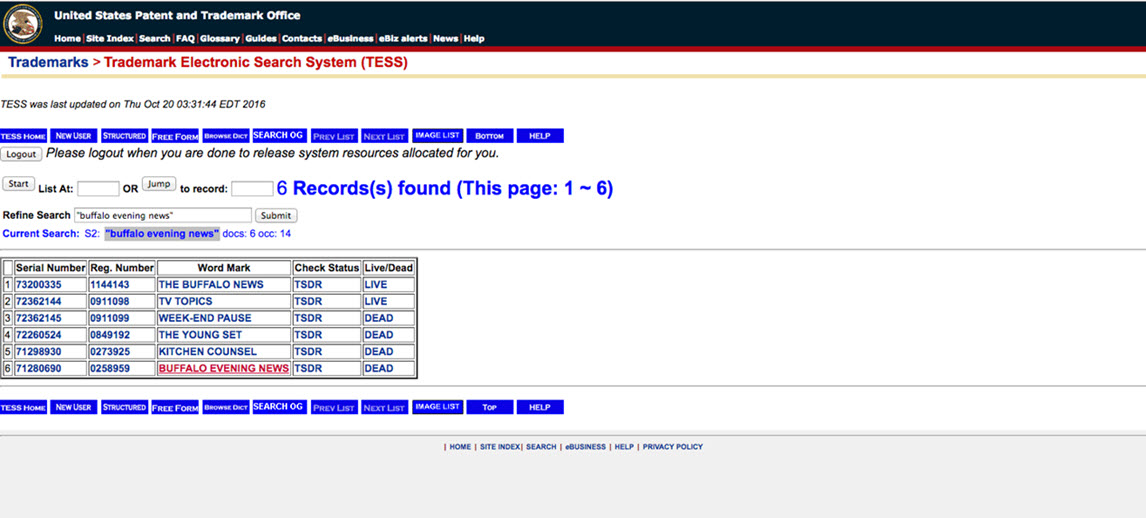
The good news is that the “Buffalo Evening News” trademark is officially “dead”  (see attached screenshot).  This may be used to promote the service, should you wish to do so.

This analysis and a similar caveat would apply to any other newspaper.


Image of Trademark search for Buffalo Evening News