
School Districts

Tax Exempt Rentals

Submission Date

Question

The library is chartered as a school district public library and thus exempt from NYS sales tax. Due to a mold issue we ended up having our HVAC contractor rent two humidifiers for us, the contractor made the arrangements and we paid for the rental via the contractor. The contractor told the renting business that we were tax exempt. The renting business refuses to remove the sales tax. They claim that the sales tax exemption only applies to purchases and not rentals. I have not been able to find anything that verifies the claim of the renting agency.

Answer

Short answer: You can't find anything to verify that claim because what is claimed is wrong.

Long answer:  The rental business may be wrong, but I can't blame them the way I can blame someone for parking in a "No Parking" zone.[1]

That's because if they are basing their answer on a plain reading of the relevant regulations (N.Y. Comp. Codes R. & Regs. Tit. 20 § 529.7), the exemption applies only to "sales."

Here's the language from the regulations:

(h) Sales to exempt organizations.

(1) Any sale or amusement charge to or any use or occupancy by an exempt organization to which an exempt organization certificate has been issued is exempt from sales and use tax.

So, a literal reading of the regs suggests that the exemption applies only to sales (and amusement charges[2]); there is no reference to renting or leasing or borrowing equipment.[3]

However, a quick check of advisory opinions[4] from the New York Department of Tax & Finance confirms that rental fees are considered exempt, too. Here is an excerpt that confirms this:

When Petitioner, within 90 days of the transaction, accepts in good faith from its customer an appropriate and properly completed exemption document showing that the purchase is exempt from sales tax, Petitioner is relieved of its burden of proving that the transaction is exempt and need not collect tax on sales or rentals to that customer. See section 1132(c) of the Tax Law.

...

When its customer is a building owner that is an organization exempt from sales tax, Petitioner’s rental or sale of equipment will be exempt from tax.

...

The organization claiming exemption from the tax must be the purchaser of record on Petitioner’s bill or invoice and must be the payer of record. See section 529.7(h) of the Sales and Use Tax Regulations. [emphasis added]

So, there you have it: rentals to tax-exempt organizations are exempt just like sales.

I am sorry you are having to put up not only with mold but also with overly literal HVAC vendors.  I hope you can show them the opinion I've linked to and reach a good resolution.  If not, I suggest you have them call their accountant or the helpful folks at the New York State Tax & Finance Information Center: https://www.tax.ny.gov/help/contact/


[1] Or smoking in a "No Smoking" area.  Or allowing your dog off the leash in a sensitive area reserved for birds and kicking off a massive social media firestorm....

[2] I resisted the urge to look up the regulatory definition of "amusement charges" so I can let my imagination run wild on the fun stuff that can be taxed.

[3] I reviewed this answer with my husband, a CPA, who pointed out that the regulation says "use" which can be construed as "rental."  So, he wasn't as inclined to be tolerant of the rental company as I was.  But I have a soft spot for HVAC.

[4] Specifically, this advisory opinion: TSB-A-03(31) from July 17, 2003, found as of July 26, 2023 at https://www.tax.ny.gov/pdf/advisory_opinions/sales/a03_31s.pdf.

Dos and Don'ts Of Addressing School Library Censorship

Submission Date

Question

NOTE: On 5/13/22, Erie 1 BOCES hosted a program[1] regarding school library materials management.  That same week, the Erie County Bar Association hosted a CLE on the same topic[2].

At both programs, school district library personnel discussed the ethics of their professions.  They also shared their personal experiences with collection management issues, including attempted censorship of library materials.

Both sessions were inspired by concerns, rooted in the current political climate, that school districts could feel pressure to sidestep policy and direct the removal or limitation of "controversial" library materials without due process.

The law, policy, and case law covered at the session was extensive. Below is a summary of the major take-aways, in a "Do's and Don'ts" format.

QUESTION

What are the "legal do's and don'ts" of school district library collection management in New York?


[1] "Collection, Selection, Objection": the recording can be located through your regional BOCES or school district library system.

[2] More information on this "Continuing Legal Education" seminar is here:  https://eriebar.org/product/2433-more-than-a-book-ban-advising-municipalities-schools-and-libraries-during-a-book-challenge/


Answer

DO ensure your school district library system, school district, or school has a robust and well-thought-out "school library materials policy"[1] ("Policy") governing selection, procurement, cataloging, lending, concerns, re-evaluation, and removal of library materials.

DON'T forget to train every person with a role in that Policy[2] on how it works, and why the district has it in place; this includes spending time on the law, regulations, and ethics[3] that govern it.

DO ensure that experienced lawyers and policy-makers have reviewed the Policy for both legal compliance, and compatibility with the unique environment at your district or school.

For example, if your school has an active PTA that likes to fund-raise and donate books to the school library, the method of accepting those donations should conform to the "selection" part of the Policy.[4]

DON'T adopt a Policy and then let it gather dust.  A policy that governs selection, procurement, cataloging, lending, concerns, re-evaluation, and removal of school library materials is a vital part of a school's library--which is a vital part of a school.

DO make sure your Policy honors the professionalism and qualifications of your school librarians and media specialists.  When considering how your district's Policy applies in real-world situations, remember that your school library staff are trained in the selection of library materials.   Because of that, your district's Policy will delegate responsibility for selection and cataloging to those professionals[5] ...and the law in New York, policy of your district, and job descriptions will back that authority up.

DON'T create a potential liability for your school by taking quick steps related to library collection management issues without checking with your district's Policy and lawyer.  Cases such as Pico[6],  the seminal case regarding school board over-reach regarding school materials, happened because school leadership took hasty action without considering policy.

DO maintain familiarity with the most basic tenets of the law in New York regarding school district library systems and school library operations.  This includes Education Law § 1709(1), Education Law §1711[2] [c, d], Education §Law 701, Education law §702, Education Law §310, 8 NYCRR § 90.18 and 91.2.  For a good primer on these, review the NYSED Commissioner Decision 14,229  "Matter of Carney."[7]

Notably, the case law and NY Education Commissioner decisions emanating from these laws and regulations show that ad hoc decisions about curricular and library materials imposed without consulting policy can lead to legal claims, creating unnecessary media attention, community tension, and expense for school districts.

DON'T impose "creative work-arounds" such as using "soft" directives to influence school library collection issues without following policy.

Hypothetical examples of such "creative work-arounds" include:

  • Directing library staff to keep "controversial" books in the collection, but move them off the shelves and into a store-room;
  • Stigmatizing books in the collection by making them available "by request only";
  • Telling parents and guardians with concerns that library material will be removed, without referring them to the relevant policy for lodging a complaint or requesting that it be re-evaluated;
  • Identifying books that may only be checked out after obtaining parent/guardian consent[8];
  • Sharing lists of books checked out by students in excess of what professional ethics, FERPA and CPLR 4509 (regarding privacy) allow;
  • Directing school library employees to avoid selecting a certain "type" of material, even if that material is otherwise appropriate per the district's Policy;
  • Basing content bans on categories of identity protected by local, state, and federal civil rights laws.

These are just a few examples...but anything that would remove or restrict access to school library materials, without applying due process, risks a legal concern and tripping the factors found unconstitutional in Pico.

DO build an administrative and educational team that is READY to respond to concerns about curricular and library materials.  

When it comes to content choices in the classroom or in the library, no Superintendent, Principal, or school board chair can do it all. 

team consisting of the school librarian, experienced teachers and administrators, the district's lawyer, and as needed, the school board, should be ready to respond promptly when there are materials concerns. [9]

DO remember that for every school library material challenged, there are people being impacted by the challenge--including yourself.

These are tough times for school administrators.   Across the country, there is a great awakening to the importance of school boards and the leadership of public institutions such as libraries.

This is good, but it has turned school districts and libraries into zones of potential controversy, with administrators charged with keeping the peace--and people threatening lawsuits on all sides.

At such times, there are three things that, when combined, can create refuge and stability:

First: a cool head.

Do not take an ad hoc action when presented with a library materials concern; lead with policy.

Second: a good team. 

Rely on your people.  They will help ensure legal compliance, the well-being of students, and good service to the community.

Third: a solid policy.

Have it, know it, follow it.

Administrators who find the culture wars on the doorstep of their schools cannot avoid controversy.  But when controversy arrives, if they DO follow policy, and DON'T take ad hoc steps in a panic, school administrators can provide a structure for communities to navigate open and honest discussions[10] of library materials, community values, and their educational environment.

Below is a template[11] for organizing a response, when a library materials[12] issue happens at your school.

School library material concern worksheet

For internal and personal use only

Important information

Answer

Material at issue (title, author, media):


Material catalog information (year acquired, category, shelf location):


First date person using form became aware of complaint:


Complaint made by:


Note: Person is the "Complainant"


Is the complainant a parent or guardian?


Is the Complainant part of a group?


Attach group information


Based on their relationship to the school or community, does the Complainant have standing to make a complaint?


If yes, continue with worksheet...


Is the Complainant following the formal complaint process?


Has the Complainant been provided with a copy of the policy governing how to make a complaint?


Name of school librarian


Other school staff involved in complaint or concern


What is/are the relevant policies?

[attach all policies that apply or might apply]


What people are assembled to help with or to effect response ("Response Team")?


What professional ethics do the members of the response team have to consider when working on this issue?

[attach copies of any relevant codes of ethics as confirmed by team member]


Is there a student involved?


What person on the response team is the primary contact with the student?


Is there any safety or well-being concern for any person involved?


Is there any media or social media discussion of this issue? 


[attach printouts of relevant content]


Is there a relevant union contract or other contract?

[attach contract or relevant section]


Who is the spokesperson for the school or district on this matter?


Track relevant deadlines set by policy or commitment to involved parties:


Deadline:


Deadline:


Deadline:


Deadline:


Deadline:


What was the final outcome of this issue?


When was this matter considered to be complete?


[1] Across New York, this type of policy has many names, and sometimes, is covered by numerous policies.  New York prioritizes local control of school district policy, so a diversity of approaches is right and proper.  The point is that no matter what it is called, or how many policies end up applying, a district has a policy that covers selection, procurement, cataloging, lending, concerns, re-evaluation, and removal of school library materials.  Very often, this will need to be coordinated across school library systems.

[2] For the rest of this article, we're using "Policy" with a capital "P" to denote whatever policy or combination of policies a district has adopted.  That's right, with a capital "P" that rhymes with "C" that stands for "cool" (as in, "We're cool; we have a Policy for this").

[3] The ethics of the profession of school librarian as emphasized by NYSED are found at http://www.nysed.gov/curriculum-instruction/teaching-learning-intellectual-freedom

[4] Sometimes, this might mean having to say "No, thank you," or "We need to take a different approach," to the PTA.  Just another day in school administration.

[5] This is another factor that will vary from district to district in New York, but every policy I have seen grants a significant role to the librarian.  This is why a good hiring pipeline for qualified school librarians and media specialists is critical.

[6] Found at: https://www.oyez.org/cases/1981/80-2043 . This US Supreme Court case ruled that "although school boards have a vested interest in promoting respect for social, moral, and political community values, their discretionary power is secondary to the transcendent imperatives of the First Amendment." 

[7] Found on the NYSED site at http://www.counsel.nysed.gov/Decisions/volume39/d14229

[8] This one is a HUGE concern, because in addition to potential legal and regulatory violations (about which countless law review articles and books have been written), it sets a precedent of parent/guardian pre-approval for ALL school materials...something that is antithetical to the democratic process by which public schools operate. 

[9] "Promptly"...but not immediately.  The benefit of having a team ready to go, and letting parents or community members know that your school is organizing a response per your district's policy, is that it signals that you take the complaint seriously, but also gives the situation breathing room.

[10] Yes, I know "open and honest" can often sound "angry and passionate."

[11] As with all templates on "Ask the Lawyer," this one is illustrative only.  A district or administrator wanting to develop such a resource should confirm a final draft with their lawyer.

[12] This template is for library materials concerns; there are some different factors when there is a challenge to curricular materials.
Access to High School Yearbooks in Public Library

Submission Date

Question

Our local public library has started a collection of donated yearbooks from the high school. They requested to receive or purchase new yearbooks as they were published. As the yearbook contains underage students, information about their sports and clubs, we felt that this was protected personal information and should not be publicly accessible. The understood "agreement" when participating in the yearbook implies that this publication is available only to the current school population. People who are not enrolled, employed, or related to a current student have theoretically been ineligible to purchase a yearbook (it really doesn't come up so no formal policy is in place). We feel that it is a mismatch between telling students to not share personal details and then willingly handing over a roadmap of what meetings and practices they will be attending. Thank you!


Answer

I appreciate the care behind this question: when yearbook information is being assembled, not many people are thinking about all the places the publication could potentially go.

Whenever I get a question related to a yearbook, the first thing I do is check my legal research service to see if there are any new yearbook cases[1] in the New York State or federal courts. It's a chance to check on the latest in a niche area of case law, as well as to make sure I am working from the most current information.

Every time I check with the list of cases, I am reminded that while most people bust them out every so often for nostalgia or period-specific hairstyle mockery, one of the most frequent uses of yearbooks in the legal world is the identification of potential criminal defendants.

That's right. There are numerous cases[2] that show that in addition to a police station photo-array and a classic lineup, trotting out the high school yearbook is another way for people to seek out suspects in criminal matters.[3]

All to illustrate the member's very real concern: yearbooks, which can be used to directly and indirectly convey so much information about students, do not remain in school and student hands, and are not used exclusively to travel down memory lane.  They can be given away, they can be sold, and they can end up in police stations...perhaps by route of the public library.

Does that mean the library shouldn't house them?  Not from where I sit, but I do think some reasonable precautions to guard against releasing information about minors could be taken.

Schools[4] who wish to take such precautions can do the following:

1.  Register the copyright of the yearbook to the school.

2.  Include a copyright notice and a "reservation of rights clause"[5] in the published hard copy version, barring duplication for any purpose whatsoever.[6]

3.  Remind (it would be largely ineffective to require) students to keep their copy safe at home[7];

4.  If requested, provide a copy to the public library with the condition that the copy will not be in circulation and certainly not be digitized until a year after the earliest class featured in the book has graduated (i.e., if the books' youngest students are in class of 2030, the book should not be in circulation until 2031);

5.  Ask if the book could always be in a "special collection" that does not leave the library and cannot be scanned[8] (either forever, or until a specific date);

6.  If advertisers or sponsors require a copy of the book, make sure the advertising contract limits their use of the book to things that don't risk the privacy of the students (no leaving the display copy at the bar in the restaurant who bought an ad).

In this day and age, it can seem almost quaint to worry about the risk that over-exposure of yearbooks poses to privacy. But as the member points out, the information that can be gleaned from a yearbook can reveal things about a student's identity, activities, and schedule. Further-although they can of course be forged--in a sea of mis-identified or ambiguous images on social media, a yearbook's status as a school district "official" publication means they are a little more authentic (and thus valuable).

For this reason, a little extra care in how yearbooks are published and distributed is well-warranted, and should be respected by anyone who has asked to take it.

Thank you for a thoughtful question!

****BONUS EXTRA***

Here is a sample yearbook "reservation of rights""

(c) [YEAR] [District Name]

This [insert year] yearbook is a collective work protected by copyright owned by the [insert school district].  Individual images and compositions may be owned by individual authors.  No part of the book may be reproduced in any medium whatsoever without permission of the District.  The names and likenesses of people featured in this publication are protected by the laws of the state of New York.  Inquiries for permission may be directed to [address].

As with all template language, this is just a starting place...review the final with your lawyer before using!


Suggested tags: Yearbook, copyright, school district, digitization, image use, privacy


[1] It's a very sophisticated legal search; I visit Lexis-Nexus, and type "yearbook" into the search bar for state and federal cases, and organize the results "newest to oldest."

[2]For example, see Wagner v. Hyra 518 F. Supp. 3d 613 (NDNY Feb. 10, 2021); Tytell v. AIW-2010 Wind Down Corp., 2019 N.Y. Misc. LEXIS 5412 (NY Oct. 19, 2019); Williams v. County of Suffolk, 2019 N.Y. Misc. LEXIS 5412 (NY Oct. 1, 2019). I would add that cases against genealogy sites like Ancestry.com and PeopleConnect.com are also often yearbook-driven; for an example, see Braundmeier v Ancestry.Com Operations Inc., 2022 US Dist LEXIS 212415 [ND Ill Nov. 23, 2022, No. 20 C 7390].

[3] I am not endorsing this practice, just noting that it exists.

[4] While it will depend on the circumstances, the school will be the owner of the copyright to the yearbook, even if professional photographers and other contributors retain the rights to their original contributions.

[5] This is really just language to warn people off from making non-fair use copies.

[6] Neither the copyright registration nor the notice will be a "magic bullet" that will stop a third party from using yearbook-gleaned information if they are determined to act creepy, but they can help reduce certain opportunities for creepiness.

[7] Maybe include a free ticket to the 80th class reunion, only redeemable if presented intact with the yearbook?

[8] Except to make adaptive copies per the ADA, of course (or to address damage as allowed by 17 U.S.C. 108).


Retroactive Background Checks

Submission Date

Question

We have a school district public library board considering requiring background checks for new employees. They are concerned that they may be legally required to background check all current employees. Would there be any legal reason they would need to do so?

Answer

[NOTE: for background to this short answer, please see the much longer "Ask the Lawyer" Background checks and fingerprinting for new employees, that addresses the tightrope walk/legal minefields of employee background checks.]

So, does a school district public library[1] implementing a background check for new employees have to also check their current ones?

The answer is: no; barring an over-ruling requirement (such as a term in a union contract) a library board can implement a background check policy for all hires going forward, without imposing a "retroactive check" requirement for current employees. 

However, I would never advise that approach.  Here are three reasons why:

1.  Possible discrimination

A policy to only check the backgrounds of "new" employees could have a disproportionate impact on candidates on the basis of age, or gender, or race (to name a few).  By not checking everyone, an employer risks the appearance of (or actual occurrence of) illegal discrimination.

2.  Possible liability

Employee background check policies are implemented to reduce risk.  If an employer is using employee background checks to reduce risk, there should be a very good reason for not checking all employees (such as a union contract that bars it[2]), or the employer risks a claim of negligence.

3.  Worker relations

A work environment should be a place of high trust.  By subjecting one class of employees ("new" employees) to heightened scrutiny, in addition to the possible concern mentioned above in "1," it creates an unbalanced environment for trust.  This is bad for morale.

I appreciate that background checks can come with a cost, so minimizing their frequency is helpful.  I encourage any library implementing such a policy to check with their "Directors & Officers Insurance" carrier, since sometimes, carriers offer resources to defray and even pick up the costs of the check.


Thank you for a thoughtful question.


[1] Of course, if a school district public library is in a school (not a common scenario; school district public libraries are largely autonomous and separate from school district property), and if the librarians are on the payroll of the district, then they are already being background checked and fingerprinted, per the chart here: http://www.nysed.gov/educator-integrity/who-must-be-fingerprinted-charts.  Of course, this question pre-supposes that the board is setting the hiring policy, which means the library is autonomous.

[2] Just to be clear, a contractual obligation to not conduct criminal background checks should never be in a collective bargaining agreement!  However, some reasonable restrictions on the scope of such a check would be consistent with NY law and policy.

Transfer of Funds in School District Public Libraries

Submission Date

Question

What law, regulation, or regulatory authority governs the budget transfer policy at a school district public library?  Is there any case law or authority on that?

Answer

Quite a few laws, regulations, and regulatory authorities will impact the budget transfer policy of a school district public library.  Here are the biggies:

  • NY State Constitution
  • NY Education Law
  • NY General Municipal Law; and
  • GAGAS[1]

The trick to this question is that New York's school districts, which often (but not always) act as treasurer for an affiliated school district public library, must follow not only the above-listed laws and standards, but also must follow school district-specific rules for managing budgets.

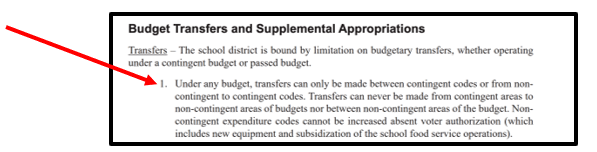
What do those school district-specific rules say about budget transfers? As can be seen in the below excerpt from the "School Districts' Accounting and Reporting Manual," a school district can only transfer funds into the budget line of a contingent fund.[2]

Screenshot of budget transfer law

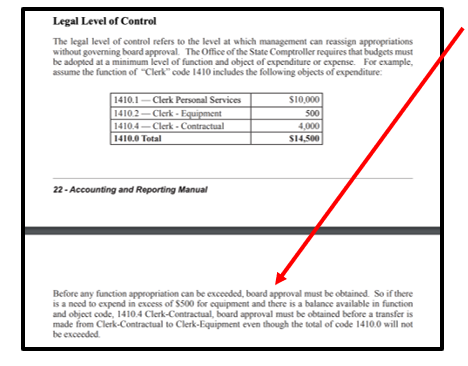
Other public entities, however, follow different rules...rules that are a bit more liberal about transfers between budgeted lines, since for inter-line transfers, "only" board approval is required...as seen below in the[3] Comptroller's "Accounting and Reporting Manual" for towns, villages, and other local government entities:[4]

Screenshot of budget transfer law 2

SO: does a school district public library in New York have to follow the rules of its sponsoring district? 

Here is what the Comptroller has to say:[5]

Public Libraries — Sponsored by counties, cities, towns, villages or school districts in most circumstances [are included in a local government's accounting] because of the existence of financial accountability as evidenced by funding of operations, approval of and responsibility for issuance and payment of debt and the ownership of real property. While this is the norm, situations do exist where the library is virtually autonomous and could be considered a special purpose government.

...

Final determination must be made at the local level after considering ... the appropriate criteria as they may apply to both governmental and non-governmental units.... [emphasis added]

In other words--while I hate to punt on this question-- IT DEPENDS.  There can be no one answer; the determination must be made at the local level--and by a person professionally qualified to make the determination.

That said, as a professional, I will go out on a limb and say that every Comptroller audit of a school district public library I have ever read emphasized the difference between the library and the district they are affiliated with.[6]  Further, the Comptroller, in those audits, has stated that independent board authority and oversight by the trustees must be exercised, even when the school district functions as treasurer. 

For this reason, I would comfortably suggest the presumption should be that the requirement to transfer only into a contingent fund, per the excerpt first pasted above, applies solely to a school district, and not to a school district's separate public library, even if the school district is the custodian of the funds, unless the two entities are so integrated that the library operates as a "component unit"[7] of the district.

That said, for school district public libraries who must develop policy based on this distinction, the person to answer this question is the accountant finalizing your audits and financial statements, since they are the one with the professional duty here.  That said, once they have determined that answer at the local level, ALL parties (the school district, the library, their accountants, and their lawyers) should be in agreement as to the reason for the decision.

Thank you for a good question, and for this reminder of why I became a lawyer, not an accountant![8]


[1] Not a gathering of meat-clad divas, but rather: "Generally Accepted Government Accounting Standards".

[2] From https://www.osc.state.ny.us/files/local-government/publications/pdf/arm_schools.pdf, page 25.  If you read the excerpt deeply, you will see I am oversimplifying...and if you want to see how much I am over-simplifying, read the whole manual!  School district budgeting is an art.

[3] riveting

[4] From https://www.osc.state.ny.us/files/local-government/publications/pdf/arm.pdf, page 22.

[5] From https://www.osc.state.ny.us/files/local-government/publications/pdf/arm.pdf, page 34.

[6] A good example of this emphasis on autonomy can be found in the 2014 audit of the Fairport Public Library, found at https://www.osc.state.ny.us/local-government/audits/library/2015/06/12/fairport-public-library-financial-management-2014m-354.

[7] A good flow chart on how to assess of a library is a component unit is on page 35 of this manual: https://www.osc.state.ny.us/files/local-government/publications/pdf/arm.pdf.

[8] Full disclosure: I am married to an accountant...a CPA, no less.  This of course gives me no professional cred when it comes to accounting, but it does lead to some good conversation on chilly Buffalo nights (he also has an MLS, which makes him all the more alluring, of course).

Petition Needed for School Ballot Vote

Submission Date

Question

For public libraries seeking school ballot funding, there's some gray area around whether a petition with signatures of eligible school district voters needs to be submitted to the school. Is the petition actually needed and if so, what laws and policies define this process?

Answer

When I started writing “Ask the Lawyer” in 2016, my daughter was two years old.

I would like to be able to answer this question like a two-year-old Molly and say simply (and loudly): “NO!” (you don't need a petition).

But time grinds on, so sadly, I have to answer this question like 9-year-old Molly, saying instead with an eye roll:  “You shouldn't have to do that.  It's not specifically required, and no one has had to do that for ages. But I guess there is some sort of precedent, so maybe do it so you don't get trolled?”[1]

The reasons for this convoluted stance is as complex as the reason why my daughter's “craft corner” is still a mess.[2]

Here they are:

As many of you know, the board of a public library (of any kind) can require a school board to put a vote to “establish or increase” a levy in support of that library per Education Law Section 259(1)(a).

In 2007, the NY Legislature amended [3] 259(1)(a) to specify that such a levy: “shall be submitted to the voters of the district as proposed by the library board of trustees...”

Lest anyone get confused as to why the Legislature would make such a change, the memo in support of the bill explained:

This legislation would amend Section 259 of the education law to clarify the ability of a library board of trustees to place budget proposals before voters for approval. Paragraph a of Subdivision 1 of Section 259 is amended to authorize only budget proposals approved by the library board of trustees to be placed on a ballot. [emphasis added]

This purpose of the amendment is explained in the section of the legislative memo ‘justifying’ the amendment:

JUSTIFICATION:

This bill clarifies and conforms provisions relating to library budget votes. The amendment to paragraph a (budget votes in school district public library) conforms the mechanism for placing a vote on the ballot to that already in Paragraph b (budget votes on municipal funding of other types of libraries). Ensuring endorsement of the proposition by the library board of trustees will eliminate the potential for multiple and conflicting library budget proposals on the same ballot. School budget propositions are currently subject to approval of the school board.

...

 While interpreting statutes is a complex exercise, ‘plain language’ is an important factor.  In this case, the plain language of both the 2007 amendment and its supporting memo indicate that to avoid “multiple and conflicting library budget proposals,” the path to a school district ballot is via the library board, for terms “as proposed by the library board of trustees.” And since this is per Education law 259(1)(a), which clearly states the resolution is “as proposed by the board” no petition is required.

Okay, great.  So the library board can adopt a resolution to propose to the voters of the district, and the voters of the district have the power to say ‘yes’ or ‘no.’

I would love to stop this RAQ there, but there is another wrinkle to consider here: is there a way for the voters to put such a resolution on the school district ballot?

This question is raised by two sections of the Education Law.

First: Section 259(1)(b), pertaining to most[4] municipal ballots, which provides:

1. Except as provided in subparagraph two of this paragraph, whenever qualified voters of a municipality, in a number equal to at least ten per centum of the total number of votes cast in such municipality for governor at the last gubernatorial election, shall so petition and the library board of trustees shall endorse, the question of establishing or increasing the amount of funding of the annual contribution for the operating budget of a registered public or free association library by such municipality to a sum specified in said petition, shall be voted on at the next general election of such municipality, provided that due public notice of the proposed action shall have been given.

Second: Education Law Section 2008, which empowers school district voters to initiate a vote on taxes.

This combo is nicely summarized in an opinion from the New York State Comptroller in 1981, when the authority of a library board to put the appropriation on the ballot was still a bit shaky[5]:

Therefore, it is the opinion of this Department that where a library board requests an appropriation proposition to be placed on the ballot at the annual meeting of a central school district, the board of education must comply. Such a proposition may also be submitted to the voters by petition under section 2008(2) of the Education Law or the board could include such a proposition with a revote called under section 2007.  The notice of any meeting where such a proposition will be voted on should so state. [emphasis added]

But that was back in 1981.  Since the 2007 amendment to Education Law 259 made it very clear that only a budget “endorsed by the library board” can be put to a school district vote, it would follow that the voters no longer have the power to submit a petition under Education 2008 (without the endorsement of the board).

So: is a petition signed by a certain number of voters required to put a budget before the voters of a school district?  No.  Just like a school board, the library board doesn't have to obtain a petition to exercise its authority under 259 and submit a budget for a vote.  And can a group of voters use their powers under Education Law 2008 to force a vote?  Again, the language and history of the law suggests the answer is ‘no.’

The tricky thing with all of this is that while the language is clear, the changes to Education Law 259(1)(a) have not been put to a legal test, and there is enough ambiguity for a school district to want to stick with a tried-and-true (pre-2007) practice and insist that a school district ballot 1) must be initiated by a petition signed by the right number of voters; OR 2) can be initiated by district voters per 2008 without the need for board approval.  What can I say?  Lawyers love precedent.[6]

And now, of course, I have to give a disclaimer.

Sitting here in my lawyer cave, I can argue what the language of the law ‘suggests.’  BUT until we get a test case to settle the issue—like how the 2022 Eisenhauer v. Watertown[7] case settled whether school district taxes can support a municipal library without violating the NY Constitution[8]—we won't have absolute certainty.  So, libraries should work carefully with their counsel, who should work carefully with the counsel for the school district, to confirm the process and language of school district ballots. Clear, open channels of communication between the library, the district, and the town can avoid problems down the road—and of course, libraries should always get a written opinion when budgets and funding are on the line.

Thank you for an important question!


[1] Yes, my daughter talks like both a lawyer and a Youtuber.  Since most people reading this are librarians, there's a strong chance the children in your life talk this way, too.  Yay, reading and multi-media literacy!

[2] “I was going to clean up but I couldn't find anywhere to put the dried mint and the glue gun, so I stuffed all the pipe cleaners in an old shoe box and called it a day.”—Not an exact quote, but a good paraphrase.

[3] Bill #A5107, sponsored by Assemblymember Eddington, and likely worked on by many people you know in “LibraryWorld” (at the time, I was in HigherEdWorld).

[4] The law makes excludes from the term “municipality” a city with a population of one million or more, and includes a county when the public libraries located in such county are members of a federated public library system whose central library is located in a city of more than three hundred thousand inhabitants.

[5] Reporter 1981 N.Y. Comp. LEXIS 726 * | 1981 N.Y. St. Comp. 176 ** Opinion No. 81-167

[6] It's a lawyer's security blanket.

[7] (Matter of Eisenhauer v Watertown City Sch. Dist., 208 AD3d 952 [4th Dept 2022]), appeal dismissed by (Eisenhauer v Watertown City Sch. Dist., 39 NY3d 944 [2022]).  By the way, the case has more going on than just constitutional issues, so give it a read.  It has nice language on the autonomy and independence of municipal libraries.

[8] Personally, I didn't think that question was up for debate, but the decision at all three levels of review (Supreme Court, Appellate Division, and Court of Appeals) now leaves no room for doubt.

Code of Ethics Conflict of Interest

Submission Date

Question

What, if any, are the ramifications if a school district public library board of trustee member refuses to sign the code of ethics and/or the conflict of interest/whistleblower policy?

Answer

I am sure there is a very interesting set of facts, personal convictions, and conversations behind the stark facts presented in this question (there always is).  But we’ll address just the stark facts.

Because a library’s Code of Ethics, Conflict of Interest Policy, and Whistleblower Policy[1] are rooted in different areas of the law, a refusal to sign these documents creates an array of ramifications. We’ll explore each type in turn.

But first, it’s important to establish certain base factors.

Base Factors

In New York, most libraries (unless they are part of a larger institutions like a college or museum) are not-for-profit corporations chartered by the New York Education Department’s Board of Regents.[2]  This means that, just like other not-for-profit corporations registered with the New York Department of State, libraries are subject to the Not-for-Profit Corporations Law (the “NFPCL”).[3]  This includes school district public libraries.

Without getting too technical, this means that all libraries in New York are governed in accordance with not only their charters and bylaws, but the applicable parts of the Education Law and the NFPCL, too.[4]

This governance structure impacts questions related to conflicts of interest, whistleblowing, and codes of ethics. With the basic features established, let’s look at the different type of policy in the member question.

Conflict of Interest Policy

Here is what the law says about a refusal to participate in the “Conflict of Interest” policy, as governed by the NFPCL:

The conflict of interest policy shall require that prior to the initial election of any director[5], and annually thereafter, such director shall complete, sign and submit to the secretary of the corporation or a designated compliance officer a written statement identifying, to the best of the director’s knowledge, any entity of which such director is an officer, director, trustee, member, owner (either as a sole proprietor or a partner), or employee and with which the corporation has a relationship, and any transaction in which the corporation is a participant and in which the director might have a conflicting interest.[6]

So, to give a stark answer to the member’s question, per the law, no person should actually be elected to serve as a trustee until the nominee’s Conflict of Interest statement (the “COI”) is completed and submitted.  In other words, if the COI is not turned in, that person should never initially be elected as a trustee (we’ll pick that back up in a few paragraphs when we discuss the election criteria for school district public library trustees).

Whistleblower Policy

A requirement to “sign” the Whistleblower Policy is a slightly different matter.  Unlike the law related to conflicts of interest, the law requiring any not-for-profit with over 20 employees (or revenue in excess of one million dollars) to have a Whistleblower Policy[7] does not come with a requirement for trustees to sign any document. 

Of course, a refusal to abide by the Whistleblower Policy (for instance, a trustee failing to keep a report confidential), could result in a violation of the law, and the libraries’ bylaws, as well.

Code of Ethics

Public school boards must have Codes of Ethics,[8] but libraries—even school district public libraries—do not. There is no requirement in the NFPCL, nor the Education Law, nor any applicable regulations, that a public library have such a code.

That said, to clearly express and enforce a library’s values, a Code of Ethics is often built into a library’s bylaws or adopted as a stand-alone policy of a library’s board.[9]   The bylaws, or policy itself, could also require that it be signed.  Once it is a requirement of the bylaws or policy, it does not have the force of law, but it can be enforced by the board.

Refusal to Sign

Which brings us to: whether it a requirement of law or policy, the refusal to sign of a board member must be addressed under the library’s charter, bylaws, and the NFPCPL. 

Under NFPCL §706, a board is empowered to remove a board member per the procedures in its bylaws.  Therefore, if a board determines that failure to sign the Code of Ethics or Whistleblower Policy is unacceptable, or that a failure to sign a Code of Ethics makes the library non-compliant with the law, then that board member can be removed, provided the remaining trustees are careful to follow the bylaw’s procedures for doing so. 

This can be a divisive issue, since I imagine someone could present a debatable reason for not signing a Code or other policy,[10] but since a Code of Ethics or mission statement is something every board member must support as part of their service to the library, the root cause of the refusal might be just as serious as the refusal, and in any event, must be resolved. And that is, except for one wrinkle, the lay of the land.

School District Public Library

At school district public libraries, board members are elected per the requirements of Education Law §260. 

§260, and by reference, §2018 of the Education Law, include very precise conditions for the nomination and election of a school district public library board member—none of which is a pre-vote signature on a COI, or a signed acceptance of a Whistleblower Policy or Code of Ethics.

Of course, per Public Officers Law §10, all school district public library trustees must take and file an oath of office “before he[11] shall be entitled to enter upon the discharge of any of his official duties.” This means, somewhere in the “pre-term” area after the election but before the newly elected trustee starts working, there is a zone where they can, based on a refusal to take the oath of office, not be qualified to start the term.[12]

The consequences of a refusal to sign a COI are a little less well-defined, but it is clear that if a board tolerates a refusal, the organization is not in compliance with the NFPCL.  The refusal to sign a Whistleblower Policy is not controlled by law, but the failure to actually follow it is.  And the failure of a board member to sign a Code of Ethics is a matter to be decided by the rest of the governing board.

What Happens Next?

The refusal to sign and participate in critical board policy cannot simply be ignored.  It has to be addressed, and the rest of the board has to follow the rules as they address it.

Barring any obvious provision in the bylaws or wording in a particular policy, what does the board use as a playbook for dealing with this type of challenge?  Upon confirming the factors leading to the refusal, a board’s executive committee,[13] consulting with the library’s lawyer and working from copies of the charter and bylaws, must consider the facts, could develop a solution.  The solution could be a revision of a policy to address a particular concern, or, in the case of an incomplete COI, removal of the member.  In no event should this be done without the input of an attorney, since the stakes are high, and feelings may be strong.

Thank you for an important question.


[1] In their quest to impose order on the universe, lawyers often use capitalization to express when a “thing” is a “Thing.”  For purposes of this answer, the various policies the member references are each Things, and so while certain style guides may disapprove, the capitals are there to stay!

[2] The way corporations are created in New York is a type of legal conjuring.  For more information on this particular type of conjuring, check out the New York State Education Department’s Division of Library Development Guide at http://www.nysl.nysed.gov/libdev/charter/index.html, and Education Law §255.

[3] This application of the NFPCL is set forth in NY Education Law §216-a, which is a fun read on a rainy day. 

[4] Intricate arrangements like this are why people like me have jobs!

[5] In the law, “director,” “board member” or “trustee member” all refer to elected members of the board of trustees.

[6] This is from NFPCL §715-a (c).  This language, or something substantially similar, should be in every library’s Conflict of Interest Policy.

[7] NFPCL §715-b.

[8] §806 Section 1(a) of NY’s General Municipal Law.

[9] Boards of museums and other cultural agencies chartered by the Regents are required to have a code of ethics; see 8 NYCRR § 3.30.

[10] I cannot imagine a good reason for not signing a COI, unless the policy was badly worded, there is confusion about the policy, or the director really does believe they should be allowed to vote for their wife’s company to install the new library floor.

[11] It’s 2019.  We really need to work on the pronouns in our legislation.

[12] As but one example of this, see 2001 Op Comm Ed No. 14,710

[13] Or the trusteeship committee, or the board, working as a committee of the whole…whatever group will ensure thorough assessment and the preparation for, if needed, a removal vote.