
Copyright

Viewing Physical Media of Live Performances

Submission Date

Question

I recently purchased a copy of a DVD at the request of a professor. I believe that the professor intends to show this film in class. The DVD is relevant to course materials. 

I opened up the case to catalog it, and inside the front cover was an insert ... asserting that a public performance rights license must be purchased to be able to show the DVD even in a classroom setting.

I purchased the DVD believing that the professor's showing would fall under Fair Use, as it would be limited to a specific and relevant educational course, shown only to students registered for that course, in a face-to-face classroom setting, using a legally purchased copy. However, my doubts are creeping in because the wording of the insert makes me wonder if this DVD was legally purchased.

If the producer intended for it to be sold only for home/individual use and expressly prohibits any type of group viewing as part of the sale, is my purchase with intent to use the DVD in a classroom setting illegal? Does this insert override or prohibit what would otherwise be Fair Use?

Thank you for your insight and expertise!

Answer

Before we jump into things, let me first offer this unambiguous assurance: Doubts, begone! The use you contemplated is allowed by law.

Okay, with that out of the way, let's break it down.

As we have reviewed on “Ask the Lawyer” before,[1] under Copyright Section 110.1, nonprofit education institutions can show physical copies of movies in class,[2] so long as the copy they are viewing was not “unlawfully obtained.”

Or, as the law puts it, it is not infringement for a school to engage in:

... performance or display of a work by instructors or pupils in the course of face-to-face teaching activities of a nonprofit educational institution, in a classroom or similar place devoted to instruction, unless, in the case of a motion picture or other audiovisual work, the performance, or the display of individual images, is given by means of a copy that was not lawfully made under this title, and that the person responsible for the performance knew or had reason to believe was not lawfully made;

When it comes to what constitutes knowledge of an “unlawful” copy, Congress commented on this in House Report 94-1476:

The exemption [from infringement] is lost where the copy being used for a classroom performance was “not lawfully made under this title” and the person responsible for the performance knew or had reason to suspect as much. This special exception to the exemption would not apply to performances from lawfully-made copies, even if the copies were acquired from someone who had stolen or converted them, or if the performances were in violation of an agreement. However, though the performance would be exempt under section 110(1) in such cases, the copyright owner might have a cause of action against the unauthorized distributor under section 106(3), or against the person responsible for the performance, for breach of contract.

Again: this means the in-class showing contemplated by the member can happen, so long as the school doesn't know the copy was unlawfully made (or didn't make the unlawful copy directly).

From the perspective of an author or owner of a work, this can be frustrating: it means that faculty at a college or university can show a movie, read a poem, or display a painting without the permission that, without the 110.1 exception,[3] might be required.[4] 

For purposes of this question, we're going to assume that the use proposed by the member checks ALL the 110.1 boxes:

  • The use is for a not-for-profit educational institution;
  • The use is by a faculty member or student; and
  • The use will be confined to a class in which the students are enrolled (not a student club or an open event on campus).

It also sounds like the school is the owner of the actual physical copy, although that is not required to exercise rights under 110.1.[5]

So, with the member having met all the criteria for an in-class showing (or “performance”) to be held under 110.1, can a notice with a physical copy, saying essentially, “No 110.1 here, you must get permission to play this in class, or we'll sue!” remove the law's protection?

No.

If the law worked that way, every 110 protection from liability for infringement (which ranges from protections for education, to protections for people with disabilities) could be revoked ad hoc. The law might as well cease to exist. Happily, laws usually don't work that way.

Of course, before being able to give such a decisive answer, I checked the most recent case law and copy of the status on LEXIS-NEXIS. 17 U.S.C. 110 has not been amended since 2005. There has never been an opt-out provision that an owner can invoke with a notice on a physical copy. There is no case law that suggests such an opt-out exists.

Although I am able to give a decisive answer to the fact pattern, the member was right to take a pause and check in when they felt unsure. Copyright, especially in academia, can have some odd-twists and turns. But even though this notice tries to pull the rug out from under the feet of educators, 110.1 abides. [6]


[1] See Screening DVD as part of curriculum: https://wnylrc.org/raq/screening-dvd-part-curriculum

[2] Note: this section pertains to in-person class. For online instruction, we need to delve into 110.2, a.k.a. the “TEACH Act” (see Streaming movies in school and the TEACH Act: https://wnylrc.org/raq/streaming-movies-school-and-teach-act).

[3] Small quibble: Use under Section 110.1 is not “Fair Use,” which is governed by Section 107 of the Act. Academic institutions certainly have rights under 107, but I prefer 110, which has much more defined parameters. No balancing test in 110!

[4] Without Section 110, more arguments would need to be made under Section 107 (Fair Use). As reviewed in footnote 3, 110 is much easier to apply.

[5] For other types of entities, and other mediums, some considerations under 17 U.S.C. 109 (governing the sale and rental of copies), could require further assessment as to if the copy was legitimate. But that doesn't apply here!

[6] I love 110.1: it really ties the classroom together.
Transferring Copyright After Creator's Death

Submission Date

Question

Many libraries/archives hold unpublished materials whose creators are deceased, but are still protected by copyright since copyright lasts 70 years after death.

If a library/archives lacks a deed of gift (or if the deed of gift doesn’t explicitly transfer copyright), can an heir transfer copyright or otherwise provide permission for the library to publish/digitize/etc? In NY, are copyrights automatically transferred to heirs when someone dies? What if there is no will?

Answer

Many libraries do indeed have materials[1] that are unpublished, one-of-a kind, original works, such as photographs, letters, drawings, and recordings. 

Some of these works may have significant financial value, while some may be more valuable in terms of local history and culture.

When the donors of such works are deceased, a library is best suited to use them[2] if they can show they have ownership of both the physical object and copyrights.

As the member points out, the copyright will survive the life of the author. And so they ask:

  1. If a library/archives lacks a deed of gift (or if the deed of gift doesn’t explicitly transfer copyright), can an heir transfer copyright or otherwise provide permission for the library to publish/digitize/etc?
  2. In NY, are copyrights automatically transferred to heirs when someone dies?
  3. What if there is no will?

To illustrate the answers to these questions, let’s create a hypothetical scenario:

Person ABC[3] was a long-time member of the Library.  Prior to their death at the age of 98, they left the Library 200 sketches. Some library workers still remember the day Person ABC dropped them off, but there is no documentation (“deed of gift” or other document acknowledging the donation). The Library would like to create a special collection to house the sketches and to digitize them for inclusion in an online archive. The Library has found their surviving spouse, child, and the executor of the estate (who has zero information about the sketches, which were not mentioned in the will).

First, the Library can work with the heirs to obtain an acknowledgment letter confirming there is no disagreement regarding custody and ownership of the physical objects.

Second, the Library can work with the same people to obtain an assignment of copyright, since without a will, the copyright would have passed to Person ABC’s heirs.[4]

And third, the Library can initiate outreach for the letter with an outreach letter summarizing the situation and the parties’ communications.

Here is a sample of the outreach letter:

As you know, the Library has 200 sketches by Person ABC and remains grateful for the donation of these items.

Recently, the Library has been taking steps to formally accession the sketches Person ABC left to the Library. This work includes planning to make digital images of their important work available for purposes of research and scholarship.

To ensure we can put accurate and helpful information about the pictures in our archive and to facilitate its use for scholarship, the Library has two requests:

First, can you kindly sign the accompanying donation acknowledgement? We know that the sketches were left to the Library, but this acknowledgement will help us document their provenance.

Second, if you are amenable, can you sign the accompanying “Assignment of Copyright?” This will position the Library to archive the sketches digitally and to allow use of images for purposes of scholarship and research. 

Thank you for considering providing the Library with this documentation. Please don’t hesitate to contact me with any questions.

Sincerely,

Director

Here is a sample of the Donation Acknowledgement:

DONATION ACKNOWLEDGEMENT

The undersigned: NAME and NAME (“Acknowledging Parties”), all being at least 18 years of age, hereby review and acknowledge:

1.  To the best of our joint and individual ability to determine, the sketches listed below (the “Photographs”) were created by Person ABC:

[insert list/description]

2.  A copy of each of the Sketches is attached as “A.”

3.  To the best of our joint and individual ability to determine, the physical copies of the Sketches were given to the Library by Person ABC in approximately YEAR.

[include signature and witness blocks]


Here is a sample of the Copyright Assignment:

COPYRIGHT ASSIGNMENT

The undersigned: INSERT NAMES (“Assigning Parties”), all being at least 18 years of age, hereby review and acknowledge:

1.  To the best of our joint and individual ability to determine, the sketches listed below (the “Sketches”) were authored by Person ABC:

[insert list/description]

2.  A copy of each of the Sketches is attached as “A.”

3.  Person A was born on DATE and died on DATE. 

4.  The Assigning Parties were their only heirs.

5.  Any and all rights to the Sketches possessed by the Assigning Parties per the Copyright Act and the Estates Powers & Trust Law are hereby assigned to the NAME Library.

[include signature and witness blocks]


For the most part, confirming that the natural heirs have acknowledged the gift—and that they convey any copyrights they have inherited—will ensure no competing claim can muddy the waters of using the works for archival and research purposes.

There is, of course, one large wrinkle here.

What is it?

Money.

In the event the works in question become valuable, the above-listed recital might not be enough.

To illustrate why, let’s return to our scenario...

As it turns out, Person ABC was a famous space marine, although tales of their exploits have only recently made it back to earth. Consequently, interest in her 200 sketches of rocks, deserted wasteland, and tentacles emerging from blown hatchways is WAY up, and a famous movie producer is offering millions of dollars to license her work and story.

Just as the Library is about the sign a deal that will ensure the Library will be able to repair its leaking roof and to add a new “Person ABC” science-fiction wing to the Library, one of the people who signed the Gift Acknowledgement and Copyright Assignment calls a press conference and says “I signed those documents before I knew what I was doing.” They then hire a well-known lawyer to try and argue that the documents are invalid.

Cases that deal with contested “deeds of gifts” and donor documents are all over the place.  When enough money is on the line, every detail will be scrutinized.  Was Person ABC of sound mind when they gave the Library the documents?  Did they unfairly disinherit their child?  Is one of the witnesses now a known liar? 

No amount of customized legal drafting can forestall these types of objections, but here is the take-away: whenever possible, a library or other cultural institution should use a customized donation document reviewed by a lawyer to ensure it is as strong as possible.  The more valuable the asset, the more it is essential to draft and review the documents to meet the specific circumstances. 

Thank you for an excellent question.


[1] I am using the term “materials” because many times, the type of material we are discussing is not in the collection of the library, nor yet part of an archive or special collection.

[2] By “use them” I mean: add them to a collection, a special collection, or an archive, or to create a special exhibit either in hard copy or online.

[3] I use “Person ABC” rather than a fake name, since coming up with names immediately brings up questions of the larger narrative around the fake person. With “Person ABC,” the reader is free to assign my fake person whatever persona and backstory they like.  Perhaps they were a space marine who fought aliens and donated the library pictures of their intergalactic adventures! Or maybe they were a local artist who taught half the kids in town how to collage. You’re in control.

[4] This is the answer to two of the questions: "In NY, are copyrights automatically transferred to heirs when someone dies? What if there is no will?"

Re-leveling Books Using AI

Submission Date

Question

[This question comes from a regional BOCES.]

Our technology integration specialist suggested that we use an AI tool to re-level books/text by an original author to a more appropriate reading level for students who are struggling. This is now being used regularly with our special education staff for students who are struggling readers. Is this an infringement of copyright?

Answer

In the spirit of learning, I am going to answer this question in a multiple-choice quiz.  For purposes of the quiz, we’ll use the member’s term “re-level” for generating simplified versions of curricular materials.

[NOTE: If you are not feeling playful and just need the answer, please read footnote #2 and skip to the “Final Paragraphs” section of this response.]

Name:                                                                                                             Date:              

Copyright Quiz


  1. A teacher uses software[1] to create a “re-levelled” version of “The Gettysburg Address,” which was published before 1900. Is it infringement?
    1. Yes, because creating a “re-levelled” version of a book is creating a “derivative work”[2] protected by the Copyright Act.
    2. No, because even if it is a derivative work, the book is no longer protected by copyright.
    3. Maybe, if the work was recently turned into a movie.
  1. A teacher uses software to create a “re-levelled” version of the 2020 young adult book All Boys Aren’t Blue, and the district does not have the permission of the copyright owner. Is it infringement?
  1. No, because the use is for education.
  2. No, because the software removes all the parts people are complaining to the school board about.
  3. Yes.
  1. A teacher uses software to create a re-levelled version of a New York Times article for a learning-disabled student and the district does not have the permission of the copyright owner. The teacher only allows access to the student. Is it infringement?
  1. No, because the simpler version is a modification of a single article to accommodate a person with a disability.
  2. No, because the district is a state institution that is arguably exempt from copyright claims in federal court.
  3. Yes.
  1. A teacher uses software to “re-level” a short excerpt of a history textbook to illustrate the dangers of relying on AI to modify learning content and the district does not have the permission of the copyright owner. The class is given a hard copy of the modified paragraph with the unmodified paragraph next to it for comparison, and the assignment is also posted on the class’s LMS[3]. Is it infringement?
  1. Yes, but kudos to the teacher for emphasizing critical thinking.
  2. No, so long as the excerpt is only long enough to demonstrate the point of the modification and is not used as a substitute for the original, allowing it to be considered a “fair use”.
  3. No, not even when the district decides they like the modified version better and decides to re-level the entire book.
  1. A teacher uses software to re-level an entire collection of curricular materials with permission of the publisher, who is not the copyright owner but has an unlimited exclusive license to authorize “derivative works” of the content. Is it infringement?
  1. No, but I am concerned this type of thing could dull our vigilance against the prospect of a future subject to the binary whim of robot overlords.
  2. Yes, because there is no specific permission from the actual author.
  3. No.


Answer Key:

  1. B
  2. C
  3. C
  4. B
  5. A or C, depending on your POV.

Final Paragraphs

As the above quiz scenarios illustrate, the answer to the member’s question is: it depends on a variety of factors, but even if the use is limited to a specific student with an IEP[4], the only ways to ensure the creation/use of an AI-modified version of an entire work is not an infringing “derivative work” is to: 1) only modify works in the public domain; OR 2) only modify works for which a district has specific permission to create derivative works.

The sole exception to this would be a modification that met the criteria for “fair use”[5] (as modelled in question 4).

I will (mostly) leave the ethical/educational/social/futuristic terror aspects of this question to philosophers,[6] ethicists, educators, Writers Guild members, artists, and speculative fiction writers.

That said, if someone uses AI to “re-level” this answer for a 4-year-old, I hope the modified version will be: “Don’t use people’s work without permission, and please don’t give up on people.”


[1] I am going to use the term “software” since the function described could be done by “AI” or (I believe) could be done by a sophisticated “find-and-replace” computer program. In making this distinction, I rely on the definition of “Artificial Intelligence” in 15 USCS 9401, which defines AI as: “… a machine-based system that can, for a given set of human-defined objectives, make predictions, recommendations or decisions influencing real or virtual environments. Artificial intelligence systems use machine and human-based inputs to—

(A) perceive real and virtual environments;

(B) abstract such perceptions into models through analysis in an automated manner; and

(C) use model inference to formulate options for information or action.”

[2] A “derivative” work is a defined term in Section 101 of the Copyright Act. The definition is: “[A] work based upon one or more preexisting works, such as a translation, musical arrangement, dramatization, fictionalization, motion picture version, sound recording, art reproduction, abridgment, condensation, or any other form in which a work may be recast, transformed, or adapted.” An excellent discussion of how AI-generated output can (or might not) be a “derivative work” can be found in the case Andersen v. Stability AI Ltd., 23-cv-00201-WHO (N.D. Cal. Oct. 30, 2023).

[3] “Learning management site.”

[4] An IEP is an “Individualized Education Program” (as I am sure many people reading this know). While modified formats of copyright-protected works can be generated to meet the needs of a person with an IEP (for instance, generating a Braille edition of a printed book), creating a “derivative” work (basically, a simpler or “re-levelled” version of the original work) does not currently fall within this exception to infringement.

[5] “Fair use” is defined by Section 107 of the Copyright Act. For more on fair use, check out the “fair use” tags on Ask the Lawyer, and for educators, review your institution’s “fair use” policy.

[6] I will share a personal story, though. The other day (specifically, “the other day” in November 2023), my 4th-grader come home with a one-page read-aloud assignment called “The Man Who Lived in a Hollow Tree.” It was such incoherent mishmash, I decided to research what the heck was going on. By dint of research, I found out that what the one-page assignment was mostly likely an abridged version of “The Man Who Lived in a Hollow Tree” (reviewed at https://www.goodreads.com/en/book/show/3866740), except the modified version left out critical facts like the main character being a carpenter, his name, and why he chose to live in a tree. I found myself wondering “Who the heck wrote this?” And now, perhaps, I know.

Donated Discards and Copyright

Submission Date

Question

The library has been discussing new ways to handle our discards. A senior staff member of a very significant local library told us recently that they donate their discards to the Internet Archive. A staff member here expressed concerns with IA scanning and making publicly available on their website copyrighted materials, and concern for liability on our part for contributing to potentially illegal activity. The staff member wondered if only materials free from copyright concerns should be donated. At this point we are not looking to create a digital library as IA has done for many organizations, but just simply to donate the material for them to use as they see fit in hopes of the material being used for the greater good. Should we have any concerns with donating our discards to IA? Thanks for helping us sort-out this concern.

Answer

Because it would muddy the core element of this question (Should we have any concerns with donating our discards to [Internet Archive]?), this answer is not going to address the various legal and regulatory requirements different libraries may have when it comes to disposing of discarded books.[1]

With that out of the way, we can dive right into the member’s concerns about liability “for contributing to potentially illegal activity.”

Internet Archive describes its work this way:

“Because we are a library, we pay special attention to books. Not everyone has access to a public or academic library with a good collection, so to provide universal access we need to provide digital versions of books. We began a program to digitize books in 2005 and today we scan 4,300 books per day in 18 locations around the world. Books published prior to 1927 are available for download, and hundreds of thousands of modern books can be borrowed through our Open Library site. One of the Internet Archive's missions is to serve people who have difficulty interacting with physical books, so most of our digitized books are available to people with print disabilities (learn about access here).”

As the member’s question alludes to, some of the content on the “Open Library” has brought accusations of copyright infringement, which Internet Archive has defended under the “controlled digital lending” theory of “fair use”.

The most notorious case is Hachette Book Grp. Inv. V. Internet Archive, decided by the U.S. District Court for the Southern District of New York on March 24, 2023, which found that when not limited to use for search functions or adaptive copies, certain scanning and (controlled digital) lending of books still protected by copyright is not defensible as “fair use.”

The decision was a blow to Internet Archive, which is committed to not only making content digitally available but to decoupling that access from the commercial exploitation of user identity. For an elegant an annotated discussion of this topic, review the amicus brief of Center for Democracy & Technology, Library Freedom Project, and Public Knowledge.[2]

The case is now being appealed, with allies showing up on both “sides.”

With all that going on, Internet Archive is still going strong and still accepting donations.[3] The question that this member asks is: if my organization donates our discarded hard copies to IA,[4] can we also get implicated in alleged infringement?

Bearing in mind that anyone can be sued by anyone for anything at any time, the answer is otherwise: no.

The basis for this answer is Section 109 of the Copyright Act, which provides that “the owner of a particular copy or phonorecord lawfully made under this title, or any person authorized by such owner, is entitled, without the authority of the copyright owner, to sell or otherwise dispose of the possession of that copy or phonorecord.”

This “first sale” doctrine, as it is referred to, does not cease to operate when a party knows or may know that the purchaser or recipient has been found to infringe copyright in the past. In addition, as the ruling in Hatchett points out, there are a number of legitimate uses Internet Archive can make of scanned versions of donated copies.

While it is true that there can be “joint liability” or “vicarious liability” for every person in a “chain of infringement,” providing copies in a manner covered by Section 109 (i.e. selling or donating a lawfully obtained copy) is not one of them.

On the topic of donating to Internet Archive, I will also say: because Internet Archive is attempting to break new legal ground,[5] supporting them is controversial in some circles,[6] while it is an almost sacred duty in some other circles. [7] So, aside from considerations of liability (which, so long as the donations are hard copies, will not pose a concern), it makes sense to review the status of the cases, and decide where your organization stands.


[1] For example, Education Law 260(12) requires that public libraries “… offer to donate such books or materials to a not-for-profit corporation or political subdivision located within the area of the library system or offer to sell such books or materials to the general public.” And different academic, school, and court libraries will have their own rules, regulations, bylaws, and policies governing donations.

[2] Shiva Stella, Public Knowledge Joins Amicus Brief Defending Controlled Digital Lending and Consumer Privacy, Public Knowledge (December 21, 2023), https://publicknowledge.org/public-knowledge-joins-amicus-brief-defending-controlled-digital-lending-and-consumer-privacy/.

[4] I am leaving digital content out of this because most digital copies come with “terms & conditions” that bar transferal of the content… not a tactic I endorse, but one that has been found enforceable.

[5] Specifically, the concept of “controlled digital lending.”

[6] Publishing and content-monetization circles.

[7] Library and privacy advocate circles.

Using Copyrighted Audio in Online Course

Submission Date

Question

[We got a question from an academic library...]

I have a question about using copyrighted materials in my classes.

A few years ago, I purchased and listened to the audio version of a Great Course called "[NAME REDACTED TO AVOID COMPLICATIONS]." Each lecture is about 30 minutes and I thought they would make a great weekly assignment in my "[NAME OF CLASS ALSO REDACTED]" class. I would have students listen to a lecture and then focus their discussion around it.

My question is, what legal ways can I share these lectures with students? I have purchased the video series at thegreatcourses.com (for $29.95). I know I can't take a screen recording of them and post on YouTube public, but could I take a screen recording and post in Brightspace? That way, they would not be able to disseminate it or access it beyond the end of the course."

PS "Brightspace" is course software (Like "BlackBoard")

Answer

The question is: what legal ways can I share these lectures with students?

The answers are:

1.  List the video series in the syllabus as a course material to acquire (I know...."BOOO").

2.  Work with the school's library to buy or license sufficient copies of the series for it to be generally accessible to the class through the library (I know... possibly also "BOOO", since the student has an extra step to access the content, but otherwise a decent option).

After these two, as they say: "I got nuthin'."

I cannot endorse the solution described in the question, since both creating a recording of the series and publishing it via Brightspace could create a possible claim of copyright infringement (even if the likelihood or discovery on a closed network was minimal).

I also cannot endorse playing the series during class, since the TEACH Act, which normally would allow watching a copyright-protected recording in class (either in person or via remote learning), does not apply to materials marketed as "mediated instructional activities" (such as a Great Course).[1]

I cannot even offer a "fair use" as a solution, since what you'd like to do does not meet the test for fair use, even though the purpose would be educational.[2]

This is an area where many instructors are going rogue, because the law does not offer a good solution (I am sure most readers have thought of a few not-so-good solutions by now).  But I cannot offer any guidance based on going rogue (well, not when it comes to copyright).

For more on the TEACH Act and fair use, see previous “Ask the Lawyer” answers including Streaming movies in school and the TEACH Act and Viewing DVD materials with remote-based students.

I hope your academic librarian can assist; this is an interesting challenge.


[1] If you would like to read some interesting commentary about the TEACH Act being a "failure" due to the limits it imposes on online learning, check out the 2021 Congressional record here: https://www.copyright.gov/1201/2021/hearing-transcripts/210419-Section-1201-Public-Hearings-Class-5-14a-14b.pdf.

[2] The "fair use test" balances four factors (only one of which is if the use is educational): https://www.copyright.gov/title17/92chap1.html#107.  When I apply those four factors to this situation, I don't arrive at a fair use defense (and my fair use cup is usually half full).  That said, when the use is academic, the key is to ensure the home institution will have your back if infringement is threatened; many institutions have a "fair use form" for this.  Cornell has a nice breakdown of the factors here:

https://guides.library.cornell.edu/copyright/fair-use, and a handy checklist for doing your own assessment here: https://guides.library.cornell.edu/ld.php?content_id=63936868.  

Rights for music during graduation ceremonies

Submission Date

Question

We have received several questions about setting graduation ceremonies to music and streaming them or recording them and sharing them with students. What are the laws surrounding this? There seems to be a lot of misinformation out there. Below is a question I received:

The slideshow for the [public] high school graduation is complete. [T]he students would like to have songs from “High School Musical” added to the slideshow. Is this possible? If copyright comes into play and we can't there will be no music added to the show. Please advise, We have viewed many other shows from various high schools and at the end of the show it simply states "we do not have rights to this music."

Answer

The need to migrate ceremonies online has created a tsunami of copyright concerns.  What is a ceremony without the right music?  But this question pertains specifically to high school graduations for public schools, so we’ll confine it to those institutions.

Readers, I have to be real with you: a newly minted Supreme Court Case, Allen v. Cooper[1], means public high schools (which are arms of the state) are arguably immune from liability for copyright infringement.  In that case, the court invalidated the “Copyright Remedy Clarification Act (“CRCA”), which had expressly removed state’s “sovereign immunity” to a copyright suit. So on a very pragmatic level, some public schools, colleges, and universities may be adding that to their risk assessment of questions like this.

But professional educators likely don’t want to do the wrong thing simply because they are arguably immune from being punished for it.  As Justice Kagan, writing in Allen and quoting an expert witness put it: “what State, after all, would “want [] to get a reputation as a copyright pirate?”   So we’ll proceed just as the member’s question suggests: that they want to do the right thing.

With that in mind, here is my answer to the question: “[T]he students would like to have songs from “High School Musical” added to the slideshow. Is this possible?

My first bit of guidance is to check the school district’s license with either ASCAP or BMI (this is the license that covers permission to play music at a high school dance). It may be that some streaming rights got thrown into your public performance license. This isn't typical, but you never know, and if you have the right clause in your contract your problem could be solved right away (and in fact, your problem never existed).

If there isn't a contract that already gives your school permission to use the song(s) as the member describes, your school needs permission. This can be done through any number of licensing agencies.

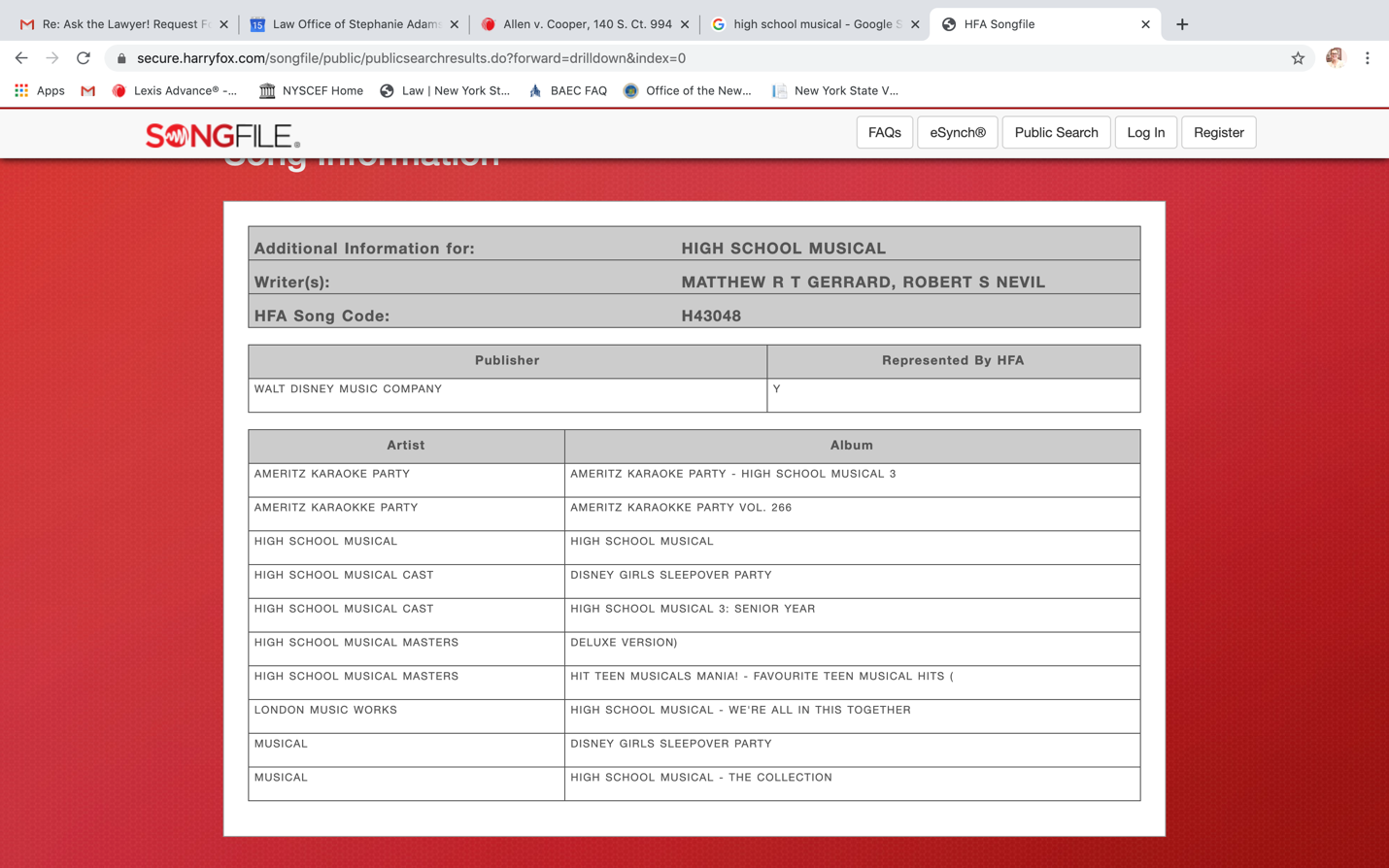
As but one example, the music to “High School Musical” is available for licensed streaming through the Harry Fox Agency:

Songfile permissions screenshot


(As can be seen, your school could even decide to use the karaoke version.)

The bad news is that it’s sort of a pain to obtain the license; you have to register and there is a fee.  Further information can be found at the link here: https://secure.harryfox.com/songfile/faq.jsp#faq2.

[NOTE: since a school district is one legal entity, it is also good to check and see if the district itself has an account already.  Signing up for a service like this does not need to be done on a school-by-school basis. Of course, this brings us to school policy and procurement issues, and for that, I refer to the attorneys serving the BOCES that serves your school!]

I hope the red tape doesn’t get in the way of the students having a good ceremony.  They have been through enough this semester.


[1] You can find the full text of the case and some commentary here: https://www.scotusblog.com/case-files/cases/allen-v-cooper/

Yearbook Copyright Status

Submission Date

Question

We at [redacted higher ed institution] are considering digitizing our past yearbooks and storing them in an institutional repository which has the option of materials being password protected or available publicly. We are also considering using these photos in future advertising materials. I was wondering what is the best practice for determining the copyright status of the photographs in these yearbooks? Should we attempt to contact the subjects of the yearbooks to inform them that their yearbook photos will be published in our institutional repository or used in school advertising?

Answer

We have had a lot of questions about yearbooks over the years of Ask the Lawyer.[1]  We'll answer this submission with the understanding that for those who want further and deeper information, there's more to read in the "ATL" vault.

Regarding the yearbooks: Unless an institution hired an outside agency to compose the yearbook, the copyright to the complete book is owned by the school, which is most likely free to digitize or otherwise make copies of the books as a whole.[2]  However...

Regarding individual images/photos: If any images were generated by an outside[3] professional, they are likely still owned by that professional (or their heirs), which as the question alludes to, could complicate creating and using them.  In addition....

Regarding the images of former students: In New York, the use of a person's image for commercial purposes requires written permission.[4]  The law also requires permission to use the images of deceased people if they qualify as a "personality" (basically, a famous graduate).  So...

That means that for the uses described in the question, limiting liability is a 2-step process:

1.  Assess if the photos are still protected by copyright, and if they are, secure appropriate permission.  This can be tough, since the individual images will likely not be credited, and finding the original contract or documentation will be hard.  Further discussion of this step is below.

2.  Ask the former students for permission to use their image (an "image release").

This can be done in a way that is fun, simple, and reinforces the students' connection to the institution.  Here is a sample way to ask for a release:

Dear NAME:

[insert customized nice things from your institution as a greeting.]

We are reaching out to you in the hope that you will grant your permission to [SCHOOL NAME] to use this image for student recruitment and to promote awareness of [SCHOOL NAME]'s mission.  This means your name, and the picture we're including, would be in advertisements for [SCHOOL NAME].

If you agree, please sign below.

NAME, we appreciate you considering this request.  In addition, if you believe any of your classmates would be excited to help us out this way, please let us know!  [SCHOOL NAME] is always seeking ways to reinforce our connections to our alumni, while we also reach out to the alumni of the future.


[insert customized nice things in closing]

[signature]

LIMITED PERMISSION TO USE NAME AND IMAGE

This form can be signed and returned in the self-addressed, stamped envelope provided, OR a photo of the signed document may be taken and the image sent to INSERT EMAIL, whichever is easier for you.  If you send the document via email, please send your preferred telephone number for confirmation. 

Thank you for granting [SCHOOL NAME] this permission.


On this _____ day of _____________, ______, I, [PRE-INSERT NAME], agree that [SCHOOL NAME] may use my name and the above likeness for purposes of student recruitment and to promote awareness of [SCHOOL NAME]'s mission in any print medium, on the school's website, and in electronic advertising.

I appreciate that I can withdraw this permission and upon so doing, the school will immediately remove my name and image from the school's website, and from any advertising (print or electronic) as soon as the duration of the advertising contract expires.


SIGNATURE: ____________________________


Okay, that's the "image use" concerns.  Now, back to the copyright.

For professional photographers, the copyright to their images is part of their livelihood, so I very much appreciate that the member is thinking about that factor.  For amateur photographers who may have supplied their work, they are owners too, but ownership of the photo may have even fewer clues.

There are a few approaches to determining copyright ownership of "old"[5] yearbook photos.

To determine copyright ownership of "old" yearbook photos, you have to play detective.  Places where you may find "clues" about ownership include:

  • The credits of the yearbook
  • Old files from the yearbook committee
  • Procurement/purchasing records from the school's business department[6]

The best documentation related to professional portrait photos is usually an old contract or invoice, since the ownership and permission to use the photos--if ever confirmed in writing--would likely be there.

If you are lucky enough to determine the photographer, but not the terms under which they worked, if they are still alive (or the business is still in operation) you can reach out to them for permission (bear in mind, they could say no, and you may need to negotiate for a reasonable fee).

If your institution can't locate ANY information on the photographer, it has a choice: don't use any of the images; OR use the images knowing there is a risk of infringement, and limit that risk by engaging in "risk management."

"Risk management" includes:

  • Using images taken before 1927, since those are most certainly not protected by copyright;
  • Using the oldest images that can suit your institution's purpose, since the older the image, the less likely it is that there is a person or estate monitoring use of the photos and waiting to claim you need permission to use them;
  • Avoid using images of "famous" alumni, since photographers who know they once photographed a famous person during their freshman year, often recall that fact, and know they are sitting on a goldmine;
  • Documenting your search for records related to ownership, so you can show the institution made a good-faith effort to locate the owner.

With all that said, the quick answers to the member's questions are:

Question 1) There is no one way or "best practice" to determine post-1927 copyright status, but there are many ways to look for clues, and many of them can be used to reduce or eliminate potential liability for copyright infringement;

and

Question 2) Yes, if an academic institution is going to use photos of former students for advertising, it MUST get written permission from the person depicted.

Thank you for sending in these thoughtful questions!


[1] See “Ask the Lawyer” yearbook-related questions on FERPARequest to remove scanned pagesPhoto Copyright and Copying

[2] The exception to this is if permission to use the photos was limited to one print edition.  Contracts for yearbooks post 1995 (or so) may limit this, but "old" yearbook contracts likely will not contain a restriction on the method of the yearbook's duplication.

[3] "Outside" meaning not an employee of the school.

[4] For more on this, see "Ask the Lawyer" here and here.

[5] What age is an "old" yearbook photo these days?  I feel like the moment you open a yearbook and say: "Look at those clothes/hair!" the photos are "old."  So, maybe, pre-2010?

[6] This may seem far-fetched, but some places hoard this stuff.  I love going through those type of records because they showcase the history of printing and document duplication.

Permissions for Photos from Defunct Publications

Submission Date

Question

An academic librarian relayed this question from a researcher/author:

"I am in the stage of tracking down photo permissions and have found images originally published by U.S. presses from the late 1800s and early 1900s (1887, 1893) that are now defunct--hence I cannot request photo permissions from them. The images are posted online by historical societies, but I'm not sure if they're in the public domain or not.   I plan to reach out to the society publishing the images on their digital archives, and credit them for using the images, but is there any other factor to consider?"

Answer

First, some validation: the faculty member is wise to be considering this issue, since publishing contracts[1] almost always put the responsibility and liability for photo clearances on the author.

In this case, there are several layers of copyright ownership to consider: the original copyright of the photographer, the copyright of the books, and the copyright to any re- publication by which they are being made available (for instance, a digital archive).

Because of the publication dates (1887, 1893), the original copyrights (for the photograph and the original book), are most certainly expired.[2] The only concern would be if the images were somehow used to create a work with a "new" copyright...for instance, if the picture of the long-dead person was enmeshed with a picture of Janelle Monae on a rocket ship to Mars...which isn't the case here.

So, while in the law game there is a rule of "never say never," based on the dates, the images in this question should be free from copyright.  That said, as contemplated by the question, it is almost always a good idea[3] to extend a "courtesy acknowledgement" to a historical society, library or other archival resource that stewarded the image so it could be used for research. 

Even more important when using a digital source, however, is first confirming, and documenting, that the image isn't being taken from a website or repository in violation of any of their "terms of use" conditions.  Written confirmations from the archive, or keeping a screenshot of the "terms of use," image information, and metadata, are all good ways to do this.

Other risks of using old photographs for commercial publications are: the possibility that the image is being used as a trademark, and the possibility that the re-publication could make commercial use of images of deceased "personalities."  These should both be ruled out before publication.

In addition, when using a photo--especially for publication--it is a good idea to confirm that there are no ethical or relational concerns with using certain images.[4]  For these reasons, writing to the historical societies to inquire about images kept in their collections (as the faculty member in this example is doing) is a good idea...just ask for information, not permission.   Checking in with a person who focuses on ethical issues in that particular area of scholarship is wise, too.


[1] This is something "authorlaw.com" attorney Sallie Randolph and I often bicker about. I advise writers to resist such clauses (or demand better royalties for taking on the risk). Sallie, who has negotiated hundreds of author contracts, tells me this is not realistic advice, because for most major publishes, it's non-negotiable. But as I see it, everything in a contract is up for negotiation!

[2]  A good resource for double-checking the date when works are in the "public domain" (which can vary) is at https://guides.library.cornell.edu/copyright/publicdomain. Thank you, Cornell.

[3] I discussed this part with Sallie Randolph, too, and for once, we agreed! When contacting an organization about a public domain image, never ask for permission, but say something like "I am contacting to discuss using a public domain image from your [archive] to see how you would like the organization credited for having made the image available to researchers."

[4] For more on that, see "Ask the Lawyer" RAQ 172.

Opt out of CCB for libraries

Submission Date

Question

The CASE Act has a provision for libraries to preemptively opt out of CCB proceedings. If we opt out at the institutional level, does that cover individual library employees?

Opting out seems like a good course of action for our institution but I wonder if there are reasons why we should not opt out.

Answer

For this question, "Ask the Lawyer" brought in "Authorlaw.com" and copyright attorney at the Law Office of Stephanie Adams, Sallie Randolph, as a guest author.  Many thanks to Sallie for crafting this answer as the CASE Act unfolds.

The final rule applies a library's or archives' opt-out election to both the qualifying entity and its employees for activities within the employee's scope of employment. Therefore, the answer to the first part of this question is yes. All employees of the institution that has opted out are covered as long as the employees are operating within the scope of their employment.

Opting out seems like a good course of action for our institution but I wonder if there are reasons why we should not opt out.

There are several factors that may influence a library’s decision to opt out or not. The Copyright Claims Board (CCB) is new.[1] It heard its first cases in April of 2022, so there is not much historical data that can inform a decision either way. It might be wise to defer such a decision until the CCB has a longer track record.

Keep in mind that a library can always opt out of an individual case by filling out a simple online form.  Therefore, there is no real risk in deferring the opt out decision until later, perhaps after a first claim is made. Depending on the nature of the claim, it is possible that defending in the CCB would be preferable to defending the same claim in federal court. Opting out preemptively would deprive the library of this flexibility.

So far there have not been any cases filed against a library, at least not any listed on the CCB cases website: https://dockets.ccb.gov/search/cases. And so far, no cases have yet been closed, so final results are unknown.

To date, relatively few libraries have opted out. Those libraries are listed at https://www.ccb.gov/libraries-archives-opt-out/.

Given the early stage of CCB operations and the relative lack of useful data, I would be tempted to defer a final decision on preemptive opt out until more information is available. Until then you can easily opt out on a case-by-case basis.


[1] For more on the Copyright Claims Board (CCB), see https://www.ccb.gov/about/

Creating adaptive copies of textbooks using text-to-speech

Submission Date

Question

My institution subscribes to the "Kurzweil Reading Program", a "Text-to-Speech" product for those with reading impairments (dyslexia, English language learners, blind/vision impaired, etc.)

Section 121 indicates these users are "eligible persons" for "fair use", but others, without such disabilities could use the program (like an audiobook in the car!).

We'd be putting TEXTBOOKS up in the program; that fair use violation is what I'm worried about....

Thanks!

Answer

This question reflects the level of savvy "Ask the Lawyer" readers bring to their submissions.  The member submitting the question has already set out (in a manner much more succinct than I usually achieve) the interplay of:

  • Owner's rights (Copyright Act Section 106),
  • Adaptive copies made under "fair use" (Copyright Act Section 107), and
  • Copies made for purposes of accommodations for disability that impacts the ability to read (Copyright Act Section 121).

do have one quibble with the member's phrasing, though, and it is important to this particular issue: Section 121, while it allows copies otherwise barred, does not create a "fair use" right to make a copy.[1]  Rather, the creation of an adaptive copy under Section 121 is a 100% exception to infringement made under highly precise circumstances.

What are those "highly precise circumstances"?

First, as the member writes, the end-user of the copy must be "eligible"--meaning they have a disability that impacts the ability to read (for the three "ways" for a user to be "eligible", see sub-section (d)(3)(A)-(C) of the law, below). 

Second, the copies must:

"(A) not be reproduced or distributed in the United States in a format other than an accessible format exclusively for use by eligible persons;

(B) bear a notice that any further reproduction or distribution in a format other than an accessible format is an infringement; and

(C) include a copyright notice identifying the copyright owner and the date of the original publication."

And third, the maker of the copies must be an "authorized entity" (which is defined in the statute; see the definition, below[2]).

This precise formula, and the right it creates, is why "fair use" is not a part of the issue at hand (adaptive copies specifically for reading-based disabilities).  None of the above-listed requirements are required to claim "fair use" under Section 107[3]. In addition, to make a Section 121 copy, there is no four-factor "balancing" test; rather, a Section 121 use is "inherently noninfringing."[4]

The above-listed Section 121 requirements to include copyright notices are also the key to addressing the member's concern: enforcement.

When an "authorized entity" is creating Section 121-based copies for "eligible" people, the institution must put copyright notices on each copy. This sets up the institution--as either an employer or alma mater--to restrict non-eligible employees and students from using them for non-Section 121 purposes.  Further, in addition to the required notices, the institution can add additional warnings, and if needed, restrict use through technological controls.[5]

Now, how much should an institution police this?  Currently, there is no case law that turns on an alleged infringement that was committed via unauthorized use of a duly made Section 121 copy.  That said, content owners are always looking for new ways to maximize revenues, so taking care to properly designate Section 121-based copies as required by law, and using policy and posted notices to reinforce those restrictions, is a wise idea.

Thank you for a well-informed and nuanced question!

HERE IS SECTION 121 OF THE COPYRIGHT ACT:

(a) Notwithstanding the provisions of section 106, it is not an infringement of copyright for an authorized entity to reproduce or to distribute in the United States copies or phonorecords of a previously published literary work or of a previously published musical work that has been fixed in the form of text or notation if such copies or phonorecords are reproduced or distributed in accessible formats exclusively for use by eligible persons.

(b)

(1) Copies or phonorecords to which this section applies shall—

(A) not be reproduced or distributed in the United States in a format other than an accessible format exclusively for use by eligible persons;

(B) bear a notice that any further reproduction or distribution in a format other than an accessible format is an infringement; and

(C) include a copyright notice identifying the copyright owner and the date of the original publication.

(2) The provisions of this subsection shall not apply to standardized, secure, or norm-referenced tests and related testing material, or to computer programs, except the portions thereof that are in conventional human language (including descriptions of pictorial works) and displayed to users in the ordinary course of using the computer programs.

(c) Notwithstanding the provisions of section 106, it is not an infringement of copyright for a publisher of print instructional materials for use in elementary or secondary schools to create and distribute to the National Instructional Materials Access Center copies of the electronic files described in sections 612(a)(23)(C), 613(a)(6), and section 674(e) of the Individuals with Disabilities Education Act that contain the contents of print instructional materials using the National Instructional Material Accessibility Standard (as defined in section 674(e)(3) of that Act), if—

(1) the inclusion of the contents of such print instructional materials is required by any State educational agency or local educational agency;

(2) the publisher had the right to publish such print instructional materials in print formats; and

(3) such copies are used solely for reproduction or distribution of the contents of such print instructional materials in accessible formats.

(d) For purposes of this section, the term—

(1) “accessible format” means an alternative manner or form that gives an eligible person access to the work when the copy or phonorecord in the accessible format is used exclusively by the eligible person to permit him or her to have access as feasibly and comfortably as a person without such disability as described in paragraph (3);

(2) “authorized entity” means a nonprofit organization or a governmental agency that has a primary mission to provide specialized services relating to training, education, or adaptive reading or information access needs of blind or other persons with disabilities;

(3) “eligible person” means an individual who, regardless of any other disability—

(A) is blind;

(B) has a visual impairment or perceptual or reading disability that cannot be improved to give visual function substantially equivalent to that of a person who has no such impairment or disability and so is unable to read printed works to substantially the same degree as a person without an impairment or disability; or

(C) is otherwise unable, through physical disability, to hold or manipulate a book or to focus or move the eyes to the extent that would be normally acceptable for reading; and

(4) “print instructional materials” has the meaning given under section 674(e)(3)(C) of the Individuals with Disabilities Education Act.

(Added Pub. L. 104–197, title III, §â€¯316(a), Sept. 16, 1996, 110 Stat. 2416; amended Pub. L. 106–379, §â€¯3(b), Oct. 27, 2000, 114 Stat. 1445; Pub. L. 107–273, div. C, title III, §â€¯13210(3)(A), Nov. 2, 2002, 116 Stat. 1909; Pub. L. 108–446, title III, §â€¯306, Dec. 3, 2004, 118 Stat. 2807; Pub. L. 115–261, §â€¯2(a)(1), Oct. 9, 2018, 132 Stat. 3667.)


[1] I'm quibbling, but I want to take this footnote to state that including a "fair use" cite in the question is very reasonable, because fair use is often cited as yet another reason to make adaptive copies that go beyond copies authorized by Section 121. Since the copies in this case are without question for those "eligible" under Section 121 (those with reading-impacting disabilities), we're going to sideline fair use at Section 107 for this question, but it very much is a part of the toolbox of creating adaptive works for non-Section 121-eligible disabilities.

[2] There is controversy, but no definitive authority, on if all not-for-profit educational institutions meet the criteria.  Academic publishers have taken a position that it only applies to institutions for the blind, not just any old school or college.  However, an uncontradicted conclusion in the October 10, 2012 district court decision in Authors Guild V. Hathitrust, 902 F. Supp, 2d 445 (2012) opines that because of their mandate to provide accessibility under the ADA, such institutions all are "authorized entities" under Section 121.  Until I read otherwise, my guidance errs on the side of accessibility (see https://wnylrc.org/index.php/raq/accessibility-options-school-ebooks).

[3] In fact, having to abide by this type of requirement could undercut some of the more vital applications of fair use, such as parody or innovation.

[4] If this distinction intrigues you, check out the commentary at  https://www.copyright.gov/1201/2021/comments/Class%2008_InitialComments_Accessibility%20Petitioners%20II.pdf

[5] I am slightly wary of a system that would force a student to "register" with the library as needing ADA accommodations, but depending on how access is granted, some type of additional log-in or control might be wise.  At higher ed institutions, students and employees arrange accommodation per a policy, and accommodations are generally confirmed in writing, so signing up for access to adaptive copies could be the way to go.  But this will be driven by technology, and care must be taken to not put up any additional hurdles to access.  If any readers out there have solved this issue at your institution, I'd appreciate hearing about it!  Please send that to info@losapllc.com.