Copyright

Permission for Appearance of Background Images

Submission Date

Question

Our historical society produced a documentary about the making of a sculpture. Our videographer filmed work in the sculptor’s studio and in so doing, in the background captured photographs the sculptor had on a storyboard for another project. Is it necessary to obtain permission to use the individual’s image, even though it was not prominent nor the subject of the documentary?

Answer

When people see a lawyer to complain about the misuse (or “misappropriation”) of their image, there are several legal theories that lawyer might assess the situation for, including:

  • Violation of image rights
  • Copyright violation
  • Trademark violation
  • Defamatory content
  • Illegal or proprietary content (this is a long list, but includes things like an image obtained illegally, trade secrets, or criminal content)
  • Contract violation
  • “Terms of Use” violation (if posted in/on a venue with such terms)

In this case, a historical society was making a documentary and, in the course of filming, inadvertently captured a photographic image of an unrelated private person in the background.

Of the items listed above, there are at least two, and perhaps three legal claims that could apply:

1. The person in the photo could claim their image is being used without their permission for commercial purposes;[1]

2. The person who owns the copyright to the photo could claim that including it in the video is infringement;[2]

3. The person who commissioned the other project, using the photo, could have required the image be kept confidential, meaning that including it risks a violation of a contract.[3]

Of these three, the first two could pose a claim against the historical society, and the third could lead to them being named as a witness.

For a small documentary project with no commercial purpose (the video is not for sale, and not being used to fund-raise), the chances of a person having the right incentive to bring a costly legal action seeking damages is low. That said, money is not the only thing that motivates lawsuits. So how could the historical society mitigate the risk?

Option #1: Ask Nicely

One option would be to disclose the incidental use in advance and get written permission from the subject of the photo and from the photographer. With the right permission secured and documented, there is no chance legal action would be successful. And if either says “no,” you still have two other options...

Option #2: Make it Blurry

The second option would be to blur the image; if the image is not recognizable, then the first two claims would be non-existent, and there would be little evidence to support the third. Of course, this can be a pain and might not be the best choice from an aesthetic standpoint. So there is also...

Option #3: (Carefully) Roll the Dice

As a third option, the society could engage in calculated risk-taking by: a) verifying they have insurance for “advertising injury” (and confirming that it doesn’t exclude image rights and copyright claims); b) obtaining a legal opinion stating that the non-commercial use means there is no image rights claim and that the inclusion of the copyrighted photo is fair use[4]; and c) hoping no one gets mad.

Of these three options, each has its own drawbacks, but I am a fan of Option #1, as it not only removes all doubt but ensures the society won’t have to deal with negative publicity and people taking sides in a squabble about image rights. When organizations depend on reputation and goodwill for donations and community support, diplomacy is wise from both the legal and relational perspectives.

Of course, for a larger endeavor (a documentary with a serious budget, or perhaps with the backer of a grant or a major donor), this type of issue can be addressed on the front end through waivers and participation agreements. But for a small organization capturing local history in the making, the above three approaches can work after-the-fact.


Thank you for the thoughtful question.


[1] See, e.g., Candelaria v Spurlock, 2008 US Dist LEXIS 51595, at *4 [EDNY July 3, 2008] (“To state a claim under NYCRL § 51, a plaintiff must allege: (1) the use of his name, portrait, or likeness; (2) for ‘advertising purposes or for the purposes of trade;’ (3) without written permission. … New York courts have also created an exception under NYCRL § 51 for ‘incidental’ uses of a person’s likeness … In order to establish liability under the statute, a plaintiff must demonstrate a ‘direct and substantial connection between the appearance of the plaintiff's name or likeness and the main purpose and subject of the work.’ Courts have found that ‘isolated’ or ‘fleeting and incidental’ uses of a person’s name or image, even if unauthorized, are insufficient to establish liability.”).

[2] See, e.g., Natl. Photo Group, LLC v Allvoices, Inc., 2014 US Dist LEXIS 9190, at *16 [ND Cal Jan. 24, 2014] (“To state a prima facie case of direct copyright infringement, a plaintiff must show that (1) it owns the copyright for the allegedly infringed materials and (2) the defendant violated at least one of the exclusive rights listed in Section 106 of the Copyright Act.” Those rights include the rights to: “reproduce the copyrighted work in copies or phonorecords … to prepare derivative works based upon the copyrighted work … to distribute copies or phonorecords of the copyrighted work to the public by sale or other transfer of ownership, or by rental, lease, or lending … to perform the copyrighted work publicly … to display the copyrighted work publicly; and … to perform the copyrighted work publicly by means of a digital audio transmission.”).

[3] A case for breach of a non-disclosure agreement has the same three elements as any contract claim: “(1) a valid contract; (2) a material breach; and (3) damages.”  Brown v. Capital One Bank (USA), N.A., 2015 U.S. Dist. LEXIS 127497, at *3 (S.D. Fla. 2015).

[4] See, e.g., Hirsch v CBS Broadcasting Inc., 2017 US Dist LEXIS 123468, at *13-14 [SDNY Aug. 4, 2017] (“The Act provides that ‘the fair use of a copyrighted work . . . is not an infringement of copyright.’ As the purpose of copyright is ‘[t]o promote the Progress of Science and useful Arts,’ U.S. Const., Art. I, § 8, cl. 8, the Act bars liability for copyright infringement when the reproduction or copying of a copyrighted work is undertaken ‘for purposes such as criticism, comment, news reporting, teaching . . . scholarship, or research.’ The fair use defense thus ‘allows the public to draw upon copyrighted materials without the permission of the copyright holder in certain circumstances.’”) (Citations omitted).

Screening DVD as part of curriculum

Submission Date

Question

If a teacher teaches a novel in school, can they show the DVD of the movie under fair use?

Answer

This question was submitted by a system serving elementary and secondary schools.

The answer for those schools (and for higher education, too) is: if the viewing of the DVD is tied to the reading of the book and the content is part of the class/curriculum, then YES, it can be viewed in class.

This exception to infringement by a school is found in 17 U.S.C. 110  (1), which states:

...the following are not infringements of copyright:

(1) performance or display of a work by instructors or pupils in the course of face-to-face teaching activities of a nonprofit educational institution, in a classroom or similar place devoted to instruction, unless, in the case of a motion picture or other audiovisual work, the performance, or the display of individual images, is given by means of a copy that was not lawfully made under this title, and that the person responsible for the performance knew or had reason to believe was not lawfully made;

So, to be clear: at a not-for-profit school, as part of the curriculum, in the school's designated learning space, the "movie based on the book" can be viewed as part of  the curriculum...so long as the copy being watched was not pirated or otherwise obtained through the shady  (but now losing ground to illegal streaming) DVD black market.

Thank you for this question.

Purchasing streaming services in libraries

Submission Date

Question

Is it legal for the library to purchase a Netflix account and install it on a Roku or Firestick and lend that out for patrons to use? See also: Amazon Prime, HBO Max, Disney+, Paramount+, etc. etc.

Answer

When this question came in, our first thought was that it was addressed in answers such as ATL 191 and ATL 104, and even older ATL 55, where we tackled the types of limits streaming services impose on accounts via contract. 

These answers (and others) discussed how most[1] commercial streaming service contracts limit the ability to transfer a personal streaming services account to another person (temporarily or permanently), even if the transfer is limited to one person at a time.

The member replied that we hadn't yet addressed their issue.

This question was submitted in June of 2021, and I have had a chance to chew it over.[2]

As I chewed, I reminded myself of a few things:

  • librarians, as a profession, need to see information flow
  • librarians, as a profession, are innovators;
  • librarians, as a profession, are service-oriented.

This is different from lawyers.  If you say: "An enforceable contract with no loophole means no one gets to borrow a Firestick to access 'If Beale Street Could Talk' during Black History Month," to a lawyer, they will say "Hmm.  When does that contract end?  Let's make a note for future negotiations."

However, from what I've seen, if you say something like that to a librarian, they will reply: "There has to be a way."

This may have something to do with why the librarians have a more popular profession than lawyers.[3]

So...is there a way?  I see three ways.

First way: enable the lending through a stark and deliberate violation of the streaming service's terms.  Just do it.

Of course, choosing to do such a thing runs a heavy risk of potential liability (for both the library and the borrower), so this is a VERY, VERY, VERY, BAD IDEA. Don't do it, unless you have worked with a lawyer on a strategic defense and are planning to use any potential litigation as publicity to negotiate changes to streaming contracts (a sort of contractual "civil disobedience").

Second way: reach out to the streaming service and see if you can negotiate a custom arrangement.  For instance, it would be very interesting to see if a library could negotiate up to 10,000 viewing hours on an annual basis to be on accounts specially created to be shared.  Clever lawyers at the streaming service could even make sure that this was regarded as a charitable donation by a streaming giant, and of course, they would also milk it for positive publicity.

Third way: You need to Go Big.

What do I mean by that?

This question is yet another example of the troubling trend of for-profit content aggregators using their market share to restrict information access.

This used to be the bleeding edge of concerns created by the intersection of copyright/contracts/capitalism, but it is now a firmly established Problem.

In my work, I have consulted with academic libraries and other institutions on how scholarly and public service-oriented content providers can guarantee access is not completely cut off on the basis of money. I have worked on checklists for contract negotiation, and provided model contract terms to help libraries use their market power to ensure big aggregators don't use their market power to stifle access, innovation and collaboration. This is not new work and I am not the first person to say this; it's an issue to which the library community is very much aware, and is closing ranks.

To solve this issue, there are a few ways to go. The best way would be to seek amendments to the copyright law to carve out further protections for libraries who are sharing electronic resources and streaming access in furtherance of their missions. This type of discussion is happening in Washington right now, and it is critical that everyone is rooting for the right revisions to be put into the law.

The second way is of course a version of my second answer above...use contract, and the market share of libraries, as leverage to negotiate for terms that enable the type of access the member is suggesting.  While I am a fan of using contracts to come up with creative solutions, this will not create an even playing field for the different types of institutions who need to benefit from this, so I prefer the legislative option.

I encourage all librarians to monitor this discussion at https://www.copyright.gov/policy/section108/, because the question the member has provided is exactly where the rubber hits the road on that type of legislation.

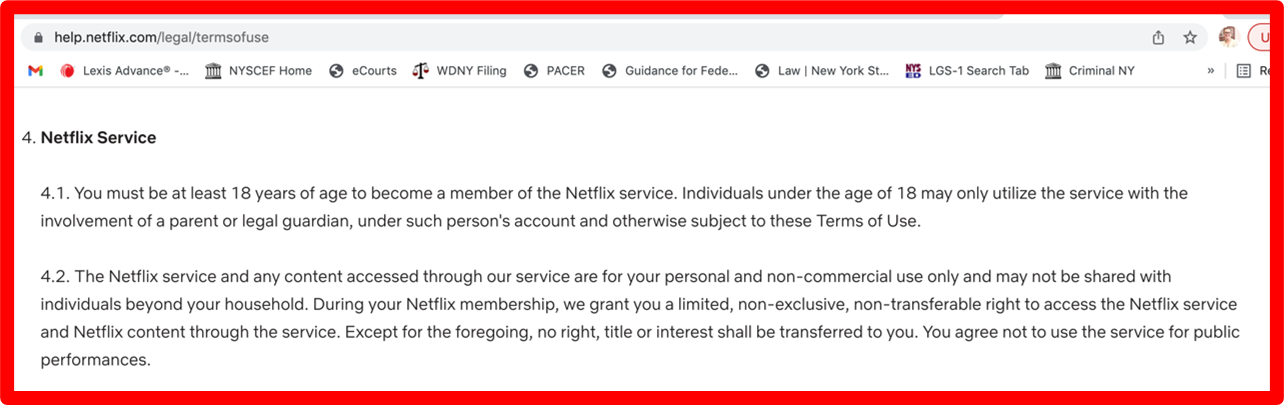
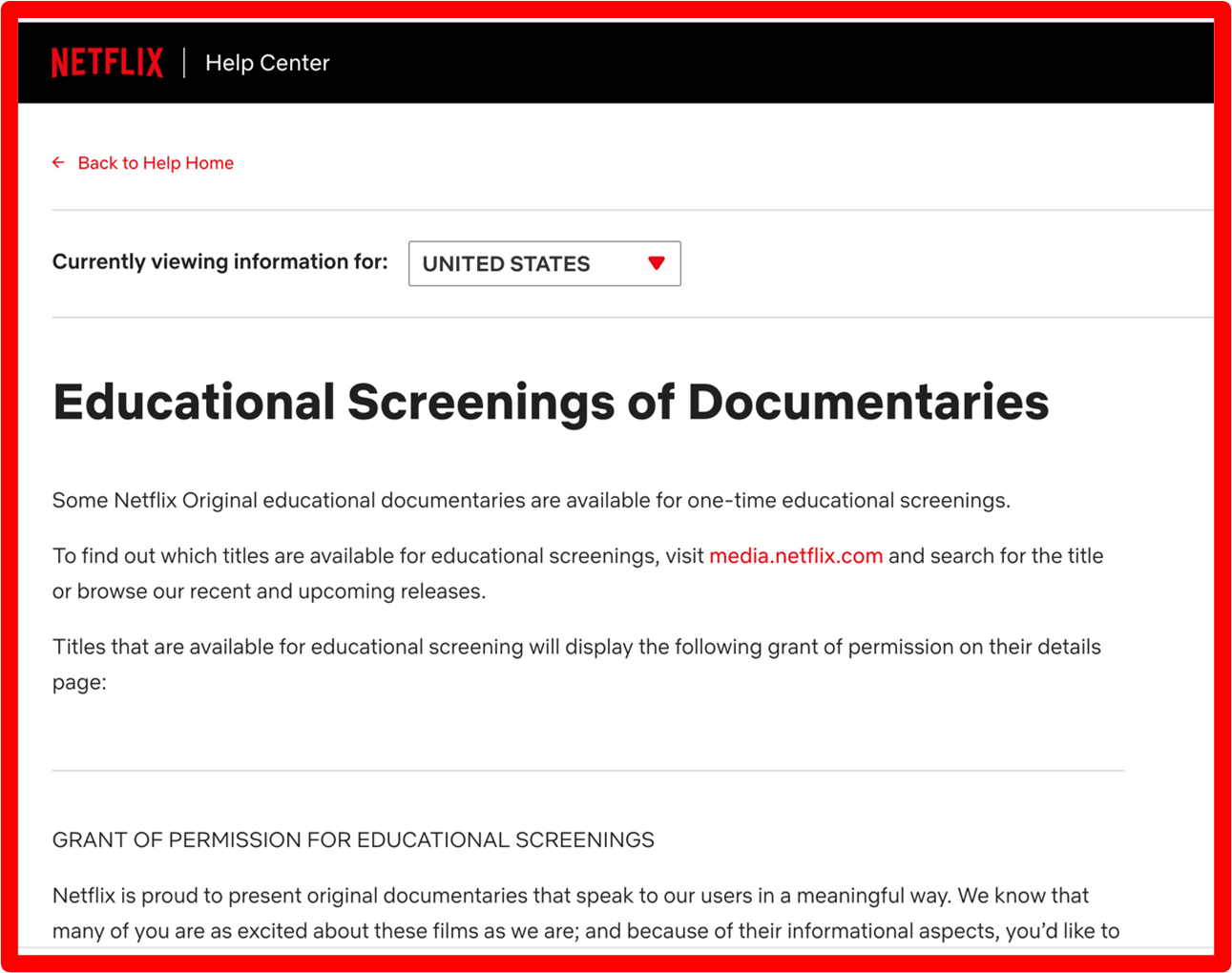
I am putting screenshots of the Netflix terms of service below this answer, which I took on February 11th, 2022, to show that at least as of this date, that particular streaming service continues to restrict access to personal use (first red box), with very limited exceptions for certain educational showing of certain documentaries in educational settings (second red box).

Thank you to the member for your tenacity, and for submitting this question.

Netflix terms of use screenshot


Screenshot of Netflix Educational Screenings help center


[1] Actually, based on what I've seen, "all," but most of the services reserve the right to change the license without notification to the end user, and of course, I am not omniscient, so I'd like to think there's a streaming service out there somewhere with less draconian terms. Hope springs eternal!

[2] And swallow it, digest it, and create this end product.  Many thanks to CLRC and member Hamilton Public Library for your patience!   It took a rain-logged, windy Saturday in February 2022 to get me in the right head space for this.

[3] I took a look, and of course, "National Librarian Day" happens every year in April. As librarians no doubt know, NLD is billed as a chance to "celebrate" your local librarian. Interestingly, April also hosts international "Be Nice to Lawyers Day." That's right...we have ONE day a year when people are told to be "nice" to their lawyer!

Using a YouTube Video to create another video

Submission Date

Question

I am asking this on behalf of the Elementary School in my district. (I work in the library of our district's high school). The Elementary School participates every year in a program called PARP. (Parents As Reading Partners). The teachers and principal always make some sort of video to kick this off this event since pandemic times.

This year the entire school is reading the SAME book: The World According to Humphrey, by Betty G. Birny. (It's a story about a Hamster and how he deals with life issues). My district's teachers want to "borrow" liberally from this Animoto video: https://animoto.com/play/ICom40fpoTdMzDov931aDQ

This video contains four components: 1. Another School (We'll call it School X, an independent school in California essentially doing the same thing), 2. an interview with the author segment, Betty G. Birny, 3. an interview with a store clerk from PetCo and 4. a video of a hamster performing "cute antics" with a voice-over dubbed in called April's Animals. (This individual posts varied animal videos on YouTube)

What my teachers want to do is create their OWN video of teachers and the principal endorsing this book, interspersed with the hamster video from April's Animals. I did observe at the end of the Animoto video, there were credits provided. My school would not use the PetCo interview or the Author Interview or the School X video as those segments are directly related to that specific school. They want to do the same idea and only use the video provided by April's Animals. I didn't know if this would be problematic because we are a public school, this would not be posted on YouTube. It would be shown over our school network to our K-2 classrooms one time only.

Answer

The short answer to this question is: IF the video is only going to include the YouTube animal clips, and IF it is only going to be used in the school for instructional purposes, the proposed use is fine, since copyright section 110(1)[1] allows schools to play videos in class if the topic is related to a class, and YouTube doesn't limit use of its service to "personal" uses.

Now, I say "mostly" fine because, technically, the combination of the YouTube content into another video compilation could be considered the creation of a "derivative work" (like a sequel or a mash-up), instead of just "performing" (playing) the video as allowed by law.  But if the copy truly isn't leaving school grounds, and the "performance" is to promote a reading program in the classroom, and the footage really is just being swapping in and out with interviews with school staff, it would be a stretch for anyone to claim infringement.

With respect to the other issue that I detect in the question--would "School X" have a claim against the school for pinching its idea? I don't think so.  The project you describe is sufficiently different from theirs; after all, they got their author for their endeavor, and your school is focusing on local talent.  You can't copyright an idea[2]...just its expression.

When it comes to a school generating original educational content inspired by others, for use only within that school, the key is to model the type of respect for others that educators want to instill in their students, while taking full advantage of the protections educators have under the law.

In this case, "Respect" means not using pirated copies when a school plays instructional movies, and not using more content than the school is entitled to when the instruction is online.  "Protections," among other things, means that for in-person instruction, videos can be played, and for online instruction, parts of videos can be played, so long as the performance is from legitimate copies.[3]

[NOTE: For schools that want to up their game and start producing original content they will share with the world: this answer is not for you.  If any school out there is thinking of becoming an author/producer/provider of educational materials, don't rely on this answer, and develop a business plan that includes how to respect and protect IP.]

And finally, I have to say: thank you for this question.  First, it got me onto Animoto, which I am totally going to check out.[4]  And second: I love PARP.  Some of my fondest circa-1980 memories are of filling out my PARP form with my folks, after some time reading together on the couch,[5] so this question made me smile.  It's good to see the program is going strong, and the hamsters of the world are showing us how to cope with the ups and downs of life.


[1] 110(1) allows "Performance...of a work by instructors ...in the course of face-to-face teaching activities of a nonprofit educational institution, in a classroom or similar place devoted to instruction, unless, in the case of a motion picture...the performance... is given by means of a copy that was not lawfully made...."

[2] Of course, you can patent certain ideas, so please don't think I'm touting intellectual property anarchy.

[3] This aspect of Copyright Section 110 is different than the issue of streaming services being limited for personal use, and thus not always the best place for educators to get their in-class movies.

[4] I clearly don't get out much.

[5] My parents still have the same couch, which they got in 1964.   They are the greenest people I know.

Contracts for Library Podcasts

Submission Date

Question

The library's podcast (Your Friendly Neighborhood Librarians), hosted by two librarians here, recently started interviewing guests from outside the organization. We are concerned about a few things: what the ramifications are if a guest does not like the way their interview was edited and whether the library owns the rights to the interview and recording. We only edit for clarity and length, and haven't done anything in regards to copyright. Additionally, any advice on whether we should be using some sort of contract or agreement with guests would be helpful. We don't have any sort of agreement in place at present, and are mostly interviewing people who are somewhat library-related. Thank you for your help!

Answer

Some days, I just love my job.  The day I subscribed to "Your Friendly Neighborhood Librarians" (2/4/22) to answer this question was one of those days.

For those of you who haven't checked out the Podcast: it's a forum where hosts (and librarians) Jim and Robyn, based in Rochester, NY, conduct deep and lively interviews with quasi-local authors.  [1]

When it comes to running a Podcast, there's a lot of legal to unpack.  I'll use a recent episode of YFNL (Season 2, Episode 4, January 30, 2022), an interview with photographer Quajay Donnell to illustrate.

When the Podcast starts, the first thing you hear is the YFNL's theme song:

[guitar strumming] "Librarians, librarians, when you've got questions, they're the ones, to help you find what you're looking for..." [more].  It sounds vaguely like the theme to "Spiderman" and is clearly a riff; it's super-cute and fun and brings a smile to my face. Then Jim and Robyn introduce the session's guest and launch into the interview.

The rapport is lively and fun, but Jim and Robyn's deeply prepared interview technique gives Quajay Donnell room to make comments, tell stories, and respond to well-informed prompts to talk not only about his work, but the work of others, and his thoughts on public art (I enjoy Mr. Donnell's comment, after a glowing list of his credentials "I sometimes struggle with the title of 'photographer', I sometimes say 'I'm a picture-taker', or 'I capture moments'."  I appreciate when people resist or explore the purpose of labels).  The show then ends with a cut to a recommendation from a circulation desk worker, Sim, who recommends "Field of Blood" by Joanne Friedman, and a tease for the next episode ("banned and challenged books"), some thanks to various show-helpers,[2] and an instrumental of that great theme song.

So with that background, let's answer the questions:

"[W]hat the ramifications are if a guest does not like the way their interview was edited and whether the library owns the rights to the interview and recording.  Additionally, any advice on whether we should be using some sort of contract or agreement with guests would be helpful. We don't have any sort of agreement in place at present, and are mostly interviewing people who are somewhat library-related."

I wish I could give simple answers to these straightforward questions, but this is "Ask the Lawyer," so I cannot.  But to start, I can say there are three variables that inform the answer to these questions:

Variable "1": Who is creating the Podcast?  Is it "officially" the library, or is it being created through the collaboration of independent individuals?[3]

Variable "2": What is the identity of the Podcast?   Is it 100% entertainment, or is it meant to be investigative journalism, oral history, or serve another documentary purpose?[4]

Variable "3": What is the purpose of the Podcast?  In other words, what is it trying to achieve not only now, but 70 years from now, when it is still protected by copyright, and past consideration of such questions will govern what type of access its intended audience should have?

Here’s how these variables impact the member's questions:

If a library is the creator of the Podcast (meaning the library directed its employees to create the Podcast as part of the work they are hired to do), then the library is the entity responsible for addressing (and bearing the liability for) issues of ethics, ownership, and risk (like defamation and image use).  If an individual or individuals are the creator/owner of the podcast,[5] the responsibility falls on them. 

If the identity of the podcast is light entertainment (that theme song!), then the creator does not have to worry about abiding by, or benefiting from, professional codes of ethics and law pertaining to journalism, academic work, oral history/documentary, or political expression.  But if it aspires to fall into any of those categories (and while it's not my call, I'd say YFNL is at the very least a form of journalism), ethics and certain laws may apply.

If the purpose of the Podcast is to ensure that people listening in 2022, as well as 100 years from now, appreciate home-grown artists in and around Rochester, NY, the creator/owner needs to ensure the work is set up to be controlled in such a way that access for that purpose is ensured.  This is true whether the owner is an entity (like a library), or a person or persons.

So with that as background, let's tackle the member's questions:

For the first question ('"[what] if a guest does not like the way their interview was edited?), the answer is: in a worst-case scenario (say the guest claims the interview was edited to make him sound offensive, and claims it caused him to be "cancelled"), there could be some type of legal claim for damages.  While I won't get too technical, this concern relates to a "tort" claim (like a personal injury) and the member is wise to bring it up, since this is a critical issue.[6]

An attorney advising an entity or person on this would: 1) confirm who the creator, publisher and owner of the content is; 2) ensure the party (or parties) makes good use of a speaker agreement that secures a waiver of liability for the producer and all people affiliated with the podcast; 3) if appropriate,[7] advise a step in the production process that gives participants the right to review and approve release of the final version (in writing).

This plays into the second question: "whether the library owns the rights to the interview and recording."

This should not be an ambiguous issue: either the work is "for hire" (meaning the librarians and other credited helpers are doing it as part of the work they are paid to do, or are working per an additional contract) and is owned by the library, OR the work is owned by the individuals creating it.

The leads to the third question (or rather, factor) listed by the member: We only edit for clarity and length.

This plays into the identity of the podcast. If a podcast or other work isn't using a lot of editing to create a specific dramatic or entertaining effect, and is structured to perform a primarily documentary function, it is worth considering using the established ethics of journalism or oral history to guide the project.

Why? 

In the state of New York, journalists' sources are accorded particular protections under the law, while the identity of the speaker and nature of the communications are relevant to claims of defamation. Also under New York law, the further an unauthorized[8] use of someone's name, likeness, or voice, is from a "commercial use," the less likely a person can sue based on "invasion of privacy." And under federal copyright law, material that incorporates copyright-protected work (perhaps reading part of a poem) for journalistic, academic, or documentary functions will get consideration of that factor if a court needs to determine "fair use."

This next variable I listed is purpose, meaning, what is this work supposed to accomplish, and for how long? Consider that variable in light of the member's statement: "[We] haven't done anything in regards to copyright."

If the purpose of the podcast is to ensure as many people as possible access and appreciate it for as long as possible, what might be more important than registering a copyright is to ensure the work is archived on not only a commercial service such as Apple Podcast (where I found it), but in repositories owned by the public, as part of an institution whose structure ensures some type of longevity.

However, if part of the purpose of the podcast is to ensure for as long as possible that it can never be exploited commercially by anyone, and the owner wants to make sure it will be able to claim damages and attorneys' fees in the event the recording is infringed, registering it is a good idea.

So with that, I get to the last, open-ended question from the member: Additionally, any advice on whether we should be using some sort of contract or agreement with guests would be helpful.

It's important to know at this point that while sometimes I reach out to a member who submits a question to "Ask the Lawyer" (to get a bit more information to enable a more helpful answer), in this case, I did not reach out to Robyn and Jim (although because I really like the podcast, I wanted to!). I thought it would be more important, and in the spirit of their question, to present a generic answer to this part of their question with a generic template that could be of use to other libraries and librarians creating a podcast or other type of audio content.

When creating a podcast, here are the "legal" questions to answer to help you (and your lawyer) address the legal considerations:

Question

Reason it's relevant

Your answer


What is the purpose of the podcast?


It's important to answer this question first, because the purpose of the podcast will drive all the answers following this one.


Are there any professional ethics that apply to the podcast?


This answer is based in part on the "purpose." If the purpose is a type of journalism, the creator may want to consider affirmatively abiding by applicable journalistic ethics. If the purpose is oral history, the ethics of oral historians could apply.


Who "owns" the podcast?


This is a question for a lawyer. However, I can broadly say that if a library or educational institution is directing the podcast to be created, and the people creating it are doing so as part of their jobs, then the podcast is owned by the employer. If everyone involved is unambiguously doing it in their free time, then likely, they are the owners together. And in either case, if there is any grant funding that applies to the podcast, the owner(s) should pay close attention to the terms of the grant, because often grants involve a license or transfer of intellectual property.


What is the end product?


This seems like a pretty straightforward question, it's "podcast recordings," right? However, in just taking a look at "Your Friendly Neighborhood Librarians" I heard a theme song that could be subject to individual copyright, and I see there are really excellent descriptions of each podcast that were authored by somebody. In addition, "Your Friendly Neighborhood Librarians" (a clever brand) could also be subject to trademark. There is also a logo.  And if the content is in its own archive with its own metadata, the metadata could also be proprietary. These are just a few examples, so inventorying the end creation (and if all of the creators are not employees, making sure intellectual property is transferred appropriately) might be bigger than maintaining a list of podcasts.


What are the terms for regular and guest contributors?


For podcasts being created by people as part of their jobs, the expectations, rules and protections for them should be understood between their job description and the rules by which the podcast is operated.


For guests, as the member's question points out, it is best to have a written agreement that sets out the terms, including the right balance of a waiver of liability and the ability to preview the podcast to ensure any editing does not result in a person saying something they didn't intend to say.


(As one example of "rules": if a podcast is being produced by a public library or a not-for-profit organization, there should be a firm rule that no endorsements of political candidates are allowed on the show.)


What other conditions may apply?


For podcasts released on Apple Podcast, this means what are the rules you have to follow under the terms of Apple. For those selecting additional or alternate fora, paying attention to the "terms and conditions" on those resources is also important.  And as mentioned above, grants and donations with conditions that support the content creation should also be considered  (if you are lucky enough to be running a grant-funded podcast).


How do people access the content?


This is critical for ensuring accessibility in both the short and long-term.   Early consideration of this factor also ensures that any legal releases or agreements an owner needs to enter into (like licensing a logo) can accommodate the full plan for accessibility. 


How are any risks being addressed?


I appreciate this is a very open-ended last item. Broadly speaking, if the podcast is being produced by the library, the library's insurance carriers should be consulted to make sure it has insurance coverage for that type of activity. Any aspect of the podcast that is not covered should either be limited or other risk management, such as a waiver of liability, and a process for preview by guests, should be considered.


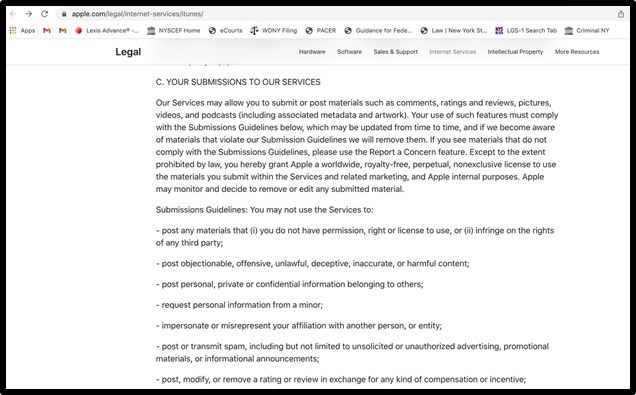
This last item is addressed by Apple's terms of use for podcasts, which I have included below.


Screenshot of submission disclaimer language

Now, with all that said, I am very aware that some of the answers I have put above may cause more anxiety then resolve curiosity. To help out with that, below is a template for a "podcast guest agreement."

As with any template, a library or podcaster should have their lawyer consider all of the factors I list above before finalizing the template. But hopefully this template can provide a good start.

[Template Podcast Guest Agreement]

RE:  Terms of guest appearance on [PODCAST NAME] on [DATE]

Dear [NAME OF GUEST]:

Thank you for agreeing to be a guest on our show, [NAME] ("the Show") on [DATE TIME] to discuss [TOPIC].

Below are the terms between you and [OWNER NAME] ("Show Publisher") for your appearance on the Show.  Please review the terms, and if you agree, please sign below.

If you have any questions before signing, please contact [NAME] at [CONTACT INFO] to discuss them before sending us the signed copy.

Ownership

You agree that the direct recording (audio and visual) and any subsequent product incorporating it, including but not limited to transcription and any adaptive copies made to enable access by those with a disability, shall be the sole property of Show Owner.

Image Use

You agree that for purposes of promoting, publishing, performing, displaying and making the Show accessible to its audience, Show Owner may use your name, image, and likeness in print and electronic media.  This permission is expressly limited to promoting and publishing the episode of the Show featuring you.  This permission is irrevocable once the Show featuring you has been made available to the public in any medium.

Rules

The rules of participating in the Show are:

Show Owner is committed to creating an experience and show that respects the dignity of all participants and listeners.  If you have any concern at any point regarding your experience working on the Show, please alert [NAME] at [CONTACT INFO].

If at any point during recording you need to take a break, please simply state "I need a break" and we'll stop recording.  This includes if a topic is not one on which you wish to speak.

We edit our show for length and clarity.  You will be given an opportunity to review the edited version prior to it being uploaded to [SITE(s)].  We ask that you write to [NAME] and [EMAIL] with any concerns about edits within [#] days of the final cut being made accessible to you.  If we don't hear anything from you within three days (excluding Saturday and Sunday), we will assume you consent to the publication of the content.

Please refrain from any endorsement of any political candidates during recording.

Please do not accuse any person of a crime, having an STD, or of being incompetent at their job, or marital infidelity, unless such fact is generally known, during recording.  We don't anticipate your appearance will warrant a dip into such a topic, but to avoid claims of defamation, or having to edit out such content, we alert guests to this consideration.

[INSERT CUSTOM RULES]

Hold Harmless

You release and hold harmless Show Owner, its employees, volunteers, and agents from any and all liability, claims of injury, lawsuits, and complaints in association with Show.[9]

Warranties & Representations

You represent and warrant that:

a) No contract or other obligation bars you from appearing on the Show;

b) Any performance on the Show by you will be of your own original work;

c) You are aware that the permission you are granting NAME to use your image, name, and likeness for the limited purposes listed above is irrevocable;

d)  You know the show will be archived by Show Owner and may archived to be available for your lifetime and beyond.

e) You are over the age of 18 and thus able to sign this contract OR your legal guardian has signed below.

Thank you so much for agreeing to be on our show!

Signed on behalf of Show Owner:___________________________

Signed by Guest:______________________________

Guest Date of Birth:_______________________________

Guest preferred pronouns:_____________________________

[if applicable] Signed by Guest's parent or guardian:____________________________


Good wishes for your friendly neighborhood podcasts, true-believers!


[1] For any Western New Yorker lamenting the decreasing number of journalists on the local creative beat, this is a nice antidote.  (BTW...Buffalo/Rochester = WNY.  Syracuse/Rome/Utica = Central NY.  I grew up in Central New York and now live in Western New York, and when this distinction gets blurred, it hurts).

[2] Including two people credited for the theme song.

[3] In my experience, librarians can have a tough time with this one, since they often go above and beyond.  For more on this type of issue, see the "Ask the Lawyer" on LibGuides at https://wnylrc.org/raq/previous-employer-re-assigned-authorship-libguides.

[4] I realize that these categories overlap, especially these days, but we'll talk about why the distinctions are important.

[5] It's official: I am using a lower-case "p" to write "podcast."  Congratulations, podcast, you've been genericized.

[6] It is also very much an "issue de jeur", since the ALA has joined an amicus brief on the rules in the state of New York for suing non-journalists for publishing content in public fora.  For more on that, search "Coleman v. Grand."

[7] This is a major distinction between a cultural or entertainment piece rather than investigative journalism, since professional reporters generally don't give interview subjects the right to approve a final cut.

[8] In this case, "unauthorized" means without written, signed permission.

[9] If you don't have a lawyer look at any other part, have them look at this.  This is a very bare-bones hold harmless intended to not "scare off" guests; a library should have a clause that matches the level of risk it is prepared to take.
School Libraries Template for Copiers

Submission Date

Question

We were asked about signage to post over the copier at a schools where educational materials are copied. Below is some template language with footnotes explaining why they say what they do.  Of course, before posting in your school or library, check with your lawyer!

Answer

MAKING A COPY ON THIS MACHINE

MAY BE SUBJECT TO THE COPYRIGHT LAW OF THE UNITED STATES

This means 4 important things:

1.  Copying a copyright-protected work here could be a copyright violation[1].

2.  Copying protected works is sometimes allowed under "fair use."[2]  Our school's fair use policy is posted INSERT.

3.  Copying a copyrighted work to accommodate a disability under the ADA is allowed.   However, to do that, please see the [insert office for disability services] staff, since adaptive copies have special rules,[3] and we want to help you (or a person you are assisting) exercise your rights.

4.   Under the TEACH Act,[4] you may display or perform certain copyright-protected content in class, but that does not allow you to make additional copies for in-class or online instruction.  Please don't make copies that exceed the permission obtained by the school (unless you use our policy to determine it is fair use).

The copy machines are here for your use, and we appreciate your consideration of these laws.

Thanks!


[1] 17 U.S.C. 106 reserves the making of copies to the copyright owner.

[2] 17. U.S.C. 107 allows copying under certain circumstances, but simply "educational" or "not-for-profit"  use is not enough.  Read the guide at the link!

[3] See https://www.loc.gov/nls/about/organization/laws-regulations/copyright-law-amendment-1996-pl-104-197/.

[4] Section 110 of the Copyright Act.

Copyright for Student Works in Anthologies

Submission Date

Question

Since the 1970s, Villa Maria College has published an annual anthology of student work called Skald (https://www.villa.edu/campus-life/skald/). This anthology is printed and distributed to students, faculty, staff, and prospective students who visit our admissions office. The anthology is also shared with the Columbia Scholastic Press Association as part of their Crown competition.

While we have made the most recent edition available on our college website using the Issuu tool, we would like to digitize the older editions and make them available as a collection in New York Heritage or New York Historic Newspapers. However, as far as I am aware, we have never formally asked the students to waive their copyrights or give us copyright permissions for digital publication as part of the anthology submission process. We certainly would not have asked about alternate format publication copyrights when the magazine was first established as these formats did not yet exist for the general public.

My question then is, would we be within copyright law to digitize and place these magazines online? Villa owns the copyright to the magazine as a whole and the design and layout as the original publisher, but I want to make sure that the copyrights of the individual pieces within the anthology will not supersede our copyright and create legal liability for the college.

Answer

To address this question, I took a look at several issues of "Skald Art & Literary Magazine."

Each issue was interesting, but it was viewing the works collectively that brought true rewards.

Every issue was a different size, was informed by a different design sensibility, and had a different type of binding.

One was like a small stack of matte postcards, bound together by silvery screws.

One was a larger, glossy collection of art and poetry, held together by wire.

Another was square-bound, with velvety paper, and blocky text of turquoise, mustard, and brown.[1]

All in all, the pile of "Skald" showcased why print, even if evolving, will never truly die.  There is too much to be gained from the tactile experience of holding words and pictures in your hand.

That said, as the member's submission suggests, the digitization of legacy publications can be important--and can require consideration of copyright.

In this case, the indicia on the physical copies was consistent with what the member described--the overall copyright of the magazine (a "collective work") was in the name of Villa Maria.  And without any sign otherwise, the listed student authors were the owners of the individual works.

As provided in Section 201(c) of the Copyright Act:

(c)Contributions to Collective Works.—

Copyright in each separate contribution to a collective work is distinct from copyright in the collective work as a whole, and vests initially in the author of the contribution. In the absence of an express transfer of the copyright or of any rights under it, the owner of copyright in the collective work is presumed to have acquired only the privilege of reproducing and distributing the contribution as part of that particular collective work, any revision of that collective work, and any later collective work in the same series.

Since technology has made not only the digital reproduction of compilations, but their dis-aggregation (as in, offering an article or picture separately from the work it was originally presented with), possible, a number of cases have ruled on when and how an owner of a "collective work" such as Skald can reproduce the work digitally.

The seminal case on this was New York Times Co. v. Tasini[2], which held that while the newspaper involved may have held the rights to digitize entire back issues, offering distinct articles separately for re-sale was an infringement of the authors' copyrights.

Almost twenty years later, additional cases[3] have further refined this issue, and set up a general rule that--unless there are terms limiting the medium or length of a license to use something in a collective work--the digitization of a collective work is a legitimate power under the work's copyright.  On the flip side, digitization that enables the ability to separately duplicate and commodify an author's contribution to such a work could be an infringement.

So, in this case, unless there are separate written agreements with the authors specifying otherwise, the owner of the literary magazine can arrange for digital publication of the work as a whole--but must take care that it is not creating digital copies of individual contributions.

This is where things can get tricky.  The college will have to plan out the project and pay close attention to the technology, taking care that the digital image is clearly a copy of the compilation, and not the individual contribution.

This is where the magazine's distinctive layout and design can really come in handy.  By digitizing the pages of the entire magazine--not just the work it features--the final product should capture and visually convey its identity as part of a collective work.  That approach should also be emphasized in the index language[4] and reinforced via the digital format (more on that in a few paragraphs).

The member's question doesn't touch on some of the other questions that digitization of student work can bring up, but since anticipating them is part of properly handling them, I'll list them:

  • Some people whose images were used as part of a student art project could now object;
  • Some students who feel their work is not a good reflection of who they are now (personally or professionally) could object;
  • Student work that is perceived as out of pace with contemporary standards of respectful discourse could cause embarrassment or controversy;
  • Some students could still try and argue that although it is clear the college owns the compilation, making the digitization available infringes their copyright.

Some of these concerns are "legal" (as in, they could bring liability) and some are "relational" (as in, they could bring bad PR, or unhappy alumni).  All of them, if not handled quickly and efficiently, can turn into a "thing."[5]

A catch-all way to give such concerns an orderly path to be submitted to your institution--and to address the copyright priorities I describe above- would be a statement along with the information accompanying the digital publication[6]:

"(c) YEAR.  The copyright to this collective work is owned by Villa Maria College.  Aside from viewing the images per the Terms of Use of INSERT PUBLICATION SITE, no permission is given to use any image or text from this collective work, for any purpose whatsoever.  For inquiries about using a particular work, interested parties must reach out directly to the author.  Any person who believes their work, image, or other right is impacted by this digital publication may contact CONTACT INFO[7] to report their concerns." [8]


Thank you for a great question!  And thank you for sharing a remarkable example of a student-led pub


[1] It looked like a yearbook for a school where a person could major in skateboarding.

[2] N.Y. Times Co. V. Tasini, U.S.Supreme Court, (2001)

[3] Such as Auscape Intl v. National Geographic Society (U.S. District Court for the Southern District of New York, (20040, and Mosca v. Yankee Publishing, Inc. (U.S.District Court of Maine) (2015).

[4] In New York Heritage, this is the section "About" a particular collection.

[5] What's a "thing?'  It's a... you know...a thing.  Like: an online petition, protests, law suit, angry letters, cancellation, documentary, Twitterstorm, etc.  While a "thing" can be started by just about anything, not having a designated place for people to direct their grievances--so they can be addressed promptly and respectfully--is often a major factor.

[6] Usually in the "Index" or "Information" function, and/or included as metadata (like the "About" section referenced in footnote #4).

[7] This should be the address for requesting removal per the DMCA.  For more information on having a designated address for DMCA "notice and takedown", see Ask the Lawyer Copyright protocols for restaurant menus.

[8] As with all template notices, it is best to have the final text reviewed by your lawyer, in this case after review of the specific publication and the final form of the digitization.


Accessibility options for school ebooks

Submission Date

Question

Students in a school are reading a simultaneous use eBook. The students with IEPs[1] have access to a screen reader but this feature is very robotic and doesn't meet their needs. The school librarian and the School Library System searched for an audio version of this book but could not find one for purchase. Several students need a high-quality audio version of the book that is not robotic because of their learning needs. Would the school library be covered under fair use if they recorded a reading of the book for the students and posted it in Google Classroom for the students? This would be in a closed platform and not open to everybody on the internet.


[1] IEP stands for "Individual Education Program, “which is a tool used in elementary and secondary schools to effect ADA accommodations for students.  For more info on that, see https://www2.ed.gov/about/offices/list/ocr/504faq.html.

Answer

The school may be covered by Fair Use but for this scenario, it doesn't need to be in order to make the recording proposed by the member.

Why?

Because Section 121 of the Copyright Act allows "authorized entities" (like schools serving those with IEP's)[1] the right to make a copy in an "accessible format" (like an audio file) for "eligible persons" (like a student with an IEP), without it being an infringement.

Of course, there's always a catch.  In addition to precautions like the one described by the member (limiting access to only those who need it), the exception under Section 121 has other requirements, such as:

  • The accessible copy has to have a copyright notice.
  • The accessible copy has to have a note stating no further copies are authorized.
  • It doesn't apply to computer programs.[2]

I am putting a copy of Section 121, which was most recently amended in 2018, below this answer, so members can review its requirements and consider how it might apply in their institution.

Now, I will say that if there wasn't a Section 121, there is a strong chance the format conversion described by the member would qualify as a Fair Use.  In fact, the 2nd Circuit Court of Appeal, which is the first level of appeal for copyright cases in New York State, has found Section 121's to bolster educational institutions' claims of Fair Use.[3]

But between a rock-solid exemption like Section 121, and a shifting, 4-part formulaic one like Section 107 ("Fair Use"), I say: go for the rock-solid exemption. 

The law takes assured access for those with disabilities seriously, and that regard is important to strengthen through robust and repeated use.

Thanks for a valuable and carefully thought-out question.


Here is the full text of section 121:

(a)

Notwithstanding the provisions of section 106, it is not an infringement of copyright for an authorized entity to reproduce or to distribute in the United States copies or phonorecords of a previously published literary work or of a previously published musical work that has been fixed in the form of text or notation if such copies or phonorecords are reproduced or distributed in accessible formats exclusively for use by eligible persons.


(b)

(1)Copies or phonorecords to which this section applies shall—

(A)  not be reproduced or distributed in the United States in a format other than an accessible format exclusively for use by eligible persons;

(B) bear a notice that any further reproduction or distribution in a format other than an accessible format is an infringement; and

(C) include a copyright notice identifying the copyright owner and the date of the original publication.

(2)The provisions of this subsection shall not apply to standardized, secure, or norm-referenced tests and related testing material, or to computer programs, except the portions thereof that are in conventional human language (including descriptions of pictorial works) and displayed to users in the ordinary course of using the computer programs.


(c)

Notwithstanding the provisions of section 106, it is not an infringement of copyright for a publisher of print instructional materials for use in elementary or secondary schools to create and distribute to the National Instructional Materials Access Center copies of the electronic files described in sections 612(a)(23)(C), 613(a)(6), and section 674(e) of the Individuals with Disabilities Education Act that contain the contents of print instructional materials using the National Instructional Material Accessibility Standard (as defined in section 674(e)(3) of that Act), if—

(1) the inclusion of the contents of such print instructional materials is required by any State educational agency or local educational agency;

(2) the publisher had the right to publish such print instructional materials in print formats; and

(3) such copies are used solely for reproduction or distribution of the contents of such print instructional materials in accessible formats.


(d)For purposes of this section, the term—

(1) “accessible format” means an alternative manner or form that gives an eligible person access to the work when the copy or phonorecord in the accessible format is used exclusively by the eligible person to permit him or her to have access as feasibly and comfortably as a person without such disability as described in paragraph (3);

(2) “authorized entity” means a nonprofit organization or a governmental agency that has a primary mission to provide specialized services relating to training, education, or adaptive reading or information access needs of blind or other persons with disabilities;

(3)“eligible person” means an individual who, regardless of any other disability—

(A) is blind;

(B) has a visual impairment or perceptual or reading disability that cannot be improved to give visual function substantially equivalent to that of a person who has no such impairment or disability and so is unable to read printed works to substantially the same degree as a person without an impairment or disability; or

(C) is otherwise unable, through physical disability, to hold or manipulate a book or to focus or move the eyes to the extent that would be normally acceptable for reading; and

(4) “print instructional materials” has the meaning given under section 674(e)(3)(C) of the Individuals with Disabilities Education Act.


[1] The literal definition of "authorized entity" is "a nonprofit organization or a governmental agency that has a primary mission to provide specialized services relating to training, education, or adaptive reading or information access needs of blind or other persons with disabilities."  The only case law construing this language interprets it to include educational institutions with obligations to provide ADA access.  For more on that, see footnote #4.

[2] An eBook is not a computer program.

[3] In the 2014 Hathi Trust case (Authors Guild, Inc. v Hathi Trust, 755 F3d 87 [2d Cir 2014])), the court opined that an academic library could qualify for 121's exemption because of its obligation to provide access under the ADA.  This was bootstrapped into an allowance for Fair Use, too.  It's not the smoothest finding, but it's there, and it’s the only line of cases citing 121 as of December 19, 2021.

NYS Documentation in the Public Domain

Submission Date

Question

I am of the understanding that NYS departments documentation falls under public domain. Can you provide any insight into this? Thank you!

Answer

I can most certainly provide some insight on this topic. But first, some terminology...

For readers who don't know, the "public domain" is the "place" distinct works of authorship (poems, paintings, books, etc.) go to when they are no longer protected by copyright. When a work is "in" the "public domain" it means it can be used without fear of copyright infringement.

Some works are "put" into the public domain by generous authors or owners, who want to optimize access. Some works "fall" into the public domain due to failures of proper registration, or other factors that can vary by countries of origin. And some works are "born" in the public domain...meaning that they have never been subject to copyright protection, even if they are sufficiently original to qualify for it.

A big example of this last category--works "born" in the public domain-- are works authored by the federal government, which are governed by Section105 of the Copyright Act ("United States Government Works"), which flatly states "Copyright protection under this title is not available for any work of the United States Government."

Of course, just because an entity can only create works in the public domain, doesn't preclude another avenue of copyright ownership. This is also illustrated by Section 105, which, after barring the feds from creating works protected by copyright, adds that the U.S. Government "is not precluded from receiving and holding copyrights transferred to it by assignment, bequest, or otherwise." In other words: you can't make 'em, but you can get 'em.

This can lead to ownership pictures like the following scenario: if I work for the U.S. Department of Transportation, and as part of my job, I write a poem about Daylight Savings Time[1], then that poem is not protected by copyright. If, however, I am a free-lance marketer, and the Department of Transportation contracts with me to create that same poem[2] as a work-for-hire, then it can be protected by copyright, even if I assign it to the U.S. Government per the requirements of the contract.

The Copyright Act, however, does not contain a similar provision limiting the ability of states to own copyrights (this makes sense, since states can get snippy when the federal government tries to strip them of assets).

Of course, individual states, on their own, can disclaim ownership of copyright...a nice thing to do, perhaps, when content creation is funded by public dollars. Here in New York, however, such a disclaimer is not a uniform rule...and in fact, the rule is just the opposite.

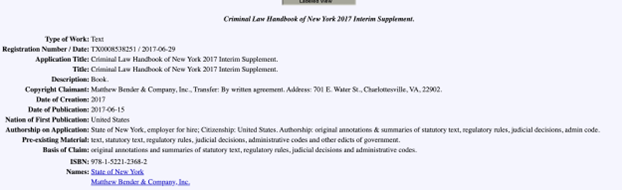
In the federal government's Copyright Registry, the "State of New York" is the registered author, and/or owner, and/or prior owner, of many copyrights, including this one:

screenshot of NYS copyright registry

In the registration shown above, the "State of New York" is listed as the author of the registered work as an "employer for hire"...meaning that the State is not only positioned to author original works that qualify for protection, but can even assign those copyrights just like any other free-lancer.[3]

Of course, much of the text generated and maintained by the State of New York is intended for public use, and in some instances, the State has declared it to be "in the public domain".

For example, in 1973, the New York State Attorney General declared that all New York "codes, rules and regulations" are in the public domain and are not subject to copyright (which makes sense; how can a lawsuit be filed if quoting too much law was an infringement?). On the same opinion, however, the NY Attorney General stated that material included in an official compilation of the codes, rules and regulations--but not actually part of the text--is protected by copyright of the Secretary of State (this is what is shown in the registration above).

So, what insight does that give us? The State of New York (and any department thereof) can both own works protected by, and generate works subject to, copyright. Some state-authored materials, however, may be deemed to be in the public domain. There is no over-arching rule; it is content-specific. So, when using works generated or published by the state, caution is just as warranted as with any other author.[4]


Thank you for a great question!


[1] Your tax dollars at work!

[2] Here it is (for more info, visit https://www.transportation.gov/regulations/time-act)

               The Uniform Time Act of '66

               Created nine zones to restrict

               Local authorities who set their clocks

               At a sunshine whim, creating blocks

               To orderly travel and safe crossroads

               'Til somebody had to take control...

               Who are these chronoscient powers-that-be?

               The Time Lords at the USDOT

[3] If anyone wants to FOIL a copy of that work-for-hire contract, I would love to take a look at it. Maybe if we get an intern....

[4] The library community seems to be investigating this topic perpetually. And good news, helpful resources/guides have ongoing development. For example, the article “The state copyright conundrum” by Kyle K. Courtney (https://crln.acrl.org/index.php/crlnews/article/view/17438/19245) describes context around the uncertainty in government document copyright status as faced by librarians and archivists, and points to this resource made by a 2014 Harvard Library Office for Scholarly Communication, Copyright Fellow, Katie Zimmerman: “State Copyright Resource Center”, http://copyright.lib.harvard.edu/states/. Bonus points for the beautiful functionality of the interactive U.S. map, that leads to state-specific guidance on govdoc copyright considerations.


Access to High School Yearbooks in Public Library

Submission Date

Question

Our local public library has started a collection of donated yearbooks from the high school. They requested to receive or purchase new yearbooks as they were published. As the yearbook contains underage students, information about their sports and clubs, we felt that this was protected personal information and should not be publicly accessible. The understood "agreement" when participating in the yearbook implies that this publication is available only to the current school population. People who are not enrolled, employed, or related to a current student have theoretically been ineligible to purchase a yearbook (it really doesn't come up so no formal policy is in place). We feel that it is a mismatch between telling students to not share personal details and then willingly handing over a roadmap of what meetings and practices they will be attending. Thank you!


Answer

I appreciate the care behind this question: when yearbook information is being assembled, not many people are thinking about all the places the publication could potentially go.

Whenever I get a question related to a yearbook, the first thing I do is check my legal research service to see if there are any new yearbook cases[1] in the New York State or federal courts. It's a chance to check on the latest in a niche area of case law, as well as to make sure I am working from the most current information.

Every time I check with the list of cases, I am reminded that while most people bust them out every so often for nostalgia or period-specific hairstyle mockery, one of the most frequent uses of yearbooks in the legal world is the identification of potential criminal defendants.

That's right. There are numerous cases[2] that show that in addition to a police station photo-array and a classic lineup, trotting out the high school yearbook is another way for people to seek out suspects in criminal matters.[3]

All to illustrate the member's very real concern: yearbooks, which can be used to directly and indirectly convey so much information about students, do not remain in school and student hands, and are not used exclusively to travel down memory lane.  They can be given away, they can be sold, and they can end up in police stations...perhaps by route of the public library.

Does that mean the library shouldn't house them?  Not from where I sit, but I do think some reasonable precautions to guard against releasing information about minors could be taken.

Schools[4] who wish to take such precautions can do the following:

1.  Register the copyright of the yearbook to the school.

2.  Include a copyright notice and a "reservation of rights clause"[5] in the published hard copy version, barring duplication for any purpose whatsoever.[6]

3.  Remind (it would be largely ineffective to require) students to keep their copy safe at home[7];

4.  If requested, provide a copy to the public library with the condition that the copy will not be in circulation and certainly not be digitized until a year after the earliest class featured in the book has graduated (i.e., if the books' youngest students are in class of 2030, the book should not be in circulation until 2031);

5.  Ask if the book could always be in a "special collection" that does not leave the library and cannot be scanned[8] (either forever, or until a specific date);

6.  If advertisers or sponsors require a copy of the book, make sure the advertising contract limits their use of the book to things that don't risk the privacy of the students (no leaving the display copy at the bar in the restaurant who bought an ad).

In this day and age, it can seem almost quaint to worry about the risk that over-exposure of yearbooks poses to privacy. But as the member points out, the information that can be gleaned from a yearbook can reveal things about a student's identity, activities, and schedule. Further-although they can of course be forged--in a sea of mis-identified or ambiguous images on social media, a yearbook's status as a school district "official" publication means they are a little more authentic (and thus valuable).

For this reason, a little extra care in how yearbooks are published and distributed is well-warranted, and should be respected by anyone who has asked to take it.

Thank you for a thoughtful question!

****BONUS EXTRA***

Here is a sample yearbook "reservation of rights""

(c) [YEAR] [District Name]

This [insert year] yearbook is a collective work protected by copyright owned by the [insert school district].  Individual images and compositions may be owned by individual authors.  No part of the book may be reproduced in any medium whatsoever without permission of the District.  The names and likenesses of people featured in this publication are protected by the laws of the state of New York.  Inquiries for permission may be directed to [address].

As with all template language, this is just a starting place...review the final with your lawyer before using!


Suggested tags: Yearbook, copyright, school district, digitization, image use, privacy


[1] It's a very sophisticated legal search; I visit Lexis-Nexus, and type "yearbook" into the search bar for state and federal cases, and organize the results "newest to oldest."

[2]For example, see Wagner v. Hyra 518 F. Supp. 3d 613 (NDNY Feb. 10, 2021); Tytell v. AIW-2010 Wind Down Corp., 2019 N.Y. Misc. LEXIS 5412 (NY Oct. 19, 2019); Williams v. County of Suffolk, 2019 N.Y. Misc. LEXIS 5412 (NY Oct. 1, 2019). I would add that cases against genealogy sites like Ancestry.com and PeopleConnect.com are also often yearbook-driven; for an example, see Braundmeier v Ancestry.Com Operations Inc., 2022 US Dist LEXIS 212415 [ND Ill Nov. 23, 2022, No. 20 C 7390].

[3] I am not endorsing this practice, just noting that it exists.

[4] While it will depend on the circumstances, the school will be the owner of the copyright to the yearbook, even if professional photographers and other contributors retain the rights to their original contributions.

[5] This is really just language to warn people off from making non-fair use copies.

[6] Neither the copyright registration nor the notice will be a "magic bullet" that will stop a third party from using yearbook-gleaned information if they are determined to act creepy, but they can help reduce certain opportunities for creepiness.

[7] Maybe include a free ticket to the 80th class reunion, only redeemable if presented intact with the yearbook?

[8] Except to make adaptive copies per the ADA, of course (or to address damage as allowed by 17 U.S.C. 108).