
Fair Use

Viewing Physical Media of Live Performances

Submission Date

Question

I recently purchased a copy of a DVD at the request of a professor. I believe that the professor intends to show this film in class. The DVD is relevant to course materials. 

I opened up the case to catalog it, and inside the front cover was an insert ... asserting that a public performance rights license must be purchased to be able to show the DVD even in a classroom setting.

I purchased the DVD believing that the professor's showing would fall under Fair Use, as it would be limited to a specific and relevant educational course, shown only to students registered for that course, in a face-to-face classroom setting, using a legally purchased copy. However, my doubts are creeping in because the wording of the insert makes me wonder if this DVD was legally purchased.

If the producer intended for it to be sold only for home/individual use and expressly prohibits any type of group viewing as part of the sale, is my purchase with intent to use the DVD in a classroom setting illegal? Does this insert override or prohibit what would otherwise be Fair Use?

Thank you for your insight and expertise!

Answer

Before we jump into things, let me first offer this unambiguous assurance: Doubts, begone! The use you contemplated is allowed by law.

Okay, with that out of the way, let's break it down.

As we have reviewed on “Ask the Lawyer” before,[1] under Copyright Section 110.1, nonprofit education institutions can show physical copies of movies in class,[2] so long as the copy they are viewing was not “unlawfully obtained.”

Or, as the law puts it, it is not infringement for a school to engage in:

... performance or display of a work by instructors or pupils in the course of face-to-face teaching activities of a nonprofit educational institution, in a classroom or similar place devoted to instruction, unless, in the case of a motion picture or other audiovisual work, the performance, or the display of individual images, is given by means of a copy that was not lawfully made under this title, and that the person responsible for the performance knew or had reason to believe was not lawfully made;

When it comes to what constitutes knowledge of an “unlawful” copy, Congress commented on this in House Report 94-1476:

The exemption [from infringement] is lost where the copy being used for a classroom performance was “not lawfully made under this title” and the person responsible for the performance knew or had reason to suspect as much. This special exception to the exemption would not apply to performances from lawfully-made copies, even if the copies were acquired from someone who had stolen or converted them, or if the performances were in violation of an agreement. However, though the performance would be exempt under section 110(1) in such cases, the copyright owner might have a cause of action against the unauthorized distributor under section 106(3), or against the person responsible for the performance, for breach of contract.

Again: this means the in-class showing contemplated by the member can happen, so long as the school doesn't know the copy was unlawfully made (or didn't make the unlawful copy directly).

From the perspective of an author or owner of a work, this can be frustrating: it means that faculty at a college or university can show a movie, read a poem, or display a painting without the permission that, without the 110.1 exception,[3] might be required.[4] 

For purposes of this question, we're going to assume that the use proposed by the member checks ALL the 110.1 boxes:

  • The use is for a not-for-profit educational institution;
  • The use is by a faculty member or student; and
  • The use will be confined to a class in which the students are enrolled (not a student club or an open event on campus).

It also sounds like the school is the owner of the actual physical copy, although that is not required to exercise rights under 110.1.[5]

So, with the member having met all the criteria for an in-class showing (or “performance”) to be held under 110.1, can a notice with a physical copy, saying essentially, “No 110.1 here, you must get permission to play this in class, or we'll sue!” remove the law's protection?

No.

If the law worked that way, every 110 protection from liability for infringement (which ranges from protections for education, to protections for people with disabilities) could be revoked ad hoc. The law might as well cease to exist. Happily, laws usually don't work that way.

Of course, before being able to give such a decisive answer, I checked the most recent case law and copy of the status on LEXIS-NEXIS. 17 U.S.C. 110 has not been amended since 2005. There has never been an opt-out provision that an owner can invoke with a notice on a physical copy. There is no case law that suggests such an opt-out exists.

Although I am able to give a decisive answer to the fact pattern, the member was right to take a pause and check in when they felt unsure. Copyright, especially in academia, can have some odd-twists and turns. But even though this notice tries to pull the rug out from under the feet of educators, 110.1 abides. [6]


[1] See Screening DVD as part of curriculum: https://wnylrc.org/raq/screening-dvd-part-curriculum

[2] Note: this section pertains to in-person class. For online instruction, we need to delve into 110.2, a.k.a. the “TEACH Act” (see Streaming movies in school and the TEACH Act: https://wnylrc.org/raq/streaming-movies-school-and-teach-act).

[3] Small quibble: Use under Section 110.1 is not “Fair Use,” which is governed by Section 107 of the Act. Academic institutions certainly have rights under 107, but I prefer 110, which has much more defined parameters. No balancing test in 110!

[4] Without Section 110, more arguments would need to be made under Section 107 (Fair Use). As reviewed in footnote 3, 110 is much easier to apply.

[5] For other types of entities, and other mediums, some considerations under 17 U.S.C. 109 (governing the sale and rental of copies), could require further assessment as to if the copy was legitimate. But that doesn't apply here!

[6] I love 110.1: it really ties the classroom together.
Using Copyrighted Audio in Online Course

Submission Date

Question

[We got a question from an academic library...]

I have a question about using copyrighted materials in my classes.

A few years ago, I purchased and listened to the audio version of a Great Course called "[NAME REDACTED TO AVOID COMPLICATIONS]." Each lecture is about 30 minutes and I thought they would make a great weekly assignment in my "[NAME OF CLASS ALSO REDACTED]" class. I would have students listen to a lecture and then focus their discussion around it.

My question is, what legal ways can I share these lectures with students? I have purchased the video series at thegreatcourses.com (for $29.95). I know I can't take a screen recording of them and post on YouTube public, but could I take a screen recording and post in Brightspace? That way, they would not be able to disseminate it or access it beyond the end of the course."

PS "Brightspace" is course software (Like "BlackBoard")

Answer

The question is: what legal ways can I share these lectures with students?

The answers are:

1.  List the video series in the syllabus as a course material to acquire (I know...."BOOO").

2.  Work with the school's library to buy or license sufficient copies of the series for it to be generally accessible to the class through the library (I know... possibly also "BOOO", since the student has an extra step to access the content, but otherwise a decent option).

After these two, as they say: "I got nuthin'."

I cannot endorse the solution described in the question, since both creating a recording of the series and publishing it via Brightspace could create a possible claim of copyright infringement (even if the likelihood or discovery on a closed network was minimal).

I also cannot endorse playing the series during class, since the TEACH Act, which normally would allow watching a copyright-protected recording in class (either in person or via remote learning), does not apply to materials marketed as "mediated instructional activities" (such as a Great Course).[1]

I cannot even offer a "fair use" as a solution, since what you'd like to do does not meet the test for fair use, even though the purpose would be educational.[2]

This is an area where many instructors are going rogue, because the law does not offer a good solution (I am sure most readers have thought of a few not-so-good solutions by now).  But I cannot offer any guidance based on going rogue (well, not when it comes to copyright).

For more on the TEACH Act and fair use, see previous “Ask the Lawyer” answers including Streaming movies in school and the TEACH Act and Viewing DVD materials with remote-based students.

I hope your academic librarian can assist; this is an interesting challenge.


[1] If you would like to read some interesting commentary about the TEACH Act being a "failure" due to the limits it imposes on online learning, check out the 2021 Congressional record here: https://www.copyright.gov/1201/2021/hearing-transcripts/210419-Section-1201-Public-Hearings-Class-5-14a-14b.pdf.

[2] The "fair use test" balances four factors (only one of which is if the use is educational): https://www.copyright.gov/title17/92chap1.html#107.  When I apply those four factors to this situation, I don't arrive at a fair use defense (and my fair use cup is usually half full).  That said, when the use is academic, the key is to ensure the home institution will have your back if infringement is threatened; many institutions have a "fair use form" for this.  Cornell has a nice breakdown of the factors here:

https://guides.library.cornell.edu/copyright/fair-use, and a handy checklist for doing your own assessment here: https://guides.library.cornell.edu/ld.php?content_id=63936868.  

Creating adaptive copies of textbooks using text-to-speech

Submission Date

Question

My institution subscribes to the "Kurzweil Reading Program", a "Text-to-Speech" product for those with reading impairments (dyslexia, English language learners, blind/vision impaired, etc.)

Section 121 indicates these users are "eligible persons" for "fair use", but others, without such disabilities could use the program (like an audiobook in the car!).

We'd be putting TEXTBOOKS up in the program; that fair use violation is what I'm worried about....

Thanks!

Answer

This question reflects the level of savvy "Ask the Lawyer" readers bring to their submissions.  The member submitting the question has already set out (in a manner much more succinct than I usually achieve) the interplay of:

  • Owner's rights (Copyright Act Section 106),
  • Adaptive copies made under "fair use" (Copyright Act Section 107), and
  • Copies made for purposes of accommodations for disability that impacts the ability to read (Copyright Act Section 121).

do have one quibble with the member's phrasing, though, and it is important to this particular issue: Section 121, while it allows copies otherwise barred, does not create a "fair use" right to make a copy.[1]  Rather, the creation of an adaptive copy under Section 121 is a 100% exception to infringement made under highly precise circumstances.

What are those "highly precise circumstances"?

First, as the member writes, the end-user of the copy must be "eligible"--meaning they have a disability that impacts the ability to read (for the three "ways" for a user to be "eligible", see sub-section (d)(3)(A)-(C) of the law, below). 

Second, the copies must:

"(A) not be reproduced or distributed in the United States in a format other than an accessible format exclusively for use by eligible persons;

(B) bear a notice that any further reproduction or distribution in a format other than an accessible format is an infringement; and

(C) include a copyright notice identifying the copyright owner and the date of the original publication."

And third, the maker of the copies must be an "authorized entity" (which is defined in the statute; see the definition, below[2]).

This precise formula, and the right it creates, is why "fair use" is not a part of the issue at hand (adaptive copies specifically for reading-based disabilities).  None of the above-listed requirements are required to claim "fair use" under Section 107[3]. In addition, to make a Section 121 copy, there is no four-factor "balancing" test; rather, a Section 121 use is "inherently noninfringing."[4]

The above-listed Section 121 requirements to include copyright notices are also the key to addressing the member's concern: enforcement.

When an "authorized entity" is creating Section 121-based copies for "eligible" people, the institution must put copyright notices on each copy. This sets up the institution--as either an employer or alma mater--to restrict non-eligible employees and students from using them for non-Section 121 purposes.  Further, in addition to the required notices, the institution can add additional warnings, and if needed, restrict use through technological controls.[5]

Now, how much should an institution police this?  Currently, there is no case law that turns on an alleged infringement that was committed via unauthorized use of a duly made Section 121 copy.  That said, content owners are always looking for new ways to maximize revenues, so taking care to properly designate Section 121-based copies as required by law, and using policy and posted notices to reinforce those restrictions, is a wise idea.

Thank you for a well-informed and nuanced question!

HERE IS SECTION 121 OF THE COPYRIGHT ACT:

(a) Notwithstanding the provisions of section 106, it is not an infringement of copyright for an authorized entity to reproduce or to distribute in the United States copies or phonorecords of a previously published literary work or of a previously published musical work that has been fixed in the form of text or notation if such copies or phonorecords are reproduced or distributed in accessible formats exclusively for use by eligible persons.

(b)

(1) Copies or phonorecords to which this section applies shall—

(A) not be reproduced or distributed in the United States in a format other than an accessible format exclusively for use by eligible persons;

(B) bear a notice that any further reproduction or distribution in a format other than an accessible format is an infringement; and

(C) include a copyright notice identifying the copyright owner and the date of the original publication.

(2) The provisions of this subsection shall not apply to standardized, secure, or norm-referenced tests and related testing material, or to computer programs, except the portions thereof that are in conventional human language (including descriptions of pictorial works) and displayed to users in the ordinary course of using the computer programs.

(c) Notwithstanding the provisions of section 106, it is not an infringement of copyright for a publisher of print instructional materials for use in elementary or secondary schools to create and distribute to the National Instructional Materials Access Center copies of the electronic files described in sections 612(a)(23)(C), 613(a)(6), and section 674(e) of the Individuals with Disabilities Education Act that contain the contents of print instructional materials using the National Instructional Material Accessibility Standard (as defined in section 674(e)(3) of that Act), if—

(1) the inclusion of the contents of such print instructional materials is required by any State educational agency or local educational agency;

(2) the publisher had the right to publish such print instructional materials in print formats; and

(3) such copies are used solely for reproduction or distribution of the contents of such print instructional materials in accessible formats.

(d) For purposes of this section, the term—

(1) “accessible format” means an alternative manner or form that gives an eligible person access to the work when the copy or phonorecord in the accessible format is used exclusively by the eligible person to permit him or her to have access as feasibly and comfortably as a person without such disability as described in paragraph (3);

(2) “authorized entity” means a nonprofit organization or a governmental agency that has a primary mission to provide specialized services relating to training, education, or adaptive reading or information access needs of blind or other persons with disabilities;

(3) “eligible person” means an individual who, regardless of any other disability—

(A) is blind;

(B) has a visual impairment or perceptual or reading disability that cannot be improved to give visual function substantially equivalent to that of a person who has no such impairment or disability and so is unable to read printed works to substantially the same degree as a person without an impairment or disability; or

(C) is otherwise unable, through physical disability, to hold or manipulate a book or to focus or move the eyes to the extent that would be normally acceptable for reading; and

(4) “print instructional materials” has the meaning given under section 674(e)(3)(C) of the Individuals with Disabilities Education Act.

(Added Pub. L. 104–197, title III, §â€¯316(a), Sept. 16, 1996, 110 Stat. 2416; amended Pub. L. 106–379, §â€¯3(b), Oct. 27, 2000, 114 Stat. 1445; Pub. L. 107–273, div. C, title III, §â€¯13210(3)(A), Nov. 2, 2002, 116 Stat. 1909; Pub. L. 108–446, title III, §â€¯306, Dec. 3, 2004, 118 Stat. 2807; Pub. L. 115–261, §â€¯2(a)(1), Oct. 9, 2018, 132 Stat. 3667.)


[1] I'm quibbling, but I want to take this footnote to state that including a "fair use" cite in the question is very reasonable, because fair use is often cited as yet another reason to make adaptive copies that go beyond copies authorized by Section 121. Since the copies in this case are without question for those "eligible" under Section 121 (those with reading-impacting disabilities), we're going to sideline fair use at Section 107 for this question, but it very much is a part of the toolbox of creating adaptive works for non-Section 121-eligible disabilities.

[2] There is controversy, but no definitive authority, on if all not-for-profit educational institutions meet the criteria.  Academic publishers have taken a position that it only applies to institutions for the blind, not just any old school or college.  However, an uncontradicted conclusion in the October 10, 2012 district court decision in Authors Guild V. Hathitrust, 902 F. Supp, 2d 445 (2012) opines that because of their mandate to provide accessibility under the ADA, such institutions all are "authorized entities" under Section 121.  Until I read otherwise, my guidance errs on the side of accessibility (see https://wnylrc.org/index.php/raq/accessibility-options-school-ebooks).

[3] In fact, having to abide by this type of requirement could undercut some of the more vital applications of fair use, such as parody or innovation.

[4] If this distinction intrigues you, check out the commentary at  https://www.copyright.gov/1201/2021/comments/Class%2008_InitialComments_Accessibility%20Petitioners%20II.pdf

[5] I am slightly wary of a system that would force a student to "register" with the library as needing ADA accommodations, but depending on how access is granted, some type of additional log-in or control might be wise.  At higher ed institutions, students and employees arrange accommodation per a policy, and accommodations are generally confirmed in writing, so signing up for access to adaptive copies could be the way to go.  But this will be driven by technology, and care must be taken to not put up any additional hurdles to access.  If any readers out there have solved this issue at your institution, I'd appreciate hearing about it!  Please send that to info@losapllc.com.

Screening DVD as part of curriculum

Submission Date

Question

If a teacher teaches a novel in school, can they show the DVD of the movie under fair use?

Answer

This question was submitted by a system serving elementary and secondary schools.

The answer for those schools (and for higher education, too) is: if the viewing of the DVD is tied to the reading of the book and the content is part of the class/curriculum, then YES, it can be viewed in class.

This exception to infringement by a school is found in 17 U.S.C. 110  (1), which states:

...the following are not infringements of copyright:

(1) performance or display of a work by instructors or pupils in the course of face-to-face teaching activities of a nonprofit educational institution, in a classroom or similar place devoted to instruction, unless, in the case of a motion picture or other audiovisual work, the performance, or the display of individual images, is given by means of a copy that was not lawfully made under this title, and that the person responsible for the performance knew or had reason to believe was not lawfully made;

So, to be clear: at a not-for-profit school, as part of the curriculum, in the school's designated learning space, the "movie based on the book" can be viewed as part of  the curriculum...so long as the copy being watched was not pirated or otherwise obtained through the shady  (but now losing ground to illegal streaming) DVD black market.

Thank you for this question.

School Libraries Template for Copiers

Submission Date

Question

We were asked about signage to post over the copier at a schools where educational materials are copied. Below is some template language with footnotes explaining why they say what they do.  Of course, before posting in your school or library, check with your lawyer!

Answer

MAKING A COPY ON THIS MACHINE

MAY BE SUBJECT TO THE COPYRIGHT LAW OF THE UNITED STATES

This means 4 important things:

1.  Copying a copyright-protected work here could be a copyright violation[1].

2.  Copying protected works is sometimes allowed under "fair use."[2]  Our school's fair use policy is posted INSERT.

3.  Copying a copyrighted work to accommodate a disability under the ADA is allowed.   However, to do that, please see the [insert office for disability services] staff, since adaptive copies have special rules,[3] and we want to help you (or a person you are assisting) exercise your rights.

4.   Under the TEACH Act,[4] you may display or perform certain copyright-protected content in class, but that does not allow you to make additional copies for in-class or online instruction.  Please don't make copies that exceed the permission obtained by the school (unless you use our policy to determine it is fair use).

The copy machines are here for your use, and we appreciate your consideration of these laws.

Thanks!


[1] 17 U.S.C. 106 reserves the making of copies to the copyright owner.

[2] 17. U.S.C. 107 allows copying under certain circumstances, but simply "educational" or "not-for-profit"  use is not enough.  Read the guide at the link!

[3] See https://www.loc.gov/nls/about/organization/laws-regulations/copyright-law-amendment-1996-pl-104-197/.

[4] Section 110 of the Copyright Act.

Libraries Open to the Public Template for Copiers

Submission Date

Question

We were asked about signage to post over the public copier at a libraries open to the public. Below is some template language with footnotes explaining why they say what they do.  Of course, before posting in your school or library, check with your lawyer!

Answer

MAKING A COPY ON THIS MACHINE

MAY BE SUBJECT TO THE COPYRIGHT LAW OF THE UNITED STATES[1]

This means 4 important things:

1.  Copying a copyright-protected work here could be a copyright violation.[2]

2.  Copying protected works is sometimes allowed under "fair use."[3]  We can't give you legal advice, but if you want to learn more about "fair use," go to https://www.copyright.gov/circs/circ21.pdf or see the [INSTITUTION NAME] Fair Use policy at [LINK].

3.  Copying a copyrighted work to accommodate a disability under the ADA is allowed.   However, to do that, please see the library staff, since adaptive copies have special rules,[4] and we want to help you (or a person you are assisting) exercise your rights.

4. As a library open to the public, there are special circumstances under which we get to make copies (libraries are special).  However, to qualify for that protection, this notice (which we have, by law, placed over the copier right in front of you), has to say what it says in bold at the very top, and we have to operate by this rule:

Any person or group is forbidden to use this machine to engage in the related or concerted reproduction or distribution of multiple copies of the same material, whether made on one occasion or over a period of time, and whether intended for aggregate use by one or more individuals or for separate use by the individual members of a group.

What does that mean? Entire classes should not come here and copy the whole text book for a course![5]  Please don't do that.[6]

The copy machines are here for your use, and we appreciate your consideration of these laws.

Thanks!


[1] This precise language is required by 17 U.S.C. 108 for the library and its employees to be protected against allegations of secondary infringement.

[2] 17 U.S.C. 106 reserves the making of copies to the copyright owner.

[3] 17. U.S.C. 107 allows copying under certain circumstances, but simply "educational" or "not-for-profit" use is not enough.  Read the guide at the link!

[4] See https://www.loc.gov/nls/about/organization/laws-regulations/copyright-law-amendment-1996-pl-104-197/.

[5] This is covered by 17 U.S.C. Section 108(f).  Section 108 also lets libraries make copies for other uses...but that is for libraries, not regular people or students using a copier in a library.

[6] Seriously, if we see you doing that, we have to ask you to stop.

Accessibility options for school ebooks

Submission Date

Question

Students in a school are reading a simultaneous use eBook. The students with IEPs[1] have access to a screen reader but this feature is very robotic and doesn't meet their needs. The school librarian and the School Library System searched for an audio version of this book but could not find one for purchase. Several students need a high-quality audio version of the book that is not robotic because of their learning needs. Would the school library be covered under fair use if they recorded a reading of the book for the students and posted it in Google Classroom for the students? This would be in a closed platform and not open to everybody on the internet.


[1] IEP stands for "Individual Education Program, “which is a tool used in elementary and secondary schools to effect ADA accommodations for students.  For more info on that, see https://www2.ed.gov/about/offices/list/ocr/504faq.html.

Answer

The school may be covered by Fair Use but for this scenario, it doesn't need to be in order to make the recording proposed by the member.

Why?

Because Section 121 of the Copyright Act allows "authorized entities" (like schools serving those with IEP's)[1] the right to make a copy in an "accessible format" (like an audio file) for "eligible persons" (like a student with an IEP), without it being an infringement.

Of course, there's always a catch.  In addition to precautions like the one described by the member (limiting access to only those who need it), the exception under Section 121 has other requirements, such as:

  • The accessible copy has to have a copyright notice.
  • The accessible copy has to have a note stating no further copies are authorized.
  • It doesn't apply to computer programs.[2]

I am putting a copy of Section 121, which was most recently amended in 2018, below this answer, so members can review its requirements and consider how it might apply in their institution.

Now, I will say that if there wasn't a Section 121, there is a strong chance the format conversion described by the member would qualify as a Fair Use.  In fact, the 2nd Circuit Court of Appeal, which is the first level of appeal for copyright cases in New York State, has found Section 121's to bolster educational institutions' claims of Fair Use.[3]

But between a rock-solid exemption like Section 121, and a shifting, 4-part formulaic one like Section 107 ("Fair Use"), I say: go for the rock-solid exemption. 

The law takes assured access for those with disabilities seriously, and that regard is important to strengthen through robust and repeated use.

Thanks for a valuable and carefully thought-out question.


Here is the full text of section 121:

(a)

Notwithstanding the provisions of section 106, it is not an infringement of copyright for an authorized entity to reproduce or to distribute in the United States copies or phonorecords of a previously published literary work or of a previously published musical work that has been fixed in the form of text or notation if such copies or phonorecords are reproduced or distributed in accessible formats exclusively for use by eligible persons.


(b)

(1)Copies or phonorecords to which this section applies shall—

(A)  not be reproduced or distributed in the United States in a format other than an accessible format exclusively for use by eligible persons;

(B) bear a notice that any further reproduction or distribution in a format other than an accessible format is an infringement; and

(C) include a copyright notice identifying the copyright owner and the date of the original publication.

(2)The provisions of this subsection shall not apply to standardized, secure, or norm-referenced tests and related testing material, or to computer programs, except the portions thereof that are in conventional human language (including descriptions of pictorial works) and displayed to users in the ordinary course of using the computer programs.


(c)

Notwithstanding the provisions of section 106, it is not an infringement of copyright for a publisher of print instructional materials for use in elementary or secondary schools to create and distribute to the National Instructional Materials Access Center copies of the electronic files described in sections 612(a)(23)(C), 613(a)(6), and section 674(e) of the Individuals with Disabilities Education Act that contain the contents of print instructional materials using the National Instructional Material Accessibility Standard (as defined in section 674(e)(3) of that Act), if—

(1) the inclusion of the contents of such print instructional materials is required by any State educational agency or local educational agency;

(2) the publisher had the right to publish such print instructional materials in print formats; and

(3) such copies are used solely for reproduction or distribution of the contents of such print instructional materials in accessible formats.


(d)For purposes of this section, the term—

(1) “accessible format” means an alternative manner or form that gives an eligible person access to the work when the copy or phonorecord in the accessible format is used exclusively by the eligible person to permit him or her to have access as feasibly and comfortably as a person without such disability as described in paragraph (3);

(2) “authorized entity” means a nonprofit organization or a governmental agency that has a primary mission to provide specialized services relating to training, education, or adaptive reading or information access needs of blind or other persons with disabilities;

(3)“eligible person” means an individual who, regardless of any other disability—

(A) is blind;

(B) has a visual impairment or perceptual or reading disability that cannot be improved to give visual function substantially equivalent to that of a person who has no such impairment or disability and so is unable to read printed works to substantially the same degree as a person without an impairment or disability; or

(C) is otherwise unable, through physical disability, to hold or manipulate a book or to focus or move the eyes to the extent that would be normally acceptable for reading; and

(4) “print instructional materials” has the meaning given under section 674(e)(3)(C) of the Individuals with Disabilities Education Act.


[1] The literal definition of "authorized entity" is "a nonprofit organization or a governmental agency that has a primary mission to provide specialized services relating to training, education, or adaptive reading or information access needs of blind or other persons with disabilities."  The only case law construing this language interprets it to include educational institutions with obligations to provide ADA access.  For more on that, see footnote #4.

[2] An eBook is not a computer program.

[3] In the 2014 Hathi Trust case (Authors Guild, Inc. v Hathi Trust, 755 F3d 87 [2d Cir 2014])), the court opined that an academic library could qualify for 121's exemption because of its obligation to provide access under the ADA.  This was bootstrapped into an allowance for Fair Use, too.  It's not the smoothest finding, but it's there, and it’s the only line of cases citing 121 as of December 19, 2021.

Popular music in Public K-12 Schools

Submission Date

Question

I am struggling to find information on using popular music in public K-12 schools. I have the following areas I am trying to find information about:
1. Can a teacher use a Spotify account in their classroom?
2. Can a teacher use music with face-to-face instruction?
3. Can a service provider (counselor, therapist, social worker...) use music with students?
4. Can music be played during sporting events
5. Can music be used as part of the morning announcements

Thank you!

Answer

Welcome to "Back to School 2021"...a year unlike any other!

I have weathered many K-12 "back-to-schools."  For instance, second grade back-to-school, for me, was in 1980.  For my son, it was in 2010.  And for my daughter, it was just a few days before I sat down to write this.

That 1980-to-2021 time span has allowed me to realize two things:

Realization #1: Erasers smell the same in 2021 as they did in 1980; and

Realization #2: Back-to-school 2021 kicked off in a world that has gone through a lot of rapid and (at times) de-stabilizing change.[1]

The good news about realization #2 is that the law--which tends to change much more slowly than the world around it-- is much the same.  So, for this answer, where we can, we'll be linking back to prior "Ask the Lawyer" answers, and where there is something new, we'll add it.

QUESTION 1: Can a teacher use a Spotify account in their classroom?

ANSWER: Not unless the license has changed to allow more than "personal use."  For more on that, see Using Streaming Services (Hulu, Netflix) in the Classroom.

QUESTION 2: Can a teacher use music with face-to-face instruction?

ANSWER:  Yes, so long as the music is part of the instruction, and the copy of the song was legally obtained.[2]

QUESTION 3: Can a service provider (counselor, therapist, social worker...) use music with students?

ANSWER:  There is no automatic permission or exception to the copyright law that allows a mental health service provider to use recordings, sheet music, or other copyright-protected property for purposes of licensed service.[3]

QUESTION 4: Can music be played during sporting events?

If the recorded or streamed music is protected by copyright, it should only be played with a license.

NOTE: Public schools will want to consult their lawyers about their risks in this regard now that the U.S. Supreme Court has (arguably) struck down the ability to sue "the state" and its subdivisions for copyright infringement.
 

5. Can music be used as part of the morning announcements?
If the music is protected by copyright, it should only be played with a license. 

NOTE: Public schools will want to consult their lawyers about their risks in this regard now that the U.S. Supreme Court has (arguably) struck down the ability to sue "the state" and its subdivisions for copyright infringement.

And with that, I wish you a joyous back-to-school.


[1] Perhaps this is why I found the familiar aroma of new "Pink Pearl" erasers comforting.

[2] This is allowed per Section 110(1) of the Copyright Act, which states that "performance or display of a work by instructors or pupils in the course of face-to-face teaching activities of a nonprofit educational institution, in a classroom or similar place devoted to instruction" is not infringement. 

[3] As I write that, it strikes me that such services are so important, ensuring the resource can be used legally is important.  There are a number of ways to do that, depending on the precise circumstances.

Do Book Covers Fall Under Fair Use?

Submission Date

Question

We are trying to determine if sharing only book covers as part of video book talks published online is Fair Use. We think we can support a Fair Use evaluation. However, we would like to know how library management software is allowed to include covers in our online public access catalogs. How to do they get permission? We would like any feedback and information regarding book covers. Many thanks.

Answer

I am writing this answer on a Friday afternoon, so before I give a formal answer (and I will, this is an important question), please indulge me in a small flight of fancy.

Instead of asking about book covers in a video book talk, let's pretend it's 1978 and you've asked me if you can bring some friends to Studio 54, where entry is based not on four fair use factors[1], but depends on a subjective analysis of fashion, beauty, eccentricity, and fame.[2]

So here we are.  It's Friday night, under the glittering marquee, approaching the doorman...[3] 

Your friend with the feather boa and the spandex?

IN.

Your friends clad totally in cutting-edge Halston?

IN.

Your friend whose art opening was recently on the cover of the Village Voice?

Mmmm... go to the back of the line and mingle, we'll see what we can do in an hour or so.

Your friend who is actually the nicest person on the planet, but is wearing a middy blouse and clogs?

OUT.

You? 

[...I'll let you decide if you have made the cut.[4]]

Flash back to a Friday afternoon in pandemic-fatigued 2021, book covers, and this fair use question.

Fair use is always complex, but adding book covers to the mix ups the ante.

That is because book covers, depending on what they feature, can have many layers of intellectual property protection--not only multiple copyrights (for the art, the cover arrangement, and the book as a whole), but any trademark on the cover and, if the cover features a photo of a real person, that person's image.

Enter my analogy to the door at Studio 54.  Not only does the usual analysis apply (is a person old enough to get in?) but with book covers, the content warrants an extra array of analysis...getting you "in" (to fair use) or "out" (risking infringement).

Which brings us to the member's very insightful sub-question: if you have to be careful about covers, how do the various library management systems ("LMS") out there include them in their catalog entries?

Since there are numerous LMS's, I can't answer for each one, but generally, permission for such a use is conveyed to the LMS by the publisher. Sometimes (if the cover is a very fuzzy copy) they are relying on fair use.

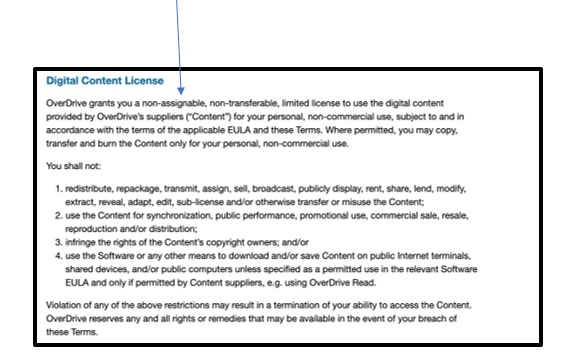
Here is a sign that your LMS has secured permission for the cover (this one is from the Terms and Condition for OverDrive[5]):

Screenshot of a digital content license warning

Of course, there are numerous LMS's, and each has its own approach.  However, this is the one I have seen most frequently in LMS contracts.

So, with all that said, what are some ways to mitigate the likelihood or limit the seriousness of a legal problem when considering incorporating book covers into a video book talk? I offer the following techniques:

1.  Rather than display a scan or borrowed digital image of the book, have the book held or displayed by the person giving the presentation.

2.  Do not use the cover image for purposes of promoting the video, especially if it is on a monetized site.

3.  Conduct your fair use analysis on a cover-by-cover basis, and retain a copy of the analysis to be able to show you made a good faith determination that the cover needed to be used for the presentation.

4.  If you plan to have the video feature the cover for long periods of time (relative to the presentation) make sure the cover is related to what is being said.  For example: the cover to the graphic novel adaptation of "Parable of the Sower" (found at https://www.hoopladigital.com/title/12473453) is a great contrast to the novel's cover (found at https://www.octaviabutler.com/parableseries); if the speaker's entire talk on your video is a "compare and contrast" of these two images, it could be a fair use to have them up on the screen the entire time.  However, that same defense might not apply if the purpose of the discussion is a broad presentation about the power of speculative fiction.

Of course, you can ditch relying on fair use and ask the publisher for permission...but if your use is genuinely "fair," there is of course no need to ask...just like Bianca Jagger never had to ask permission to enter Studio 54.[6]

I hope this has been helpful, and your videos make it safely past the doorman of Section 107[7] of the Copyright Act.                                                                                                           


[1] https://www.law.cornell.edu/uscode/text/17/107

[2] And possibly, access to cocaine.

[3] Yes, he's a door "man."  This is 1978.   But Studio 54 did fight gender norms.

[4] I speak as a person who would NOT have made the cut.  Of course, in 1978, I was five, but even pulling from my coolest, most cutting-edge day (sometime in 1997) I would not have made the cut.

[5] Found on August 6, 2021 at https://company.cdn.overdrive.com/policies/terms-and-conditions.htm

[6] I think she got permission the night she rode a horse in there, but that was arranged in advance by the management.

[7] Which lists the fair use factors.  Here it is: https://www.law.cornell.edu/uscode/text/17/107.

Fair use and Youtube in Academia

Submission Date

Question

A taskforce at the college is wanting to use a recent song and video on Youtube. This would be a traditional lip dub with a little step up in production as they would use some greenscreen and use some face tracking to animate anti-racist quotes on the faces of the participants. They want to mimic some of the effects in the video as well as add some of our own. So it is transforming the work. Also, this would be a new creation based on the content of the video and use of the music.

In short, they are looking to do a lip dub of the song with their own spin on the video. The college has their own video streaming platform so this would not be on Youtube.
This would be for the campus community but there might be that people could share outside the organization.

The intent is to educate the campus and is part of a greater initiative to promote diversity equity and inclusion.

Answer

This submission is a "fair use”[1] question coming at us from a private college, so before we delve into a reply, I have to emphasize that the specific analysis in this case is limited to that type of entity (a private, accredited school).

Since it can get boring "emphasizing" disclaimers in prose form, I will emphasize it in verse:

          If ye a public library be

          This analysis is not for ye

          If a SUNY or public school

          Do not swim in this legal pool

Okay.  With that out of the way (and for those of you not put off by either the disclaimer, nor the crude verse), here is my answer:

Riffing on, parodying, and building on popular songs can be an effective way to convey a unifying or powerful message to a group.  The use of a known work of art can build on shared familiarity, while modifying it with a unique twist can create a unique and unifying experience. 

The technique described by the member is a very popular approach for higher education institutions, and for unrecorded performances/parodies/riffs that are done live on campus, the school's ASCAP/BMI may even apply (meaning, the site of the performance has permission).

Of course, this is 2021, and that means, it doesn't happen if it isn't on video (or in a picture).  And since we are still in the midst of a pandemic (although things are looking a tad brighter, here in May of 2021), having a video that is an experience customized, created and controlled by the school is a desirable way to build remote cohesion.

When considering the use of copyright-protected content without permission, there are two factors a private institution must consider:

1. Risk management

2. Copyright infringement

"Risk management" is not about the actual legality of one's actions, but the risk that one's actions will be observed and perceived as illegal.

In this case, the additional circumstances the member lists here (not using YouTube to post the final product) enables "risk management" in two ways: a) the resulting video will not be "purged" from YouTube due to a copyright "red flag" (which can happen even if there is a fair use); and b) by hosting it on a less popular server, it is less likely to be seen by services and bots that are "out there"[2] policing copyright laws.

But of course, an educational institution doesn't want to get away with infringement, it wants to not commit it.  And that is the essence of the member's question: is creation of this derivative work[3] a "fair use"?

In their question, the member has walked us through some of the "fair use" factors. The member identifies as an educational institution. The member states that the use of the work will be "transformative." The institution will use all of the audio, and be evocative of but different from the video.  And, although it is not specifically mentioned as such, the described use of the resulting derivative work will (clearly) not be a replacement in the market for the original.

What is missing from the submission is the consideration: why this particular work?  In order to justify a fair use-especially of an entire work (the audio), the use must not only be transformative, but there must be a reason why that particular work is chosen, and the message sent by the "transformed" work must relate to that reason.

In other words, you don't select the underlying work to re-transmit it at face value; you select the works to say something new, that at least in part, relates back to the riffed/parodied work.

The best example I have seen of this lately is a complete, unaltered use of the "Avengers, assemble," scene from the "Endgame."  The clip is exactly as it is in the movie, with no changes to audio or video, except the author puts captions near the various super-heroes as they show up, giving the characters new names, and drawing an analogy to how they saw the protests of 2020 developing. 

The end result of this modified "Avengers, assemble" clip is not only highly transformative--the clip is no longer in any way about the original superheroes--but the author uses the identities of the originals to make comments about both those iconic comic book figures, and the categorical names he ascribed to them.  It's such a good example, it could be used to teach "fair use" in a law school class (you can see it here, or just search "endgame protestors 2020 avengers" and it'll pop right up).

With regard to this use of audio and video, it is this question--why this particular work was selected--that is the missing piece of the puzzle.  So long as that piece fits in, there is a good claim for fair use.

If it is decided that there is a good reason to select the original work, the other thing to be cautious about is how the end result (the new video with the unmodified audio) is used.  If it is used only as described and is built into a structured discussion about equity and inclusion--especially if the lyrics and images are used as focal points in the discussion-there is a strong case that this is an academic, non-commercial use. 

However, we have to remember that at the end of the day, a college is a place where students pay to be.  If the video bleeds into recruitment materials, or is not coupled with the education/discussion, the more likely the use could be found to be commercial. 

So: the more "academic" the end result (and its context) is, and the more the initiative functions as both a comment on the source material, and its own, stand-alone message, the better.  Since fair use is not simply an additive analysis (it's not just one factor vs. another, but rather, how the factors resolve and then inter-relate to each other), every aspect of this is critical.

Within those parameters, and if care is taken so the video is only used in the educational context (not simply sending a link to it out in a newsletter, without the educational content and context), there is a strong case to make that the new video, inspired by the song’s current video and using that unmodified song, is not a copyright infringement. 

I am sorry I could not be more definitive...answers like this are why very often, people just ask for permission![4]


[1] I am going to jump right into this answer with the assumption that the reader knows the basics about fair use (Copyright Act Section 107).  If you don't know the basics of fair use, you can get the gist on in these "Ask the Lawyer" RAQ’s: Educational films without a licenseFair Use and Restrictions of Song Parodies

[2] So I went to find an example of these "bots" and got more than I bargained for; here is an example of not only how video-sharing services shut down fair use on platforms like YouTube and Facebook, but a story about how this blocking is impacting how people film and transmit law enforcement activity: https://www.eff.org/deeplinks/2021/02/cops-using-music-try-stop-being-filmed-just-tip-iceberg

[3] A derivative work is a work that incorporates copyright-protected work.  The right to authorize derivative works is one of the six rights reserved to the owner of a copyright.  Parodies that incorporate or draw heavily from the original risk being "derivative works" (and thus infringement) unless they are 1) done with permission or 2) are a "fair use."

[4] For instance, Weird Al, although he could likely claim fair use for many of his parodies, always gets permission.