School Libraries

Evaluating Public Library Collections in NYS

Submission Date

Question

My school district public library system just reviewed a new (April 25th, 2024) NY Education Department Decision by the Commissioner, addressing the proper procedure for evaluating school library books. What does this decision mean for school libraries and school library systems?

Answer

The member is referring to NYSED Commissioner Decision #18,402, which resolved an appeal related to books in a school library.

In a nutshell: petitioners[1] appealed to Education Commissioner Betty Rosa after a school board voted to retain five books whose inclusion in the library one of the petitioners had formally requested be reconsidered. Commissioner Rosa upheld the board’s decision and emphasized the legal considerations of evaluating material in public school libraries.

The commissioner’s decision shows the importance of:

  1. well-developed collection development policies for school libraries and school library systems;
  2. following those policies; and
  3. using those policies to ensure that access to school library resources is not limited in a way that violates the state or federal constitution.

The decision did not change law or policy but is noteworthy because it emphasizes that even when a school is accused of having materials that are “obscene” or “harmful to minors,” it is important to follow the law and not to remove books due to an author’s worldview or identity.

Of course, what sounds simple—not removing library materials due to an author’s views or identity—can be complex. Selecting library materials is not simply a matter of preference or gut instinct. Per the regulation at 8 NYCRR 91.1, a school library must have an array of materials to “provide an adequate complement to the instructional program in the various areas of the curriculum.”[2]

8 NYCRR 91.1 means selection of library books must consider not just the context of the library’s collection but the overall instructional program in the various areas of the curriculum—a balancing act that certainly requires consideration of a book’s point of view, which, as the decision describes, cannot be a basis to remove it from the library.

This is why having a collection development policy is so important.

Following a collection development policy can ensure (and document) that the work of assembling a school library collection is not just based on what would be a meaningful and balanced array of books in and of itself but is evaluated in the context of the overall academic operation of the school, while avoiding assertions of viewpoint discrimination.

For this reason, many school district library collection management policies incorporate this regulatory standard into the “selection” part of its policy. A district that does not expressly work from this standard may want to consider using one of the BOCES-supplies model policies[3] to do so.

From there, as emphasized by the decision, once a book is selected and in a school library collection, removal or restriction of access on the basis of viewpoint or identity violates the First Amendment of the U.S. Constitution. 

So, for school districts wondering: how does this decision apply to us? The take-aways are:

  1. have a well-developed policy for school library collection development, which incorporates the language from 8 NYCRR 91.1;
  2. follow that policy any time books are selected, cataloged, challenged, or removed; and
  3. apply the policies to ensure that access to school library resources is not limited in a way that violates the state or federal constitution.

Another take-away (although not expressly stated) would be to not use policy “workarounds” such as removing books from shelves, requiring materials be covered or hidden, avoiding purchasing titles because of threats, or otherwise subverting normal policy and procedure.

For those with the time, reading the decision is highly recommended, as it is a timely primer on these issues.[4] 

Thank you for an important and timely question.


[1] “Petitioners” is the formal name for people bringing an appeal to the NYS Education Department Commissioner. Many “Ask the Lawyer” readers know this, but since it’s a legal term, it’s good to explain its meaning.

[2] See N.Y. Education Law Section 274 and 8 NYCRR 91.1.

[3] Such as the one offered by Erie 1 BOCES Policy Services: https://www.e1b.org/en/administrative-services/policy-services.aspx

[4] The decision is especially meaningful to this author, as her office wrote and submitted a “friend of the court” brief on behalf of the New York Library Association in this case.
Creating Prayer Space in School District Library

Submission Date

Question

We are a small, urban, very diverse school district with a large English Language Learner (ELL) population and a high poverty rate. Our school library spaces are small and do not have adjoining meeting rooms. There is no dedicated prayer/meditation space in our schools either. In the past, during Ramadan and other Muslim holidays, school administration has directed Muslim students to use the libraries as prayer spaces. Currently, Muslim students have been directed to pray daily concerning the issues taking place in Israel/Gaza, so they have been coming in daily to pray. This becomes an issue as we have classes/groups scheduled in the libraries throughout the day, so space and privacy become an issue. The libraries are also not always staffed, as librarians travel between buildings and support staff is often pulled to cover for classroom teachers.

What is the legality of using a school library for a prayer place for students?
Should an alternative location be put in place in lieu of the school library?

We want to be respectful of students' religious view and rights, but also want and need to keep the school libraries accessible to all.

I would appreciate any advice you could provide on this topic.
Thank you.

Answer

In the United States, public schools that accept federal funding are barred from restricting student access to generally available space on the basis of “religious, political, philosophical…” beliefs.[1]

In New York State, laws, regulations, and policies protect the rights of students to observe a religion at public school.[2]

Consistent with these rights and protections, public schools in New York State must allow student religious groups to use generally available space on an equitable basis[3] and confirm through policy that students and staff have an individual right to pray in school.[4]

So, in New York, students being accorded space and time to pray in school (including in a school library) can happen one of two ways: first, as an act of individual liberty, or second, as a group exercise of equal access to space.

Of course, granting space on an equitable basis and honoring an individual student's right to pray in school is not quite what the member is asking about; this question turns not on indisputable rights but on the practice of using library space for exercising them.

In some ways, a school selecting the school library as a place to exercise fundamental rights of religious expression sounds like a compliment to the library.  When seeking a place to pray, who wouldn't prefer a welcoming, orderly library to a supply room, a gym, or even an empty classroom?  There is something about orderly stacks of books and room to read that lends itself to spiritual confidence.[5]

As the member points out, however, a school library is not an empty classroom; it is a useful and routinely used space, often with scheduled activities, and generally available to all.

This is where things get tricky, and it’s at the heart of the member's question: What is the legality of using a school library for a prayer place for students?

The answer is: absolutely, use of the school library for individual prayer is legal, just as use of any designated space (a supply room, a gym, a classroom) for free exercise of religion can be legal.

That said, administrators implementing such an accommodation should be careful of three factors:

First, if space in the library is available to organized student groups/clubs for prayer, it must also be available for other school groups on the same basis (that's not the question here but is important to establish).

Second, if space in the library is available to individuals for prayer (which is the question here), the use should align with the school’s policy on “free exercise” of religion, but one must be careful not to drift into any “establishment” of religion by making it seem like that is the purpose of the space.[6]

And third: a school should be wary of using the library space—which is for all students at all times—in a way that could limit access to others. Unlike the supply room, a gym, or an empty classroom, a library has a prescribed time when it is available (generally all day). Accommodations in furtherance of free exercise of religion, while a basic civil right, should not impede access to a general-access location.

Which brings us to the second question:

Should an alternative location be put in place in lieu of the school library?

This question comes down to a school library's size and layout.  If the school library has a spare study room or area in the library that can safely and respectfully be used for prayer, without restricting general access to library resources, it may make sense to use that space. But if (as the member writes) the library is small and only has space that meets basic regulatory requirements for the school (see 9 NYCRR 90), the school should consider another location.

The bottom line here: To avoid needless stress, the civil right of free exercise of religion should NEVER be pitted against the general needs of a community. In addition, accommodations that limit access to required resources should be avoided.

School administrators must think how they can allocate space safety so students can exercise their fundamental rights without putting them in needless conflict with the rights of others.  School district lawyers and facility managers can help administrators reach solutions by allocating space with attention to compliance.


[1] This rule, which is rooted in the First Amendment, is found in 20 USCS Section 4071, and has a long history of case law behind it, including the recent “Praying Football Coach” case decided in 2022.

[2] For example, 8 NYCRR 109.2 allows students to be absent for a limited time for “religious observance and education.”

[3] For example, Glee Club and [Religion] Club have the same access.

[4] If you need more of a breakdown on this, an excellent case is Eder v. City of New York (2009).

[5] Or maybe that's just me.  Like religion itself, the best place to pray is both highly personal, and highly specialized.  In the case where prayer requires space, motion, and spatial orientation, as in this question, perhaps even more so.

[6] A good case that reviews this distinction is the 2022 U.S. Supreme Court case Kennedy v. Bremerton School District, where the court discussed the difference at great length.

Limiting Digital Content Access in Schools

Submission Date

Question

Within the context of recent regional school book challenges, much of the attention has been focused on print collections. However, librarians and school districts have started to look at digital content, too.

Sora is the K-12 platform used by many students and staff in NYS to access OverDrive content (as opposed to Libby, which is used by public library patrons). In Sora, content access levels can be implemented to restrict access to content.

Here is how OverDrive defines content access levels:

Content access levels let you control which types of users can view and borrow certain titles in your digital collection. Content access levels are customizable and can be different from the publisher-defined audience label.

Note: In the Libby app, users will be able to see all titles in your digital collection, regardless of content access levels. If a user tries to borrow a book that's restricted by content access level, the checkout won't be completed and the user will get an error message.

Content access levels are designed to let you manage access to titles based on age-appropriateness. Users are assigned a user type ("Adult," "Young Adult," or "Juvenile") when you set up authentication (for schools) or based on library card type (for libraries). Users can access titles at or below their access level:

"Adult" users can access all titles
"Young Adult" users can only access titles you label "Young Adult" or "Juvenile"
"Juvenile" users can only access titles you label "Juvenile"

A title's content access levels, which are assigned by you, may be different from the title's audience, which is assigned in its metadata by the publisher.


I am wondering if restricting digital access to content by grade level and/or to individual student could/would be another "creative work around" to limit access that may or may not be outside of board policy?

Answer

The answer is "Yes."

Of course, behind that answer is layer after layer of complexity.

Layer 1: The "you" in the policy quoted by the question (as in "Content access levels let you control which types of users can view and borrow certain...") could be the SLS, or could be an individual school, or even an individual employee of a school.  It's all about who has the access to control the settings, which is not something that should be left to chance and happenstance.

Layer 2: Databases like SORA are often licensed by school library systems ("SLSs"), not individual libraries or districts. This means that the access controlled by "you" might be controlled by SLS policy, rather than that of a member library (or the SLS's policy could specify that such control is handled at the district or individual library level).

Layer 3: The American Association of School Librarians discourages this type of limit in part 5 of its "Common Beliefs": "Learners have the freedom to speak and hear what others have to say, rather than allowing others to control their access to ideas and information."  This means that once content has been made a part of the school library or school library system's collection per established collection development policy, learners should have access to it.

Taking all these layers into account, a few things emerge:

First, there is a grave risk that restrictions in excess of appliable ethics, regulations, and policy could happen if such access controls are implemented without attention to applicable policy.

Second, if there is no policy that addresses restricting access (whether by age or individual student), that feature of a system should not be used.

Third, if a system with the capability to selectively bar access is acquired, that feature should only be implemented if there is clarity about what policy governs its use, whose policy is it, and who the "you" setting the limits is.  

But as the question points out, even with a policy in place, this may be a dangerous game (or a "creative work-around") when it comes to intellectual freedom, because as the AASL says: "Learners have the freedom to speak and hear what others have to say, rather than allowing others to control their access to ideas and information."

The decision to limit access to content that is part of collection of a school library or library system is an ethically slippery slope.  A district, school, and/or school library system should think very carefully about why it would enable such limits through policy, taking care the policy is consistent with governing ethics and regulations. 

So how is a library, school district, or system to ensure students have access to appropriate content?  The development of a pedagogically appropriate school library or school library system collection lies with their collection policies, NOT the ability to selectively control access to a collection once it is established.  This starts with using established criteria, developed and overseen by trained professionals, assembling a collection that meets the needs of the school.

By regulation (8 NYCRR 91.1), this mandate of a school library is broad: "The library in each elementary and secondary school shall meet the needs of the pupils, and shall provide an adequate complement to the instructional program in the various areas of the curriculum." [emphasis added]

By regulation (8 NYCRR 91.1), the mandate of a school library system is also broad, and it includes developing a plan for "cooperative collection development implementation," or in other words, a written plan for how cooperatively accessed materials are acquired and made available from one district to another.

There is no one way these broad mandates are achieved, and that is where the individuality of a school library system will assert itself.  But regardless of how those cooperative collection development plans are made, leaving the question "who controls collection access by age or individual identity?" unanswered is not a good option.  Through attention to applicable ethics, law, regulation, and the required collaborative governance[1], a school library system can answer that question with clarity, even if the answer is "no one."


[1] Governance as required by 8 NYCRR 90.18.

Interlibrary Loan Electronic Transmission Privacy

Submission Date

Question

For an Interlibrary Loan Electronic Transmission (whether printed out and included with the item(s) or sent via electronic means) in a K-12 setting, can a student's name (the one ultimately borrowing the item) be used in the "receipt" or notification slip? Should a student's School ID number be used? Can both be used at the same time? Is it taboo to have a student's name in ANY electronic transmission?

Answer

This question comes at us from a school district public library and supporting Board of Cooperative Educational Services ("BOCES").

One thing I knew very little[1] about when I started doing "Ask the Lawyer" was school district public library systems.  These are systems coordinated through a regional BOCES, creating a network of library resources, governed by their own section of the New York Education Law (and regulations, and Regents rules).

Over the years, the existence and importance of school district public library systems has grown more and more obvious to me--to the point where now, if you are so unfortunate to be trapped in an elevator with me, I might tell you all about them from ground level to the 32nd floor.[2]

One thing I would mention, around floor 15 or so, is that school district public libraries (and systems) have to balance privacy and data security obligations from a wide array of different state and federal laws.  I have written on this before (see "Ask the Lawyer #67#80, and #143), and won't re-hash that here, except to say: everything in those past answers impacts this question.

With those prior columns as background, the answers to the member's three questions are:

For an Interlibrary Loan Electronic Transmission (whether printed out and included with the item(s) or sent via electronic means) in a K-12 setting, can a student's name (the one ultimately borrowing the item) be used in the "receipt" or notification slip?

Yes, if the library's policy requires it for the "proper operation" of the library (CPLR 4509), AND if the school can assure that only those who need to see it (for the benefit of the student) will see it (FERPA) or the student has signed a FERPA waiver, AND if all the required measures for data privacy are in place (ED2-d).

Should a student's School ID number be used? Can both be used at the same time?

Yes, if the library's policy requires it for the "proper operation" of the library (CPLR 4509), AND if the school can assure that only those who need to see it (for the benefit of the student) will see it (FERPA) or the student has signed a FERPA waiver, AND if all the required measures for data privacy are in place (ED2-d).

Is it taboo to have a student's name in ANY electronic transmission?

No, but school district and BOCES systems creating and transmitting such records should always be confident that the use of the student's name is in a document generated and transmitted per applicable policy.

This is tougher than it sounds, since schools now have so many electronic systems facilitating record-making and communication--a situation compounded by online learning during the pandemic.  Further, the decision to use those systems might be driven by function and cost, with only secondary attention being paid to privacy, as addressed in "Ask the Lawyer" #67#80, and #143.

Since this question is rooted in interlibrary loan, I'll end with an example.

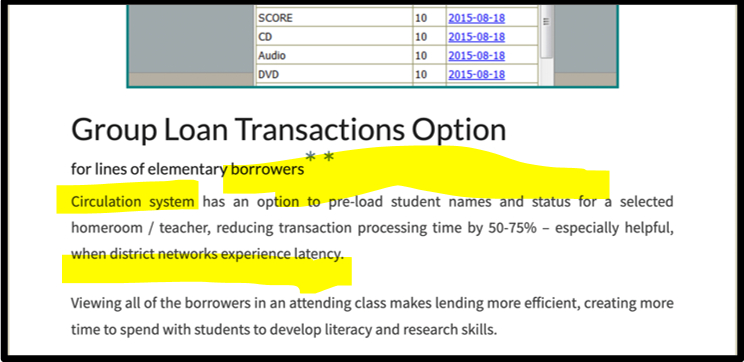
Below is a partial screenshot from the demo screen of OPALS, a popular ILS used by school district libraries (and other types of libraries, too).

As you'll see, OPALS enables the "viewing of all the borrowers in an attending class...."

Group Loan Transaction Options

There is nothing inherently wrong with this type of grouping of borrowers, so long as the district has addressed the various privacy obligations, and made sure the functionality and use of the system (in this example, OPALS) align with the school's approach and policies on privacy.

In other words, nothing should be left to chance.

So, with that, my ultimate answer--to all three questions-- is: any time a public school student's name is listed on a library record that leaves the bounds of the library (the "real" or virtual bounds), every unique way that happens (injury report, student discipline, interlibrary loan) should be covered by policy.

Now, let's consider how this issue looks "on the ground."  I poked around a bit, and while I found many interlibrary loan policies for school district library systems/BOCES in NY, I didn't find one that went so far into the weeds as setting terms for how/when to include borrower names on the routing slips (printed or electronic).

Chances are, that's usually more of a "standard operating procedure" thing, rather than something set by formal "policy."[3]

But with increasing interconnectivity between library other school systems, it might be worth formalizing in future interlibrary loan policies.  For instance, one sentence: "When effecting interlibrary loan, cooperating libraries shall mutually adhere to the other libraries' and systems' policies regarding borrower privacy"[4]  is a sample of how to add a quick reminder about this critical consideration.

Because as the member's questions indicate, we can never be too "in the weeds" on privacy.

Thank you for an important array of questions.


[1] Okay, actually, nothing.

[2] In this mythical trip up 32 floors, we are visiting Buffalo City Hall, which if you have never seen, is a must-visit location.

[3] New York is a big state!  I have no doubt there is a policy that does address this.  If your district has one, please send a link to info@losapllc.com and reference this RAQ.

[4] This is just sample language...no matter what you select, make sure your school district's attorney or BOCES system director reviews and approves any policy before it goes into effect!

Dos and Don'ts Of Addressing School Library Censorship

Submission Date

Question

NOTE: On 5/13/22, Erie 1 BOCES hosted a program[1] regarding school library materials management.  That same week, the Erie County Bar Association hosted a CLE on the same topic[2].

At both programs, school district library personnel discussed the ethics of their professions.  They also shared their personal experiences with collection management issues, including attempted censorship of library materials.

Both sessions were inspired by concerns, rooted in the current political climate, that school districts could feel pressure to sidestep policy and direct the removal or limitation of "controversial" library materials without due process.

The law, policy, and case law covered at the session was extensive. Below is a summary of the major take-aways, in a "Do's and Don'ts" format.

QUESTION

What are the "legal do's and don'ts" of school district library collection management in New York?


[1] "Collection, Selection, Objection": the recording can be located through your regional BOCES or school district library system.

[2] More information on this "Continuing Legal Education" seminar is here:  https://eriebar.org/product/2433-more-than-a-book-ban-advising-municipalities-schools-and-libraries-during-a-book-challenge/


Answer

DO ensure your school district library system, school district, or school has a robust and well-thought-out "school library materials policy"[1] ("Policy") governing selection, procurement, cataloging, lending, concerns, re-evaluation, and removal of library materials.

DON'T forget to train every person with a role in that Policy[2] on how it works, and why the district has it in place; this includes spending time on the law, regulations, and ethics[3] that govern it.

DO ensure that experienced lawyers and policy-makers have reviewed the Policy for both legal compliance, and compatibility with the unique environment at your district or school.

For example, if your school has an active PTA that likes to fund-raise and donate books to the school library, the method of accepting those donations should conform to the "selection" part of the Policy.[4]

DON'T adopt a Policy and then let it gather dust.  A policy that governs selection, procurement, cataloging, lending, concerns, re-evaluation, and removal of school library materials is a vital part of a school's library--which is a vital part of a school.

DO make sure your Policy honors the professionalism and qualifications of your school librarians and media specialists.  When considering how your district's Policy applies in real-world situations, remember that your school library staff are trained in the selection of library materials.   Because of that, your district's Policy will delegate responsibility for selection and cataloging to those professionals[5] ...and the law in New York, policy of your district, and job descriptions will back that authority up.

DON'T create a potential liability for your school by taking quick steps related to library collection management issues without checking with your district's Policy and lawyer.  Cases such as Pico[6],  the seminal case regarding school board over-reach regarding school materials, happened because school leadership took hasty action without considering policy.

DO maintain familiarity with the most basic tenets of the law in New York regarding school district library systems and school library operations.  This includes Education Law § 1709(1), Education Law §1711[2] [c, d], Education §Law 701, Education law §702, Education Law §310, 8 NYCRR § 90.18 and 91.2.  For a good primer on these, review the NYSED Commissioner Decision 14,229  "Matter of Carney."[7]

Notably, the case law and NY Education Commissioner decisions emanating from these laws and regulations show that ad hoc decisions about curricular and library materials imposed without consulting policy can lead to legal claims, creating unnecessary media attention, community tension, and expense for school districts.

DON'T impose "creative work-arounds" such as using "soft" directives to influence school library collection issues without following policy.

Hypothetical examples of such "creative work-arounds" include:

  • Directing library staff to keep "controversial" books in the collection, but move them off the shelves and into a store-room;
  • Stigmatizing books in the collection by making them available "by request only";
  • Telling parents and guardians with concerns that library material will be removed, without referring them to the relevant policy for lodging a complaint or requesting that it be re-evaluated;
  • Identifying books that may only be checked out after obtaining parent/guardian consent[8];
  • Sharing lists of books checked out by students in excess of what professional ethics, FERPA and CPLR 4509 (regarding privacy) allow;
  • Directing school library employees to avoid selecting a certain "type" of material, even if that material is otherwise appropriate per the district's Policy;
  • Basing content bans on categories of identity protected by local, state, and federal civil rights laws.

These are just a few examples...but anything that would remove or restrict access to school library materials, without applying due process, risks a legal concern and tripping the factors found unconstitutional in Pico.

DO build an administrative and educational team that is READY to respond to concerns about curricular and library materials.  

When it comes to content choices in the classroom or in the library, no Superintendent, Principal, or school board chair can do it all. 

team consisting of the school librarian, experienced teachers and administrators, the district's lawyer, and as needed, the school board, should be ready to respond promptly when there are materials concerns. [9]

DO remember that for every school library material challenged, there are people being impacted by the challenge--including yourself.

These are tough times for school administrators.   Across the country, there is a great awakening to the importance of school boards and the leadership of public institutions such as libraries.

This is good, but it has turned school districts and libraries into zones of potential controversy, with administrators charged with keeping the peace--and people threatening lawsuits on all sides.

At such times, there are three things that, when combined, can create refuge and stability:

First: a cool head.

Do not take an ad hoc action when presented with a library materials concern; lead with policy.

Second: a good team. 

Rely on your people.  They will help ensure legal compliance, the well-being of students, and good service to the community.

Third: a solid policy.

Have it, know it, follow it.

Administrators who find the culture wars on the doorstep of their schools cannot avoid controversy.  But when controversy arrives, if they DO follow policy, and DON'T take ad hoc steps in a panic, school administrators can provide a structure for communities to navigate open and honest discussions[10] of library materials, community values, and their educational environment.

Below is a template[11] for organizing a response, when a library materials[12] issue happens at your school.

School library material concern worksheet

For internal and personal use only

Important information

Answer

Material at issue (title, author, media):


Material catalog information (year acquired, category, shelf location):


First date person using form became aware of complaint:


Complaint made by:


Note: Person is the "Complainant"


Is the complainant a parent or guardian?


Is the Complainant part of a group?


Attach group information


Based on their relationship to the school or community, does the Complainant have standing to make a complaint?


If yes, continue with worksheet...


Is the Complainant following the formal complaint process?


Has the Complainant been provided with a copy of the policy governing how to make a complaint?


Name of school librarian


Other school staff involved in complaint or concern


What is/are the relevant policies?

[attach all policies that apply or might apply]


What people are assembled to help with or to effect response ("Response Team")?


What professional ethics do the members of the response team have to consider when working on this issue?

[attach copies of any relevant codes of ethics as confirmed by team member]


Is there a student involved?


What person on the response team is the primary contact with the student?


Is there any safety or well-being concern for any person involved?


Is there any media or social media discussion of this issue? 


[attach printouts of relevant content]


Is there a relevant union contract or other contract?

[attach contract or relevant section]


Who is the spokesperson for the school or district on this matter?


Track relevant deadlines set by policy or commitment to involved parties:


Deadline:


Deadline:


Deadline:


Deadline:


Deadline:


What was the final outcome of this issue?


When was this matter considered to be complete?


[1] Across New York, this type of policy has many names, and sometimes, is covered by numerous policies.  New York prioritizes local control of school district policy, so a diversity of approaches is right and proper.  The point is that no matter what it is called, or how many policies end up applying, a district has a policy that covers selection, procurement, cataloging, lending, concerns, re-evaluation, and removal of school library materials.  Very often, this will need to be coordinated across school library systems.

[2] For the rest of this article, we're using "Policy" with a capital "P" to denote whatever policy or combination of policies a district has adopted.  That's right, with a capital "P" that rhymes with "C" that stands for "cool" (as in, "We're cool; we have a Policy for this").

[3] The ethics of the profession of school librarian as emphasized by NYSED are found at http://www.nysed.gov/curriculum-instruction/teaching-learning-intellectual-freedom

[4] Sometimes, this might mean having to say "No, thank you," or "We need to take a different approach," to the PTA.  Just another day in school administration.

[5] This is another factor that will vary from district to district in New York, but every policy I have seen grants a significant role to the librarian.  This is why a good hiring pipeline for qualified school librarians and media specialists is critical.

[6] Found at: https://www.oyez.org/cases/1981/80-2043 . This US Supreme Court case ruled that "although school boards have a vested interest in promoting respect for social, moral, and political community values, their discretionary power is secondary to the transcendent imperatives of the First Amendment." 

[7] Found on the NYSED site at http://www.counsel.nysed.gov/Decisions/volume39/d14229

[8] This one is a HUGE concern, because in addition to potential legal and regulatory violations (about which countless law review articles and books have been written), it sets a precedent of parent/guardian pre-approval for ALL school materials...something that is antithetical to the democratic process by which public schools operate. 

[9] "Promptly"...but not immediately.  The benefit of having a team ready to go, and letting parents or community members know that your school is organizing a response per your district's policy, is that it signals that you take the complaint seriously, but also gives the situation breathing room.

[10] Yes, I know "open and honest" can often sound "angry and passionate."

[11] As with all templates on "Ask the Lawyer," this one is illustrative only.  A district or administrator wanting to develop such a resource should confirm a final draft with their lawyer.

[12] This template is for library materials concerns; there are some different factors when there is a challenge to curricular materials.

Screening DVD as part of curriculum

Submission Date

Question

If a teacher teaches a novel in school, can they show the DVD of the movie under fair use?

Answer

This question was submitted by a system serving elementary and secondary schools.

The answer for those schools (and for higher education, too) is: if the viewing of the DVD is tied to the reading of the book and the content is part of the class/curriculum, then YES, it can be viewed in class.

This exception to infringement by a school is found in 17 U.S.C. 110  (1), which states:

...the following are not infringements of copyright:

(1) performance or display of a work by instructors or pupils in the course of face-to-face teaching activities of a nonprofit educational institution, in a classroom or similar place devoted to instruction, unless, in the case of a motion picture or other audiovisual work, the performance, or the display of individual images, is given by means of a copy that was not lawfully made under this title, and that the person responsible for the performance knew or had reason to believe was not lawfully made;

So, to be clear: at a not-for-profit school, as part of the curriculum, in the school's designated learning space, the "movie based on the book" can be viewed as part of  the curriculum...so long as the copy being watched was not pirated or otherwise obtained through the shady  (but now losing ground to illegal streaming) DVD black market.

Thank you for this question.

Using a YouTube Video to create another video

Submission Date

Question

I am asking this on behalf of the Elementary School in my district. (I work in the library of our district's high school). The Elementary School participates every year in a program called PARP. (Parents As Reading Partners). The teachers and principal always make some sort of video to kick this off this event since pandemic times.

This year the entire school is reading the SAME book: The World According to Humphrey, by Betty G. Birny. (It's a story about a Hamster and how he deals with life issues). My district's teachers want to "borrow" liberally from this Animoto video: https://animoto.com/play/ICom40fpoTdMzDov931aDQ

This video contains four components: 1. Another School (We'll call it School X, an independent school in California essentially doing the same thing), 2. an interview with the author segment, Betty G. Birny, 3. an interview with a store clerk from PetCo and 4. a video of a hamster performing "cute antics" with a voice-over dubbed in called April's Animals. (This individual posts varied animal videos on YouTube)

What my teachers want to do is create their OWN video of teachers and the principal endorsing this book, interspersed with the hamster video from April's Animals. I did observe at the end of the Animoto video, there were credits provided. My school would not use the PetCo interview or the Author Interview or the School X video as those segments are directly related to that specific school. They want to do the same idea and only use the video provided by April's Animals. I didn't know if this would be problematic because we are a public school, this would not be posted on YouTube. It would be shown over our school network to our K-2 classrooms one time only.

Answer

The short answer to this question is: IF the video is only going to include the YouTube animal clips, and IF it is only going to be used in the school for instructional purposes, the proposed use is fine, since copyright section 110(1)[1] allows schools to play videos in class if the topic is related to a class, and YouTube doesn't limit use of its service to "personal" uses.

Now, I say "mostly" fine because, technically, the combination of the YouTube content into another video compilation could be considered the creation of a "derivative work" (like a sequel or a mash-up), instead of just "performing" (playing) the video as allowed by law.  But if the copy truly isn't leaving school grounds, and the "performance" is to promote a reading program in the classroom, and the footage really is just being swapping in and out with interviews with school staff, it would be a stretch for anyone to claim infringement.

With respect to the other issue that I detect in the question--would "School X" have a claim against the school for pinching its idea? I don't think so.  The project you describe is sufficiently different from theirs; after all, they got their author for their endeavor, and your school is focusing on local talent.  You can't copyright an idea[2]...just its expression.

When it comes to a school generating original educational content inspired by others, for use only within that school, the key is to model the type of respect for others that educators want to instill in their students, while taking full advantage of the protections educators have under the law.

In this case, "Respect" means not using pirated copies when a school plays instructional movies, and not using more content than the school is entitled to when the instruction is online.  "Protections," among other things, means that for in-person instruction, videos can be played, and for online instruction, parts of videos can be played, so long as the performance is from legitimate copies.[3]

[NOTE: For schools that want to up their game and start producing original content they will share with the world: this answer is not for you.  If any school out there is thinking of becoming an author/producer/provider of educational materials, don't rely on this answer, and develop a business plan that includes how to respect and protect IP.]

And finally, I have to say: thank you for this question.  First, it got me onto Animoto, which I am totally going to check out.[4]  And second: I love PARP.  Some of my fondest circa-1980 memories are of filling out my PARP form with my folks, after some time reading together on the couch,[5] so this question made me smile.  It's good to see the program is going strong, and the hamsters of the world are showing us how to cope with the ups and downs of life.


[1] 110(1) allows "Performance...of a work by instructors ...in the course of face-to-face teaching activities of a nonprofit educational institution, in a classroom or similar place devoted to instruction, unless, in the case of a motion picture...the performance... is given by means of a copy that was not lawfully made...."

[2] Of course, you can patent certain ideas, so please don't think I'm touting intellectual property anarchy.

[3] This aspect of Copyright Section 110 is different than the issue of streaming services being limited for personal use, and thus not always the best place for educators to get their in-class movies.

[4] I clearly don't get out much.

[5] My parents still have the same couch, which they got in 1964.   They are the greenest people I know.

Book Challenges and Records Retention

Submission Date

Question

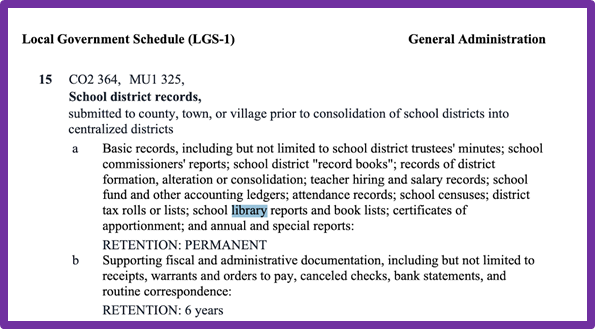
In a local school district, multiple books have been challenged recently. This week, the School Board received an email from a community member referencing record keeping for library materials and electronic records retention. The district Superintendent wants to make sure that the district is keeping the right kind of library records, and that they are keeping them for the legal amount of time. Attached are two documents to review. In the first document titled District Records, under #15, it advised that districts should keep a list of book lists and school library reports. With this, should the district have kept a list of all books in their libraries in any given year?

Answer

In speaking to different libraries about being prepared for book challenges, I have repeatedly stressed one very important element: have your policies ready.

This question shows the depth of consideration that goes into that simple requirement.

In this case, that "depth" is found in the rocky chasm of the LGS-1, New York's end-all, be-all rules for public document management.  Need to know how long to keep records for a bingo game authorized by a village?[1]  Or how long to keep a record of exhumation?[2]  Or how long we hang onto bridge inspection records?[3] It's all in the LGS-1.

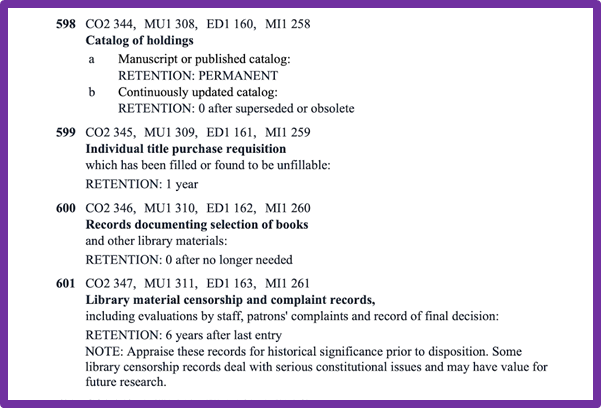
The documents the member references are sections of the LGS-1.

They look like this:

LGS-1 Screenshot of school district records law

and

Screenshot of LGS-1 guidance for schools

Looking at these requirements, the member's question is: "[S]hould the district have kept a list of all books in their libraries in any given year?"

The answer is: MAYBE, but not DEFINITELY.

Here is why:

The first section referenced by the member, at first blush, looks like it requires the retention of "book lists" for six years.  But examining that precise section, you will see the requirement is limited to records submitted prior to the "consolidation of school districts." 

So, outside of a district consolidation, section LGS-1 15, does not require compiling a list of books.

The next sections, LGS-1 598 and 599, refer to a school district maintaining records related to a "Catalog of holdings" and "Individual title purchase requisition," respectively.

We'll tackle 598 first.

598 requires that a "Manuscript or published catalog" of "holdings" must be retained "permanently."  It then requires that a "Continuously updated catalog" be retained until it is "superseded" or "obsolete."

This means that a district library's "catalog of holdings" that exists in a static form (like a print or PDF list) must be retained permanently, but a list of holdings that is ever-changing (like an ILS) is only retained until it changes form--or that form stops being useful.[4]

In practical terms, this does mean that if the library produces a static list (in print or electronic form), it must be retained forever.  That obligation, however, does not obligate the library to create such a list in the first place.  Meaning, in other words: if the library only uses an ever-changing catalog, it doesn't need to retain any particular copy.

This brings us to 599, which requires that an "[i]ndividual title purchase requisition" (the documentation showing a school library bought a book) must be retained for one year.

Again, in practical terms: while per 598, a school library is not obligated to compile a printed list showing that "Not All Boys are Blue" is in its library's collection, per 599, it does have to retain (and produce, if not otherwise accessible through FOIL) a school’s requisition to purchase "Not All Boys are Blue" if requested.

This gets more interesting as one considers that LGS-1 600 (also seen in the purple-bordered excerpt above), regarding "Records documenting selection of books" sets no minimum retention period.  Meanwhile, LGS-1 601, regarding "Library material censorship and complaint records" mandates such records be retained for at least six years (and encourages considering saving them for much longer, which strikes me as a good idea).

The upshot of these various rules creates a regime where a district is empowered to pick and choose, to some degree, what records it wants to create...but once created, imposes a very particular set of parameters for retaining, purging, and disclosing them.  This is why my answer to the member's question must be so ambiguous.

It is also why it is very important that a district have a well-developed policy on this issue.

Below are some examples of what, depending on the records a district elects to create, a district can say in answer to the question: "I want to make sure I approve of all the books my taxes paid for this year.  Can I have a list of all the books?"

[If the library maintains a published list and wants to be friendly.] "Sure thing.  We compile and publish a list of books in our collection every year as of the first Monday of September.  Do you want the one showing all the books in one particular library, or all the books in the district?"

[If the library doesn't maintain a published list, but has a continuously updated catalog, feels friendly, and allows access to library computers.] "No, we don't publish such a list.  But we do have a continuously updated catalog you can search on this terminal."

[If the library doesn't maintain a published list, has a continuously updated catalog, doesn't allow just anybody access to its computers, but feels somewhat helpful.] "No, we don't publish such a list.  But we do have a continuously updated catalog you can request a copy of."

[If the library doesn't maintain a published list, doesn't allow access to computers, and doesn't feel helpful, but does feel puckish.] "No, but if requested, we can supply you with a copy of every book requisitioned last year."[5]

[If the library doesn't maintain a published list, and doesn't want to offer alternative ways to share the information.] "No, we don't have that."

[If the library doesn't maintain a published list, and is okay risking a spat.]

"No."

Optional rider to all the above answers: "Here is a copy of our FOIL policy so you know the process for requesting our public records through our FOIL officer, and can be aware of our copying charges and the process for requesting electronic copies."

Now, as any veteran of public relations battles over school district policy knows, there's a time to be helpful, and there's a time to say "no."  I am not endorsing any particular answer, but based on a district's policy, it should know what records it keeps (and doesn't keep), and how people can access them.

From my perspective, if there isn't a need to compile information, it shouldn't be compiled.  Further, FOIL does not create the obligation to compile information if it is not already compiled.  On the other hand, waffling and appearing to dodge the question when concerned citizens are on the hunt for "objectionable material" might not be the best way to fight the battle for intellectual freedom.  "We don't have a list but we have a continuously updated database" strikes me as a glove-slap; it invites a fight...but nevertheless, if accurate, might be a perfectly valid response.

From my high horse over here in law-law land, a district should proceed from the presumption that if a book is in a school library's catalog, it belongs there; this is the stance that supports intellectual freedom, while also setting a good example for the students (but I am not the one who has to deal with angry community members storming a school board meeting).

Regardless of my personal thoughts on the diplomatic aspects of this issue, from the perspective of intellectual freedom, information access, education law, the LGS-1, and the First Amendment, here is what's important: have a sound policy governing 1) how library books are selected; 2) how library books are cataloged;[6] 3) how library books are challenged; and 4) how library books are removed, and follow that policy.

If, as part of that policy, a district has the desire and capacity to create an annual (or decennial, or whatever time span it wants) list of books in the school library catalog, great, but if such a list is created, it must be kept forever.  And if the district only uses a continuously updated library catalog, it should be clear from the policy who can access it, and how (at the school?  By appointment?  Remotely?).  And all of this turns on the district having a designated FOIL officer and process for timely responding to, assessing, and meeting FOIL requests.

So, there is my answer...and I know it rests on a dangerous triangle of law, practicality, diplomacy.   This stuff isn't easy.

I wish you a clear head, a steady heart, and a ready wit as you face whatever challenges come your way.


[1] 8 NYCRR §185.15 (2020); see schedule items 562-564.

[2] 8 NYCRR §185.15 (2020); see schedule item 136.

[3] 8 NYCRR §185.15 (2020); see schedule item 1085.   By the way, it's "6 years after structure no longer in use or inspected features have been replaced," which I find rather terrifying.

[4] Kind of whimsically sad notion: "You are needed, until you change or you aren't needed."  I would love to meet the person who wrote this part of the LGS-1; they had to be a philosophy major.

[5] I don't advise using this one.

[6] Including having a published list, or simply having a continuously updated database.

School Libraries Template for Copiers

Submission Date

Question

We were asked about signage to post over the copier at a schools where educational materials are copied. Below is some template language with footnotes explaining why they say what they do.  Of course, before posting in your school or library, check with your lawyer!

Answer

MAKING A COPY ON THIS MACHINE

MAY BE SUBJECT TO THE COPYRIGHT LAW OF THE UNITED STATES

This means 4 important things:

1.  Copying a copyright-protected work here could be a copyright violation[1].

2.  Copying protected works is sometimes allowed under "fair use."[2]  Our school's fair use policy is posted INSERT.

3.  Copying a copyrighted work to accommodate a disability under the ADA is allowed.   However, to do that, please see the [insert office for disability services] staff, since adaptive copies have special rules,[3] and we want to help you (or a person you are assisting) exercise your rights.

4.   Under the TEACH Act,[4] you may display or perform certain copyright-protected content in class, but that does not allow you to make additional copies for in-class or online instruction.  Please don't make copies that exceed the permission obtained by the school (unless you use our policy to determine it is fair use).

The copy machines are here for your use, and we appreciate your consideration of these laws.

Thanks!


[1] 17 U.S.C. 106 reserves the making of copies to the copyright owner.

[2] 17. U.S.C. 107 allows copying under certain circumstances, but simply "educational" or "not-for-profit"  use is not enough.  Read the guide at the link!

[3] See https://www.loc.gov/nls/about/organization/laws-regulations/copyright-law-amendment-1996-pl-104-197/.

[4] Section 110 of the Copyright Act.

Popular music in Public K-12 Schools

Submission Date

Question

I am struggling to find information on using popular music in public K-12 schools. I have the following areas I am trying to find information about:
1. Can a teacher use a Spotify account in their classroom?
2. Can a teacher use music with face-to-face instruction?
3. Can a service provider (counselor, therapist, social worker...) use music with students?
4. Can music be played during sporting events
5. Can music be used as part of the morning announcements

Thank you!

Answer

Welcome to "Back to School 2021"...a year unlike any other!

I have weathered many K-12 "back-to-schools."  For instance, second grade back-to-school, for me, was in 1980.  For my son, it was in 2010.  And for my daughter, it was just a few days before I sat down to write this.

That 1980-to-2021 time span has allowed me to realize two things:

Realization #1: Erasers smell the same in 2021 as they did in 1980; and

Realization #2: Back-to-school 2021 kicked off in a world that has gone through a lot of rapid and (at times) de-stabilizing change.[1]

The good news about realization #2 is that the law--which tends to change much more slowly than the world around it-- is much the same.  So, for this answer, where we can, we'll be linking back to prior "Ask the Lawyer" answers, and where there is something new, we'll add it.

QUESTION 1: Can a teacher use a Spotify account in their classroom?

ANSWER: Not unless the license has changed to allow more than "personal use."  For more on that, see Using Streaming Services (Hulu, Netflix) in the Classroom.

QUESTION 2: Can a teacher use music with face-to-face instruction?

ANSWER:  Yes, so long as the music is part of the instruction, and the copy of the song was legally obtained.[2]

QUESTION 3: Can a service provider (counselor, therapist, social worker...) use music with students?

ANSWER:  There is no automatic permission or exception to the copyright law that allows a mental health service provider to use recordings, sheet music, or other copyright-protected property for purposes of licensed service.[3]

QUESTION 4: Can music be played during sporting events?

If the recorded or streamed music is protected by copyright, it should only be played with a license.

NOTE: Public schools will want to consult their lawyers about their risks in this regard now that the U.S. Supreme Court has (arguably) struck down the ability to sue "the state" and its subdivisions for copyright infringement.
 

5. Can music be used as part of the morning announcements?
If the music is protected by copyright, it should only be played with a license. 

NOTE: Public schools will want to consult their lawyers about their risks in this regard now that the U.S. Supreme Court has (arguably) struck down the ability to sue "the state" and its subdivisions for copyright infringement.

And with that, I wish you a joyous back-to-school.


[1] Perhaps this is why I found the familiar aroma of new "Pink Pearl" erasers comforting.

[2] This is allowed per Section 110(1) of the Copyright Act, which states that "performance or display of a work by instructors or pupils in the course of face-to-face teaching activities of a nonprofit educational institution, in a classroom or similar place devoted to instruction" is not infringement. 

[3] As I write that, it strikes me that such services are so important, ensuring the resource can be used legally is important.  There are a number of ways to do that, depending on the precise circumstances.