First Amendment

Is a Public Library Responsible for Patron Conduct Outside the Library?

Submission Date

Question

Our public library has been told by patrons that another patron is following up on interactions at the library, including at the circulation desk, by showing up at the reporting patrons’ homes. Such behavior, if harassing, is against our Code of Conduct. Does our library risk legal liability for this?

Answer

I am sure many a wonderful friendship has been launched at a public library, but for this question, we’ll assume that each of the reported incidents were unwelcome.[1]

To best address this matter and limit liability, the unwelcome nature of the behavior—and the Library’s response—should be documented every step of the way.

For example, the initial report of the first instance can be: Patron A reported that Patron B arrived at their house at ADDRESS on DATE/TIME uninvited to follow up on a conversation at the library on DATE/TIME. Patron A does not welcome this conduct and would like it to not recur.

Because the interaction started at the Library and was related to library services, it is appropriate to respond to this as a Code of Conduct matter, and document it as such.

The follow-up with the offending patron could then be:

Dear Patron B,

The library has received a complaint that on DATE, you sought to continue a conversation at the circulation desk of the library by arriving uninvited at another patron’s home.

If you were invited or did not visit at all, please send us a written response confirming that.

Otherwise: a copy of the Library’s Code of Conduct accompanies this letter. Please take care to not continue Library service interactions in a manner that is not welcome by that person, as it could be considered a violation of the Code.

NAME, you are a valued patron at the library, and we trust this will not be an ongoing concern.

Sincerely,

Library Director

The letter can be reviewed in person with the offending patron or sent by mail or email; that is at the discretion of the Director. The important things are accuracy and timeliness.[2]

It is also important to double-back to the impacted patron and let the know the matter has been addressed. Sample text for that is:

Dear Patron A,

Thank you for sharing your concern about an uninvited visit at your residence by a fellow library patron following an interaction at the library. Please know that the Library has alerted the other patron that such behavior is not consistent with the library’s Code of Conduct. In the event further concerns occur, please let me know immediately.

Sincerely,

Library Director

When a library director has to address this type of thing, they should be aware that such behavior can have many motivations. Some motivations may be malevolent, but others may be worthy of compassion, including loneliness or uncertainty about social boundaries. When it comes to documenting and handling the report, however, the motivation is irrelevant; the goal is to outline the behavior, the rule it violates, and explain the consequences for recurrence.

This type of documentation serves multiple purposes in the legal world.

First, it unambiguously documents the date and time of the occurrence and a key element: that the visit was unwelcome.

Second, that clarity enables a clear articulation of the rules and possible consequences.

Third, it documents that the library has done all it is empowered to do to address this situation. After all, a public library is not law enforcement; it can enforce its own Code of Conduct but cannot police the external activities of others. In fact, a library that tells patrons not to go to places outside the library, at the risk of losing library access, may be violating the First Amendment. Quite the legal tightrope for a library director to walk![3]

Having outlined all this, I will now answer the member’s actual question:

Our question is if the Library would hold any responsibility or liability if anything were to happen based on a conversation that happened at the library but the actions of follow through occurred off library property?

The answer to that will almost always be “No.” Exceptions are:

  • If the library provided the personal information that enabled the visit;[4]
  • If the victim was an employee;[5] or
  • If the activity is part of a larger issue currently under investigation by law enforcement (stalking, harassment, domestic violence, protective order in place, etc.).

When the above legal aspects are involved, a public library is wise to timely consult an attorney to document and determine next steps.

Other than the legal risks, the other big risk in this matter would be reputational: if an incident occurred, the subsequent investigation found out that there had been multiple reported concerns (as is posed by the question), and the library had done nothing, it could negatively affect how the library is regarded by the community.

But again, a public library is not law enforcement; other than barring access to the library, it has limited ability to punish or prevent crime.[6]

So, with all that, the big takeaways for this question are: 

  • All patron complaints related to safety and access should be documented;
  • All incidents relating to safety or access should be addressed so the library is positioned to restrict the access of the offender;
  • Any person facing loss of library access due to a Code of Conduct violation should receive a written notice and a chance to refute the accusation;
  • When legal liability or a risk to safety is involved, it is wise for a library director and/or board bring in back-up.

When a director meets with such a person (who might not have quite the same view of the world as the director), it is wise to have a person there as a notetaker and for safety.

Thank you for an important question.


[1] I don’t mean to imply that showing up at someone’s house uninvited is ever a gateway to friendship. Don’t do that! It’s a bad idea.

[2] Depending on the exact circumstances, an immediate bar may also need to be enacted, rather than just a “written warning.”

[3] But just another day in the life.

[4] I flinched just typing this. I know a librarian would not release information that way!

[5] Library workers being stalked/harassed is why every public library should have a Workplace Violence Prevention Plan. For more on that, see

[6] It’s a bit different when the library is the victim, but this answer doesn’t address that.
Patron privacy regarding recording devices and minors

Submission Date

Question

Is the library at risk if a teen patron volunteers to share contents of a cell phone?

An adult patron recently called the library and said that her 11-year-old daughter reported being filmed outside the library (parking lot or backyard). The child reported that two teen patrons had been using cell phones to film her. No staff witnessed this, but all of the juveniles involved were known to library staff. The two teens had returned inside the library at the time the call came in, and staff asked them if what was reported was true. Both denied the claims, and one asked to “prove” that it wasn't true by showing the contents of his cellphone video library. Do we put ourselves at risk by allowing a patron (juvenile or otherwise) to show us such content? We can see a variety of ways that this might expose us to risk, but we also understand the teen’s impulse to defend himself.

Additional questions that came up (but maybe too much for a single query): If patrons do film each other without consent on library property, is that a further risk for us? If we were to explicitly state that filming others while on library property is against policy, how could we safely enforce that policy?

Answer

Before I dive right into the answers (we are going to address every question), let me say what a lot of readers are probably thinking: most tech-savvy people know how to modify their phone so a recording they made doesn’t show up in their files. So, this answer will not only review the questions about sensitivity and liability but also discuss the practical concerns of enforcing a Code of Conduct when a decision turns on dubious evidence.

First, let’s talk about a policy on recording.

Any public library should feel confident adopting a policy limiting use of recording devices in areas where privacy of library users is assured.

For some libraries, this rule may be limited to the service desks and common rooms where people are reading, using computers, and accessing other specific library services and programs. For others, this rule may apply to the entire interior of the library.

Some libraries may even want to bar recording in their parking lot and grounds (a factor relevant to the member’s questions), but this may be harder to justify on the basis of privacy, as there is no guarantee of privacy when walking out in the open.

So, for argument’s sake, let’s say the member’s library does have a policy, but it doesn’t extend to the outside. What else could help with the situation presented here?

In addition to a policy on recording in the library,[1] any library can use its code of conduct to prohibit the deliberate antagonism[2] of one person by another on library property.

Once a person reports such a violation, it is up to the director of the library (or librarian in charge) to ensure the policy for evaluating a code of conduct violation is followed.

Library codes of conduct vary from place to place, but a good policy will always follow this pattern: notify the person of the accusation in writing, let them know the penalty that could be imposed, and provide a reasonable opportunity for the person to respond prior to that penalty starting. If the matter involves a very clear risk to safety or compliance (a physical threat, sexual harassment, etc.), the person can also be temporarily barred from the library while the matter is pending, if the policy allows it. After a decision is made, there should be one level of appeal (usually to the board of trustees after a decision by the library director, but in a larger organization, the final appeal can be to the director after a decision by another employee).

If the matter is being handled by law enforcement, the library should still follow its own policy before removing library access and privileges (this is true even if there is an order or protection put in place).

When the accused person is a minor, that person’s parent or guardian should be notified to the degree consented to by the minor (possibly as part of getting a library card) or as stated by the policy.

If, after being accused in writing, a person volunteers to “prove” their innocence by showing their phone, the library should consider if the risk of intrusiveness[3] is worth it; likely it is not. Far better is to hear from the complaining person and the accused person a recital of what happened, decide what is most likely to have happened, and if a violation did occur, decide what penalty will help create assurance of respect and safety going forward.

This is particularly true in a case like this, where unless some other aspect makes the recording harmful (Has it been shared on social media?[4] Was the person being bullied at the time?), the consequences for doing what the youth was accused of will likely be a warning.

How would this “due process” roll out? After getting the complaint, it would start with a letter stating:

On DATE, a library user reported that she was concerned that you were recording her on library property (outside, at TIME), after she requested not to be recorded. If this happened, this is against the Library’s Code of Conduct, which prohibits INSERT.

The Library will be reviewing this report, and we invite you and your parent/guardian to provide a statement in response. You may also come in at DATE/TIME to discuss this with me.

Because it is important for library users to feel safe and respected at the library, if this did occur, it may result in a warning, or a temporary loss of library privileges. If we impose a temporary loss of privileges, you will be able to appeal it before it goes into effect.

Although the situation in the member’s question does not require it, if a reported violation is more serious (a threat, an injury, property damage, etc.), here is the language for a temporary bar on access to the premises:

Because this report relates to [a threat to safety, serious injury, etc.], until this is resolved, you are barred from library premises. You may still use library services remotely. If you need assistance to arrange services remotely, please call NUMBER to work with POSITION[5] or e-mail PERSON.

Taking this careful, deliberate approach does more than assure due process; it also slows things down and gives an accused person and their accuser time to think. It makes sure both parties can be heard. If the people involved are minors, it provides adequate notice and opportunity for parents and guardians to be involved.

Just as important: it is gentler on library workers, who should not have to serve as the sudden judge and jury of disputes between patrons (but of course, often do).

This brings things full circle to the original question: Is the library at risk if a teen patron volunteers to share contents of a cell phone?

The answer to that is YES. That risk includes everything from the simple optics of invading the privacy of a minor to compromising their rights without their parent or guardian present. It is a situation that begs for a formal complaint to a board and/or for public relations fallout. When you consider that the evidence to be provided is probably of dubious value, these risks completely undermine the worth of such access.[6]

While it can take more time, addressing things in a calm, formal manner can teach people (particularly young people) that they have rights. For certain disputes,[7] if the library identifies a way to mediate the issue[8] and help the young library users reconcile their differences, that is fine, too.

Thank you for a thoughtful array of questions.


[2] I am using “antagonism” because “harassment” is a legal term, both in criminal and civil law (where it has multiple defined meanings). “Antagonism” is the act of making someone else mad, which is what will happen if a person states they are not to be recorded, and they are recorded anyway.

[3] Those risks are accusation of invasion of privacy, coercion, duress, and inappropriate pressure on a minor. Further, as discussed, the risk is that the savvy person has already deleted or hidden the recording.

[4] In which case you may have evidence of it having been made, without looking at the phone.

[5] If the person threatened a library worker, make sure they are not working remotely with that library worker.

[6] Any situation where it would be worth it—such as one involving an alleged recording of a physical threat—is probably worth a report to police, who will conduct their own investigation.

[7] Where is will be restorative, not simply convenient.

[8] Some regions have great mediation and alternative dispute programs, especially for young people.

Creating Prayer Space in School District Library

Submission Date

Question

We are a small, urban, very diverse school district with a large English Language Learner (ELL) population and a high poverty rate. Our school library spaces are small and do not have adjoining meeting rooms. There is no dedicated prayer/meditation space in our schools either. In the past, during Ramadan and other Muslim holidays, school administration has directed Muslim students to use the libraries as prayer spaces. Currently, Muslim students have been directed to pray daily concerning the issues taking place in Israel/Gaza, so they have been coming in daily to pray. This becomes an issue as we have classes/groups scheduled in the libraries throughout the day, so space and privacy become an issue. The libraries are also not always staffed, as librarians travel between buildings and support staff is often pulled to cover for classroom teachers.

What is the legality of using a school library for a prayer place for students?
Should an alternative location be put in place in lieu of the school library?

We want to be respectful of students' religious view and rights, but also want and need to keep the school libraries accessible to all.

I would appreciate any advice you could provide on this topic.
Thank you.

Answer

In the United States, public schools that accept federal funding are barred from restricting student access to generally available space on the basis of “religious, political, philosophical…” beliefs.[1]

In New York State, laws, regulations, and policies protect the rights of students to observe a religion at public school.[2]

Consistent with these rights and protections, public schools in New York State must allow student religious groups to use generally available space on an equitable basis[3] and confirm through policy that students and staff have an individual right to pray in school.[4]

So, in New York, students being accorded space and time to pray in school (including in a school library) can happen one of two ways: first, as an act of individual liberty, or second, as a group exercise of equal access to space.

Of course, granting space on an equitable basis and honoring an individual student's right to pray in school is not quite what the member is asking about; this question turns not on indisputable rights but on the practice of using library space for exercising them.

In some ways, a school selecting the school library as a place to exercise fundamental rights of religious expression sounds like a compliment to the library.  When seeking a place to pray, who wouldn't prefer a welcoming, orderly library to a supply room, a gym, or even an empty classroom?  There is something about orderly stacks of books and room to read that lends itself to spiritual confidence.[5]

As the member points out, however, a school library is not an empty classroom; it is a useful and routinely used space, often with scheduled activities, and generally available to all.

This is where things get tricky, and it’s at the heart of the member's question: What is the legality of using a school library for a prayer place for students?

The answer is: absolutely, use of the school library for individual prayer is legal, just as use of any designated space (a supply room, a gym, a classroom) for free exercise of religion can be legal.

That said, administrators implementing such an accommodation should be careful of three factors:

First, if space in the library is available to organized student groups/clubs for prayer, it must also be available for other school groups on the same basis (that's not the question here but is important to establish).

Second, if space in the library is available to individuals for prayer (which is the question here), the use should align with the school’s policy on “free exercise” of religion, but one must be careful not to drift into any “establishment” of religion by making it seem like that is the purpose of the space.[6]

And third: a school should be wary of using the library space—which is for all students at all times—in a way that could limit access to others. Unlike the supply room, a gym, or an empty classroom, a library has a prescribed time when it is available (generally all day). Accommodations in furtherance of free exercise of religion, while a basic civil right, should not impede access to a general-access location.

Which brings us to the second question:

Should an alternative location be put in place in lieu of the school library?

This question comes down to a school library's size and layout.  If the school library has a spare study room or area in the library that can safely and respectfully be used for prayer, without restricting general access to library resources, it may make sense to use that space. But if (as the member writes) the library is small and only has space that meets basic regulatory requirements for the school (see 9 NYCRR 90), the school should consider another location.

The bottom line here: To avoid needless stress, the civil right of free exercise of religion should NEVER be pitted against the general needs of a community. In addition, accommodations that limit access to required resources should be avoided.

School administrators must think how they can allocate space safety so students can exercise their fundamental rights without putting them in needless conflict with the rights of others.  School district lawyers and facility managers can help administrators reach solutions by allocating space with attention to compliance.


[1] This rule, which is rooted in the First Amendment, is found in 20 USCS Section 4071, and has a long history of case law behind it, including the recent “Praying Football Coach” case decided in 2022.

[2] For example, 8 NYCRR 109.2 allows students to be absent for a limited time for “religious observance and education.”

[3] For example, Glee Club and [Religion] Club have the same access.

[4] If you need more of a breakdown on this, an excellent case is Eder v. City of New York (2009).

[5] Or maybe that's just me.  Like religion itself, the best place to pray is both highly personal, and highly specialized.  In the case where prayer requires space, motion, and spatial orientation, as in this question, perhaps even more so.

[6] A good case that reviews this distinction is the 2022 U.S. Supreme Court case Kennedy v. Bremerton School District, where the court discussed the difference at great length.

Professional Insurance Coverage for Book Challenge Lawsuits

Submission Date

Question

Is there professional insurance for librarians? Given the book-banning lawsuits, do librarians and library workers need additional insurance to cover possible lawsuits? Other states have passed laws fining library workers $10,000. Besides the library's D and O insurance, do librarians and library workers need additional insurance coverage?

Answer

There are many types of insurance, and many types of "exclusions" to risks covered by insurance.

Because of this, there is no one answer to this question.  A library can have "general commercial liability" and "D&O", and "E&O", and "professional liability" coverage...and could still not have coverage for a claim related to library content.

Because of this, rather than examine "types" of coverage, the questions for a board selecting or renewing coverage should be:

Our library is aware that in parts of the country, librarians are being threatened with criminal prosecution for providing access to content as part of their job. We want to indemnify and commit to defending any of our employees who are threatened for doing what their job and our policies require them to do. Does our policy cover costs incurred by the library for providing such an indemnification and defense?

and

Our library is aware that in parts of the country, librarians are being harassed and/or threatened by members of the public for providing access to content as part of their job.  Does the carrier provide resources or risk management support in the event such acts aimed against our employees and volunteers?

For library employees and volunteers, the questions are a bit different:

As the board is aware, librarians across the country are being threatened with criminal prosecution for providing access to content as part of their job. I would appreciate assurance that the library will commit to indemnifying and defending any of our employees who are threatened for doing what their job and our policies require them to do.  Can the board pass a resolution assuring us of that?

and

As the board is aware, librarians across the country are being harassed and/or threatened by members of the public for providing access to content as part of their job.  What resources or risk management support will the library provide employees and volunteers in the event such acts aimed against them?

An important take-away here is that not all risk can or should be mitigated only by insurance

Organizations facing expenses, disruption, and threats to employees as the result of protest and intimidation generally have an array of protections they can use to prepare for risk.  This array can include insurance, but can also include:

  • Budgeting for contingent needs (such as PR assistance, legal, security, private investigators, and added security);
  • Using policy and procedure to prepare for likely scenarios;
  • Staff and volunteer training;
  • Connecting with advocacy groups (locally and beyond);
  • Planning with local law enforcement and the district attorney's offices.

While the question is about insurance (and the answer is: yes, you can get insurance that covers just about anything...just read the fine print to make sure what you think is covered is actually covered), it is really about protection.

Insurance can be great protection, and libraries should use the two questions above to confirm (in writing) that their current policies protect their trustees, employees, and volunteers for First Amendment-related contingencies.

But insurance is just one part of that protection.  When it comes to attacks based on library content, solid policies, a knowledgeable board, and a confirmed commitment by leadership to stand with employees when the going gets tough are just as important.

Thanks for a great question.

First Amendment Audits on Youtube

Submission Date

Question

There are reports of first amendment audits happening in rural towns and villages. Public libraries are limited public forums - how can we stop the filming, as quietly as possible without causing a social media frenzy.

Answer

For a person who hasn't run into this concept yet, a so-called "First Amendment audit" is an increasingly popular trend where people visit government buildings and demand access to information--along with the privilege to film on site--all in the name of the law, democracy and transparency.

As a lawyer and U.S. citizen, I am all for the law, democracy, and transparency.

The concern raised by the member is that so-called "First Amendment auditors" don't just pop by their local town hall to live out a civics lesson.  Most of these folks are "monetized", meaning they post their recordings on YouTube...for money.  And since nothing draws in viewers like controversy, in the quest to get tens of thousands of hits, "First Amendment auditors" often[1] swap law, democracy, and transparency for rhetoric, bullying...and borderline harassment.

How do these YouTubers[2] create this concern?  As can be seen in their videos, they often come out swinging: filming or streaming while walking around as if "casing" a civic building, knowing that for some workers, this will cause concern.  Further, if/when confronted about what they are doing (usually some version of "Can I help you?") the best YouTubers are masters at using standoffish nonchalance, or passive-aggressive behavior, to trigger suspicion and fear.

Sadly, however, it is sometimes the fearful or angry reaction of those being filmed (town clerks, other employees) that tips things into a legal quagmire...and creates "click-worthy" material.

While mainly focused on municipal buildings (town halls, village halls, etc.) a growing sub-set of "First Amendment auditors" are visiting public libraries. I'd put a link in to some of the more egregious examples that have been created in New York in the last year or two, but I don't want to make money for these folks (they are doing just fine without me).  Let's just say that when the YouTuber is able to hit all the right pressure points, they can really tick off a civil servant--including a librarian.

The frustrating thing is that this doesn't have to happen.

Libraries--even those wholly housed within a municipally-owned structure--are, as the member says, "limited public forums" meaning that the library gets to set policy and rules imposing reasonable, operationally-related parameters on speech ("speech" in First Amendment jurisprudence, includes the right to film and access information).

Among other things, this means that libraries can totally bar or limit filming to certain areas of the library.

Of course, such a bar or limit can't be arbitrary--it must be "rationally related" to the operational needs of the library.  But so long as there is a "rational relationship" between the policy and the needs of the library, such a bar can be enforced.[3]

This means that through policy, a library can decide that patron confidentiality, information access, and the library's overall service to the public require limiting recording and/or streaming on site--a rule that can be enforced just like rules to be quiet in certain rooms, to not eat in certain areas, and to not deface any of the books.[4]

This means that the confident swagger many YouTubers bring to their "audit" game can be met, in the field, with a series of rules restricting their behavior--something (from what I've seen) that many YouTubers are not emotionally nor intellectually ready to honor in the moment.  In other words, just because your policy is legal, doesn't mean a YouTuber will magically turn their camera off!

So enforcing such policy requires forethought...especially since most YouTubers know that if they can get in an argument with a librarian, they will double (or triple) their number of hits.

So, as the member asks: "[H]ow can we stop the filming, as quietly as possible without causing a social media frenzy?"

Here are 10 different tactics[5]:

Have a Policy

Have a policy regarding filming in the library, and make sure that any decision to bar filming is rationally related to library priorities such as protecting patron confidentiality, respect for employees, and smooth operations.[6]

Use Good Signage

However your library decides to exercise its rights as a limited public forum, once it is confirmed in a policy, use prominent and effective signage to inform the public about the rules.

Transparency through FOIL

Since claiming the right to film anywhere in a public library is only part of the YouTuber package, make sure your library has a clear policy and process for requesting library records through the New York State Freedom of Information Law (or "FOIL").[7]

Designated Non-Public Areas

All staff rooms, break rooms, and other areas not accessible to the public should be designated as "No Public Access", with appropriate means of securing the area.  Give your employees a place of refuge (and a place for private information to securely reside).

Select Your Library's Response and Non-Escalation Method

As we've discussed, if you argue with a YouTuber, you might as well just hand them money.

So, while there is no one "right" way to resist escalating a situation, each library should pick its own particular brand of how to keep interactions with YouTubers civil, non-confrontational, and above all very, very, very boring.

For those libraries that do allow filming (whether without restriction,[8] or with some limits), but want to be part of the narrative, I like the idea of chatty engagement about the library's mission, services, and budget (and fundraising).  After all, the YouTuber is there to get information...why not provide it?  Think of the YouTuber's visit as a chance to inform the public of the history of the library, to showcase its services, and alert the public as to how they can donate money to support special initiatives (this is a good reason to have a copy of the library's annual report on hand). If YouTube is helping to draw attention to your library, you might as well put your best foot forward!

For those libraries that don't allow filming, or restrict it to certain times/areas, ensuring that a person who is attempting to film in the library is aware of the duly authorized and posted policy is essential.  After that, if a person persists in violating the policy, a response is down to what enforcement method is selected and practiced, which can include a combination of:

  • Policy enforcement in the moment (using practiced security procedures);
  • Policy enforcement after the moment (the recording happens without confrontation, but there is a subsequent action for trespass, or other action under Code of Conduct);
  • Deliberate non-engagement with the YouTuber using pre-determined language ("It is against our policy for you to film in this location"; and/or "You do not have my consent to film me, I consider it harassing; please stop." said once, calmly.[9]);
  • Use of pre-determined, quiet withdrawal of most employees into employee-only areas.

Do not argue. Do not debate. 

And finally, it is important to acknowledge: for some library employees, the visit of a YouTuber can feel threatening (remember, many of these entertainers are trying to get a rise out of people). So as with any other interaction with the public, the clear message to employees must be: Safety First.  If employees are feeling threatened, they should withdraw using the same protocol in place for other safety concerns.[10]

Practice, Practice, Practice

Once there is a policy and clear, engaging signage, set aside time to train employees in the policy, and give them time to practice addressing YouTubers in a non-confrontational manner.  Use role-playing techniques (done right, this can be a fun exercise, even though the actual event might not be so fun).

Coordinate with Security

Not all libraries have private security, but for those that do, make sure they understand what is at stake when dealing with a YouTuber; include security personnel in the practice sessions (if time and budget allow). At the bare minimum, confer with the local police department to know what the response will be if the situation warrants intervention by law enforcement.[11]

Remember: YouTubers are Human, Too

I know it can be hard to recall when someone is pointing a camera in your face and wandering about your library looking like they are creating a map of its security vulnerabilities, but one thing I've learned from working with libraries who have lived through a "First Amendment audit"[12] is that very often the visitor is a member of the community.

In fact, some libraries have received calls from national groups in advance alerting them that a longstanding member of the community will be visiting to film!  (I suspect the "advance warning" was to create an adrenalin rush, but the library was able to use its long-standing relationship with the person to make it a positive interaction.)

So long as a library employee dealing with a YouTuber feels confident about their safety, thinking about the YouTuber as a person who is genuinely curious about your library, and treating them as just another patron on a quest for information, can help cut down on click-bait drama--and serve the mission of the library to provide access to information.

Maintaining that type of perspective is easier if the employee is:

          a) confident that they know the library's policy about filming in the library;

          b) confident that the policy is clearly posted;

          c) confident that the library is on solid legal ground;

          d) confident of how the library as a whole responds to Code of Conduct violations;

          e) confident that the library abides by the law governing access to information; and;

          f) confident about if/how to engage, because they have practiced techniques for positive interactions and non-escalation, and they know leadership will have their back.

And that is how a library can turn YouTube drama into a non-dramatic civics lesson. It is not fool-proof, because if a person is determined to enter a library and create a scene, they will create a scene. But with good policy and practice, a library and its employees won't contribute to it.

Thank you for a great question!


[1] I say "often" because there are some people out there who get this right--and if we are now getting our civics lessons on YouTube, I want to give credit when it is due.

[2] I will not call them "auditors". In my world, an "auditor" reviews your financials, and looks for holes in your fiscal controls.  I call them "YouTubers" or "person recording in the library" because that is a more accurate appellation.

[3] For more on that, see the training video and related materials from the Empire State Library Network's presentation, “Libraries and First Amendment Audits,” which are available through the links found here. This resource also spends a lot more time on the legal underpinnings of what I am summarizing in this "Ask the Lawyer"...so if you want more info on this topic, that's the place to go!

[4] In New York, it is also a crime to deface library books...but it can still also just be a violation of policy!

[5] I urge any library considering any of these to view the ESLN materials, and to discuss their selected tactics with their lawyer.

[6] A model policy is included in the ESLN materials.

[7] For more on that, see the Ask the Lawyer response found here.

[8] At the bare minimum, a policy barring filming of: other patrons without written consent, computer screens, the reference desk, and the circulation area(s) is wise.

[9] This can come in handy later, during efforts to remove a video or to pursue other consequences as a result of the behavior.

[10] If the library currently doesn't have protocols for this, a visit with local law enforcement, private security, or a consultant to develop them is a very high priority. This can go hand-and-and with an OSHA-style "Workplace Violence Prevention Policy."

[11] Only your library can determine what the trigger for calling law enforcement is.  This is something to be discussed and (yes) practiced.

[12] To hear from these libraries, check out the ESLN training materials I keep mentioning!

Dos and Don'ts Of Addressing School Library Censorship

Submission Date

Question

NOTE: On 5/13/22, Erie 1 BOCES hosted a program[1] regarding school library materials management.  That same week, the Erie County Bar Association hosted a CLE on the same topic[2].

At both programs, school district library personnel discussed the ethics of their professions.  They also shared their personal experiences with collection management issues, including attempted censorship of library materials.

Both sessions were inspired by concerns, rooted in the current political climate, that school districts could feel pressure to sidestep policy and direct the removal or limitation of "controversial" library materials without due process.

The law, policy, and case law covered at the session was extensive. Below is a summary of the major take-aways, in a "Do's and Don'ts" format.

QUESTION

What are the "legal do's and don'ts" of school district library collection management in New York?


[1] "Collection, Selection, Objection": the recording can be located through your regional BOCES or school district library system.

[2] More information on this "Continuing Legal Education" seminar is here:  https://eriebar.org/product/2433-more-than-a-book-ban-advising-municipalities-schools-and-libraries-during-a-book-challenge/


Answer

DO ensure your school district library system, school district, or school has a robust and well-thought-out "school library materials policy"[1] ("Policy") governing selection, procurement, cataloging, lending, concerns, re-evaluation, and removal of library materials.

DON'T forget to train every person with a role in that Policy[2] on how it works, and why the district has it in place; this includes spending time on the law, regulations, and ethics[3] that govern it.

DO ensure that experienced lawyers and policy-makers have reviewed the Policy for both legal compliance, and compatibility with the unique environment at your district or school.

For example, if your school has an active PTA that likes to fund-raise and donate books to the school library, the method of accepting those donations should conform to the "selection" part of the Policy.[4]

DON'T adopt a Policy and then let it gather dust.  A policy that governs selection, procurement, cataloging, lending, concerns, re-evaluation, and removal of school library materials is a vital part of a school's library--which is a vital part of a school.

DO make sure your Policy honors the professionalism and qualifications of your school librarians and media specialists.  When considering how your district's Policy applies in real-world situations, remember that your school library staff are trained in the selection of library materials.   Because of that, your district's Policy will delegate responsibility for selection and cataloging to those professionals[5] ...and the law in New York, policy of your district, and job descriptions will back that authority up.

DON'T create a potential liability for your school by taking quick steps related to library collection management issues without checking with your district's Policy and lawyer.  Cases such as Pico[6],  the seminal case regarding school board over-reach regarding school materials, happened because school leadership took hasty action without considering policy.

DO maintain familiarity with the most basic tenets of the law in New York regarding school district library systems and school library operations.  This includes Education Law § 1709(1), Education Law §1711[2] [c, d], Education §Law 701, Education law §702, Education Law §310, 8 NYCRR § 90.18 and 91.2.  For a good primer on these, review the NYSED Commissioner Decision 14,229  "Matter of Carney."[7]

Notably, the case law and NY Education Commissioner decisions emanating from these laws and regulations show that ad hoc decisions about curricular and library materials imposed without consulting policy can lead to legal claims, creating unnecessary media attention, community tension, and expense for school districts.

DON'T impose "creative work-arounds" such as using "soft" directives to influence school library collection issues without following policy.

Hypothetical examples of such "creative work-arounds" include:

  • Directing library staff to keep "controversial" books in the collection, but move them off the shelves and into a store-room;
  • Stigmatizing books in the collection by making them available "by request only";
  • Telling parents and guardians with concerns that library material will be removed, without referring them to the relevant policy for lodging a complaint or requesting that it be re-evaluated;
  • Identifying books that may only be checked out after obtaining parent/guardian consent[8];
  • Sharing lists of books checked out by students in excess of what professional ethics, FERPA and CPLR 4509 (regarding privacy) allow;
  • Directing school library employees to avoid selecting a certain "type" of material, even if that material is otherwise appropriate per the district's Policy;
  • Basing content bans on categories of identity protected by local, state, and federal civil rights laws.

These are just a few examples...but anything that would remove or restrict access to school library materials, without applying due process, risks a legal concern and tripping the factors found unconstitutional in Pico.

DO build an administrative and educational team that is READY to respond to concerns about curricular and library materials.  

When it comes to content choices in the classroom or in the library, no Superintendent, Principal, or school board chair can do it all. 

team consisting of the school librarian, experienced teachers and administrators, the district's lawyer, and as needed, the school board, should be ready to respond promptly when there are materials concerns. [9]

DO remember that for every school library material challenged, there are people being impacted by the challenge--including yourself.

These are tough times for school administrators.   Across the country, there is a great awakening to the importance of school boards and the leadership of public institutions such as libraries.

This is good, but it has turned school districts and libraries into zones of potential controversy, with administrators charged with keeping the peace--and people threatening lawsuits on all sides.

At such times, there are three things that, when combined, can create refuge and stability:

First: a cool head.

Do not take an ad hoc action when presented with a library materials concern; lead with policy.

Second: a good team. 

Rely on your people.  They will help ensure legal compliance, the well-being of students, and good service to the community.

Third: a solid policy.

Have it, know it, follow it.

Administrators who find the culture wars on the doorstep of their schools cannot avoid controversy.  But when controversy arrives, if they DO follow policy, and DON'T take ad hoc steps in a panic, school administrators can provide a structure for communities to navigate open and honest discussions[10] of library materials, community values, and their educational environment.

Below is a template[11] for organizing a response, when a library materials[12] issue happens at your school.

School library material concern worksheet

For internal and personal use only

Important information

Answer

Material at issue (title, author, media):


Material catalog information (year acquired, category, shelf location):


First date person using form became aware of complaint:


Complaint made by:


Note: Person is the "Complainant"


Is the complainant a parent or guardian?


Is the Complainant part of a group?


Attach group information


Based on their relationship to the school or community, does the Complainant have standing to make a complaint?


If yes, continue with worksheet...


Is the Complainant following the formal complaint process?


Has the Complainant been provided with a copy of the policy governing how to make a complaint?


Name of school librarian


Other school staff involved in complaint or concern


What is/are the relevant policies?

[attach all policies that apply or might apply]


What people are assembled to help with or to effect response ("Response Team")?


What professional ethics do the members of the response team have to consider when working on this issue?

[attach copies of any relevant codes of ethics as confirmed by team member]


Is there a student involved?


What person on the response team is the primary contact with the student?


Is there any safety or well-being concern for any person involved?


Is there any media or social media discussion of this issue? 


[attach printouts of relevant content]


Is there a relevant union contract or other contract?

[attach contract or relevant section]


Who is the spokesperson for the school or district on this matter?


Track relevant deadlines set by policy or commitment to involved parties:


Deadline:


Deadline:


Deadline:


Deadline:


Deadline:


What was the final outcome of this issue?


When was this matter considered to be complete?


[1] Across New York, this type of policy has many names, and sometimes, is covered by numerous policies.  New York prioritizes local control of school district policy, so a diversity of approaches is right and proper.  The point is that no matter what it is called, or how many policies end up applying, a district has a policy that covers selection, procurement, cataloging, lending, concerns, re-evaluation, and removal of school library materials.  Very often, this will need to be coordinated across school library systems.

[2] For the rest of this article, we're using "Policy" with a capital "P" to denote whatever policy or combination of policies a district has adopted.  That's right, with a capital "P" that rhymes with "C" that stands for "cool" (as in, "We're cool; we have a Policy for this").

[3] The ethics of the profession of school librarian as emphasized by NYSED are found at http://www.nysed.gov/curriculum-instruction/teaching-learning-intellectual-freedom

[4] Sometimes, this might mean having to say "No, thank you," or "We need to take a different approach," to the PTA.  Just another day in school administration.

[5] This is another factor that will vary from district to district in New York, but every policy I have seen grants a significant role to the librarian.  This is why a good hiring pipeline for qualified school librarians and media specialists is critical.

[6] Found at: https://www.oyez.org/cases/1981/80-2043 . This US Supreme Court case ruled that "although school boards have a vested interest in promoting respect for social, moral, and political community values, their discretionary power is secondary to the transcendent imperatives of the First Amendment." 

[7] Found on the NYSED site at http://www.counsel.nysed.gov/Decisions/volume39/d14229

[8] This one is a HUGE concern, because in addition to potential legal and regulatory violations (about which countless law review articles and books have been written), it sets a precedent of parent/guardian pre-approval for ALL school materials...something that is antithetical to the democratic process by which public schools operate. 

[9] "Promptly"...but not immediately.  The benefit of having a team ready to go, and letting parents or community members know that your school is organizing a response per your district's policy, is that it signals that you take the complaint seriously, but also gives the situation breathing room.

[10] Yes, I know "open and honest" can often sound "angry and passionate."

[11] As with all templates on "Ask the Lawyer," this one is illustrative only.  A district or administrator wanting to develop such a resource should confirm a final draft with their lawyer.

[12] This template is for library materials concerns; there are some different factors when there is a challenge to curricular materials.

Pride Month Displays

Submission Date

Question

[NOTE: We didn't get this as a submission to "Ask the Lawyer", but we wish we had...]

Our library board is considering a resolution to bar displays celebrating Pride Month.  The ban focuses on, but is not limited to, displays in children's/YA areas.  Is this a legal issue?

Answer

YES. Expressly barring library displays based on categories protected by law, such as sexual orientation and gender, is--among other things--a legal issue.

This is not to say a library can't pass a policy on library displays.  A library could easily implement a policy that requires displays to be timely, that they be reflective of the needs of the community, and that they display an array of materials from different sources.  Such a policy, done thoughtfully and with director and attorney input, could be perfectly appropriate, legal, and in line with the mission of a public library.

In addition, such a policy could address and provide established and well-thought-out procedures for the library to address:

  • Concerns that a library display violates the bar on political activity by a library;
  • Concerns that a library display is age-inappropriate;
  • Concerns that the content in a library display is illegal;
  • Concerns that the display could objected to by members of the community; and
  • Concerns that the display is boring, non-engaging, and/or irrelevant.

But what such a policy could NOT do (without tripping legal concerns) is make blanket rules about display content based on categories that align with identities protected by law[1]

Further, if such decisions are made in a vacuum, without policy (like an ad hoc board resolution), they run the risk of being both discriminatory and "arbitrary and capricious."  Such a ban--especially coupled with the dialogue and community interaction that might precede and follow it--could set the stage for:

  • A claim of discrimination by a trustee;
  • A claim of discrimination by an employee;
  • A civil rights claim by a patron;
  • A report triggering an investigation by the New York Division of Human Rights[2];
  • A really awkward moment at the next sexual harassment training, since in New York, "sexual harassment" includes harassment on the basis of sex, sexual orientation, gender identity and the status of being transgender.

In addition, there are many local municipalities that have their own protections for certain protected categories, including sexual orientation and gender identity and expression.  So there is a risk of implicating not just state and federal, but local law, as well.

Of course, such a ban is FAR MORE that a legal issue.  But amidst everything else, it IS a legal concern.  And while their primary duty is to serve the library's mission, public library trustees also have a fiduciary duty to guard against claims that the library has violated state, federal and local civil rights laws.

How would a library board walk back having taken such a position?  Ideally, very quickly and decisively, with confidential legal advice from their local attorney[3].  This is because in and of itself, such a ban might not be enough to trigger legal action...rather like how just vodka isn't enough to make a martini.  But who knows when the vermouth will show up?

That said, if a board is at this point (and especially if the library director and staff are watching, without being consulted[4]), even after serious consideration of a such a policy or directive, change is possible

After all, each and every library trustee and employee in New York (and even their lawyers) can always learn more about the New York Human Rights Law,[5] federal civil rights law, and perhaps even the protections in their municipality.

And public libraries are there to enable learning by everybody.

Everybody.


[1] In New York, that includes: race, creed, color, national origin, sexual orientation, gender identity or expression, military status, sex, disability, marital status, or status as a victim of domestic violence.

[2] https://www.nysenate.gov/legislation/laws/EXC/296 This links brings the reader to a partial list of barred discriminatory actions.  Here is an excerpt (in other words, there's more): " 2. (a) It shall be an unlawful discriminatory practice for any person, being the owner, lessee, proprietor, manager, superintendent, agent or employee of any place of public accommodation, resort or amusement,
because of the race, creed, color, national origin, sexual orientation, gender identity or expression, military status, sex, disability, marital status, or status as a victim of domestic violence, of any person, directly or indirectly, to refuse, withhold from or deny to such person any of the accommodations, advantages, facilities or privileges thereof, including the extension of credit, or, directly or indirectly, to publish, circulate, issue, display, post or mail any written or printed communication, notice or advertisement, to the effect that any of the accommodations, advantages, facilities and privileges of any such place shall be refused, withheld from or denied to any person on account of race, creed, color, national origin, sexual orientation, gender identity or expression, military status, sex, disability or marital status, or that the patronage or custom thereat of any person of or purporting to be of any particular race, creed, color, national origin, sexual orientation, gender identity or expression, military status, sex or marital status, or having a disability is unwelcome, objectionable or not acceptable, desired or solicited.

[3] And perhaps a check-in with their "directors and officers" insurance carrier.

[4] This type of issue is part of why the author consistently recommends trustees be trained on non-discrimination policies (including sexual harassment).

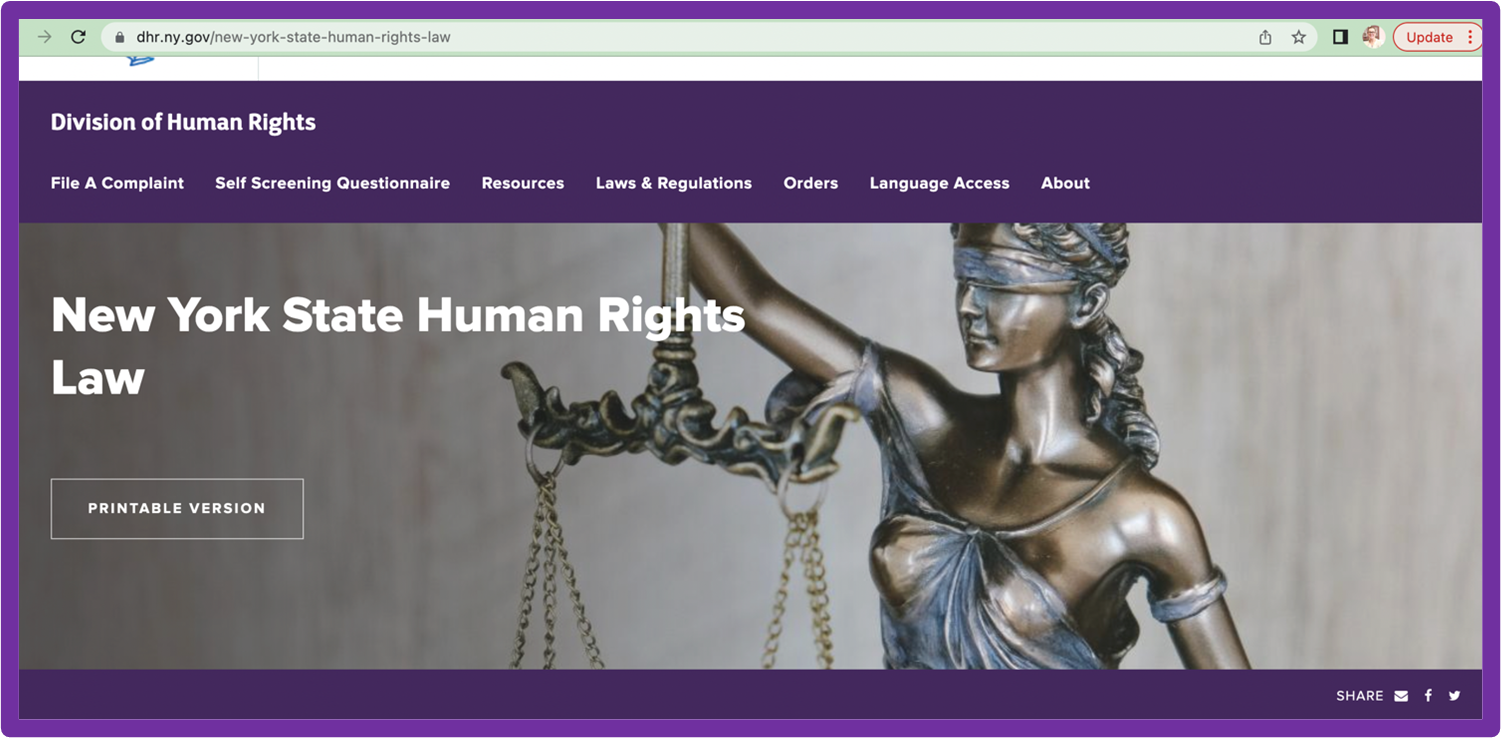
[5] https://dhr.ny.gov/new-york-state-human-rights-law


NYS Human Rights website


Book Challenges and Records Retention

Submission Date

Question

In a local school district, multiple books have been challenged recently. This week, the School Board received an email from a community member referencing record keeping for library materials and electronic records retention. The district Superintendent wants to make sure that the district is keeping the right kind of library records, and that they are keeping them for the legal amount of time. Attached are two documents to review. In the first document titled District Records, under #15, it advised that districts should keep a list of book lists and school library reports. With this, should the district have kept a list of all books in their libraries in any given year?

Answer

In speaking to different libraries about being prepared for book challenges, I have repeatedly stressed one very important element: have your policies ready.

This question shows the depth of consideration that goes into that simple requirement.

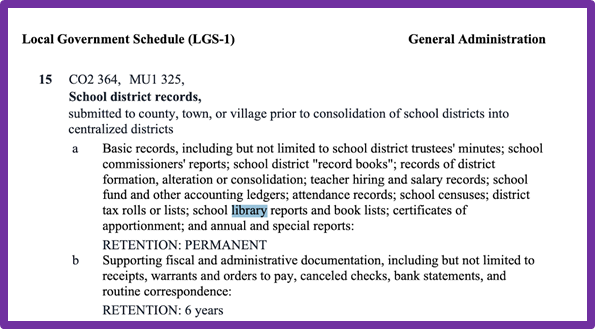
In this case, that "depth" is found in the rocky chasm of the LGS-1, New York's end-all, be-all rules for public document management.  Need to know how long to keep records for a bingo game authorized by a village?[1]  Or how long to keep a record of exhumation?[2]  Or how long we hang onto bridge inspection records?[3] It's all in the LGS-1.

The documents the member references are sections of the LGS-1.

They look like this:

LGS-1 Screenshot of school district records law

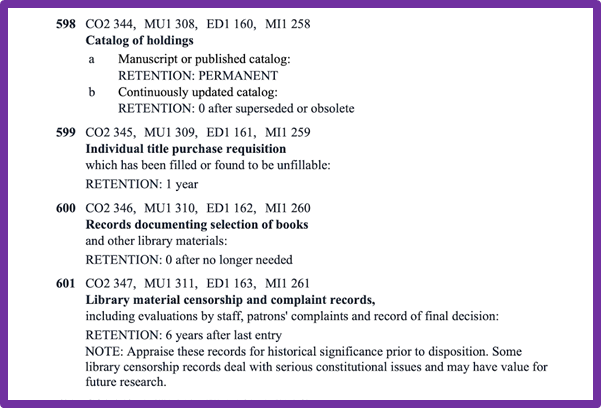
and

Screenshot of LGS-1 guidance for schools

Looking at these requirements, the member's question is: "[S]hould the district have kept a list of all books in their libraries in any given year?"

The answer is: MAYBE, but not DEFINITELY.

Here is why:

The first section referenced by the member, at first blush, looks like it requires the retention of "book lists" for six years.  But examining that precise section, you will see the requirement is limited to records submitted prior to the "consolidation of school districts." 

So, outside of a district consolidation, section LGS-1 15, does not require compiling a list of books.

The next sections, LGS-1 598 and 599, refer to a school district maintaining records related to a "Catalog of holdings" and "Individual title purchase requisition," respectively.

We'll tackle 598 first.

598 requires that a "Manuscript or published catalog" of "holdings" must be retained "permanently."  It then requires that a "Continuously updated catalog" be retained until it is "superseded" or "obsolete."

This means that a district library's "catalog of holdings" that exists in a static form (like a print or PDF list) must be retained permanently, but a list of holdings that is ever-changing (like an ILS) is only retained until it changes form--or that form stops being useful.[4]

In practical terms, this does mean that if the library produces a static list (in print or electronic form), it must be retained forever.  That obligation, however, does not obligate the library to create such a list in the first place.  Meaning, in other words: if the library only uses an ever-changing catalog, it doesn't need to retain any particular copy.

This brings us to 599, which requires that an "[i]ndividual title purchase requisition" (the documentation showing a school library bought a book) must be retained for one year.

Again, in practical terms: while per 598, a school library is not obligated to compile a printed list showing that "Not All Boys are Blue" is in its library's collection, per 599, it does have to retain (and produce, if not otherwise accessible through FOIL) a school’s requisition to purchase "Not All Boys are Blue" if requested.

This gets more interesting as one considers that LGS-1 600 (also seen in the purple-bordered excerpt above), regarding "Records documenting selection of books" sets no minimum retention period.  Meanwhile, LGS-1 601, regarding "Library material censorship and complaint records" mandates such records be retained for at least six years (and encourages considering saving them for much longer, which strikes me as a good idea).

The upshot of these various rules creates a regime where a district is empowered to pick and choose, to some degree, what records it wants to create...but once created, imposes a very particular set of parameters for retaining, purging, and disclosing them.  This is why my answer to the member's question must be so ambiguous.

It is also why it is very important that a district have a well-developed policy on this issue.

Below are some examples of what, depending on the records a district elects to create, a district can say in answer to the question: "I want to make sure I approve of all the books my taxes paid for this year.  Can I have a list of all the books?"

[If the library maintains a published list and wants to be friendly.] "Sure thing.  We compile and publish a list of books in our collection every year as of the first Monday of September.  Do you want the one showing all the books in one particular library, or all the books in the district?"

[If the library doesn't maintain a published list, but has a continuously updated catalog, feels friendly, and allows access to library computers.] "No, we don't publish such a list.  But we do have a continuously updated catalog you can search on this terminal."

[If the library doesn't maintain a published list, has a continuously updated catalog, doesn't allow just anybody access to its computers, but feels somewhat helpful.] "No, we don't publish such a list.  But we do have a continuously updated catalog you can request a copy of."

[If the library doesn't maintain a published list, doesn't allow access to computers, and doesn't feel helpful, but does feel puckish.] "No, but if requested, we can supply you with a copy of every book requisitioned last year."[5]

[If the library doesn't maintain a published list, and doesn't want to offer alternative ways to share the information.] "No, we don't have that."

[If the library doesn't maintain a published list, and is okay risking a spat.]

"No."

Optional rider to all the above answers: "Here is a copy of our FOIL policy so you know the process for requesting our public records through our FOIL officer, and can be aware of our copying charges and the process for requesting electronic copies."

Now, as any veteran of public relations battles over school district policy knows, there's a time to be helpful, and there's a time to say "no."  I am not endorsing any particular answer, but based on a district's policy, it should know what records it keeps (and doesn't keep), and how people can access them.

From my perspective, if there isn't a need to compile information, it shouldn't be compiled.  Further, FOIL does not create the obligation to compile information if it is not already compiled.  On the other hand, waffling and appearing to dodge the question when concerned citizens are on the hunt for "objectionable material" might not be the best way to fight the battle for intellectual freedom.  "We don't have a list but we have a continuously updated database" strikes me as a glove-slap; it invites a fight...but nevertheless, if accurate, might be a perfectly valid response.

From my high horse over here in law-law land, a district should proceed from the presumption that if a book is in a school library's catalog, it belongs there; this is the stance that supports intellectual freedom, while also setting a good example for the students (but I am not the one who has to deal with angry community members storming a school board meeting).

Regardless of my personal thoughts on the diplomatic aspects of this issue, from the perspective of intellectual freedom, information access, education law, the LGS-1, and the First Amendment, here is what's important: have a sound policy governing 1) how library books are selected; 2) how library books are cataloged;[6] 3) how library books are challenged; and 4) how library books are removed, and follow that policy.

If, as part of that policy, a district has the desire and capacity to create an annual (or decennial, or whatever time span it wants) list of books in the school library catalog, great, but if such a list is created, it must be kept forever.  And if the district only uses a continuously updated library catalog, it should be clear from the policy who can access it, and how (at the school?  By appointment?  Remotely?).  And all of this turns on the district having a designated FOIL officer and process for timely responding to, assessing, and meeting FOIL requests.

So, there is my answer...and I know it rests on a dangerous triangle of law, practicality, diplomacy.   This stuff isn't easy.

I wish you a clear head, a steady heart, and a ready wit as you face whatever challenges come your way.


[1] 8 NYCRR §185.15 (2020); see schedule items 562-564.

[2] 8 NYCRR §185.15 (2020); see schedule item 136.

[3] 8 NYCRR §185.15 (2020); see schedule item 1085.   By the way, it's "6 years after structure no longer in use or inspected features have been replaced," which I find rather terrifying.

[4] Kind of whimsically sad notion: "You are needed, until you change or you aren't needed."  I would love to meet the person who wrote this part of the LGS-1; they had to be a philosophy major.

[5] I don't advise using this one.

[6] Including having a published list, or simply having a continuously updated database.

Follow-up to Minor Employees and Obscenity in Libraries

Submission Date

Question

[NOTE:  This question was submitted in response to the guidance posted at Minor Employees and Obscenity in the Library.

After sharing your reply with my board, we have a follow-up question seeking clarification. The question is in regards to the following paragraph:

In that regard, I can only say that inviting concerned parents to review the library's well-thought-out accession, cataloging, and appeal policies is a pro-active way to ensure parents know that the library takes both its role as an employer of their child, and as a champion of a community's intellectual freedom, seriously. Parents or guardians of minors working in New York will have already had to sign working papers; no waiver or disclaimer should be further required.

My president reads your first sentence (and the word "pro-active") and thinks that your advice is to reach out to parents upon or before the hire of a minor in order explain these policies and allay any concerns. If so, then which? Before, or after?

Whereas, I read your second sentence and think that you're saying that we're not liable -- we already have the parent's permission -- but that parents who then express their "concern" to me about any of the training materials should be given said spiel.

Can you please clarify? Thank you!

Answer

This question is an example of why clear, precise writing is so important.

To make sure no reader is in suspense, first I'll answer the member's question: I intended the guidance to convey the member's interpretation (with the information about accession, cataloging and appeal policy being supplied only after a parent expresses concern).

Re-reading my answer, I can see how the member’s president interpreted this guidance not as a reaction, but as a preemptive strategy to head off parental concerns.[1]  But that is NOT the guidance I intended, and I have since added a footnote[2] to the original posting to clarify that.[3]

While I have your attention on this, I will add: except for factors required by law (like requiring working papers, limiting certain activities in certain industries, and abiding by child labor laws), I don't advise treating minor employees differently than any other employee. If a library wouldn't contact the parents of a 40-year-old worker to alert them to the fact that, from time to time, a library worker may be exposed to content or communications they find objectionable, it shouldn't be done for a 17-year-old either. Except for when it is required by law, employees should not be differentiated by age, just as they should not be differentiated by gender, race, or religion.

Thank you very much to the member for giving me this chance to post a clarification, and this caveat.


[1] That is what I get for using a buzzword like "pro-active."  Although...is it a "buzzword" anymore? What happens when a buzzword gets tired?  Is it a "dunzzword"? 

[2] Here is the footnote: "We received a request for clarification about when to use this tactic.  As posted in the clarification here [https://www.wnylrc.org/ask-the-lawyer/raqs/241] I intended this guidance to convey that the information about accession, cataloguing and appeal policies be supplied only after a parent expresses concern."

[3] I could of course just have made an edit, but we don't hold with that 1984-style memory adjustment here.

Minor Employees and Obscenity in the Library

Submission Date

Question

I appreciate your thorough treatment of the topic of pornography in libraries, especially couching it in the larger context of objectionable content. Our library's policies and staff training take a similar approach.

In reviewing our Employee Handbook, our fairly standard Sexual Harassment Policy, and my staff training & orientation on the topic, one trustee raised the question of the library's liability in the case of minors -- specifically, minor employees -- being subjected to viewing pornography in their workplace. The trustee thinks that minors viewing pornography is flat-out illegal, and I don't understand the subject well enough to explain whether it's a civil or criminal liability, or who would be liable in the case of a child glimpsing an adult's perusal of graphic sexual content; or whether we, as employers, should have some kind of parental consent form for minor employees, as we employ Library Pages as young as 14 years old.

Assuming a set of library policies structured as you have previously advised, what, if any, liability does a library have for minors inadvertently viewing adult pornography? And what, if any, modifications to hiring, training, and workplace procedures do you recommend for minor employees?

Answer

This submission stands at the complicated crossroads of First Amendment, employment law, library ethics, and equal protection.[1]

As such, I could write on this topic endlessly.  But "Ask the Lawyer" is not here to provide endless commentary, but rather, helpful guidance inspired by real-world questions. 

So here is some (hopefully) helpful guidance, centered on a real-world example (culled from my summer reading):

I recently read a powerful graphic novel called "I Know What I Am"[2] about the life and times of artist Artemisia Gentileschi.

Gentileschi was a powerhouse painter in the 17th century.  She was also a survivor of sexual assault, a businesswoman, and a mother who, as portrayed in the comic book, channeled her experiences into her painting.

"I Know What I Am" pulls no punches depicting Gentileschi's life.  The artwork--which re-creates many of Gentileschi's own works, including her different versions of "Judith Slaying Holifernes"[3]--is stark, bloody, and riveting.[4]  The portrayals of sex and sexual abuse do not leave much blood in the gutters.[5]

Of course, as a literary work, "I know What I Am" checks all the boxes for not triggering a charge of "obscenity" as defined in New York (including having literary merit).  But that said, select panels from the book could very easily be regarded as inappropriate for some audiences--and not just for "minors."  The content is very raw, and for those sensitive to certain topics, could exacerbate or evoke trauma.

None of that, of course, creates a legal violation caused by the content itself--even if it is in a library being shelved by a 14-year-old--but it does show why there is a need to consider questions such as those raised by the member. 

Which, using "I Know What I Am" as a focal point,[6] I will now do.

First question:  [Is] minors viewing pornography ... flat-out illegal?

Answer:  The word "pornography" does not appear in the New York State Penal (criminal) Law.  Rather, New York uses numerous defined legal terms (such as "harmful to minors,"[7] "obscenity,"[8] "indecent material"[9] and "offensive sexual material"[10]) to describe criminal acts that can lead to a charges based on providing access to certain content under certain circumstances (including to people of a certain age). 

However, because of the defenses very carefully built into these laws, none of these concepts can be accurately applied to a properly cataloged item being accessed by a minor who is doing their defined job per library policy.

That said, both internet porn and content with undisputed literary merit such as "I Know What I am" could be handled or displayed in a way considered harassing (a civil rights violation), damaging (a personal injury claim), or criminal if the access is gained or forced on/by a minor without adherence to collection and library policies, and job descriptions.

Here are some examples as to how that could happen:

  • A library employee retrieves books with suggestive titles or sexual content and repeatedly leaves them in another page's locker as a prank, and even when it is reported, the library does nothing to prevent it from recurring (sexual harassment);
  • A clerk knowingly and with intent to harm directs a page who is a recent sexual assault survivor to create a book display of "I Know What I Am" [11] (risking a charge of sexual harassment; possible personal injury); worker's comp claim);
  • A community member donates a stack of old "adult" books for the annual book sale and the director knowingly assigns a 14-year-old to inventory them (risking a charge of material harmful to minors, which requires a "sale" element to be actionable);
  • A patron repeatedly violates the library's policy about viewing sexual content on publicly viewable computers, and no one corrects the serial policy violation (risking a charge of display of sexual material, as well as sexual harassment).

Aside from the legal concerns caused by these types of extreme examples, of course, there is the very real and practical concern that parents of a minor employed by a library could take issue with some of the content their child has to work with...even if it is entirely legal.

In that regard, I can only say that inviting concerned parents to review the library's well-thought-out accession, cataloging, and appeal policies is a pro-active way to ensure parents know that the library takes both its role as an employer of their child, and as a champion of a community's intellectual freedom, seriously.[12]  Parents or guardians of minors working in New York will have already had to sign working papers; no waiver or disclaimer should be further required.[18]

Which brings us back to the point the member raised in the beginning of their question: the importance of having--and enforcing--policies that govern accession, appeal, cataloging, display, and sexual harassment/discrimination (careful adherence to job descriptions and good training on how to enforce policy in the moment are essential, too).[13]

In New York, both the criminal and civil law contain robust protections for libraries working with material some may find inappropriate, offensive, or challenging, but those protections do rest on proof of operating in harmony with the law.  By having clear policies and documenting adherence to them, a library can be ready to weather accusations of illegal conduct. 

Which brings us to the member's last questions:

Assuming a set of library policies structured as you have previously advised, what, if any, liability does a library have for minors inadvertently viewing adult pornography?

If the viewing was truly "inadvertent," and any policy violation that allowed it to occur is quickly corrected, nothing further is needed.[14]

And what, if any, modifications to hiring, training, and workplace procedures do you recommend for minor employees?

Speaking as a former "minor employee" of a public library,[15] a good employee orientation, and regular reinforcement, on the fundamentals of library ethics and the policies that protect employees is a very valuable thing. 

This is already something most libraries are doing, but here are some helpful points to reinforce:

  • Prior to hire, a minor employee should review the job description with their supervisor, and have a chance to ask questions;
  • All employees must be trained to respect patron confidentiality and be trained on how to deftly demur requests by third parties for patron information;[16]
  • All employees are entitled to respectful treatment from patrons and co-workers, and should know to whom they can direct questions and concerns about their employee experience;
  • The library has a suite of policies for selecting, challenging, cataloging, and weeding books, and minor employees who might not have direct responsibility under those policies should know they exist, and how to direct questions about them;
  • Minor employees, in particular, should be trained on how to immediately report observed or reported policy violations (including those related to pornography and harassment);
  • Library employees who are not legal adults (18) should feel free to ask questions, should know to whom those questions and concerns can be directed, and should get meaningful and timely answers so they feel respected.

All of this should be reflected in a hire letter or orientation packet, so parents, if they choose to ask their child to view the terms of their work,[17] can do so.

Not too much to remember in your day-to-day life keeping the library up and running, right???

Thank you for an excellent question.


[1] And even a bit on the law defining what a "minor" is--a status that can shift based on which law is being applied, where.

[2]https://bepl.ent.sirsi.net/client/en_US/default/search/detailnonmodal/ent:$002f$002fSD_ILS$002f0$002fSD_ILS:2101819/one?qu=9781683962113

[3] Here is one version: https://www.theguardian.com/artanddesign/2020/oct/09/artemisia-gentileschis-judith-slaying-holofernes.

[4] Being a businesswoman myself, I found the "business" parts just as compelling as the violent parts, although much of the drama in that part is subtext.

[5] "Blood in the gutter" is a phrase from comics book publishing, meaning the violence happens between panels.

[6] I could also have picked something a bit more salacious to use as an example (something that only barely makes the "literary value...for minors" test) but why waste the opportunity to tout a great book?

[7] NY Penal Law 235.20

[8] NY Penal Law 235

[9] NY Penal Law 235.21

[10] NY Penal 245.11

[11] I know, this is a very far-fetched example.  At least, I hope it is, since it illustrates truly sociopathic behavior.

[12] If a library wants to go even further and have minors only work in the Children's Room, where they will by policy only work with materials cataloged for youth, that could be an extra precaution, although it is not personally one I endorse.  Library work, like legal work, is for people who can approach all of life's variety with maturity and aplomb.

[13] As referenced by the member, past discussion of how policy plays into managing concerns about pornography is here: https://www.wnylrc.org/ask-the-lawyer/raqs/60.

[14] From the legal perspective.  I can't say if counseling, getting ready for picketing, or bracing employees for an angry phone call from parents is in the future. 

[15] New Hartford Town Library, when I was 16 and 17.

[16] I know this isn't quite on point, but the balance between respecting patron confidentiality, and enforcing respect for employees, can be tricky if people don't grasp the fundamentals.  Just because you have to keep mum on what a patron is checking out doesn't mean you keep mum about inappropriate comments!

[17] The topic of a guardian or parent viewing or interceding with the employment relationship of their child is too big for this reply.

[18] Update 11/05/2021: We received a request for clarification about when to use this tactic.  As posted in the clarification here [Follow-up to Minor Employees and Obscenity in Libraries] I intended this guidance to convey that the information about accession, cataloguing and appeal policies be supplied only after a parent expresses concern.