
Intellectual Freedom

Reconsideration Policy for Book Challenges

Submission Date

Question

We were recently reviewing our reconsideration procedure and form. One of my trustees has completed a training on book bans and challenges. The presenter (Jamie LaRue) recommended that the library requires the book (or item) have been read (viewed or listened to) fully by the patron in order to submit a request.

It made sense to my trustee (and, personally, me) that, since we would now have to put in the time to read it fully, they should too. But, I was concerned if we could require that.

So, initially I checked with other directors, and I think only one said that they required it. Most, if not all ask, as we do. Another said they use the patron’s answer to help inform their own decision. Another said no, the patron would probably just lie. Another director wrote: “ALA OIF [Office for Intellectual Freedom] routinely advises libraries that: ‘The reconsideration process should be completed in its entirety and not subverted or ended prematurely, leaving the library open to legal challenge.’ So requiring that might open the library up to accusations of not completing the process, especially if that point was not explicitly covered within the reconsideration policy.” So, what are your thoughts?

Answer

This question threw me into an existential spiral.

Unlike most existential spirals I get hit with these days,[1] this one was fairly pleasant; I got to think about New York State Education Law, due process, and library plans of service.

Here is how it went down:

Well, sure, it’s only natural to want to require a person to read a book before they exercise their right to kick off a costly and time-consuming evaluation process of it.

But yep, the ol’ OIF knows it’s business… having a threshold test to exercise a right creates a legal bone to pick. Best to avoid it if you can.

But hey… if part of the challenge process is a bone, is the whole thing a body? If it’s a body, who gets to inhabit it? What forces govern it? Are they in the library’s control?

If it’s in the library’s control… why enable challenges at all? What’s the point? Is it even required? What is it really for?

IS THERE ANOTHER WAY?

At this point, I started thinking about the recent wild scrambles to batten the hatches and make sure libraries have clear and well-developed collection management policies, so they are ready for book challenges.

Over those years,[2] when I was asked from time to time, “Do we have to have a reconsideration policy?” my answer was, “No, there is no requirement.”[3]

My answer to the inevitable follow-up question was, “While not required, having a reconsideration policy creates a channel for community engagement and feedback, so concerns about collection items have a procedural path to follow. A good policy will ensure the path for evaluating the concern reinforces the ethics of the library and abides by the First Amendment.”

I stand by that reply, but as an innovator, I do want to say: having a “reconsideration” policy for library collection materials isn’t the only way a library can do this.

Consider the current regulatory requirements of public, association, and Indian libraries, each of which must assure the New York State Education Department that it:

(1) is governed by written bylaws which define the structure and governing functions of the library board of trustees, and which shall be reviewed and re-approved by the board of trustees at least once every five years or earlier if required by law;

(2) has a community-based, board-approved, written long-range plan of service developed by the library board of trustees and staff;

(3) provides a board-approved written annual report to the community on the library’s progress in meeting its mission, goals and objectives, as outlined in the library’s long-range plan of service;

(4) has board-approved written policies for the operation of the library, which shall be reviewed and updated at least once every five years or earlier if required by law;

(5) annually prepares and publishes a board-approved, written budget, which enables the library to address the community’s needs, as outlined in the library’s long-range plan of service;

(6) periodically evaluates the effectiveness of the library’s programs, services and collections to address community needs, as outlined in the library’s long-range plan of service;

(7) is open the following scheduled hours:

Population

Minimum weekly hours open

Up to 500

12

500 - 2,499

20

2,500 - 4,999

25

5,000 - 14,999

35

15,000 - 24,999

40

25,000 - 99,999

55

100,000 and above

60

(8) maintains a facility that addresses community needs, as outlined in the library’s long-range plan of service, including adequate space, lighting, shelving, seating, power and data infrastructure, and a public restroom;

(9) provides programming to address community needs, as outlined in the library’s long-range plan of service;

(10) provides a circulation system that facilitates access to the local library collection and other library catalogs; and provides equipment, technology, and internet connectivity to address community needs and facilitate access to information;

(11) provides access to current library information in print and online, facilitating the understanding of library services, operations and governance; information provided online shall include the standards referenced in paragraphs (1) through (5) of this subdivision;

(12) employs a paid director in accordance with the provisions of section 90.8 of this Part;

(13) provides library staff with annual technology training, appropriate to their position, to address community needs, as outlined in the library’s long-range plan of service; and

(14) establishes and maintains partnerships with other educational, cultural or community organizations which enable the library to address the community’s needs, as outlined in the library’s long-range plan of service.

As shown by the highlighted language, a library is required to periodically evaluate the ability of its collection to meet community needs.

With that ongoing obligation in mind, just for fun, imagine this: instead of a “reconsideration” process as part of a collection management policy, a library continually solicits input via a “Collection Effectiveness Assessment” policy.

Rather than say (in essence), “If you don’t think a particular book belongs on our library, you can file this request for reconsideration,” a Collection Effectiveness Assessment policy could say:

YOUR INPUT MATTERS

As required by state regulations, the NAME Library regularly evaluates the effectiveness of the library’s programs, services, and collections to address community needs, as outlined in the library’s long-range plan of service.

As part of that ongoing evaluation, the library welcomes your input on our programs, services and collections.

Input on specific services, programs, and collection items will be considered in the context of library’s obligations to a) provide a circulation system that facilitates access to the local library collection and other library catalogs; b) provide programming that meets community needs; c) provide equipment, technology, and internet connectivity to address community needs and facilitate access to information; d) provide access to current library information in print and online; and (e) facilitate the understanding of library services, operations and governance.

Input may be submitted by cardholders at [INSERT METHOD].

Once a year, the library will aggregate and assess this input and will factor it into the evaluation of the long-range plan of service and policies that inform the library’s programs, services and collections.

Please provide your input, and it will be evaluated as part of the [YEAR] evaluation cycle.

Of course, a library that used this “give us your input” approach would want to be intentional about how the information is collected and scrupulous as to how the input is assessed and incorporated. The backend of such a system would take some thinking.[4]

But if done with proper attention to detail, this “routine evaluation” rather than a “ad hoc reconsideration” approach could ratchet down in-the-moment pressure to remove books on the basis of their content (which is a First Amendment no-no), while soliciting ongoing (and voluminous) input about library collections in the context of the needs of the community.

Such an approach could also control the pace at which public library boards react to that input, changing it from ad hoc panic[5] to an annual, well-planned, deliberate ritual.

The Collection Effectiveness Assessment approach solicits and empowers individual input but enters it in the context any library must operate from—its duty to meet the overall needs of the public, rather than the perspective of one member of the community. The potential result is input that may go beyond a request to remove or relocate a book; it allows for input on the strategic decisions and policies that select and catalog the books.[6]

So, at the end of all this, what are my thoughts?

I think that if there is a reconsideration policy, it must have clear parameters for who can use it (such as only cardholders or residents of the served community) and after that—as advised by OIF—as few barriers to use as possible.

But I also think there are other ways, rooted in a public library’s regulatory requirements, to empower community members to offer input on collection materials, while minimizing an individual’s ability to initiate a wasteful ruckus.[7] A holistic look at how a library is soliciting feedback might provide an opportunity to shift the library’s approach on this.

Thank you for walking on this existential spiral with me. I hope it was not too dizzying.


[1] I am turning fifty-one this year; even the simple act of flipping a pancake has me questioning the meaning of life.

[2] 2020 through to the present. I call them the “Interesting Library Times.”

[3] To be clear, there is no federal or state law or regulation requiring it.  In theory, there could be a local law or policy that requires it...some of the recent legislation (in other states) seeking to put restraints on book acquisitions in other states flirts with this notion.

[4] Some thinking, but not some overthinking. We’re not talking about a major public health study with ethics and placebos; it’s a standard form that a library system could help a library develop.

[5] I suppose “panic” is harsh. How about “I do this gig as a volunteer because I love my community and books, and now I have to deal with a person who doesn’t like a certain type of author and is calling my library director abusive names; remind me why I am doing this again?”

[6] I fully appreciate that even the most carefully designed system of input can be misused. But with careful design, the input can be gathered and arranged for optimal use, while rooting out duplicative or fraudulent input.

[7] The immortal Wu-Tang Clan has a better term for this type of ruckus, but “Ask the Lawyer” keeps it slightly less real.
Staff Disparaging Comments About Employer or Funder

Submission Date

Question

Recently, a page at the library made some comments that were less than flattering about how the local town was handling a new subdivision. The town supervisor came to me (we are an association library and not part of the town government) and asked if our personnel handbook had any language about social media use. He shared that the town personnel handbook had a clause about not disparaging the town when you are an employee. Our handbook does not have specific language on this matter, instead stating that “Appropriate use of the Internet, email and social media is expected.” (There are more clauses about how and when to use the libraries social media, but this seems to be the only line about personal social media)

He and I discussed the matter further and he made a suggestion that the library should look in to whether or not a non-disparagement clause should be part of our social media policy. I got the impression he further thinks that should apply to our major funders (mostly, the town).

How, if at all, should libraries handle personal social media use by employees, especially in regards to usage that might disparage the library or the town that funds us?

Answer

Some questions are tricky, some questions are complex, and some questions are simply a Huge Spider Web of Extremely Intricate and Dangerous Contingencies.

Not to be too dramatic, but this question is that last one.

What creates this tangled web?[1] Let’s explore the threads:

Thread One: The ALA Code of Ethics

Because the Code requires advocacy for proper working conditions, the ALA Code of Ethics may actually encourage what could be perceived as “disparagement” of an employer or financial supporter.

Here is the provision:

We treat co-workers and other colleagues with respect, fairness, and good faith, and advocate conditions of employment that safeguard the rights and welfare of all employees of our institutions. [emphasis added]

So, before adopting a restriction on employee communications, a library must consider this ethical obligation.

Thread Two: State and Federal Law

Both state and federal law can protect an employee’s right to complain about their working conditions.[2] And while not every type of complaint is protected,[3] given recent policy statements and cases (see footnote 2), it is wise to not paint what's barred with a broad brush.

Thread Three: State and Federal Constitutions

For a public library or municipality, barring disparagement of the municipality risks violation of both the state and the federal constitutions. I know that doesn’t apply directly to the library in question (since it is an association library and thus non-governmental), but it bears mentioning.

As does...

Thread Four: Civil Service

For Civil Service employees, if discipline for “disparagement” can be portrayed as “retaliation,” there could be a claim under Civil Service Law Section 75-b.[4]

And finally we have...

Thread Five: Fear

While not precisely a legal issue, limiting employee speech can be a major drain on morale, which in turn can lead to employee discontent, which in turn can lead to legal issues. To avoid that, it is best to aim for an environment that solicits and welcomes feedback, not one that stamps out criticism.

So, what can a library—mindful of its reputation and how its employees can impact it—do to protect itself?

Certainly, a library can require an employee writing or speaking publicly about the library to emphasize that they are only speaking for themselves.

Second, any employer can and should emphasize to employees that harassing, discriminatory, threatening, and abusive conduct—in and out of work, online and offline—may need to be addressed by the employer if it affects the work environment.

And third, a library can affirm that all its employees have a right to develop and express their own opinions, so long as they do not use library resources to convey them (no political candidates endorsed on company time!).

The language the member describes in the municipal policy sounds to me like a holdover of policies from the early 2000s. For the reasons discussed above, this kind of language has been removed from many policies over the past two decades. Case law and regulatory agency commentary (a tiny sampling of which are cited in this answer) show why.

Thank you for joining me in the spider web with an excellent question!


[1] I know a “tangled web” is usually a metaphor for lies. But it works for legal risk, too, since there are places where you can get caught and places where, with enough space, you can get through just fine.

[2] The Equal Employment Opportunity Commission identified the right to "access the legal system" (including by complaining) as an enforcement priority for 2024, the National Labor Relations Board bars non-disparagement clauses in severance agreements, and New York State bars punishment for complaining about discrimination.

[3] Threats, harassment, discrimination, bullying, criminal conspiracy... so many things that can ride along with “disparagement” are not protected.

[4] I won’t get into that too much here, since the question is from an association library, but a good example of a retaliation claim under Civil Service law 75-b Scheiner v. N.Y. City Health & Hosps. Corp., 152 F. Supp. 2d 487 (2007).

Donated Discards and Copyright

Submission Date

Question

The library has been discussing new ways to handle our discards. A senior staff member of a very significant local library told us recently that they donate their discards to the Internet Archive. A staff member here expressed concerns with IA scanning and making publicly available on their website copyrighted materials, and concern for liability on our part for contributing to potentially illegal activity. The staff member wondered if only materials free from copyright concerns should be donated. At this point we are not looking to create a digital library as IA has done for many organizations, but just simply to donate the material for them to use as they see fit in hopes of the material being used for the greater good. Should we have any concerns with donating our discards to IA? Thanks for helping us sort-out this concern.

Answer

Because it would muddy the core element of this question (Should we have any concerns with donating our discards to [Internet Archive]?), this answer is not going to address the various legal and regulatory requirements different libraries may have when it comes to disposing of discarded books.[1]

With that out of the way, we can dive right into the member’s concerns about liability “for contributing to potentially illegal activity.”

Internet Archive describes its work this way:

“Because we are a library, we pay special attention to books. Not everyone has access to a public or academic library with a good collection, so to provide universal access we need to provide digital versions of books. We began a program to digitize books in 2005 and today we scan 4,300 books per day in 18 locations around the world. Books published prior to 1927 are available for download, and hundreds of thousands of modern books can be borrowed through our Open Library site. One of the Internet Archive's missions is to serve people who have difficulty interacting with physical books, so most of our digitized books are available to people with print disabilities (learn about access here).”

As the member’s question alludes to, some of the content on the “Open Library” has brought accusations of copyright infringement, which Internet Archive has defended under the “controlled digital lending” theory of “fair use”.

The most notorious case is Hachette Book Grp. Inv. V. Internet Archive, decided by the U.S. District Court for the Southern District of New York on March 24, 2023, which found that when not limited to use for search functions or adaptive copies, certain scanning and (controlled digital) lending of books still protected by copyright is not defensible as “fair use.”

The decision was a blow to Internet Archive, which is committed to not only making content digitally available but to decoupling that access from the commercial exploitation of user identity. For an elegant an annotated discussion of this topic, review the amicus brief of Center for Democracy & Technology, Library Freedom Project, and Public Knowledge.[2]

The case is now being appealed, with allies showing up on both “sides.”

With all that going on, Internet Archive is still going strong and still accepting donations.[3] The question that this member asks is: if my organization donates our discarded hard copies to IA,[4] can we also get implicated in alleged infringement?

Bearing in mind that anyone can be sued by anyone for anything at any time, the answer is otherwise: no.

The basis for this answer is Section 109 of the Copyright Act, which provides that “the owner of a particular copy or phonorecord lawfully made under this title, or any person authorized by such owner, is entitled, without the authority of the copyright owner, to sell or otherwise dispose of the possession of that copy or phonorecord.”

This “first sale” doctrine, as it is referred to, does not cease to operate when a party knows or may know that the purchaser or recipient has been found to infringe copyright in the past. In addition, as the ruling in Hatchett points out, there are a number of legitimate uses Internet Archive can make of scanned versions of donated copies.

While it is true that there can be “joint liability” or “vicarious liability” for every person in a “chain of infringement,” providing copies in a manner covered by Section 109 (i.e. selling or donating a lawfully obtained copy) is not one of them.

On the topic of donating to Internet Archive, I will also say: because Internet Archive is attempting to break new legal ground,[5] supporting them is controversial in some circles,[6] while it is an almost sacred duty in some other circles. [7] So, aside from considerations of liability (which, so long as the donations are hard copies, will not pose a concern), it makes sense to review the status of the cases, and decide where your organization stands.


[1] For example, Education Law 260(12) requires that public libraries “… offer to donate such books or materials to a not-for-profit corporation or political subdivision located within the area of the library system or offer to sell such books or materials to the general public.” And different academic, school, and court libraries will have their own rules, regulations, bylaws, and policies governing donations.

[2] Shiva Stella, Public Knowledge Joins Amicus Brief Defending Controlled Digital Lending and Consumer Privacy, Public Knowledge (December 21, 2023), https://publicknowledge.org/public-knowledge-joins-amicus-brief-defending-controlled-digital-lending-and-consumer-privacy/.

[4] I am leaving digital content out of this because most digital copies come with “terms & conditions” that bar transferal of the content… not a tactic I endorse, but one that has been found enforceable.

[5] Specifically, the concept of “controlled digital lending.”

[6] Publishing and content-monetization circles.

[7] Library and privacy advocate circles.

Limiting Digital Content Access in Schools

Submission Date

Question

Within the context of recent regional school book challenges, much of the attention has been focused on print collections. However, librarians and school districts have started to look at digital content, too.

Sora is the K-12 platform used by many students and staff in NYS to access OverDrive content (as opposed to Libby, which is used by public library patrons). In Sora, content access levels can be implemented to restrict access to content.

Here is how OverDrive defines content access levels:

Content access levels let you control which types of users can view and borrow certain titles in your digital collection. Content access levels are customizable and can be different from the publisher-defined audience label.

Note: In the Libby app, users will be able to see all titles in your digital collection, regardless of content access levels. If a user tries to borrow a book that's restricted by content access level, the checkout won't be completed and the user will get an error message.

Content access levels are designed to let you manage access to titles based on age-appropriateness. Users are assigned a user type ("Adult," "Young Adult," or "Juvenile") when you set up authentication (for schools) or based on library card type (for libraries). Users can access titles at or below their access level:

"Adult" users can access all titles
"Young Adult" users can only access titles you label "Young Adult" or "Juvenile"
"Juvenile" users can only access titles you label "Juvenile"

A title's content access levels, which are assigned by you, may be different from the title's audience, which is assigned in its metadata by the publisher.


I am wondering if restricting digital access to content by grade level and/or to individual student could/would be another "creative work around" to limit access that may or may not be outside of board policy?

Answer

The answer is "Yes."

Of course, behind that answer is layer after layer of complexity.

Layer 1: The "you" in the policy quoted by the question (as in "Content access levels let you control which types of users can view and borrow certain...") could be the SLS, or could be an individual school, or even an individual employee of a school.  It's all about who has the access to control the settings, which is not something that should be left to chance and happenstance.

Layer 2: Databases like SORA are often licensed by school library systems ("SLSs"), not individual libraries or districts. This means that the access controlled by "you" might be controlled by SLS policy, rather than that of a member library (or the SLS's policy could specify that such control is handled at the district or individual library level).

Layer 3: The American Association of School Librarians discourages this type of limit in part 5 of its "Common Beliefs": "Learners have the freedom to speak and hear what others have to say, rather than allowing others to control their access to ideas and information."  This means that once content has been made a part of the school library or school library system's collection per established collection development policy, learners should have access to it.

Taking all these layers into account, a few things emerge:

First, there is a grave risk that restrictions in excess of appliable ethics, regulations, and policy could happen if such access controls are implemented without attention to applicable policy.

Second, if there is no policy that addresses restricting access (whether by age or individual student), that feature of a system should not be used.

Third, if a system with the capability to selectively bar access is acquired, that feature should only be implemented if there is clarity about what policy governs its use, whose policy is it, and who the "you" setting the limits is.  

But as the question points out, even with a policy in place, this may be a dangerous game (or a "creative work-around") when it comes to intellectual freedom, because as the AASL says: "Learners have the freedom to speak and hear what others have to say, rather than allowing others to control their access to ideas and information."

The decision to limit access to content that is part of collection of a school library or library system is an ethically slippery slope.  A district, school, and/or school library system should think very carefully about why it would enable such limits through policy, taking care the policy is consistent with governing ethics and regulations. 

So how is a library, school district, or system to ensure students have access to appropriate content?  The development of a pedagogically appropriate school library or school library system collection lies with their collection policies, NOT the ability to selectively control access to a collection once it is established.  This starts with using established criteria, developed and overseen by trained professionals, assembling a collection that meets the needs of the school.

By regulation (8 NYCRR 91.1), this mandate of a school library is broad: "The library in each elementary and secondary school shall meet the needs of the pupils, and shall provide an adequate complement to the instructional program in the various areas of the curriculum." [emphasis added]

By regulation (8 NYCRR 91.1), the mandate of a school library system is also broad, and it includes developing a plan for "cooperative collection development implementation," or in other words, a written plan for how cooperatively accessed materials are acquired and made available from one district to another.

There is no one way these broad mandates are achieved, and that is where the individuality of a school library system will assert itself.  But regardless of how those cooperative collection development plans are made, leaving the question "who controls collection access by age or individual identity?" unanswered is not a good option.  Through attention to applicable ethics, law, regulation, and the required collaborative governance[1], a school library system can answer that question with clarity, even if the answer is "no one."


[1] Governance as required by 8 NYCRR 90.18.

Dos and Don'ts Of Addressing School Library Censorship

Submission Date

Question

NOTE: On 5/13/22, Erie 1 BOCES hosted a program[1] regarding school library materials management.  That same week, the Erie County Bar Association hosted a CLE on the same topic[2].

At both programs, school district library personnel discussed the ethics of their professions.  They also shared their personal experiences with collection management issues, including attempted censorship of library materials.

Both sessions were inspired by concerns, rooted in the current political climate, that school districts could feel pressure to sidestep policy and direct the removal or limitation of "controversial" library materials without due process.

The law, policy, and case law covered at the session was extensive. Below is a summary of the major take-aways, in a "Do's and Don'ts" format.

QUESTION

What are the "legal do's and don'ts" of school district library collection management in New York?


[1] "Collection, Selection, Objection": the recording can be located through your regional BOCES or school district library system.

[2] More information on this "Continuing Legal Education" seminar is here:  https://eriebar.org/product/2433-more-than-a-book-ban-advising-municipalities-schools-and-libraries-during-a-book-challenge/


Answer

DO ensure your school district library system, school district, or school has a robust and well-thought-out "school library materials policy"[1] ("Policy") governing selection, procurement, cataloging, lending, concerns, re-evaluation, and removal of library materials.

DON'T forget to train every person with a role in that Policy[2] on how it works, and why the district has it in place; this includes spending time on the law, regulations, and ethics[3] that govern it.

DO ensure that experienced lawyers and policy-makers have reviewed the Policy for both legal compliance, and compatibility with the unique environment at your district or school.

For example, if your school has an active PTA that likes to fund-raise and donate books to the school library, the method of accepting those donations should conform to the "selection" part of the Policy.[4]

DON'T adopt a Policy and then let it gather dust.  A policy that governs selection, procurement, cataloging, lending, concerns, re-evaluation, and removal of school library materials is a vital part of a school's library--which is a vital part of a school.

DO make sure your Policy honors the professionalism and qualifications of your school librarians and media specialists.  When considering how your district's Policy applies in real-world situations, remember that your school library staff are trained in the selection of library materials.   Because of that, your district's Policy will delegate responsibility for selection and cataloging to those professionals[5] ...and the law in New York, policy of your district, and job descriptions will back that authority up.

DON'T create a potential liability for your school by taking quick steps related to library collection management issues without checking with your district's Policy and lawyer.  Cases such as Pico[6],  the seminal case regarding school board over-reach regarding school materials, happened because school leadership took hasty action without considering policy.

DO maintain familiarity with the most basic tenets of the law in New York regarding school district library systems and school library operations.  This includes Education Law § 1709(1), Education Law §1711[2] [c, d], Education §Law 701, Education law §702, Education Law §310, 8 NYCRR § 90.18 and 91.2.  For a good primer on these, review the NYSED Commissioner Decision 14,229  "Matter of Carney."[7]

Notably, the case law and NY Education Commissioner decisions emanating from these laws and regulations show that ad hoc decisions about curricular and library materials imposed without consulting policy can lead to legal claims, creating unnecessary media attention, community tension, and expense for school districts.

DON'T impose "creative work-arounds" such as using "soft" directives to influence school library collection issues without following policy.

Hypothetical examples of such "creative work-arounds" include:

  • Directing library staff to keep "controversial" books in the collection, but move them off the shelves and into a store-room;
  • Stigmatizing books in the collection by making them available "by request only";
  • Telling parents and guardians with concerns that library material will be removed, without referring them to the relevant policy for lodging a complaint or requesting that it be re-evaluated;
  • Identifying books that may only be checked out after obtaining parent/guardian consent[8];
  • Sharing lists of books checked out by students in excess of what professional ethics, FERPA and CPLR 4509 (regarding privacy) allow;
  • Directing school library employees to avoid selecting a certain "type" of material, even if that material is otherwise appropriate per the district's Policy;
  • Basing content bans on categories of identity protected by local, state, and federal civil rights laws.

These are just a few examples...but anything that would remove or restrict access to school library materials, without applying due process, risks a legal concern and tripping the factors found unconstitutional in Pico.

DO build an administrative and educational team that is READY to respond to concerns about curricular and library materials.  

When it comes to content choices in the classroom or in the library, no Superintendent, Principal, or school board chair can do it all. 

team consisting of the school librarian, experienced teachers and administrators, the district's lawyer, and as needed, the school board, should be ready to respond promptly when there are materials concerns. [9]

DO remember that for every school library material challenged, there are people being impacted by the challenge--including yourself.

These are tough times for school administrators.   Across the country, there is a great awakening to the importance of school boards and the leadership of public institutions such as libraries.

This is good, but it has turned school districts and libraries into zones of potential controversy, with administrators charged with keeping the peace--and people threatening lawsuits on all sides.

At such times, there are three things that, when combined, can create refuge and stability:

First: a cool head.

Do not take an ad hoc action when presented with a library materials concern; lead with policy.

Second: a good team. 

Rely on your people.  They will help ensure legal compliance, the well-being of students, and good service to the community.

Third: a solid policy.

Have it, know it, follow it.

Administrators who find the culture wars on the doorstep of their schools cannot avoid controversy.  But when controversy arrives, if they DO follow policy, and DON'T take ad hoc steps in a panic, school administrators can provide a structure for communities to navigate open and honest discussions[10] of library materials, community values, and their educational environment.

Below is a template[11] for organizing a response, when a library materials[12] issue happens at your school.

School library material concern worksheet

For internal and personal use only

Important information

Answer

Material at issue (title, author, media):


Material catalog information (year acquired, category, shelf location):


First date person using form became aware of complaint:


Complaint made by:


Note: Person is the "Complainant"


Is the complainant a parent or guardian?


Is the Complainant part of a group?


Attach group information


Based on their relationship to the school or community, does the Complainant have standing to make a complaint?


If yes, continue with worksheet...


Is the Complainant following the formal complaint process?


Has the Complainant been provided with a copy of the policy governing how to make a complaint?


Name of school librarian


Other school staff involved in complaint or concern


What is/are the relevant policies?

[attach all policies that apply or might apply]


What people are assembled to help with or to effect response ("Response Team")?


What professional ethics do the members of the response team have to consider when working on this issue?

[attach copies of any relevant codes of ethics as confirmed by team member]


Is there a student involved?


What person on the response team is the primary contact with the student?


Is there any safety or well-being concern for any person involved?


Is there any media or social media discussion of this issue? 


[attach printouts of relevant content]


Is there a relevant union contract or other contract?

[attach contract or relevant section]


Who is the spokesperson for the school or district on this matter?


Track relevant deadlines set by policy or commitment to involved parties:


Deadline:


Deadline:


Deadline:


Deadline:


Deadline:


What was the final outcome of this issue?


When was this matter considered to be complete?


[1] Across New York, this type of policy has many names, and sometimes, is covered by numerous policies.  New York prioritizes local control of school district policy, so a diversity of approaches is right and proper.  The point is that no matter what it is called, or how many policies end up applying, a district has a policy that covers selection, procurement, cataloging, lending, concerns, re-evaluation, and removal of school library materials.  Very often, this will need to be coordinated across school library systems.

[2] For the rest of this article, we're using "Policy" with a capital "P" to denote whatever policy or combination of policies a district has adopted.  That's right, with a capital "P" that rhymes with "C" that stands for "cool" (as in, "We're cool; we have a Policy for this").

[3] The ethics of the profession of school librarian as emphasized by NYSED are found at http://www.nysed.gov/curriculum-instruction/teaching-learning-intellectual-freedom

[4] Sometimes, this might mean having to say "No, thank you," or "We need to take a different approach," to the PTA.  Just another day in school administration.

[5] This is another factor that will vary from district to district in New York, but every policy I have seen grants a significant role to the librarian.  This is why a good hiring pipeline for qualified school librarians and media specialists is critical.

[6] Found at: https://www.oyez.org/cases/1981/80-2043 . This US Supreme Court case ruled that "although school boards have a vested interest in promoting respect for social, moral, and political community values, their discretionary power is secondary to the transcendent imperatives of the First Amendment." 

[7] Found on the NYSED site at http://www.counsel.nysed.gov/Decisions/volume39/d14229

[8] This one is a HUGE concern, because in addition to potential legal and regulatory violations (about which countless law review articles and books have been written), it sets a precedent of parent/guardian pre-approval for ALL school materials...something that is antithetical to the democratic process by which public schools operate. 

[9] "Promptly"...but not immediately.  The benefit of having a team ready to go, and letting parents or community members know that your school is organizing a response per your district's policy, is that it signals that you take the complaint seriously, but also gives the situation breathing room.

[10] Yes, I know "open and honest" can often sound "angry and passionate."

[11] As with all templates on "Ask the Lawyer," this one is illustrative only.  A district or administrator wanting to develop such a resource should confirm a final draft with their lawyer.

[12] This template is for library materials concerns; there are some different factors when there is a challenge to curricular materials.

Pride Month Displays

Submission Date

Question

[NOTE: We didn't get this as a submission to "Ask the Lawyer", but we wish we had...]

Our library board is considering a resolution to bar displays celebrating Pride Month.  The ban focuses on, but is not limited to, displays in children's/YA areas.  Is this a legal issue?

Answer

YES. Expressly barring library displays based on categories protected by law, such as sexual orientation and gender, is--among other things--a legal issue.

This is not to say a library can't pass a policy on library displays.  A library could easily implement a policy that requires displays to be timely, that they be reflective of the needs of the community, and that they display an array of materials from different sources.  Such a policy, done thoughtfully and with director and attorney input, could be perfectly appropriate, legal, and in line with the mission of a public library.

In addition, such a policy could address and provide established and well-thought-out procedures for the library to address:

  • Concerns that a library display violates the bar on political activity by a library;
  • Concerns that a library display is age-inappropriate;
  • Concerns that the content in a library display is illegal;
  • Concerns that the display could objected to by members of the community; and
  • Concerns that the display is boring, non-engaging, and/or irrelevant.

But what such a policy could NOT do (without tripping legal concerns) is make blanket rules about display content based on categories that align with identities protected by law[1]

Further, if such decisions are made in a vacuum, without policy (like an ad hoc board resolution), they run the risk of being both discriminatory and "arbitrary and capricious."  Such a ban--especially coupled with the dialogue and community interaction that might precede and follow it--could set the stage for:

  • A claim of discrimination by a trustee;
  • A claim of discrimination by an employee;
  • A civil rights claim by a patron;
  • A report triggering an investigation by the New York Division of Human Rights[2];
  • A really awkward moment at the next sexual harassment training, since in New York, "sexual harassment" includes harassment on the basis of sex, sexual orientation, gender identity and the status of being transgender.

In addition, there are many local municipalities that have their own protections for certain protected categories, including sexual orientation and gender identity and expression.  So there is a risk of implicating not just state and federal, but local law, as well.

Of course, such a ban is FAR MORE that a legal issue.  But amidst everything else, it IS a legal concern.  And while their primary duty is to serve the library's mission, public library trustees also have a fiduciary duty to guard against claims that the library has violated state, federal and local civil rights laws.

How would a library board walk back having taken such a position?  Ideally, very quickly and decisively, with confidential legal advice from their local attorney[3].  This is because in and of itself, such a ban might not be enough to trigger legal action...rather like how just vodka isn't enough to make a martini.  But who knows when the vermouth will show up?

That said, if a board is at this point (and especially if the library director and staff are watching, without being consulted[4]), even after serious consideration of a such a policy or directive, change is possible

After all, each and every library trustee and employee in New York (and even their lawyers) can always learn more about the New York Human Rights Law,[5] federal civil rights law, and perhaps even the protections in their municipality.

And public libraries are there to enable learning by everybody.

Everybody.


[1] In New York, that includes: race, creed, color, national origin, sexual orientation, gender identity or expression, military status, sex, disability, marital status, or status as a victim of domestic violence.

[2] https://www.nysenate.gov/legislation/laws/EXC/296 This links brings the reader to a partial list of barred discriminatory actions.  Here is an excerpt (in other words, there's more): " 2. (a) It shall be an unlawful discriminatory practice for any person, being the owner, lessee, proprietor, manager, superintendent, agent or employee of any place of public accommodation, resort or amusement,
because of the race, creed, color, national origin, sexual orientation, gender identity or expression, military status, sex, disability, marital status, or status as a victim of domestic violence, of any person, directly or indirectly, to refuse, withhold from or deny to such person any of the accommodations, advantages, facilities or privileges thereof, including the extension of credit, or, directly or indirectly, to publish, circulate, issue, display, post or mail any written or printed communication, notice or advertisement, to the effect that any of the accommodations, advantages, facilities and privileges of any such place shall be refused, withheld from or denied to any person on account of race, creed, color, national origin, sexual orientation, gender identity or expression, military status, sex, disability or marital status, or that the patronage or custom thereat of any person of or purporting to be of any particular race, creed, color, national origin, sexual orientation, gender identity or expression, military status, sex or marital status, or having a disability is unwelcome, objectionable or not acceptable, desired or solicited.

[3] And perhaps a check-in with their "directors and officers" insurance carrier.

[4] This type of issue is part of why the author consistently recommends trustees be trained on non-discrimination policies (including sexual harassment).

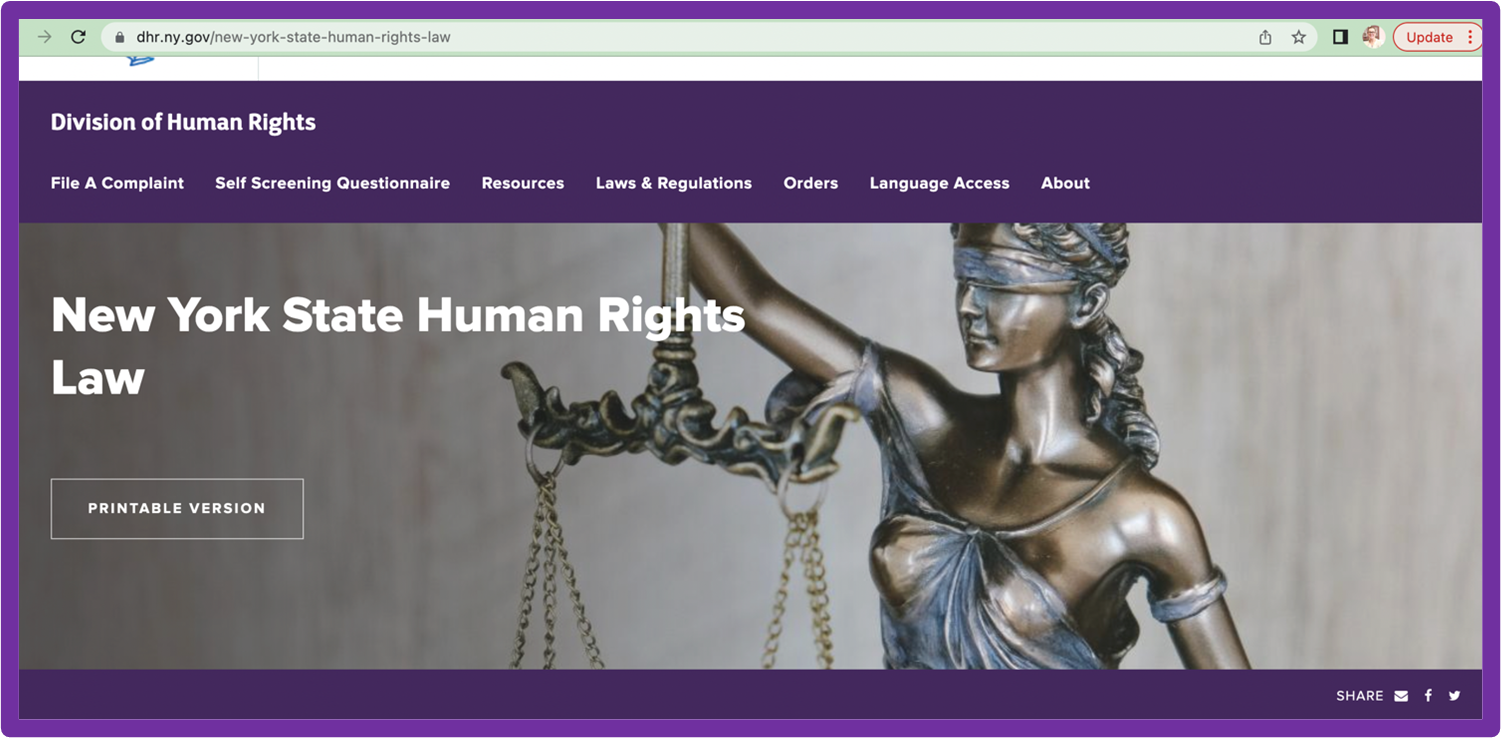
[5] https://dhr.ny.gov/new-york-state-human-rights-law


NYS Human Rights website


Legal Recourse for Slanderous Accusations Against Librarians

Submission Date

Question

A recent article appeared in a local newspaper that was describing the local efforts of a group called Moms for Liberty to have certain books removed from school libraries because the group consider the titles to be inappropriate for school age children. However, the language used and quoted in the article, including “#Porninschools Exposed" and that they found over 80 titles that should be given an "R" rating seems as if it could be construed as an accusation against school libraries that they are distributing materials to minors that are prohibited by law. The article also quoted the group as intending to get people "outraged" by posting excerpts from books they consider objectionable. I would like to know if the school librarians facing these kinds of accusations have any recourse to bring action against the organization or individuals within the organization making these kinds of possibly slanderous and libelous accusations.

Answer

I am writing this on May 23, 2023. 

It has been well over a year since I started working with school district libraries and regional BOCES on the ethics, law, and policy considerations of school library collection concerns.[1]

In that time, I have worked with many on the front lines of this issue, and heard their stories: librarians worried their school's policies aren't up to the challenge, librarians enduring insults and threats, and librarians developing contingency plans for the day when the anger is directed at their school library.

The sessions I have worked on have focused on different ways to be prepared: 

  • Be certain of your ethics
  • Know the laws that pertain to your library
  • Know your district's procedures
  • If necessary, update your district's policies
  • Build a team that is ready to respond
  • Have a plan for that team so they work seamlessly
  • Memorize an "elevator speech" on intellectual freedom
  • Keep calm.

The member's question addresses a factor that cuts across every facet of preparation: be ready to play offense. 

To reiterate, the member asks: [Do] school librarians facing these kinds of accusations have any recourse to bring action against the organization or individuals within the organization making these kinds of possibly slanderous and libelous accusations[?]

The answer is: YES.

Some of the more possible legal tactics are listed below, along with tips on when a librarian should reach out to their own personal lawyer.

A few disclaimers, and tips for being ready to employ these possible tactics, come next.

Possible Legal Tactics

If a school librarian is wrongly accused of a crime, or of incompetence at their job, that can be grounds for a claim of defamation (slander or libel, depending on how expressed).

If a school librarian is subjected to acts which alarm or seriously annoy them, and serve no legitimate purpose, there can be grounds for a harassment claim and protective order.

If social media is used to attack a librarian's character, or to abuse or stalk them, there can be grounds for account suspension and other remedies.

If a school librarian is subjected to abusive or negative comments regarding gender, sexual orientation, race, or religion that create a hostile environment, and after a complaint, nothing is done to stop the behavior, it can be a violation of the New York Human Rights law and federal civil rights laws.

If a school librarian is subjected to a coordinated attack by a registered charitable organization or PAC in violation of formation documents or state/federal law, the organization's actions can be reported to the Attorney General or other regulatory authority.[2]

If a school librarians' image is used to raise funds and/or to agitate people into donating money or for other commercial purposes, there can be grounds for a case based on misuse of the librarian's right to personality.

If a school librarian is subject to abuse or conduct that leads to stress-induced workplace injury, they can bring a claim for worker's compensation.

If a school librarian raises concerns regarding harassment, abuse and safety, and is subject to retaliation for raising such concerns, such retaliation could be the basis of a claim based on violation of state and/or federal labor law.

If a school librarian's employment is threatened or ended due to wrongful accusations, the wrongful accusations can be addressed via a combination of legal claims.[3]

For every possible "cause of action" (the items in bold) listed above, there is a precise formula, deadline, and basis for damages that will require careful analysis of the facts.  For this reason, obtaining timely and competent legal advice is essential.


A Disclaimer

Every one of the above-listed "causes of action"--and more--can be used to fight abuse and harassment based on performance of a school librarian's work...if the right elements are present.  That said, make no mistake

  • A person or group who thinks a particular book shouldn't be in a library has a right to state their opinion;
  • A person or group who thinks a particular book is harmful may have a right to use policy and procedure to challenge that book within a library's catalog;
  • A person or group who has a bona fide belief they have witnessed criminal behavior has a right to report it.

This is the United States of America, and we are in the mighty State of New York.  If a person wants to say they don't like a book--and even if they want to say they don't like that pesky librarian--they get to say that.[4]

That said, a person who uses their voice and power to defame, harass, threaten, and injure[5] a school librarian may have to face the consequences.

Being Ready to Bring Consequences

To assess if advocacy or self-expression by a person or group protesting books in the library crosses a line, a school librarian should seek the opinion of an attorney.[6]

This attorney does not need to be an expert in First Amendment jurisprudence, Labor Law, or Education Law...but should have some experience in handling significant matters related to the tactic being explored (or at least a willingness to roll up their sleeves and do serious research[7]), and be ready to assess the full facts of what the librarian is dealing with. 

What does this assessment look like? School librarians, once you retain an attorney through a written retainer agreement,[8] be ready for that attorney to have to spend up to ten or more hours gathering information, researching, and developing an array of options.[9]  The lawyer should review the policies and procedures that create the playing field for the drama unfolding before deciding on a course of action[10] (assessing the viability of legal claims should not be a hasty exercise).  And when the initial assessment is complete, expect a written opinion setting out their options, so you can make an informed decision before the attorney takes any action.[11]

In addition to exploring claims a school librarian can bring, some of the above-listed items are relief the employer may be obligated to bring...meaning the librarian's lawyer should be ready to articulate the strong "expectation"[12] that the school or district will go to bat to protect the rights and safety of their employee.  A district or school does not need to stand idly by when its librarian is under attack--and in many cases, the options listed above are available to the school, as well as the librarian.

Whenever possible, the fight for intellectual freedom is not a battle to wage alone!

Which brings us back to our other tactics:

  • Be certain of your ethics
  • Know the laws that pertain to your library
  • Know your district's procedures
  • If necessary, update your district's policies
  • Build a team that is ready to respond
  • Have a plan for that team so they work seamlessly
  • Memorize an "elevator speech" on intellectual freedom
  • Keep calm.

All of these can help if the legal tactics above need to be utilized. All of these can help if you need to decide that the best defense might be an offense. 

So: [Do] school librarians facing these kinds of accusations have any recourse...?

You bet they do.

Thank you for an excellent question.


[1] Presentations include: Wayne-Finger Lakes BOCES on March 2, 2022; Southern Adirondack Library System on March 11, 2022; Monroe County Library System on March 21, 2022.  Many thanks to the school district library system directors who invited me into their space for these events, and many thanks to the school librarians for their courage and commitment during difficult times.

[2] Such as the Internal Revenue Service.

[3] "Combination of claims" is my catch-all for a contract violation, policy violation, union grievance, random legal violation, etc.

[4] The First Amendment: "Making no one happy since 1791."  Ah, democracy.

[5] "Injure" in the legal sense, meaning a "tort," not just a physical injury.

[6] By this, I don't mean the district's attorney, or even the local BOCES attorney (although they should be helpful, too).  By this, I mean an attorney who is 100% only concerned with the rights and interests of that particular librarian.  To find that attorney, contact your area's local bar association, or ask for a referral from a trusted attorney who practices in another area of law (attorneys like to refer people to other attorneys who can provide good assistance).  If you are worried about costs, see footnote #10.

[7] Did you find a newbie?  My advice is to never write off any attorney willing to admit they don't have extensive experience IF they are willing to connect with a mentor and/or do the research to develop experience in a particular area or law.  Just make sure they don't charge you too much for learning on the job!

[8] Yes: a written retainer agreement.  Not informal advice from your cousin the lawyer, or a third-year law student, but someone with malpractice insurance who gives you a WRITTEN opinion you can rely on.

[9] For example, the attorney for a school librarian being bullied on social media should assess: 1) is this something the school district's attorney should handle? 2) Is there a union that should be fighting for the librarian? 3) Is there relevant school policy that should be enforced? 4) Are the issues causing or contributing to harassment, abuse, threats, or a medical condition? 5) Is social media a factor?  --Just to name a few.

[10] This part sounds boring, but it is vital.  For an example of how such tactical considerations coalesce, see https://pen.org/wp-content/uploads/2023/05/1-Complaint.pdf.

[11] As I have written before, if you are a librarian concerned that a right to read issue could impact their job, and those hours of attorney work are unaffordable, contact the Merritt Fund.

[12] Did I say "expectation?" I mean "clearly written demand."