
Accomodations

Patrons with Service Animals

Submission Date

Question

My library knows that service animals provide vital assistance to patrons with disabilities, and that they must be allowed on library premises without pre-approval.

We also know that when a service animal is brought into the library by a visitor, we can only ask if the animal is needed for a disability, and what work or task it has been trained to provide.

We also know that some disabilities are not easily observed, and not every person using a service animal will be perceived as having a “real” disability.

Our library is small and we prohibit all animals—other than service animals—for a combination of reasons (including cleanliness, allergies, and fear).

Our question is this: we have a patron who we think is faking it. The patron sometimes comes in with a dog, and based on a variety of factors, it seems the patron is bringing in the dog not to accommodate a disability but to taunt staff members and dare them to confront this patron. What can we do?

Answer

First: Because of the restrictions you cite, continue to not take the bait! If this person is indeed taunting library workers and daring them to deny access, continue to address the situation with tactical restraint.[1]

Second: It pains me to say this, but if you suspect a person is faking having a service animal,[2] there isn’t much you can do in the moment. The current rules are set up to maximize access for people with genuine needs, which means those who fake such needs will often get away with it.  It’s maddening, but it’s the by-product of a good thing: access.

Third: Since you’re stuck with it, use it to make you better.

I don’t mean this in a “grin and bear it” kind of way. I mean, use it to inspire a series of steps that will have your team ready for the next act of seranipoke[3] as well as other situations that can test the rules about access and use of library property.

These steps are:

  1. Clearly designate “Employees Only” areas, where visitors (with or without service animals) cannot go.
  2. Ensure your library’s policy on service animals includes the requirement that the animal be leashed or otherwise restrained. A good resource for this policy development is here: https://www.ada.gov/resources/service-animals-2010-requirements/
  3. Consider special spaces to meet other ADA needs. Service animals should never be restricted to a limited area, but some areas can be limited to meet other needs. For example, if your library has an array of spaces people can use (such as multiple study rooms or meeting areas), one can be designated this way: “We strive to keep this space allergen free. Scented products (including personal hygiene products and cleaning products), food, and animal dander should not be brought into this space.” 
  4. And finally: practice dealing with the “taunting/legal” personality and sub-type:[4] a life skill that will come in handy other situations in the library and beyond.

Here are a few scenarios to work with.[5]

A patron comes in and says: “Since I pay taxes, I partly own this property, so I am going to pitch a tent on the lawn. If you try and kick me out, I’ll sue you for theft.”

A visitor comes in and says: “Those lights aren’t up to code. I am going to take pictures of all the light bulbs right now. Please give me the keys to the basement or I will report you to the EPA.”

A reporter comes in and says: “We got a tip that the library only buys books published by big publishers. We are here to investigate why you are shunning local authors and indie publishers. Give us all your purchasing records or we’ll sue you under FOIL.”

For each scenario, an employee or volunteer should practice their own, personalized version of:

Everyone is welcome at the library. The library works toward access for all. Our code of conduct is here. We’ll check on your legal question.[6]

Thanks for a great question!


[1] “Tactical restraint” is otherwise known as “grace under pressure”.

[2] Which can only ever be a dog, or a miniature horse.  If you need a refresher on this, visit https://www.ada.gov/resources/service-animals-2010-requirements/

[3] This is my new word for the act of using a dodgy-seeming service animal situation to taunt people (from “service animal” and “poke”).  Other suggestions from my team are: PAFSA (passive-aggressive fake service animal) and Gefälschtassistenzhundprovozieren (German for “provoke with a fake service dog”).

[4] This is the sub-type that brings us the people recording in the library (A.K.A. “First Amendment auditors”) and some of those who monitor library board meetings for Open Meetings Law gaffes.

[5] I am sure many of you out there could write a whole play on this.

[6] When confronted with a legal question, a good first step is a call to the library system. They have seen it all (except people keep coming up with new things). In addition, “Ask the Lawyer” has an expedited option for quick answers, so if outreach to other institutions doesn’t help, send it on in. Chances are many others have the same question.

LED Lighting And Accessibility

Submission Date

Question

A member of the public called me regarding the trend to switch to LED lighting in many libraries, especially rural libraries applying for NYS Public Library Construction Funding. She told me that she suffers from Photosensitive Epilepsy, and LED lights (among other light sources) cause her to have seizures, which result in injuries. She said this disease has limited access to much of what we all take for granted.

The local library, across the street, was the only place she could go because of the older lighting. The library is about to undergo renovation, and LED lighting may be part of the project because of its cost-savings and environmental impact.

She would like the library board to reconsider and asked why the library has not conducted a “reduction of access survey” because public libraries need to maintain or improve access. Are there reasonable accommodations combined to be fiscally responsible?

Thanks.

Answer

This question is at the tip of a large and fast-moving iceberg.

As with many iceberg-type issues, when I started my research, I didn’t know how deep things went.

So, I did my usual thing when a question involves the Americans with Disabilities Act (“ADA”), went to AskJAN.org, to see what they had to say about LEDs and epilepsy.

As it turns out, as of June 6, 2024, AskJAN wasn’t really hip to this issue (LED’s triggering seizures), which--if you perform a simple Google check--you can see is emerging as a “thing.”

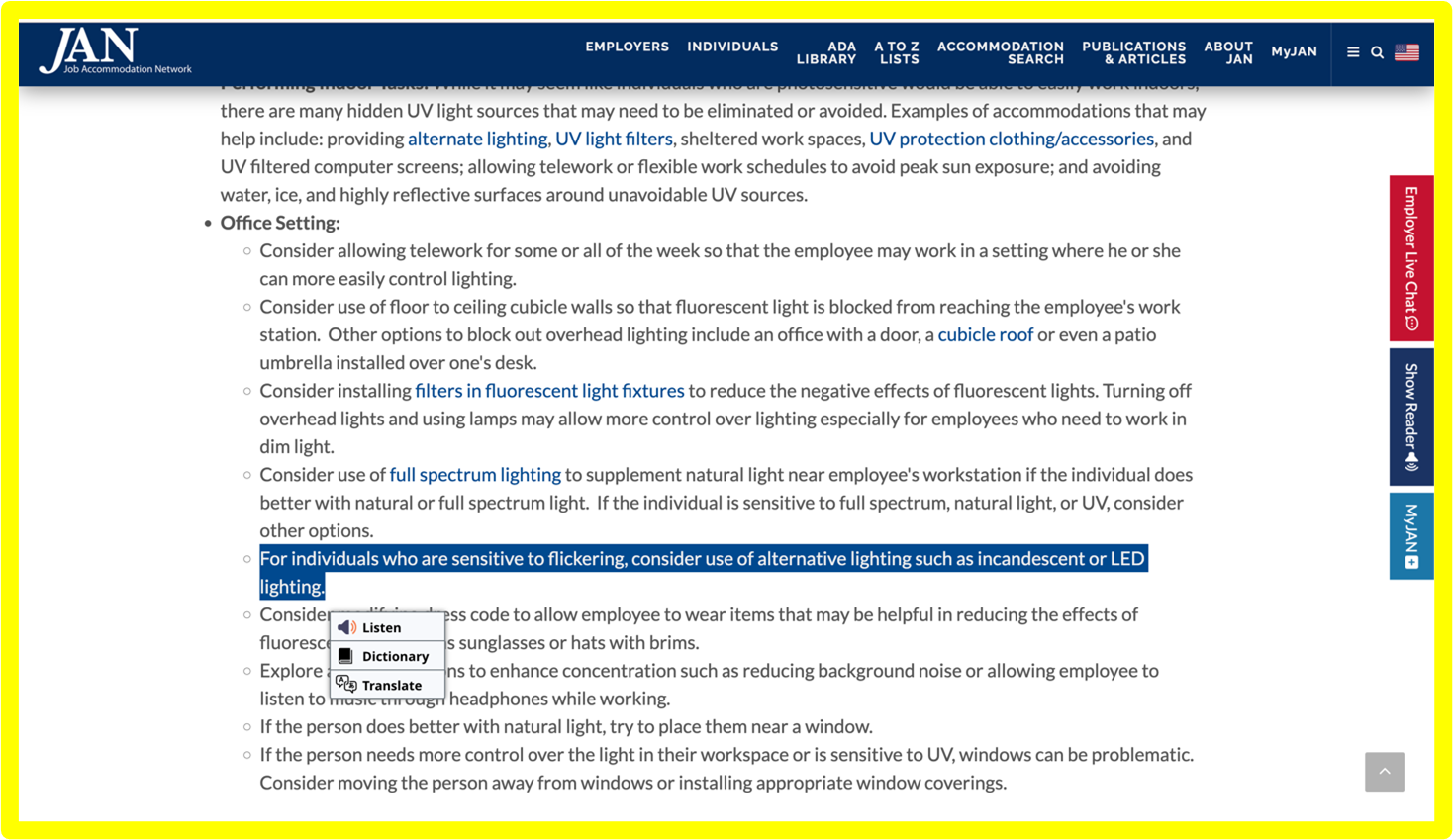
In fact, on their resource page for photosensitivity,[1] LEDs were listed as a possible accommodation, rather than a possible trigger to be mitigated:

 Screenshot from AskJan.org resource page on Photosensitivity. An arrow is highlighting text that reads: "For individuals who are sensitive to flickering, consider use of alternative lighting such as incandescent or LED lighting."

While frustrating, this actually answers the question: when a disability is triggered by environmental conditions (person-made or otherwise), if the need for the accommodation is not broad (like the need caused by limited mobility) it doesn’t become part of design criteria (like ramps designed to address limited mobility). This means it doesn’t automatically get factored in when places of public accommodation are renovated.

Of course, just because something “doesn’t automatically get factored in” doesn’t mean it isn’t considered when a person requests an accommodation. For instance, an employee whose migraines or seizures were triggered by LEDs could request a change in lighting, or to work from an alternate location, and that might be a reasonable accommodation. But again, that is different from a lighting choice during the design phase of a building renovation.

Now, I could leave it there, but we haven’t quite looked at the entire iceberg. So, for those who want to…

  • See some very interesting, annotated background on photosensitivity as a trigger of epilepsy;
  • Get in touch with the groundswell of J.Q. Public’s resistance to LED lighting, not only as a disability concern but a “quality of life” issue; and
  • Get a sense of where the federal government—the primary enforcer of the ADA—sits with LED lights as of May 24, 2024;

… I encourage you to read the U.S. Food & Drug Administration’s reply to the Soft Lights Foundation’s[2] request that the FDA regulate LEDs,[3] a request made in (small) part because there is a growing body of evidence that they can trigger seizures.

The good news is that while they are not required to reject LED lighting on the basis that it could trigger a seizure in a patron, libraries in New York are empowered to make their own decisions about lighting and can take into consideration the potential impact lighting can have on people—employees and patrons—and buy accordingly.[4]


[1] I appreciate that in this case, the photosensitivity is a trigger for epilepsy, not the actual disability. But still.

[2] Yes, there is a “Soft Lights Foundation” whose mission is to advocate “for the protection of people and the environment from the harms of Visible Light radiation emitted by products that use Light Emitting Diodes.” For more information, visit: https://www.softlights.org/about/

[4] Full disclosure: I hate LED lighting. Hate. Hate. Hate. We have some in my office in Buffalo, because it really is efficient, but it’s behind thick panels to dull the de-humanizing impact of its cold, hellish, dystopian lumens.

Creating Prayer Space in School District Library

Submission Date

Question

We are a small, urban, very diverse school district with a large English Language Learner (ELL) population and a high poverty rate. Our school library spaces are small and do not have adjoining meeting rooms. There is no dedicated prayer/meditation space in our schools either. In the past, during Ramadan and other Muslim holidays, school administration has directed Muslim students to use the libraries as prayer spaces. Currently, Muslim students have been directed to pray daily concerning the issues taking place in Israel/Gaza, so they have been coming in daily to pray. This becomes an issue as we have classes/groups scheduled in the libraries throughout the day, so space and privacy become an issue. The libraries are also not always staffed, as librarians travel between buildings and support staff is often pulled to cover for classroom teachers.

What is the legality of using a school library for a prayer place for students?
Should an alternative location be put in place in lieu of the school library?

We want to be respectful of students' religious view and rights, but also want and need to keep the school libraries accessible to all.

I would appreciate any advice you could provide on this topic.
Thank you.

Answer

In the United States, public schools that accept federal funding are barred from restricting student access to generally available space on the basis of “religious, political, philosophical…” beliefs.[1]

In New York State, laws, regulations, and policies protect the rights of students to observe a religion at public school.[2]

Consistent with these rights and protections, public schools in New York State must allow student religious groups to use generally available space on an equitable basis[3] and confirm through policy that students and staff have an individual right to pray in school.[4]

So, in New York, students being accorded space and time to pray in school (including in a school library) can happen one of two ways: first, as an act of individual liberty, or second, as a group exercise of equal access to space.

Of course, granting space on an equitable basis and honoring an individual student's right to pray in school is not quite what the member is asking about; this question turns not on indisputable rights but on the practice of using library space for exercising them.

In some ways, a school selecting the school library as a place to exercise fundamental rights of religious expression sounds like a compliment to the library.  When seeking a place to pray, who wouldn't prefer a welcoming, orderly library to a supply room, a gym, or even an empty classroom?  There is something about orderly stacks of books and room to read that lends itself to spiritual confidence.[5]

As the member points out, however, a school library is not an empty classroom; it is a useful and routinely used space, often with scheduled activities, and generally available to all.

This is where things get tricky, and it’s at the heart of the member's question: What is the legality of using a school library for a prayer place for students?

The answer is: absolutely, use of the school library for individual prayer is legal, just as use of any designated space (a supply room, a gym, a classroom) for free exercise of religion can be legal.

That said, administrators implementing such an accommodation should be careful of three factors:

First, if space in the library is available to organized student groups/clubs for prayer, it must also be available for other school groups on the same basis (that's not the question here but is important to establish).

Second, if space in the library is available to individuals for prayer (which is the question here), the use should align with the school’s policy on “free exercise” of religion, but one must be careful not to drift into any “establishment” of religion by making it seem like that is the purpose of the space.[6]

And third: a school should be wary of using the library space—which is for all students at all times—in a way that could limit access to others. Unlike the supply room, a gym, or an empty classroom, a library has a prescribed time when it is available (generally all day). Accommodations in furtherance of free exercise of religion, while a basic civil right, should not impede access to a general-access location.

Which brings us to the second question:

Should an alternative location be put in place in lieu of the school library?

This question comes down to a school library's size and layout.  If the school library has a spare study room or area in the library that can safely and respectfully be used for prayer, without restricting general access to library resources, it may make sense to use that space. But if (as the member writes) the library is small and only has space that meets basic regulatory requirements for the school (see 9 NYCRR 90), the school should consider another location.

The bottom line here: To avoid needless stress, the civil right of free exercise of religion should NEVER be pitted against the general needs of a community. In addition, accommodations that limit access to required resources should be avoided.

School administrators must think how they can allocate space safety so students can exercise their fundamental rights without putting them in needless conflict with the rights of others.  School district lawyers and facility managers can help administrators reach solutions by allocating space with attention to compliance.


[1] This rule, which is rooted in the First Amendment, is found in 20 USCS Section 4071, and has a long history of case law behind it, including the recent “Praying Football Coach” case decided in 2022.

[2] For example, 8 NYCRR 109.2 allows students to be absent for a limited time for “religious observance and education.”

[3] For example, Glee Club and [Religion] Club have the same access.

[4] If you need more of a breakdown on this, an excellent case is Eder v. City of New York (2009).

[5] Or maybe that's just me.  Like religion itself, the best place to pray is both highly personal, and highly specialized.  In the case where prayer requires space, motion, and spatial orientation, as in this question, perhaps even more so.

[6] A good case that reviews this distinction is the 2022 U.S. Supreme Court case Kennedy v. Bremerton School District, where the court discussed the difference at great length.

Accessibility Devices for In-Library Use

Submission Date

Question

We have a large facility. Sometimes patrons have to walk far to get to various programs and spaces. We have had a few patrons in the recent couple of months ask if we have a wheelchair or walker they could use to help them get around. We consulted with our insurance provider about this and he basically said to ask a lawyer. We want to provide accessibility accommodations but are also concerned if doing so opens us up to liability issues. Thanks!

Answer

This is such a beautiful idea! In my experience, there are three things that often impede beautiful ideas:

  1. Insurance concerns;
  2. Legal concerns; and
  3. People who worry that there might be insurance or legal concerns.

This question shows how to protect an idea from these impediments:

  1. Ask the insurance carrier;
  2. Check with legal; and
  3. Be in a position to assure worried people that you've handled the insurance and legal concerns.[1]

As it happens, Ask the Lawyer has addressed this question before, but under slightly different circumstances. In April of 2020,[2] we got a question about lending blood pressure cuffs, pulse oximeters, and forehead thermometers.

The risks assessed in that RAQ are somewhat the same as here, but as these mobility devices are only for on-site use, I will modify the guidance from a 9-step guide to a 3-step guide.

Step 1: Buy Carefully

The equipment purchased per the library's procurement policy and should be under warranty at all times it is in use.

Step 2: Set Clear Terms for Use

The rules and conditions for use of a mobility device should be clearly posted and should be individually agreed to by each user (just once).[3] 


Posted Rules for [Wheelchair/Walker]

This [insert item] may be signed out by any person who has signed the "Equipment Use Agreement" on a first-come, first-serve basis.

The [item] cannot leave [area].

This [item] may be used for up to [#] hours.

The manual for this equipment is at the [insert]. Please review before using.

Please clean the [item] after use; [spray and paper towels][4] are at [insert].

 Equipment Use Acknowledgements and Waiver

I understand the [insert item] may be signed out and used for up to [#] hours.

I have been provided with a copy of or access to the manual for this equipment and agree to use it as set forth in the manual.

Please select:

I agree to clean the [item] after use with the [spray and paper towels] provided.                   

                    OR                   

I request the reasonable accommodation of not having to clean the equipment after use.

I hereby agree to hold harmless the Library and its employees with respect to any injury related to the use of this equipment.

I am at least 18 years of age.

I understand that this agreement is in place until revoked by me in writing.

Reviewed and agreed by _______­­­­­______________ on ____________.

                                        Print name                             Date

Signature:


The Library shall retain a copy of this agreement for six years after its revocation.


Step 3:  Plan, Budget, Train, and Delegate for Function and Cleanliness

As established by Step 1, each mobility device should be carefully selected based on reliability, warranty, and ease of care. 

Step 3 is the other side of that coin: ensuring the mobility devices are maintained as required by the warranty and ready for use by the public.

Since the device will need to be cleaned between each use,[5] budget staff time to quickly check cleanliness and function between uses, and calendar for and log routine evaluation. If there is not sufficient time and budget to do this, it is better to wait and plan to do it in another fiscal year. The routine checking and cleaning of the equipment will be important to both its longevity and to any concerns related to its function (including alleged injury).

Thank you for a great question!


[1] I do not mean to make light of people who rightly point out that initiatives very often have insurance and legal concerns! It just frustrates me when the law and insurance are blamed for the death of an idea, instead of being allowed to support it (which, with proper planning, they can often do).

[2] What, you don't remember reading this one in April 2020?  What could possibly have been distracting you?

[3] This form is as much to be able to regulate use of a limited resource as it is to guard against liability.

[4] Ensure that the cleaning instructions from the warranty are used here.

[5] This is not a legal requirement but a common sense one.

Napping in library

Submission Date

Question

Sometimes, people nap in the library, particularly people who we believe might not have stable or sufficient housing. We feel that a library should not exclude people who need a secure place to rest, so long as there is no interference with library operations, but are there any legal considerations to this issue?

Answer

This is a VERY sensitive issue. There are many factors that could contribute to a person sleeping in a public space, including:

  • An undiagnosed medical condition
  • A diagnosed medical condition
  • Non-medical factors impacting behaviors
  • Temporary or serial lack of a safe, stable place to rest
  • Simply wanting to take a nap[1]
  • Any combination of the above-listed factors

Each one of these brings their own array of legal (and ethical, and moral) considerations.

But before we get into all that, let's discuss: for purposes of this question, what is "sleep"?

For purposes of this question, let's call "sleep" a "state of healthy, restful, and restorative unconsciousness."  In other words, "sleep" is that great thing we all do when our eyes get heavy, we yawn, and lie down, dozing into blissful unawareness.

Sleep: we all do it, and many of us love it.[2]

Now, let's talk about what sleep isn't for purpose of this question.  "Sleep" isn't, for purposes of this question; the result  of a concussion, a seizure, a stroke, an opioid overdose, or dangerously low blood sugar.   And yet, to the untrained eye, any one of these dangerous conditions could be mistaken for "sleep."[3]

Because of this, no matter how much my bleeding heart and sense compassion want to say, "Just let the person sleep in the library, and don't say anything," I can't.  I just can't bring myself to normalize ignoring what could be "sleep" one day, and a diabetic coma the next.[4]

That said, because it could be related to a real or perceived medical condition and/or disability, denying or restricting library services (including the right to simply be present in the library) on the basis of simply falling asleep could pose risks of disability discrimination.  Sleep happens, folks, and sometimes people can't help it.

So, what is the solution, here?

Well, as with many things, there is no one "right" answer.  But I will say:

1.  Every library should have a policy, or at least a "standard operating procedure" (or "SOP"), regarding "Suspected or Actual Medical Events in The Library."   That policy should address (among other things) what to do about perceived loss of consciousness or coherence by library users.[5]

2.  A" Suspected or Actual Medical Events in the Library" policy or SOP can also address incidental (meaning unintended) and deliberate use of the library for napping.
3.  This is where a library's discretion and autonomy kick in.

A library can decide if it is going to normalize sleeping in the library, or not.

If a library decides NOT to normalize sleep in the library, a simple statement such as "For assurance of safety, the library is a no-nap, no-sleep zone.  Thank you for helping us maintain this rule.  We understand that sleep happens; if you need to request ADA accommodations due to this rule, please contact NAME at INFO."   Then, as a rule, patrons who fall asleep should be awoken (just as patrons who bring food in might be asked to remove it, or patrons who don't wear shoes might be asked to put some on).

On the flip side, if a library decides, as a matter of policy, to allow users to sleep in the library[6], such a policy can also create the protocol for "safe napping," with those planning to sleep notifying staff, so the nap is not mistaken for an overdose, seizure, etc.

NOTE: Before selecting this option, a library should check with its general liability insurance carrier to make sure it is consistent with the library's risk threshold and coverage.

What does a "Suspected or Actual Medical Events in the Library" with a "sleeping" section look like?  Here is an example (with both a "sleep okay" and "no sleep" option at the end):

The XYZ Community Library is a welcoming, service-oriented, and inclusive space for all. To promote the health and safety of those using our library, the following possible medical events will result in the staff calling 911:

  • Any perceived or actual loss of sustained coherence or consciousness;
  • Any library user exhibiting signs that they may require emergency medical attention,

who does not expressly instruct staff that immediate medical attention is not required;

  • Any person requesting emergency medical response.

Definitions

For this policy, "loss of sustained coherence or consciousness" is the inability to communicate meaningfully with library employees in the user's primary language.

For this policy, express instructions to staff that "immediate medical attention is not required" may be disregarded at the considered discretion of the library employees; such a decision will be based on consideration of: the specific facts of the situation, respect for the agency of the user, and respect for the mission and operational needs of the library.

ADA

If a library user has a medical condition that can potentially result in perceived or actual loss of coherence or consciousness, you may use the library's ADA Accommodations policy to arrange reasonable accommodations so your library experience is not unnecessarily impacted by this policy. For example, if a library user has narcolepsy and wishes to be woken in the event, they fall asleep, the library can consider a reasonable accommodation such as allowing the user to use a specific type of alarm in an otherwise quiet space.

Specific Situations

Whenever possible, the library uses the following specific guidelines from the CDC with respect to common medical events that can impact coherence or consciousness:

Seizures

Seizures do not usually require emergency medical attention. Only call 911 if one or more of these are true:

  • The person has never had a seizure before;
  • The person has difficulty breathing or waking after the seizure;
  • The seizure lasts longer than 5 minutes;
  • The person has another seizure soon after the first one;
  • The person is hurt during the seizure;
  • The seizure happens in water;
  • The person has a health condition like diabetes, heart disease, or is pregnant.

Suspected opioid overdose
Call 911 if an overdose is suspected.

Recognizing an opioid overdose may be difficult. If it is unclear, treat the situation like an overdose and proceed with treatment. Even if the patient wakes up or seems better after one or two doses of naloxone, emergency medical assistance is still necessary.

Severely Low Blood Sugar

Blood sugar below 55 mg/dL is considered severely low. If any of the following happens, you should call 911:

  • A person with low blood sugar passes out;
  • A person with low blood sugar needs a second dose of glucagon;
  • A person with low blood sugar had glucagon but are still confused;
  • A person with low blood sugar stays too low 20 minutes after treatment or doesn’t respond to the usual treatments.

Concussion
Signs and symptoms of a dangerous concussion can include:

  • One pupil larger than the other;
  • Drowsiness or inability to wake up;
  • A headache that gets worse and does not go away;
  • Slurred speech, weakness, numbness, or decreased coordination;
  • Repeated vomiting or nausea, convulsions or seizures (shaking or twitching);
  • Unusual behavior, increased confusion, restlessness, or agitation;
  • Loss of consciousness (passed out/knocked out). Even a brief loss of consciousness should be taken seriously.

Call 911.

This policy, and sleeping in the Library

CHOICE 1: USE IF THE LIBRARY DECIDES TO NOT ALLOW PEOPLE TO SLEEP IN THE LIBRARY Because loss of consciousness can be a sign of a medical emergency, library users are asked not to deliberately sleep or nap in the library.

If a library user is asleep in the library, staff are instructed to wake them.

In applying this rule, the library will follow the requirements of the ADA; if a library user has a medical condition that can cause uncontrollable sleep, at that library user's discretion, they may alert staff so accommodations can be made (see "ADA" above).

CHOICE 2: USE IF THE LIBRARY DECIDES TO ALLOW PEOPLE TO SLEEP IN THE LIBRARY

If you have a medical condition that can cause uncontrollable sleep, at your discretion, you may alert staff so accommodations can be made (see "ADA" above).

If you simply find that the library is a nice, quiet place for you to take a nap, please alert us that you "Plan to take a nap" so our staff knows that you are asleep by desire, and not experiencing a medical emergency causing loss of consciousness or coherence. We'll give you a nice arrangement of purple flowers[7] to keep near where you're sitting so staff know you're deliberately using the library space to rest and restore yourself.

Users must limit planned napping in the library to no later than one half-hour before close, so you have time to gather your thoughts and energy before it is time for us to close up the building.[8]

If your nap creates loud snoring or other disruption, we may have to wake you! Please be gracious to staff who are responsible for making sure the library is a welcoming and inclusive space for all.

As with any template, before adopting a policy based on this one, review the final version with your lawyer (and, as noted above, your library's insurance carrier).

And a final note: I truly wish I had a better answer to this question.  As I said at the beginning, this is a VERY sensitive issue.  But if a commitment to library access, safety, and mission guide the decision, your library can find the best answer for  YOUR library.

Thank you for this tough question.


[1] This bullet might be more properly be phrased “Sometimes people just want to take a damn nap,” meaning that forces that get in the way of said nap are unreasonable.  I have to disagree in this case, but I get it.

[2] And if you suffer from insomnia, you may not do it enough.  I feel you, fellow lying-awake-at-2AM-person.

[3] If you are a trained medical professional qualified to diagnose of a concussion, a seizure, a stroke, an opioid overdose, or dangerously low blood sugar, this statement obviously doesn't apply to you.

[4] One of my children has Type 1 Diabetes (the kind where you can't make your own insulin, because your immune system attacked the Beta cells in your pancreas) so this issue hits close to home.

[5] When in doubt, call 911.

[6] Just in case it isn't readily apparent, I am truly neutral on whether or not to "normalize" sleeping in a library.  Truly, I can see the benefit to a decision either way; the point is to make a deliberate decision based on a commitment to access, safety, and smooth library operations.

[7] It doesn't need to be flowers (purple or otherwise), that’s just me being cute.  The point is having a signifier or system, so employees know the lack of consciousness didn't start as a medical issue.

[8] I worked on this question while sitting in my back yard on a sunny day in May. I asked my 7-year-old neighbor, Matt, who is possessed of both a wise spirit and a blunt nature, if he thought people should be able to sleep in the library.  "No," he said, after a moment’s reflection.  "They might not be seen and could get locked in for the night."  He then asked me: "You do this for your work?" Kids are the best.
Creating adaptive copies of textbooks using text-to-speech

Submission Date

Question

My institution subscribes to the "Kurzweil Reading Program", a "Text-to-Speech" product for those with reading impairments (dyslexia, English language learners, blind/vision impaired, etc.)

Section 121 indicates these users are "eligible persons" for "fair use", but others, without such disabilities could use the program (like an audiobook in the car!).

We'd be putting TEXTBOOKS up in the program; that fair use violation is what I'm worried about....

Thanks!

Answer

This question reflects the level of savvy "Ask the Lawyer" readers bring to their submissions.  The member submitting the question has already set out (in a manner much more succinct than I usually achieve) the interplay of:

  • Owner's rights (Copyright Act Section 106),
  • Adaptive copies made under "fair use" (Copyright Act Section 107), and
  • Copies made for purposes of accommodations for disability that impacts the ability to read (Copyright Act Section 121).

do have one quibble with the member's phrasing, though, and it is important to this particular issue: Section 121, while it allows copies otherwise barred, does not create a "fair use" right to make a copy.[1]  Rather, the creation of an adaptive copy under Section 121 is a 100% exception to infringement made under highly precise circumstances.

What are those "highly precise circumstances"?

First, as the member writes, the end-user of the copy must be "eligible"--meaning they have a disability that impacts the ability to read (for the three "ways" for a user to be "eligible", see sub-section (d)(3)(A)-(C) of the law, below). 

Second, the copies must:

"(A) not be reproduced or distributed in the United States in a format other than an accessible format exclusively for use by eligible persons;

(B) bear a notice that any further reproduction or distribution in a format other than an accessible format is an infringement; and

(C) include a copyright notice identifying the copyright owner and the date of the original publication."

And third, the maker of the copies must be an "authorized entity" (which is defined in the statute; see the definition, below[2]).

This precise formula, and the right it creates, is why "fair use" is not a part of the issue at hand (adaptive copies specifically for reading-based disabilities).  None of the above-listed requirements are required to claim "fair use" under Section 107[3]. In addition, to make a Section 121 copy, there is no four-factor "balancing" test; rather, a Section 121 use is "inherently noninfringing."[4]

The above-listed Section 121 requirements to include copyright notices are also the key to addressing the member's concern: enforcement.

When an "authorized entity" is creating Section 121-based copies for "eligible" people, the institution must put copyright notices on each copy. This sets up the institution--as either an employer or alma mater--to restrict non-eligible employees and students from using them for non-Section 121 purposes.  Further, in addition to the required notices, the institution can add additional warnings, and if needed, restrict use through technological controls.[5]

Now, how much should an institution police this?  Currently, there is no case law that turns on an alleged infringement that was committed via unauthorized use of a duly made Section 121 copy.  That said, content owners are always looking for new ways to maximize revenues, so taking care to properly designate Section 121-based copies as required by law, and using policy and posted notices to reinforce those restrictions, is a wise idea.

Thank you for a well-informed and nuanced question!

HERE IS SECTION 121 OF THE COPYRIGHT ACT:

(a) Notwithstanding the provisions of section 106, it is not an infringement of copyright for an authorized entity to reproduce or to distribute in the United States copies or phonorecords of a previously published literary work or of a previously published musical work that has been fixed in the form of text or notation if such copies or phonorecords are reproduced or distributed in accessible formats exclusively for use by eligible persons.

(b)

(1) Copies or phonorecords to which this section applies shall—

(A) not be reproduced or distributed in the United States in a format other than an accessible format exclusively for use by eligible persons;

(B) bear a notice that any further reproduction or distribution in a format other than an accessible format is an infringement; and

(C) include a copyright notice identifying the copyright owner and the date of the original publication.

(2) The provisions of this subsection shall not apply to standardized, secure, or norm-referenced tests and related testing material, or to computer programs, except the portions thereof that are in conventional human language (including descriptions of pictorial works) and displayed to users in the ordinary course of using the computer programs.

(c) Notwithstanding the provisions of section 106, it is not an infringement of copyright for a publisher of print instructional materials for use in elementary or secondary schools to create and distribute to the National Instructional Materials Access Center copies of the electronic files described in sections 612(a)(23)(C), 613(a)(6), and section 674(e) of the Individuals with Disabilities Education Act that contain the contents of print instructional materials using the National Instructional Material Accessibility Standard (as defined in section 674(e)(3) of that Act), if—

(1) the inclusion of the contents of such print instructional materials is required by any State educational agency or local educational agency;

(2) the publisher had the right to publish such print instructional materials in print formats; and

(3) such copies are used solely for reproduction or distribution of the contents of such print instructional materials in accessible formats.

(d) For purposes of this section, the term—

(1) “accessible format” means an alternative manner or form that gives an eligible person access to the work when the copy or phonorecord in the accessible format is used exclusively by the eligible person to permit him or her to have access as feasibly and comfortably as a person without such disability as described in paragraph (3);

(2) “authorized entity” means a nonprofit organization or a governmental agency that has a primary mission to provide specialized services relating to training, education, or adaptive reading or information access needs of blind or other persons with disabilities;

(3) “eligible person” means an individual who, regardless of any other disability—

(A) is blind;

(B) has a visual impairment or perceptual or reading disability that cannot be improved to give visual function substantially equivalent to that of a person who has no such impairment or disability and so is unable to read printed works to substantially the same degree as a person without an impairment or disability; or

(C) is otherwise unable, through physical disability, to hold or manipulate a book or to focus or move the eyes to the extent that would be normally acceptable for reading; and

(4) “print instructional materials” has the meaning given under section 674(e)(3)(C) of the Individuals with Disabilities Education Act.

(Added Pub. L. 104–197, title III, §â€¯316(a), Sept. 16, 1996, 110 Stat. 2416; amended Pub. L. 106–379, §â€¯3(b), Oct. 27, 2000, 114 Stat. 1445; Pub. L. 107–273, div. C, title III, §â€¯13210(3)(A), Nov. 2, 2002, 116 Stat. 1909; Pub. L. 108–446, title III, §â€¯306, Dec. 3, 2004, 118 Stat. 2807; Pub. L. 115–261, §â€¯2(a)(1), Oct. 9, 2018, 132 Stat. 3667.)


[1] I'm quibbling, but I want to take this footnote to state that including a "fair use" cite in the question is very reasonable, because fair use is often cited as yet another reason to make adaptive copies that go beyond copies authorized by Section 121. Since the copies in this case are without question for those "eligible" under Section 121 (those with reading-impacting disabilities), we're going to sideline fair use at Section 107 for this question, but it very much is a part of the toolbox of creating adaptive works for non-Section 121-eligible disabilities.

[2] There is controversy, but no definitive authority, on if all not-for-profit educational institutions meet the criteria.  Academic publishers have taken a position that it only applies to institutions for the blind, not just any old school or college.  However, an uncontradicted conclusion in the October 10, 2012 district court decision in Authors Guild V. Hathitrust, 902 F. Supp, 2d 445 (2012) opines that because of their mandate to provide accessibility under the ADA, such institutions all are "authorized entities" under Section 121.  Until I read otherwise, my guidance errs on the side of accessibility (see https://wnylrc.org/index.php/raq/accessibility-options-school-ebooks).

[3] In fact, having to abide by this type of requirement could undercut some of the more vital applications of fair use, such as parody or innovation.

[4] If this distinction intrigues you, check out the commentary at  https://www.copyright.gov/1201/2021/comments/Class%2008_InitialComments_Accessibility%20Petitioners%20II.pdf

[5] I am slightly wary of a system that would force a student to "register" with the library as needing ADA accommodations, but depending on how access is granted, some type of additional log-in or control might be wise.  At higher ed institutions, students and employees arrange accommodation per a policy, and accommodations are generally confirmed in writing, so signing up for access to adaptive copies could be the way to go.  But this will be driven by technology, and care must be taken to not put up any additional hurdles to access.  If any readers out there have solved this issue at your institution, I'd appreciate hearing about it!  Please send that to info@losapllc.com.

Accessibility options for school ebooks

Submission Date

Question

Students in a school are reading a simultaneous use eBook. The students with IEPs[1] have access to a screen reader but this feature is very robotic and doesn't meet their needs. The school librarian and the School Library System searched for an audio version of this book but could not find one for purchase. Several students need a high-quality audio version of the book that is not robotic because of their learning needs. Would the school library be covered under fair use if they recorded a reading of the book for the students and posted it in Google Classroom for the students? This would be in a closed platform and not open to everybody on the internet.


[1] IEP stands for "Individual Education Program, “which is a tool used in elementary and secondary schools to effect ADA accommodations for students.  For more info on that, see https://www2.ed.gov/about/offices/list/ocr/504faq.html.

Answer

The school may be covered by Fair Use but for this scenario, it doesn't need to be in order to make the recording proposed by the member.

Why?

Because Section 121 of the Copyright Act allows "authorized entities" (like schools serving those with IEP's)[1] the right to make a copy in an "accessible format" (like an audio file) for "eligible persons" (like a student with an IEP), without it being an infringement.

Of course, there's always a catch.  In addition to precautions like the one described by the member (limiting access to only those who need it), the exception under Section 121 has other requirements, such as:

  • The accessible copy has to have a copyright notice.
  • The accessible copy has to have a note stating no further copies are authorized.
  • It doesn't apply to computer programs.[2]

I am putting a copy of Section 121, which was most recently amended in 2018, below this answer, so members can review its requirements and consider how it might apply in their institution.

Now, I will say that if there wasn't a Section 121, there is a strong chance the format conversion described by the member would qualify as a Fair Use.  In fact, the 2nd Circuit Court of Appeal, which is the first level of appeal for copyright cases in New York State, has found Section 121's to bolster educational institutions' claims of Fair Use.[3]

But between a rock-solid exemption like Section 121, and a shifting, 4-part formulaic one like Section 107 ("Fair Use"), I say: go for the rock-solid exemption. 

The law takes assured access for those with disabilities seriously, and that regard is important to strengthen through robust and repeated use.

Thanks for a valuable and carefully thought-out question.


Here is the full text of section 121:

(a)

Notwithstanding the provisions of section 106, it is not an infringement of copyright for an authorized entity to reproduce or to distribute in the United States copies or phonorecords of a previously published literary work or of a previously published musical work that has been fixed in the form of text or notation if such copies or phonorecords are reproduced or distributed in accessible formats exclusively for use by eligible persons.


(b)

(1)Copies or phonorecords to which this section applies shall—

(A)  not be reproduced or distributed in the United States in a format other than an accessible format exclusively for use by eligible persons;

(B) bear a notice that any further reproduction or distribution in a format other than an accessible format is an infringement; and

(C) include a copyright notice identifying the copyright owner and the date of the original publication.

(2)The provisions of this subsection shall not apply to standardized, secure, or norm-referenced tests and related testing material, or to computer programs, except the portions thereof that are in conventional human language (including descriptions of pictorial works) and displayed to users in the ordinary course of using the computer programs.


(c)

Notwithstanding the provisions of section 106, it is not an infringement of copyright for a publisher of print instructional materials for use in elementary or secondary schools to create and distribute to the National Instructional Materials Access Center copies of the electronic files described in sections 612(a)(23)(C), 613(a)(6), and section 674(e) of the Individuals with Disabilities Education Act that contain the contents of print instructional materials using the National Instructional Material Accessibility Standard (as defined in section 674(e)(3) of that Act), if—

(1) the inclusion of the contents of such print instructional materials is required by any State educational agency or local educational agency;

(2) the publisher had the right to publish such print instructional materials in print formats; and

(3) such copies are used solely for reproduction or distribution of the contents of such print instructional materials in accessible formats.


(d)For purposes of this section, the term—

(1) “accessible format” means an alternative manner or form that gives an eligible person access to the work when the copy or phonorecord in the accessible format is used exclusively by the eligible person to permit him or her to have access as feasibly and comfortably as a person without such disability as described in paragraph (3);

(2) “authorized entity” means a nonprofit organization or a governmental agency that has a primary mission to provide specialized services relating to training, education, or adaptive reading or information access needs of blind or other persons with disabilities;

(3)“eligible person” means an individual who, regardless of any other disability—

(A) is blind;

(B) has a visual impairment or perceptual or reading disability that cannot be improved to give visual function substantially equivalent to that of a person who has no such impairment or disability and so is unable to read printed works to substantially the same degree as a person without an impairment or disability; or

(C) is otherwise unable, through physical disability, to hold or manipulate a book or to focus or move the eyes to the extent that would be normally acceptable for reading; and

(4) “print instructional materials” has the meaning given under section 674(e)(3)(C) of the Individuals with Disabilities Education Act.


[1] The literal definition of "authorized entity" is "a nonprofit organization or a governmental agency that has a primary mission to provide specialized services relating to training, education, or adaptive reading or information access needs of blind or other persons with disabilities."  The only case law construing this language interprets it to include educational institutions with obligations to provide ADA access.  For more on that, see footnote #4.

[2] An eBook is not a computer program.

[3] In the 2014 Hathi Trust case (Authors Guild, Inc. v Hathi Trust, 755 F3d 87 [2d Cir 2014])), the court opined that an academic library could qualify for 121's exemption because of its obligation to provide access under the ADA.  This was bootstrapped into an allowance for Fair Use, too.  It's not the smoothest finding, but it's there, and it’s the only line of cases citing 121 as of December 19, 2021.

Filling Out Forms for Patrons

Submission Date

Question

We had a patron come in this past week who said that he couldn't see well and also couldn't type or use a mouse, but he needed to certify Unemployment Insurance. He asked the staff member to login with his username and password and do this for him, and the staff member was, understandably, uncomfortable doing it.

I feel like patrons who divulge their personal data to us are doing it of their own accord and our privacy responsibility is to not share that information with others without the consent of the patron.

In this particular case, the patron was offering his information and consenting for us to enter it for him. As such, I don't think this violates any privacy agreement we have made as employees of the library.

The part that I worry about is, could this come back on an employee if they are doing a legal filing for a patron and the filing may be fraudulent? I am optimistic by nature and like to think people have good intentions, but the reality is, I know this happens. I wouldn't want to put an employee in a sticky legal position if they filed what might turn out to be a fraudulent claim for someone.

Do you know of similar situations in other libraries and what, if any, legal ramifications there might be for employees who could be caught in the middle of something like this?

Answer

At first glance, this question seems simple: what are the possible legal risks to a librarian helping a patron fill out a legal document?

But within this question lies another, slightly more complex issue: when does good customer service become an accommodation for a disability?

This "slightly more complex" consideration is brought up by this part of the member's scenario:  "We had a patron come in this past week who said that he couldn't see well...", potentially meaning: the patron could not access the library services (use of the computer and internet) without assistance, because of a disability.

Of course, not every visual limit is a bona fide disability (I have to take off my glasses to read these days, but that does not entitle me, by law, to an accommodation under the ADA).  However, a patron requesting help to access a library service due to "low vision" (meaning that patron cannot view the screen even with corrective lenses), is potentially requesting an accommodation.

This is because "low vision" can be "a physical or mental impairment that substantially limits one or more major life activities," (which is the ADA's definition of a disability).

For patrons with "low vision," an ADA accommodation can take many forms aside from a human-powered solution, including:

  • Ensuring computers have increased operating system font size with large-size computer monitors
  • Screen magnification software
  • Locator dots and/or large print keyboard labels for keyboard navigation
  • External computer screen magnifier[1]

What accommodations a library chooses to offer to someone needing an accommodation to access library services will vary based on that library's size, type, served population, and (of course) budget. [2]  For some libraries, the "human solution" will be the only one available...which creates dilemmas like the one shown in the member's question.

Okay, let's press "pause" on the ADA aspect (we'll come back to it) and return to the original, simple question: what are the possible legal risks of a librarian helping a patron fill out a legal document?

The risks, of course, are that if the patron is accused of fraud, identity theft, or any other illegal activity based on the form's contents, it could lead to complications for the library (and thus, potentially, the employee).

Of course, most types of crimes based on fraud, false personation, and identity theft turn on the awareness and intent of the involved parties. Basically--and this is a big paraphrase--so long as a person can show they had no awareness or intent to help with a crime, they will have a defense against such an accusation...especially if they are performing the action as part of a duty in their job description.

But how can a library avoid such accusations against its employees in the first place?  This is where we take the ADA aspect off "pause," and consider how a library's policies can set firm boundaries for good customer service, while also facilitating accommodations for disability.

How is that done? Many libraries already have a version of this approach, but here's my plain-language version of a policy:

Library employees are here to help patrons use library resources, but librarians and library staff may not interpret, provide guidance, or fill in forms for patrons.

Patrons who need assistance filling in a form or completing a document due to uncertainty about the content are welcome to ask librarians for help locating the instructions or contact information for assistance.

Patrons who need assistance filling in a form or completing a document on the library's computer or other resource as an accommodation for a disability, please alert the Director or [insert alternate, accessible means], so the Library may act on the request per the library's ADA policy.

So, to be clear, my answer to the member's overall question is: to avoid doubt, librarians should never help patrons fill out the answers on legal forms if the help is just part of good customer service.[3]   HOWEVER, librarians absolutely can read the content and type substantive answers on a patron's legal forms if the library decides (and documents) that it is providing the assistance as part of a reasonable accommodation for a disability.

When considering employee-powered assistance as a form of accommodation, part of evaluating the request must be consideration of how it can be fulfilled ethically.  For instance, a person providing an ADA accommodation as an ASL Interpreter must follow the Registry of Interpreters' Code of Ethics[4] (or other professional association).  A person providing an ADA accommodation as a "reader" for a person who is blind or has low vision should not offer guidance or commentary on the content--their role is limited to reading, and perhaps typing, based on verbal prompts from the accommodated party.[5]  A person typing because the library's only keyboard is inaccessible to the patron and the library has no dictation software should similarly only type as an accommodation, and not offer comment or guidance. [6]

Some libraries, looking at the range and requirements for certain types of human-powered accommodations, may decide they do not have the staff capacity to provide such resources.  Others will say (and support by well-developed policy): sure, we can do that, here's how.[7]

The important thing, no matter what the decision is, is to keep a record as to why a library employee (or contractor) would assist a patron with filling out and/or submitting a confidential or legal document.  Since the only reason should be as an accommodation, that reason should be documented in either the policy (for instance, if the library has a standard service) or as an ad hoc request.

Thank you for a very compassionate and thoughtful question.


[1] Many thanks as always to the "AskJAN.org" web site, which lists common disabilities and their accommodations, including the definition and accommodations for "low vision," found here as of June 28,2021: https://askjan.org/disabilities/Low-Vision.cfm.

[2] "Ask the Lawyer" has addressed the various types of libraries’ obligations under the ADA in other answers, such as ADA Compliance When Screening Movies and Oral history transcriptions and the ADA.

[3] Assistance printing, formatting, duplicating, locating a hyperlink, and in general using library technology in furtherance of completing the form is okay.

[4] Found at https://rid.org/ethics/code-of-professional-conduct/.  Are there any libraries with in-house ASL interpreters?  That would be cool.

[5] The National Foundation for the Blind has a helpful article on this here: https://nfb.org//sites/default/files/images/nfb/publications/fr/fr35/1/fr350105.htm.

[6] This is why consideration of ADA access is so critical in procurement of library resources.   As you will see on most ADA-resource sites (like AskJAN.org), most accommodations these days are powered by technology.  Although some still rely on human action (for instance, reading aloud), most do not.  A library that factors these needs into procurement decisions (buying larger screens, or adaptable keyboards) will not only model a practical commitment to ensuring access, but will reduce the need for employees to be the mode of accommodation--lowering the risk of viewing and contributing to the completion and submission of confidential/legal documents.

[7] An example of the types of accommodations offered on the "larger budget" end of things can be seen at NYPL: https://www.nypl.org/accessibility.

Oral history transcriptions and the ADA

Submission Date

Question

When publishing Oral Histories to a Digital Exhibit, such as Omeka, are we required by ADA to include a full transcription of the interview in the metadata? Is a Time Summary sufficient?

Answer

Ugh.

Not only is the answer to this “maybe,” but I am afraid the answer is actually “maybe maybe.”  And it might even have to be “Maybe maybe maybe, maybe.”  But hang in there, because I think I can still give you some solid information in reply! (Maybe.)

Oral history projects—exhibits and collections using audio and video recordings to tell a story in participants’ own words--provide invaluable access into the culture and experience of particular people, at a particular place, during a particular time.  Using direct representation, with only the mediation of the recording, they can show emotion, capture dialect, and put a subject in control of their own story.[1]

Hosting such stories online is a great way to bring unique perspectives and individual experiences to a broad audience who might not be able to access a physical museum.  But as the member’s question points out, not everyone has equal access to audio or audio-visual online content.  So what are the precise ADA obligations pertaining to an oral history exhibit’s audio components?

As the word “maybe” implies, there is no bright-line answer.

Libraries, museums and archives collecting and curating oral histories all have different obligations under the Americans with Disabilities Act.  Some institutions will fall under the obligations governing government entities. Others will fall under the law and regulations governing places of public accommodation. Still others will have accessibility considerations arising from acceptance of federal grant money, or operation as an educational institution or health facility.

And finally, some institutions may develop an oral history exhibit along with a community partner, splitting duties regarding collection of stories, arrangement of information, construction of the on-line exhibit’s functionality and web presence, and ongoing hosting.  And any one of those split or shared duties, regarding audio, could have implications for access under the ADA.

But while there is no bright-line answer, there is some great guidance out there on this topic, and if that guidance is followed as closely as possible, it will not only reduce the risk of an ADA violation, but perhaps also enhance an oral history exhibit.

To design an oral history project that will have a high likelihood of complying with the ADA, the project developers have to be thinking about access from the start.  This means, before the project budget is fully allocated, before the contracts are awarded, before the online platform for a project is selected, or before any contributor terms are settled, access for those with a disability has to be considered up-front.

Fortunately, pre-planning and clear methodology are the hallmarks of all serious oral history projects.  This is due to the great professionalism of those who are committed to this medium, who have developed an array of ethics, legal considerations, and guidelines for such projects.

Any member considering an oral history project should check out the excellent guidance at https://www.oralhistory.org/?s=ethical+guidelines (the statement of ethics developed by the Oral History Association) as well as their institution’s own ethics policies and guidelines.  Any agreement with a collaborator or contributor should also reference the ethics/access criteria for both parties, as well as for a particular project.

For compliance with the ADA, what are those guidelines?  There are any number of them, but I’ll go with what I consider the Gold Standard: The US Department of Justice, which investigates alleged violations of the ADA, guides web developers to the World Wide Web Consortium’s (“W3W”) Web Accessibility Initiative (WAI), which sets forth clearly developed standards for web content accessibility.

What does WAI say about the issue of audio content?  A lot.  Further, what the WAI has to say is so well-developed and nuanced—addressing just about every permutation you can think of (speaker reading from script, spontaneous speech with one person, spontaneous conversation, both audio-only, and audio-visual)—that the best thing I can do is send you to their guidelines:

https://www.w3.org/WAI/WCAG21/Understanding/audio-only-and-video-only-prerecorded

As you’ll see in the “Standards,” just as the member suggests, sometimes a textual timeline might be sufficient.  Other times, a transcript of the complete audio content should be available.  And while this information can be part of the metadata, the manner in which the exhibit interacts with the user’s browser will be just as critical (for oral history exhibit developers who are actually developing the front end of an exhibit, here is what the USDOJ looks for : https://www.justice.gov/crt/web-page-accessibility-checklist1).

To use the member’s specific example, there may be times when simply a timeline of the information is sufficient.  If, however, the way the person is describing the events, or the particular language or dialect they are using is part of the value of the exhibit, the content should be fully transcribed.  The standards used to make that call should be part of the design of the project.  For contributors sending an exhibit in to larger work, the host should be the one to set the criteria. 

Now: I appreciate that not every oral history project, or every institution undertaking one, will have the budget or professional support to create W3W-informed access content.  And while transcription gets easier and faster every day, not every project will have the capacity or need to use that, either.

Some oral history projects are very small.  Some projects involve simply wanting to record different experiences of the people in a town, enjoying their Public Library, and put them on the library website.[2] For those projects, the more modest resources and needs of the Town will govern the ADA obligations (unless there are strict conditions under grant money).  But for larger projects connected to institutions that can be seen as having an obligation to provide such transcripts as part of a large oral project, particularly if public funding is involved, it is best to design the project to conform to agreed upon ethics, and W3W’s standards for Accessibility.

Again, this requires consideration at the front end of the project, and needs to be built into the budget and the procurement.  It also needs to be built into any agreements for outside contributors (which the question hints at). 

As the W3W guidelines point out, this will not only ensure the accessibility of your project, but will help people and institutions who do not speak the language of the person in the audio or audiovisual content to use your oral history project in their own research. The fact that this will also give you a better project is an incidental benefit of designing for inclusion!

Thanks for a great question.


[1] Through the magic of editing selective footage, an oral history project can also directly subvert these goals, but let’s assume anyone reading this is using their powers for good.

[2] Some would debate if this would be called an “oral history” project.  Out in the field, I have encountered many uses of that term, and some of them are very informal, or minimally funded, so I am including that as an example.


Policy On Personal Phone Use at Work

Submission Date

Question

We have a pretty exhaustive personnel policy on the use/limits of use of Library technology and property, both for compliant work-related purposes and for personal purposes.

What we do *not* have, and are wondering if we should, is a policy that speaks to the permitted (or restricted) uses of *personal* phones and similar devices while at work.

The question has come up because of supervisors needing to repeatedly remind staff to not use personal phones while on the public service desk, without having an explicit "policy" to fall back on.

Answer

On the surface, this is a simple issue: if people are using their cell phone for personal use on the job, a simple policy to stop the use should solve the problem, right?

Not these days.

As technology continues to transform the workplace (and the world), “cell phones away, please,” is not as easy as it once was.  People use their cell phones to monitor health, track their steps, and get emergency calls from kids at school.  Some may even use their cell phones to save their lives, serve as a witness to illegal activity, and exercise their right to free speech. 

Many of these functions depend on the proximity of the person to the phone (or the watch that connects them to it), and because of this, cell phones are becoming extensions of the people who own them.  So a policy to keep them stowed and away, or secured in a locker, can be met with resistance. 

Here are a few examples of how this “resistance” can play out on the job:

  • An employee who is the parent of a child with Type 1 Diabetes may want their cell phone on them to keep an eye on their child’s glucose level[1] while the child is at school;
  • An employee who being stalked by an ex may want the phone to record evidence to seek a protective order;
  • An employee trying to lose weight per a doctor’s orders may be using a supportive app and a Fitbit;
  • An employee may want to use their personal camera phone (“it’s better”) to take pictures for the library’s Instagram;
  • An employee may need to text their partner to confirm who is picking up the kids, making dinner, and mowing the lawn before it turns onto a meadow;
  • An employee may really love to play Candy Crush Saga® when things are slow at the reference desk.

As can be seen, many of the reasons to keep a cell phone on one’s person are compelling; other uses may not be.  And many of reasons/uses overlap with other library policies.

The goal, of course, is not to bar an employee from important connections and a tool for their well-being, but to make sure the use of personal electronics does not distract from the library’s professional environment and employee productivity (even on a slow day).  To achieve that, there are two broad solutions: 1) rely on a collection of policies to address the variety of purposes for personal cell phones while at work; or 2) create a catch-all policy. 

In a work environment where consistency for staff members is critical for professionalism and productivity, I prefer a combination of both.  What does that combination look like? 

It starts with policies for:

  • ADA accommodations
  • FMLA
  • Domestic violence victims’ accommodations
  • Workplace violence prevention
  • Communications/media
  • Use of technology
  • Confidentiality of library records and patron privacy
  • Employee conduct

…which should all allow for appropriate use of personal cell phones and electronic devices.  This doesn’t mean the policy has to mention cell phones specifically—just have enough flexibility to address them.

At the same time, assuming the above-listed policies harmonize with it, creating a specific “Policy on Use of Personal Cell Phones and Electronics,” as proposed by the member, can help employees and management navigate these issues in a rapidly changing world.

Here is an example of such a policy[2]:

[INSERT LIBRARY NAME] Policy on Personal Use of Cell Phones and Electronics

The mission of the [INSERT LIBRARY NAME] depends on employees maintaining a professional, productive environment. 

To maintain that environment, use of personal cell phones and electronics should only divert employees from work duties in the case of an emergency. 

To achieve this, cell phones and personal electronics should be stored in a carrier, purse, or pocket where the screen is not visible during work time, and watches synched with other electronics should not divert employees from work except during designated breaks in designated break areas. 

Sudden personal emergency needs that require use of a cell phone or other personal electronics should follow the established procedures for use of break time and personal time.

Use of cell phones and personal electronics for ADA accommodations, FMLA arrangements, personal emergency, and personal safety needs are exempted from this policy, and should be arranged on a case by case basis with a supervisor per the relevant policy. 

As with most HR policies, this one sounds simple, but can be complex to administer.  The need to be flexible and allow some cell phone use (especially ADA use, the basis of which may be confidential), can cause seeming inconsistency in enforcement.  To address this, employees must be sensitized to the fact that some people may depend on a personal devise for an authorized (and confidential) use, while at the same time be given the clear message that keeping in touch with social media and personal contacts during work time is not allowed.

As technology puts pressure on the norms of society, it is important to draw (and re-draw) reliable and clear boundaries…especially in the workplace.  So should a workplace have a policy on personal cell phones?  Done right, and with due consideration of the law, it can help.

Thanks for a timely question.


[1] There are electronic devices and apps that enable sharing of blood glucose levels at all times; it’s both cool, and terrifying, since if blood glucose is too low, a child can faint, and if too high, a child’s blood can become toxic. 

[2] Do not use stock language to create an employment policy without having a lawyer review the final product.  Union contracts, local laws, other policies, current handbook language, and work conditions can all impact what a catch-all employment policy can look like.