ADA

Does Title II of the Americans with Disabilities Act apply to born-digital archival collections?

Submission Date

Question

In April 2024, the Federal Register published the US Department of Justice’s final rule on Title II of the Americans with Disabilities Act (ADA). The rule includes specific requirements for state and local governments to ensure that web content and mobile applications are accessible to people with disabilities. My question is related to the applicability of Title II to the online collections of public academic libraries, and more specifically, to born-digital archival collections, i.e., archival collections consisting of materials originating in a computer environment.

According to the rule, state and local entities must follow the technical standard outlined in the Web Content Accessibility Guidelines (WCAG) 2.1 level AA. However, this rule allows for five exceptions: https://www.ecfr.gov/current/title-28/section-35.201.

I understand the updated regulation does not override the existing obligations under Title II to make reasonable modifications on an individual basis, but it is unclear if Title II applies to born-digital archival collections, or if these collections fall under the exceptions linked above.

Answer

Thank you for such a thoughtful (and complex) question.

To answer it, I am going to respond in the form of a dialogue between a lawyer and librarian that will allow other Ask the Lawyer readers at public institutions to assess if their born-digital archives must comply, too.

After establishing the criteria for applicability, the end of dialogue will address this question: Do the new Title II regulations apply to “born-digital” archival collections, and if so, is there any exception for non-compliant content?

Let’s go!

Lawyer: Hello! I see you want to figure out if your library’s archive of “born-digital” content has to follow the new Title II regs.

Let’s start with an easy question:

Is your institution a “public entity” (or part of a public entity) as governed by 42 U.S.C. 1213(1)?

Librarian: Yes / No / I don’t know!

Lawyer: If you don’t know, or want to double-check your answer, here is the definition of a “public entity”[1] in ADA Title II:

(1) Public entity

The term “public entity“ means—

(A) any State or local government;

(B) any department, agency, special purpose district, or other instrumentality of a State or States or local government; and

(C) the National Railroad Passenger Corporation, and any commuter authority (as defined in section 24102(4) [1] of title 49).

Librarian: Aha! / Huh?

Lawyer: If you are still unsure, here is another hint: the term “instrumentality of a state,” as used in 42 U.S.C. § 12131(1)(B), refers to governmental units or units created by them (like town libraries, school district public libraries, community colleges, SUNY, etc.).

Librarian: Okay, I get it. / Ugh, I’ll ask our library’s lawyer.

[Note: If you are a “public entity,” keep reading this dialogue. If aren’t a public entity… Stop! This dialogue is not for you.]

Lawyer: Okay, with just public entities going forward, it’s time for another soul-searching exploration into your institution’s identity. Is the “total population” of your entity over or under 50,000, making you a “large public entity”?

If you’re over 50,000, then your “Start Date” for these regulations is April 24, 2026.

If you’re under 50,000, then your “Start Date” is April 26, 2027.[2]

Librarian: How does a school or library even have a “population?”

Lawyer: This can get tricky for academic libraries, but here are three examples from the new regulations to help you:

  • The total population of a county library is the population of the county of which the library is an instrumentality.
  • A public state university located in a town of 20,000 within a state with a population of 5 million would be considered a large public entity for the purposes of this part because it is an instrumentality of the state.
  • A county community college in the same state where the county has a population of 35,000 would be considered a “small public entity” for the purposes of this part, because the community college is an instrumentality of the county.

Now that you know if you have to follow this, and if so, when you have to follow it, here are the new requirements for web and mobile accessibility:

Web content and mobile apps that your entity provides or makes available directly or through contractual, licensing, or other arrangements must comply with Level A and Level AA success criteria and conformance requirements specified in WCAG 2.1.

Librarian: Got it! / Uh, what does “WCAG 2.1” mean?

Lawyer: WCAG 2.1 is a standard of accessibility that makes sure web content and mobile apps work are compatible with adaptive technology. If you need more information on it, you can check it out at https://www.w3.org/WAI/standards-guidelines/wcag/glance/.

Librarian: Okay, but isn’t this question about exceptions to this rule for “born-digital “content in library archives?

Lawyer: Yes, it is! But to talk about exceptions, it is helpful to talk about requirements.

Librarian: Okay, I get it. But like the question says, aren’t there some exceptions?

Lawyer: Indeed, there are exceptions. Here are some of them from the section[3] quoted by the member:

(1) archived web content;

(2) preexisting conventional electronic documents, unless such documents are currently used to apply for, gain access to, or participate in the public entity's services, programs, or activities;

(3) content posted by a third party, unless the third party is posting due to contractual, licensing, or other arrangements with the public entity;

(4) conventional electronic documents that are about a specific individual, their property, or their account and that are password-protected or otherwise secured; and

(5) preexisting social media posts.

Librarian: Aha! Does “archived web content” cover anything in a public entity’s born-digital archive going forward?

Lawyer: No.

Librarian: Oh. Why not?

Lawyer: Because of how “archived web content” is defined in the new regulations.

With a few modifications for brevity, here are the criteria for archived web content:

(1) Was created before your Start Date, reproduces paper documents created before your Start Date, or reproduces the contents of other physical media created before your Start Date;

(2) Is retained exclusively for reference, research, or recordkeeping;

(3) Is not altered or updated after the date of archiving; and

(4) Is organized and stored in a dedicated area or areas clearly identified as being archived.

Of great importance to the question, this definition does not allow non-compliant born-digital content created after your Start Date, even if it is only on your website or mobile app because it is part of the archive.

Librarian: Okay, but is there another way non-compliant born-digital materials created after our Start Date could be in our online archive?

Lawyer: Yes! The regulations have another exception in a different subsection.[4]

This subsection provides that born-digital content generated by a third party does not have to comply (unless your institution contracted with the third party to provide it).

Here’s an example of how this works:

Let’s say your institution wants to create the archive “Born in Digital Shame: Non-WCAG 2.1-Compliant Materials posted by Public Entities.” You then gathered a bunch of non-WCAG 2.1-compliant content from other public entities, generated after their Start Date, and put it in your archive.

That would be fine. It would be a gallery of non-compliance, but it would be fine.

Librarian: Okay. Can we answer the question now?

Lawyer: Yes, we can now answer the fateful QUESTION: Do the new Title II regulations apply to “born-digital” archival collections, and if so, is there any exception for non-compliant content?

ANSWER: Yes, the new Title II regulations apply to born-digital content, with only the following two exceptions:

1) the content pre-dates your Start Date; or

2) it is from a third party and is on your website only as archival content.[5]

Librarian: That makes sense!

Lawyer: Yes, sometimes federal regulations do make sense… even if you have to write a Socratic dialogue to make sense of them.

Librarian: I need a beverage now![6]

Lawyer: Thank you for a great question!


[1] Definition is at 42 U.S.C. § 12131(1)(B).

[5] This is important. The functional part or your archive—the metadata, the search function, the display, will all have to be WCAG 2.1 compliant by your Start Date. But the material you are archiving does not.

[6] I have found that green tea mixed with a soothing herbal tea is a great blend for ploughing through federal regulations. What I drink after is between me and my bartender.
Hiring Interviews and Accommodations

Submission Date

Question

If a prospective employer specifically asks about a candidate’s physical capacity to do a job and they say they can do all of the tasks required, and then notify us afterwards that they need accommodations for things they said they could do without them, are we:

a) by law required to provide them 

OR

b) can we make a decision that the person is not able to do the essential functions of the job and therefore not be allowed to continue in their employment?

Dishonesty in applying for jobs seems grounds for termination, but when it comes to disabilities, I realize it’s a minefield.

Answer

A minefield, indeed.[1]

The first issue in this question is the premise: “If a prospective employer specifically asks about a candidate’s physical capacity to do a job and they say they can do all of the tasks required…”

When interviewing a job applicant, it is perfectly appropriate to ask if they are able to perform the essential functions of the job. Acceptable questions are:

  • Can you type 90 words per minute?
  • Can you weld for an 8-hour workday?
  • Can you read out loud to kids for an hour at a time, even if they interrupt you because they need to use the bathroom?

However, it is important to remember that the answer can honestly be “yes,” whether or not an accommodation is required to be able to perform the task.

In other words, the answer can honestly be “yes”, even if:

  • The typist needs a special keyboard due to carpal tunnel syndrome;
  • The welder needs a special back brace;
  • The reader needs a hearing aid, so they can hear questions from the attendees.

Of course, in the scenario sent in by the member, things are not that simple, since the applicant’s honesty is being questioned (“… they need accommodations for things they said they could do without…”).

Before addressing possible dishonesty, a critical consideration is: how did the applicant happen to say they didn’t need an accommodation? Did the applicant simply say that they can do the tasks (which as we reviewed above is fine, even if they now need an accommodation), or did the employer ask if the applicant needed an accommodation?

If the employer specifically asked, that is where we enter the minefield[2], because there are very limited circumstances where an employer can ask if accommodations are needed.

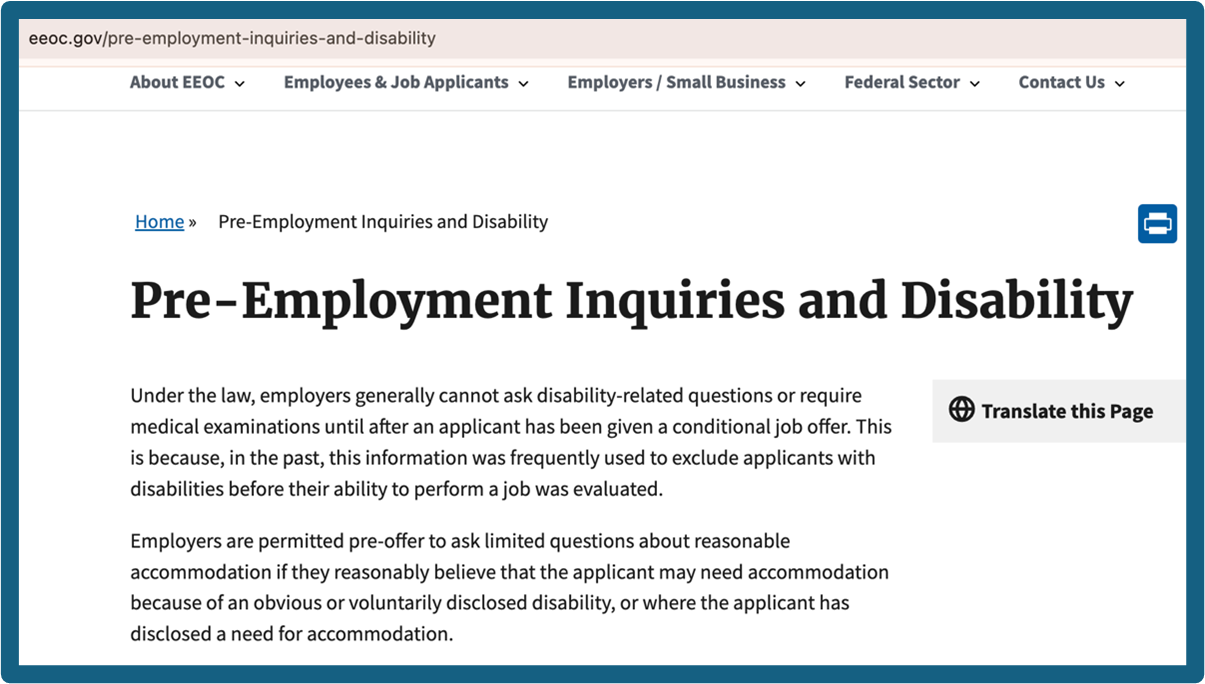
Because this is so high-risk, I am simply going to put a screenshot of the Equal Employment Opportunity Commission’s (EEOC) guidance here:

Screenshot of EEOC.gov page titled Pre-Employment Inquiries and Disability. Text reads Under the law, employers generally cannot ask disability-related questions or require medical examinations until after an applicant has been given a conditional job offer. This is because, in the past, this information was frequently used to exclude applicants with disabilities before their ability to perform a job was evaluated.  Employers are permitted pre-offer to ask limited questions about reasonable accommodation if they reasonably believe that the applicant may need accommodation because of an obvious or voluntarily disclosed disability, or where the applicant has disclosed a need for accommodation.

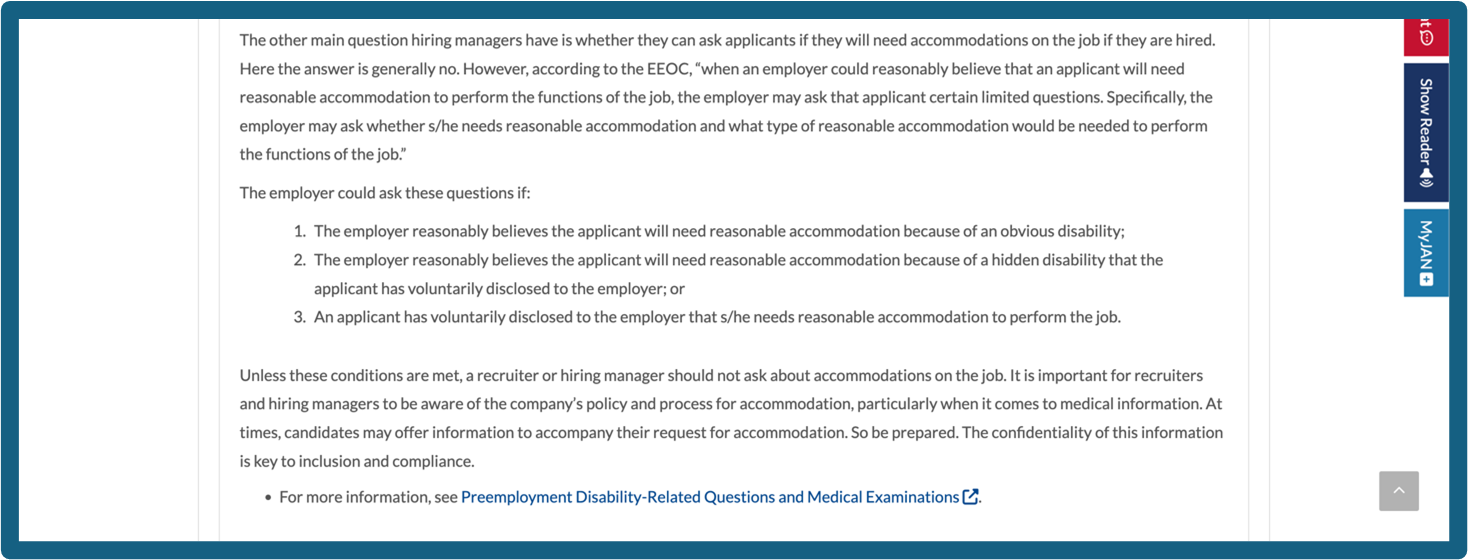
The “Job Accommodation Network,” at AskJAN.org, provides additional guidance on this limited ability to ask applicants about the need for accommodations:

Screenshot from AskJAN.org page titled The JAN Workplace Accommodation Toolkit. Text reads The other main question hiring managers have is whether they can ask applicants if they will need accommodations on the job if they are hired. Here the answer is generally no. However, according to the EEOC, “when an employer could reasonably believe that an applicant will need reasonable accommodation to perform the functions of the job, the employer may ask that applicant certain limited questions. Specifically, the employer may ask whether s/he needs reasonable accommodation and what type of reasonable accommodation would be needed to perform the functions of the job.”  The employer could ask these questions if:      The employer reasonably believes the applicant will need reasonable accommodation because of an obvious disability;     The employer reasonably believes the applicant will need reasonable accommodation because of a hidden disability that the applicant has voluntarily disclosed to the employer; or     An applicant has voluntarily disclosed to the employer that s/he needs reasonable accommodation to perform the job.  Unless these conditions are met, a recruiter or hiring manager should not ask about accommodations on the job. It is important for recruiters and hiring managers to be aware of the company’s policy and process for accommodation, particularly when it comes to medical information. At times, candidates may offer information to accompany their request for accommodation. So be prepared. The confidentiality of this information is key to inclusion and compliance.      For more information, see Preemployment Disability-Related Questions and Medical Examinations Opens in new window..

Why are these excerpts from the EEOC and AskJAN relevant? The only way the issue of accommodations could have been brought up by the employer is if the applicant had an “obvious” disability (two legs in a cast), or the applicant voluntarily disclosed a disability before/during the interview.

After that, if the employee was flat-out dishonest, that is indeed a grave concern.

That said, it is important to remember that disability is not static. A person may need mobility assistance one day and not need it another. A person may be able to hear in certain circumstances and not in others. A person may have low-pain days and high-pain days where they are more easily fatigued. The point of the Americans with Disabilities Act[3] and the New York State Human Rights Law[4] is that people get to work so long as an accommodation can enable them to perform from day-to-day.

The final part of the question is: if the need for an accommodation was not disclosed during the interview, is the employer now “by law required to provide them?”

If the requested accommodation is “reasonable” (which changes from employer to employer[5]), the employer is required to provide the accommodation. This is true even if the employer also has to address the impact of documented dishonesty during a job interview.

This is because dishonesty during a job interview and requesting a disability accommodation occupy two separate legal buckets.

Bucket 1: Dishonesty during a job interview

Dishonesty during an interview would not bar an employee from later getting an accommodation they are entitled to, but it could be a reason to terminate employment. It must be evaluated using the employer’s policy on employee honesty and corrective action.

Bucket 2: A request for disability accommodation

A request for a disability accommodation (even after previously saying one is not needed), simply needs to be addressed as a request for an accommodation. It must be evaluated using the employer’s disability accommodation policy.

The final take-away: if an employer is facing a situation like this scenario, and especially if they were to consider termination the basis of applicant dishonesty, it is wise to work with an HR professional or lawyer to address the situation. That process would start with determining if there was an improper inquiry during the interview, and if there was, if any dishonesty was serious enough to merit a warning or termination.

While that evaluation was pending, accommodations should be provided if they are reasonable.

Thank you for any important question.


[1]I have recently been trying to get away from war metaphors when discussing law. Sports and the arts are helping; “battle plan” is now “playbook,” and “crush your enemies” is sometimes “out-sing the competition.” But since the law is adversarial, it’s a tough fight ongoing rehearsal.

[2] The croquet lawn? The Eugene O’Neill play? “Minefield” is a tough one to replace with a sports or arts analogy.

[3] The ADA applies to employers with over 15 employees and to all government employers.

[4] The Human Rights Law, which bars employment discrimination on the basis of disability, applies to all employers in New York State, regardless of size, and applies much the same approach as the ADA. So, it is wise for all employers in New York to abide by the ADA when addressing accommodation requests by employees.

[5] A good flow chart for assessing accommodation requests during interviews is here: https://askjan.org/articles/Hiring-Process-Reasonable-Accommodation-Flowchart.cfm. A good place to start for assessing employee requests is here: https://askjan.org/toolkit/index.cfm.

Patrons with Service Animals

Submission Date

Question

My library knows that service animals provide vital assistance to patrons with disabilities, and that they must be allowed on library premises without pre-approval.

We also know that when a service animal is brought into the library by a visitor, we can only ask if the animal is needed for a disability, and what work or task it has been trained to provide.

We also know that some disabilities are not easily observed, and not every person using a service animal will be perceived as having a “real” disability.

Our library is small and we prohibit all animals—other than service animals—for a combination of reasons (including cleanliness, allergies, and fear).

Our question is this: we have a patron who we think is faking it. The patron sometimes comes in with a dog, and based on a variety of factors, it seems the patron is bringing in the dog not to accommodate a disability but to taunt staff members and dare them to confront this patron. What can we do?

Answer

First: Because of the restrictions you cite, continue to not take the bait! If this person is indeed taunting library workers and daring them to deny access, continue to address the situation with tactical restraint.[1]

Second: It pains me to say this, but if you suspect a person is faking having a service animal,[2] there isn’t much you can do in the moment. The current rules are set up to maximize access for people with genuine needs, which means those who fake such needs will often get away with it.  It’s maddening, but it’s the by-product of a good thing: access.

Third: Since you’re stuck with it, use it to make you better.

I don’t mean this in a “grin and bear it” kind of way. I mean, use it to inspire a series of steps that will have your team ready for the next act of seranipoke[3] as well as other situations that can test the rules about access and use of library property.

These steps are:

  1. Clearly designate “Employees Only” areas, where visitors (with or without service animals) cannot go.
  2. Ensure your library’s policy on service animals includes the requirement that the animal be leashed or otherwise restrained. A good resource for this policy development is here: https://www.ada.gov/resources/service-animals-2010-requirements/
  3. Consider special spaces to meet other ADA needs. Service animals should never be restricted to a limited area, but some areas can be limited to meet other needs. For example, if your library has an array of spaces people can use (such as multiple study rooms or meeting areas), one can be designated this way: “We strive to keep this space allergen free. Scented products (including personal hygiene products and cleaning products), food, and animal dander should not be brought into this space.” 
  4. And finally: practice dealing with the “taunting/legal” personality and sub-type:[4] a life skill that will come in handy other situations in the library and beyond.

Here are a few scenarios to work with.[5]

A patron comes in and says: “Since I pay taxes, I partly own this property, so I am going to pitch a tent on the lawn. If you try and kick me out, I’ll sue you for theft.”

A visitor comes in and says: “Those lights aren’t up to code. I am going to take pictures of all the light bulbs right now. Please give me the keys to the basement or I will report you to the EPA.”

A reporter comes in and says: “We got a tip that the library only buys books published by big publishers. We are here to investigate why you are shunning local authors and indie publishers. Give us all your purchasing records or we’ll sue you under FOIL.”

For each scenario, an employee or volunteer should practice their own, personalized version of:

Everyone is welcome at the library. The library works toward access for all. Our code of conduct is here. We’ll check on your legal question.[6]

Thanks for a great question!


[1] “Tactical restraint” is otherwise known as “grace under pressure”.

[2] Which can only ever be a dog, or a miniature horse.  If you need a refresher on this, visit https://www.ada.gov/resources/service-animals-2010-requirements/

[3] This is my new word for the act of using a dodgy-seeming service animal situation to taunt people (from “service animal” and “poke”).  Other suggestions from my team are: PAFSA (passive-aggressive fake service animal) and Gefälschtassistenzhundprovozieren (German for “provoke with a fake service dog”).

[4] This is the sub-type that brings us the people recording in the library (A.K.A. “First Amendment auditors”) and some of those who monitor library board meetings for Open Meetings Law gaffes.

[5] I am sure many of you out there could write a whole play on this.

[6] When confronted with a legal question, a good first step is a call to the library system. They have seen it all (except people keep coming up with new things). In addition, “Ask the Lawyer” has an expedited option for quick answers, so if outreach to other institutions doesn’t help, send it on in. Chances are many others have the same question.

LED Lighting And Accessibility

Submission Date

Question

A member of the public called me regarding the trend to switch to LED lighting in many libraries, especially rural libraries applying for NYS Public Library Construction Funding. She told me that she suffers from Photosensitive Epilepsy, and LED lights (among other light sources) cause her to have seizures, which result in injuries. She said this disease has limited access to much of what we all take for granted.

The local library, across the street, was the only place she could go because of the older lighting. The library is about to undergo renovation, and LED lighting may be part of the project because of its cost-savings and environmental impact.

She would like the library board to reconsider and asked why the library has not conducted a “reduction of access survey” because public libraries need to maintain or improve access. Are there reasonable accommodations combined to be fiscally responsible?

Thanks.

Answer

This question is at the tip of a large and fast-moving iceberg.

As with many iceberg-type issues, when I started my research, I didn’t know how deep things went.

So, I did my usual thing when a question involves the Americans with Disabilities Act (“ADA”), went to AskJAN.org, to see what they had to say about LEDs and epilepsy.

As it turns out, as of June 6, 2024, AskJAN wasn’t really hip to this issue (LED’s triggering seizures), which--if you perform a simple Google check--you can see is emerging as a “thing.”

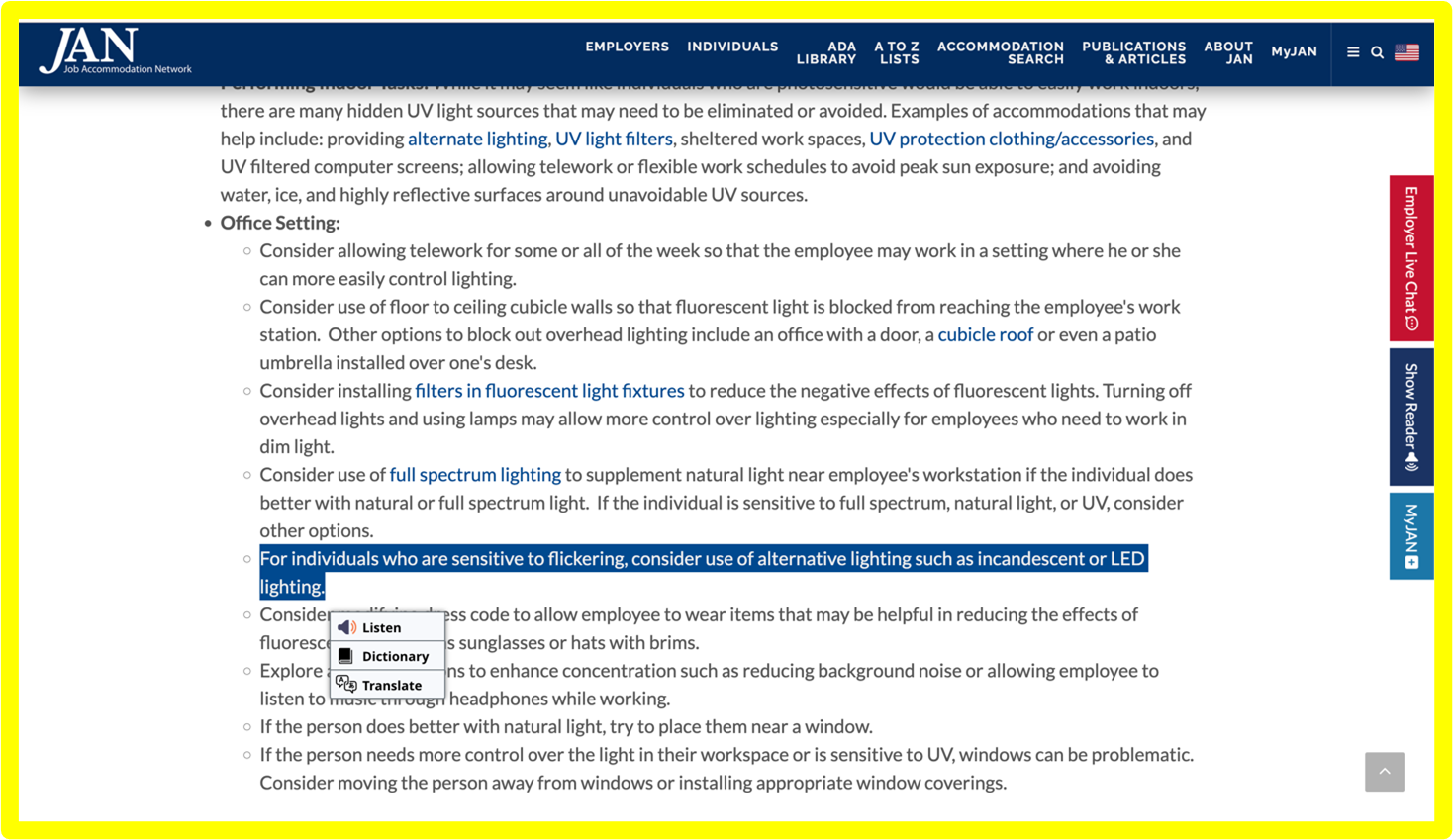
In fact, on their resource page for photosensitivity,[1] LEDs were listed as a possible accommodation, rather than a possible trigger to be mitigated:

 Screenshot from AskJan.org resource page on Photosensitivity. An arrow is highlighting text that reads: "For individuals who are sensitive to flickering, consider use of alternative lighting such as incandescent or LED lighting."

While frustrating, this actually answers the question: when a disability is triggered by environmental conditions (person-made or otherwise), if the need for the accommodation is not broad (like the need caused by limited mobility) it doesn’t become part of design criteria (like ramps designed to address limited mobility). This means it doesn’t automatically get factored in when places of public accommodation are renovated.

Of course, just because something “doesn’t automatically get factored in” doesn’t mean it isn’t considered when a person requests an accommodation. For instance, an employee whose migraines or seizures were triggered by LEDs could request a change in lighting, or to work from an alternate location, and that might be a reasonable accommodation. But again, that is different from a lighting choice during the design phase of a building renovation.

Now, I could leave it there, but we haven’t quite looked at the entire iceberg. So, for those who want to…

  • See some very interesting, annotated background on photosensitivity as a trigger of epilepsy;
  • Get in touch with the groundswell of J.Q. Public’s resistance to LED lighting, not only as a disability concern but a “quality of life” issue; and
  • Get a sense of where the federal government—the primary enforcer of the ADA—sits with LED lights as of May 24, 2024;

… I encourage you to read the U.S. Food & Drug Administration’s reply to the Soft Lights Foundation’s[2] request that the FDA regulate LEDs,[3] a request made in (small) part because there is a growing body of evidence that they can trigger seizures.

The good news is that while they are not required to reject LED lighting on the basis that it could trigger a seizure in a patron, libraries in New York are empowered to make their own decisions about lighting and can take into consideration the potential impact lighting can have on people—employees and patrons—and buy accordingly.[4]


[1] I appreciate that in this case, the photosensitivity is a trigger for epilepsy, not the actual disability. But still.

[2] Yes, there is a “Soft Lights Foundation” whose mission is to advocate “for the protection of people and the environment from the harms of Visible Light radiation emitted by products that use Light Emitting Diodes.” For more information, visit: https://www.softlights.org/about/

[4] Full disclosure: I hate LED lighting. Hate. Hate. Hate. We have some in my office in Buffalo, because it really is efficient, but it’s behind thick panels to dull the de-humanizing impact of its cold, hellish, dystopian lumens.

Employers Disclosing Reason for Employee's Leave

Submission Date

Question

Are there any laws around a supervisor or manager telling others the reason for an employee being out on leave? Does the answer change if the employee isn't using sick time, but [has] disclosed why they were unavailable for additional hours during non-contract time?

Answer

Here are the state and federal laws specifically barring an employer from disclosing why an employee is out on sick or personal leave.[1]

  • New York State Human Rights Law (NYSHRL), whose regulations require that employers maintain the confidentiality of medical information disclosed as part of requesting disability accommodations. 
  • The New York State Workers’ Compensation Law, which requires employers maintain the confidentiality of medical records used to assess benefit claims.
  • The Americans with Disabilities Act (“ADA”), which imposes very strict rules for handling information obtained through post-offer medical examinations and inquiries. 
  • The Health Insurance Portability and Accountability Act (“HIPAA”), which requires employers to protect the privacy of employees' personal health-related information in relation to health insurance benefits.
  • The Genetic Information Nondiscrimination Act (“GINA”), which prohibits employers from requesting or using employees’ genetic information.
  • The Family and Medical Leave Act (“FMLA”), which requires that all records and documents relating to medical histories of employees or employees' family members created for purposes of FMLA be kept confidential.

This sounds straightforward, but of course, it isn’t, since only the first two laws (NYSHRL and Workers’ Compensation) apply to all employers in New York State, and not all disclosures related to sick or personal leave are “medical information” or private health records.

Here are some examples of disclosures that could be forbidden by law, if the law applies to the employee in question.

  • A library employee temporarily reduces their hours using FMLA leave to address a personal health issue; when the library’s board of trustees approves a budget item to hire a temp to fill the extra hours, a board member says at an open meeting: “This is to help with consistent service as [NAME] deals with [DIAGNOSIS].”
  • A museum employee is absent from work as a disability accommodation under the ADA, and the co-workers covering her shift are told that the schedule change “is because of [NAME] has [DIAGNOSIS].”
  • A warehouse employee who was injured on the job is on leave covered by Workers’ Compensation, and his supervisor schedules a time to go over the accident and review safety precautions with co-workers.
  • An office employee who needs disability accommodation provides proof from a treating physician and the documentation is left on the table in the break room for all to see.

Here are some things that could be gross violations of privacy, but without additional factors, would not be legal violations.

  • An employee is out on paid sick leave, and although an employer can’t require confidential medical information to use paid sick leave, the employee lets his supervisor know that he has the flu; the supervisor then tells everyone else they work with to “be on the lookout for flu symptoms, since [NAME] is out with a pretty bad flu.”
  • An employee is out on New York State paid family medical leave (not FMLA leave, due to the size of the employer) to help her spouse with a serious medical issue. Although the employee has not shared the reason for the leave with co-workers, the HR director organizes signatures on a sympathy card that alludes to the reason for the leave.
  • An employee is on discretionary unpaid personal leave to help out a friend who is ill and the reason for the leave is referenced throughout the workplace frequently.
  • An employee tells a coworker outside of work time that they can’t take on more hours due to issues with anxiety and depression, and the co-worker shares that information with colleagues.[2]

That said, the answer to this question really is: if an employee is concerned that their information may have been improperly shared or used, or if an employer is concerned about properly safeguarding employee information, consult an HR specialist or at attorney to confirm compliance. 

For employees, there are often legal clinics that can address a question of this nature; check with your county bar association. For employers, there is “Ask the Lawyer” and your local employment and labor law attorneys.

This is a good one to get right, from the start, for everybody. Thank you for trusting me with this question.


[1] This list does not cover all the confidentiality requirements imposed on employers—just those related to sick time and general leave! There are many other things subject to confidentiality requirements; for example, a check of credit history must be kept confidential.

[2] While not a violation, if this information was then used to deny a promotion, or to not offer extra hours when they would otherwise be offered, that could be a problem!  Don’t use second-hand medical information to make employment decisions.

Napping in library

Submission Date

Question

Sometimes, people nap in the library, particularly people who we believe might not have stable or sufficient housing. We feel that a library should not exclude people who need a secure place to rest, so long as there is no interference with library operations, but are there any legal considerations to this issue?

Answer

This is a VERY sensitive issue. There are many factors that could contribute to a person sleeping in a public space, including:

  • An undiagnosed medical condition
  • A diagnosed medical condition
  • Non-medical factors impacting behaviors
  • Temporary or serial lack of a safe, stable place to rest
  • Simply wanting to take a nap[1]
  • Any combination of the above-listed factors

Each one of these brings their own array of legal (and ethical, and moral) considerations.

But before we get into all that, let's discuss: for purposes of this question, what is "sleep"?

For purposes of this question, let's call "sleep" a "state of healthy, restful, and restorative unconsciousness."  In other words, "sleep" is that great thing we all do when our eyes get heavy, we yawn, and lie down, dozing into blissful unawareness.

Sleep: we all do it, and many of us love it.[2]

Now, let's talk about what sleep isn't for purpose of this question.  "Sleep" isn't, for purposes of this question; the result  of a concussion, a seizure, a stroke, an opioid overdose, or dangerously low blood sugar.   And yet, to the untrained eye, any one of these dangerous conditions could be mistaken for "sleep."[3]

Because of this, no matter how much my bleeding heart and sense compassion want to say, "Just let the person sleep in the library, and don't say anything," I can't.  I just can't bring myself to normalize ignoring what could be "sleep" one day, and a diabetic coma the next.[4]

That said, because it could be related to a real or perceived medical condition and/or disability, denying or restricting library services (including the right to simply be present in the library) on the basis of simply falling asleep could pose risks of disability discrimination.  Sleep happens, folks, and sometimes people can't help it.

So, what is the solution, here?

Well, as with many things, there is no one "right" answer.  But I will say:

1.  Every library should have a policy, or at least a "standard operating procedure" (or "SOP"), regarding "Suspected or Actual Medical Events in The Library."   That policy should address (among other things) what to do about perceived loss of consciousness or coherence by library users.[5]

2.  A" Suspected or Actual Medical Events in the Library" policy or SOP can also address incidental (meaning unintended) and deliberate use of the library for napping.
3.  This is where a library's discretion and autonomy kick in.

A library can decide if it is going to normalize sleeping in the library, or not.

If a library decides NOT to normalize sleep in the library, a simple statement such as "For assurance of safety, the library is a no-nap, no-sleep zone.  Thank you for helping us maintain this rule.  We understand that sleep happens; if you need to request ADA accommodations due to this rule, please contact NAME at INFO."   Then, as a rule, patrons who fall asleep should be awoken (just as patrons who bring food in might be asked to remove it, or patrons who don't wear shoes might be asked to put some on).

On the flip side, if a library decides, as a matter of policy, to allow users to sleep in the library[6], such a policy can also create the protocol for "safe napping," with those planning to sleep notifying staff, so the nap is not mistaken for an overdose, seizure, etc.

NOTE: Before selecting this option, a library should check with its general liability insurance carrier to make sure it is consistent with the library's risk threshold and coverage.

What does a "Suspected or Actual Medical Events in the Library" with a "sleeping" section look like?  Here is an example (with both a "sleep okay" and "no sleep" option at the end):

The XYZ Community Library is a welcoming, service-oriented, and inclusive space for all. To promote the health and safety of those using our library, the following possible medical events will result in the staff calling 911:

  • Any perceived or actual loss of sustained coherence or consciousness;
  • Any library user exhibiting signs that they may require emergency medical attention,

who does not expressly instruct staff that immediate medical attention is not required;

  • Any person requesting emergency medical response.

Definitions

For this policy, "loss of sustained coherence or consciousness" is the inability to communicate meaningfully with library employees in the user's primary language.

For this policy, express instructions to staff that "immediate medical attention is not required" may be disregarded at the considered discretion of the library employees; such a decision will be based on consideration of: the specific facts of the situation, respect for the agency of the user, and respect for the mission and operational needs of the library.

ADA

If a library user has a medical condition that can potentially result in perceived or actual loss of coherence or consciousness, you may use the library's ADA Accommodations policy to arrange reasonable accommodations so your library experience is not unnecessarily impacted by this policy. For example, if a library user has narcolepsy and wishes to be woken in the event, they fall asleep, the library can consider a reasonable accommodation such as allowing the user to use a specific type of alarm in an otherwise quiet space.

Specific Situations

Whenever possible, the library uses the following specific guidelines from the CDC with respect to common medical events that can impact coherence or consciousness:

Seizures

Seizures do not usually require emergency medical attention. Only call 911 if one or more of these are true:

  • The person has never had a seizure before;
  • The person has difficulty breathing or waking after the seizure;
  • The seizure lasts longer than 5 minutes;
  • The person has another seizure soon after the first one;
  • The person is hurt during the seizure;
  • The seizure happens in water;
  • The person has a health condition like diabetes, heart disease, or is pregnant.

Suspected opioid overdose
Call 911 if an overdose is suspected.

Recognizing an opioid overdose may be difficult. If it is unclear, treat the situation like an overdose and proceed with treatment. Even if the patient wakes up or seems better after one or two doses of naloxone, emergency medical assistance is still necessary.

Severely Low Blood Sugar

Blood sugar below 55 mg/dL is considered severely low. If any of the following happens, you should call 911:

  • A person with low blood sugar passes out;
  • A person with low blood sugar needs a second dose of glucagon;
  • A person with low blood sugar had glucagon but are still confused;
  • A person with low blood sugar stays too low 20 minutes after treatment or doesn’t respond to the usual treatments.

Concussion
Signs and symptoms of a dangerous concussion can include:

  • One pupil larger than the other;
  • Drowsiness or inability to wake up;
  • A headache that gets worse and does not go away;
  • Slurred speech, weakness, numbness, or decreased coordination;
  • Repeated vomiting or nausea, convulsions or seizures (shaking or twitching);
  • Unusual behavior, increased confusion, restlessness, or agitation;
  • Loss of consciousness (passed out/knocked out). Even a brief loss of consciousness should be taken seriously.

Call 911.

This policy, and sleeping in the Library

CHOICE 1: USE IF THE LIBRARY DECIDES TO NOT ALLOW PEOPLE TO SLEEP IN THE LIBRARY Because loss of consciousness can be a sign of a medical emergency, library users are asked not to deliberately sleep or nap in the library.

If a library user is asleep in the library, staff are instructed to wake them.

In applying this rule, the library will follow the requirements of the ADA; if a library user has a medical condition that can cause uncontrollable sleep, at that library user's discretion, they may alert staff so accommodations can be made (see "ADA" above).

CHOICE 2: USE IF THE LIBRARY DECIDES TO ALLOW PEOPLE TO SLEEP IN THE LIBRARY

If you have a medical condition that can cause uncontrollable sleep, at your discretion, you may alert staff so accommodations can be made (see "ADA" above).

If you simply find that the library is a nice, quiet place for you to take a nap, please alert us that you "Plan to take a nap" so our staff knows that you are asleep by desire, and not experiencing a medical emergency causing loss of consciousness or coherence. We'll give you a nice arrangement of purple flowers[7] to keep near where you're sitting so staff know you're deliberately using the library space to rest and restore yourself.

Users must limit planned napping in the library to no later than one half-hour before close, so you have time to gather your thoughts and energy before it is time for us to close up the building.[8]

If your nap creates loud snoring or other disruption, we may have to wake you! Please be gracious to staff who are responsible for making sure the library is a welcoming and inclusive space for all.

As with any template, before adopting a policy based on this one, review the final version with your lawyer (and, as noted above, your library's insurance carrier).

And a final note: I truly wish I had a better answer to this question.  As I said at the beginning, this is a VERY sensitive issue.  But if a commitment to library access, safety, and mission guide the decision, your library can find the best answer for  YOUR library.

Thank you for this tough question.


[1] This bullet might be more properly be phrased “Sometimes people just want to take a damn nap,” meaning that forces that get in the way of said nap are unreasonable.  I have to disagree in this case, but I get it.

[2] And if you suffer from insomnia, you may not do it enough.  I feel you, fellow lying-awake-at-2AM-person.

[3] If you are a trained medical professional qualified to diagnose of a concussion, a seizure, a stroke, an opioid overdose, or dangerously low blood sugar, this statement obviously doesn't apply to you.

[4] One of my children has Type 1 Diabetes (the kind where you can't make your own insulin, because your immune system attacked the Beta cells in your pancreas) so this issue hits close to home.

[5] When in doubt, call 911.

[6] Just in case it isn't readily apparent, I am truly neutral on whether or not to "normalize" sleeping in a library.  Truly, I can see the benefit to a decision either way; the point is to make a deliberate decision based on a commitment to access, safety, and smooth library operations.

[7] It doesn't need to be flowers (purple or otherwise), that’s just me being cute.  The point is having a signifier or system, so employees know the lack of consciousness didn't start as a medical issue.

[8] I worked on this question while sitting in my back yard on a sunny day in May. I asked my 7-year-old neighbor, Matt, who is possessed of both a wise spirit and a blunt nature, if he thought people should be able to sleep in the library.  "No," he said, after a moment’s reflection.  "They might not be seen and could get locked in for the night."  He then asked me: "You do this for your work?" Kids are the best.

Creating adaptive copies of textbooks using text-to-speech

Submission Date

Question

My institution subscribes to the "Kurzweil Reading Program", a "Text-to-Speech" product for those with reading impairments (dyslexia, English language learners, blind/vision impaired, etc.)

Section 121 indicates these users are "eligible persons" for "fair use", but others, without such disabilities could use the program (like an audiobook in the car!).

We'd be putting TEXTBOOKS up in the program; that fair use violation is what I'm worried about....

Thanks!

Answer

This question reflects the level of savvy "Ask the Lawyer" readers bring to their submissions.  The member submitting the question has already set out (in a manner much more succinct than I usually achieve) the interplay of:

  • Owner's rights (Copyright Act Section 106),
  • Adaptive copies made under "fair use" (Copyright Act Section 107), and
  • Copies made for purposes of accommodations for disability that impacts the ability to read (Copyright Act Section 121).

do have one quibble with the member's phrasing, though, and it is important to this particular issue: Section 121, while it allows copies otherwise barred, does not create a "fair use" right to make a copy.[1]  Rather, the creation of an adaptive copy under Section 121 is a 100% exception to infringement made under highly precise circumstances.

What are those "highly precise circumstances"?

First, as the member writes, the end-user of the copy must be "eligible"--meaning they have a disability that impacts the ability to read (for the three "ways" for a user to be "eligible", see sub-section (d)(3)(A)-(C) of the law, below). 

Second, the copies must:

"(A) not be reproduced or distributed in the United States in a format other than an accessible format exclusively for use by eligible persons;

(B) bear a notice that any further reproduction or distribution in a format other than an accessible format is an infringement; and

(C) include a copyright notice identifying the copyright owner and the date of the original publication."

And third, the maker of the copies must be an "authorized entity" (which is defined in the statute; see the definition, below[2]).

This precise formula, and the right it creates, is why "fair use" is not a part of the issue at hand (adaptive copies specifically for reading-based disabilities).  None of the above-listed requirements are required to claim "fair use" under Section 107[3]. In addition, to make a Section 121 copy, there is no four-factor "balancing" test; rather, a Section 121 use is "inherently noninfringing."[4]

The above-listed Section 121 requirements to include copyright notices are also the key to addressing the member's concern: enforcement.

When an "authorized entity" is creating Section 121-based copies for "eligible" people, the institution must put copyright notices on each copy. This sets up the institution--as either an employer or alma mater--to restrict non-eligible employees and students from using them for non-Section 121 purposes.  Further, in addition to the required notices, the institution can add additional warnings, and if needed, restrict use through technological controls.[5]

Now, how much should an institution police this?  Currently, there is no case law that turns on an alleged infringement that was committed via unauthorized use of a duly made Section 121 copy.  That said, content owners are always looking for new ways to maximize revenues, so taking care to properly designate Section 121-based copies as required by law, and using policy and posted notices to reinforce those restrictions, is a wise idea.

Thank you for a well-informed and nuanced question!

HERE IS SECTION 121 OF THE COPYRIGHT ACT:

(a) Notwithstanding the provisions of section 106, it is not an infringement of copyright for an authorized entity to reproduce or to distribute in the United States copies or phonorecords of a previously published literary work or of a previously published musical work that has been fixed in the form of text or notation if such copies or phonorecords are reproduced or distributed in accessible formats exclusively for use by eligible persons.

(b)

(1) Copies or phonorecords to which this section applies shall—

(A) not be reproduced or distributed in the United States in a format other than an accessible format exclusively for use by eligible persons;

(B) bear a notice that any further reproduction or distribution in a format other than an accessible format is an infringement; and

(C) include a copyright notice identifying the copyright owner and the date of the original publication.

(2) The provisions of this subsection shall not apply to standardized, secure, or norm-referenced tests and related testing material, or to computer programs, except the portions thereof that are in conventional human language (including descriptions of pictorial works) and displayed to users in the ordinary course of using the computer programs.

(c) Notwithstanding the provisions of section 106, it is not an infringement of copyright for a publisher of print instructional materials for use in elementary or secondary schools to create and distribute to the National Instructional Materials Access Center copies of the electronic files described in sections 612(a)(23)(C), 613(a)(6), and section 674(e) of the Individuals with Disabilities Education Act that contain the contents of print instructional materials using the National Instructional Material Accessibility Standard (as defined in section 674(e)(3) of that Act), if—

(1) the inclusion of the contents of such print instructional materials is required by any State educational agency or local educational agency;

(2) the publisher had the right to publish such print instructional materials in print formats; and

(3) such copies are used solely for reproduction or distribution of the contents of such print instructional materials in accessible formats.

(d) For purposes of this section, the term—

(1) “accessible format” means an alternative manner or form that gives an eligible person access to the work when the copy or phonorecord in the accessible format is used exclusively by the eligible person to permit him or her to have access as feasibly and comfortably as a person without such disability as described in paragraph (3);

(2) “authorized entity” means a nonprofit organization or a governmental agency that has a primary mission to provide specialized services relating to training, education, or adaptive reading or information access needs of blind or other persons with disabilities;

(3) “eligible person” means an individual who, regardless of any other disability—

(A) is blind;

(B) has a visual impairment or perceptual or reading disability that cannot be improved to give visual function substantially equivalent to that of a person who has no such impairment or disability and so is unable to read printed works to substantially the same degree as a person without an impairment or disability; or

(C) is otherwise unable, through physical disability, to hold or manipulate a book or to focus or move the eyes to the extent that would be normally acceptable for reading; and

(4) “print instructional materials” has the meaning given under section 674(e)(3)(C) of the Individuals with Disabilities Education Act.

(Added Pub. L. 104–197, title III, §â€¯316(a), Sept. 16, 1996, 110 Stat. 2416; amended Pub. L. 106–379, §â€¯3(b), Oct. 27, 2000, 114 Stat. 1445; Pub. L. 107–273, div. C, title III, §â€¯13210(3)(A), Nov. 2, 2002, 116 Stat. 1909; Pub. L. 108–446, title III, §â€¯306, Dec. 3, 2004, 118 Stat. 2807; Pub. L. 115–261, §â€¯2(a)(1), Oct. 9, 2018, 132 Stat. 3667.)


[1] I'm quibbling, but I want to take this footnote to state that including a "fair use" cite in the question is very reasonable, because fair use is often cited as yet another reason to make adaptive copies that go beyond copies authorized by Section 121. Since the copies in this case are without question for those "eligible" under Section 121 (those with reading-impacting disabilities), we're going to sideline fair use at Section 107 for this question, but it very much is a part of the toolbox of creating adaptive works for non-Section 121-eligible disabilities.

[2] There is controversy, but no definitive authority, on if all not-for-profit educational institutions meet the criteria.  Academic publishers have taken a position that it only applies to institutions for the blind, not just any old school or college.  However, an uncontradicted conclusion in the October 10, 2012 district court decision in Authors Guild V. Hathitrust, 902 F. Supp, 2d 445 (2012) opines that because of their mandate to provide accessibility under the ADA, such institutions all are "authorized entities" under Section 121.  Until I read otherwise, my guidance errs on the side of accessibility (see https://wnylrc.org/index.php/raq/accessibility-options-school-ebooks).

[3] In fact, having to abide by this type of requirement could undercut some of the more vital applications of fair use, such as parody or innovation.

[4] If this distinction intrigues you, check out the commentary at  https://www.copyright.gov/1201/2021/comments/Class%2008_InitialComments_Accessibility%20Petitioners%20II.pdf

[5] I am slightly wary of a system that would force a student to "register" with the library as needing ADA accommodations, but depending on how access is granted, some type of additional log-in or control might be wise.  At higher ed institutions, students and employees arrange accommodation per a policy, and accommodations are generally confirmed in writing, so signing up for access to adaptive copies could be the way to go.  But this will be driven by technology, and care must be taken to not put up any additional hurdles to access.  If any readers out there have solved this issue at your institution, I'd appreciate hearing about it!  Please send that to info@losapllc.com.

School Libraries Template for Copiers

Submission Date

Question

We were asked about signage to post over the copier at a schools where educational materials are copied. Below is some template language with footnotes explaining why they say what they do.  Of course, before posting in your school or library, check with your lawyer!

Answer

MAKING A COPY ON THIS MACHINE

MAY BE SUBJECT TO THE COPYRIGHT LAW OF THE UNITED STATES

This means 4 important things:

1.  Copying a copyright-protected work here could be a copyright violation[1].

2.  Copying protected works is sometimes allowed under "fair use."[2]  Our school's fair use policy is posted INSERT.

3.  Copying a copyrighted work to accommodate a disability under the ADA is allowed.   However, to do that, please see the [insert office for disability services] staff, since adaptive copies have special rules,[3] and we want to help you (or a person you are assisting) exercise your rights.

4.   Under the TEACH Act,[4] you may display or perform certain copyright-protected content in class, but that does not allow you to make additional copies for in-class or online instruction.  Please don't make copies that exceed the permission obtained by the school (unless you use our policy to determine it is fair use).

The copy machines are here for your use, and we appreciate your consideration of these laws.

Thanks!


[1] 17 U.S.C. 106 reserves the making of copies to the copyright owner.

[2] 17. U.S.C. 107 allows copying under certain circumstances, but simply "educational" or "not-for-profit"  use is not enough.  Read the guide at the link!

[3] See https://www.loc.gov/nls/about/organization/laws-regulations/copyright-law-amendment-1996-pl-104-197/.

[4] Section 110 of the Copyright Act.

Libraries Open to the Public Template for Copiers

Submission Date

Question

We were asked about signage to post over the public copier at a libraries open to the public. Below is some template language with footnotes explaining why they say what they do.  Of course, before posting in your school or library, check with your lawyer!

Answer

MAKING A COPY ON THIS MACHINE

MAY BE SUBJECT TO THE COPYRIGHT LAW OF THE UNITED STATES[1]

This means 4 important things:

1.  Copying a copyright-protected work here could be a copyright violation.[2]

2.  Copying protected works is sometimes allowed under "fair use."[3]  We can't give you legal advice, but if you want to learn more about "fair use," go to https://www.copyright.gov/circs/circ21.pdf or see the [INSTITUTION NAME] Fair Use policy at [LINK].

3.  Copying a copyrighted work to accommodate a disability under the ADA is allowed.   However, to do that, please see the library staff, since adaptive copies have special rules,[4] and we want to help you (or a person you are assisting) exercise your rights.

4. As a library open to the public, there are special circumstances under which we get to make copies (libraries are special).  However, to qualify for that protection, this notice (which we have, by law, placed over the copier right in front of you), has to say what it says in bold at the very top, and we have to operate by this rule:

Any person or group is forbidden to use this machine to engage in the related or concerted reproduction or distribution of multiple copies of the same material, whether made on one occasion or over a period of time, and whether intended for aggregate use by one or more individuals or for separate use by the individual members of a group.

What does that mean? Entire classes should not come here and copy the whole text book for a course![5]  Please don't do that.[6]

The copy machines are here for your use, and we appreciate your consideration of these laws.

Thanks!


[1] This precise language is required by 17 U.S.C. 108 for the library and its employees to be protected against allegations of secondary infringement.

[2] 17 U.S.C. 106 reserves the making of copies to the copyright owner.

[3] 17. U.S.C. 107 allows copying under certain circumstances, but simply "educational" or "not-for-profit" use is not enough.  Read the guide at the link!

[4] See https://www.loc.gov/nls/about/organization/laws-regulations/copyright-law-amendment-1996-pl-104-197/.

[5] This is covered by 17 U.S.C. Section 108(f).  Section 108 also lets libraries make copies for other uses...but that is for libraries, not regular people or students using a copier in a library.

[6] Seriously, if we see you doing that, we have to ask you to stop.

Presenters and vaccination requirements

Submission Date

Question

In the RAQ you provided an answer about vaccine requirements for new hires. What about performers or presenters we hire to come into the library, especially to work with children? Are we allowed to ask/require proof of vaccination status before signing a contract?

Answer

A library needs two documents to address this issue:

1.  Its template contract or "rider"[1] for performers and presenters;[2]and

2.  Its current Safety Plan.

How does the contract/rider come into play?  One of the conditions it should list is a "behavior requirement," requiring that any person performing a service at or for the library "will abide by the library's policies, and the reasonable requests of library staff."[3]

How does the Safety Plan[4]  come into play?  This is the document that likely addresses vaccination, PPE, and other safety requirements for those visiting your library.

Now, see how the two work together: the Safety Plan is a library policy; the "behavior requirement" means visitors must follow it.

When the two documents are assessed together, if it isn't crystal-clear that the library requires proof of vaccination before performance, the Safety Plan or the contract/riders--or both--can be amended to require:

To maximize the safety of in-person events, the ABC library requires all providers of in-person events to provide current proof of vaccination against COVID-19 at least seven days prior to the event.

 The ABC library will consider remote options if a prospective performer or presenter requests such a change as a reasonable accommodation under the ADA due to a disability.

How can this be done so simply?

While there are many nuances that libraries must consider prior to flatly requiring vaccination for all employees,[5] WHEN IT COMES TO CONTRACTORS PROVIDING ONE-TIME OR PERIODIC PERFORMANCES,[6] unless there are grant requirements or other obligations specifically hemming a library in, a library can be more blunt in its requirements.

While they can be a very beloved part of a library's offerings, independent contractors have less rights than employees when it comes to a library imposing the conditions on performance. This is because, whether incorporated, or working "DBA", independent contractors are free to accept and reject the terms of any particular contract--and thus have more leverage and freedom than employees.[7]  And because of that, when it comes to requiring them to provide proof of vaccination, there are a few less legal hoops to jump through than with employees (new, or otherwise).

So, after all that, what were the questions? "What about performers or presenters we hire to come into the library, especially to work with children? Are we allowed to ask/require proof of vaccination status before signing a contract?"


The answer is: with the right policy and contract terms[8] in place: yes.


[1] A document you can attach to the performer's contract or proposal, setting the terms of the work.

[2] There are any number of forms a standard contract or "rider " for a library to engage performers and presenters can take. It can be in the form of a friendly letter that outlines the terms of the arrangement, or it can be a more formal document that sounds like it was written by a lawyer. Either option is OK, so long as it addresses the fundamental questions: what is being done, how much the person is being paid to do it, and what rules and expectations protect the library from any risks related to the performance. For comments on contracts for performers (both generally and in the COVID Times), dive back into history and review the "Ask the Lawyer" at https://www.wnylrc.org/ask-the-lawyer/raqs/125.

[3] Very standard stuff.

[4] Which at this point (August 2021) you have probably amended at least five times.

[5] See recent comments at https://www.wnylrc.org/ask-the-lawyer/raqs/231 and https://www.wnylrc.org/ask-the-lawyer/raqs/204.

[6] Because contracts with providers of more essential/routine services such as delivery, cleaning, and security are likely to be more complex, this guidance does not apply to those types of services...although of course a library can explore amending a contract with such a provider to require maximum allowable safety measures.

[7] That's the theory, anyway.

[8] A library should work with a lawyer to have a stock performance contract tailored to that library's identity, insurance coverage, and other unique factors.