
Archives

Does Title II of the Americans with Disabilities Act apply to born-digital archival collections?

Submission Date

Question

In April 2024, the Federal Register published the US Department of Justice’s final rule on Title II of the Americans with Disabilities Act (ADA). The rule includes specific requirements for state and local governments to ensure that web content and mobile applications are accessible to people with disabilities. My question is related to the applicability of Title II to the online collections of public academic libraries, and more specifically, to born-digital archival collections, i.e., archival collections consisting of materials originating in a computer environment.

According to the rule, state and local entities must follow the technical standard outlined in the Web Content Accessibility Guidelines (WCAG) 2.1 level AA. However, this rule allows for five exceptions: https://www.ecfr.gov/current/title-28/section-35.201.

I understand the updated regulation does not override the existing obligations under Title II to make reasonable modifications on an individual basis, but it is unclear if Title II applies to born-digital archival collections, or if these collections fall under the exceptions linked above.

Answer

Thank you for such a thoughtful (and complex) question.

To answer it, I am going to respond in the form of a dialogue between a lawyer and librarian that will allow other Ask the Lawyer readers at public institutions to assess if their born-digital archives must comply, too.

After establishing the criteria for applicability, the end of dialogue will address this question: Do the new Title II regulations apply to “born-digital” archival collections, and if so, is there any exception for non-compliant content?

Let’s go!

Lawyer: Hello! I see you want to figure out if your library’s archive of “born-digital” content has to follow the new Title II regs.

Let’s start with an easy question:

Is your institution a “public entity” (or part of a public entity) as governed by 42 U.S.C. 1213(1)?

Librarian: Yes / No / I don’t know!

Lawyer: If you don’t know, or want to double-check your answer, here is the definition of a “public entity”[1] in ADA Title II:

(1) Public entity

The term “public entity“ means—

(A) any State or local government;

(B) any department, agency, special purpose district, or other instrumentality of a State or States or local government; and

(C) the National Railroad Passenger Corporation, and any commuter authority (as defined in section 24102(4) [1] of title 49).

Librarian: Aha! / Huh?

Lawyer: If you are still unsure, here is another hint: the term “instrumentality of a state,” as used in 42 U.S.C. § 12131(1)(B), refers to governmental units or units created by them (like town libraries, school district public libraries, community colleges, SUNY, etc.).

Librarian: Okay, I get it. / Ugh, I’ll ask our library’s lawyer.

[Note: If you are a “public entity,” keep reading this dialogue. If aren’t a public entity… Stop! This dialogue is not for you.]

Lawyer: Okay, with just public entities going forward, it’s time for another soul-searching exploration into your institution’s identity. Is the “total population” of your entity over or under 50,000, making you a “large public entity”?

If you’re over 50,000, then your “Start Date” for these regulations is April 24, 2026.

If you’re under 50,000, then your “Start Date” is April 26, 2027.[2]

Librarian: How does a school or library even have a “population?”

Lawyer: This can get tricky for academic libraries, but here are three examples from the new regulations to help you:

  • The total population of a county library is the population of the county of which the library is an instrumentality.
  • A public state university located in a town of 20,000 within a state with a population of 5 million would be considered a large public entity for the purposes of this part because it is an instrumentality of the state.
  • A county community college in the same state where the county has a population of 35,000 would be considered a “small public entity” for the purposes of this part, because the community college is an instrumentality of the county.

Now that you know if you have to follow this, and if so, when you have to follow it, here are the new requirements for web and mobile accessibility:

Web content and mobile apps that your entity provides or makes available directly or through contractual, licensing, or other arrangements must comply with Level A and Level AA success criteria and conformance requirements specified in WCAG 2.1.

Librarian: Got it! / Uh, what does “WCAG 2.1” mean?

Lawyer: WCAG 2.1 is a standard of accessibility that makes sure web content and mobile apps work are compatible with adaptive technology. If you need more information on it, you can check it out at https://www.w3.org/WAI/standards-guidelines/wcag/glance/.

Librarian: Okay, but isn’t this question about exceptions to this rule for “born-digital “content in library archives?

Lawyer: Yes, it is! But to talk about exceptions, it is helpful to talk about requirements.

Librarian: Okay, I get it. But like the question says, aren’t there some exceptions?

Lawyer: Indeed, there are exceptions. Here are some of them from the section[3] quoted by the member:

(1) archived web content;

(2) preexisting conventional electronic documents, unless such documents are currently used to apply for, gain access to, or participate in the public entity's services, programs, or activities;

(3) content posted by a third party, unless the third party is posting due to contractual, licensing, or other arrangements with the public entity;

(4) conventional electronic documents that are about a specific individual, their property, or their account and that are password-protected or otherwise secured; and

(5) preexisting social media posts.

Librarian: Aha! Does “archived web content” cover anything in a public entity’s born-digital archive going forward?

Lawyer: No.

Librarian: Oh. Why not?

Lawyer: Because of how “archived web content” is defined in the new regulations.

With a few modifications for brevity, here are the criteria for archived web content:

(1) Was created before your Start Date, reproduces paper documents created before your Start Date, or reproduces the contents of other physical media created before your Start Date;

(2) Is retained exclusively for reference, research, or recordkeeping;

(3) Is not altered or updated after the date of archiving; and

(4) Is organized and stored in a dedicated area or areas clearly identified as being archived.

Of great importance to the question, this definition does not allow non-compliant born-digital content created after your Start Date, even if it is only on your website or mobile app because it is part of the archive.

Librarian: Okay, but is there another way non-compliant born-digital materials created after our Start Date could be in our online archive?

Lawyer: Yes! The regulations have another exception in a different subsection.[4]

This subsection provides that born-digital content generated by a third party does not have to comply (unless your institution contracted with the third party to provide it).

Here’s an example of how this works:

Let’s say your institution wants to create the archive “Born in Digital Shame: Non-WCAG 2.1-Compliant Materials posted by Public Entities.” You then gathered a bunch of non-WCAG 2.1-compliant content from other public entities, generated after their Start Date, and put it in your archive.

That would be fine. It would be a gallery of non-compliance, but it would be fine.

Librarian: Okay. Can we answer the question now?

Lawyer: Yes, we can now answer the fateful QUESTION: Do the new Title II regulations apply to “born-digital” archival collections, and if so, is there any exception for non-compliant content?

ANSWER: Yes, the new Title II regulations apply to born-digital content, with only the following two exceptions:

1) the content pre-dates your Start Date; or

2) it is from a third party and is on your website only as archival content.[5]

Librarian: That makes sense!

Lawyer: Yes, sometimes federal regulations do make sense… even if you have to write a Socratic dialogue to make sense of them.

Librarian: I need a beverage now![6]

Lawyer: Thank you for a great question!


[1] Definition is at 42 U.S.C. § 12131(1)(B).

[5] This is important. The functional part or your archive—the metadata, the search function, the display, will all have to be WCAG 2.1 compliant by your Start Date. But the material you are archiving does not.

[6] I have found that green tea mixed with a soothing herbal tea is a great blend for ploughing through federal regulations. What I drink after is between me and my bartender.

Permissions for Photos from Defunct Publications

Submission Date

Question

An academic librarian relayed this question from a researcher/author:

"I am in the stage of tracking down photo permissions and have found images originally published by U.S. presses from the late 1800s and early 1900s (1887, 1893) that are now defunct--hence I cannot request photo permissions from them. The images are posted online by historical societies, but I'm not sure if they're in the public domain or not.   I plan to reach out to the society publishing the images on their digital archives, and credit them for using the images, but is there any other factor to consider?"

Answer

First, some validation: the faculty member is wise to be considering this issue, since publishing contracts[1] almost always put the responsibility and liability for photo clearances on the author.

In this case, there are several layers of copyright ownership to consider: the original copyright of the photographer, the copyright of the books, and the copyright to any re- publication by which they are being made available (for instance, a digital archive).

Because of the publication dates (1887, 1893), the original copyrights (for the photograph and the original book), are most certainly expired.[2] The only concern would be if the images were somehow used to create a work with a "new" copyright...for instance, if the picture of the long-dead person was enmeshed with a picture of Janelle Monae on a rocket ship to Mars...which isn't the case here.

So, while in the law game there is a rule of "never say never," based on the dates, the images in this question should be free from copyright.  That said, as contemplated by the question, it is almost always a good idea[3] to extend a "courtesy acknowledgement" to a historical society, library or other archival resource that stewarded the image so it could be used for research. 

Even more important when using a digital source, however, is first confirming, and documenting, that the image isn't being taken from a website or repository in violation of any of their "terms of use" conditions.  Written confirmations from the archive, or keeping a screenshot of the "terms of use," image information, and metadata, are all good ways to do this.

Other risks of using old photographs for commercial publications are: the possibility that the image is being used as a trademark, and the possibility that the re-publication could make commercial use of images of deceased "personalities."  These should both be ruled out before publication.

In addition, when using a photo--especially for publication--it is a good idea to confirm that there are no ethical or relational concerns with using certain images.[4]  For these reasons, writing to the historical societies to inquire about images kept in their collections (as the faculty member in this example is doing) is a good idea...just ask for information, not permission.   Checking in with a person who focuses on ethical issues in that particular area of scholarship is wise, too.


[1] This is something "authorlaw.com" attorney Sallie Randolph and I often bicker about. I advise writers to resist such clauses (or demand better royalties for taking on the risk). Sallie, who has negotiated hundreds of author contracts, tells me this is not realistic advice, because for most major publishes, it's non-negotiable. But as I see it, everything in a contract is up for negotiation!

[2]  A good resource for double-checking the date when works are in the "public domain" (which can vary) is at https://guides.library.cornell.edu/copyright/publicdomain. Thank you, Cornell.

[3] I discussed this part with Sallie Randolph, too, and for once, we agreed! When contacting an organization about a public domain image, never ask for permission, but say something like "I am contacting to discuss using a public domain image from your [archive] to see how you would like the organization credited for having made the image available to researchers."

[4] For more on that, see "Ask the Lawyer" RAQ 172.

Retention Period for Employee Records

Submission Date

Question

How long should the library retain employee records, payroll records, sales and purchase records, mortgage and loan documents, and other records?

Answer

Several considerations impact the answer to this question:

For a public library, the bare minimum record retention periods are found in a document called "the LGS-1."[1]  The LGS-1 has rules for retention covering everything from your library's charter, to how long you hold onto circulation records.

For an association library, which does not have to follow the LGS-1, those retention rules in the LGS-1 are a good baseline, but you have a bit more latitude.

However, no matter what baseline a library or other cultural organization chooses to adopt, it is good to keep in mind that required retention periods are routinely extended by things like:

  • Insurance policy requirements
  • Union contracts (for personnel records)
  • Grants, and other sponsored funding
  • Lawyers instructing a client to retain records as part of a "litigation hold"

In addition, while it can't be considered a formal "retention period", documents are also "retained" by institutions simply due to a tendency to hoard records.  At times, this can be a healthy tendency (like when letters from a first grade class from 1945, written to thank the local library for a story hour, are found in moisture-resistant storage, and they are turned into an exhibit).  Other times, it is not so healthy (like when borrower records from 5 years prior[2] are accessed during a burglary or hack).

For a large library (or museum, or other cultural institution) with robust funding and a large staff, "records management" per the LGS-1 or a customized "record retention policy" is often part of a person’s (or department's) job description--and is supported in the annual budget.  For a smaller library (or museum, or other cultural institution) with less-than-robust funding, and a smaller staff, "records management" is often an afterthought.  This can cause complications when the records pile up, and there is no person--or budget--to sort through them and make sure they are properly retained/purged.

But this question is about retention periods, not the drama they can cause!  So here is the answer:

For the types of records mentioned in the question ("employee records, payroll records, sales and purchase records, mortgage and loan documents"), the retention periods vary; some are "permanent", and others are as short at 6 years.  The LGS-1 (which will pop up when you search "LGS-1") will give you the breakdown.

For an association library that doesn't want to follow the precise requirements of the LGS-1, but still wants a retention policy, below is a model policy.

Thank you for submitting an important question!


[ABC] ASSOCIATION LIBRARY

RECORD RETENTION AND DISPOSAL POLICY

Items in yellow are to be changed or removed

Policy

The ABC Library retains and disposes of records as required by law, contracts, and based on the board's determination of what is in the operational best interests of the Library.

I.        Records are retained as follows:

-Association Library Charter, bylaws, Plan(s) of Service, Annual Reports: PERMANENT

-All records made available per the Open Meetings Law: PERMANENT

-Deeds: PERMANENT

-Contracts: (includes leases, mortgages, loan documents, vendor contracts, employee benefit contracts, warrantees, use of independent contractors): Seven years after termination of all obligations and rights created by contract; in some cases, PERMANENT. See "Archives."

-Employee-related: Seven years after termination of employee.  See "Archives."

NOTE: This will be impacted by an association library's union contracts, employee manual provisions, and employee-related policies; check these documents to ensure consistency.

-Fiscal & Financial: Seven yearsunless the relevant fiscal policy, document or transaction it is related to requires longer. See "Archives."

-Archives: PERMANENT

-Records pertaining to library operations (based on the LGS-1 to ensure consistency with non-association libraries in the XYZ Library System):

-Accession records: 1 year after accessioning procedure becomes obsolete

NOTE: Some libraries accession manuscripts, rare books and special collections, but not their general library holdings. In these cases, the accession records need to be retained only for the kinds of materials still accessioned.

 -Informational copies of records prepared by and received from public library system, including but not limited to directories, minutes, budgets and reports: 0 after superseded or obsolete

-Directory of public library system and member libraries, prepared by public library system (member library's copy): 0 after superseded or obsolete

-Library card application records: 3 years after card expires or is inactive

-Borrowing or loaning records: 0 after no longer needed

-Interlibrary loan records, including requests to borrow or copy materials from other libraries, receipts for materials, copy logs, accounting records, and circulation records

a) When no copies of original materials are requested: 0 after no longer needed

b) When copies of original materials are requested: 5 years after order is completed

-Catalog of holdings

a) Manuscript or published catalog: PERMANENT

b) Continuously updated catalog: 0 after superseded or obsolete

-Individual title purchase requisition which has been filled or found to be unfillable: 1 year

-Records documenting selection of books and other library materials:

0 after no longer needed

-Library material censorship and complaint records, including evaluations by staff, patrons' complaints and record of final decision: 6 years after last entry NOTE: Appraise these records for historical significance prior to disposition. Some library censorship records deal with serious constitutional issues and may have value for future research.

-Patron's registration for use of rare, valuable or restricted non-circulating materials: 6 years

-Program and exhibit file documenting planning and implementation of programs, services and exhibits sponsored or co-sponsored by the library, including but not limited to photographs, sketches, worksheets, publicity, brochures, exhibit catalogs, inventory lists, loan agreements, correspondence, attendance sheets or registration forms, and parental consent forms:

a) Parental consent records: 6 years, or 3 years after child attains age 18, whichever is longer

NOTE: Photo release records are covered under item no. 68 in General Administration section. Local Government Schedule (LGS-1) Library/Library System

b) Attendance sheets and registration forms, when no fee is charged: 0 after no longer needed

c) All other records: 6 years after exhibit closed or program ended

NOTE: Appraise these records for historical significance or value for collections documentation prior to disposition. Some of these records may have continuing value for historical or other research and should be retained permanently. Contact the State Archives for additional advice

II.       Records are disposed of as follows:

At the end of the retention period, physical copies are purged via shredding as their retention period expires.[3]

At the end of the retention period, electronic records are routinely disposed of by [insert input from your IT professional].

Archives

Prior to purging, all records of the Library are appraised for historical significance or value for collections documentation prior to disposition. Some of these records may have continuing value for historical or other research and should be retained permanently. Records retained permanently due to historic or research value are designated as "Archives."


[1] For more "Ask the Lawyer" on the LGS-1, see Board of Trustees Notes Retention. The 2022 version of the LGS-1 was, as of April 11, 2022, found here: http://www.archives.nysed.gov/common/archives/files/lgs-1-2022.pdf.

[2] I know library systems are very good about ensuring borrower records are purged from ILS once they are no longer needed, as authorized by the LGS-1.  This is just an extreme example to make my point.

[3] For more information on appropriate ways to dispose of physical copies, visit http://www.archives.nysed.gov/common/archives/files/mr_pub41.pdf.

Accepting Donated Items At Appraisal Value

Submission Date

Question

Our museum has an item on long-term loan that is potentially pretty valuable--a 200-yr old document.

We no longer wish to have this item in our custody unless it is gifted to us outright, and no longer on loan.

The gentleman who loaned it to us lives out of state and is considering donating the item to us, but is currently consulting with his attorneys to decide if he should gift the item to us (a non-profit museum) for tax deduction benefits or ask us to return it to sell the item elsewhere.

He is basing this decision on appraisals done by a company that has not seen the object in question in person for nearly 20 years (the length of time it has been on loan to us), and only has photographs to go by. These appraisals were paid for by the potential donor.

Our museum does not do appraisals, nor can we afford one of our own, so we have no way of knowing if the item is worth what he says it is. Is there any potential legal ramification to us if we decide to accept the item into our collection as a donation with the value he has listed (around $20,000)- i.e. in a situation like a tax audit?


Answer

This question had me on the edge of my seat until the very end.

          WHAT is this 200-year-old document?

          WHO is this mysterious lender?

          WHAT does the original loan agreement look like?

          WHO took the 20-year-old photos?

Sadly, it's possible I'll never know the answers to these questions since none of that information is required to answer the member's question.

Is there any potential legal ramification to us if we decide to accept the item into our collection as a donation with the value he has listed (around $20,000)- i.e. in a situation like a tax audit?

The answer is: maybe, but no big deal.

Uh...

"No big deal"?

Yep.  Here's why:

For a donor to claim a federal income tax deduction based on the fair market value of a donated object, the donor must back up the claimed amount with a recent[1] appraisal.  But the form the donee must sign to acknowledge the gift expressly says:

This acknowledgment does not represent agreement with the claimed fair market value.

So, unless there are enough circumstances to suggest that things are fishy or outright fraudulent, a donee accepting a gift and signing a tax form to enable a donor to claim a deduction puts the risk of inaccuracy on the donor.

That said...

There are other reasons, aside from concerns from the IRS audit, that merit caution in a scenario like the one described by the member.

When a museum that relies solely on the representation of a donor as to the value of a donated object in their collection, the insurance coverage on that object, which should be based on the value of a collection, is based on third-party information. In a worst-case scenario, that could mean an insurance claim is based on what turns out to be inaccurate information. And of course, clear eyes and scrutiny are warranted when part of a donation's value is because of history and/or provenance.

Assessing value might also be part of a museum’s overall evaluation of whether an object fits within the institution's mission and collection management policy. So even if an independent appraisal isn't possible, having a policy of insisting on one for donations in excess of a certain value might be a good policy...and one that, for special circumstances, could be waived.[2]

As with any transaction, there absolutely could be "legal ramifications" for accepting a document[3] worth $20k+, but in and of themselves, those factors shouldn't pose an impediment to accepting such a gift.

Thanks for a great question.

For more information on gift acceptance, income tax deductions, and appraisals, visit the IRS at: https://www.irs.gov/instructions/i8283#en_US_202112_publink62730rd0e827


[1] The appraisal should be done within 6 months of the donation.

[2] Or a donor could be sought to cover the costs

[3] Art and a few other things require the appraisal to be attached.  For more on that, see the IRS guidance linked above.


NYS Documentation in the Public Domain

Submission Date

Question

I am of the understanding that NYS departments documentation falls under public domain. Can you provide any insight into this? Thank you!

Answer

I can most certainly provide some insight on this topic. But first, some terminology...

For readers who don't know, the "public domain" is the "place" distinct works of authorship (poems, paintings, books, etc.) go to when they are no longer protected by copyright. When a work is "in" the "public domain" it means it can be used without fear of copyright infringement.

Some works are "put" into the public domain by generous authors or owners, who want to optimize access. Some works "fall" into the public domain due to failures of proper registration, or other factors that can vary by countries of origin. And some works are "born" in the public domain...meaning that they have never been subject to copyright protection, even if they are sufficiently original to qualify for it.

A big example of this last category--works "born" in the public domain-- are works authored by the federal government, which are governed by Section105 of the Copyright Act ("United States Government Works"), which flatly states "Copyright protection under this title is not available for any work of the United States Government."

Of course, just because an entity can only create works in the public domain, doesn't preclude another avenue of copyright ownership. This is also illustrated by Section 105, which, after barring the feds from creating works protected by copyright, adds that the U.S. Government "is not precluded from receiving and holding copyrights transferred to it by assignment, bequest, or otherwise." In other words: you can't make 'em, but you can get 'em.

This can lead to ownership pictures like the following scenario: if I work for the U.S. Department of Transportation, and as part of my job, I write a poem about Daylight Savings Time[1], then that poem is not protected by copyright. If, however, I am a free-lance marketer, and the Department of Transportation contracts with me to create that same poem[2] as a work-for-hire, then it can be protected by copyright, even if I assign it to the U.S. Government per the requirements of the contract.

The Copyright Act, however, does not contain a similar provision limiting the ability of states to own copyrights (this makes sense, since states can get snippy when the federal government tries to strip them of assets).

Of course, individual states, on their own, can disclaim ownership of copyright...a nice thing to do, perhaps, when content creation is funded by public dollars. Here in New York, however, such a disclaimer is not a uniform rule...and in fact, the rule is just the opposite.

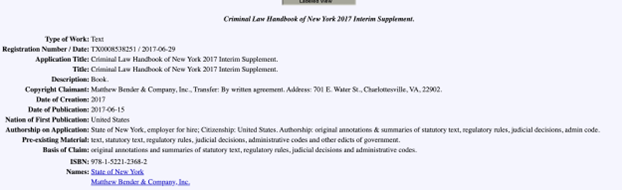
In the federal government's Copyright Registry, the "State of New York" is the registered author, and/or owner, and/or prior owner, of many copyrights, including this one:

screenshot of NYS copyright registry

In the registration shown above, the "State of New York" is listed as the author of the registered work as an "employer for hire"...meaning that the State is not only positioned to author original works that qualify for protection, but can even assign those copyrights just like any other free-lancer.[3]

Of course, much of the text generated and maintained by the State of New York is intended for public use, and in some instances, the State has declared it to be "in the public domain".

For example, in 1973, the New York State Attorney General declared that all New York "codes, rules and regulations" are in the public domain and are not subject to copyright (which makes sense; how can a lawsuit be filed if quoting too much law was an infringement?). On the same opinion, however, the NY Attorney General stated that material included in an official compilation of the codes, rules and regulations--but not actually part of the text--is protected by copyright of the Secretary of State (this is what is shown in the registration above).

So, what insight does that give us? The State of New York (and any department thereof) can both own works protected by, and generate works subject to, copyright. Some state-authored materials, however, may be deemed to be in the public domain. There is no over-arching rule; it is content-specific. So, when using works generated or published by the state, caution is just as warranted as with any other author.[4]


Thank you for a great question!


[1] Your tax dollars at work!

[2] Here it is (for more info, visit https://www.transportation.gov/regulations/time-act)

               The Uniform Time Act of '66

               Created nine zones to restrict

               Local authorities who set their clocks

               At a sunshine whim, creating blocks

               To orderly travel and safe crossroads

               'Til somebody had to take control...

               Who are these chronoscient powers-that-be?

               The Time Lords at the USDOT

[3] If anyone wants to FOIL a copy of that work-for-hire contract, I would love to take a look at it. Maybe if we get an intern....

[4] The library community seems to be investigating this topic perpetually. And good news, helpful resources/guides have ongoing development. For example, the article “The state copyright conundrum” by Kyle K. Courtney (https://crln.acrl.org/index.php/crlnews/article/view/17438/19245) describes context around the uncertainty in government document copyright status as faced by librarians and archivists, and points to this resource made by a 2014 Harvard Library Office for Scholarly Communication, Copyright Fellow, Katie Zimmerman: “State Copyright Resource Center”, http://copyright.lib.harvard.edu/states/. Bonus points for the beautiful functionality of the interactive U.S. map, that leads to state-specific guidance on govdoc copyright considerations.


Reviewing Deed of Gift and Loan Forms

Submission Date

Question

"Ask the Lawyer" got a question from a member: "Can you review our deed of gift and loan forms?"  We helped them out on a confidential basis, but we're using their question to inspire this guidance on implementing or updating a suite of policies for accepting and managing gifts into your collections.

Answer

The State of New York has very strong feelings about collecting cultural assets and information.  So strong, that such collections are governed by a host of laws, regulations, and policy.

Precisely which laws, regulations and policy apply to a collection depends on the type of entity doing the collecting.  Museums, historical societies, archives, and libraries all fall under their different (but overlapping) conditions. And before the law takes the wheel, the formation documents of an entity control what items fall within their mission, and what items don't make the cut.

So, for a simple question like: "Can you review our deed of gift and loan forms?" be ready for this response:

Yes!  We can review your deed of gift and loan forms.  To make sure the review supports your mission, is consistent with your governing documents, and ensures compliance with relevant law and regulation, can you send us:

  • Charter or Certificate of Incorporation
  • Bylaws
  • Collection Management Policy
  • Most recent form 990 or CHAR 500
  • Insurance Summary (optional, but it helps to know the extent of insurance coverage for both owned and borrowed items)

Now, if your institution needs your forms reviewed, and you can't find these things, don't worry, we can help you find them.  Also be prepared for a quick phone call asking if there are any current disputes involving collection items, and to discuss any specific goals you have for the forms.

When reviewing gift forms, the goal is always to ensure that the contract terms created by the form are consistent with the law and foundation documents that will govern the institution's receipt of the gift.  The makes a form more likely to withstand a challenge from an angry relative, or during an internal dispute.

So, no matter what lawyer reviews your forms, be ready to give them a dossier of documents!

Thanks to the member out there who put up with me while I kept asking questions!

Undocumented and unclaimed items in collections

Submission Date

Question

We have a couple of questions relating to Section 233-A of NYS Education Law, the "Museum Property Law". The law as written seems to only address totally undocumented objects and recent loans, but it also seems to have clear implications for the many partially documented objects and very old loans we have to deal with. As we all have slightly different ideas of how to stretch the law to fit our situation, I thought it would be best to get a legal opinion rather than trusting our common sense.

1) Regarding “undocumented property”: How much documentation is required for a donation to have sufficient written proof of legal transfer of ownership?

In the collections, we have a significant number of donated items which do not appear to have deeds of gift clearly transferring title from the original owner to the museum. They do appear in our ledgers along with the names of their donors, and sometimes have information confirming the link between donor and object on a vintage card cataloguing system – however, these forms of documentation are not a contract like the deed of gift, or even a piece of correspondence that shows an intent to donate.

In your reading of the Museum Property Law, should we consider such property to be undocumented, and to require similar measures to gain title? (That is, advertisement in local papers, followed by a period of advertisement on the state comptroller’s website.) Should we follow a similar procedure as with unclaimed property, despite these items not having been intended as loans? Or can we consider them to be documented, since we know the donors, and treat them like any other object when it comes to deaccessioning.

2) Regarding “unclaimed property”: How much of an effort is considered “good faith” in seeking lenders of very old loans?

The vast majority of the items we would consider unclaimed property were lent in the 1940s-1960s. From the research we’ve done into the lenders, they appear to be deceased, and in many cases their children are also deceased.

The law is written in such a way that it seems to presume all unclaimed property is the result of a recent loan that is still technically the property of a living person, which causes us some difficulties. It presumes that sending the lender a certified letter to their last known address will notify the person who currently owns the object. However, in our situation, as the original lenders are deceased someone else would have inherited their property – and in some cases, that heir would have left it to someone else in their own will.

If we know that a lender is deceased, are we still required to send them certified letters? Are we required to seek out their next of kin, and if so, are we required to continue seeking next of kin until we find a living relative? Is seeking permission from next of kin actually counterproductive, in that it could open us up to a lawsuit from a non-next-of-kin heir?

Thank you for any assistance you can give.

Answer

[NOTE:  For some initial background on New York's law governing museums and loaned/donated items, see Special collections not recorded on institution's ledgers]

On its face, NY Education Law 233-aa seems straightforward, but as the member's questions point out, it requires the consideration of a lot of details.

To answer the question while addressing those details, I'm going to use a story to give my answers some focus.

The Story

When I was in third grade,[1] a schoolmate brought her grandfather's shillelagh,[2] a family heirloom from Ireland, into school for "Show & Tell."

Before and after our "Show and Tell," the shillelagh was kept in my classmate's locker.

You probably know where this story is going.  At some point after "Show and Tell," the shillelagh went missing. 

I can still remember my teacher making the announcement, casting a discerning eye at my fellow third-graders, trying to pick out the criminal.[3]

To the best of my knowledge, that family heirloom has never been found.[4]  But because I am the sort of person who is very into both heirlooms and true crime mysteries, every few years, I find myself wondering where it is.[5]

But let's pretend that sometime in 1981, whoever took it that day held onto it for a bit, and then-- realizing they had no need for a hot shillelagh--hastily left it on a museum's doorstep with a note reading: "I thought you could use this, so here you go.  Sincerely, I.M. Purloiner." 

And to make my scenario work, let's further pretend the museum, finding an antique shillelagh to be within the scope of its mission,[6] accessions the item into its collection, and never hears from "I.M.  Purloiner" again.

And with that scenario to work with, let's answer these questions.

How much documentation is required for a donation to have sufficient written proof of legal transfer of ownership?

If a museum has any contemporaneous records showing that an item, when dropped off, was a "donation," unless there are circumstances to the contrary, I am comfortable saying the museum can regard the item as its own property.

In the member's scenario, that record would be a routine practice of recording items as either loans or donations.  In my scenario, there isn't quite enough (nothing shows an intent to transfer the ownership).

Of course, nowadays, there are very precise requirements for ensuring donors are aware of the terms of a gift to a museum.  For example, Education Law 233-aa (3) requires:

Prior to the acquisition of property by gift, a museum shall inform a donor or prospective donor of the provisions of this section and shall provide a donor or prospective donor with a written copy of its mission statement and collections policy, which shall include policies and procedures of the museum related to deaccessioning.

But what about, as the member writes, documentation of items from before the law was in effect?[7]  Again: if a museum can show a customary practice of accepting donations by recording them in a particular way, I believe it can make a compelling case that the title (ownership) of the piece was transferred to the museum at the time of the intake.

I base this conclusion, in part, on the law's definition of a "loan" and a "lender":

The term “loan” means a deposit of property with a museum not accompanied by a transfer to such museum of title to the property.

The term “lender” means a person legally entitled to, or claiming to be legally entitled to, property held by the museum or, if such person is deceased, the legal heirs of such person.

That said, if there is no record of how an item was accepted (as either a donation or loan), the only presumption I can endorse is that the item was a loan.

Which brings us to the member’s next question: In the collections, we have a significant number of donated items which do not appear to have deeds of gift clearly transferring title from the original owner to the museum. ...  In your reading of the Museum Property Law, should we consider such property to be undocumented, and to require similar measures to gain title?

Building on the idea that if there is clear evidence that the property was accepted as a gift--even if not through a "deed of gift" or other typical instrument--I would regard it not as "undocumented" (which means there is no reliable information as to the lender or donor), but as a donation.  On the flip side, if accepted as a loan, I would again not regard it as "undocumented," but rather, as "unclaimed" property, as contemplated by Section 7 of the Education Law 233-aa:

Unless there is a written loan agreement to the contrary, and notwithstanding any other provision of law regarding abandoned or lost property, a museum that has made a good faith and reasonable search for the identity and last known address of the lender from the museum records and other records reasonably available to museum staff may terminate a loan for unclaimed property in its possession in accordance with the provisions of this subdivision. [emphasis added]

Which brings us to the member's next question:  Regarding “unclaimed property”: How much of an effort is considered “good faith” in seeking lenders of very old loans?

There is no magic formula for "good faith" (in this context), but in general, if a museum feels it can show it has used all available resources, without undo time and expense, it should be able to demonstrate it.

The trick to "good faith" is being able to show a meaningful, genuine effort.  Does it mean a museum has to hire a private investigator to establish the identity of a person who left a shillelagh on its porch in 1981? No. But if a known lender with a known address is recently deceased, and a list of heirs can be obtained from the Surrogate’s Court in their county (for free or a nominal copying fee), should that be done? Yes.

This brings us to these final questions:

If we know that a lender is deceased, are we still required to send them certified letters?

If it is known that the lender is deceased, the letter should be addressed to their heir, if possible. 

Are we required to seek out their next of kin, and if so, are we required to continue seeking next of kin until we find a living relative?

It is not the next-of-kin, but the "heir" who should be sought (the terms are not synonymous[8]). 

How does a museum identify a deceased lender’s heir?  That information can "reasonably" be sought in the Surrogate's Court in the county of the lenders' last known residence.  And if the information isn't there, I feel comfortable saying that a documented attempt to locate it there is all that is needed to show "good faith."

Is seeking permission from next of kin actually counterproductive, in that it could open us up to a lawsuit from a non-next-of-kin heir?

As I say, because of how 233-aa defines "lender," it is not the next-of-kin who should be sought, but the "heir."   Of course, doing the right thing is never a guarantee that a museum won't be sued...but if there is a legal action, or threat of one, efforts to find the "heir" will establish a "good faith" attempt to follow the law, which will position a museum to legally defend its actions.

All of which brings me back to my classmate's missing shillelagh.  If the museum in my scenario decided it wasn't comfortable with the manner in which it was acquired, and wanted to firm up its claim to the item (or return it to its owner), that is when a museum can follow the process for "undocumented property" and publish a notice meeting the requirements of 233-aa.

I hope this walk through the details (with a shillelagh), has been helpful.


[1] Circa 1981.

[2] What's a shillelagh (pronounced "shill-lay-lee")?  It's an Irish walking stick; for more info, see https://en.wikipedia.org/wiki/Shillelagh_(club).

[3] It was not me.

[4] I resisted the urge to jump on Facebook and find my former classmate to ask.  What a random, creepy question to ask after 30 years of silence.

[5] If by any chance you are reading this in the Central New York area and happen to know, please send me a note at adams@losapllc.com.

[6] The Museum of Wooden Tools?  The Museum of Walking Sticks?  The Museum of Irish Implements?

[7] 2008.

[8] This is why it is important to try and get the information from the Surrogate's Court.  A person may die and deliberately disinherit their next-of-kin, while designating other heirs.

Enforcing Code of Conduct

Submission Date

Question

The New York Archives Conference recently posted a formal Code of Conduct (https://www.nyarchivists.org/nyac/code). While discussing our procedures for implementing this code, we began to wonder about the legal implications for enforcement. Are there any considerations for the standards we use in evaluating a complaint? What should we use for the burden of proof? To what extent are we empowered to investigate claims? What happens if someone challenges any resulting board action? Can we be sued for taking action and besmirching someone’s professional reputation? To summarize, we're wondering what legal ground we can stand on while enforcing our code of conduct.

It would be great to have a response before our conference on June 11. Thank you

Answer

Before I dive into this meaty and spectacular[1] question, here is a necessary disclaimer: this answer does not apply to chartered libraries.

Who does it apply to?  The following:

  • New York State Education Department chartered or incorporated museums, archives, historical societies, and other non-public entities;
  • Not-for-profit charitable corporations (like a "Friends of the Library");
  • Clubs, fraternal organizations, benevolent societies (like a knitting club, a bike club, or athletic league).

Specifically excluded from this answer are municipal, school district, and special district libraries, because their rules of conduct must accord with state and federal requirements of due process.  Indian[2] and association libraries must also be cautious about this issue, since the law and practices that form those libraries may have express and at times unique provisions about access.[3]

So, to be clear: NO PUBLIC LIBRARIES should rely on this answer (unless you are using it to help a private museum answer questions about enforcing its code of conduct). [4]

Okay, with that established, here is the answer:

At the heart of this question is the charter (or certificate of incorporation) and bylaws of an organization. Close to the beating heart are its policies.

In New York, most not-for-profit organizations are made "official" through a filing with the NY Department of State.  However, many cultural not-for-profit organizations (including the New York Archives Conference) are made "official" via "chartering" or "incorporating" through the State Department of Ed. 

Both types of entities--"chartered" organizations, and "not-for-profit corporations"--are "real" entities, created by law. 

It is this act of creation--through charter, or incorporation--that sets the stage for how an organization gathers its participants and conducts its business...which is exactly the member's question.

So, before anything else, to determine "what legal ground we can stand on while enforcing our code of conduct" one must look at those documents, which are the key to the identity of the entity.

In this case, the Conference's certificate of incorporation[5] says nothing about membership criteria, but the Conference's Constitutions and bylaws[6] say:

3.1 Membership. Membership shall be open to all persons interested in the purposes of the Corporation. The Members and Board may establish such other criteria for membership, including a schedule of dues, as they deem appropriate.

Meanwhile the Conference's membership terms on its website[7] state:

The constitution and by-laws reflect as much as possible the traditional informality of NYAC. Traditionally, membership in NYAC has been based on attendance at an annual meeting. A single attendance put a person’s name on NYAC’s mailing list for a long time, resulting in a cumbersome list with many out-of-date addresses.

The membership year will coincide with the fiscal year of NYAC, from July through June. The annual meeting registration fee will include the membership dues (currently $15.00). For people unable to attend the annual meeting, membership dues should be sent to the NYAC treasurer to ensure receipt of the following year’s program. If, by some strange chance, a member pays the annual dues prior to conference registration in a given year, his or her registration will be reduced accordingly.

The authority of the Conference's board to adopt the criterial for membership, including adherence to a "Code of Conduct" that can apply to members (and guests), is found back in the bylaws, which state:

4.2 General Powers. In addition to specific powers delineated in the By-Laws, the Board may adopt such rules and regulations, not inconsistent with the Certificate of Incorporation, the By-Laws, or applicable laws, as it may deem proper for the conduct of its meetings and the management of the Corporation.

The "Code of Conduct" the member's question links to is one of the "rules and regulations" mentioned in Bylaws section 4.2.   

Looking at the Code, you can see that it encourages certain (welcome) behavior, and bars certain (unwelcome) behavior, with the following being used to enforce the requirements:

All participants are expected to observe these guidelines during the conference or any NYAC proceedings, including virtual settings. If you may witness or experience any inappropriate or harassing behavior please report this concern using the form below.

Dial 911 for immediate medical emergencies or to report a crime. All reports to NYAC will be followed up and taken seriously in order to protect our participants from further abuse. 

The policy then sets out multiple options for reporting, including an online form, which states:

We can't follow up on an anonymous report with you directly, but we will fully investigate it and take whatever action is necessary to prevent a recurrence.

...all of which brings us to the member's question: how can this be enforced?

First, it is important to consider just what is being prohibited. Here is the list from the Code (as stated at the bottom of the Code, this policy is inspired by Codes adopted by other archival organizations):

Unacceptable Behavior: 

NYAC does not tolerate harassment of any shape. If any participant engages in any demeaning, abusive, coercive, discriminatory, or harassing behavior, appropriate consequences will be taken against such individuals. This could result in something as minimal as a warning or more serious as being handled by the authorities. Harassers may lose privileges to the conference(s). 

  • Threats or acts of violence.
  • Intimidation or stalking.
  • Disruption of any speakers/panelists or any conference proceedings
  • Derogatory or unwelcome comments regarding a person’s race, gender, sexual orientation, religion, disability, lifestyle choices and practices.
  • Inappropriate physical contact or unwelcome sexual attention.

Second, it is important to establish: as a not-for-profit corporation operating in New York, the New York Archives Conference already has to follow the below-listed laws:

  • Conflict of Interest requirements of the Not-for-Profit Corporation law;
  • (If it ever had the right amount of money or employees, or wants to meet some donor criteria) the Whistleblowing requirements of the Not-for-Profit Corporation law;
  • The New York Human Rights Law (barring illegal discrimination on an array of characteristics[8]) and other civil rights laws.

So even without such a policy, there is not only authority, but could be an obligation, to receive reports of certain behavior, and deal with them as required by law. 

A good example of this, from the Code, would be derogatory comments based on sexual orientation (which could be a violation of New York's bar of sexual harassment).

Third, it is important to consider that some of the conduct listed in the Code is criminal.  Examples of that include:

  • Stalking
  • Threats of violence
  • Unwelcome physical contact (this is of course highly fact-specific)

For instances involving the alleged commission of a crime, a report and investigation could quickly become complicated by questions such as: will the reporter want to contact law enforcement?  Does the venue have an obligation with regard to the incident?[9]   Does the Conference have evidence that could later become relevant in a criminal proceeding? 

And finally, it is important to see that this Code requires conduct that "rises above" the bare minimum set by various laws.

For instance, the Code bars interruptions, rudeness, and demeaning conduct.  While sometimes such conduct can be a part of illegal "harassment" or even "coercion," barring even one minor instance of such conduct is more about setting the professional atmosphere for the Conference, rather than simply obeying the law.

"Setting the professional atmosphere" for an organization might also be called "setting the norm."  By adopting this Code, the Conference is setting a norm of courtesy and respect, ensuring members are not interrupted or jeered when participating in Conference activities. 

So how does the board enforce this "professional atmosphere"?

I could go on and on about the law,[10] but I have 5 tips:

Tip #1: Model the behavior you require.

The best way to enforce a Code of Conduct is to ensure the leadership within the group visibly complies with it (this will also ensure compliance by directors and officers, which will help avoid legal complications).

Tip #2: Repeat the rules often.

It may leave leadership feeling like a broken record,[11] but when it comes to new norms of behavior, repetition is your friend.  It is great that the Code has its own sub-page on the Conference web site; for an event or meeting invitation, a link should be on all materials.  Conference event leaders and speakers should get at least a 15-minute orientation on how to comply with and benefit from the Code during events, meetings, and online discussion (I am a fan of training through role-play).  The board should revisit the Code at least once a year to discuss specific incidents and assess if the institution's response requires refinement. 

By repeatedly describing and addressing the norms, they will be built into the foundations of the organization.

Tip #3:  Follow through on enforcement.

The Conference's Code says "All reports to NYAC will be followed up and taken seriously in order to protect our participants from further abuse."  What does that mean? That each report must result in a final summary as to how the incident was handled.

Unfortunately, there is no one way to ensure this level of follow-through.  Some instances may be resolved simply by a discrete chat with a person to let them know that their romantic overtures are inappropriate.  Other incidents may warrant an announcement to all attendees at an event ("We received reports of numerous interruptions.  We want to emphasize that this is a violation of our Code of Conduct."), as well as more private action directed to specific individuals (a letter or warning).  Still other incidents (hopefully very rare) could result in ejection from an event and/or a report to law enforcement.

The trick is that for every report received, there be a good summary of the reported conduct, and a thorough "final summary" as to how the incident was investigated and resolved.  Again, there is no one-size-fits-all for this: some instances might be resolved with a paragraph ("The attendee was told that for the remainder of the Conference, no interruptions would be tolerated, and she agreed"), others could result in multiple pages and coordination with other organizations (for instance, if two co-workers get into a screaming match and call each other discriminatory names, be ready for lots of paperwork).

Tip #4: Have an established team, and a back-up team, to handle reports.

A reported incident under a Code of Conduct is not a trip for a part-time volunteer to fly solo.

Even if a report seems straightforward ("I sat down after presenting and PERSON gave me a long hug that made me very uncomfortable"), handling reports under this Code is not a one-person job.  There are too many variables[12] that can trip up even the most diplomatic and well-intentioned individual. 

If you are a designated report recipient, you need calm, steady back-up.  This is why having a pool of at least six people who know the Code, and are ready to respond to a report, is critical, and using no less than two people to respond to each report is also important.

Tip #5: Know when to bring in a pro.

The member has asked:

Are there any considerations for the standards we use in evaluating a complaint? What should we use for the burden of proof? To what extent are we empowered to investigate claims? What happens if someone challenges any resulting board action? Can we be sued for taking action and besmirching someone’s professional reputation?

These are excellent questions fueled by perceptive concerns; even the most professionally handled investigation with maximum due process can lead to distrust, the forming of factions, destabilization, and even (as the last question alludes) claims of liability.

How does an organization avoid that?

For a policy such as this Code of Conduct, at an all-volunteer organization, it is good to have a sense of what things can be handled in-house, and when it is time to call in an expert.

Here are some broad guidelines for when to bring in a ringer:

  • If there is an allegation of criminal conduct, especially if there is an allegation of physical abuse or stalking;
  • If there is an allegation that-if true-would lead to suspension or permanent ejection from the organization;
  • If there is property damage.

Now, when I say "bring in a ringer," I don't mean a person to take over the whole investigation (although they may).  And I don't necessarily mean a lawyer.  I simply mean a person with the professional skills and past experience to help the organization consider issues beyond the Code, but critical to the organization: risk of personal harm, liability, legal compliance, insurance, and (a distant fifth, but still important) public relations.

For issues that are going to result in a "soft" correction ("Hi, we know people hug here on occasion, but please know that unless a person has told you it is okay to hug them, it's a Conference rule that you refrain"), there is no need to consult a pro. 

But for "hard" corrections ("After repeated warnings regarding physical contact, you continue to impose unwelcome physical contact, and we must ask you to leave the Conference immediately") it is good to quickly check in with a pro.

For example, if I was consulted on the above "inappropriate hugging leading to a ban" scenario, I would ask:

  • Is/are the complainant/s injured?
  • Is/are the complainant/s the recipients of the hugs, or a third party?
  • When was the hugger last spoken to about this?
  • Who has witnessed the behavior?
  • Is the person a paid speaker or ticketed attendee?
  • What dynamics are at play?
  • What is the venue?

I would then work with the client to craft a swift but thorough response that ensured clear documentation of the occurrences, ruled in or out any allegation of injury or illegality (a very prolonged hug can be a criminal act, or just a very welcome gesture, depending on the details), used a risk analysis to adopt an immediate response, and developed a clear path forward to effect a resolution.

The good thing is, with the power of leadership modeling, repetition, and training, most complaints will be in the "soft consequences" zone ("I was speaking and PERSON interrupted me to tell me our approach was 'junk' and say how much better their database would handle the content; I just want to know that you have let them know that is unacceptable.").[13]

If a serious complaint does come along, there is no "catch-all" due process I can recommend for responding.  However, I can say that for each report, each response should follow this pattern:

  • A written statement of the complaint (held in confidence by the Conference; there is no need to share this document with any party, and it should be considered confidential) NOTE: This is the phase where you consult an expert if things are serious;
  • An initial assessment as to if the complaint is bona fide (if it isn't, you document that, and things end there, except perhaps to explore if you need to address a confabulated allegation);
  • A process for collection of relevant evidence and designation of an appropriate deadline for wrapping up the process;
  • A consistently applied means of evaluating the evidence;[14]
  • If there is to be action based on a finding of fact, a chance for the accused party to set forth their perspective on the accusation (a private organization has no obligation to share evidence in this type of proceeding, and shouldn't, without very careful planning);
  • A final summary as to how the report was resolved (a "soft" resolution simply advising an accused party of the rules, but no penalty, or a "hard" resolution with conditions imposed), and how the resolution can reinforce the norms of the Conference (does there need to be both a "private" and "public" resolution?)

In my experience, where all-volunteer organizations get in trouble is when a serious complaint (such as a complaint with injuries, or extreme rancor, or challenging harmful norms in the organization) is sat on (meaning: no action is taken, because they just don't know what to do).  This, along with early identification of risks and planning to avoid liability, is why I advise bringing in a pro for "serious" matters.

Other than the "serious" matters, having a group of board members or a volunteer committee trained and ready to nimbly and promptly address concerns under the Code will be a tremendous service to your organization.  I applaud the Conference for adopting a Code, and for thinking about the details of enforcing it.

I wish you many challenging-but-polite, innovative-but-patient, and rigorous-but-respectful events. 

Thanks for a great question.


[1] I say "spectacular" because for me, questions like this are why I was first interested in studying law.  My whole career is based on a 30-year fascination with how the law impacts what we can do and say.  When a question stands at the apex of your life's work, that is "spectacular."

[2] I know "Indian" can be a controversial term, but that is the term in the law.  In New York, the chartered Indian Libraries are The Akwesasne Library and Cultural Center the Seneca Nation Library, and the Tonawanda Indian Community Library.

[3] New York Education Law Section 253, which enables the creation of chartered libraries in New York, requires that all such libraries be "free" to their areas of service, and of course there are regulatory requirements about access, and system rules about services throughout a system, so caution is warranted when it comes to items that could curtail access to a chartered library.

[4] Shoo.  Go away.  This answer is dangerous to you!!  (Ok, you can stay...but don't use this answer).

[5] Nerd note: The Conference is not a chartered entity, but rather a corporation formed through an application to the Regents.  This means there is no charter, but rather, articles of incorporation that bring it into "life."

[6] Found on May 24, 2021 at http://www.nyarchivists.org/nyac/wp-content/uploads/2011/03/NYAC_bylaws_rev2010_final.pdf.

[7] Found on May 24, 2021 at https://www.nyarchivists.org/nyac/membership-information/.

[8] Since the Conference has no employees, their obligations will not flow from employer status, but there are still contexts where the civil rights laws will apply.

[9] For instance, if stalking takes place on a college campus--even if the Conference just rented the venue--the incident requires a very precise response by the college or university.

[10] And often do.

[11] Is "broken record" still a thing?  Perhaps we should start saying "repetition code."

[12] Gender, cultural, class, language, power balance, race, religion, and perceived bias issues, to name just a few.

[13] Just a small note: when a policy like this is first enacted, it may feel like you are getting a lot of complaints.  Actually, this will be the very normal process of a group adjusting to newly established norms.

[14] The standard choices are "preponderance of the evidence" and of course "beyond a reasonable doubt."  Either is fine, it just should be uniformly applied.
Copyright protocols for restaurant menus

Submission Date

Question

(Question has been slightly modified to maintain anonymity)

We have been digitizing restaurant, hotel and other menus from our historical menu collection and have been following standard copyright protocols – but also making many case-by-case decisions based on things like whether of the establishment still exists, etc. (With only a couple exceptions I made for a faculty member who had permission of the restaurant owners, I haven’t scanned any menus from after 2000.) Our public collection site is used by students and researchers around the world.

My question is: can we scan and put online menus dated after 1977 (and especially more recent – up until 2021) if it is for educational purposes? If we do scan them, would we need permissions from every single chef/owner? The copyright status of menus in general has always seemed murky to me, but I don’t even know where to go to find clear answers for this situation.

Answer

Menus can be works of art.[1]

"Art" of course, is a subjective term, and has no precise, stand-along definition in copyright law.[2]  So more importantly for this discussion, a "menu" can be a composition of such originality and substance, that it is protected by copyright law.

This protection can be for the work as a whole (the entire menu), and/or it can be for individual elements in the work.  It can cover stand-alone elements (such as a cover photo image or flavor text[3] used to describe a signature dish), and, in these days of Slice and Grubhub and Yelp, it can be for the menu as a physical object, or a version published only online.  It can cover the original art in a trademarked logo, whether that art was generated by an independent contractor or employee.

Recent case law illustrates how these protections can be sliced-and-diced, and also shows just how nasty litigation over restaurant copyrights and trademarks can be.[4]  Menus and the logos and information they carry can be the apex of a restaurant's brand, reputation, and intellectual property.  So the member is right to take this concern seriously.

With care, however, the act of creating an online archive of carefully curated restaurant menus, for well-articulated academic purposes, should be able to find protection in the line of "fair use" case law building on the 2nd Circuit's 2015 decision in Authors Guild v. Google,[5] which relates to the creation of online repositories.[6]

As the Court found in that case: The purpose of the copying [to create the online resource] is highly transformative, the public display of text is limited, and the revelations do not provide a significant market substitute for the protected aspects of the originals.

The key to scanning and incorporating menus still under copyright protection into an archival database of menus at a library or educational institution, while taking advantage of the fair use defense set forth in Authors Guild, is to do so in a manner that:

  • Yields an asset that is useful beyond the mere replication of a single menu;
  • Ensures the archive will not enable use of its images in place of a copyright-protected original text or image; and
  • Uses an array of professionally developed standards to confirm and assert the academic and/or cultural value of the archive as a whole, and the inclusion of a particular work in that archive.

There are numerous techniques to achieve this.

First and foremost, the purpose of the archive should be developed and set forth on the archive in clear, well-developed terms. The database should not look like a group of menus simply gathered together by a person who happens to have made a collection of his favorite restaurants.[7] The cultural value and purpose of the collection should be stated in very certain terms, and consistently repeated throughout the archive's pages, cataloging text, and metadata.

Second, the function of the archive should be such that users can demonstrably benefit from the aggregated content and information. For instance, menus should be searchable by geographic region, type of food, notable characteristics, and other relevant factors...giving the aggregated content value beyond what is created by each individual entry.[8]

Third, the archive should adopt a standard approach to assessing and depicting the authorship, ownership, and copyright status of archived works.[9]

Fourth, the images themselves should be created so that a third party using the image cannot create a credible replica of the menu or the original originating restaurant's logo or copyright-protected content. A picture taken with a border, or the use of a watermark indicating that the image is part of the archive are some common ways to do this; technology creates many other and evolving options.

Fifth, since it will help mitigate damage in the event a copyright owner simply refuses to believe an archive has made a "fair use" of their content, the overall approach of the collection should be assessed using your institution's fair use assessment form, and that record should be kept. Why is that?  Being able to demonstrate a good-faith effort to establish that the use is fair can help mitigate damages, and can be a deterrent to a plaintiff pursuing a lawsuit all the way to a verdict.

Sixth, the "Terms and Conditions" of your online archive should feature a process for owners to report good-faith suspicion of copyright infringement, and your institution should have a registered agent as provided by the DMCA.  An example of this type of statement can be found in the DPLA's Terms and Conditions as of April 15, 2021: https://dp.la/about/terms-conditions[10]

Seventh, if you haven't, consider the benefits of registering an agent under the DMCA, and if it's a good move for your institution, register (you can look up and see if your institution already has an agent here: https://www.copyright.gov/dmca-directory/).

And finally, to the extent possible, for steps five, six, and seven, work with your institution's attorney, who can connect all these steps and the academic activity they support with your institution's insurance and risk tolerance.[11]

So, with all that as background, here are my answers to the questions:

Can we scan and put online menus dated after 1977 (and especially more recent – up until 2021) if it is for educational purposes?

Answer: Yes, copyright-protected materials can be duplicated if the use is fair; by following the cautions above, an institution can set itself up to both create a highly useful and important archive, to claim fair use, and to mitigate damages in the event of a worst-case scenario.

If we do scan them, would we need permissions from every single chef/owner?

Answer: if the use is fair, there is no need for permission...and in fact, asking for it could be introduced by a plaintiff as an admission that you concluded you needed permission.

Now, a word of caution on this: if your archive is part of a larger institution, the other departments of that larger institution need to be alerted that just because an image is on your archive, that doesn't mean they can use it for a catalog cover, a web site image, or a poster advertising your institution.  After all, a use that is "fair" for an academic archive might not be so "fair" if it is on a brochure for a program or event (even if the program or event is not subject to a charge).  This is especially true since menus will often feature not only copyright-protected material, but trademarks (which, unlike copyrights, do not expire if they are in continuous use).

The copyright status of menus in general has always seemed murky to me, but I don’t even know where to go to find clear answers for this situation.

Because the menus themselves can be protected by copyright--as well as the individual elements in the menus--that "murkiness" is here to stay. Unless a menu is clearly in the public domain, it is best to assume that it--or some part of it--is subject to copyright, and remember that a restaurant's name and logo are its intellectual property, too.  The reason an archival initiative can make this assumption, and still hope to achieve its objective, is because by carefully and deliberately assembling those individually protected elements, they are creating a broader work with value beyond each individual element.

The value of a collection of menus is likely obvious to librarians, academics, and information managers.  But just as an example of how valuable such a resource can be, even outside the field of scholarship, I'll share a personal anecdote: while working on a case for a neighborhood fighting a fast food drive-thru in their dense, urban neighborhood, I used the New York Public Library's digital collection to find a menu for the "Little Harlem Hotel" in Buffalo NY.  The menu was part of the research we used to make the case that the neighborhood has a history worth fighting for. 

We lost the case,[12] but that menu helped create a vivid argument about the history of the neighborhood and its vibrant legacy, and that argument was energized by the archive.  An online archive of menus can be important in countless ways; finding the right legal recipe to make it happen is worth it.

Thank you for a great question.


[1] If you are skeptical about "menus as art," check out the menu here, and tell me if the rooster doesn't convince you that he could be in a museum.

[2] "Visual art" does, and of course "art" as a general term is used regularly in copyright jurisprudence. But "art" remains a subjective term.

[3] Yep, that's a "flavor text" pun.  Yum.

[4] The 2019 case Khan v Addy's BBQ LLC, (419 F Supp 3d 538), involving former business partners operating BBQ joints in Tea Neck, NJ, and Elmont, NY, shows just how convoluted these things can get.  Another case from 2018, 784 8th St. Corp. v Ruggiero, 2018 US Dist LEXIS 5405 shows how copyright ownership to logos and menus can change based on who did the work; also, it shows that if you are in business with family, it is important to have a good lawyer!

[5] Authors Guild v Google, Inc., 804 F3d 202.  The Supreme Court denied a chance to review this case, leaving the 2nd Circuit's decision intact. 

[6] The database created by Google in the Authors Guild case was not a straightforward online archive like the one described by the member here.  However, the case is still applicable in several important ways.

[7] I know a professional archivist would not do this, but this is a very important distinction.

[8] Other "relevant factors" of which I, a food philistine living in the city that invented Buffalo Wings, and originally from the city that invented Chicken Riggies and Half-Moon cookies, am shamefully unaware.

[9] The approach of the Digital Public Library of America ("DPLA") happens to be my favorite, seen here in this document about the Erie Canal, but is not the only standard out there. What's important is that the institution identified a system that works for it--and then consistently uses that system.

[10] It would be deeply ironic if the DPLA sent me a "cease and desist" for linking to their excellent resources.

[11] Since every archive or library has a different structure and different approach, while inspiration can be drawn from fellow institutions, the final approach and policies should be reviewed by a lawyer for your institution whenever possible.  As just a threshold issue, state-affiliated institutions have different risk considerations than independent not-for-profits.

[12] It hurt to lose, but the damage to the neighborhood hurt more.

Archival materials, Privacy, and FERPA

Submission Date

Question

My institution has a small number of documents in our archives related to previous graduate students. Some are definitely educational records (transcripts, field placement evaluations). Then there are a) letters of recommendation received by the school or written by school faculty/administrators and sent to other schools, b) some correspondence between a student and the school/administration, and other items like c) copies of images or articles from student publications.

The documents span decades.   Most --- but not all--- of these former students are confirmed deceased. Most items in this small group of documents relate to alumni who were/are notable, but in widely varying degrees.

A few of these documents concern a famous alum, who passed away.  An outside researcher is asking about the documents related to that alum, and unfortunately, there are no surviving institutional access policies related to student records or unpublished correspondence in our archives. We want to respect copyright, FERPA, and the alum's estate.

For the educational records, I can't find clear guidance on how long FERPA access restrictions last, but other academic collections seem to allow access 50-75 years after the former student's death.

So, a few questions:

1) When should on-site access to historical educational records be allowed (if ever), with reference to FERPA? What about providing copies of historical educational records?
 

2) When should on-site access to unpublished, non-educational records related to former students be allowed, in reference to state and federal copyright and privacy laws, and possibly FERPA? What about providing copies of these documents?
 

3) Should we take a more risk-averse approach to high-profile alumni materials, or should our policies apply equally to all alums?

Answer

I am always fascinated by the transformation documents can undergo, simply by operation of law, circumstance, or time.  For instance:

  • Documents that are "education records" under FERPA can become simply "records," or "nothing" once the person to whom they pertain has died.[1]
  • Documents that are "private information" under New York's new(ish) SHIELD Act[2] are no longer controlled by the Act if the digital copy is swapped for a copy on paper.
  • Documents that use the "name and likeness" of a deceased performer, currently allowed, will be far more restricted when New York's new Civil Rights Law 50-f, which requires written permission for certain commercial uses, goes into effect on May 29th, 2021.[3]

And of course, documents can be "in" copyright, and "out" of copyright, or restricted due to medical content, or under terms of non-disclosure...restrictions that can shift based on any number of factors. 

An educational institution considering levels of access and use of student-related documents[4] has to consider not only these legal factors, but their unique policies.  Factor in fame,[5] and the stakes get even higher. 

Because of that complexity, I could muse/write/talk on this topic for hours.  But let's focus on the member’s specific questions:

1) When should on-site access to historical educational records be allowed (if ever), with reference to FERPA? What about providing copies of historical educational records?


If a former student is not deceased, there can be NO release of FERPA-protected education records to otherwise barred parties without written, dated consent.

If the former student is known to be deceased—or the passage of time suggests they might be deceased—then the records are no longer protected by FERPA, and that restriction no longer applies.

But as the member points out, there are other considerations.

2) When should on-site access to unpublished, non-educational records related to former students be allowed, in reference to state and federal copyright and privacy laws, and possibly FERPA? What about providing copies of these documents?
 

This is an interesting question because unless the records we're talking about ("related to former students") only contain "directory information,”[6] then they are by definition "education records" under FERPA.[7]  That is because the FERPA is intentionally expansive.  So old bills, dusty admissions files, and antiquated (but often fascinating) "administrative" records, although not "educational," per se, are still barred from release by FERPA if they relate directly to a student.[8]

BUT, as this question implies, FERPA isn't the only thing that could bar or restrict access to old records.  Copyright, privacy laws, and general prudence are all good reasons to not release institutional records unless there is a policy and process for doing so (like a policy for sending transcripts to future employers), or your institution is compelled to release them (like a judicial order or subpoena).

So, while a student will always have access to their records under FERPA, both former students and third parties should by default be barred from access or obtaining copies to records they are not entitled to.

Which brings us to:

3) Should we take a more risk-averse approach to high-profile alumni materials, or should our policies apply equally to all alums?

Many, but not all, educational institutions have internal archives—not formal "Archives" they hold in trust for the public (like the W.E.B. DuBois papers at University of Massachusetts),[9] but rather, materials they regard as important pieces of their institution's history and identity, so deliberately retain.

For some, this may be a complex and far-reaching catalog of institutional history.  For others, it may be simply hanging onto every program for every graduation ceremony.  And of course, for many, it will be special handling of any material that is related to famous or noteworthy alumnae.

Whether formal and well-funded, or informal and not funded,[10] every educational institution's internal archive should have a policy that covers: 1) that the archive exists to transition material from "records" into "archives;" 2) how those materials are selected; 3) how those archival materials are to be preserved; 4) how the archival materials are used and accessed internally; 5) how the archival materials are used and accessed externally; 6) the ethical standards and institutional values being applied in the overall operation of the archive. [11]

If an educational institution has in-house records of such magnitude that they warrant being their own archive (for instance, the Eqbal Ahmad papers at Hampshire College), yes, the development of that archive could warrant its own separate policy.  In that case, unique care would have to be taken to consider not only FERPA, but privacy laws, copyright (the author of an admissions letter is the copyright owner of that admissions letter...not the institution the letter was sent to, even if the institution retains the only physical copy).  

All that said, the end result need not be "risk-averse," so much as "risk-informed:" carefully assessing all the compliance concerns and risks,[12] how does an institution create an archive that suits its stated purpose and conforms to institutional ethics?  Until an institution is confident it has reached the right answer, access to third parties should not be granted, and only need-to-know access should be granted to those within the institution. 

I would like to thank the member for this question, it is a good one.  And I think we may have reached a new milestone at "Ask the Lawyer"—a reply where the footnotes are as long as the reply!

Thanks.  I wish you a well-resourced and culturally rich archive, and continue positive alumnae relations.


[1] See letter of LeRoy Rooker, Director, Family Policy Compliance Office, U.S. Department of Education letter of Date, found at https://studentprivacy.ed.gov/sites/default/files/resource_document/file/LettertoConnecticutStateArchivistRegardingEducationRecordsMay2008.pdf as of February 10, 2021, re-affirming "that the FERPA rights of “eligible students” lapse or expire upon the death of the student based on common law of privacy rights." [NOTE: This link was confirmed as no longer active and removed on 02/25/2022  as part of the routine review of "Ask the Lawyer" materials.]

[2] Text for this law can be found at: https://www.nysenate.gov/legislation/bills/2019/s5575.

[3] I am writing this on February 10, 2021. 

[4] This "Ask the Lawyer" answer does not address the issue of yearbook photos and student-generated art or academic work.  For that, see RAQ #108 and RAQ #91.

[5] What is "fame?"  It's a notion that is taking odd journeys these days.  As I said in footnote #3, I am writing this on February 10, 2021.  Jockeying with the impeachment proceedings for "fame" on the cover of today's digital New York Times: an article about a lawyer who appeared in virtual court as a cat.  I bet he can't wait for his 15 minutes to be over.

[6] "Directory information" includes, but is not limited to, the student's name; address; telephone listing; electronic mail address; photograph; date and place of birth; major field of study; grade level; enrollment status (e.g., undergraduate or graduate, full-time or part-time); dates of attendance; participation in officially recognized activities and sports; weight and height of members of athletic teams; degrees, honors, and awards received; and the most recent educational agency or institution attended.

[7] Here is the actual definition: "...those records that are: (1) Directly related to a student; and (2) Maintained by an educational agency or institution or by a party acting for the agency or institution."

[8] There are exceptions to this, of course...one big one being the records of campus police.

[9] I value this archive because it has letters between W.E.B. DuBois and Mary Talbert, a Buffalo resident who was a stalwart organizer for civil rights and, on the side, historic preservation (she led the effort to save the house of Frederick Douglass).  I read her letters when I need a shot of pragmatic inspiration.

[10] Some "archives" exist because some wonderful employee couldn't bear to see institutional history thrown out, and they got permission to buy some boxes and put the "archives" in the storage closet. 

[11] The "Ask the Lawyer" from November 4, 2020 has more about ethical considerations for archival projects: RAQ #178.

[12] For this question, "risk" is not just legal risk, but relational and reputational risk, too.  After all, it might be legal to share a harsh evaluation from a thesis committee related to the work of a long-dead student...but is there value in doing it?  (Of course, there might be).  Knowing why something is in the archive, and having full confidence in that reason, is just as important as preserving the record in the first place.