
Archives

Online posting of area drone pictures

Submission Date

Question

One of our member libraries has asked me the following question:

"We'd like to create an online catalog of drone pictures of our area. What do we need to consider? We know people are posting these pictures on Facebook, and we'd like to request permission to collect them all in a catalog on our website. Please let me know any technical issues or legalities we need to keep in mind. I think it's a good idea, but I don't know exactly how to implement it."

Are drone pictures copyright free as they are in other people's properties and cover large areas? Is it legal to post drone pictures without permission?

Thanks for any thoughts on this topic!

Answer

This is a cool idea—aggregating and cataloging drone shots.   Someone fifty years from now will be very, very grateful for that type of work!

But as the member points out, there could be some technical or legal issues, namely: copyright, privacy, and security.  How does the library make sure none of those concerns negatively impact the project?

Let's take those in order.

Legal Concern: Copyright

This one is pretty simple: with one exception, the copyrights to pictures taken by a drone are owned by the operator(s) of the camera, who usually (but not always) is the same person/people flying the drone.  They are never the property of the area photographed (unless the property owner is also the photographer).

What is the "one exception" to that ownership?  If the photographer is taking the drone images as part of their regular job,[1] the copyright will belong to their employer (for example: if the drone shot was taken by the photographer to illustrate a story in a newspaper).[2]

Once the library establishes the copyright owner, the only copyright-related impediment to including the images in the catalog would be if the owner had sold the copyright, or given someone else "an exclusive license," since that would mean they could no longer license the images to your library.  Other than those complications, with the right agreement,[3] permission and use should be simple.


Legal Concern: Privacy & Security

The "copyright" section, above, is fairly simple.  Things are a bit more complex when it comes to privacy and security.

There is a huge array of drone-shot content that I could see risking a violation of privacy or a threat to security.  Here are the most common I could rattle off at a cocktail party:

  • The risk of the images being the result of "Unlawful Surveillance,"[4] which is an “E” Felony in the state of New York.  "Unlawful Surveillance” is (among other things) taking a picture of a person dressing (or undressing) in a place where that person has a “reasonable expectation of privacy” (and they haven't agreed to pose for the picture);[5]
  • The risk of the images being a violation of a person's "right of publicity,"[6] which is using someone's image for commercial purposes without their written authorization.  For instance, if the images were found on a site where they were being used for a commercial purpose.
  • The risk of the images being the result of, or evidence of, trespass, harassment, and other criminal law violations that could result from a person deploying a drone over a residence, business, or area near an airport.

In addition to my "rattle it off" list, I did some research.  If we leave out the restrictions of reconnaissance and targeting drones, there is one other drone-related “no-no” to be wary of:

  • The risk that the images are the result of harassing sea otters.[7]

In most of these concerns, it is not the act of including the images in the catalog that would be the legal issue--but rather, that the images themselves could be proof of a legal violation.  We’ll address that more in the last section.


Legal Concern: FAA-restricted Areas

The Federal Aviation Administration’s rules for academic, hobbyist and other forms of non-military drone use are here:

https://www.faa.gov/uas/public_safety_gov/media/FAA_UAS-PO_LEA_Guidance.pdf. [NOTE: This link was confirmed as no longer active and removed on 02/25/2022  as part of the routine review of "Ask the Lawyer" materials.]

I won't re-hash them, but the FAA does not bar taking pictures—just flying at certain locations and times.[8]  However, all operators--whether hobbyists or professionals--have to avoid certain areas at certain times. 

The FAA maintains a list of those areas, as well as a list of designated recreational UAS flight zones, available here:

https://www.faa.gov/uas/recreational_fliers/where_can_i_fly/airspace_restrictions/

This was so cool, I looked up my part of the state:
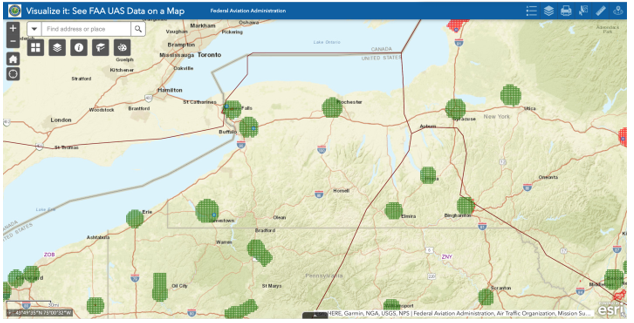
Restricted airspace map of Western NY

And now I know where not to fly the drone I don’t own.


Sample License for Use of Drone Pictures

Once you have confirmed that any drone shots your library would like to use are not: the result of or evidence of a crime, taken in forbidden air space,[9] or otter harassment, here is a sample license for securing permission to include them in an online catalog:


IRREVOCABLE, NON-EXCLUSIVE LICENSE

[NAME] ("Photographer"), an individual residing at [ADDRESS], and at least 18 years of age, hereby gives the [NAME LIBRARY] (the "Library") an irrevocable, non-exclusive, transferable license to use an image entitled [TITLE], a copy of which is attached hereto as "A" (the "Image"). The permission to use the Image includes unlimited use in any format now existing or later developed.

Photographer represents and warrants that the Image is their original work and that to the best of their ability to determine the rights of no individual or entity were violated by the creation of the Image.

In consideration of the rights granted herein, Library shall at all times credit Photographer with authorship and ownership of the photo as follows: This image is © [NAME], [YEAR], and is used by the [NAME LIBRARY] with permission from the photographer, who may be reached at [email address].


Signed by Photographer: _________________________.


Signed on behalf of the Library: ___________________________.


A Final Word on Getting "Permission"

This question was pre-packaged to consider issues of permission/legal concern related to images generated via drone, so I have structured it to give primary consideration of those issues.

However, I would be remiss if I didn't stress that when assembling an archive or image collection, worries about permission shouldn't always be a threshold consideration.

Why is that?  If a library or archive crafts the parameters of an image catalog around the purpose of that catalog—around why it is important to gather a certain type of content, within a certain range of criteria—permission might not even be necessary. 

Concerns about permission and legality should not prevent the assembly of a resource that has academic, documentary, or investigative value.[10]  And the more a collection or archive is shaped as a documentary, academic, or investigatory endeavor, the less the subject matter and content can pose legal concerns...or rather, the more protections[11] the project will be able to avail itself of.

Taking advantage of those exemptions starts with having a very clear scope for your project, a written set of ethics, and a statement of purpose for the endeavor. [12]

My takeaway in this final part of the answer?   If your project is of academic, historical, or social value, don't let lack of permission be a roadblock.  Instead, just like the member does in this question, set up a clear scope for your project, and then tackle any reservations head-on.  This will lay the groundwork for a strong archive or catalog.


Posterity will thank you.


[1] Head Photographer at "Drone Shot Weekly?"

[2] Here is the FAA guidance on media use of drones for newsgathering: https://www.faa.gov/about/office_org/headquarters_offices/agc/practice_areas/regulations/interpretations/Data/interps/2015/Williams-AFS-80%20-%20(2015)%20Legal%20Interpretation.pdf [NOTE: This link was confirmed as no longer active and removed on 02/25/2022  as part of the routine review of "Ask the Lawyer" materials.]  It’s interesting: even if using a small drone, such use doesn’t qualify for the “hobby” exception, and the drone should be registered.

[3] Do you need the “right agreement?” See the section of the answer called "Sample Agreement" for an example.

[4] NY Penal Law 250.45

[5] JUST TO BE CLEAR: I have 100% confidence that if a library comes across a creeper nude drone shot, they will not include it in an online catalog!  I am just being thorough.

[6] New York Civil Rights Law Section 50.

[7] Per 50 CFR 18.137: "Unmanned aerial systems or drones must not cause take by harassment of sea otters. Measures for avoidance of take may be required in an LOA, and may include maintaining a minimum altitude and horizontal distance no less than 100 m away from otters, conducting continuous visual monitoring by PSOs, and ceasing activities in response to sea otter behaviors indicating any reaction to drones."

[8] Thank you, THANK YOU to the member who sent this question.  Because of you, I got to read the FAA's guidance to local law enforcement for drone-related incidents, which includes this practical guidance "NOTE: Battery life is typically 20 to 30 minutes." 

[9] By the way, it might not be precisely forbidden for your library to post such images, just as a newspaper or academic publisher might reproduce them for purposes of news or scholarship.  But since those categories come with some higher risks (particularly of being told to cease and desist), it is wise to consider consistency with the purpose and ethics of your archive before including them.

[10] I am not saying to not consider them...just don't let them be project-killers.

[11] Such as fair use, journalism privileges, and recognition of the non-commercial nature of the use.

[12] Links to further "Ask the "Lawyer" content on this specific consideration (ethics as a key component to rock-solid archives) are here: RAQ #172 and RAQ #178.

Archiving images of minors in organizational online collections

Submission Date

Question

Our archive was part of a regional project to initiate, scan, and make available church records from predominantly African American churches within a city. As part of this project, student/graduate assistants went to the particular churches, scanned the historical records as digital files, and provided those files to [our archive] for public access.

My question is in regards to photographs taken of minors and the restrictions for retention and online display. I would not have selected those particular items for retention, but because I was not on-site during the scanning, I have the files as part of the larger record (church programs, organizational records, committees, etc.). We have signed permissions from the church administration for online access and display of their records. In some cases the photographs are from over 20-40 years ago, in some cases they're much more recent. They're taken at private church events, Sunday school classes/activities, and public events--some as part of photo albums and some as individual files.

I'm struggling with how to treat these photographs and any associated records when I know they display minors. Any advice or direction would be greatly appreciated.

Answer

This question is at the vertex of the law and ethics.  What an institution may be positioned to do with archival images legally might not be what our society demands ethically.  And if the issue impacts real people with real feelings, this conflict can lead to legal claims—regardless of solid footing based on precedent and the law.[1]

When it comes to images of children, who can't legally consent to the use of their images, the ethical issues arising from agency, respect, and self-determination are all the more critical.

The member clearly knows this, and is seeking a direction for assessing how to access, catalog, and use them—if at all. The law is often too blunt an instrument to assess ethical questions, but in this case, I believe the legal steps for assessing the use of such such images can provide a framework for the deeper assessment of the ethical considerations[2] .

Below, I will list the "legal" steps an attorney considers when reviewing a museum or archive's acquisition, but focus on the ethical considerations connected to those factors, especially with regard to use of images of children.

1.  Ownership of the Physical Object

This stage is where an institution looks at the provenance of the object and, if that physical object is to be transferred to the institution, addresses the legal priority of making sure the title is "clear."

Ethical considerations: How did the physical object come into existence?  Was the creator a member of the community being documented, an academic, a journalist, or an "outsider?"  Does it appear that parents or guardians were present?  What was the original purpose of the object?  Does any of that information suggest coercion, exploitation, or invasion of privacy?

Or, as the International Council on Archives puts it in Section 7 of their Code:

Archivists...must respect the privacy of individuals who created or are the subjects of records, especially those who had no voice in the use or disposition of the materials.


2.  Ownership of the Copyright

This stage is where an institution looks at the original ownership of the copyright of the image, any transfers of those rights, the use of those rights, if the rights have expired or been transferred to the public domain, and if any of those rights are to be transferred to the institution.

Ethical considerations: Who "owns" the rights to the image?  Are the rights financially valuable?  Have they been put to non-academic, commercial use before, or are they likely to be?  Can your institution accept the rights in a way that limits future commercial exploitation of depicted minors?

Or, as the Society of American Archivists puts it in Section VI of their Code of Ethics:

Archivists may place restrictions on access for the protection of privacy or confidentiality of information in the records.


3.  Manner of Accession

This stage is where an institution looks at the overall package it is acquiring.  In this case, the member has pointed out that the data collection project may have over-stepped some (formal or informal) boundaries.  Other accession challenges can be donor-imposed conditions, environmental factors, and budget concerns.

Or, as the International Council on Archives puts it in Section 2 of their Code of Ethics:

Archivists should appraise records impartially basing their judgment on a thorough knowledge of their institution’s administrative requirements and acquisitions policies.

...and in Section 5 of that same Code:

Archivists negotiating with transferring officials or owners of records should seek fair decisions based on full consideration – when applicable – the following factors: authority to transfer, donate, or sell; financial arrangements and benefits; plans for processing; copyright and conditions of access. Archivists should keep a permanent record documenting accessions, conservation and all archival work done.


4.  Legal Considerations of Content

This stage is where an institution looks for specific concerns caused by the precise content in the materials.  When it comes to pictures of minors, this means assessing if the content is in any way criminal, contains evidence of a crime, if the information suggests they were a ward of the state, if it originated from sealed criminal records, and if the use will in any way be commercial (and thus require permission).

Or, as the Society of American Archives puts it in Section IX of their Code of Ethics:

Archivists must uphold all federal, state, and local laws.


5.  Identity of Person(s) Portrayed

This stage is where an institution looks at the depiction of the real person portrayed in the material and assesses if it poses any additional challenges.

Or, as the Society of American Archives puts it in Section VI of their Code of Ethics:

Archivists strive to promote open and equitable access to their services and the records in their care without discrimination or preferential treatment, and in accordance with legal requirements, cultural sensitivities, and institutional policies.


6.  Alignment with Mission

An archive or museum will always have a mission—or "charitable purpose"—at its core.  This is how it maintains a tax-exempt status, its charter, and its ability to operate.  Does the contemplated use of the content you are focusing on (the images of children) match up with that mission?  Or it is somehow at odds or unaligned with it?

This consideration warrants a repeat of Section 7 of the International Council on Archives Code of Ethics:

Archivists should take care that corporate and personal privacy as well as national security are protected without destroying information, especially in the case of electronic records where updating and erasure are common practice. They must respect the privacy of individuals who created or are the subjects of records, especially those who had no voice in the use or disposition of the materials.


7.  Alignment with Collection Purpose

Just as an archive or museum will always have a mission—or "charitable purpose"—at its core, so will a particular collection have a description that sets out its scope, methods, and purpose.  Does the contemplated use of the content you are focusing on (the images of children) match up with that description?  Or it is somehow extraneous or not quite consistent with it?  If sensitive material is not squarely within the scope of the collection, it shouldn't be there at all.

Or, as the Society of American Archives puts it in Section III of their Code of Ethics:

Archivists should exercise professional judgment in acquiring, appraising, and processing historical materials. They should not allow personal beliefs or perspectives to affect their decisions.


That's great...but what to do?!?

When faced with a sensitive decision like the one posed by the member, a subject-focused analysis based on the above factors is the right way to move ahead, in one of three directions:

  • If there is a decision to accession the materials and facilitate access, a written protocol for handling the sensitivities should be made part of the policies of the collection.
  • If there is a decision to accession but limit access (something archival values generally counsel against) there should be a clear path through the restrictions and a well-documented justification for the limitations.
  • If there is a decision to decline accession, the basis of the decision should be documented in light of the factors impacting the decision.

In this particular case, any of the three above-listed options might be appropriate.  From the brief description provided by the member, it sounds like the photos were joyful documentation of a community by its own members—not exploitive or rooted in dubious practices. 

But even under a "best case scenario"[3] like the one provided by the member, it is appropriate to develop a checklist based on the mission of the institution, and the goals of the collection, to be assured any archival images with minors:

1) will not be subject to commercial exploitation by the institution or a third party accessing the collection (unless there is properly executed permission allowing such use);

2) were not created in a manner inconsistent with the mission, values, and ethics of your institution; or if they were, the collection parameters address those concerns;

3) are included in a manner consistent with the purpose of the collection; and

4) there is a process[4] for any individual or relative to request removal of an image of a depicted minor.  Since such a request would only come after there was a determination that the image was consistent with the values of the institution and fit within the scope of the collection, any evaluation of such a request should be made based on the reasons for the request.


The good news is, the same documentation that shows careful assessment of the ethical factors will help you with any future legal concerns.

And finally, there is one more option for this particular scenario, which is to ask each church to include in their weekly bulletin or routine outreach:

Our church has been selected for inclusion in the ABC institution's online archives. As part of this work, we have provided numerous photos of our events over the years, which include pictures of many of our congregants when they were children. If you have any concerns with your childhood image being included in such a collection, please alert us.  Otherwise, please know that our community records are being preserved for the future!

That way, the church as the original provider of the records can "claw back" any photos that a person might object to, and your archive will have another step in its own records to show it did everything it could to respect people's agency and privacy.

Thank you for a thoughtful question.


[1] A critical example of this issue—use of a person's image in ways that raise question of agency and ethics (to say nothing of basic human decency) is found in the saga of the images of people named Alfred, Fassena, Jem, Renty, Delia, Jack, and Drana, all subjected to enslavement in the 19th century.  The images are commonly called the "Zealey Daguerotypes" and the disputes about them start with how they come into being, as well as how they are used in the present day.  For a good summary of this saga, see https://www.nytimes.com/2020/09/29/books/to-make-their-own-way-in-world-zealy-daguerreotypes.html.

[2] "Established" by recognized authorities, not by me.  My go-to for this will be the Code of Ethics of the Society of American Archivists, found at https://www2.archivists.org/statements/saa-core-values-statement-and-code-of-ethics#code_of_ethics, and the Code of Ethics of the International Council on Archives, found at https://www.ica.org/en/ica-code-ethics.

[3] This "Ask the Lawyer" is only addressing the question about minors...I am not tackling the fact that the rights to the relatively recent photos may be held by still living people, or relatives!

[4] This does not need to be a flagrant "notice and takedown" process; it can be accomplished through a simple statement like: "The ABC Archive [is accredited by/follows the ethics of DEF]; if you are concerned that the depiction of any individual or the inclusion of certain content in this collection is contrary to those ethics, please contact GHI at ### to share your concern."