
Music

Rights for music during graduation ceremonies

Submission Date

Question

We have received several questions about setting graduation ceremonies to music and streaming them or recording them and sharing them with students. What are the laws surrounding this? There seems to be a lot of misinformation out there. Below is a question I received:

The slideshow for the [public] high school graduation is complete. [T]he students would like to have songs from “High School Musical” added to the slideshow. Is this possible? If copyright comes into play and we can't there will be no music added to the show. Please advise, We have viewed many other shows from various high schools and at the end of the show it simply states "we do not have rights to this music."

Answer

The need to migrate ceremonies online has created a tsunami of copyright concerns.  What is a ceremony without the right music?  But this question pertains specifically to high school graduations for public schools, so we’ll confine it to those institutions.

Readers, I have to be real with you: a newly minted Supreme Court Case, Allen v. Cooper[1], means public high schools (which are arms of the state) are arguably immune from liability for copyright infringement.  In that case, the court invalidated the “Copyright Remedy Clarification Act (“CRCA”), which had expressly removed state’s “sovereign immunity” to a copyright suit. So on a very pragmatic level, some public schools, colleges, and universities may be adding that to their risk assessment of questions like this.

But professional educators likely don’t want to do the wrong thing simply because they are arguably immune from being punished for it.  As Justice Kagan, writing in Allen and quoting an expert witness put it: “what State, after all, would “want [] to get a reputation as a copyright pirate?”   So we’ll proceed just as the member’s question suggests: that they want to do the right thing.

With that in mind, here is my answer to the question: “[T]he students would like to have songs from “High School Musical” added to the slideshow. Is this possible?

My first bit of guidance is to check the school district’s license with either ASCAP or BMI (this is the license that covers permission to play music at a high school dance). It may be that some streaming rights got thrown into your public performance license. This isn't typical, but you never know, and if you have the right clause in your contract your problem could be solved right away (and in fact, your problem never existed).

If there isn't a contract that already gives your school permission to use the song(s) as the member describes, your school needs permission. This can be done through any number of licensing agencies.

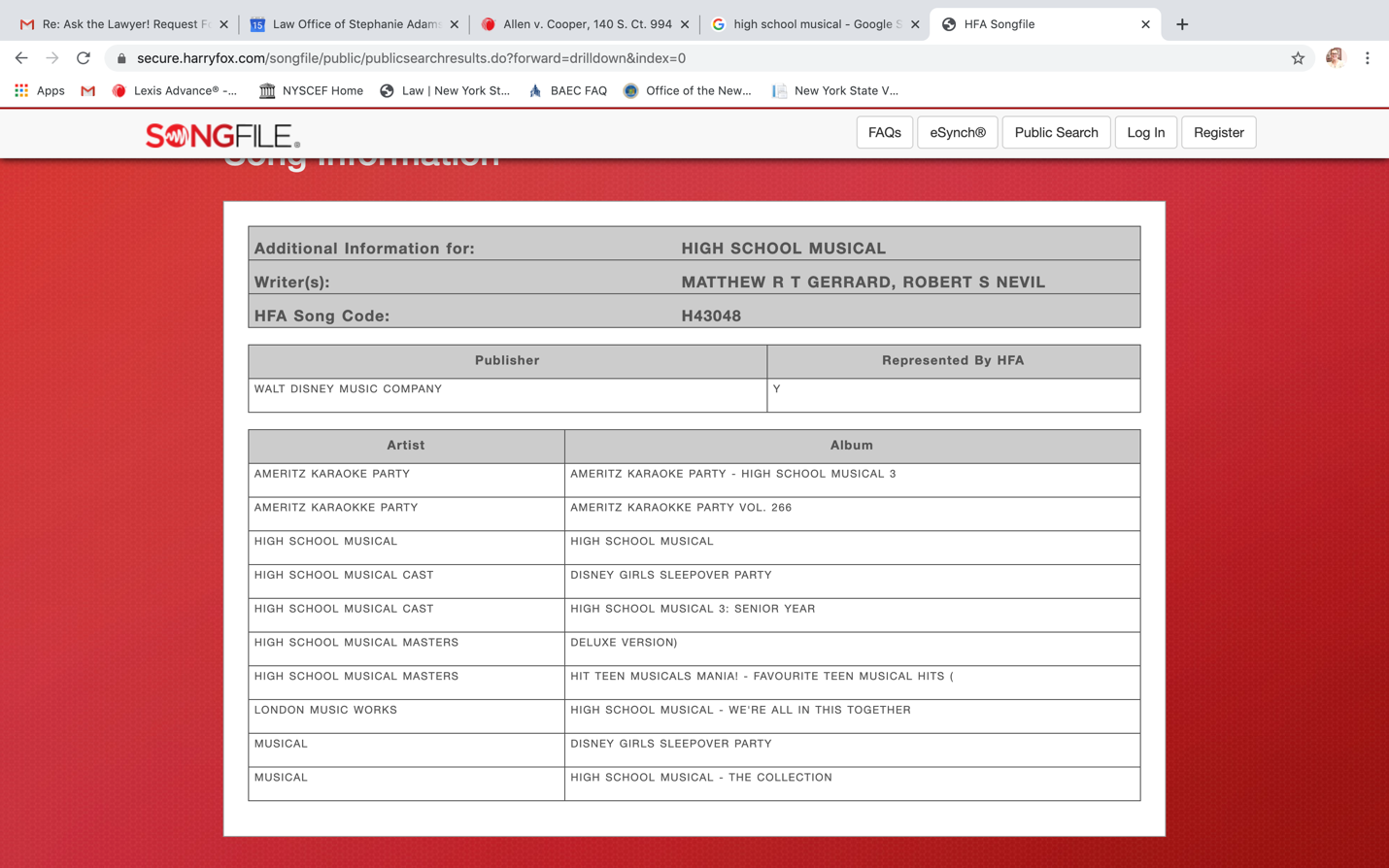
As but one example, the music to “High School Musical” is available for licensed streaming through the Harry Fox Agency:

Songfile permissions screenshot


(As can be seen, your school could even decide to use the karaoke version.)

The bad news is that it’s sort of a pain to obtain the license; you have to register and there is a fee.  Further information can be found at the link here: https://secure.harryfox.com/songfile/faq.jsp#faq2.

[NOTE: since a school district is one legal entity, it is also good to check and see if the district itself has an account already.  Signing up for a service like this does not need to be done on a school-by-school basis. Of course, this brings us to school policy and procurement issues, and for that, I refer to the attorneys serving the BOCES that serves your school!]

I hope the red tape doesn’t get in the way of the students having a good ceremony.  They have been through enough this semester.


[1] You can find the full text of the case and some commentary here: https://www.scotusblog.com/case-files/cases/allen-v-cooper/

Popular music in Public K-12 Schools

Submission Date

Question

I am struggling to find information on using popular music in public K-12 schools. I have the following areas I am trying to find information about:
1. Can a teacher use a Spotify account in their classroom?
2. Can a teacher use music with face-to-face instruction?
3. Can a service provider (counselor, therapist, social worker...) use music with students?
4. Can music be played during sporting events
5. Can music be used as part of the morning announcements

Thank you!

Answer

Welcome to "Back to School 2021"...a year unlike any other!

I have weathered many K-12 "back-to-schools."  For instance, second grade back-to-school, for me, was in 1980.  For my son, it was in 2010.  And for my daughter, it was just a few days before I sat down to write this.

That 1980-to-2021 time span has allowed me to realize two things:

Realization #1: Erasers smell the same in 2021 as they did in 1980; and

Realization #2: Back-to-school 2021 kicked off in a world that has gone through a lot of rapid and (at times) de-stabilizing change.[1]

The good news about realization #2 is that the law--which tends to change much more slowly than the world around it-- is much the same.  So, for this answer, where we can, we'll be linking back to prior "Ask the Lawyer" answers, and where there is something new, we'll add it.

QUESTION 1: Can a teacher use a Spotify account in their classroom?

ANSWER: Not unless the license has changed to allow more than "personal use."  For more on that, see Using Streaming Services (Hulu, Netflix) in the Classroom.

QUESTION 2: Can a teacher use music with face-to-face instruction?

ANSWER:  Yes, so long as the music is part of the instruction, and the copy of the song was legally obtained.[2]

QUESTION 3: Can a service provider (counselor, therapist, social worker...) use music with students?

ANSWER:  There is no automatic permission or exception to the copyright law that allows a mental health service provider to use recordings, sheet music, or other copyright-protected property for purposes of licensed service.[3]

QUESTION 4: Can music be played during sporting events?

If the recorded or streamed music is protected by copyright, it should only be played with a license.

NOTE: Public schools will want to consult their lawyers about their risks in this regard now that the U.S. Supreme Court has (arguably) struck down the ability to sue "the state" and its subdivisions for copyright infringement.
 

5. Can music be used as part of the morning announcements?
If the music is protected by copyright, it should only be played with a license. 

NOTE: Public schools will want to consult their lawyers about their risks in this regard now that the U.S. Supreme Court has (arguably) struck down the ability to sue "the state" and its subdivisions for copyright infringement.

And with that, I wish you a joyous back-to-school.


[1] Perhaps this is why I found the familiar aroma of new "Pink Pearl" erasers comforting.

[2] This is allowed per Section 110(1) of the Copyright Act, which states that "performance or display of a work by instructors or pupils in the course of face-to-face teaching activities of a nonprofit educational institution, in a classroom or similar place devoted to instruction" is not infringement. 

[3] As I write that, it strikes me that such services are so important, ensuring the resource can be used legally is important.  There are a number of ways to do that, depending on the precise circumstances.

Fair use and Youtube in Academia

Submission Date

Question

A taskforce at the college is wanting to use a recent song and video on Youtube. This would be a traditional lip dub with a little step up in production as they would use some greenscreen and use some face tracking to animate anti-racist quotes on the faces of the participants. They want to mimic some of the effects in the video as well as add some of our own. So it is transforming the work. Also, this would be a new creation based on the content of the video and use of the music.

In short, they are looking to do a lip dub of the song with their own spin on the video. The college has their own video streaming platform so this would not be on Youtube.
This would be for the campus community but there might be that people could share outside the organization.

The intent is to educate the campus and is part of a greater initiative to promote diversity equity and inclusion.

Answer

This submission is a "fair use”[1] question coming at us from a private college, so before we delve into a reply, I have to emphasize that the specific analysis in this case is limited to that type of entity (a private, accredited school).

Since it can get boring "emphasizing" disclaimers in prose form, I will emphasize it in verse:

          If ye a public library be

          This analysis is not for ye

          If a SUNY or public school

          Do not swim in this legal pool

Okay.  With that out of the way (and for those of you not put off by either the disclaimer, nor the crude verse), here is my answer:

Riffing on, parodying, and building on popular songs can be an effective way to convey a unifying or powerful message to a group.  The use of a known work of art can build on shared familiarity, while modifying it with a unique twist can create a unique and unifying experience. 

The technique described by the member is a very popular approach for higher education institutions, and for unrecorded performances/parodies/riffs that are done live on campus, the school's ASCAP/BMI may even apply (meaning, the site of the performance has permission).

Of course, this is 2021, and that means, it doesn't happen if it isn't on video (or in a picture).  And since we are still in the midst of a pandemic (although things are looking a tad brighter, here in May of 2021), having a video that is an experience customized, created and controlled by the school is a desirable way to build remote cohesion.

When considering the use of copyright-protected content without permission, there are two factors a private institution must consider:

1. Risk management

2. Copyright infringement

"Risk management" is not about the actual legality of one's actions, but the risk that one's actions will be observed and perceived as illegal.

In this case, the additional circumstances the member lists here (not using YouTube to post the final product) enables "risk management" in two ways: a) the resulting video will not be "purged" from YouTube due to a copyright "red flag" (which can happen even if there is a fair use); and b) by hosting it on a less popular server, it is less likely to be seen by services and bots that are "out there"[2] policing copyright laws.

But of course, an educational institution doesn't want to get away with infringement, it wants to not commit it.  And that is the essence of the member's question: is creation of this derivative work[3] a "fair use"?

In their question, the member has walked us through some of the "fair use" factors. The member identifies as an educational institution. The member states that the use of the work will be "transformative." The institution will use all of the audio, and be evocative of but different from the video.  And, although it is not specifically mentioned as such, the described use of the resulting derivative work will (clearly) not be a replacement in the market for the original.

What is missing from the submission is the consideration: why this particular work?  In order to justify a fair use-especially of an entire work (the audio), the use must not only be transformative, but there must be a reason why that particular work is chosen, and the message sent by the "transformed" work must relate to that reason.

In other words, you don't select the underlying work to re-transmit it at face value; you select the works to say something new, that at least in part, relates back to the riffed/parodied work.

The best example I have seen of this lately is a complete, unaltered use of the "Avengers, assemble," scene from the "Endgame."  The clip is exactly as it is in the movie, with no changes to audio or video, except the author puts captions near the various super-heroes as they show up, giving the characters new names, and drawing an analogy to how they saw the protests of 2020 developing. 

The end result of this modified "Avengers, assemble" clip is not only highly transformative--the clip is no longer in any way about the original superheroes--but the author uses the identities of the originals to make comments about both those iconic comic book figures, and the categorical names he ascribed to them.  It's such a good example, it could be used to teach "fair use" in a law school class (you can see it here, or just search "endgame protestors 2020 avengers" and it'll pop right up).

With regard to this use of audio and video, it is this question--why this particular work was selected--that is the missing piece of the puzzle.  So long as that piece fits in, there is a good claim for fair use.

If it is decided that there is a good reason to select the original work, the other thing to be cautious about is how the end result (the new video with the unmodified audio) is used.  If it is used only as described and is built into a structured discussion about equity and inclusion--especially if the lyrics and images are used as focal points in the discussion-there is a strong case that this is an academic, non-commercial use. 

However, we have to remember that at the end of the day, a college is a place where students pay to be.  If the video bleeds into recruitment materials, or is not coupled with the education/discussion, the more likely the use could be found to be commercial. 

So: the more "academic" the end result (and its context) is, and the more the initiative functions as both a comment on the source material, and its own, stand-alone message, the better.  Since fair use is not simply an additive analysis (it's not just one factor vs. another, but rather, how the factors resolve and then inter-relate to each other), every aspect of this is critical.

Within those parameters, and if care is taken so the video is only used in the educational context (not simply sending a link to it out in a newsletter, without the educational content and context), there is a strong case to make that the new video, inspired by the song’s current video and using that unmodified song, is not a copyright infringement. 

I am sorry I could not be more definitive...answers like this are why very often, people just ask for permission![4]


[1] I am going to jump right into this answer with the assumption that the reader knows the basics about fair use (Copyright Act Section 107).  If you don't know the basics of fair use, you can get the gist on in these "Ask the Lawyer" RAQ’s: Educational films without a licenseFair Use and Restrictions of Song Parodies

[2] So I went to find an example of these "bots" and got more than I bargained for; here is an example of not only how video-sharing services shut down fair use on platforms like YouTube and Facebook, but a story about how this blocking is impacting how people film and transmit law enforcement activity: https://www.eff.org/deeplinks/2021/02/cops-using-music-try-stop-being-filmed-just-tip-iceberg

[3] A derivative work is a work that incorporates copyright-protected work.  The right to authorize derivative works is one of the six rights reserved to the owner of a copyright.  Parodies that incorporate or draw heavily from the original risk being "derivative works" (and thus infringement) unless they are 1) done with permission or 2) are a "fair use."

[4] For instance, Weird Al, although he could likely claim fair use for many of his parodies, always gets permission.

Music Performance and Broadcasting on Webpage

Submission Date

Question

A high school band has purchased music with permission to perform. The music teacher has requested that the performance be shared on the school's website. From my understanding, the performance may be shared live / streamed (permission to broadcast) via the school's web page but may not be recorded and then posted to the website. The public performance relates to the site/building and not to the World Wide Web.

Please confirm whether my understanding is correct.

Answer

Your understanding is correct, but there are three additional details it is helpful to consider in this type of situation:

First, when a school confronts a concern like this, it should take a careful look at the license (the permission to use a copyright-protected composition) it purchased. 

This is because a license for sheet music can convey not only permission for on-site performance and broadcast, but also "recording" and "publishing" (posting).  I have observed that the range of these permissions will vary not only between publishers, but even between songs at the same publisher.  So, before recording (or deliberately not recording), check the fine print; you might have more (or less) permission than your district thought.

Second, it is good to consider why the school wants to make the recording and post it on the school website.  Is it to simply showcase the band on a page dedicated to the school's achievements?  Is it for fundraising purposes?  Or is it posted as part of a student newspaper or student club newscast?  If the post is part of an academic endeavor--especially one related to commentary or gathering news--posting part of a recorded performance could be a fair use

And third--though still on the topic of fair use--it is important to remember that "Circular 21" pertaining to "Reproduction of Copyrighted Works by Educators and Librarians" confirms that the Copyright Act allows educators to make:

"A single copy of recordings of performances by students...for evaluation or rehearsal purposes...."

Now, under no circumstances am I saying that this provision gives a school permission to record and publish (post) a copyright-protected musical work.  But a copy that is created incident to streaming[1] can be retained by the school or teacher, and perhaps posted to an intranet, if they plan to use it for rehearsal or evaluation later. 

The important take-away from all of these is: your school may have options from not only within but additional to the license.  By assessing the precise permission your school received, the reasons for recording, and the reasons for posting, a school can consider their full range of options.[2]

Of course, what copyright law can give, contract law can take away.  So, if your school has secured a license with a specific agreement that you will not make and post a recording, remember that's a contract term it agreed to, even if fair use would otherwise authorize the use.[3]

I know, I know, thinking about copyright while planning to make the most of a performance can feel like allegro, adagio, adagio, allegro...

Just andante, like the question models, plan what you need, and you'll find a good pace!
Thank you for a thoughtful question.


[1] I know "streaming" and "recording" are different, but as a technical matter, "streaming" does create a digital copy, even if it is fleeting.

[2] This answer does not consider limited posting on an intranet, although I'd argue that with planning such posting could be consistent with the CONTU guidelines for retaining a copy for rehearsal or evaluation.

[3] This is why people negotiating for license content should always be trained to not negotiate away rights your district has by law.

Music licensing and on-demand viewing

Submission Date

Question

Is it a violation of Copyright Law to publicly share a video recording of a DJ playing music from his music library for a public library archive and make this available for on-demand viewing?

Answer

My favorite DJ-related story is about how "scratching" a record,[1] as both a musical instrument and an act of composition, evolved in the hip-hop scene of the late 1970's and early 80's.[2]  It is a story of technological innovation, of community culture, and (as all good stories are) controversy.[3]  DJ's, like all contributing figures to culture, make for compelling scholarship.  So I am not surprised to see this question about audio-visual content portraying a DJ on a library archive.

The short answer is: sure, it could be a violation; but there are five things that can keep it on the right side of the law—or at least mitigate the risk if there is an unintentional violation.

Here are those five "things":

First thing

Is the posted video part of a well-developed and organized collection or archive?

If "yes," go on.

Second thing

Does the metadata on the unique video reflect that it is part of a well-developed and organized collection?

If "yes," go on.

Third thing

Is the music part of a recording of an event, or is the music a separate track with all other ambient sound (the crowd, street noise, the DJ talking over the music) removed (or never there)?

Even if "no" go on, but have the next two really, really tight.

Fourth thing

Has your library[4] conducted and documented[5] a "fair use" analysis[6]  of its posting of this particular content, and to the best of its ability, reflected accurate ownership of the item in the metadata and item information on the archive?

If “yes,” go on.

Fifth thing

Does your library have a "notice and takedown" contact point posted on its website, so anyone who believes the content is an infringement can complain, AND has your library registered[7] for "safe harbor" under the Digital Millennium Copyright Act?[8]

If "yes," DJ on!

Why do I have to do the "5-step hustle" to answer what seems like a simple (if compound) question?  Because how and why content is used can transform "infringing use" to non-infringing "fair use."  For a component of a scholarly or historic video archive, this means being able to show that a musical recording incorporated into an audio-visual record is not merely a gratuitous use of the audio content, but rather, a critical element of a work that transcends (and doesn't simply replace) the purpose of the original. 

This is, in some ways, a tall order.  But if you follow steps "1" through "4" above, you significantly increase your likelihood of getting it right. And as for step 5: the DMCA has been in the news, recently, as a part of the national info-tech infrastructure that is due for an overhaul.  But for now, it can protect certain kinds of service providers (like search engines, directories, and other information location tools) from liability for third-party infringement, and it is an essential part of any information database's copyright compliance toolkit.

Thank you for a good question.


[1] Which makes a sound like either "schkud-shckud-shzyaaa" or "hschhzka- hschhzka-zreek" depending on how you translate it into onomatopoeia, along with the skill and intent of the person doing the scratching.

[2] According to his tag in the Cornell University Hip-Hop Collection, scratching was invented by Grandwizzard Theodore.  However, there is some assertion that Grandmaster Flash put Theodore on the path to the scratch.  Either way, it is a good story.

[3] If you are looking for a new era to get obsessed with, early Hip-Hop is a good one.  It is replete with geniuses, scandal, and triumph—and provides insight into cultural and community factors relevant to today.

[4] This 5-step analysis assumes your library is a not-for-profit educational institution (like a public library).

[5] As in: done the analysis in writing (generally a form), and retained the form.

[6] From 17 U.S.C. Section 504(c)(2): "...The court shall remit statutory damages in any case where an infringer believed and had reasonable grounds for believing that his or her use of the copyrighted work was a fair use under section 107, if the infringer was: (i) an employee or agent of a nonprofit educational institution, library, or archives acting within the scope of his or her employment who, or such institution, library, or archives itself, which infringed by reproducing the work in copies or phonorecords..."  Of course, making video "available" can be considered a transmission under certain circumstances (like streaming), so make sure your "fair use" conclusion is solid.

[7] Your institution can register for "safe harbor" in some instances (when it is more of a "provider" than a "publisher") here: https://www.copyright.gov/dmca-directory/

[8] I like the way Creative Commons does it: https://creativecommons.org/dmca/

Music used for virtual school Halloween parade

Submission Date

Question

The elementary is planning a virtual Halloween parade this year. The students will parade through the building in costume. As they pass through the entrance hallway, there will be a video camera live-streaming the parade via zoom (to families watching from home). The parade committee would like to play a purchased CD of spooky music in the background of the video.

Does this violate the music copyright?

Answer

In the spirit of the season, and the answer I must give, this answer will be a modified version of a scene from Macbeth.

[Cue sounds of wind, rain, and small children trying to line up while thinking about candy and their itchy "Frozen II Elsa" costume.]

ENTER THREE WITCHES

FIRST WITCH: Educator!  I sense thou wouldst put on a show!  And Zoom it to demesnes beyond thy institution!  But if the music is protected by copyright and the school does not have a license to use the music in that manner it will be a violation of the copyright!!!

SECOND WITCH:  And, Educator, know this, as well! The Zoom terms of use state: "Zoom may deny access to the Services to any User who is alleged to infringe another party's copyright!" So be warned, or you be twice-condemned for the foul deed of infringement, by both the copyright's master, and the Powers of Zoom!!!

[Lightning.  Thunder.]

THIRD WITCH:  Ahem.  Of course, you'd have to get caught, first....

[Pause.  The cauldron bubbles.  FIRST WITCH and SECOND WITCH give THIRD WITCH the side-eye.]

THIRD WITCH:  Ahem.  Of course, you'd have to get caught, first....

FIRST WITCH and SECOND WITCH:  Gasp!

THIRD WITCH: What? We're witches!  We have to be sneaky, why do you think we're camped out here in the woods?  And seriously, do you think in the midst of everything happening on Zoom, someone's going to notice?  The world is going so crazy, I'm expecting it to rain toads at any moment!  Give this poor Educator a break.

FIRST WITCH:  Oh, Alecto, you always were a rebel.

Okay, back in the real world...

Sadly, my three witches are right, and this is the answer I have to give.  Since the parade won't be a part of a class, there is no TEACH Act exception, so transmitting the music via Zoom is just like putting it out over a streaming service or live TV: a no-go without permission[1].

That said, I dug around in my cauldron, and I can offer this possible solution:

Round about the copyright go

In the creative solution throw

Songs that "copyleft" be

Can help thee celebrate Halloween

For works freely used and easy got

Search "Copyleft Halloween Songs," and find a lot.

Not very much toil and trouble

"Copyleft" works make music bubble!


Just in case my Shakespearean verse is too obtuse, what I'm saying is: Hop on your favorite search engine and type "copyleft Halloween songs."[2]

What will this do?

For those of you who don't know: "Copyleft"[3] is slang for: "I could own and control this copyright, but I am so cool, I am letting you use it, so long as you let others use it, too."  Meaning: "copyleft" work is free to use, by anyone, so long as whatever you generate using the work is also free to use.[4]

Now, as with all clever solutions, this one calls for thorough planning.  I listened to a few of the songs I found this way; not all of them are, as they say, "safe for work" (or at least safe for school) so check out the songs before you Zoom them out to parents. But since this is music the authors have proudly composed and released for free use by a wide audience, I suspect at least some of it will meet your needs.[5]

[NOTE: I don't know if it would work for your school, but this one by Frannie Comstock is hilariously clever[6] (and mentions lawyers)!  If nothing else, give it a listen just for a fun 5 minutes.  Here is that YouTube link written out: https://www.youtube.com/watch?v=XzvlAuUiM5s]

Happy Halloween!


[1] I am not weighing if this would be a "fair use."  That said, if the Halloween Parade and the music interacted to make a clever statement or unique medley of work, that could be a possibility.  But I've been to my kids' Halloween parades.  They are darling, they are not ground-breaking, incisive commentary on modern theatre.

[2] Don't search "Copyleft Halloween Music" because for some reason (which I am sure many of you information professionals out there know) it just wasn't as fruitful.

[3] Yes, this is similar to Creative Commons, but it is also different.  For more information, visit https://www.copyleft.org/.

[4] This means that if you make a movie out of the Zoom recording of the parade, using a Copyleft song, that recording needs to be Copyleft, too.

[5] Unless "your needs" involved specifically using the soundtrack to "The Nightmare Before Christmas."  In which case, I cannot help you, because Skellington Productions, Inc. owns all those copyrights, and I don't see them going Copyleft anytime soon.

[6] I don't know Fannie Comstock (is that even a real name?  It sounds like a person who makes candy while panning for gold), and I am not receiving any kickback for this endorsement of her ridiculously clever work.  Which makes sense, since there is no charge to use her highly amusing song.

Digitizing legally owned choral music

Submission Date

Question

Is it permissible to make digital copies of choral music that is legally owned by the institution to students in choral and instrumental ensembles? Some students may be studying remotely and mailing physical copies may result in lost or non-returned copies.

Answer

There are four ways it can be permissible:

1.  Check the license[1] from the publisher and see if the purchase of the physical copies came with any digitization/duplication permission.  You'd be surprised how many rights you buy (or don't buy) when you make that hard copy purchase.  Publishers take a variety of approaches on this, and an individual publisher's permissions may change from work-to-work, so confirm (or rule out) this approach for each work.

2.  If the license does not allow making digital copies, contact the publisher, and see if it can be expanded.  Publishers are now getting many requests like this and may be ready with a simple (and affordable) solution.

3.  I am not a fan of them (they are as outdated and as risky as the Ford Pinto), but the "CONTU" guidelines speak to this issue.  I am including the relevant guidelines, as presented in Copyright Office Circular 21, under this answer.  If one of your precise needs fits one of the "permissible uses" listed in Circular 21, you are all set.

4.  Speaking of CONTU, the first "permissible use" listed in the guidelines may help you out here, with a slight twist on your scenario.  In the event that the physical copies listed in the question are mailed out and not returned as feared, the guidelines allow for emergency copying after the fact (of course, they also require that at some point, you purchase more physical copies, but at least you can get the copies to the students).


Those are my four solutions, based on conventional approaches and current case law.

I'll also throw out a "fifth option" based on a slightly different approach, which, depending on some precise facts, could work for faculty teaching choral classes:


The 110 Solution

Copyright Section 110 allows an academic choral group (if meeting as part of a class) to display "a work in an amount comparable to that which is typically displayed in the course of a live classroom session," during an online class/rehearsal.

How can that help with the member's scenario?

Let's say I am in a class that is working up an a capella performance of "36 Chambers,"[2] as arranged by the composers of the original work.[3]

If the class was still meeting physically, Copyright Section 110(a) would allow us to perform the song and to display the music on the in-class smart board.  In the online environment, the same performance and display could happen via the internet, as allowed by 110(b) (the "TEACH Act")—again, so long as only the amount "typically" displayed in class was shown. 

Whether in-person or online, the rehearsal would include review of the different parts for bass, tenor, alto and soprano,[4] with the relevant music displayed on the screen.  While an academic institution can't tell people to take screen shots of the music displayed for rehearsal purposes, students who want to snap screenshots of a class to take notes is a fact of modern-day academia.  If a student who was told to purchase a copy of their part uses this method to ensure they are practicing on an incremental basis, that's out of the school's control, and the student can make their own claim to fair use.

This type of solution should never be used as a deliberate alternative to the purchase of individual copies.  But so long as the display is incremental and truly a part of the in-class experience, it is a viable option.

I wish all music faculty approaching the Fall 2020 semester many good performances, whether virtual, or face-to-face.  These are tough days for people who love to sing, who enjoy the community of a choir, and who need to hone their vocal art in collaboration with others.  Hunting for music should not add to the burden, and with a few tricks and an awareness of the limits of the law, it doesn't have to.

------------------------

Guidelines for Educational Uses of Music

The purpose of the following guidelines is to state the minimum and not the maximum standards of educational fair use under Section 107 of H.R. 2223.

The parties agree that the conditions determining the extent of permissible copying for educational purposes may change in the future; that certain types of copying permitted under these guidelines may not be permissible in the future, and conversely that in the future other types of copying not permitted under these guidelines may be permissible under revised guidelines.

Moreover, the following statement of guidelines is not intended to limit the types of copying permitted under the standards of fair use under judicial decision and which are stated in Section 107 of the Copyright Revision Bill. There may be instances in which copying which does not fall within the guidelines stated below may nonetheless be permitted under the criteria of fair use.

Reproduction of Copyrighted Works

Permissible Uses

1 Emergency copying to replace purchased copies which for any reason are not available for an imminent performance provided purchased replacement copies shall be substituted in due course.

2 For academic purposes other than performance, single or multiple copies of excerpts of works may be made, provided that the excerpts do not comprise a part of the whole which would constitute a performable unit such as a section¹, movement or aria, but in no case more than 10 percent of the whole work. The number of copies shall not exceed one copy per pupil.

3 Printed copies which have been purchased may be edited or simplified provided that the fundamental character of the work is not distorted or the lyrics, if any, altered or lyrics added if none exist.

4 A single copy of recordings of performances by students may be made for evaluation or rehearsal purposes and may be retained by the educational institution or individual teacher.

5 A single copy of a sound recording (such as a tape, disc, or cassette) of copyrighted music may be made from sound recordings owned by an educational institution or an individual teacher for the purpose of constructing aural exercises or examinations and may be retained by the educational institution or individual teacher. (This pertains only to the copyright of the music itself and not to any copyright which may exist in the sound recording.)

Prohibitions

1 Copying to create or replace or substitute for anthologies, compilations or collective works.

2 Copying of or from works intended to be “consumable” in the course of study or of teaching such as workbooks, exercises, standardized tests and answer sheets and like material.

3 Copying for the purpose of performance, except as in A(1) above.

4 Copying for the purpose of substituting for the purchase of music, except as in A(1) and A(2) above.

5 Copying without inclusion of the copyright notice which appears on the printed copy. (iv)

Discussion of Guidelines

The Committee appreciates and commends the efforts and the cooperative and reasonable spirit of the parties who achieved the agreed guidelines on books and periodicals and on music. Representatives of the American Association of University Professors and of the Association of American Law Schools have written to the Committee strongly criticizing the guidelines, particularly with respect to multiple copying, as being too restrictive with respect to classroom situations at the university and graduate level. However, the Committee notes that the Ad Hoc group did include representatives of higher education, that the stated “purpose of the … guidelines is to state the minimum and not the maximum standards of educational fair use” and that the agreement acknowledges “there may be instances in which copying which does not fall within the guidelines … may nonetheless be permitted under the criteria of fair use.” The Committee believes the guidelines are a reasonable interpretation of the minimum standards of fair use. Teachers will know that copying within the guidelines is fair use. Thus, the guidelines serve the purpose of fulfilling the need for greater certainty and protection for teachers. The Committee expresses the hope that if there are areas where standards other than these guidelines may be appropriate, the parties will continue their efforts to provide additional specific guidelines in the same spirit of good will and give and take that has marked the discussion of this subject in recent months


[1] Checking a license is not an exact science.  Some publisher's use a catch-all that is included on their invoices.  Others put the information right on the music.  Others like to make you really hunt for it, but it is usually part of the sale transaction.  This is why, when making a purchase of music, it is good to take a screen shot or save the paperwork related to the purchase.

[2] Note: To my knowledge this work does not exist, but it is on my wish list of music to hear.  I love it when genres collide.

[3] This new version would be a "derivative work" based on the original, and have its own copyright protection as a musical composition.

[4] We have reached the limit of my choral knowledge.  Is there separate sheet music for mezzo-soprano and counter-tenor?  Probably.  I am sorry, I quit choir in 7th grade.


Inter-library Audio Files

Submission Date

Question

More than once we have received requests to provide digital copies of audio files from institutions that wish to make them accessible either through headphones or as ambient sound as parts of public exhibitions. The exhibitions presumably charge some sort of fee. We have had requests both for commercially released recordings and for archival, unpublished recordings for which we do not own either composer or performers rights, some of them dating prior to 1972.
Some of the questions raised from this issue: 

  • What do requesting institutions have to do to acquire the necessary rights to play audio at their exhibitions?
  • Does it matter if audio is provided via headphone or open speakers?
  • Does it matter if an entire recording is played vs. an excerpt?
  • Are excerpts of certain duration allowable regardless of securing permissions?
    If excerpts of a certain duration are allowed, is it the duty of the holding institution to create the audio files of the excerpted portion rather than providing the audio of an entire work?
  • As many exhibitions occur at locations remote to the holding institution, actual on-site checks for compliance are prohibitive. Does this change anything in terms of how permission forms should be crafted?

Answer

This one is tricky.

It’s tricky because it stands on a no-man’s land comprised of fair use, library law, contract, and licensing.  This is a place where libraries boldly go on a routine basis, but lawyers fear to tread.  But we’ll try and parse it out.

To do so, we need to remember some “Considerations”:

Consideration #1: Section 108 (d) of the Copyright Act allows a library to duplicate and distribute, for non-commercial use, a “small part” of an audio recording based on a request of a patron or another library.

Consideration #2:  Section 108 (e) of the Copyright Act allows a library to duplicate and distribute, again for non-commercial use, the entirety of an audio recording based on a request of a patron or another library, IF a replacement copy cannot be purchased for a reasonable price.

Consideration #3: Disappointingly and tragically (but predictably), musical works are excluded from Section 108.  What does that mean?  Here’s an example: a recording of Robert Frost reading a poem may be duplicated under 108...but a recording of that same poem set to music may not. 

Consideration #4: Although Congress legislated that 108 protections don’t apply to musical works, it has also stated[1]:

…it is important to recognize that the doctrine of fair use under section 107 remains fully applicable to the photocopying or other reproduction of such works. In the case of music, for example, it would be fair use for a scholar doing musicological research to have a library supply a copy of a portion of a score or to reproduce portions of a phonorecord of a work. Nothing in section 108 impairs the applicability of the fair use doctrine to a wide variety of situations involving photocopying or other reproduction by a library of copyrighted material in its collections, where the user requests the reproduction for legitimate scholarly or research purposes. [emphasis added]

Which brings us to…

Consideration #5:  A library can make a partial or complete copy if it is a “fair use.”  Fair use is determined on a work-by-work basis, applying the four factors[2] set out in Section 107 of the Copyright Act. 

Consideration #6:  An initial “fair use” can meet the requirements of 107 (say, 10 bars of music contrasted with another in a documentary film), but a subsequent, related use might not (the same 10 bars in an TV ad for the same documentary).

Consideration #7:  None of this matters if the copy is coming from a license (a contract) that imposes greater restrictions a library.


Bearing these seven “Considerations” in mind, let’s check out the member’s questions in relation to the scenario they provided:

More than once we have received requests to provide digital copies of audio files from institutions that wish to make them accessible either through headphones or as ambient sound as parts of public exhibitions. The exhibitions presumably charge some sort of fee. We have had requests both for commercially released recordings and for archival, unpublished recordings for which we do not own either composer or performers rights, some of them dating prior to 1972.

Question: What do requesting institutions have to do to acquire the necessary rights to play audio at their exhibitions?

Answer: If the work is protected by copyright, and they can’t justify a fair use, they need a license to play the audio at their exhibition.  As the member points out, if the library providing the copy is not also the rights holder, the requesting party needs to work with that third party for permission to play the copy in public (unless it is a fair use).

But that is a secondary consideration for the library who might be providing the copy.  Remember “Consideration #6:” the initial basis for the request could be allowed under 107 or 108, even if a latter use in not allowed. Combine that with what we established in “Consideration #4:” Congress knew that subsequent uses might not be legitimate.  So, to protect libraries, and to protect the sharing of knowledge for purposes of scholarship and creativity, they made it very clear: if the first basis for the copy is legitimate, and the providing library has no knowledge of plans for infringing uses, the providing library will not be liable for infringement.

This is hard, because librarians are both helpful, and tend to be relentless gatherers of information.  If a patron requests a copy and discloses an infringing use for that copy, it cannot legally be provided.  This is true even if the requester subsequently gets a license (since there is no guarantee the license would retroactively extend to the providing library), although at that point, any damage claim would likely be moot. 

Question: Does it matter if audio is provided via headphone or open speakers?

Answer: The number of speakers (headphone or otherwise), the location of the devices, the size of the audience, and the capacity of the venue matter can all matter to an analysis of fair use.  But again, unless the exhibition is the only reason for the request, that information should not impact a providing library’s 108 or 107 analysis, unless the precise use is disclosed as part of the immediate basis of the request.

Question: Does it matter if an entire recording is played vs. an excerpt?

Answer: If the requesting institution is relying on a fair use defense, absolutely, yes.  The amount of the work used is one of the four factors.

Question: Are excerpts of certain duration allowable regardless of securing permissions?

Answer: Recent case law[3] shows that even the tiniest duration can be infringement, if fair use factors are not met.  But don’t let that stop you from providing a 107 copy!  If the fair use factors are met, it is conceivable that a person could use the entire work.  There is no set formula; fair use can only be assessed on a work-by-work basis.

If excerpts of a certain duration are allowed, is it the duty of the holding institution to create the audio files of the excerpted portion rather than providing the audio of an entire work?

This is not a binary question, it is an algorithm.  Here we go:

  • The holding institution should try to ascertain if the work is still protected by copyright.  As the member points out, this depends on dates and publication status.  If it is still protected…
  • The holding institution should establish what type of copy it is providing: 108(d), 108(d) or 107. 
  • If it’s a 108 (d) copy, the institution should document that the 108 (a) and (d) factors are met, and if they are, may copy a “small part” (but remember, 108 doesn’t apply to a musical work).
  • If it’s a108 (e) copy, the institution should document that the 108 (a) and (e) factors are met, and if they are, may copy the entire work (by now, you surely remember that 108 doesn’t apply to a musical work).
  • If it’s a 107 (fair use) copy, after applying the factors, only copy what’s justified; when in doubt, seek legal advice.  This is tough to give guidance on, because “fair use” can only be assessed on a case-by-case basis.  For the example provided, there is no clear answer.  Sometimes, even if the access to the work is free, the use isn’t “fair,” while sometimes, even if money is charged, the fair use factors are met.  So if you go down the 107 road, be sure to get information relevant to the factors, stick to the use at hand (not potential later uses), and apply the factors.  This is true for both commercially released recordings and for archival, unpublished recordings (although publication status is part of the second fair use factor).

Question: As many exhibitions occur at locations remote to the holding institution, actual on-site checks for compliance are prohibitive. Does this change anything in terms of how permission forms should be crafted?

Answer: As quoted above, it was the intent of Congress that a library not be liable for subsequent unlawful use.

For a 107 copy, this starts and ends with the library’s assessment of the fair use for the copy at the time of the request.  Your forms should solicit information only about the immediate need for the copy, and assess if the request is within your institution’s comfort zone.  Your forms should not ask about prospective future uses, which may be beyond your control, nor should you feel any obligation to police the use, which is impossible.


Here is food for thought: forms should promote making a 108 copy whenever possible.  108 protection, while narrower, is far less subject to debate; 108 factors are clear and easy to document.  “Fair use,” on the other hand, is often in the eye of the beholder.  Judges must not only apply four factors of analysis, but as recent case law has recently re-affirmed[4], the four factors are not so much weighed, as considered in relation to each other.  It’s a tough analysis that unfortunately inspires erring on the side of caution.  So use 108 whenever it can apply.

A lot of questions, a lot of answers, and a lot of food for thought.  This is a rapidly evolving area of law, so check back in on this issue in a year or so.  The Copyright Office, various library organizations, and Congress all know that the law isn’t quite up to the challenge of technology (108 still uses the word “phonorecord,” which my Spellcheck actually refuses to recognize), so this complex web will continue to evolve. 

And in the meantime, if someone requests a copy of audio by Anthony Barré, use it as an excuse to read Estate of Anthony Barré and Angel Barré v. Carter, et al.  (a/k/a Beyoncé and Jay-Z), because it’s a good illustration of why this response is so very, very convoluted!


[1] House Report 94-1476.

[2] The factors are:

(1) the purpose and character of the use, including whether such use is of a commercial nature or is for nonprofit educational purposes;

(2) the nature of the copyrighted work;

(3) the amount and substantiality of the portion used in relation to the copyrighted work as a whole; and

(4) the effect of the use upon the potential market for or value of the copyrighted work.

[3] Estate of Anthony Barré and Angel Barré v. Carter, et al. No. 17-1057 (E.D. Lou. July 25, 2017).  In this case, pop star Beyoncé used very small clips from Anthony Barré’s recorded spoken word performances in the song “Formation;” the court ruled that while the amount of Barré’s work used very small, and was but a small part of the song, the overall factors did not make the use fair.

[4] Cambridge University Press v. Mark P. Becker No. 1:08-cv-01425-ODE (N.D. Ga. Mar. 31, 2016)
 

Digitizing dramatic and musical works

Submission Date

Question

When it comes to digitizing large theater and music program collections, it is well-established that a library can digitize anything before 1923, and that if there are no copyright notices on them, can digitize anything before 1978.  But if there are multiple "copyrightable" elements in the works (advertisements, photos, actor biographies, illustrations, etc.) is it okay to digitize them? What is the risk in digitizing a program when there is a copyright notice on one or more element in the program, but not all of it? If a theater or musical society is defunct, is it okay to digitize the programs associated with it beyond 1978 or when it may have a copyright notice?


Answer

This is a complex issue (although not nearly as complex as assessing a library wing full of dramatic and musical works).  To unpack this, I will take advantage of a form suggested by the topic: the opera libretto.

[Cue overture…]

ALTO:  Can works with no copyright notice before 1978 be safely digitized?

BASSO:  Beware, if they were previously unpublished or the trademark is still monetized.

ALTO: What about text works with multiple works inside them?

BASSO:  A compilation notice may protect the whole system.

ALTO: What about a work included in an unregistered collection?

BASSO:  Beware!  That work may have a separate protection.

ALTO:  If a theatre organization has folded, can their work be duplicated?

BASSO:  The copyright could have been transferred, so…it’s complicated.

SOPRANO:  So you’re saying…[crescendo] you DON’T KNOWWWWWW?

BASSO: ….no. 

[triangle]

Okay, enough of that.

The bottom line:  There is no bright-line rule I can provide to give assurances for works that are post-1923[1] (and, for unpublished works like journals or private recordings, items authored prior to that date).  Between image rights, trademark, privacy, and overlapping copyright terms, projects like the one described in the question can bring an array of legal considerations.  Adding music to the equation—which is exempted from §108, the law that allows certain copying at libraries—only heightens the concerns.

The key to designing a digitization project that can survive this type of risk assessment resides in the question: why does the collection, and the particular items in it, need to be digitized in the first place?

If the answer is, “for preservation,” then documenting, on a work-by-work basis, that either there are no protected elements in the work, and that all 108 factors have been met, is the key (NOTE: this would likely involve restricting some of the collection to on-site access only).

If the answer is, “for ADA adaptability,” then documenting, on a work-by-work basis, that the digitization was only for purposes of making an accommodation is the key.

If the answer is, “so the whole world has easy access to high-resolution, searchable, meta-tagged copies of the material,” then verifying, on a work-by-work basis, that no valid copyright or other bar to duplication and online publication is the key.  Materials still under copyright could not be available for download, but could be listed as on-site and available for copying if allowed per §108. 

If the answer is, “so the whole world has internet access to low-resolution, water-marked, searchable, thoughtfully meta-tagged copies of representational selections of each title (whether under copyright, or not), presenting the bare minimum of what’s needed for researchers to determine what we have on site and available for §108 copying,” then carefully following the four “fair use” factors is the key.

If the answer is, “so the whole world has internet access to our carefully curated, scholarship-oriented, presented-with-commentary-and-criticism, non-market-disrupting, selective array of material carefully culled to represent the breath and scholarly value of our larger collection of theatrical and musical materials available for §108 copying” then designing an end product that meets the four “fair use” factors is the key.

I realize this is a chicken-and-egg reply: if you can’t clear answers on what you can do with the material, how can you envision what to do with it?  My reply to that is: trust that your mission to provide access to information is supported by the law.  Think about the materials, develop a theme as to why access to them is important, acknowledge any potential boundaries, and a legal solution can be found.  Bring in a lawyer to advise on specifics when needed,[2] like a decision to invoke “fair use,” to set up clear parameters for copyright determinations, or how to best document use of §108. 

Since access is your mission, copyright should only inform, not deter it.


[1] When "Ask the Lawyer" started in 2016, the author was not thinking about how, just a few years later, the "Public Domain" date would change. To preserve this shameful lack of foresight, but also ensure accurate information, as part of the "2021 ATL Audit" we are adding this footnote: Please substitute "1923" with [whatever year it is minus 95]. For instance, if it is 2021, the year should be 1926. When in doubt, visit the excellent chart at https://copyright.cornell.edu/publicdomain.

[2] Sometimes, you just need a lawyer.  This RAQ can cover a lot of helpful general ground, but some things—like designing a particular fair use, or crafting the legal parameters for a specific project—can only be done through confidential legal advice based on viewing the precise materials and circumstances.


Using music videos for projects

Submission Date

Question

An internationally known band released various music videos for the purpose of a contest they were holding. Fans were asked to create a new video using the clips provided. One of our professors downloaded and saved the music videos and would like to share them with his students so they can use them for an editing project. He would like to post the copied files in his password protected class management system (Black Board.) However, we would also like his students to be able to share their projects either in an eportfolio or online.

My initial reaction is that he should get permission from the copyright holder / publisher for permission even though the band released the content for a contest. I see many danger zones.

Answer

Some of the trickiest copyright questions I get relate to student work.

Why are they tricky?  Because of a self-imposed rule I have: find a way for the work to be done;  don’t let copyright interfere with art and science.[1]  In other words, our copyright glass of scholarship should be half full…of scholarship, not fear of lawsuits.

That said, most readers of this column will know that “educational use” does not justify the wholesale infringement of works, even if the purpose is scholarship.  To use a work without permission, the use must meet the criteria of “fair use.”[2]

But I’m getting ahead of the question.  Let’s bring it back to the beginning.

What’s the tricky issue here?  In this scenario, the band “released various music videos,” and asked the public to create new works based on the old, for entry into a contest.[3]

The band was essentially asking the public to create “derivative works,” which are new works based around a copyright-protected original (think movie sequels, musicals based on books, and paintings of paintings).

The faculty member plans to retain copies and direct students to use them after the completion of the contest, both for assignment and portfolio purposes.  Is that cool?

Now, if the band’s videos were expressly put into the “public domain” for the contest (meaning: no copyright protection) the question ends here. If the clips aren’t protected by copyright, the faculty member’s plans are just fine (it’s cool).[4]

Further, if the band gave a perpetual, irrevocable permission to any person who generates a new video using the clip, to use the clip for whatever reason they want, the question also ends here (again, retain the copy and using it as planned is cool).

But if instead, the band kept the videos protected by copyright,[5] and gave the public permission for only a limited amount of time (say, the duration of the contest), for a limited amount of purposes (say, for entering the contest), then yes, we are in a “danger zone” (not cool).[6]

However, before I agree that the ideal solution is to get the copyright owner’s position, I do want to make a case for fair use, which allows people to use copyrighted works in way that would otherwise be infringing (make copies, make derivative works, and even at times to sell them).

Based on the scenario described, it is not clear if the retention of copies as described in the scenario would be a fair use.  It would have to be justified under the four fair use factors, with the school and student being able to show that the retention of a complete copy and use of the clip for assignment and student portfolio purposes was justified.

The way for a school to do this is to use their fair use assessment form[7] and retain a copy.

To me, aside from the legal concerns, this is also an ethical issue.  A faculty member should not encourage a student to unknowingly infringe another’s copyright, especially if they know that student might include that work in an online portfolio of work.  This could put the student in legal trouble that is independent from the liability of the school.

Students, as individuals, do not have the same protections that higher education professionals have.  Schools, if they conduct a bona-fide fair use analysis, can limit the damages from alleged infringement.  Schools also usually have insurance for this stuff.  Newly-minted B.A.’s and M.F.A’s typically do not have the same resources.  This means, when the student gets sued, they are in a much riskier place than the school or the faculty member.

All that said, remember the mantra: find a way for the work to be done;  don’t let copyright interfere with art and science.  What does this mean?  While being cautious to not promote infringement, a faculty member in a medium such as film, or music, should not let students operate in ignorance of fair use, which is so important to both mediums.  Without sampling, without artistic call-and-response, we suffocate creative innovation.

If that sounds complicated, it is!  I will be reaching out to this member to talk the specifics through (that part is confidential).


[1] Promotion of “science and the useful arts” is the reason we have IP law in the first place (see U.S. Constitution, Article I, Section I, Clause 8).

[2] Or Section 110(a) or (b) of the Copyright Act. But you can read out that here https://www.law.cornell.edu/uscode/text/17/110.

[3] As gimmicks go, I like this one.  I wish my favorite author, Umberto Eco, had invited me to write a chapter of “The Name of the Rose.”  I would have had Adso and William fire-proof…uh, sorry, spoiler.

[4] I speak legally, not pedagogically.  I have no idea if this would be a good film class assignment; I was a Russian History/U.S. Constitutional law major at an experimental school with no grades or tests (Hampshire College).  Other than once attending a class on the classic film “Battleship Potemkin” and whatever skills can be gleaned from serially watching the musical “1776,” I have zero credentials to evaluate the curriculum of a film course.

[5] Which, by the way, the band might not even own.

[6] For the record, if I were the lawyer advising this band, the contest terms would have contained a clause allowing my client to revoke permission to use the clip and participate in the contest in the event an entry was contrary to their values (racist, sexist, transphobic, etc.). 

[7] More information using a Fair Use Assessment form can be found here: https://copyright.cornell.edu/fairuse