Emergency Response

Rights for music during graduation ceremonies

Submission Date

Question

We have received several questions about setting graduation ceremonies to music and streaming them or recording them and sharing them with students. What are the laws surrounding this? There seems to be a lot of misinformation out there. Below is a question I received:

The slideshow for the [public] high school graduation is complete. [T]he students would like to have songs from “High School Musical” added to the slideshow. Is this possible? If copyright comes into play and we can't there will be no music added to the show. Please advise, We have viewed many other shows from various high schools and at the end of the show it simply states "we do not have rights to this music."

Answer

The need to migrate ceremonies online has created a tsunami of copyright concerns.  What is a ceremony without the right music?  But this question pertains specifically to high school graduations for public schools, so we’ll confine it to those institutions.

Readers, I have to be real with you: a newly minted Supreme Court Case, Allen v. Cooper[1], means public high schools (which are arms of the state) are arguably immune from liability for copyright infringement.  In that case, the court invalidated the “Copyright Remedy Clarification Act (“CRCA”), which had expressly removed state’s “sovereign immunity” to a copyright suit. So on a very pragmatic level, some public schools, colleges, and universities may be adding that to their risk assessment of questions like this.

But professional educators likely don’t want to do the wrong thing simply because they are arguably immune from being punished for it.  As Justice Kagan, writing in Allen and quoting an expert witness put it: “what State, after all, would “want [] to get a reputation as a copyright pirate?”   So we’ll proceed just as the member’s question suggests: that they want to do the right thing.

With that in mind, here is my answer to the question: “[T]he students would like to have songs from “High School Musical” added to the slideshow. Is this possible?

My first bit of guidance is to check the school district’s license with either ASCAP or BMI (this is the license that covers permission to play music at a high school dance). It may be that some streaming rights got thrown into your public performance license. This isn't typical, but you never know, and if you have the right clause in your contract your problem could be solved right away (and in fact, your problem never existed).

If there isn't a contract that already gives your school permission to use the song(s) as the member describes, your school needs permission. This can be done through any number of licensing agencies.

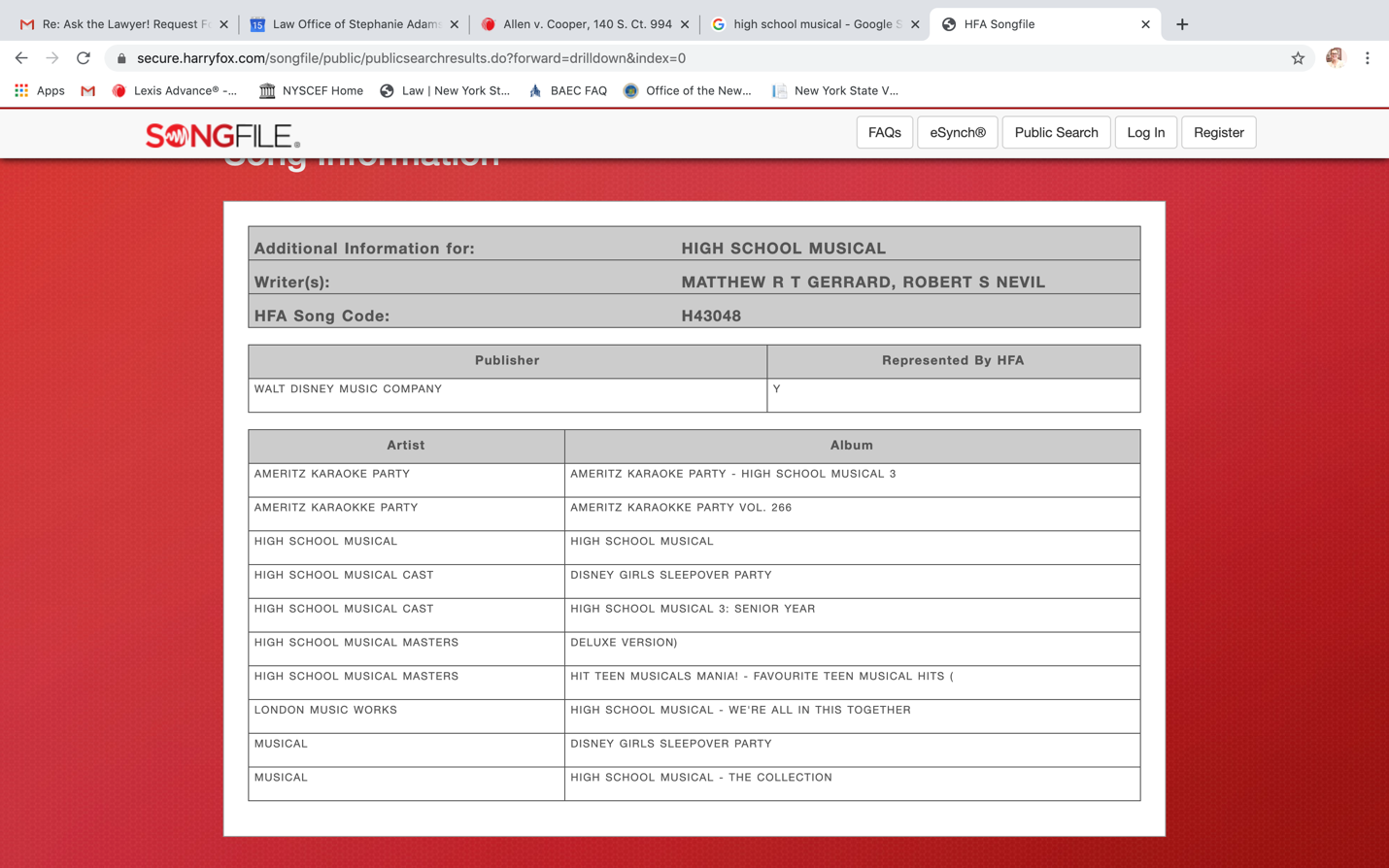
As but one example, the music to “High School Musical” is available for licensed streaming through the Harry Fox Agency:

Songfile permissions screenshot


(As can be seen, your school could even decide to use the karaoke version.)

The bad news is that it’s sort of a pain to obtain the license; you have to register and there is a fee.  Further information can be found at the link here: https://secure.harryfox.com/songfile/faq.jsp#faq2.

[NOTE: since a school district is one legal entity, it is also good to check and see if the district itself has an account already.  Signing up for a service like this does not need to be done on a school-by-school basis. Of course, this brings us to school policy and procurement issues, and for that, I refer to the attorneys serving the BOCES that serves your school!]

I hope the red tape doesn’t get in the way of the students having a good ceremony.  They have been through enough this semester.


[1] You can find the full text of the case and some commentary here: https://www.scotusblog.com/case-files/cases/allen-v-cooper/

Staff Expectations for Emergency Preparedness Training

Submission Date

Question

We are planning an emergency preparedness training for library staff to include CPR, First Aid, Stop the Bleed, and Narcan training. We have heard from librarians that some boards are concerned about the implications of having staff trained. We would like to have some commonly asked questions addressed so that we can answer them if they come up.

1. If staff are trained, do they incur a duty to act? Would they personally or the library as institution become liable should they freeze up and not intervene?

2. If staff are trained but inadvertently cause harm in the process of administering aid, are they covered by any kind of Good Samaritan law?

3. Can a library have a policy of requiring all staff to undergo these types of trainings?

4. Are there any other legal implications or obligations that should be considered that the average person may not think of?

Answer

Because the training and resources described in the question can save lives, I will both a) quickly answer the questions and b) provide an answer in a format suitable to share with a library board.

Quick answers:

1. If staff are trained, do they incur a duty to act?

No, they will not incur a duty to act, unless the library adds that expectation to a job description, or adopts a policy requiring such action (which it should not do without careful planning).

1.5 Would they personally or the library as institution become liable should they freeze up and not intervene?

No, they will not incur liability for failure to provide first aid or emergency treatment, unless the library adds that expectation to a job description or adopts a policy requiring such action (which it should not do without careful planning).

2. If staff are trained but inadvertently cause harm in the process of administering aid, are they covered by any kind of Good Samaritan law?

Yes, except in cases of "gross negligence" (more on that below) they are shielded from liability by New York State's "Good Samaritan" law (Section 3000-a of the Public Health Law).

3. Can a library have a policy of requiring all staff to undergo these types of trainings?

Mandatory training, which could imply that providing first aid or emergency treatment is a job requirement (and thus outside the scope of the Good Samaritan protection), should not be required unless there is a careful program that considers the factors set forth in the guidance below.

Voluntary training, howevereven on staff time—does not remove the Good Samaritan protection. 

4. Are there any other legal implications or obligations that should be considered that the average person may not think of?

Yes (see below).  But none that should get in the way of a library helping library employees and volunteers feel better prepared to provide first aid and emergency treatment!

Analysis

NOTE: This "Analysis" is composed in a format that could be presented to a board with concerns regarding this type of training or capability in their library.

First Aid at Your Public Library

A Guide for Public Library Boards in New York

Stephanie A. Adams, Esq.

The Law Office of Stephanie Adams, PLLC

Library trustees know that as free and open places of public accommodation, public libraries can often be the location of a medical emergency.

Because of this, many public libraries opt to prepare by:

  • Having first aid kits on site
  • Having Narcan on site (with or without staff training)
  • Installing an AED[1] on site (to be used by EMS upon arrival after calling 911)
  • Using posters in multiple languages to alert people to important considerations during a medical emergency
  • Arranging training in first aid, CPR, and "Stop the Bleed" for staff and volunteers
  • Implementing private security with some level of emergency response training
  • Implementing policies for addressing medical emergencies in the library

Of course, a good board of trustees not only considers how to address potential medical emergencies in the library but also considers how the resources and tactics selected could put library employees, volunteers, the public, and the library itself at legal risk

This guide addresses the fundamental considerations of such an analysis and provides three immediate assurances so long-range planning doesn't slow down steps that may be immediately implementable.

Immediate Assurance #1: New York Law's "Good Samaritan Law" protects those who voluntarily provide first aid and emergency treatment.

In New York, Public Health Law 3000-a provides that any person who "voluntarily and without expectation of monetary compensation renders first aid or emergency treatment at the scene of an accident or other emergency outside a hospital, doctor’s office or any other place having proper and necessary medical equipment, to a person who is unconscious, ill, or injured, shall not be liable for damages for injuries alleged to have been sustained by such person or for damages for the death of such person alleged to have occurred by reason of an act or omission in the rendering of such emergency treatment unless it is established that such injuries were or such death was caused by gross negligence[2] on the part of such person."

Immediate Assurance #2: New York Law Protects Libraries that enable access to and use of Narcan (naloxone).

2.  In New York, Public Health Law Section 3309 provides that the "use of an opioid antagonist [such as Narcan] ... shall be considered first aid or emergency treatment for the purpose of any statute relating to liability...[and] an...entity, or any person employed by the person or entity, acting reasonably and in good faith in compliance with this section, shall not be subject to criminal, civil or administrative liability solely by reason of such action."

In 2016, this section of the Public Health Law was revised to specifically include a public library in the definition of a protected "entity."  So, without a doubt, a library providing access to Narcan, or whose employees administer Narcan, are protected by the law (so long as they avoid "gross negligence" as required by the law).

Immediate Assurance #3: Neither staff training nor on-site equipment creates an obligation to provide first aid or emergency treatment.

This is true even if the location is required by law to have an AED and a person trained to use it.[3]

So long as the first aid or emergency treatment is provided "voluntarily and without expectation of monetary compensation" (and without gross negligence) the person is protected by Public Health Law 3000-a.

First Legal Consideration: Voluntary Training, Voluntary Action

While the protection of the Good Samaritan law is clear, it is also clear that the help being provided must be "voluntary."

Because of that, unless a library has a) a carefully planned first aid/medical event program with b) well-developed policy, and c) language in job descriptions, all d) coordinated with the right insurance coverage, and the e) written plan for implementing that program has been f) reviewed by a lawyer issuing a g) written opinion as to how liability is mitigated, the training provided to staff should be documented as voluntary, with no express or implied requirement that an employee attend.

Second Legal Consideration:  Alternate or Added Medical Event Planning

In a medical emergency, quick response time is key.  So, in addition to or in lieu of training staff, some libraries may benefit from better contracts, Memoranda of Understanding, or other connections with local first responders. 

If your library has first responders stationed or residing nearby, it may be better to train staff on recognizing different signs of medical distress and to practice calling 911.  Then work with the local first responders on what type of training could be useful when even a quick response time might not be quick enough.

Third Legal Consideration:  Insurance

Every board should review, on an annual basis, its library's coverage for personal injury, and be aware of the different protections the library has for on-site injury, which should include:

  • Workers’ Compensation Insurance
  • General Premises Liability
  • Coverage as an "additional insured" (if there is a contractor or other professional physically working on site)

As part of this assessment, the board should be confident that the library has a clear process for 1) documenting on-site injury; 2) promptly alerting relevant insurance carriers about on-site injury; and 3) following up with carriers to ensure the library is making maximum use of the coverage it pays for.

Fourth Legal Consideration:  Commitment to Continuous Improvement

In addition to assessing what equipment and training the library may need for first aid and emergency treatment, a board may also want to consider the results of a medical incident.  While this goes beyond just considering the "legal" aspects, whenever there is a serious medical event in the library, the board should ensure the library has the resources to:

  • Consider if the situation warrants improvements to on-site safety[4];
  • Consider if there is a need to address employee well-being and morale; and
  • Consider if the incident can have an impact on reputation.

With these assurances and considerations in mind, library leadership can effectuate immediate steps to address medical events in the library and initiate an overall plan for mitigating and managing associated risks.  This is good for your community, good for your mission, and good for your workers... and consistent with the fiduciary duties of a library board.


[1] "Automatic Electronic Defibrillator".  Good starter information on installing an AED at your library can be found at https://www.health.ny.gov/professionals/ems/pdf/07-04.pdf.  Another resource is your county health department.

[2] Gross negligence "differs in kind, not only degree, from claims of ordinary negligence" (Colnaghi, U.S.A. v. Jewelers Protection Servs., 81 N.Y.2d 821, 823, 595 N.Y.S.2d 381, 611 N.E.2d 282; see Goldstein v. Carnell Assoc., Inc., 74 A.D.3d 745, 746, 906 N.Y.S.2d 905). "To constitute gross negligence, a party's conduct must smack of intentional wrongdoing or evince a reckless indifference to the rights of others" (Ryan v. IM Kapco, Inc., 88 A.D.3d 682, 683, 930 N.Y.S.2d 627 [internal quotation marks and brackets omitted] ). "Stated differently, a party is grossly negligent when it fails to exercise even slight care or slight diligence" (id. at 683, 930 N.Y.S.2d 627 [internal quotation marks omitted]; see Goldstein v. Carnell Assoc., Inc., 74 A.D.3d at 747, 906 N.Y.S.2d 905). Ordinarily, the question of gross negligence is a matter to be determined by the trier of fact (see Food Pageant v. Consolidated Edison Co., 54 N.Y.2d 167, 172-173, 445 N.Y.S.2d 60, 429 N.E.2d 738).

[3] Miglino v Bally Total Fitness of Greater NY, Inc., 20 NY3d 342 (2013)

[4] Many places worry that making improvements after an on-site injury can contribute to a finding of liability.  Such a concern should never get in the way of making safety improvements; if that is a concern, it should be promptly addressed with your library's lawyer, who will research the latest case law on this issue andunless there is a radical change in the lawadvise that any potential hazards be mitigated.

Paid sick leave for COVID quarantine

Submission Date

Question

The library (school district public library without a union or a bargaining agreement and less than 50 employees) offers paid sick leave for most employees. However, based on what we have learn we have paid people, without it coming off of their earned sick time, if they are told to quarantine because they have been exposed to the virus. Does the same hold true for someone who is out sick because they have the virus? 
 
I have looked at the Ask a Lawyer FAQs, the various federal and state sites and issues of the HR Specialist Employment newsletter and do not see a clear answer.

Answer

I can offer a simple answer, and a complicated answer. 

Here is the simple answer: 

Per the "COVID-19 Sick Leave Law"

  • The current requirement of a public employer is 14 days of PAID leave for quarantine/absence due to COVID-19.   

  • A private employer with under 10 employees must provide unpaid sick leave for the entire period of quarantine, during which time the employee can apply for Paid Family Leave benefits ("PFLA").  

  • A private employer with between 11 and 99 employees, or with fewer employees, but at least $1 million in annual revenue, must provide 5 days of paid sick leave, after which the employee can apply for PFLA for whatever time they need to be out. 

  • For employers with more than 100 employees, the employer must give 14 days. 

In all instances, the time out for COVID must not count against other accrued sick leave. 

And that's it. 


The complicated answer 

As you can see, the obligations under the Covid-19 Paid Sick Leave Law depend on the type and (if private) the size of the employer. 

So, is your library a "public employer?"   

The definition of "public employer" in this law is broader than in many other labor-related laws, so unless your library's HR and employment arrangements are 100% separate from those of the local municipality or sponsoring district, it is wise to consider this applicable (or get it in writing from your lawyer that it isn't). 

Since the library that submitted the question is offering paid sick leave for "most" employees--which means there is a different approach for different employees--it sounds like they have decided the library is not subject to Labor Law 196-b (New York's new "Sick Leave Law"), which applies to only private employers.   

This issue is not an atypical one in New York's "Library land."  Does your library use comp time instead of overtime?  That is an option available only to government employers. Does your library use the federal rather than the state minimum wage?  Only a government employer can do that.  Does your library not have to follow the Wage Theft Prevention Act?  Employers are only exempt if they are a government employer. The list goes on and on.  

[NOTE: A nice exception to this dichotomy is worker's compensation for work-related injury.  EVERYONE has to pay into worker's comp; you could say it is something New York employers all have in common]. 

The bottom line on this "complicated" answer? Make sure your library has clarity about which employment-related laws it decides that apply to it before it implements a COVID-19 Paid Leave policy based on them. And when in doubt, have a lawyer examine the compensation and other aspects of your library's employment arrangements to make the decision that is most consistent with its other employment-related practices. 

Thanks for a great question. And if this "public/private" employer issue has you flummoxed, here is a short poem to help out: 


Library Labor Law Chanty 

What law governs at my library?

What labor laws must we abide?

What legal authorities preside?


Sorry, there's no simple rule

Be you association, town, or school

But here's a few comforting rhymes

To get you through confusing times:


An oath of office is required

When a public library director's hired

Civil service law protects employees

Except at association libraries


Must my library pay state minimum wage?

YES (unless only the FLSA is your gauge)

Do we have to pay overtime?

Not if you're municipal AND grant comp time.


The new sick leave law pays workers' rent

Unless your (sorta) government

And no matter who gets COVID-19

Employees ALL get paid during quarantine.


What if we offer NYS retirement?

Just that doesn't make you government.

But if HR's handled by your municipality

You might just be a public agency.


What if there's a union contract?

That can change everything, that's a fact.

And don't forget your HR handbook

Should be based on the "type" of path you took.


Yes, there IS legal variety

caused by the "types" of library

But despite inconsistencies

One thing's always true: director hired by trustees.


And regardless of type or identity

And despite any support or interdependency

No matter what your answers to the questions three

Your library has... autonomy.

NY Hero Act and libraries

Submission Date

Question

How does the NY HERO Act https://dol.ny.gov/ny-hero-act apply to the different types of libraries? Are Association Libraries included?

Answer

The letters in the "NY HERO Act" stand for "Health and Essential Rights."[1]

What "essential rights" does it protect? 

  • Section one of the HERO Act amends the New York Labor Law to create an "airborne infectious disease standard" covering all private employers.  The standard requires many things that will sound familiar: health checks, sanitization practices, and other preventative measure when there is a declared risk of airborne disease.
  • Section two of the HERO Act amends the New York Labor Law to create joint employer-employee "workplace health and safety committees" (where there are 10 or more employees), so workers can collaborate and be involved in safety initiatives.

The new laws are activated only when an "infectious disease" is declared by the NY Commissioner of Health.  This means that right now, while the law is in effect, but no disease is designated, there is no need to have an active plan...but entities have to be ready to spring into action.[2]

Which brings us to the question: What types of libraries must comply?

We'll tackle the easy part first: without question, association libraries, which are private education corporations, must comply. 

For non-association libraries ("public" libraries), the language of the Act is much less clear, since the Act specifically exempts "...the state, any political subdivision of the state, a public authority, or any other governmental agency or instrumentality."

That sounds simple, right?  They should be exempt.  After all, libraries are considered, in some contexts, nigh-governmental entities.

But as many know, a public library's status as "governmental" ebbs and flows.

Here are just two recent examples:

Example #1: 2020 brought an interesting development when, after months of anxious curiosity, the NY Forward "powers that be" confirmed that public libraries were always considered to be exempt from the Executive Orders shutting down private businesses (and instead, were to follow the mandates governing local municipalities).  So: a governmental entity.

Example #2: A noteworthy new case[3] from NY's second-highest court has found that for purposes of the Prevailing Wage Act (Section 230 of the NY Labor Law), a public library is NOT "the state, any of its political subdivisions, a public benefit corporation, a public authority or commission or special purpose district board appointed pursuant to law, and a board of education."[4]  In other works:  not a governmental entity.

So, when it comes to this new law, I can't point to any definite authority either way; just because one part of the Labor Law excludes libraries, doesn't mean another does.  And certainly, we have no case law yet.  That said, if I HAD to pick, I would err on the side of caution and say that public libraries, which are education corporations with their own governance structures (just as the Court commented in "Executive Cleaning"), have to comply with the HERO Act.

Since the stakes are high for non-compliance, any public library that decides the HERO Act doesn't apply to them (and that's fine to reach a different conclusion; I am not omniscient, nor do I have a crystal ball) should:

1) Get that opinion, in writing, from an attorney retained to give advice to that library specifically, and considering its unique position under the law;

AND

2) Confirm the library is in compliance with New York Labor Law 27-a, which covers workplace safety in "the state, any political subdivision of the state, a public authority or any other governmental agency or instrumentality thereof."

The bottom line on this: when it comes to occupational safety, a public library can't fall into a hole between the mandates governing public and private entities: it either has to follow the rules of a "governmental instrumentality" employing people as government employees (and giving them all the protections government employees get under the law) OR it is following the rules of a private education corporation (and giving them all the protections private employees get under the law).

Since the HERO Act is really about taking all the protocols the State of New York developed in response to COVID, and ensuring they are on hand and ready for the next pandemic,[5] a library can't go wrong by having "an exposure prevention plan available, upon request, to all employees, employee representatives, collective bargaining representatives, independent contractors, the department of labor, and the department of health."[6]  By making a clear decision about what safety rules apply to your library, and developing a plan to follow them, you can not only comply with the law, but show that the library is working to keep employees safe.


Thank you for an important question.


[1] What about the "O?"  I double-checked the bills in both the State Senate and Assembly and apparently, it's just a bonus letter (I guess the "HER" act would imply only women get clean air).

[2] The NYS Department of Labor, as of July 12, 2021, states: "Currently, while employers must adopt plans as required by the law, as of the date of this writing no designation has been made and plans are not required to be in effect."

[3]  (Matter of Exec. Cleaning Servs. Corp. v NY State Dept. of Labor, 193 AD3d 13 [3d Dept 2021])

[4] Contrast this with the definition of who’s in/excluded from the HERO Act: "'Employer' shall mean any person, entity, business, corporation, partnership, limited liability company, or association employing, hiring, or paying for the labor of any individual in any occupation, industry, trade, business, or service. The term shall not include the state, any political subdivision of the state, a public authority, or any other governmental agency or instrumentality."

[5] I know, my stomach turned a bit when I typed the phrase "next pandemic."  But no point putting our heads in the sand.

[6] From the requirements summarized in the NYS Department of Health guidance here: https://dol.ny.gov/system/files/documents/2021/07/p764-the-airborne-infectious-disease-exposure-prevention-standard-v4.pdf.

Open Meetings Law and Social Distancing Requirements

Submission Date

Question

Now that Open Meetings Law modifications have been lifted, are we still required to maintain physical distancing for board meetings? We have a fifteen member board which makes it difficult to spread our trustees out. I understand that we can ask trustees whether they have been vaccinated: If all are vaccinated, do we have to maintain physical distancing? If some of them are not vaccinated, do we required all the trustees to wear masks? Do we provide physical distancing for the ones who are not fully vaccinated? I would like to host a staff luncheon ( I understand that is now allowable) but some of my staff are not vaccinated. If it is held outside, do we have to maintain physical distancing measures? What about holding the luncheon inside?

Answer

This question comes at a very challenging time.[1]

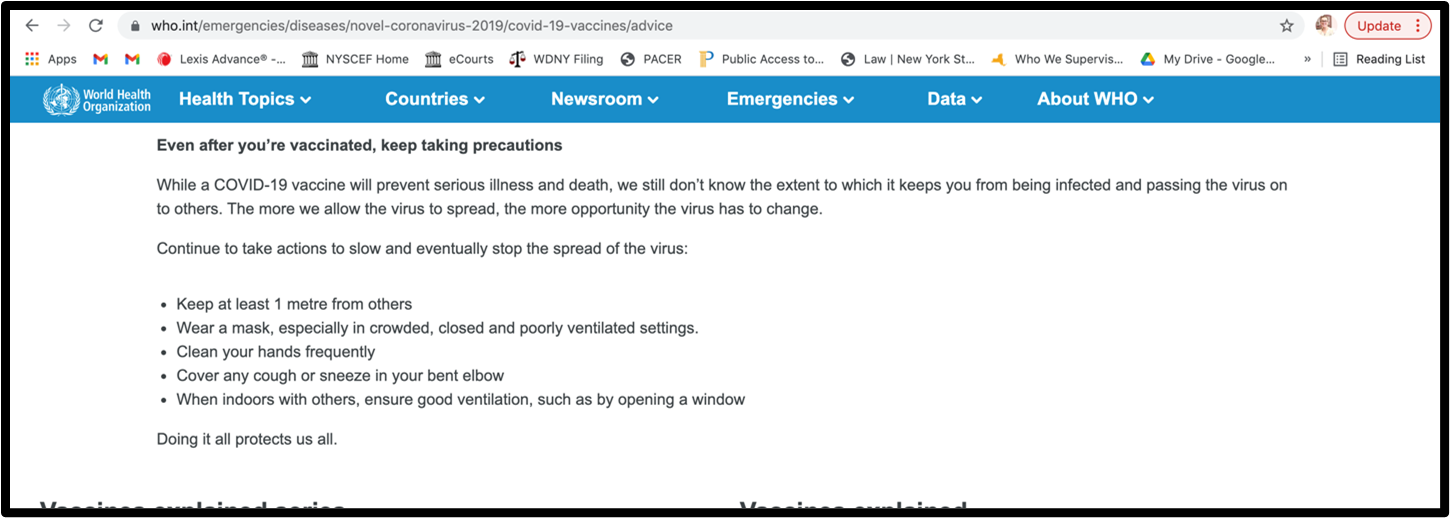
The question is difficult because right now, the World Health Organization is looking at the "Delta Variant" of COVID-19 and telling the world to consider continuing to use masks and social distancing while inside.[2]

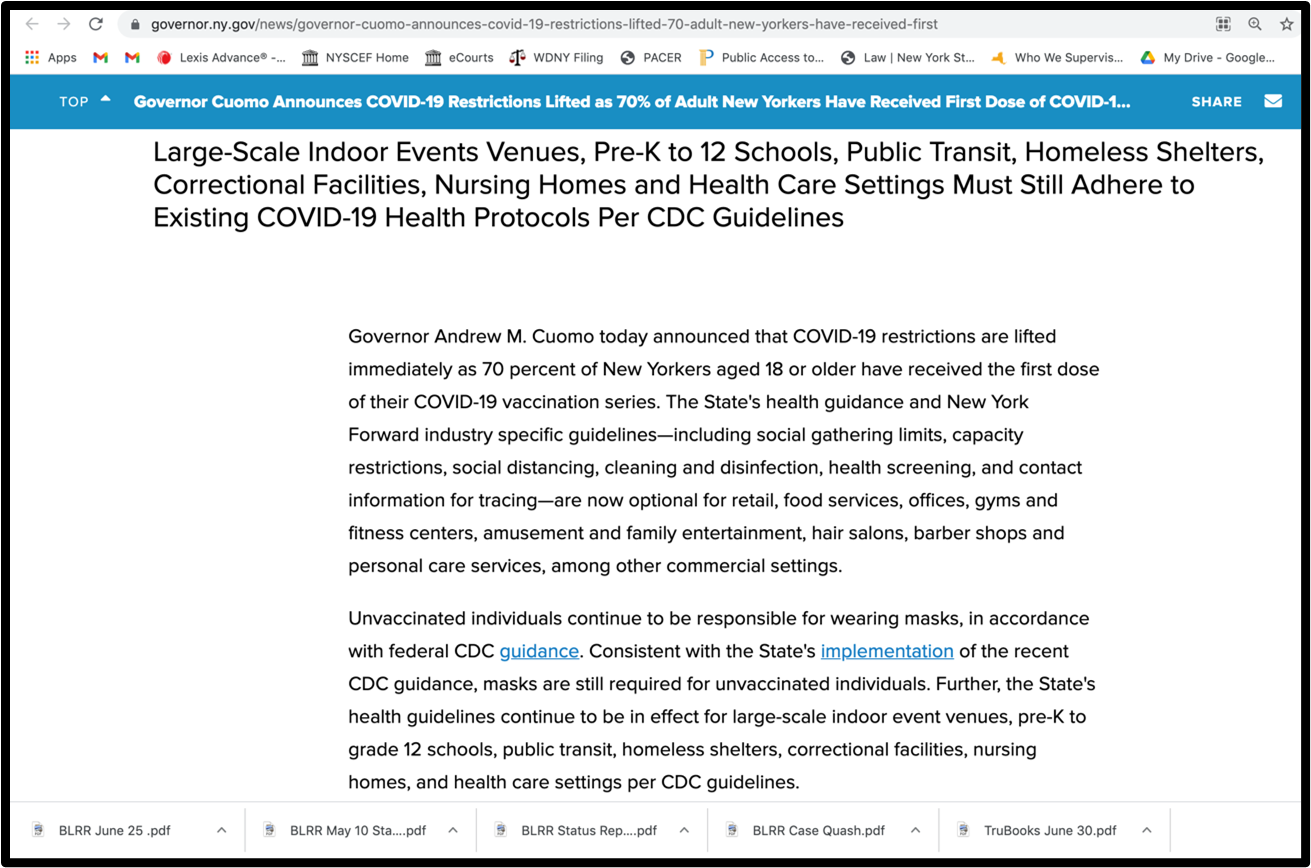
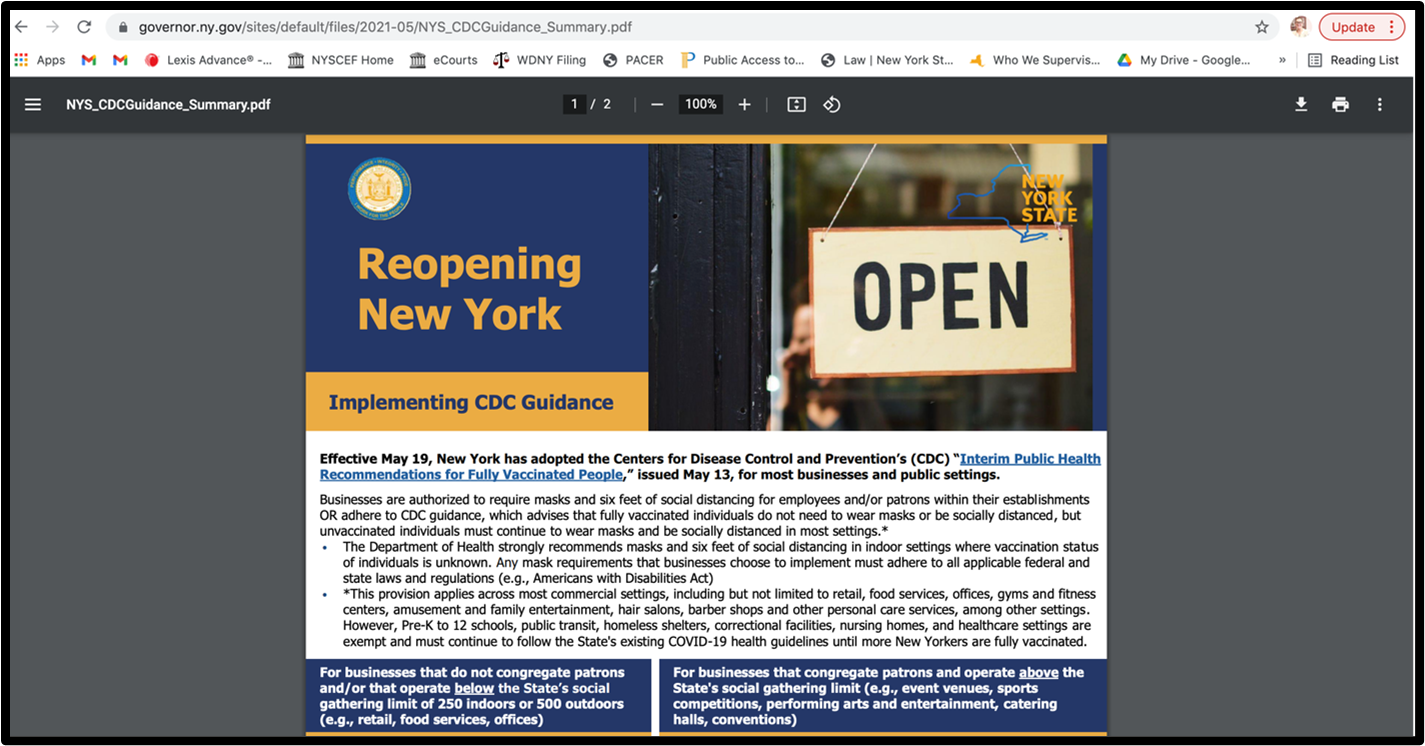
New York, of course, after a 6-day scramble, started following the Center for Disease Control's May 13 "surprise" guidelines stating that vaccinated people no longer need to wear masks or social distance indoors.[3]  And as of July 1, 2021, the state announced that almost all COVID-related restrictions were lifted.[4]

Where does this leave us?

Throughout the Pandemic, when asked about how to interpret and follow law, regulations, and Executive Orders governing the state's COVID response, my watchword has been: "Safety first."

After that, I have listed what is required at that point in time, and then referred libraries and cultural institutions to resources about how they can develop a Safety Plan[5] crafted to suit their unique identity (by "unique identity" I mean things like a large library with outdated HVAC and windows that don't open, has different considerations than a small library with assurance of constant fresh air).

With so much uncertainly at this time, my tired playbook is getting tested.  But I'll use it to try and answer each of the member's questions:

Now that Open Meetings Law modifications have been lifted, are we still required to maintain physical distancing for board meetings?

If your (now optional, but if the board keeps it in place, enforceable) Safety Plan still requires physical distancing, then yes.

We have a fifteen member board which makes it difficult to spread our trustees out. I understand that we can ask trustees whether they have been vaccinated: If all are vaccinated, do we have to maintain physical distancing?

If your Safety Plan has opted to continue using the NYS May 19th guidance, and the meeting is not exceeding the occupancy threshold, no, you do not.  HOWEVER, there is nothing to stop the board from deciding that, in the interest of safety and enabling each trustee to take whatever steps they need to feel safe, they are going to allow some trustees to attend from a remote location.[6]

If some of them are not vaccinated, do we required all the trustees to wear masks?

The WHO would (currently[7]) say: yes.

The CDC and the State of NY would (currently[8]) say: no.

For what it's worth, I tend to follow the most cautious reputable source at any given time (so would say: there is ample ground for your Safety Plan to require this, while there is also ample ground for your board to revise the Safety Plan to require only the bare minimum of advised precautions).

Do we provide physical distancing for the ones who are not fully vaccinated?

If that is at all possible, I strongly support that idea.  Being able to show an institution took the time to consider the best way to keep its community safe is good from any angle: mission, legal compliance, and employee/community relations.

I would like to host a staff luncheon (I understand that is now allowable[9]) but some of my staff are not vaccinated. If it is held outside, do we have to maintain physical distancing measures? What about holding the luncheon inside?

It pains me to say it, but sometimes, the law is not the best guide as to what to do!  Legally, if your library is still using the May 19th NYS Guidance, your Safety Plan can allow for this to happen, if you follow the required prescriptions.

However, it makes sense to me to "read the room" and see if such a luncheon would be a team-building exercise, or (because some employees might not feel at ease eating in close proximity to others) risk bad feelings and alienation.  If everyone cannot attend with the same level of comfort, it might be better to come up with an alternate bonding exercise.[10]

Conclusion

I truly wish I could offer more definite guidance.  The truth is, libraries--even with the return to the strict requirements of the Open Meetings Law--have many options for how to proceed.  So as tired as it may sound, put "safety first," and all things will follow from there.

Coda

Since the Powers That Be out there move quickly, here are some snapshots of the current guidance I am referencing in this answer.

Snapshot of the current WHO Guidance:

Screenshot of WHO guidance ca July 2021

Snapshot of NY's July 1 announcement:

Screenshot of NYS guidance ca July 2021


Snapshot of New York's May 19th Guidance (now largely optional):

Screenshot of NYS guidance ca May 2021


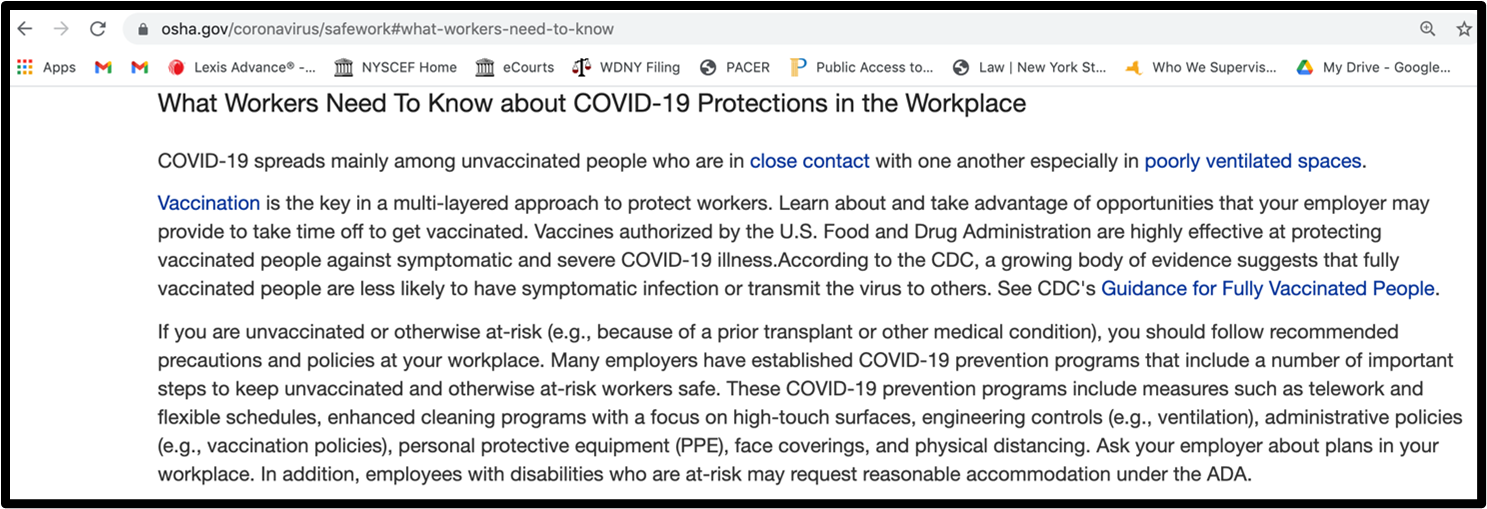
Snapshot of current (June 10) OSHA guidance:

Screenshot of OSHA guidance ca June 2021


[1] Has any date since March of 2020 not been in a "challenging time?"  I have a dim recollection of July of 2020 being semi-okay.

[2] https://www.who.int/emergencies/diseases/novel-coronavirus-2019/covid-19-vaccines/advice

[3] https://www.governor.ny.gov/sites/default/files/2021-05/NYS_CDCGuidance_Summary.pdf

[4] https://www.governor.ny.gov/news/governor-cuomo-announces-covid-19-restrictions-lifted-70-adult-new-yorkers-have-received-first

[5] Whether they were required to have one, or opted to have one.

[6] For more on this, see Open Meetings Law and end of NYS' Emergency Status.

[7] As of July 2, 2021, at 11:30 AM.  Go ahead, WHO, hit me with a change-up, I can take it.

[8] As of July 2, 2021, at 11:30 AM.  Go ahead, CDC and NY Department of Health, hit me with a change-up, I can take it just as well as I could at 11:30!

[9] This answer is complicated enough, I am not going to tackle the fiscal considerations of hosting events for staff!  See 1990 Comptroller Opinion #144 (May 15, 1990)

[10] This part might be a better question for the "Ask the HR Expert" service, since my idea of bonding is listening to Supreme Court Oral argument while providing color commentary (this is why my paralegal plans our events).

Open Meetings Law and end of NYS' Emergency Status

Submission Date

Question

First question: With the expiration of the Executive Orders on June 24th, 2021, including the Order modifying the requirements of the Open Meetings Law, are libraries back to the "old way" of conducting trustee meetings?

Follow-up question: If the answer to the first question is "yes," does this mean that trustees who still want/need to attend remotely from home must disclose their address in the meeting notice?

Answer

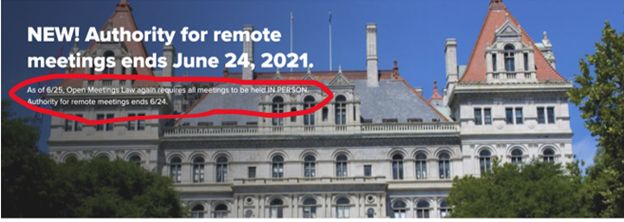
First question: Yes...with the expiration of the Executive Orders on June 24th, including the Order modifying the Open Meetings law,[1] things are "back to normal."

Or, as the Committee on Open Government, the authority on the State's Open Meetings Law (OML), put it:

Image of NY Governor's website showing end of emergency status date


So, does this mean "trustees who still want/need to attend remotely from home must disclose their address in the meeting notice?"

Various case law and commentary about the OML has confirmed that when a public body needs to meet via teleconference, the public must be able to attend from any remote location "calling in" to the meeting, and that location should be part of the meeting notice.[2]

Or, as the COOG put it in Advisory Opinion 5535 in 2018:

"So long as the public is permitted to attend at any location at which a member participates and can observe the members wherever they may be, I believe that the members may participate and be counted for purposes of attaining a quorum and for voting, and that a meeting may validly be held." [emphasis added]

For large public bodies such as the Regents, the New York Power Authority, and other entities that must hold publicly accessible meetings, and whose board members may reside in far-flung areas of the state, the use of publicly accessible call-in sites comes with an IT team and a budget.

For a public library, whose members generally reside within that library's area of service, this "back to normal" pretty much means that you're back to meetings in person.

Of course, under the Not-for-Profit Corporation law (which, along with the Education Law, governs the conduct of library meetings), a library board of trustees is allowed to conduct meetings telephonically.[3]  When coupled with the requirements of the OML, however, that latitude is severely reigned in--since whatever space is used for the remote call-in must be accessible to the public, and included in the notice.

For this reason, unless a library trustee is very comfortable inviting the public into their home, I advise against using the "dial in from home" option.[4]

NOTE:  This answer does not consider if a trustee needs to attend remotely due to it being an accommodation under the ADA.  That is a separate and critical question; for now, I'll simply say that adherence to the OML should not rule out consideration of ADA issues.

The transparency created by Education Law 260-a's requirement that public libraries abide by the Open Meetings Law is laudable--but is also based on older notions of technology.  Now that the State of New York has lived under different rules for over a year, we might see some changes in legislation.

But for now, we're "back to normal."

I hope this is helpful.


[1] Allowing them to be held via teleconference so long as the meeting is accessible to the public, recorded, and transcribed.  For more comments on this, see "Ask the Lawyer" Executive Order 202 and NY Open Meetings Law and Open Meetings Law and COVID.

[2] See https://docs.dos.ny.gov/coog/otext/o5535.html and https://docs.dos.ny.gov/coog/otext/o5575.html.

[3] See NFPCL Section 708(c) "Unless otherwise restricted by the certificate of incorporation or the by-laws, any one or more members of the board or of any committee thereof who is not physically present at a meeting of the board or a committee may participate by means of a conference telephone or similar communications equipment or by electronic video screen communication. Participation by such means shall constitute presence in person at a meeting as long as all persons participating in the meeting can hear each other at the same time and each director can participate in all matters before the board, including, without limitation, the ability to propose, object to, and vote upon a specific action to be taken by the board or committee."

[4] I recently saw a very good presentation on parliamentary procedure for library boards.  The presenter commented that disclosure of home addresses should not be made, due to safety concerns.  I absolutely agree with that caution, but must emphasize that if a trustee calls in from a remote location, with the emergency modification of the law over, the OML requires that all "locations" of the meeting (including a remote call-in site) must be disclosed.

"Masks recommended" phase and the vaccinated

Submission Date

Question

We are preparing to go to the "masks recommended" phase.  Staff would still be required to wear masks in public portions of the building, but not in their non-shared offices.  However, for those in shared offices, how do we handle the vaccinated/not vaccinated issue?  Do we go with the honor system and tell those in shared offices that if they are vaccinated, they may go maskless?

I've heard that some restaurants are allowing their servers to go maskless if they show proof of their vaccination to their employer.  Would we be allowed to do something like that?

Answer

[DISCLAIMER: This answer presumes there is no collective bargaining agreement or landlord/municipal host terms that impact the library's flexibility while revising their Safety Plan.]

Okay, with that disclaimer out of the way, here are my "short answers" to these excellent questions:

"[F]or those in shared offices, how do we handle the vaccinated/not vaccinated issue?"

Short answer:  Revise your library's current Safety Plan to specify how it has adopted the 5/19 NY Forward Guidelines (for advice on how to do that, please see my "Long Answer," below).

"Do we go with the honor system and tell those in shared offices that if they are vaccinated, they may go maskless?"  

Short answer:  I advise requiring proof (for the legal/operational rationale behind this opinion, please see my "Long Answer," below).

"I've heard that some restaurants are allowing their servers to go maskless if they show proof of their vaccination to their employer.  Would we be allowed to do something like that?"

Short answer:  Yes (for more on that, please see my "Long Answer", below!).

Long Answer

This question comes at a good time, since on June 10, 2021, the U.S. Occupational Safety & Hazard Administration ("OSHA") updated its guidance for employers on protecting workers from COVID-19.[1]  This new "6/10 OSHA Guidance" speaks to questions like these. 

But first, a quick recap. 

When the CDC came out with their "surprise" interim guidance for fully vaccinated people on May 13th, 2021 (the "5/13 CDC Guidance"), it took New York six days to incorporate it (into the "5/19 NY Guidance").

OSHA, on the other hand, took a bit more than six days.[2]  But by June 10th, here's what they had to say:

CDC's Interim Public Health Recommendations for Fully Vaccinated People explain that under most circumstances, fully vaccinated people need not take all the precautions that unvaccinated people should take. For example, CDC advises that most fully vaccinated people can resume activities without wearing masks or physically distancing, except where required by federal, state, local, tribal, or territorial laws, rules and regulations, including local business and workplace guidance.

And from there, OSHA takes it granular.[3]

The 6/10 OSHA Guidance sets out an array of factors for employers and workers to not just consider in isolation, but to think about as a continuum of risk assessment and safety measures.  The factors they list include consideration of vaccination status, and shared office space.

Because it is so critical that employers get this right, I am putting this "6/10 OSHA Guidance"[4] below.  Now that we have this resource, I strongly advise employers to refer to it when updating their Safety Plan to include the 5/19 NY Guidance.

And now, for this library's very specific set of questions about non-public, shared office space, here is the rest of my "long answer."

As you can see in OSHA's listing, the consideration of shared office space isn't simply one of vaccination and proximity.  It also involves the consideration of things such as ventilation, worker education, and individual worker vulnerabilities.

Because of this, there is no "one size fits all" answer to this library's question.  Rather, the library should review the non-public, shared workspace against the OSHA criteria, and then craft a customized plan...recognizing that the protocol for areas with up-to-date HVAC systems will be different from a work area near the stacks where there might be very little fresh air. 

This variability is the key consideration of shared non-public workspace.  Your library's safety measures may be different when the weather is cold and workers can't open a window.  Your library's Safety Plan measures may be limited if the workspace is near a rare book collection or other assets requiring precise climate control.  And on top of that (literally, as an add-on after the fact) your library will need to consider the impact that a Safety Plan's working conditions can have on individuals with disclosed, pre-existing conditions (such as allergies, heightened vulnerability to COVID, or a health condition impeding vaccination).[5]

Within all this variability (which is a LOT for any employer to handle, to say nothing of a library that is also focusing most of its energy on meeting the needs of the public), I advise requesting proof of vaccination for two reasons.  First, it positions an employer to be more confident in their adherence to the plan they develop.  Second, it positions employees to be confident that they are in a position to advocate for their own health.

Now, on the flip side, the employee relations challenge of requiring workers to provide vaccination status can be onerous.  Some people are just not comfortable revealing that type of information, and I totally get it.  BUT the EEOC and the New York State Division of Human Rights have both determined that an employer requesting proof of vaccination is not the same as an employer demanding disclosure of confidential medical information.[6]  Barring a union contract or other term forbidding the demanding proof of vaccination, employers should be confident they can require it.

That confidence can, in turn, transfer to the employees who are certain that their unmasked and nearby co-workers are vaccinated.  In my experience, nothing can erode trust like an honor system where someone is suspected of being dishonorable.   Further, that suspicion can turn into full-on blame if a worst-case scenario emerges and someone does get sick.

And while the current CDC and NY Forward guidance mean an employer won't likely be successfully sued for using the honor system as opposed to requiring proof, I wouldn't put it past one of my fellow attorneys to try.[7]  This is especially true if your library's Safety Plan or past planning has identified certain front-facing work or other tasks as "higher" risk, meaning there is an acknowledgement on the record that some work may bring increased exposure.

Okay, to sum up: you don't have to, but it's worth considering requiring proof of vaccination.   But most critically, whatever your library does, if you update your Safety Plan, factor in the new 6/10 OSHA Guidance.

Since the combination of options is extensive (New guidance? Old? Require vaccinations? Proof?) I have laid out a chart below.  Below that are some of the high points of the 6/10 OSHA Guidance, which every employer should read.

I hope this reply makes up for in helpfulness what it poses in complexity.  I wish you calm and careful planning as your library moves into this next phase.

Safety Plan -->


Employee requirement -->

No Use of NY Forward 5/19 guidance[8]

Updated to NY Forward 5/19 guidance

and uses "honor system" only for employees

Updated to NY 5/19 guidance and library requires proof of

vaccination for employees

Employee vaccination status not considered in Safety Plan

This means your library is still using your pre-May 19th Safety Plan; that's fine, just stick to it until it is updated.


Not possible (if using 5/19 guidance, the library must consider vaccination status).

Not possible (if using 5/19 guidance, the library must consider vaccination status).

Employee vaccination status considered in Safety Plan but vaccination is not required to perform routine duties of job

This means your library is still using your pre-May 19th Safety Plan; that's fine, just stick to it until it is updated.


If your library is using the honor system, but still structured so vaccination is not a factor in performance of routine duties, so long as the OSHA 6/10 guidance doesn't suggest otherwise, carry on!

If your library is requiring proof of vaccination to use 5/19 guidelines, but still structured so vaccination is not a factor in performance of routine duties, so long as the OSHA 6/10 guidance doesn't suggest otherwise, carry on!

Library-employer requires vaccination as part of Safety Plan and vaccination is required to perform routine duties of job.

With such rigorous requirements, assessing the Safety Plan under the OSHA 6/10/21 guidance is wise.


This combination brings some risk since it bases safety on vaccination but does not require proof, which limits the ability to assuage employee relations concerns regarding unvaccinated colleagues.

This combination provides the best documentation of maximum risk management and positions library to address employee relations concerns regarding unvaccinated colleagues.


OSHA

Except for workplace settings covered by OSHA's ETS and mask requirements for public transportation, most employers no longer need to take steps to protect their workers from COVID-19 exposure in any workplace, or well-defined portions of a workplace, where all employees are fully vaccinated. Employers should still take steps to protect unvaccinated or otherwise at-risk workers in their workplaces, or well-defined portions of workplaces. 2

Employers should engage with workers and their representatives to determine how to implement multi-layered interventions to protect unvaccinated or otherwise at-risk workers and mitigate the spread of COVID-19, including:

  1. Grant paid time off for employees to get vaccinated. The Department of Labor and OSHA, as well as other federal agencies, are working diligently to ensure access to COVID-19 vaccinations. CDC provides information on the benefits and safety of vaccinations. Businesses with fewer than 500 employees may be eligible for tax credits under the American Rescue Plan if they provide paid time off for employees who decide to receive the vaccine and to recover from any potential side effects from the vaccine.
  2. Instruct any workers who are infected, unvaccinated workers who have had close contact with someone who tested positive for SARS-CoV-2, and all workers with COVID-19 symptoms to stay home from work to prevent or reduce the risk of transmission of the virus that causes COVID-19. Ensure that absence policies are non-punitive. Eliminate or revise policies that encourage workers to come to work sick or when unvaccinated workers have been exposed to COVID-19. Businesses with fewer than 500 employees may be eligible for refundable tax credits under the American Rescue Plan if they provide paid time off for sick and family leave to their employees due to COVID-19 related reasons. The ARP tax credits are available to eligible employers that pay sick and family leave for qualified leave from April 1, 2021, through September 30, 2021. More information is available from the IRS.
  3. Implement physical distancing for unvaccinated and otherwise at-risk workers in all communal work areas. A key way to protect unvaccinated or otherwise at-risk workers is to physically distance them from other unvaccinated or otherwise at-risk people (workers or customers) – generally at least 6 feet of distance is recommended, although this is not a guarantee of safety, especially in enclosed or poorly ventilated spaces.

Employers could also limit the number of unvaccinated or otherwise at-risk workers in one place at any given time, for example by implementing flexible worksites (e.g., telework); implementing flexible work hours (e.g., rotate or stagger shifts to limit the number of such workers in the workplace at the same time); delivering services remotely (e.g., phone, video, or web); or implementing flexible meeting and travel options, all for such workers.

At fixed workstations where unvaccinated or otherwise at-risk workers are not able to remain at least 6 feet away from other people, transparent shields or other solid barriers (e.g., fire resistant plastic sheeting or flexible strip curtains) can separate these workers from other people. Barriers should block face-to-face pathways between individuals in order to prevent direct transmission of respiratory droplets, and any openings should be placed at the bottom and made as small as possible. The posture (sitting or standing) of users and the safety of the work environment should be considered when designing and installing barriers, as should the need for enhanced ventilation.

  1. Provide unvaccinated and otherwise at-risk workers with face coverings or surgical masks, unless their work task requires a respirator or other PPE. Such workers should wear a face covering that covers the nose and mouth to contain the wearer's respiratory droplets and help protect others and potentially themselvesFace coverings should be made of at least two layers of a tightly woven breathable fabric, such as cotton, and should not have exhalation valves or vents. They should fit snugly over the nose, mouth, and chin with no large gaps on the outside of the face. CDC provides general guidance on masks.

Employers should provide face coverings to unvaccinated and otherwise at-risk workers at no cost. Under federal anti-discrimination laws, employers may need to provide reasonable accommodation for any workers who are unable to wear or have difficulty wearing certain types of face coverings due to a disability or who need a religious accommodation under Title VII. In workplaces with employees who are deaf or hard of hearing, employers should consider acquiring masks with clear coverings over the mouth for unvaccinated and otherwise at-risk workers to facilitate lip-reading.

Unless otherwise provided by federal, state, or local requirements, unvaccinated workers who are outdoors may opt not to wear face coverings unless they are at-risk, for example, if they are immunocompromised. Regardless, all workers should be supported in continuing face covering use if they choose, especially in order to safely work closely with other people.

When an employer determines that PPE is necessary to protect unvaccinated and otherwise at-risk workers, the employer must provide PPE in accordance with relevant mandatory OSHA standards and should consider providing PPE in accordance with other industry-specific guidance. Respirators, if necessary, must be provided and used in compliance with 29 CFR 1910.134 (e.g., medical determination, fit testing, training on its correct use), including certain provisions for voluntary use when workers supply their own respirators, and other PPE must be provided and used in accordance with the applicable standards in 29 CFR 1910, Subpart I (e.g., 1910.132 and 133). There are times when PPE is not called for by OSHA standards or other industry-specific guidance, but some workers may have a legal right to PPE as a reasonable accommodation under the ADA. Employers are encouraged to proactively inform employees who have a legal right to PPE as a reasonable accommodation for their disability about how to make such a request. Other workers may want to use PPE if they are still concerned about their personal safety (e.g., if a family member is at higher-risk for severe illness, they may want to wear a face shield in addition to a face covering as an added layer of protection). Encourage and support voluntary use of PPE in these circumstances and ensure the equipment is adequate to protect the worker.

For operations where the face covering can become wet and soiled, provide unvaccinated and otherwise at-risk workers with replacements daily or more frequently, as needed. Face shields may be provided for use with face coverings to protect them from getting wet and soiled, but they do not provide protection by themselves. See CDC's Guide to Masks.

Employers with workers in a setting where face coverings may increase the risk of heat-related illness indoors or outdoors or cause safety concerns due to introduction of a hazard (for instance, straps getting caught in machinery) may wish to consult with an occupational safety and health professional to help determine the appropriate face covering/respirator use for their setting.

  1. Educate and train workers on your COVID-19 policies and procedures using accessible formats and in language they understand. Train managers on how to implement COVID-19 policies. Communicate supportive workplace policies clearly, frequently, and via multiple methods to promote a safe and healthy workplace. Communications should be in plain language that unvaccinated and otherwise at-risk workers understand (including non-English languages, and American Sign Language or other accessible communication methods, if applicable) and in a manner accessible to individuals with disabilities. Training should be directed at employees, contractors, and any other individuals on site, as appropriate, and should include:
    1. Basic facts about COVID-19, including how it is spread and the importance of physical distancing (including remote work), ventilation, vaccination, use of face coverings, and hand hygiene.
    2. Workplace policies and procedures implemented to protect workers from COVID-19 hazards.

For basic facts, see About COVID-19 and What Workers Need to Know About COVID-19, above and see more on vaccinations, improving ventilation, physical distancing (including remote work), PPE, and face coverings, respectively, elsewhere in this document. Some means of tracking which workers have received this information, and when, could be utilized, by the employer, as appropriate.

In addition, ensure that workers understand their rights to a safe and healthful work environment, whom to contact with questions or concerns about workplace safety and health, and their right to raise workplace safety and health concerns free from retaliation. This information should also be provided in a language that workers understand. (See Implementing Protections from Retaliation, below.) Ensure supervisors are familiar with workplace flexibilities and other human resources policies and procedures.

  1. Suggest that unvaccinated customers, visitors, or guests wear face coverings, especially in public-facing workplaces such as retail establishments, if there are unvaccinated or otherwise at-risk workers in the workplace who are likely to interact with these customers, visitors, or guests. This could include posting a notice or otherwise suggesting unvaccinated people wear face coverings, even if no longer required by your jurisdiction. Individuals who are under the age of 2 or are actively consuming food or beverages on site need not wear face coverings.
  2. Maintain Ventilation Systems. The virus that causes COVID-19 spreads between people more readily indoors than outdoors. Improving ventilation is a key engineering control that can be used as part of a layered strategy to reduce the concentration of viral particles in indoor air and the risk of virus transmission to unvaccinated workers in particular. Some measures to improve ventilation are discussed in CDC's Ventilation in Buildings and in the OSHA Alert: COVID-19 Guidance on Ventilation in the Workplace. These recommendations are based on ASHRAE Guidance for Building Operations During the COVID-19 Pandemic. Adequate ventilation will protect all people in a closed space. Key measures include ensuring the HVAC system(s) is operating in accordance with the manufacturer's instructions and design specifications, conducting all regularly scheduled inspections and maintenance procedures, maximizing the amount of outside air supplied, installing air filters with a Minimum Efficiency Reporting Value (MERV) 13 or higher where feasible, maximizing natural ventilation in buildings without HVAC systems by opening windows or doors, when conditions allow (if that does not pose a safety risk), and considering the use of portable air cleaners with High Efficiency Particulate Air (HEPA) filters in spaces with high occupancy or limited ventilation.
  3. Perform routine cleaning and disinfection. If someone who has been in the facility within 24 hours is suspected of having or confirmed to have COVID-19, follow the CDC cleaning and disinfection recommendations. Follow requirements in mandatory OSHA standards 29 CFR 1910.1200 and 1910.132133, and 138 for hazard communication and PPE appropriate for exposure to cleaning chemicals.
  4. Record and report COVID-19 infections and deaths: Under mandatory OSHA rules in 29 CFR 1904, employers are responsible for recording work-related cases of COVID-19 illness on OSHA's Form 300 logs if the following requirements are met: (1) the case is a confirmed case of COVID-19; (2) the case is work-related (as defined by 29 CFR 1904.5); and (3) the case involves one or more relevant recording criteria (set forth in 29 CFR 1904.7) (e.g., medical treatment, days away from work). Employers must follow the requirements in 29 CFR 1904 when reporting COVID-19 fatalities and hospitalizations to OSHA. More information is available on OSHA's website. Employers should also report outbreaks to health departments as required and support their contact tracing efforts.

In addition, employers should be aware that Section 11(c) of the Act prohibits reprisal or discrimination against an employee for speaking out about unsafe working conditions or reporting an infection or exposure to COVID-19 to an employer. In addition, mandatory OSHA standard 29 CFR 1904.35(b) also prohibits discrimination against an employee for reporting a work-related illness.

Note on recording adverse reactions to vaccines: DOL and OSHA, as well as other federal agencies, are working diligently to encourage COVID-19 vaccinations. OSHA does not want to give any suggestion of discouraging workers from receiving COVID-19 vaccination or to disincentivize employers' vaccination efforts. As a result, OSHA will not enforce 29 CFR 1904's recording requirements to require any employers to record worker side effects from COVID-19 vaccination through May 2022. OSHA will reevaluate the agency's position at that time to determine the best course of action moving forward. Individuals may choose to submit adverse reactions to the federal Vaccine Adverse Event Reporting System.

  1. Implement protections from retaliation and set up an anonymous process for workers to voice concerns about COVID-19-related hazards: Section 11(c) of the OSH Act prohibits discharging or in any other way discriminating against an employee for engaging in various occupational safety and health activities. Examples of violations of Section 11(c) could include discriminating against employees for raising a reasonable concern about infection control related to COVID-19 to the employer, the employer's agent, other employees, a government agency, or to the public, such as through print, online, social, or any other media; or against an employee for voluntarily providing and safely wearing their own PPE, such as a respirator, face shield, gloves, or surgical mask.

In addition to notifying workers of their rights to a safe and healthful work environment, ensure that workers know whom to contact with questions or concerns about workplace safety and health, and that there are prohibitions against retaliation for raising workplace safety and health concerns or engaging in other protected occupational safety and health activities (see educating and training workers about COVID-19 policies and procedures, above); also consider using a hotline or other method for workers to voice concerns anonymously.

  1. Follow other applicable mandatory OSHA standards: All of OSHA's standards that apply to protecting workers from infection remain in place. These mandatory OSHA standards include: requirements for PPE (29 CFR 1910, Subpart I (e.g., 1910.132 and 133)), respiratory protection (29 CFR 1910.134), sanitation (29 CFR 1910.141), protection from bloodborne pathogens: (29 CFR 1910.1030), and OSHA's requirements for employee access to medical and exposure records (29 CFR 1910.1020). Many healthcare workplaces will be covered by the mandatory OSHA COVID-19 Emergency Temporary Standard. More information on that standard is available on the OSHA website at [link]. Where the ETS does not apply, employers are required under the General Duty Clause, Section 5(a)(1) of the OSH Act, to provide a safe and healthful workplace free from recognized hazards that are causing or likely to cause death or serious physical harm .

Appendix: Measures Appropriate for Higher-Risk Workplaces with Mixed-Vaccination Status Workers

Employers should take additional steps to mitigate the spread of COVID-19 for unvaccinated and otherwise at-risk workers in workplaces where there is heightened risk due to the following types of factors:

  • Close contact– where unvaccinated or otherwise at-risk workers are working close to one another, for example, on production or assembly lines. Such workers may also be near one another at other times, such as when clocking in or out, during breaks, or in locker/changing rooms.
  • Duration of contact – where unvaccinated or otherwise at-risk workers often have prolonged closeness to coworkers (e.g., for 8–12 hours per shift). Continued contact with potentially infectious individuals increases the risk of SARS-CoV-2 transmission.
  • Type of contact – unvaccinated or otherwise at-risk workers who may be exposed to the infectious virus through respiratory droplets in the air—for example, when unvaccinated or otherwise at-risk workers in a manufacturing or factory setting who have the virus cough or sneeze. It is also possible that exposure could occur from contact with contaminated surfaces or objects, such as tools, workstations, or break room tables. Shared spaces such as break rooms, locker rooms, and entrances/exits to the facility may contribute to their risk.
  • Other distinctive factors that may increase risk among these unvaccinated or otherwise at-risk workers include:
    • A common practice at some workplaces of sharing employer-provided transportation such as ride-share vans or shuttle vehicles;
    • Frequent contact with other unvaccinated or otherwise at-risk individuals in community settings in areas where there is elevated community transmission; and
    • Communal housing or living quarters onboard vessels with other unvaccinated or otherwise at-risk individuals.

In these types of higher-risk workplaces – which include manufacturing, meat and poultry processing, high-volume retail and grocery, and seafood processing – this Appendix provides best practices to protect unvaccinated or otherwise at-risk workers. Please note that these recommendations are in addition to those in the general precautions described above, including isolation of infected or possibly infected workers, and other precautions.

In all higher-risk workplaces where there are unvaccinated or otherwise at-risk workers:

  • Stagger break times in these generally high-population workplaces, or provide temporary break areas and restrooms to avoid groups of unvaccinated or otherwise at-risk workers congregating during breaks. Unvaccinated or otherwise at-risk workers should maintain at least 6 feet of distance from others at all times, including on breaks.
  • Stagger workers' arrival and departure times to avoid congregations of unvaccinated or otherwise at-risk in parking areas, locker rooms, and near time clocks.
  • Provide visual cues (e.g., floor markings, signs) as a reminder to maintain physical distancing.
  • Implement strategies (tailored to your workplace) to improve ventilation that protects workers as outlined in CDC's Ventilation in Buildings and in the OSHA Alert: COVID-19 Guidance on Ventilation in the Workplace.

In workplaces (or well-defined work areas) with processing or assembly lines where there are unvaccinated or otherwise at-risk workers:

  • Working on food processing or assembly lines can result in virus exposure because these workplaces have often been designed for a number of workers to stand next to or across from each other to maximize productivity. Proper spacing of unvaccinated or otherwise at-risk workers (or if not possible, appropriate use of barriers) can help reduce the risks for such workers.

In retail workplaces (or well-defined work areas within retail) where there are unvaccinated or otherwise at-risk workers:

  • Suggest masks for unvaccinated (or unknown-status) customers and other visitors.
  • Consider means for physical distancing from other people who are not known to be fully vaccinated. If distancing is not possible, consider the use of barriers between work stations used by unvaccinated or otherwise at-risk workers and the locations customers will stand, with pass-through openings at the bottom, if possible.
  • Move the electronic payment terminal/credit card reader farther away from any unvaccinated or otherwise at-risk workers in order to increase the distance between customers and such workers, if possible.
  • Shift primary stocking activities of unvaccinated or otherwise at-risk workers to off-peak or after hours when possible to reduce contact between unvaccinated or otherwise at-risk workers and customers.

Unvaccinated and otherwise at-risk workers are also at risk when traveling to and from work in employer-provided buses and vans.

  • Notify unvaccinated and otherwise at-risk workers of this risk and, to the extent feasible, help them limit the number of such workers in one vehicle.
  • Make sure all unvaccinated and otherwise at-risk workers sharing a vehicle are wearing appropriate face coverings.

[1] While not every library is covered by OSHA regulations, OSHA's standards are a "go-to" for protecting workers, and much of New York's guidance on COVID safety refers employers to their materials.

[2] Considering what's at stake, I appreciate that.

[3] "Granular:" a tired buzzword, I know. What word/phrase would I have used pre-2014?  "Particular?"  "Minutely specific?"  Look at all that CDC minutia!  Sometimes "granular" really does get the job done.

[4] Found at https://www.osha.gov/coronavirus/safework as of June 14th, 2021.

[5] I once worked in a dampish half-basement that had a window that would open onto a thriving crop of ragweed.  In the winter, the mold from the damp got activated by the heating units.  Hello, allergies!

[6]https://www.eeoc.gov/wysk/what-you-should-know-about-covid-19-and-ada-rehabilitation-act-and-other-eeo-laws

[7] This is how the law changes, after all.

[8] This means no relaxing of social distancing and face-covering rules; they are at pre-May 19th levels.covid
Postal problems and mask mandate changes

Submission Date

Question

Our postman refuses to wear a mask in the building even though it is policy and a NYS mandate. When asked to, he refuses and because of that, now delivers the mail by yelling "mail" into our building bookdrop and drops the mail inside. If no one hears him, we miss our opportunity to give him outgoing mail, which he told us to just drop in a mailbox down the street. Yesterday he placed two very heavy boxes in the vestibule without us knowing.

I did call the post office and the postmaster stated that he can only ask him to wear one, but he can't force him to. Am I missing something? What is the legal obligation of the mail carrier? And why doesn't he have to follow the rules of the establishments he is entering? It is now getting to the point where it is disrupting our mail service. Do I have a leg to stand on here?

Answer

I am expediting the answer to this question in light of the new guidance issued by the CDC on 5/13 (stating that people two weeks past their final vaccination can relax on wearing masks)[1], because I foresee more situations like this are going to arise.[2]

The short answer to the member's question is: yes, your mail carrier should provide service in a manner compliant with USPS delivery standards, while following the requirements of current executive orders and your library's safety plan.

Further, based on the delivery standards in various postal handbooks,[3]  I think you indeed may have "a leg to stand on" in pressing the matter.

That said, when it comes to contract service providers or vendors--even the USPS--refusing to abide by your library's policy and, instead, altering a long-established mode of service, the only recourse (unless there is a service contract in play[4]) is to do what you have done: take up the issue with their employer.

So, what more can the member do?

This question gave me a chance to do a little digging, and I was not surprised to see that the USPS  has been dealing with this type of issue for a year now[5].

The pandemic has thrown curveball after curveball at the USPS.  This onslaught has resulted in a series of temporary guidance and local union contract modifications being layered on top of the already complex web of regulations and union contracts governing the delivery of the US mail.

In other words, the "legs" supporting the case for safe and compliant delivery in this case might be tangled...making identifying the applicable rules tough, even for a local supervisor with the union contract at their fingertips. 

If you try to re-visit the issue with the local office, my suggestion is to approach the issue in a spirit of problem-solving, focused on how the library can get the "actual delivery" it needs, while keeping the postal carrier safe and the library compliant with its own policy.

The Postal Service, the United Postal Workers Union (the APWU[6]) and the National Association of Letter Carriers" (or "NALC") support the use of acknowledged safety measures. 

In December, 2020, the President of the NALC wrote to the union's membership[7]:

Today, over 14,000 postal employees are under quarantine from the virus. Well over 66,000 previously quarantined postal employees have been cleared and returned to work. About 5300 of the currently quarantined postal employees have tested positive for the virus, and another 1800 plus are presumed to be positive. Almost 16,000 postal employees who tested positive in the past have recovered and returned to work. Of all these numbers, about thirty percent are letter carriers. Sadly, 105 active postal employees have passed away from the virus, including 22 city letter carriers. We have been notified of 6 retired members who have passed away from the virus as well.

The heroic work you do each day delivering the nation’s mail is of great importance to our economy, to our health, and through the election season during a pandemic, to our democracy. As you continue this important work, please also continue to take every precaution regarding social distancing and face coverings. Please do all that you can to protect yourselves, your families, your coworkers, and your customers. Thank you for all that you do. God bless each of you and your families, please stay safe. [emphasis added]

So, what more can the member do here?

While acknowledging it could be a tangled web, working with a post office's local supervisor to truly confirm that the carrier cannot be required to follow your safety plan--in light of the statements by both USPS and the unions--might be a good first step.

I also want to take the opportunity to address the "5/13 development" (the new CDC guidance).

This pandemic isn't over, but we are clearly moving into a new phase...a new phase that will include the state, the various counties and municipalities, and OSHA (whose COVID guidance has been the go-to for workers across the country, including New York State), working to "catch up" with the new guidance from CDC.[8]

What can a library do right now to address this new CDC guidance?  We'll know soon enough...but (this is being finalized May 16, 2021) we don't know right now.

Until we have that new guidance, from a source you trust (confirmed by your county health department, straight from OSHA, or the NY Department of Health), here is a suggested template for addressing the new guidance:

Well, the CDC hit us with a curveball on 5/13 when it issued guidance stating that people at least 2 weeks past their final immunization shot can be without masks.

As of 5/16, the State of New York has not changed its mandates and guidance to incorporate this guideline.  In addition, OSHA, from which many draw their safety practices, has not changed its guidance yet.

Therefore: for now, the [NAME] Library's Safety Plan is unchanged.  Please continue to wear masks as before, regardless of vaccination status.  Further, please continue to use social distancing when required, and continue with our established wipe-down procedures.

We are all ready for a time when we can come to work with less restrictions.  We expect updated guidance from the State soon, and we will amend our Safety Plan when it is appropriate to do so.

Until then, please keep following the Plan, and carry on.

Thanks for all you do.

Overall, here is my suggested order of priorities for board and library employees working to provide critical services in this time of rapid change:

  • Safety first (including your safety)
  • Also: People first (starting with people's safety, which is both physical and emotional well-being)
  • Routinely check the applicable requirements (designate a person to do this daily)
  • As needed, update your Safety Plan
  • When enforcing a policy, to the greatest extent possible, work with a buddy
  • Boards and directors: stay nimble

We're getting there.

More soon....


[1] Stay tuned for even more on that, since on 5/16 we got word that NY will have guidance out on this by 5/18.

[2] Found on 5/14 at https://www.cdc.gov/coronavirus/2019-ncov/vaccines/fully-vaccinated.html.

[3] Such as this one linked to the American Postal Workers Union site at https://apwu.org/contracts/handbook-m-41-city-delivery-carriers-duties-and-responsibilities: "131.35 Deliver mail according to the instructions or known desire of the addressee. Otherwise, deliver as addressed if the addressee has not moved."  [emphasis added]. 

[4] For instance, if the was the ILL service, we'd look at the contract, not governing regulations.

[5] The link takes you to https://www.uspsoig.gov/document/employee-safety-%E2%80%93-postal-service-covid-19-response, which as of 5/14/21, stated "To slow the virus’s spread, the Postal Service required all employees to wear face coverings where a state or local mandate was in place and social distancing could not be achieved,[and] requested customers to wear face coverings in all retail facilities...."

[6] Their guidance listing use of masks/face coverings is here: https://d1ocufyfjsc14h.cloudfront.net/sites/default/files/apwu_march_30_supervisor_guidance_changes.pdf [NOTE: This link was confirmed as no longer active and removed on 02/25/2022  as part of the routine review of "Ask the Lawyer" materials.]

[7] Full statement here: https://www.nalc.org/news/nalc-updates/body/12-3-20-statement.pdf. This message also includes a demand by the union president that then-President Trump apologize for stating that mail carriers were selling ballots sent in the mail.  2020 was a tough year for everyone, but this letter really brought home the extra burdens it brought to mail carriers.

[8] And, throughout the summer of 2021, doubtless many other developments.

Update on retention of health screening records

Submission Date

Question

I am writing to update the excellent advice on the RAQ page from November 2020 in regards to the retention of health screening records in a school district, local government, or state agency (under a separate retention schedule.)

I just called the state archives to confirm the retention period of library employee daily health screenings using LGS-1. They referred me to item 792c (positive health screening) with a 6 year retention and 792d (negative health screening) with a 1 year retention. (pg: 210-211 in the schedule.)

They have also updated their guidance on records related questions for COVID-19 http://www.archives.nysed.gov/records/documenting-government-response-to-covid-19

Thank you for answering the original question in November. I hope this update to the response is helpful.

Answer

First: thank you very much for your kind words and feedback.  Both are very appreciated, and I encourage users of the service to keep a dialogue going--the service is only as good as the questions and input that inspire it.

Second, just to recap my advice from the November, 2020 "Ask the Lawyer" referenced by the member, it boiled down to:

"With no clear bucket and no clear requirements, at this point, I have to answer that retention of proof of screening should be permanent."

Time, as they say, has marched on, and as the member states, the State Archives has offered some additional guidance on this topic.

Here's where I am at: I have reviewed the additional information referenced by the member, and despite that input, I am just not confident that the time periods in LGS-792 "c" and "d" are the right fit for records showing a public library's routine use of employee screening as part of their Safety Plan,[1] and I continued to advise that retention be permanent (at least for now).

Here are the three reasons for my continued hesitation:

Reason 1: LGS-1 792a-f have a clear application, and I am not certain a pandemic response is quite it

I appreciate that 792c, which is part of the "Public Health" section of the LGS-1, applies to a "positive report" of a screening, and 792d is for a "negative report of individual screened."

However, as the remaining sections of 792 show, 792 applies to screenings conducted for public health initiatives that also (might) use: summary reports, master indices of "participants," informed consent forms, and a log used to compile data extracted from the screen.  

Logs, data crunching, and "informed consent" are all part of a public health agency's toolbox for public health initiatives in response to concerns such as the transmission and impact of a dangerous virus like COVID-19.

But unlike the majority of such initiatives, which tackle challenges such as STD's, tuberculosis, and cancer, employee health screenings for COVID-19 symptoms are part of a much larger effort conducted as part of an emergency response.

Reason 2: Emergency response records under the LGS-1

Because of the "emergency response" aspect discussed above, when I first reviewed the original question, I considered the applicability of LGS-1 802 ("public health incident files") which pertains to "records related to public health emergencies, communicable disease occurrences, and epidemics." 

Under 802 (also referenced in the State Archive's resource linked by the member), the retention period for "[s]urveillance, investigation, and response records" created in response to an epidemic is THREE YEARS "after [the] outbreak has abated."

Are a public library's employee health screenings "surveillance, investigation, and response recordsduring a "public health incident?"  Since employers are required to report the names of employees who screen positive to their local health department--who then engage in contract tracing and outreach--I believe they could be, which debatably makes the retention period of employee screenings (positive or negative) three years.

However, even three years doesn't sit right with me.  Here is why:

Reason 3: The other reasons to keep the records

My original answer went a little beyond the scope of required retention, addressing not only the precise retention period that might be required by the NY Arts & Cultural Affairs Law,[2]  but also, the other factors a public library might wish to consider when determining how long to retain the records of employee screenings.[3]

These "other factors" include legal claims based on alleged non-compliance with required pandemic procedures, some of which could underlie personal injury claims, alleged civil rights violations or even a contract violation (which has a six-year statute of limitations).[4]

In the body of New York case law involving personal injury, civil rights, and contract claims against public libraries, one can see an interesting pattern: sometimes public libraries are treated as government agencies, and sometimes, they are not.[5]  This is why public libraries are often required by their municipality to have their own insurance.  This also means that while they might be held to the document retention standards of municipal agencies, sometimes, they won't have the legal protections of one.

My concern was--and strongly remains--that a process of purging documents that could demonstrate use of and adherence to screening programs will only disadvantage a library, even if the lost record was properly disposed of under the LGS-1.[6]  There are reasons beyond required retention to keep those records.  And without a clear directive on retention, I think it is best that a library keep a close hold on them.

In closing

I am sure no public library that documents input from State Archives about the applicable retention period and then purges negative screens after 1 year will be met with a penalty from the State

But as you can see in "Reason 3," the State is not my primary concern. 

With the benefit of 5 additional months since my original answer, I will take advantage of this chance to refine it to revise my above-quoted statement and change it to:

"Even when we get clear requirements, I have to answer that retention of proof of screening should be permanent, or at least until your library's attorney has determined that any advantage to the library created by retention is past, and your library has determined they are of no historical significance."

Thank you very much to the member for giving me the opportunity to re-visit this issue and to offer this updated (and hopefully improved) guidance.  I am sorry to cause you more use of storage room, but gratified to have the chance to offer this analysis!


Afternote:  Below are the relevant excerpts from LGS-1 792 and 802:

792 CO2 508, MU1 472, MI1 409

Results of screening programs, except lead poisoning

a          Summary reports on screening results: RETENTION: PERMANENT

b          Master index or listing of participants: RETENTION: 50 years

c          Positive report of individual screened, including statement of consent or participation   and authorization for release of information: RETENTION: 6 years, or 3 years after    individual attains age 18, whichever is longer

d          Negative report of individual screened, including statement of consent or participation   and authorization for release of information: RETENTION: 1 year

e          Log or other working record of screening and testing, used to compile statistics and other      data: RETENTION: 1 year

f           Anonymous H.I.V. test results and related records: RETENTION: 7 years

NOTE: Identifiable H.I.V. related records are covered by item nos. 743 and 745, and related laboratory records are covered by items in the Laboratory subsection.


802

Public health incident files, including records related to public health emergencies, communicable disease occurrences, and epidemics

a          Surveillance, investigation, and response records: RETENTION: 3 years after outbreak          has abated


...

NOTE: Appraise these records for historical significance prior to disposition. Records of unusual disease occurrences or epidemics may have continuing value for historical or other research and should be retained permanently. Contact the State Archives for additional advice.


[1] This "Ask the Lawyer," like the original, avoids the issue of whether a non-association library has decided it must follow its local government's safety plans, or generate its own, and under which order or mandate that safety plan and the library operates.  The last footnote will show you why!

[2] The Law that empowers the Archives to develop the LGS-1.

[3] FOIL and various claims of civil liability being the top reasons.

[4] What I said was: "Most people know that when you leave a paper trail, it can (with many exceptions) be used for—or against—you in court.  In the employee data arena, common uses of such evidence are labor law and civil rights claims."

[5] For a good case illustrating this, see the chain of cases here: Gilliard v. New York Pub. Library Sys., 597 F. Supp. 1069, 1074-75 (S.D.N.Y. 1984)  New York Public Library v. PERB, 45 A.D.2d 271, 274, 357 N.Y.S.2d 522 (1st Dept. 1974), aff'd, 37 N.Y.2d 752, 337 N.E.2d 136, 374 N.Y.S.2d 625 (1975); Rendell-Baker v. Kohn, 457 U.S. 830, 840, 102 S. Ct. 2764, 73 L. Ed. 2d 418 (1982)); Breytman v. New York Pub. Library, No, 05 Civ. 10453 (RMB) (FM), 2007 U.S. Dist. LEXIS 12769, 2007 WL 541693, at *2 (S.D.N.Y. Feb. 21, 2007),  Breytman v. New York Pub. Library, Dyckman Branch, 296 F. App'x 156 (2d Cir. 2008)

[6] Unless your library hasn't had a safety plan and hasn't been performing screenings, in which case, talk with your lawyer and consider the best way to mitigate your risks!

Proof of vaccination from employees

Submission Date

Question

We are a large (100-employee) school district public library. We are currently encouraging and educating employees on getting vaccinated, but not (yet) *requiring* vaccinations. We are providing employees with up to 4 hours of paid time off to obtain the vaccine voluntarily--if their vaccine appointment occurs during hours/days when they would otherwise be scheduled and working for us--and requiring proof of vaccination if this paid time off is used.

My question has to do with requiring or requesting proof of vaccination for employees who get vaccinated during their "off hours" and opt not to use this specific paid time off type. Can or should be asking for proof of vaccination from *all* employees, so that we can have some sense of how many employees have been vaccinated, if that is to somehow figure into any decisions we might need to make re: staffing and proximity to others, or any considerations for the possible liability of "direct threat" to others by those who either choose not to get vaccinated, or are awaiting vaccination eligibility?

If it is desirable or permissible for us to obtain proof of vaccination universally, should compliance by the employee be optional/voluntary or compulsory?

If we can obtain proof from everyone, I assume that this should be handled by HR (me) in the typical manner of any confidential medical information. But how do (or can) I share specifics on who has been vaccinated (versus who has not) with others, such as supervisors and managers? They might wish to know details in order to schedule staff accordingly. But at the same time, I would be leery of divulging such information, out of concerns for maintaining employee confidentiality, possible discrimination by unwitting supervisors, etc. I might be more inclined to/comfortable with reporting general numbers--i.e., of 100 employees, 29 have been vaccinated to date--than to share employee-specific details, but am not sure if that would be helpful, or really what information *is* helpful for employers to track and report on internally where vaccination status of staff is concerned.

This is an invaluable service. Thank you for your consideration of my questions and for any guidance you can give!

Answer

Over and over again, I am floored by the care, tenacity, and creativity of the libraries determined to provide services in a time of pandemic.  New York's libraries just don't give up.  This question shows the mechanics of that fighting spirit.

So much of what we do in this pandemic comes back to why we are doing things in this pandemic.  For many libraries, the "why" of offering services is making sure their communities have lifelines to professionally curated information.

For this question, the "why" of asking for proof of vaccination is right there in the submission's core:

... so that we can have some sense of how many employees have been vaccinated, if that is to somehow figure into any decisions we might need to make re: staffing and proximity to others, or any considerations for the possible liability of "direct threat" to others by those who either choose not to get vaccinated, or are awaiting vaccination eligibility?

Let's take that "direct threat" part first.

Back on March 19, 2020, we addressed a question about employer (library) liability due to Coronavirus exposure.  Although much has changed since that time (we have vaccines), the basic recipe for liability has not changed: liability happens when a person/entity owes a duty of care to a person, does not perform that duty, and the failure results in damage.

Because if this recipe, it is essential for libraries to always know what "duty of care" they owe their workers, and their community.

In a pandemic, evolving data and resulting best practices can change the "duty of care" rapidly (No masks? One mask? Two?).

While many resources are aggregating and pushing out up-to-the-minute guidance on "best practices," there are only three places libraries in the State of New York should be drawing their duty of care practices directly from: the New York State Department of Health ("NYSDOH"), the Centers for Disease Control ("CDC"), and the Occupational Hazard and Safety Administration ("OSHA").

Right now, as of this writing, OSHA's 1/29/2021 workplace guidance[1] for mitigating the impact of COVID-19 lists 16 "elements" of an effective COVID protection program.  Here is what OSHA recommends about using awareness of vaccination status of employees:

Not distinguishing between workers who are vaccinated and those who are not: Workers who are vaccinated must continue to follow protective measures, such as wearing a face covering and remaining physically distant, because at this time, there is not evidence that COVID-19 vaccines prevent transmission of the virus from person-to-person. The CDC explains that experts need to understand more about the protection that COVID-19 vaccines provide before deciding to change recommendations on steps everyone should take to slow the spread of the virus that causes COVID-19.

So right now, the "duty of care" set out by OSHA expressly excludes relying on vaccination status to reduce the spread of the virus.  Rather, it focuses on providing and insisting on appropriate PPE.

That said, in the same guidance, OSHA continues to recommend allowing employees who self-identify as medically vulnerable to swap tasks to limit risk:

Offer vulnerable workers duties that minimize their contact with customers and other workers (e.g., restocking shelves rather than working as a cashier), if the worker agrees to this.

This means if a person, relying on their vaccination status, decides to not self-identify as medically vulnerable, the employer is not advised to offer them contact-minimizing duties.

There are other steps on the current OSHA list that the member is already doing.  By enabling the use of PTO for vaccination, they are following the guidance in element "14":

Making a COVID-19 vaccine or vaccination series available at no cost to all eligible employees. Provide information and training on the benefits and safety of vaccinations.

This guidance, I imagine, will evolve.  That evolution should be reflected in revised Safety Plans.

And with that said, let's answer the member's specific questions:

Can or should be asking for proof of vaccination from *all* employees, so that we can have some sense of how many employees have been vaccinated, if that is to somehow figure into any decisions we might need to make re: staffing and proximity to others, or any considerations for the possible liability of "direct threat" to others by those who either choose not to get vaccinated, or are awaiting vaccination eligibility?
 

Based on the current OSHA guidance, along with guidance from the EEOC, the answer to this is "yes," and then "no."  Yes, an employer can ask for proof of vaccination (whether acquired on PTO or off-hours).[2]  No, right now, it should not be used for assignment of duties[3] or with the idea of reducing possible liability.

Here is the member's follow-up question:

If it is desirable or permissible for us to obtain proof of vaccination universally, should compliance by the employee be optional/voluntary or compulsory?

Based on the current OSHA guidance, along with guidance from the EEOC, right now does not seem like the time to rely on vaccination status and data to make determinations about workplace risk management and safety.  So while requiring a notification of vaccination status may be permissible, it does not appear desirable if its purpose is to mitigate concerns about liability.

If, however, the motivation is to verify that the library is effectively encouraging the most employees possible to get vaccinated—simply for the employees' own personal health and safety—then yes, tracking those metrics (and any non-disability factors barring vaccinations) might not only be permissible, but desirable. In that case, the question is: does the information need to be tied directly to a particular employee, or is it just as meaningful if anonymous?

Which brings us to the member's last question:

But how do (or can) I share specifics on who has been vaccinated (versus who has not) with others, such as supervisors and managers?...I would be leery of divulging such information, out of concerns for maintaining employee confidentiality...

This HR manager knows their stuff!

First, yes: no matter what, never create a risk of trampling on employees' privacy.

Second: Right now, it appears that sharing such information is unnecessary.

In a December 18th, 2020 "Ask the Lawyer," I stated that a vaccine requirement should only be implemented if it is part of a well-thought-out, board-approved Safety Plan.  Right now, it appears that no Safety Plan should rely on a vaccine requirement to reduce transmission of the virus.  With that in mind, right now, it appears the safest course of action –both COVID-wise, and legally—is to encourage vaccination, but not require it, and if a library tracks it, only do it for purposes of encouraging more employee vaccinations (or finding out you've hit close to 100%).

Of course, here we are on February 26, 2021.  If you are reading this in March, or April, or that sunny, warmer time in the future, May and beyond[4], this answer might no longer apply.

Keep checking with NYSDOH, with the CDC, and of course, with OSHA.  At some point, requiring vaccination—or allocating duties by vaccination status—could become something expected of an employer.  If that happens, a library's "duty of care" could change, altering the threshold for liability, and the answer to these questions could shift—some subtly, some not-so-subtly. 

But we have had a lot of twists and turns in the Pandemic.  That "shift" may or may not happen.[5]  As I often say at my office, "the only plan we can make is that the plan will change."  And how do you plan for that?  By doing what this member has done: keeping employees' well-being and safety at the forefront, and adapting every time the data and guidance change. 

If your library does that, you'll be as safe as you can be.  And mitigate your liability.


Thank you for a thoughtful question.


[1] Posted as of February 26, 2021 at https://www.osha.gov/coronavirus/safework.

[2] This answer is found on the EEOC site at https://www.eeoc.gov/wysk/what-you-should-know-about-covid-19-and-ada-rehabilitation-act-and-other-eeo-laws as of 2/26/2021.  "K.3. Is asking or requiring an employee to show proof of receipt of a COVID-19 vaccination a disability-related inquiry? (12/16/20) No.  There are many reasons that may explain why an employee has not been vaccinated, which may or may not be disability-related.  Simply requesting proof of receipt of a COVID-19 vaccination is not likely to elicit information about a disability and, therefore, is not a disability-related inquiry.  ...  If an employer requires employees to provide proof that they have received a COVID-19 vaccination from a pharmacy or their own health care provider, the employer may want to warn the employee not to provide any medical information as part of the proof in order to avoid implicating the ADA."

[3] Remember, if the employee uses vaccination status to self-identify as vulnerable, such information can be considered by the library reactively (and confidentially).  For more on that, see the "Ask the Lawyer" from January 19, 2021.

[4] Garden time!  Can you tell I can't wait to get into the dirt?  It always feels so distant, this time of year.

[5] As OSHA says, more research is required.