Emergency Response

Removal of Trustee From Board

Submission Date

Question

Our board meetings are now 100% remote, and one trustee has failed to attend every session since the start of the pandemic.  How can our board address that, if we know the move to virtual meetings (unfamiliarity with Zoom, bad internet, etc.) is the reason for the absence?  Is removal an option?

Answer

Earlier this week I was having a conversation with Brian, one of my paralegals, about the challenges we—our office and our clients—are facing due to the pandemic.  The conversation ranged from the personal (Brian is a musician whose band hasn't been able to play; my father-in-law is in the hospital and we can't go see him), to the professional (how to handle a contract breached because people can’t gather to do the work).  We concluded, in a very non-scientific way, that everything—whether it used to be easy, or was only a little bit difficult—is now "at least 30% harder" than before.[1]

On the flip side, later that day, I spoke via Zoom with a friend about how the increased reliance on Zoom, FB Live, and other virtual fora has done wonders for democracy.  "People are going to meetings they could never get to before," said my friend. "People who would never have had time to get to City Hall, or would have faced actual physical barriers to getting in a building,[2] are now able to attend."  And I optimistically thought: Cool...one thing that isn't 30% harder.

But these current times are not kind to optimists, and this question shows that, for some, even the Zoom-ification of democracy might make life at least 30% harder. 

And with that harsh reality established, let's take a look at the legal considerations of this question.

I.  Meetings during COVID

As "Ask the Lawyer" has addressed a few times[3] since the onset of NY's response to the pandemic,[4] chartered libraries are obligated to conduct their board meetings in compliance with the "Open Meetings Law (the “OML”). When New York went into social-distancing mode, the requirements of that law were modified by Executive Order to allow people to attend remotely, or through a blend of in-person and remote solutions.[5]

The New York Committee on Open Government (the "COOG") addressed some of the practical considerations of these modifications in guidance issued on August 20, 2020 [NOTE: This link was confirmed as no longer active and removed on 02/25/2022  as part of the routine review of "Ask the Lawyer" materials.].  In that opinion, the COOG stated that if a body subject to the OML resumed meeting in person while the executive orders allowing the modifications were effective, a remote attendance alternative must be provided.[6]  As of this writing, modification is good through February 26, 2021.


II.  Attendance as a Trustee During COVID

The Executive Orders and COOG guidance clearly require enabling attendance through remote measures.  What the executive orders and COOG[7] guidance are silent on is the scenario posed by the member: if a library board and community have transitioned to meeting 100% virtually, and one trustee, due to the technology, isn't able to attend, is the board able to address that under the law?[8]

I have found no guidance precisely on point, but below is my legal analysis, and what I hope will be helpful guidance.


III.  Analysis

Library trustee service is governed by the laws of New York and a library's enabling legislation, charter, bylaws, and policies (in that order).  Aside from customized provisions in a charter, bylaws or policy, the law has two means of addressing serial trustee absence:

Means #1: "Unexcused Absence"

Per Section 226(4) of the Education Law,[9] trustees who are absent for three consecutive meetings without a "satisfactory excuse" for missing the meeting are "deemed to have resigned."  That is why, when a trustee lets a board know that they are unable to attend a meeting (virtual or otherwise), and they don’t show up, they are noted on the minutes as "excused," since to do otherwise could put the trustee on a path of resignation-by-law.[10]

Many NY library bylaws have this language in them, but it is not required...since it's in the law.  But what isn't in the law is what a board can regard as a "satisfactory" excuse. Is the excuse of a trustee who can't attend remotely, due entirely to technology, "acceptable"?  Only a board can say.  In a very rural community, it might be.  In a highly wired urban area with free wi-fi, where a trustee could perhaps even borrow some library technology to attend the meeting, it might not. So long as the reason is not discriminatory,[11] and not contrary to the bylaws or being unfairly applied, a board has some discretion in what type of reason they are "satisfied" by.

But I can say this: if the absences aren't noted as "unexcused" on the board minutes, a board should not contemplate this as a basis for implied resignation, since the law is clear that this must be based on absence that is unexcused.

Means #2: "Neglect of Duty"

The other statutory basis for removal of a trustee is found in Section 226 (8) of the Education Law: "Removals and Suspensions,” which states that a board may:

“Remove or suspend from office by a vote of a majority of the entire board any trustee, officer or employee engaged under special contract, on examination and due proof of the truth of a written complaint by any trustee, of misconduct, incapacity or neglect of duty; provided, that at least one week’s previous notice of the proposed action shall have been given to the accused and to each trustee."

As you can see, this section (a provision often replicated in library bylaws) creates a more intricate process than Section 226(4): it requires a written complaint, advance notice, and a majority vote of trustees to confirm a removal. 

To use this provision to address nothing more than repeated absence due to technical issues is probably overkill, unless the board finds that the mounting excuses—while perhaps initially acceptable—are causing real harm to the library or the operations of the board.  Before resorting to this step, it is always good for a board president or other leader to have a conversation with a board member and ask if they would like to offer their resignation (for some, this request may come as a relief).[12]

That said, a "neglect of duty" removal doesn't have to be hostile.  It can simply state that a trustee has failed to attend X number of meetings, has been unable to fulfill their duty as a trustee, and that to ensure the board has the benefit of a fully participating body, the board must consider removal. Give proper notice of the “complaint,” make sure the trustee has a chance to be heard, and vote.


IV.  Guidance

So: Is removal an option?

Yes, removal is an option, but as can be seen, when considering such removal, a board should pay close attention to the documentation that it is basing its decision upon.

I am very glad the member who submitted this question is being so thoughtful about this.  It is clear from the law, the pandemic-related Executive Orders, and the COOG guidance, that it is the public policy of the State of New York to encourage attendance and access to library trustee meetings, even during difficult times. 

While trustees have a different set of rights and obligations than the general public, an effort to orchestrate meetings to be free of pandemic-created impediments to trustee participation is clearly within the spirit, if not the letter of the law. To that end, if a library is open and if it has a Safety Plan that could allow a capacity-limited physical component of a virtual board meeting (perhaps set up in the room where the trustees used to meet, if possible under the Safety Plan), it is worth considering allowing trustees to attend in that manner—even if the rest of the trustees appear virtually. 

But to be clear: that is not what the law requires.  And if everything feels at least 30% harder these days, every library needs every trustee to be giving 100%.  So, if steps need to be taken to ensure a board has its full capacity of engaged trustees, just double-check your bylaws and documentation, and do what's best for the library.

Thanks for a difficult but very important question.


[1] I have heard people used "B.P." as in, "Before Pandemic."  "Pre-COVID" and "pre-pandemic" are also used.  I have floated "ante-Corona," because it sounds so grandiose, but I can't get it to stick.

[2] My friend is an architect, so they tend to see the world in design terms.

[3] In the answers from March 18, 2020November 16, 2020, and December 14, 2020.

[4] "P-Day?" 

[5] The latest extension of this modification is valid until February 26, 2021 per Executive Order 202.92.

[6] What the Executive Director wrote was: "In my opinion, if a public body can possibly anticipate that any persons who may wish to attend a meeting governed by the provisions of the Open Meetings Law cannot be safely physically accommodated in the proposed meeting location ... that public body is required to simulcast to the public, by either video or audio means, the proceedings of the meeting as they are occurring so that all members of the public who wish to “attend” may do so."

[7] Full disclosure: this acronym is a constant test of my maturity level.

[8] For purposes of this scenario, I am accepting the premise that not even attendance via LAN line is possible; something that is certainly feasible in our cord-cutting, cell-reliant society.  Further, I have never seen bylaws that require a trustee to own a computer, or even a phone (you usually just have to be 18 and live in the area of service!).

[9] "If any trustee shall fail to attend three consecutive meetings without excuse accepted as satisfactory by the trustees, he shall be deemed to have resigned, and the vacancy shall be filled."  Please pardon the implication by pronoun "he" that only a male trustee can be subject to this law; I don't write the law, I just research, construe, and quote it. 

[10] Short note for all you minute-takers out there: this is why noting those “excused” and “unexcused” absences is so important.

[11] For instance, if board meetings are always held on Friday night, and the board doesn't excuse the absence of someone who keeps the Jewish sabbath.

[12] I appreciate that if the trustee is truly inaccessible by computer/phone, this might be cumbersome.
Requiring COVID Tests for Employees

Submission Date

Question

Can an employer require a negative COVID test before an employee comes to work? We have discussed it on our [public library system] member directors list but have not come up with a clear yes or no answer.

Answer

Here's something positive and affirming I can say: it's possible that the members expressing different opinions on the member directors' list are actually all correct.

That’s because, while I can't give one "clear yes or no answer" to this question, I can give five...five answers based on different scenarios about the facts "before an employee comes to work," including their symptoms, COVID exposure, and the safety measures needed to reduce the risk of COVID transmission in their workplace.

Here the five scenarios are:

Scenario 1

Yes, an employer must (and therefore, can) require a COVID test before an employee returns to work,[1] if the employee reports symptoms as part of routine screening.[2]


Scenario 2

Yes, an employer must (and therefore, can) require a COVID test before an employee returns to work, if an employee is symptomatic upon arrival at work or becomes sick with COVID-19 symptoms while at the workplace, absent close or proximate contact with a person with COVID-19.[3]


Scenario 3

No, an employer does not have to, and has no basis to, require a negative COVID test before an employee comes to work, if the employee is working 100% remotely at home or in a location not at all controlled or at the direction of the employer.[4]


Scenario 4

No, an employer may not require a negative COVID test before an employee comes to work, IF the employee has a medical basis to not be tested; without a negative test, however, if certain screening factors were tripped (such as those in item 2, above) the employer will have to enforce other prescribed measures to comply with state requirements and reduce the risk of transmission within the workplace, such as a mandatory quarantine.[5]


Scenario 5

Yes, an employer can require a negative COVID test before an employee comes to work, if an established safety plan based on applicable OHSA guidance and the employee's job duties warrant that level of caution.[6]


Conclusion

I am not surprised you were unable to find a clear answer from a single reliable source, as these five scenario-based answers had to be cobbled together from two separate documents from the New York State Department of Health, which when combined, require employers to:

"Implement mandatory health screening assessment (e.g. questionnaire, temperature check) before employees begin work each day and for essential visitors, asking about (1) COVID-19 symptoms in past 14 days, (2) positive COVID-19 test in past 14 days, and/or (3) close contact[7] with confirmed or suspected COVID-19 case in past 14 days. Assessment responses must be reviewed every day and such review must be documented."

AND

"An individual who screens positive for COVID-19 symptoms must not be allowed to enter the office and must be sent home with instructions to contact their healthcare provider for assessment and testing." [emphasis added]

AND

"If an employee tests positive for COVID-19, regardless of whether the employee is symptomatic or asymptomatic, the employee may return to work upon completing at least 10 days of isolation from the onset of symptoms or 10 days of isolation after the first positive test if they remain asymptomatic."

AND

"If an employee has had close or proximate contact with a person with COVID-19 for a prolonged period of time AND is experiencing COVID-19 related symptoms, the employee may return to work upon completing at least 10 days of isolation from the onset of symptoms."

AND

"If an employee has had close or proximate contact with a person with COVID-19 for a prolonged period of time AND is not experiencing COVID-19 related symptoms, the employee may return to work upon completing 14 days of self-quarantine."

AND

"If an employee is symptomatic upon arrival at work or becomes sick with COVID-19 symptoms while at the workplace, absent close or proximate contact with a person with COVID-19, the employee must be separated and sent home immediately and may return to work upon completing at least 10 days of isolation from the onset of symptoms OR upon receipt of a negative COVID-19 test result." [emphasis added]."


And there you have it. I am not sure if this will make things clearer, but hopefully I have added some clarity to the uncertainty. 


[1] In this case "work" means the "work site," as in an established office or location controlled by the employer where an employee will report to work, or a site they are directed to appear at.  For this question, "work site" does not mean a home office or other space the employer does not control/send the employee to.

[2] This answer is based on the combined effect of the New York State Department of Health requirements here and  here.

[3] This answer is based on based on the combined effect of the New York State Department of Health requirements here and here.

[4] I know I covered this in footnote #1, but it bears repeating: based on the published guidance, NY employers are required to conduct mandatory screenings to reduce the transmission of COVID in areas they are responsible for, and areas they serve as part of their work, but not an employee's home office.  Requiring a test when there is no logical nexus between the employer's obligations and the request for medical information runs the risk of an ADA violation (not a slam-dunk risk, but enough of a risk to make it a bad idea).

[5] This answer is based on the Americans with Disabilities Act; if an employee has a disability that means they cannot medically tolerate a test (I have not heard of this, but I imagine it is possible), they will have to provide an alternate means of ensuring safety if such an accommodation is reasonable.

[6] This answer is based on the needs of work places with the highest levels of risk and risk management. 

[7] "The New York State Department of Health considers a "close contact" to be "someone who was within 6 feet of an infected person for at least 10 minutes starting from 48 hours before illness onset until the time the person was isolated. The local health department should be contacted if the extent of contact between an individual and a person suspected or confirmed to have COVID-19 is unclear. "

Paid time-off for COVID-19 vaccinations

Submission Date

Question

Are public or private libraries obligated to give paid time off for eligible employees to get the vaccine during work time? A staffer is planning to go upstate for it on a work day and the question came up if they have to use sick time or just "get the day" to take care of this. Thank you!

Answer

Non-governmental employers

Recent changes to the Labor Law make the "private" part of this question easy to answer: since all employers must now offer all employees sick leave (unpaid if the employer has under four employees, paid if five or more), an employee may use that sick leave for the purpose of obtaining medical care, including to get vaccinated.

If a non-government-agency employer would like to go one step further and not require an employee to use accrued sick leave, but instead, give them a day (or two half-days, for the vaccine that requires two shots) for the specific purpose of being vaccinated, that's fine, too, so long as the library considers vaccination of employees to be part of its Safety Plan (making the vaccination a work activity, and not a prohibited gratuity from a charitable entity to a private person).[1]  But there is no obligation to do so.

Small but critically important exception to this rule: if your library employees are in a union and their time off is subject to a collective bargaining agreement, you must check and abide by that agreement, or develop a special provision with the union.


Public libraries

Okay, this is where it gets tricky.  For public libraries that consider their employees to be employees of a "government agency," hang on one second, we'll address what you can do in the paragraph below.  For all other public libraries, who must follow the new sick leave law, the section above applies.


Public Libraries Who are "Government Agencies"

For public libraries whose employees are considered employees of their sponsoring municipalities,[2]  there is no obligation to "give" paid time out of the library to get vaccinated unless it is in a collective bargaining agreement or your government subdivision's response plan.  However, if your library is allotted vaccine as part of a rollout to public employers, and the entity you are getting it through (sponsoring municipality or school district) is encouraging vaccination by allowing it to be done on work time, that is an option to consider.  Further, if your library develops an employee vaccination rollout plan as an addendum to its Safety Plan[3] and would like to offer up to a certain number of hours of paid time out of the office to encourage vaccination, if part of a plan, that can be allowed (but is not required).[4]

Small but very important exception to this rule, just like with "private" libraries: if your library employees are in a union and their time off is subject to a collective bargaining agreement, you must check and abide by that agreement, or develop a special provision with the union.


For All

Issues like this a) affect mission and morale, b) relate deeply to employee and public safety, c) can impact a library's budget, and d) are fraught with compliance concerns, so any decision is best to tie to your library's Safety Plan,[5] and to have trustee approval (confirmed by a vote).

I continue to admire the care for others, tenacity, and attention to detail members of the library community bring to their questions as we get through this pandemic together.


[1] Just to be clear: to avoid a forbidden benefit to an individual, NO charitable entity should "give" a paid day off for vaccination without linking the enhanced safety of workers to its charitable operations (i.e., making it a part of their Safety Plan).

[2] Note: even when this is the case, the library's board of trustees, and only the board of trustees, determines who is hired, how they are compensated, and any matters related to development, discipline, and termination.

[3] This "Ask the Lawyer" addresses how to prioritize vaccine allotments and roll them out through policy: RAQ #193.

[4] At least, it is not required as of 1/21/21.  As with all things COVID, check for updates on this.

[5] And be reviewed by a lawyer, whenever possible.

Vaccine priorities for staff

Submission Date

Question

The governor announced that the vaccine rollout to public employees would be through our unions and health groups, but also said that WE need to prioritize who receives the vaccine first (based upon risk factors/comorbidities) since the supply is limited (as the governor mentioned in Friday's press conference) --it will probably take a few months to vaccinate every staff member who wants one.

How can we organize our internal "prioritization?"  Should we prioritize those with underlying health conditions, or use other criteria? What about HIPAA? I want to do this fairly, but I am also concerned about the ethics.

Answer

The member's caution shows how important it is to get this one right.

Before delving into it, I want to say: for public libraries with a union, this is one to confer with union leadership on. 

For public libraries without a union, it will be good to think about not only your internal prioritization, but the messaging around it. 

And for all libraries connecting their employees to vaccine, this is one to plan in careful coordination with a board committee, your lawyer, and your local health department.

With the right participants at the table[1] and careful consideration of ethics and privacy, finding the right plan for you won't be easy, but you will get it right.

This question is about the "ethics and privacy" part of the process. For a public institution that will be part of this rollout, the State of New York's own ethical statement and guidelines for prioritization are a good place to start.  Here they are:

New York State based its COVID-19 vaccine distribution and administration process on ten guiding principles.

  1. Safety: New York State will only endorse and distribute a COVID-19 vaccine if it is determined to be safe and will only be used according to the indication under which it received its authorization or license. This includes continued monitoring and reporting of adverse events after the vaccine is licensed and administered.
  2. Effectiveness: New York State will only endorse and distribute a COVID-19 vaccine if it is demonstrated to be appropriately effective in the populations intended for use.
  3. Expert approved: New York State will rely on the advice and counsel of recognized clinical experts and scientists to review and approve the safety and effectiveness of every vaccine that is authorized by the federal government for distribution.
  4. Equitable & clinically driven distribution: New York State’s COVID-19 vaccine distribution plan will be based on standards that prioritize people at higher risk of exposure, illness and/or poor outcome. Unrelated factors, such as wealth or status, will not influence distribution.
  5. Transparency: Throughout the COVID-19 crisis, the state’s daily public presentation of facts and reliance on science and medical expertise helped build public trust and confidence in government action. New York State will continue to be transparent regarding all aspects of the COVID-19 vaccine distribution, administration, and monitoring process to ensure New Yorkers are fully informed.
  6. Use of Data: Coordination of a successful vaccination program will require robust tracking, data and analytics capabilities. New York State will use powerful data and information technology platforms to guide all parts of the COVID-19 vaccine distribution and administration process to maximize safety, accuracy, and efficiency and meet all federal reporting requirements — all while maintaining patient privacy.
  7. Privacy and Patient Safety: New York State will ensure all vaccination processes prioritize patient safety, and all information systems guarantee patient privacy. Vaccination does not take away the importance of other public health measures that have served us well in the fight against COVID-19. New Yorkers will be urged to continue to practice social distancing, mask wearing, hand washing, and other measures.
  8. Partnership, Coordination & Public Outreach: New York State recognizes that coordination with local organizations and community providers is essential to the safe and successful distribution and administration of COVID-19 vaccines. The state’s outreach efforts will especially focus on reaching underserved, hard to reach, and vaccine-hesitant populations, as well as those at highest risk for COVID-19 infection and poor outcomes.
  9. State Leadership: New York State expects federal engagement on vaccine vetting, distribution, administration, and funding. However, regardless of the level of federal engagement, New York State will take all necessary steps and require local coordination with the state’s centralized approach to ensure an efficient and organized vaccine distribution.
  10. NEW YORK TOUGH: Throughout this COVID-19 crisis, New Yorkers have shown that there is nothing we cannot do if we work together as one community. Our approach to the COVID-19 vaccine will be tough, strong, united, disciplined, and loving.


Informed by these guiding principles, each library can consider its unique policies, Safety Plan, and if relevant, collective bargaining agreement (union contract), and confirm its own internal method of prioritizing.

While these variables will make each library's position unique, the best way to confirm and follow the method of prioritization they decide on is to:

            1) Adopt a written policy;

            2) Document that it is being followed consistently;

            3) Notify the employees and the public as to how the process will be implemented.

Here are an "example policy" and "example notice" drawn from the State's approach:

[**START EXAMPLE POLICY**]

[NAME] Library Vaccine Distribution Policy [Employees Only]

[**EXAMPLE ONLY**]

Policy

In step with the method of prioritization being applied by the State of New York, [NAME] Library's COVID-19 vaccine employee distribution plan will be based on "levels" that prioritize people at higher risk of exposure, illness and/or poor outcome.

Definitions and Levels

"Higher risk of illness and/or poor outcome" means that a medical condition makes it potentially more likely the employee could become ill, or, if they do become ill, are statistically more likely to experience a poor outcome; such need shall be considered "Level 1(d)." 

"Higher risk of exposure" means those who, working within the parameters of the Library's current safety plan, PPE requirements, and operations:

  • Perform any function or share any criteria required for vaccination during the New York Department of Health's Vaccine Distribution Phases 1a and 1b (including those 65 and older), but did not obtain the vaccine; such need shall be considered "Level 1(a/b)".
  • Must report to work on site and physically interact with the public as part of their routine job duties, and/or handle circulating materials; such need shall also be considered "Level 1".
  • Must report to work on site as part of their job duties; such need shall be considered "Level 2".
  • Performing all work duties 100% remotely; such need shall be considered "Level 3".

Procedure for 1(d) requests

Any Level 1(d) requests for vaccination shall be confidential.  When supplies are available to the Library, employees who self-identify as at "higher risk of illness and/or poor outcome" may request COVID vaccination through the same confidential process used to request and arrange disability accommodations, with the understanding that during this time of extra burden on medical providers, documentation of the condition creating the need may be supplied after vaccination (please supply a note from your physician when you are able).

A request for vaccination may be considered separately or together with accommodations based on disability.


Procedure

Any employee may request vaccination. 

When supply and demand require prioritization, the order of priority shall be:

          Levels 1 (any type): highest priority

          Level 2 and with a member of their immediate household with higher risk of illness and/or poor outcome: second highest priority

          Level 2: third highest priority

          Level 3 and with a member of their immediate household with higher risk of illness and/or poor outcome: fourth highest priority

          Level 3: fifth highest priority

          All others: lowest level of priority


If further prioritization is required to prioritize between Level 1 employees, the order of priority shall be:

          Level 1 (a/b)

          Level 1(d)

          Level 1 (any type) and with a member of their immediate household with higher risk of illness and/or poor outcome

          Level 1


If an employee is selected for vaccination through the library, the employee will be expected to follow all the rules and procedures for vaccination. 

Employees not selected will be placed on a wait list in order of priority.[2]

The Director, or their designee, shall be responsible for compliance with this policy.

         [**END EXAMPLE POLICY**]


[**START EXAMPLE NOTICE**]

[NAME] Library Vaccine Opportunity Notice

[**EXAMPLE ONLY**]

DATE: [INSERT]

The Library has been issued # doses of COVID-19 vaccine.  We expect to be able to initiate vaccinations on DATE.

As determined by the attached policy, the Library will be offering vaccination through our allotment to as many employees as possible. 

Vaccination is voluntary.

Please transmit your interest in being vaccinated and your assessment as to the level of priority you fall into (see the policy) to name@address by DATE.

For example: "I am voluntarily requesting vaccination through the library's allotted doses.  I believe my priority level is "1."

Requests that include medical disclosures will be treated confidentially.

If the library is able to grant your request, we will send you information regarding next steps, and you will be expected to follow all the rules and procedures for vaccination.  Employees not selected will be placed on a wait list in order of priority. 

Supplies are limited.  If you have the opportunity to be vaccinated through another supplier, we encourage you to do so.  Employees may use up to a day of sick leave for each vaccination session.[3]  The library places the highest priority on the health of our employees.

[**END EXAMPLE NOTICE**]


Final notes from the lawyer:

These are early days for the vaccine and vaccination rollout.  While being prepared with a policy is the right move, prior to announcing any prioritization, after adopting a policy, be ready to be flexible, since the situation is changing rapidly. 

As with all major policies, this is one that ideally will be adopted via a vote by your board.[4] Here is a sample resolution for you:

BE IT RESOLVED, that after due consideration of the "guiding principles" of the State of New York and the library's own code of ethics, that the Library adopt the attached "Library Vaccine Distribution Policy" and "Notice;" and

BE IT FURTHER RESOLVED, that the [insert] committee shall work with the Director to monitor the need to revise this policy, based on any new guidance, knowledge, or operational needs.


I wish you good health, strength, and fortitude as we move into this next phase of overcoming the pandemic.


[1] This does not mean your library's (online) meetings about your rollout should have a cast of thousands—or even 5.  A good approach is like a series of waves: a small core group of policy makers (director and one or two board members) reach out to the identified parties to alert them and get initial input, set a time to check in on a final draft, set a tight deadline for final input and final approval by the board.  With the right planning, this can be done in 3-5 business days, and no one should be allowed to sandbag it.

[2] Care should be taken that any Level 1(d) designation is not set forth on a list that can be accessible per FOIL.  Once created, a wait list should simply set forth the names or employee ID numbers in order of priority.

[3] Drafting note: for libraries that must follow the new sick leave law (Labor Law Section 196-b, effective in September 2020), time off for vaccination does qualify as sick leave.  Libraries that regard themselves as being exempt government agencies, and thus not subject to 196-b, should check with their municipal attorney or HR professional to confirm if this meets the requirements for sick leave under municipal policies.

[4] While it is critical that a library board of trustees entrust the day-to-day management of the library to the director, policies are always ideally adopted at the level of highest accountability.  This will also position a board to have a director's back if there is a legal or operational challenge to the vaccine distribution policy.

Patron refusing to wear mask (private association library)

Submission Date

Question

We are a private association library. There is a "difficult" patron who sits on a bench (almost everyday doing nothing but trying to talk to anyone nearby) which is immediately next to our front doors on library property. We are doing curbside pick-up so the staff places the library items immediately outside the front doors on a table. The patrons come to the table to pick them up. The "difficult" patron refuses to wear a mask no matter who asks and how many times he is asked. We recently found out that he was exposed to someone who has COVID. The police tried to offer a mask to this patron and he still refused. We were told to call the police if he returns. When he did, the police never came. This patron is a health hazard to the staff and our patrons. What else can we do?

Answer

***THIS ANSWER IS NOT FOR PUBLIC LIBRARIES***[1]

Here is what else you can do:

Any private association library currently[2] operating in the State of New York is required[3] to have a pandemic Safety Plan.

A library’s pandemic Safety Plan is not set in stone; it should be a living document that evolves as the library’s operations and our overall knowledge about COVID transmission change.

With that in mind, revising its Safety Plan to ensure the physical layout of its curbside operations could be a good solution to this member’s situation.[4]

Here are some possible revisions to accomplish this:

  • Modify the Safety Plan so external seating in close proximity to all entrances/exits and curbside sites is removed or roped off for all but emergency or ADA use; or
  • Modify the safety plan so the bench is within a perimeter that is barred for use by the public during business hours; or
  • Modify the Safety Plan to enhance the size of pick-up zones where only employees and those quickly picking up curbside service may enter, and set up barriers (tables, Plexiglass, cones, bollards) to emphasize the increased size of the zone; and
  • For any solution: use new signage with clear language and graphics to emphasize any changes or updates to the Plan, so people can adhere to the new rules.

NOTE: As with any adoption or revision of a Safety Plan, to the greatest extent possible, check in with your local Department of Health (I appreciate that in some places, the Department of Health may be so overwhelmed that this "check-in" is impossible).

Since it is best to have your library board "on board" with the library's Safety Plan, and any changes to it, below is a proposed resolution for adopting such a change:[5]

BE IT RESOLVED, that to ensure the Library's Safety Plan is evolving as our information, operations, and needs evolve, the board adopts the attached [date] version of the Safety Plan, effective [date/immediately].

Now, all that said, I know there could still be a few hiccups (plans on paper often get shredded by reality).  Here is the obvious “hiccup” I see, and a proposed way to address it:

If the "difficult" patron suddenly discovers that the bench they like to use and socialize from is suddenly not there/unavailable, and they have a strongly negative reaction—yelling abuse, or even being physically violent—that is when to call law enforcement, and of course to invoke your Code of Conduct and consider barring or suspending them from the library, as circumstances warrant. 

But hopefully, with some modifications to the Safety Plan, and good communication of the changes, this concern can be resolved in a way that not only addresses this specific issue, but deters any other visitor who could pose such a threat.

Please let us know[6] if this approach proves effective.


[1] I trust public libraries know why this guidance is not for them, but since it is an important reason, I'll footnote it: adjustments to practices that can be demonstrably tied to a concern caused by one individual need to be carefully developed to ensure they cause no constitution-based due process or disparate treatment concerns.  Basically, a public library can take the exact same measures I propose in here for this private association library, but must be even more cautious to ensure their actions are not—and cannot reasonably be perceived as—discriminatory or unfair.

[2] This answer is being composed on January 11, 2021.

[3] https://www.governor.ny.gov/news/no-20234-continuing-temporary-suspension-and-modification-laws-relating-disaster-emergency [NOTE: This link was confirmed as no longer active and removed on 02/25/2022  as part of the routine review of "Ask the Lawyer" materials.]

[4] Although the current Safety Plan templates posted on the NY Forward site set out a requirement of six feet, there is nothing saying that an established safety perimeter can't be more (I was at a hotel that used 15 feet, and gave us our room key-cards via a system that felt like I was at a drive-up teller).

[5] Per Education Law 226(2), the executive committee of your board may have the power to adopt this change without a full meeting, but CHECK YOUR ASSOCATION LIBRARY'S BYLAWS to make sure you can use this approach; if there is no executive committee, your library can follow its procedures for a special meeting or an e-mail vote of the full board.

[6] adams@losapllc.com (Stephanie "Cole" Adams) and jill@losapllc.com (paralegal Jill Aures), thanks.

Open Meetings Law and COVID

Submission Date

Question

A member of my board of trustees would like for us to meet in person. There would be 9 people in the room. They wanted to know if allowing the meeting to be simultaneously on Zoom would satisfy the requirements of open meetings law even though only one member of the public would be able to be physically present in order to stay under the 10-member cap for small gatherings.

Answer

Since the onset of the pandemic, we have had two questions about the impact of Executive Orders on the Open Meetings Law.

The first question, back in March 2020 (remember March 2020?  Ugh.), led to this advice:

... the method you select for sharing the meeting in real time (livestreaming, a broadcast) should be accessible to the general public.

Of course, by Fall 2020, we all became experts at these modified proceedings, and were asking refined questions like:

How long does a library (public or association) or a cooperative public library system have to keep the recording of board or committee meetings?

(Answer: until transcribed.)

This brings us to December, 2020.

On December 2, 2020, the Governor issued Executive Order 202.79,[1] continuing the suspension and temporary modification of the Open Meetings Law through January 1, 2021.[2]  So here we are, still meeting under modified circumstances.[3]

Which brings us to the member's question:

[Does] allowing the meeting to be simultaneously on Zoom ... satisfy the requirements of open meetings law even though only one member of the public would be able to be physically present in order to stay under the 10-member cap for small gatherings[?]

Answer: Yes.

Here is why I can answer this question with one-word confidence.

Back in August, 2020 (remember August, 2020?  Slightly less "ugh.") the Executive Director of the State Committee on Open Government, realizing that different areas have different COVID numbers and are facing different Open Meetings Law compliance challenges, wrote in an Advisory Opinion:[4]

...if a public body is convening an essential meeting, the body must ensure that it adheres to social distancing, masking, and any other administration requirements, and if there is any question about whether it is able to maintain a safe space in which to hold an essential open meeting, it must provide a contemporaneous video or audio broadcast such that members of the public who cannot safely attend in person “ha[ve] the ability to view or listen to such proceeding and that such meetings are recorded and later transcribed.”

Further, the Advisory Opinion went on to emphasize that room capacity and safety concerns should not impede public access to an OML-accessible meeting. "[A] public body may not artificially limit attendance at its meetings – to do so would not be consistent with the requirements of the Open Meetings Law."

The solution posed in the question submitted by the member adequately addresses this concern.   By enabling observation and attendance via Zoom, the proceeding will be virtually accessible even though it has been physically convened.  The key is ensuring access at a time of modified operations.

And what do we do when Executive Order 202.72 expires?

We'll see in the New Year!

Thanks for a thoughtful question, I wish you a productive and safe meeting.


[1] https://www.governor.ny.gov/news/no-20279-continuing-temporary-suspension-and-modification-laws-relating-disaster-emergency.

[2] If you'd like to follow the daisy-chain of executive orders on this, here goes: Executive Order 202.1 first suspended/modified the Open Meetings Law Requirements, and then Executive Orders 202.14, 202.28. 202.38, 202,48, 202.55, 202.60, 202.67, and now, 202.72, kept that suspension/modification going.

[3] There are several legal challenges under way, based on the ability of the Governor to continue the state of emergency and resulting Executive Orders.  I am not commenting on that.

[4] Found at https://www.dos.ny.gov/press/2020/Essential%20Meeting%20OML%20AO.pdf

Transcribing records under Open Meetings Law

Submission Date

Question

Under the executive order, the modifications to Open Meetings Law meant we (I'm asking for several libraries in our system) record our Board meetings.

How long does a library (public or association) or a cooperative public library system have to keep the recording of board or committee meetings ?  Looking at http://www.archives.nysed.gov/records/local-government-records-schedule-browse?combine=meeting+recording, it states:
 "Four months after the transcription or minutes have been created"

Transcribing could be challenging, particularly for smaller libraries, so we were relieved to read that once minutes were created, we might not have to transcribe (hopefully we are reading that correctly).

However - our question is about the placement of the word "or".  Is it:

Option 1: Once transcribed, keep for four months. Once minutes are created and accepted (which might be less than four months - in our case, it would be at the next board meeting), you can delete recording.
Option 2: Whether transcribed or minutes created, keep the recordings for four months. 

Under option 2, it seems like there is a higher standard for meetings.  Pre COVID, our board meetings would occur, open to the public but usually no public in attendance, and the only "evidence" of the meeting would be the minutes.  Now, we are required to keep the recording for at least four months - which isn't a huge hardship but curious about the rationale behind that.

Thank you!

Answer

Before attempting to answer this one, my team and I looked to see if anyone else "out there" has tackled this question.

We scoured the usual places (NYS Empire Development's COVID site, Committee on Open Government, NY Archives, NYLA, etc.), but my staff and I didn't find anything right on point. That said, the COVID landscape changes fast, so please let us know if you find anything, and we'll post an update to this answer.

And with that shameless disclaim/plea on the record, here is my answer:

As I read it, the currently-governing Executive Order[1] requires an entity subject to the Open Meetings Law to keep the recordings until they have been transcribed—not just until the minutes have been created.

Here is my reasoning: Executive Order 202.1[2] changed the Open Meetings Law as follows:

...to the extent necessary to permit any public body to meet and take such actions authorized by the law without permitting in public in-person access to meetings and authorizing such meetings to be held remotely by conference call or similar service, provided that the public has the ability to view or listen to such proceeding and that such meetings are recorded and later transcribed. [emphasis added]

Although the normal application of the LGS-1 would allow for the recording to be erased upon creation of the minutes—just as the member points out—the Executive Order is an overlay that super-cedes (or at least, exceeds) normal record-keeping requirements.

I realize this means a library that can't afford to transcribe the recording any time soon will have to keep the audio around.  It's possible that the state, after considering the fiscal reality of the conditions the "later transcribed" condition imposes, may eventually tinker with the requirement, perhaps simply insisting the audio be retained for a certain time after the minutes are generated.[3]

I am leaning on the side of retention, and not taking the easy way out by swapping it out for creating minutes, because access to the process, in all its glory, is the default purpose of the law.  Further, Committee on Open Government Advisory Opinion has stated that while masks and social distancing remain requirements, entities subject to the Open Meetings Law must be making the proceedings contemporaneously available via audio or video[4].  So with all that, I have to err on the side of retention, access, and transparency.

Fortunately, digital sound file storage is not too costly these days.[5]

Thank you for a thoughtful question.


[1] Found at https://www.governor.ny.gov/news/no-2021-continuing-temporary-suspension-and-modification-laws-relating-disaster-emergency [NOTE: This link was confirmed as no longer active and removed on 02/25/2022 as part of the routine review of "Ask the Lawyer" materials.]

[2] Which as of this writing, is extended through December 3, 2020, by Executive Order #72, found on 11/17/20 at https://www.governor.ny.gov/news/no-20272-continuing-temporary-suspension-and-modification-laws-relating-disaster-emergency [NOTE: This link was confirmed as no longer active and removed on 02/25/2022  as part of the routine review of "Ask the Lawyer" materials.]

[3] This sounds like a nice ask to go out from a library advocacy organization.   "Please, Mr. Governor, can you waive the estimated $[AMOUNT] in estimated transcription fees incurred the same year when many localities are taking COVID-induced hits to their budgets?"  I'd sign that letter in a heartbeat.

[4] Found at https://www.dos.ny.gov/press/2020/Essential%20Meeting%20OML%20AO.pdf [NOTE: This link was confirmed as no longer active and removed on 02/25/2022  as part of the routine review of "Ask the Lawyer" materials.]

[5] Finding the budget to properly compensate qualified people to manage that storage is another question!

Face shields and COVID safety guidelines

Submission Date

Question

New state guidelines list face shields as acceptable face coverings:
https://regs.health.ny.gov/volume-1a-title-10/content/section-66-32-face-coverings [NOTE: This link was confirmed as no longer active and removed on 02/25/2022 as part of the routine review of "Ask the Lawyer" materials.]
However, people often spend quite a bit of time in the library, especially using our computers. We would like to require that they wear actual cloth (or paper surgical) face masks. Are we permitted to make our own safety rules? It seems to me, that just as we can prevent roller skating in the library, we should be able to set other safety rules for the sake of staff and patrons.
Thank you.

Answer

This question came into "Ask the Lawyer" with a request for a quick turnaround, so we'll keep this brief.

Are we permitted to make our own safety rules?

Yes...and no.[1]  But that doesn't matter for this question, because the member's real objective is...

 "We would like to require that they wear actual cloth (or paper surgical) face masks."

...which a library with a well-developed, uniformly applied Safety Plan can absolutely do.

Why is that?

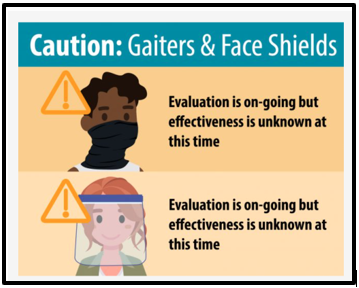
As of this writing[2], there is documented evidence that the CDC is still weighing the advisability of face shields.  Here is what they have to say:

Gaiter and Face Shield infographic


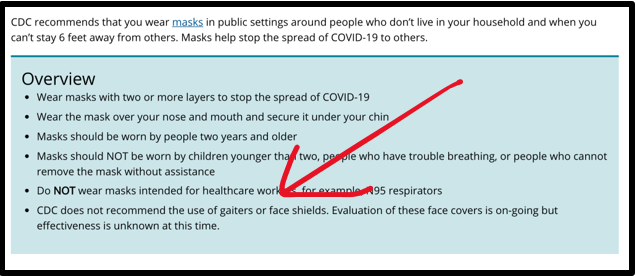
(For the less cartoon-oriented[3], the CDC says it like this:)

CDC mask guidance

Of course, at the same time, as the member points out, the State of New York now allows face shields to "count" as a face cover:

66-3.2 Face-Coverings....

(i) Face-coverings shall include, but are not limited to, cloth masks (e.g. homemade sewn, quick cut, bandana), surgical masks, N-95 respirators, and face shields.


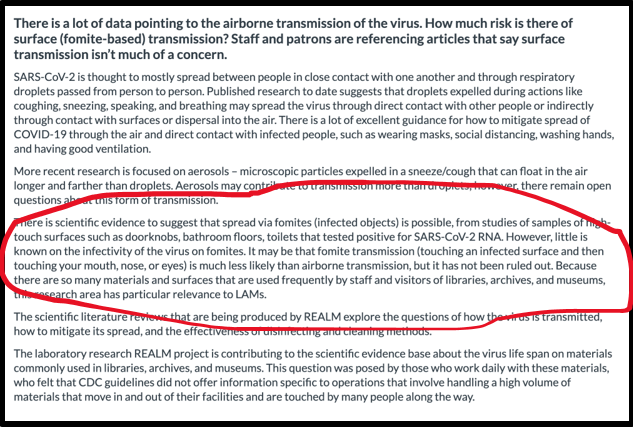
Meanwhile, the REALMS study has hit the library community with THIS cold cup of coffee[4]:

Transmission infographic from Project REALM


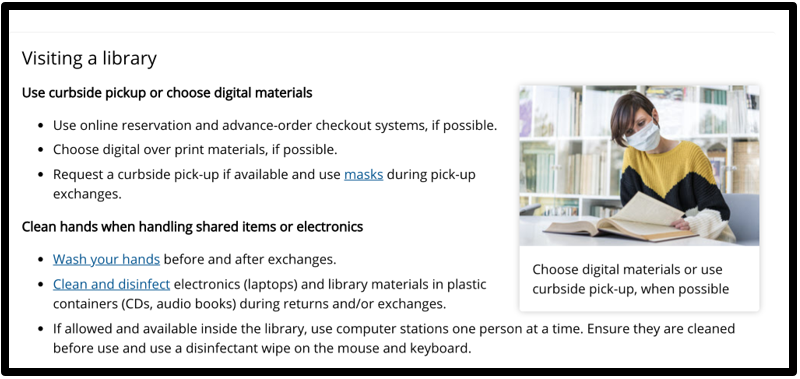
Libraries should be paying attention to all of these evolving resources[5], and should regard their Safety Plan as a "living document" that evolves with that information.  This will help libraries develop a plan that can help them help patrons adhere to CDC guidelines like this one:

CDC Library visit infographic

The bottom line?  If your library bases its access and services on current information, is careful to adhere to its obligations under the ADA, and adheres to a Safety Plan that provides—based on the combined input from such reliable sources—that certain areas may only be accessed by those wearing faces masks (and/or gloves, and/or only if they agree to spray down certain surfaces, and/or only by a certain number of people a day), it may do so.

It all comes down to having a Safety Plan based on your library's unique size, design, staffing capacity, and collection materials.  With a plan that is linked to established factors, the best guidance we can get in uncertain times, and reliable enforcement, anything is possible.[6]

Thanks for an insightful question!


[1] The answer to THIS question is about 15 pages and has 20 footnotes.  Aren't you glad we found a way to make it snappier?

[2] October 16, 2020.  CDC content found at https://www.cdc.gov/coronavirus/2019-ncov/prevent-getting-sick/about-face-coverings.html

[3] I am "cartoon-oriented."  Whenever something can be conveyed effectively via icon or cartoon, it should be.  Of course, as a lawyer, I experience no shortage of words.

[4]  https://www.oclc.org/realm/faq.html.  On a side note, how bad is my DIY mark-up of this content?  It looks like I am trying to draw a squished amoeba. 

[5] My "word of the day," which I learned as I researched this answer, is "fomite" (infected objects). Given what we've all had to deal with in 2020, I am sure I have seen the word before, but was too busy learning the concepts like "zoonotic" & "contact tracing" for it to sink in.

[6] Even wearing a masks while roller skating in a library (but I'd check that one out with your insurance carrier).

Template Facility Use Agreement

Submission Date

Question

Can you provide a template facility use agreement for renting or allowing community groups to regularly use space in a public or association library?

Answer

Yes, I can!  But first, a few caveats:

  • Any template contract is just a starting point.  Use a lawyer to generate a version of this document customized to your library. 
  • For any Organization that wants to use your library for a high-risk event (sports, concert with stage or sound equipment, large event open to the public, routine presence of children), whenever possible, additional review for insurance concerns and premises liability is wise.
  • When filling this out, always make sure the nature of the Organization is confirmed (individual, DBA, LLC, NFP, corporation, etc.), and you have confirmed they exist as stated. 
  • If the form shows that an activity requiring a professional license is going to happen (haircuts, massage, tax prep, legal clinic) obtain a copy of the insurance coverage for the professional activity and make sure it names your Library.
  • No political events should occur unless it is confirmed the arrangements conform to IRS and NYS Charities guidance.
  • A copy of the signed contract should be kept for 7 years (because the statute of limitations to sue on a contract is 6 years). 


ABC Library

FACILITY USE CONTRACT

This contract for facility use is between the ABC Library (the "Library") and INSERT NAME ("Organization") an [insert type organization/individual] ("Organization") with an address of [INSERT], for temporary use of [INSERT ROOM# or Description] in the Library (the "Space").

Details of Temporary Use


Date(s) and time(s) of use


NOTE:  If use is routine ("Every Monday in 2020") note the routine


Purpose of use (the "Event/s").  Please describe the activity to be conducted while you are using the Space.


Estimated maximum attendees


Will you bring in any contractors or third parties under contract for this event?


If so, you must provide the Library with a copy of the contract and they must name the Library on their certificate of insurance.


Please list any special details


Person from Organization who will oversee Organization's use of the Space (must be present at all times) and their back-up person


Name:

Cell number:

E-mail:


Name:

Cell number:

E-mail:


[If applicable]


Rental Fee on a per-use basis


NOTE:  If the use is charitable and the fee is to be waived, the use must not involve any political activity as defined by the IRS.


[If applicable]


Fee is payable to [INSERT] and shall be paid by:


Will minors unaccompanied by parents/guardians be attending the event at the Space?


If yes: does Organization have a policy barring abuse of minors, and requiring instances of abuse of minors in connection with Organization's programs to be reported to law enforcement within 24 hours?


Is Organization a chapter or affiliate of a larger organization?


If so, include larger organization's name.


Will the event involve food or the creation of materials to dispose of?


If yes, what time will clean-up, including removal of all trash and recycling generated by the event, be completed?


Organization's Library Contact (the person who will help them with any questions and address any concerns)


Name:

Email:

Cell:


Library Mission and Terms of Use


The ABC Library's mission is [INSERT].

As part of its mission, the Library requires that all people on Library property abide by all the Library's policies.  In addition, while using the Space, Organization and any person at the Space in affiliation with Organization must at all times follow the below rules, and any reasonable request of any Library representative.

Rules include:

No harassing, abusive, or demeaning activity directed at any person or the Space.

No contact that violates any applicable law or regulation.

In the event of an emergency at the Library, Organization shall abide not only by the reasonable request of any Library representative, but also any first responder assisting with the emergency.

In the event of any injury to any person, or incident of property damage while the Space is in use, Organization will immediately notify the Library Contact listed in the chart above immediately.  In the event of a crime or medical emergency, call 911.

Aside from those attending the event(s) in the Space sponsored by Organization, no filming or taking pictures of any individual in the library (visitor or employee) is allowed, without their express permission.

After use, the Space will be restored to the condition it was in prior to Organization's use, by the Organization, unless otherwise specifically confirmed with the Library Contact.

Organization will not promote the event using the Library/Space as the location until this contract is fully signed and (if applicable) Organization has paid the applicable Rental Fee.

Drafting note: if the Library does not own the building, add any other rules based on requirements in the lease.

Violation of any rules may result in the termination of this Contract with no refund, and denial of future use.

Emergency Cancellation

This Contract guarantees that Library will reserve the Space for Organization as set forth in the "Details" section, above. However, in the event the Library or a related entity experiences an emergency which, in the sole determination of the Library, requires the cancellation of the use (including but not limited to condition at the facility, weather emergency, or event requiring Library's emergency use of the space), Library shall notify Organization as soon as possible, and work with Organization to refund the fee or determine a new date, whichever is preferable.

Indemnification
To the greatest extent allowed by law, Organization hereby agrees to indemnify and defend and hold harmless the Library, its Board of Trustees, employees, agents, and volunteers, from any and all causes of action, complaints, violations, and penalties, and shall pay the cost of defending same, as well as any related fines, penalties, and fees, including reasonable attorneys' fees, related to Organization's use of the Space, including conduct by any third party or contractor present at the Space as part of the Event/s.

Insurance
Organization shall provide insurance meeting the requirements shown in exhibit "A."

Drafting Note/Instruction: the person at the Library organizing the contract will either select the default insurance requirement, which is the conventional insurance demand, or it shall be determined that no insurance is required.  For organizations conducting routine meetings, and especially if children are served by the Organization, the library's lawyer, and/or your insurance carrier will almost always advise insurance be required. 

Person signing for Organization
The person signing on the line below on behalf of organization is at least 18 years of age and has the power to sign for the Organization.
 

Venue for Dispute
This contract and any related action shall be governed according to the laws of the state of New York, and Venue for any dispute shall be INSERT county, New York.

Accepted on behalf of the Library:___________________     on:___________

                              Print name:__________________


Accepted on behalf of the Organization:___________________          on:___________

                              Print name:________________________

Memorandum of Understanding for Municipal Libraries

Submission Date

Question

I work with a number of municipal public libraries - some are village, others are town. Some libraries use their municipality's employee handbooks, payroll, services like snow blowing and building maintenance, and have the municipalities cut the checks.

It would be helpful to have a clear understanding that the libraries are not a department of the municipality and that the board of trustees is in charge of the library, hiring staff, evaluating staff, approving expenses, and have complete control of the budget.

It would also be helpful if there was a sample MOU that spells out the division of responsibilities clearly.

Answer

Many of the questions we get at "Ask the Lawyer"[1] relate to this concern.  As the priorities cited by the member suggest, the library-municipality relationship is a Big Issue.

I have worked with city, town, and village attorneys, in one way or another,[2] for most of my professional life. So I can understand why sometimes, if they are focusing on reducing liability or overhauling operations, a town board or a city mayor might be tempted to think of the library as "just another department."

But we know that is not the case.

With all that in mind, I am very grateful to have this opportunity to craft a pro-active answer to this issue.

I am going to let the requested sample Memorandum of Understanding—or "MOU"—do most of the talking on this topic.  For comments on why I have included certain things, you'll see footnotes and items in italics that should be removed from any final version (unless you have a really fun-loving and tolerant town attorney).

Caveats

Of course, with all things "template," this MOU should only serve as a boilerplate.

Further, libraries with very sensitive or less-than-ideal relationships with their municipalities might want to use this only as an internal guide for discussion.  It's not a fun fact, but it remains a fact that some municipal leaders could take a "request for clarity" as an act of aggression.

And as noted throughout, to the greatest degree possible, your library should consult their own attorney about the different considerations in this template.[3]  With that in mind, I hope this document is a useful starting place for that attorney, and I welcome calls from lawyers working with this document.[4]

And here we go:

USING THIS TEMPLATE:  Any guidance in italics, and the footnotes, should be removed before an MOU using this template is finalized.  If at all possible, the MOU and attachments should be reviewed by an attorney before signature.  Items in bold are non-negotiable; they are based on the law and are not subject to change.[5]


[PROPOSED] MEMORANDUM OF UNDERSTANDING

Between the [NAME] Library and the [MUNICIALITY]

This memorandum of understanding is between the [NAME] Library (the "Library") and the [INSERT NAME OF MUNICIPALITY] (["GOVERNMENT ENTITY" or "GE"][6]), which both serve the community of [INSERT NAME OF MUNICIPALITY] (the "Community").

This memorandum of understanding ("MOU") is entered into by the Library's Board of Trustees (the "Library Board") and the [AUTHORITY OF THE ENTITY[7]] ("[GE AUTHORITY]"[8]) and is intended to ensure clarity and unified purpose with regard to critical interdependencies between the Library and the GE.  Together, the Library and the [GE] are the "Parties" to this MOU.

As a living document this [first] version of the MOU sets forward both items of clarity, will be revisited by the Parties in the month of [INSERT] every [TIME SPAN[9]].  

Mission and Shared Purpose

The mission of the Library is [INSERT MISSION].

The mission of the [GE] is to [INSERT MISSION].

The Library and the [GE] share the mission-oriented purpose of serving the Community within the [GE] by [compose and insert "shared purpose"[10]]; this is their "Shared Purpose." 


The Parties

The Library is a public library chartered by the Regents of the New York State Education Department on [DATE], as shown in the most recent version of the Charter attached as "A" (the "Charter").[11]

As required by law, the Library is governed by a board whose authority is set by sections 255, 256, 260, and 226 of the New York Education Law, the Not-for-Profit Education Law, the Charter, and the bylaws of the library.  A copy of the most current bylaws of the Library is attached as "B."  

The [GE] is a Municipal Corporation incorporated under the laws of New York State in [YEAR]. 

As required by law, the [GE] is governed by [INSERT][12].

A copy of the [GE] Code (the "Code") may be found at [insert code link[13]]. 

[IF RELEVANT] The provision[s] of the Code pertaining to the Library are attached as "C."


The Relationship of the Parties

As a Regents- chartered entity, the Library is an independent corporation with the ability to own property, enter into contracts, employ a workforce, and maintain its own bank account for the management of library funds. 

Further, the Library is required by state law and regulation to employ adequate employees to staff the Library in fulfillment of its Plan of Service, which is attached as "D."[14]

Since the [GE] and the Library are two distinct entities, many of their operations occur independently of the other.  However, for the sake of their Shared Purpose, the leadership of the parties have determined that certain "Critical Interdependencies" are in the best interests of the Community.

These "Independent Operations" and "Critical Interdependencies" are itemized below, with comments or additional information in column 3.[15]

Operational item


Independent Operation or Critical Interdependency?

When possible, check your conclusion with your lawyer before making a final determination.

Important information or attachment


Ownership of Library Building


This should specify if the library or the municipality owns the structure housing the library. 


If the GE owns the structure but charges no rent (or $1), it is a "critical interdependency." 

If the library owns its premises, it is an "independent operation."


Attach a survey or schematic of the library's complete property as "F".[16]


Maintenance of Library: capital improvements


This should specify who takes the lead on capital projects and how the parties will work together for remodeling or building a new library.


By "take the lead," I mean: who signs the contracts for the work and manages the different factors in the capital project?


If the GE "takes the lead" on capital improvements, it is a "critical interdependency."  If the library takes the lead, it is an "independent operation."


The library should always have copies of warrantees and contracts related to capital improvements.


Maintenance of Library: emergency repair


This should specify what happens when a pipe bursts and you need to stop the water and fix the pipe, or who makes sure the elevator gets fixed promptly (we'll handle damage to library assets in another section).


If the GE is responsible for arranging emergency repair, it is a "critical interdependency." 


If the library does, it is an "independent operation."


This is a great place to list who to call in the event of a facilities emergency.


Maintenance of Library: landscaping and snow removal


This should specify if the library or the municipality does the work or contracts for it.


If the GE is responsible for external routine maintenance, it is a "critical interdependency." 


If the library does, it is an "independent operation."


This should establish not only the party responsible, but set the expectations for service (for instance, should the driveway be plowed before the employees arrive on a snowy day?  That sounds good to me).


If performed by a third party, the library should always have copies of contracts related to grounds maintenance, even if the contract is with the GE.


Maintenance of Library: routine cleaning


This should clarify the line between "routine" cleaning (like weekly vacuuming) and "non-routine cleaning" (like cleaning up when a printer cartridge breaks open near the rare book room), and specify if the library or the municipality does or contracts for the work.


If the GE is responsible for routine cleaning, it is a "critical interdependency." 


If the library does, it is an "independent operation."


If performed by a third party, the library should always have copies of contracts related to routine cleaning, even if the contract is with the GE.


Details such as when the cleaning is, and the levels of access of workers, are important to clarify.


Damage to library structure: insurance coverage


This should specify what insurance covers damage to library structure.


If the GE coverage applies, it is a "critical interdependency." 


If the library supplies its own coverage, it is an "independent operation."


The board should always have a copy of the policy covering the library structure, and the copy should be in the cloud, not just in the library.


Always.  This should not be left to chance.


Current insurance policy or amount determined for "self-insurance" by municipality is attached as "F."


Library Security Personnel


This should specify if the library or the municipality supplies any security personnel. 


If the GE is responsible for security personnel, it is a "critical interdependency." 


If the library employs or contracts for its own security, it is an "independent operation."


Any discussion of this or contracts relating to security should emphasize rights of access and patron confidentiality, and clearly establish who is "in charge" of the security personnel (who tells them what to do).


Library Security System, including any cameras


This should establish who pays for, monitors, and owns the system and any content on it.


If the GE is responsible for security personnel, it is a "critical interdependency." 


If the library employs or contracts for its own security, it is an "independent operation."


Any discussion of this or contracts relating to security should emphasize rights of access and patron confidentiality![17]


Insurance coverage for damage to library assets (collection, furniture, equipment)


This should specify what insurance covers damage to library assets (not the structure).  The type and amount of coverage should be assessed on an annual basis by the board of trustees.


If the GE coverage applies, it is a "critical interdependency." 


If the library supplies its own coverage, it is an "independent operation."


To help with this item, a library should have an inventory of its assets. 


The board should always have a copy of the insurance policy covering the library assets, and the copy should be in the cloud, not just in the library.


Always.  This should not be left to chance.


Current insurance policy is attached as "G."


Employees: who is the employer


The employer of the employees is the library, not the [GE].


This is not negotiable.


Employees: who processes payroll and tracks leave accruals[18]


If the GE issues the paychecks, it is a "critical interdependency." 


If the library runs its own payroll, it is an "independent operation."


Whatever entity (or third-party contractor) is doing this, it must be done properly and with proper retention of payroll records and paid time off accruals.


Employees: who administers benefits


If the library employees get benefits (health insurance, retirement) through the GE this is a "critical interdependency." 


If the library arranges its own benefits, it is an "independent operation."


Copies of Summary Plan Documents ("SPD's") or other benefit descriptions are attached as "H"


Employees: what coverage applies for workers' compensation, paid family medical leave, and disability?


If the library employees are covered through the GE, this is a "critical interdependency." 


If the library arranges its own coverage, it is an "independent operation."


This is another one to have absolute clarity on! 


Your library should have the most recent mandatory postings[19] up in an area accessible to employees, confirming this clarity.


Employees: what employee policies apply, and who is responsible for determining them


The employer of the employees is the library, not the municipal entity.  While the library may "borrow" some or all municipal policies, within the constraints of applicable law and regulation, the board of trustees determines the employment policies.


Sexual harassment/civil rights complaints, whistleblower complaints, resolving conflict of interest matters


These complaints must always be managed by the Library Board per the relevant library policy.


Library Emergency Response Plan(s)


Optional but encouraged


The entity responsible for the library's response in an emergency is the Library Board, not the municipal entity.  While the library may "borrow" some or all municipal policies, within the constraints of applicable law and regulation, the Library Board determines any emergency response-related policies.


Facility use policies


Regardless of whether the library owns the building, or is a "tenant," only the Library Board determines facility use policies of the library (for example, rental or free use of rooms and other library space).


A good facility use agreement establishes the rules of use, confirms if/how liability for the use is transferred (hold harmless, indemnification), and addresses if insurance is necessary.


Banking


Who hangs onto the money?[20]


Library funds are solely controlled by the library, regardless of where the funds are kept.


Even if the operational funds of the library are held by the GE, this "critical interdependency" should be confirmed as being in aid of separate and distinct library finances solely controlled by the Library Board.


Money can be a HUGE source of dysfunction between a library and its municipality.  Before picking any battles, the Treasurer, director, and board should have clarity about their expectations and goals for stewarding the funds of the library.  This is a good topic to stay in touch with your system, Library Development, and your lawyer on.


Fiscal controls (petty cash, cash handling policy, book-keeping, accounts receivable and payable, use of credit card, tracking restricted funds, tracking capital funds)


To the extent needed, and consistent with a public library boards autonomy over library finances, these policies are to be adopted by the Library Board.


Audit


Different libraries will have different audit obligations, but all are subject to audit by the New York State Comptroller.


Any audit of the library should be done with the awareness of the library board.


The last 10 years of audits should be accessible for review by the parties.

Procurement and disposal of library assets[21]

Although controlled to a certain extent by law, procurement and disposal of library assets are solely controlled by the Library Board.


Budget


The library budget is passed by the board.


Library System


The library board is the entity that decides to sign any Library System membership agreement.


A library facing a determination based on any of the factors in this chart should reach out to their System as soon as possible for assistance.  Although every system is different, they will be a critical ally in navigating these items.  Remember, you are not alone!


Custom factors special for your library


Every library is different.  Use this section to track custom factors that impact your library-municipality relationship.


There are so many cool, odd, special things out there in library world, I am only surprised when a day goes by and I haven't learned about a new one.

Directors and Officers insurance and/or indemnification of library trustees

If the GE provides coverage and/or indemnification[22], this is a "critical interdependency." 


If the library has its own policy, it is an "independent operation."


The board should always have a copy of the policy covering the library trustees and directors against assertions of liability in the course of their library duties.


Always.  This should not be left to chance.


Current insurance policy is attached as "I."


Acknowledged on behalf of the [NAME]Library on _______:

BY: _______________________________________________


Acknowledged on behalf of the [NAME of ENTITY] on _______:

BY:______________________________________________


Attachments:

A: Library Charter

B:  Library Bylaws

C:  Section of municipal code pertaining to library

D:  Library Plan of Service

E:  Survey or schematic of library property

F:  Current Insurance Policy (premises)

G:  Current Insurance Policy (assets)

H:  Benefit documents

I:   Current Insurance Policy ("Directors and Officers Insurance")


[1] For example: RAQ #50RAQ #62RAQ #93

[2] My first experience with municipal law was when I worked for attorney Dan Seaman, who has served as the town attorney for many towns and villages in Niagara County, New York.  My former partner Daniel Shonn was the town attorney for Akron, NY, and I covered town meetings from time to time.  I worked closely with the Town of Lewiston and the City of Niagara Falls attorneys when I was the in-house counsel at Niagara University.  And lately, even though I love my city very much, I just can't stop suing Buffalo (on behalf of clients), so they are really getting to know me at the city law department.

[3] Critical difference between an "MOU" and a contract: an "MOU" is, by design, not intended to be enforceable-although it may recite items that are enforceable via other means (for instance, if they simply recite something that is mandatory under the Education Law, which this one will).  For libraries seeking to elevate an MOU to an enforceable agreement, it is best to work with a lawyer from the get-go.

[4] (716) 464-3386, or adams@losapllc.com.

[5] Any NY library system that wants a fillable version of this MOU Template can write to Jill@stephaniecoleadams.com

[6] For this item, you will select whatever type of entity you are working with: city, town, or village.  For this template, we're going to call it the "GE" (for "government entity"), although that will make it sound like you are trying to make them turn right in the 1800's.

[7] The authority entering into the MOU will vary depending on the entity type.

[8] This name will also be modified to reflect what applies to your municipality: Town Supervisor, Village Board, City Common Council, etc.

[9] This "time span" should be selected to ensure you never have a fresh board of trustees and municipal leaders who don't know how things need to function.

[10] A nice "shared purpose" might be "the service and betterment of those living in our community."  It's nice to revisit the "shared purpose" every now and again so leadership is invested in it and it doesn't get stale. 

[11] Make sure you use the most recent version of the Charter.  An updated copy can be obtained via a request to New York State Education Department, Division of Library Development.  If there is enabling legislation, attach that, too, since the legislation can impact some of the variables in the chart.

[12] This is whatever combination of leadership calls the shots for the municipality: town supervisor and board, etc.

[13] I am sure I don't need to tell a library audience that most municipalities have their codes online, but I just love footnotes.

[14] Yes!  This MOU will need a binder or a routinely updated database to hold all the attachments!  Don't you love it?

[15] From what I have seen—and at this point, it's a lot—every library working with a municipality handles this differently.  It's like a Myers-Briggs personality test...endless permutations, even within similar types.

[16] Knowing the exact physical footprint of the library is critical!  Among many other things, this is how you set the boundaries for the limit on things such as, for example, smoking near the property.

[17] This is critical for compliance and clarity about patron records under the New York Civil Procedure Laws and Rules (CPLR) 4509.

[18] A not-so-fun, but instructive, read on this topic is found in the NY State Comptroller Audit found here: https://www.osc.state.ny.us/sites/default/files/local-government/audits/2018-09/lgsa-audit-library-2018-brentwood.pdf

[19] A list and copies of most postings is here: https://labor.ny.gov/workerprotection/laborstandards/employer/posters.shtm

[20] Extensive information on this topic is found here: http://www.nysl.nysed.gov/libdev/trustees/handbook/pltreasurer.htm

[21] A good example of this is in Ask the Lawyer RAQ #68

[22] "Indemnification" is when an organization defends a director, officer, or employee in a lawsuit (like a discrimination claim).