
Emergency Response

Public restroom availability in reopening

Submission Date

Question

A small, rural public library, we have public restrooms. In pre-pandemic times, our restrooms were not kept locked, and were cleaned once a day by our building's maintenance person.

Both restrooms are ADA-compliant and include a changing table. We have already installed motion sensors on the toilets and sink and replaced the hot air dryer with paper towels. Currently, our building is only open to staff and they wipe down touched surfaces with cleaner after use, and initial that they have done so on a bathroom cleaning log as required by our Safety Plan.

As we edge toward reopening to the public, we have many questions around these restrooms. Should we lock the restrooms and require the public to ask for a key? Should we lock the restrooms to the public entirely? Should we return to our pre-pandemic practice of completely open restrooms cleaned once a day? Should we require non-janitorial staff to clean the restrooms during open hours, and, if yes, how often, and do they require training on the products and methods required to clean a public restroom during a pandemic--and what kind of PPE does that require?

Any guidance on how to handle ostensibly public restrooms in an ostensibly public building is appreciated.

Answer

Like many of you, I have had to tackle a lot of previously unaddressed conundrums since March of 2020.  Especially when it involved developing a Safety Plan, this "tackling" has required research, patience, a good sense of humor, and lots of flexibility.[1]

The issue of how to handle 1) newfound concerns regarding the sanitary conditions of workplace toilets; and 2) newfound concerns about sanitary conditions of toilets in public spaces, is one of the most high-stakes and complex.  It can cause a lot of anxiety.

When a matter makes me anxious, I resort to either exercise, or exacting linguistic specificity.  Since you don't come to "Ask the Lawyer" for workout tips[2], I will address this anxiety-provoking issue with exacting linguistic specificity, starting with the Occupational Safety and Health Administration (OSHA)'s definitions of the different terminology used for bathrooms[3]:


Personal service room, means a room used for activities not directly connected with the production or service function performed by the establishment. Such activities include, but are not limited to, first-aid, medical services, dressing, showering, toilet use, washing, and eating.

Toilet facility, means a fixture maintained within a toilet room for the purpose of defecation or urination, or both.

Toilet room, means a room maintained within or on the premises of any place of employment, containing toilet facilities for use by employees.

Urinal means a toilet facility maintained within a toilet room for the sole purpose of urination.

Water closet means a toilet facility maintained within a toilet room for the purpose of both defecation and urination and which is flushed with water.
 

Now, before we go further: a few words about OSHA.  Based on size, location, type, and a dozen other factors, there is no one-size-fits-all for OSHA compliance. But public employers (like many libraries) in NY are required to follow OSHA's standards for employee toilets[4], and non-public employers, whose bathroom-supplying obligations will change by site and size of the organization, can refer to those standards for inspiration.[5] And OSHA (along with the Center for Disease Control, or "CDC") is currently a New York State Department of Health (NYSDOH) go-to for COVID-related sanitization information. 

So with those three resources in mind (NYSDOH, CDC, and OSHA), let's address the member's questions:

QUESTION 1: Should we lock the restrooms to the public entirely?

The first question to address in this is not "should" the library lock the restrooms to the public entirely, but can it?

Any library considered a place of "public assembly,"[6] by state regulation, must have a bathroom open to the public.[7]  However, the definition of a "place of public assembly" expressly excludes public association and free libraries, so yes, and while a municipal library will have a few more hoops to jump through, an association library can decide to limit access by the public.

If your library isn't required to have a "toilet facility" accessible by the public[8], and the capacity of your library means the toilet facility can't be routinely cleaned per the NYSDOH's recommendations, it is worth considering reducing or shutting access down.[9]


QUESTION 2: Should we lock the restrooms and require the public to ask for a key?

If this would help monitor use so the bathroom can be cleaned on an as-needed basis per NYSDOH/CDC/OSHA recommendations, yes, that is a viable option, and can be included as part of a Safety Plan. 

Should we return to our pre-pandemic practice of completely open restrooms cleaned once a day?

OSHA states: "Employers operating workplaces during the COVID-19 pandemic should continue routine cleaning and other housekeeping practices in any facilities that remain open to workers or others. Employers who need to clean and disinfect environments potentially contaminated with SARS-CoV-2 should use EPA-registered disinfectants with label claims to be effective against SARS-CoV-2."

Meanwhile, the Phase II Safety Plan template from New York State requires any library to: "Conduct regular cleaning and disinfection at least after every shift, daily, or more frequently as needed, and frequent cleaning and disinfection of shared objects (e.g. tools, machinery) and surfaces, as well as high transit areas, such as restrooms and common areas, must be completed."

So, although there is no mathematically determined heightened standard, these requirements show that routine disinfection should be based on frequency of use, and at a bare minimum, bathrooms should be disinfected at least "once per shift," and there should be a log to register each cleaning (just as the member described they are already doing).


QUESTION 3: Should we require non-janitorial staff to clean the restrooms during open hours, and, if yes, how often, and do they require training on the products and methods required to clean a public restroom during a pandemic--and what kind of PPE does that require?

This is a tricky question.  "Requiring" non-janitorial staff to do a task not in their job description risks concerns with morale, operational consistency, and if there is a contract involved, compliance (this will vary from library to library, of course).  And if the cleaning supplies trip a person's health conditions, there might also be concerns with ADA. 

Because of this, like all aspects of the Safety Plan, the requirement to sanitize surfaces in the bathroom(s) must be planned carefully. 

That should start with an analysis of the toilet facility, just as the member asking this question has done.  Does it have one toilet or many?  Does it have touchless sinks or sinks with handles?  Is the tile in good condition, or is the grout failing?  In short, what does it take to sanitize your library's unique space effectively?

One you've done the analysis, select the right products from the EPA's list of products known to effectively combat COVID-19, and based on the instructions on the product, select the method of disinfection that meets the needs of your operation, including the frequency.  And once you have established the method and the frequency, the requirements for employee PPE and training are here: https://www.cdc.gov/coronavirus/2019-ncov/community/disinfecting-building-facility.html and they include a link to a pdf poster about safe disinfection of the work site: https://www.epa.gov/sites/production/files/2020-04/documents/disinfectants-onepager.pdf.


And finally, the last part of the member's submission: Any guidance on how to handle ostensibly public restrooms in an ostensibly public building is appreciated.

This is a great summarizing statement, because as it hints, and as this answer reviews, not all "public" restrooms are actually required to be open to the public at all.  Once you have confirmed the requirements for your particular library, it's time to assess what you can do—and what your mission demands that you do.  If that means reducing toilet facility access to minimum required levels, so employee energy and your library's budget can focus on service to the public, make it so.  If that means re-allocating part of the budget to hire a contractor specifically to clean the bathrooms every four hours since your library knows public access is either required or essential, and your library isn't situated to add that to employees' job descriptions, do that.  And if that means employees are expected to take on new duties to effect routine sanitization, develop a well-thought-out rollout plan[10] before implementing that as an express job duty.[11]

But whatever you do with the restrooms, the key is to consistently document that your library is following the NYDSOH, CDC, and OSHA guidelines suited to its unique site, location, and identity.

Thank you for a great question and a great example of the care libraries are taking to stay open and safe for the public.


[1] One of my co-workers rejected my first idea for managing our narrow hallway in the office.  "I will not announcement my presence by yelling "Gang Way!", Cole."  We settled on a protocol of visual inspection, first.   Even when your name is over the door, a Safety Plan is a matter of give and take.

[2] That said, if you suffer from carpel tunnel or sore forearms from too much typing, put your hands down flat (palm side up), stand on your fingers/palms, and pull upwards for 1minute 3xday.  Changed my life. 

[3] The OSHA-specific information is aggregated at this link: https://www.osha.gov/SLTC/covid-19/covid-19-faq.html#restrooms

[4]  This standard is enforced by the New York State Department of Labor Public Employees Safety and Health Bureau (NYSDOL PES) for public employees.

[5] Further information on required numbers of toilets can be found here, but for the sake of brevity, I am not going to go there: https://dos.ny.gov/system/files/documents/2021/05/tb-2011-required-toilet-facilities-based-on-occupancy.pdf#:~:text=Using%20exception%20number%204%20to,25%20and%20less%20than%2050

[6] Per New York State Labor Law, §2, a “Place of public assembly” shall include (1) a theatre, (2) moving picture house, (3) assembly halls maintained or leased for pecuniary gain where one hundred or more persons may assemble for amusement or recreation, except (a) halls owned by churches, religious organizations, granges, and public association and free libraries as defined by section two hundred fifty-three of the education law, and (b) hotels having fifty or more rooms. [emphasis added, note the exclusionary language].

[7] 12 NYCRR 36-2.8

[8] Be careful in this analysis; if possible, confirm any conclusion that you don't have to have a public bathroom with your local attorney, or the municipal building inspector.

[9] Just be mindful that General Business Law Section 492 requires any place of business with an employee bathroom to let a visitor use that bathroom if it is a medical necessity.  While your library might not be a "place of business" under that law, people with medical needs may have an expectation of access.  Be ready to be flexible if there is a medical need for a toilet facility.

[10] This could simply mean thinking the Safety Plan through, meeting with employees to make sure they are on board with it, and making sure every employee has clarity about safety.  It can also mean working with your civil service agency or local attorney, so any contractual aspects are properly considered.  Since these are tense times for employees, good planning and communication about job duties is essential.

[11] In many library environments, it will be fine to add sanitization as a "duty as assigned," but in other places (with detailed job descriptions, a union contract, or contracts or policies that could impact the "assignment") it will not.  This concern cannot be answered generally; it will vary from library to library.
Temporary disuse of a meeting room

Submission Date

Question

My library's reopening plan calls for not allowing group meetings/ programs for a time.

There is some concern for a BOT member as to if the library can legally do this. The concern is if a community group or club that regularly meets in the library were to want to meet again, could they challenge the library in regards to this issue? In a nutshell, the question is "Do we legally have the right to suspend and not allow all meeting room use as the library reopens?"

As library director my thought process is that as long as the policy is being equally and fairly enforced to everyone then there should not be an issue. This does beg the question however as to what may happen if the city, which owns the building calls "eminent domain" and quickly demands use of a meeting space they own in an emergency circumstance. This is rare but has happened a few times in the past.

Any input you have would be greatly appreciated.

Answer

I have been looking at some of my post-COVID "Ask the Lawyer" responses, and they are pretty grim.  Such serious writing.

Of course, these are serious days, and operating during COVID-19 is a serious topic.

But I have been on the lookout for a chance for some joy, if not some outright levity.  And finally, this question supplies one!

Why would a question about temporary disuse of a meeting room make me happy?  Well, as some of you may have noticed, very little gratifies me more than emphasizing a library's autonomy.[1]

So, hear me rejoice: Yes, your library has the right to disallow all meeting room use in the interest of safety!

And if that isn't joyful enough, get ready for more good news: this is true whether your library is a tenant or a landowner, a public library or an association library, a library in a big city or a library in a small rural village!

Why is that?  If a chartered library in New York has assessed its unique space, its unique operational capacity, and its unique ability to operate safely, and as a result has adopted a Safety Plan that does not allow meeting spaces or on-site programming, then...there will be no meeting use or on-site programming.  It's as simple as that.

Now, that said, can someone try and complain about it?  Sure.[2] Can a building owner (like a town or a landlord) try and over-ride it? Yes.[3]  Could a pre-COVID contract be implicated?[4]  Yes.  But as an autonomous entity governed by an independent board, can your library make a Safety Plan and stick to it?  Yes.

As it should be.

Of course, within that autonomy is the obligation to steward and utilize library assets responsibly, and in compliance with the law.[5]  This is why the member's point about uniform enforcement and clarity is so important.  If the access is restricted for the Book Club, it needs to be restricted for the Comic Book Club, and even for the Garden Club.[6]  But after ensuring basic fairness and compliant use of library resources, the baseline decision about what facilities to allow access to during the pandemic is in the hands of the library's board and director.  And as I have said in many of my recent answers: they must put safety first.

Only one thing remains to be said: despite my obvious relish for the task, I want to assure the reading public that I still did my homework for this reply.  As of this date,[7] the only court rulings in New York to address litigation or complaints about library access as impacted by COVID-19 are numerous claims about transmission concerns impeding access to a prison law library[8] (now, in that case, I can understand why someone would complain).  But I found nothing regarding action against public and association libraries due to COVID-induced closure, reduced operations, and impediments to general access.  Hopefully it stays that way.[9]

Thanks for a good question and for some time on the bright side.


[1] It gives me a very "we the people" thrill that no amount of election-year jitters can override.

[2] I am sure that by now (August 25, 2020), MANY of you have heard MANY complaints...complaints about masks violating the ADA, complaints about the Library being too open or too closed, complaints that your signage is in the wrong font, or perhaps complaints about the smell of your hand sanitizer being too fruity.  These days, people just need to complain about something—it helps us feel more in-control.  I know I directed a very strongly worded message to my local government regarding document retention policies after the repeal of Civil Rights Law 50-a; for about 10 minutes, I felt really in charge of my own destiny.

[3] This is why a lease, or at least an agreement with a municipality who may own the library building, is a good idea.  At the bare minimum, such a document should address security/confidentiality, insurance for loss, the protocol for an on-site slip-and-fall, and the process for planning capital improvements.

[4] For instance, a facility rental agreement.

[5] For instance, once your meeting room is again accessible to the public, you can't let a start-up business owner hold a pop-up retail stand there to turn a profit, since that would risk compliance with several laws and tax regulations.

[6] Comics are very cool, but obviously your library doesn't want to play favorites.  And just because the Garden Club shows up with trowels is no reason to give them special treatment.

[7] August 25, 2020.

[8] There are already over a dozen of these.  A typical case can be seen in Vogel v Ginty, 2020 US Dist LEXIS 148513 [SDNY Aug. 14, 2020, No. 20-CV-6349 (LLS)].

[9] It will be hard enough sorting out the impact on budgets and various regulatory requirements.

What to do if an employee tests positive for COVID-19

Submission Date

Question

We got lucky: an employee, who was asymptomatic at work but tripped one of the screening factors requiring him to stay home, was tested and found NEGATIVE for COVID-19.

Our employee is coming back to work, but I have been wondering...what if the test came back POSITIVE?  If we have to quarantine all our employees, we'd be shut down completely!

Answer

First: that is good news about your employee.

Second: a gold star to your library for having a screening system that works, and for following the requirement to restrict an employee who trips a screening factor from on-site work while waiting for test results.

Third: Let's talk about your alternate scenario (the one where you don't get such good news).

As of August 17, 2020, any library[1] that is up and running should have a Safety Plan as required by both the guidance for "Office-based Work", and "Retail Business Activities" (we'll call this the "Guidance").

The Guidance includes the requirement to fill out a New York Forward Business Affirmation Form, which attests to having a Safety Plan.  It also answers the member’s question about what to do if an employee tests positive for COVID-19.

Here is what the Guidance (as of 8/18/2020) requires:

An individual who screens positive for COVID-19 symptoms must not be allowed to enter the office and must be sent home with instructions to contact their healthcare provider for assessment and testing.

Responsible Parties should remotely provide such individuals with information on healthcare and testing resources.

Responsible Parties must immediately notify the state and local health department about the case if test results are positive for COVID-19.

Responsible Parties should refer to DOH’s “Interim Guidance for Public and Private Employees Returning to Work Following COVID-19 Infection or Exposure”[2] regarding protocols and policies for employees seeking to return to work after a suspected or confirmed case of COVID-19 or after the employee had close or proximate contact with a person with COVID-19.

So, the answer to the member's question: "What if the test came back positive?" is: "[I]immediately notify the state and local health department."

After that, the direction from the local health department may vary, but the Guidance requires:

If an employee has had close or proximate contact[3] with a person with COVID-19 for a prolonged period of time AND is experiencing COVID-19 related symptoms, the employee may return to work upon completing at least 10 days of isolation from the onset of symptoms.

...[and]...

If an employee has had close or proximate contact with a person with COVID-19 for a prolonged period of time AND is not experiencing COVID-19 related symptoms, the employee may return to work upon completing 14 days of self-quarantine.

And after that, things can really vary.  But in a scenario where every employee of the library came within six feet[4] of their (now confirmed as) infected co-worker, the library really could be looking at up to two weeks of employees in self-quarantine...along with any other response required by the local health department.

This is not a feel-good scenario.  But the good news is, the same Guidance that requires a library[5] to require employees to isolate also reduces the likelihood of such a remedy being needed.  This is because the Guidance also requires a host of preventative practices to limit exposure in the first place, including:

  • Staggering shifts to limit "close or proximate contact," between people;
  • Creating and posting clear signage;
  • Consistently enforcing masking, cleaning, and social distancing practices

If a library maps these things out for employees, and consistently enforces them, there will be less need for the "isolation/quarantine" sections.  While right now, there is no magic bullet, the simple elements of your library's Safety Plan can reduce the need for quarantine.

And that's it; thanks for a great question.  I hope this answer never has to come in handy for your library.  But just in case it does: here’s a quick checklist for the steps listed in this response [6]:

"CHECKLIST FOR RESPONDING TO NOTICE OF COVID-19 EXPOSURE AT THE LIBRARY; TO BE USED IN CONJUCTION WITH UPDATED SAFETY PLAN"

  • However the library was notified of the potential close/proximate contact, obtain a copy of the notice in writing (or send a confirmation e-mail to the source);
  • As required by the most recent New York Forward Guidance, notify the library's local public health Department (both in person and in writing), and factor in their response[7];
  • As required by the most recent New York Forward Guidance and the library's Safety Plan, determine who (if anyone) else must be restricted from the workplace, for how long; and if any further testing must be required;
  • Ensure the library is taking steps to protect the privacy of any employees disclosing screening factors (like a high temperature);
  • Ensure the library is taking steps to assess if any employee must be given paid time off or will need assistance to claim short-term disability or Paid Family Leave Act benefits;
  • Generate a short statement reviewing the above check listed factors, summarizing what your library has done for each step, and make sure you retain copies of all documentation showing you completed these steps;
  • Once these actions are taken and these determinations are made, notify your Board of Trustees of the critical aspects of the situation, but take care to respect the privacy of employees.


Here is a template notice to the board, designed to reflect taking the necessary steps, while also protecting employee privacy: 

On ____________, the library received notification of an [individual/employee] testing positive for COVID-19. As required by current guidance from the State, we notified the Health Department immediately.  At this time, the direction from the local health department is _____________________________________[this may be extensive]. 

We have determined that # employees must self-isolate until they DATE. 

We have determined that # employees must self-quarantine until DATE. 

We have confirmed with the health department that as a result of this notice and response, and consultation with the [Executive Committee of the board/full board/board officer/other] we will [close/reduce operations/operate under the status quo], unless the board determines otherwise. 

Our Safety Plan has been followed and we have retained the documentation showing such compliance.


[1] Any library that does not consider itself "operated by a local government or political subdivision", that is, since the New York Forward guidance specifically states that the various Executive Orders' business restrictions do not apply to such libraries.

[2] Found at this link as of 8/17/2020: https://coronavirus.health.ny.gov/system/files/documents/2020/06/doh_covid19_publicprivateemployeereturntowork_053120.pdf

[3] According to the Guidance, "close contact" is "to be someone who was within 6 feet of an infected person for at least 10 minutes starting from 48 hours before illness onset until the time the person was isolated."

[4] This should NOT be happening!

[5] Remember, local governments and political subdivisions may decide not to follow these precise requirements.  That said, if it determines it is operated by a local government or political subdivision, a library must then follow the safety plan set by that local government or political subdivision.

[6] Some of this isn't required by applicable laws or Guidance, but is in there to position a library to easily show it followed applicable laws and Guidance.

[7] While keeping confidentiality at top of mind, libraries need to think carefully about a voluntary system allowing users to log visits for purposes of contact tracing.  A voluntary list of names, dates and times, maintained with all due care for privacy, can position a library to participate in a local health department's contact tracing initiative.  This can in turn help a community reduce its rate of transmission.

Board of Trustees Approval for Library Reopening Plans

Submission Date

Question

Should a board of trustees vote on their institution’s COVID-19 Safety Plan?  Or should the adoption of the Plan be left entirely to the institution’s director or executive director?

Answer

Who is “in charge” of a library’s safety plan--the trustees, or the director?

It’s tricky, but if you bear with me, you will get an answer.

When it comes to who is “in charge” at an organization, boards must respect the authority of those they employ to lead (the director).  At the same time, the organization, including the director, must be guided by the work of those fiduciaries ultimately responsible for it (the trustees).

This dynamic can play out in many ways, but in a healthy board-director dynamic, the board lives up to its responsibility as a fiduciary by honoring the authority of the director. So to assess a question like this, I start with the board’s responsibility…which is also the responsibility of the library.

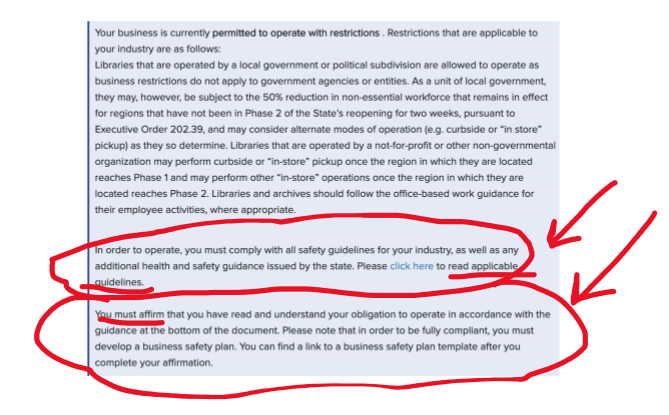
What is the responsibility of a library open during COVID-19?  Here’s the lay of the land, straight from the “NY Forward Lookup Tool”:

NY Reopening Guidelines screenshot

The “applicable guidelines”[1] I have so carefully underlined (as found July 6, 2020, at https://www.governor.ny.gov/sites/governor.ny.gov/files/atoms/files/RetailMasterGuidance.pdf)  state, in relevant part:

The Responsible Parties – as defined below – are accountable for adhering to all local, state and federal requirements relative to retail business activities. …

The proprietor/operator… or another party as may be designated by the proprietor/operator (in either case, "the Responsible Parties"), shall be responsible for meeting these standards.”

As part of the “applicable guidelines”, the “Responsible Parties” must certify having read and understood the obligation of their institution to “operate in accordance with such guidance,” as shown here[2]:

Image is a screenshot with an arrow pointing to the italicized text mentioning the Responsible Parties. This text can be read on the NY Forward Applicable Guidelines page.

None of this expressly requires that the person signing the certification, or the developer of a Safety Plan, is any particular person or entity.  Rather, the “owner or agent” of the library (who could be an officer of the board with signing authority from the bylaws, the director, another employee, or even an attorney operating on instructions from the library/client) signs the certification, and at some point, they adopt a Safety Plan.  That’s it.

But while there is no prescribed process for the Safety Plan, a look at some of the things the Plan must address is instructive.  For instance, the above-linked guidance states:

Signage should be used to remind employees and customers to:

  • Cover their nose and mouth with a face covering when six feet of social distance cannot be maintained.
  • Properly store and, when necessary, discard PPE.
  • Adhere to physical distancing instructions.
  • Report symptoms of or exposure to COVID-19, and how they should do so.
  • Follow hand hygiene and cleaning and disinfection guidelines.
  • Follow appropriate respiratory hygiene and cough etiquette.

As I have written about elsewhere[3], the requirements listed above, among other things, become temporary modifications to a library’s Code of Conduct.  In order to enforce social distancing and use of PPE in the library as required by the State, a library must ultimately tie a patron’s failure to do so to its Code and process for restricting access to patrons.[4]  For that reason alone (and there are many, many others, including a Plan’s impact on conditions for employees, procurement practices, security procedures, budget, etc.), the board should be the entity that adopts the Plan.

This is not to say that a director with adequate experience to draft a library’s Safety Plan cannot be the primary author of the Plan.  In fact, the director (and other employees with high familiarity with certain operations) is likely the person best situated to envision adjusted floorplans, shift schedules, workflows, signage posting, employee temperature monitoring, and employee training methods (to name just a few), all of which must be addressed in the Safety Plan. 

But because of the many high-stakes areas a Safety Plan impacts, a library’s board should be the entity accountable for adopting it and ensuring it is updated at regular intervals.  On the flip side, after the Plan is adopted, the director will be the authority responsible for seeing that the Plan is followed.

The board has this accountability for passing the Plan because a COVID-19 Safety Plan is not just a tool for safety, but also a mechanism of legal compliance and risk management.  When you stop and think about it, most policies or plans that relate to safety, legal compliance, and risk management—things like workers’ compensation insurance policies, sexual harassment and civil rights policies, and fiscal controls policies—are all things that a board is ultimately accountable for.  While the director may have the authority to ensure compliance with them, they are adopted by a board. And that is as it should be.

Of course, it can be a challenge for a small board to meet as often as needed to keep a COVID-19 Safety Plan evolving in light of new research, evolving library operations, and on-the-ground improvements.[5]  For such situations, it is good to consider an approach like the one set out in the below template resolution:

BE IT RESOLVED that the board hereby adopts the Safety Plan considered at this meeting of DATE; and

BE IT FURTHER RESOLVED that the Plan be posted in the Library, as required by the Plan, within 24 hours of the passage of this Resolution; and

BE IT FURTHER RESOLVED that to ensure the Safety Plan is updated in a manner that is conducive to optimal operations of the Library, the Director, [in consultation with INSERT[6]] is authorized to update the Safety Plan as needed, consistent with CDC and OSHA guidelines, and shall present the current updated version then in effect at each subsequent meeting of the board, to be reviewed and ratified by same.


So, what is the answer to the member’s questions? 

There is no “right” answer to this, but lots of factors point to the board serving as a library’s COVID-19 Safety Plan’s ultimate authority.  That said, in passing such a plan, a board should draw from the experience, and support the executive authority, of the library’s director. 

Like all healthy board-director relationships, this approach requires listening, learning, a good sense of roles and boundaries, and mutual respect.  A tall order in frantic times, but one that good planning and careful consideration[7] can almost always bring about.

Thank you for an important question.


[1] You will no doubt be shocked to learn that my law school did not have a “graphic design” elective for marking up NY State pandemic policy documents.

[2] I imagine many directors and board members have gone through this triad of assurance many times, and are sick of it.

[3] RAQ #138

[4] While Executive Order 206.39 granted any business the right to refuse a person access if they are not wearing a mask (if they can medically tolerate one), I am not comfortable with any lingering consequences for refusal to wear a mask or otherwise abide by the safety plan unless they are tied to the due process in a Code of Conduct.

[5] Larger libraries will have already had a business continuity, disaster recovery, and perhaps even an all-hazards response plan in place.  The approach outlined in this answer is drafted with smaller libraries, who typically don’t have such deep resources, in mind.

[6] The option in brackets here is to allow revisions in consultation with some back-up for the director: a committee of the board, or the chair of the board, or an independent consultant as authorized by the board, or the local Health Department. 

[7] And frequent re-reads of the “Handbook for Library Trustees of New York State,” found at http://www.nysl.nysed.gov/libdev/trustees/handbook/.

Working from home during reopening

Submission Date

Question

I work at a public library that is gradually reopening to the public. We employ quite a few librarians who trend older and have underlying health conditions. Many of these staff have been working remotely for the past few months, but not necessarily on tasks essential to their positions. As we begin to recall employees to the physical worksite, some are requesting to continue working from home, and/or for indefinite relief from working directly with the public, because of their vulnerability to Covid-19 complications.

While we are working to accommodate our employees, we also realize that working directly with the public is an essential part of being a *public librarian*. So how can we effectively accommodate public librarians who are asking to *not* work with the public?

We have done this during our work-from-home phase, when our Library was required to remain closed. But I don't believe that we can sustain this over the longer term. At some point, we may have to hire people to fill the in-person needs of the Library, and won't have enough "at-home" work for existing staff to do.

Thank you for your guidance.

Answer

This is a heart-breaking question, and I am sure it has been a hard process to get to this phase in your operations and planning.

In the state of New York, it can be a violation of both state and federal law to deny a person an employment opportunity on the basis of age or disability.  However, when a person cannot perform their essential duties due to a health concern, and no reasonable accommodation can help them do so, that person may have to leave the position.

Which brings us to the member's question: "So how can we effectively accommodate public librarians who are asking to *not* work with the public?"
There is a lot of wiggle room in this type of question, because the answer will change from library to library, but that also makes it hard to answer generically. 

Since I can't give an answer, I can do the next best thing: an array of questions to help members assess their own library's response to this type of disability accommodation[1] request:

Consideration

Why this is important

Your answer:


Are the impacted employees Civil Service?


Any assessment of job duties, changes, and consideration of alternation of essential duties should be done with your Civil Service agency's input.


Does your library have to abide by the Americans with Disabilities Act, and if so, what are its precise obligations?


Precise ADA obligations change based on library type, size, location, and funding. 


This is a factor that should already be known and addressed in the library's policies or employee manual, or with input from your Civil Service agency.


Does your library have to abide by the New York State Human Rights Law?


Precise NYHRL obligations change based on library type, size, location, and funding.


This is a factor that should be known and addressed in the library's policies or employee manual or with input from your Civil Service agency.


Are the impacted employees governed by a collective bargaining agreement ("union contract")?


The union contract may control how employees’ duties may be assigned/re-assigned and offer additional protections and considerations.


Do you have a copy of each job description involved, and are those job descriptions current and accurate?


Before assessing if an employee can be granted a reasonable accommodation, or must leave their job due to disability, make sure their job duties and reporting structure are accurately set forth in their job description.


Looking at the job description, what are the elements that the employee is stating that they cannot perform due to medical factors?


This should be confirmed in writing between the library and the employee (and as needed, review with Civil Service).


What accommodations can allow the employee to still perform their essential function?  Can those accommodations be implemented by the library?


Isolating these factors, and confirming them with Civil Service when they impact job duties, will position the library to assess if accommodations (like not coming into close proximity with the public) is possible, and if so, if they are reasonable.


After considering its legal obligations, operational needs, and the specific request, can the library reasonably accommodate the request?


The answer may be "yes," or "no."  In the member's scenario, if an essential duty requires activity that, even with all applicable safety provisions, cannot be done by the employee due to a medical concern, the key question is: can the library accomplish the essential element?  As the member writes, that might be hard.


This is the part to review with your library's attorney, prior to acting on any determinations.


Look at the big picture, and plan accordingly. 


When the assessment/s is/are done, look at the overall impact.  How will this impact the Plan of Service?  Or employee morale?

Develop a plan to get any messaging right, while respecting employee privacy.


This is the part where you review the big picture with the board personnel committee, civil service agency, and/or attorney.  The goal is for directors to be empowered to make decisions about workforce matters, with appropriate support for the plans.


Effect decision-making.


Plan out any accommodations to ensure they are supported by your COVID-19 Safety Plan, and create a schedule for implementing any necessary workforce changes.  Make sure the plan makes room for communicating changes to employees, in a way that will build team cohesion.[2]


Generate documentation to show compliance with the plans.

I know no chart can take the place of a solid plan that considers the needs and resources of your library, the well-being and privacy of your employees, but hopefully this chart can help you develop one. Together with the more general guidance in an earlier answer, these are the fundamental steps to consider.

Thank you for being willing to pose a difficult question.  I wish your library well at this difficult time.


[1] The employee can call it whatever they want, but a request to change job duties on the basis of a medical condition (including the condition of having heightened vulnerability to infection) will generally be considered an accommodation request under the ADA or the New York State Human Rights Law.  Therefore, any library entertaining such a request should evaluate is as they would a disability accommodations request, which as stated in this answer, will vary from library to library, based on their policy (which should be based on the precise way the laws apply to that specific institution).

[2] Yes: It can be very tough to acknowledge someone is leaving, and then try to focus on "team cohesion."  And it can be doubly tough when a medical concern, and inability to offer an accommodation, leads someone to leave on disability (which of course is confidential, and cannot be shared by the library).  But at the same time, the right message can help with employee morale.  This is why strategizing with an HR professional or Personnel Committee Chair, to organize some talking points on those things, can be so important.

Asking COVID-19 symptomatic patrons to leave

Submission Date

Question

In regards to COVID-19 when libraries do reopen, (and allow people in) is it advisable to ask customers to leave the public building if they are exhibiting any visible COVID symptoms? If so, are there benchmarks for how extreme symptoms should be or how policies should be worded? There are of course patron behavior policies in place allowing for the removal of anything disruptive, which can include noise or inappropriate behavior. There are some members of our leadership team who believe our safety reopening plan should include provision specifically mentioning symptoms of COVID-19 and the staff's/ library's right to remove them if symptoms are exhibited. There are other concerns that library staff are not medical professionals and we are not able to determine if a few sneezes and coughs are common colds, allergies or COVID. Attached is our library's current reopening plan

Answer

As the member writes, it is very difficult to determine if some physical factors—coughing, a flush, seeming malaise—are in fact symptoms of COVID-19.  Confronting a patron with suspected symptoms can also lead to concerns impacting community relations, privacy, and the ADA.

A good Safety Plan addresses this concern, without requiring patrons[1] to be removed mid-visit from the library.

To position libraries to address the impact of patrons with suspected symptoms, New York's "Interim Guidance for Essential and Phase II Retail" (issued July 1, 2020)[2] states:

CDC guidelines on “Cleaning and Disinfecting Your Facility” if someone is suspected or confirmed to have COVID-19 are as follows:

  • Close off areas used by the person suspected or confirmed to have COVID-19 (Responsible Parties do not necessarily need to close operations, if they can close off the affected areas).
  • Open outside doors and windows to increase air circulation in the area.
  • Wait 24 hours before you clean or disinfect.
  • If 24 hours is not feasible, wait as long as possible.
  • Clean and disinfect all areas used by the person who is suspected or confirmed to have COVID19, such as offices, bathrooms, common areas, and shared equipment.
  • Once the area has been appropriately disinfected, it can be opened for use.
  • Employees without close or proximate contact with the person who is suspected or confirmed to have COVID-19 can return to the work area immediately after disinfection.  Refer to DOH’s “Interim Guidance for Public and Private Employees Returning to Work Following COVID-19 Infection or Exposure[3] for information on “close or proximate” contacts.  [4]
  • If more than seven days have passed since the person who is suspected or confirmed to have COVID-19 visited or used the retail location, additional cleaning and disinfection is not necessary, but routine cleaning and disinfection should continue.

[emphasis on "suspected" has been added]

In other words: your Safety Plan, as informed by the most recent guidelines, should leave nothing to chance.  By using this procedure, library staff are never put in the position of having to guess, ask, or consider if a patron's coughing, sneezing, or other behaviors are COVID-19...rather, the moment the possibility is "suspected," the Plan kicks into action.

Of course, if a patron is properly masked, some of the risk of exposure is limited, even if they are infected (this is why we wear masks and identify areas with six feet of clearance in the first place).  And if a patron removes their mask mid-visit, refuses to keep appropriate distance, or refuses to spray down equipment after using it,[5] THAT person can be asked to leave, simply as a matter of policy—whether they are exhibiting symptoms, or not.[6]

So to answer the question: no, it is not advisable to ask patrons to leave the public building if they are exhibiting any visible COVID symptoms, for exactly the reasons the member provides.[7]  Rather, it is required that your Safety Plan keep people distant from each other, and that the library be ready to address any real or suspected exposure as quickly and effectively as possible. 

That said, having signage that reads "Safety first!  Patrons who are concerned about transmission of germs can arrange curbside service by [INSERT]" is a great way to remind people that if they are having an "off" day, there are many ways to access the services of your library.

I wish you a strong and steady re-opening.


[1] This answer does not apply to employees and visitors like contractors, who must be screened.

[2] Found as of July 25th, 2020 at https://www.governor.ny.gov/sites/governor.ny.gov/files/atoms/files/RetailMasterGuidance.pdf

[3] Found as of July 25th, 2020 at https://coronavirus.health.ny.gov/system/files/documents/2020/06/doh_covid19_publicprivateemployeereturntowork_053120.pdf

[4] I note that the DOH's "Interim Guidelines" do not include guidance to staff with suspected (as opposed to confirmed) exposure.  If an employee feels they were exposed to a suspected case of COVID-19, however, that will impact their answers on their next daily screening, which will trip consideration of whether they can report to work.

[5] Or whatever other safety measures a library has identified.  It is inspiring to read the variety of tactics out there, as listed at https://www.nyla.org/covid-19-library-reopening-plan-database/?menukey=nyla.

[6] Another member raised this consideration in this "Ask the Lawyer" from earlier in July 2020: RAQ #153

[7] Of course, if a patron is having a medical event and you have an immediate concern for their well-being, call 911.

Employee Identity Theft

Submission Date

Question

I was recently contacted by my employer stating that someone had applied for unemployment benefits using my Social Security number name and Job title. My employer notified me by email to be aware of this but stated that they conducted a security audit and found that there was no breach on their end and that the matter was currently being investigated by the department of labor and FBI. What responsibilities does an employer have to the employee when this happens? What should the employee do?

Answer

For this answer, we are again joined by Jessica Keltz, associate attorney at the Law Office of Stephanie Adams, PLLC.

This question takes us back to the SHIELD Act. Last discussed by Ask The Lawyer at the end of 2019 (NY SHIELD Act and Libraries). The SHIELD Act requires businesses (and other entities that conduct business, such as, yes, libraries) that collect personal data to institute compliance measures including assessing security risks, implementing new data security measures, and securely destroying private information when it is no longer needed for business purposes.

We will take the two questions separately.

First, what responsibilities does an employer have to the employee when this happens?

If your library is not part of a large institution such as a university or a hospital, its compliance responsibilities likely fall under the SHIELD Act requirements for “small businesses.”

The act’s definition of a “small business” is:

"Small business" shall mean any person or business with (i) fewer than fifty employees; (ii) less than three million dollars in gross annual revenue in each of the last three fiscal years; or (iii) less than five million dollars in year-end total assets, calculated in accordance with generally accepted accounting principles.

Compliance requirements for small businesses under the SHIELD Act are more generalized; they simply need to ensure that their data security safeguards are appropriate for their business’ size, complexity, scope of activities, and the sensitivity of the information the business handles.  Within those guidelines, libraries that fall under the “small business” requirements should have a data breach plan.

The event that the member described is certainly cause to be concerned that a data breach had occurred, and the library should have a plan to address it. What does addressing it look like? The most important elements are being able to evaluate whether a breach occurred (which it seems like the employer was able to do), and disclosing to the potential victim that a breach may have occurred (which the employer definitely did).

If the library had found that a data breach did occur, staff or a contract data security expert should re-evaluate the library’s security protocols to make sure to prevent the problem in the future; but in this case, as a breach did not occur, this may not be necessary.

In the case of a data breach or potential data breach (and this falls under “potential”), the employer is also required to disclose the concern to any resident of New York state whose private information was, or is reasonably believed to have been, accessed or acquired by a person without valid authorization. By notifying you this event occurred, the employer has complied with the requirement.

Meanwhile, what can an employee in this position do?

First: as soon as possible, the employee should consider involving their own attorney.  The risks posed by this situation are too critical.  For those who can’t afford an attorney, contact the local county bar association to learn about pro bono assistance in your region.

Second, assuming the employer has complied with their obligations under the SHIELD Act, since this involved a fraudulent claim for unemployment from the New York State Department of Labor (“NYSDOL”), the employee should work with the NYSDOL to learn all they can about the incident.

This starts with contacting NYSDOL’s fraud department at https://dol.ny.gov/report-fraud to see what they can share about the abuse of your personal information.  Armed with whatever other information is gathered from NYSDOL, the employee (or their attorney) can then look at their own credit history and other uses of their identity for potential breaches (social media and e-mail accounts).

While this is going on, be extra-wary of any calls, emails, or other contact requesting any personal information.  Always require people to call back or write to you with any out-of-the-blue-seeming inquiry.  Make sure the people close to you know you are on heightened alert.  Consider changing all passwords (just make sure you keep a good record of the changes in a very secure place).

The Federal Trade Commission offers guidelines on when and how to place a “fraud alert” on your credit, to stop new accounts from being opened using your name and information.

https://www.consumer.ftc.gov/articles/0275-place-fraud-alert.  Any person who learns their information may have been illegally accessed should also request a free credit history from one of the three main credit bureaus, and review their credit report for any unexpected checks or accounts. Depending on what you find when you do so, consider freezing your credit and reporting the theft of your identity to the Federal Trade Commission.

And finally, if any employee has reason to believe their employer or a contract provider is at fault for a breach (even if the employer or contract provider denies it) it is even more critical that the employee consult their own attorney as soon as possible.  There are too many variables to give general guidance on this, but broadly speaking, the more you have at stake (employment-related information, direct deposit information, health and benefit-related information, and of course, a potential dispute with an employer) the more important it is to act quickly.

The scenario the member describes is nerve-wracking, and the member was right to reach out about it. Don’t go it alone!

Requirements for public access to SUNY libraries

Submission Date

Question

[Submitted from a SUNY Library]

(1) What are the requirements for a SUNY library to provide access to the general non-campus community/public (those outside staff, faculty, students)?
(2) Are their specific requirements/repercussions academic libraries should be aware of in regards to public access or prohibiting public access?
(3) What are the Section 108 repercussions for not allowing public access, specifically related to the pandemic? Would libraries still be protected if they provide public 'access by appointment' only? Would "temporary" non-public access still allow for application of the 108 exceptions?
(4) Can a SUNY library deny entry to students/faculty refusing to wear a mask in the facility if it's justified in the interests of health and safety?

Answer

This is a deep array of questions, requiring a deep array of answers.

But let’s start with the basics.

There are 64 SUNY campuses, some with more than one library.

What’s cool about these libraries?  They aren’t just collections of books on a campus, but distinct entities within their institutions, governed by the body of laws that apply to all libraries in New York, as well as the law that is SUNY-library specific.

The “SUNY-library specific” law is Education Law 249-a, which states:

The state university trustees and the board of higher education of the city of New York are hereby authorized to establish such rules and regulations as may be necessary and appropriate to make provision for access and use by the residents of the state of the libraries and library facilities of the public institutions of higher education under their respective jurisdictions.

In other words: SUNY and CUNY have libraries, and the boards of SUNY and CUNY can set those libraries’ rules, including the rules governing access.

SUNY’s[1]  board has established “such rules” by, among other things, adopting a policy on “Public Access to SUNY Libraries[2]  which states:

It is the policy of the State University of New York (University) that the public is given access to University libraries insofar as possible. Since implementation of this policy has fiscal and administrative implications, campuses may extend the facilities of their libraries to the public whenever it can be done and in a manner that is both fiscally sound and consistent with their primary educational mission.


What does this mean for public access to those libraries?

State law gives SUNY broad authority “to establish such rules…for access and use by the residents of the state.” SUNY then uses that authority to develop a policy requiring “that the public is given access to University libraries insofar as possible.”  BUT, after asserting that broad goal, SUNY allows individual campuses to tailor that access based on the “fiscal” and “administrative” considerations of individual institutions.  So while access to the public is the stated goal, the conditions for access are really up to the individual libraries (and the academic leadership they report to).

I tooled around a few SUNY library web sites (I couldn’t resist the Charles B. Sears Law Library at SUNY Buffalo, my alma mater), and each have their own unique conditions for giving the public access.  Some make it easier to find that information than others.  I saw a range of conditions for access…anecdotal evidence that the libraries are using the latitude granted to them by SUNY policy.

And with that background established, I’ll answer the questions.

(1) What are the requirements for a SUNY library to provide access to the general non-campus community/public (those outside staff, faculty, students)?

While the law only goes so far as to “authorize” SUNY to provide for public access, SUNY-wide policy is that “the public is given access to University libraries insofar as possible… whenever it can be done and in a manner that is both fiscally sound and consistent with their primary educational mission.”

So my answer to the first question is: based on SUNY policy, public access to a SUNY library must be provided insofar as possible, provided the use by the public doesn’t interfere with the use of the students and faculty, and the burden of public use doesn’t throw off the budget.[3]

(2) Are there specific requirements/repercussions academic libraries should be aware of in regards to public access or prohibiting public access?

Absolutely, there are requirements and potential repercussions for access to libraries at state institutions.  I could write an entire book on them (and I bet someone has[4]), but here is my quick summary:

  • Requirement: develop budgets, staffing plans, and operational policies that ensure the public is given access to University libraries “insofar as possible.”
  • Requirement: in coordination with Campus Safety or Campus Police, develop a process to address the most serious public patron behavioral concerns. 
  • Requirement: develop a privacy policy regarding the rights students, employees, and public patrons have under CPLR 4509.
  • Repercussion: be ready to address civil rights concerns related to the library’s status as a public institution.

(3) What are the Section 108 repercussions for not allowing public access, specifically related to the pandemic? Would libraries still be protected if they provide public 'access by appointment' only? Would "temporary" non-public access still allow for application of the 108 exceptions?

For readers not familiar with it, “Section 108” is the portion of the Copyright Act, which gives special exemptions from infringement to libraries and archives that are open to the public.

Section 108 does not go into great lengths regarding what the requirement “open to the public” means, but some insight can be gained from how it handles access to special collections closed to the general public; such collections qualify for Section 108’s protection so long as they are open “to other persons doing research in [that] specialized field.”  So it is clear that “open to the public” is not intended to be a carte blanche free-for-all.

The current pandemic and SUNY’s efforts to combat it will certainly impact SUNY libraries’ ability to be “open to the public.”  However, I feel confident writing my conclusion that any institution that temporarily restricts all patron access will not be found to have not meet the requirements of section 108.  And I feel just as confident saying that scheduled visits by appointment—if that is what a SUNY library needs to do to ensure safety—would not cause a 108 concern, either.[5]

That said, I cannot feel the same confidence for any Safety Plan that completely and utterly removes all public access.  Public access, even if severely restricted, must still be a component in order to meet the requirements of 108.

(4) Can a SUNY library deny entry to students/faculty refusing to wear a mask in the facility if it's justified in the interests of health and safety?

Broadly and boldly speaking: yes.

BUT.

As discussed at the beginning of this answer, the law of the state of New York and the policies of SUNY give a great deal of latitude to libraries on a campus-by-campus basis.  Different campuses exercise this latitude in different ways.  This means that while the library in one SUNY location may be operating per a Safety Plan confirmed by a central coordinator, another library may be given a directive to develop their own. 

Or, as (former[6]) SUNY Chancellor Kristina M. Johnson put it:

We understand that…each of our campuses is a complex ecosystem with regular engagement with their respective surrounding communities.

Within those different plans will be different solutions for the safe operations of different sites.  Some of those plans will call for masks, because masks will be the only way the planned operations will be able to be conducted safely.  Other plans may only include modified operations that may be performed safely without masks.  And of course, any plan requiring a mask will include the proper ADA accommodations information for those who are not able to wear one.

While the country has watched as some people challenge the requirement to wear PPE on the basis of civil rights, a limited requirement to wear a certain type of protective gear for a narrowly tailored purpose with a general application is not likely to be found a violation of the First Amendment. But of course, when it comes to civil rights, the devil is often in the details.  If, for instance, only a certain type of facemask was required, and that facemask type did not work well with a certain body type, or the need to wear a hijab, it is possible that could trigger an ADA or First Amendment claim. The guidance being assembled by the Center for Disease Control and the Occupational Safety and Health Administration takes into account the diversity of bodies and identities that Safety Plans will need to serve. By using properly credentialed resources and thinking through Safety Plans from multiple perspectives, a SUNY library should be positioned to deny entry to students/faculty refusing to wear a mask in the facility if it's justified in the interests of health and safety.

Last note

In responding to these questions, I am mindful that general legal services are provided to SUNY institutions through the office of the NY State Attorney General, and many campuses have lawyers on staff. Therefore, to the greatest extent possible, any SUNY library, department, center, school, college or university finalizing a Safety Plan should take care that whenever possible, coordinated guidance from SUNY’s recognized legal advisers is incorporated. (Very often, this will have been done at the level where the institution is planning its emergency response.)  I am always gratified when a SUNY lawyer, or another lawyer, calls me to discuss my work for libraries, and I welcome those calls.[7]

As of this date (June 26, 2020) I have found no publicly accessible model safety plan or guidance from SUNY HQ with regard to the resumption of operations.  Rather, the SUNY page for COVID questions shows that the State University of New York is very much in an assessment and response mode, and the SUNY Library Consortium’s page shows that plans are still in development.[8] I am sure that will change as the situation evolves, and I encourage people to be attentive to that page, and their own administrations, for further specific guidance.   At the same time, since no one knows a library better than the librarians who works at it, I encourage pro-active assessment and formulation of access and safety plans by library leadership, informed by the people who work and study there.

This guidance was assembled directly from available materials, and while not legal advice, it is consistent with published SUNY materials and the law.  I hope it is helpful to SUNY libraries as you consider the continuation of your operations.

Thank you for a great array of thoughtful questions. I wish our SUNY libraries much health and strength for the days ahead.


[1] The rest of this answer will focus on SUNY, since that is the focus of the member’s questions.

[2] Found on June 8, 2020 at https://www.suny.edu/sunypp/documents.cfm?doc_id=330 and not to be confused with the “Open Access To State University Libraries” policy found that same day at https://www.suny.edu/sunypp/documents.cfm?doc_id=329.

[3] Having sat through budget meetings of all types as a student leader, journalist, academic administrator, and lawyer, I realize that the words “fiscal” and “mission” can be applied to many divergent ends.  Let’s not go there, this is about the law.

[4] I will ask my paralegal Jill to research this question and alert me if she finds one.  If she does, we’ll update this footnote.  Otherwise, you’ll know we didn’t find one.

[5] I am punting on the very practical consideration of the recent Supreme Court ruling regarding sovereign immunity, which arguably positions SUNY to not be very concerned about qualifying for protection under 108.  I am punting because, as the court put it, I am sure SUNY does not want to be seen as a “serial infringer.”  For more on that, see https://www.scotusblog.com/case-files/cases/allen-v-cooper/

[6] https://www.suny.edu/suny-news/press-releases/06-20/6-3-20/chancellor-johnson-departs.html

[7] (716) 464-3386

[8] This is not a criticism. A good plan takes time. And no plan other than a good plan should be implemented.


Digitizing legally owned choral music

Submission Date

Question

Is it permissible to make digital copies of choral music that is legally owned by the institution to students in choral and instrumental ensembles? Some students may be studying remotely and mailing physical copies may result in lost or non-returned copies.

Answer

There are four ways it can be permissible:

1.  Check the license[1] from the publisher and see if the purchase of the physical copies came with any digitization/duplication permission.  You'd be surprised how many rights you buy (or don't buy) when you make that hard copy purchase.  Publishers take a variety of approaches on this, and an individual publisher's permissions may change from work-to-work, so confirm (or rule out) this approach for each work.

2.  If the license does not allow making digital copies, contact the publisher, and see if it can be expanded.  Publishers are now getting many requests like this and may be ready with a simple (and affordable) solution.

3.  I am not a fan of them (they are as outdated and as risky as the Ford Pinto), but the "CONTU" guidelines speak to this issue.  I am including the relevant guidelines, as presented in Copyright Office Circular 21, under this answer.  If one of your precise needs fits one of the "permissible uses" listed in Circular 21, you are all set.

4.  Speaking of CONTU, the first "permissible use" listed in the guidelines may help you out here, with a slight twist on your scenario.  In the event that the physical copies listed in the question are mailed out and not returned as feared, the guidelines allow for emergency copying after the fact (of course, they also require that at some point, you purchase more physical copies, but at least you can get the copies to the students).


Those are my four solutions, based on conventional approaches and current case law.

I'll also throw out a "fifth option" based on a slightly different approach, which, depending on some precise facts, could work for faculty teaching choral classes:


The 110 Solution

Copyright Section 110 allows an academic choral group (if meeting as part of a class) to display "a work in an amount comparable to that which is typically displayed in the course of a live classroom session," during an online class/rehearsal.

How can that help with the member's scenario?

Let's say I am in a class that is working up an a capella performance of "36 Chambers,"[2] as arranged by the composers of the original work.[3]

If the class was still meeting physically, Copyright Section 110(a) would allow us to perform the song and to display the music on the in-class smart board.  In the online environment, the same performance and display could happen via the internet, as allowed by 110(b) (the "TEACH Act")—again, so long as only the amount "typically" displayed in class was shown. 

Whether in-person or online, the rehearsal would include review of the different parts for bass, tenor, alto and soprano,[4] with the relevant music displayed on the screen.  While an academic institution can't tell people to take screen shots of the music displayed for rehearsal purposes, students who want to snap screenshots of a class to take notes is a fact of modern-day academia.  If a student who was told to purchase a copy of their part uses this method to ensure they are practicing on an incremental basis, that's out of the school's control, and the student can make their own claim to fair use.

This type of solution should never be used as a deliberate alternative to the purchase of individual copies.  But so long as the display is incremental and truly a part of the in-class experience, it is a viable option.

I wish all music faculty approaching the Fall 2020 semester many good performances, whether virtual, or face-to-face.  These are tough days for people who love to sing, who enjoy the community of a choir, and who need to hone their vocal art in collaboration with others.  Hunting for music should not add to the burden, and with a few tricks and an awareness of the limits of the law, it doesn't have to.

------------------------

Guidelines for Educational Uses of Music

The purpose of the following guidelines is to state the minimum and not the maximum standards of educational fair use under Section 107 of H.R. 2223.

The parties agree that the conditions determining the extent of permissible copying for educational purposes may change in the future; that certain types of copying permitted under these guidelines may not be permissible in the future, and conversely that in the future other types of copying not permitted under these guidelines may be permissible under revised guidelines.

Moreover, the following statement of guidelines is not intended to limit the types of copying permitted under the standards of fair use under judicial decision and which are stated in Section 107 of the Copyright Revision Bill. There may be instances in which copying which does not fall within the guidelines stated below may nonetheless be permitted under the criteria of fair use.

Reproduction of Copyrighted Works

Permissible Uses

1 Emergency copying to replace purchased copies which for any reason are not available for an imminent performance provided purchased replacement copies shall be substituted in due course.

2 For academic purposes other than performance, single or multiple copies of excerpts of works may be made, provided that the excerpts do not comprise a part of the whole which would constitute a performable unit such as a section¹, movement or aria, but in no case more than 10 percent of the whole work. The number of copies shall not exceed one copy per pupil.

3 Printed copies which have been purchased may be edited or simplified provided that the fundamental character of the work is not distorted or the lyrics, if any, altered or lyrics added if none exist.

4 A single copy of recordings of performances by students may be made for evaluation or rehearsal purposes and may be retained by the educational institution or individual teacher.

5 A single copy of a sound recording (such as a tape, disc, or cassette) of copyrighted music may be made from sound recordings owned by an educational institution or an individual teacher for the purpose of constructing aural exercises or examinations and may be retained by the educational institution or individual teacher. (This pertains only to the copyright of the music itself and not to any copyright which may exist in the sound recording.)

Prohibitions

1 Copying to create or replace or substitute for anthologies, compilations or collective works.

2 Copying of or from works intended to be “consumable” in the course of study or of teaching such as workbooks, exercises, standardized tests and answer sheets and like material.

3 Copying for the purpose of performance, except as in A(1) above.

4 Copying for the purpose of substituting for the purchase of music, except as in A(1) and A(2) above.

5 Copying without inclusion of the copyright notice which appears on the printed copy. (iv)

Discussion of Guidelines

The Committee appreciates and commends the efforts and the cooperative and reasonable spirit of the parties who achieved the agreed guidelines on books and periodicals and on music. Representatives of the American Association of University Professors and of the Association of American Law Schools have written to the Committee strongly criticizing the guidelines, particularly with respect to multiple copying, as being too restrictive with respect to classroom situations at the university and graduate level. However, the Committee notes that the Ad Hoc group did include representatives of higher education, that the stated “purpose of the … guidelines is to state the minimum and not the maximum standards of educational fair use” and that the agreement acknowledges “there may be instances in which copying which does not fall within the guidelines … may nonetheless be permitted under the criteria of fair use.” The Committee believes the guidelines are a reasonable interpretation of the minimum standards of fair use. Teachers will know that copying within the guidelines is fair use. Thus, the guidelines serve the purpose of fulfilling the need for greater certainty and protection for teachers. The Committee expresses the hope that if there are areas where standards other than these guidelines may be appropriate, the parties will continue their efforts to provide additional specific guidelines in the same spirit of good will and give and take that has marked the discussion of this subject in recent months


[1] Checking a license is not an exact science.  Some publisher's use a catch-all that is included on their invoices.  Others put the information right on the music.  Others like to make you really hunt for it, but it is usually part of the sale transaction.  This is why, when making a purchase of music, it is good to take a screen shot or save the paperwork related to the purchase.

[2] Note: To my knowledge this work does not exist, but it is on my wish list of music to hear.  I love it when genres collide.

[3] This new version would be a "derivative work" based on the original, and have its own copyright protection as a musical composition.

[4] We have reached the limit of my choral knowledge.  Is there separate sheet music for mezzo-soprano and counter-tenor?  Probably.  I am sorry, I quit choir in 7th grade.


Fair Use in Uncertain Times

Submission Date

Question

In the spring, it was clear academic libraries providing digital resources were in a state of emergency and fair use restrictions were loosened.

This fall, we are asked to plan for face to face learning, but we may be asked to turn on a dime and provide digital resources overnight if a student or faculty member in a course is unable to attend class.

We are hearing mixed messages from other institutions. What is our situation today, emergency or status quo?

Thank you

Answer

Before I answer this question, I do have to emphasize: as I wrote here, fair use was not modified during the height of the initial pandemic closures.  Further, there is no case law or regulatory guidance indicating things will be any different if we have to return to the level of lockdown experienced this Spring. 

There is no "emergency use" exception to copyright law--even under fair use.  That said, this is an excellent question that captures the experience of working in higher education right now, and I do have a few helpful things to offer in response.

Higher education libraries trying to support another immediate conversion from in-person to online learning should consider doing the following:

1.  Work with their academic and IT colleagues to optimize their institution's rights under the TEACH Act, which under the right conditions, allows the digital transmission of copyright-protected material.

"Optimizing," in this case, means presenting otherwise inaccessible materials in class, so the TEACH Act's[1] exception infringement can be fully used, while making the most of the medium.  For example, if a history class would typically read a chapter of a book before class, then meet in person to discuss the chapter, perhaps now a part of the online class could consist of the faculty member or students reading the chapter aloud,[2] and the class using an asynchronous message board to discuss it.

This method requires faculty to be flexible, but it is one way to ensure access for all, when all else fails.


2.  Unite with other institutions to re-negotiate the terms of digital licenses from academic publishers.

I cannot stress this one enough.  Academic libraries must unite, must negotiate hard, and must threaten to boycott any publisher that refuses to offer a reasonable price for students to access content online.  This was critical before COVID, and it is even more critical now.[3]


3.  Much easier, and even cooler than #2: plan to collaborate with students' local libraries to ensure students can take full advantage of Copyright Section 108's support of access via inter-library loan.

What?

That's right.  Let's say I am a college student from Littleplace, NY.   Suddenly, it's October and I have to vacate my dorm room at ABC College, due to a local surge in COVID-19.  To be ready for the rest of my (now online) classes, I need 12 articles, a textbook that costs $500 (that I was previously sharing with two friends), and a course pak I forgot in my dorm.

So long as I have access to the list of materials, I can head over to the Littleplace Library (or call them) and work to find the materials I need.  Using its rights under Section 108 of the Copyright Code, the Littleplace Library can get me a copy of the articles...possibly even in collaboration with the ABC library, or another academic institution with the right subscription.

In my observation, this is a very under-discussed option.  Remember, your students have a right to work with their local library to get copies under a combination of 108 and (on the part of the student) fair use.  The key is having the course materials listed in such a way, that the local college or public library can easily (and quickly) help them.

This, by the way, is one of the many reasons it is critical to keep open every single one of our small and mid-size libraries in small towns and villages across the country.[4]


4.  Use your institution's compliance with NY's Textbook Access Act.

This is another "if you have time" one. 

In New York, all higher education institutions and publishers must follow this law[5]:

Textbooks shall be sold in the same manner as ordered by such faculty member or entity in charge of selecting textbooks for courses. In the event such product is unavailable as ordered, the bookstore, faculty, and relevant publisher shall work together to provide the best possible substitute that most closely matches the requested item or items, and the publisher shall make available the price of such substitute or substitutes readily available.

This clause has always been applied to combat predatory pricing for course materials, but lends itself to the current situation, too.  If the instructor was given a discount digital copy, the students should be able to buy one, too.

5.  Take some time to examine the latest ruling on academic e-reserves and fair use, so you feel comfortable making the call when you can post things on e-reserve without permission.[6]  Fair use has not been "loosened," but it still has lots of room.  The full document has been updated to "Ask the Lawyer" as "Becker Ruling 2020."  It's boring,[7] but very instructive.

My best wishes for a supported and supportive prep for the Fall semester.


[1]The full requirements of this law can be found at: https://www.law.cornell.edu/uscode/text/17/110

[2] This would also allow presentation through adaptive technology, for those who need it per ADA.

[3] I understand if you are too busy coming up with an "August Staffing Plan" and trying to figure out where to get 10 gallons of hand sanitizer to organize the revolution.  But this really is important.

[4] As if I have to sell most of you on the importance of funding libraries.

[5] Full text at https://www.nysenate.gov/legislation/laws/EDN/722.

[6] Always use your institution's fair use form to record your conclusion.

[7] The helpful stuff starts on page 6.