
Copyright

Fair use and Youtube in Academia

Submission Date

Question

A taskforce at the college is wanting to use a recent song and video on Youtube. This would be a traditional lip dub with a little step up in production as they would use some greenscreen and use some face tracking to animate anti-racist quotes on the faces of the participants. They want to mimic some of the effects in the video as well as add some of our own. So it is transforming the work. Also, this would be a new creation based on the content of the video and use of the music.

In short, they are looking to do a lip dub of the song with their own spin on the video. The college has their own video streaming platform so this would not be on Youtube.
This would be for the campus community but there might be that people could share outside the organization.

The intent is to educate the campus and is part of a greater initiative to promote diversity equity and inclusion.

Answer

This submission is a "fair use”[1] question coming at us from a private college, so before we delve into a reply, I have to emphasize that the specific analysis in this case is limited to that type of entity (a private, accredited school).

Since it can get boring "emphasizing" disclaimers in prose form, I will emphasize it in verse:

          If ye a public library be

          This analysis is not for ye

          If a SUNY or public school

          Do not swim in this legal pool

Okay.  With that out of the way (and for those of you not put off by either the disclaimer, nor the crude verse), here is my answer:

Riffing on, parodying, and building on popular songs can be an effective way to convey a unifying or powerful message to a group.  The use of a known work of art can build on shared familiarity, while modifying it with a unique twist can create a unique and unifying experience. 

The technique described by the member is a very popular approach for higher education institutions, and for unrecorded performances/parodies/riffs that are done live on campus, the school's ASCAP/BMI may even apply (meaning, the site of the performance has permission).

Of course, this is 2021, and that means, it doesn't happen if it isn't on video (or in a picture).  And since we are still in the midst of a pandemic (although things are looking a tad brighter, here in May of 2021), having a video that is an experience customized, created and controlled by the school is a desirable way to build remote cohesion.

When considering the use of copyright-protected content without permission, there are two factors a private institution must consider:

1. Risk management

2. Copyright infringement

"Risk management" is not about the actual legality of one's actions, but the risk that one's actions will be observed and perceived as illegal.

In this case, the additional circumstances the member lists here (not using YouTube to post the final product) enables "risk management" in two ways: a) the resulting video will not be "purged" from YouTube due to a copyright "red flag" (which can happen even if there is a fair use); and b) by hosting it on a less popular server, it is less likely to be seen by services and bots that are "out there"[2] policing copyright laws.

But of course, an educational institution doesn't want to get away with infringement, it wants to not commit it.  And that is the essence of the member's question: is creation of this derivative work[3] a "fair use"?

In their question, the member has walked us through some of the "fair use" factors. The member identifies as an educational institution. The member states that the use of the work will be "transformative." The institution will use all of the audio, and be evocative of but different from the video.  And, although it is not specifically mentioned as such, the described use of the resulting derivative work will (clearly) not be a replacement in the market for the original.

What is missing from the submission is the consideration: why this particular work?  In order to justify a fair use-especially of an entire work (the audio), the use must not only be transformative, but there must be a reason why that particular work is chosen, and the message sent by the "transformed" work must relate to that reason.

In other words, you don't select the underlying work to re-transmit it at face value; you select the works to say something new, that at least in part, relates back to the riffed/parodied work.

The best example I have seen of this lately is a complete, unaltered use of the "Avengers, assemble," scene from the "Endgame."  The clip is exactly as it is in the movie, with no changes to audio or video, except the author puts captions near the various super-heroes as they show up, giving the characters new names, and drawing an analogy to how they saw the protests of 2020 developing. 

The end result of this modified "Avengers, assemble" clip is not only highly transformative--the clip is no longer in any way about the original superheroes--but the author uses the identities of the originals to make comments about both those iconic comic book figures, and the categorical names he ascribed to them.  It's such a good example, it could be used to teach "fair use" in a law school class (you can see it here, or just search "endgame protestors 2020 avengers" and it'll pop right up).

With regard to this use of audio and video, it is this question--why this particular work was selected--that is the missing piece of the puzzle.  So long as that piece fits in, there is a good claim for fair use.

If it is decided that there is a good reason to select the original work, the other thing to be cautious about is how the end result (the new video with the unmodified audio) is used.  If it is used only as described and is built into a structured discussion about equity and inclusion--especially if the lyrics and images are used as focal points in the discussion-there is a strong case that this is an academic, non-commercial use. 

However, we have to remember that at the end of the day, a college is a place where students pay to be.  If the video bleeds into recruitment materials, or is not coupled with the education/discussion, the more likely the use could be found to be commercial. 

So: the more "academic" the end result (and its context) is, and the more the initiative functions as both a comment on the source material, and its own, stand-alone message, the better.  Since fair use is not simply an additive analysis (it's not just one factor vs. another, but rather, how the factors resolve and then inter-relate to each other), every aspect of this is critical.

Within those parameters, and if care is taken so the video is only used in the educational context (not simply sending a link to it out in a newsletter, without the educational content and context), there is a strong case to make that the new video, inspired by the song’s current video and using that unmodified song, is not a copyright infringement. 

I am sorry I could not be more definitive...answers like this are why very often, people just ask for permission![4]


[1] I am going to jump right into this answer with the assumption that the reader knows the basics about fair use (Copyright Act Section 107).  If you don't know the basics of fair use, you can get the gist on in these "Ask the Lawyer" RAQ’s: Educational films without a licenseFair Use and Restrictions of Song Parodies

[2] So I went to find an example of these "bots" and got more than I bargained for; here is an example of not only how video-sharing services shut down fair use on platforms like YouTube and Facebook, but a story about how this blocking is impacting how people film and transmit law enforcement activity: https://www.eff.org/deeplinks/2021/02/cops-using-music-try-stop-being-filmed-just-tip-iceberg

[3] A derivative work is a work that incorporates copyright-protected work.  The right to authorize derivative works is one of the six rights reserved to the owner of a copyright.  Parodies that incorporate or draw heavily from the original risk being "derivative works" (and thus infringement) unless they are 1) done with permission or 2) are a "fair use."

[4] For instance, Weird Al, although he could likely claim fair use for many of his parodies, always gets permission.
Copyright protocols for restaurant menus

Submission Date

Question

(Question has been slightly modified to maintain anonymity)

We have been digitizing restaurant, hotel and other menus from our historical menu collection and have been following standard copyright protocols – but also making many case-by-case decisions based on things like whether of the establishment still exists, etc. (With only a couple exceptions I made for a faculty member who had permission of the restaurant owners, I haven’t scanned any menus from after 2000.) Our public collection site is used by students and researchers around the world.

My question is: can we scan and put online menus dated after 1977 (and especially more recent – up until 2021) if it is for educational purposes? If we do scan them, would we need permissions from every single chef/owner? The copyright status of menus in general has always seemed murky to me, but I don’t even know where to go to find clear answers for this situation.

Answer

Menus can be works of art.[1]

"Art" of course, is a subjective term, and has no precise, stand-along definition in copyright law.[2]  So more importantly for this discussion, a "menu" can be a composition of such originality and substance, that it is protected by copyright law.

This protection can be for the work as a whole (the entire menu), and/or it can be for individual elements in the work.  It can cover stand-alone elements (such as a cover photo image or flavor text[3] used to describe a signature dish), and, in these days of Slice and Grubhub and Yelp, it can be for the menu as a physical object, or a version published only online.  It can cover the original art in a trademarked logo, whether that art was generated by an independent contractor or employee.

Recent case law illustrates how these protections can be sliced-and-diced, and also shows just how nasty litigation over restaurant copyrights and trademarks can be.[4]  Menus and the logos and information they carry can be the apex of a restaurant's brand, reputation, and intellectual property.  So the member is right to take this concern seriously.

With care, however, the act of creating an online archive of carefully curated restaurant menus, for well-articulated academic purposes, should be able to find protection in the line of "fair use" case law building on the 2nd Circuit's 2015 decision in Authors Guild v. Google,[5] which relates to the creation of online repositories.[6]

As the Court found in that case: The purpose of the copying [to create the online resource] is highly transformative, the public display of text is limited, and the revelations do not provide a significant market substitute for the protected aspects of the originals.

The key to scanning and incorporating menus still under copyright protection into an archival database of menus at a library or educational institution, while taking advantage of the fair use defense set forth in Authors Guild, is to do so in a manner that:

  • Yields an asset that is useful beyond the mere replication of a single menu;
  • Ensures the archive will not enable use of its images in place of a copyright-protected original text or image; and
  • Uses an array of professionally developed standards to confirm and assert the academic and/or cultural value of the archive as a whole, and the inclusion of a particular work in that archive.

There are numerous techniques to achieve this.

First and foremost, the purpose of the archive should be developed and set forth on the archive in clear, well-developed terms. The database should not look like a group of menus simply gathered together by a person who happens to have made a collection of his favorite restaurants.[7] The cultural value and purpose of the collection should be stated in very certain terms, and consistently repeated throughout the archive's pages, cataloging text, and metadata.

Second, the function of the archive should be such that users can demonstrably benefit from the aggregated content and information. For instance, menus should be searchable by geographic region, type of food, notable characteristics, and other relevant factors...giving the aggregated content value beyond what is created by each individual entry.[8]

Third, the archive should adopt a standard approach to assessing and depicting the authorship, ownership, and copyright status of archived works.[9]

Fourth, the images themselves should be created so that a third party using the image cannot create a credible replica of the menu or the original originating restaurant's logo or copyright-protected content. A picture taken with a border, or the use of a watermark indicating that the image is part of the archive are some common ways to do this; technology creates many other and evolving options.

Fifth, since it will help mitigate damage in the event a copyright owner simply refuses to believe an archive has made a "fair use" of their content, the overall approach of the collection should be assessed using your institution's fair use assessment form, and that record should be kept. Why is that?  Being able to demonstrate a good-faith effort to establish that the use is fair can help mitigate damages, and can be a deterrent to a plaintiff pursuing a lawsuit all the way to a verdict.

Sixth, the "Terms and Conditions" of your online archive should feature a process for owners to report good-faith suspicion of copyright infringement, and your institution should have a registered agent as provided by the DMCA.  An example of this type of statement can be found in the DPLA's Terms and Conditions as of April 15, 2021: https://dp.la/about/terms-conditions[10]

Seventh, if you haven't, consider the benefits of registering an agent under the DMCA, and if it's a good move for your institution, register (you can look up and see if your institution already has an agent here: https://www.copyright.gov/dmca-directory/).

And finally, to the extent possible, for steps five, six, and seven, work with your institution's attorney, who can connect all these steps and the academic activity they support with your institution's insurance and risk tolerance.[11]

So, with all that as background, here are my answers to the questions:

Can we scan and put online menus dated after 1977 (and especially more recent – up until 2021) if it is for educational purposes?

Answer: Yes, copyright-protected materials can be duplicated if the use is fair; by following the cautions above, an institution can set itself up to both create a highly useful and important archive, to claim fair use, and to mitigate damages in the event of a worst-case scenario.

If we do scan them, would we need permissions from every single chef/owner?

Answer: if the use is fair, there is no need for permission...and in fact, asking for it could be introduced by a plaintiff as an admission that you concluded you needed permission.

Now, a word of caution on this: if your archive is part of a larger institution, the other departments of that larger institution need to be alerted that just because an image is on your archive, that doesn't mean they can use it for a catalog cover, a web site image, or a poster advertising your institution.  After all, a use that is "fair" for an academic archive might not be so "fair" if it is on a brochure for a program or event (even if the program or event is not subject to a charge).  This is especially true since menus will often feature not only copyright-protected material, but trademarks (which, unlike copyrights, do not expire if they are in continuous use).

The copyright status of menus in general has always seemed murky to me, but I don’t even know where to go to find clear answers for this situation.

Because the menus themselves can be protected by copyright--as well as the individual elements in the menus--that "murkiness" is here to stay. Unless a menu is clearly in the public domain, it is best to assume that it--or some part of it--is subject to copyright, and remember that a restaurant's name and logo are its intellectual property, too.  The reason an archival initiative can make this assumption, and still hope to achieve its objective, is because by carefully and deliberately assembling those individually protected elements, they are creating a broader work with value beyond each individual element.

The value of a collection of menus is likely obvious to librarians, academics, and information managers.  But just as an example of how valuable such a resource can be, even outside the field of scholarship, I'll share a personal anecdote: while working on a case for a neighborhood fighting a fast food drive-thru in their dense, urban neighborhood, I used the New York Public Library's digital collection to find a menu for the "Little Harlem Hotel" in Buffalo NY.  The menu was part of the research we used to make the case that the neighborhood has a history worth fighting for. 

We lost the case,[12] but that menu helped create a vivid argument about the history of the neighborhood and its vibrant legacy, and that argument was energized by the archive.  An online archive of menus can be important in countless ways; finding the right legal recipe to make it happen is worth it.

Thank you for a great question.


[1] If you are skeptical about "menus as art," check out the menu here, and tell me if the rooster doesn't convince you that he could be in a museum.

[2] "Visual art" does, and of course "art" as a general term is used regularly in copyright jurisprudence. But "art" remains a subjective term.

[3] Yep, that's a "flavor text" pun.  Yum.

[4] The 2019 case Khan v Addy's BBQ LLC, (419 F Supp 3d 538), involving former business partners operating BBQ joints in Tea Neck, NJ, and Elmont, NY, shows just how convoluted these things can get.  Another case from 2018, 784 8th St. Corp. v Ruggiero, 2018 US Dist LEXIS 5405 shows how copyright ownership to logos and menus can change based on who did the work; also, it shows that if you are in business with family, it is important to have a good lawyer!

[5] Authors Guild v Google, Inc., 804 F3d 202.  The Supreme Court denied a chance to review this case, leaving the 2nd Circuit's decision intact. 

[6] The database created by Google in the Authors Guild case was not a straightforward online archive like the one described by the member here.  However, the case is still applicable in several important ways.

[7] I know a professional archivist would not do this, but this is a very important distinction.

[8] Other "relevant factors" of which I, a food philistine living in the city that invented Buffalo Wings, and originally from the city that invented Chicken Riggies and Half-Moon cookies, am shamefully unaware.

[9] The approach of the Digital Public Library of America ("DPLA") happens to be my favorite, seen here in this document about the Erie Canal, but is not the only standard out there. What's important is that the institution identified a system that works for it--and then consistently uses that system.

[10] It would be deeply ironic if the DPLA sent me a "cease and desist" for linking to their excellent resources.

[11] Since every archive or library has a different structure and different approach, while inspiration can be drawn from fellow institutions, the final approach and policies should be reviewed by a lawyer for your institution whenever possible.  As just a threshold issue, state-affiliated institutions have different risk considerations than independent not-for-profits.

[12] It hurt to lose, but the damage to the neighborhood hurt more.

Registering works with the copyright office

Submission Date

Question

When is it advisable for an author/creator to register a work with the copyright office?

I work in higher education. Students will sometimes ask for information on copyright protection for a thesis (written, not performance). Sometimes faculty will ask about protecting various devices of education such as a syllabus, exam or spreadsheet.

The Copyright Office used to promote the idea that works that are fixed do not necessarily need to be registered. When is registration a good idea? What does registration do for copyright holders?

Answer

There are some really good, separate answers to this question.  I'll present them in the order I think would be useful to students and academics.

Answer #1: Clarity of ownership

Students own the academic work they author.  Even if they are completing an assignment with requirements tightly prescribed by a syllabus (such as: "Write an essay about four different civil rights cases heard in 2019; no more than 2,000 words; cite no less than four peer-reviewed law journal articles commenting on each case; identify a shared theme of the cases; conclude with a short paragraph as to which case is your favorite and why."[1]), the end result--if the student is the  only writer--is the student's.

Registration is not necessary to claim a copyright any more, but it remains strong evidence as to the ownership of a work.[2]  A student who authors something of importance to that student (such as a thesis, or a student film) should consider registration so they can readily assert that ownership.

Answer #2: Publicly establishing co-authorship

Not only do students own the copyright to their academic work, but students who are co-authors own that copyright together. 

This is true even if co-authors take on different tasks (such as: "Student 1 summarizes two cases, Student 2 summarizes two cases; each summary is 250 words; each cites to eight articles; they flip a coin to see whose paragraph on their favorite civil rights case is in the final version, and they proofread, edit, and finalize the document together."[3]), the end result--if they combine their work into a single whole--is the students'.

This is also true of students collaborating with a faculty member or a faculty research partner--even if one author/researcher has more experience than the other.  So, while most academic collaborations might not warrant the time and expense of registration, if the end result could be valuable (either financially, or as an academic credit in a published journal or on a CV) the co-authorship should be established in a written collaboration agreement, and confirmed with a joint registration.

Answer #3: Being able to quickly fight infringement

Before I dive into this one, a bit of commentary on copyright and academia:

The world of copyright--and of students taking credit for their artistic and academic expression--is changing: more and more authors are authorizing audiences to use their work through mechanisms such as an “open license” through the Creative Commons.

As a person who (still) believes that "information [still] wants to be free," I see this trend as a positive, but I do have one concern with this generous/generative approach: sometimes, the use of the work might be...wrong. 

What do I mean by this?  While an author might assume that anyone wishing to use their work would do so for a reason that aligns with that author's own perspective, values, and vision, that is simply not always the case. Sometimes, a person or organization could make a use of a work that is simply unacceptable to the author.[4]

Authors who think they could be impacted by this type of concern should consider using a copyright notice together with an easy way for would-be users to request permission, rather than an “open license.”  With this approach, an author/owner can still enable use, but will have a bit more control over what their work is associated with.[5]

The concern over work being used in a way that is objectionable to the author (and isn’t a fair use), is one of the biggest reasons to register a copyright: if a writer/photographer/muralist/etc. really wants to stop someone from infringing their work, that work's copyright must be registered, because that is the only way an author can sue for infringement and obtain an injunction.[6]

 Answer #4: Money

My final answer is 100% financial.

As the member's question states, authors no longer have to make a registration to claim a copyright. So what is the motivation to register?  In addition to answers "1" through "3," above, if a student/copyright owner, finding that their work has been infringed, wants to be able to sue for "statutory"[7] damages, actual damages,[8] and attorney's fees, they need to have completed the registration of a published work prior to the infringement. 

Among many other things, these “statutory” damages, and the ability to recoup the costs of enforcement, are a motivation for a copyright attorney to take your infringement case without needing an up-front deposit.  So, it's another tool in the toolbox of copyright enforcement.

Final question

I believe answers "1" through "4" take care of the member's last two questions.  But what about the first one:

When is it advisable for an author/creator to register a work with the copyright office?

I don't usually play this card on "Ask the Lawyer," but I have to say, this is an almost unanswerable question.

For some people, the mere prestige of being able to look up their registrations at copyright.gov is important.

For others, the certainty of knowing they've done everything they can to protect their work from mis-use is critical.

And for still others--especially those planning to support themselves and their families through their intellectual property--registration is an important habit to ensure they are protecting their valuable property.   After all, copyrights are property rights left to a person's heirs after they die, just like money in the bank and real estate.

When I advise a client to register a Copyright, it is because they have flagged that work as important for some reason. For some, they might have already self-published it, and want to be able to control how their work is used. For others, it is because they plan to shop it or sell it, and they want to have optimal protection before they share it. And for others, it is because they suspect that the work has that "special something," and people in the future may copy it.

Any of these, and more, are valid reasons. For students, and those working in academia, the important thing is to be aware of your full body of work, to have clarity about its ownership, and --when you know you've created and own something important to you—to protect it.

Thank you for making sure today's students are thinking about their work and their intellectual property.


[1] Assignments like this are why students have either loved or hated my classes, AND why I never have to rely on a utility like "Turnitin" to detect cheating.  You just can't fake selecting a favorite civil rights case.

[2] The basics of registration, including the basic elements it asserts, are in "Circular 2" found at https://copyright.gov/circs/circ02.pdf.

[3] Back when I was in law school this type of group work drove me crazy.  I am a good team player professionally, but group academic work brought out the lone wolf in me.

[4] For example, a person who takes photos at a "Black Lives Matter" march, hoping the images will boost support for criminal justice reform, finds that their photos are being used by a political candidate who portrays the marchers as "the enemy."

[5] To carry forward my example, license for the photos could say "© NAME, 2020, to be used only with attribution and only after written permission.  For permission, please write to ADDRESS.  The author generally gives permission to those whose use will align with the author's values and agree to attribution."

[6] An injunction is a court order to "cease and desist" infringing use of the work.

[7] "Statutory damages" are those big numbers you used to see at the beginning of movies on video and DVD.  And although both mediums are quickly becoming a relic of the past, damages with fixed amounts set by law are not.

[8] The "actual" costs and damages created by the infringement.

Music Performance and Broadcasting on Webpage

Submission Date

Question

A high school band has purchased music with permission to perform. The music teacher has requested that the performance be shared on the school's website. From my understanding, the performance may be shared live / streamed (permission to broadcast) via the school's web page but may not be recorded and then posted to the website. The public performance relates to the site/building and not to the World Wide Web.

Please confirm whether my understanding is correct.

Answer

Your understanding is correct, but there are three additional details it is helpful to consider in this type of situation:

First, when a school confronts a concern like this, it should take a careful look at the license (the permission to use a copyright-protected composition) it purchased. 

This is because a license for sheet music can convey not only permission for on-site performance and broadcast, but also "recording" and "publishing" (posting).  I have observed that the range of these permissions will vary not only between publishers, but even between songs at the same publisher.  So, before recording (or deliberately not recording), check the fine print; you might have more (or less) permission than your district thought.

Second, it is good to consider why the school wants to make the recording and post it on the school website.  Is it to simply showcase the band on a page dedicated to the school's achievements?  Is it for fundraising purposes?  Or is it posted as part of a student newspaper or student club newscast?  If the post is part of an academic endeavor--especially one related to commentary or gathering news--posting part of a recorded performance could be a fair use

And third--though still on the topic of fair use--it is important to remember that "Circular 21" pertaining to "Reproduction of Copyrighted Works by Educators and Librarians" confirms that the Copyright Act allows educators to make:

"A single copy of recordings of performances by students...for evaluation or rehearsal purposes...."

Now, under no circumstances am I saying that this provision gives a school permission to record and publish (post) a copyright-protected musical work.  But a copy that is created incident to streaming[1] can be retained by the school or teacher, and perhaps posted to an intranet, if they plan to use it for rehearsal or evaluation later. 

The important take-away from all of these is: your school may have options from not only within but additional to the license.  By assessing the precise permission your school received, the reasons for recording, and the reasons for posting, a school can consider their full range of options.[2]

Of course, what copyright law can give, contract law can take away.  So, if your school has secured a license with a specific agreement that you will not make and post a recording, remember that's a contract term it agreed to, even if fair use would otherwise authorize the use.[3]

I know, I know, thinking about copyright while planning to make the most of a performance can feel like allegro, adagio, adagio, allegro...

Just andante, like the question models, plan what you need, and you'll find a good pace!
Thank you for a thoughtful question.


[1] I know "streaming" and "recording" are different, but as a technical matter, "streaming" does create a digital copy, even if it is fleeting.

[2] This answer does not consider limited posting on an intranet, although I'd argue that with planning such posting could be consistent with the CONTU guidelines for retaining a copy for rehearsal or evaluation.

[3] This is why people negotiating for license content should always be trained to not negotiate away rights your district has by law.

Archival materials, Privacy, and FERPA

Submission Date

Question

My institution has a small number of documents in our archives related to previous graduate students. Some are definitely educational records (transcripts, field placement evaluations). Then there are a) letters of recommendation received by the school or written by school faculty/administrators and sent to other schools, b) some correspondence between a student and the school/administration, and other items like c) copies of images or articles from student publications.

The documents span decades.   Most --- but not all--- of these former students are confirmed deceased. Most items in this small group of documents relate to alumni who were/are notable, but in widely varying degrees.

A few of these documents concern a famous alum, who passed away.  An outside researcher is asking about the documents related to that alum, and unfortunately, there are no surviving institutional access policies related to student records or unpublished correspondence in our archives. We want to respect copyright, FERPA, and the alum's estate.

For the educational records, I can't find clear guidance on how long FERPA access restrictions last, but other academic collections seem to allow access 50-75 years after the former student's death.

So, a few questions:

1) When should on-site access to historical educational records be allowed (if ever), with reference to FERPA? What about providing copies of historical educational records?
 

2) When should on-site access to unpublished, non-educational records related to former students be allowed, in reference to state and federal copyright and privacy laws, and possibly FERPA? What about providing copies of these documents?
 

3) Should we take a more risk-averse approach to high-profile alumni materials, or should our policies apply equally to all alums?

Answer

I am always fascinated by the transformation documents can undergo, simply by operation of law, circumstance, or time.  For instance:

  • Documents that are "education records" under FERPA can become simply "records," or "nothing" once the person to whom they pertain has died.[1]
  • Documents that are "private information" under New York's new(ish) SHIELD Act[2] are no longer controlled by the Act if the digital copy is swapped for a copy on paper.
  • Documents that use the "name and likeness" of a deceased performer, currently allowed, will be far more restricted when New York's new Civil Rights Law 50-f, which requires written permission for certain commercial uses, goes into effect on May 29th, 2021.[3]

And of course, documents can be "in" copyright, and "out" of copyright, or restricted due to medical content, or under terms of non-disclosure...restrictions that can shift based on any number of factors. 

An educational institution considering levels of access and use of student-related documents[4] has to consider not only these legal factors, but their unique policies.  Factor in fame,[5] and the stakes get even higher. 

Because of that complexity, I could muse/write/talk on this topic for hours.  But let's focus on the member’s specific questions:

1) When should on-site access to historical educational records be allowed (if ever), with reference to FERPA? What about providing copies of historical educational records?


If a former student is not deceased, there can be NO release of FERPA-protected education records to otherwise barred parties without written, dated consent.

If the former student is known to be deceased—or the passage of time suggests they might be deceased—then the records are no longer protected by FERPA, and that restriction no longer applies.

But as the member points out, there are other considerations.

2) When should on-site access to unpublished, non-educational records related to former students be allowed, in reference to state and federal copyright and privacy laws, and possibly FERPA? What about providing copies of these documents?
 

This is an interesting question because unless the records we're talking about ("related to former students") only contain "directory information,”[6] then they are by definition "education records" under FERPA.[7]  That is because the FERPA is intentionally expansive.  So old bills, dusty admissions files, and antiquated (but often fascinating) "administrative" records, although not "educational," per se, are still barred from release by FERPA if they relate directly to a student.[8]

BUT, as this question implies, FERPA isn't the only thing that could bar or restrict access to old records.  Copyright, privacy laws, and general prudence are all good reasons to not release institutional records unless there is a policy and process for doing so (like a policy for sending transcripts to future employers), or your institution is compelled to release them (like a judicial order or subpoena).

So, while a student will always have access to their records under FERPA, both former students and third parties should by default be barred from access or obtaining copies to records they are not entitled to.

Which brings us to:

3) Should we take a more risk-averse approach to high-profile alumni materials, or should our policies apply equally to all alums?

Many, but not all, educational institutions have internal archives—not formal "Archives" they hold in trust for the public (like the W.E.B. DuBois papers at University of Massachusetts),[9] but rather, materials they regard as important pieces of their institution's history and identity, so deliberately retain.

For some, this may be a complex and far-reaching catalog of institutional history.  For others, it may be simply hanging onto every program for every graduation ceremony.  And of course, for many, it will be special handling of any material that is related to famous or noteworthy alumnae.

Whether formal and well-funded, or informal and not funded,[10] every educational institution's internal archive should have a policy that covers: 1) that the archive exists to transition material from "records" into "archives;" 2) how those materials are selected; 3) how those archival materials are to be preserved; 4) how the archival materials are used and accessed internally; 5) how the archival materials are used and accessed externally; 6) the ethical standards and institutional values being applied in the overall operation of the archive. [11]

If an educational institution has in-house records of such magnitude that they warrant being their own archive (for instance, the Eqbal Ahmad papers at Hampshire College), yes, the development of that archive could warrant its own separate policy.  In that case, unique care would have to be taken to consider not only FERPA, but privacy laws, copyright (the author of an admissions letter is the copyright owner of that admissions letter...not the institution the letter was sent to, even if the institution retains the only physical copy).  

All that said, the end result need not be "risk-averse," so much as "risk-informed:" carefully assessing all the compliance concerns and risks,[12] how does an institution create an archive that suits its stated purpose and conforms to institutional ethics?  Until an institution is confident it has reached the right answer, access to third parties should not be granted, and only need-to-know access should be granted to those within the institution. 

I would like to thank the member for this question, it is a good one.  And I think we may have reached a new milestone at "Ask the Lawyer"—a reply where the footnotes are as long as the reply!

Thanks.  I wish you a well-resourced and culturally rich archive, and continue positive alumnae relations.


[1] See letter of LeRoy Rooker, Director, Family Policy Compliance Office, U.S. Department of Education letter of Date, found at https://studentprivacy.ed.gov/sites/default/files/resource_document/file/LettertoConnecticutStateArchivistRegardingEducationRecordsMay2008.pdf as of February 10, 2021, re-affirming "that the FERPA rights of “eligible students” lapse or expire upon the death of the student based on common law of privacy rights." [NOTE: This link was confirmed as no longer active and removed on 02/25/2022  as part of the routine review of "Ask the Lawyer" materials.]

[2] Text for this law can be found at: https://www.nysenate.gov/legislation/bills/2019/s5575.

[3] I am writing this on February 10, 2021. 

[4] This "Ask the Lawyer" answer does not address the issue of yearbook photos and student-generated art or academic work.  For that, see RAQ #108 and RAQ #91.

[5] What is "fame?"  It's a notion that is taking odd journeys these days.  As I said in footnote #3, I am writing this on February 10, 2021.  Jockeying with the impeachment proceedings for "fame" on the cover of today's digital New York Times: an article about a lawyer who appeared in virtual court as a cat.  I bet he can't wait for his 15 minutes to be over.

[6] "Directory information" includes, but is not limited to, the student's name; address; telephone listing; electronic mail address; photograph; date and place of birth; major field of study; grade level; enrollment status (e.g., undergraduate or graduate, full-time or part-time); dates of attendance; participation in officially recognized activities and sports; weight and height of members of athletic teams; degrees, honors, and awards received; and the most recent educational agency or institution attended.

[7] Here is the actual definition: "...those records that are: (1) Directly related to a student; and (2) Maintained by an educational agency or institution or by a party acting for the agency or institution."

[8] There are exceptions to this, of course...one big one being the records of campus police.

[9] I value this archive because it has letters between W.E.B. DuBois and Mary Talbert, a Buffalo resident who was a stalwart organizer for civil rights and, on the side, historic preservation (she led the effort to save the house of Frederick Douglass).  I read her letters when I need a shot of pragmatic inspiration.

[10] Some "archives" exist because some wonderful employee couldn't bear to see institutional history thrown out, and they got permission to buy some boxes and put the "archives" in the storage closet. 

[11] The "Ask the Lawyer" from November 4, 2020 has more about ethical considerations for archival projects: RAQ #178.

[12] For this question, "risk" is not just legal risk, but relational and reputational risk, too.  After all, it might be legal to share a harsh evaluation from a thesis committee related to the work of a long-dead student...but is there value in doing it?  (Of course, there might be).  Knowing why something is in the archive, and having full confidence in that reason, is just as important as preserving the record in the first place.

Online posting of area drone pictures

Submission Date

Question

One of our member libraries has asked me the following question:

"We'd like to create an online catalog of drone pictures of our area. What do we need to consider? We know people are posting these pictures on Facebook, and we'd like to request permission to collect them all in a catalog on our website. Please let me know any technical issues or legalities we need to keep in mind. I think it's a good idea, but I don't know exactly how to implement it."

Are drone pictures copyright free as they are in other people's properties and cover large areas? Is it legal to post drone pictures without permission?

Thanks for any thoughts on this topic!

Answer

This is a cool idea—aggregating and cataloging drone shots.   Someone fifty years from now will be very, very grateful for that type of work!

But as the member points out, there could be some technical or legal issues, namely: copyright, privacy, and security.  How does the library make sure none of those concerns negatively impact the project?

Let's take those in order.

Legal Concern: Copyright

This one is pretty simple: with one exception, the copyrights to pictures taken by a drone are owned by the operator(s) of the camera, who usually (but not always) is the same person/people flying the drone.  They are never the property of the area photographed (unless the property owner is also the photographer).

What is the "one exception" to that ownership?  If the photographer is taking the drone images as part of their regular job,[1] the copyright will belong to their employer (for example: if the drone shot was taken by the photographer to illustrate a story in a newspaper).[2]

Once the library establishes the copyright owner, the only copyright-related impediment to including the images in the catalog would be if the owner had sold the copyright, or given someone else "an exclusive license," since that would mean they could no longer license the images to your library.  Other than those complications, with the right agreement,[3] permission and use should be simple.


Legal Concern: Privacy & Security

The "copyright" section, above, is fairly simple.  Things are a bit more complex when it comes to privacy and security.

There is a huge array of drone-shot content that I could see risking a violation of privacy or a threat to security.  Here are the most common I could rattle off at a cocktail party:

  • The risk of the images being the result of "Unlawful Surveillance,"[4] which is an “E” Felony in the state of New York.  "Unlawful Surveillance” is (among other things) taking a picture of a person dressing (or undressing) in a place where that person has a “reasonable expectation of privacy” (and they haven't agreed to pose for the picture);[5]
  • The risk of the images being a violation of a person's "right of publicity,"[6] which is using someone's image for commercial purposes without their written authorization.  For instance, if the images were found on a site where they were being used for a commercial purpose.
  • The risk of the images being the result of, or evidence of, trespass, harassment, and other criminal law violations that could result from a person deploying a drone over a residence, business, or area near an airport.

In addition to my "rattle it off" list, I did some research.  If we leave out the restrictions of reconnaissance and targeting drones, there is one other drone-related “no-no” to be wary of:

  • The risk that the images are the result of harassing sea otters.[7]

In most of these concerns, it is not the act of including the images in the catalog that would be the legal issue--but rather, that the images themselves could be proof of a legal violation.  We’ll address that more in the last section.


Legal Concern: FAA-restricted Areas

The Federal Aviation Administration’s rules for academic, hobbyist and other forms of non-military drone use are here:

https://www.faa.gov/uas/public_safety_gov/media/FAA_UAS-PO_LEA_Guidance.pdf. [NOTE: This link was confirmed as no longer active and removed on 02/25/2022  as part of the routine review of "Ask the Lawyer" materials.]

I won't re-hash them, but the FAA does not bar taking pictures—just flying at certain locations and times.[8]  However, all operators--whether hobbyists or professionals--have to avoid certain areas at certain times. 

The FAA maintains a list of those areas, as well as a list of designated recreational UAS flight zones, available here:

https://www.faa.gov/uas/recreational_fliers/where_can_i_fly/airspace_restrictions/

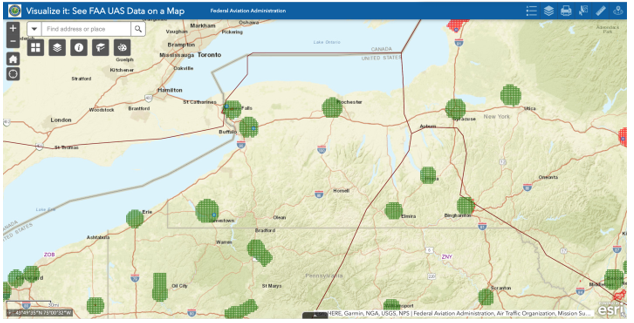
This was so cool, I looked up my part of the state:

Restricted airspace map of Western NY

And now I know where not to fly the drone I don’t own.


Sample License for Use of Drone Pictures

Once you have confirmed that any drone shots your library would like to use are not: the result of or evidence of a crime, taken in forbidden air space,[9] or otter harassment, here is a sample license for securing permission to include them in an online catalog:


IRREVOCABLE, NON-EXCLUSIVE LICENSE

[NAME] ("Photographer"), an individual residing at [ADDRESS], and at least 18 years of age, hereby gives the [NAME LIBRARY] (the "Library") an irrevocable, non-exclusive, transferable license to use an image entitled [TITLE], a copy of which is attached hereto as "A" (the "Image"). The permission to use the Image includes unlimited use in any format now existing or later developed.

Photographer represents and warrants that the Image is their original work and that to the best of their ability to determine the rights of no individual or entity were violated by the creation of the Image.

In consideration of the rights granted herein, Library shall at all times credit Photographer with authorship and ownership of the photo as follows: This image is © [NAME], [YEAR], and is used by the [NAME LIBRARY] with permission from the photographer, who may be reached at [email address].


Signed by Photographer: _________________________.


Signed on behalf of the Library: ___________________________.


A Final Word on Getting "Permission"

This question was pre-packaged to consider issues of permission/legal concern related to images generated via drone, so I have structured it to give primary consideration of those issues.

However, I would be remiss if I didn't stress that when assembling an archive or image collection, worries about permission shouldn't always be a threshold consideration.

Why is that?  If a library or archive crafts the parameters of an image catalog around the purpose of that catalog—around why it is important to gather a certain type of content, within a certain range of criteria—permission might not even be necessary. 

Concerns about permission and legality should not prevent the assembly of a resource that has academic, documentary, or investigative value.[10]  And the more a collection or archive is shaped as a documentary, academic, or investigatory endeavor, the less the subject matter and content can pose legal concerns...or rather, the more protections[11] the project will be able to avail itself of.

Taking advantage of those exemptions starts with having a very clear scope for your project, a written set of ethics, and a statement of purpose for the endeavor. [12]

My takeaway in this final part of the answer?   If your project is of academic, historical, or social value, don't let lack of permission be a roadblock.  Instead, just like the member does in this question, set up a clear scope for your project, and then tackle any reservations head-on.  This will lay the groundwork for a strong archive or catalog.


Posterity will thank you.


[1] Head Photographer at "Drone Shot Weekly?"

[2] Here is the FAA guidance on media use of drones for newsgathering: https://www.faa.gov/about/office_org/headquarters_offices/agc/practice_areas/regulations/interpretations/Data/interps/2015/Williams-AFS-80%20-%20(2015)%20Legal%20Interpretation.pdf [NOTE: This link was confirmed as no longer active and removed on 02/25/2022  as part of the routine review of "Ask the Lawyer" materials.]  It’s interesting: even if using a small drone, such use doesn’t qualify for the “hobby” exception, and the drone should be registered.

[3] Do you need the “right agreement?” See the section of the answer called "Sample Agreement" for an example.

[4] NY Penal Law 250.45

[5] JUST TO BE CLEAR: I have 100% confidence that if a library comes across a creeper nude drone shot, they will not include it in an online catalog!  I am just being thorough.

[6] New York Civil Rights Law Section 50.

[7] Per 50 CFR 18.137: "Unmanned aerial systems or drones must not cause take by harassment of sea otters. Measures for avoidance of take may be required in an LOA, and may include maintaining a minimum altitude and horizontal distance no less than 100 m away from otters, conducting continuous visual monitoring by PSOs, and ceasing activities in response to sea otter behaviors indicating any reaction to drones."

[8] Thank you, THANK YOU to the member who sent this question.  Because of you, I got to read the FAA's guidance to local law enforcement for drone-related incidents, which includes this practical guidance "NOTE: Battery life is typically 20 to 30 minutes." 

[9] By the way, it might not be precisely forbidden for your library to post such images, just as a newspaper or academic publisher might reproduce them for purposes of news or scholarship.  But since those categories come with some higher risks (particularly of being told to cease and desist), it is wise to consider consistency with the purpose and ethics of your archive before including them.

[10] I am not saying to not consider them...just don't let them be project-killers.

[11] Such as fair use, journalism privileges, and recognition of the non-commercial nature of the use.

[12] Links to further "Ask the "Lawyer" content on this specific consideration (ethics as a key component to rock-solid archives) are here: RAQ #172 and RAQ #178.

Handling CASE Act Claims for Libraries

Submission Date

Question

The awful CASE ACT is now a law. While I think the language is problematic, I fear trolls will try to collect money ($30,000) from libraries unaware of this change in copyright. Here is a blog post that I thought was helpful https://www.recreatecoalition.org/the-case-act-now-what/

What should we be doing? Thanks.

Answer

For those readers who haven't been following it, the "CASE Act" authorizes the federal Copyright office to create a "small claims" division for the adjudication of "small" (under $30k, and no award of attorney's fees) copyright infringement cases. [1],[2]

Like the member, I know many attorneys who think this legislation is "awful."  I also suspect that if I took an insurance carrier and a publisher out to a bar, they would think it is "pretty cool," and would toast the efforts of the well-paid lobbyists who worked so hard to ensure it got passed this December along with the federal budget.

There is a LOT of writing out there on the CASE Act, so I am going to focus on the practical aspect of the member's question: when it comes to the inevitable trolls[3] who will use genuine claims and fraudulent allusions to this new method of bringing copyright claims, what should libraries and other information professionals be aware of?

The good news is: even with new legislation, your response remains the same: keep calm, and deal with a copyright infringement allegation step-by-step. 

What are those steps?  Updated for a CASE Act-containing world, here is the "Ask the Lawyer" "Copyright Troll Begone!" Emergency Response Procedure.[4]


"Copyright Troll Begone!" Emergency Response Procedure

Step 1: Receiving the complaint

If your institution receives ANY assertion of copyright violation (by email, mail, phone, in person, or fax), do not immediately reply to the allegations.  Never!

If the accusation is in writing, simply move on to step "2." 

For interpersonal outreach (on the phone, in person, in yet another Zoom meeting),[5] state, "I am making a note of your concerns.  What is a good number/email to reach you at [at least one day later]?"  NOTE: Even if they keep trying to get you to argue/response/engage, don't take the bait, just set up a time to reply.


Step 2: Dealing with the complaint

Okay, you have in writing before you (either as submitted, or in your notes) an allegation of infringement.   It is either: i) a scam; ii) an honest but empty threat; or iii) a problem.  To determine which of these options it is, you need to either consult your lawyer, or do some research.


Step 3: If you conclude it is a scam

There are copyright-based scams all over the place, and with the CASE Act, the scammers will have yet another point of entry for their menacing but baseless threats.  "You owe us $150,000!!!"  "To avoid prosecution, contact us NOW."  "The CASE Act means we can sue you without registration, so we're attaching your bank account for $30k."  Scare tactics.  Bogus claims.

If your attorney or your research shows that the complaint you received is illegitimate, I encourage you to send a copy of it to the New York Attorney General,[6] and to the Copyright Office.[7]  Then you can stop thinking about the claim, and move on with your day.[8]


Step 3: If you conclude it is not a scam, or can't tell

If you examine the complaint and it seems legitimate, the only thing I can say is: consult your institution's insurance carrier and/or your attorney as soon as possible. 

Even if you think your use was "fair" (as in, not an infringement), or you can show you had permission, there is too much risk in saying something that could be problematic later, if you respond to the allegation without a pro.


Step 4: Ensure the Hand-off

Make sure that whoever is handling the matter for you (attorney, insurance carrier) takes responsibility for the next steps, in writing.  If an attorney is handling it, a letter or e-mail confirming they are representing your institution in the matter is essential.  If your institution's insurance carrier is handling it (many general liability policies cover this...do not forget to check!), you will get a notice of "tender," telling your library that there is coverage, and if/how they will handle it (including if legal counsel will be assigned). With that assurance in writing, you are ready to get back to the business of information management.


Step 5: Check in this time next year on the CASE Act

As the blogger cited by the member writes, the CASE Act was only passed this December.  Implementing it will take the federal Copyright Office some time.  Or as they put it[9]:

The Office must establish the CCB by within one year of enactment, unless the Register of Copyrights, for good cause, extends the time period for no more than 180 additional days. The Office will soon begin implementation activities. Proposed regulations will be published in the Federal Register and the Office will provide updates through its NewsNet service.


We'll keep an eye on the developing regulations here, and send a "CASE Act" update this summer or early spring.


[1] If you want a more official-sounding description, here is the description from the Copyright Office: "On December 27, 2020, the Copyright Alternative in Small-Claims Enforcement Act of 2020 (the CASE Act) was enacted as part of the Consolidated Appropriations Act, 2021. The CASE Act includes a number of the Office’s earlier recommendations. It establishes a Copyright Claims Board (CCB) in the Copyright Office to hear copyright infringement matters and (1) caps damages at $30,000 total (including statutory damages of $15,000 per work, and $7,500 per work for which an application was not filed in accordance with section 412 timelines); (2) provides an opt-out option for the respondent; (3) includes streamlined procedures that limit discovery and rely mostly on written materials; (4) allows claims by both copyright owners and users for infringement and exceptions and limitations, respectively; and (5) includes additional fees for bad faith claimants and bars those who repeatedly abuse the system."

[2] Here is a link to the legislation: https://www.congress.gov/bill/116th-congress/senate-bill/1273/text

[3] "Troll" has a primary connotation of being an online provocateur, these days.  But in the intellectual property world (patent, trademark, copyright), "Troll" means a person/entity who trades in IP with a goal of suing for infringement.  Either meaning, of course, is nowhere near as cute as the fluorescent heroes of the "Trolls" franchise, who are just darling.

[4] Feel free to print it and put it on the wall near the "handling angry phone calls," and "don't fall for this phishing scam" lists.

[5] If they put the threat in the chat box, just grab a screenshot and continue with the meeting.

[6] You can send a consumer complaint to the NY Attorney General at https://ag.ny.gov/consumer-frauds/Filing-a-Consumer-Complaint.

[7] The Copyright Office doesn't have a fraud report utility, but you can reach them at https://www.copyright.gov/help/.  You can forward a pdf of it to me, too.  I collect these things the way other people collect menus or bottle caps.

[8] If you are feeling whimsical, you can say "Copyright Troll, begone!" as you put the notice in the shredder.

[9] At the update posted here as of January 28, 2021:  https://www.copyright.gov/docs/smallclaims/ .

Movie covers on Facebook

Submission Date

Question

I've seen libraries take pictures of book covers and promote them on their library social media page, and was wondering if the same policy holds for movies. Can we take a picture of the front covers our new DVDs and promote them on Facebook? Or is it preferred that patrons browse our new DVDs in the library and/or on our library catalog?

Even though we purchased a movie license, I do know that due to copyright laws, we are not allowed to promote on social media any movies that we are showing at the library. Patrons are asked to call us and inquire what movie we are showing. Thanks for the help!

Answer

There are a lot of legal technicalities hidden in this question, but before we get to them, here is my overall advice: The more your library generates unique, custom content showing the people, personalities and experiences of your library on your social media,[1] the more you can include copyright and trademark-restricted content in social media promotions.

For example: If a library takes a picture of a new DVD, with only the cover content in the photo, and posts it to social media, that could potentially trigger some type of copyright/trademark concern.  But if that same library takes a picture of their librarian holding that same DVD while giving a thumbs-up ("This new movie is librarian-approved!") that concern is greatly reduced, since the proprietary work is only part of the message.

This same guidance applies for book covers, new games, and other media packaging.  Since copyright and/or trademark can both be invoked to protect any of that content (although just how protected the content is will vary from item to item), displaying it on social media as part of your library's overall personality and outreach is much better than using a photo or scan of the book/cover on its own.  When you don't have permission, use of a proprietary image as part of a related but larger social media message ("We have this great book!") is generally a safer approach to image use.

Now, at this point I must note: the "image use" in this question is different from using cover content (let's call them "thumbnails," for nostalgia's sake) supplied by providers like Overdrive for your library's online catalog.  Use of thumbnail content in your catalog (and thus, generally, on your library's website) is likely restricted in the license from the provider, but supplied with the understanding that the thumbnails will be viewed via your library's website as part of the service.[2]

Now, as to announcing movie nights...this question gave me a double-take, because neither copyright nor trademark, in and of themselves, bar listing the bald fact that your library is hosting a (licensed) movie night, and the title of the movie—whether via a poster, or via social media.[3]

But since I have never known a librarian to submit a baseless question to this service, I dug a bit more, and found this statement[4] in the Swank guidance for libraries using their "single event' license:

"If the public library’s social media accounts are set to private, the title may be used. If the library’s social media accounts are not set to private, it is recommended the title not be included. The movie event may be promoted on the social media pages with a link to the title on the library’s website."

So to be clear: copyright doesn't forbid promoting the movie, but restrictions on promotion could be a requirement of the license (the contract allowing your library to show the movie), or (as the case here) a "recommendation"[5] of the licensor, likely at the request of the trademark holder.  This is one of the more bizarre "recommendations" I have run into in the contract-analysis business, and I thank the member for sending it along!

And that's it.  Again, the take-away from this answer is: the more your library generates unique, custom content showing the people, personalities and experiences of your library on your social media, the more you can include copyright and trademark-restricted content in social media promotions as a component of that larger messaging.  Along with being a type of risk management,[6] this will also lend itself to your library having better, richer, and more interesting social media, so it's a win-win; sometimes the law and quality control go hand-in-hand.

And now, to go watch the new [TITLE OF MOVIE REDACTED] with my family.


[1] For purposes of this question, I do not consider your library's website "social media," since in many ways these days the website is simply the virtual part of the library.  "Social media," to me, are third-party contractors: the usual and growing array, like FB, IG, TT, Twitter, etc.

[2]That's how OverDrive's does it, anyway: "OverDrive grants you a limited, revocable, non-exclusive, non-transferable license to use the Embed Code to display Samples on Your Site."

[3] Using movies stills and original posters can pose a concern, but here, we're just talking about announcing the title.

[4] You can find it, too: https://www.swank.com/public-libraries/faq/#afterpurchase6

[5] That said: "it is recommended" is not the hallmark of contractually enforceable language.  My guess is that this is something Swank told its content providers it would do, but everyone realized that as a hard requirement, it is pretty ridiculous ("We're showing a movie!  Can't say the title!") and could cost them business. I can see why content providers would ask for it, though, and I bet it shows up in other licenses.  If you have a license with a requirement like this, please send us a copy; I collect contract artifacts like this.

[6] Because it will make it much easier to claim fair use, and also make it much less likely that your library will be accused of infringement in the first place.

Producer permission for streaming services

Submission Date

Question

I know we can't use Netflix, Hulu, or Amazon Prime on a normal basis to show movies in our classrooms because when we sign up for their service, we sign a contract stating that our accounts won't be used for public performances (personal use only). I am understanding that it is because Netflix, Hulu, and Amazon Prime do not outright own the content on their platforms and enter into agreements with the owners of the content for personal use only. However, I wanted to find out if a student can use Netflix, Hulu, or Amazon Prime to stream a portion (5 Minutes) of a movie where the student has received written permission from the Producer of a movie to show it as a public performance... I wasn't sure if the Producer permission supersedes the personal account contract of the Streaming Service?

Answer

This question is a good question for the bar exam!  It is a great blend of contract law and copyright.

Well, that's enough positivity for today; time for the answer, which is...

No.

Here’s the simply reason why I say “no”: as the member states, Netflix, Hulu, etc. tend to[1] restrict their content for personal use, meaning: no classroom/board room viewings.  This means that even if the use is "fair" or otherwise non-infringing, non-personal-use viewing is barred by the agreement the account holder has with the service.

The more sophisticated basis for me saying "no," is this: Netflix, Hulu, and their ilk bar group viewing not only because of the contractual obligations they have to their content owners, but also because to do otherwise would mess with their economic model.  In short: it will cost them money.  So even if a copyright owner says it's okay, they might not be inclined to consent to a use contrary to their contract.

That said, to add to the law-school-ness of your question, I'll add to your scenario:

If the student obtains a DVD or finds an online copy of the 5 minutes they need, and plays that copy (not the one from a commercial content service) to the class, if the student truly has proper permission of the copyright owner, then what would otherwise be an infringement is not.[2]

Of course, this requires a DVD,[3] or an online copy from a source that doesn't bar the use via contract.[4]  And of course, my scenario defeats the purpose of your question, which is to view the 5 minutes of the film in the format that is (likely) the most convenient: streaming.

I am sorry to be a bummer.


[1] There are of course exceptions, as these services can feature education-specific content intended for educational use.  But those are the exceptions, not the general rules (at least right now).

[2] Sadly, this hack does not work if you use your personal on-demand account to make the copy.  See how Netflix bars this: "Except as explicitly authorized in these Terms of Use, you agree not to archive, download, reproduce, distribute, modify, display, perform, publish, license, create derivative works from, offer for sale, or use content and information contained on or obtained from or through the Netflix service." Those pesky lawyers think of everything!

[3] Which are quickly on their way to becoming as obsolete as—but not as cool as--vinyl, or cassette tapes.

[4] Which makes it painfully likely the copy is not 100% legit.

Music licensing and on-demand viewing

Submission Date

Question

Is it a violation of Copyright Law to publicly share a video recording of a DJ playing music from his music library for a public library archive and make this available for on-demand viewing?

Answer

My favorite DJ-related story is about how "scratching" a record,[1] as both a musical instrument and an act of composition, evolved in the hip-hop scene of the late 1970's and early 80's.[2]  It is a story of technological innovation, of community culture, and (as all good stories are) controversy.[3]  DJ's, like all contributing figures to culture, make for compelling scholarship.  So I am not surprised to see this question about audio-visual content portraying a DJ on a library archive.

The short answer is: sure, it could be a violation; but there are five things that can keep it on the right side of the law—or at least mitigate the risk if there is an unintentional violation.

Here are those five "things":

First thing

Is the posted video part of a well-developed and organized collection or archive?

If "yes," go on.

Second thing

Does the metadata on the unique video reflect that it is part of a well-developed and organized collection?

If "yes," go on.

Third thing

Is the music part of a recording of an event, or is the music a separate track with all other ambient sound (the crowd, street noise, the DJ talking over the music) removed (or never there)?

Even if "no" go on, but have the next two really, really tight.

Fourth thing

Has your library[4] conducted and documented[5] a "fair use" analysis[6]  of its posting of this particular content, and to the best of its ability, reflected accurate ownership of the item in the metadata and item information on the archive?

If “yes,” go on.

Fifth thing

Does your library have a "notice and takedown" contact point posted on its website, so anyone who believes the content is an infringement can complain, AND has your library registered[7] for "safe harbor" under the Digital Millennium Copyright Act?[8]

If "yes," DJ on!

Why do I have to do the "5-step hustle" to answer what seems like a simple (if compound) question?  Because how and why content is used can transform "infringing use" to non-infringing "fair use."  For a component of a scholarly or historic video archive, this means being able to show that a musical recording incorporated into an audio-visual record is not merely a gratuitous use of the audio content, but rather, a critical element of a work that transcends (and doesn't simply replace) the purpose of the original. 

This is, in some ways, a tall order.  But if you follow steps "1" through "4" above, you significantly increase your likelihood of getting it right. And as for step 5: the DMCA has been in the news, recently, as a part of the national info-tech infrastructure that is due for an overhaul.  But for now, it can protect certain kinds of service providers (like search engines, directories, and other information location tools) from liability for third-party infringement, and it is an essential part of any information database's copyright compliance toolkit.

Thank you for a good question.


[1] Which makes a sound like either "schkud-shckud-shzyaaa" or "hschhzka- hschhzka-zreek" depending on how you translate it into onomatopoeia, along with the skill and intent of the person doing the scratching.

[2] According to his tag in the Cornell University Hip-Hop Collection, scratching was invented by Grandwizzard Theodore.  However, there is some assertion that Grandmaster Flash put Theodore on the path to the scratch.  Either way, it is a good story.

[3] If you are looking for a new era to get obsessed with, early Hip-Hop is a good one.  It is replete with geniuses, scandal, and triumph—and provides insight into cultural and community factors relevant to today.

[4] This 5-step analysis assumes your library is a not-for-profit educational institution (like a public library).

[5] As in: done the analysis in writing (generally a form), and retained the form.

[6] From 17 U.S.C. Section 504(c)(2): "...The court shall remit statutory damages in any case where an infringer believed and had reasonable grounds for believing that his or her use of the copyrighted work was a fair use under section 107, if the infringer was: (i) an employee or agent of a nonprofit educational institution, library, or archives acting within the scope of his or her employment who, or such institution, library, or archives itself, which infringed by reproducing the work in copies or phonorecords..."  Of course, making video "available" can be considered a transmission under certain circumstances (like streaming), so make sure your "fair use" conclusion is solid.

[7] Your institution can register for "safe harbor" in some instances (when it is more of a "provider" than a "publisher") here: https://www.copyright.gov/dmca-directory/

[8] I like the way Creative Commons does it: https://creativecommons.org/dmca/