Disclaimers

Contracts for Library Podcasts

Submission Date

Question

The library's podcast (Your Friendly Neighborhood Librarians), hosted by two librarians here, recently started interviewing guests from outside the organization. We are concerned about a few things: what the ramifications are if a guest does not like the way their interview was edited and whether the library owns the rights to the interview and recording. We only edit for clarity and length, and haven't done anything in regards to copyright. Additionally, any advice on whether we should be using some sort of contract or agreement with guests would be helpful. We don't have any sort of agreement in place at present, and are mostly interviewing people who are somewhat library-related. Thank you for your help!

Answer

Some days, I just love my job.  The day I subscribed to "Your Friendly Neighborhood Librarians" (2/4/22) to answer this question was one of those days.

For those of you who haven't checked out the Podcast: it's a forum where hosts (and librarians) Jim and Robyn, based in Rochester, NY, conduct deep and lively interviews with quasi-local authors.  [1]

When it comes to running a Podcast, there's a lot of legal to unpack.  I'll use a recent episode of YFNL (Season 2, Episode 4, January 30, 2022), an interview with photographer Quajay Donnell to illustrate.

When the Podcast starts, the first thing you hear is the YFNL's theme song:

[guitar strumming] "Librarians, librarians, when you've got questions, they're the ones, to help you find what you're looking for..." [more].  It sounds vaguely like the theme to "Spiderman" and is clearly a riff; it's super-cute and fun and brings a smile to my face. Then Jim and Robyn introduce the session's guest and launch into the interview.

The rapport is lively and fun, but Jim and Robyn's deeply prepared interview technique gives Quajay Donnell room to make comments, tell stories, and respond to well-informed prompts to talk not only about his work, but the work of others, and his thoughts on public art (I enjoy Mr. Donnell's comment, after a glowing list of his credentials "I sometimes struggle with the title of 'photographer', I sometimes say 'I'm a picture-taker', or 'I capture moments'."  I appreciate when people resist or explore the purpose of labels).  The show then ends with a cut to a recommendation from a circulation desk worker, Sim, who recommends "Field of Blood" by Joanne Friedman, and a tease for the next episode ("banned and challenged books"), some thanks to various show-helpers,[2] and an instrumental of that great theme song.

So with that background, let's answer the questions:

"[W]hat the ramifications are if a guest does not like the way their interview was edited and whether the library owns the rights to the interview and recording.  Additionally, any advice on whether we should be using some sort of contract or agreement with guests would be helpful. We don't have any sort of agreement in place at present, and are mostly interviewing people who are somewhat library-related."

I wish I could give simple answers to these straightforward questions, but this is "Ask the Lawyer," so I cannot.  But to start, I can say there are three variables that inform the answer to these questions:

Variable "1": Who is creating the Podcast?  Is it "officially" the library, or is it being created through the collaboration of independent individuals?[3]

Variable "2": What is the identity of the Podcast?   Is it 100% entertainment, or is it meant to be investigative journalism, oral history, or serve another documentary purpose?[4]

Variable "3": What is the purpose of the Podcast?  In other words, what is it trying to achieve not only now, but 70 years from now, when it is still protected by copyright, and past consideration of such questions will govern what type of access its intended audience should have?

Here’s how these variables impact the member's questions:

If a library is the creator of the Podcast (meaning the library directed its employees to create the Podcast as part of the work they are hired to do), then the library is the entity responsible for addressing (and bearing the liability for) issues of ethics, ownership, and risk (like defamation and image use).  If an individual or individuals are the creator/owner of the podcast,[5] the responsibility falls on them. 

If the identity of the podcast is light entertainment (that theme song!), then the creator does not have to worry about abiding by, or benefiting from, professional codes of ethics and law pertaining to journalism, academic work, oral history/documentary, or political expression.  But if it aspires to fall into any of those categories (and while it's not my call, I'd say YFNL is at the very least a form of journalism), ethics and certain laws may apply.

If the purpose of the Podcast is to ensure that people listening in 2022, as well as 100 years from now, appreciate home-grown artists in and around Rochester, NY, the creator/owner needs to ensure the work is set up to be controlled in such a way that access for that purpose is ensured.  This is true whether the owner is an entity (like a library), or a person or persons.

So with that as background, let's tackle the member's questions:

For the first question ('"[what] if a guest does not like the way their interview was edited?), the answer is: in a worst-case scenario (say the guest claims the interview was edited to make him sound offensive, and claims it caused him to be "cancelled"), there could be some type of legal claim for damages.  While I won't get too technical, this concern relates to a "tort" claim (like a personal injury) and the member is wise to bring it up, since this is a critical issue.[6]

An attorney advising an entity or person on this would: 1) confirm who the creator, publisher and owner of the content is; 2) ensure the party (or parties) makes good use of a speaker agreement that secures a waiver of liability for the producer and all people affiliated with the podcast; 3) if appropriate,[7] advise a step in the production process that gives participants the right to review and approve release of the final version (in writing).

This plays into the second question: "whether the library owns the rights to the interview and recording."

This should not be an ambiguous issue: either the work is "for hire" (meaning the librarians and other credited helpers are doing it as part of the work they are paid to do, or are working per an additional contract) and is owned by the library, OR the work is owned by the individuals creating it.

The leads to the third question (or rather, factor) listed by the member: We only edit for clarity and length.

This plays into the identity of the podcast. If a podcast or other work isn't using a lot of editing to create a specific dramatic or entertaining effect, and is structured to perform a primarily documentary function, it is worth considering using the established ethics of journalism or oral history to guide the project.

Why? 

In the state of New York, journalists' sources are accorded particular protections under the law, while the identity of the speaker and nature of the communications are relevant to claims of defamation. Also under New York law, the further an unauthorized[8] use of someone's name, likeness, or voice, is from a "commercial use," the less likely a person can sue based on "invasion of privacy." And under federal copyright law, material that incorporates copyright-protected work (perhaps reading part of a poem) for journalistic, academic, or documentary functions will get consideration of that factor if a court needs to determine "fair use."

This next variable I listed is purpose, meaning, what is this work supposed to accomplish, and for how long? Consider that variable in light of the member's statement: "[We] haven't done anything in regards to copyright."

If the purpose of the podcast is to ensure as many people as possible access and appreciate it for as long as possible, what might be more important than registering a copyright is to ensure the work is archived on not only a commercial service such as Apple Podcast (where I found it), but in repositories owned by the public, as part of an institution whose structure ensures some type of longevity.

However, if part of the purpose of the podcast is to ensure for as long as possible that it can never be exploited commercially by anyone, and the owner wants to make sure it will be able to claim damages and attorneys' fees in the event the recording is infringed, registering it is a good idea.

So with that, I get to the last, open-ended question from the member: Additionally, any advice on whether we should be using some sort of contract or agreement with guests would be helpful.

It's important to know at this point that while sometimes I reach out to a member who submits a question to "Ask the Lawyer" (to get a bit more information to enable a more helpful answer), in this case, I did not reach out to Robyn and Jim (although because I really like the podcast, I wanted to!). I thought it would be more important, and in the spirit of their question, to present a generic answer to this part of their question with a generic template that could be of use to other libraries and librarians creating a podcast or other type of audio content.

When creating a podcast, here are the "legal" questions to answer to help you (and your lawyer) address the legal considerations:

Question

Reason it's relevant

Your answer


What is the purpose of the podcast?


It's important to answer this question first, because the purpose of the podcast will drive all the answers following this one.


Are there any professional ethics that apply to the podcast?


This answer is based in part on the "purpose." If the purpose is a type of journalism, the creator may want to consider affirmatively abiding by applicable journalistic ethics. If the purpose is oral history, the ethics of oral historians could apply.


Who "owns" the podcast?


This is a question for a lawyer. However, I can broadly say that if a library or educational institution is directing the podcast to be created, and the people creating it are doing so as part of their jobs, then the podcast is owned by the employer. If everyone involved is unambiguously doing it in their free time, then likely, they are the owners together. And in either case, if there is any grant funding that applies to the podcast, the owner(s) should pay close attention to the terms of the grant, because often grants involve a license or transfer of intellectual property.


What is the end product?


This seems like a pretty straightforward question, it's "podcast recordings," right? However, in just taking a look at "Your Friendly Neighborhood Librarians" I heard a theme song that could be subject to individual copyright, and I see there are really excellent descriptions of each podcast that were authored by somebody. In addition, "Your Friendly Neighborhood Librarians" (a clever brand) could also be subject to trademark. There is also a logo.  And if the content is in its own archive with its own metadata, the metadata could also be proprietary. These are just a few examples, so inventorying the end creation (and if all of the creators are not employees, making sure intellectual property is transferred appropriately) might be bigger than maintaining a list of podcasts.


What are the terms for regular and guest contributors?


For podcasts being created by people as part of their jobs, the expectations, rules and protections for them should be understood between their job description and the rules by which the podcast is operated.


For guests, as the member's question points out, it is best to have a written agreement that sets out the terms, including the right balance of a waiver of liability and the ability to preview the podcast to ensure any editing does not result in a person saying something they didn't intend to say.


(As one example of "rules": if a podcast is being produced by a public library or a not-for-profit organization, there should be a firm rule that no endorsements of political candidates are allowed on the show.)


What other conditions may apply?


For podcasts released on Apple Podcast, this means what are the rules you have to follow under the terms of Apple. For those selecting additional or alternate fora, paying attention to the "terms and conditions" on those resources is also important.  And as mentioned above, grants and donations with conditions that support the content creation should also be considered  (if you are lucky enough to be running a grant-funded podcast).


How do people access the content?


This is critical for ensuring accessibility in both the short and long-term.   Early consideration of this factor also ensures that any legal releases or agreements an owner needs to enter into (like licensing a logo) can accommodate the full plan for accessibility. 


How are any risks being addressed?


I appreciate this is a very open-ended last item. Broadly speaking, if the podcast is being produced by the library, the library's insurance carriers should be consulted to make sure it has insurance coverage for that type of activity. Any aspect of the podcast that is not covered should either be limited or other risk management, such as a waiver of liability, and a process for preview by guests, should be considered.


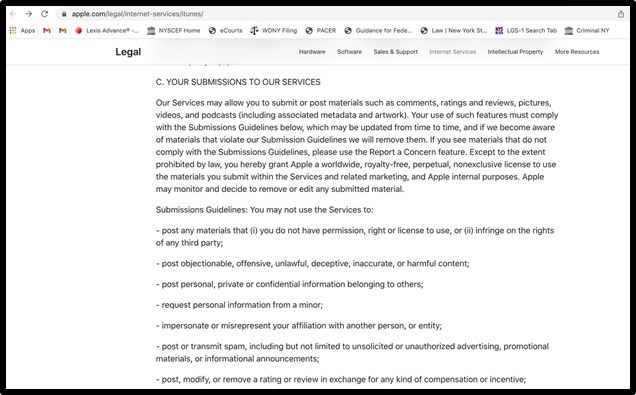
This last item is addressed by Apple's terms of use for podcasts, which I have included below.


Screenshot of submission disclaimer language

Now, with all that said, I am very aware that some of the answers I have put above may cause more anxiety then resolve curiosity. To help out with that, below is a template for a "podcast guest agreement."

As with any template, a library or podcaster should have their lawyer consider all of the factors I list above before finalizing the template. But hopefully this template can provide a good start.

[Template Podcast Guest Agreement]

RE:  Terms of guest appearance on [PODCAST NAME] on [DATE]

Dear [NAME OF GUEST]:

Thank you for agreeing to be a guest on our show, [NAME] ("the Show") on [DATE TIME] to discuss [TOPIC].

Below are the terms between you and [OWNER NAME] ("Show Publisher") for your appearance on the Show.  Please review the terms, and if you agree, please sign below.

If you have any questions before signing, please contact [NAME] at [CONTACT INFO] to discuss them before sending us the signed copy.

Ownership

You agree that the direct recording (audio and visual) and any subsequent product incorporating it, including but not limited to transcription and any adaptive copies made to enable access by those with a disability, shall be the sole property of Show Owner.

Image Use

You agree that for purposes of promoting, publishing, performing, displaying and making the Show accessible to its audience, Show Owner may use your name, image, and likeness in print and electronic media.  This permission is expressly limited to promoting and publishing the episode of the Show featuring you.  This permission is irrevocable once the Show featuring you has been made available to the public in any medium.

Rules

The rules of participating in the Show are:

Show Owner is committed to creating an experience and show that respects the dignity of all participants and listeners.  If you have any concern at any point regarding your experience working on the Show, please alert [NAME] at [CONTACT INFO].

If at any point during recording you need to take a break, please simply state "I need a break" and we'll stop recording.  This includes if a topic is not one on which you wish to speak.

We edit our show for length and clarity.  You will be given an opportunity to review the edited version prior to it being uploaded to [SITE(s)].  We ask that you write to [NAME] and [EMAIL] with any concerns about edits within [#] days of the final cut being made accessible to you.  If we don't hear anything from you within three days (excluding Saturday and Sunday), we will assume you consent to the publication of the content.

Please refrain from any endorsement of any political candidates during recording.

Please do not accuse any person of a crime, having an STD, or of being incompetent at their job, or marital infidelity, unless such fact is generally known, during recording.  We don't anticipate your appearance will warrant a dip into such a topic, but to avoid claims of defamation, or having to edit out such content, we alert guests to this consideration.

[INSERT CUSTOM RULES]

Hold Harmless

You release and hold harmless Show Owner, its employees, volunteers, and agents from any and all liability, claims of injury, lawsuits, and complaints in association with Show.[9]

Warranties & Representations

You represent and warrant that:

a) No contract or other obligation bars you from appearing on the Show;

b) Any performance on the Show by you will be of your own original work;

c) You are aware that the permission you are granting NAME to use your image, name, and likeness for the limited purposes listed above is irrevocable;

d)  You know the show will be archived by Show Owner and may archived to be available for your lifetime and beyond.

e) You are over the age of 18 and thus able to sign this contract OR your legal guardian has signed below.

Thank you so much for agreeing to be on our show!

Signed on behalf of Show Owner:___________________________

Signed by Guest:______________________________

Guest Date of Birth:_______________________________

Guest preferred pronouns:_____________________________

[if applicable] Signed by Guest's parent or guardian:____________________________


Good wishes for your friendly neighborhood podcasts, true-believers!


[1] For any Western New Yorker lamenting the decreasing number of journalists on the local creative beat, this is a nice antidote.  (BTW...Buffalo/Rochester = WNY.  Syracuse/Rome/Utica = Central NY.  I grew up in Central New York and now live in Western New York, and when this distinction gets blurred, it hurts).

[2] Including two people credited for the theme song.

[3] In my experience, librarians can have a tough time with this one, since they often go above and beyond.  For more on this type of issue, see the "Ask the Lawyer" on LibGuides at https://wnylrc.org/raq/previous-employer-re-assigned-authorship-libguides.

[4] I realize that these categories overlap, especially these days, but we'll talk about why the distinctions are important.

[5] It's official: I am using a lower-case "p" to write "podcast."  Congratulations, podcast, you've been genericized.

[6] It is also very much an "issue de jeur", since the ALA has joined an amicus brief on the rules in the state of New York for suing non-journalists for publishing content in public fora.  For more on that, search "Coleman v. Grand."

[7] This is a major distinction between a cultural or entertainment piece rather than investigative journalism, since professional reporters generally don't give interview subjects the right to approve a final cut.

[8] In this case, "unauthorized" means without written, signed permission.

[9] If you don't have a lawyer look at any other part, have them look at this.  This is a very bare-bones hold harmless intended to not "scare off" guests; a library should have a clause that matches the level of risk it is prepared to take.

Does a library need a disclaimer stating it is not responsible for COVID-19 cases?

Submission Date

Question

I understand that the libraries need a disclaimer stating that the library is not responsible should a visitor or patron become ill with COVID-19. Is this true, and if so, do you have suggestions on wording for this disclaimer?
Thank you

Answer

I appreciate this question, because it gives me a chance to make an important clarification:

As they prepare to re-open and re-welcome the public for summer 2020, libraries and other chartered entities DO NOT need “disclaimers”[1] to combat alleged responsibility for employee and patron cases of COVID-19. Instead, they need:

  • a WRITTEN SAFETY PLAN (customized to their own operations);
  • SIGNAGE and other documentation to enforce the Plan; and
  • Clear and consistent ENFORCEMENT.

Why is that?  Because limiting liability for the transmission of disease is not the same as limiting liability for riding a roller coaster.

Liability based on infection/illness is based on either 1) the intentional act of deliberately spreading infection (for instance, someone with COVID-19 deliberately spitting on someone); or 2) the negligent act of not doing what you were reasonably supposed to do, and thus causing a heightened risk of harm (for instance, someone mistakenly using the wrong product to clean a high-traffic surface).

When it comes to a person allegedly getting COVID at a library, no disclaimer will reduce liability for either type of action. What is needed, instead, is to show that the library has taken all reasonable steps to protect the safety of employees and the public.  That is the key to limiting liability.

This can only be done via a Safety Plan based on guidance from NYSDOH, OSHA and the CDC.   Since a Plan is only good if the planners follow it, signage[2] promoting adherence to the Plan, through consistent and well-documented enforcement, is also critical.

I am emphasizing a written Safety Plan not only because the State is requiring them, but because in New York, disclaimers, waivers, and “At Your Own Risk” notices are only effective under precise circumstances. 

For instance, an insurance carrier can refuse coverage based on a properly worded disclaimer.  A sky-diving company can avoid liability for a customer’s heart attack with a waiver.  But the insurance disclaimer still won’t void the liability of the insured, and the waiver won’t work if the damage is caused by a sky-diving instructor’s willful action.   The enforceability of such documents depends on the circumstances.

What DOES guard against liability for transmission of disease is showing that a library 1) identified appropriate safety practices confirmed by a recognized authority; 2) uniformly and consistently enforced those practices.  In that approach, signage alerting people to the risk of transmission (and requiring adherence to rules to minimize it), is part of that “uniform and consistent” enforcement.

Which brings me to the hard truth I have to emphasize:

If your library can’t 1) identify appropriate safety practices confirmed by a recognized authority as reducing transmission of COVID-19; and can’t 2) uniformly and consistently enforce those practices, your library should not operate.  No waiver or legal document will protect it if basic safety practices are not identified and enforced.

Now, all that said, as part of its “consistent and uniform enforcement” of safety practices, a library could decide to ask each patron to review and sign a document like this:

The ABC library is now open for [insert limited services].  To ensure consistent use of appropriate safety practices, please review and agree to the following practices before entering, which will apply until the board determines otherwise:

I agree to wear a mask at all times in the library; if I am medically unable to wear a mask, I will call the library at [##########] to arrange reasonable accommodations.

I will sanitize my hands prior to entry at the station provided by the library.

I will avoid touching my face and mask while in the library's premises.

I will abide by any other safety-related requests by library staff.

I will [insert your library’s specific requirements, as stated in the Safety Plan].

I understand that these practices are currently the rules of the library and they are being enforced both for my safety and that of the public as currently advised by the Center for Disease Control.

Signed: ________________________


This type of signed “acknowledgement” is one way to show that people have been notified that these are unusual times in the library, and that entering the premises may bring more than the usual risk.  That said, this approach is not an “acceptance of risk” document, disclaimer, or liability waiver.  For the reasons stated above, those approaches really aren’t what’s needed for the simple resumption of library activity.  What is needed is a Safety Plan.

Of course, if your library decides that aside from resuming some modified operations, it would like to host some inherently hazardous activities (riding a mechanical bull,[3] digging a community garden with heavy equipment, printing Jarts on the 3-D printer) a waiver is a good idea.  But for resumption of activities while the country is still fighting COVID-19, your Safety Plan is the key.

Thanks for a great question.


[1] In New York, a “disclaimer” is a formal written document or policy clause used by an insurance company to deny coverage for liability.  As an example, see §3420 of the New York Insurance Law.

[2] By “signage,” I mean any documentation in the library, or on the Internet, that encourages Safety Plan compliance.

[3] I had to draft a waiver for a mechanical bull once.  Sometimes being a lawyer is fun!


Circulating telehealth kits and disclaimers

Submission Date

Question

Our library is considering adding a circulating telehealth kit to our collection for patron use. With the pandemic and telemedicine being the current norm, the goal is to fill a perceived need within our community. The proposed kit would include medical supplies including a blood pressure cuff, pulse oximeter, a forehead thermometer, and a bag to hold the equipment. My question concerns any disclaimers that would be necessary to add to the kit as well as liability issues for the library if we were to implement this.

Answer

I love learning about new assets communities can access through their library.  Tools, ties, seeds, toys…this list is endless.

This is the first question “Ask the Lawyer” has received about health monitoring devices and medical supplies, and the member has rightly pointed out that there is a lot to consider in such a venture.  How can such lending be done with an emphasis on safety, and limiting legal risk for a library?

But before we delve into disclaimers and liability (yes, a disclaimer is going to be needed), let’s confirm some terminology.

In New York, Telehealth is defined[1] as “the use of electronic information and communication technologies to deliver health care to patients at a distance.”

Meanwhile, Telemedicine is defined[2] as “two-way electronic audio-visual communications to deliver clinical health care services to a patient at an originating site by a telehealth provider located at a distant site.”

In other words, Telemedicine is also Telehealth--but Telehealth is more than Telemedicine.  “Telehealth” is like the largest figure in a Russian nesting doll set, with Telemedicine (audio-visual communication of services) contained within—but separate.

The equipment being considered by the member are equipment for Telehealth, not the transmission of Telemedicine.  This has a lot of ramifications for liability and legal compliance, so it is important to take care in making the distinction from the start.

When considering the cataloging and lending of equipment for Telehealth, there are two other critical terms:

Store-and-Forward Technology, which is defined[3] as “asynchronous, electronic transmission of a member's health information in the form of patient-specific pre-recorded videos and/or digital images from a provider at an originating site to a telehealth provider at a distant site.”

…and…

Remote Patient Monitoring, which is defined[4] as “the use of digital technologies to collect medical data and other personal health information from members in one location and electronically transmit that information securely to health care providers in a different location for assessment and recommendations.”

“RMP,” as it is also called, includes the collection of information such as vital signs, blood pressure, heart rate, weight, blood sugar, blood oxygen levels and electrocardiogram readings; the type of monitoring the devices in the member’s question are about.

Okay, with that established…

YES, in lending such equipment, there are some concerns about risk and liability.  YES, a disclaimer is a good idea. And there are a few other considerations, too…related to procurement, cataloging, and lending (but in the end, all relevant to the issues of risk and liability).

How does a library address those considerations?  There are many details, but here is a process to systematically take them on:

Step One:  Make it incremental

What do I mean by “incremental?” 

I mean, instead of cataloging a kit of equipment as a single item, each item in the kit (and perhaps the bag itself) should be cataloged as a separate item.  That way, when the patron borrows the bag and the equipment, they will borrow them as separate components…the way another patron might check out the entire “Harry Potter” series and a DVD of “Goblet of Fire.” [5]

Why? Because each piece of health-related or medical equipment comes with its own set of legal terms (warrantees, disclaimers) and operating instructions.  By lending that equipment on a piece-by-piece basis, rather than in kits with multiple components checked out as a single unit, a library will be able to use that level of detail to take the liability-limiting and risk management steps I describe below.


Step Two: Know the devices

The member’s question lists the following telehealth equipment: “…a blood pressure cuff, pulse oximeter, a forehead thermometer, and a bag to hold the equipment.” 

This list makes sense, since “remote patient monitoring,” as described by the New York Department of Health,[6] uses instruments to measure vital signs, blood pressure, heart rate, weight, blood sugar, blood oxygen levels and electrocardiogram readings, so that information can be used to provide telemedicine.

How can a library “know” the equipment?  Before a Telehealth device is added to a catalog, a library should a) confirm it is commonly used for telehealth, b) confirm it meets your library’s procurement requirements; c) confirm that the precise device is registered with the FDA, and d) use the FDA site to confirm it has not been recalled.

The best place to do this is: https://accessgudid.nlm.nih.gov/.


Step Three: Plan to include the instructions

If the device comes with instructions, ensure the physical copy of the instructions is lent along with the device,[7] and generate a link or QR code so the instructions (in an ADA accessible format) can easily be found online.

This is so the borrower is empowered to use the device per the manufacturer’s instructions.  This is a key component of limiting the risks associated with lending devices of any kind—including health-related equipment.


Step Four: Set the Requirements for procurement

In addition to the Procurement Policy your library must follow, the following requirements should be in the RFP or RFQ for each device:

  • Will not transmit data OR any data transmission capability the device has meets current transmission requirements for telehealth;
  • Any digital memory the device has must be capable of deletion with no ability to recall the prior data;
  • Any device supplied must be registered with and thus listed on the FDA’s medical device database (and searchable by name or number);
  • There should be no parts intended for insertion into the body;
  • There should be no need for replacement parts;
  • There should be clear instructions for cleaning the device between uses, and those instructions should be a process staff can perform safely;
  • The purchasing decision should consider if/how the product is powered (battery, charging station) and plan to support that during lending;
  • There should be no safety recall.


Step Five: Be ready to continuously monitor for recall

This is critical—and why any device included in the collection should be registered with the FDA.  Prior to lending (every time), it should be confirmed at https://accessgudid.nlm.nih.gov/ that the device has not been recalled by the FDA.


Step Six: Confirm Functionality after Every Return

This, too, is critical.  Prior to lending (every time), it should be confirmed that the device is functioning properly, as described by the product’s instructions.


Step Seven: Consider bringing in a ringer

Prior to making the equipment ready for lending, consider launching the collection in connection with a public health partner in your community.

Why?

The ability to borrow a thermometer, or a blood pressure cuff, or pulse oximeter, could be a game-changer if a person’s own equipment is stolen, damaged, or lost.[8]  For people in rural areas who must order equipment and wait for delivery, it could facilitate the immediate start of Telehealth care, or ensure continuity of care while a replacement is on its way.  This project you are considering could save lives.

That said, people should only use telehealth equipment in connection with ongoing care from their health care provider. 

I am well aware of the cruel irony in this caveat.  Not all people have access to reliable health insurance or ongoing healthcare,[9] and thus might need to DIY their care with telehealth devices. But the concept of telehealth ONLY works if it is in conjunction with a health care provider. 

No one should be borrowing a library’s telehealth resources to use them in a health care vacuum.

This is where a public health partner could come in.  If the equipment is linked to information about a clinic or other local health care provider in your region who can help a patron connect to care, you can mitigate this risk, and urge the proper use of Telehealth equipment, while respecting the privacy and autonomy of patrons. 

This awareness should be part of your disclaimer.


Step Eight:  Yes, you should include a disclaimer

…and it is on a device-by-device basis.

Of course, any disclaimer should only be adopted after review by your library’s attorney AND insurance carrier.[10]  But here is a place for them to start:

“Prior to being borrowed, this equipment has been confirmed as not under recall by the United State Food and Drug Administration (“FDA”), and to be functioning per the manufacturer’s specifications. 

However, the [NAME] library cannot confirm that the equipment will remain functional or unrecalled while it is on loan.  To determine proper functioning, please refer to the instructions, and check the recall status of the device at at https://accessgudid.nlm.nih.gov/.

This is borrowed equipment.  You must follow the cleaning directions in the instructions before using this equipment. 

Please review the instructions and notify the library immediately at (#####) in the event the equipment is not functioning as the instructions describe. 

Use of this equipment should only be in conjunction with service from a licensed health care provider familiar with your medical needs. 

In the event you do not have access to a licensed health care provider, call [community health partner] to inquire about health care in the [NAME] region.  The library has confirmed that this resource can assist you in finding care.

In the event of a medical emergency, dial 911.”


Step Nine:  (If You have Room) Let them Know Their Rights

In the State of New York, patients being treated through telemedicine have certain legal rights. [11] If feasible, it would be good to foster awareness of these legal rights when lending telehealth equipment.  

Here is a sample notification:

This equipment is for temporary use when being treated via Telehealth.  It should only be used in connection with service from your health care provider.

If you are being treated by telehealth in New York, here are your rights:

Any practitioner starting a course of telemedicine should provide a patient with basic information about the services that they will be receiving via telehealth, and obtain their consent to participate in services utilizing this technology. 

Telehealth sessions/services may not be recorded without the member's consent.

Patients have the right to refuse to participate in services delivered via telehealth and must be made aware of alternatives and potential drawbacks of participating in a telehealth visit versus a face-to-face visit.

Patients must be informed and made aware of the role of the practitioner at the distant site, as well as qualified professional staff at the originating site who are going to be responsible for follow-up or ongoing care.

Patients must be informed and made aware of the location of the distant site and all questions regarding the equipment, the technology, etc., are addressed.

Patients have the right to have appropriately trained staff immediately available to them while receiving the telehealth service to attend to emergencies or other needs.

Patients have the right to be informed of all parties who will be present at each end of the telehealth transmission.

Patients have the right to select another provider and be notified that by selecting another provider, there could be a delay in service and the potential need to travel for a face-to-face visit.


Step 10:  Plan and budget to clean the Equipment Upon Return

However the instructions state the equipment should be cleaned, it must be cleaned (every time).  Developing a protocol to do this safety is something your library must consider during both procurement and budgeting for the staff time needed to lend and maintain the equipment.


And that’s it! 

Okay..I admit “it” is “a lot.”  The big take-away here is that, in addition to considering liability concerns and a disclaimer, your library must ensure it has the staff, storage, and maintenance capacity to engage in appropriate risk management.  That will take some planning, and some resources beyond simply buying the equipment.

That said, I suspect it will be worth it.[12]

I hope a worthy initiative like this can find a strong community health partner in the member’s region.  With a health care supporting your staff in selecting the right equipment, choosing the best brands, and pushing out information about patient rights and public health, this program could truly save lives.

Please let me know how it goes.[13]


[1] NYS Public Health Law § 4406-g (2).

[2] NY CLS Pub Health § 2805-u 1.(d).

[3]  NYS Public Health Law § 2999-cc, 6.  PLEASE NOTE: if your library is considering providing equipment to assist with “store-and-forward” a rigorous ethics, security, and HIPAA compliance check should be part of procurement.

[4] NYS Public Health Law § 2999-cc, 7.

[5] In Harry Potter, they practiced telemedicine via the Floo Network. (P.S. If you think I threw in this Harry Potter reference to enliven a dull list of footnoted citations, you are right!).

[6] As found on April 14, 2020, at https://health.ny.gov/health_care/medicaid/program/update/2019/2019-02_speced.htm#definition

[7] I appreciate that this may involve the use of a laminator or other cool process libraries use to unnaturally extend the life of print media.  Wait until you see Step Ten.

[8] Or if the patron is in a coverage dispute with their carrier.  I have had some experience with this; not fun.

[9] https://www.health.ny.gov/press/releases/2019/2019-10-02_uninsured_rate.htm

[10] Your carrier should also be apprised of the undertaking, in general. They may even have some helpful tips for you in developing the lending program.

[11] As set forth in the NYSDOH guidance document found on April 14, 2020, at https://health.ny.gov/health_care/medicaid/program/update/2019/2019-02_speced.htm#definition, with citations to relevant laws and regulations.

[12] As I write this, the state is still on “PAUSE” due to COVID-19.  The use of telehealth during the time has SOARED.  And reading projections for the future, it will only increase.

[13] Adams@stephaniecoleadams.com or call at (716) 464-3386.


Providing website disclaimers

Submission Date

Question

With the Covid-19 pandemic, we are creating a Google Site where we are listing websites. I know I have seen websites that post a disclaimer something to the effect that we are anticipating that the links are recommended, but that we cannot guarantee the veracity of the information. I am looking for preferred wording from a legal standpoint.

Answer

During a pandemic, reliable and verifiable information is critical.

Even as libraries are faced with challenges to their operations, they are working hard to ensure people have just that: solid information. 

This is a vital service, since what is needed is not only virus-related, but the details of how we hold our communities together: information on social services, operations of courts and other critical government functions, and the distribution of resources to those in need.

In all this, “bad” (unreliable) information can travel with the “good” (reliable) information. 

A good disclaimer alerts the reader to this in a resource-appropriate way.  Because of that, there is no “one size fits all” disclaimer.  But there is a formula for generating one.

An effective disclaimer alerts the reader to: 1) the reliability of the sources on a list; 2) the purpose of the list, and 3) the ability of the compiler to assure readers as to content’s continued quality.  For the broadest lists requiring the strongest disclaimers, re-directing the reader back to the best sources is a good practice to consider.

With that formula in mind, here are 4 sample disclaimers, based on the qualities of a list of links:

1.  Reliable/verifiable source, very specific purpose, specific date:

This compilation of links is limited to government sites’ updates on pandemic response as of [DATE]. 


2.  Reliable/verifiable source, broader purpose, rolling updates

This compilation of links is limited to CDC and local Department of Health updates on pandemic response and public health, and will be added to as resources grow. This situation is evolving rapidly; please alert us to any broken links. 


3.  Less verifiable/reliable sources, specific purpose, specific date

This list was assembled on DATE and gathers a diversity of information and sources regarding Covid-19 pandemic response.  [NAME] library cannot verify the links will remain active and cannot verify the veracity of content.  For the most reliable information regarding global and local pandemic response, visit the Center for Disease Control and [your local Department of Health].


4.  Broadest list, broadest disclaimer

This list of links gathers a diversity of information and sources regarding Covid-19 pandemic response and related issues, including resources for coping during a time of social distancing.  [NAME] library cannot verify the links will remain active and cannot verify the veracity of content.  For the most reliable information regarding global and local pandemic response, visit the Center for Disease Control and [your local Department of Health]. 


I hope this approach is helpful. Thank you for a good question and thank you for serving the public at this time of need.