
Legal Poems

Who Can Access School Library User Records?

Submission Date

Question

We got a question from a school library...

I was wondering about student privacy when substitutes are in the library. When I started here, subs were able to use the circulation desk to check out material. However, since September we have had one substitute who is also a parent looking up their children’s accounts. We also had another issue with a different substitute looking up material to see what students were checking out. When I found this out it made me uncomfortable and I am no longer allowing subs to circulate materials. I have had some pushback from subs about the sudden limitations. I was thinking that the information would be along the same lines as an adult volunteer. However, I did not know if subs had more privileges to access student accounts because they are district employees. I would like something in writing to reference if admin ever asks.

Answer

First things first: whether a school board trustee, superintendent, principal, teacher, substitute, or volunteer, everyone must abide by the requirements of FERPA, Education Law Section 2-D, and CPLR 4509, each of which restrict access to library user records.

FERPA restricts access to education records on a “need to know” basis, even for employees.

Education Law Section 2-D restricts access to confidential student information.

CPLR 4509 restricts access to library user records, including those of minors.

Of course, knowing the law is different than following it. Plus, the scenario presented requires consideration of an additional factor: the substitute is a parent who’s looking at their child’s information.

Under the Education Law and FERPA, a parent has a right to inspect their child’s education record, and that is often interpreted to include their school library records.[1]

But! The right to inspect a record is not the same as using employee access to view a record for personal reasons. Unless district policy says otherwise,[2] a school employee taking advantage of their employee privileges to specifically access their child’s records is inappropriate.

Most people—including many teachers—are unaware of the additional layers of protection for library user records in New York State. Substitute teachers assigned to a school library might be given minimal information, and if the library is using volunteers, there may be even more reason to be cautious.[3] For this reason, a posted sign at the staff computer(s) could help emphasize the law and your library’s policy.

Here is sample language:

Use of this computer is limited to checking out and returning students’ selections and answering student questions. Accessing student library records for personal reasons is prohibited by privacy laws and district policy. Confidentiality of library services is an important part of library ethics and our school library system’s policies. If you have questions about this policy, please see [Media Specialist].

Or, if you want to have a more light-hearted approach:

Thank you for helping out today!

Just a few things we have to say:

Library user privacy

Means there are things you cannot see.

We only use the computer system

To check out items and return them.

If a student makes an inquiry

We handle it confidentially.

Borrowing records, what’s checked out

Can’t be casually talked about.

If you have a question about this list

Please ask the Media Specialist.

So welcome to our library crew!

Service with ethics is what we do.

Whenever possible, discussing policy guidance and signage like this with a supervisor and/or building principal, so they can back you up in the moment, is a wise idea.

In 2026, standing up for privacy and respect for laws governing electronic access to data grows more critical every day. Care on this topic is a sign of professionalism.[4]

Many thanks to the member for a thoughtful and important question.


[1]^ For more information, see Patron Confidentiality in School Libraries.

[2]^ I can’t imagine a district policy allowing this, but I have learned to never say never.

[3]^ For more, see Adult and Student Volunteers in School Libraries.

[4]^ Is standing up for privacy with doggerel poetry a sign of professionalism? I’ll leave that up to you.
Viva La Difference: Lobbying, Political Activity, and Telling People How to Vote

Submission Date

Question

Please provide a long, detailed, and deeply footnoted resource on the difference between lobbying, political activity, and telling people how to vote on a ballot measure such as a library budget proposition.

Answer

I am so glad we got this request! A long, detailed, and deeply footnoted resource is the only way to responsibly discuss the difference between these things.

We’ll start with: what is “lobbying?”

“Lobbying” is broadly defined as making contact with a government official to ask for something.

Of course, “asking for something” encompasses a LOT of activities. So, after broadly defining lobbying, the law then narrows it down a bit.

The federal lobbying law[1] whittles its definition of “lobbying” down by exempting things such as testimony, rule-making submissions, “asks” made in speeches or other general communications, and contact between public officials in their official capacity (for instance, if a library treasurer asks the IRS to give the library an extension on filing its Form 990, they are not lobbying).[2]

New York State’s lobbying law[3] also reduces its broad definition of lobbying with various exceptions (for instance, if a library’s attorney asks a local government’s attorney about collaborating on a bond initiative, it is not lobbying).

Because of the many holes in this wide net, a large part of getting lobbying right is taking the time to know what lobbying is, and what it isn’t.

For libraries, museums, and other cultural institutions, things that are NOT lobbying (although they could be interpreted as “asking the government for things”) are:

  • Issuing reports to the community that could be construed as making an “ask” related to funding, a grant, or legislative action[4];
  • Stating legislative, financial, or other asks of the government to reporters or the news media;
  • Joining in a public statement with other libraries or a library system about pending legislation at the local, state, or federal level;
  • Testifying before a local, state, or federal legislative body (even if it pertains to something of importance to the library);
  • Engaging in advocacy that doesn’t make contact with a specific official (for example, gathering at the steps of the capital building with signs asking for funding);
  • Appearing before a local zoning or planning committee as part of a proceeding;
  • Submitting a response to a question put by a legislator or public official;
  • Procurement activity after the contract is awarded.

For libraries, museums, and other cultural institutions, relevant examples of things that ARE lobbying are:

  • Directly asking a legislator to change a law;
  • Directly asking the governor to issue, adopt, rescind, or amend an executive order;
  • Directly asking any public official to make a determination regarding a procurement (like a contract to the library system to do a scanning project);
  • Asking in private for budget moneys as part of the municipal budget (not at an open meeting or public hearing);
  • Directly attempting to influence an official’s decision, outside of an established process (“Can we meet for lunch and talk about a new roof for the library?”).

In addition to knowing what is (and isn’t) lobbying, it is important to know who is (or isn’t) a “lobbyist.”

In New York, a lobbyist is “every person or organization retained, employed or designated by any client to engage in lobbying.”

Again, a pretty wide net! Basically, whether a company employs or hires a lobbyist as an independent contractor, or someone volunteers to ask a government official for something on the organization’s behalf, they are a “lobbyist” who has to register and report on their lobbying.

But just as with the definition of lobbying, the NY definition of lobbyist has holes. Here they are: “The term ‘lobbyist’ shall not include any officer, director, trustee, employee, counsel or agent of the state, or any municipality or subdivision thereof of New York when discharging their official duties; except those officers, directors, trustees, employees, counsels, or agents of colleges, as defined by section two of the education law.”

This is a very exciting loophole for public libraries,[5] because it means their officers, directors, trustees, employees, counsels or agents are not lobbyists (although their paid lobbyists are). This can save some registration paperwork and filing.

What “paperwork and filing” can it save?

Well, in New York, every lobbyist who receives in excess of five thousand dollars in reportable compensation and/or expenses per year must register as a lobbyist and file quarterly reports of lobbying activity; this is true no matter what type of organization the lobbyist is working for. But public library employees, officers, and trustees lobbying state and local officials are exempt from being considered “lobbyist”,[6] meaning those people might by lobbying, but they don’t have to individually register.

That said, I have to add two important caveats.

First, while there is a registration exemption for public libraries who only use a director or trustee to lobby in New York, this has no impact whatsoever on the Internal Revenue Code’s bar on excessive use of resources for lobbying purposes.

As the IRS puts it: “In general, no organization may qualify for section 501(c)(3) status if a substantial part of its activities is attempting to influence legislation (commonly known as lobbying). A 501(c)(3) organization may engage in some lobbying, but too much lobbying activity risks loss of tax-exempt status.” The IRS then has some “tests” to ensure a 501(c)(3) does not get too close to the danger zone.[7]

Second, this exemption for public library employees and trustees does not apply to federal lobbying, although the annual threshold triggering registration and reporting is higher ($16,000 dollars).[8]

And now we’ll move on to “political activity.”

Here is where things can get tricky, and a lot of people get confused: “political activity,” despite its broad phrasing, is defined by the federal Internal Revenue Service as supporting or opposing a political candidate or party. That is something a 501(c)(3) corporation can never, ever do[9], and is why a public library—or any 501(c)(3) tax-exempt organization—cannot donate to a political action committee (a “PAC”).[10]

And now we’ll move onto something for which (until November 2025) there has been no word or succinct phrase (just a string of case law and advisory opinions)— gepvia.[11]

Gepvia is the use of government resources to tell voters how to vote on a particular issue. Examples include:

  • A public library paying for “Vote Yes!” flyers
  • A school district public library board voting to issue a “Vote Yes” statement to the public
  • Public library property with signs telling people how to vote[12]

Why is “gepvia” forbidden? Because the use of public resources to pay for production and distribution of campaign materials for a partisan cause in any election or referendum has been held to “fall within the prohibition of Article VII, Section 8 of the N.Y. Constitution.”[13]

I know this is a tad complicated,[14] so here is a poem to summarize:

Libraries using tax money

Can pay to lobby and remain sunny.

But a public library boosting its idea

Might be engaging in gepvia.

Meanwhile Section five-o-one-cee-three

Forbids political activity.

And no matter how strong your feeling,

Do not engage in electioneering.

So...

Ask a senator to take action?

The law allows that satisfaction.

Tell the voters how to vote?

Publics can’t get in that boat.

Want to support a candidate?

No library org can participate.

Want to advocate at a polling place?

That’s a crime, give it some space.

And...

For the publics, here’s a handy quote:

“You can hang in the lobby, but don’t tell voters how to vote!”


Thank you for hanging in there on this complicated issue.


[1]^ See 2 U.S. Code § 1602.

[2]^ See 2 U.S. Code § 1602(8)(B)(i)

[3]^ N.Y. Legislative Law Article 1-A, “The Lobbying Act,” Section 1-c.

[4]^ But be careful, because that could be gepvia (“Government-Entity-Public-Vote-Influence Activity”).

[5]^ Sorry, association libraries, this loophole does not fit you.

[6]^ Sorry, cooperative library systems and research systems, this loophole does not fit you, either.

[7]^ As of November 5, 2025, the tests are linked here.

[8]^ See the federal requirements here and relevant guidance here.

[9]^ Unless, as of July 7, 2025, you are a religious corporation. See here.

[10]^ See this IRS FAQ for more information.

[11]^ “Government-Entity-Public-Vote-Influence Activity”

[12]^ This is not to be confused with “electioneering,” which is telling people how to vote within one hundred feet of a polling place (also illegal, but for different reasons).

[13]^ See 2012 NY Educ. Dept. LEXIS 48, 2012 NY Educ. Dept. LEXIS 48. Frankly, I think there is a little room for libraries to test this on First Amendment grounds, but legal risk-taking is not the primary mission of a library, so don’t poke that bear without thinking things through and having a lawyer briefed and ready!

[14]^ And this is me oversimplifying and leaving out a lot of things, like ethics rules, lobbying in procurement, and the distinction between school district public libraries and other public libraries, who have to do the same thing for slightly different reasons (see Phillips v Maurer, 67 NY2d 672 [1986]).

Determining Responsibility in Materials Selection Policy

Submission Date

Question

The [NAME REDACTED] Public Library has a materials selection policy in place. When recently updating the policy, trustees had questions about the "responsibility" section which states:

"Authority and responsibility for the selection of library resources is delegated to the Library Director by the Board of Trustees. At the discretion of the Library Director, staff who are qualified by reason of education, training and experience are given the responsibility to select resources within the framework of this policy."

The question we have is should the word "delegated" be used in this context. The Handbook for Library Trustees includes sections stating that the board is legally responsible for all aspects of the library as an institution and have broad and almost exclusive powers and authority to administer the library. We wonder if the delegated section is correct, or if the responsibility section should just say that the Library Director is responsible for the selection of library resources.

Answer

What an insightful question.

Here is my answer: no, "delegate" is not quite the right word in this context.  A more suitable phrase could be:

"Per library policy, the Director, or an employee designated by the Director, has authority and responsibility for the selection of library resources."

Here is why:

The word "delegate", in the context of a board operations,[1] pertains to outsourcing very precise responsibilities (such as managing investments[2]).

Many board responsibilities can't be delegated.  For instance, a library board has a legal responsibility to hire the library director,[3] and a legal responsibility to pass policy related to library operations.[4]  Neither of these can be outsourced (or "delegated").

But having responsibility to hire the library director and a legal responsibility to pass policy related to library operations is not the same as performing professional duties required of that director, per that policy.

Just as with other work performed by a credentialed professional, collection management should be governed by board-approved policy, but that policy should not "delegate", but rather authorize, those duties to the person qualified to perform them.

If this seems a little obtuse, here is a small poem to illustrate the point:

A board can hire a lawyer

But cannot practice law.

A board can hire an architect

But plans it cannot draw.


A board can hire a CPA

But can't audit on its own.

A board can hire a barber

But can't cut hair alone!


When a job requires credentials,

When it's licensed or certified,

The duty's not "delegated,"

Instead the action's "authorized."


So when selecting books to add

Or choosing what to weed,

The policy's set by the board,

But the director does the deed.


For these reasons, a collection management policy should emphasize that the board passes the policy governing the process, but the policy empowers the Director to set and apply the selection criteria.  The sample language above is not the only way to articulate this, but it is one way; to see another sample, ask your library system director for the model policy created last year by PULISDO and ESLN.

Thank you again for a thought-provoking question.


[1] Meaning, as it is used in the Not-for-Profit Corporations Law (see Section 717).

[2] To go down one large tunnel connected to this rabbit hole, visit https://ag.ny.gov/sites/default/files/regulatory-documents/mifa-funds.pdf, and search for the word "delegate."

[3] See Section 260 of the Education Law.

[4] See 8 NYCRR 90.2 (a)(4) .

Library Employment Contracts

Submission Date

Question

Our Board of Trustees is searching for a new director. Our Library has transitioned from a very small building to a modern, significantly larger building. As a public library, the school district we serve has a population of more than 18,000. Our former director did not have a contract. Some trustees have expressed the desire to make a contract with the candidate selected to serve as the next Library Director. We have received conflicting information about how common such contracts are. We don't want to devote time and energy to drawing up a contract that holds no value in the end. How common and necessary is it to have a Library Director contract for a public library serving a community of our size?

Answer

Regular readers of "Ask the Lawyer" know one of the cardinal rules is: "Do not reinvent the wheel."  So, before working on this reply, we[1] checked the "NY Library Trustees Handbook (2018),"[2] which has a whole section on hiring library directors.

The Handbook does not reference how "common" having a contract for a library director is, but on page 46, it does emphasize the importance of using a "hire letter" or "memorandum" or "contract" to confirm the hiring terms. 

This is wise counsel.  So, before we build on it to answer the member (and we will!), let's (briefly) talk about the difference between hire letters, memorandums,[3] and contracts.

As most readers likely know, New York is an "at will" employment state.  This means that, barring illegal[4] factors, an employer is free to terminate an employee as needed--and similarly, an employee is free to resign.  Most "hire letters" confirm "at-will" employment.[5]

An "employment contract," on the other hand, puts more bells and whistles on the relationship. It can address a range of things, including the parties' ability to terminate the relationship, and can alter (for a particular employee) the application of an employer's policies.[6]

Typical clauses in employment contracts for library directors are:

  • A confirmation of the job description;
  • A probationary period;
  • A routine evaluation method;
  • An assured period of employment (for instance, a 1-year or 5-year contract);
  • Relocation costs;
  • A recital of specific expectations beyond what is in the job description--for instance, if the director is being employed at the beginning of a strategic plan with expansion objectives, and part of the reason for the hire is a requirement to help keep the expansions on track;
  • A benefit structure that differs from other job titles;
  • A base compensation and bonus structure based on clearly articulated and quantifiable performance metrics;
  • A commitment to a certain amount of budgeted funds and time out of the library for professional development;
  • Tuition or professional development reimbursement;
  • A consequence for early resignation;
  • A list of specific reasons the contract can be terminated early by the board "for cause";
  • A list of specific reasons the contract can be terminated early by the director;
  • A buy-out or other provision in the event of early termination by the employer "without cause";
  • A confidentiality clause;
  • A clause regarding support in the event a lawsuit or legal complaint is directed at the employee[7] as a result of the employee performing their duties (similar to what protects a trustee).

Of course, the above-listed items are just examples.

So, how does a library board know when to use a contract?

There are too many factors to list, but here is a tool for assessing if a contract is the right approach to locking in employment terms between a library and director:

Factor

Comment

Yes

No

1. Is your library seeking the stability of a long-term commitment from its director?

Sometimes, even the promise of a year's service can lend stability...and a term can be as long as five years (or more...but five is a nice start).


2. Is the library about to undertake an initiative where the specific candidate’s skills and experience are a necessary asset?

For instance, if the library is overhauling its approach to IT over the next 5 years, and the candidate has specific prior experience with that type of project.


3. Is the search process unusually challenging for your library? (due to geography, etc.)

If every search costs time, money, and (most importantly) impacts services to the community, finding a way to get added stability may be worthwhile not only financially, but for the sake of the library's mission.


4. Are you more likely to retain a desirable director if you offer the protection of a contract?

The possibility of a contract can be an aid to recruitment.  If the job advertisement sets out the potential for greater stability, it might attract a more qualified candidate pool.


5. Will being able to tout having a director under contract help during budget and funding initiatives?

This could be a double-edged sword!  If the contract helps with cost containment, it's a benefit.  If it could be portrayed as excessive or unnecessary, it can backfire.


6. Will the library be channeling extra resources into professional development for the director, and thus want assurance of a return on investment?

This is a consideration where, if done right, the contract creates a win-win (the library director gets the benefit of development, and the library gets stability of an increasingly qualified director).


7. Will it help employee morale to know there is stability in the director role?

This can be another double-edged sword, depending on the relationship between the director and the other employees.


8. Will having the director under contract help with union negotiations? [skip if no union]

This may be a neutral factor, but certainly one to consider if there is an employee union.


9. Does the board want to be able to link compensation to specific objectives in an enforceable way?

A good contract can also serve as a planning tool.


10. [If director already employed by library] Has the director been successfully employed by the library for a while, but the library seeks greater assurance of retaining them?


Converting a successful at-will employee to a contract employee is another way to ensure stability.  If a system of progressive raises or bonuses is used, it can aid retention.


If your library answered "yes" to one or more of the above factors, it might be worth considering using a contract!  This is true even if no other library you know of is doing so (or if they all are).


That said, like all things that create obligations, a contract requires CAUTION.  Here are some factors to consider before a library decides to use a contract:


Factor

Comment

Yes

No

1. Does the board have what it takes to conduct a search that meets the objectives of the contract?

If the candidate pool is not robust, a contract cannot make things better.


2. Does the board have the capacity to pay attention to the compliance factors in the contract?

If the board doesn't follow the contract, it is dangerous to have one!


3. Does your board have the capacity to engage a lawyer to generate a custom contract?

A lawyer will look at the library's unique features, and the objectives of the board, to draft a contract.  The lawyer should also be ready to help the board negotiate.  Ideally, the first draft of the contract should be ready BEFORE the job is posted.


4. Does the library's financial position allow it to make the financial commitments the contract would create?

This should be confirmed by the Treasurer and the auditor before any offer is made.


5. Does Civil Service impact the terms of employment?

If yours is a non-association library, check with your local Civil Service rep to make sure the rules for hiring, discipline, promotion, and compensation are all honored in the contract (the lawyer mentioned in #3, above, can do this for you).


6. Is there anything in the enabling legislation, charter, bylaws, policies, or current Plan of Service that would deter using a contract?

This question is really one for the lawyer drafting the contract, who should review these documents before preparing the draft, but it is worth considering at the starting point of the process.


If the answer to any of the above questions is "no," a board should consider if additional steps need to be taken before deciding to offer a director an employment contract.  Employment contracts are like houseplants; although they largely just sit there, they need attention from time-to-time.

And that's my answer to the member's question; not based so much on what is "common", but definitely based on what might be "necessary" for a particular library.

Thanks for a great question, and good luck with your search.

BONUS CONTENT

If there are three take-aways I hope this answer conveys, they are:

1) a contract for a library director can be a positive and helpful thing for both parties;

2) before offering or requesting a contract, a board or director should know what they want, and why (and if a contract can fulfill that); and

3) never, never, NEVER use a generic contract from the internet...always have a draft contract reviewed by a lawyer[8] before it is offered.

To help emphasize these three take-aways, here are three limericks:

A pro-active library board

Over its strategy pored

"We seek a director

who has it together

Should a contract be offered?"


The board then decided "Why yes,

Our new person must fix quite the mess

So we'll set some terms

That our contract confirms

To address our points of high stress."


The right fit was finally found

A lawyer said the contract was sound

So to the future director,

A contract was sent o'er,

And now they are legally bound!


Did this trio of limericks skip the part of the process where the parties negotiate back and forth, and the contract is (hopefully) signed?  Yes.

But hey... the top 3 take-aways are in bold.  That's what's important. Please let us know if they are helpful.[9]


[1] Who is "we"?  The staff at the law office, and in this case, a call to the director of the council whose member sent in the question.

[2] Found as of June 2, 2022, at https://www.nysl.nysed.gov/libdev/trustees/handbook/index.html.

[3] The term "memorandum" is not a legal term.  If a "memorandum" of hire only confirms that the position is at will, it is at-will.  If the memorandum adds to the rights and/or obligations of the parties, it is a contract.  For this reason, I discourage use of the term "memorandum" to confirm hiring terms.

[4] Like discrimination, retaliation, and contract violation.

[5] These days, they also fulfill state legal requirements to confirm the date of hire, the rate and frequency of compensation, and the identity of the employer. For more on this, see the state's "wage theft" rules explained here: https://dol.ny.gov/system/files/documents/2022/05/p715.pdf.

[6] Most employee handbooks will have language confirming that the board can change the policy at will and nothing in the manual is to be taken as creating a contract; this is to preserve the "at will" arrangement.  Any employment contract should consider how it works with an existing or future employee handbook.

[7] Assurance of such coverage is not needed for most "Directors and Officers" (or "D&O) insurance to cover a director, but considering the extent of D&O coverage is an important annual task for the board.

[8] Who knows about both employment law and libraries.

[9] Feedback can go to info@losapllc.com.

Union Business in the Library

Submission Date

Question

I understand that, as employers of a union shop, the library is required to allow the union a reasonable amount of time to conduct union business.[1] However, how much time is reasonable? Can employees meet with their shop stewards on the clock at the library for 5+ hours a week, taking both away from their duties? Is there a ballpark? Could we set a limit of 1-2 hours a week?
Thank you!


[1] At least as of April 11, 2023, things don't work quite this way.

Answer

The care required when addressing union-related issues in so critical, we're going to start with a small cautionary poem:

When employees seek to organize

A good employer must emphasize:

Contract, practice, policy...

If not there, don't intervene.

Why do I have to start this answer with a warning?

When it comes to employees communicating about their working conditions--whether they are in a union, talking about forming a union, or posting notices about union activity--if the activity is not governed by a contract or clearly established policy[1], there should be no effort to limit the activity.  Rather, the director and/or the board should consult the library's lawyer, and make sure you proceed with written advice from them.

This is the only way to safely proceed.

This extreme caution is necessary because: 1) if perceived as seeking to improperly limit communications, an employer can cause immense damage to employee relations in a short period of time; 2) both the National Labor Relations Board and the Public Employee Relations Board (who will handle any disputes, based on the "type" of library[2]), broadly recognize workers' right to organize and communicate regarding workplace conditions and union activity. 

As the member's question alludes to, there are protections in place an employer must honor.  For instance:

If there is an employee break room where pretty much anything can be discussed[3], workplace conditions and union organizing efforts can also be discussed;
If there is a bulletin board where general information can be posted, union-related materials can be posted there;
If employees are allowed to chat about pretty much anything they want as they perform work tasks, discussions of workplace conditions and organizing can't be barred.
These examples sound simple, but in real life, this issue is complex; a long line of cases going back to the 1940's[4] shows that there is an ever-changing balance between what a union and workers can and can't do on company property (and/or on company time).

This complexity is present even when union contract is in place. 

For instance, a union contract may provide something like this clause (taken from a contract posted on the PERB site):

Just as referenced in the member's question, this contract language allows for a "reasonable" use of on-the-clock time to post notices, distribute literature, transmit communications, and consult with representatives on contract issues.  This is a common clause in union contracts, and it is based on prior court decision stating that some access to employer resources may be required for union activity.

But as the member writes: "...how much time is reasonable?"

The only answer I can provide is: there is no right answer except to get a good answer about how to get the right answer.

Or, to add to our cautionary rhyme:

When employees seek to organize

A good employer must emphasize:

Contract, practice, policy...

If not there, don't intervene.

And if something needs more clarity

Ask your lawyer for strategy.

Many contracts, policies, or past practices will list (or have citable past examples of) what is a "reasonable" time for a meeting.  If, however, there is no clear information allowing the parties (the employer and the bargaining unit or employee) to discern what amount of time is "reasonable", the parties will need to discuss it.  For the library (the employer) this means calling in their lawyer to confirm:

 how to raise the issue
with that specific union,
under those precise circumstances, and
at that specific time.
This may sound overly paranoid[5], but sadly, it is not.  Here is 2023, the NLRB keeps back-flipping on precent, and the PERB doesn't have much out there on what "reasonable" means.  This leaves me without any solid precedent or definition to point to (and even in the most stable of times, the interpretation of "reasonable" is highly fact-specific).

Without clear shared understanding between the employer and the unit, a well-crafted legal strategy that considers the big picture is the only responsible[6] way to address union-related concerns, including ones related to union activity on company time. 

Because of this, a board or director who believes it is in the best interests of their library to raise such a concern should proceed only after securing attorney-client privileged legal advice based on a thorough analysis of the contract (or policy), past practice, and the present situation.[7]  The approach (which should be in writing) must be crafted so the outreach doesn't risk the appearance of undue pressure or restrictions on protected activity, and to ensure the parties reach (and document) an articulable understanding that both can rely on with confidence. Ideally, the way the issue should be raised in a way that will reinforce (or create) trusted pathways of communication with bargaining unit leadership. 

This technique will be different for different libraries.  Some will have to consider recent decisions from the NLRB[8], others will have to review decisions from the PERB[9].  Regardless of library "type", the precise contract, relevant policies, past practice, and overall climate and relationship will need to be considered. 

Once a strategy is in motion, if the lines of communication have been positive, the issue may be able to be resolved "at the speed of trust."  If the relationship is hostile or rocky, raising such a concern may result in other matters being brought up, with the worst-case scenario leading to filing a grievance or accusations of a labor law violation. All of this needs to be considered before the employer's position is communicated to the employee[10] or the union.

In fairness to the member who asked the question with the reasonable hope of getting an actual answer[11], I have to say that both the NLRB and the PERB are very fond of the word "reasonable"-- but provide very little guidance as to what the term means.  Looking at NLRB decisions and other authorities, "reasonable" seems to be whatever makes sense to the decision-maker at the time.[12] There just isn't a more reliable answer.

Because of this, what's important is that the employer and the union have clarity about what they jointly agree is "reasonable" and that they use good communication to maintain that understanding over time.

Or to add a final couplet to our poem:

When employees seek to organize

A good employer must emphasize:

Contract, practice, policy...

If not there, don't intervene.

And if something needs more clarity,

Ask your lawyer for strategy.

But most critical to good relations

Are trust and careful communications.


May your union-employer relations be smoother than my rhymes!

 
[1] Note that I say "activity", not "communication."  More on this soon.

[2] The PERB will handle libraries that are "public employers", the NLRB will handle the rest.

[3] Except things that are harassing, discriminatory, threatening, etc...

[4] Starting with this case here: https://www.law.cornell.edu/supremecourt/text/324/793

[5] I usually sound so hopeful and encouraging in these columns!

[6] By "responsible", I mean: "less likely to cause a grievance, more likely to foster good relations, less likely to cause needless resentment and panic, more likely to cost less legal fees in the long run." 

[7] This is not the time to call the lawyer you know to get a quick informal opinion.

[8] Found at https://www.nlrb.gov/cases-decisions/decisions

[9] Found at https://perb.ny.gov/nys-perb-board-decisions/

[10] If it is a union matter, don't raise it with the employee, if the contract calls for something else.

[11] Which they clearly haven't gotten, but truly, this is the most responsible way to reply.

[12] Okay, it's not that bad, but still, the flip-flipping out there in Labor Law jurisprudence is de-stabilizing the legal playing field.  If you know an attorney who regularly negotiates union contracts, say "Hey, how about that Caesar's decision?" and you'll likely get a tense smile.  https://www.nlrb.gov/case/28-CA-060841


Board of Trustees notes retention

Submission Date

Question

I am a Trustee on the Board of our library. I also serve as the Secretary to the Board. As such, I do the note-taking and draft the meeting minutes for every board meeting. Do I need to retain my handwritten notes, once I have transcribed them into document format? If so, how long must they be kept and where? FYI, the minutes are drafted, approved by the Board, then uploaded to the library website where they are available to the public.

Thanks for your consideration. Much appreciated.

Answer

This question comes to "Ask the Lawyer" from a public library.

As quasi-governmental entities, public libraries must follow a precise array of law, regulations, and rules for record-keeping.  We'll delve into that for those factors to answer this question.

What does that mean for association libraries, who can be a bit more free-wheeling in their records management?  This answer doesn't (quite) apply to you, but stick around, we'll make it worth plowing through the next few paragraphs.

Governments and "quasi-governmental"[1] entities, like public libraries, are subject to the requirements of Article 57-A of the New York "Arts and Cultural Affairs Law" ("57-A") which requires officers to "maintain records to adequately document the transaction of public business and the services and programs for which such officer is responsible."

57-A also gives the NY Commissioner of Education the right (and obligation) to set the period of retention for different types of records.  The current collection of these retention periods is the LGS-1, on which "Ask the Lawyer" has written admiringly[2] before.

The LGS-1 does have a specific section for libraries and library systems (rules #590-603, which every public library should be following), but it is silent on the topic of board meeting materials, which means that the more generic section 48, "Meeting files of governing body or board or agency, commission or committee thereof, including agendas, background materials and other records used at meetings" applies.

Rule 48 states that the retention period for "[t]emporary drafts or personal notes that were not circulated, reviewed, or used to make decisions or complete transactions" is ZERO "after no longer needed."

So: as long as the hand-written notes are considered a "temporary draft" or "personal notes" as part of the creation of the actual draft minutes (the retention of which is "PERMANENT" per Rule 47), they may be shredded after the draft minutes are typed up as described by the question.

BUT, I offer caution: if the hand-written draft minutes are used for any purpose other than to create an exact typescript version, including but not limited to interim decision-making before the next board meeting, or to inform the process of passing the official minutes, then they are transformed into something different than personal or temporary notes, and I advise they be retained together with the other permanently retained public library board meeting materials...which also makes them subject to FOIL.

Sounds complicated, right?  Below is a poem to help you remember (association libraries, the last four lines are for you, too...I told you it would be worth sticking around):

public library's records must stay

At the library per A and C Law 57-A;

The retention of those library records is done

For a period set by the LGS-1;

And the public can demand to see

Those records by asking for a FOIL copy.

Chartered libraries of any kind

The Open Meetings Law must mind

And the docs the board will see

Must be shared with the community.[3]

In all of this, personal notes

turned into minutes per trustee votes

When no longer needed, can be disposed

...so long as notes were all they posed.

Hmm.   Maybe it's just easier to read the law and rules?  Just in case, I have put them below.

Thanks for a great question, and thank you for your service as a conscientious trustee and officer!

The law:

§ 57.25. Records retention and disposition

1. It shall be the responsibility of every local officer to maintain records to adequately document the transaction of public business and the services and programs for which such officer is responsible; to retain and have custody of such records for so long as the records are needed for the conduct of the business of the office; to adequately protect such records; to cooperate with the local government’s records management officer on programs for the orderly and efficient management of records including identification and management of inactive records and identification and preservation of records of enduring value; to dispose of records in accordance with legal requirements; and to pass on to his successor records needed for the continuing conduct of business of the office. In towns, records no longer needed for the conduct of the business of the office shall be transferred to the custody of the town clerk for their safekeeping and ultimate disposal.

2. No local officer shall destroy, sell or otherwise dispose of any public record without the consent of the commissioner of education. The commissioner of education shall, after consultation with other state agencies and with local government officers, determine the minimum length of time that records need to be retained. Such commissioner is authorized to develop, adopt by regulation, issue and distribute to local governments records retention and disposition schedules establishing minimum legal retention periods. The issuance of such schedules shall constitute formal consent by the commissioner of education to the disposition of records that have been maintained in excess of the retention periods set forth in the schedules. Such schedules shall be reviewed and adopted by formal resolution of the governing body of a local government prior to the disposition of any records. If any law specifically provides a retention period longer than that established by the records retention and disposition schedule established herein the retention period established by such law shall govern.

The "Meetings/Hearings"  provisions  from LGS-1

47 CO2 1, MU1 1, ED1 1, MI1

1 Official minutes and hearing transcripts of governing body or board, commission or committee thereof, including all records accepted as part of minutes: RETENTION: PERMANENT

48 CO2 3, MU1 3, ED1 3, MI1

Meeting files of governing body or board or agency, commission or committee thereof, including agendas, background materials and other records used at meetings

NOTE: Appraise these records for continuing administrative or historical value prior to disposition. Agendas may have continuing administrative value and may be useful for accessing information in unindexed minutes and for indexing those minutes. Other records prepared for or used at meetings may have administrative or historical value for documenting issues discussed at the meetings and referenced in the minutes.

See item no. 47, above, for records which are accepted as part of the minutes.

a Records not accepted as part of the minutes, including agendas, background materials and other records used at meetings: RETENTION: 1 year

b Temporary drafts or personal notes that were not circulated, reviewed, or used to make decisions or complete transactions: RETENTION: 0 after no longer needed


[1] I use "quasi-governmental" because public libraries fall into (and out of) different categories of "government" or "public" law depending on the legal issue.   For instance, public libraries are subject to the Freedom of Information Law ("FOIL"), which is part of the Public Officers Law, but the board of trustees must also abide by the NY Not-For-Profit Corporation Law.  There are good reasons for this, but it can make things complicated.

[2] Some people are fans of opera, or sports teams.  I am a fan of meticulously categorized retention periods.

[3] For more on the application of the Open Meetings Law and the new(ish) requirements regarding board meeting materials, see "Ask the Lawyer" https://wnylrc.org/raq/availability-open-meeting-documents.

NYS Documentation in the Public Domain

Submission Date

Question

I am of the understanding that NYS departments documentation falls under public domain. Can you provide any insight into this? Thank you!

Answer

I can most certainly provide some insight on this topic. But first, some terminology...

For readers who don't know, the "public domain" is the "place" distinct works of authorship (poems, paintings, books, etc.) go to when they are no longer protected by copyright. When a work is "in" the "public domain" it means it can be used without fear of copyright infringement.

Some works are "put" into the public domain by generous authors or owners, who want to optimize access. Some works "fall" into the public domain due to failures of proper registration, or other factors that can vary by countries of origin. And some works are "born" in the public domain...meaning that they have never been subject to copyright protection, even if they are sufficiently original to qualify for it.

A big example of this last category--works "born" in the public domain-- are works authored by the federal government, which are governed by Section105 of the Copyright Act ("United States Government Works"), which flatly states "Copyright protection under this title is not available for any work of the United States Government."

Of course, just because an entity can only create works in the public domain, doesn't preclude another avenue of copyright ownership. This is also illustrated by Section 105, which, after barring the feds from creating works protected by copyright, adds that the U.S. Government "is not precluded from receiving and holding copyrights transferred to it by assignment, bequest, or otherwise." In other words: you can't make 'em, but you can get 'em.

This can lead to ownership pictures like the following scenario: if I work for the U.S. Department of Transportation, and as part of my job, I write a poem about Daylight Savings Time[1], then that poem is not protected by copyright. If, however, I am a free-lance marketer, and the Department of Transportation contracts with me to create that same poem[2] as a work-for-hire, then it can be protected by copyright, even if I assign it to the U.S. Government per the requirements of the contract.

The Copyright Act, however, does not contain a similar provision limiting the ability of states to own copyrights (this makes sense, since states can get snippy when the federal government tries to strip them of assets).

Of course, individual states, on their own, can disclaim ownership of copyright...a nice thing to do, perhaps, when content creation is funded by public dollars. Here in New York, however, such a disclaimer is not a uniform rule...and in fact, the rule is just the opposite.

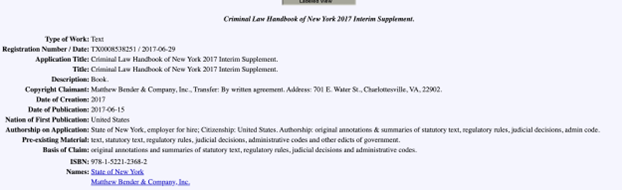
In the federal government's Copyright Registry, the "State of New York" is the registered author, and/or owner, and/or prior owner, of many copyrights, including this one:

screenshot of NYS copyright registry

In the registration shown above, the "State of New York" is listed as the author of the registered work as an "employer for hire"...meaning that the State is not only positioned to author original works that qualify for protection, but can even assign those copyrights just like any other free-lancer.[3]

Of course, much of the text generated and maintained by the State of New York is intended for public use, and in some instances, the State has declared it to be "in the public domain".

For example, in 1973, the New York State Attorney General declared that all New York "codes, rules and regulations" are in the public domain and are not subject to copyright (which makes sense; how can a lawsuit be filed if quoting too much law was an infringement?). On the same opinion, however, the NY Attorney General stated that material included in an official compilation of the codes, rules and regulations--but not actually part of the text--is protected by copyright of the Secretary of State (this is what is shown in the registration above).

So, what insight does that give us? The State of New York (and any department thereof) can both own works protected by, and generate works subject to, copyright. Some state-authored materials, however, may be deemed to be in the public domain. There is no over-arching rule; it is content-specific. So, when using works generated or published by the state, caution is just as warranted as with any other author.[4]


Thank you for a great question!


[1] Your tax dollars at work!

[2] Here it is (for more info, visit https://www.transportation.gov/regulations/time-act)

               The Uniform Time Act of '66

               Created nine zones to restrict

               Local authorities who set their clocks

               At a sunshine whim, creating blocks

               To orderly travel and safe crossroads

               'Til somebody had to take control...

               Who are these chronoscient powers-that-be?

               The Time Lords at the USDOT

[3] If anyone wants to FOIL a copy of that work-for-hire contract, I would love to take a look at it. Maybe if we get an intern....

[4] The library community seems to be investigating this topic perpetually. And good news, helpful resources/guides have ongoing development. For example, the article “The state copyright conundrum” by Kyle K. Courtney (https://crln.acrl.org/index.php/crlnews/article/view/17438/19245) describes context around the uncertainty in government document copyright status as faced by librarians and archivists, and points to this resource made by a 2014 Harvard Library Office for Scholarly Communication, Copyright Fellow, Katie Zimmerman: “State Copyright Resource Center”, http://copyright.lib.harvard.edu/states/. Bonus points for the beautiful functionality of the interactive U.S. map, that leads to state-specific guidance on govdoc copyright considerations.


Paid sick leave for COVID quarantine

Submission Date

Question

The library (school district public library without a union or a bargaining agreement and less than 50 employees) offers paid sick leave for most employees. However, based on what we have learn we have paid people, without it coming off of their earned sick time, if they are told to quarantine because they have been exposed to the virus. Does the same hold true for someone who is out sick because they have the virus? 
 
I have looked at the Ask a Lawyer FAQs, the various federal and state sites and issues of the HR Specialist Employment newsletter and do not see a clear answer.

Answer

I can offer a simple answer, and a complicated answer. 

Here is the simple answer: 

Per the "COVID-19 Sick Leave Law"

  • The current requirement of a public employer is 14 days of PAID leave for quarantine/absence due to COVID-19.   

  • A private employer with under 10 employees must provide unpaid sick leave for the entire period of quarantine, during which time the employee can apply for Paid Family Leave benefits ("PFLA").  

  • A private employer with between 11 and 99 employees, or with fewer employees, but at least $1 million in annual revenue, must provide 5 days of paid sick leave, after which the employee can apply for PFLA for whatever time they need to be out. 

  • For employers with more than 100 employees, the employer must give 14 days. 

In all instances, the time out for COVID must not count against other accrued sick leave. 

And that's it. 


The complicated answer 

As you can see, the obligations under the Covid-19 Paid Sick Leave Law depend on the type and (if private) the size of the employer. 

So, is your library a "public employer?"   

The definition of "public employer" in this law is broader than in many other labor-related laws, so unless your library's HR and employment arrangements are 100% separate from those of the local municipality or sponsoring district, it is wise to consider this applicable (or get it in writing from your lawyer that it isn't). 

Since the library that submitted the question is offering paid sick leave for "most" employees--which means there is a different approach for different employees--it sounds like they have decided the library is not subject to Labor Law 196-b (New York's new "Sick Leave Law"), which applies to only private employers.   

This issue is not an atypical one in New York's "Library land."  Does your library use comp time instead of overtime?  That is an option available only to government employers. Does your library use the federal rather than the state minimum wage?  Only a government employer can do that.  Does your library not have to follow the Wage Theft Prevention Act?  Employers are only exempt if they are a government employer. The list goes on and on.  

[NOTE: A nice exception to this dichotomy is worker's compensation for work-related injury.  EVERYONE has to pay into worker's comp; you could say it is something New York employers all have in common]. 

The bottom line on this "complicated" answer? Make sure your library has clarity about which employment-related laws it decides that apply to it before it implements a COVID-19 Paid Leave policy based on them. And when in doubt, have a lawyer examine the compensation and other aspects of your library's employment arrangements to make the decision that is most consistent with its other employment-related practices. 

Thanks for a great question. And if this "public/private" employer issue has you flummoxed, here is a short poem to help out: 


Library Labor Law Chanty 

What law governs at my library?

What labor laws must we abide?

What legal authorities preside?


Sorry, there's no simple rule

Be you association, town, or school

But here's a few comforting rhymes

To get you through confusing times:


An oath of office is required

When a public library director's hired

Civil service law protects employees

Except at association libraries


Must my library pay state minimum wage?

YES (unless only the FLSA is your gauge)

Do we have to pay overtime?

Not if you're municipal AND grant comp time.


The new sick leave law pays workers' rent

Unless your (sorta) government

And no matter who gets COVID-19

Employees ALL get paid during quarantine.


What if we offer NYS retirement?

Just that doesn't make you government.

But if HR's handled by your municipality

You might just be a public agency.


What if there's a union contract?

That can change everything, that's a fact.

And don't forget your HR handbook

Should be based on the "type" of path you took.


Yes, there IS legal variety

caused by the "types" of library

But despite inconsistencies

One thing's always true: director hired by trustees.


And regardless of type or identity

And despite any support or interdependency

No matter what your answers to the questions three

Your library has... autonomy.

Name of Employee Personnel Policy

Submission Date

Question

Should what we think of as the personnel policy be called Employee Handbook or Personnel Policy?

Sometime in the past, legal counsel advised a library system I was involved in, that the term "Employee Handbook" is correct. The document under now review at my library has what amounts to the rules of employment - typical sections about what the library provides, what we expect the employee to do etc. and does have a page acknowledging receipt of the document.

So what should it be called?

Thank you!

Answer

Ooh, an ontological question!

I am not sure about the basis of the past legal input mentioned in the question, differentiating a "policy" from a "handbook," but I (mostly) agree with it.

I (mostly) agree with it because, in both state and federal labor law, the term "policy" is generally used to refer to a stand-alone set of rules governing the terms of employment.[1]  Examples of policies required by law include:

  • Sexual Harassment Policy[2]
  • Prevention of Airborne Disease[3]
  • Whistleblower Policy[4]

In both common usage and in the law, when such policies are gathered together, they become a "Handbook."[5]  Many times, at the advice of lawyers,[6] employers then annually distribute a copy of this "Handbook," and (as in the member's question), require employees to acknowledge it.

The tricky thing is that once an employer has taken the step to pull the policies and create a "handbook" (again, with the name not being important...the important part being that there is some collection of policies, distributed to employees), the law may put additional obligations on the employer regarding the content.

For instance, Labor Law Section 203-e (6), which bars discrimination on the basis of an employee or their family member using reproductive services, states: " An employer that provides an employee handbook to its employees must include in the handbook notice of employee rights and remedies under this section" [emphasis added].  In other words: if the company has no handbook, there is no mandatory inclusion of the notice...but if there IS a "handbook," the notice must be part of it.

The term "handbook," used to mean a collection of employee policies, is also part of the recently passed HERO Act.[7]  It takes the same approach as Labor Law 203-e: if a handbook is handed out to employees, the required Airborne Infectious Disease Plan must be distributed with it (or at least, in the same manner as it is distributed).

Now, for the member's precise scenario: What about when a document that really is just one "personnel policy," but has different sections/rules and a section for the employee to acknowledge receipt?

Based on how the various employment laws in New York use "policy" and "handbook," I feel very comfortable saying that any document that aggregates an employer's rules on more than one topic (say, "progressive discipline," "appropriate attire" and "vacation") and is distributed to employees is--no matter what you call it--a "handbook." 

Or as I have put in this illustrative limerick:

One rule to another said: "Look,

Here's something that has me quite shook

We rules stand alone

In a "policy zone"

But together, we are a handbook!"

Thank you for a chance to do this research and to write this dubious verse about it.


[1] Of course, "policy" is also used in other ways in the employment context.  A big example: it is often used in the NY Civil Service Law, which frequently refers to the development of "policy" (meaning governmental positions).  Second, it is used in the context of different types of insurance required of employers (a workers' compensation insurance policy, a paid family leave act policy, a disability insurance policy...etc.). 

Huh.  I have never thought about it before now, but we should really develop some more refined terms for different "policies."

[2] New York Labor Law 201-g

[3] New York Labor Law 218-b, aka the "HERO Act" (for more on that, see Footnote #7.)

[4] New York Not-for-Profit Corporation Law Section 715-b requires this of every not-for-profit that has "twenty or more employees and in the prior fiscal year had annual revenue in excess of one million dollars." 

[5] Or an "Employee Manual" or a "Company Manual" or whatever the employer wants to call it.

[6] The legal bases for why this acknowledgement is advised will vary based on the Handbook/Manual's contents and the employer's industry.

[7] For more on the HERO Act, see "Ask the Lawyer" RAQ here: NY Hero Act and libraries.

Creating a poetry anthology

Submission Date

Question

Is it permissible to create an anthology of 20-30 poems, all by British poets, to be distributed to an entire grade level of students to be used for annotation and instruction? [It’s been suggested] that "since they're all available on the internet" they should be able to printed, collected, bound, and sold to students. A few things that I am unclear on are:
1. Does it make a difference that they are British poets whose work is in the public domain (as I understand, 70 years after death of author)
2. Does it make a difference that the collections are intended to be SOLD to students?
3. If they are, in fact, available through sites such as Project Gutenberg and 
https://www.whitemarketpodcast.co.uk/blog/2015/10/08/public-domain-poems-for-national-poetry-day/ are they okay to copy, bind, and sell?

Answer

I wandered lonely as a cloud…wondering “is there a way to create our own custom array of poems by Wordsworth, Keats, and Burns?”

The answer is: Yes.  If a poem was published before 1923[1], or meets certain other criteria, it is in the public domain.  Being in the “public domain” means it is free from copyright protection, and that any would-be publisher may generate, duplicate, and sell their own version of it—with or without  new illustrations, new original commentary, and other non-infringing works.

When taking on such a project, the critical factor for worry-free re-use is publication before 1923.  For such poems, status in the public domain is assured.

For poems published after 1923, the analysis is a bit trickier.  There is no hard-and-fast rule; the place of publication, the manner of claiming copyright protection, and the life of the author are all relevant.  Cornell maintains an excellent chart that breaks down the factors to consider when assessing if a work is in the public domain.[2]

Public domain status, or permission from the copyright owner, is something a would-be publisher should verify on their own.  It should not be assumed, even if the poem is free for download on the internet.  Even Project Gutenberg puts terms and restrictions on its content (see the Project Gutenberg License), and does not guarantee that a work is in the public domain (check out PG’s statement on this issue).

Once a would-be publisher has a method for confirming that the poems are in the public domain, it does not matter how many poems they use.  When working with public domain material, there is no limit on how many works can be assembled, duplicated, and distributed. 

That said, there are a few serious caveats. 

First, a publisher must truly verify that each and every poem was published (not written, but published) before 1923, or that any post-1923 publication meets the factors on the chart. 

Second, a publisher must make sure they are not infringing someone else’s updated version of a public domain poem.  All of Chaucer’s works may be in the public domain, but a new translation, or a copy with new cartoon illustrations, is not.  To avoid any charge of copying, it would be best to re-type the poems.  Do not copy a recently annotated version.  Do not scan a newly illustrated version.  Do not simply cut-and-paste.  For the final compilation[3] to be owned and then sold by the new publisher, the typing should be done by an employee, as part of their work.

Third (but very important!), if preparing copies of public domain materials for sale, take care that trademarks are not a part of the newly compiled content.  As an example…a publisher can re-print a pre-1923 poem about Coca-Cola, but can’t use the Coca-Cola logo to sell the copies (unless its for commentary/criticism, but that’s a fair use question…).  Make sure the school has the rights to any images that are used.

Overall: The member’s question models the sense of caution when using previously published material.  But with the above caveats in mind, a new publisher can relax, share some poetry, and say:

For oft, when on my couch I lie

In vacant or in pensive mood,

Poems flash upon that inward eye

Which is the bliss of solitude;

And then my heart with pleasure fills,

Thinking I will have no legal bills.


[1]When "Ask the Lawyer" started in 2016, the author was not thinking about how, just a few years later, the "Public Domain" date would change.  To preserve this shameful lack of foresight, but also ensure accurate information, as part of the "2021 ATL Audit" we are adding this footnote:  Please substitute "1923" with [whatever year it is minus 95].   For instance, if it is 2021, the year should be 1926. When in doubt, visit the excellent chart at https://copyright.cornell.edu/publicdomain.

[2] While rare, some copyright owners simply announce that their work is free to use, or free to use with very limited restrictions.  Such an announcement should be verified and documented before being relied on.

[3] If the end product is simply a gathering of public domain material, it might not have sufficient originality to be subject to copyright.  But if new illustrations or instructional materials are included, it might.