
Unions

What every school librarian’s union rep should know

Submission Date

Question

I am a school librarian represented by the teachers’ union. What should my union leaders know to advocate for me?

Answer

It is hard to be a union rep. Teachers and other educators have a wide variety of regulations they must abide by. What is important to remember is that within those parameters, school libraries have even more requirements and limits.

Here are the important things for an attorney or union rep negotiating or advocating for a school librarian to know:

Public school libraries are required by law.[1]

Public school librarians (or “media specialists”) are required by law.[2]

Public school librarians must meet specific regulatory criteria.[3]

Public school library materials are NOT curricular materials.[4]

Librarianship is constantly evolving! School librarians should be provided with adequate annual professional development training.

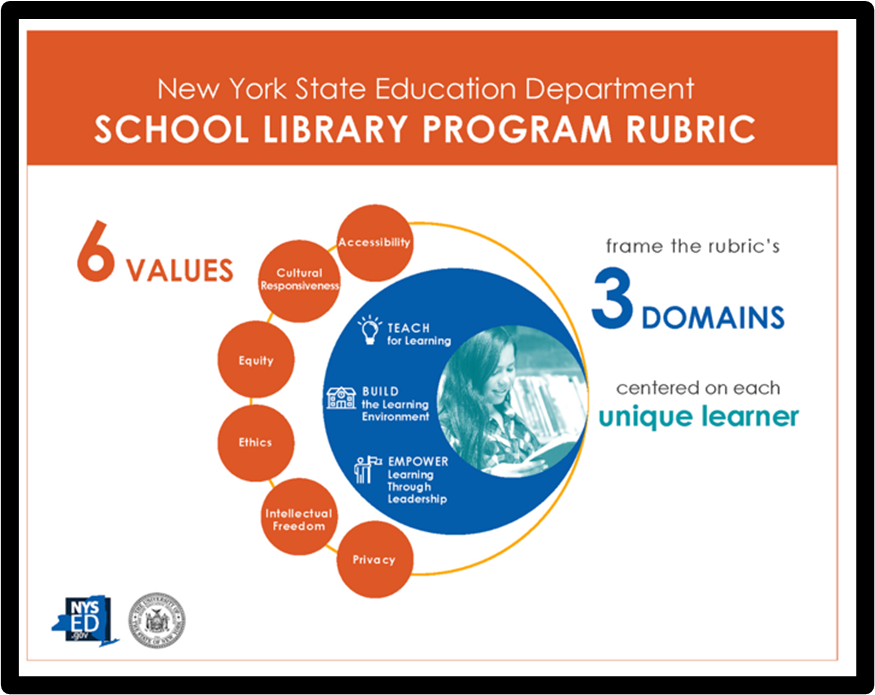
Public school librarians have an obligation to uphold the values in the New York State Education Department “School Library Program Rubric” below.

Screenshot of the NYS Education Department School Library Program Rubric. It shows 6 values: Accessibility, Cultural responsiveness,  Equity, Ethics, Intellectual Freedom, Privacy, that frame the rubric's 3 domains, which are teach for learning, build the learning environment, and empower learning through leadership. This is centered on each unique learner.

"Intellectual freedom” includes the right of students to have access to school library materials and services.

A student’s library records are confidential under FERPA as well as under state law.[5]

If a district uses student device-monitoring software, the software must be able to omit consideration of library materials from its monitoring.

A librarian is ethically obligated to maintain the confidentiality of a student’s library records.

Every school district should have a robust and well-thought-out “school library materials policy” governing selection, procurement, cataloging, lending, concerns, re-evaluation, and removal of library materials.[6] 

A district’s policies and procedures should honor the legal obligations, professionalism, and qualifications of your school librarians and media specialists. 

A school librarian with ethical and legal compliance concerns should have, if at all possible, access to their school district’s lawyer, so they can confidentially share those concerns and work to resolve them.

Ad hoc decisions about curricular and library materials imposed without consulting policy can lead to legal claims, creating unnecessary media attention, community tension, and expense for school districts. For a good primer on this, review the NYSED Commissioner Decision 18,402.[7]

School librarians must not be required to work under these conditions:

  • Library staff are directed to keep “controversial” books in the collection but move them off the shelves and into a storeroom;
  • Books in the collection are stigmatized by making them available “by request only;”
  • Parents and guardians with concerns are told that library material will be removed and are not referred to the relevant policy for lodging a complaint or requesting that material be re-evaluated;
  • Staff are instructed that certain books may only be checked out after obtaining parent/guardian consent;
  • Lists of books checked out by students are shared in excess of what professional ethics, FERPA and CPLR 4509 (regarding privacy) allow;
  • Staff are directed to avoid selecting a certain “type” of material, even if that material is otherwise appropriate per the district's materials policy; or
  • Library collection content is prohibited based on political or identity-based factors.

It is good for the district, its employees, and their union to build an administrative and educational team that is READY to respond to concerns about library materials.

Librarians should be assured of protection from retaliation for performing their jobs as required by law and policy and should be supported by their union through any grievance or disciplinary proceeding based on same.

Just a short list!

Compelling reasons to use an automated payroll system

Submission Date

Question

I work at a library with a diverse range of employee types, including part-time, full-time, union, and non-union staff. Unfortunately, time tracking methods vary widely, with most employees using paper timesheets. There are also inconsistencies in how comp time, overtime, flexible schedules, and double time are applied, even for those not in the union.

What is the best approach to standardize and streamline scheduling, timekeeping, and compensation management for greater efficiency?

Thank you for your guidance.

Answer

The best approach to standardize and streamline scheduling, timekeeping, benefits, and compensation management is to use a single automated payroll system that enables tracking of all accruals and leave time offered by your library.

Although this sounds obvious,[1] at institutions with multiple unions, different “types” of employees, and without centralized HR to coordinate things, transitioning to such a system can be quite complex, causing some libraries to delay implementation.

Facing that complexity head-on and transitioning to a single automated payroll system is worth it. Aside from the simple fact that it is only fair for an employer to record everyone’s hours consistently, there are significant compliance risks for imprecise or irregular payroll practices, including:

  • Failure to retain payroll records (penalty: a fine of not less than five nor more than ten thousand dollars in addition to any other penalties otherwise provided by law);[2]
  • Failure to accurately confirm compensation terms (penalty: damages of up to $250 dollars per day, per employee, unless employees are paid all wages required by law);[3]
  • Failure to pay wages earned due to error or intentional under-payment, a.k.a. “wage theft” (penalty: the sum of five hundred dollars for each such failure);[4]
  • Failure to abide by collective bargaining terms (penalty for breach of contract: compensatory damages and legal fees);[5]
  • Failure to properly withhold state and federal income taxes (penalty: federal Class E felony, up to 5 years in prison[6] and a state penalty equal to the sum of the total amount of the tax evaded, or not collected, or not
    accounted for and paid over, and the interest that has accrued on
    the total amount of tax evaded on the date this penalty is first imposed
    until this penalty is paid with interest thereon.);[7]
  • Failure to properly track accrued paid sick leave based on hours or days worked (penalty: may be subject to civil/administrative actions and/or criminal penalties, including but not limited to, an order assessing the full amount of the wage underpayment, 100% liquidated damages, and civil penalties in an amount up to double the total amount to be due);[8]
  • Failure to pay overtime and/or properly track “comp time”;[9]
  • Failure to properly track hours worked for purposes of New York State Retirement contributions (penalty: embarrassment as the NYS Comptroller conducts a review and correction);[10]
  • Failure to accurately report hours works to the NYS Unemployment Insurance Program (penalty: many);[11]
  • Failure to accurately report hours worked to a workers’ compensation insurance carrier (penalty: if intentional, a Class E felony);[12]
  • Failure to accurately report hours worked to a disability insurance carrier (penalty: many);[13]
  • Failure to accurately report hours worked to Paid Family Medical Leave insurance carrier (penalty: same as for disability—see footnote 13); and
  • Failure to properly document hours worked in relation to 401k or 403b retirement benefits (if this leads to a “knowing misrepresentation” the penalty is a fine and/or up to five years imprisonment).[14]

Of course, not all these risks apply to all employer types. If a workplace doesn’t have a union, it doesn’t have the risk of a union grievance. If a workplace isn’t subject to the paid sick leave law, it can’t be fined for not following it. But every employer has an obligation to retain accurate payroll records and pay people for the time they have worked (whether they are salaried or hourly), and most employers have to follow at least half of the items listed above.[15]

The good news is that many of the responsibilities leading to penalties (like payroll recordkeeping) can be contracted out. And that is why employers use a professional payroll service and a standard system for timekeeping.

Setting up a contract with a payroll company is relatively simple, but getting employees to use the same system—especially if the switch involves new procedures—can be a struggle.

In particular, a transition to a new system can be difficult for salaried employees who don’t get paid by the hour but are expected to work a basic work week (usually set by policy). For such employees, “clocking in” can be antithetical to being a salaried professional, executive, or administrative employee; the whole point is you don’t have to punch in.

But there are many reasons for ALL employees to “clock in” (whether it is by noting their start time on a physical spreadsheet, or on the company system, or a vendor’s system). Aside from the obvious reasons the employer might have (assessing productivity), employees of all types should track their start and end times so there is a clear record of when they are working. Among other things, knowing when an employee was working is important for workers’ compensation claims for workplace injury.

In addition, it is healthy for salaried supervisors to know the experience of hourly employees; this includes using the same system whenever possible for tracking accrued sick leave, vacation time, personal time, and other days out (bereavement and jury duty being two prime examples).

When an employer is shopping for a new payroll system, it is important to know the different ways employee time is tracked and ensure the system supports those breakdowns. This is particularly important for employers that have to track sick leave and prenatal care leave[16] or for those who offer New York State retirement pensions.[17] So, basically everyone.

Once a payroll system is selected, there should be clear policy and protocol for entering time. Although it requires planning and resources, training on the new system so people know how to use it is important.

Thank you for a great question.


[1]^ I can hear you now: “You need a law degree to tell me to use a payroll system? What, do I need a CPA to tell me to use Excel?”

[2]^ N.Y. Labor Law Section 195

[3]^ Wage Theft Prevention Act (WTPA), Labor Law Section 195

[4]^ Labor (LAB) CHAPTER 31, ARTICLE 6 § 197

[5]^ National Labor Relations Act, N.Y. Labor Law

[6]^ 26 U.S.C. § 7202

[7]^ Tax (TAX) CHAPTER 60, ARTICLE 22, PART 6, § 685 (g)

[9]^ “Comp time” can only be used by government entities. For more on that, see Salaried/Non-Exempt Employees and Compensatory Time.

[10]^ N.Y. Social Security and Retirement Law Section 111(c).

[11]^ N.Y. Labor Law, Article 18, Title 9.

[12]^ N.Y. Workers Compensation Law Section 114.

[13]^ For the wide variety of penalties, see N.Y. Workers Compensation Law Article 9 (yes, disability and paid family leave are part of the Workers Compensation Law).

[14]^ 18 U.S.C. 1027.

[15]^ In addition, if there are any labor law attorneys out there, you can send me a list of what I missed to adams@losapllc.com.

[16]^ Private employers.

[17]^ Public employers.

Union Business in the Library

Submission Date

Question

I understand that, as employers of a union shop, the library is required to allow the union a reasonable amount of time to conduct union business.[1] However, how much time is reasonable? Can employees meet with their shop stewards on the clock at the library for 5+ hours a week, taking both away from their duties? Is there a ballpark? Could we set a limit of 1-2 hours a week?
Thank you!


[1] At least as of April 11, 2023, things don't work quite this way.

Answer

The care required when addressing union-related issues in so critical, we're going to start with a small cautionary poem:

When employees seek to organize

A good employer must emphasize:

Contract, practice, policy...

If not there, don't intervene.

Why do I have to start this answer with a warning?

When it comes to employees communicating about their working conditions--whether they are in a union, talking about forming a union, or posting notices about union activity--if the activity is not governed by a contract or clearly established policy[1], there should be no effort to limit the activity.  Rather, the director and/or the board should consult the library's lawyer, and make sure you proceed with written advice from them.

This is the only way to safely proceed.

This extreme caution is necessary because: 1) if perceived as seeking to improperly limit communications, an employer can cause immense damage to employee relations in a short period of time; 2) both the National Labor Relations Board and the Public Employee Relations Board (who will handle any disputes, based on the "type" of library[2]), broadly recognize workers' right to organize and communicate regarding workplace conditions and union activity. 

As the member's question alludes to, there are protections in place an employer must honor.  For instance:

If there is an employee break room where pretty much anything can be discussed[3], workplace conditions and union organizing efforts can also be discussed;
If there is a bulletin board where general information can be posted, union-related materials can be posted there;
If employees are allowed to chat about pretty much anything they want as they perform work tasks, discussions of workplace conditions and organizing can't be barred.
These examples sound simple, but in real life, this issue is complex; a long line of cases going back to the 1940's[4] shows that there is an ever-changing balance between what a union and workers can and can't do on company property (and/or on company time).

This complexity is present even when union contract is in place. 

For instance, a union contract may provide something like this clause (taken from a contract posted on the PERB site):

Just as referenced in the member's question, this contract language allows for a "reasonable" use of on-the-clock time to post notices, distribute literature, transmit communications, and consult with representatives on contract issues.  This is a common clause in union contracts, and it is based on prior court decision stating that some access to employer resources may be required for union activity.

But as the member writes: "...how much time is reasonable?"

The only answer I can provide is: there is no right answer except to get a good answer about how to get the right answer.

Or, to add to our cautionary rhyme:

When employees seek to organize

A good employer must emphasize:

Contract, practice, policy...

If not there, don't intervene.

And if something needs more clarity

Ask your lawyer for strategy.

Many contracts, policies, or past practices will list (or have citable past examples of) what is a "reasonable" time for a meeting.  If, however, there is no clear information allowing the parties (the employer and the bargaining unit or employee) to discern what amount of time is "reasonable", the parties will need to discuss it.  For the library (the employer) this means calling in their lawyer to confirm:

 how to raise the issue
with that specific union,
under those precise circumstances, and
at that specific time.
This may sound overly paranoid[5], but sadly, it is not.  Here is 2023, the NLRB keeps back-flipping on precent, and the PERB doesn't have much out there on what "reasonable" means.  This leaves me without any solid precedent or definition to point to (and even in the most stable of times, the interpretation of "reasonable" is highly fact-specific).

Without clear shared understanding between the employer and the unit, a well-crafted legal strategy that considers the big picture is the only responsible[6] way to address union-related concerns, including ones related to union activity on company time. 

Because of this, a board or director who believes it is in the best interests of their library to raise such a concern should proceed only after securing attorney-client privileged legal advice based on a thorough analysis of the contract (or policy), past practice, and the present situation.[7]  The approach (which should be in writing) must be crafted so the outreach doesn't risk the appearance of undue pressure or restrictions on protected activity, and to ensure the parties reach (and document) an articulable understanding that both can rely on with confidence. Ideally, the way the issue should be raised in a way that will reinforce (or create) trusted pathways of communication with bargaining unit leadership. 

This technique will be different for different libraries.  Some will have to consider recent decisions from the NLRB[8], others will have to review decisions from the PERB[9].  Regardless of library "type", the precise contract, relevant policies, past practice, and overall climate and relationship will need to be considered. 

Once a strategy is in motion, if the lines of communication have been positive, the issue may be able to be resolved "at the speed of trust."  If the relationship is hostile or rocky, raising such a concern may result in other matters being brought up, with the worst-case scenario leading to filing a grievance or accusations of a labor law violation. All of this needs to be considered before the employer's position is communicated to the employee[10] or the union.

In fairness to the member who asked the question with the reasonable hope of getting an actual answer[11], I have to say that both the NLRB and the PERB are very fond of the word "reasonable"-- but provide very little guidance as to what the term means.  Looking at NLRB decisions and other authorities, "reasonable" seems to be whatever makes sense to the decision-maker at the time.[12] There just isn't a more reliable answer.

Because of this, what's important is that the employer and the union have clarity about what they jointly agree is "reasonable" and that they use good communication to maintain that understanding over time.

Or to add a final couplet to our poem:

When employees seek to organize

A good employer must emphasize:

Contract, practice, policy...

If not there, don't intervene.

And if something needs more clarity,

Ask your lawyer for strategy.

But most critical to good relations

Are trust and careful communications.


May your union-employer relations be smoother than my rhymes!

 
[1] Note that I say "activity", not "communication."  More on this soon.

[2] The PERB will handle libraries that are "public employers", the NLRB will handle the rest.

[3] Except things that are harassing, discriminatory, threatening, etc...

[4] Starting with this case here: https://www.law.cornell.edu/supremecourt/text/324/793

[5] I usually sound so hopeful and encouraging in these columns!

[6] By "responsible", I mean: "less likely to cause a grievance, more likely to foster good relations, less likely to cause needless resentment and panic, more likely to cost less legal fees in the long run." 

[7] This is not the time to call the lawyer you know to get a quick informal opinion.

[8] Found at https://www.nlrb.gov/cases-decisions/decisions

[9] Found at https://perb.ny.gov/nys-perb-board-decisions/

[10] If it is a union matter, don't raise it with the employee, if the contract calls for something else.

[11] Which they clearly haven't gotten, but truly, this is the most responsible way to reply.

[12] Okay, it's not that bad, but still, the flip-flipping out there in Labor Law jurisprudence is de-stabilizing the legal playing field.  If you know an attorney who regularly negotiates union contracts, say "Hey, how about that Caesar's decision?" and you'll likely get a tense smile.  https://www.nlrb.gov/case/28-CA-060841
 

Collaborating with volunteer organizations to provide services

Submission Date

Question

If a nonprofit organization is unionized, may they have volunteers as part of a collaborative effort with another organization for a service that is not currently provided? For example, could they collaborate with a volunteer organization for an outreach service that is not currently provided?

Answer

This is a very good question, since the use of volunteers to supplement or replace work typically performed by union employees can most definitely be a violation of a collective bargaining agreement.

In one case[1] from 1981, a school district on an "austerity budget" used volunteers to set up (and then clean up) district facilities for student sports--a task typically performed by custodial workers under a collective bargaining agreement ("CBA").  An arbitrator found that the district's use of volunteers to perform the unionized workers' tasks violated the CBA, and the workers were owed pay for the work they should have had the opportunity to perform.[2]

That said, schools, libraries and not-for-profits with unions routinely use volunteers for all sorts of things; clearly, not all use of volunteers risks violation of a CBA.  So, my plain answer to this question is: "yes, if the library is careful."

The rest of this reply sets out what I mean by "careful."

First, any not-for-profit has to exercise caution when using volunteers, because (as the member's question points out) there can be concerns that some use of volunteers violates the labor law.

The NY Department of Labor has really good basic guidance on this at https://dol.ny.gov/system/files/documents/2021/03/p726.pdf

In relevant part, that guidance says:

Unpaid volunteers [at an NFP] may not:

• Replace or augment paid staff to do the work of paid staff

• Do anything but tasks traditionally reserved for volunteers

• Be required to work certain hours

• Be required to perform duties involuntarily

• Be under any contract to hire by any other person or business express or implied

• Be paid for their services (except reimbursement for expenses) 

Considering this guidance, when I work with libraries and other not-for-profit organizations who are considering using volunteers (no matter what the work for the volunteers will be, and whether or not there is a union), I advise that the organization have a volunteer policy

The volunteer policy should cover all the concerns raised in the bullets above, as well as address risk factors such as placement letters confirming the terms of volunteer service, safety, insurance, and when a library using volunteers will conduct background checks.

Second, when I work with libraries and other not-for-profit organizations who are considering using volunteers, who also have one or more unions representing their employees, I stress the need to work with the union(s) pro-actively to confirm that an activity performed under the volunteer policy is not regarded as replacing paid/union workers.

There are a number of ways to achieve this confirmation.

The most formal way would be accomplished through a broad exclusion clause in the union contract(s) so every program does not present an ad-hoc task (but that could be a hard thing to fight for at a negotiation).  A sample clause for that could be:

It is understood between the Parties that volunteer service performed per the Library's "Volunteer Policy" to enable events and programs that are not part of the Library's Plan of Service are not regarded as replacing or supplementing union members. 

However, if such a clause is not a part of the standing collective bargaining agreement, a simple exchange of emails, or a more formal signed memorandum addressing only one type of volunteer activity, can be used to confirm this understanding.

The goal in all cases is to have clarity about what service is being performed by the volunteers, and to be able to show an affirmative agreement that it is not negatively impacting the experience of the workers in the union (which risks assertions of breaching the contract).  Since the perception of "negative impact" (and breach) can vary from place to place, this is not an understanding to pursue after-the-fact nor without a solid understanding of the legalities and subtleties of the situation.[3]

Third, even if a union is amendable to it, I would caution a library against using volunteers for any service that is part of a library's Plan of Service, since that can undercut the data needed to support adequate state/local funding.  Volunteers can be invaluable assets, but a library should always be able to function as required by law without them.

Fourth, if all the other cautions and no-no's listed above check out, it is vital to have a very clear agreement with the collaborating organization outlining the nature of the service, and each parties' roles and responsibilities for it.  This ensures the risks and liabilities posed by offering any program to the public are properly balanced, and the library isn't taking risks for the actions of volunteers provided by another organization.  I know it sounds impolite, but when it comes to volunteer services from a third-party, a not-for-profit must look a gift horse in the mouth.[4]

In many ways, it's a new world out there.  For libraries seeking to innovate and work with other organizations to co-produce new programs, the above-listed cautions can set the stage for using volunteers without worrying about violating a union contract.

Thank you for a good question.


[1] (Onteora Cent. Sch. Dist. v Onteora Non-Teaching Empls. Asso., 79 AD2d 415 [3d Dept 1981])

[2] After the original decision cited in footnote 1, this case takes a lot of twists and turns through different rulings involving the education law and the authority of arbitrators.  But the takeaway for purposes of this answer is: "Yes, use of volunteers can violate a CBA."

[3] For this reason, whenever possible, an attorney who knows the volunteer policy, knows the details about the service to be performed, and knows the union contract, should be consulted in advance.

[4] Of course, libraries and other organizations can host volunteer services (have them on site, but not co-sponsor them) provided by other organizations (such as Literacy Volunteers) without having to worry about these issues quite as deeply.  "Hosting," rather than "collaborating" is a way to work with other organizations (and their volunteers) while not exposing a library to an assertion of violating the labor law, a CBA, or incurring unnecessary liability.