
Public Libraries

Does NYS plastic bag ban apply to libraries?

Submission Date

Question

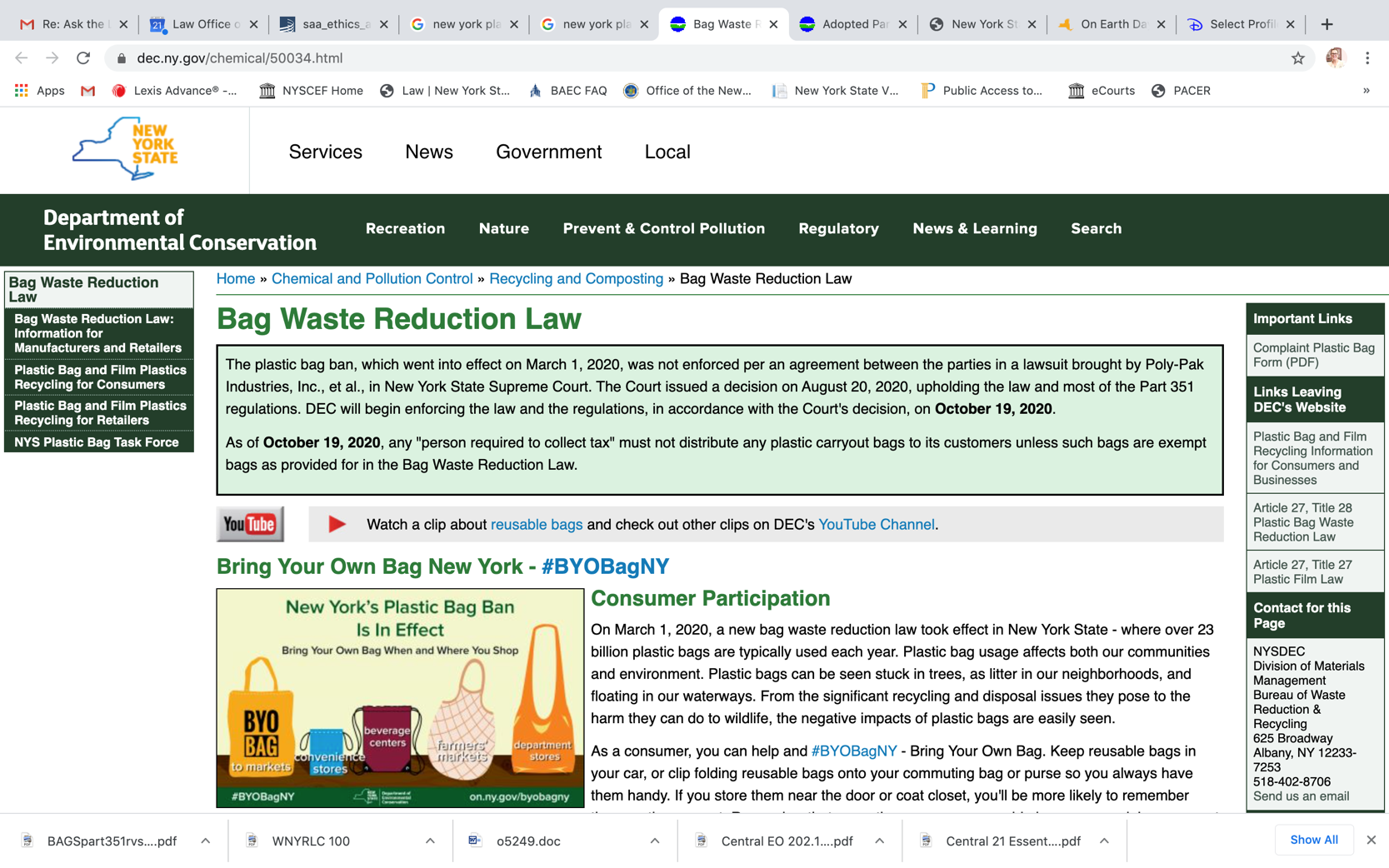
[NOTE: This question relates 6 NYCRR Part 351, which implements the requirements of Titles 27 and 28 of Article 27 of the Environmental Conservation Law, aka "the plastic bag ban" which went into effect March 1, 2020, but was suspended for a variety of reasons until October 19, 2020.  For more information on that, see the graphic at the bottom of this answer.[1]]

Does the NYS plastic ban law apply to libraries using plastic bags for curbside pickup?

We purchased plastic bags to hold library items that patrons request, label the outside with their name and leave the bags on pick up carts in the foyer of the building. This is for patron privacy-others cannot see what a patron has requested. As well as a COVID-19 measure-others are not touching items for pick up to search for their materials.

We are tax-exempt and not selling anything. When our supply is exhausted I will explore other possibilities in order to support less plastic waste, even if the ban does not apply to us. But in the meantime, are we in violation of the plastic bag ban if we continue to distribute materials in plastic bags?


[1] Found on October 21, 2020 at https://www.dec.ny.gov/chemical/50034.html

Answer

The answer for this member is: NO.

Why?

The NYS plastic bag ban does NOT apply to libraries using plastic bags for storage of items pending curbside pick-up, unless the libraries are required to collect sales tax.

So while this member's library can choose to phase out plastic bags[2], since it is not required to collect sales tax ("we're not selling anything"), it is not compelled to do so.

Here is what the new regulations prohibit:

351-2.1 Prohibitions. A person required to collect tax shall not:

(a) distribute any plastic carryout bag to its customers unless the bag is an exempt bag;

...   [emphasis added]

"A person required to collect tax" (as if the term really needs clarification!) is defined as:

(l) ‘Person required to collect tax’ means any vendor of tangible personal property required to collect New York State sales tax pursuant to subdivision (a) of Section 1105 of the New York State Tax Law, “Imposition of sales tax.”

The trick is that the application of the law is not based on the taxability of the sale, but rather, the status of the bag distributor as a "person" required to collect tax. 

This is further borne out by commentary from the NY Department of Environmental Conservation, which states[3]:

As of March 1, 2020, all plastic carryout bags (other than an exempt bag) became banned from distribution by anyone required to collect New York State sales tax. For sales that are tax exempt, plastic carry out bags are still not allowed to be distributed by anyone required to collect New York State sales tax (unless it is an exempt bag). [emphasis added]

So, while the vendors at your library's annual craft fair (if you're able to have a craft fair, sigh), who have to collect sales tax, can no longer use plastic bags, a non-sales tax-collecting library's curbside delivery service can.

Extra credit:

At "Ask the Lawyer," we are not used to being the bearers of good news.  So just to be sure—I mean really, really sure—that we could give the above answer, I also checked the " REVISED REGULATORY FLEXIBILITY ANALYSIS FOR SMALL BUSINESSES AND LOCAL GOVERNMENTS" found on the NY Department of Environmental Conservation's web page at https://www.dec.ny.gov/docs/materials_minerals_pdf/part351rfafinal.pdf.

The "ANALYSIS" is one of the documents that drills a little more into the law, and how it will impact those it covers.  It states:

In 2019, a new Title 28, “Bag Waste Reduction” was added to Article 27 of the ECL. This law bans the distribution of plastic carryout bags to customers, effective March 1, 2020, by any person required to collect tax. (“Person required to collect tax” means any vendor of tangible personal property subject to the tax imposed by New York State Tax Law section 1105(a), “Imposition of sales tax.”)

So, really: unless your library is collecting sales tax (for sales of food, or sales of items like t-shirts, office supplies, or other retail[4]), these new requirements do not apply.  But if your institution is registered to collect sales tax (for anything): beware, and "ban the bag."


Thank you for a great and timely question.

Plastic Bag Ban infographic


[2] Which, as the member states, they intend to do.

[3] On https://www.dec.ny.gov/chemical/50034.html, as of 10/21/2020.

[4] Yes, not-for-profit and education corporations that sell retail items have to collect sales tax (they don't have to pay it, but they have to collect it). For more info on that, see https://www.tax.ny.gov/pdf/publications/sales/pub750.pdf.

Can a public library set up a separate LLC?

Submission Date

Question

A public library is looking at the possibility of taking over the running of a medical loan closet that has been previously run by a church.

The library would find a space through a partner, so it would not be on library property.

The library would be responsible for cataloging the items, tracking their circulation, and applying for grants to help with funding.

The local visiting nurses have volunteered to handle the distribution of equipment, and are willing to continue if the library takes it over from the church.

The library's director and trustees are concerned about insuring the library to protect it in the event that someone gets hurt using a piece of equipment and there is the possibility of a lawsuit. They talked to their insurance agent and the company they use would not cover this.

A discussion came up about starting a separate LLC for the medical loan closet that the library would be openly affiliated with.

Would it be possible for a public library to set up a separate LLC to do this?

Answer

Before I answer, let's talk about why a person or business might create an LLC ("limited liability company").

A primary function of an “LLC”[1] is to do exactly what the member has proposed—to create a separate entity designed to hold the liability associated with a particular venture.

Examples of how an LLC can be used to take on liability (and keep it from flowing to its owner/s) include: ownership of rental properties, operation of restaurants, and yes, collaborative formation of charitable initiatives, like a medical closet operated in affiliation with a library.[2]

This is because, when set up properly, an LLC allows its "members"[3] to have an ownership stake in the company, while minimizing the risk of liability associated with the LLC adhering to other parties (like the members).

For this reason, a lot of property owners and participants in risky ventures[4] use an LLC to contain the liability that could result from the risks of the venture.  This helps with insurance, critical decision-making, and keeping unrelated assets separate from the liabilities of a venture.

Aside from this primary “separation of risk” function, the LLC model also allows creative arrangements for financial operations and tax considerations.  Among many other things that relate to ownership of family businesses, and complex corporate structures, this includes allowing one or multiple 501(c)(3)[5] not-for-profit charitable entities to form an LLC that will have a similar tax status. 

So the "short answer"[6] to the member's question is: YES.

That said, I do have a "long answer" composed of several considerations and caveats, which I hope will be helpful.

Consideration 1: Audit.

While the laws governing public libraries[7] do not forbid--and arguably expressly allow--an education corporation like a public library to own, or partially own, the asset of an LLC[8], a review of various New York State Comptroller audits[9] shows that any assets flowing between the two entities will be considered subject to all the requirements that must be followed by the library.

In other words, if the State Comptroller conducts a fiscal audit of the library (as State Comptrollers are randomly wont to do), the Comptroller will not only look at the books of the library, but also the books of the LLC—subjecting them to the same scrutiny as the library. 

So, to the extent money and resources flow from the library to the LLC, the same constraints on procurement, investment, and other use of assets will be imposed on the LLC.  This could bar or limit the activities of the LLC, so should be a primary consideration when it is formed.

Consideration 2: Operations

By "operations," I mean: who is helping the LLC get the work done?

In the scenario submitted by the member, it is the library who will "be responsible for cataloging the items, tracking their circulation, and applying for grants to help with funding."  Meanwhile "local visiting nurses have volunteered to handle the distribution of equipment."  And finally, as described by the member, the storage/pick-up (the "Closet") will be off-site (not on library property).

This means that the LLC would rent/borrow the space for the Closet, volunteer nurses would work there helping to distribute equipment, and the library would use its personnel to track the lending and equipment.

And although the member doesn't specify, let's say the library doesn't use its own circulation system for this, but instead, buys or builds a custom system—maybe even something as simple as an Excel spreadsheet.[10]

So the library would supply the "time and talent" of its people on an ongoing basis to the LLC, perhaps tracking it as an in-kind support to the charitable venture,[11] and also separately purchase assets that would be solely owned and used by the LLC.

This "time and talent," is where "risk and liability" for the library—even with an LLC housing the operations—truly enter the picture.  Even with a separate entity designed to take the hit, when an entity supplies its own people to staff a venture, there is always some risk that the direct involvement of a third party can lead to an assertion of liability (when people sue, they often look for not only deep, but multiple pockets).

How do you solve that?  It takes two things:

Consideration 3: The Operating Agreement

By law, every LLC must have an "Operating Agreement" that specifies how the "members" run the company.  For small, simple LLC's, an "OA" can be a fairly short document.  For complex ventures with detailed financial goals and complex management structures, an OA can be hundreds of pages.

In the case of a "Medical Loan Closet" LLC meeting the criteria in the member's scenario, the operating agreement would have to address, head-on:

  • The precise responsibilities of each member[12]; and
  • The in-kind services being supplied by each member; and
  • The precise terms under which individuals would contribute their services, including volunteers; and
  • The precise way assets of the LLC are purchased, loaned, and de-accessioned (this is the part the Comptroller would look at); and
  • How the premises of the Closet is managed and insured; and
  • Most critically, the way the LLC would hold harmless and indemnify the participating parties for any assertion of liability against them based on LLC operations.

Which brings us back to...

Consideration 4:  Insurance

At the end of the day, this question is about two things: 1) how to do a good thing for a community; and 2) how to make sure the organizations doing that "good thing" properly manage the risks of doing it.

While much of this can be addressed via good planning, rigorous equipment maintenance,[13] and proper paperwork, as can be seen in "Consideration 3,” and as the member clearly knows, a venture that will be so closely connected to people's physical health must have some form of insurance. The coverage should extend to every person with either a fiduciary, employment, agency, or volunteer relationship with the Closet.

While precise coverage amounts should be determined by the participating parties, my instinct is that there should be at least $1 million of coverage per incident, with no less than $3 million/year aggregate.[14]  But it will depend on many factors.

So, what to do?

Many times, there is a very solid reason to start an LLC.  If the Closet described by the member was going to own real property, have its own employees, apply for grants, and in general, take care of most of its operations in-house, with the support—but not the direct service—of the members, I'd say that was the right solution for this scenario.

However, if the Closet is to be a collaborative effort that will rely on the direct services and assets of the member organization/s (in this case, services by library employees, on library time), in my experience[15], a tightly structured plan that properly establishes the responsibilities of the collaborating parties—and ensures there is proper insurance coverage for all involved—might be the most practical way to move forward. 

This will also position the library to do the right type and amount of "volunteer vetting" and to properly confirm the conditions of (and insurance coverage for) the volunteers.

So, on a practical level, what am I saying?  A library can spend thousands to set up a charitable LLC to run a Medical Loan Closet[16], and then about a thousand or so a year to ensure the proper administration of that LLC--or it can develop the Closet as a program of the library (either stand-alone, or in collaboration with others) and spend the money on additional risk management and insurance. 

After all, we're not talking small engine repair, here.  Lending things—even if it is health-related equipment—is part of any library's core mission.

At the end of the day, many factors will play into the decision to use 1) an LLC, 2) a collaboration agreement[17], or 3) to simply operate the Closet as a new program of the library (with some volunteer agreements for the nurses). 

To get to the part where the library can make the decision, I advise developing an "Operational Plan"[18] for the program, and getting quotes from several insurance carriers as to what the coverage would costs for your library and/or for a new entity to conduct the activities in the Operational Plan.

Since there will be a lot of detail to review, a small ad hoc committee[19] consisting of a board member or two, the library director, any other person whose input will be helpful, and the library's attorney, can then review this information, and come up with a solution to pitch to the board. 

And when that pitch is made, everyone should be confident that there is no "wrong" way to develop a new, life-saving lending initiative—so long as the way selected clearly defines everyone's responsibilities, establishes that clarity in writing, assures legal and fiscal compliance, and ensures everyone helping out is covered by insurance.  With the right attention to detail, this could be an LLC—or another solution.

I wish this venture luck and stout hearts for getting it over the finish line; it sounds like a great asset to any community!


[1] When I write about LLC's, I really struggle with putting "an" before an acronym that begins with a consonant ("LLC").  But the rules on "indefinite articles" assure me it is proper.

[2] There are some questions about the operation of a collaborative 501(c)(3) LLC in New York, but they happen, and haven't been shot down yet.

[3] "Members" is what the New York State Limited Liability Company Law calls owners.

[4] I don’t mean “risky” as in “Don’t drive that Pinto!” In in this context, “risky” applies to any venture that has a risk of exposure to legal claims due to having premises, employees, contractual obligations, or providing goods/services.  In that context, even my own law office (which is a type of LLC) is “risky.”

[5] "501(c)(3)" is a designation from the IRS that allows a library or other charitable organization to accept donations while the donor takes a deduction.

[6] Trust me, this WAS that short answer!  Another business lawyer who reads this will find it pretty skimpy.

[7] The Education Law, the Not-for-Profit Corporation law, the General Municipal Law, the Public Officer's Law.

[8] This is NOT to say that the local library could engage in a hostile takeover of the LLC-operated laundromat next door to ensure the very loud HVAC system is turned off during children's story hour.  A not-for-profit, and a public library, both have extensive rules regarding what assets and investments they can own, and how they can benefit from them.  But it could be done (in my hypothetical, it could be done if either: a portion of the laundromat income was a directed donation used to purchase special collections OR if use of the machines to clean clothes while reading or using library Wi-Fi was a free service to the community tied into the library's Plan of Service.  Which, by the way, would be AWESOME).

[9] When I want to relax, I just pop on over to the Comptroller's "library audits" page at https://www.osc.state.ny.us/local-government/audits/library, and have a jolly good read.

[10] My apologies if my assumption that such a project could be tracked via Excel is laughable.  While I can script out workflow and compliance protocols like a pro, my database programming skills stop with a 4-column chart in "Microsoft Word."

[11] Remember, the assets of both a not-for-profit and a public library come with heavy restrictions.  This includes the "asset" of the workforce.  In this scenario, we're assuming all the right paperwork for "lending" employees to a venture is properly in place...not something to assume lightly in the Real World.

[12] Operating a charitable LLC is fairly simple after the start-up phase, but there are routine tasks that must be kept up with: book-keeping, audit, routine IRS and Charities Bureau filings, compliant procurement, de-accession.  Consider who will be responsible for all these things.

[13] This consideration—about properly maintaining loaned health-related equipment—is addressed in the RAQ response to a question we got back in April 2020 about lending a Telehealth kit, which is found here: https://www.wnylrc.org/ask-the-lawyer/raqs/132.

[14] A great short cut on this would be to find some other medical loan closet programs in New York and ask who their carrier is.  Establish your credentials and tell them why you need the information first, though...places get VERY nervous when you ask who their insurance carrier is!

[15] At this point, I have worked on joint ventures for educational purposes, arts purposes, community gardens, the development of apps for civic transparency, community murals, and just about every feel-good thing you can think of.  I will never be rich, but I love my job.

[16] A word of caution: the phrase "Medical Loan Closet" is part of a name protected by a trademark, the "Wichita Medical Loan Closet" which can be seen here: https://tmsearch.uspto.gov/bin/gate.exe?f=tess&state=4802:iitou7.3.1. When developing a "closet" program here in New York, take care to distinguish your brand so there is no risk of getting a cease-and-desist.

[17] Remember, a “collaboration agreement” is different than an LLC’s “operating agreement.”  A “collaboration agreement” unites the efforts of two or more entities creating the venture, and manages risk WITHOUT creating an LLC. 

[18] The "operational plan" will evolve once you make the decision about the entity type, but to start it is just a description that sets out how the Closet will run.  If the idea is largely to use the same model used by the current operator, that is a fairly simple task, but make sure to include every role and responsibility, simply noting "TBD" is you don't yet have an answer.  An inventory of equipment will be an essential component of this exercise.

[19] Since I have hit you with a lot of detail that could be daunting, I will add this gratuitous advice: if possible, have a meal or fun snack at your planning meetings (even if they have to be via Zoom right now).  I have been working on a charitable planning committee, and by turning it into a convivial experience, we are getting through some fairly obscure stuff while staying in touch with basic human joy.
Children's Library Cards

Submission Date

Question

COVID has made online library card registration essential in many areas. What do we need to consider when dispensing online (temporary cards that allow access to e-resources) and physical library cards to children? At what age, and under what circumstances do we need to get a guardian's signature? Can we require some form of ID for children?

Answer

I remember getting my first library card at the Utica Public Library with my Dad, circa 1985.  It was a right of passage: something "official" before I could drive, or work, or vote; a stepping-stone to adult life.

Of course, back then, we didn't have the Child Online Privacy Protection Act, the SHIELD Act, or the GDPR.  We did have CPLR 4509[1], but if that was part of the application, I probably assumed it was what the library would use to revive me if I had a heart attack in the stacks.

But enough of Memory Lane: this question is rooted in 2020, a time of pandemic, of online ecosystems, and of growing awareness about personal privacy and data security.  During this time, a library putting in place direct access to services for children in the ways listed by the member is a critical service, and as the member points out, introduces a lot of legal factors to think about.

To answer the member's questions, let's dive into them.

Contracts and Kids

Since the relationship of a library to a patron is (among other things) contractual, and in New York a person (generally) cannot be held to a contract until they are 18[2], any terms a library wants to be able to enforce on a minor must require legal consent of a parent or guardian...and in some cases, the contract really is just with the parent or guardian (who I will call "P/G" for the sake of efficiency going forward).

This, by the way, doesn't mean a library can't let minors have a card and borrow books (or have online access, or be in the library) without the signature of a parent or guardian—it just means if you want to enforce any contractual terms against those minors (like the requirement to return borrowed books), it's best to have a P/G's consent along for the ride.


Contracts and the Internet

Most contracts—including those signed by P/Gs binding minors—can be entered into electronically,[3] and a contract signified by a library card is no exception.  So yes, a patron, including a child, can get a library card or access to services through an electronic signature. 

(Just in case you want the nation-wide definition, an "electronic signature" is "an electronic sound,[4] symbol, or process, attached to or logically associated with a contract or other record and executed or adopted by a person with the intent to sign the record."[5])


What about COPPA?

When a website specifically provides services to children, we often have to consider the Children's Online Privacy Protection Act, or "COPPA."  But not today, since COPPA expressly states that the law applies to "commercial" websites and online services and generally not to nonprofit entities like a library.[6]

Although nonprofit entities are generally not subject to COPPA, the FTC "encourages[7] such entities to post privacy policies online and to provide COPPA’s protections to their child visitors."  Since libraries are sticklers for privacy, this makes sense, but if your library does this when setting up online resources for minors, don't call it "compliance with COPPA," call it "doing it the right thing because we want to."[8]


Should we require a parent?

COPPA, by the way, is one of the laws that uses the age of thirteen as the cut-off age for children being able to sign up for things (commercial or otherwise) on their own.  In my experience, 13 is also the age when insurance carriers decide children transition from "vulnerable" to simply "minors."  For this reason, many content providers and services (including libraries) bar access without a parent to those under 13.

All of which is to say: while there might not be a legal requirement to involve a P/G, in general, I'd say this is a good practice.  Good—but not required.  Remember, to legally enforce any conditions[9] (collect fines), you need a P/G's signature, but if you just want to let a kid borrow a book without consequences enforceable in court, you don't.


Let's see some ID?

Okay: you're set with electronic signatures.  You know you need to get P/G into the mix for patrons under 18.  You're "Doing The Right Thing Because You Want To" when it comes to soliciting information from minors under 13.  Do you need to see identification to make things official?

That depends.

If the privileges the library card or access grants come with conditions you will need to enforce in a court of law (fines, damages), it is ALWAYS better to get some form of identification or proof of address.  I say this, because when lawyers sue, proper ID and proof of address is how they know they are suing the right person.

Similarly, if there is an age or residency requirement, or a financial element (for instance, loading money onto an account), or if a person is to have access to another's account, you might need to require ID. 

Because the need for it will vary, when to require ID is a good question for your local attorney.  From my perspective, if a person is allowed to take out more than $10,000.00 worth of library assets at a time, or a library wants to be able to collect fines, I'd want to know how to enforce a return of those items.  Similarly, if patrons are allowed to access services from third-party vendors through their library card (software programs, audio books, anything governed by a third-party license), and there are consequences for a violation, it is good to have solid information about who your patron really is.

The problem is, if you are going to require ID, you must have a solid policies and procedures that address:

  • Requiring ID in a manner that does not disproportionately impact those who live in poverty, or other categories of people[10]
  • Requesting ID
  • Evaluating ID
  • Securely retaining and routinely destroying hard copies of ID
  • Securely retaining and routinely purging electronic copies of ID
  • Have a plan for data breach impacting retained ID

Basically: the reason a library would require ID—aside from verifying that a person lives in the relevant area of service, or is who they say they are—is to collect damages or to legally enforce conditions the patron has agreed to as a condition of a card.  Since that is an unpleasant business, its best to avoid it whenever you can...but when it's important, it's important to do it right.

I enjoyed writing this answer, because as part of it, I got to poke around and see how different libraries are solving this issue.  I saw some great stuff, including a temporary e-access system that let the technology do all the work (requesting verification of age via click-thru, using location services to confirm location in NY, imposing conditions on digital content via function without the need for legal enforcement mechanisms).

It is good to see when the law inspires, rather than quashes, creativity and information access.  I hope your library and library system finds this helpful as you imagine new ways to connect people to vital services!


[1] Requiring libraries to not release an individual's library records to a third party.

[2] There ARE some exceptions, but unless your library is hiring a minor to act in their movie, or selling a married couple of 17-year-olds a house, they shouldn't apply here (see General Obligations Law § 3-101).

[3] (15 USCS § 7001) states: "a signature, contract, or other record relating to such transaction may not be denied legal effect, validity, or enforceability solely because it is in electronic form."

[4] This definition's use of "electronic sound" created a rabbit hole where I envisioned a series of "auditory" contract signature proceedings where a person uses their Spotify Playlist to accept contracts.

[5] 15 USCS § 7006

[6] Entities that otherwise would be exempt from coverage under Section 5 of the Fair Trade Commission Act, which most if not all libraries are.

[7] You can find this "encouragement" at https://www.ftc.gov/tips-advice/business-center/guidance/complying-coppa-frequently-asked-questions-0

[8] A great guide for "doing the right thing" is here: https://www.ftc.gov/tips-advice/business-center/guidance/complying-coppa-frequently-asked-questions-0#A.%20General%20Questions

[9] By "enforce conditions," I mean contractually, in a court of law.  A library can always ask a 12-year-old to pipe down, and enforce its Code of Conduct if they do not.  But to collect fees, get a P/G signature!

[10] This question is critical to a library's mission.  While there is no "right" answer, I can say that even facially neutral things such as asking for utility bills, pay stubs, or non-driver ID can alienate people within a library's area of service.  I advise maintaining a list of ID types that includes "the usual" types of ID (driver's license, ss card, birth certificate, non-driver ID), and some other types, as well (report card, lease, or any correspondence from a government agency (with private information redacted)).  The list maintained by NYPL, who clearly gets this issue, made me smile: https://www.nypl.org/help/library-card/terms-conditions.

Friends and Library Cooperation Agreement

Submission Date

Question

There are so many ways the relationship between a library and their Friends can get "complicated."

Can you provide a template for an agreement between a library and their Friends?

Answer

NOTE: As a primer to this answer, which mostly consists of the requested template, I suggest reviewing the materials in the ever-excellent "NYLA Handbook for Library Trustees,"[1] particularly the guidance and links on page 85.

"Ask the Lawyer" has addressed the issue of "Friends" relationships before.[2] This question presents a chance to address some common areas of concern pro-actively.

Of course, since an agreement is only as good as the lines of communication between the parties who are in it, aside from reviewing this template in advance of discussing it with your Friends, get ready to spend some time on this.  A good agreement is the product of a lot of discussion, back-and forth, and work for clarity—not the other way around.  And if you can, invite your lawyer to the table.

That said, a simple template can be a handy way to frame the discussion.  So with that, here it is:


TEMPLATE Cooperation Agreement

_____________ Library

and the

Friends of the ______________ Library


This agreement (the "Agreement") between the _________________ Library (the "Library") and the Friends of the  _____________ Library, Inc. (the "Friends") is intended to further the mission of the Library and the mission of the Friends by clarifying the mission-driven collaboration, shared commitments, and terms for collaboration between the two institutions ("Collaboration").

Mission-driven Collaboration

In all matters involving the Collaboration, the Library and the Friends shall be guided by their missions.

The mission of the Library is:

INSERT


The mission of the Friends is:

INSERT


In furtherance of their missions, the Parties set forth the below "Shared Commitments."

Shared Commitments of the Library and the Friends

Shared Commitment to Ethics

In all matters involving the Collaboration, the Library and the Friends shall be guided by the ethics of their institutions, including the American Library Code of Ethics, the Library Board's Code of Ethics, the oaths of office of the Library Board Members, and the Friends Board's Code of Ethics, and each parties' Conflict of Interest policy.

Shared Commitment to Legal Compliance and Transparency

As not-for-profit institutions governed by a variety of federal and state laws and regulations, the Parties operate under an array of legal obligations, and hereby commit to model compliance and all appropriate transparency in their stewardship of Library and Friend's resources.

Shared Commitment to the Success of the Library

The Parties agree that the very purpose of the creation of the Friends is the continued viability and growth of the Library, and all their Collaboration shall be to that end.


In furtherance of their shared commitments, the Parties set forth the below "Collaboration Terms."

Collaboration Terms

Use of Name

In consideration of the support enabled by this Agreement, the _________________ Library consents to the use of the Library's name in the name of the Friends.

Distinguishing the Entities

Although the Friends are allowed, by this Agreement, to incorporate the name of the Library into their name, each party agrees to exert extreme care to consistently distinguish one entity from the other, and to use their respective EIN's, proper corporate names, when relevant proper Charities Bureau number and corporate identification number, at all times to distinguish one from the other.   

This obligation shall be especially critical during any marketing, contracting, fund-raising, event-planning, and when either party communicates with the public or any oversight authority.

Inter-organizational Familiarity

To ensure mutual awareness of each other, the boards shall maintain a shared record of the current information for both parties, as it is available:

  • Charter (Library); Certificate of Incorporation (Friends)
  • Bylaws
  • Fiscal policies
  • Conflict of Interest policy
  • Current list of Board members and officers
  • Plan of Service (Library); Strategic Plan (Friends)
  • Social networking addresses
  • Meeting Schedule
  • Event Schedule

Board Participation

By no later than DATE, the Library and the Friends shall create and maintain a "Library-Friends Collaboration Committee," with at least three board members from each organization, for the coordination of any aspect of the Collaboration, and shall invite no less than three Library board members to serve on the committee in a voting capacity. The committee itself may also appoint three additional members, by majority vote, but the total membership shall not exceed nine. 

The Library-Friends Collaboration Committee shall have no authority to bind either the Friends or the Library.

Committee members shall serve one-year, renewable terms, which run from January to December (the Friend’s fiscal year).  The Committee shall be co-chaired by one appointee from each board, as named by the President of that board.

The stated purpose and authority of the committee shall be "To maintain a strong and routine collaboration between the Library and the Friends, to facilitate planning in furtherance of the mission of the Friends, and to ensure clarity in matters of fund-raising, fiscal goals, and specific donations."

The Library-Friends Collaboration Committee shall meet no less than quarterly, in furtherance of the commitments of this Agreement.

Annual Contribution Ratio

The Friends shall aspire to direct no less than INSERT% of their total annual income to the Library.  Any departure from this percentage shall be subject to a vote by both parties, based on the planned need to temporarily direct resources in another way, for the benefit of the library (for example, the Friends contracting with registered fund-raising counsel for a capital campaign).

Annual Planning Sheet

As part of the operations of "Library-Friends Collaboration Committee" the committee shall create for each fiscal year an "Annual Planning Sheet."  This sheet will list the special asks the library has (including but not limited to funding for acquisitions, equipment, programming, board discretionary funds, or a capital campaign), and will be used by the Committee and the Friends to determine fund-raising objectives for the year, and to pre-identify any departure from the annual contribution ratio.

Donations

The Friends will encourage donors to make "unrestricted" donations (donations without conditions).

If a restricted donation is accepted (for instance, a donation that requires a naming right, or a certain work of art be placed in the Library) the conditions of the donations must first be reviewed for consistency with the Library's controlling documents and strategic plan, and then accepted via a majority vote by the Library's board.

It is expected that at all times the Friends shall maintain appropriate records of donations and donor-restricted donations and shall issue, in a timely manner, letters of acknowledgement in furtherance of any tax credit the donor may qualify for.

Grants

The Friends may apply for grants from government and private entities for the benefit of the Library, but prior to applying for the grant, the conditions of the grant must first be reviewed for consistency with the Library's controlling documents and strategic plan, and then accepted via a majority vote by the Library's board.  This is to ensure that the time and resources used to apply for the grant are not wasted.

If the Friends apply for grants from government and private entities for the benefit of the Friends (for instance, to purchase donor management software, or to buy equipment the Friends will use for events), the Library does not need to be consulted.  However, the Friends and the Library will, through the Collaboration Committee, maintain awareness of grant applications, to ensure there are no redundant requests.

Annual Accounting

In MONTH of each year, the Treasurer of the Library, and the Treasurer of the Friends, shall meet to exchange financial reports, and to independently and/or jointly develop any observations or advice they as Treasurers may have for the Committee or their respective boards.

No Library Resources for Fund-Raising

It is understood between the Library and the Friends that no library employees shall staff a Friends' fund-raising event, and no Library resources whatsoever shall be used in furtherance of such event.[3]

Appropriate Boundaries

To avoid any concerns regarding authority and responsibility, no members of the Friends Board shall volunteer at the Library.

Dispute Resolution

To avoid any concerns to the detriment of the Friends or the Library, in the event either party believes the other has violated its mission, formation documents, charitable purpose, applicable laws and regulations, or this Agreement, the concerned party shall notify the other in writing.

If the dispute is not resolved within ten days, the parties shall agree to retain a New York Bar Association-listed mediator to resolve the dispute.  To select the mediator, the Library shall supply a list of 5 qualified candidates, and the Friends shall select the mediator from the list.  As part of their service as a neutral party, the Mediator shall certify that they may serve without a conflict of interest.

If one full-day session of mediation does not resolve the dispute, the concerned party may seek such other relief as appropriate.

Bi-annual Agreement Review and Amendment

This agreement shall continue for so long as the Friends continue activities for the benefit of the ______________ Library.

Every two years, the officers of the Friends and the Library, shall meet to review this Agreement, or refine their practices that are governed by it, as needed.

This Agreement may be amended through a two-thirds vote by both boards within the same two-month period.

Effective Date and Term

The Agreement is effective upon the date of incorporation of the Friends, and shall continue for so long as both parties are in existence.

With this understanding, on ________, the Board of the ___________________ Library passed a resolution to enter this Agreement effective as of _________________, and the Board of the Friends of the  _____________ Library, Inc. passed a resolution to enter this Agreement effective as of ____________, as signified by the signatures below.

[insert signatures, etc.]


[1] Found at: http://www.nysl.nysed.gov/libdev/trustees/handbook/handbook.pdf

[2] Specifically, here: RAQ #113

[3] This is to avoid any risk of library resources being used in furtherance of a private organization.

Template Facility Use Agreement

Submission Date

Question

Can you provide a template facility use agreement for renting or allowing community groups to regularly use space in a public or association library?

Answer

Yes, I can!  But first, a few caveats:

  • Any template contract is just a starting point.  Use a lawyer to generate a version of this document customized to your library. 
  • For any Organization that wants to use your library for a high-risk event (sports, concert with stage or sound equipment, large event open to the public, routine presence of children), whenever possible, additional review for insurance concerns and premises liability is wise.
  • When filling this out, always make sure the nature of the Organization is confirmed (individual, DBA, LLC, NFP, corporation, etc.), and you have confirmed they exist as stated. 
  • If the form shows that an activity requiring a professional license is going to happen (haircuts, massage, tax prep, legal clinic) obtain a copy of the insurance coverage for the professional activity and make sure it names your Library.
  • No political events should occur unless it is confirmed the arrangements conform to IRS and NYS Charities guidance.
  • A copy of the signed contract should be kept for 7 years (because the statute of limitations to sue on a contract is 6 years). 


ABC Library

FACILITY USE CONTRACT

This contract for facility use is between the ABC Library (the "Library") and INSERT NAME ("Organization") an [insert type organization/individual] ("Organization") with an address of [INSERT], for temporary use of [INSERT ROOM# or Description] in the Library (the "Space").

Details of Temporary Use


Date(s) and time(s) of use


NOTE:  If use is routine ("Every Monday in 2020") note the routine


Purpose of use (the "Event/s").  Please describe the activity to be conducted while you are using the Space.


Estimated maximum attendees


Will you bring in any contractors or third parties under contract for this event?


If so, you must provide the Library with a copy of the contract and they must name the Library on their certificate of insurance.


Please list any special details


Person from Organization who will oversee Organization's use of the Space (must be present at all times) and their back-up person


Name:

Cell number:

E-mail:


Name:

Cell number:

E-mail:


[If applicable]


Rental Fee on a per-use basis


NOTE:  If the use is charitable and the fee is to be waived, the use must not involve any political activity as defined by the IRS.


[If applicable]


Fee is payable to [INSERT] and shall be paid by:


Will minors unaccompanied by parents/guardians be attending the event at the Space?


If yes: does Organization have a policy barring abuse of minors, and requiring instances of abuse of minors in connection with Organization's programs to be reported to law enforcement within 24 hours?


Is Organization a chapter or affiliate of a larger organization?


If so, include larger organization's name.


Will the event involve food or the creation of materials to dispose of?


If yes, what time will clean-up, including removal of all trash and recycling generated by the event, be completed?


Organization's Library Contact (the person who will help them with any questions and address any concerns)


Name:

Email:

Cell:


Library Mission and Terms of Use


The ABC Library's mission is [INSERT].

As part of its mission, the Library requires that all people on Library property abide by all the Library's policies.  In addition, while using the Space, Organization and any person at the Space in affiliation with Organization must at all times follow the below rules, and any reasonable request of any Library representative.

Rules include:

No harassing, abusive, or demeaning activity directed at any person or the Space.

No contact that violates any applicable law or regulation.

In the event of an emergency at the Library, Organization shall abide not only by the reasonable request of any Library representative, but also any first responder assisting with the emergency.

In the event of any injury to any person, or incident of property damage while the Space is in use, Organization will immediately notify the Library Contact listed in the chart above immediately.  In the event of a crime or medical emergency, call 911.

Aside from those attending the event(s) in the Space sponsored by Organization, no filming or taking pictures of any individual in the library (visitor or employee) is allowed, without their express permission.

After use, the Space will be restored to the condition it was in prior to Organization's use, by the Organization, unless otherwise specifically confirmed with the Library Contact.

Organization will not promote the event using the Library/Space as the location until this contract is fully signed and (if applicable) Organization has paid the applicable Rental Fee.

Drafting note: if the Library does not own the building, add any other rules based on requirements in the lease.

Violation of any rules may result in the termination of this Contract with no refund, and denial of future use.

Emergency Cancellation

This Contract guarantees that Library will reserve the Space for Organization as set forth in the "Details" section, above. However, in the event the Library or a related entity experiences an emergency which, in the sole determination of the Library, requires the cancellation of the use (including but not limited to condition at the facility, weather emergency, or event requiring Library's emergency use of the space), Library shall notify Organization as soon as possible, and work with Organization to refund the fee or determine a new date, whichever is preferable.

Indemnification
To the greatest extent allowed by law, Organization hereby agrees to indemnify and defend and hold harmless the Library, its Board of Trustees, employees, agents, and volunteers, from any and all causes of action, complaints, violations, and penalties, and shall pay the cost of defending same, as well as any related fines, penalties, and fees, including reasonable attorneys' fees, related to Organization's use of the Space, including conduct by any third party or contractor present at the Space as part of the Event/s.

Insurance
Organization shall provide insurance meeting the requirements shown in exhibit "A."

Drafting Note/Instruction: the person at the Library organizing the contract will either select the default insurance requirement, which is the conventional insurance demand, or it shall be determined that no insurance is required.  For organizations conducting routine meetings, and especially if children are served by the Organization, the library's lawyer, and/or your insurance carrier will almost always advise insurance be required. 

Person signing for Organization
The person signing on the line below on behalf of organization is at least 18 years of age and has the power to sign for the Organization.
 

Venue for Dispute
This contract and any related action shall be governed according to the laws of the state of New York, and Venue for any dispute shall be INSERT county, New York.

Accepted on behalf of the Library:___________________     on:___________

                              Print name:__________________


Accepted on behalf of the Organization:___________________          on:___________

                              Print name:________________________

Memorandum of Understanding for Municipal Libraries

Submission Date

Question

I work with a number of municipal public libraries - some are village, others are town. Some libraries use their municipality's employee handbooks, payroll, services like snow blowing and building maintenance, and have the municipalities cut the checks.

It would be helpful to have a clear understanding that the libraries are not a department of the municipality and that the board of trustees is in charge of the library, hiring staff, evaluating staff, approving expenses, and have complete control of the budget.

It would also be helpful if there was a sample MOU that spells out the division of responsibilities clearly.

Answer

Many of the questions we get at "Ask the Lawyer"[1] relate to this concern.  As the priorities cited by the member suggest, the library-municipality relationship is a Big Issue.

I have worked with city, town, and village attorneys, in one way or another,[2] for most of my professional life. So I can understand why sometimes, if they are focusing on reducing liability or overhauling operations, a town board or a city mayor might be tempted to think of the library as "just another department."

But we know that is not the case.

With all that in mind, I am very grateful to have this opportunity to craft a pro-active answer to this issue.

I am going to let the requested sample Memorandum of Understanding—or "MOU"—do most of the talking on this topic.  For comments on why I have included certain things, you'll see footnotes and items in italics that should be removed from any final version (unless you have a really fun-loving and tolerant town attorney).

Caveats

Of course, with all things "template," this MOU should only serve as a boilerplate.

Further, libraries with very sensitive or less-than-ideal relationships with their municipalities might want to use this only as an internal guide for discussion.  It's not a fun fact, but it remains a fact that some municipal leaders could take a "request for clarity" as an act of aggression.

And as noted throughout, to the greatest degree possible, your library should consult their own attorney about the different considerations in this template.[3]  With that in mind, I hope this document is a useful starting place for that attorney, and I welcome calls from lawyers working with this document.[4]

And here we go:

USING THIS TEMPLATE:  Any guidance in italics, and the footnotes, should be removed before an MOU using this template is finalized.  If at all possible, the MOU and attachments should be reviewed by an attorney before signature.  Items in bold are non-negotiable; they are based on the law and are not subject to change.[5]


[PROPOSED] MEMORANDUM OF UNDERSTANDING

Between the [NAME] Library and the [MUNICIALITY]

This memorandum of understanding is between the [NAME] Library (the "Library") and the [INSERT NAME OF MUNICIPALITY] (["GOVERNMENT ENTITY" or "GE"][6]), which both serve the community of [INSERT NAME OF MUNICIPALITY] (the "Community").

This memorandum of understanding ("MOU") is entered into by the Library's Board of Trustees (the "Library Board") and the [AUTHORITY OF THE ENTITY[7]] ("[GE AUTHORITY]"[8]) and is intended to ensure clarity and unified purpose with regard to critical interdependencies between the Library and the GE.  Together, the Library and the [GE] are the "Parties" to this MOU.

As a living document this [first] version of the MOU sets forward both items of clarity, will be revisited by the Parties in the month of [INSERT] every [TIME SPAN[9]].  

Mission and Shared Purpose

The mission of the Library is [INSERT MISSION].

The mission of the [GE] is to [INSERT MISSION].

The Library and the [GE] share the mission-oriented purpose of serving the Community within the [GE] by [compose and insert "shared purpose"[10]]; this is their "Shared Purpose." 


The Parties

The Library is a public library chartered by the Regents of the New York State Education Department on [DATE], as shown in the most recent version of the Charter attached as "A" (the "Charter").[11]

As required by law, the Library is governed by a board whose authority is set by sections 255, 256, 260, and 226 of the New York Education Law, the Not-for-Profit Education Law, the Charter, and the bylaws of the library.  A copy of the most current bylaws of the Library is attached as "B."  

The [GE] is a Municipal Corporation incorporated under the laws of New York State in [YEAR]. 

As required by law, the [GE] is governed by [INSERT][12].

A copy of the [GE] Code (the "Code") may be found at [insert code link[13]]. 

[IF RELEVANT] The provision[s] of the Code pertaining to the Library are attached as "C."


The Relationship of the Parties

As a Regents- chartered entity, the Library is an independent corporation with the ability to own property, enter into contracts, employ a workforce, and maintain its own bank account for the management of library funds. 

Further, the Library is required by state law and regulation to employ adequate employees to staff the Library in fulfillment of its Plan of Service, which is attached as "D."[14]

Since the [GE] and the Library are two distinct entities, many of their operations occur independently of the other.  However, for the sake of their Shared Purpose, the leadership of the parties have determined that certain "Critical Interdependencies" are in the best interests of the Community.

These "Independent Operations" and "Critical Interdependencies" are itemized below, with comments or additional information in column 3.[15]

Operational item


Independent Operation or Critical Interdependency?

When possible, check your conclusion with your lawyer before making a final determination.

Important information or attachment


Ownership of Library Building


This should specify if the library or the municipality owns the structure housing the library. 


If the GE owns the structure but charges no rent (or $1), it is a "critical interdependency." 

If the library owns its premises, it is an "independent operation."


Attach a survey or schematic of the library's complete property as "F".[16]


Maintenance of Library: capital improvements


This should specify who takes the lead on capital projects and how the parties will work together for remodeling or building a new library.


By "take the lead," I mean: who signs the contracts for the work and manages the different factors in the capital project?


If the GE "takes the lead" on capital improvements, it is a "critical interdependency."  If the library takes the lead, it is an "independent operation."


The library should always have copies of warrantees and contracts related to capital improvements.


Maintenance of Library: emergency repair


This should specify what happens when a pipe bursts and you need to stop the water and fix the pipe, or who makes sure the elevator gets fixed promptly (we'll handle damage to library assets in another section).


If the GE is responsible for arranging emergency repair, it is a "critical interdependency." 


If the library does, it is an "independent operation."


This is a great place to list who to call in the event of a facilities emergency.


Maintenance of Library: landscaping and snow removal


This should specify if the library or the municipality does the work or contracts for it.


If the GE is responsible for external routine maintenance, it is a "critical interdependency." 


If the library does, it is an "independent operation."


This should establish not only the party responsible, but set the expectations for service (for instance, should the driveway be plowed before the employees arrive on a snowy day?  That sounds good to me).


If performed by a third party, the library should always have copies of contracts related to grounds maintenance, even if the contract is with the GE.


Maintenance of Library: routine cleaning


This should clarify the line between "routine" cleaning (like weekly vacuuming) and "non-routine cleaning" (like cleaning up when a printer cartridge breaks open near the rare book room), and specify if the library or the municipality does or contracts for the work.


If the GE is responsible for routine cleaning, it is a "critical interdependency." 


If the library does, it is an "independent operation."


If performed by a third party, the library should always have copies of contracts related to routine cleaning, even if the contract is with the GE.


Details such as when the cleaning is, and the levels of access of workers, are important to clarify.


Damage to library structure: insurance coverage


This should specify what insurance covers damage to library structure.


If the GE coverage applies, it is a "critical interdependency." 


If the library supplies its own coverage, it is an "independent operation."


The board should always have a copy of the policy covering the library structure, and the copy should be in the cloud, not just in the library.


Always.  This should not be left to chance.


Current insurance policy or amount determined for "self-insurance" by municipality is attached as "F."


Library Security Personnel


This should specify if the library or the municipality supplies any security personnel. 


If the GE is responsible for security personnel, it is a "critical interdependency." 


If the library employs or contracts for its own security, it is an "independent operation."


Any discussion of this or contracts relating to security should emphasize rights of access and patron confidentiality, and clearly establish who is "in charge" of the security personnel (who tells them what to do).


Library Security System, including any cameras


This should establish who pays for, monitors, and owns the system and any content on it.


If the GE is responsible for security personnel, it is a "critical interdependency." 


If the library employs or contracts for its own security, it is an "independent operation."


Any discussion of this or contracts relating to security should emphasize rights of access and patron confidentiality![17]


Insurance coverage for damage to library assets (collection, furniture, equipment)


This should specify what insurance covers damage to library assets (not the structure).  The type and amount of coverage should be assessed on an annual basis by the board of trustees.


If the GE coverage applies, it is a "critical interdependency." 


If the library supplies its own coverage, it is an "independent operation."


To help with this item, a library should have an inventory of its assets. 


The board should always have a copy of the insurance policy covering the library assets, and the copy should be in the cloud, not just in the library.


Always.  This should not be left to chance.


Current insurance policy is attached as "G."


Employees: who is the employer


The employer of the employees is the library, not the [GE].


This is not negotiable.


Employees: who processes payroll and tracks leave accruals[18]


If the GE issues the paychecks, it is a "critical interdependency." 


If the library runs its own payroll, it is an "independent operation."


Whatever entity (or third-party contractor) is doing this, it must be done properly and with proper retention of payroll records and paid time off accruals.


Employees: who administers benefits


If the library employees get benefits (health insurance, retirement) through the GE this is a "critical interdependency." 


If the library arranges its own benefits, it is an "independent operation."


Copies of Summary Plan Documents ("SPD's") or other benefit descriptions are attached as "H"


Employees: what coverage applies for workers' compensation, paid family medical leave, and disability?


If the library employees are covered through the GE, this is a "critical interdependency." 


If the library arranges its own coverage, it is an "independent operation."


This is another one to have absolute clarity on! 


Your library should have the most recent mandatory postings[19] up in an area accessible to employees, confirming this clarity.


Employees: what employee policies apply, and who is responsible for determining them


The employer of the employees is the library, not the municipal entity.  While the library may "borrow" some or all municipal policies, within the constraints of applicable law and regulation, the board of trustees determines the employment policies.


Sexual harassment/civil rights complaints, whistleblower complaints, resolving conflict of interest matters


These complaints must always be managed by the Library Board per the relevant library policy.


Library Emergency Response Plan(s)


Optional but encouraged


The entity responsible for the library's response in an emergency is the Library Board, not the municipal entity.  While the library may "borrow" some or all municipal policies, within the constraints of applicable law and regulation, the Library Board determines any emergency response-related policies.


Facility use policies


Regardless of whether the library owns the building, or is a "tenant," only the Library Board determines facility use policies of the library (for example, rental or free use of rooms and other library space).


A good facility use agreement establishes the rules of use, confirms if/how liability for the use is transferred (hold harmless, indemnification), and addresses if insurance is necessary.


Banking


Who hangs onto the money?[20]


Library funds are solely controlled by the library, regardless of where the funds are kept.


Even if the operational funds of the library are held by the GE, this "critical interdependency" should be confirmed as being in aid of separate and distinct library finances solely controlled by the Library Board.


Money can be a HUGE source of dysfunction between a library and its municipality.  Before picking any battles, the Treasurer, director, and board should have clarity about their expectations and goals for stewarding the funds of the library.  This is a good topic to stay in touch with your system, Library Development, and your lawyer on.


Fiscal controls (petty cash, cash handling policy, book-keeping, accounts receivable and payable, use of credit card, tracking restricted funds, tracking capital funds)


To the extent needed, and consistent with a public library boards autonomy over library finances, these policies are to be adopted by the Library Board.


Audit


Different libraries will have different audit obligations, but all are subject to audit by the New York State Comptroller.


Any audit of the library should be done with the awareness of the library board.


The last 10 years of audits should be accessible for review by the parties.

Procurement and disposal of library assets[21]

Although controlled to a certain extent by law, procurement and disposal of library assets are solely controlled by the Library Board.


Budget


The library budget is passed by the board.


Library System


The library board is the entity that decides to sign any Library System membership agreement.


A library facing a determination based on any of the factors in this chart should reach out to their System as soon as possible for assistance.  Although every system is different, they will be a critical ally in navigating these items.  Remember, you are not alone!


Custom factors special for your library


Every library is different.  Use this section to track custom factors that impact your library-municipality relationship.


There are so many cool, odd, special things out there in library world, I am only surprised when a day goes by and I haven't learned about a new one.

Directors and Officers insurance and/or indemnification of library trustees

If the GE provides coverage and/or indemnification[22], this is a "critical interdependency." 


If the library has its own policy, it is an "independent operation."


The board should always have a copy of the policy covering the library trustees and directors against assertions of liability in the course of their library duties.


Always.  This should not be left to chance.


Current insurance policy is attached as "I."


Acknowledged on behalf of the [NAME]Library on _______:

BY: _______________________________________________


Acknowledged on behalf of the [NAME of ENTITY] on _______:

BY:______________________________________________


Attachments:

A: Library Charter

B:  Library Bylaws

C:  Section of municipal code pertaining to library

D:  Library Plan of Service

E:  Survey or schematic of library property

F:  Current Insurance Policy (premises)

G:  Current Insurance Policy (assets)

H:  Benefit documents

I:   Current Insurance Policy ("Directors and Officers Insurance")


[1] For example: RAQ #50RAQ #62RAQ #93

[2] My first experience with municipal law was when I worked for attorney Dan Seaman, who has served as the town attorney for many towns and villages in Niagara County, New York.  My former partner Daniel Shonn was the town attorney for Akron, NY, and I covered town meetings from time to time.  I worked closely with the Town of Lewiston and the City of Niagara Falls attorneys when I was the in-house counsel at Niagara University.  And lately, even though I love my city very much, I just can't stop suing Buffalo (on behalf of clients), so they are really getting to know me at the city law department.

[3] Critical difference between an "MOU" and a contract: an "MOU" is, by design, not intended to be enforceable-although it may recite items that are enforceable via other means (for instance, if they simply recite something that is mandatory under the Education Law, which this one will).  For libraries seeking to elevate an MOU to an enforceable agreement, it is best to work with a lawyer from the get-go.

[4] (716) 464-3386, or adams@losapllc.com.

[5] Any NY library system that wants a fillable version of this MOU Template can write to Jill@stephaniecoleadams.com

[6] For this item, you will select whatever type of entity you are working with: city, town, or village.  For this template, we're going to call it the "GE" (for "government entity"), although that will make it sound like you are trying to make them turn right in the 1800's.

[7] The authority entering into the MOU will vary depending on the entity type.

[8] This name will also be modified to reflect what applies to your municipality: Town Supervisor, Village Board, City Common Council, etc.

[9] This "time span" should be selected to ensure you never have a fresh board of trustees and municipal leaders who don't know how things need to function.

[10] A nice "shared purpose" might be "the service and betterment of those living in our community."  It's nice to revisit the "shared purpose" every now and again so leadership is invested in it and it doesn't get stale. 

[11] Make sure you use the most recent version of the Charter.  An updated copy can be obtained via a request to New York State Education Department, Division of Library Development.  If there is enabling legislation, attach that, too, since the legislation can impact some of the variables in the chart.

[12] This is whatever combination of leadership calls the shots for the municipality: town supervisor and board, etc.

[13] I am sure I don't need to tell a library audience that most municipalities have their codes online, but I just love footnotes.

[14] Yes!  This MOU will need a binder or a routinely updated database to hold all the attachments!  Don't you love it?

[15] From what I have seen—and at this point, it's a lot—every library working with a municipality handles this differently.  It's like a Myers-Briggs personality test...endless permutations, even within similar types.

[16] Knowing the exact physical footprint of the library is critical!  Among many other things, this is how you set the boundaries for the limit on things such as, for example, smoking near the property.

[17] This is critical for compliance and clarity about patron records under the New York Civil Procedure Laws and Rules (CPLR) 4509.

[18] A not-so-fun, but instructive, read on this topic is found in the NY State Comptroller Audit found here: https://www.osc.state.ny.us/sites/default/files/local-government/audits/2018-09/lgsa-audit-library-2018-brentwood.pdf

[19] A list and copies of most postings is here: https://labor.ny.gov/workerprotection/laborstandards/employer/posters.shtm

[20] Extensive information on this topic is found here: http://www.nysl.nysed.gov/libdev/trustees/handbook/pltreasurer.htm

[21] A good example of this is in Ask the Lawyer RAQ #68

[22] "Indemnification" is when an organization defends a director, officer, or employee in a lawsuit (like a discrimination claim).

Public restroom availability in reopening

Submission Date

Question

A small, rural public library, we have public restrooms. In pre-pandemic times, our restrooms were not kept locked, and were cleaned once a day by our building's maintenance person.

Both restrooms are ADA-compliant and include a changing table. We have already installed motion sensors on the toilets and sink and replaced the hot air dryer with paper towels. Currently, our building is only open to staff and they wipe down touched surfaces with cleaner after use, and initial that they have done so on a bathroom cleaning log as required by our Safety Plan.

As we edge toward reopening to the public, we have many questions around these restrooms. Should we lock the restrooms and require the public to ask for a key? Should we lock the restrooms to the public entirely? Should we return to our pre-pandemic practice of completely open restrooms cleaned once a day? Should we require non-janitorial staff to clean the restrooms during open hours, and, if yes, how often, and do they require training on the products and methods required to clean a public restroom during a pandemic--and what kind of PPE does that require?

Any guidance on how to handle ostensibly public restrooms in an ostensibly public building is appreciated.

Answer

Like many of you, I have had to tackle a lot of previously unaddressed conundrums since March of 2020.  Especially when it involved developing a Safety Plan, this "tackling" has required research, patience, a good sense of humor, and lots of flexibility.[1]

The issue of how to handle 1) newfound concerns regarding the sanitary conditions of workplace toilets; and 2) newfound concerns about sanitary conditions of toilets in public spaces, is one of the most high-stakes and complex.  It can cause a lot of anxiety.

When a matter makes me anxious, I resort to either exercise, or exacting linguistic specificity.  Since you don't come to "Ask the Lawyer" for workout tips[2], I will address this anxiety-provoking issue with exacting linguistic specificity, starting with the Occupational Safety and Health Administration (OSHA)'s definitions of the different terminology used for bathrooms[3]:


Personal service room, means a room used for activities not directly connected with the production or service function performed by the establishment. Such activities include, but are not limited to, first-aid, medical services, dressing, showering, toilet use, washing, and eating.

Toilet facility, means a fixture maintained within a toilet room for the purpose of defecation or urination, or both.

Toilet room, means a room maintained within or on the premises of any place of employment, containing toilet facilities for use by employees.

Urinal means a toilet facility maintained within a toilet room for the sole purpose of urination.

Water closet means a toilet facility maintained within a toilet room for the purpose of both defecation and urination and which is flushed with water.
 

Now, before we go further: a few words about OSHA.  Based on size, location, type, and a dozen other factors, there is no one-size-fits-all for OSHA compliance. But public employers (like many libraries) in NY are required to follow OSHA's standards for employee toilets[4], and non-public employers, whose bathroom-supplying obligations will change by site and size of the organization, can refer to those standards for inspiration.[5] And OSHA (along with the Center for Disease Control, or "CDC") is currently a New York State Department of Health (NYSDOH) go-to for COVID-related sanitization information. 

So with those three resources in mind (NYSDOH, CDC, and OSHA), let's address the member's questions:

QUESTION 1: Should we lock the restrooms to the public entirely?

The first question to address in this is not "should" the library lock the restrooms to the public entirely, but can it?

Any library considered a place of "public assembly,"[6] by state regulation, must have a bathroom open to the public.[7]  However, the definition of a "place of public assembly" expressly excludes public association and free libraries, so yes, and while a municipal library will have a few more hoops to jump through, an association library can decide to limit access by the public.

If your library isn't required to have a "toilet facility" accessible by the public[8], and the capacity of your library means the toilet facility can't be routinely cleaned per the NYSDOH's recommendations, it is worth considering reducing or shutting access down.[9]


QUESTION 2: Should we lock the restrooms and require the public to ask for a key?

If this would help monitor use so the bathroom can be cleaned on an as-needed basis per NYSDOH/CDC/OSHA recommendations, yes, that is a viable option, and can be included as part of a Safety Plan. 

Should we return to our pre-pandemic practice of completely open restrooms cleaned once a day?

OSHA states: "Employers operating workplaces during the COVID-19 pandemic should continue routine cleaning and other housekeeping practices in any facilities that remain open to workers or others. Employers who need to clean and disinfect environments potentially contaminated with SARS-CoV-2 should use EPA-registered disinfectants with label claims to be effective against SARS-CoV-2."

Meanwhile, the Phase II Safety Plan template from New York State requires any library to: "Conduct regular cleaning and disinfection at least after every shift, daily, or more frequently as needed, and frequent cleaning and disinfection of shared objects (e.g. tools, machinery) and surfaces, as well as high transit areas, such as restrooms and common areas, must be completed."

So, although there is no mathematically determined heightened standard, these requirements show that routine disinfection should be based on frequency of use, and at a bare minimum, bathrooms should be disinfected at least "once per shift," and there should be a log to register each cleaning (just as the member described they are already doing).


QUESTION 3: Should we require non-janitorial staff to clean the restrooms during open hours, and, if yes, how often, and do they require training on the products and methods required to clean a public restroom during a pandemic--and what kind of PPE does that require?

This is a tricky question.  "Requiring" non-janitorial staff to do a task not in their job description risks concerns with morale, operational consistency, and if there is a contract involved, compliance (this will vary from library to library, of course).  And if the cleaning supplies trip a person's health conditions, there might also be concerns with ADA. 

Because of this, like all aspects of the Safety Plan, the requirement to sanitize surfaces in the bathroom(s) must be planned carefully. 

That should start with an analysis of the toilet facility, just as the member asking this question has done.  Does it have one toilet or many?  Does it have touchless sinks or sinks with handles?  Is the tile in good condition, or is the grout failing?  In short, what does it take to sanitize your library's unique space effectively?

One you've done the analysis, select the right products from the EPA's list of products known to effectively combat COVID-19, and based on the instructions on the product, select the method of disinfection that meets the needs of your operation, including the frequency.  And once you have established the method and the frequency, the requirements for employee PPE and training are here: https://www.cdc.gov/coronavirus/2019-ncov/community/disinfecting-building-facility.html and they include a link to a pdf poster about safe disinfection of the work site: https://www.epa.gov/sites/production/files/2020-04/documents/disinfectants-onepager.pdf.


And finally, the last part of the member's submission: Any guidance on how to handle ostensibly public restrooms in an ostensibly public building is appreciated.

This is a great summarizing statement, because as it hints, and as this answer reviews, not all "public" restrooms are actually required to be open to the public at all.  Once you have confirmed the requirements for your particular library, it's time to assess what you can do—and what your mission demands that you do.  If that means reducing toilet facility access to minimum required levels, so employee energy and your library's budget can focus on service to the public, make it so.  If that means re-allocating part of the budget to hire a contractor specifically to clean the bathrooms every four hours since your library knows public access is either required or essential, and your library isn't situated to add that to employees' job descriptions, do that.  And if that means employees are expected to take on new duties to effect routine sanitization, develop a well-thought-out rollout plan[10] before implementing that as an express job duty.[11]

But whatever you do with the restrooms, the key is to consistently document that your library is following the NYDSOH, CDC, and OSHA guidelines suited to its unique site, location, and identity.

Thank you for a great question and a great example of the care libraries are taking to stay open and safe for the public.


[1] One of my co-workers rejected my first idea for managing our narrow hallway in the office.  "I will not announcement my presence by yelling "Gang Way!", Cole."  We settled on a protocol of visual inspection, first.   Even when your name is over the door, a Safety Plan is a matter of give and take.

[2] That said, if you suffer from carpel tunnel or sore forearms from too much typing, put your hands down flat (palm side up), stand on your fingers/palms, and pull upwards for 1minute 3xday.  Changed my life. 

[3] The OSHA-specific information is aggregated at this link: https://www.osha.gov/SLTC/covid-19/covid-19-faq.html#restrooms

[4]  This standard is enforced by the New York State Department of Labor Public Employees Safety and Health Bureau (NYSDOL PES) for public employees.

[5] Further information on required numbers of toilets can be found here, but for the sake of brevity, I am not going to go there: https://dos.ny.gov/system/files/documents/2021/05/tb-2011-required-toilet-facilities-based-on-occupancy.pdf#:~:text=Using%20exception%20number%204%20to,25%20and%20less%20than%2050

[6] Per New York State Labor Law, §2, a “Place of public assembly” shall include (1) a theatre, (2) moving picture house, (3) assembly halls maintained or leased for pecuniary gain where one hundred or more persons may assemble for amusement or recreation, except (a) halls owned by churches, religious organizations, granges, and public association and free libraries as defined by section two hundred fifty-three of the education law, and (b) hotels having fifty or more rooms. [emphasis added, note the exclusionary language].

[7] 12 NYCRR 36-2.8

[8] Be careful in this analysis; if possible, confirm any conclusion that you don't have to have a public bathroom with your local attorney, or the municipal building inspector.

[9] Just be mindful that General Business Law Section 492 requires any place of business with an employee bathroom to let a visitor use that bathroom if it is a medical necessity.  While your library might not be a "place of business" under that law, people with medical needs may have an expectation of access.  Be ready to be flexible if there is a medical need for a toilet facility.

[10] This could simply mean thinking the Safety Plan through, meeting with employees to make sure they are on board with it, and making sure every employee has clarity about safety.  It can also mean working with your civil service agency or local attorney, so any contractual aspects are properly considered.  Since these are tense times for employees, good planning and communication about job duties is essential.

[11] In many library environments, it will be fine to add sanitization as a "duty as assigned," but in other places (with detailed job descriptions, a union contract, or contracts or policies that could impact the "assignment") it will not.  This concern cannot be answered generally; it will vary from library to library.

Working from home during reopening

Submission Date

Question

I work at a public library that is gradually reopening to the public. We employ quite a few librarians who trend older and have underlying health conditions. Many of these staff have been working remotely for the past few months, but not necessarily on tasks essential to their positions. As we begin to recall employees to the physical worksite, some are requesting to continue working from home, and/or for indefinite relief from working directly with the public, because of their vulnerability to Covid-19 complications.

While we are working to accommodate our employees, we also realize that working directly with the public is an essential part of being a *public librarian*. So how can we effectively accommodate public librarians who are asking to *not* work with the public?

We have done this during our work-from-home phase, when our Library was required to remain closed. But I don't believe that we can sustain this over the longer term. At some point, we may have to hire people to fill the in-person needs of the Library, and won't have enough "at-home" work for existing staff to do.

Thank you for your guidance.

Answer

This is a heart-breaking question, and I am sure it has been a hard process to get to this phase in your operations and planning.

In the state of New York, it can be a violation of both state and federal law to deny a person an employment opportunity on the basis of age or disability.  However, when a person cannot perform their essential duties due to a health concern, and no reasonable accommodation can help them do so, that person may have to leave the position.

Which brings us to the member's question: "So how can we effectively accommodate public librarians who are asking to *not* work with the public?"
There is a lot of wiggle room in this type of question, because the answer will change from library to library, but that also makes it hard to answer generically. 

Since I can't give an answer, I can do the next best thing: an array of questions to help members assess their own library's response to this type of disability accommodation[1] request:

Consideration

Why this is important

Your answer:


Are the impacted employees Civil Service?


Any assessment of job duties, changes, and consideration of alternation of essential duties should be done with your Civil Service agency's input.


Does your library have to abide by the Americans with Disabilities Act, and if so, what are its precise obligations?


Precise ADA obligations change based on library type, size, location, and funding. 


This is a factor that should already be known and addressed in the library's policies or employee manual, or with input from your Civil Service agency.


Does your library have to abide by the New York State Human Rights Law?


Precise NYHRL obligations change based on library type, size, location, and funding.


This is a factor that should be known and addressed in the library's policies or employee manual or with input from your Civil Service agency.


Are the impacted employees governed by a collective bargaining agreement ("union contract")?


The union contract may control how employees’ duties may be assigned/re-assigned and offer additional protections and considerations.


Do you have a copy of each job description involved, and are those job descriptions current and accurate?


Before assessing if an employee can be granted a reasonable accommodation, or must leave their job due to disability, make sure their job duties and reporting structure are accurately set forth in their job description.


Looking at the job description, what are the elements that the employee is stating that they cannot perform due to medical factors?


This should be confirmed in writing between the library and the employee (and as needed, review with Civil Service).


What accommodations can allow the employee to still perform their essential function?  Can those accommodations be implemented by the library?


Isolating these factors, and confirming them with Civil Service when they impact job duties, will position the library to assess if accommodations (like not coming into close proximity with the public) is possible, and if so, if they are reasonable.


After considering its legal obligations, operational needs, and the specific request, can the library reasonably accommodate the request?


The answer may be "yes," or "no."  In the member's scenario, if an essential duty requires activity that, even with all applicable safety provisions, cannot be done by the employee due to a medical concern, the key question is: can the library accomplish the essential element?  As the member writes, that might be hard.


This is the part to review with your library's attorney, prior to acting on any determinations.


Look at the big picture, and plan accordingly. 


When the assessment/s is/are done, look at the overall impact.  How will this impact the Plan of Service?  Or employee morale?

Develop a plan to get any messaging right, while respecting employee privacy.


This is the part where you review the big picture with the board personnel committee, civil service agency, and/or attorney.  The goal is for directors to be empowered to make decisions about workforce matters, with appropriate support for the plans.


Effect decision-making.


Plan out any accommodations to ensure they are supported by your COVID-19 Safety Plan, and create a schedule for implementing any necessary workforce changes.  Make sure the plan makes room for communicating changes to employees, in a way that will build team cohesion.[2]


Generate documentation to show compliance with the plans.

I know no chart can take the place of a solid plan that considers the needs and resources of your library, the well-being and privacy of your employees, but hopefully this chart can help you develop one. Together with the more general guidance in an earlier answer, these are the fundamental steps to consider.

Thank you for being willing to pose a difficult question.  I wish your library well at this difficult time.


[1] The employee can call it whatever they want, but a request to change job duties on the basis of a medical condition (including the condition of having heightened vulnerability to infection) will generally be considered an accommodation request under the ADA or the New York State Human Rights Law.  Therefore, any library entertaining such a request should evaluate is as they would a disability accommodations request, which as stated in this answer, will vary from library to library, based on their policy (which should be based on the precise way the laws apply to that specific institution).

[2] Yes: It can be very tough to acknowledge someone is leaving, and then try to focus on "team cohesion."  And it can be doubly tough when a medical concern, and inability to offer an accommodation, leads someone to leave on disability (which of course is confidential, and cannot be shared by the library).  But at the same time, the right message can help with employee morale.  This is why strategizing with an HR professional or Personnel Committee Chair, to organize some talking points on those things, can be so important.

Trustees and First Amendment

Submission Date

Question

Our municipal library recently revised its by-laws, and the revisions were approved by four of our five elected trustees. The fifth trustee abstained, and a month later sent the other board members an email saying he thought some of the language was in violation of First Amendment rights. He said three lawyers he talked with concurred.

The language in question were sentences that were copied verbatim from United For Libraries of the American Library Association's Code of Ethics. The same language was found in the New York State Library Trustees Manual, published by the New York Board of Regents.

Specifically, this is the language in the revised by-laws the trustee objected to:

"Trustees must distinguish clearly in their actions and statements between their personal philosophies and attitudes of those of the library, acknowledging and supporting the formal position of the Board even if they disagree."

"When any trustee acts in a manner that is not in the best interests of the library or in a cooperative nature of the Board, the Board Chair shall discuss the issue with the trustee in a direct and constructive manner. Specifically, if a trustee is negligent in attending meetings to an extent that affects the operation of the Board, if a trustee is actively working against the interest of the library or Board decisions, if a trustee acts or speaks on behalf of the Board on any matter without prior approval of the Board, or if a trustee or his/her family benefits personally from any library matters, that trustee may be asked to resign from the Board by majority vote of the trustees. The trustee will be asked to resign from the Board by letter from the Board Chair, and the trustee will be asked to send a letter of resignation to the Board Chair."

The trustee stated, "A public library, with publicly elected trustees cannot in any manner restrict the opinions or comments of any board member, whether in executive session or public meeting, nor can they be compelled to support the decisions of the majority. Such action is a direct infringement on the First Amendment to the Constitution."

QUESTION: Do the passages in quotes
[1] from United for Libraries of the library's new by-laws infringe on First Amendment rights?


[1] NOTE:  The quoted language in the question does not exactly track the language in the 2018 NY Trustee Handbook, nor the United for Libraries Public Library Trustee Ethics Statement.  This reply addresses the language as quoted in the question and does not address the Handbook nor the United for Libraries Public Library Trustee Ethics Statement.


Answer

OPENING NOTE: Before I answer this question, I must stress: while some of it is identical, the quoted language in the question does not exactly track the language in the “2018 Handbook for Library Trustees in New York State,” nor the “United for Libraries Public Library Trustee Ethics Statement.”  This reply addresses the language as quoted in the question and does not address the precise language of the Handbook or the Ethics Statement.

Here are the words of the First Amendment:

Congress shall make no law respecting an establishment of religion, or prohibiting the free exercise thereof; or abridging the freedom of speech, or of the press; or the right of the people peaceably to assemble, and to petition the Government for a redress of grievances.”

I have been thinking a lot about these words, lately.  Business restrictions, social distancing, mask-wearing, protesting…2020 has evoked them, again and again.[2]

For this question, these strong, simple words are contrasted against the laws, regulations, and documents setting the terms of service of a public library board member. 

Let’s review those terms of service:

  • In the State of New York, public and private libraries are chartered by the NY State Education Department, as authorized by Education Law Section 255.
  • Whatever “type”[3] a Regents-chartered library is, it is always considered an “education corporation,”[4] to be governed, in part, by the Not-for-Profit Corporation Law.[5]
  • Although they are “education corporations,” public libraries bear some hallmarks of government entities: trustees must take oaths of office, most employees are part of the Civil Service, and there are significant, government-aligned requirements for procurement, audit, and accounting.
  • And of course, public libraries are subject to the Freedom of Information Law, the Open Meetings Law, the laws of their host municipalities, and the requirements of their own charters, bylaws, and policies.

This elaborate grid of law, regulation, and governance creates not only a public library--it creates the conditions for service by the public library trustee. 

Overarching all of this is the First Amendment, with its shifting assurances of unfettered freedom of speech and association. These shifting assurances include (but are not limited to): the right to say something (“free speech”), the right to not say something (no “compelled speech”), the freedom to attend meetings and gatherings (“association”), and the right to protest and advocate for your point of view (to “peaceably petition the government for redress of grievances”).

I say “shifting assurances,” because as is widely known, the tests for violations of the First Amendment depend on the context of the speech.[6]  Depending on the government interest to be advanced, or the nature of the speech impacted, the Supreme Court has created various tests to assess the Constitutionality of governmental actions impacting expression.[7]  One of those “contexts” is the voluntary acceptance of public library trustee service, which means agreeing to serve in alignment with certain laws. 

Here are just a few examples of how, even though every person on a public library board has First Amendment rights, speech and association of a trustee may be “limited” by law:

  • Trustees must take an Oath of Office,[8] which is arguably “compelled speech” required by the Education Law and the Public Officers Law;
  • Trustees must agree to follow the library’s “Conflict of Interest” policy, which is arguably “compelled speech” required by both the Not-for-Profit Corporation Law and the mandated Oath of Office;
  • Trustees must meet at least quarterly and if individual members do not attend, they may be removed, which is arguably “compelled association” required by the Education Law;
  • Trustees must not divulge communications designated by statute as confidential (whether or not they were discussed at executive session)[9] which is arguably “restricted speech” but is a condition confirmed in a number of judicial and Education Commissioner decisions;
  • Board members must abide by a library board’s code of ethics or risk being removed for misconduct.

Each of these examples is an instance where library trustees must curb or engage in behavior due to their special status as a public library trustee.  Each is a well-established condition, limiting or prescribing actions and expression, voluntarily undertaken as part of a valuable public service.

So, it is clear that library trustees must accept some conditions impacting their First Amendment rights, as a condition of board service.  But what about the language cited by the member’s question?

Most of the language in the question, as presented, does not lend itself to any concerns about the First Amendment; in fact, most of it does just the opposite.  By requiring a board member who is expressing a personal opinion to clarify that they do not speak for the full board or the institution, the language allows a trustee to express their personal position without jeopardizing their duty as a fiduciary who must act solely in the best interests of the institution.  Further, citing “the best interests of the library” and “the cooperative nature of the Board” emphasizes how a board must collaborate in good faith to achieve board decisions based solely in the trustees’ role as fiduciaries, which is consistent with both the Not-for-Profit Corporation law, and the cases construing duties of boards. 

In short, most of the language allows a trustee to perform their duties while exercising their First Amendment rights.

All that said, I have First Amendment concerns about the following phrases:

“…supporting the formal position of the Board even if they disagree.”

“…if a trustee is actively working against the interest of the library or Board decisions …”


What are my concerns with these phrases?

I have concerns because the meaning of these phrases, while evocative of a trustee’s “duty of loyalty”[10] to the library they serve, is ambiguous.   Ambiguity—by which I mean uncertainty about what exactly is being required--does not work well when free speech is implicated; and the uncertainty caused by a term being vague or overbroad creates risk. 

Here is how that risk plays out:

The following are some examples [11] of behavior that could be characterized as a trustee “actively working against the interest of the library or Board decisions…” that would violate the trustee’s duty of loyalty, and thus if punished with removal or censure, would NOT create First Amendment concerns:

  • A trustee knows it is in the best interest of the library to fix the roof in 2020, but publicly advocates waiting until a roofer they personally like (a neighbor or a drinking buddy) is free to perform the work in 2021;
  • A trustee knows that Candidate #1 has the best qualifications for the job, and therefore hiring Candidate #1 is in the best interest of the library, but thinks Candidate #2 will make their friends happier, so publicly endorses and votes for #2;
  • After appropriate due diligence and discussion with legal counsel during executive session, the board votes to buy the lot next door and to roll out news of the decision in a particular way.  A trustee, by virtue of information learned during the process, knows that the decision complies with all applicable laws and regulations, but still organizes a petition asserting the purchase is “illegal.”

Any of these, if proved, could be grounds for removing a trustee for “misconduct” and removal with no First Amendment defense to fight the removal. 

HOWEVER, as I said, the ambiguity of the quoted phrases, and some of their possible implications, concerns me.  To flip my examples around, here are some examples of behavior that could be characterized as a “trustee is actively working against the interest of the library or Board decisions…” that would NOT violate the duty of loyalty, and if punished with removal or censure, COULD create concerns under the First Amendment:

  • A trustee knows it is in the best interest of the library to fix the roof in 2020, but the only roofer to bid on the contract as authorized by the board has an established track record of defective work which is not being considered in the procurement process. In the days before the scheduled vote on the contract, the trustee publicly—and clearly only speaking for themselves—advocates a new procurement process and project timing that will attract roofers with a better record of performance;
  • A trustee sees that the new director, while excellent in many ways, does not have experience organizing a move to a new building, so despite a previous decision by the board to not hire a consultant to assist with the move, re-introduces a resolution to hire a consultant, and publicly (but respectfully) shares their reasons for the procurement;
  • A trustee, by virtue of information learned at executive session, has a genuine concern that a planned land purchase will not comply with all applicable laws and regulations, and reaches out to a private attorney to confidentially share their concerns.  Once those concerns are confirmed, the trustee shares the concerns in another executive session.  The board ignores the concerns, so the trustee—taking care to state that they are speaking personally and not for the board--THEN (without divulging attorney-client privileged information from the sessions) writes to the state Comptroller and the Attorney General for guidance, and writes a letter to the town paper stating simply that they hope to have time to gather further information.

If this seems complicated: it is.[12]  This is why there is a 132-page Handbook for library trustees, why there is currently a state-wide discussion about mandated training for library trustees, and why libraries have lawyers. 

Serving as a public library trustee is truly a role like no other.  To support the people in that role, if I were to word-smith the phrasing I have expressed concerns with, it would read (shown here with tracked changes):

"Trustees must distinguish clearly in their actions and statements between their personal philosophies and attitudes of those of the library, acknowledging and supporting as legitimate the formal actions position of the Board even if they disagree."

"When any trustee acts in a manner that is not in the best interests of the library or is inconsistent with thein a cooperative nature of the Board, the Board Chair shall discuss the issue with the trustee in a direct and constructive manner. Specifically, if a trustee is negligent in attending meetings to an extent that affects the operation of the Board, if a trustee is  engaging in misconduct or neglect of dutyactively working against the interest of the library or Board decisions, if a trustee acts or speaks on behalf of the Board on any matter without prior approval of the Board, or if a trustee or his/her family benefits personally from any library matters, that trustee may be asked to resign from the Board by majority vote of the trustees. The trustee will be asked to resign from the Board by letter from the Board Chair, and the trustee will be asked to send a letter of resignation to the Board Chair."


I suggest adding the words “misconduct” and “neglect of duty” because they come straight from Education Law 226(8), and as such, they are less prone to mis-interpretation.  On the flip side, I suggest removing the phrase, “actively working against,” because that phrase has no basis in law, regulation, or case law;[13] therefore, it risks mis-interpretation.  Since First Amendment decisions often turn on a phrase’s precise meaning (through definition or usage), these are more reliable choices.

To put this plainly: I am concerned that the language, as presented by the member’s question, creates the possibility of a public library chair thinking it is appropriate to tell a public library trustee: “The majority of the board voted to fix the roof this year, it’s a done deal, and now you have to keep quiet about it, or be removed from the board.”  This might not only violate the First Amendment, but could result in a course of action where the trustees are not acting in the best interests of the library.  That is a result to avoid.

At the same time, boards MUST feel empowered to remove members who are disruptive, who refuse to engage in the processes of deliberation and voting, who are disrespectful if they don’t get their own way, who improperly disclose confidential information, who have inappropriate relations with patrons or staff, or who violate board policy...so language emphasizing trustees’ responsibilities should be retained, and should be revisited often. 

Clarity about trustee rights and obligations, board training, and procedures creating a high-functioning board are always in the best interests of a library.

Thank you for a great question.  I hope this answer is helpful. 

CLOSING NOTE: At this closing section of the answer, I would like to re-iterate what was established in the first footnote: Although similar, the quoted language in the question does not exactly track the language in the “2018 Handbook for Library Trustees in New York State” nor the “United for Libraries Public Library Trustee Ethics Statement”.  This reply addresses the language as quoted in the question and does not address the precise language in the Handbook nor the Ethics Statement.


[2] And the year is only half over.

[3] Indian, free association, special district, school district, municipal.

[4] This governance is established through a daisy chain of Education Law sections: 255, 260, 226, and 216-a.

[5] The Education Law carves out several areas where the NFP law does not apply, including provisions related to trustee removal.

[6] Here is a nice summary of some of them: https://www.law.cornell.edu/constitution-conan/amendment-1/government-as-employer-free-expression-generally

[7] Here is a another summary, this time of the “tests”: https://www.law.cornell.edu/constitution-conan/amendment-1/modern-tests-and-standards-vagueness-overbreadth-strict-scrutiny-intermediate-scrutiny-and-effectiveness-of-speech-restrictions

[8] By taking the Oath, a public library trustee has made the sworn commitment to “support the constitution of the United States, and the constitution of the State of New York, and … faithfully discharge the duties of the office of” serving on the board. 

[9] This is a tricky one.  A good “Committee on Open Government” opinion discussing the nuances of this can be found at https://docs.dos.ny.gov/coog/otext/o4258.htm.  Another illustration of the shifting conditions of board service is the discussion in a 2017 NY Commissioner of Education’s decision to not overturn the removal of a school board member who admittedly shared confidential information from an executive session, found here: http://www.counsel.nysed.gov/Decisions/volume57/d17147.

[10] It is worth noting that the phrase “duty of loyalty” does not appear in the Not-for-Profit Corporation Law, but is a creature of case law.

[11] All of these examples were picked to not otherwise be covered by required policies such as Sexual Harassment, Conflict of Interest, Whistleblower, confidentiality of topics duly discussed during Executive Session.

[12] These distinctions may be counter-intuitive to some people used to the operations of not-for-profit boards, which come with a high expectation of service with confidentiality.  A key distinction between library board work and the work of other entities governed by the Not-for-Profit corporation law is that library board work, by law, takes place before the scrutiny of the public.  So, while the “duty of loyalty” held by a typical not-for-profit board member would include not divulging board discussions and board votes, for chartered libraries, this activity takes place with an expectation of disclosure.

[13] To make this assertion, I checked for the phrase “actively working against” in all laws and regulations of New York, and the decisions of the NYS Commissioner of education.  The phrase has no application in any of those contexts, and appears in only six judicial decisions in New York (state and federal), none of which deal with libraries or not-for-profit board service.


[2020 Pandemic Date Specific] Policies for employees returning to work during COVID-19

Submission Date

Question

Public and Association libraries have questions about making policies creating conditions that must be met for library staff to return to work. Can they set policies that exclude vulnerable employees from being able to return to work? Can they set policies requiring non-vulnerable employees to return to work?

Answer

I had initially considered bundling this question with another submission about temporary actions or policies during COVID-19.  After all, both questions relate to policy, and a big goal of “Ask the Lawyer” is to provide legal information efficiently.

But after drafting that answer, and considering this question further, I did away with that notion.  The member has isolated an incredibly critical concern about employee/employer safety and authority.  It is a question that demands—and deserves—its own consideration.

But before we dive into the legalities, let's consider the practical implications of the member’s question.  Why would an employer want to “exclude vulnerable employees” from the work site? On the flip side, why would an employer want to set policies “requiring” a class of employee termed “non-vulnerable” to return to work?

Near as I can figure, the employer would want to do this to promote safety; a laudable goal.

However, that is not precisely the approach an employer in New York State is empowered to take.

Under both the Americans with Disabilities Act (“ADA”) and the New York Human Rights Law (“HRL”), employers are barred from discriminating against employees on the basis of real or perceived disability. This means that a NY employer who knows—or suspects—an employee might be particularly “vulnerable” (in this case, to COVID-19, but in other cases, due to pregnancy, or other medical conditions), is barred from simply labeling that employee “vulnerable” and taking steps to limit or change the terms of their employment on the basis of that conclusion. 

Rather, disability law is set up to empower employees to identify their needs, and then—under the most confidential circumstances possible—work with their employer to receive reasonable accommodations in consideration of those needs.

For example, a person whose medical history means that they might be more vulnerable to COVID-19 would work with their medical provider to provide documentation setting forth the risks and requesting a reasonable accommodation on the basis of those risks.

Employers are always welcome to let employees know the ways in which they may request accommodations. For instance, as libraries, museums, and archives consider limited or full reopening, employers can transmit those plans to their employees, and invite them to submit any request for accommodations based on the anticipated additional exposure to on-site visitors.

Think of it in the same way your institution might think of planning a large event that would invite the maximum number of people possible to your library or a rented venue. When planning for an event that will attract a large number of people, almost every institution will consider the need to accommodate people who use mobility devices. They might not contact those people in advance, even if they know they're coming…rather, the event will be planned with those accommodations in mind.

A good example of this, of relevance to the current COVID-19 crisis, is an employee with a respiratory disability.  As we know, people who have had respiratory illnesses in the past may be especially vulnerable to COVID-19 now.  These are people who may request accommodations—potentially including the ability to work off-site—based on a disability (a good list of accommodations for respiratory issues can be found here, on the Job Accommodation Network).

So, with all that being said, the answer to the member’s questions (Can they set policies that exclude vulnerable employees from being able to return to work? Can they set policies requiring non-vulnerable employees to return to work?) is: NOT AS SUCH.

However.

Employers can most certainly, when otherwise allowed by law, policy, contract, and Executive Order, require employees to return to work.  After that…

Once an employer is able/decides to re-open, in addition to any re-opening conditions, the employer must consider any requests for reasonable accommodations.  This could absolutely include modifications for those whose disabilities render them vulnerable to COVID-19.  The employer can even generally pre-plan to offer those modifications.  Or they can make working from home, or working on-site, optional (if the work can, in the sole determination of the employer, still be done).  But what they can’t do is pre-sort their employees by “vulnerability.”

There is one final critical point to make here, at this time (May 19, 2020).

Institutions re-opening as part of “NY Forward,” may be required to monitor the health of their employees in a way that typically would seem intrusive, and in some contexts, would even be illegal.

For example, here is a sample of the monitoring required under NY Forward, taken from a sample safety plan.  NOTE: this is taken from the NYForward’s Phase One Retail Summary, and is provided as an example, only:

Employees who are sick should stay home or return home, if they become ill at work.

[Employers must] [i]mplement mandatory health screening assessment (e.g. questionnaire, temperature check) before employees begin work each day and for essential visitors (but not customers), asking about (1) COVID-19 symptoms in past 14 days, (2) positive COVID-19 test in past 14 days, and/or (3) close contact with confirmed or suspected COVID-19 case in past 14 days.

Assessment responses must be reviewed every day and such review must be documented.

Employees who present with COVID-19 symptoms should be sent home to contact their health care provider for medical assessment and COVID-19 testing. If tested positive, employee may only return completing a 14-day quarantine. Employees who present with no symptoms but have tested positive in past 14 days may only return to work after completing a 14-day quarantine.

As stated, this is the procedure for Phase 1 re-opening of limited retail operations.  When will libraries subject to closure in NY be able to re-open under NY Forward, and under what terms?  As I write this, the New York Library Association, NYLA, has this on their COVID-19 page, which states[1]:

With input from our partners from the Public Library System Directors Organization (PULISDO), NYLA has been advocating for libraries to be permissively included in phase two.  This would allow libraries to be a phased re-opening processed, to be determined at the local level, as early as when their region enters Phase Two.  The decision on when, as well as the steps and procedures for re-opening, are best determined locally, and in conjunction with the local library system and county Department of Health.

This is a critical service to association and public libraries by NYLA, and every board and director should be monitoring this site for updates.

Of course, some libraries may have determined that the current workforce restrictions don’t apply to them at all (that they are exempt right along with school districts and local governments).  And it is possible some libraries and museums, affiliated with larger institutions, will not be able to open until their region hits “Phase Four” (covering educational institutions).  And it may be that by the point libraries are given the go-ahead, the emergency has abated to the point where monitoring of employees won’t be required. 

But any library contemplating opening, in addition to being ready to consider ADA accommodations for those more vulnerable to COVID-19, needs to be considering these possible employee monitoring requirements, as well as the need to adopt any NY Forward-required Safety Plan, or similar documentation showing they are taking defined, affirmative steps to protect employee and public safety.

Public and association libraries developing the policies they need to re-open have a large, complex task before them.  Thank you for a question that explores a critical consideration of that work.


[1] Just to emphasize: NYLA is a critical resource at this time and all libraries should be monitoring this page daily for updates.