
Templates

Art Show+! Copyright Considerations of Display and Use of Minor Student Work

Submission Date

Question

We are reviewing our copyright policies and procedures at our BOCES. We are specifically reviewing student work. We understand, recognize, and respect that students hold the copyright to works they create. Our student community includes, but is not limited to, students with exceptional learning needs, behavior concerns, and our Career and Technical Education High School. Sample items of student work may include, but not limited to, writing pieces, artwork, metal working projects, carpentry projects, cake decorating, and hair design. We often use student works to decorate the hallway/classroom, highlight best practices, promotional materials, social media postings, BOCES and Component District publications, general communication home, curriculum writing, plus many other examples.

We want to ensure we are legally and ethically using the student work correctly.

  • Are we allowed to use the student work unless the parent/guardian submits an opt out request? The opt out request would be included in a parent packet sent home. This would be similar to our use of student images policy.
  • If a parent/guardian permission form is required, is there a distinction between displaying student work in the hall/class versus district publications versus social media?

As always, THANK YOU for all the work and dedication you do on behalf of libraries and schools! It is appreciated.

Answer

Thank you for your kind words. We’re going to address this question in three chunks:

  • Displaying Student Work (putting the work in hallways);
  • Using Student Work (in “promotional materials, social media postings, BOCES and Component District publications, general communication, curriculum writing, plus many other examples”); and
  • Solutions (because that is what is requested).

Displaying Student Work

Just last week, I went to my 11-year-old daughter’s art show at her school, where two works (a collage and a self-portrait) were on display with the work of other students grades 5 through 8.

I watched as the students and their families looked over their work, praising, critiquing,[1] and learning together. The art teachers were there, smiling and commenting.

I knew from my daughter that the students had been working on their submissions all year and saw this show as the culmination of a long learning experience.

It sounds like the students referred to in this question are getting a similar benefit. The display is not mere decoration; it is part of an educational experience that teaches creation with an aim to display. I imagine that often, this connects to many learning outcomes in the curriculum.

When display of the work is part of the educational experience, no permission is needed to display the work, because subsection (1) of Section 110 of the Copyright Act allows it.

Section 110 of the Copyright is a broad collection of exceptions to copyright infringement, often in excess of what is allowed by Section 107 (“Fair use”). An excellent commentary on the rights created by 110 can be found here, in the “Notes” tab: https://www.law.cornell.edu/uscode/text/17/110.

For people who want extra credit, I encourage reading the full “Notes” at that link, but for the current question, what’s important is that 110 (1) says:

Notwithstanding the provisions of section 106, the following are not infringements of copyright:

(1) performance or display of a work by instructors or pupils in the course of face-to-face teaching activities of a nonprofit educational institution, in a classroom or similar place devoted to instruction...

While generally this refers to the work of third parties (like reading a poem by Marquis Burton during a class on poetry), it does apply to student work if the culminating experience of the work being on display is part of the educational experience.

Of course, just because something is legal doesn’t mean it is appropriate; as the member’s question points out, the school wants to empower and respect the students, not outfox them on an obscure point of copyright law.

To ensure awareness and respect, schools use opt-in and opt-out forms, as mentioned in the question.

Which brings us to the next part of the question.

Using Student Work

Every single example here (promotional materials, social media postings, BOCES and Component District publications, general communication, curriculum writing) requires written permission of the author,[2] without exception, and when the author is a minor, permission of their parent or legal guardian.

This is where the “opt-in” form mentioned in the question is a great tool.

My favorite thing about this type of form is not that it is used as a mini-contract to get appropriate permission to use student work[3] but rather that it can be used to educate students on their rights as a creator and copyright owner, which brings us to...

Solutions

Below is sample language[4] for a form securing permission to use student work in various media and educating students and their families about their rights.

[Letterhead]

[Date]

Dear student and family:

Our [type] display of student work is approaching!

This form is for two things: display of student work at the show and use of student work in other places.

Please review it carefully and send it back in by DATE.

DISPLAY AT THE SHOW

As a student creator, a student owns the copyrights to their work. Just as important, both state and federal law protect student privacy.

Our [art show/course/class] will allow students to participate in the full experience of creating and displaying creative work.

Because students have the right to control their creative works and have a right to privacy, if a student wants to OPT OUT of the display of their work, they may do so. Otherwise, because this is an educational experience, the work will be displayed, and we will have a show on DATE. Students will not be penalized for choosing not to show their work.

To opt out of their work being displayed, the student can check the below section. It is not necessary to return a signed form in order to participate in the [show/display].

[  ] I OPT OUT of my work being displayed at the school. I understand I will not be penalized for this choice, and I know I can change my mind.

Signed by student: _______________________________

Acknowledged by parent:_______________________________

USE OF YOUR ARTWORK

Because your work is special, the school and our BOCES would like to be able to use it in promotional materials, social media postings, publications, general communications, curriculum writing, and in other places. We will credit you as the student artist!

If you consent to this use of your work, please sign the release below.

STUDENT: I consent to the use of my work in different places.

Signed by student: _______________________________

PARENT/GUARDIAN: On behalf of the student, I also consent to use of their work in different places by the school and BOCES.

Signed by parent:_____________________

To the student: please know that once you are 18 years old, you can revoke this permission at any time; just send the school a note, and if the image is still being used, we will stop using it from that point on.

Thank you!

Conclusion

I know that form is A LOT, but the good news is that if it isn’t returned, it simply means the student’s work is in the show, but they haven’t given permission for it to be used in any other ways.[5]

The experience of preparing creative work for display can be a key educational experience. Using those moments to educate students (and their families) about their rights can enhance their learning experience and empower them.

While copyright can be obscure,[6] experience shows that students who must contend with challenges in life—exceptional learning needs, behavior concerns, etc.—may end up being powerful generators of intellectual property. Students going into trades after career and technical education are very likely to become small business owners and will benefit from learning, early on, that they will own their business names,[7] any designs they might prepare for work,[8] and other work they author as they conduct their business. Early education on these concepts will help them for decades after.

Of course, the member who sent this is knows all this, which is why they asked such an important and thoughtful question.

Thank you!


[1]^ “Critiquing”, as in “Ah, you used a chiaroscuro effect,” not as in “Oh, the New York Times is gonna trash this derivative drivel.”

[2]^ I am using “author” as it is used in the Copyright Act, which means “the person who created the thing.” This is true even though “artist,” “composer,” “poet,” “writer,” etc. are used for creators of a specific type of work.

[3]^ You’d think this would be my favorite part, and a well-written contract IS a beautiful thing. But wait, there’s more!

[4]^ New York’s regional BOCES have excellent legal teams and policy support staff who can assist with review and finalizing a form, so it is within your school’s risk tolerances. You can share this answer with them as a starting place (hi, BOCES legal team!).

[5]^ If the work is being included in a report to NYSED or an accreditor for assessment purposes, that is likely “fair use.” Although fair use should be confirmed on a case-by-case basis, the factors should support this. Just remember to document the analysis per your school’s “fair use” policy.

[6]^ But is it? It boils down to: “You create it, you own it. You own it, you control it. There might be some exceptions.” Simple, right?

[7]^ Okay, that’s trademark, but once someone starts learning about intellectual property, it’s a slippery slope.

[8]^ For example, certain types of hairstyling and make-up might even qualify as a “work,” as do videos and images of the hairstyles and makeup.

NYS Retirement and Public Libraries: FAQs and Myths

Submission Date

Question

We got a series of questions from a public library system about New York State Retirement. Buckle up, this is a LOT.

Answer

QUESTION 1

I am currently the director of a municipal library, but I have many years in the NYS system and am fully vested from my previous job. I am not able to get the municipality to submit my hours, as I am not an employee of the town. Is there anything I can do about this?

ANSWER 1

A good first place to start may be with the New York State & Local Retirement System’s (NYSLRS) mechanism for addressing this type of situation: https://www.osc.ny.gov/retirement/members/get-credit-all-your-public-service

That said, any time a library employee has a question regarding personal retirement, it is worth it to consult a personal lawyer with experience in NYS retirement matters. The stakes and intricacies of retirement law and regulations make such input essential.

While an employee has many options for self-advocacy, a municipal public library will have options, too. Section 30(c) of the NYS Retirement & Social Security Law requires:

c. Participation by a municipality pursuant to this section shall cover all agencies of the government of such municipality including the free public library, if any, of such municipality, unless separate participation by any such agency or school district public library has been approved pursuant to section thirty-one, thirty-one-a or thirty-two of this article. [emphasis added]

In other words, the municipality should not feel like it has the option to just kick your library to the curb when it comes to NYS Retirement!

This is not an optional clause; it is a requirement.

Of course, just because something is legal doesn’t mean people automatically follow the law. We’ll discuss this more in the answers below.

One wrinkle posed by the scenario in this question is: this problem cannot be solved for just one employee. When the library corrects this issue, it must correct it for all employees. For that reason (and many others) the board may want to review this with the library’s attorney.[1]

QUESTION 2

Our school district public library is eligible for NYS Retirement but has not yet opted in. We currently receive NYS Retirement through our school district. What would the process of transitioning our library employees from receiving retirement through the school, to receiving retirement from the library look like?

ANSWER 2

The process would look a tad complicated, but it’s nothing a library couldn’t handle. Here’s the law on that:

§ 31-a. Participation by school district public libraries
a. A school district public library, by resolution legally adopted by its board of trustees, may elect to become a participating employer in the retirement system, separate and distinct from the school district. Acceptance of the school district public library as a participating employer in the retirement system shall be mandatory with the comptroller.

While it sounds like “passing a resolution” to become a participating employer is a first step, I usually suggest the board first pass a resolution to adopt an “implementation plan” like this:

FIRST RESOLUTION [Remember: only for school district public libraries!]

WHEREAS the library is currently participating in the New York State and Local Retirement System via the school district;

WHEREAS under New York State Retirement and Social Security Law Section 31-a, a school district library may elect to become a separately participating employer; and

WHEREAS the library would like to explore this possibility and ensure that the decision to become a separately participating employer is within the budget and capacity of the library;

BE IT RESOLVED that the director shall contact the Office of the State Comptroller to discuss the steps to becoming a participating employer;

BE IT FURTHER RESOLVED that the treasurer [and director] shall prepare for the consideration of this board a memorandum regarding the fiscal responsibility and any necessary changes to current practices to become a participating employer; and

 BE IT FURTHER RESOLVED that the board shall review reports on these tasks at its next meeting and take further appropriate action.

After that, the board can use resolutions to explore a properly planned and supported implementation process.

This educates board members that the process is not as simple as “adopting a resolution” and alerts them that there will budget and policy decisions to come. It also ensures that the board is giving clear instructions to the director (and treasurer/fiscal officer).

Once that is done, and the resulting review is completed by the board, the board can consider a SECOND RESOLUTION:

WHEREAS the library is currently participating in the New York State & Local Retirement System via the school district;

WHEREAS under New York State Retirement & Social Security Law Section 31-a, a school district library may elect to become a separately participating employer; and

WHEREAS the board, exploring this possibility, has reviewed a report on the resources and actions needed to make this transition;

BE IT RESOLVED that

[considering the resources needed, the Library shall NOT make such a transition at this time]

OR

[the library director and treasurer shall develop an implementation plan and resolution for the Library to be a participating employer by DATE].

If the resolution is to go ahead with a plan to become a participating employer in New York State Retirement, a third and (yes) fourth resolution[2] can document the board’s decision to take that next step.

THIRD RESOLUTION [Remember: only for school district public libraries!]

WHEREAS the library is currently participating in the New York State and Local Retirement System via the school district;

WHEREAS under New York State Retirement & Social Security Law Section 31-a, a school district library may elect to become a separately participating employer; and

WHEREAS the board, exploring this possibility, has developed a plan make this transition effective as of DATE;

BE IT RESOLVED that the Library elects to become a participant in the New York State and Local Retirement System; and

BE IT FURTHER RESOLVED that the board directs the Library Director and Treasurer to implement the plan developed for such participation; and

BE IT FURTHER RESOLVED that this board shall amend any fiscal policies and procedures needing adjustment prior to the effective date of such participation.

With the decision to become a participating employer made, the board can then direct the director, treasurer, and others to take the steps needed to effect a proper implementation:

FOURTH RESOLUTION [Remember: only for school district public libraries!]

WHEREAS the Library will be a participating employer in the New York State and Local Retirement System effective DATE;

BE IT RESOLVED that the following amendments and/or additional fiscal policies and procedures, [and revision of the employee handbook] are approved to be effective on the date of such participation.

And that’s it!

QUESTION 3

Are there any laws/legal references that require school districts to offer state retirement to school district public library staff on behalf of the school district public library if the school district public library opts out of state retirement?

ANSWER 3

YES; see NYS Retirement & Social Security Law Section 31-a, above. Just like a municipality, a school district must offer NYS Retirement enrollment to its school district public library, unless the library separately enrolls as a “participating employer.”

QUESTION 4

For public libraries that do offer retirement through their municipality, should there be a MOU in place? What does that look like?

ANSWER 4

Because inclusion of the library employees should happen automatically, a memorandum of agreement, contract, or other agreement is not required for this to happen, but because of the impact of turnover and “political factors,” it is wise to have at the very least a regular exchange of emails that confirm how the process is coordinated.

Just as effective as an MOU—and not requiring signature or assent from the municipality—is a board-approved policy for offering and administering NYS Retirement. This can be shared with the municipality annually, with a request that they send any points for refinement.

A policy governing NYS Retirement should address:

  • Provisions in the HR Handbook or Employee Manual (eligibility, enrollment, contributions, retirement);
  • Who the participating employer is (in this question, a municipality);
  • How NYS Retirement contributions are sent in (is the municipality reimbursed by the library, does the library pay directly, does the municipality simply cover it?);
  • Approval of payments by the board, and how often the board approves the vouchers for the payments; and
  • Record-keeping.

QUESTION 5

Hold on. If “inclusion of the library employees should happen automatically” at municipal libraries per Section 30-C, what if the library doesn’t WANT to participate? And what if their municipality doesn’t participate? Can the library just go rogue?

ANSWER 5

New York State Retirement & Social Security Law defines a “participating employer” as “[a]ny municipality, library, or public or quasi-public organization participating in the retirement system.” This means all types of public libraries[3] can be participants.

Section 31 provides:

a. Any public or quasi-public organization created wholly or partly or deriving its powers by the legislature of the state and which organization employs persons engaged in service to the public or any state agency as defined in section fifty-three-a of the state finance law, or the New York state association of town superintendents of highways, inc. or any school board association, by resolution legally adopted by its governing body and approved by the comptroller, may elect to have its officers and employees become eligible to participate in the retirement system. Acceptance of the officers and employees of such an employer for membership in the retirement system shall be optional with the comptroller. If he shall approve their participation, such organization, except as specifically provided in this article to the contrary, shall thereafter be treated as a participating employer. Any election made pursuant to this subdivision by a school board association shall be applicable to current employees of such association.

Section 30-C states:

c. Participation by a municipality pursuant to this section shall cover all agencies of the government of such municipality including the free public library, if any, of such municipality, unless separate participation by any such agency or school district public library has been approved pursuant to section thirty-one, thirty-one-a or thirty-two of this article. [emphasis added]

So, the law provides two ways for municipal libraries to participate: either through their municipality, or as a separate “participating employer” approved by the New York State Comptroller.

What the law doesn’t address is: what happens if a municipal public library doesn’t want to participate, and its municipality does? There is no case law or advisory authority on this, but the plain language of the law suggests that it’s impossible—if the municipality is in, so is the library. This is true even if the payroll is administered by the library.

The good news is that even if a municipality elects not to participate, its local municipal library has a way to!

DISCLAIMER: Experience shows that a municipal library participating on its own is usual and that it may be met with resistance when setting things up. The key is to be intentional (have a plan for enrolling) and to be calm in the face of any potential roadblocks. Be ready for the team at NYSLRS to find it odd if a municipal library decides to go it alone and call in backup.[4]

That said, there are municipal libraries listed as separate participating employers (Salamanca Public Library, for just one example), so be ready to make a strong case.

QUESTION 6

Does participation by the employer mean the employees (who are “members” of NYS Retirement) can get not only a retirement account, but the State’s Deferred Compensation benefit?

ANSWER 6

The NYS Deferred Compensation Plan is a separate benefit from NYS Retirement, but if an employer signs up to participate, employees can become members of that, too. More info on that is at https://www.nysdcp.com/rsc-web-preauth/Images/Administrative-Manual_tcm90-5531.pdf.

BONUS INFO

Remember that if there is a union contract, any changes to employee benefits, including retirement, might be a part of collective bargaining. No changes should be made without due consideration of a collective bargaining agreement.

To explore becoming a NYSLRS participating employer, visit: https://www.osc.ny.gov/retirement/employers/partnership/becoming-participating-employer and https://web.osc.state.ny.us/retire/retirement_online/how-to.php.

To look for nearby libraries that have made the change to “enhanced reporting” (as in, they really know what they’re doing) check out the list at: https://web.osc.state.ny.us/retire/retirement_online/word_and_pdf_documents/gold-certified-employers.pdf.

Because we created it to answer these questions, below is a list of the libraries we extracted, which should be current as of April 29, 2025.

Employees should be encouraged to use the benefit, even if they can opt out. The NYSLRS has a good “fundamentals” sheet on financial literacy:

https://nyretirementnews.com/financial-literacy-and-retirement/

Thanks for a great array of questions!

List of public libraries as distinct participating employers:

Albany Public Library

Amityville Public Library

Babylon Public Library

Baldwin Public Library

Ballston Community Public Library

Bay Shore Brightwaters Library

Bayport Blue Point Pub Library

Bellmore Memorial Library

Bethlehem Public Library

Bethpage Public Library

Brentwood Public Library

Brooklyn Public Library

Bryant Library

C V Whitney Long Lake Library

Canastota Public Library

Catskill Public Library

Center Moriches Public Library

Central Islip Public Library

Chautauqua-Cattaraugus Lib Sys

Chazy Public Library

Co. Library Dist.

Clifton Park-Halfmoon Pub Lib Dist

Clinton-Essex-Franklin Library

Clyde Savannah Public Library

Commack Public Library

Comsewogue Public Library

Connetquot Public Library

Copiague Memorial Library

Corning Public Library

Cornwall Public Library

Cortland Free Library

Crandall Library

Crawford Library District

Deer Park Public Library

Dunkirk Public Library

East Greenbush Comm Library

East Islip Public Library

East Meadow Public Library

Elwood Public Library

Emma S Clark Memorial Library

Fallsburg Library

Farmingdale Public Library

Field Library

Finger Lakes Library System

Finkelstein Memorial Library

Four County Library System

Frank J Basloe Library

Franklin Square Public Library

Freeport Memorial Library

Fulton Public Library

Galway Public Library

Geneva Public Library

Glen Cove Public Library

Gloversville Public Library

Gold Coast Public Library Dist

Goshen Public Library

Great Neck Library

Grinnell Public Library District

Guilderland Public Library

Half Hollow Hills Comm Library Harborfields Public Library

Hauppauge Public Library

Heermance Memorial Library

Hempstead Library

Hendrick Hudson Free Library

Hewlett Woodmere Pub Library

Hicksville Public Library

Highland Public Library

Hillside Public Library

Howland Public Library

Huntington Memorial Library

Huntington Public Library

Hyde Library Dist.

Island Park Public Library

Island Trees Public Library

Islip Public Library

James Prendergast Library

Jericho Public Library

Johnstown Public Library

Katonah Village Library

Lakeview Public Library

Lansing Community Library

Levittown Public Library

Liberty Public Library

Lindenhurst Memorial Library

Lockport Public Library

Long Beach Public Library

Longwood Public Library

Mahopac Public Library

Malverne Public Library

Mamakating Public Library

Mamaroneck Public Library Dist

Manhasset Public Library

Massapequa Public Library

Mastics Moriches Shirley Library

Mechanicville Library Dist.

Merrick Library

Metropolitan Reference Library

Mid Hudson Library System

Mid York Library System

Middle Country Public Library

Moffat Library Washingtonville

Mohawk Valley Library Assoc

Montauk Library

Mt Vernon Public Library

Nanuet Public Library

Naples Library

Nassau Library System

New City Library

New Rochelle Public Library

New York Public Library

Newark Public Library

Nioga Library System

No Onondaga Library District

No Tonawanda Public Library

North Bellmore Public Library

North Library System 

North Greenbush Public Library

North Merrick Public Library

North Shore Public Library Dis

Northport E Northport Pub Lib

Nyack Library

Oceanside Library

Olean Public Library

Orangeburg Library District

Ossining Public Library

Oswego School Dist Pub Library

Oyster Bay Public Library

Palmyra Community Library

Patchogue-Medford Pub Library

Pearl River Public Library

Peninsula Public Library

Penn Yan Public Library

Perry Public Library

Piermont Public Library

Pioneer Library System

Plainview/Old Bethpage 

Public Library

Plattekill Public Library

Port Chester Public Library

Port Jefferson Free Library

Port Jervis Free Library

Port Washington Library

Potsdam Public Library

Poughkeepsie Publ Library Dis

Queens Borough Public Library

Ramapo Catskill Library System

RCS Community Library

Red Jacket Library

Richmond Memorial Library

Riverhead Free Library

Rockville Centre Pub Library

Rockwell Falls Public Library

Roosevelt Public Library

Rosendale Library

S Adirondack Library System

Sachem Public Library

Salamanca Public Library

Saugerties Public Library Dist

Sayville Library

Schuylerville Public Library

SE NY Library Resource Council

Seymour Public Library District

Sidney Memorial Public Library

Smithtown Special Library Dist

So Huntington Public Library

Southern Tier Library System

Stevens Memorial Comm Library

Stillwater Public Library

Suffolk Coop Library System

Syosset Public Library

The Comm Libr of Cobleskill

Thrall Public Library

Town of Esopus Library

Troy Public Library

Uniondale Public Library

Upper Hudson Library System

Vestal Public Library

WNY Library Resources Council

W Sullivan Public Library

Wadsworth Library

Wantagh Public Library

Waterville Public Library

West Babylon Public Library

West Hempstead Public Library

West Hurley Public Library

West Islip Public Library

Westbury Mem Public Library

Westchester Library System

Williamson Public Library

Woodstock Public Library

Woodward Memorial Library


[1]^ In my experience, a situation like this often has a complicated backstory, so reviewing the correspondence between the town and the library might be wise.

[2]^ I know this is a lot of resolutions, but they are important. The decision to become a participating employer must be made by the board, and it comes with a great deal of compliance, capacity, and budget decisions. It is important that these be considered at the board level, and instructions based on that consideration be given with great clarity. Resolutions in board minutes are the best way to do this.

[3]^ Association libraries supported by a taxing district may be able to participate, too (James Prendergast Library, for one). An association library can also seek special legislation to be included (The New York Public Library has this, among others).

NOTE: Many thanks to Kirsten and Henri at the LOSA for laboriously going through the comptroller’s list of participants!

[4]^ Experience has shown that at times, NYSLRS may resist this approach. When in doubt, be persistent, and have backup. A great resource for considering this approach is Rebecca Verhayden, who has lived through this as director for a library! Rebecca agreed to this footnote and can be reached at rverhayden1@sals.edu.

Privacy concerns related to software monitoring of public school library records

Submission Date

Question

I am a school librarian, and just found out my school district is using student-device monitoring software. The software uses AI to check for searches and content that could indicate consideration of self-harm. I am concerned the software will monitor access to school library content and violate student privacy. What can I do? 

Answer

This is a very serious concern.

Use of such monitoring software (such as GoGuardian’s Beacon, Google’s Gaggle, and others) is growing rapidly.[1]

Each technology works differently, but the common function is constant monitoring of searches and content on student devices, to be alert for signs of potential danger.  When such potential signs are detected, both AI and real people are used to provide further assessment and intervention.

Deployed properly,[2] such software has been shown to be somewhat effective.[3]  But in New York State, as of January 22, 2025, it seems to have been deployed without much overt consideration[4] of a student’s right to confidentially use the school library.

A student’s right to privacy when using a school library is built into governing ethics, educational standards, law, and regulations.[5] It is often also assured by the policies of a particular school district.[6]

As is often the case with rapidly developing technology, it looks like the adoption of the tech may be outpacing the consideration of all relevant legal factors, including how such software will be programmed to not violate the private use of the school library for research and information access.

In the K-12 environment, this is a delicate balance.  While schools are allowed to access student education records[7] and library records[8] under particular circumstances, the wholesale monitoring of such records is a violation of the law and the ethics of library privacy. In addition, it is quite possible that students will research or access school library e-content that may “trip” the search terms, and, without a careful effort to exclude library searches and content, the software could yield a false positive… along with a privacy violation.

Where does this leave school librarians?

Since the way this plays out may change from software to software and from district to district, and different districts are in different phases of considering or using such software, it is hard to say. Below is an array of possible actions a school librarian can take to raise a concern:

Phase of ConcernTemplate language to report concernConsiderations
1. School is considering use of student device monitoring software but hasn’t purchased it or passed a policy about using it.

Sample language for raising the concern: “As the product is sourced, please include specific language to ensure the device does not monitor the use of library services. As a policy is developed, it should affirm that library searches and content are not monitored.”

Sample language for the procurement: “Product must be able to assure exclusion of school library searches and library-obtained content from searches and reports.”

Build a supportive team[9] to:

Ask to see the procurement documents before the RFP is issued.

Stay engaged as a policy is developed.

Know how the content is being monitored and who the response team at the district is.

2. School is already using student device monitoring software, there is no policy requiring library services not be monitored, but no incident is known of.


At supervisor or IT level: “It has come to my attention that the school is using [SOFTWARE NAME]. Because student library records are confidential by law, it is important that any monitoring software expressly excludes use of library services (searches and content access via the library) or is otherwise respecting the privacy of student library records. I am also concerned library content could yield false positives. How is our district addressing that?”Prior to raising such a concern, just like in “1,” above, it is wise to build a supportive team.
3. The request in “2,” above is not answered satisfactorily.To the Superintendent or School Board attorney: “It has come to my attention that the school is using [SOFTWARE NAME]. Because student library records are confidential by law, it is important that any monitoring software expressly excludes use of library services (searches and content accessed via the library) or is otherwise respecting the privacy of student library records.  I am also concerned library content could yield false positives.  How is our district addressing that?”

Prior to raising such a concern, just like in “1,” above, it is wise to build a supportive team.

If possible, having a person from that team raise the issue may be a more comfortable (and effective) approach.

4. No policy is in place, the software is in use, and a possible library privacy violation is detected.

Make an internal complaint: “It has come to my attention that the school is using [SOFTWARE NAME], and on [DATE], a student’s library search history was accessed.

Because student library records are confidential by law, it is important that any monitoring software expressly excludes use of library services (searches and content access via the library).  Can we address this issue and ensure the program excludes these materials from searches in the future?”

Prior to raising such a concern, just like in “1,” above, it is wise to build a supportive team.

In this case, the school librarian can raise the issue, but it is very wise to have back-up.

5. Library privacy violation reported and the internal complaint was not responded to meaningfully.

File an external complaint to NYS Education Department’s Chief Privacy Officer.[10] 

It is wise to work with allies when crafting this, and to have legal advice[11] if possible.

This should include a copy of the internal compliant, so the Chief Privacy Officer knows your district had an opportunity to address this issue itself.

The link to report to the NYSED Chief Privacy Officer is at:

https://www.nysed.gov/data-privacy-security/educational-agencies-report-data-privacysecurity-incident

This is an important—even vital—topic. While the goal of student device-monitoring software is laudable, improper deployment of such technology can be a disaster. Proper deployment should consider all privacy obligations owed to the students being monitored. While there is not one solution to such a consideration (because the technology will vary from product to product), such assurance is also vital.

Thank you for an important question. “Ask the Lawyer” will be alert for further developments on this emerging topic.


[1]^ For an overview, check out The New York Times’s Article “Spying on Student Devices…” here.

[2]^ And by “properly”, I mean that the HUMAN team at the other end is not simply an IT professional but an established team of safety and health providers qualified to assess threats and take appropriate action.

[3]^ See the NYT article cited in footnote 1.

[4]^ If there has been covert consideration, it’s time to be more obvious, people.

[5]^ See the American Library Association’s Code of Ethics, FERPA, and CPLR 4509, to name a few.

[6]^ Such assurance will vary widely, because policy is set at the school board level.

[7]^ As defined by FERPA and Education Law 2-c.

[8]^ As Defined by CPLR 4509.

[9]^ I am very aware that often, the school librarian does not have the access to the school board, its attorney, or upper-level administration. Building a team of your school library system leaders, your 3R, and other support organizations can help.

[10]^ As of 1/23/25, there is no resolved complaint on file with the CPO as to how this type of concern will be addressed.

[11]^ Common places to reach out for this type of help are your union, your regional BOCES/school library system, or your regional library council/network.

Best practices for faxing sensitive documents

Submission Date

Question

In this RAQ’s section 2, “Libraries, Fax Lines, and HIPAA,” you say, there is NO CIRCUMSTANCE under which a public, academic or public library should be engaging in a HIPAA-governed communication.” You also say, “If your library is not transmitting this type of information, you can stop sweating about HIPAA, even if patrons are using your fax to send it.”

Just so that we are crystal clear: this means that if patrons need to use a fax machine to correspond with a doctor’s office, it’s okay as long as they are the ones who physically use the fax machine? If they require help, can staff tell them how to use the machine as long as we don’t handle the physical documents?

Answer

Not quite.

What this means is that so long as the information is being transmitted as a library service, and not as library business, it is not subject to HIPAA.

This means that when helping a patron send a fax to their doctors, library workers can handle the documents and even push the buttons on the fax machine without violating HIPAA.[1]

That said, may libraries put guardrails around workers’ handling of sensitive documents (banking and health being two of the major categories), regardless of whether such handling is “legal.” This is to protect workers from accusations of identity theft and invasion of privacy, as well as from the distressing by-products of reading patrons’ confidential information.[2]

Fax machines are not the most intuitive of technology, so there is a strong chance some patrons may ask for help.[3] In addition, the small buttons and other operational aspects of a fax machine can be a challenge for people with certain disabilities.

To enable assistance but protect workers, if a library wants to be able to help patrons with physical actions related to handling sensitive documents (faxing, copying, scanning[4]) there should be a clear reason, and protocol.

There are all sorts of options for this, but here is any example to post near a fax machine:

If you need physical assistance faxing a document:

  1. Please let a library worker know.
  2. The library worker will give you a folder.
  3. Put your documents to be faxed in the folder.

NOTE: If your documents don’t fit in the folder, are stapled, or the pages are too creased to be faxed, the Library cannot assist. Please return when the document is in a condition to be faxed. To protect our workers, we cannot prepare your documents.

  1. Keep the fax number handy!
  2. Let us know when you are ready, and as time allows, a library worker will: load the pages, enter the fax number, stay with you as the pages are transmitted, and return the pages to the folder for you to take back.
  3. Library workers are instructed to not review what is on the pages, and please do not ask them to. This is for everyone’s protection.
  4. The library worker will hand you the fax transmission report.
  5. If the fax fails, and we have time, we’ll help figure things out!
  6. For your privacy, our fax machines do not retain a copy of what was sent after [#] hours.

This type of protocol can be modified as needed,[5] but the important things are: please don’t ask us to review your documents, and please don’t ask us to manipulate your documents.

But to be clear, the reason for a library to adopt these protections is to protect workers and to respect patron privacy, not to comply with HIPAA. And because of the labor involved, a library can simply say: due to privacy concerns, we cannot assist with faxing.

Thank you for seeking this clarification!


[1]^ If a health insurance company or a doctor used the library’s fax machine to send health information, THAT might violate HIPAA, but the violation would be by the health insurance rep or the doctor, not the library.

[2]^ See Ask the Lawyer RAQ Filling Out Forms for Patrons.

[3]^ Many lawyers also refuse to learn how to use them, simply so they can credibly ask a paralegal to do the work. Not that I would engage in that type of ignorant elitism. Nope.

[4]^ I am leaving out most digital activity, because that’s covered in CLRC’s “Digital Navigators” guide.

[5]^ For instance, you can helpfully point out that creased pages can be addressed by making a fresh copy. But if I get that far into the weeds, I’ll start talking about what type of folder to use, or what font this notice could be in, and I have no legal basis to do that.

Adult and Student Volunteers in School Libraries

Submission Date

Question

Should librarians who use student or parent volunteers have them sign a statement on protecting patron privacy? If so, what would the wording look like?

Maybe something like this?

“As a library volunteer, I agree to follow all the policies and practices of the school library including ensuring patron privacy. What patrons check out or research in the library is confidential. I will not tell others, students or adults, who has what materials checked out or comment on what is being checked out. I understand that lack of privacy and confidentiality has a chilling effect on users’ selection, access to, and use of library resources. All users have a right to freely use the library and have their privacy protected. I will let the librarian know if I think I have violated any policies.”

Answer

School libraries operate as part of a public school.[1] In New York’s public schools, volunteers who will work in curricular operations (classes, library, gym, etc.) need to be vetted per school district policy. These days that usually involves a background check, but it will vary from district to district.[2]

The privacy of a student’s school library records (borrowing records, library computer searches) are confidential under several laws:

  • The Family Educational Rights and Privacy Act (FERPA)
  • New York State’s Civil Practice Law & Rules (CPLR) Section 4509
  • New York State Education Law Section 2-d

The issue has also recently become more complicated as students use school-provided technology which is not configured to abide by the confidentiality of library records.[3]

When volunteering at a school library, a parent volunteer ideally will not have access to students’ library records (just like they shouldn’t have access to grades). Instead, they should help re-shelve books, read aloud, or help minimize chaos when there is a large group in the library.

If the parent volunteer needs to help with check-outs, a statement like the one the member suggests is fine. To make things even more direct (but also upbeat), another version could be:

Thank you for volunteering at our library! As a reminder:

  • Student media selections are confidential by law;
  • Past borrowing is confidential by law;
  • Student questions when using the library are confidential;
  • If you suspect a safety risk, immediately alert the librarian or another school employee.

We appreciate your service and your respect for our students’ privacy rights!

For student volunteers, the same guidance applies; students should primarily assist with re-shelving, cleaning, and other tasks that don’t expose them to private information.

However, for students who are believed to be trustworthy, here is a notice:

Thank you for volunteering at our library!

As a student volunteer, it is important for you to know that the materials you and your classmates borrow are confidential. Please do not reveal what has been borrowed by other students; that would be against the law and against school rules, and it could require us to take disciplinary action. If you want to learn more about the privacy of student library records, please ask.

We appreciate your help in the library!

I do have to say, this overall issue throws my lawyer brain for a loop. School library records are actually confidential under more laws than other academic records, and I think it would be odd to have a student inputting grades—or helping other students see a teacher’s gradebook—on a volunteer basis.[4]

So, to make frequent use of either parent or student volunteers to check out books, a school library should also have a relevant policy, such as:

School Library Volunteer Policy

Adult Volunteers

To involve parents and community members in the operations of the school library, the library makes use of adult volunteers.

Adult volunteers are evaluated and confirmed as follows [insert school policy on volunteers].

Adult library volunteers must demonstrate the ability to understand that school library records are confidential and must be trained in the law and ethics that require confidentiality of school library records.

Adult library volunteers are distinguished by a badge worn during their service.

Student Volunteers

To familiarize students with the ethics, laws, and policies governing school library services, and to involve students in the operations of the library, the school library makes use of student library volunteers.

Student library volunteers must demonstrate the ability to understand that school library records are confidential and must be trained in the law and ethics that require confidentiality of school library records.

Student library volunteers are designated by a badge worn during their service.

Whenever possible, such a policy should be reviewed by a school district’s lawyer.[5]

Thank you for an important question!


[1]^ I know for many readers, the response to this sentence could prompt a sarcastic, “Oh, really? I had no idea!” but we like to keep this resource useful for a broad audience.

[3]^ For example, monitoring software looking for signs of inappropriate content or risk of self-harm can be tripped by checking out e-content that has certain trigger words. This should be avoided by careful firewalling of library content from such software’s monitoring (software that doesn’t allow this level of refinement should be avoided). For more, see Privacy concerns related to software monitoring of public school library records.

[4]^ Or am I wrong? Please let me know if this is a “thing” at your public school: info@losapllc.com.

[5]^ Experience has taught me that this is not always possible.

Can Employees Volunteer at Their Library?

Submission Date

Question

Can employees volunteer at the library where they work, specifically in New York State?

We have had this come up quite often and the word has always been, employees cannot under any circumstances volunteer at the place they work. Since libraries have programming like holiday events outside of regular working hours, employees like to lend a hand but have been told they cannot.

The Fair Labor Standards Act from the US Department of Labor says that for nonprofits, employees may volunteer at their workplace, if it is work outside their regular duties. Our example, under FLSA, would be if a library page wants to help with our gardening. The gardening is outside their regular duties and can volunteer. If it was volunteering to shelve books, that wouldn’t be permitted.

We cannot find anything in state law or anywhere else that clarifies whether employees are permitted to volunteer outside their regular hours. This is especially critical for large events or for people that work at a circulation desk. They cannot leave their post to do anything else.

Answer

There is no law in New York State that prevents public library employees from volunteering at the library they work for, but there are other things that can forbid such volunteering or make it so risky that it is not worth it.

Those things are:

  1. A union contract that forbids it.
  2. A library board-approved policy that forbids it.
  3. A municipal policy that forbids it and applies to the library because the library’s employees are covered by the municipality’s workers’ compensation insurance.
  4. There is no clear path forward to volunteering, so everyone worries that it is wrong (this is the most common impediment).

A library that wants to enable employees to joyfully volunteer their time[1] can follow the checklist below to create a clear path forward.

1.Does the Library have a union contract that bars employees from volunteering?

If yes, stop right there. Employees can’t volunteer.

Otherwise, keep going!

2.Does the Library have a policy that forbids employees from volunteering?

If yes, stop right there. Employees can’t volunteer.

Otherwise, keep going!

3.Did the Library agree to a policy or practice that bars employees from volunteering as part of getting employee insurance, employee benefits, or payroll services through a sponsoring school district or municipality?

If yes, stop right there. Employees can’t volunteer.

Otherwise, keep going!

4.

Does the Library have a volunteer policy specifying:

  • Volunteers do not do the work of paid employees;
  • Volunteers who work with minors or vulnerable adults are background checked and/or volunteers never work alone;
  • Volunteer service is not contingent on certain shifts or performance expectations; and
  • Volunteer service is confirmed by a letter that confirms the scope of the experience and who to work with in the event of a concern.

If not, stop right there.

No one should volunteer just yet. The Library should take some time to firm up the process for volunteering (after which you can return to this checklist).

For more from Ask the Lawyer about volunteer policies, see Adult and Student Volunteers in School Libraries.

If the Library has a volunteer policy as described, keep going!

5.Does each employee at the Library have an up-to-date job description that outlines what their duties are?

If not, stop right there.

Before employees volunteer for tasks that are NOT part of their job, the tasks that ARE part of their job should be clearly delineated.[2]

So, before continuing, the Library should take some time to firm up job descriptions (after which you can return to this flow chart).

Otherwise, keep going!

6.Are the volunteer opportunities the employee may be interested in clearly described, so they can be clearly assigned and adhered to?

If not, stop right there.

Before employees volunteer for tasks that are not part of their job, the tasks that are part of the volunteer experience should be clear.

The Library or the organization asking for volunteers should take some time to firm up the volunteer opportunity (after which you can return to this flow chart). The tasks should be in the volunteer letter or sign-up sheet.

If they are, keep going!

7.

Does the Library have a section on “employees as volunteers” in its volunteer policy and/or in a volunteer letter the employee will get?

This can help ensure the boundaries and expectations of the volunteer experience are clear.

Because an employee volunteering can quickly become convoluted with an employee’s work, clarity is important.

Sample text for an “Employees as Volunteers” section to add to a Library’s volunteer policy is below.

NOTE: Policy changes like this should be reviewed by the Library’s lawyer whenever possible (who will want to check it against the Library’s volunteer insurance).

8.Does the Library or organization sponsoring the event have insurance that covers injuries to and actions by volunteers?

If the answer is “no” or “we don’t know,”[3] it is best to check the insurance policy before moving ahead.

The Library should confirm the limits of its volunteer insurance every year.

Some insurance policies actually exclude coverage for employees who are volunteering when an issue occurs, so clarity on this is important!

9.Has the Library made it clear that volunteering is not a requirement of employment?This should be addressed in the Volunteer Policy, and care must be taken to not seem to treat employees who volunteer “better” than those who choose not to (or cannot).
10.

Finally, can the Library and the leaders of the volunteers resist the temptation for an employee-volunteer to use their access and skills as an employee from time to time?

Examples of this “volunteer drift” would be:

  • Asking an employee to open doors using employee-only access;
  • Having an employee operate technology the employee can only access and use because they are an employee; or
  • Asking an employee for internal information or nonpublic records.[4]

This comes down to training, awareness, and adherence to policy.

Many volunteer efforts are led by community group leaders (Friends, etc.) that are great at making events happen but that might not be familiar with the concerns related to employees as volunteers or library law and ethics.

A good policy or volunteer letter can help avoid this situation, so long as volunteer leadership remembers it in the moment!

The below sample letter addresses this.

A template letter for an employee volunteer is:

RE:     Volunteering at the ABC EVENT

Dear EMPLOYEE:

Thank you for agreeing to volunteer at the ABC EVENT!

During this event, you will be INSERT ACTIONS. Your volunteer service will be coordinated by EVENT LEADER.

EVENT LEADER knows that you are serving as a volunteer and that you may not be asked to perform any of your usual duties at the event. If there are any concerns about that, please alert me immediately.

The Library’s Volunteer Policy sets out the rules for volunteer service.

I hope you have a great time helping out with this event!

Gratefully,

DIRECTOR

Sample text for an “employee volunteers” section to add to a volunteer policy is:

Employees as Volunteers

Employees are welcome to volunteer at community events hosted by the Library and Library affiliates at or for the Library [such as the Friends].

Just like for all other volunteers, each employee volunteer experience will be confirmed by a letter or sign-up sheet that sets out the activities that the employee will do on a voluntary basis.

To minimize the perception of improper pressure to volunteer, employees will never be asked by the Library or its affiliates to volunteer; all service must be initiated by the employee expressing interest in a generally known opportunity.

Employees volunteering shall not perform their regular duties or use their employee access during the volunteer experience. Events that require the assistance of Library employees for things like opening and closing the Library and use of Library resources shall not rely on employee volunteers; use of employee access and/or employee proficiency with Library resources must be paid employee time. This must be taken into consideration when volunteer events are planned.

Employees who violate Library policy in the context of a volunteer experience may be subject to consequences, but such violation shall not be evaluated as job performance.

Employees shall not receive rewards or benefits for volunteer service from the Library, except those accolades given to all volunteers generally (for example, a public acknowledgement of service).

Thank you for a great question!


[1]^ I like the example of helping in the library’s garden, for a person whose job description and routine duties have nothing to do with mulching (and the only “weeding” is of books).

[2]^ There are several more compelling reasons why job descriptions should be up to date, including compliance with the Americans with Disabilities Act and guarding against accusations of discrimination and violations of civil service laws and regulations.

[3]^ Sometimes the answer is, “How the heck would we know that?” The answer is in the insurance policy (not just the summary, but the actual policy, which is usually 30-100 pages). A library can also ask the broker; make sure to get the answer in writing. For more, see the Empire State Library Network’s Unlocking the Mysteries of Directors & Officers Insurance (learning checklist here).

[4]^ I know a librarian would not do this, but they could be asked, and having to explain library ethics and CPLR 4509 in the midst of a Library Fun Fair can be a real downer.

The Library Law of Lost & Found

Submission Date

Question

What are the legal requirements, or best practices, for libraries handling lost or unclaimed property, i.e. patron items left inadvertently at the library?

For items like lost library cards where the owner’s identity it easy to find, we look up the patron record and attach a note to it, then place the card in Lost & Found. But what about things like electronics? We’ve had a lost cell phone in L&F for several months now. I assume for privacy reasons we should never access the phone in an attempt to learn the owner’s identity?

Three area directors I’ve asked said that after one month, they give unclaimed phones to their local police department. Is this a legal requirement or simply a best practice? What about other found items, like money? Can money, after a period of time, be given to the library’s Friends group or kept by the library itself, or should it be turned over to the police as well?

Thanks.

Answer

In New York State, lost property is controlled by Personal Property Law Article 7-B.

In that law, “Property” is defined as:

  • money (cash and coins)
  • “instruments” (checks, money orders)
  • goods (a.k.a. “stuff”)

Exceptions to that definition are:

  • animals
  • shipwrecks[1]
  • vehicles (but not bicycles)

 The law presumes lost Property to also be “mislaid” or “abandoned” property.

And this is where things get tricky.

For lost property worth $20 or more, the property must be deposited at the local police station within 10 days; failure to do so is a misdemeanor and can lead to a fine of up to $600.

For property worth under $10, there is no obligation to turn it over to the police, and if the finder made an effort to find the owner, the finder becomes the owner after 1 year.

For property valued between $10 and $19.99, the law creates a gray zone (likely due to sloppy updates). 

Depending on the value of the property turned over to the police, it is retained for a set period of time, after which it is either returned to the original owner, given to the finder (who becomes the owner), or auctioned off, with the proceeds going to the municipality (or in the case of property lost at a SUNY campus, to SUNY).

When in police custody, the property has an interesting journey, as there are several steps the police must take to try and locate the original owner. These steps are impacted not only by the value of the property, but how it was found, if crime was involved, and if it is in “instrument” (like a check). Suffice it to say that the job of “Policy Clerk for Lost Property” is either a dream fob for a highly detail-oriented person who appreciates eclectic tchotchkes or a punishing nightmare for a person who entered law enforcement because they didn’t want a desk job.

What does all this mean for a library, museum, or other institution where people regularly leave behind glasses, cell phones, handbags, etc.?

First, it means that even though it sounds like a good idea, simply giving lost property to a Friends group, or another charitable group, is not an option.

Second, it means that every library and museum should have a Lost Property Policy.

Third, it means that if you are the type of institution that might find a shipwreck,[2] you should also have a Shipwreck Property Policy.

A good “Lost Property Policy” should cover all the points raised by the member’s questions: procedures for efforts to find the owner, procedures for properly turning it over to the police when required, and procedures governing how the property will be used if it is returned.

While every institution might want to add its own flourishes, here is a template for doing that (it’s in italics so you can distinguish it from the rest of this answer):

ABC Library Lost Property Policy

Position responsible for compliance: INSERT

Adopted on: TEMPLATE DRAFT

Reviewed by the board every: INSERT

Policy

It is the policy of the Library to follow New York State’s law on lost property (Personal Property Article 7-B) and to use the Library’s best efforts to reunite visitors with lost property. To the end, the Library follows the below procedures, and any proceeds from lost property are directed to the Library’s [INSERT FUND].

Procedures

Every day, the Library assesses personal property has been left behind at the Library; such property is “Lost Property.”

Items of no discernable value, items that pose a potential hazard, and items which appear to be refuse (scrap paper, empty cans, soiled clothing, etc.) will be disposed of immediately.

Items that appear to have value (including but not limited to bags, phones, clothing, technology, personal items such as brushes or cosmetics) will be logged in a Lost Property list that notes the date and location of the item when found, the estimated value, together with any relevant information known by the Library.

Estimated Value will be established on a good-faith basis. The Library does not regard accurate valuation of Lost Property as a job requirement of any employee. The Library does not accept any responsibility for errors in assessment of value.

Items with an estimated value of over $20.00 shall be stored in a locked area and in a clearly marked receptacle designated for Lost Property.

Consistent with the law, the Library will turn over Lost Property estimated to be over $20.00 in value to the INSERT Police Department ten days after being found.

Receipts for Lost Property issued by the Police Department pursuant to Personal Property Law Section 253 will be retained by the Library for at least # years.

Owners seeking the property after it is conveyed to the Police Department shall be referred to the INSERT Police Department, with a copy of the receipt if one is requested.

If Lost Property is returned to the Library by the INSERT Police Department per Personal Property Law Section 254 (because no owner has come forward, and the Library is now the owner), the property shall be [donated to the Friends of the Library for a sale to benefit the Library; sold by the Library to benefit a [specific program]; donated to [a specific charity]. The Library reserves the right to depart from this standard procedure if the nature of Lost Property and/or the priorities of the Library merit a different disposition.

Items with an estimated value of under $20.00 shall be kept in an open area and in a clearly marked receptacle designated for “Lost and Found.” After one (1) year in “Lost and Found,” items valued under $10.00 shall become the property of the Library, and the Library will dispose of such items as it deems appropriate.

The Library will make a good faith effort to alert owners of Lost Property but will not access technology or open private documentation to do so. The Library will not use significant employee time for such efforts unless the Director determines such effort is consistent with the Library’s service to the community. Examples where such extra effort may be warranted are: Lost Property that appears to meet a medical need, jewelry in excess of $500.00 in value, cell phones, computers, wallets, and [ADD YOUR OWN].


Thank you for a great question!

Now we just need a member to find a shipwreck…


[1]^ Shipwrecks get their own law.

[2]^ I’m looking at you, Whaling Museum.

Retention of Library Card Application Records

Submission Date

Question

Many libraries use a form of “registration card” when signing people up for a library card; a small form filled out by a patron before receiving a library card. We’d like some clarity regarding the retention of physical registration cards as they pertain to “Library Card Application Records” in the LGS-1.

Here are the questions:
1. How would you define a Library Card Application Record?

2. Does duplicating all information from a simple registration card into the ILS patron record relieve the retention period of the physical registration card?

3. The registration card would not have unique information or signatures. Does retention change if there is unique information on the registration card that is not duplicated in the ILS, including signatures?

4. If retention applies to a simple registration card (no signatures or unique information), is it possible to define it as a temporary data transfer tool rather than an application through policy, to relieve the retention requirement?

Answer

At one point about twenty years ago, I thought about forming a small company that would use etchings on stone to authenticate important records. The stones would range in size and be etched with a unique pattern documenting the record. The properties of the stone, in combination with the pattern, would be the authentication key. The jobs of “stone courier” and “stone reader” would be a fiduciary position, akin to a lawyer or CPA (but they would be in better shape, because of all the lifting).

I did not follow up on this idea, which is of course the only reason why we now use QR codes to authenticate everything from mortgages to concert tickets, and why you don’t have to have a padded “rock bag” in place of your cell phone, as you go through the airline check-in.

Why am I starting my answer to a serious question with this silly (but real) story? Because as the question points out, there are many types of records, and they are defined by their content, not their medium. A ticket to see “Lords of the Sound,” whether on paper, your phone, or a gilded rock, is still a ticket.[1] In that same vein, a library card application record, no matter what the medium, is still a library card application record.

So, to address the first question (How would you define a Library Card Application Record?), we must first ask, “What is a library card application record, as defined by the LGS-1?”[2]

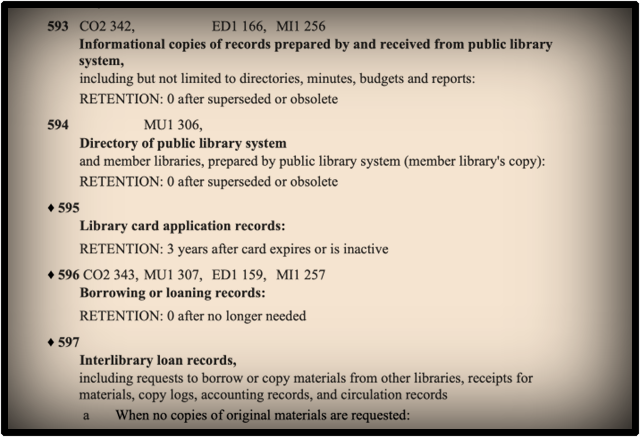
Here is how “library card application records” are referred to in the most recent version:[3]

Screenshot of LGS-1 showing information about Library card application records. The text on the page reads: 593 CO2 342 EDI 166, MI1 256 Informational copies of records prepared by and received from public library system, including but not limited to directories, minutes, budgets and reports: RETENTION: 0 after superseded or obsolete. 594 MU1 306, Directory of public library system and member libraries, prepared by public library system (member library's copy): RETENTION: 0 after superseded or obsolete. (Highlighted) 595 Library card application records: RETENTION: 3 years after card expires or is inactive (end highlight). 596 CO2 343, MU1 307, ED1 159, MI1 257 Borrowing or loaning records: RETENTION: 0 after no longer needed. 597 Interlibrary loan records, including requests to borrow or copy materials from other libraries, receipts for materials, copy logs, accounting records, and circulation records a when no copies of original materials are requested.

Lawyers can be notoriously precious about definitions, but I will say that in this case, it is the record generated by the process of applying for a library card and/or borrowing privileges.

Interestingly, the term “library card” is not defined by law or regulation in New York State and is only used in Education Law Section 816, which requires public schools to disseminate library card application information to K-12 students.

Instead, Education Law Section 262 provides: Every library ... shall be forever free to the inhabitants of the municipality or district or Indian reservation, which establishes it, subject always to rules of the library trustees who shall have authority to exclude any person who wilfully [sic] violates such rules; and the trustees may, under such conditions as they think expedient, extend the privileges of the library to persons living outside such municipality or district or Indian reservation. [emphasis added]

A “library card” is, by custom (not law), the end product of the “rules” of the “privilege” of using the library. A “Library Card Application Record” is whatever was generated with the end goal of a person having the privilege to use a library card. As can be seen, it must be retained for at least three years after the card has expired.

This brings us to the second question: Does duplicating all information from a simple registration card into the ILS patron record relieve the retention period of the physical registration card?

Great question!

I have to say “no.”

Here is why:

If you read the LGS-1 closely, you will see that it does not pertain to cooperative library systems; for example, LGS-1 items 593 and 594 in the above excerpt[4] show that while a member library must retain materials received from its library system, the system has no similar obligation.

This is because cooperative library systems do not fall under the record-keeping obligations of the state’s Arts & Cultural Affairs Law,[5] the law that mandates record-keeping by government agencies and directs NYSED to maintain a schedule of document retention (the LGS-1).

The obligations in the LGS-1 fall on public libraries. So, unless the cooperative library system providing the ILS is specifically under contract to maintain the records as a vendor for the required retention period, the copy retained by the system might not meet the retention obligation of the library (even if the record is 100% duplicated).

So, with that, on to the next question:

Does retention change if there is unique information on the registration card that is not duplicated in the ILS, including signatures?

If the application information is combined with other information, the retention period could be increased. For example, here is another type of record that must be kept by a public library:

Screenshot from LGS-1 with text that reads: 602 CO2 348, MU1 312, ED1 164, MI1 262. Patron's registration: for use of rare, valuable or restricted non-circulating materials: RETENTION: 6 years.

So, if a library is doubling up on its application form (online or in hard copy) and also uses it as a form for registering the right to access a special collection, the retention period could be increased.

The next question is very important: If retention applies to a simple registration card (no signatures or unique information), is it possible to define it as a temporary data transfer tool rather than an application through policy, to relieve the retention requirement?

Again, I have to answer “no.”

Here is why: the physical registration card is filled out by the library user to apply for a card, and then it is used by the library or system to initiate the digital process of entering the card holder into the ILS.

Once the person is granted a card, the library has no obligation to retain their borrowing record (except to the extent the Library decides that it is “needed”). This includes—hold on, things are about to get meta here—the record entered into the ILS based on the application.

The record that must be retained for three years after the expiration of the card is the “application,” not the ILS record that facilitates borrowing.

Consider: The application is the act of the future library user signifying that they accept the rules the library is imposing and asking for library privileges.

Entry into the ILS is the act of the library accepting the application (generally with the help of the library system, which provides the ILS) and enabling the creation of a borrowing record.

Although the two operations may record the same information at the onset, these are two separate things, with two separate retention periods (life of the card plus three years and zero years after needed, respectively).

For this reason, cooperative library systems that do not fall under the Arts & Cultural Affairs Law have to carefully identify when they are performing a record-keeping function for a member public library that does fall under the Arts & Cultural Affairs Law. Although ILS technology will impact how borrowing privileges are put into effect and used, each public library within a system should have its own policy and practice for applying for a card, and each cooperative system should make it clear (via policy or a member agreement) when it is providing a record-keeping function for a member related to that process and when it is not.[6]

Interestingly, because a library card application can signify agreement to library and/or system policy and procedure, I believe it is wise to retain application materials for at least six years after expiration, because that is the default statute of limitations for bringing an action on a contract.[7] This is true whether the application was “born digital,” created on paper, or even submitted via a gilded rock.

But that is just something to consider, not a law. Here is a sample policy including this consideration and the others discussed above.

Library Card Application Records PolicyAuthority responsible for compliance:
Related Policies:Adopted on:

Library card application records are records generated by a library user and/or the library or library system in furtherance of the user’s formal library privileges. 

Library card application records are confidential and private and will not be disclosed to any third party without written permission of the cardholder, or per a duly issued subpoena, court order, or warrant, unless for the operational needs of the library.

Typical information supplied on library card application records is: [username, address, optional additional contact information, optional third parties who may access confidential library records, and card type (select all that apply/add your own: temporary card, youth card, resident borrower, non-resident borrower, system card)].

The [NAME Library/NAME System] stores library card application records in the following ways: [SELECT ALL THAT APPLY: hard copy, on computers owned and controlled by the Library, on a network owned and controlled by the Library, on a confidential cloud service controlled by INSERT, and on an integrated library system maintained by the [NAME] Library System].

To ensure the proper retention and disposal of library card application records, such records are retained for not less than three (3) years after the card has been discontinued.

The following retention periods will add to and never subtract from the above period: 

For a library card or other application for permission to use non-circulating materials, such records are retained for not less than six (6) years. 

For library card application records relating to permission to use rare, valuable, or non-circulating materials, such records are retained for not less than six (6) years.

For library card application records relating to agreements to abide by a Code of Conduct, granting image rights use, third-party access to an account, or otherwise making a contractual agreement, such records are retained for not less than six (6) years.

Library card application records are disposed of within one (1) year of the expiration of the relevant retention period. Some library card application records may be retained for archival or operational purposes, but the privacy and confidentiality of such records shall continue.

Thank you for an important series of questions.


[1]^ I got my family tickets to see this group, performing the works of soundtrack composer Hans Zimmer, who composed the soundtrack to the 2023 “Dune.” If you know the work, you know that a gilded rock would be a much more appropriate ticket.

[2]^ I am assuming anyone who has read this far is a fan of the LGS-1, but for those to whom it sounds like a droid from Star Wars: the LGS-1 is a list of different types of documents kept by government agencies and their retention periods. Public libraries count as “government agencies”; cooperative library systems do not... but as they serve many public libraries, they must aid with compliance.

[3]^ I am including the entry in situ because I think it is helpful to see what other records are being defined. Also, I like the phrase “in situ.”

[4]^ See why it is important to consider things in situ?

[5]^ This law defines the agencies that must follow it. Public libraries and confederated/consolidated library systems are “in,” while cooperative library systems and research councils are “out.”

[6]^ To take this into another realm: if a town hires a payroll company and is relying on the company to keep payroll records for the required period, its contract must provide assurance of the proper retention period. If the payroll company is merely processing things, and the town retains all the records, the contract does not have to address long-term retention. Library systems that provide ILS are providing the record-keeping function for borrowing records, and policy should address that—usually by specifying that records are not retained after materials are returned (unless the patron opts to keep the record).

[7]^ In addition, a cooperative library system can pass a policy for cards to be applied for directly from the system, but the basis and terms for doing so should be clearly defined by a board-approved policy.

Is a Public Library Responsible for Patron Conduct Outside the Library?

Submission Date

Question

Our public library has been told by patrons that another patron is following up on interactions at the library, including at the circulation desk, by showing up at the reporting patrons’ homes. Such behavior, if harassing, is against our Code of Conduct. Does our library risk legal liability for this?

Answer

I am sure many a wonderful friendship has been launched at a public library, but for this question, we’ll assume that each of the reported incidents were unwelcome.[1]

To best address this matter and limit liability, the unwelcome nature of the behavior—and the Library’s response—should be documented every step of the way.

For example, the initial report of the first instance can be: Patron A reported that Patron B arrived at their house at ADDRESS on DATE/TIME uninvited to follow up on a conversation at the library on DATE/TIME. Patron A does not welcome this conduct and would like it to not recur.

Because the interaction started at the Library and was related to library services, it is appropriate to respond to this as a Code of Conduct matter, and document it as such.

The follow-up with the offending patron could then be:

Dear Patron B,

The library has received a complaint that on DATE, you sought to continue a conversation at the circulation desk of the library by arriving uninvited at another patron’s home.

If you were invited or did not visit at all, please send us a written response confirming that.

Otherwise: a copy of the Library’s Code of Conduct accompanies this letter. Please take care to not continue Library service interactions in a manner that is not welcome by that person, as it could be considered a violation of the Code.

NAME, you are a valued patron at the library, and we trust this will not be an ongoing concern.

Sincerely,

Library Director

The letter can be reviewed in person with the offending patron or sent by mail or email; that is at the discretion of the Director. The important things are accuracy and timeliness.[2]

It is also important to double-back to the impacted patron and let the know the matter has been addressed. Sample text for that is:

Dear Patron A,

Thank you for sharing your concern about an uninvited visit at your residence by a fellow library patron following an interaction at the library. Please know that the Library has alerted the other patron that such behavior is not consistent with the library’s Code of Conduct. In the event further concerns occur, please let me know immediately.

Sincerely,

Library Director

When a library director has to address this type of thing, they should be aware that such behavior can have many motivations. Some motivations may be malevolent, but others may be worthy of compassion, including loneliness or uncertainty about social boundaries. When it comes to documenting and handling the report, however, the motivation is irrelevant; the goal is to outline the behavior, the rule it violates, and explain the consequences for recurrence.

This type of documentation serves multiple purposes in the legal world.

First, it unambiguously documents the date and time of the occurrence and a key element: that the visit was unwelcome.

Second, that clarity enables a clear articulation of the rules and possible consequences.

Third, it documents that the library has done all it is empowered to do to address this situation. After all, a public library is not law enforcement; it can enforce its own Code of Conduct but cannot police the external activities of others. In fact, a library that tells patrons not to go to places outside the library, at the risk of losing library access, may be violating the First Amendment. Quite the legal tightrope for a library director to walk![3]

Having outlined all this, I will now answer the member’s actual question:

Our question is if the Library would hold any responsibility or liability if anything were to happen based on a conversation that happened at the library but the actions of follow through occurred off library property?

The answer to that will almost always be “No.” Exceptions are:

  • If the library provided the personal information that enabled the visit;[4]
  • If the victim was an employee;[5] or
  • If the activity is part of a larger issue currently under investigation by law enforcement (stalking, harassment, domestic violence, protective order in place, etc.).

When the above legal aspects are involved, a public library is wise to timely consult an attorney to document and determine next steps.

Other than the legal risks, the other big risk in this matter would be reputational: if an incident occurred, the subsequent investigation found out that there had been multiple reported concerns (as is posed by the question), and the library had done nothing, it could negatively affect how the library is regarded by the community.

But again, a public library is not law enforcement; other than barring access to the library, it has limited ability to punish or prevent crime.[6]

So, with all that, the big takeaways for this question are: 

  • All patron complaints related to safety and access should be documented;
  • All incidents relating to safety or access should be addressed so the library is positioned to restrict the access of the offender;
  • Any person facing loss of library access due to a Code of Conduct violation should receive a written notice and a chance to refute the accusation;
  • When legal liability or a risk to safety is involved, it is wise for a library director and/or board bring in back-up.

When a director meets with such a person (who might not have quite the same view of the world as the director), it is wise to have a person there as a notetaker and for safety.

Thank you for an important question.


[1] I don’t mean to imply that showing up at someone’s house uninvited is ever a gateway to friendship. Don’t do that! It’s a bad idea.

[2] Depending on the exact circumstances, an immediate bar may also need to be enacted, rather than just a “written warning.”

[3] But just another day in the life.

[4] I flinched just typing this. I know a librarian would not release information that way!

[5] Library workers being stalked/harassed is why every public library should have a Workplace Violence Prevention Plan. For more on that, see

[6] It’s a bit different when the library is the victim, but this answer doesn’t address that.

Pushing Back on Problematic Terms in Subscription Contracts

Submission Date

Question

Academic libraries need to make the most of their budgets for subscription services. We also want to advance librarian-aligned priorities like fair use, accessibility, authors’ rights, user privacy, and data security. Can you provide guidance on how academic and research libraries can resist contracts with non-disclosure clauses and other conditions that can work against these priorities?

Answer

The answer to this question shows the power of libraries working together.

Over the winter of ‘24 – ‘25, WNLYRC gathered a group of librarians from academic and research institutions to talk about pricing transparency and other priorities for database subscriptions. I was invited to the meeting to discuss possible legal solutions.

The result is the first edition of “A Research Librarian’s Guide to Negotiating E-Resource Contracts in New York State,” posted on the Ask the Lawyer Resources page.

The Guide includes contract assessment guidance, RFP language, a model contract addendum, and guidance for working with in-house legal counsel and purchasing specialists.

Informed by the real-world experience of academic libraries, the goals of this new resource are to: 

  • Help libraries avoid the negative impacts of non-disclosure agreements (“NDAs”);
  • Limit redundant purchasing;
  • Assure the ability of making adaptive copies under the Americans with Disabilities Act of 1990 (the “ADA”);
  • Protect rights created by Copyright Act Sections 107, 108, and 110;
  • Protect library user privacy;
  • Emphasize data security; and
  • Respect the intellectual property of content creators.

The resource may be used together with ESLN’s upcoming template for evaluating purchase and use of AI products and services.

The Guide may be found here. Just as important, your experience using the Guide, and suggestions for improvement, can be sent through the form here. The Guide is a collaboratively developed resource, and with your help, the next version will draw from even more real-world experiences.

If you use it, please provide feedback to make it better.