Records Management

Retention of Library Card Application Records

Submission Date

Question

Many libraries use a form of “registration card” when signing people up for a library card; a small form filled out by a patron before receiving a library card. We’d like some clarity regarding the retention of physical registration cards as they pertain to “Library Card Application Records” in the LGS-1.

Here are the questions:
1. How would you define a Library Card Application Record?

2. Does duplicating all information from a simple registration card into the ILS patron record relieve the retention period of the physical registration card?

3. The registration card would not have unique information or signatures. Does retention change if there is unique information on the registration card that is not duplicated in the ILS, including signatures?

4. If retention applies to a simple registration card (no signatures or unique information), is it possible to define it as a temporary data transfer tool rather than an application through policy, to relieve the retention requirement?

Answer

At one point about twenty years ago, I thought about forming a small company that would use etchings on stone to authenticate important records. The stones would range in size and be etched with a unique pattern documenting the record. The properties of the stone, in combination with the pattern, would be the authentication key. The jobs of “stone courier” and “stone reader” would be a fiduciary position, akin to a lawyer or CPA (but they would be in better shape, because of all the lifting).

I did not follow up on this idea, which is of course the only reason why we now use QR codes to authenticate everything from mortgages to concert tickets, and why you don’t have to have a padded “rock bag” in place of your cell phone, as you go through the airline check-in.

Why am I starting my answer to a serious question with this silly (but real) story? Because as the question points out, there are many types of records, and they are defined by their content, not their medium. A ticket to see “Lords of the Sound,” whether on paper, your phone, or a gilded rock, is still a ticket.[1] In that same vein, a library card application record, no matter what the medium, is still a library card application record.

So, to address the first question (How would you define a Library Card Application Record?), we must first ask, “What is a library card application record, as defined by the LGS-1?”[2]

Here is how “library card application records” are referred to in the most recent version:[3]
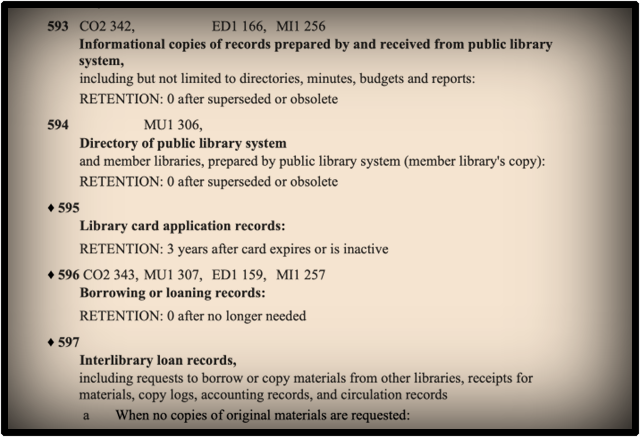
Screenshot of LGS-1 showing information about Library card application records. The text on the page reads: 593 CO2 342 EDI 166, MI1 256 Informational copies of records prepared by and received from public library system, including but not limited to directories, minutes, budgets and reports: RETENTION: 0 after superseded or obsolete. 594 MU1 306, Directory of public library system and member libraries, prepared by public library system (member library's copy): RETENTION: 0 after superseded or obsolete. (Highlighted) 595 Library card application records: RETENTION: 3 years after card expires or is inactive (end highlight). 596 CO2 343, MU1 307, ED1 159, MI1 257 Borrowing or loaning records: RETENTION: 0 after no longer needed. 597 Interlibrary loan records, including requests to borrow or copy materials from other libraries, receipts for materials, copy logs, accounting records, and circulation records a when no copies of original materials are requested.

Lawyers can be notoriously precious about definitions, but I will say that in this case, it is the record generated by the process of applying for a library card and/or borrowing privileges.

Interestingly, the term “library card” is not defined by law or regulation in New York State and is only used in Education Law Section 816, which requires public schools to disseminate library card application information to K-12 students.

Instead, Education Law Section 262 provides: Every library ... shall be forever free to the inhabitants of the municipality or district or Indian reservation, which establishes it, subject always to rules of the library trustees who shall have authority to exclude any person who wilfully [sic] violates such rules; and the trustees may, under such conditions as they think expedient, extend the privileges of the library to persons living outside such municipality or district or Indian reservation. [emphasis added]

A “library card” is, by custom (not law), the end product of the “rules” of the “privilege” of using the library. A “Library Card Application Record” is whatever was generated with the end goal of a person having the privilege to use a library card. As can be seen, it must be retained for at least three years after the card has expired.

This brings us to the second question: Does duplicating all information from a simple registration card into the ILS patron record relieve the retention period of the physical registration card?

Great question!

I have to say “no.”

Here is why:

If you read the LGS-1 closely, you will see that it does not pertain to cooperative library systems; for example, LGS-1 items 593 and 594 in the above excerpt[4] show that while a member library must retain materials received from its library system, the system has no similar obligation.

This is because cooperative library systems do not fall under the record-keeping obligations of the state’s Arts & Cultural Affairs Law,[5] the law that mandates record-keeping by government agencies and directs NYSED to maintain a schedule of document retention (the LGS-1).

The obligations in the LGS-1 fall on public libraries. So, unless the cooperative library system providing the ILS is specifically under contract to maintain the records as a vendor for the required retention period, the copy retained by the system might not meet the retention obligation of the library (even if the record is 100% duplicated).

So, with that, on to the next question:

Does retention change if there is unique information on the registration card that is not duplicated in the ILS, including signatures?

If the application information is combined with other information, the retention period could be increased. For example, here is another type of record that must be kept by a public library:

Screenshot from LGS-1 with text that reads: 602 CO2 348, MU1 312, ED1 164, MI1 262. Patron's registration: for use of rare, valuable or restricted non-circulating materials: RETENTION: 6 years.

So, if a library is doubling up on its application form (online or in hard copy) and also uses it as a form for registering the right to access a special collection, the retention period could be increased.

The next question is very important: If retention applies to a simple registration card (no signatures or unique information), is it possible to define it as a temporary data transfer tool rather than an application through policy, to relieve the retention requirement?

Again, I have to answer “no.”

Here is why: the physical registration card is filled out by the library user to apply for a card, and then it is used by the library or system to initiate the digital process of entering the card holder into the ILS.

Once the person is granted a card, the library has no obligation to retain their borrowing record (except to the extent the Library decides that it is “needed”). This includes—hold on, things are about to get meta here—the record entered into the ILS based on the application.

The record that must be retained for three years after the expiration of the card is the “application,” not the ILS record that facilitates borrowing.

Consider: The application is the act of the future library user signifying that they accept the rules the library is imposing and asking for library privileges.

Entry into the ILS is the act of the library accepting the application (generally with the help of the library system, which provides the ILS) and enabling the creation of a borrowing record.

Although the two operations may record the same information at the onset, these are two separate things, with two separate retention periods (life of the card plus three years and zero years after needed, respectively).

For this reason, cooperative library systems that do not fall under the Arts & Cultural Affairs Law have to carefully identify when they are performing a record-keeping function for a member public library that does fall under the Arts & Cultural Affairs Law. Although ILS technology will impact how borrowing privileges are put into effect and used, each public library within a system should have its own policy and practice for applying for a card, and each cooperative system should make it clear (via policy or a member agreement) when it is providing a record-keeping function for a member related to that process and when it is not.[6]

Interestingly, because a library card application can signify agreement to library and/or system policy and procedure, I believe it is wise to retain application materials for at least six years after expiration, because that is the default statute of limitations for bringing an action on a contract.[7] This is true whether the application was “born digital,” created on paper, or even submitted via a gilded rock.

But that is just something to consider, not a law. Here is a sample policy including this consideration and the others discussed above.

Library Card Application Records PolicyAuthority responsible for compliance:
Related Policies:Adopted on:

Library card application records are records generated by a library user and/or the library or library system in furtherance of the user’s formal library privileges. 

Library card application records are confidential and private and will not be disclosed to any third party without written permission of the cardholder, or per a duly issued subpoena, court order, or warrant, unless for the operational needs of the library.

Typical information supplied on library card application records is: [username, address, optional additional contact information, optional third parties who may access confidential library records, and card type (select all that apply/add your own: temporary card, youth card, resident borrower, non-resident borrower, system card)].

The [NAME Library/NAME System] stores library card application records in the following ways: [SELECT ALL THAT APPLY: hard copy, on computers owned and controlled by the Library, on a network owned and controlled by the Library, on a confidential cloud service controlled by INSERT, and on an integrated library system maintained by the [NAME] Library System].

To ensure the proper retention and disposal of library card application records, such records are retained for not less than three (3) years after the card has been discontinued.

The following retention periods will add to and never subtract from the above period: 

For a library card or other application for permission to use non-circulating materials, such records are retained for not less than six (6) years. 

For library card application records relating to permission to use rare, valuable, or non-circulating materials, such records are retained for not less than six (6) years.

For library card application records relating to agreements to abide by a Code of Conduct, granting image rights use, third-party access to an account, or otherwise making a contractual agreement, such records are retained for not less than six (6) years.

Library card application records are disposed of within one (1) year of the expiration of the relevant retention period. Some library card application records may be retained for archival or operational purposes, but the privacy and confidentiality of such records shall continue.

Thank you for an important series of questions.


[1]^ I got my family tickets to see this group, performing the works of soundtrack composer Hans Zimmer, who composed the soundtrack to the 2023 “Dune.” If you know the work, you know that a gilded rock would be a much more appropriate ticket.

[2]^ I am assuming anyone who has read this far is a fan of the LGS-1, but for those to whom it sounds like a droid from Star Wars: the LGS-1 is a list of different types of documents kept by government agencies and their retention periods. Public libraries count as “government agencies”; cooperative library systems do not... but as they serve many public libraries, they must aid with compliance.

[3]^ I am including the entry in situ because I think it is helpful to see what other records are being defined. Also, I like the phrase “in situ.”

[4]^ See why it is important to consider things in situ?

[5]^ This law defines the agencies that must follow it. Public libraries and confederated/consolidated library systems are “in,” while cooperative library systems and research councils are “out.”

[6]^ To take this into another realm: if a town hires a payroll company and is relying on the company to keep payroll records for the required period, its contract must provide assurance of the proper retention period. If the payroll company is merely processing things, and the town retains all the records, the contract does not have to address long-term retention. Library systems that provide ILS are providing the record-keeping function for borrowing records, and policy should address that—usually by specifying that records are not retained after materials are returned (unless the patron opts to keep the record).

[7]^ In addition, a cooperative library system can pass a policy for cards to be applied for directly from the system, but the basis and terms for doing so should be clearly defined by a board-approved policy.

Contract Employees and FOIL

Submission Date

Question

Does a contractor have to comply with FOIL request if they are contracted to a county government?

We have a [person] requesting information about a Security Guard who is a Contract Employee (employed by another government entity). All I know is the Guard's 1st name- which is on no paperwork we have. I have already told the requestor that the Guard is employed by an outside company. We are [REDACTED] County government and contract through [REDACTED Other Public Agency] - What do we have to do legally?

Answer

New York's Freedom of Information Law, or “FOIL”, applies to government agencies (including public libraries) but cannot be used to compel private companies (or individuals) to allow inspection or copying or records.

So, in the scenario described by the member, the private company employing the guard is not subject to FOIL, but the library is, as is the county, so information about the security company can be accessed.

Of course, that doesn't mean a person gets everything they might want, but it does mean that information about private companies working for public entities can be accessed.

We'll talk about this in more detail, but to illustrate my point, here is a short, one-act play:

CITIZEN (to security guard at public library): Who are you?!?! The Power of FOIL compels you!

SECURITY GUARD: Well, as you can see on my ID, my name is Phil. But I am not subject to FOIL.  Ask my boss.

CITIZEN (to Phil's private employer, whose company name and logo are on the ID): Who is that guy "Phil"?!? What's his last name and his qualifications?!? What does he get paid a year?!? The Power of FOIL compels you!

PRIVATE SECURITY COMPANY:  We're so glad you like Phil! We do, too. Unfortunately, we are not subject to FOIL, and we don't provide information about private employee to third parties.

CITIZEN (to the library): Your private security company is hiding information! Tell me everything about Phil! EVERYTHING!!! The Power of FOIL compels you!

LIBRARY (answering within 5 days): Your request is a bit broad, but we do have records relating to how we arranged the services of a security company through the County. Would you like to inspect those records, or be provided with copies?

CITIZEN (to the county): I don't just want to know "the arrangement," I want to know about Phil, the actual guy providing security at the Library!  Give me all the information you have on him!!! The Power of FOIL compels you!

COUNTY (replying within 5 days, and helping to narrow down the request): We are not quite sure what you're asking for, but we can definitely provide information about the security company. Do you want just the contract, or the complete procurement process, including their proposal?

[End Scene]

Of course, in this (hopefully fictional) scenario, the citizen asking for the information might not be able to get (such as what "Phil" is making per hour, or Phil's address, or Phil's resume). But if the information the person is really hoping to access falls into the accessible materials held by an entity subject to FOIL (like a county or a public library), they will hopefully get what they need.

Unfortunately, we live in a world where many times requests under FOIL can be perceived as aggressive. And sometimes the FOIL request is clearly being made by a person with an axe to grind.[1]

That's one of the many prices, to be cheerfully paid, of living in a democracy. Good government thrives on transparency, and prompt disclosures show respect for the public, as well as competence.

In my experience, the best way for an entity subject to FOIL to de-escalate any hostility accompanying a FOIL request is to:

  • Always require that employees be treated with respect;
  • Have a clearly articulated and easily located FOIL policy;
  • Have clarity within the organization as to who is responsible for requests and appeals under FOIL[2];
  • Maintain records in such a way that FOIL requests are easy and economical to fulfill;
  • Allocate time and budget to train the person responsible for responding to FOIL request, so they know what to do (and when to consult a lawyer).

All of the above-listed bullets can be achieved through a policy that sets out the proper timelines and procedures for following the law.

The great thing about a FOIL request being submitted to a library is that if there is one thing librarians know how to do, it's how to help people find information. So, unlike other "agencies" subject to FOIL, where records management and disclosure can be perceived as a hassle, in some ways, fulfilling a FOIL request is just business as usual: enable access.

The below "Template Public Library FOIL Policy" is based on the model policy supplied by the New York State Committee on Open Government (the COOG), found at https://opengovernment.ny.gov/freedom-information-law.  Since it is right from the COOG (with a few added bells and whistles from me), it checks all the boxes on mandatory reply times, providing copies, and how to reply to a request.

Having a policy, and a posting a summary setting out how to request a library record under FOIL, is a good way to diffuse any tension underlying a FOIL request.

As with any template, before a public library's board passes a version based on this one, it is best to have it reviewed by your library's lawyer.


NAME Public Library FOIL Compliance Policy


Date adopted: INSERT

To be posted at: INSERT

Position primarily responsible for coordinating compliance: INSERT


Records Access Officer: INSERT


FOIL Appeal Officer: INSERT


Position Responsible for annual check of Subject Matter list: INSERT


Review annual at the MONTH meeting by the Trustees to ensure familiarity, compliance, and budget support.

Appendix: Model FOIL Notice for posting


Related policies: Record Retention Policy


Section 1: Purpose and scope of this FOIL Compliance Policy:

The NAME Library (the "Library") believes in the right of the People to know the process of decision-making and to have access to the documents and information underlying the operations of the Library.  

In addition, a part of the mission of the Library is to enable access to information the public is entitled to.

To that end, the Library shall furnish to the public the information and records required by the Freedom of Information Law, using this policy to enable, effect, and document such compliance.


Section 2: Designation of Library Records Access Officer:

  1. The Library designates the following person(s) as "Records Access Officer(s)":

Job title or name:  _____________________________________________

Business address: _____________________________________________

Email address: ________________________________________________

  1. The Records Access Officer is responsible for ensuring appropriate library response to public requests for access to records, and shall ensure that the Library:
    1. Maintains an up-to-date subject matter list of type of Library records, based on the categories of documents in the LGS-1[3].
    2. Assist persons seeking public library records to identify the records sought, if necessary, and when appropriate, indicate the manner in which the records are filed, retrieved or generated to assist persons in reasonably describing records.
    3. Contact persons seeking records when a request is voluminous or when locating the records involves substantial effort, so that personnel may ascertain the nature of records of primary interest and attempt to reasonably reduce the volume of records requested.
    4. Upon locating the records, take one of the following actions:
      1. Make records available for inspection; OR,
      2. Deny access to the records in whole or in part and explain in writing the reasons therefor.
    5. Upon request for copies of records:
    6. Make a copy available upon payment or offer to pay established fees, if any, in accordance with Section 8 of this Policy; OR,
    7. Permit the requester to copy those records under appropriate supervision to ensure the records' physical integrity.
    8. Upon request, certify that a record is a true copy; and
    9. The NAME Library is not the custodian for such records; OR,
    10. The records of which NAME Library is a custodian cannot be found after diligent search.
    11. Upon failure to locate records, certify that;


Section 3: Location

Records shall be available for public inspection and copying at:

(Location)____________________________________

(Address)____________________________________

____________________________________________

____________________________________________

____________________________________________


Section 4: Hours for public inspection:

Requests for public access to records shall be accepted and records produced during all hours the Library is regularly open for business, however, timing of fulfillment will be impacted by staff capacity.


Section 5: Requests for public access to records

  1. A written request may be required, but oral requests may be accepted when records are readily available.
  2. If records are maintained on the internet, the requester shall be informed that the records are accessible via the internet and in printed form either on paper or other information storage medium.
  3. A response shall be given within five business days of receipt of a request by:
    1. informing a person requesting records that the request or portion of the request does not reasonably describe the records sought, including direction, to the extent possible, that would enable that person to request records reasonably described; OR,
    2. granting or denying access to records in whole or in part; OR,
    3. acknowledging the receipt of a request in writing, including an approximate date when the request will be granted or denied in whole or in part, which shall be reasonable under the circumstances of the request and shall not be more than twenty business days after the date of the acknowledgment, or if it is known that circumstances prevent disclosure within twenty business days from the date of such acknowledgment, providing a statement in writing indicating the reason for inability to grant the request within that time and a date certain, within a reasonable period under the circumstances of the request, when the request will be granted in whole or in part; OR,
    4. if the receipt of request was acknowledged in writing and included an approximate date when the request would be granted in whole or in part within twenty business days of such acknowledgment, but circumstances prevent disclosure within that time, providing a statement in writing within twenty business days of such acknowledgment specifying the reason for the inability to do so and a date certain, within a reasonable period under the circumstances of the request, when the request will be granted in whole or in part.
  4. In determining a reasonable time for granting or denying a request under the circumstances of a request, the Library shall consider the volume of a request, the ease or difficulty in locating, retrieving or generating records, the complexity of the request, the need to review records to determine the extent to which they must be disclosed, the number of requests received by the agency, and similar factors that bear on the ability to grant access to records promptly and within a reasonable time.
  5. A failure to comply with the time limitations described herein shall constitute a denial of a request that may be appealed. Such failure shall include situations in which the Records Access Officer (or other employee):
  6. fails to grant access to the records sought, deny access in writing or acknowledge the receipt of a request within five business days of the receipt of a request; OR,
  7. acknowledges the receipt of a request within five business days but fails to furnish an approximate date when the request will be granted or denied in whole or in part; OR,
  8. furnishes an acknowledgment of the receipt of a request within five business days with an approximate date for granting or denying access in whole or in part that is unreasonable under the circumstances of the request; OR,
  9. fails to respond to a request within a reasonable time after the approximate date given or within twenty business days after the date of the acknowledgment of the receipt of a request; OR,
  10. determines to grant a request in whole or in part within twenty business days of the acknowledgment of the receipt of a request, but fails to do so, unless the agency provides the reason for its inability to do so in writing and a date certain within which the request will be granted in whole or in part; OR,
  11. does not grant a request in whole or in part within twenty business days of the acknowledgment of the receipt of a request and fails to provide the reason in writing explaining the inability to do so and a date certain by which the request will be granted in whole or in part; OR,
  12. responds to a request, stating that more than twenty business days is needed to grant or deny the request in whole or in part and provides a date certain within which that will be accomplished, but such date is unreasonable under the circumstances of the request.


Section 6: Subject matter list

  1. The Library shall maintain a reasonably detailed current list by subject matter of all records in its possession, based on the categories of records set forth in the LGS-1, whether or not records are available pursuant to subdivision two of Section eighty-seven of the Public Officers Law.
  2. The "Subject Matter List shall be sufficiently detailed to permit identification of the category of the record sought; the LGS-1 breakdown and description of record categories is the default system the Library shall use.  Whenever possible, this Subject Matter List shall accord with the categories in the Library's [Document Retention and Destruction Policy OR equivalent].
  3. The Subject Matter List shall be updated annually by POSITION. The most recent update shall appear on the first page of the subject matter list.


Section 7: Denial of access to records

  1. Denial of access to records shall be in writing stating the reason therefor and advising the requester of the right to appeal to the individual or body established to determine appeals, [who or which] shall be identified by name, title, business address and business phone number.
  2. If requested records are not provided promptly, as required in Section 5 of this policy, such failure shall also be deemed a denial of access.
  3. The following "FOIL Appeal Officer" shall determine appeals regarding denial of access to records under the Freedom of Information Law:
    Name: ___________________________________________________


Title or position: ____________________________________________

Address for FOIL purposes:___________________________________

_________________________________________________________

Phone number:____________________________________________
 

  1. Any person denied access to records may appeal within thirty days of a denial.
  2. The time for deciding an appeal by the individual or body designated to determine appeals shall commence upon receipt of a written appeal identifying:
    1. the date and location of requests for records;
    2. a description, to the extent possible, of the records that were denied; and
    3. the name and return address of the person denied access.
  3. A failure to determine an appeal within ten business days of its receipt by granting access to the records sought or fully explaining the reasons for further denial in writing shall constitute a denial of the appeal.
  4. The person or body designated to determine appeals shall transmit to the Committee on Open Government copies of all appeals upon receipt of appeals. Such copies shall be addressed to:

    Committee on Open Government
    Department of State
    One Commerce Plaza
    99 Washington Avenue, Suite 650
    Albany, NY 12231
     
  5. The person or body designated to determine appeals shall inform the appellant and the Committee on Open Government of its determination in writing within ten business days of receipt of an appeal. The determination shall be transmitted to the Committee on Open Government in the same manner as set forth subdivision (f) of this section.


Section 8: Fees

  1. There shall be no fee charged for:
    1. inspection of records;
    2. search for records; or
    3. any certification pursuant to this part.
  2. Copies may be provided without charging a fee.
  3. Fees for copies may be charged, provided that:
  4. the fee for copying records shall not exceed 25 cents per page for photocopies not exceeding 9 by 14 inches. This section shall not be construed to mandate the raising of fees where agencies or municipalities in the past have charged less that 25 cents for such copies;
  5. the fee for photocopies of records in excess of 9 x 14 inches shall not exceed the actual cost of reproduction; or
  6. an agency has the authority to redact portions of a paper record and does so prior to disclosure of the record by making a photocopy from which the proper redactions are made.
  7. an amount equal to the hourly salary attributed to the lowest paid employee who has the necessary skill required to prepare a copy of the requested record, but only when more than two hours of the employee’s time is necessary to do so; and
  8. the actual cost of the storage devices or media provided to the person making the request in complying with such request; or
  9. the actual cost to the agency of engaging an outside professional service to prepare a copy of a record, but only when an agency’s information technology equipment is inadequate to prepare a copy, and if such service is used to prepare the copy.
  10. The fee an agency may charge for a copy of any other record is based on the actual cost of reproduction and may include only the following:
  11. When the Library has the ability to retrieve or extract a record or data maintained in a computer storage system with reasonable effort, or when doing so requires less employee time than engaging in manual retrieval or redactions from non-electronic records, the Library shall retrieve or extract such record or data electronically. In such case, the Library may charge a fee in accordance with Section 8.3 above.
  12. The Library shall inform a person requesting a record of the estimated cost of preparing a copy of the record if more than two hours of an agency employee’s time is needed, or if it is necessary to retain an outside professional service to prepare a copy of the record.
  13. The Library may require that the fee for copying or reproducing a record be paid in advance of the preparation of such copy.


Section 9: Public notice

A notice containing:

  • the title or name and business address of the Library Records Access Officer
  • the title or name and business address of the Library's FOIL Appeal Officer
  • the location where records can be seen or copied

shall be posted in a conspicuous location in the Library, and on the Library website at ADDRESS.


Section 10: Severability

If any provision of these regulations or the application thereof to any person or circumstances is adjudged invalid by a court of competent jurisdiction, such judgment shall not affect or impair the validity of the other provisions of these regulations or the application thereof to other persons and circumstances.


NAME Public Library FOIL Compliance Public Notice


Date adopted: INSERT

To be posted at: INSERT

Position primarily responsible for coordinating compliance: INSERT


Records Access Officer: INSERT


FOIL Appeal Officer: INSERT


Position Responsible for annual check of Subject Matter list: INSERT


Review annual at the MONTH meeting by the Trustees to ensure familiarity, compliance, and budget support.

Appendix: Model FOIL Notice for posting


Related policies: Record Retention Policy


YOU HAVE A RIGHT TO SEE YOUR LIBRARY'S PUBLIC RECORDS

The amended Freedom of Information Law ("FOIL"), which took effect on January 1, 1978, gives you the right of access to many public records, including many of those related to the operation of your public library.

Records related to the Library, if not considered exempt from FOIL, can be seen and copied at:

(Location)____________________________________

(Address)____________________________________

____________________________________________

____________________________________________

____________________________________________


The following Library employee(s) will help you to exercise your right to access:

Library Records Access Officer(s)

(name)_____________________________________________

(job title)____________________________________________

(business address)_____________________________________

____________________________________________________

(phone #)____________________________________________


If you are denied access to a record, you may appeal to the following person(s) or body:

(name)_____________________________________________

(job title)____________________________________________

(business address)_____________________________________

____________________________________________________

(phone #)____________________________________________


[1] I personally have ground down at least three metaphorical axes, making FOIL requests over the years.

[2] These will be different people/groups.

[3] LGS-1 is the NYS Archives Retention and Disposition Schedule for New York Local Government Records and can be found at: http://www.archives.nysed.gov/records/local-government-record-schedule/lgs-1-title-page

Update on retention of health screening records

Submission Date

Question

I am writing to update the excellent advice on the RAQ page from November 2020 in regards to the retention of health screening records in a school district, local government, or state agency (under a separate retention schedule.)

I just called the state archives to confirm the retention period of library employee daily health screenings using LGS-1. They referred me to item 792c (positive health screening) with a 6 year retention and 792d (negative health screening) with a 1 year retention. (pg: 210-211 in the schedule.)

They have also updated their guidance on records related questions for COVID-19 http://www.archives.nysed.gov/records/documenting-government-response-to-covid-19

Thank you for answering the original question in November. I hope this update to the response is helpful.

Answer

First: thank you very much for your kind words and feedback.  Both are very appreciated, and I encourage users of the service to keep a dialogue going--the service is only as good as the questions and input that inspire it.

Second, just to recap my advice from the November, 2020 "Ask the Lawyer" referenced by the member, it boiled down to:

"With no clear bucket and no clear requirements, at this point, I have to answer that retention of proof of screening should be permanent."

Time, as they say, has marched on, and as the member states, the State Archives has offered some additional guidance on this topic.

Here's where I am at: I have reviewed the additional information referenced by the member, and despite that input, I am just not confident that the time periods in LGS-792 "c" and "d" are the right fit for records showing a public library's routine use of employee screening as part of their Safety Plan,[1] and I continued to advise that retention be permanent (at least for now).

Here are the three reasons for my continued hesitation:

Reason 1: LGS-1 792a-f have a clear application, and I am not certain a pandemic response is quite it

I appreciate that 792c, which is part of the "Public Health" section of the LGS-1, applies to a "positive report" of a screening, and 792d is for a "negative report of individual screened."

However, as the remaining sections of 792 show, 792 applies to screenings conducted for public health initiatives that also (might) use: summary reports, master indices of "participants," informed consent forms, and a log used to compile data extracted from the screen.  

Logs, data crunching, and "informed consent" are all part of a public health agency's toolbox for public health initiatives in response to concerns such as the transmission and impact of a dangerous virus like COVID-19.

But unlike the majority of such initiatives, which tackle challenges such as STD's, tuberculosis, and cancer, employee health screenings for COVID-19 symptoms are part of a much larger effort conducted as part of an emergency response.

Reason 2: Emergency response records under the LGS-1

Because of the "emergency response" aspect discussed above, when I first reviewed the original question, I considered the applicability of LGS-1 802 ("public health incident files") which pertains to "records related to public health emergencies, communicable disease occurrences, and epidemics." 

Under 802 (also referenced in the State Archive's resource linked by the member), the retention period for "[s]urveillance, investigation, and response records" created in response to an epidemic is THREE YEARS "after [the] outbreak has abated."

Are a public library's employee health screenings "surveillance, investigation, and response recordsduring a "public health incident?"  Since employers are required to report the names of employees who screen positive to their local health department--who then engage in contract tracing and outreach--I believe they could be, which debatably makes the retention period of employee screenings (positive or negative) three years.

However, even three years doesn't sit right with me.  Here is why:

Reason 3: The other reasons to keep the records

My original answer went a little beyond the scope of required retention, addressing not only the precise retention period that might be required by the NY Arts & Cultural Affairs Law,[2]  but also, the other factors a public library might wish to consider when determining how long to retain the records of employee screenings.[3]

These "other factors" include legal claims based on alleged non-compliance with required pandemic procedures, some of which could underlie personal injury claims, alleged civil rights violations or even a contract violation (which has a six-year statute of limitations).[4]

In the body of New York case law involving personal injury, civil rights, and contract claims against public libraries, one can see an interesting pattern: sometimes public libraries are treated as government agencies, and sometimes, they are not.[5]  This is why public libraries are often required by their municipality to have their own insurance.  This also means that while they might be held to the document retention standards of municipal agencies, sometimes, they won't have the legal protections of one.

My concern was--and strongly remains--that a process of purging documents that could demonstrate use of and adherence to screening programs will only disadvantage a library, even if the lost record was properly disposed of under the LGS-1.[6]  There are reasons beyond required retention to keep those records.  And without a clear directive on retention, I think it is best that a library keep a close hold on them.

In closing

I am sure no public library that documents input from State Archives about the applicable retention period and then purges negative screens after 1 year will be met with a penalty from the State

But as you can see in "Reason 3," the State is not my primary concern. 

With the benefit of 5 additional months since my original answer, I will take advantage of this chance to refine it to revise my above-quoted statement and change it to:

"Even when we get clear requirements, I have to answer that retention of proof of screening should be permanent, or at least until your library's attorney has determined that any advantage to the library created by retention is past, and your library has determined they are of no historical significance."

Thank you very much to the member for giving me the opportunity to re-visit this issue and to offer this updated (and hopefully improved) guidance.  I am sorry to cause you more use of storage room, but gratified to have the chance to offer this analysis!


Afternote:  Below are the relevant excerpts from LGS-1 792 and 802:

792 CO2 508, MU1 472, MI1 409

Results of screening programs, except lead poisoning

a          Summary reports on screening results: RETENTION: PERMANENT

b          Master index or listing of participants: RETENTION: 50 years

c          Positive report of individual screened, including statement of consent or participation   and authorization for release of information: RETENTION: 6 years, or 3 years after    individual attains age 18, whichever is longer

d          Negative report of individual screened, including statement of consent or participation   and authorization for release of information: RETENTION: 1 year

e          Log or other working record of screening and testing, used to compile statistics and other      data: RETENTION: 1 year

f           Anonymous H.I.V. test results and related records: RETENTION: 7 years

NOTE: Identifiable H.I.V. related records are covered by item nos. 743 and 745, and related laboratory records are covered by items in the Laboratory subsection.


802

Public health incident files, including records related to public health emergencies, communicable disease occurrences, and epidemics

a          Surveillance, investigation, and response records: RETENTION: 3 years after outbreak          has abated


...

NOTE: Appraise these records for historical significance prior to disposition. Records of unusual disease occurrences or epidemics may have continuing value for historical or other research and should be retained permanently. Contact the State Archives for additional advice.


[1] This "Ask the Lawyer," like the original, avoids the issue of whether a non-association library has decided it must follow its local government's safety plans, or generate its own, and under which order or mandate that safety plan and the library operates.  The last footnote will show you why!

[2] The Law that empowers the Archives to develop the LGS-1.

[3] FOIL and various claims of civil liability being the top reasons.

[4] What I said was: "Most people know that when you leave a paper trail, it can (with many exceptions) be used for—or against—you in court.  In the employee data arena, common uses of such evidence are labor law and civil rights claims."

[5] For a good case illustrating this, see the chain of cases here: Gilliard v. New York Pub. Library Sys., 597 F. Supp. 1069, 1074-75 (S.D.N.Y. 1984)  New York Public Library v. PERB, 45 A.D.2d 271, 274, 357 N.Y.S.2d 522 (1st Dept. 1974), aff'd, 37 N.Y.2d 752, 337 N.E.2d 136, 374 N.Y.S.2d 625 (1975); Rendell-Baker v. Kohn, 457 U.S. 830, 840, 102 S. Ct. 2764, 73 L. Ed. 2d 418 (1982)); Breytman v. New York Pub. Library, No, 05 Civ. 10453 (RMB) (FM), 2007 U.S. Dist. LEXIS 12769, 2007 WL 541693, at *2 (S.D.N.Y. Feb. 21, 2007),  Breytman v. New York Pub. Library, Dyckman Branch, 296 F. App'x 156 (2d Cir. 2008)

[6] Unless your library hasn't had a safety plan and hasn't been performing screenings, in which case, talk with your lawyer and consider the best way to mitigate your risks!

School library records retention

Submission Date

Question

We got a question regarding how the new rules for records retention (the "LGS-1") impacts the retention of school library borrowing records.

Under the new LGS-1, how long must school library borrowing records be retained?  How does that impact BOCES, district, and school library records purging? 

Answer

Thank you for this question.  The LGS-1 is one of my favorite rabbit holes to explore.

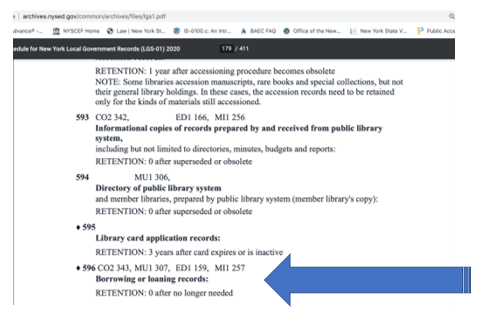
I took a look at Schedule Item 596, which applies to "Borrowing or loaning records."  I have put a screenshot of the section, as it appears in the schedule as displayed on the NY State Archives web site: http://www.archives.nysed.gov/common/archives/files/lgs1.pdf

Screenshot of school retention period law

As you can see in the screenshot, 596 fixes the retention period for borrowing or loaning records for school libraries as "0 years after no longer needed."

"No longer needed" is one of those phrases in the LGS-1 that renders the retention period variable.  This flexibility can be both helpful and frustrating, since a district, BOCES, or school library must determine, via policy, what "needed" means.

This can vary from place to place, but in all instances should be based on a determination of what is meant (for the district/BOCES/or school library) by "need," and then confirmed in a policy.

After that, best practice is always to purge records once their retention period is over, and for something as deeply connected to ethics, compliance and privacy as library records,[1] that is doubly true.  For school libraries, that retention period is zeroonce the records are no longer needed.

Therefore: determining how long student library borrowing records are "needed" (something that may vary from library to library, district to district, BOCES to BOCES), and then purging the record as soon as possible,[2] is a good way to use the LGS-1 to enhance an institution's commitment to privacy.


Thanks to the member for bringing up this nuance.  These issues are at the crossroads of ethics, compliance and automation, and require continuous and careful attention to detail and resulting policy.


[1] Please see "Ask the Lawyer" here for a discussion of school library records, CPLR 4509, and FERPA.

[2] The LGS-1 encourages, but does not require, "the systematic disposal of unneeded records."

NY's paid sick leave law

Submission Date

Question

The state's new paid sick leave law recently went into effect on September 30th. According to the state's website, eligibility requirements are as follows:

"All private-sector employees in New York State are covered, regardless of industry, occupation, part-time status, and overtime exempt status. Federal, state, and local government employees are NOT covered, but employees of charter schools, private schools, and not-for-profit corporations are covered."

As a school district public library, I'm curious to know if we fall into this local government category and so are not covered by the law.  According to the state comptroller's table summary of local government entities [https://www.osc.state.ny.us/local-government/data/local-government-entities] [NOTE: This link was confirmed as no longer active and removed on 02/25/2022 as part of the routine review of "Ask the Lawyer" materials.], public libraries are listed as "Miscellaneous Local Public Organizations".

However, in regards to page 33 of the State's Local Government handbook,

"Local government in New York State comprises counties, cities, towns and villages, which are corporate entities known as municipal corporations. These units of local government provide most local government services. Special purpose governmental units also furnish some basic services, such as sewer and water services. School districts, although defined as municipal corporations, are single-purpose units concerned basically with education in the primary and secondary grades. Fire districts, also considered local governments in New York State, are single-purpose units that provide fire protection in areas of towns. Fire districts are classified as district corporations. There are other governmental entities which have attributes of local governments but which are not local governments. These miscellaneous units or entities are generally special-purpose or administrative units normally providing a single service for a specific geographic area."

I wonder if a school district public library, such as ourselves, doesn't fall under this last category of governmental entity: one which has attributes of local governments but which is not a local government. If this is so, then this new law would seem to apply to us as well.

It's all a little confusing. Maybe you can help!

Answer

I wish I could reply to this excellent question with a plain "yes" or "no." But I cannot.

Why not?  Because, while as the member points out, a public library's "type" is relevant to this question, what may also be relevant is how the employees are being paid.  So answering this question requires a two-factor analysis:

Factor 1: Is the library in question considered a "type" of "governmental agency[1]?"

AND/OR

Factor 2: are the employees of that library compensated as if they were employees of a governmental agency?

If the answer to either question is "yes," Labor Law 196-b (which is the new "sick leave" law) doesn't apply.  If the answer to both is "no," then it may be time for the non-exempt library to draft a new Sick Leave Policy.


Now let's talk about the factors in this "two-factor test."

Factor 1: Is the library in question considered a "type" of "governmental agency?

Most libraries in the state of New York are NOT "governmental agencies" as that term is used in Labor Law Article 6 [2].

Sure, the library has to account for taxpayer money as required by the "General Municipal Law."  And yes, it is subject to parts of the "Public Officers Law."  And yep—it may even have to disclose certain records under the Freedom of Information Law. 

But none of that means they are performing a function of a "governmental agency" as defined under the Labor Law, which is where the new "sick leave" rules come from.  Under the Labor Law, a public library is far more likely to be considered a not-for-profit education corporation required to offer sick leave (and provide Workers' Compensation Insurance, and follow the NY Minimum wage laws...), than an exempt entity like a school district.

Now that being said, even if a library is not a "governmental agency," they may also be exempt from 196-b if their employees are....


Factor 2: "Compensated as if they were employees of a governmental agency"

How can this type of "compensation" happen, if the library itself isn't a "governmental agency?"

In New York, many libraries use their sponsoring municipalities and sponsoring school districts[3] as the "employer" of their employees—even though the library board retains the legal autonomy to hire, discipline, set compensation, promote, or terminate the employees. 

In this type of scenario, the library employees are a) paid directly by the municipality[4], b) are covered by the municipality's insurance[5],  c) get the municipality's benefits, and (most tellingly) are d) eligible for "comp time"[6] otherwise barred by rules requiring mandatory overtime.  In short, under much of the Labor Law,[7] they are treated as municipal/district employees.[8]


So does my public library have to give employees sick leave under the new law, or what?

Sadly, there is no "bright-line" rule.  But!  I have created a handy "Library-Municipality Relationship Type" chart to help you figure it out if it's something your library needs to worry about:

Library-municipality Relationship Type


Hallmarks

Legal impact with regard to employees and labor law

What this means with regard to the new "Sick Leave" law ("196-b").

1. "Total Coupling" Type

The library never separated any functions from the sponsoring entity; all finances, employee compensation, employee benefits, procurements, and property are owned/controlled by the municipal entity.


Ideally, the relationship is confirmed in writing.

In "total coupling," employees of the library, for Labor Law 196-b purposes, are considered municipal/district employees, even though the library board retains the authority to hire, discipline, set compensation, promote, or terminate the employees.

Employees are totally covered by the policies and benefits of the municipality/district, including the sick leave policy, and 196-b does not apply. 

2. "Select support: determinative" Type

The library has separated some functions from the sponsoring entity, but some functions determinative of legal status remain controlled by the municipal entity; for example, if a town still owns the library's building, or payroll and benefits are through a city.


Ideally, the relationship is confirmed in writing.

In a "Select support: determinative" scenario, if "employment" is a determinative factor, employees of the library  are paid by the municipality/district, so for legal purposes the employees might be considered municipal employees, even though the board retains the authority to hire, discipline, set compensation, promote, collectively bargain with, or terminate the employees, and even though the library has de-coupled from the entity in other ways.

IF employees are totally paid by and covered by the benefits of the municipality/district, including their sick leave policy, 196-b does not apply. 

Otherwise, the library must develop a policy under Labor Law 196-b, OR consider itself a separate "governmental agency" to be exempt.


3. "Select support: non-determinative" Type

The library has separated from the sponsoring entity to the degree that any slight collaboration between the library and the municipality does not determine legal status.  For example, the Town may plow the parking lot as a courtesy, but does not own the building, hold the money, or provide payroll/benefits.


Ideally, the relationship is confirmed in writing.

In a "Select support: non-determinative" scenario, the select support related to employees would not risk creating employer-employee status, or influence compensation and benefits, but could still be helpful assistance.  For example: if library employees were allowed to attend town employee trainings and professional development to save money for the library.


Library employees are not paid through the town/district, so the library must develop a policy under Labor Law 196-b, OR consider itself a separate "governmental agency" exempt from the law (which should be confirmed by a lawyer in writing for that specific library).

4. "Totally De-coupled" Type

The library has completely separated functions from any sponsoring entity.  The library owns the building, does all its own procurement and contracting, is the sole administrator of employee-related matters, and takes no extras or freebies from its municipalities/district.


No need to confirm the lack of relationship in writing, but you can exchange New Year's cards.

In a "total de-coupling," there is no select support related to employees. Librarians and municipal/district employees might say "hi," but they don't attend regular trainings or joint work sessions, and they are not in any way co-workers.

Library employees are not paid through the town/district, so the library must develop a policy under Labor Law 196-b[9], OR consider itself a separate "governmental agency" exempt from the law (which should be confirmed by a lawyer in writing for that specific library).


And there you have it.  From what I have seen, every public library in New York State handles its coupling/de-coupling in a different way.  Charter documents, bylaws, MOU's, and political/diplomatic relations can influence this just as much (if not more than) that law.  If you know where your library stands, you can not only assess its obligations under the Labor Law, but many other critical compliance obligations, as well.[10]

The bottom line here is: library employees shouldn't be left in a lurch, especially when it comes to sick leave, family medical leave, short-term disability, workers' compensation, and paid family medical leave—all of which are rooted in the question of "who" their employer is.  This means library trustees should periodically confirm, with certainty and clarity, what policies apply to their workforce.[11]  Regardless of where a library falls on the above chart, this can be accomplished with a confirmed, clear set of policies.

As employment law gets more and more intricate, and as we continue to live with a pandemic, this need for clarity will only get more critical.

I want to say a big "THANK YOU" to  Ben Gocker at Tupper Lake Public Library for submitting this excellent question and bearing with me while I talked through the answer with him.[12] Like all librarians I get to work with on "Ask the Lawyer," Ben is a critical thinker who brought a lot of research and practical experience to his question.  He also exhibited incredible patience as I tried to explain the mutable legal status of bodies defined by the Education Law, operating under the Not-for-Profit Corporation Law, subject to the General Municipal Law, living with the Civil Service law, and of debatable status under the Labor Law.  Thanks again, Ben!

I hope this approach and chart come in handy for public libraries out there struggling with this question. 


[1] I know this sounds like a re-hash of the member's point in the question, but in this case, I mean as that term is defined in Article 6 of the Labor Law, which is the section 196-b is part of. 

[2] Section 190 of the Labor Law, whose definitions apply to 196-b, states: “Employer” includes any person, corporation, limited liability company, or association employing any individual in any occupation, industry, trade, business or service. The term “employer” shall not include a governmental agency."

[3] How this is accomplished will vary, BUT there should always be a written document that sets forth how it is accomplished, and what compensation structure, benefits, and laws apply to the employee.  If there uncertainly about how an employee gets worker's comp, unemployment, or paid family leave, that is a sign the library and entity have to examine things a bit further.

[4] Or school district.

[5] Worker's compensation, unemployment, paid family leave, etc.

[6] "Comp time" is when employees can "bank" time off, rather than get paid time-and-a-half for overtime.  Only municipalities who are exempt from the Fair Labor Standards Act can do that.  For more on that, see "Ask the Lawyer" RAQ #59.

[7] Except the Taylor Law.

[8] I can't emphasize this enough: even when this is the case, the library board retains the authority to hire, discipline, set compensation, promote, collectively bargain with, or terminate the employees.

[9] Just in case you read this and think "Oops—we may need to develop a policy!" A good breakdown and resources for compliance can be found at https://www.ny.gov/programs/new-york-paid-sick-leave

[10] That said, this chart only considers the application of Labor Law 196-b.  If it tackled everything, it would be...very, very long.  For a good case that shows how tricky these “what is a library” issues can be when it comes to employment, check out this case.

[11] It will vary from place to place, but for public libraries, your civil service rep should be a great resource for this.

[12] And another big thank-you for agreeing to be publicly thanked.