Association Libraries

How association libraries and Friends of the Library groups can influence budget referendums

Submission Date

Question

We got a question from an association library planning for a budget referendum that would substantially increase its tax levy. This question is in follow-up to the recent answer, The Low-down on Libraries Lobbying. Guest writer and Ask the Lawyer paralegal Nathan Feist composed this reply.

Answer

As a private not-for-profit corporation, an association library can engage in public advocacy on ballot measures such as a budget referendum, including telling voters to “Vote Yes.” However, association libraries that have 501(c)(3) tax-exempt status or otherwise accept tax-deductible donations cannot support or oppose political candidates, which the IRS considers to be prohibited “political activity.”

These conditions also apply to a “Friends of the Library” group. Friends of the Library can lead a Vote Yes campaign for a budget referendum, but they cannot support or oppose political candidates, including a library trustee candidate on the same ballot as a budget referendum.

Friends of the Library and association libraries that have 501(c)(3) status must be careful not to make advocacy a substantial part of their activities. A helpful rule of thumb derived from Section 501(h) of the Internal Revenue Code is that a small not-for-profit corporation should spend no more than 20% of its revenue on advocacy, such as campaigning for a ballot measure or lobbying elected officials.

Of course, a library receiving taxpayer money and then telling people how to vote could raise objections from the public, even though such conduct is legal. For this reason, it’s wise to address this issue as part of a carefully planned and visible Vote Yes campaign. Here’s a sample FAQ that an association library in this situation could post on its website and social media.

Can a library really ask people to vote “yes”? 

Yes, it can. As an association library, the [NAME] Library is a private not-for-profit corporation, not a government entity. 

Doesn’t the Library receive taxpayer funding?

Yes, it does, and the Library is fortunate to receive that support. Many not-for-profit corporations receive public funds—that does not make them government agencies or prohibit them from engaging in public advocacy.

Why is the Library telling me how I should vote?

The Library’s Board of Trustees voted in favor of requesting additional funding to maintain and improve the valuable services that the Library provides to our community. In furtherance of its mission to provide information access, educational services, and community resources, the Library is conducting a public awareness and advocacy campaign that informs our community about the benefits of the proposed budget and encourages voters to vote “yes.”

Can I help?

Yes, the Library is gratefully accepting help and coordinating with advocates and professionals who share our vision for a bigger, brighter, and future-focused library. Please contact [NAME] at [CONTACT INFORMATION] to offer assistance!

An association library can also contract a marketing firm or public relations professional to handle this delicate work. Good luck out there in the arena of civic participation and thank you for an important question!

Is a 414 a “new tax”?

Submission Date

Question

In the Municipal Ballot Votes for Library Funding in New York State manual (the “414 Manual”), it states that a Chapter 414 referendum “is not a new tax,” asserting that the funds remain a municipal appropriation. However, Chapter 414 of the Laws of 1995 appears to authorize voters to determine “how much to tax themselves” for library services, and the municipality is then required to levy and collect that amount annually as a separate line item on the tax bill.

Given that the municipality becomes the taxing authority responsible for collecting and remitting these funds to the library, does a successful 414 vote legally create a new or distinct tax obligation (as opposed to a continuation or adjustment of an existing municipal appropriation)?

In other words, how should the resulting levy be properly characterized under New York Education Law and municipal finance law, as a continuation of an existing appropriation or as a new dedicated tax established by voter approval?

Answer

For the five people reading this who don’t work day-to-day on library budget matters but for some reason care about this question,[1] I will explain: a “414” is the nickname for when the voters of a village, town, city, or county approve a separate tax levy to support a public or association library (or libraries).

The “414” got its nickname for the reason set out in the question (“Chapter 414 of the laws of 1995”), but the tax is enabled through Education Law Section 259. It is called “414” to differentiate it from another fun nickname in library tax-land, the “259,” which is reserved for levies approved by school district voters.

“414” is actually a bad nickname,[2] because in the time since “Chapter 414 of the Laws of 1995” was passed, the part of the law governing “414 votes” has changed (in 1996, 1997, 2021, and (most recently) in 2023. I guess changing “414” to “587” (for “Chapter 587 of the laws of 2023”) is too cumbersome.

While I appreciate that nicknames are important, that isn’t the real reason I am reviewing this history. Rather, I am reviewing the history because it is relevant to the question: is a “414” a “new” tax?

The answer is: in 1995 (when the vote was only to “increase” the amount to appropriate), there may have been some grounds to say it was not a “new” tax. But since the 2007 change, the law has allowed for the tax to be not only “increased” but to be “established.”

So, since 2007, without a doubt, a 414 (or, more fittingly, a “184” for “Chapter 184 of the Laws of 2007”) can be a “new” (as in separate and never having happened before) tax.

While the phrase “new tax” might be a repugnant notion to some,[3] to call a tax proposed by the voters, endorsed by the library board, and separately enforced by the power of a tax levy and a lien on real property is… disingenuous, at best. In fact, it could be viewed as downright dishonest, by some.[4]

A tax such as a 184[5] is defined in New York’s Real Property Tax Law[6] as “a charge imposed upon real property by or on behalf of a county, city, town, village or school district for municipal or school district purposes…”[7]

The ability of any library (not just a library created by the taxing entity) to benefit from a 184 or a 259 is a vast power.[8] As a separate tax, it is also subject to the Real Property Tax Law’s provisions about refunds (meaning a library sometimes has to return part of it). As a tax, it can be enforced by the power of the state, and it provides an important source of independent, separate funding. For these reasons, its status as a new tax (when it is first adopted) should not be denied.

Libraries that want to point out that a new 414 to replace funding that from a municipality’s budget can stress that it’s not an additional charge (if the amount isn’t increasing).

A newly established 414 (or whatever you call it) is a new tax. An official source that glosses over these considerations may want to refine its guidance.

Thank you for a thoughtful question.


[1]^ Perhaps they are preparing for the bar exam or are exploring a PhD in library revenue streams.

[2]^ For an example of a “good” nickname for a law, see the “Freelance isn’t Free” revision to the General Business Law. Now that’s a nickname that gets the job done!

[3]^ My parents, for instance.

[4]^ Me, for instance.

[5]^ Let’s do this! Let’s give it the right nickname!

[6]^ A law that is more fun to read than the General Construction law, but less fun to read than the Real Property Actions and Proceedings Law.

[7]^ The definition goes on to say, “but does not include a special ad valorem levy or a special assessment.” That does not exempt the library tax from the definition of what a tax is.

[8]^ A 259 (school levy) actually has a better claim to being called a “414” than a 184, because it has largely been unchanged since being created in 1995, so... okay I am going to stop this now.

How to Confirm the Number of Trustees at a NYSED-Chartered Library

Submission Date

Question

I was told that when a public or association library’s charter sets a range of trustees (for instance “no less than 5, no more than 15”) the bylaws should always set out the current number. Is this true?

Answer

Rule #1 in library law: there is never an “always.”[1]

In this case, the question has a correct premise: a library’s charter will often set a range of trustees, after which the bylaws or an action of the board can set the number.

But do the bylaws “always” have to do this?

No, they don’t have to, and sometimes, they can’t.

This is because a charter might set another way of confirming the number. For example, at least one charter I have seen requires that the number be set by a resolution passed by a three-fourths majority vote of the board. Take that, bylaws![2]

Still other charters could require the number be set in the bylaws, or by a vote of a library’s membership,[3] or by a throw of a ceremonial dart every Leap Year.[4] With over seven hundred chartered libraries in New York State, there are lot of possibilities.[5]

This is why any bylaws changes—and any action that affects the number and terms of trustees—should always start with a quick look at a library’s charter. Who knows what’s hiding in there?

Thank you for a niche but important question!


[1]^ This is why an attorney advising a library on a trustee question very often has to look learned, say, “It depends,” and scurry to the nearest computer to research and compose a memo that considers the charter, recent board minutes, and Education Law Sections 260, 216, and 226. Depending on the Library, she may also need to dip into the Public Officers Law.

[2]^ Can this resolution also amend the bylaws to include the currently approved number? It can (and perhaps should), but it doesn’t have to.

[3]^ Association libraries often have “members” who vote for the trustees, rather than the board voting to reconstitute itself. Membership is usually open to residents over 18 in the area of service. Although such votes are generally sleepy affairs, from time to time the membership can reignite and you might even have a contested vote! NOTE: This process is distinct from association libraries supported by taxing districts that conduct votes per the N.Y. Election Law.

[4]^ Okay, I made this one up. I think…

[5]^ “Hey, trustworthy AI, build me a database that assesses every chartered public library in New York and create a table of various methods of establishing the range of trustees, putting the results in a cadence so they can be rapped to the flow of Jay-Z and Alicia Keys’s “Empire State of Mind.” For guidance on assessing “trustworthy” AI, see the materials from the Empire State Library Network’s September 2025 presentation, The Ultimate AI Policy for Your (Public, Academic, Museum, etc.) Library, on the “Ask the Lawyer Webinar Recordings” page.

Publishing a library's budget

Submission Date

Question

Could you please provide the effective date of 8 CRR-NY 90.2?

Are all public libraries required to publish their budgets online on their websites?

Answer

For readers that don’t see Education Department regulations as subtitles to the movie of your life,[1] these questions pertain to the state regulations governing public libraries, which have changed significantly in recent years.

For context, here is the full legal citation hierarchy we are in:

New York Codes, Rules and Regulations

TITLE 8

EDUCATION DEPARTMENT

CHAPTER II. REGULATIONS OF THE COMMISSIONER

SUBCHAPTER D. LIBRARIES

PART 90. PUBLIC AND FREE ASSOCIATION LIBRARIES

§ 90.2 Standards for registration of public, free association and Indian libraries[2]

That’s a deep bowl of citation soup! To avoid having to list it all, it generally gets shortened (as the member has done) to “8 NY-CRR 90.2.” But since “8 NY-CRR 90.2” sounds a bit like a Star Wars droid name, for this answer, let’s go with the “90.2 Requirements.”

This question about the 90.2 Requirements is understandable. Generally, the effective date of a regulation is pretty straightforward, but this one is a tad complex, because while current revision went into effect August 1, 2018,[3] it delayed its effective date as follows:

Any public, free association or Indian library that was registered by the department on or before December 31, 2020, shall meet the following registration requirements by January 1, 2021 to continue to be registered by the department… [emphasis added]

In other words, if you were an existing registered library as of August 1, 2018, you had 2 years and 4 months’ warning to bring things up to snuff; if you were a new library after January 1, 2021, you obtained your original registration under these standards.

This delay provided a chance for existing libraries to budget and plan for meeting the new standards, which was helpful, because as stated above, the 2018 amendment added quite a few requirements.[4]

So, to answer the first question: In legal parlance, the current version was “effective” on August 1, 2018 (the date of the amendment) but went into effect on January 1, 2021.

Which brings us to the next question: Are all public libraries required to publish their budgets online on their websites?

Because this question came linked with the question about the 90.2 Requirements, I believe it is inspired by this new[5] requirement:

(5) annually prepares and publishes a board-approved, written budget, which enables the library to address the community's needs, as outlined in the library's long-range plan of service; [emphasis added]

This use of “publish” is not a defined term,[6] so the mode of publication is not set by the 90.2 Requirements. However, due to the requirement that all registered libraries must conduct their meetings per the Open Meetings Law,[7] the budget likely should be part of a posted board packet.[8]

So, the answer to the second question is: Unless your library has no website, there is a risk of non-compliance with the Open Meetings Law if the budget is not at least posted online 24 hours before the meeting where the board first considers it. After that, how the library chooses to further “publish” it[9] as required by 90.2 is up to the library.

A small plea for accessibility: No matter what form the publication required by the 90.2 Requirements takes, it is wise to ensure it can be converted to large print, Braille, or audio file, for accessibility.

Thank you for two very thoughtful questions!


[1] If at some point you didn’t go to sleep muttering “minimum standards,” “direct access,” or “trustee training,” this means you.

[2] I have been wading in these regs for so long, this is like reading a recipe, but I remember my first law class, when I saw that little wiggly sigil (it means “section”) and wondered if I should go back to studying Russian history.

[3] State Education Department’s memo on the 2018 amendment is here:

https://www.regents.nysed.gov/sites/regents/files/318ced1.pdf.

[4] This change is actually easy to see, because Section 90.2 still lists the “old” standards (in part “a”), and the “new” (in part “b”). Just do a search for “8 NYCRR 90.2” and you’ll see it.

[5] Newish? I am writing this in December, 2024. These regulations no longer have fresh new car smell.

[6] There are all sorts of publication requirements and definitions in state law and regulations. This use doesn’t synch up with any of them.

[7] See Education Law § 260-a.

[8] The Open Meetings Law requires that if an agency has “a regularly and routinely updated website and utilizes a high speed internet connection, such records shall be posted on the website to the extent practicable at least twenty-four hours prior to the meeting.” [OML § 103(e)].

[9] Aside from hard copy, it would be cool to see a budget as a poster, or a Lego tower (remove a brick when you have to cut an item), or a tapestry.

Use of library website and staff time for fundraising

Submission Date

Question

I am reaching out to request a legal opinion regarding the roles and responsibilities of library staff in supporting board fundraising efforts, as well as the permissible use of library digital platforms for fundraising activities. As a New York association library, we strive to adhere to state guidelines and ethical standards and seek clarity on the following specific matters:

Staff Involvement in Fundraising
Are there any legal restrictions or guidelines that would limit or prohibit our library staff from directly or indirectly assisting in fundraising efforts organized by the library board? We are interested in understanding any relevant employment or nonprofit regulations that would guide staff participation in these activities.

Use of Library’s Website and Facebook Account for Fundraising
Can the library board legally use the library’s official website and existing Facebook account to promote or facilitate board-led fundraising campaigns? We would like to ensure that these actions comply with any applicable state laws and nonprofit guidelines that might apply to public association libraries in New York.

Creation of a Library Board Facebook Account for Fundraising
If the above is permissible, is it also acceptable for the board to establish a separate Facebook account specifically for fundraising purposes on behalf of the library? We are particularly concerned with understanding the necessary distinctions (if any) between a board account and the library’s official social media presence.

Your legal guidance on these questions will be invaluable in helping our board make informed, compliant decisions about our fundraising strategies and staff involvement. If any additional information is required for this analysis, please let me know.

Thank you for your attention to these matters. We look forward to your advice.

Answer

Before I answer, I have to put in this obnoxious disclaimer: THIS ANSWER IS ONLY FOR ASSOCIATION LIBRARIES.

I’m sorry. I know using ALL CAPS means I’m YELLING. But the distinction is important for these questions, so it warrants boosted volume.

Okay, with that obnoxious disclaimer out there, let’s get to the questions and answers.

QUESTION: Are there any legal restrictions or guidelines that would limit or prohibit our library staff from directly or indirectly assisting in fundraising efforts organized by the library board?

ANSWER: Yes, there are many, but most are surmountable with careful planning. To illustrate both the issues and the careful planning that can surmount them, here are two short stories. [Readers who don’t want to wade through two faux fairy tales to get to an answer can skip to “THE (BETTER) END.”]

Story #1: The Three Friends

Once upon a time, three friends worked at an association library: a library page, a library clerk, and a library director. The three friends didn’t let their differential power dynamic interfere with their friendship and were happy as they put away books, helped patrons, and directed day-to-day operations at the library (respectively).

One day, however, things changed. Out of the blue, the page was directed to make phone calls to all patrons who had borrowed books within the last year to ask for donations to the summer reading program. The clerk was told they would have to work that Friday night, paid, at the “Pizza for Pages” fundraising dinner. The library director was told to write and practice delivering a pitch to seek a large donation from a major regional philanthropic organization.

The three friends’ peaceful[1] work life came to a screeching end. The page worried that the calls to patrons were an invasion of privacy.[2] The clerk did not regard selling pizza as part of his job description. And the library director—while an excellent library director—had never been trained in seeking or managing charitable contributions.

It was all very stressful, and the three friends started looking for new jobs.

THE (CAUTIONARY) END

Story #2: The Three Other Friends

Once upon a time, there were three other friends at an association library: a library page, a library clerk, and a library director. Their differential power dynamic was occasionally an issue in their friendship, but they were united by their love of textiles and trivia.

The three friends were happy as they put away books, helped patrons, and directed day-to-day operations at the library (respectively). They also felt very accomplished in their careers, because in addition to their regular duties, each had specific language in their job description that made them an integral part of the library’s fundraising.

Part of the page’s formal duties were to “help maintain a donor database”—separate and apart from patron records—of people who had expressed interest in donating to the library. The page also sent out regular, scheduled donation solicitations that had been reviewed by the library’s accountant and fundraising counsel, making sure people understood how to make a tax-deductible donation to the library.

Part of the clerk’s formal duties were to “assist with fundraising, event planning, and presentations,” and the clerk’s regular hours were sometimes adjusted (or the clerk was paid overtime) to assist with fundraising events. As the clerk performed this duty, they often had to consult the library’s policies and procedures for working with the volunteers who helped with the events.

The library director felt particularly accomplished, because even though she didn’t have any experience with grants and grant management when she started, the library paid for her to attend training sessions until she was confident about applying for grants and managing them. As the director built these skills, the library board developed and passed policies on managing grants and soliciting/accepting donations, while the library’s treasurer took the time to understand the regulatory requirements of managing donations and grants.

It was occasionally stressful, but the three friends felt supported and confident in their jobs and didn’t spend a lot of time looking through job listings.

THE (BETTER) END

The take-away from these two tales is simple. At an association library, employees should not assist with fundraising unless:

  • To comply with both governing ethics and laws pertaining to patron confidentiality, there is great care to not use library patron information to solicit donations. Instead, a completely separate database built using direct expressions of donor interest should be used; frequency of use or borrowing habits should not be referenced in solicitations;
  • Fundraising duties are in the employee’s job description[3] (not just “additional duties as assigned”);
  • The employees performing fundraising duties are still being supervised by their supervisor,[4] not a trustee, contractor, or volunteer;
  • The library has a full array of policies governing gift/donation solicitation and acceptance;[5]
  • If seeking grants (governmental or private) is part of the effort, the library has a full array of grant management policies;[6]
  • If volunteers are also helping with fundraising, there is a volunteer policy that includes confirming volunteer service by letter, and the volunteers are covered by insurance;[7]
  • The library is providing employees required to solicit gifts with appropriate on-the-job training;
  • If the library is using a paid consultant or external fundraiser to help with fund-raising, that person or company’s service should be confirmed with a written contract.

Basically, like all things, fundraising by employees at an association library should be planned and overseen with care.

Thank you for giving me a reason to get all that out there!

NEXT QUESTION: Can the library board legally use the library’s official website and existing Facebook account to promote or facilitate board-led fundraising campaigns?

ANSWER: Yes, as long as the library has a full array of policies governing gift/donation solicitation and acceptance, and the policy includes solicitation via social media.[8]

QUESTION: If the above is permissible, is it also acceptable for the board to establish a separate Facebook account specifically for fundraising purposes on behalf of the library?

ANSWER: Yes, as long as the library has a full array of policies governing gift/donation solicitation and acceptance, and the policy includes solicitation via social media.

Unlike other public libraries, an association library is not subject to FOIL, so the considerations about record-keeping that sometimes arise when quasi-governmental entities use social media are not present here. However, a board should take great care to make sure solicitations on the library’s social media account do not distract from the primary purpose of the account, and if the solicitations are on a separate account, that the separate account is still owned by the library.

The member’s careful questions are the right approach this issue. Fundraising by a library—association or otherwise—should never be a spontaneous activity. An association library engaging in fundraising should have a well-developed array of policies, and if library employees have fundraising responsibilities, those responsibilities should be clearly stated. If the library is using volunteers and/or paid consultants to help fundraise, that service should also be governed by policy and with attention to compliance (including a written contract for all external services).

The policies needed to make informed, compliant decisions about your association library’s fundraising strategies and staff involvement are bolded in this answer, and where there are templates or other relevant information, this answer includes them in the footnotes.

Thank you for a serious and important array of questions.


[1] And even idyllic, as their town was book-ban free.

[2] Plus, they preferred texting.

[3] Job descriptions should be reviewed routinely to ensure they are accurate.

[4] Trustees should not supervise employees except for the director.

[5] A previous Ask the Lawyer response on donation solicitation is available here.

[6] Accepting federal, state, and private grants requires certain procurement, accounting, and other compliance procedures. The current (as of 11/13/2024) federal regulations can be found here.

[8] Commentary on what to consider when developing a social media policy can be found here.


Hiring Interviews and Accommodations

Submission Date

Question

If a prospective employer specifically asks about a candidate’s physical capacity to do a job and they say they can do all of the tasks required, and then notify us afterwards that they need accommodations for things they said they could do without them, are we:

a) by law required to provide them 

OR

b) can we make a decision that the person is not able to do the essential functions of the job and therefore not be allowed to continue in their employment?

Dishonesty in applying for jobs seems grounds for termination, but when it comes to disabilities, I realize it’s a minefield.

Answer

A minefield, indeed.[1]

The first issue in this question is the premise: “If a prospective employer specifically asks about a candidate’s physical capacity to do a job and they say they can do all of the tasks required…”

When interviewing a job applicant, it is perfectly appropriate to ask if they are able to perform the essential functions of the job. Acceptable questions are:

  • Can you type 90 words per minute?
  • Can you weld for an 8-hour workday?
  • Can you read out loud to kids for an hour at a time, even if they interrupt you because they need to use the bathroom?

However, it is important to remember that the answer can honestly be “yes,” whether or not an accommodation is required to be able to perform the task.

In other words, the answer can honestly be “yes”, even if:

  • The typist needs a special keyboard due to carpal tunnel syndrome;
  • The welder needs a special back brace;
  • The reader needs a hearing aid, so they can hear questions from the attendees.

Of course, in the scenario sent in by the member, things are not that simple, since the applicant’s honesty is being questioned (“… they need accommodations for things they said they could do without…”).

Before addressing possible dishonesty, a critical consideration is: how did the applicant happen to say they didn’t need an accommodation? Did the applicant simply say that they can do the tasks (which as we reviewed above is fine, even if they now need an accommodation), or did the employer ask if the applicant needed an accommodation?

If the employer specifically asked, that is where we enter the minefield[2], because there are very limited circumstances where an employer can ask if accommodations are needed.

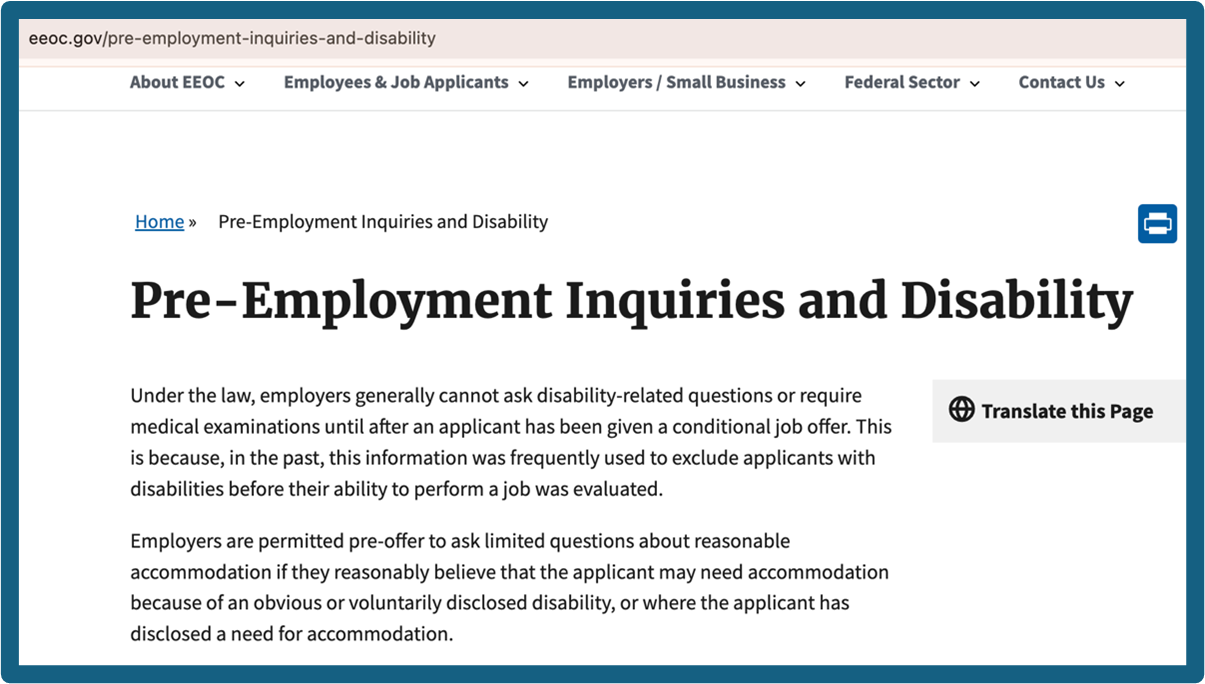
Because this is so high-risk, I am simply going to put a screenshot of the Equal Employment Opportunity Commission’s (EEOC) guidance here:

Screenshot of EEOC.gov page titled Pre-Employment Inquiries and Disability. Text reads Under the law, employers generally cannot ask disability-related questions or require medical examinations until after an applicant has been given a conditional job offer. This is because, in the past, this information was frequently used to exclude applicants with disabilities before their ability to perform a job was evaluated.  Employers are permitted pre-offer to ask limited questions about reasonable accommodation if they reasonably believe that the applicant may need accommodation because of an obvious or voluntarily disclosed disability, or where the applicant has disclosed a need for accommodation.

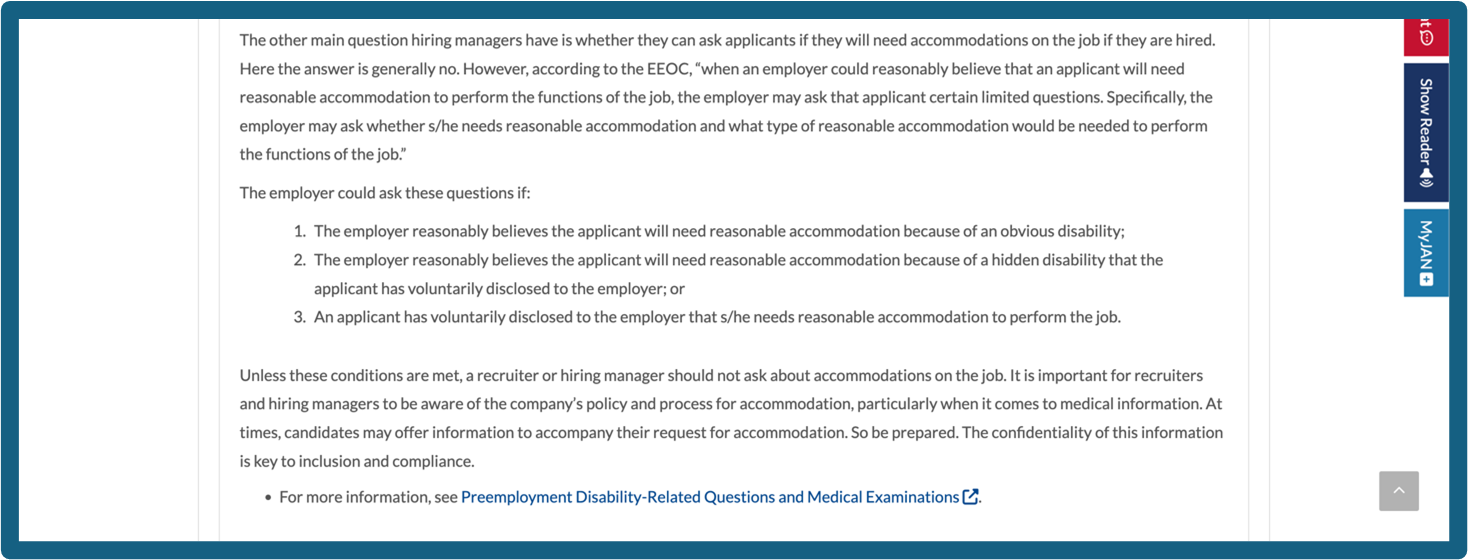
The “Job Accommodation Network,” at AskJAN.org, provides additional guidance on this limited ability to ask applicants about the need for accommodations:

Screenshot from AskJAN.org page titled The JAN Workplace Accommodation Toolkit. Text reads The other main question hiring managers have is whether they can ask applicants if they will need accommodations on the job if they are hired. Here the answer is generally no. However, according to the EEOC, “when an employer could reasonably believe that an applicant will need reasonable accommodation to perform the functions of the job, the employer may ask that applicant certain limited questions. Specifically, the employer may ask whether s/he needs reasonable accommodation and what type of reasonable accommodation would be needed to perform the functions of the job.”  The employer could ask these questions if:      The employer reasonably believes the applicant will need reasonable accommodation because of an obvious disability;     The employer reasonably believes the applicant will need reasonable accommodation because of a hidden disability that the applicant has voluntarily disclosed to the employer; or     An applicant has voluntarily disclosed to the employer that s/he needs reasonable accommodation to perform the job.  Unless these conditions are met, a recruiter or hiring manager should not ask about accommodations on the job. It is important for recruiters and hiring managers to be aware of the company’s policy and process for accommodation, particularly when it comes to medical information. At times, candidates may offer information to accompany their request for accommodation. So be prepared. The confidentiality of this information is key to inclusion and compliance.      For more information, see Preemployment Disability-Related Questions and Medical Examinations Opens in new window..

Why are these excerpts from the EEOC and AskJAN relevant? The only way the issue of accommodations could have been brought up by the employer is if the applicant had an “obvious” disability (two legs in a cast), or the applicant voluntarily disclosed a disability before/during the interview.

After that, if the employee was flat-out dishonest, that is indeed a grave concern.

That said, it is important to remember that disability is not static. A person may need mobility assistance one day and not need it another. A person may be able to hear in certain circumstances and not in others. A person may have low-pain days and high-pain days where they are more easily fatigued. The point of the Americans with Disabilities Act[3] and the New York State Human Rights Law[4] is that people get to work so long as an accommodation can enable them to perform from day-to-day.

The final part of the question is: if the need for an accommodation was not disclosed during the interview, is the employer now “by law required to provide them?”

If the requested accommodation is “reasonable” (which changes from employer to employer[5]), the employer is required to provide the accommodation. This is true even if the employer also has to address the impact of documented dishonesty during a job interview.

This is because dishonesty during a job interview and requesting a disability accommodation occupy two separate legal buckets.

Bucket 1: Dishonesty during a job interview

Dishonesty during an interview would not bar an employee from later getting an accommodation they are entitled to, but it could be a reason to terminate employment. It must be evaluated using the employer’s policy on employee honesty and corrective action.

Bucket 2: A request for disability accommodation

A request for a disability accommodation (even after previously saying one is not needed), simply needs to be addressed as a request for an accommodation. It must be evaluated using the employer’s disability accommodation policy.

The final take-away: if an employer is facing a situation like this scenario, and especially if they were to consider termination the basis of applicant dishonesty, it is wise to work with an HR professional or lawyer to address the situation. That process would start with determining if there was an improper inquiry during the interview, and if there was, if any dishonesty was serious enough to merit a warning or termination.

While that evaluation was pending, accommodations should be provided if they are reasonable.

Thank you for any important question.


[1]I have recently been trying to get away from war metaphors when discussing law. Sports and the arts are helping; “battle plan” is now “playbook,” and “crush your enemies” is sometimes “out-sing the competition.” But since the law is adversarial, it’s a tough fight ongoing rehearsal.

[2] The croquet lawn? The Eugene O’Neill play? “Minefield” is a tough one to replace with a sports or arts analogy.

[3] The ADA applies to employers with over 15 employees and to all government employers.

[4] The Human Rights Law, which bars employment discrimination on the basis of disability, applies to all employers in New York State, regardless of size, and applies much the same approach as the ADA. So, it is wise for all employers in New York to abide by the ADA when addressing accommodation requests by employees.

[5] A good flow chart for assessing accommodation requests during interviews is here: https://askjan.org/articles/Hiring-Process-Reasonable-Accommodation-Flowchart.cfm. A good place to start for assessing employee requests is here: https://askjan.org/toolkit/index.cfm.

Issuing Refunds to Tax Levies

Submission Date

Question

We are an association library that receives about 75% of our operating budget from a tax levy approved by school district voters via a [New York State Education Law Section] 259 ballot proposition. In 2019 the school informed us that they had settled a case with a local resident about the assessed value of their property and how much was paid in taxes in 2018 and 2019. The assessment was changed, and the school owed him a refund. The district proposed to deduct the library’s amount of the refund from our 2019-20 tax levy. We were advised at the time that the district had no standing to do this, and that the law did not provide a recourse for refund of association library taxes.

Now we’ve received a demand for refund from the attorney of a different resident who had been disputing their assessment every year since 2018 (covering tax years 18/19, 19/20, 20/21, 21/22, 22/23 and 23/24). We’ve received no communication from the town or the school - just a letter from the attorney. It was settled in court, yet we had no idea it was happening. The town and the school district were represented and part of the negotiation, but not the library.

We have three questions:

1) Do we need to pay refunds to tax levies received in prior years?

2) If we’re not obligated to pay the refund, would the school district have to pay it on our behalf as the tax collector? and

3) Are we subject to settlements that we weren’t involved in, nor aware of?

Any other advice you have on proactively managing this issue going forward would be much appreciated!

Answer

Let’s give short, punchy answers to the questions and then drill down with further information about each answer.

  1. Do we need to pay refunds to tax levies received in prior years?

If the library was not a party to the settlement (which it wasn’t), NO.

  1. If we’re not obligated to pay the refund, would the school district have to pay it on our behalf as the tax collector?

If the district entered into the settlement without the library being notified, YES.

  1. Are we subject to settlements that we weren’t involved in, nor aware of?

There is no case law on this point (yet) but a wise position to adopt is NO (while being ready to be told MAYBE).

Okay, let’s break this down a bit more:

First, let’s remember how we got here: in 2021, the State Assembly amended Real Property Tax Law Section 726, enabling school districts to collect from the library any lost revenue from taxpayer challenges to property assessments. A recap and commentary on that law, which went live in 2022, is posted at https://wnylrc.org/raq/return-school-district-tax-levy-money.

In that earlier answer, I wrote: “There are about fifty more pages I could write on this topic, but that’s the Big Picture, and the Big Takeaways are: 1) it can happen; 2) it is good to prepare for it; and 3) if it happens, review the details before agreeing to it.[1]

This issue—settlements of assessment challenges covering multiple years, including years before the law was changed—is a big chunk of those fifty pages! But we’ll keep this answer short.

So, to dive in a bit more:

Why do I say there is no obligation to pay refunds for tax levies from prior years (before 2022) if the library was not a party to the settlement?

I say this, because it is a prudent first position to take. Agreeing to pay a settlement when your library wasn’t notified or invited to the table is dicey. Agreeing to pay the money for years when there was no obligation to pay it is even more dicey! It is wise to be circumspect and assess the claim before paying it.

Why do I say that, if a library is not obligated to pay a refund, the school district would still have to pay it? Because the law doesn’t allow the taxpayer to collect the refund from the library directly; it allows the district to collect the money from the library after repayment to the taxpayer. In this case, while the district might only be able to collect part of the payment from the library, it will still owe the full amount of the refund to the taxpayer.

Finally, why did I say it is wise to reject that your library is obligated by a settlement it wasn’t involved in nor made aware of, but that your library “maybe” should be ready to be told otherwise?

Whenever the law changes, there is a period of trying to figure out the new boundaries and implications of the change. While the resolution of an assessment challenge is often a judicial order, with thousands of dollars at stake, it is good to take a hard look at what is being demanded and make sure the district demanding it is clearly entitled to it.

So, when a refund is demanded, it is a good idea to demand ALL the paperwork related to the assessment challenge, the negotiations, the settlement, and the final order, to make sure your library is both following the law and not handing over more than it has to.

And on a final note: all that said, every aspect of a tax assessment challenge and refund must be handled with extreme tact and diplomacy. After all, the library must maintain a positive and collaborative relationship with the people involved in the deliberations, so, when assessing potential refunds and requesting paperwork, feel free to pour as much sugar as you want into the request.

Sample language for this is: “Of course the library wants to issue a refund in any amount required by law. Please provide us with copies of the documentation related to the assessment challenge, any settlement, and the final order, and our treasurer will assess this as soon as possible so we can issue the correct amount.”

When your library has received the documentation, have your local attorney take a look it, and issue a written opinion as to what is owed.

Once the board has the complete picture and any advice it needs, it can vote to issue the refund, and then make sure it is considering the financial implications of the amount.

Thank you for a nuanced and very important question!


[1] Is there anything more grandiose than quoting oneself?  I feel as smug as King George in Hamilton.

Minimum Wage for Public Library Employees

Submission Date

Question

We have 12 employees of the Library. 3 are salaried the rest are minimum wage. Are Library employees subject to NYS DOL Minimum Wage Law as well as the Wage Orders for salaried employees? We are unsure where we would fall. Our funding comes from taxes/aid/grants. We are looking for an answer as soon as you are able as we are preparing our budget for next year. Thank you so much for your help.

Answer

First things first: as private entities (much like private colleges or historical societies) association public libraries in New York are without question subject to both state and federal laws governing minimum wage and overtime, as well as other worker protections that apply to private entities.

So, if you are reading this from the perspective of an association library:

  • Your library MUST pay hourly workers at least the state minimum wage;
  • Your library MUST provide (paid or unpaid) sick leave as required by law;
  • Your library MUST pay time-and-a-half (“overtime”) for any hours over 40 in a standard workweek;
  • Your library MUST offer Paid Family Medical Leave; and
  • Your library MUST disclose the pay range and duties along with published opportunities for hiring and promotion.

Okay. With that out of the way, we’ll handle the slightly more awkward part of this question: do non-association public libraries have to pay state minimum wage?

The answer is tricky. Non-association public libraries[1] are subject to many state and federal laws, but New York Labor Law Article 19, which controls minimum wage, specifically exempts employees of a “municipal government or political subdivision thereof.”[2] It also exempts school district employees (except “non-teaching” employees).[3]

So, the question really is: Is a non-association public library a “municipal government or political subdivision thereof” under Article 19 of the Labor Law (and thus exempt from state minimum wage)?

The law, regulations, case law, and agency[4] guidance are all SILENT AS THE GRAVE as to this question. Scour as I might, I have not found a definitive answer.[5]

More frustratingly, I suspect the answer could vary from library type to library type.

The reason why is summarized in the 2014 case Tongring v. Bronx Cmty. College of the City Univ. of N.Y.:

Although there is no provided definition for “political subdivision,” New York courts engage in a “particularized inquiry into the nature of the [organization] and the statute claimed to be applicable to it” … “to determine whether—for the specific purpose at issue—the public benefit corporation … perform[s] an essential government function … [and therefore] should be treated like the State… ([the] court must consider “the nature of the employing organization” in determining whether an entity is a political subdivision under the New York Labor Law).

How “particularized” does this “inquiry” get? In 2021, in Matter of Executive Cleaning Servs. Corp. v New York State Dept. of Labor, the State Department of Labor argued that a public library was a “political subdivision”, and thus the cleaning company they contracted with had to pay the prevailing wage for the services. Ruling against the Department of Labor, the Court wrote:

The library at issue undoubtedly performs a public function and is closely intertwined with the school district that it serves, but it is not itself “a municipal corporation, school district, district corporation [or] board of cooperative educational services”—the entities that are considered to be “[p]olitical subdivision[s]” of the state for purposes of public contracts (General Municipal Law § 100 [1]; see General Construction Law § 66 [2]).

...

Consequently, we hold that the library at issue is not a public agency within the meaning of Labor Law § 230 (3).

Now, does not being a political subdivision “for the purposes of public contracts” mean a library is not a political subdivision for purposes of Labor Law Article 19?

NO.

Is either Tongring v. Bronx Cmty. College, or Matter of Executive Cleaning Servs., directly applicable to this issue?

NO.

Is there any clear authority on this issue anywhere?

NO.

Because of this dearth of guidance, I have to answer that it is wise not to rule out the application of New York State Labor Law Article 19 unless an attorney retained by a particular library reviews the specific position of that particular library and offers a very particular written opinion advising otherwise.[6] When generating the opinion, the lawyer should consider the library’s “type” as well as the other aspects of the state Labor Law that apply to that library (or don’t apply).

Of course, I wish I could give a more definitive answer. But without more to work with from case law and enforcement guidance, I must urge caution.

Thank you for a frustrating but important question


[1] By which I mean: municipal public libraries, school district public libraries, special district public libraries, and Indian libraries.

[2] Labor Law Article 19, § 651(5) defines “employer” to exclude a “municipal government or political subdivision thereof.”

[3] New York Labor Law § 651(5)

[4] What agencies? The NYS Department of Labor, the NYS Comptroller, the NYS Attorney General.

[5] If you find a definitive answer, please send it in. I am not too proud to take help from the outside.  

[6] Lawyers for municipal libraries might find this case helpful: Vlad-Berindan v. N.Y. City Metro. Transp. Auth., 2016 U.S. Dist. LEXIS 43613.

SAM Coverage for Libraries

Submission Date

Question

We are a small, rural, association library that serves a population of under 4,500. We recently received an Abuse or Molestation Exclusion from our general liability/property insurance company. It states that the Abuse or Molestation Exclusion on our policy has been replaced with a new "Broad" Abuse or Exclusion, which applies regardless of whether the abuse or molestation occurs while in the care, custody or control of any insured. Basically, we have no coverage in the case of any abuse or molestation claim made against a staff member. Our library has 21 security cameras throughout our facility, including any room where a staff member might be alone with children. We have a strict policy where a staff member is never to be alone one-on-one with a child. We have a Child Safety Policy in place. We also have Directors and Officers insurance, Employment Practices Liability insurance, as well as Workmans Comp coverage. We've had our insurance agent look into a separate Sexual Abuse Molestation (SAM) policy but it is quite expensive. Is it necessary for libraries to purchase an additional SAM policy, if we have taken these extra precautions?

Answer

Before answering this question, I have to point to the extraordinary care the member has put into formulating it.

Prior to considering insurance coverage as a question of budget, this member library has:

  • Passed policies to promote safety;
  • Taken action to monitor its environment and protect itself, its employees, and visitors from unsubstantiated claims of molestation and abuse; and
  • Addressed insurance considerations head-on.

This is the exact order of operations: only once an institution has done all it can to prevent a risk of molestation or abuse, should it then consider questions of adequate insurance and budget.

That said, because it can impact the financial viability of a library, right after assurance of safety, it is critical—as this library is doing—to consider questions of adequate insurance and budget.

Why is this important?

No volunteer board member likes to consider the possibility that their library may need coverage for “Abuse and Molestation,” but there are many scenarios where even a library with the best policies and safest practices can have a credible accusation. For example:

  • If a library has a room that it allows community groups to use, the library may be named in a case against the group (if the alleged incident took place at the library);
  • If an employee engages in abuse without warning, but an injured party claims the library knew the employee posed a threat; or
  • If the alleged incident truly didn’t happen, but the library or named employee still needs to be represented in court until it is dismissed (hopefully in the early phases of litigation).

In other words, there are many scenarios where even a library that has taken the best precautions—and which truly is not at fault in any way—can be named in costly legal proceedings. If there is no insurance coverage when that happens, the library will have to pay.[1]

Further, if innocent trustees, employees and/or volunteers are personally named in such proceedings, the library may also want to defend these people (and in some cases, may owe them a defense[2]).

All that said, as the member points out, there may be a point where coverage is so costly, a small library must decide it simply isn’t affordable.

Which brings us to the member’s question: Is deciding to go without “SAM coverage” truly an option?

There is no legal requirement to have SAM coverage. Unlike automobile insurance and some of the other types of coverage listed by the member, such coverage is not required by law (this might have something to do with its lack of affordability).

However, while not required, it is important for library trustees to remember that the bills for a claim of sexual abuse or molestation can easily be in the tens of thousands—and that’s just to get an unfounded case knocked out in the initial phases of litigation. Therefore, a library with a high degree of confidence that such a claim is highly unlikely to occur, OR, if it does occur, highly likely to be defensible, can take the following steps to be ready, without securing SAM insurance:

Step 1: Ensure that the library has a policy barring trustees, employees, or volunteers from any physical abuse of any person in connection with the library. Importantly, this policy should also state that “In the event the library determines that this policy has been broken, termination will be immediate, and the library will not indemnify or defend the violating trustee, employee, or volunteer.”

Step 2: Conduct a criminal background check[3] prior to hiring employees or accepting volunteers and conduct an annual search of the New York State sexual offender registry to verify that no trustees, volunteers, or employees are on the list (if they are, consult a lawyer regarding next steps).[4]

Step 3: Double-check that every use of library space by outside groups is per a written contract that ensure such users are: a) covered by SAM insurance[5] and b) have agreed to “hold harmless and indemnify” the library, its employees, trustees, and volunteers from any claims.[6]

Step 4: Have a “zero tolerance” policy for any abuse or threats of abuse and enforce the policy “without fear or favor” so the library cannot be accused of being on notice of retaining personnel with abusive tendencies (which can support a claim of “negligent hiring” or “negligent retention”).

Step 5: Maintain a policy that upon notice of a potential SAM claim, the library retains legal counsel to immediately conduct a confidential investigation. [NOTE: it sounds almost silly to say this, but since a SAM claim is also a claim of illegal sexual harassment, this “immediate investigation” approach is already 90% met in a library’s state-mandated Sexual Harassment Policy; the difference is that the “immediate investigation” should be done by a lawyer so the results can be used to either defend the library AND/OR to take corrective action with regard to an offending trustee/employee/volunteer].

Step 6: Maintain a fund balance of at least $20,000.00 dollars[7] that can be readily accessible “for trustee, employee, and volunteer indemnification and library defense” upon a vote of the trustees.[8]

Step 7: Be ready to face a financial crisis at the library in the event of a worst-case scenario (a claim that—despite every possible protection—results in a finding of liability).

Step 8: Long-term, consider working with your cooperative library system or another group on an ongoing basis to explore finding SAM coverage for a group of similarly sized libraries. While libraries in New York can’t band together to jointly buy one insurance policy, entities in New York can loosely coordinate to shop for a good deal together and might be able to find a more favorable rate with a collaborative approach.[9]  

I wish I had better news for the thoughtful member library that submitted this question. But if SAM coverage is truly unaffordable, the additional mitigation steps in this RAQ can help with being ready to both deter and fight a claim of liability. What’s admirable is that rather than simply ducking the issue, you are considering what’s best for the library and community.

Thank you for a very important question.


[1] Yes, there are some instances where, after an unfounded accusation, an institution can be paid for the cost of the proceedings. However, those instances are rare, and when they occur, they generally occur well into the proceedings.

[2] Under the New York Not-for-Profit Corporation Law, some library bylaws may even speak to this issue of “indemnification.”

[3] Libraries who decide to use pre-hire criminal background checks should adopt a policy to ensure compliance with applicable state and federal laws.

[4] These are both good practices even if your library has SAM coverage.

[5] Ironic, I know.

[6] Common examples of groups or professionals that should supply this coverage: the local school/clubs, scouts, tutoring and ELL programs, hobby clubs. Many of these types of organizations have coverage through a national entity or regional chapter.

[7] I know: for many small libraries, this number might as well be $20 million. I would add that for some type of easily dismissed claims, it is a bit high, while for others, it will prove woefully low.

[8] The advantage of this approach is that the fund is also available for other unlikely contingencies.

[9] While the success of such an initiative is by no means assured, I have seen it work.

Hiring a Lobbyist for Libraries

Submission Date

Question

Politics are impacting libraries more than ever, and our library organization is considering hiring a lobbyist to represent our interests in Albany.  We know that as a non-profit we can't engage in "political activity", but can we hire a lobbyist?  And if we can, what do we need to be thinking about, legally?

Answer

This answer applies to an association library, a cooperative library system, or regional library council (e.g. the Western New York Library Resources Council or the Northern New York Library Network).

It can also apply to a chartered museum or historical society.

If you are a public library (municipal, special district, school district) or a consolidated/confederated library system, feel free to read along for fun[1]...but this does not apply to you, since there are some extra things to consider before such an entity directly engages[2] in activity that looks/acts/smells like lobbying.

But speaking of "looks/acts/smells like lobbying"... what is "lobbying"?

By law[3], "lobbying" is "any attempt to influence":[4]

(i) the passage or defeat of any legislation or resolution by either house of the state legislature including but not limited to the introduction or intended introduction of such legislation or resolution or approval or disapproval of any legislation by the governor;

(ii) the adoption, issuance, rescission, modification or terms of a gubernatorial executive order; (iii) the adoption or rejection of any rule or regulation having the force and effect of law by a state agency;

(iv) the outcome of any rate making proceeding by a state agency;

(v) any determination: (A) by a public official, or by a person or entity working in cooperation with a public official related to a governmental procurement, or (B) by an officer or employee of the unified court system, or by a person or entity working in cooperation with an officer or employee of the unified court system related to a governmental procurement;

(vi) the approval, disapproval, implementation or administration of tribal-state compacts, memoranda of understanding, or any other tribal-state agreements and any other state actions related to Class III gaming as provided in 25 U.S.C. § 2701, except to the extent designation of such activities as “lobbying” is barred by the federal Indian Gaming Regulatory Act, by a public official or by a person or entity working in cooperation with a public official in relation to such approval, disapproval, implementation or administration;

(vii) the passage or defeat of any local law, ordinance, resolution, or regulation by any municipality or subdivision thereof;

(viii) the adoption, issuance, rescission, modification or terms of an executive order issued by the chief executive officer of a municipality;

(ix) the adoption or rejection of any rule, regulation, or resolution having the force and effect of a local law, ordinance, resolution, or regulation; or

(x) the outcome of any rate making proceeding by any municipality or subdivision thereof.

So, "lobbying" is attempting to influence various decisions and actions of state and local government. 

And although the above list doesn't say it, lobbying can be done either by a contractor retained by an organization, an employee of the organization, or through the "grassroots" work of an organization.

With all that said....

YES, a non-profit entity chartered by NYSED (including a university, college, museum, historical society, library, library system, or library council) can hire a lobbyist to advance their interests at New York's state capital, or at the local level, through lobbying. 

That said, before hiring or employing a person to lobby at the state or local level[5], there are some important things to consider.

First, an organization should familiarize itself with the many requirements imposed on lobbying entities in New York (basically, on lobbyists and their clients).

As of October 10, 2023, the state has a helpful guide on those requirements—which are so extensive I would exceed my "Ask the Lawyer" word count[6] if I tried to even summarize it—is posted here: https://ethics.ny.gov/lobbying-overview.

Of those requirements, one of the most significant is this: for any organization that will spend more than $4,999.99 on lobbying during a calendar year (not just on one lobbyist, but overall lobbying activities), there are some routine reporting requirements.  So before signing a contract with a lobbyist or lobbying firm, or budgeting for employee or organizational resources for lobbying, a governing board should consider what is needed to both comply with the law and get the most out of a lobbying relationship and activities.[7]

From these requirements spring some "considerations".  The big ones are:

  • All lobby firms or lobbyists hired must be registered with the state[8];
  • All lobbying contractual agreements and reporting must meet precise regulatory requirements[9];
  • A client spending more than $4999.99 a year on lobbying must file a semi-annual report to the New York State Commission on Ethics and Lobbying in Government (due every July 15th and January 15)[10] which requires creating a login and developing a profile https://my.ny.gov
  • Once triggered, the duty to self-report lobbying activity may also include "direct lobbying" (lobbying by employees of the organization)
  • The CEO of the organization hiring the lobby firm must attend mandatory ethics training (see https://ethics.ny.gov/information-mandated-ethics-training-requirement-lobbyists-and-clients)
  • The objectives of lobbying should be clear and the decision to spend resources on lobbying should be re-evaluated at least annually (when the budget is approved).

In other words: while the benefits can be immense, the decision to retain a lobbyist—or to in any way spend at least $5,000.00 annually on lobbying—comes with added obligations.  Responsibility for meeting those obligations should be assigned with clarity and monitored routinely.

Which means that any organization engaging in lobbying OR employing employees who lobby should have a policy on lobbying.

As readers know, at "Ask the Lawyer," when we say "you should have a policy" we provide a template policy. 

Of course, as with all templates, this template should be reviewed by your own legal counsel and customized to your institution's own operations.  

But it is a good place to start.

Here it is:


[NAME] Lobbying Policy


Adopted by the Board of Trustees on: DATE


Related policies:


[any policy that addresses the bar on political activity and who speaks for the organization]


To be reviewed by the Board of Trustees not less than every 5 years


To ensure compliance with state and federal lobbying law and regulations, any lobbing done on behalf of the NAME ("Organization") will follow this policy and procedure.

Action

Responsibility

Identifying strategic objectives meriting retention or employment of lobbyist by Organization

Board, Director

Selecting qualified contractors for lobbying services


Director

Signing contract for lobbying services

Director, after resolution approving contract by board

Ensuring Organization files of client semi-annual reports required by New York when required (when at least $5,000.00 is spent on lobbying in the calendar year).


Director

Monitoring state and federal lobbying filings to ensure accuracy, consistency with contract requirements, and awareness of Organization's footprint in a publicly accessible filing.


Director

Maintaining a system to track all expenses related to lobbying by and on behalf of Organization.

Treasurer, Board

Ensuring all expenses related to lobbying are properly and timely entered by Organization.


Director and any designated personnel or retained book-keeper

Monitoring annual expenses for lobbying to ensure consistency with budget, contract, and this policy.


Treasurer, Board

Monitoring performance of all retained and employed lobbyists to enable assessment of contract performance prior to termination or renewal.

Board, aided by report of Director.

Before passing such a policy, a board should review the guidance linked in the footnotes, and make sure the organization is set up to comply with the requirements.  Whenever possible, having a local attorney review the final version before it is adopted is a wise idea.

Thank you for a great question.  May all your visits to state and local officials be cordial, helpful, and productive!


[1] Who DOESN'T read commentary about state lobbying law for fun?

[2] This is why the Education Law specifically allows membership in the New York Library Association (NYLA), which was expressly created to advocate for library interests and does spend resources on lobbyists.

[3] Specifically, New York's Legislative Law, Article 1-A, the "Lobbying Act."

[4] I am about to his you with ten roman numerals worth of various types of legislative and government action.  If you don't want to read it, summarize it this way: "decisions and actions by government."

[5] If your organization is considering lobbying at the federal level, check out the guidance here: http://lobbyingdisclosure.house.gov/amended_lda_guide.html.  This RAQ only addresses lobbying to state and local officials/agencies.

[6] Hmmm… do I have a word count?  Let's not try to find out.

[7] The state's guidance on these requirements is set out in the 27-page guide listed here:  https://ethics.ny.gov/system/files/documents/2023/10/final-updated-2023_9-csa-and-csa-amendment-information.pdf.

[8] As required by 19 NYCRR 943.10.

[9] These basic requirements are set out in 19 NYCRR 943(j).

[10] As required by 19 NYCRR 943.12.