Policy

Debt Collection and Library Fines

Submission Date

Question

We have become aware that a recent law in New York shortened the statute of limitations to collect consumer debts.  Does this affect our library’s ability to enforce and collect library fines?

Answer

Libraries likely do not have any statute of limitations for collecting overdue or replacement fines because the law does not consider library fines as “debts.” As such, any change to how long a “debt” may be collected does not matter for libraries. This privilege extends to third parties who collect fines on behalf of libraries. Let’s dive in deeper to help understand why.

            In February of 2019, a different WNYLRC member had a question regarding libraries and patron bankruptcy. Part of that answer addressed whether bankruptcy discharged replacement and overdue fines due to the library. We advised the member that it was likely that overdue and replacement fines would not be discharged in bankruptcy because libraries do not engage in the types of “business dealings” that can create a “debt” in the first place. That answer was taking case law on debt collection and applying it to the bankruptcy context. Here, the same case law is much more directly applicable. Understanding the full picture, however, requires a step back to examine why these Federal cases are relevant to interpreting a recent New York State law.

            In 2022, New York’s Consumer Credit Fairness Act (“CCFA”) went into effect. One of the provisions of the CCFA was reduction in the statute of limitations, from six to three years, for most types of consumer debt. The types of transactions the CCFA applies to are “consumer credit transactions.” That term is defined as “a transaction wherein credit is extended to an individual and the money, property, or service which is the subject of the transaction is primarily for personal, family or household purposes.”


            There is no case law or official guidance in New York that directly addresses libraries. There are, however, interpretations of federal statutes, such as the Fair Debt Collection Practices Act (“FDCPA”), which use nearly identical terms to the New York statute. Under the FDCPA, a “debt” is defined as “[a]ny obligation or alleged obligation of a consumer to pay money arising out of a transaction in which the money, property, insurance, or services which are the subject of the transaction are primarily for personal, family, or household purposes.” Almost identical to New York’s definition under the CCFA. Given these similarities, and that most state debt-collection statutes are modeled on the analogous federal statutes, looking at federal interpretations is persuasive.

            Tierney v. Unique is a 2018 federal case originating in South Carolina. There, a collection agency attempting to collect library fines on behalf of a library in Charleston was sued under the FDCPA. The court ruled in favor of the collection agency, holding that

“Plaintiff has failed to allege a proper claim, as he has not sufficiently pled that he has been the object of collection activity arising from ‘consumer debt.’ The borrowing of library materials, and the failure to return or timely return them which results in library fines, does not constitute such a ‘consumer debt.’”

            Notably, in Tierney, the library had added an administrative cost to the fines to offset the expense and having to offload the collection’s effort to a third party. This did not seem to affect the judge’s decision. Tierney also cited a 1997 case from the Northern District of Illinois which provided a full explanation of why library fines are different from consumer debt and credit transactions. This is the case we previously explored in the bankruptcy context. In Riebe v. Juergensmeyer, the Court wrote that 

“we agree with Defendants’ assertion that “public libraries do not engage in business transactions with patrons -- they lend public property to patrons, free of charge.” . . . A library is not a center of commerce but rather a “place dedicated to quiet, to knowledge, and to beauty,” and “a place to test or expand ideas . . . .” . . . Moreover, “an adequate library is essential for the dissemination of knowledge.” . . . “Its very purpose is to aid in the acquisition of knowledge through reading, writing and quiet contemplation.” . . . Unfortunately, when one fails to return library materials, he frustrates this purpose by depriving the public the full-use of the tremendous resources that a library has to offer. . . Consequently, the court finds that the borrowing of a library book is not the type of conduct that the FDCPA considers a transaction. As such, the ensuing obligation to pay for failure to return the book did not create a “debt” under the FDCPA.”

            The takeaway is this: Libraries probably do not have any statute of limitations whatsoever for overdue and replacement fines—whether collected on their own behalf or sold to collection agencies. There are some limitations. For instance, if the library charges an upfront fee for a DVD—that could be outside the scope. For run-of-the-mill overdue and replacement fines, however, courts seem to say that libraries are free to collect such fines by whatever means and by whatever timeline they see fit. Since most library fines are not “debt,” the statutes of limitations that apply to “debt” are simply inapplicable.

            There are two caveats to this answer. First, this reasoning likely applies to commonplace overdue and replacement fines, but not necessarily to every conceivable fine that may be imposed. As such, your library may wish to check its fine/fee/replacement policies and its collection contracts with collectors, to ensure they do not unknowingly create an enforcement limit where it would otherwise not apply. Members who want to ensure their specific policies and contracts do not create limits should confer with their attorneys for a written opinion.

            Second, the fact that a certain action is legal does not mean that it is the right course of action for a particular library. Having libraries as a “free” resource has always been a goal in New York – and the Education Law which establishes the legal footing for libraries expressly states as such. In order to further this goal, some libraries have chosen to move towards a “fine-free” model. A recent article in the American Library Association delves into why this model may be becoming more common. That being said, every library is different, and fines may play a bigger or smaller role in maintaining core services. Any decision about fines and how aggressively to pursue them is ultimately a balancing act that each library must decide for themselves.

Considering accessibility in library statements and purchases

Submission Date

Question

Should our library have an accessibility statement?  And should we consider accessibility when making purchases?

Answer

Yes, and yes.

Every library, historical society, archives, or museum, if open to the public, should have accessibility information posted at its premises, in its printed brochures and fliers, and on its website.

While it can (and often should, based on the size and type of the library), this "accessibility statement" does not have to cite the ADA.[1]  Rather, it can just be a simple statement about your institution's commitment to access, along with some basic information about what common accommodations are on site—and critically, how to get in touch if a person needs more.

Here is some sample language:

The ABC Library is committed to access for all.  We currently [insert all current accessibility features, including ramps, bathrooms, parking, adaptive technology, etc.].  As renovations are planned and new items are purchased, our accessibility grows.

Questions about our resources and any accommodations can be directed to [PERSON] at [PHONE] or [EMAIL].  To ensure timely and thorough assessment of accommodation requests, we will confirm the details of the request with you, assess the request, and let you know the options we can offer as soon as possible.

Requests related to specific events should ideally be received at least two weeks before the event, to allow time for proper assessment and planning.

Some requests might not be within the scope of what we can do, or may be met through alternatives, but the ABC Library board of trustees, director, and employees are committed to making our library the best it can be for everyone in our community.

Further, every library should have an accessibility/universal design section in its purchasing/procurement policy.

Just something simple, like:

When generating Request for Proposals and soliciting quotes, the ABC Library will assess the goods and/or services to be purchased and develop criteria to: 1) assure ADA compliance; 2) incorporate consideration of universal design; and 3) position the library to promote accessibility based on established, current, and properly sourced research.

Why is this important?  Well, aside from being a kind, considerate thing to do[2], it is a form of legal risk management for facilities required to follow the ADA. 

Pre-emptive outreach on accessibility helps people plan visits and find ways to access services, rather than look to the law for alternatives.  And by building accessibility priorities into the earliest phases of procurement, your institution makes sure it thinks about accessibility before a purchase becomes a problem.

Once a library resolves to do these two things, there are endless resources out there on how to write policy, compose statements, and how to consider the ADA when making purchases, designing signage, and updating websites.  But resolving to make these things a priority is the first step.  So...

Should your library have an accessibility statement?  And should your library consider accessibility when making purchases?

Yes, and yes.


[1] A longer "Ask the Lawyer" answer regarding precise ADA obligations is RAQ #153. This is just a sweet and simple guide to some basic concerns.

[2] Even an institution with a 200-year-old building with no elevator on a street with no parking can be welcoming if the right signage and alternate means of accessing services have been communicated and properly arranged beforehand.

Face shields and COVID safety guidelines

Submission Date

Question

New state guidelines list face shields as acceptable face coverings:
https://regs.health.ny.gov/volume-1a-title-10/content/section-66-32-face-coverings [NOTE: This link was confirmed as no longer active and removed on 02/25/2022 as part of the routine review of "Ask the Lawyer" materials.]
However, people often spend quite a bit of time in the library, especially using our computers. We would like to require that they wear actual cloth (or paper surgical) face masks. Are we permitted to make our own safety rules? It seems to me, that just as we can prevent roller skating in the library, we should be able to set other safety rules for the sake of staff and patrons.
Thank you.

Answer

This question came into "Ask the Lawyer" with a request for a quick turnaround, so we'll keep this brief.

Are we permitted to make our own safety rules?

Yes...and no.[1]  But that doesn't matter for this question, because the member's real objective is...

 "We would like to require that they wear actual cloth (or paper surgical) face masks."

...which a library with a well-developed, uniformly applied Safety Plan can absolutely do.

Why is that?

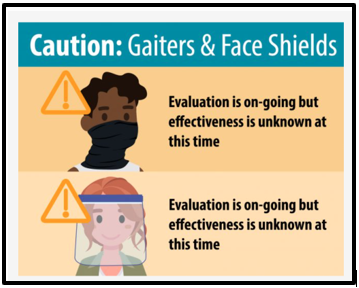
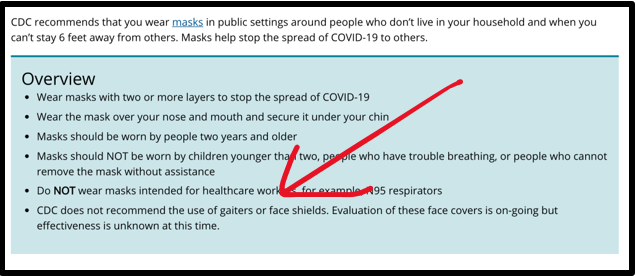
As of this writing[2], there is documented evidence that the CDC is still weighing the advisability of face shields.  Here is what they have to say:

Gaiter and Face Shield infographic


(For the less cartoon-oriented[3], the CDC says it like this:)

CDC mask guidance

Of course, at the same time, as the member points out, the State of New York now allows face shields to "count" as a face cover:

66-3.2 Face-Coverings....

(i) Face-coverings shall include, but are not limited to, cloth masks (e.g. homemade sewn, quick cut, bandana), surgical masks, N-95 respirators, and face shields.


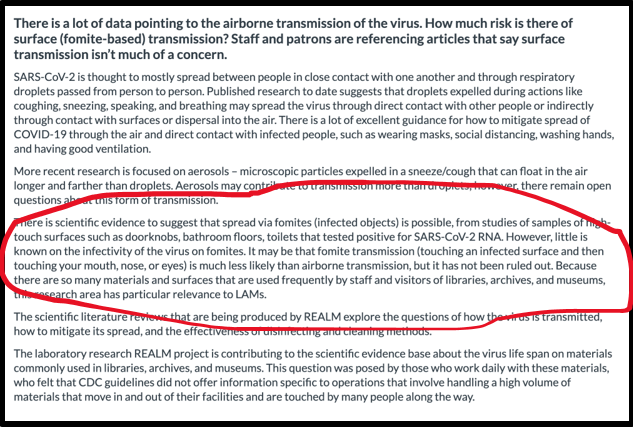
Meanwhile, the REALMS study has hit the library community with THIS cold cup of coffee[4]:

Transmission infographic from Project REALM


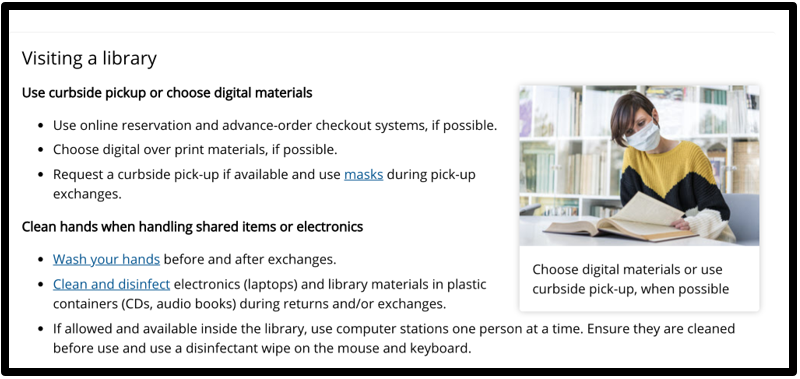
Libraries should be paying attention to all of these evolving resources[5], and should regard their Safety Plan as a "living document" that evolves with that information.  This will help libraries develop a plan that can help them help patrons adhere to CDC guidelines like this one:

CDC Library visit infographic

The bottom line?  If your library bases its access and services on current information, is careful to adhere to its obligations under the ADA, and adheres to a Safety Plan that provides—based on the combined input from such reliable sources—that certain areas may only be accessed by those wearing faces masks (and/or gloves, and/or only if they agree to spray down certain surfaces, and/or only by a certain number of people a day), it may do so.

It all comes down to having a Safety Plan based on your library's unique size, design, staffing capacity, and collection materials.  With a plan that is linked to established factors, the best guidance we can get in uncertain times, and reliable enforcement, anything is possible.[6]

Thanks for an insightful question!


[1] The answer to THIS question is about 15 pages and has 20 footnotes.  Aren't you glad we found a way to make it snappier?

[2] October 16, 2020.  CDC content found at https://www.cdc.gov/coronavirus/2019-ncov/prevent-getting-sick/about-face-coverings.html

[3] I am "cartoon-oriented."  Whenever something can be conveyed effectively via icon or cartoon, it should be.  Of course, as a lawyer, I experience no shortage of words.

[4]  https://www.oclc.org/realm/faq.html.  On a side note, how bad is my DIY mark-up of this content?  It looks like I am trying to draw a squished amoeba. 

[5] My "word of the day," which I learned as I researched this answer, is "fomite" (infected objects). Given what we've all had to deal with in 2020, I am sure I have seen the word before, but was too busy learning the concepts like "zoonotic" & "contact tracing" for it to sink in.

[6] Even wearing a masks while roller skating in a library (but I'd check that one out with your insurance carrier).

Can a public library set up a separate LLC?

Submission Date

Question

A public library is looking at the possibility of taking over the running of a medical loan closet that has been previously run by a church.

The library would find a space through a partner, so it would not be on library property.

The library would be responsible for cataloging the items, tracking their circulation, and applying for grants to help with funding.

The local visiting nurses have volunteered to handle the distribution of equipment, and are willing to continue if the library takes it over from the church.

The library's director and trustees are concerned about insuring the library to protect it in the event that someone gets hurt using a piece of equipment and there is the possibility of a lawsuit. They talked to their insurance agent and the company they use would not cover this.

A discussion came up about starting a separate LLC for the medical loan closet that the library would be openly affiliated with.

Would it be possible for a public library to set up a separate LLC to do this?

Answer

Before I answer, let's talk about why a person or business might create an LLC ("limited liability company").

A primary function of an “LLC”[1] is to do exactly what the member has proposed—to create a separate entity designed to hold the liability associated with a particular venture.

Examples of how an LLC can be used to take on liability (and keep it from flowing to its owner/s) include: ownership of rental properties, operation of restaurants, and yes, collaborative formation of charitable initiatives, like a medical closet operated in affiliation with a library.[2]

This is because, when set up properly, an LLC allows its "members"[3] to have an ownership stake in the company, while minimizing the risk of liability associated with the LLC adhering to other parties (like the members).

For this reason, a lot of property owners and participants in risky ventures[4] use an LLC to contain the liability that could result from the risks of the venture.  This helps with insurance, critical decision-making, and keeping unrelated assets separate from the liabilities of a venture.

Aside from this primary “separation of risk” function, the LLC model also allows creative arrangements for financial operations and tax considerations.  Among many other things that relate to ownership of family businesses, and complex corporate structures, this includes allowing one or multiple 501(c)(3)[5] not-for-profit charitable entities to form an LLC that will have a similar tax status. 

So the "short answer"[6] to the member's question is: YES.

That said, I do have a "long answer" composed of several considerations and caveats, which I hope will be helpful.

Consideration 1: Audit.

While the laws governing public libraries[7] do not forbid--and arguably expressly allow--an education corporation like a public library to own, or partially own, the asset of an LLC[8], a review of various New York State Comptroller audits[9] shows that any assets flowing between the two entities will be considered subject to all the requirements that must be followed by the library.

In other words, if the State Comptroller conducts a fiscal audit of the library (as State Comptrollers are randomly wont to do), the Comptroller will not only look at the books of the library, but also the books of the LLC—subjecting them to the same scrutiny as the library. 

So, to the extent money and resources flow from the library to the LLC, the same constraints on procurement, investment, and other use of assets will be imposed on the LLC.  This could bar or limit the activities of the LLC, so should be a primary consideration when it is formed.

Consideration 2: Operations

By "operations," I mean: who is helping the LLC get the work done?

In the scenario submitted by the member, it is the library who will "be responsible for cataloging the items, tracking their circulation, and applying for grants to help with funding."  Meanwhile "local visiting nurses have volunteered to handle the distribution of equipment."  And finally, as described by the member, the storage/pick-up (the "Closet") will be off-site (not on library property).

This means that the LLC would rent/borrow the space for the Closet, volunteer nurses would work there helping to distribute equipment, and the library would use its personnel to track the lending and equipment.

And although the member doesn't specify, let's say the library doesn't use its own circulation system for this, but instead, buys or builds a custom system—maybe even something as simple as an Excel spreadsheet.[10]

So the library would supply the "time and talent" of its people on an ongoing basis to the LLC, perhaps tracking it as an in-kind support to the charitable venture,[11] and also separately purchase assets that would be solely owned and used by the LLC.

This "time and talent," is where "risk and liability" for the library—even with an LLC housing the operations—truly enter the picture.  Even with a separate entity designed to take the hit, when an entity supplies its own people to staff a venture, there is always some risk that the direct involvement of a third party can lead to an assertion of liability (when people sue, they often look for not only deep, but multiple pockets).

How do you solve that?  It takes two things:

Consideration 3: The Operating Agreement

By law, every LLC must have an "Operating Agreement" that specifies how the "members" run the company.  For small, simple LLC's, an "OA" can be a fairly short document.  For complex ventures with detailed financial goals and complex management structures, an OA can be hundreds of pages.

In the case of a "Medical Loan Closet" LLC meeting the criteria in the member's scenario, the operating agreement would have to address, head-on:

  • The precise responsibilities of each member[12]; and
  • The in-kind services being supplied by each member; and
  • The precise terms under which individuals would contribute their services, including volunteers; and
  • The precise way assets of the LLC are purchased, loaned, and de-accessioned (this is the part the Comptroller would look at); and
  • How the premises of the Closet is managed and insured; and
  • Most critically, the way the LLC would hold harmless and indemnify the participating parties for any assertion of liability against them based on LLC operations.

Which brings us back to...

Consideration 4:  Insurance

At the end of the day, this question is about two things: 1) how to do a good thing for a community; and 2) how to make sure the organizations doing that "good thing" properly manage the risks of doing it.

While much of this can be addressed via good planning, rigorous equipment maintenance,[13] and proper paperwork, as can be seen in "Consideration 3,” and as the member clearly knows, a venture that will be so closely connected to people's physical health must have some form of insurance. The coverage should extend to every person with either a fiduciary, employment, agency, or volunteer relationship with the Closet.

While precise coverage amounts should be determined by the participating parties, my instinct is that there should be at least $1 million of coverage per incident, with no less than $3 million/year aggregate.[14]  But it will depend on many factors.

So, what to do?

Many times, there is a very solid reason to start an LLC.  If the Closet described by the member was going to own real property, have its own employees, apply for grants, and in general, take care of most of its operations in-house, with the support—but not the direct service—of the members, I'd say that was the right solution for this scenario.

However, if the Closet is to be a collaborative effort that will rely on the direct services and assets of the member organization/s (in this case, services by library employees, on library time), in my experience[15], a tightly structured plan that properly establishes the responsibilities of the collaborating parties—and ensures there is proper insurance coverage for all involved—might be the most practical way to move forward. 

This will also position the library to do the right type and amount of "volunteer vetting" and to properly confirm the conditions of (and insurance coverage for) the volunteers.

So, on a practical level, what am I saying?  A library can spend thousands to set up a charitable LLC to run a Medical Loan Closet[16], and then about a thousand or so a year to ensure the proper administration of that LLC--or it can develop the Closet as a program of the library (either stand-alone, or in collaboration with others) and spend the money on additional risk management and insurance. 

After all, we're not talking small engine repair, here.  Lending things—even if it is health-related equipment—is part of any library's core mission.

At the end of the day, many factors will play into the decision to use 1) an LLC, 2) a collaboration agreement[17], or 3) to simply operate the Closet as a new program of the library (with some volunteer agreements for the nurses). 

To get to the part where the library can make the decision, I advise developing an "Operational Plan"[18] for the program, and getting quotes from several insurance carriers as to what the coverage would costs for your library and/or for a new entity to conduct the activities in the Operational Plan.

Since there will be a lot of detail to review, a small ad hoc committee[19] consisting of a board member or two, the library director, any other person whose input will be helpful, and the library's attorney, can then review this information, and come up with a solution to pitch to the board. 

And when that pitch is made, everyone should be confident that there is no "wrong" way to develop a new, life-saving lending initiative—so long as the way selected clearly defines everyone's responsibilities, establishes that clarity in writing, assures legal and fiscal compliance, and ensures everyone helping out is covered by insurance.  With the right attention to detail, this could be an LLC—or another solution.

I wish this venture luck and stout hearts for getting it over the finish line; it sounds like a great asset to any community!


[1] When I write about LLC's, I really struggle with putting "an" before an acronym that begins with a consonant ("LLC").  But the rules on "indefinite articles" assure me it is proper.

[2] There are some questions about the operation of a collaborative 501(c)(3) LLC in New York, but they happen, and haven't been shot down yet.

[3] "Members" is what the New York State Limited Liability Company Law calls owners.

[4] I don’t mean “risky” as in “Don’t drive that Pinto!” In in this context, “risky” applies to any venture that has a risk of exposure to legal claims due to having premises, employees, contractual obligations, or providing goods/services.  In that context, even my own law office (which is a type of LLC) is “risky.”

[5] "501(c)(3)" is a designation from the IRS that allows a library or other charitable organization to accept donations while the donor takes a deduction.

[6] Trust me, this WAS that short answer!  Another business lawyer who reads this will find it pretty skimpy.

[7] The Education Law, the Not-for-Profit Corporation law, the General Municipal Law, the Public Officer's Law.

[8] This is NOT to say that the local library could engage in a hostile takeover of the LLC-operated laundromat next door to ensure the very loud HVAC system is turned off during children's story hour.  A not-for-profit, and a public library, both have extensive rules regarding what assets and investments they can own, and how they can benefit from them.  But it could be done (in my hypothetical, it could be done if either: a portion of the laundromat income was a directed donation used to purchase special collections OR if use of the machines to clean clothes while reading or using library Wi-Fi was a free service to the community tied into the library's Plan of Service.  Which, by the way, would be AWESOME).

[9] When I want to relax, I just pop on over to the Comptroller's "library audits" page at https://www.osc.state.ny.us/local-government/audits/library, and have a jolly good read.

[10] My apologies if my assumption that such a project could be tracked via Excel is laughable.  While I can script out workflow and compliance protocols like a pro, my database programming skills stop with a 4-column chart in "Microsoft Word."

[11] Remember, the assets of both a not-for-profit and a public library come with heavy restrictions.  This includes the "asset" of the workforce.  In this scenario, we're assuming all the right paperwork for "lending" employees to a venture is properly in place...not something to assume lightly in the Real World.

[12] Operating a charitable LLC is fairly simple after the start-up phase, but there are routine tasks that must be kept up with: book-keeping, audit, routine IRS and Charities Bureau filings, compliant procurement, de-accession.  Consider who will be responsible for all these things.

[13] This consideration—about properly maintaining loaned health-related equipment—is addressed in the RAQ response to a question we got back in April 2020 about lending a Telehealth kit, which is found here: https://www.wnylrc.org/ask-the-lawyer/raqs/132.

[14] A great short cut on this would be to find some other medical loan closet programs in New York and ask who their carrier is.  Establish your credentials and tell them why you need the information first, though...places get VERY nervous when you ask who their insurance carrier is!

[15] At this point, I have worked on joint ventures for educational purposes, arts purposes, community gardens, the development of apps for civic transparency, community murals, and just about every feel-good thing you can think of.  I will never be rich, but I love my job.

[16] A word of caution: the phrase "Medical Loan Closet" is part of a name protected by a trademark, the "Wichita Medical Loan Closet" which can be seen here: https://tmsearch.uspto.gov/bin/gate.exe?f=tess&state=4802:iitou7.3.1. When developing a "closet" program here in New York, take care to distinguish your brand so there is no risk of getting a cease-and-desist.

[17] Remember, a “collaboration agreement” is different than an LLC’s “operating agreement.”  A “collaboration agreement” unites the efforts of two or more entities creating the venture, and manages risk WITHOUT creating an LLC. 

[18] The "operational plan" will evolve once you make the decision about the entity type, but to start it is just a description that sets out how the Closet will run.  If the idea is largely to use the same model used by the current operator, that is a fairly simple task, but make sure to include every role and responsibility, simply noting "TBD" is you don't yet have an answer.  An inventory of equipment will be an essential component of this exercise.

[19] Since I have hit you with a lot of detail that could be daunting, I will add this gratuitous advice: if possible, have a meal or fun snack at your planning meetings (even if they have to be via Zoom right now).  I have been working on a charitable planning committee, and by turning it into a convivial experience, we are getting through some fairly obscure stuff while staying in touch with basic human joy.
Children's Library Cards

Submission Date

Question

COVID has made online library card registration essential in many areas. What do we need to consider when dispensing online (temporary cards that allow access to e-resources) and physical library cards to children? At what age, and under what circumstances do we need to get a guardian's signature? Can we require some form of ID for children?

Answer

I remember getting my first library card at the Utica Public Library with my Dad, circa 1985.  It was a right of passage: something "official" before I could drive, or work, or vote; a stepping-stone to adult life.

Of course, back then, we didn't have the Child Online Privacy Protection Act, the SHIELD Act, or the GDPR.  We did have CPLR 4509[1], but if that was part of the application, I probably assumed it was what the library would use to revive me if I had a heart attack in the stacks.

But enough of Memory Lane: this question is rooted in 2020, a time of pandemic, of online ecosystems, and of growing awareness about personal privacy and data security.  During this time, a library putting in place direct access to services for children in the ways listed by the member is a critical service, and as the member points out, introduces a lot of legal factors to think about.

To answer the member's questions, let's dive into them.

Contracts and Kids

Since the relationship of a library to a patron is (among other things) contractual, and in New York a person (generally) cannot be held to a contract until they are 18[2], any terms a library wants to be able to enforce on a minor must require legal consent of a parent or guardian...and in some cases, the contract really is just with the parent or guardian (who I will call "P/G" for the sake of efficiency going forward).

This, by the way, doesn't mean a library can't let minors have a card and borrow books (or have online access, or be in the library) without the signature of a parent or guardian—it just means if you want to enforce any contractual terms against those minors (like the requirement to return borrowed books), it's best to have a P/G's consent along for the ride.


Contracts and the Internet

Most contracts—including those signed by P/Gs binding minors—can be entered into electronically,[3] and a contract signified by a library card is no exception.  So yes, a patron, including a child, can get a library card or access to services through an electronic signature. 

(Just in case you want the nation-wide definition, an "electronic signature" is "an electronic sound,[4] symbol, or process, attached to or logically associated with a contract or other record and executed or adopted by a person with the intent to sign the record."[5])


What about COPPA?

When a website specifically provides services to children, we often have to consider the Children's Online Privacy Protection Act, or "COPPA."  But not today, since COPPA expressly states that the law applies to "commercial" websites and online services and generally not to nonprofit entities like a library.[6]

Although nonprofit entities are generally not subject to COPPA, the FTC "encourages[7] such entities to post privacy policies online and to provide COPPA’s protections to their child visitors."  Since libraries are sticklers for privacy, this makes sense, but if your library does this when setting up online resources for minors, don't call it "compliance with COPPA," call it "doing it the right thing because we want to."[8]


Should we require a parent?

COPPA, by the way, is one of the laws that uses the age of thirteen as the cut-off age for children being able to sign up for things (commercial or otherwise) on their own.  In my experience, 13 is also the age when insurance carriers decide children transition from "vulnerable" to simply "minors."  For this reason, many content providers and services (including libraries) bar access without a parent to those under 13.

All of which is to say: while there might not be a legal requirement to involve a P/G, in general, I'd say this is a good practice.  Good—but not required.  Remember, to legally enforce any conditions[9] (collect fines), you need a P/G's signature, but if you just want to let a kid borrow a book without consequences enforceable in court, you don't.


Let's see some ID?

Okay: you're set with electronic signatures.  You know you need to get P/G into the mix for patrons under 18.  You're "Doing The Right Thing Because You Want To" when it comes to soliciting information from minors under 13.  Do you need to see identification to make things official?

That depends.

If the privileges the library card or access grants come with conditions you will need to enforce in a court of law (fines, damages), it is ALWAYS better to get some form of identification or proof of address.  I say this, because when lawyers sue, proper ID and proof of address is how they know they are suing the right person.

Similarly, if there is an age or residency requirement, or a financial element (for instance, loading money onto an account), or if a person is to have access to another's account, you might need to require ID. 

Because the need for it will vary, when to require ID is a good question for your local attorney.  From my perspective, if a person is allowed to take out more than $10,000.00 worth of library assets at a time, or a library wants to be able to collect fines, I'd want to know how to enforce a return of those items.  Similarly, if patrons are allowed to access services from third-party vendors through their library card (software programs, audio books, anything governed by a third-party license), and there are consequences for a violation, it is good to have solid information about who your patron really is.

The problem is, if you are going to require ID, you must have a solid policies and procedures that address:

  • Requiring ID in a manner that does not disproportionately impact those who live in poverty, or other categories of people[10]
  • Requesting ID
  • Evaluating ID
  • Securely retaining and routinely destroying hard copies of ID
  • Securely retaining and routinely purging electronic copies of ID
  • Have a plan for data breach impacting retained ID

Basically: the reason a library would require ID—aside from verifying that a person lives in the relevant area of service, or is who they say they are—is to collect damages or to legally enforce conditions the patron has agreed to as a condition of a card.  Since that is an unpleasant business, its best to avoid it whenever you can...but when it's important, it's important to do it right.

I enjoyed writing this answer, because as part of it, I got to poke around and see how different libraries are solving this issue.  I saw some great stuff, including a temporary e-access system that let the technology do all the work (requesting verification of age via click-thru, using location services to confirm location in NY, imposing conditions on digital content via function without the need for legal enforcement mechanisms).

It is good to see when the law inspires, rather than quashes, creativity and information access.  I hope your library and library system finds this helpful as you imagine new ways to connect people to vital services!


[1] Requiring libraries to not release an individual's library records to a third party.

[2] There ARE some exceptions, but unless your library is hiring a minor to act in their movie, or selling a married couple of 17-year-olds a house, they shouldn't apply here (see General Obligations Law § 3-101).

[3] (15 USCS § 7001) states: "a signature, contract, or other record relating to such transaction may not be denied legal effect, validity, or enforceability solely because it is in electronic form."

[4] This definition's use of "electronic sound" created a rabbit hole where I envisioned a series of "auditory" contract signature proceedings where a person uses their Spotify Playlist to accept contracts.

[5] 15 USCS § 7006

[6] Entities that otherwise would be exempt from coverage under Section 5 of the Fair Trade Commission Act, which most if not all libraries are.

[7] You can find this "encouragement" at https://www.ftc.gov/tips-advice/business-center/guidance/complying-coppa-frequently-asked-questions-0

[8] A great guide for "doing the right thing" is here: https://www.ftc.gov/tips-advice/business-center/guidance/complying-coppa-frequently-asked-questions-0#A.%20General%20Questions

[9] By "enforce conditions," I mean contractually, in a court of law.  A library can always ask a 12-year-old to pipe down, and enforce its Code of Conduct if they do not.  But to collect fees, get a P/G signature!

[10] This question is critical to a library's mission.  While there is no "right" answer, I can say that even facially neutral things such as asking for utility bills, pay stubs, or non-driver ID can alienate people within a library's area of service.  I advise maintaining a list of ID types that includes "the usual" types of ID (driver's license, ss card, birth certificate, non-driver ID), and some other types, as well (report card, lease, or any correspondence from a government agency (with private information redacted)).  The list maintained by NYPL, who clearly gets this issue, made me smile: https://www.nypl.org/help/library-card/terms-conditions.

Template Facility Use Agreement

Submission Date

Question

Can you provide a template facility use agreement for renting or allowing community groups to regularly use space in a public or association library?

Answer

Yes, I can!  But first, a few caveats:

  • Any template contract is just a starting point.  Use a lawyer to generate a version of this document customized to your library. 
  • For any Organization that wants to use your library for a high-risk event (sports, concert with stage or sound equipment, large event open to the public, routine presence of children), whenever possible, additional review for insurance concerns and premises liability is wise.
  • When filling this out, always make sure the nature of the Organization is confirmed (individual, DBA, LLC, NFP, corporation, etc.), and you have confirmed they exist as stated. 
  • If the form shows that an activity requiring a professional license is going to happen (haircuts, massage, tax prep, legal clinic) obtain a copy of the insurance coverage for the professional activity and make sure it names your Library.
  • No political events should occur unless it is confirmed the arrangements conform to IRS and NYS Charities guidance.
  • A copy of the signed contract should be kept for 7 years (because the statute of limitations to sue on a contract is 6 years). 


ABC Library

FACILITY USE CONTRACT

This contract for facility use is between the ABC Library (the "Library") and INSERT NAME ("Organization") an [insert type organization/individual] ("Organization") with an address of [INSERT], for temporary use of [INSERT ROOM# or Description] in the Library (the "Space").

Details of Temporary Use


Date(s) and time(s) of use


NOTE:  If use is routine ("Every Monday in 2020") note the routine


Purpose of use (the "Event/s").  Please describe the activity to be conducted while you are using the Space.


Estimated maximum attendees


Will you bring in any contractors or third parties under contract for this event?


If so, you must provide the Library with a copy of the contract and they must name the Library on their certificate of insurance.


Please list any special details


Person from Organization who will oversee Organization's use of the Space (must be present at all times) and their back-up person


Name:

Cell number:

E-mail:


Name:

Cell number:

E-mail:


[If applicable]


Rental Fee on a per-use basis


NOTE:  If the use is charitable and the fee is to be waived, the use must not involve any political activity as defined by the IRS.


[If applicable]


Fee is payable to [INSERT] and shall be paid by:


Will minors unaccompanied by parents/guardians be attending the event at the Space?


If yes: does Organization have a policy barring abuse of minors, and requiring instances of abuse of minors in connection with Organization's programs to be reported to law enforcement within 24 hours?


Is Organization a chapter or affiliate of a larger organization?


If so, include larger organization's name.


Will the event involve food or the creation of materials to dispose of?


If yes, what time will clean-up, including removal of all trash and recycling generated by the event, be completed?


Organization's Library Contact (the person who will help them with any questions and address any concerns)


Name:

Email:

Cell:


Library Mission and Terms of Use


The ABC Library's mission is [INSERT].

As part of its mission, the Library requires that all people on Library property abide by all the Library's policies.  In addition, while using the Space, Organization and any person at the Space in affiliation with Organization must at all times follow the below rules, and any reasonable request of any Library representative.

Rules include:

No harassing, abusive, or demeaning activity directed at any person or the Space.

No contact that violates any applicable law or regulation.

In the event of an emergency at the Library, Organization shall abide not only by the reasonable request of any Library representative, but also any first responder assisting with the emergency.

In the event of any injury to any person, or incident of property damage while the Space is in use, Organization will immediately notify the Library Contact listed in the chart above immediately.  In the event of a crime or medical emergency, call 911.

Aside from those attending the event(s) in the Space sponsored by Organization, no filming or taking pictures of any individual in the library (visitor or employee) is allowed, without their express permission.

After use, the Space will be restored to the condition it was in prior to Organization's use, by the Organization, unless otherwise specifically confirmed with the Library Contact.

Organization will not promote the event using the Library/Space as the location until this contract is fully signed and (if applicable) Organization has paid the applicable Rental Fee.

Drafting note: if the Library does not own the building, add any other rules based on requirements in the lease.

Violation of any rules may result in the termination of this Contract with no refund, and denial of future use.

Emergency Cancellation

This Contract guarantees that Library will reserve the Space for Organization as set forth in the "Details" section, above. However, in the event the Library or a related entity experiences an emergency which, in the sole determination of the Library, requires the cancellation of the use (including but not limited to condition at the facility, weather emergency, or event requiring Library's emergency use of the space), Library shall notify Organization as soon as possible, and work with Organization to refund the fee or determine a new date, whichever is preferable.

Indemnification
To the greatest extent allowed by law, Organization hereby agrees to indemnify and defend and hold harmless the Library, its Board of Trustees, employees, agents, and volunteers, from any and all causes of action, complaints, violations, and penalties, and shall pay the cost of defending same, as well as any related fines, penalties, and fees, including reasonable attorneys' fees, related to Organization's use of the Space, including conduct by any third party or contractor present at the Space as part of the Event/s.

Insurance
Organization shall provide insurance meeting the requirements shown in exhibit "A."

Drafting Note/Instruction: the person at the Library organizing the contract will either select the default insurance requirement, which is the conventional insurance demand, or it shall be determined that no insurance is required.  For organizations conducting routine meetings, and especially if children are served by the Organization, the library's lawyer, and/or your insurance carrier will almost always advise insurance be required. 

Person signing for Organization
The person signing on the line below on behalf of organization is at least 18 years of age and has the power to sign for the Organization.
 

Venue for Dispute
This contract and any related action shall be governed according to the laws of the state of New York, and Venue for any dispute shall be INSERT county, New York.

Accepted on behalf of the Library:___________________     on:___________

                              Print name:__________________


Accepted on behalf of the Organization:___________________          on:___________

                              Print name:________________________

Temporary disuse of a meeting room

Submission Date

Question

My library's reopening plan calls for not allowing group meetings/ programs for a time.

There is some concern for a BOT member as to if the library can legally do this. The concern is if a community group or club that regularly meets in the library were to want to meet again, could they challenge the library in regards to this issue? In a nutshell, the question is "Do we legally have the right to suspend and not allow all meeting room use as the library reopens?"

As library director my thought process is that as long as the policy is being equally and fairly enforced to everyone then there should not be an issue. This does beg the question however as to what may happen if the city, which owns the building calls "eminent domain" and quickly demands use of a meeting space they own in an emergency circumstance. This is rare but has happened a few times in the past.

Any input you have would be greatly appreciated.

Answer

I have been looking at some of my post-COVID "Ask the Lawyer" responses, and they are pretty grim.  Such serious writing.

Of course, these are serious days, and operating during COVID-19 is a serious topic.

But I have been on the lookout for a chance for some joy, if not some outright levity.  And finally, this question supplies one!

Why would a question about temporary disuse of a meeting room make me happy?  Well, as some of you may have noticed, very little gratifies me more than emphasizing a library's autonomy.[1]

So, hear me rejoice: Yes, your library has the right to disallow all meeting room use in the interest of safety!

And if that isn't joyful enough, get ready for more good news: this is true whether your library is a tenant or a landowner, a public library or an association library, a library in a big city or a library in a small rural village!

Why is that?  If a chartered library in New York has assessed its unique space, its unique operational capacity, and its unique ability to operate safely, and as a result has adopted a Safety Plan that does not allow meeting spaces or on-site programming, then...there will be no meeting use or on-site programming.  It's as simple as that.

Now, that said, can someone try and complain about it?  Sure.[2] Can a building owner (like a town or a landlord) try and over-ride it? Yes.[3]  Could a pre-COVID contract be implicated?[4]  Yes.  But as an autonomous entity governed by an independent board, can your library make a Safety Plan and stick to it?  Yes.

As it should be.

Of course, within that autonomy is the obligation to steward and utilize library assets responsibly, and in compliance with the law.[5]  This is why the member's point about uniform enforcement and clarity is so important.  If the access is restricted for the Book Club, it needs to be restricted for the Comic Book Club, and even for the Garden Club.[6]  But after ensuring basic fairness and compliant use of library resources, the baseline decision about what facilities to allow access to during the pandemic is in the hands of the library's board and director.  And as I have said in many of my recent answers: they must put safety first.

Only one thing remains to be said: despite my obvious relish for the task, I want to assure the reading public that I still did my homework for this reply.  As of this date,[7] the only court rulings in New York to address litigation or complaints about library access as impacted by COVID-19 are numerous claims about transmission concerns impeding access to a prison law library[8] (now, in that case, I can understand why someone would complain).  But I found nothing regarding action against public and association libraries due to COVID-induced closure, reduced operations, and impediments to general access.  Hopefully it stays that way.[9]

Thanks for a good question and for some time on the bright side.


[1] It gives me a very "we the people" thrill that no amount of election-year jitters can override.

[2] I am sure that by now (August 25, 2020), MANY of you have heard MANY complaints...complaints about masks violating the ADA, complaints about the Library being too open or too closed, complaints that your signage is in the wrong font, or perhaps complaints about the smell of your hand sanitizer being too fruity.  These days, people just need to complain about something—it helps us feel more in-control.  I know I directed a very strongly worded message to my local government regarding document retention policies after the repeal of Civil Rights Law 50-a; for about 10 minutes, I felt really in charge of my own destiny.

[3] This is why a lease, or at least an agreement with a municipality who may own the library building, is a good idea.  At the bare minimum, such a document should address security/confidentiality, insurance for loss, the protocol for an on-site slip-and-fall, and the process for planning capital improvements.

[4] For instance, a facility rental agreement.

[5] For instance, once your meeting room is again accessible to the public, you can't let a start-up business owner hold a pop-up retail stand there to turn a profit, since that would risk compliance with several laws and tax regulations.

[6] Comics are very cool, but obviously your library doesn't want to play favorites.  And just because the Garden Club shows up with trowels is no reason to give them special treatment.

[7] August 25, 2020.

[8] There are already over a dozen of these.  A typical case can be seen in Vogel v Ginty, 2020 US Dist LEXIS 148513 [SDNY Aug. 14, 2020, No. 20-CV-6349 (LLS)].

[9] It will be hard enough sorting out the impact on budgets and various regulatory requirements.

What to do if an employee tests positive for COVID-19

Submission Date

Question

We got lucky: an employee, who was asymptomatic at work but tripped one of the screening factors requiring him to stay home, was tested and found NEGATIVE for COVID-19.

Our employee is coming back to work, but I have been wondering...what if the test came back POSITIVE?  If we have to quarantine all our employees, we'd be shut down completely!

Answer

First: that is good news about your employee.

Second: a gold star to your library for having a screening system that works, and for following the requirement to restrict an employee who trips a screening factor from on-site work while waiting for test results.

Third: Let's talk about your alternate scenario (the one where you don't get such good news).

As of August 17, 2020, any library[1] that is up and running should have a Safety Plan as required by both the guidance for "Office-based Work", and "Retail Business Activities" (we'll call this the "Guidance").

The Guidance includes the requirement to fill out a New York Forward Business Affirmation Form, which attests to having a Safety Plan.  It also answers the member’s question about what to do if an employee tests positive for COVID-19.

Here is what the Guidance (as of 8/18/2020) requires:

An individual who screens positive for COVID-19 symptoms must not be allowed to enter the office and must be sent home with instructions to contact their healthcare provider for assessment and testing.

Responsible Parties should remotely provide such individuals with information on healthcare and testing resources.

Responsible Parties must immediately notify the state and local health department about the case if test results are positive for COVID-19.

Responsible Parties should refer to DOH’s “Interim Guidance for Public and Private Employees Returning to Work Following COVID-19 Infection or Exposure”[2] regarding protocols and policies for employees seeking to return to work after a suspected or confirmed case of COVID-19 or after the employee had close or proximate contact with a person with COVID-19.

So, the answer to the member's question: "What if the test came back positive?" is: "[I]immediately notify the state and local health department."

After that, the direction from the local health department may vary, but the Guidance requires:

If an employee has had close or proximate contact[3] with a person with COVID-19 for a prolonged period of time AND is experiencing COVID-19 related symptoms, the employee may return to work upon completing at least 10 days of isolation from the onset of symptoms.

...[and]...

If an employee has had close or proximate contact with a person with COVID-19 for a prolonged period of time AND is not experiencing COVID-19 related symptoms, the employee may return to work upon completing 14 days of self-quarantine.

And after that, things can really vary.  But in a scenario where every employee of the library came within six feet[4] of their (now confirmed as) infected co-worker, the library really could be looking at up to two weeks of employees in self-quarantine...along with any other response required by the local health department.

This is not a feel-good scenario.  But the good news is, the same Guidance that requires a library[5] to require employees to isolate also reduces the likelihood of such a remedy being needed.  This is because the Guidance also requires a host of preventative practices to limit exposure in the first place, including:

  • Staggering shifts to limit "close or proximate contact," between people;
  • Creating and posting clear signage;
  • Consistently enforcing masking, cleaning, and social distancing practices

If a library maps these things out for employees, and consistently enforces them, there will be less need for the "isolation/quarantine" sections.  While right now, there is no magic bullet, the simple elements of your library's Safety Plan can reduce the need for quarantine.

And that's it; thanks for a great question.  I hope this answer never has to come in handy for your library.  But just in case it does: here’s a quick checklist for the steps listed in this response [6]:

"CHECKLIST FOR RESPONDING TO NOTICE OF COVID-19 EXPOSURE AT THE LIBRARY; TO BE USED IN CONJUCTION WITH UPDATED SAFETY PLAN"

  • However the library was notified of the potential close/proximate contact, obtain a copy of the notice in writing (or send a confirmation e-mail to the source);
  • As required by the most recent New York Forward Guidance, notify the library's local public health Department (both in person and in writing), and factor in their response[7];
  • As required by the most recent New York Forward Guidance and the library's Safety Plan, determine who (if anyone) else must be restricted from the workplace, for how long; and if any further testing must be required;
  • Ensure the library is taking steps to protect the privacy of any employees disclosing screening factors (like a high temperature);
  • Ensure the library is taking steps to assess if any employee must be given paid time off or will need assistance to claim short-term disability or Paid Family Leave Act benefits;
  • Generate a short statement reviewing the above check listed factors, summarizing what your library has done for each step, and make sure you retain copies of all documentation showing you completed these steps;
  • Once these actions are taken and these determinations are made, notify your Board of Trustees of the critical aspects of the situation, but take care to respect the privacy of employees.


Here is a template notice to the board, designed to reflect taking the necessary steps, while also protecting employee privacy: 

On ____________, the library received notification of an [individual/employee] testing positive for COVID-19. As required by current guidance from the State, we notified the Health Department immediately.  At this time, the direction from the local health department is _____________________________________[this may be extensive]. 

We have determined that # employees must self-isolate until they DATE. 

We have determined that # employees must self-quarantine until DATE. 

We have confirmed with the health department that as a result of this notice and response, and consultation with the [Executive Committee of the board/full board/board officer/other] we will [close/reduce operations/operate under the status quo], unless the board determines otherwise. 

Our Safety Plan has been followed and we have retained the documentation showing such compliance.


[1] Any library that does not consider itself "operated by a local government or political subdivision", that is, since the New York Forward guidance specifically states that the various Executive Orders' business restrictions do not apply to such libraries.

[2] Found at this link as of 8/17/2020: https://coronavirus.health.ny.gov/system/files/documents/2020/06/doh_covid19_publicprivateemployeereturntowork_053120.pdf

[3] According to the Guidance, "close contact" is "to be someone who was within 6 feet of an infected person for at least 10 minutes starting from 48 hours before illness onset until the time the person was isolated."

[4] This should NOT be happening!

[5] Remember, local governments and political subdivisions may decide not to follow these precise requirements.  That said, if it determines it is operated by a local government or political subdivision, a library must then follow the safety plan set by that local government or political subdivision.

[6] Some of this isn't required by applicable laws or Guidance, but is in there to position a library to easily show it followed applicable laws and Guidance.

[7] While keeping confidentiality at top of mind, libraries need to think carefully about a voluntary system allowing users to log visits for purposes of contact tracing.  A voluntary list of names, dates and times, maintained with all due care for privacy, can position a library to participate in a local health department's contact tracing initiative.  This can in turn help a community reduce its rate of transmission.

Asking COVID-19 symptomatic patrons to leave

Submission Date

Question

In regards to COVID-19 when libraries do reopen, (and allow people in) is it advisable to ask customers to leave the public building if they are exhibiting any visible COVID symptoms? If so, are there benchmarks for how extreme symptoms should be or how policies should be worded? There are of course patron behavior policies in place allowing for the removal of anything disruptive, which can include noise or inappropriate behavior. There are some members of our leadership team who believe our safety reopening plan should include provision specifically mentioning symptoms of COVID-19 and the staff's/ library's right to remove them if symptoms are exhibited. There are other concerns that library staff are not medical professionals and we are not able to determine if a few sneezes and coughs are common colds, allergies or COVID. Attached is our library's current reopening plan

Answer

As the member writes, it is very difficult to determine if some physical factors—coughing, a flush, seeming malaise—are in fact symptoms of COVID-19.  Confronting a patron with suspected symptoms can also lead to concerns impacting community relations, privacy, and the ADA.

A good Safety Plan addresses this concern, without requiring patrons[1] to be removed mid-visit from the library.

To position libraries to address the impact of patrons with suspected symptoms, New York's "Interim Guidance for Essential and Phase II Retail" (issued July 1, 2020)[2] states:

CDC guidelines on “Cleaning and Disinfecting Your Facility” if someone is suspected or confirmed to have COVID-19 are as follows:

  • Close off areas used by the person suspected or confirmed to have COVID-19 (Responsible Parties do not necessarily need to close operations, if they can close off the affected areas).
  • Open outside doors and windows to increase air circulation in the area.
  • Wait 24 hours before you clean or disinfect.
  • If 24 hours is not feasible, wait as long as possible.
  • Clean and disinfect all areas used by the person who is suspected or confirmed to have COVID19, such as offices, bathrooms, common areas, and shared equipment.
  • Once the area has been appropriately disinfected, it can be opened for use.
  • Employees without close or proximate contact with the person who is suspected or confirmed to have COVID-19 can return to the work area immediately after disinfection.  Refer to DOH’s “Interim Guidance for Public and Private Employees Returning to Work Following COVID-19 Infection or Exposure[3] for information on “close or proximate” contacts.  [4]
  • If more than seven days have passed since the person who is suspected or confirmed to have COVID-19 visited or used the retail location, additional cleaning and disinfection is not necessary, but routine cleaning and disinfection should continue.

[emphasis on "suspected" has been added]

In other words: your Safety Plan, as informed by the most recent guidelines, should leave nothing to chance.  By using this procedure, library staff are never put in the position of having to guess, ask, or consider if a patron's coughing, sneezing, or other behaviors are COVID-19...rather, the moment the possibility is "suspected," the Plan kicks into action.

Of course, if a patron is properly masked, some of the risk of exposure is limited, even if they are infected (this is why we wear masks and identify areas with six feet of clearance in the first place).  And if a patron removes their mask mid-visit, refuses to keep appropriate distance, or refuses to spray down equipment after using it,[5] THAT person can be asked to leave, simply as a matter of policy—whether they are exhibiting symptoms, or not.[6]

So to answer the question: no, it is not advisable to ask patrons to leave the public building if they are exhibiting any visible COVID symptoms, for exactly the reasons the member provides.[7]  Rather, it is required that your Safety Plan keep people distant from each other, and that the library be ready to address any real or suspected exposure as quickly and effectively as possible. 

That said, having signage that reads "Safety first!  Patrons who are concerned about transmission of germs can arrange curbside service by [INSERT]" is a great way to remind people that if they are having an "off" day, there are many ways to access the services of your library.

I wish you a strong and steady re-opening.


[1] This answer does not apply to employees and visitors like contractors, who must be screened.

[2] Found as of July 25th, 2020 at https://www.governor.ny.gov/sites/governor.ny.gov/files/atoms/files/RetailMasterGuidance.pdf

[3] Found as of July 25th, 2020 at https://coronavirus.health.ny.gov/system/files/documents/2020/06/doh_covid19_publicprivateemployeereturntowork_053120.pdf

[4] I note that the DOH's "Interim Guidelines" do not include guidance to staff with suspected (as opposed to confirmed) exposure.  If an employee feels they were exposed to a suspected case of COVID-19, however, that will impact their answers on their next daily screening, which will trip consideration of whether they can report to work.

[5] Or whatever other safety measures a library has identified.  It is inspiring to read the variety of tactics out there, as listed at https://www.nyla.org/covid-19-library-reopening-plan-database/?menukey=nyla.

[6] Another member raised this consideration in this "Ask the Lawyer" from earlier in July 2020: RAQ #153

[7] Of course, if a patron is having a medical event and you have an immediate concern for their well-being, call 911.

Optional removal of materials from personnel records

Submission Date

Question

The library is using NYS Archives and Civil Service references to set personnel and payroll files records retention and disposition.

A question arose regarding employee rights to request removal of materials from personnel records.

The committee’s question was specifically about removal of a negative matter after the minimum required retention time had elapsed.

In this instance there was no question about the accuracy of the record nor was there litigation involved or anticipated.

Answer

There are a lot of little details to address in considering this question, but first, there is one big principle I must emphasize. When it comes to records retention—and especially when it comes to employee-related records—nothing should be discretionary.

In other words, if an employer wants to create a process where every corrective action plan,[1] performance evaluation, employment-related investigation, or incident report is removed after its minimum retention period has elapsed, that is fine. However, unless it is a benefit that has been carefully negotiated and confirmed in a contract,[2] there should be no process for an employee to initiate optional removal of materials, and by no means should that process require the employer to make a “yes” or “no” decision.

The moment personnel records that could be interpreted as “negative” become subject to an employee-initiated, optional procedure, the employer, simply by having such a procedure, has: 1) admitted that possibility that the materials could have a negative impact on the employee; 2) created a system where such material could be retained inadvertently; and 3) set up a scenario where such a request could accidentally or deliberately be denied or perceived as somehow subject for debate, potentially triggering the possibility of a complaint, litigation, or a damage claim.[3]

Unless retention is being considered for historic/archival purposes, record retention or destruction should never be discretionary (and of course, the decision to retain certain records for historic/archival purposes should be based on objective criteria).  The best approach for management of employee performance-related records is simply that they be retained as required, or be purged when no longer needed, based purely on the category (not the substance) of the records’ content.[4]

So, my answer to this question is: there should be no process for an employee to request optional removal of negative materials from a personnel file. Rather, the removal of material from personnel files should only happen per uniformly and routinely applied policy.[5]  If a negative review or incident report has served its purpose and is no longer needed,[6] it may be removed as part of the routine purging policy and process. If it is still needed, it should be retained.  There should be no middle ground; it creates risk.  If your library is part of a collective bargaining agreement or uses contracts that include this approach, employees should all be notified and trained on how to exercise these rights.

Thank you for an insightful question.


[1] Just in case you are new to the Human Resources world, a “corrective action plan” is a time-limited plan with a clearly articulated goal and measurable steps to address a performance concern.  Here is an example of a properly formulated Corrective Action Plan, taken from my domestic life: “To ensure optimal vegetable growth and family cohesion, for the next eight weeks, every family member will spend no less than ten minutes weeding per day.  To enable verification, family members will place uprooted weeds on the Stick Pile.”  Now, here is an improperly formulated version: “If you Ingrates don’t help me in the garden today, I will put a dead thistle by your pillow tonight.”  Both techniques can, of course, yield results, but only one wins the “Happiest Workplace” award.

[2] Of course, a collective bargaining agreement could create the right to request removal of accurate information from a personnel file.  Again, however, because such a discretionary approach might not be exercised or even known by all employees, I don't see this as a fair or helpful clause (to either employees, or the employer).  A better option would be a simple records purge, or a purge tied to an objective performance metric (“after three years of ‘satisfactory’ reviews, this Corrective Action Plan will be removed from the employee’s record”).

[3] These are all the “little details” I mention in the opening sentence, but as you can see, they aren’t so little.

[4] With all due consideration of privacy.

[5] This could include, by the way, a Corrective Action Plan process with a “self-destruct” measure for the guts of the “negative” issue.  In other words, the CAP policy itself could say “Upon satisfactory completion of a Corrective Action Plan, after # years, the only record retained will be the summary note confirming successful completion of a Plan of Improvement.”  But again, this should be per a uniformly applied policy, not a discretionary request.

[6] By “needed,” I mean, among other things, that proof of the remedial action taken by the employer is no longer required to protect the employer.  While many policies base this on statutes of limitations, most only start the clock after the employee’s period of employment is over, and that, in my view, is generally the most prudent choice.