Construction

Using a Board Committee to Authorize Changes During Library Construction Project

Submission Date

Question

We have a major building project coming up for our library. We are wondering if a committee of the board can be given the authority to make official decisions, which are then ratified by the full board at the following monthly board meeting. We expect the Building & Grounds Committee will begin to meet regularly with a newly appointed project manager to get updates and to approve decisions that can’t wait until a full meeting of the board. It would seem like there must be a means for expediting important business without trying to get a quorum of the board together to approve them every single time. 

Answer

For those of you who can’t wait: the answer is YES! A committee can be set up to approve construction project-related decisions between regular meetings of a public library’s full board.

BUT how this authority is set up is critical, so please keep reading.

A public library board’s ability to delegate this type of authority varies based on the type of library, as well as what is in the library’s charter, bylaws, and policies. For construction projects funded by grants and conditional donations, it is possible that grant terms may also impact how authorizations flow, too.

So how does a library set up a committee to get the efficiency described the member’s question?

Let’s break all that down in a fun and literary way.

While day-to-day coordination with a contractor may be assigned to the library’s director (or, at a larger library, a facilities manager[1]) a major construction[2] project requires extra capacity.[3] Even on a smallish project,[4] a library will need people keeping an eye on the overall picture, or things can go askew quickly. We’ll call this the “Dune Factor.”[5]

Another key element in a major construction project is maintaining a tight and trusting relationship with the architect. We’ll call that the “Fountainhead Factor.”[6]

A huge element is that no matter how great a contractor might be, it is vital to keep an eye on them. While a client’s instinct may be “we’re going to trust they are doing it right and give them their space,” that is NOT how to do it… instead, at regular intervals, the work must be inspected for conformity with plans and specs. This can be done by an “owner’s rep,” a “clerk of the works,” or even a properly experienced trustee.[7] We’ll call this is the “le Carré Factor.”[8]

Short note on timing: it is important to consider these factors, plan for them, and budget for them, BEFORE the job is bid out.

Why is that? Because how these roles become part of the toolbox that the library board (and any committee or person with delegated authority) will use to address issues requiring quick action (by the full board, or a special committee).

Here are common construction issues that may require quick action:

  • Change orders (for example, the specified door model isn’t available, and the next best thing is $5,000 dollars more);[9]
  • Design changes, which also lead to change orders (for example, if the tie-in to an addition needs to change because the old building is deteriorating);
  • Discovery of unforeseen conditions (for example, it is discovered that a load-bearing wall is slated for demolition as part of an open floor plan);[10]
  • Environmental concerns (for example, uncovering friable asbestos);[11]
  • Onsite injury (for example, a worker is injured);[12]
  • Negative public relations (for example, if the contractor’s crew is smoking on the library’s property during a break);[13] and
  • Bees![14]

For all of this, a library is wise to do exactly as the member describes and designate a committee or person to make decisions.

Here is where things get tricky. Because all public libraries[15] are subject to the Open Meetings Law, the meetings of a committee empowered to take action need to be publicized and open to the public. However, many of the scenarios depicted above will provide little to no time for advance notice, and some actions may require executive sessions due to confidentiality (for example, matters that could be in litigation).

To keep things more streamlined, some libraries will hire an “owner’s rep” who will be at the project (Dune Factor), chum up with the architect (Fountainhead Factor), keep an eye on things (le Carré Factor), and have a certain amount of delegated authority to issue change orders that are within the bounds of a pre-approved budget. The best owner’s reps will have serious experience with similar projects and owe 100% of their loyalty to the library.[16]

For economy, some libraries will have the library director fill this “owner’s rep” role. Many library directors, being detail-oriented folks who are passionate about what’s best for their libraries, are well suited to it, particularly if they have already lived through a construction project or two. However, if a library is going to do this, they must plan for the library director not to be able to perform other functions at the same time; in fact, at least 30% of the library director’s time should be assumed as being spent on the project.

From the legal perspective, using the library director for this role is risky. This is because if something is missed, the liability for the mistake comes back on the library, rather than a contractor. The same concern applies if the library decides to use a trustee to play this role informally. So, whenever possible, budgeting for a contracted and professional “owner’s rep” is wise.

Regardless of the model chosen to address the Dune, Fountainhead, and le Carré factors, a library board committee empowered to call a special meeting to approve items over and above budgeted factors—or to amend contracts—can be formed to take quick action, so long as the library’s charter,[17] bylaws, and policies do not prohibit giving a committee such authority.[18]

Here is a model resolution for setting up such a committee, and it includes consideration of the Open Meetings Law requirements:

WHEREAS the Library is planning to undertake a project to [INSERT DESCRIPTION] (“the Project”);

WHEREAS the Project’s contracted cost is $[INSERT COST] (“Project Budget”);

WHEREAS the Library has authorized an amount of [INSERT PERCENT]% of the Project Budget, for a total of [INSERT AMOUNT], as a “Contingency Budget,” to address emergent project costs, such as change orders; and

WHEREAS the Library wishes to avoid costs and delays related to approving use of the Contingency Budget;

BE IT RESOLVED that [INSERT NAMES] are appointed as a “Project Committee” authorized to call special meetings to address the sudden need for change orders and to authorize via a unanimous vote contract changes for amounts not exceeding the Contingency Budget;

BE IT FURTHER RESOLVED that [INSERT NAME] shall have the authority to sign documents related to approvals granted by the Project Committee;

BE IT FURTHER RESOLVED that the Project Committee is also authorized to timely raise concerns related to construction and construction contracts with the Library’s contractors, insurance carriers, and attorney;

BE IT FURTHER RESOLVED that to ensure Open Meetings Law compliance, the Project Committee shall provide the public 48-hour notice of its meetings whenever possible but shall not delay immediate action to do so, shall maintain minutes of its proceedings together with copies of any change orders or expenditures authorized, and such minutes and documentation shall be reviewed and adopted into the record of the next regular board meeting;

BE IT FURTHER RESOLVED that if the Project Committee meets via videoconferencing as allowed by the Library Board’s policy, the information to attend the public meeting will be publicized on the Library’s webpage, if time allows;

BE IT FURTHER RESOLVED that the Project Committee has the authority to call a special meeting of the full board, if a matter of immediate concern requires approval in excess of its authority or of the authorized Contingency Budget; and

BE IT FURTHER RESOLVED that the Project Committee shall only be dissolved after the expiration of the warrantee period of the Project, which shall be [INSERT NUMBER] years after the issuance of the Certificate of Occupancy.

The reason to keep the committee operating after completion of the project is that if anything goes awry (like the new wing begins sinking six months after completion), the group is still empowered to take quick action (like calling an attorney and an engineer).

Hopefully, of course, every major construction project goes smoothly, and the committee’s work will be over as soon as the ribbon is cut on the new project!

Thank you for an important question.


[1]^ A very cool job.

[2]^ By “major construction project” I mean a new build, an addition, or a major renovation that will impact day-to-day operations at the library for at least two weeks.

[3]^ Unless the director is relieved of 30% of their routine duties during construction.

[4]^ Like painting the exterior a new color; see Anne of Avonlea by Lucy Maud Montgomery for an example of what can go wrong.

[5]^ Among many other things, Frank Herbert’s classic science-fiction novel, Dune, shows what happens when a major facility project (a spice mining operation) does not have an on-site project manager.

[6]^ Ayn Rand’s The Fountainhead is about an uncompromising architect inspired by Frank Lloyd Wright, the Prairie School pioneer who notoriously under-engineered many of his iconic cantilevered structures while demanding the right to control furniture placement, leading to conflict with contractors and owners.

[7]^ NOTE: It is generally a responsibility of the architect to inspect for conformity (this is often part of approving the contractor’s applications for payment), but if you read the fine print in the typical architect’s contract, they do not accept liability for errors related to a contractor’s means, methods, and materials. A second set of eyes, which owe a contractual duty to the library, is wise.

[8]^ Spies everywhere!

[9]^ Yes, these examples have happened… but it was real life, not fiction.

[10]^ Yes, that should have been noticed by the architect. This is why quick action is needed, and part of that action is assessing blame.

[11]^ “Friable” as in loose and thus carcinogenic, not tasty with wing sauce.

[12]^ Yes, this should be covered by the contractor’s insurance, but the library should also have an incident report, in case an action is brought later.

[13]^ Yes, that is prohibited by the Public Health Law. Make sure your contractor knows that!

[14]^ Finding bees during construction is a huge money-burner, since the crews have to halt while the bees are removed. Pro tip: if it’s a swarm and not a hive, just wait, it’ll be gone in 12 hours.

[15]^ Even you, association libraries.

[16]^ For this reason, sometimes an owner’s rep and an architect’s relationship can... deteriorate.

[17]^ The likelihood that a library’s charter would impact this is slim to none, but I’ve seen enough charters to realize that sometimes odd things get stuck in there.

[18]^ In particular, check that the bylaws don’t say, “In no event shall a committee make a decision for the board,” or something similar. When in doubt on this, contact an attorney.

School District Public Library Building Permits

Submission Date

Question

We are a school district public library. We own our property. We recently obtained a construction grant and are eager to get our project moving! We have been told we don’t have to get a building permit from our town because we are a school district public library. Is that true? It would be great to not have to worry about a permit.

Answer

Before we dive into this, let’s make one thing very clear: the law in New York State always requires a construction permit! The question is: who issues it?

Confusion on this issue has been caused by “19 NYCRR 1201.2,” the state regulation that specifies which authorities can grant building permits to which types of entities (including schools and libraries).

Most public libraries will fall under sections “(a)” and “(b)” of this regulation. These sections place permitting authority for a private or local government building in the hands of a city, village, town, or county.

However, libraries on property owned by school districts or a regional BOCES will fall under section “(e),” which puts permitting authority for certain projects in the hands of the New York State Education Department (“NYSED”).

The specific wording of the authority given to NYSED is:

(e) The State Education Department shall be accountable for administration and enforcement of the Uniform Code [e.g., issuing building permits] with respect to buildings, premises and equipment in the custody of, or activities related thereto undertaken by, school districts and boards of cooperative educational services [a.k.a. BOCES].

In other words, if the property is owned, leased, or operated by a school district or a BOCES, NYSED will have permitting authority over it. This authority applies to only those libraries that lease property from a school district or a BOCES.

Guidance from NYSED about its permitting process[1] is consistent with this interpretation of the language in section (e).[2]

So, a school district public library needs to work with its municipality for a building permit, unless it is a tenant of a school district or a BOCES.

And now, a note about the library construction process…

Confirming the permitting authority—and who will work with them—is an important first step in the library construction process. When a library designates a person to take point on leading a library construction project, the plan for a positive relationship with the permitting authority should be confirmed early on. If the point person has not done that type of work before, another person[3] with that experience (hopefully with the same permitting authority) should help lead the team.

Thank you for an important question!


[2] Not that it requires much interpretation. As regulations go, this is a model of clarity.

[3] Architect, lawyer, contractor, “owner’s rep,” consultant, board member… it can be anyone, so long as they have the real-world experience.

LED Lighting And Accessibility

Submission Date

Question

A member of the public called me regarding the trend to switch to LED lighting in many libraries, especially rural libraries applying for NYS Public Library Construction Funding. She told me that she suffers from Photosensitive Epilepsy, and LED lights (among other light sources) cause her to have seizures, which result in injuries. She said this disease has limited access to much of what we all take for granted.

The local library, across the street, was the only place she could go because of the older lighting. The library is about to undergo renovation, and LED lighting may be part of the project because of its cost-savings and environmental impact.

She would like the library board to reconsider and asked why the library has not conducted a “reduction of access survey” because public libraries need to maintain or improve access. Are there reasonable accommodations combined to be fiscally responsible?

Thanks.

Answer

This question is at the tip of a large and fast-moving iceberg.

As with many iceberg-type issues, when I started my research, I didn’t know how deep things went.

So, I did my usual thing when a question involves the Americans with Disabilities Act (“ADA”), went to AskJAN.org, to see what they had to say about LEDs and epilepsy.

As it turns out, as of June 6, 2024, AskJAN wasn’t really hip to this issue (LED’s triggering seizures), which--if you perform a simple Google check--you can see is emerging as a “thing.”

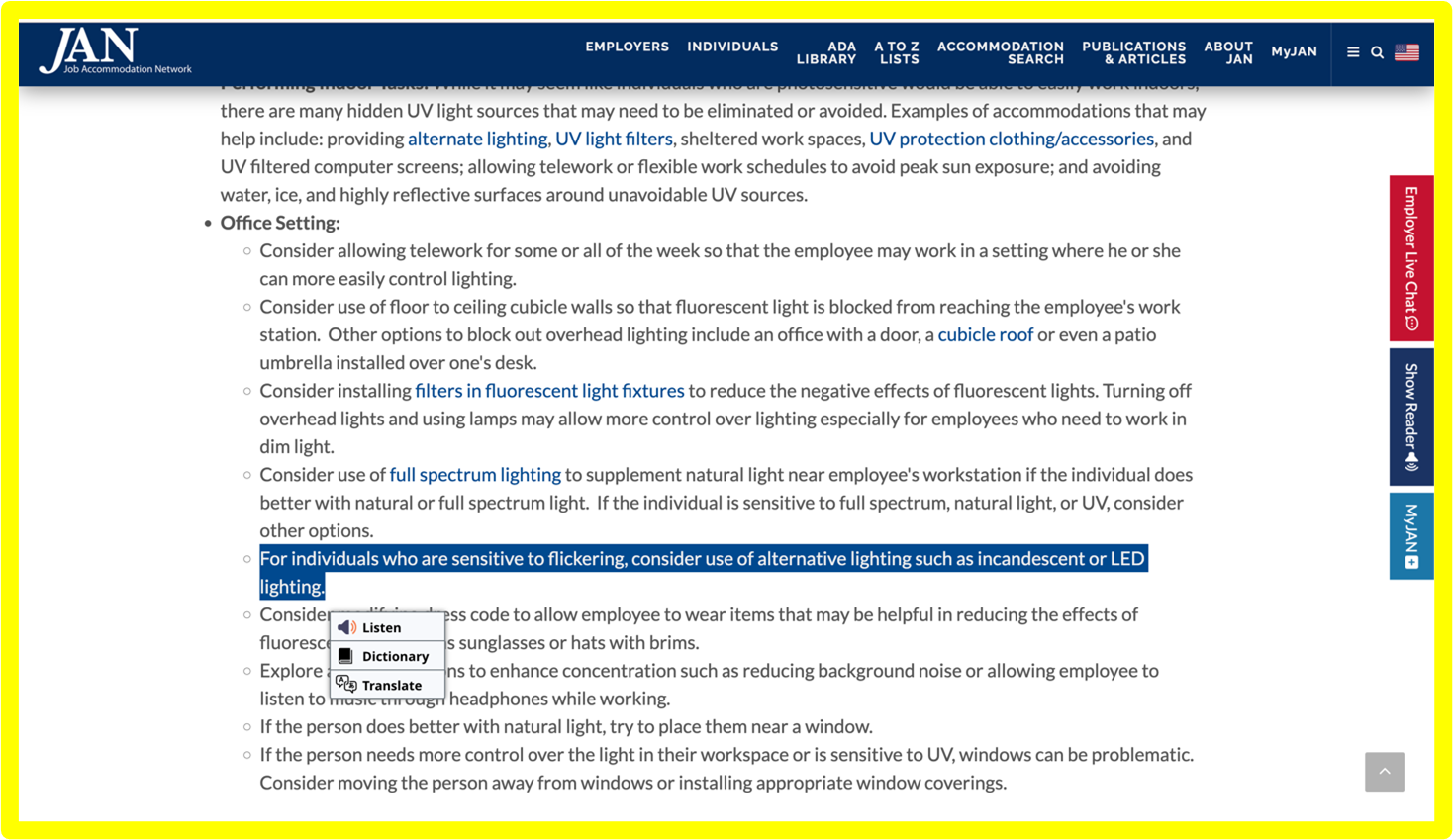
In fact, on their resource page for photosensitivity,[1] LEDs were listed as a possible accommodation, rather than a possible trigger to be mitigated:

 Screenshot from AskJan.org resource page on Photosensitivity. An arrow is highlighting text that reads: "For individuals who are sensitive to flickering, consider use of alternative lighting such as incandescent or LED lighting."

While frustrating, this actually answers the question: when a disability is triggered by environmental conditions (person-made or otherwise), if the need for the accommodation is not broad (like the need caused by limited mobility) it doesn’t become part of design criteria (like ramps designed to address limited mobility). This means it doesn’t automatically get factored in when places of public accommodation are renovated.

Of course, just because something “doesn’t automatically get factored in” doesn’t mean it isn’t considered when a person requests an accommodation. For instance, an employee whose migraines or seizures were triggered by LEDs could request a change in lighting, or to work from an alternate location, and that might be a reasonable accommodation. But again, that is different from a lighting choice during the design phase of a building renovation.

Now, I could leave it there, but we haven’t quite looked at the entire iceberg. So, for those who want to…

  • See some very interesting, annotated background on photosensitivity as a trigger of epilepsy;
  • Get in touch with the groundswell of J.Q. Public’s resistance to LED lighting, not only as a disability concern but a “quality of life” issue; and
  • Get a sense of where the federal government—the primary enforcer of the ADA—sits with LED lights as of May 24, 2024;

… I encourage you to read the U.S. Food & Drug Administration’s reply to the Soft Lights Foundation’s[2] request that the FDA regulate LEDs,[3] a request made in (small) part because there is a growing body of evidence that they can trigger seizures.

The good news is that while they are not required to reject LED lighting on the basis that it could trigger a seizure in a patron, libraries in New York are empowered to make their own decisions about lighting and can take into consideration the potential impact lighting can have on people—employees and patrons—and buy accordingly.[4]


[1] I appreciate that in this case, the photosensitivity is a trigger for epilepsy, not the actual disability. But still.

[2] Yes, there is a “Soft Lights Foundation” whose mission is to advocate “for the protection of people and the environment from the harms of Visible Light radiation emitted by products that use Light Emitting Diodes.” For more information, visit: https://www.softlights.org/about/

[4] Full disclosure: I hate LED lighting. Hate. Hate. Hate. We have some in my office in Buffalo, because it really is efficient, but it’s behind thick panels to dull the de-humanizing impact of its cold, hellish, dystopian lumens.

Management of Municipal Library Construction Projects

Submission Date

Question

I am seeking clarification on the legal provisions regarding the oversight and management of construction projects by a municipal library. Our Law Department has previously indicated that the library board is not authorized to handle construction projects directly, asserting that it is the responsibility of the town. However, assuming full compliance with municipal laws, would it be permissible for the library to manage its construction projects if we hire a qualified project manager and maintain close coordination with the accounting department for payments?

Could you please advise on the legal framework that governs these responsibilities and whether there is any flexibility for the library board to take on such a role?

Thank you for your guidance on this matter.

Answer

Let's begin by breaking this question down a bit and giving one-word answers.

Question 1: Is it legally possible for a municipal library to manage its own construction projects?

Answer: YES.

Question 2: Can a library board take on such a role?

YES.

Question 3: What is the legal framework for such an arrangement?

Well…

And with that, we're out of one-word answers. So, grab a relaxing beverage of choice, get comfy, and join me in fiddling with the Rubik’s Cube of New York State library law: library real estate.

Why is this issue a "Rubik's Cube"?

Well, for starters, there are SIX questions every municipal library board must always know the answer to:

  1. Who owns the library building and grounds?
  2. Who insures the library building and grounds?
  3. Who is responsible for day-to-day maintenance of the library building and grounds?
  4. Who pays for day-to-day maintenance of the library building and grounds?
  5. Who pays for construction, renovation, and repair of the library building and grounds?
  6. Who can sign contracts as the owner of the library building and grounds, and/or who [if anyone] can sign contracts as "tenant" of library building and grounds?

One would think there are only two possible answers to each of these questions ("the library" or "the municipality") and that those answers would have some sort of internal consistency—but that is not the case. Often, the answers are hybridized (with a third party playing a role), and what is written on paper might not be true in practice. Further, a clear answer to one question doesn't mean there is a clear answer to another. This means that the six questions of the "Cube" form scores of possible combinations.

Here are some interesting combos inspired by situations I have run into:

  • The municipality owns the building, but the deed restricts use to only the library, which arranges for and pays for everything but the heat and roof repairs.
  • The library owns the building and grounds, and the municipality has nothing to do with it. NOTHING.
  • Everyone says the library "owns" the building, but they don't own the land; when this is found to not be the case, everyone wants to keep saying it anyway, since that helps keep things separate and emphasizes the library board's authority over the operations of the library.
  • The municipality owns the building and grounds AND has custody of the library's money AND the library board can never get a clear answer on what part of the library budget is being used to maintain and insure the building.
  • The municipality owns the building and grounds, but the library handles everything (with or without a lease).

These different permutations are neither "wrong" nor "right", but they do set the stage for some interesting dynamics. Here are some inspired by situations I have run into:

  • The municipality owns the building, but the deed restricts use to only the library, which becomes very useful knowledge when a new mayor tries to threaten the library with eviction.
  • The library owns the building and grounds, and the municipality has nothing to do with it. NOTHING. So, everyone is happy because there is no cause for friction about real estate.
  • Everyone says the library "owns" the building but they don't own the land. This works well until a construction grant requires proof of ownership and the truth has to be articulated in a letter to the state.
  • The municipality owns the building and grounds AND has custody of the library's money, AND the library board can never get a clear answer on what part of the library budget is being used to maintain and insure the building.  No one knows if/how it is insured. This can be a nightmare.
  • The municipality owns the building and grounds, but the library handles everything (with or without a lease). When there is a lease, it should establish this level of authority: who can arrange a contractor, whose insurance covers what, etc. When there isn't a lease, the lack of clear authority can become a problem.

Because of the variety possible, no two libraries have precisely the same combination of answers to these questions. But each of these questions relates to the member's request for the "legal framework" that enables a municipal library to oversee its own construction project.

Let's examine the six questions with respect to this "framework."

  1. Who owns the library building and grounds?

When the library owns the building and grounds, it is indisputably able to enter contracts for construction (site testing, general contractors, contractors).

When the library doesn't own the building and grounds, it only truly has the authority to enter contracts for construction if that authority is confirmed in writing.

This can get confusing, as anyone can hire services (such as those of an architect) for a building but might not have the authority to do so on behalf of the library.

  1. Who insures the library building and grounds?

This factor is important because insurance and risk management are such a huge part of designing and building a library (whether renovating, repairing, or newly constructing). If the library isn't in a position to call the shots on insurance, it is not truly in control of the project.[1]

  1. Who is responsible for ensuring day-to-day maintenance of the library building and grounds?

Very often, libraries who are not positioned to sign a contract for major construction (because they don't own the building or have a lease or municipal policy that allows them to) find themselves arranging small services such as a plumber visit or a quick repair by an electrician. From what I have seen, this seeming authority is due to one of two things; either 1) the municipality has a policy allowing "department heads" or others to sign on to smaller contracts, or 2) it is due to these smaller contracts flying under the radar of the risk management and procurement authorities.

  1. Who pays for day-to-day maintenance of the library building and grounds?

Even when a library owns the building the issue of "who pays" can result in a municipality denying the library’s ability to sign a routine maintenance contract.

For example, if a municipality funds the library out of a general operations budget (no separate tax levy) and is the custodian of the funds, a municipality can functionally[2] deny the ability of the board even so much to bring in a needed cleaner, if there is not exceptional clarity.

On a more routine level, this aspect can get weird[3] when municipalities deduct or charge costs for services provided by third party contractors or facilities departments, without even alerting the library.

  1. Who pays for construction, renovation and major repair of the library building and grounds?

The examples in #3, above, become more extreme once construction, renovation, and major repair come into play.

Some municipalities will accept construction funds and then try to bundle the projects, using library money to underwrite non-library projects.[4]

Some will reject architectural plans generated by a firm hired by the library, claiming the municipality must be on the contract.[5]

And some, like the member's question describes, will demand to have complete control over a project.

 6(a). Who can sign contracts as owner of the library building and grounds?

This factor is the one at the heart of the member's question.

There are two ways a municipal library can sign a contract with a general contractor for construction:

A) As owner of the building; or

B) With confirmed permission of the actual owner.

"Confirmed permission" is the key term here; the "confirmation" can be in the form of a policy, a letter of understanding, or a lease. It should be in writing, and it should be clear and unambiguous. If it doesn't exist, the library can't (or at least, shouldn't) sign the contract.

6(b). Who [if anyone] can sign contracts as "tenant" of library building and grounds?

If a library is a tenant of its municipality, the lease or license to operate the library within the building should clearly spell out this right or set out the procedures for solely or jointly arranging contracts.

And that's it.

I wish I could offer a more straightforward formula… sort of an A + B = C. But as I said, it's a Rubik's Cube, and a municipal library can have any of several combinations. The bottom line: if the library doesn't either own the building or have clearly articulated authority to sign contracts for and manage risks associated with construction, renovation, or major repair of the building, the board won't be situated to manage the project.

So, for a problem like the one described by the member, I suggest:

Step 1: Research and confirm your library's answers to all six questions.

Step 2: Assess which answers are the cause of any impediment to the library overseeing its own construction projects.

Step 3: Develop solutions to the issues.[6]

This last step is of course a vast step. What makes it extra challenging is that each library will have its own unique solutions, which take months or years to develop and actualize. But I promise there always ARE solutions.

Happy building!


[1] The sentence just won the award for the grossest over-simplification I have ever indulged in. But it's also true!

[2] Not legally; functionally. As in "I have the money, and I say you can't use it this way." This is compounded when the municipality owns the building but can also be a factor when the library owns the property.

[3] "Weird" in this case also means "possibly illegal", since the library board is supposed to approve all expenses.

[4] Did I say "will"? I mean "could." After all, no municipality would ever, ever, ever do this... Right?

[5] I have sympathy for this one. Architectural services contracts come with protections for the client, including protection from liability in the event of a claim related to design failure. But only a party to a contract can invoke those protections. So, if a municipality owns a building, unless the municipality is fully protected by a lease with the library, it should be protected by the architect's contract.

[6] High five to you if you thought, "another over-simplification so soon?"