Public Libraries

Contracts for Library Podcasts

Submission Date

Question

The library's podcast (Your Friendly Neighborhood Librarians), hosted by two librarians here, recently started interviewing guests from outside the organization. We are concerned about a few things: what the ramifications are if a guest does not like the way their interview was edited and whether the library owns the rights to the interview and recording. We only edit for clarity and length, and haven't done anything in regards to copyright. Additionally, any advice on whether we should be using some sort of contract or agreement with guests would be helpful. We don't have any sort of agreement in place at present, and are mostly interviewing people who are somewhat library-related. Thank you for your help!

Answer

Some days, I just love my job.  The day I subscribed to "Your Friendly Neighborhood Librarians" (2/4/22) to answer this question was one of those days.

For those of you who haven't checked out the Podcast: it's a forum where hosts (and librarians) Jim and Robyn, based in Rochester, NY, conduct deep and lively interviews with quasi-local authors.  [1]

When it comes to running a Podcast, there's a lot of legal to unpack.  I'll use a recent episode of YFNL (Season 2, Episode 4, January 30, 2022), an interview with photographer Quajay Donnell to illustrate.

When the Podcast starts, the first thing you hear is the YFNL's theme song:

[guitar strumming] "Librarians, librarians, when you've got questions, they're the ones, to help you find what you're looking for..." [more].  It sounds vaguely like the theme to "Spiderman" and is clearly a riff; it's super-cute and fun and brings a smile to my face. Then Jim and Robyn introduce the session's guest and launch into the interview.

The rapport is lively and fun, but Jim and Robyn's deeply prepared interview technique gives Quajay Donnell room to make comments, tell stories, and respond to well-informed prompts to talk not only about his work, but the work of others, and his thoughts on public art (I enjoy Mr. Donnell's comment, after a glowing list of his credentials "I sometimes struggle with the title of 'photographer', I sometimes say 'I'm a picture-taker', or 'I capture moments'."  I appreciate when people resist or explore the purpose of labels).  The show then ends with a cut to a recommendation from a circulation desk worker, Sim, who recommends "Field of Blood" by Joanne Friedman, and a tease for the next episode ("banned and challenged books"), some thanks to various show-helpers,[2] and an instrumental of that great theme song.

So with that background, let's answer the questions:

"[W]hat the ramifications are if a guest does not like the way their interview was edited and whether the library owns the rights to the interview and recording.  Additionally, any advice on whether we should be using some sort of contract or agreement with guests would be helpful. We don't have any sort of agreement in place at present, and are mostly interviewing people who are somewhat library-related."

I wish I could give simple answers to these straightforward questions, but this is "Ask the Lawyer," so I cannot.  But to start, I can say there are three variables that inform the answer to these questions:

Variable "1": Who is creating the Podcast?  Is it "officially" the library, or is it being created through the collaboration of independent individuals?[3]

Variable "2": What is the identity of the Podcast?   Is it 100% entertainment, or is it meant to be investigative journalism, oral history, or serve another documentary purpose?[4]

Variable "3": What is the purpose of the Podcast?  In other words, what is it trying to achieve not only now, but 70 years from now, when it is still protected by copyright, and past consideration of such questions will govern what type of access its intended audience should have?

Here’s how these variables impact the member's questions:

If a library is the creator of the Podcast (meaning the library directed its employees to create the Podcast as part of the work they are hired to do), then the library is the entity responsible for addressing (and bearing the liability for) issues of ethics, ownership, and risk (like defamation and image use).  If an individual or individuals are the creator/owner of the podcast,[5] the responsibility falls on them. 

If the identity of the podcast is light entertainment (that theme song!), then the creator does not have to worry about abiding by, or benefiting from, professional codes of ethics and law pertaining to journalism, academic work, oral history/documentary, or political expression.  But if it aspires to fall into any of those categories (and while it's not my call, I'd say YFNL is at the very least a form of journalism), ethics and certain laws may apply.

If the purpose of the Podcast is to ensure that people listening in 2022, as well as 100 years from now, appreciate home-grown artists in and around Rochester, NY, the creator/owner needs to ensure the work is set up to be controlled in such a way that access for that purpose is ensured.  This is true whether the owner is an entity (like a library), or a person or persons.

So with that as background, let's tackle the member's questions:

For the first question ('"[what] if a guest does not like the way their interview was edited?), the answer is: in a worst-case scenario (say the guest claims the interview was edited to make him sound offensive, and claims it caused him to be "cancelled"), there could be some type of legal claim for damages.  While I won't get too technical, this concern relates to a "tort" claim (like a personal injury) and the member is wise to bring it up, since this is a critical issue.[6]

An attorney advising an entity or person on this would: 1) confirm who the creator, publisher and owner of the content is; 2) ensure the party (or parties) makes good use of a speaker agreement that secures a waiver of liability for the producer and all people affiliated with the podcast; 3) if appropriate,[7] advise a step in the production process that gives participants the right to review and approve release of the final version (in writing).

This plays into the second question: "whether the library owns the rights to the interview and recording."

This should not be an ambiguous issue: either the work is "for hire" (meaning the librarians and other credited helpers are doing it as part of the work they are paid to do, or are working per an additional contract) and is owned by the library, OR the work is owned by the individuals creating it.

The leads to the third question (or rather, factor) listed by the member: We only edit for clarity and length.

This plays into the identity of the podcast. If a podcast or other work isn't using a lot of editing to create a specific dramatic or entertaining effect, and is structured to perform a primarily documentary function, it is worth considering using the established ethics of journalism or oral history to guide the project.

Why? 

In the state of New York, journalists' sources are accorded particular protections under the law, while the identity of the speaker and nature of the communications are relevant to claims of defamation. Also under New York law, the further an unauthorized[8] use of someone's name, likeness, or voice, is from a "commercial use," the less likely a person can sue based on "invasion of privacy." And under federal copyright law, material that incorporates copyright-protected work (perhaps reading part of a poem) for journalistic, academic, or documentary functions will get consideration of that factor if a court needs to determine "fair use."

This next variable I listed is purpose, meaning, what is this work supposed to accomplish, and for how long? Consider that variable in light of the member's statement: "[We] haven't done anything in regards to copyright."

If the purpose of the podcast is to ensure as many people as possible access and appreciate it for as long as possible, what might be more important than registering a copyright is to ensure the work is archived on not only a commercial service such as Apple Podcast (where I found it), but in repositories owned by the public, as part of an institution whose structure ensures some type of longevity.

However, if part of the purpose of the podcast is to ensure for as long as possible that it can never be exploited commercially by anyone, and the owner wants to make sure it will be able to claim damages and attorneys' fees in the event the recording is infringed, registering it is a good idea.

So with that, I get to the last, open-ended question from the member: Additionally, any advice on whether we should be using some sort of contract or agreement with guests would be helpful.

It's important to know at this point that while sometimes I reach out to a member who submits a question to "Ask the Lawyer" (to get a bit more information to enable a more helpful answer), in this case, I did not reach out to Robyn and Jim (although because I really like the podcast, I wanted to!). I thought it would be more important, and in the spirit of their question, to present a generic answer to this part of their question with a generic template that could be of use to other libraries and librarians creating a podcast or other type of audio content.

When creating a podcast, here are the "legal" questions to answer to help you (and your lawyer) address the legal considerations:

Question

Reason it's relevant

Your answer


What is the purpose of the podcast?


It's important to answer this question first, because the purpose of the podcast will drive all the answers following this one.


Are there any professional ethics that apply to the podcast?


This answer is based in part on the "purpose." If the purpose is a type of journalism, the creator may want to consider affirmatively abiding by applicable journalistic ethics. If the purpose is oral history, the ethics of oral historians could apply.


Who "owns" the podcast?


This is a question for a lawyer. However, I can broadly say that if a library or educational institution is directing the podcast to be created, and the people creating it are doing so as part of their jobs, then the podcast is owned by the employer. If everyone involved is unambiguously doing it in their free time, then likely, they are the owners together. And in either case, if there is any grant funding that applies to the podcast, the owner(s) should pay close attention to the terms of the grant, because often grants involve a license or transfer of intellectual property.


What is the end product?


This seems like a pretty straightforward question, it's "podcast recordings," right? However, in just taking a look at "Your Friendly Neighborhood Librarians" I heard a theme song that could be subject to individual copyright, and I see there are really excellent descriptions of each podcast that were authored by somebody. In addition, "Your Friendly Neighborhood Librarians" (a clever brand) could also be subject to trademark. There is also a logo.  And if the content is in its own archive with its own metadata, the metadata could also be proprietary. These are just a few examples, so inventorying the end creation (and if all of the creators are not employees, making sure intellectual property is transferred appropriately) might be bigger than maintaining a list of podcasts.


What are the terms for regular and guest contributors?


For podcasts being created by people as part of their jobs, the expectations, rules and protections for them should be understood between their job description and the rules by which the podcast is operated.


For guests, as the member's question points out, it is best to have a written agreement that sets out the terms, including the right balance of a waiver of liability and the ability to preview the podcast to ensure any editing does not result in a person saying something they didn't intend to say.


(As one example of "rules": if a podcast is being produced by a public library or a not-for-profit organization, there should be a firm rule that no endorsements of political candidates are allowed on the show.)


What other conditions may apply?


For podcasts released on Apple Podcast, this means what are the rules you have to follow under the terms of Apple. For those selecting additional or alternate fora, paying attention to the "terms and conditions" on those resources is also important.  And as mentioned above, grants and donations with conditions that support the content creation should also be considered  (if you are lucky enough to be running a grant-funded podcast).


How do people access the content?


This is critical for ensuring accessibility in both the short and long-term.   Early consideration of this factor also ensures that any legal releases or agreements an owner needs to enter into (like licensing a logo) can accommodate the full plan for accessibility. 


How are any risks being addressed?


I appreciate this is a very open-ended last item. Broadly speaking, if the podcast is being produced by the library, the library's insurance carriers should be consulted to make sure it has insurance coverage for that type of activity. Any aspect of the podcast that is not covered should either be limited or other risk management, such as a waiver of liability, and a process for preview by guests, should be considered.


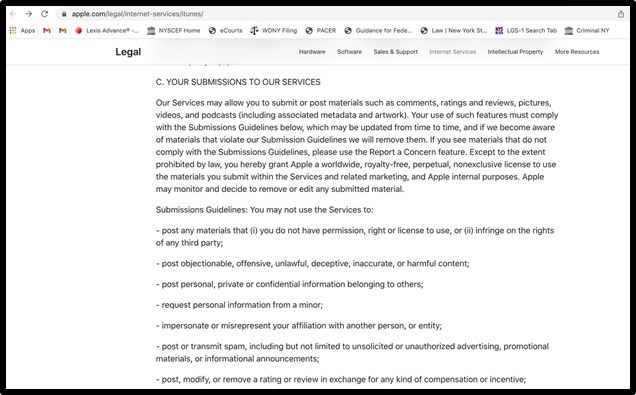
This last item is addressed by Apple's terms of use for podcasts, which I have included below.


Screenshot of submission disclaimer language

Now, with all that said, I am very aware that some of the answers I have put above may cause more anxiety then resolve curiosity. To help out with that, below is a template for a "podcast guest agreement."

As with any template, a library or podcaster should have their lawyer consider all of the factors I list above before finalizing the template. But hopefully this template can provide a good start.

[Template Podcast Guest Agreement]

RE:  Terms of guest appearance on [PODCAST NAME] on [DATE]

Dear [NAME OF GUEST]:

Thank you for agreeing to be a guest on our show, [NAME] ("the Show") on [DATE TIME] to discuss [TOPIC].

Below are the terms between you and [OWNER NAME] ("Show Publisher") for your appearance on the Show.  Please review the terms, and if you agree, please sign below.

If you have any questions before signing, please contact [NAME] at [CONTACT INFO] to discuss them before sending us the signed copy.

Ownership

You agree that the direct recording (audio and visual) and any subsequent product incorporating it, including but not limited to transcription and any adaptive copies made to enable access by those with a disability, shall be the sole property of Show Owner.

Image Use

You agree that for purposes of promoting, publishing, performing, displaying and making the Show accessible to its audience, Show Owner may use your name, image, and likeness in print and electronic media.  This permission is expressly limited to promoting and publishing the episode of the Show featuring you.  This permission is irrevocable once the Show featuring you has been made available to the public in any medium.

Rules

The rules of participating in the Show are:

Show Owner is committed to creating an experience and show that respects the dignity of all participants and listeners.  If you have any concern at any point regarding your experience working on the Show, please alert [NAME] at [CONTACT INFO].

If at any point during recording you need to take a break, please simply state "I need a break" and we'll stop recording.  This includes if a topic is not one on which you wish to speak.

We edit our show for length and clarity.  You will be given an opportunity to review the edited version prior to it being uploaded to [SITE(s)].  We ask that you write to [NAME] and [EMAIL] with any concerns about edits within [#] days of the final cut being made accessible to you.  If we don't hear anything from you within three days (excluding Saturday and Sunday), we will assume you consent to the publication of the content.

Please refrain from any endorsement of any political candidates during recording.

Please do not accuse any person of a crime, having an STD, or of being incompetent at their job, or marital infidelity, unless such fact is generally known, during recording.  We don't anticipate your appearance will warrant a dip into such a topic, but to avoid claims of defamation, or having to edit out such content, we alert guests to this consideration.

[INSERT CUSTOM RULES]

Hold Harmless

You release and hold harmless Show Owner, its employees, volunteers, and agents from any and all liability, claims of injury, lawsuits, and complaints in association with Show.[9]

Warranties & Representations

You represent and warrant that:

a) No contract or other obligation bars you from appearing on the Show;

b) Any performance on the Show by you will be of your own original work;

c) You are aware that the permission you are granting NAME to use your image, name, and likeness for the limited purposes listed above is irrevocable;

d)  You know the show will be archived by Show Owner and may archived to be available for your lifetime and beyond.

e) You are over the age of 18 and thus able to sign this contract OR your legal guardian has signed below.

Thank you so much for agreeing to be on our show!

Signed on behalf of Show Owner:___________________________

Signed by Guest:______________________________

Guest Date of Birth:_______________________________

Guest preferred pronouns:_____________________________

[if applicable] Signed by Guest's parent or guardian:____________________________


Good wishes for your friendly neighborhood podcasts, true-believers!


[1] For any Western New Yorker lamenting the decreasing number of journalists on the local creative beat, this is a nice antidote.  (BTW...Buffalo/Rochester = WNY.  Syracuse/Rome/Utica = Central NY.  I grew up in Central New York and now live in Western New York, and when this distinction gets blurred, it hurts).

[2] Including two people credited for the theme song.

[3] In my experience, librarians can have a tough time with this one, since they often go above and beyond.  For more on this type of issue, see the "Ask the Lawyer" on LibGuides at https://wnylrc.org/raq/previous-employer-re-assigned-authorship-libguides.

[4] I realize that these categories overlap, especially these days, but we'll talk about why the distinctions are important.

[5] It's official: I am using a lower-case "p" to write "podcast."  Congratulations, podcast, you've been genericized.

[6] It is also very much an "issue de jeur", since the ALA has joined an amicus brief on the rules in the state of New York for suing non-journalists for publishing content in public fora.  For more on that, search "Coleman v. Grand."

[7] This is a major distinction between a cultural or entertainment piece rather than investigative journalism, since professional reporters generally don't give interview subjects the right to approve a final cut.

[8] In this case, "unauthorized" means without written, signed permission.

[9] If you don't have a lawyer look at any other part, have them look at this.  This is a very bare-bones hold harmless intended to not "scare off" guests; a library should have a clause that matches the level of risk it is prepared to take.
Libraries Open to the Public Template for Copiers

Submission Date

Question

We were asked about signage to post over the public copier at a libraries open to the public. Below is some template language with footnotes explaining why they say what they do.  Of course, before posting in your school or library, check with your lawyer!

Answer

MAKING A COPY ON THIS MACHINE

MAY BE SUBJECT TO THE COPYRIGHT LAW OF THE UNITED STATES[1]

This means 4 important things:

1.  Copying a copyright-protected work here could be a copyright violation.[2]

2.  Copying protected works is sometimes allowed under "fair use."[3]  We can't give you legal advice, but if you want to learn more about "fair use," go to https://www.copyright.gov/circs/circ21.pdf or see the [INSTITUTION NAME] Fair Use policy at [LINK].

3.  Copying a copyrighted work to accommodate a disability under the ADA is allowed.   However, to do that, please see the library staff, since adaptive copies have special rules,[4] and we want to help you (or a person you are assisting) exercise your rights.

4. As a library open to the public, there are special circumstances under which we get to make copies (libraries are special).  However, to qualify for that protection, this notice (which we have, by law, placed over the copier right in front of you), has to say what it says in bold at the very top, and we have to operate by this rule:

Any person or group is forbidden to use this machine to engage in the related or concerted reproduction or distribution of multiple copies of the same material, whether made on one occasion or over a period of time, and whether intended for aggregate use by one or more individuals or for separate use by the individual members of a group.

What does that mean? Entire classes should not come here and copy the whole text book for a course![5]  Please don't do that.[6]

The copy machines are here for your use, and we appreciate your consideration of these laws.

Thanks!


[1] This precise language is required by 17 U.S.C. 108 for the library and its employees to be protected against allegations of secondary infringement.

[2] 17 U.S.C. 106 reserves the making of copies to the copyright owner.

[3] 17. U.S.C. 107 allows copying under certain circumstances, but simply "educational" or "not-for-profit" use is not enough.  Read the guide at the link!

[4] See https://www.loc.gov/nls/about/organization/laws-regulations/copyright-law-amendment-1996-pl-104-197/.

[5] This is covered by 17 U.S.C. Section 108(f).  Section 108 also lets libraries make copies for other uses...but that is for libraries, not regular people or students using a copier in a library.

[6] Seriously, if we see you doing that, we have to ask you to stop.

Agenda Changes

Submission Date

Question

Often times, our meeting agenda changes so we would like to add a disclosure at the bottom that reads “Agenda is subject to change.”

Is this something that is allowed, and would it need to be included in our bylaws?

Answer

With the changes to the open meetings law and more attention on library leadership generally, now is a good time to think about the nuances of public library meeting agendas.

Since agendas have to be posted in advance, it is true that sometimes a board may have to make an 11th-hour change.

The typical ways to address the need to switch up the agenda, once it is set and published in advance as required by law, are:

1.  To use the "new business" section to add anything that wasn't announced in advance;

2.  For items on the agenda that, for whatever reason, must be removed/postponed or changed, to do it by motion, such as:

"RESOLVED: Due to the board still receiving active public comments, the comment period has been extended and the agenda item to review and discuss the comments on [TOPIC] is to be rescheduled to the next regular meeting of the board.

OR

"RESOLVED: Due to the confirmation that insurance will cover the damage, the emergency fundraising discussion is no longer needed."

There is no problem with also including on public notices "As board agendas and meeting notices are generally set one week in advance, the board may announce new business or change posted items, as warranted by circumstances and the best interests of the library."

The thing to avoid (because it can leave you open to criticism, not really a huge legal vulnerability) is "unofficial" changes to the agenda.  By using "new business" for unexpected items, and resolutions to change set items, the minutes will reflect proper adjustments that change the agenda.


Donations Solicitations for Public Libraries

Submission Date

Question

A town municipal public library has been told by the town that the library cannot have a donate to the library button on the library's website. The library hosts its own website, and the donations would go into a library checking account.

The town feels that the library will be seen as fundraising. Is there a comptroller's opinion or NYS Law that states municipal town libraries (or school district or special district) libraries cannot ask for donations on its website?

Thanks

Answer

There is no legal authority in New York that denies the ability of a town public library (or any municipally affiliated public library) to solicit donations.

There is no law that bars it.

There is no regulation that bars it.

There is no comptroller opinion that bars it.

There is no attorney general opinion that bars it.

There is no case law that bars it.

Now, despite all that lack of barring, there ARE many reasons why libraries funded by tax dollars, and operating in conjunction with a municipality, may want to avoid the general solicitations of donations (some previous "Ask the Lawyer" RAQs on this issue is here: https://www.wnylrc.org/ask-the-lawyer/raqs/282,  https://www.wnylrc.org/ask-the-lawyer/raqs/68 and here: https://www.wnylrc.org/ask-the-lawyer/raqs/25). For those reasons (and maybe ten more I could name after a strong cup of coffee), I always strongly urge public libraries who wish to solicit donations to have a precise, defined purpose for soliciting donations...something that is distinct and separate from the core operations of the library.

For example, if the library would like to sponsor local artists to create window displays related to new books and programming, a solicitation could be "Donate to our local artist window program!" Or if the library wanted to solicit funds for extra activities, a solicitation could be "Donate to our 'Kids Jumping into Reading' 2023 fitness program!" Or if the library wants to create or grow an endowment, it could be "Assure our future, donate to our endowment fund!"[1]

And of course, regardless of the purpose, any library receiving donations must be set up to receive, track, and expend the donations per proper fiscal controls. If the money is for a specific purpose (as I have suggested it be), the accounting mechanisms to show it was only expended for that purpose must be in place before the money is solicited. If the money is being solicited online via credit card or other electronic means, care should be taken to select a processor that the library's financial institution regards as secure.

Solicitation of donations are how public libraries can grow non-essential programs, amass a capital funds, and plan for long-range strategic objectives. The extra conditions non-association libraries face when it comes to using donated money--controls on procurement, criteria for investment, and the interplay between public and private money--is why many public libraries designate Friends groups to solicit funds for "extras."

But while a public library may determine that such solicitation is best left to an affiliated not-for-profit, so long as they have the right policies and fiscal controls, there is no bar to a public library receiving donated funds, and no bar on asking for them... or enabling such a request by putting a "donate" button on the library website.

Thank you for a great question.


[1] DO NOT DO THIS unless the library has an investment policy that meets the requirements of both the General Municipal Law and the Not-for-Profit Education Law, and both the library's accountant and lawyer have reviewed the policy and the fund parameters and have confirmed, IN WRITING, that the policy meets the requirements.


FOIL and Social Media

Submission Date

Question

For public libraries that must comply with Freedom of Information Law (FOIL), how does FOIL impact our organization's use of social media? What sort of social media records can be FOIL-ed and what are some best practices for using social media in regards to FOIL?

Answer

This is a timely question, because New York's Committee on Open Government (the authority on all things FOIL), has recently stated[1] that not only do public libraries have to follow FOIL, but cooperative public library systems have to, as well. So, the answer will be useful for libraries and library systems[2] alike.

NOTE: For those of you who need a quick primer on FOIL to get the most of this question: FOIL is the state law requiring timely public access to public agency records (with exceptions). As you can imagine, complying with this obligation requires a clear understanding of what constitutes a "public agency" is, what a "record" is, and what any exceptions might be.

FOIL defines a public agency record as “any information kept, held, filed, produced or reproduced by, with or for an agency or the state legislature, in any physical form whatsoever…” FOIL §86(4).

There is the potential for financial costs for agencies that fail to make timely and compliant FOIL disclosures.[3]

Further guidance on FOIL is available at https://opengovernment.ny.gov/freedom-information-law.

Before we dive deeply into this question, aside from the above small primer on FOIL, it is necessary to consider what "social media" is, in the FOIL context.

When websites were first developed and published by local governments (and libraries), the phrase "social media" was not used to refer to them.

Since that time, government agency use of not only web sites, but more socially interactive utilities like Facebook and Twitter, has exploded. From public "state of emergency" announcements via Twitter, to town council meetings streamed live via Facebook, government use of social media is rampant.

Despite this explosion, the phrase "social media", as used today, is not legally defined. Most critically, the phrase "social media" is not found in the LGS-1[4], which in New York's comprehensive list of record "types" that are subject to mandatory retention.[5]

Among other things, this means there is no one catch-all obligation to retain (and thus have them around to have to disclose) records posted via social media. Which means that instead of focusing on the medium (social media) we have to focus on the message (the "type" of record the social media is being used to create and/or transmit).

While certainly not the exclusive "type", the LGS-1 category social media is mostly used to create and/or transmit is type #68: "Public Relations".

Here is how the LGS-1 categorizes public relation records and sets their retention periods:

Public Relations 68 CO2 11, MU1 11, ED1 11, MI1 11

Official copy of publication, including newsletter, press release, published report, calendar, bulletin, recording, homepage or other website file, educational or informational program material prepared by or for local government, and associated consent forms.

NOTE: Specific publications are listed in other places in this Schedule. Before using this item to determine the minimum legal retention for a publication, determine if that publication is covered by a more specific item.

a

Publications which contain significant information or substantial evidence of plans and directions for government activities, or publications where critical information is not contained in other publications: RETENTION: PERMANENT

b

Publications where critical information is also contained in other publications or reports, publications which document routine activities, publications which contain only routine information, or publications (such as webpages) that Local Government Schedule (LGS-1) General Administration 15 facilitate access to government information on the Internet: RETENTION: 0 after no longer needed

NOTE: Appraise these records for historical significance prior to disposition. Records with historical value should be retained permanently. Local governments should consider permanent retention of samples of publications covered by part "b" of the above item. Contact the State Archives for additional advice in this area.

What does this quote mean? Among other things, unless a library is using a social media publication to be the "official copy" of news, it does not have to retain the copy.

And if the copy of the social media post is not retained, it is not available to be disclosed per FOIL (although the official copy might).

So, with all that established, let's re-visit the member's questions:

For public libraries that must comply with Freedom of Information Law (FOIL), how does FOIL impact our organization's use of social media? What sort of social media records can be FOIL-ed and what are some best practices for using social media in regards to FOIL?

Considering that the LGS-1 confirms that libraries are not obligated to retain everything posted on social media, but FOIL requires that if the record exists and is subject to FOIL, the library must disclose it, I will boil the answers down to 4 very simple things:

1. The library should have a FOIL compliance policy.

Why?

This will ensure the library has the right system and designated personnel for receiving, evaluating, replying to, and considering appeals of FOIL requests.

For more information on putting a policy in place, see the "model rules for agencies" at https://opengovernment.ny.gov/freedom-information-law#model-rules-for-agencies.

2. Social media should never be the sole copy of a notice or publication put out by a library.

Why?

If it is, the social media content may be subject to a "permanent" or a defined period of retention, even though the library doesn't control the means of publication (thus creating more work to properly retain the copy). This means that when the record is requested under FOIL, the Library had better be able to provide it, even if the social media provider is no longer in business, or for some reason, the content is no longer in existence.

3. Every public library[6] should have a records retention policy that tracks its obligations as set forth in the LGS-1 and sets the retention periods and purge times for routine records.

Why?

First, it's the law.[7]

Second, using the LGS-1 forces your library to consider what "type" of records it is generating and what retention periods apply to them--including records generated on and/or being pushed out by social media.

Third, but just as critically, it will encourage your library to purge or formally archive records no longer actively needed, minimizing the content to be disclosed under FOIL.

Fourth, it will better position your library's FOIL officer to timely respond to requests.

And fifth (but of the most relevance to the questions) it will enable your library to determine what, if any, of its social media content must be retained and thus ready for disclosure under FOIL (hopefully not much).

4. Whenever possible, the library should use its own media for primary communications, only relying on social media for secondary "boosting" of content.

Why?

This will make sure the primary copy the library is obligated to retain (if the LGS-1 requires retention) is controlled by the Library, making it simpler to fulfill a FOIL request.

5. The Library should only use its own social media (not accounts belonging to employees) for creating library records.

Why?

Because if the library relies on social media owned by employees and doesn't take care to generate in-house primary copies of certain records, the content generated by the employee could be subject to FOIL (for an example of how that can happen, see the COOG commentary FOIL AO 19732, found at https://docsopengovernment.dos.ny.gov/coog/ftext/f19732.htm).

Still with me? Have I lost you in the morass of FOIL and LGS-1? Hang in there!

I realize this is getting rather complex. So here are some practical examples of social media messages a library might post, and how that post might play out under the lens of FOIL, LGS-1, and other factors.

Social media message

Places where message is published

Publication

a record subject

to FOIL?


Retention period of record(s)

Considerations


Twitter post: "We have a new director!" with a link to more information about the new director on the library website.


Library website


Library newsletter


Twitter


YES for all.


Twitter post: 0 after useful


Library website: 0 after useful

Library Newsletter: Permanent


If only Twitter was used, the retention period of the announcement via Twitter would be 6 years.


Regardless of format, each version of the record is subject to FOIL.


Facebook post: "You can find the proposed 2023 budget here [link to library website]"; post also found in a link on an employee's page, as they discuss the budget process on their personal account.


Library Facebook page


Library website


Hard copy of proposed budget available from library circulation desk upon request


Copy of proposed budget posted with board materials per OML.


YES for all.


Twitter post: 0 after useful


Library website: 0 after useful


Library newsletter: Permanent


Library budget: Permanent


Board packet with budget information: Permanent


The budget and meeting materials must be retained per the LGS-1; all the records available to the Library are subject to FOIL, but there is no obligation to retain the Facebook post.


Meanwhile, as they are not an official publication by the library, the link and commentary by the library employee is not subject to FOIL or any retention requirement.


Library Instagram post: "Look at this blank wall and imagine seeing a smiling face next year! The Library is applying for a variance to enable a drive-up window for pick-ups and returns; a hearing before the Zoning Board will be held on DATE," with link to hearing notice and renovation plans.


Boosted notice and link to materials: Instagram


Copy of building plans and notification of Zoning Board of Appeals meeting, along with proof of publication and mailing to neighbors and community as required by local law.


YES for all.


Instagram post: 0 after useful


Building permit documentation: permanent.


Proof of mailing and publication: varies (see LGS-1).


When mailings and publication of public notice are set by law, a library should ensure the precise publication requirements are followed; social media can supplement awareness but cannot replace required means of notice and publication.


Tweet from the library: "After review as required by policy, the Library has determined that the book "Gender Queer" is properly included in the catalog."


Library Twitter account


"News" section of library website


Library also has a record of complete decision-making process


YES to all.


Tweet: Because it is not the only means of notification, only for so long as useful.


Announcement on web site: Because public relations record is redundant to case file, only for so long as useful.


Actual record of decision: 6 years, but per LGS-1, consider archiving for future reference after retention period has expired.


This is one to consider carefully.


If the library's Twitter is set up to encourage extensive discussion of the decision, the library should consider archiving the Twitter content, as it will be subject to FOIL and may be of archival value.


However, while the Twitter content may be subject to FOIL for so long as it exists, if not archived nor accessible, there is no obligation to save it, and thus no concern that it was not properly stored.


Doodle poll linked from library's Facebook post: "Should we add a children's story hour at 6PM on Saturdays?" Poll solely conducted on Doodle, announced only via Facebook.[8]


No other primary publication.


YES.


Retention period: because this arguably falls into LGS-1 category 603 ("Program and exhibit file documenting planning and implementation of programs"), 6 years.


When planning library events, a file containing the full record should be kept--including a screen shot or image copy of the social media process at the time it was used--so disclosure per FOIL can be affected without having to return to an old social media post or other third-party resource.


Not a message, but social media information requested per FOIL:


List of usernames blocked from the Library's Twitter account.


Let's consider 3 scenarios:


1) the library only maintains the list on its Twitter account;


2) the library maintains a list, drawn from its Twitter account, in a "social media management" file;


3) The library blocks usernames only if they do not follow the Library's Code of Conduct with respect to social media; the list is kept with other "Code of Conduct" records.


YES to all forms.


Retention period: as set by library policy, either specifically or using a catch-all period.


The documentation of a decision to bar a username (or names) from the library's Twitter will be subject to FOIL; however, what the record looks like will be determined by how the library reaches and then documents that decision.


If the Twitter account is active and the printout of the lists can be obtained, that can be subject to FOIL; but if another record provides the information, the printout from Twitter might not be needed to fulfill the request for information.

When considering the examples above, and the member's questions, the important take-aways are:

  • Know what records the library has; and
  • Have a good system for disclosing those records upon request (if they are subject to FOIL).

In each of these examples, it should be clear that reliance on third-party social media to house the sole copy of the FOIL-able record is not the optimal way to do business. On the flip side, no fancy software is needed to archive contemporaneous social media records; rather, libraries should be using their record retention policies to determine how their records are generated, and how they are managed to be ready for disclosure under FOIL.

With a little planning, this can be done economically and in a way that furthers the library's commitment to information access and transparency

Thank you for hanging in there with me on this one! May all your FOIL requests be clear, and all your social media be impactful.

Below are the retention periods set by the LGS-1, specifically for libraries.

591 CO2 340, MU1 304, ED1 165, MI1 254

Incorporation, chartering and registration records: RETENTION: PERMANENT

592 CO2 341, MU1 305, ED1 158, MI1 255

Accession records: RETENTION: 1 year after accessioning procedure becomes obsolete NOTE: Some libraries accession manuscripts, rare books and special collections, but not their general library holdings. In these cases, the accession records need to be retained only for the kinds of materials still accessioned.

593 CO2 342, ED1 166, MI1 256

Informational copies of records prepared by and received from public library system, including but not limited to directories, minutes, budgets and reports: RETENTION: 0 after superseded or obsolete

594 MU1 306

Directory of public library system and member libraries, prepared by public library system (member library's copy): RETENTION: 0 after superseded or obsolete

595 Library card application records: RETENTION: 3 years after card expires or is inactive

596 CO2 343, MU1 307, ED1 159, MI1 257

Borrowing or loaning records: RETENTION: 0 after no longer needed

597

Interlibrary loan records, including requests to borrow or copy materials from other libraries, receipts for materials, copy logs, accounting records, and circulation records

a When no copies of original materials are requested: Local Government Schedule (LGS-1) Library/Library System RETENTION: 0 after no longer needed

b When copies of original materials are requested: RETENTION: 5 years after order is completed

598 CO2 344, MU1 308, ED1 160, MI1 258

Catalog of holdings

a Manuscript or published catalog: RETENTION: PERMANENT

b Continuously updated catalog: RETENTION: 0 after superseded or obsolete

599 CO2 345, MU1 309, ED1 161, MI1 259

Individual title purchase requisition which has been filled or found to be unfillable: RETENTION: 1 year

600 CO2 346, MU1 310, ED1 162, MI1 260

Records documenting selection of books and other library materials: RETENTION: 0 after no longer needed

601 CO2 347, MU1 311, ED1 163, MI1 261

Library material censorship and complaint records, including evaluations by staff, patrons' complaints and record of final decision: RETENTION: 6 years after last entry NOTE: Appraise these records for historical significance prior to disposition. Some library censorship records deal with serious constitutional issues and may have value for future research.

602 CO2 348, MU1 312, ED1 164, MI1 262

Patron's registration for use of rare, valuable or restricted non-circulating materials: RETENTION: 6 years

603

Program and exhibit file documenting planning and implementation of programs, services and exhibits sponsored or co-sponsored by the library, including but not limited to photographs, sketches, worksheets, publicity, brochures, exhibit catalogs, inventory lists, loan agreements, correspondence, attendance sheets or registration forms, and parental consent forms:

a Parental consent records: RETENTION: 6 years, or 3 years after child attains age 18, whichever is longer

NOTE: Photo release records are covered under item no. 68 in General Administration section. Local Government Schedule (LGS-1) Library/Library System 156 b Attendance sheets and registration forms, when no fee is charged: RETENTION: 0 after no longer needed c All other records: RETENTION: 6 years after exhibit closed or program ended NOTE: Appraise these records for historical significance or value for collections documentation prior to disposition. Some of these records may have continuing value for historical or other research and should be retained permanently. Contact the State Archives for additional advice.


[1] See the advisory opinion at https://docsopengovernment.dos.ny.gov/coog/ftext/f19797.html.

[2] I am a fan of transparency, but not necessarily this new position by the COOG. But now is not the time to discuss that!

[3] From FOIL Section 89 4 (c) "The court in such a proceeding: (i) may assess, against such agency involved, reasonable attorney's fees and other litigation costs reasonably incurred by such person in any case under the provisions of this section in which such person has substantially prevailed...."

[4] As of January 2023. LSG-1 can be found here: http://www.archives.nysed.gov/records/local-government-record-schedule/lgs-1-title-page

[5] The LGS-1 does not create obligations under FOIL. That said, because it defines "types" of records, and sets their retention periods (after which they can be discarded, and thus, incapable of being disclosed), it is a handy way to think about handling "types" of records subject to FOIL.

[6] In this case, this means all but association libraries. That said, all not-for-profits should have a record retention policy, and for an association library, tracking the retention terms in the LGS-1 is not a bad place to start.

[7] http://www.archives.nysed.gov/records/laws-local-government-records-law-57a

[8] I know this is not a preferred method of decision-making for libraries (for one of many reasons, it is not optimally accessible), I am just including it as an extreme example.


Transfer of Funds in School District Public Libraries

Submission Date

Question

What law, regulation, or regulatory authority governs the budget transfer policy at a school district public library?  Is there any case law or authority on that?

Answer

Quite a few laws, regulations, and regulatory authorities will impact the budget transfer policy of a school district public library.  Here are the biggies:

  • NY State Constitution
  • NY Education Law
  • NY General Municipal Law; and
  • GAGAS[1]

The trick to this question is that New York's school districts, which often (but not always) act as treasurer for an affiliated school district public library, must follow not only the above-listed laws and standards, but also must follow school district-specific rules for managing budgets.

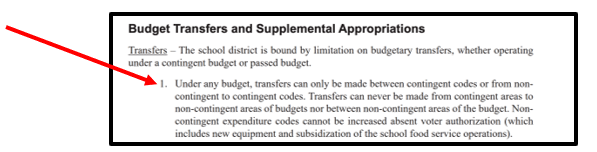
What do those school district-specific rules say about budget transfers? As can be seen in the below excerpt from the "School Districts' Accounting and Reporting Manual," a school district can only transfer funds into the budget line of a contingent fund.[2]

Screenshot of budget transfer law

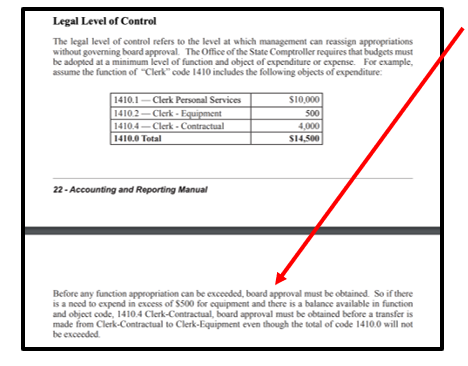
Other public entities, however, follow different rules...rules that are a bit more liberal about transfers between budgeted lines, since for inter-line transfers, "only" board approval is required...as seen below in the[3] Comptroller's "Accounting and Reporting Manual" for towns, villages, and other local government entities:[4]

Screenshot of budget transfer law 2

SO: does a school district public library in New York have to follow the rules of its sponsoring district? 

Here is what the Comptroller has to say:[5]

Public Libraries — Sponsored by counties, cities, towns, villages or school districts in most circumstances [are included in a local government's accounting] because of the existence of financial accountability as evidenced by funding of operations, approval of and responsibility for issuance and payment of debt and the ownership of real property. While this is the norm, situations do exist where the library is virtually autonomous and could be considered a special purpose government.

...

Final determination must be made at the local level after considering ... the appropriate criteria as they may apply to both governmental and non-governmental units.... [emphasis added]

In other words--while I hate to punt on this question-- IT DEPENDS.  There can be no one answer; the determination must be made at the local level--and by a person professionally qualified to make the determination.

That said, as a professional, I will go out on a limb and say that every Comptroller audit of a school district public library I have ever read emphasized the difference between the library and the district they are affiliated with.[6]  Further, the Comptroller, in those audits, has stated that independent board authority and oversight by the trustees must be exercised, even when the school district functions as treasurer. 

For this reason, I would comfortably suggest the presumption should be that the requirement to transfer only into a contingent fund, per the excerpt first pasted above, applies solely to a school district, and not to a school district's separate public library, even if the school district is the custodian of the funds, unless the two entities are so integrated that the library operates as a "component unit"[7] of the district.

That said, for school district public libraries who must develop policy based on this distinction, the person to answer this question is the accountant finalizing your audits and financial statements, since they are the one with the professional duty here.  That said, once they have determined that answer at the local level, ALL parties (the school district, the library, their accountants, and their lawyers) should be in agreement as to the reason for the decision.

Thank you for a good question, and for this reminder of why I became a lawyer, not an accountant![8]


[1] Not a gathering of meat-clad divas, but rather: "Generally Accepted Government Accounting Standards".

[2] From https://www.osc.state.ny.us/files/local-government/publications/pdf/arm_schools.pdf, page 25.  If you read the excerpt deeply, you will see I am oversimplifying...and if you want to see how much I am over-simplifying, read the whole manual!  School district budgeting is an art.

[3] riveting

[4] From https://www.osc.state.ny.us/files/local-government/publications/pdf/arm.pdf, page 22.

[5] From https://www.osc.state.ny.us/files/local-government/publications/pdf/arm.pdf, page 34.

[6] A good example of this emphasis on autonomy can be found in the 2014 audit of the Fairport Public Library, found at https://www.osc.state.ny.us/local-government/audits/library/2015/06/12/fairport-public-library-financial-management-2014m-354.

[7] A good flow chart on how to assess of a library is a component unit is on page 35 of this manual: https://www.osc.state.ny.us/files/local-government/publications/pdf/arm.pdf.

[8] Full disclosure: I am married to an accountant...a CPA, no less.  This of course gives me no professional cred when it comes to accounting, but it does lead to some good conversation on chilly Buffalo nights (he also has an MLS, which makes him all the more alluring, of course).

NY Hero Act and libraries

Submission Date

Question

How does the NY HERO Act https://dol.ny.gov/ny-hero-act apply to the different types of libraries? Are Association Libraries included?

Answer

The letters in the "NY HERO Act" stand for "Health and Essential Rights."[1]

What "essential rights" does it protect? 

  • Section one of the HERO Act amends the New York Labor Law to create an "airborne infectious disease standard" covering all private employers.  The standard requires many things that will sound familiar: health checks, sanitization practices, and other preventative measure when there is a declared risk of airborne disease.
  • Section two of the HERO Act amends the New York Labor Law to create joint employer-employee "workplace health and safety committees" (where there are 10 or more employees), so workers can collaborate and be involved in safety initiatives.

The new laws are activated only when an "infectious disease" is declared by the NY Commissioner of Health.  This means that right now, while the law is in effect, but no disease is designated, there is no need to have an active plan...but entities have to be ready to spring into action.[2]

Which brings us to the question: What types of libraries must comply?

We'll tackle the easy part first: without question, association libraries, which are private education corporations, must comply. 

For non-association libraries ("public" libraries), the language of the Act is much less clear, since the Act specifically exempts "...the state, any political subdivision of the state, a public authority, or any other governmental agency or instrumentality."

That sounds simple, right?  They should be exempt.  After all, libraries are considered, in some contexts, nigh-governmental entities.

But as many know, a public library's status as "governmental" ebbs and flows.

Here are just two recent examples:

Example #1: 2020 brought an interesting development when, after months of anxious curiosity, the NY Forward "powers that be" confirmed that public libraries were always considered to be exempt from the Executive Orders shutting down private businesses (and instead, were to follow the mandates governing local municipalities).  So: a governmental entity.

Example #2: A noteworthy new case[3] from NY's second-highest court has found that for purposes of the Prevailing Wage Act (Section 230 of the NY Labor Law), a public library is NOT "the state, any of its political subdivisions, a public benefit corporation, a public authority or commission or special purpose district board appointed pursuant to law, and a board of education."[4]  In other works:  not a governmental entity.

So, when it comes to this new law, I can't point to any definite authority either way; just because one part of the Labor Law excludes libraries, doesn't mean another does.  And certainly, we have no case law yet.  That said, if I HAD to pick, I would err on the side of caution and say that public libraries, which are education corporations with their own governance structures (just as the Court commented in "Executive Cleaning"), have to comply with the HERO Act.

Since the stakes are high for non-compliance, any public library that decides the HERO Act doesn't apply to them (and that's fine to reach a different conclusion; I am not omniscient, nor do I have a crystal ball) should:

1) Get that opinion, in writing, from an attorney retained to give advice to that library specifically, and considering its unique position under the law;

AND

2) Confirm the library is in compliance with New York Labor Law 27-a, which covers workplace safety in "the state, any political subdivision of the state, a public authority or any other governmental agency or instrumentality thereof."

The bottom line on this: when it comes to occupational safety, a public library can't fall into a hole between the mandates governing public and private entities: it either has to follow the rules of a "governmental instrumentality" employing people as government employees (and giving them all the protections government employees get under the law) OR it is following the rules of a private education corporation (and giving them all the protections private employees get under the law).

Since the HERO Act is really about taking all the protocols the State of New York developed in response to COVID, and ensuring they are on hand and ready for the next pandemic,[5] a library can't go wrong by having "an exposure prevention plan available, upon request, to all employees, employee representatives, collective bargaining representatives, independent contractors, the department of labor, and the department of health."[6]  By making a clear decision about what safety rules apply to your library, and developing a plan to follow them, you can not only comply with the law, but show that the library is working to keep employees safe.


Thank you for an important question.


[1] What about the "O?"  I double-checked the bills in both the State Senate and Assembly and apparently, it's just a bonus letter (I guess the "HER" act would imply only women get clean air).

[2] The NYS Department of Labor, as of July 12, 2021, states: "Currently, while employers must adopt plans as required by the law, as of the date of this writing no designation has been made and plans are not required to be in effect."

[3]  (Matter of Exec. Cleaning Servs. Corp. v NY State Dept. of Labor, 193 AD3d 13 [3d Dept 2021])

[4] Contrast this with the definition of who’s in/excluded from the HERO Act: "'Employer' shall mean any person, entity, business, corporation, partnership, limited liability company, or association employing, hiring, or paying for the labor of any individual in any occupation, industry, trade, business, or service. The term shall not include the state, any political subdivision of the state, a public authority, or any other governmental agency or instrumentality."

[5] I know, my stomach turned a bit when I typed the phrase "next pandemic."  But no point putting our heads in the sand.

[6] From the requirements summarized in the NYS Department of Health guidance here: https://dol.ny.gov/system/files/documents/2021/07/p764-the-airborne-infectious-disease-exposure-prevention-standard-v4.pdf.

Parking Lot Safety and Signage

Submission Date

Question

Kids have been playing in our parking lot and my board is concerned that they will hurt themselves and we will be liable. We have a very vague policy about our parking lot being for patrons to park at only and a couple signs that say patron parking only. We can update our policy to be more specific if need be but their thoughts are no policy on our end will protect us if someone gets hurt and says they didn't know our policy so we need a sign posted that makes it clear we don't expect kids to be riding bikes, go carts, etc in our parking lot.

Our treasurer thought maybe just a "no trespassing" sign would work.

Another Library Director I know said they have a sign that reads:

          "Please No...

          Bicycling
          Loitering
          Roller Blading
          Skate Boarding

          On Library Property"

Would something more specific like that be a benefit or would it be worse because if they hurt themselves doing an activity other than those listed they can say they were in their right?


The kids are often waiting until the library is closed and I'm no longer there before they start riding around on it so simply being vigilant telling them to leave is not going to work.

Thanks so much for any guidance you can offer.

Answer

Behold, the humble skateboarder: wheels spinning, scabby knees, and (if they have gotten over the fact that even when worn by Tony Hawk, it looks dorky) brain carefully protected by helmet, ready for action.  Never has a humble sport posed more of a challenge to local governments, park designers, architects, and urban planners; lay down a relatively smooth surface, and there they are, ready to challenge both gravity and the rules governing property.

As a lawyer who studies[1] how the law impacts what people do--and how we do it--I find skateboarding fascinating.[2]  Since at least the late 80's,[3] in town meeting after town meeting, legal case after legal case,[4] site design after site design, public authorities and property owners have attempted to control when and where people can skate (and bike, and rollerblade, and hang out while watching others do those things).

That we as a society often fail at such prohibitions and dissuasions is shown by the magnitude of letters-to-the-editor and news reporting regarding parking lot/ramp/sidewalk incident and injury.[5]  It has also spawned an array of dangerous and off-putting site design, such as metal rivets on walkways and spikes on hardscaping.[6]

Of course, this question is not about skateboards, but rather, about signage effective enough to reduce risky activity and to avoid liability while keeping library premises welcoming to everybody.[7]

For any library, museum, or other public cultural institution wrestling with this issue, this poses a conundrum.  The mission of your institution is to be accessible, inclusive, and to serve your community.  Yet at the same time, the promotion of a safe parking lot and grounds during open hours is critical...while after-hours promotion of safety is just as important (especially if you offer 24-hour Wi-Fi that is accessible in the parking lot and grounds). 

How can an institution achieve this balance?

For an institution confronted by this issue, there is a five-step process that must be conducted:

STEP ONE: Confirm who legally owns and/or controls the parking lot and grounds.[8]  Does your library own the lot, or is it rented and subject to the terms of a lease?  What you learn during this step will show who has to solve this issue (with a landlord, collaboration will be required).

STEP TWO:  What insurance covers the lot, and what types of incidents are covered?  This step will provide insight into how your institution is set up to manage the risks you've identified.

STEP THREE:  What is the purpose of the parking lot and grounds?  What functions do those resources serve?  Hopefully, the uses are already limited to only things that serve the mission and plan of service of the library.  However, in the case of a lease or shared premises, that might not be the case.

STEP FOUR:  Confirm and harmonize everything from the first three steps. 

This fourth step sounds simple, but it can take many forms. 

For instance:

  • If the land is owned by the library, it will require verifying that no one else is using the lot (unless there is a lease and insurance covering the non-library use);
  • If a private party owns the lot but leases it to the library, it will require checking the terms of the lease; 
  • If a supporting municipality owns the lot, it will require confirming who truly controls the space;
  • If the property is insured for general liability, it will require contrasting what the insurance covers, with what it is being used for, and what it is intended for, and how it is being controlled;
  • If the property is not insured for general liability, it will involve assessing if/how the library is protected from liability.  

NOTE: For these reasons (and more), whenever, possible, "Step Four" should be done with a lawyer.

STEP FIVE: Only after completing Steps "One" through "FOUR" should a library board approve a signage plan.

Why these steps?  Because the details they draw out will help your library determine the final text of the signage, whittling it down from many permutations.  For instance:

  • A suburban library that leases its property within a strip mall will want to put most of the onus for liability back on their landlord (especially if parking facilities are shared with other tenants). 
  • A rural library with lots of its own land, but near a public park, has the luxury to post signage that says "Parking lot and grounds are for library activities only; please use ABC Park for recreational activities."
  • A city library located within a city-owned building may need to coordinate signage with a city department (or might not).
  • A library (in any location) that is neither designed nor insured to safely host any type of unsupervised recreational activity[9] on its grounds (whether in the parking lot, or the front yard, or on the roof) can post exterior signage that says: "No recreational activity on the grounds unless authorized by the Library."[10]

In addition to helping your library check all the boxes (ownership, risk management, mission, messaging), I advise this approach because it will position your library to give your signage some personality...something that projects the library’s values and mission out into the community.

For instance, there is nothing wrong, after your property/purpose/insurance analysis, with posting a friendly sign like this:

"Our parking lot is for the safety and convenience of

our Library's diverse and wonderful community.

Please limit your use of our lot to parking your bike or car

while using the services of the library."

Or, if the "personality" of your library is a bit less celebratory, and there has been collaboration with local law enforcement on the issue, and it has been determined that it is safest to employ some forceful messaging, the signage can say:

"Parking lot use limited to parking for

library patrons, employees, and vendors.

POLICE ENFORCED."[11]

Which brings me to the member's actual question:

"Would something more specific like [listing barred activities] be a benefit or would it be worse because if they hurt themselves doing an activity other than those listed they can say they were in their right?"

As you can see, I do not recommend barring a list of activities--partly for the reason in the question, but more fundamentally, because a list of “forbidden” activities only invites quibbling during enforcement (see footnote 9), which creates a needless headache. 

In my experience, those who actually have to enforce a policy (a director, a security officer, a police officer, a municipal employee), should be meaningfully consulted during its development, and are better served by a final product that positions them to quote a broad definition of purpose, together with a bar on unrelated activity, such as:

"This parking lot is for parking only.

No recreational use allowed at any time."

And finally, let's talk about that all-important STEP SIX: Dealing with the Human Factor.

We all know this: an institution can install signage six feet high, in flaming letters, and if someone wants to trespass on it after hours, that signage will not stop them.

If that is true, what is the purpose of the signage?

The purpose of the signage is 1) to promote safety; 2) to reinforce mission; and 3) to be able to show that, if injury occurs, the library in no way encouraged, condoned, or sanctioned the activity that caused it (and in fact, forbid it).

Now, while that is important, there is one other thing I must get out there while we're talking about limiting premises liability: just as critical as clear, enforceable signage is ensuring that the library is not maintaining a hazardous condition.

Why?  If the injury a trespasser experiences on property is related to a known defective condition (a pothole, for instance, or a heaved sidewalk) the owner/controller of the parking lot could still face liability.  To truly promote safety and guard against liability, an owner who invites the public onto their land must be able to show it was not "on notice" about the defect, or that if it was, it had taken adequate steps to protect the public from the hazard (surrounding the pothole by cones, or getting it temporarily filled with cold patch, for instance).

This is why a vigorous facility maintenance plan and deferred maintenance/contingency repair budget is just as--if not more--critical as proper parking lot signage.

In closing, I have to say: writing effective property signage is a tricky thing.[12]   Since there is no perfect way to do it, I advise aiming for something that clearly limits the use of the restricted property to its core function (in this case, parking), while also reinforcing the identity of the library as a community resource.  Here is a model to consider (after your library follows all the steps):

"To promote a safe and welcoming environment,

this parking lot is for parking and library-approved events only.

All other uses must be approved in writing by the library.

To inquire about using our lot for a community event, call ###-###-####."

...with shorter, smaller, punchier signs at key areas to reinforce the core message:

"No playing in our parking lot at any time.

Safety first!"

I wish all libraries reading this a reduced-risk, injury-free parking lot.


[1] In the field.

[2] I had a board in the 80's, but I only ever attained the level of skill shown in Tom Petty's "Free Fallin'" video (which is to say: not very much).

[3] And maybe earlier?

[4] I like this one: People v Smith, 160 Misc 2d 1070 [Just Ct 1993]

[5] I am not going to cite a study here.  Rather, I will cite NY Insurance regulation 11 NYCRR 27.3, which includes in a list of specially elevated risks: "Asbestos, Fungi and Water Damage Remediation ... Amusement Parks and Carnivals Property...Amusement Rides and Devices ...including bumper cars, go-carts and go-cart tracks, giant slides, skateboard tracks, roller-blade tracks...."

When you want to know if something is statistically risky, ask an insurance carrier.

[6] These measures are also used to "dissuade" people from sleeping and getting comfortable in public spaces, an overlap worth contemplating.

[7] A skateboarder or roller-blader on a sidewalk or in a parking lot can pose a risk to a person walking with a small child or stroller, using a walker or wheelchair, or walking an animal.

[8] Although the question was confined to the "parking lot" I am adding "and grounds" since this issue doesn't just involve parking lot concerns.

[9] BMX bikes, skateboards, and roller-blades take the brunt of this type of issue, but frankly, does your director want to quibble over policy when a group of rogue folk-dancers hosts an event in the parking lot after-hours? 

[10] I like this last bullet because it reserves the right of a library to host a planned recreational event, but to otherwise bar them on the property.  Further, by avoiding the term "loitering," it reduces the risk of confusion for those who need to park or sit on the grounds after-hours to use a library's 24/7 free Wi-Fi.

[11] If you go with this one, confirm with your local PD that they will do this in a way that is consistent with the mission and role of the library.  NOTE: I appreciate that in some places, this will not be viewed as a viable option.  The mission of your library should be the guiding factor in deciding whether or not to involve law enforcement or private security in this type of policy.

[12] Whenever possible, it is good to use a licensed architect or credentialed municipal planner to design signage; they will pay attention to things like reflectivity, placement, font choice, and ADA accessibility.

Paying Director for Trustee Meeting Attendance

Submission Date

Question

Our Library Director was hired 5 years ago and has always been paid for her attendance at monthly Trustee meetings. In 2021 the Town Supervisor stopped this long-standing practice. Our Town pays our Library Director.
 

Is this legal without letting the Trustees and Director prior to stopping the practice?

Answer

"Is this legal?"  Not likely.

But before I say more, I just want to offer a quick primer on how things work at "Ask the Lawyer."

Since the situation depicted in the question could result in legal claims by the Director, the board, and/or even the Town--or be relevant to an audit by the State Comptroller--this is the type of "Ask the Lawyer" question that can only be answered--really answered--under attorney-client privilege.

Why is that?  Because of how "Ask the Lawyer” works.  When questions like this are submitted (questions that ask for advice and guidance for the requesting member and their council, as joint clients[1]), our typical approach is to a) contact the member, b) get any additional information needed to assess the question, and then c) send an attorney-client privileged answer. [2]

After that, if the member consents to it, we create a "generic" answer, channeling the research gathered into general advice that may be useful for a broad audience (of libraries, museums, historical societies, and other regional council members).

This question, of course, presents an issue mostly relevant to public libraries.  And here is the "generic" answer to the scenario presented:

There are a number of factors an attorney needs to dig into in order to answer this question.

First: is the director an hourly employee, or salaried?  If salaried, this question doesn't make much sense,[3] so we'll go with hourly.

Second: Is the director required as part of their job to attend the meeting?  Since they are mostly there in their professional capacity, let's say "yes."

Third:  Did the director, in the past, report the hours into the payroll system, and receive compensation for them?  Let's again say "yes."

Fourth: Has the board consistently performed the aspects of board authority over the position (making the decision to hire, signing the hiring letter, performing annual reviews, working with Civil Service to amend the job description when needed, effecting disciplinary action and plans of improvement if needed, approving payroll,[4] approving scheduled vacation times, overseeing time off for disability, effecting termination)?  Again, from the scenario, we'll say "yes," which means the board has not laid a foundation for the lines of employment to be blurred (they are undisputedly in charge).

Fifth: Has the previous payroll, which included compensation for attending the meetings, been approved per the requirements of the Civil Service law?[5]  While that may be something happening subtly behind the scenes, based on the scenario, again it is probably "yes."

If we added those details to the scenario, I would see no basis for a town official to be able to unilaterally decide what tasks may or may not be compensated.

In fact, the only way I could see a town official being able to (legitimately) do such a thing is if the library board had expressly delegated all authority for supervision and payroll oversight to the town...something that would be a dangerous practice, since it would seriously undercut the library board's autonomy and authority.

The courts in New York, the State Comptroller,[6] the State Attorney General, and local Civil Service agencies all grasp the nuances of public library boards' authority, but it can be a struggle for newer public officers.  The autonomy and authority of a library board can often feel like a square peg to a public official used to only round holes.  That is why it is important to nurture the relationship routinely, deliberately, and carefully.[7]

What can be done in this case?  To avoid a claim of unpaid wages, a library board would need to develop a plan to put things right.  There are a number of ways to approach this, but I'd start out by enlisting the help of the local Civil Service, who can confirm that the library is a separate employer, with an obligation to confirm their employees' hours.[8] In the alternative, a good resource who may take a similar technical approach could be the municipality's attorney.

Since all that could take some time, if the board wants to vote to adjust the payroll (ensuring the payment is properly subject to taxes and withholding, etc.), the board may also want to enlist the help of the State Comptroller (the authority that audits public library payroll from time-to-time).  How would a library do that?  Prior to any adjustment, it would be a good idea to confirm the basis for the correcting payment in writing with the Comptroller, after which the board could resolve to make the adjusting payment (since the minutes of the meeting, and the meeting itself, are a public record, this is a good exercise in transparency).

Because of the risks involved in compensation-related matters, if at all possible, this type of challenge is a good one to work through with an attorney.[9]


[1] More on this approach, piloted in consultation with Sheryl Knab at WNYLRC (who was very patient as I unpacked all the nuances about attorney ethics and retainer agreements), is described in Hope Dunbar’s excellent article: https://www.tandfonline.com/doi/abs/10.1080/15332748.2018.1443572

[2] Sometimes, if the issue is sensitive enough (and there is no reason to involve them) the answer doesn't even go to the council.

[3] It could be relevant in the sense that the salaried employee was using the meeting time to hit a minimum amount of service for the work-week (say, 37.5 hours).  But that nuance doesn't quite fit the scenario.

[4] Note this says "approving," not "effecting."  A municipality can process the payroll and provide the employment benefits, and the library board of trustees remains the actual employer.

[5] Two great primers on how Civil Service Law impacts hiring library directors in New York are found at: http://www.nysl.nysed.gov/libdev/trustees/handbook/cs101.htm, and https://www.nyla.org/a-librarians-guide-to-civil-service-in-nys-2018/.

[6] The New York State Comptroller has understood the nuances of the library board-municipality relationship for decades.  See 1972 Op St Compt File #402.

[7] See the "Ask the Lawyer" on developing an MOU with your sponsoring municipality: https://www.wnylrc.org/ask-the-lawyer/raqs/166

[8] I realize that might not be the case in some localities.  If that is the case for your library, you may want to skip this step, and head to the Comptroller.

[9] The case at this link, Beers v. Incorporation City of Floral Park, from 1999, shows why! https://casetext.com/case/beers-v-incorporated-village-of-floral-park

Proof of vaccination from employees

Submission Date

Question

We are a large (100-employee) school district public library. We are currently encouraging and educating employees on getting vaccinated, but not (yet) *requiring* vaccinations. We are providing employees with up to 4 hours of paid time off to obtain the vaccine voluntarily--if their vaccine appointment occurs during hours/days when they would otherwise be scheduled and working for us--and requiring proof of vaccination if this paid time off is used.

My question has to do with requiring or requesting proof of vaccination for employees who get vaccinated during their "off hours" and opt not to use this specific paid time off type. Can or should be asking for proof of vaccination from *all* employees, so that we can have some sense of how many employees have been vaccinated, if that is to somehow figure into any decisions we might need to make re: staffing and proximity to others, or any considerations for the possible liability of "direct threat" to others by those who either choose not to get vaccinated, or are awaiting vaccination eligibility?

If it is desirable or permissible for us to obtain proof of vaccination universally, should compliance by the employee be optional/voluntary or compulsory?

If we can obtain proof from everyone, I assume that this should be handled by HR (me) in the typical manner of any confidential medical information. But how do (or can) I share specifics on who has been vaccinated (versus who has not) with others, such as supervisors and managers? They might wish to know details in order to schedule staff accordingly. But at the same time, I would be leery of divulging such information, out of concerns for maintaining employee confidentiality, possible discrimination by unwitting supervisors, etc. I might be more inclined to/comfortable with reporting general numbers--i.e., of 100 employees, 29 have been vaccinated to date--than to share employee-specific details, but am not sure if that would be helpful, or really what information *is* helpful for employers to track and report on internally where vaccination status of staff is concerned.

This is an invaluable service. Thank you for your consideration of my questions and for any guidance you can give!

Answer

Over and over again, I am floored by the care, tenacity, and creativity of the libraries determined to provide services in a time of pandemic.  New York's libraries just don't give up.  This question shows the mechanics of that fighting spirit.

So much of what we do in this pandemic comes back to why we are doing things in this pandemic.  For many libraries, the "why" of offering services is making sure their communities have lifelines to professionally curated information.

For this question, the "why" of asking for proof of vaccination is right there in the submission's core:

... so that we can have some sense of how many employees have been vaccinated, if that is to somehow figure into any decisions we might need to make re: staffing and proximity to others, or any considerations for the possible liability of "direct threat" to others by those who either choose not to get vaccinated, or are awaiting vaccination eligibility?

Let's take that "direct threat" part first.

Back on March 19, 2020, we addressed a question about employer (library) liability due to Coronavirus exposure.  Although much has changed since that time (we have vaccines), the basic recipe for liability has not changed: liability happens when a person/entity owes a duty of care to a person, does not perform that duty, and the failure results in damage.

Because if this recipe, it is essential for libraries to always know what "duty of care" they owe their workers, and their community.

In a pandemic, evolving data and resulting best practices can change the "duty of care" rapidly (No masks? One mask? Two?).

While many resources are aggregating and pushing out up-to-the-minute guidance on "best practices," there are only three places libraries in the State of New York should be drawing their duty of care practices directly from: the New York State Department of Health ("NYSDOH"), the Centers for Disease Control ("CDC"), and the Occupational Hazard and Safety Administration ("OSHA").

Right now, as of this writing, OSHA's 1/29/2021 workplace guidance[1] for mitigating the impact of COVID-19 lists 16 "elements" of an effective COVID protection program.  Here is what OSHA recommends about using awareness of vaccination status of employees:

Not distinguishing between workers who are vaccinated and those who are not: Workers who are vaccinated must continue to follow protective measures, such as wearing a face covering and remaining physically distant, because at this time, there is not evidence that COVID-19 vaccines prevent transmission of the virus from person-to-person. The CDC explains that experts need to understand more about the protection that COVID-19 vaccines provide before deciding to change recommendations on steps everyone should take to slow the spread of the virus that causes COVID-19.

So right now, the "duty of care" set out by OSHA expressly excludes relying on vaccination status to reduce the spread of the virus.  Rather, it focuses on providing and insisting on appropriate PPE.

That said, in the same guidance, OSHA continues to recommend allowing employees who self-identify as medically vulnerable to swap tasks to limit risk:

Offer vulnerable workers duties that minimize their contact with customers and other workers (e.g., restocking shelves rather than working as a cashier), if the worker agrees to this.

This means if a person, relying on their vaccination status, decides to not self-identify as medically vulnerable, the employer is not advised to offer them contact-minimizing duties.

There are other steps on the current OSHA list that the member is already doing.  By enabling the use of PTO for vaccination, they are following the guidance in element "14":

Making a COVID-19 vaccine or vaccination series available at no cost to all eligible employees. Provide information and training on the benefits and safety of vaccinations.

This guidance, I imagine, will evolve.  That evolution should be reflected in revised Safety Plans.

And with that said, let's answer the member's specific questions:

Can or should be asking for proof of vaccination from *all* employees, so that we can have some sense of how many employees have been vaccinated, if that is to somehow figure into any decisions we might need to make re: staffing and proximity to others, or any considerations for the possible liability of "direct threat" to others by those who either choose not to get vaccinated, or are awaiting vaccination eligibility?
 

Based on the current OSHA guidance, along with guidance from the EEOC, the answer to this is "yes," and then "no."  Yes, an employer can ask for proof of vaccination (whether acquired on PTO or off-hours).[2]  No, right now, it should not be used for assignment of duties[3] or with the idea of reducing possible liability.

Here is the member's follow-up question:

If it is desirable or permissible for us to obtain proof of vaccination universally, should compliance by the employee be optional/voluntary or compulsory?

Based on the current OSHA guidance, along with guidance from the EEOC, right now does not seem like the time to rely on vaccination status and data to make determinations about workplace risk management and safety.  So while requiring a notification of vaccination status may be permissible, it does not appear desirable if its purpose is to mitigate concerns about liability.

If, however, the motivation is to verify that the library is effectively encouraging the most employees possible to get vaccinated—simply for the employees' own personal health and safety—then yes, tracking those metrics (and any non-disability factors barring vaccinations) might not only be permissible, but desirable. In that case, the question is: does the information need to be tied directly to a particular employee, or is it just as meaningful if anonymous?

Which brings us to the member's last question:

But how do (or can) I share specifics on who has been vaccinated (versus who has not) with others, such as supervisors and managers?...I would be leery of divulging such information, out of concerns for maintaining employee confidentiality...

This HR manager knows their stuff!

First, yes: no matter what, never create a risk of trampling on employees' privacy.

Second: Right now, it appears that sharing such information is unnecessary.

In a December 18th, 2020 "Ask the Lawyer," I stated that a vaccine requirement should only be implemented if it is part of a well-thought-out, board-approved Safety Plan.  Right now, it appears that no Safety Plan should rely on a vaccine requirement to reduce transmission of the virus.  With that in mind, right now, it appears the safest course of action –both COVID-wise, and legally—is to encourage vaccination, but not require it, and if a library tracks it, only do it for purposes of encouraging more employee vaccinations (or finding out you've hit close to 100%).

Of course, here we are on February 26, 2021.  If you are reading this in March, or April, or that sunny, warmer time in the future, May and beyond[4], this answer might no longer apply.

Keep checking with NYSDOH, with the CDC, and of course, with OSHA.  At some point, requiring vaccination—or allocating duties by vaccination status—could become something expected of an employer.  If that happens, a library's "duty of care" could change, altering the threshold for liability, and the answer to these questions could shift—some subtly, some not-so-subtly. 

But we have had a lot of twists and turns in the Pandemic.  That "shift" may or may not happen.[5]  As I often say at my office, "the only plan we can make is that the plan will change."  And how do you plan for that?  By doing what this member has done: keeping employees' well-being and safety at the forefront, and adapting every time the data and guidance change. 

If your library does that, you'll be as safe as you can be.  And mitigate your liability.


Thank you for a thoughtful question.


[1] Posted as of February 26, 2021 at https://www.osha.gov/coronavirus/safework.

[2] This answer is found on the EEOC site at https://www.eeoc.gov/wysk/what-you-should-know-about-covid-19-and-ada-rehabilitation-act-and-other-eeo-laws as of 2/26/2021.  "K.3. Is asking or requiring an employee to show proof of receipt of a COVID-19 vaccination a disability-related inquiry? (12/16/20) No.  There are many reasons that may explain why an employee has not been vaccinated, which may or may not be disability-related.  Simply requesting proof of receipt of a COVID-19 vaccination is not likely to elicit information about a disability and, therefore, is not a disability-related inquiry.  ...  If an employer requires employees to provide proof that they have received a COVID-19 vaccination from a pharmacy or their own health care provider, the employer may want to warn the employee not to provide any medical information as part of the proof in order to avoid implicating the ADA."

[3] Remember, if the employee uses vaccination status to self-identify as vulnerable, such information can be considered by the library reactively (and confidentially).  For more on that, see the "Ask the Lawyer" from January 19, 2021.

[4] Garden time!  Can you tell I can't wait to get into the dirt?  It always feels so distant, this time of year.

[5] As OSHA says, more research is required.