
Policy

Book Challenges and Records Retention

Submission Date

Question

In a local school district, multiple books have been challenged recently. This week, the School Board received an email from a community member referencing record keeping for library materials and electronic records retention. The district Superintendent wants to make sure that the district is keeping the right kind of library records, and that they are keeping them for the legal amount of time. Attached are two documents to review. In the first document titled District Records, under #15, it advised that districts should keep a list of book lists and school library reports. With this, should the district have kept a list of all books in their libraries in any given year?

Answer

In speaking to different libraries about being prepared for book challenges, I have repeatedly stressed one very important element: have your policies ready.

This question shows the depth of consideration that goes into that simple requirement.

In this case, that "depth" is found in the rocky chasm of the LGS-1, New York's end-all, be-all rules for public document management.  Need to know how long to keep records for a bingo game authorized by a village?[1]  Or how long to keep a record of exhumation?[2]  Or how long we hang onto bridge inspection records?[3] It's all in the LGS-1.

The documents the member references are sections of the LGS-1.

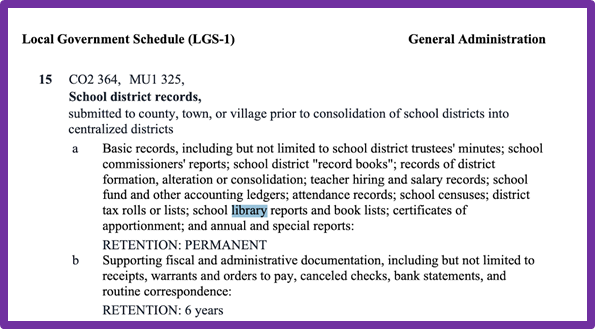
They look like this:

LGS-1 Screenshot of school district records law

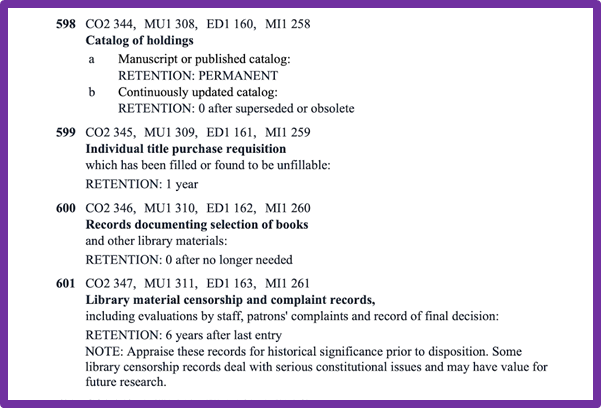
and

Screenshot of LGS-1 guidance for schools

Looking at these requirements, the member's question is: "[S]hould the district have kept a list of all books in their libraries in any given year?"

The answer is: MAYBE, but not DEFINITELY.

Here is why:

The first section referenced by the member, at first blush, looks like it requires the retention of "book lists" for six years.  But examining that precise section, you will see the requirement is limited to records submitted prior to the "consolidation of school districts." 

So, outside of a district consolidation, section LGS-1 15, does not require compiling a list of books.

The next sections, LGS-1 598 and 599, refer to a school district maintaining records related to a "Catalog of holdings" and "Individual title purchase requisition," respectively.

We'll tackle 598 first.

598 requires that a "Manuscript or published catalog" of "holdings" must be retained "permanently."  It then requires that a "Continuously updated catalog" be retained until it is "superseded" or "obsolete."

This means that a district library's "catalog of holdings" that exists in a static form (like a print or PDF list) must be retained permanently, but a list of holdings that is ever-changing (like an ILS) is only retained until it changes form--or that form stops being useful.[4]

In practical terms, this does mean that if the library produces a static list (in print or electronic form), it must be retained forever.  That obligation, however, does not obligate the library to create such a list in the first place.  Meaning, in other words: if the library only uses an ever-changing catalog, it doesn't need to retain any particular copy.

This brings us to 599, which requires that an "[i]ndividual title purchase requisition" (the documentation showing a school library bought a book) must be retained for one year.

Again, in practical terms: while per 598, a school library is not obligated to compile a printed list showing that "Not All Boys are Blue" is in its library's collection, per 599, it does have to retain (and produce, if not otherwise accessible through FOIL) a school’s requisition to purchase "Not All Boys are Blue" if requested.

This gets more interesting as one considers that LGS-1 600 (also seen in the purple-bordered excerpt above), regarding "Records documenting selection of books" sets no minimum retention period.  Meanwhile, LGS-1 601, regarding "Library material censorship and complaint records" mandates such records be retained for at least six years (and encourages considering saving them for much longer, which strikes me as a good idea).

The upshot of these various rules creates a regime where a district is empowered to pick and choose, to some degree, what records it wants to create...but once created, imposes a very particular set of parameters for retaining, purging, and disclosing them.  This is why my answer to the member's question must be so ambiguous.

It is also why it is very important that a district have a well-developed policy on this issue.

Below are some examples of what, depending on the records a district elects to create, a district can say in answer to the question: "I want to make sure I approve of all the books my taxes paid for this year.  Can I have a list of all the books?"

[If the library maintains a published list and wants to be friendly.] "Sure thing.  We compile and publish a list of books in our collection every year as of the first Monday of September.  Do you want the one showing all the books in one particular library, or all the books in the district?"

[If the library doesn't maintain a published list, but has a continuously updated catalog, feels friendly, and allows access to library computers.] "No, we don't publish such a list.  But we do have a continuously updated catalog you can search on this terminal."

[If the library doesn't maintain a published list, has a continuously updated catalog, doesn't allow just anybody access to its computers, but feels somewhat helpful.] "No, we don't publish such a list.  But we do have a continuously updated catalog you can request a copy of."

[If the library doesn't maintain a published list, doesn't allow access to computers, and doesn't feel helpful, but does feel puckish.] "No, but if requested, we can supply you with a copy of every book requisitioned last year."[5]

[If the library doesn't maintain a published list, and doesn't want to offer alternative ways to share the information.] "No, we don't have that."

[If the library doesn't maintain a published list, and is okay risking a spat.]

"No."

Optional rider to all the above answers: "Here is a copy of our FOIL policy so you know the process for requesting our public records through our FOIL officer, and can be aware of our copying charges and the process for requesting electronic copies."

Now, as any veteran of public relations battles over school district policy knows, there's a time to be helpful, and there's a time to say "no."  I am not endorsing any particular answer, but based on a district's policy, it should know what records it keeps (and doesn't keep), and how people can access them.

From my perspective, if there isn't a need to compile information, it shouldn't be compiled.  Further, FOIL does not create the obligation to compile information if it is not already compiled.  On the other hand, waffling and appearing to dodge the question when concerned citizens are on the hunt for "objectionable material" might not be the best way to fight the battle for intellectual freedom.  "We don't have a list but we have a continuously updated database" strikes me as a glove-slap; it invites a fight...but nevertheless, if accurate, might be a perfectly valid response.

From my high horse over here in law-law land, a district should proceed from the presumption that if a book is in a school library's catalog, it belongs there; this is the stance that supports intellectual freedom, while also setting a good example for the students (but I am not the one who has to deal with angry community members storming a school board meeting).

Regardless of my personal thoughts on the diplomatic aspects of this issue, from the perspective of intellectual freedom, information access, education law, the LGS-1, and the First Amendment, here is what's important: have a sound policy governing 1) how library books are selected; 2) how library books are cataloged;[6] 3) how library books are challenged; and 4) how library books are removed, and follow that policy.

If, as part of that policy, a district has the desire and capacity to create an annual (or decennial, or whatever time span it wants) list of books in the school library catalog, great, but if such a list is created, it must be kept forever.  And if the district only uses a continuously updated library catalog, it should be clear from the policy who can access it, and how (at the school?  By appointment?  Remotely?).  And all of this turns on the district having a designated FOIL officer and process for timely responding to, assessing, and meeting FOIL requests.

So, there is my answer...and I know it rests on a dangerous triangle of law, practicality, diplomacy.   This stuff isn't easy.

I wish you a clear head, a steady heart, and a ready wit as you face whatever challenges come your way.


[1] 8 NYCRR §185.15 (2020); see schedule items 562-564.

[2] 8 NYCRR §185.15 (2020); see schedule item 136.

[3] 8 NYCRR §185.15 (2020); see schedule item 1085.   By the way, it's "6 years after structure no longer in use or inspected features have been replaced," which I find rather terrifying.

[4] Kind of whimsically sad notion: "You are needed, until you change or you aren't needed."  I would love to meet the person who wrote this part of the LGS-1; they had to be a philosophy major.

[5] I don't advise using this one.

[6] Including having a published list, or simply having a continuously updated database.

Libraries Open to the Public Template for Copiers

Submission Date

Question

We were asked about signage to post over the public copier at a libraries open to the public. Below is some template language with footnotes explaining why they say what they do.  Of course, before posting in your school or library, check with your lawyer!

Answer

MAKING A COPY ON THIS MACHINE

MAY BE SUBJECT TO THE COPYRIGHT LAW OF THE UNITED STATES[1]

This means 4 important things:

1.  Copying a copyright-protected work here could be a copyright violation.[2]

2.  Copying protected works is sometimes allowed under "fair use."[3]  We can't give you legal advice, but if you want to learn more about "fair use," go to https://www.copyright.gov/circs/circ21.pdf or see the [INSTITUTION NAME] Fair Use policy at [LINK].

3.  Copying a copyrighted work to accommodate a disability under the ADA is allowed.   However, to do that, please see the library staff, since adaptive copies have special rules,[4] and we want to help you (or a person you are assisting) exercise your rights.

4. As a library open to the public, there are special circumstances under which we get to make copies (libraries are special).  However, to qualify for that protection, this notice (which we have, by law, placed over the copier right in front of you), has to say what it says in bold at the very top, and we have to operate by this rule:

Any person or group is forbidden to use this machine to engage in the related or concerted reproduction or distribution of multiple copies of the same material, whether made on one occasion or over a period of time, and whether intended for aggregate use by one or more individuals or for separate use by the individual members of a group.

What does that mean? Entire classes should not come here and copy the whole text book for a course![5]  Please don't do that.[6]

The copy machines are here for your use, and we appreciate your consideration of these laws.

Thanks!


[1] This precise language is required by 17 U.S.C. 108 for the library and its employees to be protected against allegations of secondary infringement.

[2] 17 U.S.C. 106 reserves the making of copies to the copyright owner.

[3] 17. U.S.C. 107 allows copying under certain circumstances, but simply "educational" or "not-for-profit" use is not enough.  Read the guide at the link!

[4] See https://www.loc.gov/nls/about/organization/laws-regulations/copyright-law-amendment-1996-pl-104-197/.

[5] This is covered by 17 U.S.C. Section 108(f).  Section 108 also lets libraries make copies for other uses...but that is for libraries, not regular people or students using a copier in a library.

[6] Seriously, if we see you doing that, we have to ask you to stop.

Offering Travel Grants to Members

Submission Date

Question

A director of a library resources council asks…

I know we have policy and procedures in place for our staff travel, but what if we were to reimburse or give grants for personal auto travel to members.

Example: could we offer a monetary amount for our members to travel to Albany for NYLA Legislative Day? Would our [library]council be liable if the person gets in an accident?

We also offer Professional Development grants. If travel is included in the grant we award are we liable for supporting that trip if the person is in an accident or injured?


Answer

This is the right question at the right time.  As we wrap up 2022, remote work, work travel, work-from-home, work abroad...all these are evolving in a tangle of legal considerations.

Whenever an employer adopts policies or practices that can impact the physical situation of an employee, questions about liability must be addressed.  The same is true for an organization that offers grants.

Liability is only one consideration among many, however.  When the terms for compensation or funding are being set, equally important are: support for institutional mission, individual well-being, and meaningful assessment of how funds are spent.

Fortunately, consideration of liability can be harmonized with these other priorities, by considering the purpose of the funding, and the way it is awarded.

Here are some examples of this balance, based on the member's scenarios:

Scenario 1 (regarding travel to Albany): "To promote member and professional participation in NYLA Legislative Day, member organizations can apply for travel grants up to [AMOUNT].  Member organizations who apply must submit a copy of their lobbying policy to demonstrate they are set up to properly receive, administer, and report lobbying-related funds."

Scenario 2 (regarding professional development): "To promote professional capacity-building at member organizations, member organizations can apply for professional development grants of up to [AMOUNT].  Recipient members will be required to send a short report describing the use of funds so professional capacity-building can be assessed."

How does this limit liability?  In both of the above examples, the grant recipient is the member organization, not the acting/receiving individual.  This would be emphasized further in the grant application and award conditions[1], which would require the funds be spent in a certain way (emphasizing mission and assessment), but would rely on the member-recipient to administer the funds to their employee, as a term of employment.

This separation reduces the chance for liability to be directed at the grant funder, while the chance for liability between the employee and the employer remains the same (unless the grant is conditioning funding on something inherently dangerous, like sky-diving into Albany, or professional development as an underwater welder).

On the flip side of this arrangement is the fact that any time an employee is travelling or engaging in any activity for business--whether the trip is specially funded by a grant, or to promote the employee's individual professional development--the trip or activity may result in an injury that could result in worker's compensation claim.

This is true whether the employee is at the employer's office, a home office, an off-site work location, or travelling for business, and is true whether or not the activity is grant-funded, or funded out of general operating expenses.[2]

Such injury, when incurred by an employee, should be reported promptly to the employer, so the employer can file the appropriate claim for workers' compensation insurance.  If the incident involved injury to another, or injury to property or assets, the matter might involve other types of insurance.[3]

Of course, there are some professional development opportunities and grants that may go straight from a grant-giving organization to an individual, rather than to that individual's employer.  When that is the case, the application materials and recipient award notice (which should double as a "terms of acceptance" document) must make it clear that the funded tasks are not being performed by the recipient as an employee, agent, or contractor of the donor.  That is another task for a lawyer.


Thank you for a nuanced question!


[1] This is why grant application and award notices should be reviewed by a lawyer when newly issued or revised.

[2] Please bear in mind, this is the default condition, and many things could happen to change it (including the contract between the grantee and grantor).  The bottom line: if an employee is injured, prompt reporting is essential to ensure they receive the protection and coverage they may be entitled to.

[3] Examples include but aren't limited to: general liability insurance, commercial liability insurance, professional liability insurance, automobile insurance, marine insurance (if the incident happened on a boat).


Staff Expectations for Emergency Preparedness Training

Submission Date

Question

We are planning an emergency preparedness training for library staff to include CPR, First Aid, Stop the Bleed, and Narcan training. We have heard from librarians that some boards are concerned about the implications of having staff trained. We would like to have some commonly asked questions addressed so that we can answer them if they come up.

1. If staff are trained, do they incur a duty to act? Would they personally or the library as institution become liable should they freeze up and not intervene?

2. If staff are trained but inadvertently cause harm in the process of administering aid, are they covered by any kind of Good Samaritan law?

3. Can a library have a policy of requiring all staff to undergo these types of trainings?

4. Are there any other legal implications or obligations that should be considered that the average person may not think of?

Answer

Because the training and resources described in the question can save lives, I will both a) quickly answer the questions and b) provide an answer in a format suitable to share with a library board.

Quick answers:

1. If staff are trained, do they incur a duty to act?

No, they will not incur a duty to act, unless the library adds that expectation to a job description, or adopts a policy requiring such action (which it should not do without careful planning).

1.5 Would they personally or the library as institution become liable should they freeze up and not intervene?

No, they will not incur liability for failure to provide first aid or emergency treatment, unless the library adds that expectation to a job description or adopts a policy requiring such action (which it should not do without careful planning).

2. If staff are trained but inadvertently cause harm in the process of administering aid, are they covered by any kind of Good Samaritan law?

Yes, except in cases of "gross negligence" (more on that below) they are shielded from liability by New York State's "Good Samaritan" law (Section 3000-a of the Public Health Law).

3. Can a library have a policy of requiring all staff to undergo these types of trainings?

Mandatory training, which could imply that providing first aid or emergency treatment is a job requirement (and thus outside the scope of the Good Samaritan protection), should not be required unless there is a careful program that considers the factors set forth in the guidance below.

Voluntary training, howevereven on staff time—does not remove the Good Samaritan protection. 

4. Are there any other legal implications or obligations that should be considered that the average person may not think of?

Yes (see below).  But none that should get in the way of a library helping library employees and volunteers feel better prepared to provide first aid and emergency treatment!

Analysis

NOTE: This "Analysis" is composed in a format that could be presented to a board with concerns regarding this type of training or capability in their library.

First Aid at Your Public Library

A Guide for Public Library Boards in New York

Stephanie A. Adams, Esq.

The Law Office of Stephanie Adams, PLLC

Library trustees know that as free and open places of public accommodation, public libraries can often be the location of a medical emergency.

Because of this, many public libraries opt to prepare by:

  • Having first aid kits on site
  • Having Narcan on site (with or without staff training)
  • Installing an AED[1] on site (to be used by EMS upon arrival after calling 911)
  • Using posters in multiple languages to alert people to important considerations during a medical emergency
  • Arranging training in first aid, CPR, and "Stop the Bleed" for staff and volunteers
  • Implementing private security with some level of emergency response training
  • Implementing policies for addressing medical emergencies in the library

Of course, a good board of trustees not only considers how to address potential medical emergencies in the library but also considers how the resources and tactics selected could put library employees, volunteers, the public, and the library itself at legal risk

This guide addresses the fundamental considerations of such an analysis and provides three immediate assurances so long-range planning doesn't slow down steps that may be immediately implementable.

Immediate Assurance #1: New York Law's "Good Samaritan Law" protects those who voluntarily provide first aid and emergency treatment.

In New York, Public Health Law 3000-a provides that any person who "voluntarily and without expectation of monetary compensation renders first aid or emergency treatment at the scene of an accident or other emergency outside a hospital, doctor’s office or any other place having proper and necessary medical equipment, to a person who is unconscious, ill, or injured, shall not be liable for damages for injuries alleged to have been sustained by such person or for damages for the death of such person alleged to have occurred by reason of an act or omission in the rendering of such emergency treatment unless it is established that such injuries were or such death was caused by gross negligence[2] on the part of such person."

Immediate Assurance #2: New York Law Protects Libraries that enable access to and use of Narcan (naloxone).

2.  In New York, Public Health Law Section 3309 provides that the "use of an opioid antagonist [such as Narcan] ... shall be considered first aid or emergency treatment for the purpose of any statute relating to liability...[and] an...entity, or any person employed by the person or entity, acting reasonably and in good faith in compliance with this section, shall not be subject to criminal, civil or administrative liability solely by reason of such action."

In 2016, this section of the Public Health Law was revised to specifically include a public library in the definition of a protected "entity."  So, without a doubt, a library providing access to Narcan, or whose employees administer Narcan, are protected by the law (so long as they avoid "gross negligence" as required by the law).

Immediate Assurance #3: Neither staff training nor on-site equipment creates an obligation to provide first aid or emergency treatment.

This is true even if the location is required by law to have an AED and a person trained to use it.[3]

So long as the first aid or emergency treatment is provided "voluntarily and without expectation of monetary compensation" (and without gross negligence) the person is protected by Public Health Law 3000-a.

First Legal Consideration: Voluntary Training, Voluntary Action

While the protection of the Good Samaritan law is clear, it is also clear that the help being provided must be "voluntary."

Because of that, unless a library has a) a carefully planned first aid/medical event program with b) well-developed policy, and c) language in job descriptions, all d) coordinated with the right insurance coverage, and the e) written plan for implementing that program has been f) reviewed by a lawyer issuing a g) written opinion as to how liability is mitigated, the training provided to staff should be documented as voluntary, with no express or implied requirement that an employee attend.

Second Legal Consideration:  Alternate or Added Medical Event Planning

In a medical emergency, quick response time is key.  So, in addition to or in lieu of training staff, some libraries may benefit from better contracts, Memoranda of Understanding, or other connections with local first responders. 

If your library has first responders stationed or residing nearby, it may be better to train staff on recognizing different signs of medical distress and to practice calling 911.  Then work with the local first responders on what type of training could be useful when even a quick response time might not be quick enough.

Third Legal Consideration:  Insurance

Every board should review, on an annual basis, its library's coverage for personal injury, and be aware of the different protections the library has for on-site injury, which should include:

  • Workers’ Compensation Insurance
  • General Premises Liability
  • Coverage as an "additional insured" (if there is a contractor or other professional physically working on site)

As part of this assessment, the board should be confident that the library has a clear process for 1) documenting on-site injury; 2) promptly alerting relevant insurance carriers about on-site injury; and 3) following up with carriers to ensure the library is making maximum use of the coverage it pays for.

Fourth Legal Consideration:  Commitment to Continuous Improvement

In addition to assessing what equipment and training the library may need for first aid and emergency treatment, a board may also want to consider the results of a medical incident.  While this goes beyond just considering the "legal" aspects, whenever there is a serious medical event in the library, the board should ensure the library has the resources to:

  • Consider if the situation warrants improvements to on-site safety[4];
  • Consider if there is a need to address employee well-being and morale; and
  • Consider if the incident can have an impact on reputation.

With these assurances and considerations in mind, library leadership can effectuate immediate steps to address medical events in the library and initiate an overall plan for mitigating and managing associated risks.  This is good for your community, good for your mission, and good for your workers... and consistent with the fiduciary duties of a library board.


[1] "Automatic Electronic Defibrillator".  Good starter information on installing an AED at your library can be found at https://www.health.ny.gov/professionals/ems/pdf/07-04.pdf.  Another resource is your county health department.

[2] Gross negligence "differs in kind, not only degree, from claims of ordinary negligence" (Colnaghi, U.S.A. v. Jewelers Protection Servs., 81 N.Y.2d 821, 823, 595 N.Y.S.2d 381, 611 N.E.2d 282; see Goldstein v. Carnell Assoc., Inc., 74 A.D.3d 745, 746, 906 N.Y.S.2d 905). "To constitute gross negligence, a party's conduct must smack of intentional wrongdoing or evince a reckless indifference to the rights of others" (Ryan v. IM Kapco, Inc., 88 A.D.3d 682, 683, 930 N.Y.S.2d 627 [internal quotation marks and brackets omitted] ). "Stated differently, a party is grossly negligent when it fails to exercise even slight care or slight diligence" (id. at 683, 930 N.Y.S.2d 627 [internal quotation marks omitted]; see Goldstein v. Carnell Assoc., Inc., 74 A.D.3d at 747, 906 N.Y.S.2d 905). Ordinarily, the question of gross negligence is a matter to be determined by the trier of fact (see Food Pageant v. Consolidated Edison Co., 54 N.Y.2d 167, 172-173, 445 N.Y.S.2d 60, 429 N.E.2d 738).

[3] Miglino v Bally Total Fitness of Greater NY, Inc., 20 NY3d 342 (2013)

[4] Many places worry that making improvements after an on-site injury can contribute to a finding of liability.  Such a concern should never get in the way of making safety improvements; if that is a concern, it should be promptly addressed with your library's lawyer, who will research the latest case law on this issue andunless there is a radical change in the lawadvise that any potential hazards be mitigated.

Current COVID safety measures for NYS employers

Submission Date

Question

It's January 6, 2022, and I am trying to pinpoint what libraries are obligated to do for employees with regard to COVID safety measures.  Are employers still required to provide safety implements such as masks to their employees and encourage social distancing? What about providing testing kits at no cost to employees? There is so much information that it's overwhelming and while https://forward.ny.gov/ is helpful, there is a lot to sift through.

Answer

Here we are in January, 2022, and frustratingly, there is no ONE right answer to this question.[1]  Between OSHA, CDC, WHO, and NYSDOH, together with state-wide and local Executive Orders and states of emergency, the answer to this question is a big, tangled web.

That said, there are THREE things I can say for certain, and they do answer this question:

1.  Regardless of what Emergency Order, law, or regulation is in effect, libraries and museums that are operating in any way should be doing so per a written and routinely updated Safety Plan.[2]

2.  Regardless of what Emergency Order, law, or regulation is in effect, libraries and museums operating under a Safety Plan that involves use of PPE and sanitization supplies should provide that equipment.[3]  Libraries relying on social distancing should continue to demarcate areas where it must be maintained.

3.  Regardless of what Emergency Order, law, or regulation is in effect, libraries and museums operating under a written Safety Plan that involves employer-required testing must provide those tests.[4]

Again: while different laws, regulations, and orders create these three obligations, I can say that they remain.

After that, I can only say: when updating Safety Plans (which should either be done, or ruled out, monthly, and ad hoc as guidance changes), libraries should confirm their obligations with either their lawyer or their local health department.

For libraries looking for a model, a good place to start is the HERO Act template found at  https://dol.ny.gov/system/files/documents/2021/09/p765-ny-hero-act-model-airborne-infectious-disease-exposure-prevention-plan-09-21_0.pdf. [NOTE: This link was confirmed as no longer active and removed on 02/25/2022  as part of the routine review of "Ask the Lawyer" materials.]  For municipal libraries that operate largely in conjunction with their municipal government (sharing HR policies, hazard response plans, etc.), it might be appropriate to look to their municipality's mandated[5] "Public Health Emergency Operations Plan."

I realize this doesn't eliminate the need to swim in the alphabet soup of authorities offering different, and sometimes divergent, guidance.  But by relying on your local health department to confirm obligations, hopefully a library can focus more energy on its mission to serve its community...while also demonstrably living up to its duty to safeguard its workforce.


[1] I can supply lots of answers, just not a one-size-fits all one.  Whether it's OSHA,  the NY HERO ACT, or currently  suspended federal mandates, 

[2] While different laws and regulations will govern the written plan, this is true for both private and quasi-governmental entities.

[3] While different laws and regulations will govern this obligation, this is true for both private and quasi-governmental entities.

[4] Examples of "employer-required testing" are:  random tests of the workforce, required routine tests for those not vaccinated, and any  other required testing built into an  Employer's Safety Plan.  Tests required by CDC, NYDOH, and local health department statements, such as the current recommendation by  the CDC for fully vaccinated, asymptomatic people to test 5-7 days after a known exposure, are not "employer-required."

[5] By New York Public Health Law Section 27-c.

FOIL and Social Media

Submission Date

Question

For public libraries that must comply with Freedom of Information Law (FOIL), how does FOIL impact our organization's use of social media? What sort of social media records can be FOIL-ed and what are some best practices for using social media in regards to FOIL?

Answer

This is a timely question, because New York's Committee on Open Government (the authority on all things FOIL), has recently stated[1] that not only do public libraries have to follow FOIL, but cooperative public library systems have to, as well. So, the answer will be useful for libraries and library systems[2] alike.

NOTE: For those of you who need a quick primer on FOIL to get the most of this question: FOIL is the state law requiring timely public access to public agency records (with exceptions). As you can imagine, complying with this obligation requires a clear understanding of what constitutes a "public agency" is, what a "record" is, and what any exceptions might be.

FOIL defines a public agency record as “any information kept, held, filed, produced or reproduced by, with or for an agency or the state legislature, in any physical form whatsoever…” FOIL §86(4).

There is the potential for financial costs for agencies that fail to make timely and compliant FOIL disclosures.[3]

Further guidance on FOIL is available at https://opengovernment.ny.gov/freedom-information-law.

Before we dive deeply into this question, aside from the above small primer on FOIL, it is necessary to consider what "social media" is, in the FOIL context.

When websites were first developed and published by local governments (and libraries), the phrase "social media" was not used to refer to them.

Since that time, government agency use of not only web sites, but more socially interactive utilities like Facebook and Twitter, has exploded. From public "state of emergency" announcements via Twitter, to town council meetings streamed live via Facebook, government use of social media is rampant.

Despite this explosion, the phrase "social media", as used today, is not legally defined. Most critically, the phrase "social media" is not found in the LGS-1[4], which in New York's comprehensive list of record "types" that are subject to mandatory retention.[5]

Among other things, this means there is no one catch-all obligation to retain (and thus have them around to have to disclose) records posted via social media. Which means that instead of focusing on the medium (social media) we have to focus on the message (the "type" of record the social media is being used to create and/or transmit).

While certainly not the exclusive "type", the LGS-1 category social media is mostly used to create and/or transmit is type #68: "Public Relations".

Here is how the LGS-1 categorizes public relation records and sets their retention periods:

Public Relations 68 CO2 11, MU1 11, ED1 11, MI1 11

Official copy of publication, including newsletter, press release, published report, calendar, bulletin, recording, homepage or other website file, educational or informational program material prepared by or for local government, and associated consent forms.

NOTE: Specific publications are listed in other places in this Schedule. Before using this item to determine the minimum legal retention for a publication, determine if that publication is covered by a more specific item.

a

Publications which contain significant information or substantial evidence of plans and directions for government activities, or publications where critical information is not contained in other publications: RETENTION: PERMANENT

b

Publications where critical information is also contained in other publications or reports, publications which document routine activities, publications which contain only routine information, or publications (such as webpages) that Local Government Schedule (LGS-1) General Administration 15 facilitate access to government information on the Internet: RETENTION: 0 after no longer needed

NOTE: Appraise these records for historical significance prior to disposition. Records with historical value should be retained permanently. Local governments should consider permanent retention of samples of publications covered by part "b" of the above item. Contact the State Archives for additional advice in this area.

What does this quote mean? Among other things, unless a library is using a social media publication to be the "official copy" of news, it does not have to retain the copy.

And if the copy of the social media post is not retained, it is not available to be disclosed per FOIL (although the official copy might).

So, with all that established, let's re-visit the member's questions:

For public libraries that must comply with Freedom of Information Law (FOIL), how does FOIL impact our organization's use of social media? What sort of social media records can be FOIL-ed and what are some best practices for using social media in regards to FOIL?

Considering that the LGS-1 confirms that libraries are not obligated to retain everything posted on social media, but FOIL requires that if the record exists and is subject to FOIL, the library must disclose it, I will boil the answers down to 4 very simple things:

1. The library should have a FOIL compliance policy.

Why?

This will ensure the library has the right system and designated personnel for receiving, evaluating, replying to, and considering appeals of FOIL requests.

For more information on putting a policy in place, see the "model rules for agencies" at https://opengovernment.ny.gov/freedom-information-law#model-rules-for-agencies.

2. Social media should never be the sole copy of a notice or publication put out by a library.

Why?

If it is, the social media content may be subject to a "permanent" or a defined period of retention, even though the library doesn't control the means of publication (thus creating more work to properly retain the copy). This means that when the record is requested under FOIL, the Library had better be able to provide it, even if the social media provider is no longer in business, or for some reason, the content is no longer in existence.

3. Every public library[6] should have a records retention policy that tracks its obligations as set forth in the LGS-1 and sets the retention periods and purge times for routine records.

Why?

First, it's the law.[7]

Second, using the LGS-1 forces your library to consider what "type" of records it is generating and what retention periods apply to them--including records generated on and/or being pushed out by social media.

Third, but just as critically, it will encourage your library to purge or formally archive records no longer actively needed, minimizing the content to be disclosed under FOIL.

Fourth, it will better position your library's FOIL officer to timely respond to requests.

And fifth (but of the most relevance to the questions) it will enable your library to determine what, if any, of its social media content must be retained and thus ready for disclosure under FOIL (hopefully not much).

4. Whenever possible, the library should use its own media for primary communications, only relying on social media for secondary "boosting" of content.

Why?

This will make sure the primary copy the library is obligated to retain (if the LGS-1 requires retention) is controlled by the Library, making it simpler to fulfill a FOIL request.

5. The Library should only use its own social media (not accounts belonging to employees) for creating library records.

Why?

Because if the library relies on social media owned by employees and doesn't take care to generate in-house primary copies of certain records, the content generated by the employee could be subject to FOIL (for an example of how that can happen, see the COOG commentary FOIL AO 19732, found at https://docsopengovernment.dos.ny.gov/coog/ftext/f19732.htm).

Still with me? Have I lost you in the morass of FOIL and LGS-1? Hang in there!

I realize this is getting rather complex. So here are some practical examples of social media messages a library might post, and how that post might play out under the lens of FOIL, LGS-1, and other factors.

Social media message

Places where message is published

Publication

a record subject

to FOIL?


Retention period of record(s)

Considerations


Twitter post: "We have a new director!" with a link to more information about the new director on the library website.


Library website


Library newsletter


Twitter


YES for all.


Twitter post: 0 after useful


Library website: 0 after useful

Library Newsletter: Permanent


If only Twitter was used, the retention period of the announcement via Twitter would be 6 years.


Regardless of format, each version of the record is subject to FOIL.


Facebook post: "You can find the proposed 2023 budget here [link to library website]"; post also found in a link on an employee's page, as they discuss the budget process on their personal account.


Library Facebook page


Library website


Hard copy of proposed budget available from library circulation desk upon request


Copy of proposed budget posted with board materials per OML.


YES for all.


Twitter post: 0 after useful


Library website: 0 after useful


Library newsletter: Permanent


Library budget: Permanent


Board packet with budget information: Permanent


The budget and meeting materials must be retained per the LGS-1; all the records available to the Library are subject to FOIL, but there is no obligation to retain the Facebook post.


Meanwhile, as they are not an official publication by the library, the link and commentary by the library employee is not subject to FOIL or any retention requirement.


Library Instagram post: "Look at this blank wall and imagine seeing a smiling face next year! The Library is applying for a variance to enable a drive-up window for pick-ups and returns; a hearing before the Zoning Board will be held on DATE," with link to hearing notice and renovation plans.


Boosted notice and link to materials: Instagram


Copy of building plans and notification of Zoning Board of Appeals meeting, along with proof of publication and mailing to neighbors and community as required by local law.


YES for all.


Instagram post: 0 after useful


Building permit documentation: permanent.


Proof of mailing and publication: varies (see LGS-1).


When mailings and publication of public notice are set by law, a library should ensure the precise publication requirements are followed; social media can supplement awareness but cannot replace required means of notice and publication.


Tweet from the library: "After review as required by policy, the Library has determined that the book "Gender Queer" is properly included in the catalog."


Library Twitter account


"News" section of library website


Library also has a record of complete decision-making process


YES to all.


Tweet: Because it is not the only means of notification, only for so long as useful.


Announcement on web site: Because public relations record is redundant to case file, only for so long as useful.


Actual record of decision: 6 years, but per LGS-1, consider archiving for future reference after retention period has expired.


This is one to consider carefully.


If the library's Twitter is set up to encourage extensive discussion of the decision, the library should consider archiving the Twitter content, as it will be subject to FOIL and may be of archival value.


However, while the Twitter content may be subject to FOIL for so long as it exists, if not archived nor accessible, there is no obligation to save it, and thus no concern that it was not properly stored.


Doodle poll linked from library's Facebook post: "Should we add a children's story hour at 6PM on Saturdays?" Poll solely conducted on Doodle, announced only via Facebook.[8]


No other primary publication.


YES.


Retention period: because this arguably falls into LGS-1 category 603 ("Program and exhibit file documenting planning and implementation of programs"), 6 years.


When planning library events, a file containing the full record should be kept--including a screen shot or image copy of the social media process at the time it was used--so disclosure per FOIL can be affected without having to return to an old social media post or other third-party resource.


Not a message, but social media information requested per FOIL:


List of usernames blocked from the Library's Twitter account.


Let's consider 3 scenarios:


1) the library only maintains the list on its Twitter account;


2) the library maintains a list, drawn from its Twitter account, in a "social media management" file;


3) The library blocks usernames only if they do not follow the Library's Code of Conduct with respect to social media; the list is kept with other "Code of Conduct" records.


YES to all forms.


Retention period: as set by library policy, either specifically or using a catch-all period.


The documentation of a decision to bar a username (or names) from the library's Twitter will be subject to FOIL; however, what the record looks like will be determined by how the library reaches and then documents that decision.


If the Twitter account is active and the printout of the lists can be obtained, that can be subject to FOIL; but if another record provides the information, the printout from Twitter might not be needed to fulfill the request for information.

When considering the examples above, and the member's questions, the important take-aways are:

  • Know what records the library has; and
  • Have a good system for disclosing those records upon request (if they are subject to FOIL).

In each of these examples, it should be clear that reliance on third-party social media to house the sole copy of the FOIL-able record is not the optimal way to do business. On the flip side, no fancy software is needed to archive contemporaneous social media records; rather, libraries should be using their record retention policies to determine how their records are generated, and how they are managed to be ready for disclosure under FOIL.

With a little planning, this can be done economically and in a way that furthers the library's commitment to information access and transparency

Thank you for hanging in there with me on this one! May all your FOIL requests be clear, and all your social media be impactful.

Below are the retention periods set by the LGS-1, specifically for libraries.

591 CO2 340, MU1 304, ED1 165, MI1 254

Incorporation, chartering and registration records: RETENTION: PERMANENT

592 CO2 341, MU1 305, ED1 158, MI1 255

Accession records: RETENTION: 1 year after accessioning procedure becomes obsolete NOTE: Some libraries accession manuscripts, rare books and special collections, but not their general library holdings. In these cases, the accession records need to be retained only for the kinds of materials still accessioned.

593 CO2 342, ED1 166, MI1 256

Informational copies of records prepared by and received from public library system, including but not limited to directories, minutes, budgets and reports: RETENTION: 0 after superseded or obsolete

594 MU1 306

Directory of public library system and member libraries, prepared by public library system (member library's copy): RETENTION: 0 after superseded or obsolete

595 Library card application records: RETENTION: 3 years after card expires or is inactive

596 CO2 343, MU1 307, ED1 159, MI1 257

Borrowing or loaning records: RETENTION: 0 after no longer needed

597

Interlibrary loan records, including requests to borrow or copy materials from other libraries, receipts for materials, copy logs, accounting records, and circulation records

a When no copies of original materials are requested: Local Government Schedule (LGS-1) Library/Library System RETENTION: 0 after no longer needed

b When copies of original materials are requested: RETENTION: 5 years after order is completed

598 CO2 344, MU1 308, ED1 160, MI1 258

Catalog of holdings

a Manuscript or published catalog: RETENTION: PERMANENT

b Continuously updated catalog: RETENTION: 0 after superseded or obsolete

599 CO2 345, MU1 309, ED1 161, MI1 259

Individual title purchase requisition which has been filled or found to be unfillable: RETENTION: 1 year

600 CO2 346, MU1 310, ED1 162, MI1 260

Records documenting selection of books and other library materials: RETENTION: 0 after no longer needed

601 CO2 347, MU1 311, ED1 163, MI1 261

Library material censorship and complaint records, including evaluations by staff, patrons' complaints and record of final decision: RETENTION: 6 years after last entry NOTE: Appraise these records for historical significance prior to disposition. Some library censorship records deal with serious constitutional issues and may have value for future research.

602 CO2 348, MU1 312, ED1 164, MI1 262

Patron's registration for use of rare, valuable or restricted non-circulating materials: RETENTION: 6 years

603

Program and exhibit file documenting planning and implementation of programs, services and exhibits sponsored or co-sponsored by the library, including but not limited to photographs, sketches, worksheets, publicity, brochures, exhibit catalogs, inventory lists, loan agreements, correspondence, attendance sheets or registration forms, and parental consent forms:

a Parental consent records: RETENTION: 6 years, or 3 years after child attains age 18, whichever is longer

NOTE: Photo release records are covered under item no. 68 in General Administration section. Local Government Schedule (LGS-1) Library/Library System 156 b Attendance sheets and registration forms, when no fee is charged: RETENTION: 0 after no longer needed c All other records: RETENTION: 6 years after exhibit closed or program ended NOTE: Appraise these records for historical significance or value for collections documentation prior to disposition. Some of these records may have continuing value for historical or other research and should be retained permanently. Contact the State Archives for additional advice.


[1] See the advisory opinion at https://docsopengovernment.dos.ny.gov/coog/ftext/f19797.html.

[2] I am a fan of transparency, but not necessarily this new position by the COOG. But now is not the time to discuss that!

[3] From FOIL Section 89 4 (c) "The court in such a proceeding: (i) may assess, against such agency involved, reasonable attorney's fees and other litigation costs reasonably incurred by such person in any case under the provisions of this section in which such person has substantially prevailed...."

[4] As of January 2023. LSG-1 can be found here: http://www.archives.nysed.gov/records/local-government-record-schedule/lgs-1-title-page

[5] The LGS-1 does not create obligations under FOIL. That said, because it defines "types" of records, and sets their retention periods (after which they can be discarded, and thus, incapable of being disclosed), it is a handy way to think about handling "types" of records subject to FOIL.

[6] In this case, this means all but association libraries. That said, all not-for-profits should have a record retention policy, and for an association library, tracking the retention terms in the LGS-1 is not a bad place to start.

[7] http://www.archives.nysed.gov/records/laws-local-government-records-law-57a

[8] I know this is not a preferred method of decision-making for libraries (for one of many reasons, it is not optimally accessible), I am just including it as an extreme example.
 

Patron Privacy and Police

Submission Date

Question

Local police walked through our Library earlier today with no explanation. Later on, we noticed 2 teens on premises, who we assume should have been in school. We thought the police may have been looking for them as truants, but that is not confirmed. The question is, if the police were to ask if we saw the teens, are we able to answer or is that considered a violation of patron privacy as it is with patron information and records?

Answer

There is no one right answer to this question, but there is a formula for any library to come up with its own, unique answer.

Here is the formula:

[Situation] x [Ethics + Law] / [POLICY/Precedent] = YES or NO

Let me break this approach down.  And trust me, I will give a clear reply to the member's question at the end of all this.

The formula starts with the situation.  In the scenario we have here:

"Local police walked through our Library earlier today with no explanation. Later on, we noticed 2 teens on premises, who we assume should have been in school. We thought the police may have been looking for them as truants, but that is not confirmed."

There is a lot that can be said about this description, but one important aspect of it is the library's care to not reach a conclusion about why the teens were at the library instead of school (while the member describes an "assumption," there is no action on that assumption).  And as noted, law enforcement was not called; rather they "walked through...with no explanation."

This situation is then multiplied by the combined factor of ethics and law.  Both the ALA and NYLA Codes of ethics emphasize patron confidentiality.  Meanwhile, New York's Civil Practice Law and Rules ("CPLR") Section 4509,[1] the state law requiring a subpoena or judicial order before a user's library records can be shared without that patron's consent, does not define "library records" other than to state that they include "personally identifying details."  This is why whatever the situation, ethics, and law are, the answer must be assessed under a library's policy governing patron records (while considering past applications of the policy, to ensure consistent application).

It is at this last factor--policy--where things can get complicated.  With the advent of (sorta) new technologies, the definition of "library records" is not just internet searches and checked-out materials.  It could be what a person printed on a 3D printer, or their image on a surveillance camera, or their use of library wi-fi.  None of these things, right now, are listed in CPLR 4509, but many library professionals would consider them to be library records.

The trick is making sure that when a library takes a position about library records (especially with regard to records that, at first glance, are not about library services, but more about security), it is supported by their policy.

Okay, I know I promised a "clear answer".  So let's re-state the question: "if the police were to ask if we saw the teens, are we able to answer or is that considered a violation of patron privacy as it is with patron information and records?"

Based on a fictitious library consulting a fictitious lawyer, here is one possible answer:

To the ABC Library:

You have requested legal advice regarding whether a library may provide a substantive answer in response to law enforcement enquiring about the presence of a patron in the library.

Your concern is that such a disclosure, based on the visual observations of library employees rather than written/recorded records, could still be considered a violation of patron privacy.  You confirmed that at the time of the inquiry, the library had no operational need to release any such information.

I have reviewed the library's policy on patron confidentiality, and based on the below clause, I advise to not release such information unless there is a subpoena or judicial order:

"Consistent with the ALA and NYLA Codes of Ethics, the ABC library considers any record or information that indicates an individual's use of library services and/or facilities to be a library record under CPLR 4509, unless specifically excluded[2] by this policy."

Therefore, I advise not providing such information without a subpoena or judicial order, unless the requestor accurately points out that a specific law requires it.

Thank you for trusting me with this question.

Very truly yours,

A. Hypothetical Lawyer, Esq.

Of course, as the "formula" at the start of this answer points out, the "situation" may vary from time to time.   And CPLR 4509 does leave room for mandatory disclosure "when otherwise required by statute." [3] Those are the times when a library may want to consult a local attorney to obtain quick advice in the moment.

Since this formulaic balancing of facts, ethics, legal obligations, and policy can be difficult to keep in mind,[4] it may be helpful to summarize it to library trustees, employees, and volunteers this way: “A patron's use of the library and our services are confidential.  If anyone asks about a patron using or being at the library, our standard reply is 'Since patron information is confidential, I need to refer you to [the Director].’”[5]

Thanks for a very thought-provoking question.


[1] As of November 12, 2021, here is the text of CPLR 4509: "Library records, which contain names or other personally identifying details regarding the users of public, free association, school, college and university libraries and library systems of this state, including but not limited to records related to the circulation of library materials, computer database searches, interlibrary loan transactions, reference queries, requests for photocopies of library materials, title reserve requests, or the use of audio-visual materials, films or records, shall be confidential and shall not be disclosed except that such records may be disclosed to the extent necessary for the proper operation of such library and shall be disclosed upon request or consent of the user or pursuant to subpoena, court order or where otherwise required by statute."

[2] What are examples of things to exclude?  If a library is in shared space with a shared security surveillance system, that should be excluded (unless the library has confirmed via written contract that the footage of the library will only be reviewed per the policy).  If the library has a snack bar or gift shop and wants to monitor the point of sale for theft, that could be excluded.  Security footage of a community room used by third-party groups (not individuals) under a space rental agreement is another possible example. 

[3] Such as FERPA. For more on this, see the “Ask the Lawyer” posted here: Patron Confidentiality in School Libraries

[4] Even lawyers need to look this stuff up sometimes.  Just like I don't have some of the finer points of the Domestic Relations Law at my fingertips, not all lawyers can recite the requirements of CPLR 4509.

[5] Or designated positions with regular training and/or adequate experience to appreciate the fine points of the library's policy.

Follow-up to Minor Employees and Obscenity in Libraries

Submission Date

Question

[NOTE:  This question was submitted in response to the guidance posted at Minor Employees and Obscenity in the Library.

After sharing your reply with my board, we have a follow-up question seeking clarification. The question is in regards to the following paragraph:

In that regard, I can only say that inviting concerned parents to review the library's well-thought-out accession, cataloging, and appeal policies is a pro-active way to ensure parents know that the library takes both its role as an employer of their child, and as a champion of a community's intellectual freedom, seriously. Parents or guardians of minors working in New York will have already had to sign working papers; no waiver or disclaimer should be further required.

My president reads your first sentence (and the word "pro-active") and thinks that your advice is to reach out to parents upon or before the hire of a minor in order explain these policies and allay any concerns. If so, then which? Before, or after?

Whereas, I read your second sentence and think that you're saying that we're not liable -- we already have the parent's permission -- but that parents who then express their "concern" to me about any of the training materials should be given said spiel.

Can you please clarify? Thank you!

Answer

This question is an example of why clear, precise writing is so important.

To make sure no reader is in suspense, first I'll answer the member's question: I intended the guidance to convey the member's interpretation (with the information about accession, cataloging and appeal policy being supplied only after a parent expresses concern).

Re-reading my answer, I can see how the member’s president interpreted this guidance not as a reaction, but as a preemptive strategy to head off parental concerns.[1]  But that is NOT the guidance I intended, and I have since added a footnote[2] to the original posting to clarify that.[3]

While I have your attention on this, I will add: except for factors required by law (like requiring working papers, limiting certain activities in certain industries, and abiding by child labor laws), I don't advise treating minor employees differently than any other employee. If a library wouldn't contact the parents of a 40-year-old worker to alert them to the fact that, from time to time, a library worker may be exposed to content or communications they find objectionable, it shouldn't be done for a 17-year-old either. Except for when it is required by law, employees should not be differentiated by age, just as they should not be differentiated by gender, race, or religion.

Thank you very much to the member for giving me this chance to post a clarification, and this caveat.


[1] That is what I get for using a buzzword like "pro-active."  Although...is it a "buzzword" anymore? What happens when a buzzword gets tired?  Is it a "dunzzword"? 

[2] Here is the footnote: "We received a request for clarification about when to use this tactic.  As posted in the clarification here [https://www.wnylrc.org/ask-the-lawyer/raqs/241] I intended this guidance to convey that the information about accession, cataloguing and appeal policies be supplied only after a parent expresses concern."

[3] I could of course just have made an edit, but we don't hold with that 1984-style memory adjustment here.

Retroactive Background Checks

Submission Date

Question

We have a school district public library board considering requiring background checks for new employees. They are concerned that they may be legally required to background check all current employees. Would there be any legal reason they would need to do so?

Answer

[NOTE: for background to this short answer, please see the much longer "Ask the Lawyer" Background checks and fingerprinting for new employees, that addresses the tightrope walk/legal minefields of employee background checks.]

So, does a school district public library[1] implementing a background check for new employees have to also check their current ones?

The answer is: no; barring an over-ruling requirement (such as a term in a union contract) a library board can implement a background check policy for all hires going forward, without imposing a "retroactive check" requirement for current employees. 

However, I would never advise that approach.  Here are three reasons why:

1.  Possible discrimination

A policy to only check the backgrounds of "new" employees could have a disproportionate impact on candidates on the basis of age, or gender, or race (to name a few).  By not checking everyone, an employer risks the appearance of (or actual occurrence of) illegal discrimination.

2.  Possible liability

Employee background check policies are implemented to reduce risk.  If an employer is using employee background checks to reduce risk, there should be a very good reason for not checking all employees (such as a union contract that bars it[2]), or the employer risks a claim of negligence.

3.  Worker relations

A work environment should be a place of high trust.  By subjecting one class of employees ("new" employees) to heightened scrutiny, in addition to the possible concern mentioned above in "1," it creates an unbalanced environment for trust.  This is bad for morale.

I appreciate that background checks can come with a cost, so minimizing their frequency is helpful.  I encourage any library implementing such a policy to check with their "Directors & Officers Insurance" carrier, since sometimes, carriers offer resources to defray and even pick up the costs of the check.


Thank you for a thoughtful question.


[1] Of course, if a school district public library is in a school (not a common scenario; school district public libraries are largely autonomous and separate from school district property), and if the librarians are on the payroll of the district, then they are already being background checked and fingerprinted, per the chart here: http://www.nysed.gov/educator-integrity/who-must-be-fingerprinted-charts.  Of course, this question pre-supposes that the board is setting the hiring policy, which means the library is autonomous.

[2] Just to be clear, a contractual obligation to not conduct criminal background checks should never be in a collective bargaining agreement!  However, some reasonable restrictions on the scope of such a check would be consistent with NY law and policy.

Name of Employee Personnel Policy

Submission Date

Question

Should what we think of as the personnel policy be called Employee Handbook or Personnel Policy?

Sometime in the past, legal counsel advised a library system I was involved in, that the term "Employee Handbook" is correct. The document under now review at my library has what amounts to the rules of employment - typical sections about what the library provides, what we expect the employee to do etc. and does have a page acknowledging receipt of the document.

So what should it be called?

Thank you!

Answer

Ooh, an ontological question!

I am not sure about the basis of the past legal input mentioned in the question, differentiating a "policy" from a "handbook," but I (mostly) agree with it.

I (mostly) agree with it because, in both state and federal labor law, the term "policy" is generally used to refer to a stand-alone set of rules governing the terms of employment.[1]  Examples of policies required by law include:

  • Sexual Harassment Policy[2]
  • Prevention of Airborne Disease[3]
  • Whistleblower Policy[4]

In both common usage and in the law, when such policies are gathered together, they become a "Handbook."[5]  Many times, at the advice of lawyers,[6] employers then annually distribute a copy of this "Handbook," and (as in the member's question), require employees to acknowledge it.

The tricky thing is that once an employer has taken the step to pull the policies and create a "handbook" (again, with the name not being important...the important part being that there is some collection of policies, distributed to employees), the law may put additional obligations on the employer regarding the content.

For instance, Labor Law Section 203-e (6), which bars discrimination on the basis of an employee or their family member using reproductive services, states: " An employer that provides an employee handbook to its employees must include in the handbook notice of employee rights and remedies under this section" [emphasis added].  In other words: if the company has no handbook, there is no mandatory inclusion of the notice...but if there IS a "handbook," the notice must be part of it.

The term "handbook," used to mean a collection of employee policies, is also part of the recently passed HERO Act.[7]  It takes the same approach as Labor Law 203-e: if a handbook is handed out to employees, the required Airborne Infectious Disease Plan must be distributed with it (or at least, in the same manner as it is distributed).

Now, for the member's precise scenario: What about when a document that really is just one "personnel policy," but has different sections/rules and a section for the employee to acknowledge receipt?

Based on how the various employment laws in New York use "policy" and "handbook," I feel very comfortable saying that any document that aggregates an employer's rules on more than one topic (say, "progressive discipline," "appropriate attire" and "vacation") and is distributed to employees is--no matter what you call it--a "handbook." 

Or as I have put in this illustrative limerick:

One rule to another said: "Look,

Here's something that has me quite shook

We rules stand alone

In a "policy zone"

But together, we are a handbook!"

Thank you for a chance to do this research and to write this dubious verse about it.


[1] Of course, "policy" is also used in other ways in the employment context.  A big example: it is often used in the NY Civil Service Law, which frequently refers to the development of "policy" (meaning governmental positions).  Second, it is used in the context of different types of insurance required of employers (a workers' compensation insurance policy, a paid family leave act policy, a disability insurance policy...etc.). 

Huh.  I have never thought about it before now, but we should really develop some more refined terms for different "policies."

[2] New York Labor Law 201-g

[3] New York Labor Law 218-b, aka the "HERO Act" (for more on that, see Footnote #7.)

[4] New York Not-for-Profit Corporation Law Section 715-b requires this of every not-for-profit that has "twenty or more employees and in the prior fiscal year had annual revenue in excess of one million dollars." 

[5] Or an "Employee Manual" or a "Company Manual" or whatever the employer wants to call it.

[6] The legal bases for why this acknowledgement is advised will vary based on the Handbook/Manual's contents and the employer's industry.

[7] For more on the HERO Act, see "Ask the Lawyer" RAQ here: NY Hero Act and libraries.