Submission Date
Question
Many libraries use a form of “registration card” when signing people up for a library card; a small form filled out by a patron before receiving a library card. We’d like some clarity regarding the retention of physical registration cards as they pertain to “Library Card Application Records” in the LGS-1.
Here are the questions:
1. How would you define a Library Card Application Record?
2. Does duplicating all information from a simple registration card into the ILS patron record relieve the retention period of the physical registration card?
3. The registration card would not have unique information or signatures. Does retention change if there is unique information on the registration card that is not duplicated in the ILS, including signatures?
4. If retention applies to a simple registration card (no signatures or unique information), is it possible to define it as a temporary data transfer tool rather than an application through policy, to relieve the retention requirement?
Answer
At one point about twenty years ago, I thought about forming a small company that would use etchings on stone to authenticate important records. The stones would range in size and be etched with a unique pattern documenting the record. The properties of the stone, in combination with the pattern, would be the authentication key. The jobs of “stone courier” and “stone reader” would be a fiduciary position, akin to a lawyer or CPA (but they would be in better shape, because of all the lifting).
I did not follow up on this idea, which is of course the only reason why we now use QR codes to authenticate everything from mortgages to concert tickets, and why you don’t have to have a padded “rock bag” in place of your cell phone, as you go through the airline check-in.
Why am I starting my answer to a serious question with this silly (but real) story? Because as the question points out, there are many types of records, and they are defined by their content, not their medium. A ticket to see “Lords of the Sound,” whether on paper, your phone, or a gilded rock, is still a ticket.[1] In that same vein, a library card application record, no matter what the medium, is still a library card application record.
So, to address the first question (How would you define a Library Card Application Record?), we must first ask, “What is a library card application record, as defined by the LGS-1?”[2]
Here is how “library card application records” are referred to in the most recent version:[3]
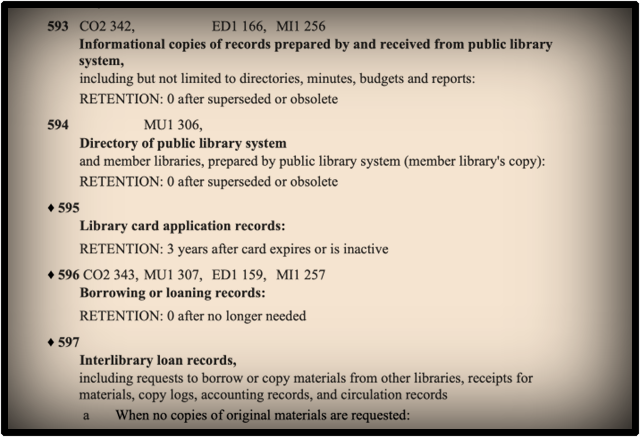
Lawyers can be notoriously precious about definitions, but I will say that in this case, it is the record generated by the process of applying for a library card and/or borrowing privileges.
Interestingly, the term “library card” is not defined by law or regulation in New York State and is only used in Education Law Section 816, which requires public schools to disseminate library card application information to K-12 students.
Instead, Education Law Section 262 provides: Every library ... shall be forever free to the inhabitants of the municipality or district or Indian reservation, which establishes it, subject always to rules of the library trustees who shall have authority to exclude any person who wilfully [sic] violates such rules; and the trustees may, under such conditions as they think expedient, extend the privileges of the library to persons living outside such municipality or district or Indian reservation. [emphasis added]
A “library card” is, by custom (not law), the end product of the “rules” of the “privilege” of using the library. A “Library Card Application Record” is whatever was generated with the end goal of a person having the privilege to use a library card. As can be seen, it must be retained for at least three years after the card has expired.
This brings us to the second question: Does duplicating all information from a simple registration card into the ILS patron record relieve the retention period of the physical registration card?
Great question!
I have to say “no.”
Here is why:
If you read the LGS-1 closely, you will see that it does not pertain to cooperative library systems; for example, LGS-1 items 593 and 594 in the above excerpt[4] show that while a member library must retain materials received from its library system, the system has no similar obligation.
This is because cooperative library systems do not fall under the record-keeping obligations of the state’s Arts & Cultural Affairs Law,[5] the law that mandates record-keeping by government agencies and directs NYSED to maintain a schedule of document retention (the LGS-1).
The obligations in the LGS-1 fall on public libraries. So, unless the cooperative library system providing the ILS is specifically under contract to maintain the records as a vendor for the required retention period, the copy retained by the system might not meet the retention obligation of the library (even if the record is 100% duplicated).
So, with that, on to the next question:
Does retention change if there is unique information on the registration card that is not duplicated in the ILS, including signatures?
If the application information is combined with other information, the retention period could be increased. For example, here is another type of record that must be kept by a public library:

So, if a library is doubling up on its application form (online or in hard copy) and also uses it as a form for registering the right to access a special collection, the retention period could be increased.
The next question is very important: If retention applies to a simple registration card (no signatures or unique information), is it possible to define it as a temporary data transfer tool rather than an application through policy, to relieve the retention requirement?
Again, I have to answer “no.”
Here is why: the physical registration card is filled out by the library user to apply for a card, and then it is used by the library or system to initiate the digital process of entering the card holder into the ILS.
Once the person is granted a card, the library has no obligation to retain their borrowing record (except to the extent the Library decides that it is “needed”). This includes—hold on, things are about to get meta here—the record entered into the ILS based on the application.
The record that must be retained for three years after the expiration of the card is the “application,” not the ILS record that facilitates borrowing.
Consider: The application is the act of the future library user signifying that they accept the rules the library is imposing and asking for library privileges.
Entry into the ILS is the act of the library accepting the application (generally with the help of the library system, which provides the ILS) and enabling the creation of a borrowing record.
Although the two operations may record the same information at the onset, these are two separate things, with two separate retention periods (life of the card plus three years and zero years after needed, respectively).
For this reason, cooperative library systems that do not fall under the Arts & Cultural Affairs Law have to carefully identify when they are performing a record-keeping function for a member public library that does fall under the Arts & Cultural Affairs Law. Although ILS technology will impact how borrowing privileges are put into effect and used, each public library within a system should have its own policy and practice for applying for a card, and each cooperative system should make it clear (via policy or a member agreement) when it is providing a record-keeping function for a member related to that process and when it is not.[6]
Interestingly, because a library card application can signify agreement to library and/or system policy and procedure, I believe it is wise to retain application materials for at least six years after expiration, because that is the default statute of limitations for bringing an action on a contract.[7] This is true whether the application was “born digital,” created on paper, or even submitted via a gilded rock.
But that is just something to consider, not a law. Here is a sample policy including this consideration and the others discussed above.
| Library Card Application Records Policy | Authority responsible for compliance: |
| Related Policies: | Adopted on: |
Library card application records are records generated by a library user and/or the library or library system in furtherance of the user’s formal library privileges.
Library card application records are confidential and private and will not be disclosed to any third party without written permission of the cardholder, or per a duly issued subpoena, court order, or warrant, unless for the operational needs of the library.
Typical information supplied on library card application records is: [username, address, optional additional contact information, optional third parties who may access confidential library records, and card type (select all that apply/add your own: temporary card, youth card, resident borrower, non-resident borrower, system card)].
The [NAME Library/NAME System] stores library card application records in the following ways: [SELECT ALL THAT APPLY: hard copy, on computers owned and controlled by the Library, on a network owned and controlled by the Library, on a confidential cloud service controlled by INSERT, and on an integrated library system maintained by the [NAME] Library System].
To ensure the proper retention and disposal of library card application records, such records are retained for not less than three (3) years after the card has been discontinued.
The following retention periods will add to and never subtract from the above period:
For a library card or other application for permission to use non-circulating materials, such records are retained for not less than six (6) years.
For library card application records relating to permission to use rare, valuable, or non-circulating materials, such records are retained for not less than six (6) years.
For library card application records relating to agreements to abide by a Code of Conduct, granting image rights use, third-party access to an account, or otherwise making a contractual agreement, such records are retained for not less than six (6) years.
Library card application records are disposed of within one (1) year of the expiration of the relevant retention period. Some library card application records may be retained for archival or operational purposes, but the privacy and confidentiality of such records shall continue.
Thank you for an important series of questions.
[1] I got my family tickets to see this group, performing the works of soundtrack composer Hans Zimmer, who composed the soundtrack to the 2023 “Dune.” If you know the work, you know that a gilded rock would be a much more appropriate ticket.
[2] I am assuming anyone who has read this far is a fan of the LGS-1, but for those to whom it sounds like a droid from Star Wars: the LGS-1 is a list of different types of documents kept by government agencies and their retention periods. Public libraries count as “government agencies”; cooperative library systems do not... but as they serve many public libraries, they must aid with compliance.
[3] I am including the entry in situ because I think it is helpful to see what other records are being defined. Also, I like the phrase “in situ.”
[5] This law defines the agencies that must follow it. Public libraries and confederated/consolidated library systems are “in,” while cooperative library systems and research councils are “out.”
[6] To take this into another realm: if a town hires a payroll company and is relying on the company to keep payroll records for the required period, its contract must provide assurance of the proper retention period. If the payroll company is merely processing things, and the town retains all the records, the contract does not have to address long-term retention. Library systems that provide ILS are providing the record-keeping function for borrowing records, and policy should address that—usually by specifying that records are not retained after materials are returned (unless the patron opts to keep the record).
Tag