Library Systems

Viva La Difference: Lobbying, Political Activity, and Telling People How to Vote

Submission Date

Question

Please provide a long, detailed, and deeply footnoted resource on the difference between lobbying, political activity, and telling people how to vote on a ballot measure such as a library budget proposition.

Answer

I am so glad we got this request! A long, detailed, and deeply footnoted resource is the only way to responsibly discuss the difference between these things.

We’ll start with: what is “lobbying?”

“Lobbying” is broadly defined as making contact with a government official to ask for something.

Of course, “asking for something” encompasses a LOT of activities. So, after broadly defining lobbying, the law then narrows it down a bit.

The federal lobbying law[1] whittles its definition of “lobbying” down by exempting things such as testimony, rule-making submissions, “asks” made in speeches or other general communications, and contact between public officials in their official capacity (for instance, if a library treasurer asks the IRS to give the library an extension on filing its Form 990, they are not lobbying).[2]

New York State’s lobbying law[3] also reduces its broad definition of lobbying with various exceptions (for instance, if a library’s attorney asks a local government’s attorney about collaborating on a bond initiative, it is not lobbying).

Because of the many holes in this wide net, a large part of getting lobbying right is taking the time to know what lobbying is, and what it isn’t.

For libraries, museums, and other cultural institutions, things that are NOT lobbying (although they could be interpreted as “asking the government for things”) are:

  • Issuing reports to the community that could be construed as making an “ask” related to funding, a grant, or legislative action[4];
  • Stating legislative, financial, or other asks of the government to reporters or the news media;
  • Joining in a public statement with other libraries or a library system about pending legislation at the local, state, or federal level;
  • Testifying before a local, state, or federal legislative body (even if it pertains to something of importance to the library);
  • Engaging in advocacy that doesn’t make contact with a specific official (for example, gathering at the steps of the capital building with signs asking for funding);
  • Appearing before a local zoning or planning committee as part of a proceeding;
  • Submitting a response to a question put by a legislator or public official;
  • Procurement activity after the contract is awarded.

For libraries, museums, and other cultural institutions, relevant examples of things that ARE lobbying are:

  • Directly asking a legislator to change a law;
  • Directly asking the governor to issue, adopt, rescind, or amend an executive order;
  • Directly asking any public official to make a determination regarding a procurement (like a contract to the library system to do a scanning project);
  • Asking in private for budget moneys as part of the municipal budget (not at an open meeting or public hearing);
  • Directly attempting to influence an official’s decision, outside of an established process (“Can we meet for lunch and talk about a new roof for the library?”).

In addition to knowing what is (and isn’t) lobbying, it is important to know who is (or isn’t) a “lobbyist.”

In New York, a lobbyist is “every person or organization retained, employed or designated by any client to engage in lobbying.”

Again, a pretty wide net! Basically, whether a company employs or hires a lobbyist as an independent contractor, or someone volunteers to ask a government official for something on the organization’s behalf, they are a “lobbyist” who has to register and report on their lobbying.

But just as with the definition of lobbying, the NY definition of lobbyist has holes. Here they are: “The term ‘lobbyist’ shall not include any officer, director, trustee, employee, counsel or agent of the state, or any municipality or subdivision thereof of New York when discharging their official duties; except those officers, directors, trustees, employees, counsels, or agents of colleges, as defined by section two of the education law.”

This is a very exciting loophole for public libraries,[5] because it means their officers, directors, trustees, employees, counsels or agents are not lobbyists (although their paid lobbyists are). This can save some registration paperwork and filing.

What “paperwork and filing” can it save?

Well, in New York, every lobbyist who receives in excess of five thousand dollars in reportable compensation and/or expenses per year must register as a lobbyist and file quarterly reports of lobbying activity; this is true no matter what type of organization the lobbyist is working for. But public library employees, officers, and trustees lobbying state and local officials are exempt from being considered “lobbyist”,[6] meaning those people might by lobbying, but they don’t have to individually register.

That said, I have to add two important caveats.

First, while there is a registration exemption for public libraries who only use a director or trustee to lobby in New York, this has no impact whatsoever on the Internal Revenue Code’s bar on excessive use of resources for lobbying purposes.

As the IRS puts it: “In general, no organization may qualify for section 501(c)(3) status if a substantial part of its activities is attempting to influence legislation (commonly known as lobbying). A 501(c)(3) organization may engage in some lobbying, but too much lobbying activity risks loss of tax-exempt status.” The IRS then has some “tests” to ensure a 501(c)(3) does not get too close to the danger zone.[7]

Second, this exemption for public library employees and trustees does not apply to federal lobbying, although the annual threshold triggering registration and reporting is higher ($16,000 dollars).[8]

And now we’ll move on to “political activity.”

Here is where things can get tricky, and a lot of people get confused: “political activity,” despite its broad phrasing, is defined by the federal Internal Revenue Service as supporting or opposing a political candidate or party. That is something a 501(c)(3) corporation can never, ever do[9], and is why a public library—or any 501(c)(3) tax-exempt organization—cannot donate to a political action committee (a “PAC”).[10]

And now we’ll move onto something for which (until November 2025) there has been no word or succinct phrase (just a string of case law and advisory opinions)— gepvia.[11]

Gepvia is the use of government resources to tell voters how to vote on a particular issue. Examples include:

  • A public library paying for “Vote Yes!” flyers
  • A school district public library board voting to issue a “Vote Yes” statement to the public
  • Public library property with signs telling people how to vote[12]

Why is “gepvia” forbidden? Because the use of public resources to pay for production and distribution of campaign materials for a partisan cause in any election or referendum has been held to “fall within the prohibition of Article VII, Section 8 of the N.Y. Constitution.”[13]

I know this is a tad complicated,[14] so here is a poem to summarize:

Libraries using tax money

Can pay to lobby and remain sunny.

But a public library boosting its idea

Might be engaging in gepvia.

Meanwhile Section five-o-one-cee-three

Forbids political activity.

And no matter how strong your feeling,

Do not engage in electioneering.

So...

Ask a senator to take action?

The law allows that satisfaction.

Tell the voters how to vote?

Publics can’t get in that boat.

Want to support a candidate?

No library org can participate.

Want to advocate at a polling place?

That’s a crime, give it some space.

And...

For the publics, here’s a handy quote:

“You can hang in the lobby, but don’t tell voters how to vote!”


Thank you for hanging in there on this complicated issue.


[1] See 2 U.S. Code § 1602.

[2] See 2 U.S. Code § 1602(8)(B)(i)

[3] N.Y. Legislative Law Article 1-A, “The Lobbying Act,” Section 1-c.

[4] But be careful, because that could be gepvia (“Government-Entity-Public-Vote-Influence Activity”).

[5] Sorry, association libraries, this loophole does not fit you.

[6] Sorry, cooperative library systems and research systems, this loophole does not fit you, either.

[7] As of November 5, 2025, the tests are linked here.

[8] See the federal requirements here and relevant guidance here.

[9] Unless, as of July 7, 2025, you are a religious corporation. See here.

[10] See this IRS FAQ for more information.

[11] “Government-Entity-Public-Vote-Influence Activity”

[12] This is not to be confused with “electioneering,” which is telling people how to vote within one hundred feet of a polling place (also illegal, but for different reasons).

[13] See 2012 NY Educ. Dept. LEXIS 48, 2012 NY Educ. Dept. LEXIS 48. Frankly, I think there is a little room for libraries to test this on First Amendment grounds, but legal risk-taking is not the primary mission of a library, so don’t poke that bear without thinking things through and having a lawyer briefed and ready!

[14] And this is me oversimplifying and leaving out a lot of things, like ethics rules, lobbying in procurement, and the distinction between school district public libraries and other public libraries, who have to do the same thing for slightly different reasons (see Phillips v Maurer, 67 NY2d 672 [1986]).

The Low-down on Libraries Lobbying

Submission Date

Question

Can a public library or library system use taxpayer revenue to engage in advocacy, hire a lobbyist, or pay dues to an organization doing advocacy/lobbying?

Answer

It can be a fact as shocking as learning that there are no “Berenstein Bears”:[1] a public library or library system—or even a town or a village—can engage directly in lobbying.

A public library, library system, or municipality can also join a membership organization that uses funds from its dues to engage in lobbying.[2]

Now, it is important to not confuse lobbying with political activity, political donations, electioneering, or telling regular voters (not lawmakers) how to vote on a particular item. Those are forbidden to any quasi-governmental organization, and all but the last one (telling voters how to vote[3]) are forbidden for association libraries and other private nonprofit organizations, too.

“Lobbying”—which any library organization of any type can do or pay another entity to do on its behalf—is an activity that is defined by state and federal law, and it means directly asking government officials for things,[4] such as:

  • A budget item
  • A new law
  • A change to the law
  • Voting against something
  • Changing the enforcement or interpretation of something

Lobbying involves direct contact with a government official… not testimony at a hearing, not demonstrating in front of a building, and not attending an open meeting to make an ask or presentation (activities many people call “advocacy”).

For readers who are taking this in and having a Berenstain Bears Moment (“It can’t be true!”) about tax-funded entities lobbying, try this exercise: If an organization is lobbying or hiring lobbyists in New York, you can look up its reporting here. Search the database for “town” or “school district” and you will see many towns and other taxpayer-funded entities engaging in lobbying.

Basically, if a taxpayer-funded entity has decided that lobbying is in the best interests of the organization, the expenditure is legal.[5] As long as all the lobbying registration and reporting requirements are met and not too much money is spent on the lobbying, all will be well.[6]

So yes, a public library or library system can use budget moneys derived from taxpayer revenue to hire a lobbyist or pay dues to an organization doing advocacy/lobbying.

For more information on the difference between lobbying, political activity, advocacy, and gepvia,[7] please see this longer, more detailed RAQ.


[1] My husband, along with about half the world, was shocked to learn it is not “Berenstein” (like the composer Leonard Bernstein, but with an extra “e”). Perhaps because I was once a page who regularly had to put away The Berenstain Bears, I was mystified by this entire kerfuffle.

[2] See the 1980 New York Attorney General Opinion “N.Y. Comp. LEXIS 250, 1980 N.Y. Comp. LEXIS 250, 1980 N.Y. St. Comp. 136”

[3] There seems to be no unambiguous single term for this action, so I will call it “gepvia,” or “Government-Entity-Public-Vote-Influence Activity.” Courts have held gepvia to be forbidden by the New York State Constitution.

[4] There are a lot of specific inclusion and exclusions in the definitions of lobbying. We’ll tackle that in another Ask the Lawyer RAQ.

[5] So long as it is not made from a restricted fund, misappropriated, etc. You still have to follow the rules of how to spend money!

[6] For example, they New York Library Association is registered to lobby and files routine reports. To search for them, try “library association,” as the term “New York” is weird on the database (for NYLA, they call it “Library Association (NY)”, which does not make for an intuitive search.

[7] Gepvia [noun] is the use of government resources to influence a vote by the electorate. Examples include a public library board issuing a “Vote Yes on the Budget” ad on local radio and a confederated library system telling voters to vote for a particular trustee candidate.

Retention of Library Card Application Records

Submission Date

Question

Many libraries use a form of “registration card” when signing people up for a library card; a small form filled out by a patron before receiving a library card. We’d like some clarity regarding the retention of physical registration cards as they pertain to “Library Card Application Records” in the LGS-1.

Here are the questions:
1. How would you define a Library Card Application Record?

2. Does duplicating all information from a simple registration card into the ILS patron record relieve the retention period of the physical registration card?

3. The registration card would not have unique information or signatures. Does retention change if there is unique information on the registration card that is not duplicated in the ILS, including signatures?

4. If retention applies to a simple registration card (no signatures or unique information), is it possible to define it as a temporary data transfer tool rather than an application through policy, to relieve the retention requirement?

Answer

At one point about twenty years ago, I thought about forming a small company that would use etchings on stone to authenticate important records. The stones would range in size and be etched with a unique pattern documenting the record. The properties of the stone, in combination with the pattern, would be the authentication key. The jobs of “stone courier” and “stone reader” would be a fiduciary position, akin to a lawyer or CPA (but they would be in better shape, because of all the lifting).

I did not follow up on this idea, which is of course the only reason why we now use QR codes to authenticate everything from mortgages to concert tickets, and why you don’t have to have a padded “rock bag” in place of your cell phone, as you go through the airline check-in.

Why am I starting my answer to a serious question with this silly (but real) story? Because as the question points out, there are many types of records, and they are defined by their content, not their medium. A ticket to see “Lords of the Sound,” whether on paper, your phone, or a gilded rock, is still a ticket.[1] In that same vein, a library card application record, no matter what the medium, is still a library card application record.

So, to address the first question (How would you define a Library Card Application Record?), we must first ask, “What is a library card application record, as defined by the LGS-1?”[2]

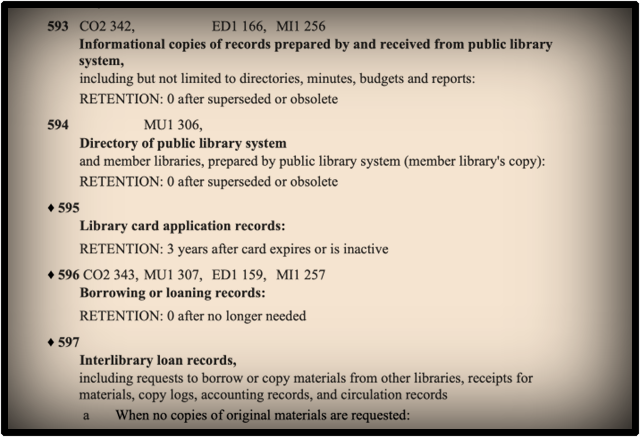
Here is how “library card application records” are referred to in the most recent version:[3]

Screenshot of LGS-1 showing information about Library card application records. The text on the page reads: 593 CO2 342 EDI 166, MI1 256 Informational copies of records prepared by and received from public library system, including but not limited to directories, minutes, budgets and reports: RETENTION: 0 after superseded or obsolete. 594 MU1 306, Directory of public library system and member libraries, prepared by public library system (member library's copy): RETENTION: 0 after superseded or obsolete. (Highlighted) 595 Library card application records: RETENTION: 3 years after card expires or is inactive (end highlight). 596 CO2 343, MU1 307, ED1 159, MI1 257 Borrowing or loaning records: RETENTION: 0 after no longer needed. 597 Interlibrary loan records, including requests to borrow or copy materials from other libraries, receipts for materials, copy logs, accounting records, and circulation records a when no copies of original materials are requested.

Lawyers can be notoriously precious about definitions, but I will say that in this case, it is the record generated by the process of applying for a library card and/or borrowing privileges.

Interestingly, the term “library card” is not defined by law or regulation in New York State and is only used in Education Law Section 816, which requires public schools to disseminate library card application information to K-12 students.

Instead, Education Law Section 262 provides: Every library ... shall be forever free to the inhabitants of the municipality or district or Indian reservation, which establishes it, subject always to rules of the library trustees who shall have authority to exclude any person who wilfully [sic] violates such rules; and the trustees may, under such conditions as they think expedient, extend the privileges of the library to persons living outside such municipality or district or Indian reservation. [emphasis added]

A “library card” is, by custom (not law), the end product of the “rules” of the “privilege” of using the library. A “Library Card Application Record” is whatever was generated with the end goal of a person having the privilege to use a library card. As can be seen, it must be retained for at least three years after the card has expired.

This brings us to the second question: Does duplicating all information from a simple registration card into the ILS patron record relieve the retention period of the physical registration card?

Great question!

I have to say “no.”

Here is why:

If you read the LGS-1 closely, you will see that it does not pertain to cooperative library systems; for example, LGS-1 items 593 and 594 in the above excerpt[4] show that while a member library must retain materials received from its library system, the system has no similar obligation.

This is because cooperative library systems do not fall under the record-keeping obligations of the state’s Arts & Cultural Affairs Law,[5] the law that mandates record-keeping by government agencies and directs NYSED to maintain a schedule of document retention (the LGS-1).

The obligations in the LGS-1 fall on public libraries. So, unless the cooperative library system providing the ILS is specifically under contract to maintain the records as a vendor for the required retention period, the copy retained by the system might not meet the retention obligation of the library (even if the record is 100% duplicated).

So, with that, on to the next question:

Does retention change if there is unique information on the registration card that is not duplicated in the ILS, including signatures?

If the application information is combined with other information, the retention period could be increased. For example, here is another type of record that must be kept by a public library:

Screenshot from LGS-1 with text that reads: 602 CO2 348, MU1 312, ED1 164, MI1 262. Patron's registration: for use of rare, valuable or restricted non-circulating materials: RETENTION: 6 years.

So, if a library is doubling up on its application form (online or in hard copy) and also uses it as a form for registering the right to access a special collection, the retention period could be increased.

The next question is very important: If retention applies to a simple registration card (no signatures or unique information), is it possible to define it as a temporary data transfer tool rather than an application through policy, to relieve the retention requirement?

Again, I have to answer “no.”

Here is why: the physical registration card is filled out by the library user to apply for a card, and then it is used by the library or system to initiate the digital process of entering the card holder into the ILS.

Once the person is granted a card, the library has no obligation to retain their borrowing record (except to the extent the Library decides that it is “needed”). This includes—hold on, things are about to get meta here—the record entered into the ILS based on the application.

The record that must be retained for three years after the expiration of the card is the “application,” not the ILS record that facilitates borrowing.

Consider: The application is the act of the future library user signifying that they accept the rules the library is imposing and asking for library privileges.

Entry into the ILS is the act of the library accepting the application (generally with the help of the library system, which provides the ILS) and enabling the creation of a borrowing record.

Although the two operations may record the same information at the onset, these are two separate things, with two separate retention periods (life of the card plus three years and zero years after needed, respectively).

For this reason, cooperative library systems that do not fall under the Arts & Cultural Affairs Law have to carefully identify when they are performing a record-keeping function for a member public library that does fall under the Arts & Cultural Affairs Law. Although ILS technology will impact how borrowing privileges are put into effect and used, each public library within a system should have its own policy and practice for applying for a card, and each cooperative system should make it clear (via policy or a member agreement) when it is providing a record-keeping function for a member related to that process and when it is not.[6]

Interestingly, because a library card application can signify agreement to library and/or system policy and procedure, I believe it is wise to retain application materials for at least six years after expiration, because that is the default statute of limitations for bringing an action on a contract.[7] This is true whether the application was “born digital,” created on paper, or even submitted via a gilded rock.

But that is just something to consider, not a law. Here is a sample policy including this consideration and the others discussed above.

Library Card Application Records PolicyAuthority responsible for compliance:
Related Policies:Adopted on:

Library card application records are records generated by a library user and/or the library or library system in furtherance of the user’s formal library privileges. 

Library card application records are confidential and private and will not be disclosed to any third party without written permission of the cardholder, or per a duly issued subpoena, court order, or warrant, unless for the operational needs of the library.

Typical information supplied on library card application records is: [username, address, optional additional contact information, optional third parties who may access confidential library records, and card type (select all that apply/add your own: temporary card, youth card, resident borrower, non-resident borrower, system card)].

The [NAME Library/NAME System] stores library card application records in the following ways: [SELECT ALL THAT APPLY: hard copy, on computers owned and controlled by the Library, on a network owned and controlled by the Library, on a confidential cloud service controlled by INSERT, and on an integrated library system maintained by the [NAME] Library System].

To ensure the proper retention and disposal of library card application records, such records are retained for not less than three (3) years after the card has been discontinued.

The following retention periods will add to and never subtract from the above period: 

For a library card or other application for permission to use non-circulating materials, such records are retained for not less than six (6) years. 

For library card application records relating to permission to use rare, valuable, or non-circulating materials, such records are retained for not less than six (6) years.

For library card application records relating to agreements to abide by a Code of Conduct, granting image rights use, third-party access to an account, or otherwise making a contractual agreement, such records are retained for not less than six (6) years.

Library card application records are disposed of within one (1) year of the expiration of the relevant retention period. Some library card application records may be retained for archival or operational purposes, but the privacy and confidentiality of such records shall continue.

Thank you for an important series of questions.


[1] I got my family tickets to see this group, performing the works of soundtrack composer Hans Zimmer, who composed the soundtrack to the 2023 “Dune.” If you know the work, you know that a gilded rock would be a much more appropriate ticket.

[2] I am assuming anyone who has read this far is a fan of the LGS-1, but for those to whom it sounds like a droid from Star Wars: the LGS-1 is a list of different types of documents kept by government agencies and their retention periods. Public libraries count as “government agencies”; cooperative library systems do not... but as they serve many public libraries, they must aid with compliance.

[3] I am including the entry in situ because I think it is helpful to see what other records are being defined. Also, I like the phrase “in situ.”

[4] See why it is important to consider things in situ?

[5] This law defines the agencies that must follow it. Public libraries and confederated/consolidated library systems are “in,” while cooperative library systems and research councils are “out.”

[6] To take this into another realm: if a town hires a payroll company and is relying on the company to keep payroll records for the required period, its contract must provide assurance of the proper retention period. If the payroll company is merely processing things, and the town retains all the records, the contract does not have to address long-term retention. Library systems that provide ILS are providing the record-keeping function for borrowing records, and policy should address that—usually by specifying that records are not retained after materials are returned (unless the patron opts to keep the record).

[7] In addition, a cooperative library system can pass a policy for cards to be applied for directly from the system, but the basis and terms for doing so should be clearly defined by a board-approved policy.