
ILS

Libraries, Fax Machines, and Data Security Obligations

Submission Date

Question

Outside of best practices for staff handling of sensitive documents, are public libraries otherwise bound by HIPAA, FERPA and SOX when sending faxes for patrons, in terms of the privacy protections provided (or not) by the type of fax technology?

Our library currently uses a traditional standalone fax machine (staff mediated) to send and receive public faxes across a dedicated copper phone line, so there’s a direct connection between receiver and sender, maintaining privacy during transmission. Faxing remains a popular service here largely for that reason -- patrons are often told by the fax destination that documents must be sent via fax and not scanned to email.

We’ve been told that copper phone lines will soon be eliminated, so we’re investigating fax-to-email services, which are cheaper than our current method and can use our public copier as the faxing device. However, the Forbes article linked below says faxing by email does not offer privacy protections: “Virtual fax introduces an intermediary into the fax process; there’s no direct connection between the sending and receiving parties. This can be problematic if your business has certain regulatory compliance requirements to support (for example, HIPAA, FERPA and SOX).” The article cites an encrypted kind of fax by IP, “T.38 Fax Lines,” which we suspect would not be cost effective for us.

Are libraries bound by HIPAA et al in the type of faxing technology they can use?

Answer

This is a great question. Before we jump into it, let’s summarize the three types of faxing set out in the referenced article:

  1. “Walk-up Faxing” (on a copper line)
  2. “Virtual Fax” (it’s really email![1])
  3. “Real-Time T.38 Fax Lines” (still e-mail, but with a better connection)

The “T.38” as a “best practice” intrigued me, so I dug in to see if there was any case law featuring it.

There is! And it digs into the capability of the T.38: [2]

Defendant further attacks Richard’s credibility by claiming that his testimony reveals his failure to understand the intricacies of fax technology. These critiques are frivolous. For example, defendant claims Richard’s credibility is undermined by his allegedly inaccurate testimony that: (1) MessageVision used only the T.30 protocol; and (2) a device such as MessageVision’s that uses the T.38 protocol cannot use the T.30 protocol. Even if defendant is correct that Richard’s testimony reflects his limited comprehension of fax technology—a proposition that appears to be dubious at best—defendant’s argument is contradicted by the fact that his own expert admits that T.38 converts to T.30 when a fax is sent using APX 1000.

Well then.[3]

So, with “the intricacies of fax technology” now established as a legal niche, let’s take the questions about faxing and regulatory compliance acronym-by-acronym.

  • FERPA
  • HIPAA
  • SOX[4]

1. Libraries, Fax Lines, and FERPA

FERPA does not apply to public libraries, so we’ll discuss it in the context of school libraries.

Academic libraries at institutions that receive federal assistance have to follow the “Family Education Rights Privacy Act,” which (among many other things) restricts third-party access to education records.[5]

As an example: if I am a student at ABC College, I need to borrow something via an inter-library loan, and (for some odd, steampunky reason) the lending library will only receive loan requests by fax, FERPA could restrict third-party access to the request, if the request lists me (the student) by name as the borrower.[6]

In this case, the manner in which the fax is sent (copper, email, fancy T.38) does not matter. What matters is that either a) I consented for my FERPA-protected education record to be shared with a third party or b) inter-library lending is set up in a way that makes lending libraries (sorta) part of the institution under 34 CFR § 99.31.[7]

After that, the fax simply has to be sufficiently secure to get it from point A (the library) to point B (the other library) without disclosure to a third party.[8]

So that’s FERPA.

2. Libraries, Fax Lines, and HIPAA

HIPAA and other laws related to medical privacy are important and high-stakes; the fine for a HIPAA violation is $50,000 dollars.

Before we delve into this, aside from a hospital librarian or librarian serving a program providing health services, there is NO CIRCUMSTANCE under which a public, academic or public library should be engaging in a HIPAA-governed communication.[9]

What do I mean by “HIPAA-governed communication?” Here’s the type of information governed by HIPAA:[10]

Individually identifiable health information

The term “individually identifiable health information” means any information, including demographic information collected from an individual, that—

(A) is created or received by a health care provider, health plan, employer, or health care clearinghouse; and

(B) relates to the past, present, or future physical or mental health or condition of an individual, the provision of health care to an individual, or the past, present, or future payment for the provision of health care to an individual, and—

(i) identifies the individual; or

(ii) with respect to which there is a reasonable basis to believe that the information can be used to identify the individual.

If your library is not transmitting this type of information,[11] you can stop sweating about HIPAA, even if patrons are using your fax to send it, or (at an academic library) the health center on campus has to abide by it.

Now, if you are a library in a teaching hospital, etc., here is the deal: your institution needs to step up and provide you with 100% assurance that you have the right policies, technology, and practices to be compliant.[12] This includes assurance of a fax line that is secure, which can be any of the three solutions, so long as it is set up right and maintained properly.[13]

So that’s HIPAA.

3. Libraries, Fax Lines, and SOX

While the accountants who audit your library or larger institution may (rightly) hold themselves to the standard set by “Sarbanes-Oxley” (SOX), which was passed in 2002 to protect investors in publicly traded companies, SOX does not govern the data transmission practices of a public or academic library.

But the mention of SOX in the Forbes article referenced in the question intrigued me—it says, “Virtual fax... can be problematic if your business has certain regulatory compliance requirements to support (for example, HIPAA, FERPA and SOX).”

So, I took a look to see if there has been a SOX case involving an insecure fax... and there is!

Here is what happened as told by Judge Denise Cote in Seybold v. Groenink:[14]

In October 2004, while the chairman of ABN’s Managing Board, defendant Rijkman Groenink, met with Federal Reserve Bank regulators in New York over the Eastern European transactions, he received a fax at the Ritz-Carlton Hotel concerning the results of an internal ABN investigation regarding Iran-Libya transactions. Groenink allegedly ordered his aides to destroy the report and to stop sending sensitive documents to the United States.

So, if you are at a library near a business school prepping students for stellar careers in international business... it may be helpful to show that we must all fax wisely.

Does this mean your library needs a T.38? No, but it does mean that asking questions and developing secure systems is important.

You may even want to do the research and see if you can fight to keep at least one copper line.[15] There is strength in having a diversity of technology.[16]

Thank you for an excellent question!

Update 7/23/2025: We received a followup question on this topic; read our answer here.


[1]^ For this question, I will assume that the academic library is using the institutionally assigned and controlled email, which is generally either an in-house service or a third-party provider with a contract that addresses privacy/security.

[2]^ This tech-takedown was issued by U.S. District Judge Robert Gettleman in Ira Holtzman, C.P.A., & Assocs. v. Turza in 2011. Citation: U.S. Dist. LEXIS 97666, 2011 WL 3876943.

[3]^ This paragraph is the judicial equivalent of what in videogames is called “pwnage.”

[4]^ FAX in FERPA, HIPAA in SOX... HIPPA with FERPA on FAX in SOX!

[5]^ Ask the Lawyer has tackled FERPA elsewhere, see: FERPA and NYS Privacy Laws and Patron Confidentiality in School Libraries for two examples.

[6]^ Why this would happen outside a hypothetical situation eludes me, but if you are at an academic library that includes patron names in ILL requests (aside from those enabled by an interconnected/automated ILS), please write adams@losapllc.com, because I am curious how that works.

[7]^ This section of FERPA is how institutions do things like use outside providers to held run residence halls, consult on student outcomes, and in general assist with institutional functions that require access to education records.

[8]^ This means the email used to send the virtual fax needs to be a secure, institutionally-controlled email on both ends, but one would hope that is not a heavy lift.

[9]^ A good resource to assess if you are at a HIPAA “covered entity” is at https://www.hhs.gov/hipaa/for-professionals/covered-entities/index.html.

[11]^ What your patrons are doing is their own business. Of course, if they have stolen the health information of a person and are now using your fax machine to engage in identity theft, the might a violation of your Code of Conduct (and about three laws), but it is still not an illegal act by the library.

[12]^ Seriously... this cannot be self-diagnosed. The lawyer for your institution should sign off on it.

[13]^ And with that, we have hit the threshold of my techy savvy.

[14]^ 2007 U.S. Dist. LEXIS 16994, 2007 WL 737502.

[15]^ I did. And yes, my law office still faxes. Like the article said, it’s still very much a thing.

[16]^ Look, sir. Look, sir. It’s our fax, sir. Let’s do tricks with lines and wires, sir. Let’s do tricks with code and lines, sir.

Retention of Library Card Application Records

Submission Date

Question

Many libraries use a form of “registration card” when signing people up for a library card; a small form filled out by a patron before receiving a library card. We’d like some clarity regarding the retention of physical registration cards as they pertain to “Library Card Application Records” in the LGS-1.

Here are the questions:
1. How would you define a Library Card Application Record?

2. Does duplicating all information from a simple registration card into the ILS patron record relieve the retention period of the physical registration card?

3. The registration card would not have unique information or signatures. Does retention change if there is unique information on the registration card that is not duplicated in the ILS, including signatures?

4. If retention applies to a simple registration card (no signatures or unique information), is it possible to define it as a temporary data transfer tool rather than an application through policy, to relieve the retention requirement?

Answer

At one point about twenty years ago, I thought about forming a small company that would use etchings on stone to authenticate important records. The stones would range in size and be etched with a unique pattern documenting the record. The properties of the stone, in combination with the pattern, would be the authentication key. The jobs of “stone courier” and “stone reader” would be a fiduciary position, akin to a lawyer or CPA (but they would be in better shape, because of all the lifting).

I did not follow up on this idea, which is of course the only reason why we now use QR codes to authenticate everything from mortgages to concert tickets, and why you don’t have to have a padded “rock bag” in place of your cell phone, as you go through the airline check-in.

Why am I starting my answer to a serious question with this silly (but real) story? Because as the question points out, there are many types of records, and they are defined by their content, not their medium. A ticket to see “Lords of the Sound,” whether on paper, your phone, or a gilded rock, is still a ticket.[1] In that same vein, a library card application record, no matter what the medium, is still a library card application record.

So, to address the first question (How would you define a Library Card Application Record?), we must first ask, “What is a library card application record, as defined by the LGS-1?”[2]

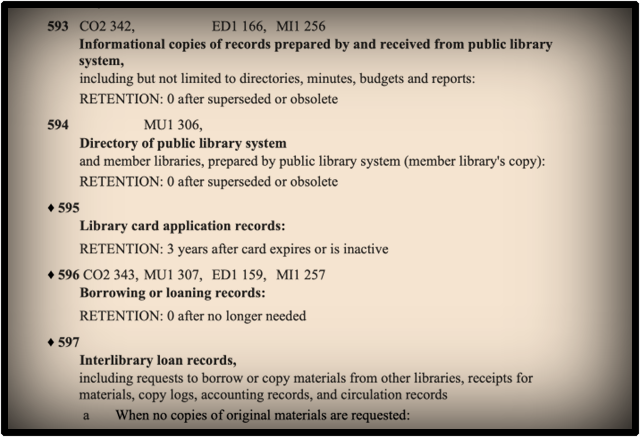
Here is how “library card application records” are referred to in the most recent version:[3]

Screenshot of LGS-1 showing information about Library card application records. The text on the page reads: 593 CO2 342 EDI 166, MI1 256 Informational copies of records prepared by and received from public library system, including but not limited to directories, minutes, budgets and reports: RETENTION: 0 after superseded or obsolete. 594 MU1 306, Directory of public library system and member libraries, prepared by public library system (member library's copy): RETENTION: 0 after superseded or obsolete. (Highlighted) 595 Library card application records: RETENTION: 3 years after card expires or is inactive (end highlight). 596 CO2 343, MU1 307, ED1 159, MI1 257 Borrowing or loaning records: RETENTION: 0 after no longer needed. 597 Interlibrary loan records, including requests to borrow or copy materials from other libraries, receipts for materials, copy logs, accounting records, and circulation records a when no copies of original materials are requested.

Lawyers can be notoriously precious about definitions, but I will say that in this case, it is the record generated by the process of applying for a library card and/or borrowing privileges.

Interestingly, the term “library card” is not defined by law or regulation in New York State and is only used in Education Law Section 816, which requires public schools to disseminate library card application information to K-12 students.

Instead, Education Law Section 262 provides: Every library ... shall be forever free to the inhabitants of the municipality or district or Indian reservation, which establishes it, subject always to rules of the library trustees who shall have authority to exclude any person who wilfully [sic] violates such rules; and the trustees may, under such conditions as they think expedient, extend the privileges of the library to persons living outside such municipality or district or Indian reservation. [emphasis added]

A “library card” is, by custom (not law), the end product of the “rules” of the “privilege” of using the library. A “Library Card Application Record” is whatever was generated with the end goal of a person having the privilege to use a library card. As can be seen, it must be retained for at least three years after the card has expired.

This brings us to the second question: Does duplicating all information from a simple registration card into the ILS patron record relieve the retention period of the physical registration card?

Great question!

I have to say “no.”

Here is why:

If you read the LGS-1 closely, you will see that it does not pertain to cooperative library systems; for example, LGS-1 items 593 and 594 in the above excerpt[4] show that while a member library must retain materials received from its library system, the system has no similar obligation.

This is because cooperative library systems do not fall under the record-keeping obligations of the state’s Arts & Cultural Affairs Law,[5] the law that mandates record-keeping by government agencies and directs NYSED to maintain a schedule of document retention (the LGS-1).

The obligations in the LGS-1 fall on public libraries. So, unless the cooperative library system providing the ILS is specifically under contract to maintain the records as a vendor for the required retention period, the copy retained by the system might not meet the retention obligation of the library (even if the record is 100% duplicated).

So, with that, on to the next question:

Does retention change if there is unique information on the registration card that is not duplicated in the ILS, including signatures?

If the application information is combined with other information, the retention period could be increased. For example, here is another type of record that must be kept by a public library:

Screenshot from LGS-1 with text that reads: 602 CO2 348, MU1 312, ED1 164, MI1 262. Patron's registration: for use of rare, valuable or restricted non-circulating materials: RETENTION: 6 years.

So, if a library is doubling up on its application form (online or in hard copy) and also uses it as a form for registering the right to access a special collection, the retention period could be increased.

The next question is very important: If retention applies to a simple registration card (no signatures or unique information), is it possible to define it as a temporary data transfer tool rather than an application through policy, to relieve the retention requirement?

Again, I have to answer “no.”

Here is why: the physical registration card is filled out by the library user to apply for a card, and then it is used by the library or system to initiate the digital process of entering the card holder into the ILS.

Once the person is granted a card, the library has no obligation to retain their borrowing record (except to the extent the Library decides that it is “needed”). This includes—hold on, things are about to get meta here—the record entered into the ILS based on the application.

The record that must be retained for three years after the expiration of the card is the “application,” not the ILS record that facilitates borrowing.

Consider: The application is the act of the future library user signifying that they accept the rules the library is imposing and asking for library privileges.

Entry into the ILS is the act of the library accepting the application (generally with the help of the library system, which provides the ILS) and enabling the creation of a borrowing record.

Although the two operations may record the same information at the onset, these are two separate things, with two separate retention periods (life of the card plus three years and zero years after needed, respectively).

For this reason, cooperative library systems that do not fall under the Arts & Cultural Affairs Law have to carefully identify when they are performing a record-keeping function for a member public library that does fall under the Arts & Cultural Affairs Law. Although ILS technology will impact how borrowing privileges are put into effect and used, each public library within a system should have its own policy and practice for applying for a card, and each cooperative system should make it clear (via policy or a member agreement) when it is providing a record-keeping function for a member related to that process and when it is not.[6]

Interestingly, because a library card application can signify agreement to library and/or system policy and procedure, I believe it is wise to retain application materials for at least six years after expiration, because that is the default statute of limitations for bringing an action on a contract.[7] This is true whether the application was “born digital,” created on paper, or even submitted via a gilded rock.

But that is just something to consider, not a law. Here is a sample policy including this consideration and the others discussed above.

Library Card Application Records PolicyAuthority responsible for compliance:
Related Policies:Adopted on:

Library card application records are records generated by a library user and/or the library or library system in furtherance of the user’s formal library privileges. 

Library card application records are confidential and private and will not be disclosed to any third party without written permission of the cardholder, or per a duly issued subpoena, court order, or warrant, unless for the operational needs of the library.

Typical information supplied on library card application records is: [username, address, optional additional contact information, optional third parties who may access confidential library records, and card type (select all that apply/add your own: temporary card, youth card, resident borrower, non-resident borrower, system card)].

The [NAME Library/NAME System] stores library card application records in the following ways: [SELECT ALL THAT APPLY: hard copy, on computers owned and controlled by the Library, on a network owned and controlled by the Library, on a confidential cloud service controlled by INSERT, and on an integrated library system maintained by the [NAME] Library System].

To ensure the proper retention and disposal of library card application records, such records are retained for not less than three (3) years after the card has been discontinued.

The following retention periods will add to and never subtract from the above period: 

For a library card or other application for permission to use non-circulating materials, such records are retained for not less than six (6) years. 

For library card application records relating to permission to use rare, valuable, or non-circulating materials, such records are retained for not less than six (6) years.

For library card application records relating to agreements to abide by a Code of Conduct, granting image rights use, third-party access to an account, or otherwise making a contractual agreement, such records are retained for not less than six (6) years.

Library card application records are disposed of within one (1) year of the expiration of the relevant retention period. Some library card application records may be retained for archival or operational purposes, but the privacy and confidentiality of such records shall continue.

Thank you for an important series of questions.


[1] I got my family tickets to see this group, performing the works of soundtrack composer Hans Zimmer, who composed the soundtrack to the 2023 “Dune.” If you know the work, you know that a gilded rock would be a much more appropriate ticket.

[2] I am assuming anyone who has read this far is a fan of the LGS-1, but for those to whom it sounds like a droid from Star Wars: the LGS-1 is a list of different types of documents kept by government agencies and their retention periods. Public libraries count as “government agencies”; cooperative library systems do not... but as they serve many public libraries, they must aid with compliance.

[3] I am including the entry in situ because I think it is helpful to see what other records are being defined. Also, I like the phrase “in situ.”

[4] See why it is important to consider things in situ?

[5] This law defines the agencies that must follow it. Public libraries and confederated/consolidated library systems are “in,” while cooperative library systems and research councils are “out.”

[6] To take this into another realm: if a town hires a payroll company and is relying on the company to keep payroll records for the required period, its contract must provide assurance of the proper retention period. If the payroll company is merely processing things, and the town retains all the records, the contract does not have to address long-term retention. Library systems that provide ILS are providing the record-keeping function for borrowing records, and policy should address that—usually by specifying that records are not retained after materials are returned (unless the patron opts to keep the record).

[7] In addition, a cooperative library system can pass a policy for cards to be applied for directly from the system, but the basis and terms for doing so should be clearly defined by a board-approved policy.

The Legalities of Patron Data on a Shared ILS

Submission Date

Question

According to the RAQ: Using Emails from ILS Patron Database: “Although a member library contributes information to an ILS, unless system bylaws or policies say otherwise, that information belongs to the system, who is just as ethically and legally bound to protect the information as a member library.”

However, there was a question during a session at NYLA regarding system ownership of library records that seemed to contradict this.

If the system owns the ILS and therefore the library records, wouldn’t that mean that policies pertaining to accessing/creating/modifying/deleting records for the ILS should be governed by system policies that are also approved by each member library board?

I’m specifically thinking of such policies as Confidentiality of Library Records / Inquiries from Law Enforcement - where if the system owns the records then wouldn’t both these policies just be a system one? Also with having consistency for Library Card Applications. A patron can go to one of our libraries and have to show many forms of identification - but the same patron could see us at an outreach event and not even have to show their ID to get a card.

Answer

This submission has it all—attention to detail, a blend of law and policy, and a reference to a past ATL.[1]

It also shows what’s at stake for libraries when we ask these two questions: who “owns” all that data on an ILS? Who sets the terms of cardholder access?

As the members questions point out, uncertainly about these issues can cause complications

Before we jump into the details, there is a critical take-away: while there is no one right answer to these questions, every library and every system should know their particular answers.

To make this answer as helpful as possible, we’ll spend a little time on why there is no single right answer to this issue. After we review the “why,” we’ll review the spectrum of approaches. And after all that, I’ll provide a diagnostic form so your library or system can assess where it stands.

The “Why”

Why is there “no one right answer” to who owns ILS data and who sets the terms of cardholder access? Because the law and its regulations give library systems and members infinite flexibility on those topics.

That flexibility means there is no prescribed model of ILS.[2] Instead, the law[3] simply conditions certain state aid on a system having “an automation program to support bibliographic control and interlibrary sharing of information resources of member libraries, and to coordinate and integrate the automated system or systems of such member libraries consistent with regulations of the commissioner.”

Those “regulations of the commissioner” state: “The plan of each public library system shall provide for coordination of the reference and interlibrary loan programs and functions of the public library system with the approved plan of the reference and research library system of which it is a member.”[4]

That’s it. There are no laws or regulations saying how that must be done.

Because of that, the “rules” of an ILS and its impact on cardholder access come from charters,[5] bylaws, contracts, and policy—all of which are set by a system’s board of trustees and then accepted by the member libraries.

This approach has led to there being a spectrum of ILS policies in New York State.[6]

Let’s explore this spectrum.

The ILS Spectrum

Library systems are formed to offer “improved and expanded”[7] library service.

To qualify for certain state aid under Education Law Section 273(d), systems must implement an “automation program to support bibliographic control and interlibrary sharing of information resources of member libraries, and to coordinate and integrate the automated system or systems of such member libraries consistent with regulations of the commissioner…”

How a system meets those requirements is up to the system. To illustrate how differently systems can do that, here is a range of solutions:[8]

One system puts major rules for ILS right in its bylaws, including that all ILS contracts and policy must be approved by the board. This is an “ILS by Bylaws and Board” model.[9]

Another system has bare-bones bylaws, but ILS policy, pricing, and contracts can only be approved by the board of trustees. This is an “ILS by Board Only” model.

Another system wants more “on the ground” input, and it wants that input to have power. It creates a council to assess ILS policy, pricing, and contracts, and those things can only be changed by the board of trustees after approval by the council. This is a “Two-Step Approval ILS Policy” model.

Another system finds bylaws and policy revision cumbersome and puts all the terms for the ILS in an “ILS Participation Contract” that must be approved by the system board and then by the board of each participating library. This is an “ILS by Contract” model.[10]

Another system wants to have ongoing stability, so it puts part of the ILS process in the bylaws, some in board-approved policy, and then outsources more mutable aspects (like pricing and desired tech functions) to a committee (or committees). The system believes in the power of shared governance, so it asks another group (usually of directors) to assess ALL changes to policy before approval by the board. And finally, it uses an annual contract process to confirm pricing and updated security measures. This is an “ILS By Everything” model.

See what I mean about diversity?[11] And these five models only illustrate a broad range of approaches; within this range, any number of permutations exist.[12]

Where your Library/System Stands

All this diversity and flexibility means it can be tough to sort out answers to the questions raised by the member:

  • Who “owns” all that data on an ILS?
  • Who sets the terms of cardholder access?

To answer them—because as was said at the beginning, no matter what the answer is, it must be clear—it is helpful to review certain documents while asking certain questions.

Here they are:[13]

QuestionWhy it’s important

Does your library have a policy governing the terms of getting a library card?

NOTE: Libraries can have a policy of issuing cards only to “resident” borrowers, even though they must honor the cards of nonresident borrowers issued by other member libraries and the library system.

If so, attach the policy.

If your library doesn’t have a policy, the only terms will be those on the application form and those in the policy of the system.

Does your library have an application form governing the terms of getting a library card?

NOTE: Libraries can have a policy of issuing cards only to “resident” borrowers, even though they must honor the cards of nonresident borrowers issued by other member libraries and the library system.

If so, attach the form.

If your library doesn’t have a form, you might not be informing the patron of your library’s conditions for getting a card.


Does your system have a policy governing the terms of getting a library card?

If so, attach the system’s policy.

The system’s policy should be a “floor” that sets the base terms. Your library can add additional terms, so long as they don’t restrict the direct access of non-resident borrowers.

Does your system have an application form governing the terms of getting a library card?

NOTE: Unless a charter, bylaws, or policy says otherwise, systems can issue cards without the person being served by a member library.

If so, attach the form.

The system’s policy should be a “floor” that sets the base terms. Your library can add additional terms, so long as they don’t restrict the direct access of non-resident borrowers.
Attach the system’s charter and bylaws.They most likely don’t address the issue of ILS, but never say never in Libraryland!
If the system has an ILS Policy, attach the system’s ILS policy.NOTE: Some systems have multiple policies that address different aspects of ILS (operations, privacy, security, costs, routine assessment, etc.). Attach them all.

Is there a contract (or other written agreement) between the system and the Library governing ILS services provided by the system?

If yes, attach the contract.

NOTE: While a contract approved or acknowledged by the board of a member library is the most formal method, some systems may use an “MOU” or other less formal instrument.

Looking at the documents you’ve assembled, answer this question:

Whose privacy policy governs a cardholder’s data?

The answer must be:

1. Both the library’s and the system’s

2. Only the library’s

3. Only the system’s

If the answer is “both,” that’s okay! Privacy can stack. Just make sure that the library and system are actually doing what has been assured by the policies and that they don’t contradict each other.

Looking at the policies and forms, answer this question:

Whose data security policy governs the cardholder’s data?

The answer must be:

1. Both the library’s and the system’s

2. Only the library’s

3. Only the system’s

If the answer is “both,” that’s okay! Security can stack. Just make sure that the library and system are actually doing what has been assured by the policies and that they don’t contradict each other.

Looking at the policies and forms, answer this question:

Whose policies did the cardholder agree to follow to get a card?

The answer must be:

1. Both the library’s and the system’s

2. Only the library’s

3. Only the system’s

4. Every participating library’s

If the answer is “both” or “every participating library’s,” that’s okay, unless the terms don’t harmonize.

For instance, if a library’s policy says that cardholder privileges will be suspended due to a Code of Conduct violation, is there clarity about how that suspension will impact system access or access at member libraries?[14]

Looking at the bylaws, policies, and contracts, answer this question:

Who sends the patron a notice if there is a data breach at the library involving their patron data?

The answer should be “the library”, although the system (which may have more technical capacity) can agree to help (up to and including doing it).

Looking at the bylaws, policies, and contracts, answer this question:

Who sends the patron a notice if there is a data breach at the system involving their patron data?

The answer should be “the system,” and there should be a clear process for the Library to get notified about the impact on it patrons.

Looking at the bylaws, policies, and contracts, answer this question:

Who must preserve evidence on the ILS if there is a directive to do so?

The answer must be:

1. Both the library and the system

2. Only the library

3. Only the system

Looking at the bylaws, policies, and contracts, answer this question:

Who must disclose patron data on the ILS if there is a proper subpoena, warrant, or court order?

The answer must be:

1. Both the library and the system

2. Only the library

3. Only the system

Looking at the bylaws, policies, and contracts, answer this question:

Whose insurance covers loss of a library’s data on the ILS due to natural disaster, negligence, or criminal activity?

The answer must be:

1. Only the library’s

2. Only the system’s

What record retention policy governs the retention of the patron’s records on the ILS?

Follow-up question: How are the records disposed of when the retention period is over?

The answer must be:

1. Only the library’s

2. Only the system’s

Public libraries are obligated to retain certain records for prescribed periods (See the LGS-1).

Are there any technical functions of the current ILS system that complicate the above factors or make them impossible to sort out?

The answer will be:

1. No

2. Yes

If “no,” that is great news, because such complications are a true pain.

If “yes,” the complications should be continuously documented and then addressed when the ILS contract is next assessed for renewal or termination.

And that’s it!

Who “owns” all that data on an ILS? It depends, but the rights and obligations of ownership should be clear between a system and its members.

Who sets the terms of cardholder access? It depends, but the rights and obligations of cardholders, member libraries, and the system should be clearly set in guidance, forms, contracts, and policies.

Thank you for submitting such a great question.


[1] If I was “Stefon” from SNL, I’d add “library cart axle grease, book club groupies, and book signings in a hot tub,” but I am not.

[2] Flexibility means diversity! This is a strength, unless the lack of prescription leads to uncertainty.

[3] Education Law Section 273

[4] 8 NYCRR 90.3(k)

[5] Charters don’t typically speak to ILS terms, but they are so fundamental, it feels wrong to omit them from this list. Like a grumpy fairy, if they are left out, it could result in mischief.

[6] And when I say “spectrum”...we are talking triple rainbow.

[7] Education Law 255 (2).

[8] None of the models in this answer are from particular systems I am familiar with. So, if you are at a system and feel seen, that’s great, but I am painting with a broad brush here!

[9] I don’t know of any system that does this, but it is feasible.

[10] Such models can be annual or for longer terms. Generally, at least one fiscal year’s worth of notice is needed to leave.

[11] Further complicating things is that ILS is often lumped in with web services, e-mail, delivery, and other services systems offer to help libraries maximize services.

[12] A mathematician, a lawyer, and Library IT manager all walk into a bar…

[13] It is none of my business how a library or system does this, but I advise using a buddy system. While the friendly table above makes this look simple, much of this requires a “search” function, a highlighter, and a calming herbal tea.

[14] This is especially important to coordinate when it comes to public safety. A system should have a policy to ensure that if a person loses privileges at one library, there is clarity about how that impacts access to other member libraries. Simply posting an unofficial warning via an ILS puts you at risk of a civil rights violation claim by the barred patron. This is also a priority to ensure worker safety.