Budget

Marketing Library Budget Vote

Submission Date

Question

We are a free association library. More than 90% of our funding comes from a tax levy voted on by local residents when they vote on our local school district budget.

We are considering strategies for reminding library patrons to go out and vote. We do not have a friends group.

We know that the library cannot say “vote yes.” But we are unsure of where the line is.

Can we create a Facebook event for the Library Budget Vote, reminding people to vote?

In emails, social posts, or other marketing materials reminding people to vote on the library budget, can we use language like:

“Your vote matters!”

“Library supporters- your vote is critical!”

Thanks for clarifying!

Answer

To answer this question, we need to leave the hard, unyielding pavement of a clear prohibition (We know that the library cannot say “vote yes.”) and hang out in the weeds.

Which weeds?

Let’s go with:

  • The Bullthistle of the Election Law
  • The Dandelions of additional definitions
  • The Knotweed of particular circumstances

We’ll start with the Bullthistle.

The Election Law

Under the Election Law, a vote on a library budget is a “ballot proposal”[1] and a group of people organized to express an up-or-down opinion on that vote are a “committee.”[2]

A committee that plans to spend under $100 can file form CF-5,[3] and then advocate for the ballot proposition.

But remember, we are walking in bullthistle! Make sure not a penny over $100 is spent.

The Dandelions of additional definitions

With the election law as a backdrop, let’s talk about some definitions.

Association libraries such as the member asking the question are generally a “501(c)(3)” organizations that are barred from “political activity”.

But does this “501(c)(3)” definition and resulting bar from “political activity” mean an association library is barred from promoting a “yes” vote on their budget?

Let’s see what the IRS, in its training video posted here, has to say about that:

Voice 1: As we have seen, a charity may not advocate for or against a candidate for public office.

Voice 2: On the other hand, it may advocate for or against a particular issue as long as that advocacy furthers its mission. Charities may continue to advocate issues during a political campaign, but must not use advocacy as an excuse for, or to double as, political campaign intervention.

Of course, IRS regulations are not the source of the member’s question (I just wanted to get that issue out of the way[4]). The member’s question is: as a largely taxpayer-funded entity, can their association library spend its money on “issue advocacy” in such a way that they might be operating as a committee per the Election Law (as in, expressing an up-or-down opinion on a budget vote)?

This question was addressed in the 1995 case Schulz v. State,[5] which states:

The use of public funds ...to pay for production and distribution of campaign materials for ...a partisan cause in any election falls squarely within the prohibition of N.Y. Const. art. VII, § 8.

Which brings us to the Knotweed.[6]

The Knotweed of particular circumstances

So far, we have reviewed:

  • A library of any type may present neutral information and education about a ballot initiative without any restrictions or filing requirements;
  • An association library can spend resources on issue advocacy[7] related to its mission;
  • That said, if “issue advocacy”, relates to a ballot proposal (like a budget vote) it can turn a corporation or group into a political committee that must report donations and spending;
  • Spending any amount of taxpayer dollars on the production or distribution of campaign materials risks being accused of violating the New York State Constitution.

Which means:

1. An association library can remind people to vote on the budget (information & education), no problem.

2. An association library CANNOT use library assets to tell people to “Vote Yes!” on a ballot proposition.

3. A group of people (like some library trustees[8] and their buddies) CAN register as a political committee and tell people to “Vote Yes!” on a ballot proposition.

 Which means we can now step out of the weeds and the member’s questions:

Can we create a Facebook event for the Library Budget Vote, reminding people to vote?

YES, if the Facebook event is truly “information only” (and comments are restricted to not transform it into something else).

In emails, social posts, or other marketing materials reminding people to vote on the library budget, can we use language like: “Your vote matters!” “Library supporters- your vote is critical!”

Ouch. I have to say “no.” To be safe in the tax, legal and public relations arenas, only neutral information and outreach should be generated and distributed using library resources.[9]

BUT, as stated, there is a third option: a political committee that registers, accepts donations,[10] and engages in advocacy specifically for purposes of the budget vote (which doesn’t need to be organized as a “Friends”). 

A great resource on forming such a committee is here. If possible, a local who knows the ins and outs of political committee work would be good for the group to consult with.

While such a committee does take some small initial effort to form and register—and it does have to limit, track and report donations—it can not only engage in advocacy but can create a solid infrastructure for future advocacy going forward.

Thanks for a great question, and sorry if going into the weeds gave you allergies!


[1] Election Law Chapter §1-104: “17. The term “ballot proposal” means any constitutional amendment,
proposition, referendum or other question submitted to the voters at any election.”

[2] Election Law § 14-100: “[A]”political committee” means any corporation aiding or promoting and any committee, political club or combination of one or more persons operating or co-operating to aid or to promote the success or defeat of a political party or principle, or of any ballot proposal; ....”

[3] As of April 22, 2024, form CF-05 is found here: https://elections.ny.gov/system/files/documents/2023/08/cf05.pdf

[4] Not to be left out, New York State’s Tax Law, section 1116(a)(4), also prohibits charitable entities like association libraries from engaging in any political activities prohibited by IRS 501(c)(3).

[5] And a small note on this: I think it is perhaps overly cautious to simply lump all association library funds into a “public funds” basket (and thus barred from use on a ballot proposition), but a library wanting to test these bounds should lawyered up and be ready to fight both a legal and public relations battle! So, this “Ask the Lawyer” stays on the side of caution.

[6] It’s like a knotty problem, get it?

[7] Mind you, the “issue” must be genuinely related to the mission of the organization, AND remember, “issue advocacy” (promoting a position to the general public) is different than “lobbying” (asking state and local officials for something). DO NOT CONFUSE ISSUE ADVOCACY WITH LOBBYING...lobbying is a while other passel of weeds.

[8] NOTE: Association library trustees who are elected by the voters should get advice on this that considers how they were elected. Or, they can just let some buddies know it would be cool for trustees to not have to be on the committee.

[9] “Your vote matters!” is of course pretty neutral but calling out to “supporters” is too close to advocating for a particular result.

[10] Donations that are not from the library (I know, “No duh, Cole,” but I had to say it.)
Return of School District Tax Levy Money

Submission Date

Question

Our library gets taxpayer funding from its own line on a school district tax bill. We know this "259" funding is a recurring tax that can only be changed with approval of the voters. That said, this year the total amount remitted by the school district was reduced due to "corrections" made after the tax bills went out. We've also been told the library could have to return levy money if a taxpayer successfully challenges their assessment. Is this true? We're concerned about what such reductions could do to our annual budget.

Answer

The short answer is yes, it's true. A school district tax levy, even if it’s a separate line on a school district bill in support of a library, can be reduced if a taxpayer challenges their assessment after the tax bills go out, and yes, since 2022, a library may have to refund overpayments.

While taxes supported directly by the voters (and distinctly designated on tax bills as for the library) are the most stable sources of annual revenue, both can be subject to the correcting and refund provisions of New York's Real Property Tax Law (RPTL 554 and 729, respectively).

For this reason (and others), it’s a good idea for a library dependent on such revenues to maintain a fund balance that can help bridge any reductions.

All that said, if your library receives notice that a reduction or refund must be made due to correction, it is wise to ask for the details and underlying documentation (and have your lawyer or accountant review them), to ensure the board is in a position to agree that the reduction or refund was issued properly.

There are about fifty more pages I could write on this topic, but that's the Big Picture, and the Big Takeaways are: 1) it can happen; 2) it is good to prepare for it; and 3) if it happens, review the details before agreeing to it.

Transfer of Funds in School District Public Libraries

Submission Date

Question

What law, regulation, or regulatory authority governs the budget transfer policy at a school district public library?  Is there any case law or authority on that?

Answer

Quite a few laws, regulations, and regulatory authorities will impact the budget transfer policy of a school district public library.  Here are the biggies:

  • NY State Constitution
  • NY Education Law
  • NY General Municipal Law; and
  • GAGAS[1]

The trick to this question is that New York's school districts, which often (but not always) act as treasurer for an affiliated school district public library, must follow not only the above-listed laws and standards, but also must follow school district-specific rules for managing budgets.

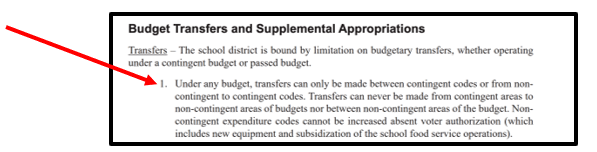
What do those school district-specific rules say about budget transfers? As can be seen in the below excerpt from the "School Districts' Accounting and Reporting Manual," a school district can only transfer funds into the budget line of a contingent fund.[2]

Screenshot of budget transfer law

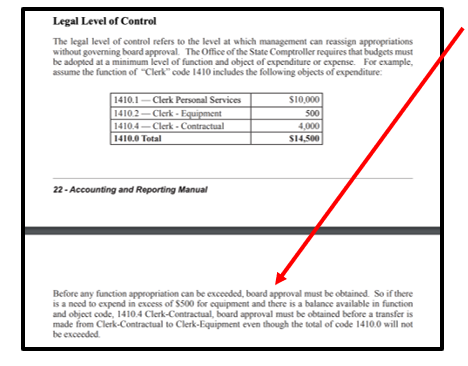
Other public entities, however, follow different rules...rules that are a bit more liberal about transfers between budgeted lines, since for inter-line transfers, "only" board approval is required...as seen below in the[3] Comptroller's "Accounting and Reporting Manual" for towns, villages, and other local government entities:[4]

Screenshot of budget transfer law 2

SO: does a school district public library in New York have to follow the rules of its sponsoring district? 

Here is what the Comptroller has to say:[5]

Public Libraries — Sponsored by counties, cities, towns, villages or school districts in most circumstances [are included in a local government's accounting] because of the existence of financial accountability as evidenced by funding of operations, approval of and responsibility for issuance and payment of debt and the ownership of real property. While this is the norm, situations do exist where the library is virtually autonomous and could be considered a special purpose government.

...

Final determination must be made at the local level after considering ... the appropriate criteria as they may apply to both governmental and non-governmental units.... [emphasis added]

In other words--while I hate to punt on this question-- IT DEPENDS.  There can be no one answer; the determination must be made at the local level--and by a person professionally qualified to make the determination.

That said, as a professional, I will go out on a limb and say that every Comptroller audit of a school district public library I have ever read emphasized the difference between the library and the district they are affiliated with.[6]  Further, the Comptroller, in those audits, has stated that independent board authority and oversight by the trustees must be exercised, even when the school district functions as treasurer. 

For this reason, I would comfortably suggest the presumption should be that the requirement to transfer only into a contingent fund, per the excerpt first pasted above, applies solely to a school district, and not to a school district's separate public library, even if the school district is the custodian of the funds, unless the two entities are so integrated that the library operates as a "component unit"[7] of the district.

That said, for school district public libraries who must develop policy based on this distinction, the person to answer this question is the accountant finalizing your audits and financial statements, since they are the one with the professional duty here.  That said, once they have determined that answer at the local level, ALL parties (the school district, the library, their accountants, and their lawyers) should be in agreement as to the reason for the decision.

Thank you for a good question, and for this reminder of why I became a lawyer, not an accountant![8]


[1] Not a gathering of meat-clad divas, but rather: "Generally Accepted Government Accounting Standards".

[2] From https://www.osc.state.ny.us/files/local-government/publications/pdf/arm_schools.pdf, page 25.  If you read the excerpt deeply, you will see I am oversimplifying...and if you want to see how much I am over-simplifying, read the whole manual!  School district budgeting is an art.

[3] riveting

[4] From https://www.osc.state.ny.us/files/local-government/publications/pdf/arm.pdf, page 22.

[5] From https://www.osc.state.ny.us/files/local-government/publications/pdf/arm.pdf, page 34.

[6] A good example of this emphasis on autonomy can be found in the 2014 audit of the Fairport Public Library, found at https://www.osc.state.ny.us/local-government/audits/library/2015/06/12/fairport-public-library-financial-management-2014m-354.

[7] A good flow chart on how to assess of a library is a component unit is on page 35 of this manual: https://www.osc.state.ny.us/files/local-government/publications/pdf/arm.pdf.

[8] Full disclosure: I am married to an accountant...a CPA, no less.  This of course gives me no professional cred when it comes to accounting, but it does lead to some good conversation on chilly Buffalo nights (he also has an MLS, which makes him all the more alluring, of course).

Handling Funds for Friends of the Library

Submission Date

Question

There seems to be a trend for libraries that have Friends groups to hold fundraisers, donations, and membership drives at the library. In some instances, the library collects money for the Friends and pays it to them at a later date. Considering the cash handling procedures libraries have to worry about, is it allowable for libraries to collect Friends membership dues and donations then pay it back to the Friends?

Answer

Ideally, a public library does NOT handle the money of another entity, even for "Friends."  Ever.

That said, there is no law barring a library from helping out a partner or organization with cash handling for events; this "never" rule comes from risk management, not the law.  

What risks are managed by this "never" rule?  All the risks that come with handling funds, including:

  • The risk that cash is not properly counted;
  • The risk that the cash is misplaced or stolen;
  • The risk that cash is from sales requiring sales tax;
  • Accusations (even if unfounded) of mis-handling or theft;
  • Improper attribution of income to the library;
  • Consumer or regulatory agency confusion about who transactions were with.

None of these are risks that can be totally eliminated, but they can be mitigated.  Sometimes, there may be very compelling reasons to break the "never" rule so the library can help another entity (including Friends) and mitigate the risk as best as possible.

So my answer to the question "...is it allowable for libraries to collect Friends membership dues and donations then pay it back to the Friends?" is: YES, but it should only be done for the right purpose, with the right preparation, and per the right policy.

What is "the right purpose?"  That is up to your library and its policies.  But certainly, helping Friends or other affiliated organizations support the mission of the library can qualify.

What is "the right preparation?"  It starts with the "right policy."

If the limited capacity of the Friends (or another allied organization) means the library must help with cash handling (facilitating sales, accepting donations, forwarding the monies to the Friends), there should be a policy at both organizations addressing this approach.

A sample policy for the library is:

Fiscal Controls When Collaborating with Another Entity

To reduce costs and avoid risk, whenever possible, the Library will not support or serve as the agent for collecting donations or revenue for another entity with which it is jointly providing programming.

However, from time to time, the Library may help present an event that requires the coordinated payment, acceptance, and transfer of money or in-kind donations between the Library and the collaborating party.  When that is the case, to ensure adherence to all relevant laws, regulations, and policies, every such event shall be governed by written, signed terms for the handling of such monies.  Such written, signed terms shall be tailored to the specific circumstances of the event and shall set out the manner in which the parties will abide by all relevant policies, including but not limited to:

  • Conflict of Interest
  • Fiscal Controls (including those governing cash handling, acceptance of payment, payments, approved credit card use, acceptance of credit cards/PCI compliance, deposit, remission of funds, and accounting)
  • Bar on political activity
  • Relevant tax considerations

The written agreement shall be reviewed and approved by the Treasurer before being signed by the Director, no less than two weeks before the event.

For entities that frequently collaborate with the Library (local charities, Friends, etc.), a standing agreement reviewed once per year by the respective organizations may be used, so long as it contemplates all forms of accepting and remitting money and confirms the process for the sharing or remission of the same.


A sample Letter Agreement is:

RE:  [NAME OF EVENT]

Dear [Treasurer of Friends]:

The Library is looking forward to the event on DATE at the Library.

At the event, the Friends will be accepting donations via cash, credit card, and check.  While the credit card transactions will be completed via a service maintained by the Friends, the Library staff will be assisting with the acceptance of cash and checks by providing a secure location to store them until deposit per the Library's process for securely holding cash.

Per Library policy, at no point will one Library employee be responsible for receiving, counting, and securing cash on site (all transactions must include two Library employees). 

The Treasurer of the Friends will sign an acknowledgement confirming the amount of cash and number of checks turned over to the Friend's Treasurer for deposit.  The receipt will be retained by the Library for a minimum of 6 years.

If such sales are made as part of the event, the Friends will be responsible for collecting and remitting any sales tax owed for any sales of retail items.


All of this being said, it is the sign of a strong "Friends"—or any type of not-for-profit organization—for the organization to have its own fiscal control policies and to be ready to competently receive and account for donations.

While it is not the "sexy" part of a charitable mission, fiscal controls (and the ability to security accept money) is a critical infrastructure. So, when recruiting leadership for "Friends," taking the time to find a few volunteers who are familiar with accounting is a worthwhile investment!

Thank you for an important and nuanced question.

Charitable organization filing requirements for small (under 50k) “Friends”

Submission Date

Question

Are incorporated "Friends", who do not receive over $50 thousand, do not have paid staff, and are only able to provide the funds to the library, required to register [with the New York Attorney General] and submit the CHAR500 form?

Answer

When one considers becoming a "Friend" of a library, several activities spring to mind:

Parties
Craft fairs
A charity auction
But being a "Friend" is not all book sales and giant thermometers.  Get out your Excel spreadsheets and prepare to take good notes; for a "Friends" group, raising "charitable" money[1] comes with detailed record-keeping and government oversight.

The "CHAR-500"[2] referenced in the question, an annual filing required of many not-for-profit organizations in New York State, is a major part of state oversight.[3]

A companion requirement—also referenced by the member—is that a not-for-profit register with the New York State Attorney General's Office.

But does every not-for-profit in New York State have to fulfill these requirements?

The answer, which does depend on some of the factors listed in the question, is:

"No.  BUT—." 

Let's review.

There are several factors that can exempt a not-for-profit operating in New York State from having to register and file the CHAR500. 

Of relevance to the member's question is Article 7-A of New York State's Executive Law, which provides:

§ 172-a. Certain persons[4] exempted.

...

2. The following persons shall not be required to register with the attorney general:

...

(d) Any charitable organization which solicits or receives gross contributions of less than twenty-five thousand dollars during a fiscal year of such organization, provided none of its fund raising is carried on by professional fund raisers or fund raising counsel. However, if the gross contributions received by such charitable organization during any fiscal year of such organization shall be in excess of twenty-five thousand dollars, it shall within thirty days after the date it shall have received gross contributions in excess of twenty-five thousand dollars register with the attorney general as required by section one hundred seventy-two of this article.

So, the member is right to point out the relevance of the Friends' annual income (although the trigger amount is $25,000.00, not $50,000.00).

That said, it is important to keep in mind that the reporting requirements of a not-for-profit are not just governed by the Executive Law.[5]  Further, even the Executive Law comes with exceptions: if the organization is using a professional fund-raiser, they will need to register (no matter how much money they take in).

Trying to figure out what to do?  For Friends, this is a good one to confirm with both your attorney and accountant, but in general, it is important to remember the difference between registering, which per Executive Law 172 and 7s-a is triggered when the $25,000 dollar annual income threshold is reached, and annual filing, which per Executive Law 172-b (2-s) is triggered either by registration, or when the first $25,000 dollar annual income is reached, after which a filing is due even in years with smaller income.

Despite this exemption for annual revenue of under $25k, many organizations will register and file the CHAR500 registration because: 1) they aspire to raise more than $25k; 2) they know that potential donors often use the Charities Bureau registration to conduct "due diligence" on potential donees;[6] 3) it is a way to model transparency (and inspire trust).

But to answer the question, in this instance, unless a pro is being used... no, registration is not required.

Thank you for an important question.


[1] Meaning money being raised by a charity, for a charitable purpose.

[2] Which is what I would call my BBQ-themed bar for not-for-profit sector workers, if I were to go into the niche restaurant business.

[3] Found here as of March 14, 2023: https://www.charitiesnys.com/pdfs/statute_booklet.pdf.

[4] As used in this section of the Not-for-profit Corporation law, a "person" is a not-for-profit organization.  I know, it's weird.

[5] The IRS allows certain charitable organizations with under 500K in assets and 200k in annual revenue to file an "EZ" form, rather that the full form 990.  For more on that, visit the IRS at https://www.irs.gov/instructions/i990ez.

[6] That said, not filing when it is not required can signal a commitment to economy and conservation of resources.

Can Library Surplus Funds Be Added to Municipal General Fund

Submission Date

Question

We are a small municipal library serving a village of 6500 & a town population the same size. Our village trustees have decided to take our balance from the 2022-2023 fiscal year & add to the village general fund. Does New York State Education Law #259 apply here? We were told it is just the Attorney General’s interpretation of the law & does not keep the balance in the library’s possession.


Answer

For me, the most persuasive commentary on this topic is from the NYS Comptroller, who wrote in 2002:

This Office has previously noted that no provision of law requires that library fund monies-that are not expended during a fiscal year be returned to the municipality or school district which sponsors the library (see, e.g., 1983 Opns St Comp No. 83-32, p 37; see also Opn No. 87-49, supra). Therefore, we have expressed the opinion that library fund monies remain the property of the library and surplus monies in a municipal or school district public library fund, or surplus moneys held by the library treasurer, may be carried-over from year to year, and accumulated and expended for proper library purposes as determined by the library board (see [*3] e.g., 1980 Opns St Comp No. 80-260, p 71; 1979 Opns St Comp No. 79-866, unreported; 1975 Opns St Comp No. 75-399, unreported; see also Buffalo and Erie County Public Library, supra; compare Korn v Gulotta, 72 NY2d 108, 534 NYS2d 108; but see Town Law § 107[1], Village Law § 5-506[1][c], County Law § 355[1][g], as amended by L 2000, ch 528).

I am leaving the citations in the quote above to show that the Comptroller didn't just randomly arrive at this opinion; it is based in both law and case law.

Despite this clear line of reasoning, it is not unheard of for towns and villages to claw back surplus funds from the library budget at the end of a fiscal year. Why do they do it? Because they can. Why can they do it?  Factors include:

  • Is there a separate levy for the library (a "414"), or is it funded like a Town Department?
  • Does the library have an agreement with the municipality to serve as custodian[1] of the library's funds, or have things just "always been that way"?
  • Does the library have its own fiscal controls, or does it just use the municipality's?
  • Does the library have a policy regarding "Fund Balance"?

To be clear: none of these factors should be determinative of how strong an argument a library can make to retain surplus funds and accumulate a fund balance from year to year.  The opinion of the Comptroller is clear: the library has that power.

But if the matter comes up for debate, it is important that the library be able to make a strong case for retaining the funds.  Those arguments are:

  • If there is a separate levy for the library (a "414"), the funds were unambiguously levied for the library. 
  • If the municipality serves as the custodian of library funds per an agreement, the agreement can address the retention of surplus; without an agreement, past practices can be changed at the whim of a town or village leadership.
  • If the library does not have its own fiscal controls, it risks appearing unready to take on the fiscal responsibilities.
  • If the library does not have a policy regarding "Fund Balance"[2], it is not in an optimal position to argue that it has a plan for money (and is thus entitled to it).

So, the very plain answer to the question "Does New York State Education Law #259 apply here?" is: YES.  However, it is clear not everyone sees it that way...and until there is some new case law[3] to go on, the more a library can make a compelling argument that those surplus funds not only rightly belong to the library, but also that the library is entitled to and relying on them, the better.

Thank you for an important question.  It sounds like your Town should give that money back, but if that ship has sailed (with your library's money!) laying the groundwork to retain surplus funds in the future would be good fiscal planning.


[1] I am not addressing the contingency where the library is the custodian of the funds (using its own bank account), since clawing back a fund balance is less likely to happen when the library Treasurer demands and takes custody of the money.  For that reason, if a library and board have the capacity to be the custodian of the funds, I urge libraries to do that!  --But only if you have the capacity (and the fiscal policies).

[2] For instance, some libraries use their surplus fund balance as a rainy-day fund, or to advance or match moneys when they apply for grants.  So long as there is a rational relationship between the amount in the fund and the identified purpose, it is not only allowed, but appropriate, for a public library to maintain such a fund.

[3] Sadly, behind every useful case we can cite in favor of this interpretation, there is a legal action that probably cost the participants a great deal of stress and money.    In the case such as this, what is called an "Article 78" could be explored to demand return of the money.  Most libraries, realizing they could win the battle but lose the war, would not try suing...or even threatening.


Reallocation of Earmarked Library Funds

Submission Date

Question

Is it legal for a library board to approve expenditures (without a referendum) for a capital project from its operating funds (or operating fund balance) to bridge a shortfall in bond monies earmarked for the construction of a new building?

Answer

Before I address this question, let's parse the meaning of "legal."

There's "legal" as in: Is this specifically against the law?

There's "legal" as in: Is this not only not specifically against the law, but generally allowed?

And there's "legal" as in: Is this a cool thing to do?

What the member is proposing in their question is taking previously allocated dollars designated for the operating budget--the budget used to pay routine salaries, utilities, and other planned-for expenses--and applying it to other expenses (in this case, construction).

Is that specifically illegal?  No.[1]  While voters approve budget amounts, how the precise dollars are allocated for otherwise allowable expenses is within a library board's authority.[2]

Is that generally allowed?  Yes.  Boards of public libraries have the authority to set fiscal policies governing accounts, and it could be within the bounds of both bylaws and policy to responsibly re-allocate use of funds.

Is it a cool thing to do?  Hard to say[3], but using allocated operational money as a bridge loan, unless there is a solid plan to replenish it, may not be optimal for a fiduciary.   Meaning: unless there is a clear, actionable plan to ensure there are funds on hand for the operating line before there is a risk of an operating shortfall, it is not a cool thing to do.

This is where "how" something is done is just as important as "what." Some libraries have very conservative fiscal policies that would never allow such a transfer, even with a solid plan for timely replenishment (for instance, if a distribution was due from an endowment).  Some libraries have more liberal policies, but also have trustees who would take a very dim view of such internal "borrowing."  And some have policies and a practice of retaining reserve fund balances that could certainly allow for it.

To document that a board has properly considered and documented the "how," a board would need to show that at all times, their actions were 1) allowed under the bylaws; 2) per duly approved fiscal policy; 3) in the best interests of the library; and 4) that the plan of replenishment was rock-solid, not based on luck or untested hopes of fundraising.

Which brings us back to the first question: is it illegal?

If a governing board makes a financial decision to re-allocate use of certain funds that can't show the above four things[4], it risks recklessly incurring debt and liability, which may be a violation of the fiduciary duties of the trustees...meaning YES, it would be illegal.[5]  To discern that, however, careful analysis of many factors would need to be made.

Fortunately, most governing boards do not engage in financial brinksmanship requiring that level of analysis.

Thank you for a thoughtful question.


[1] But...

[2] Obviously, if the money were "allocated" to buying the board a vacation beach house, or "allocated" to feed a gambling addiction, or "allocated" to supporting a political candidate, such an act would be illegal!

[3] Unless you have full access to the financial records and meeting minutes.  With those, after many hours of analysis, it would be easier to say.

[4] Is it allowed under the bylaws, allowed by policy, best interests of the library, solid plan for fiscal stability.

[5] Not "go to jail"-type illegal, but "be removed as trustee and possibly face civil liability for certain types of debt"-type illegal.


Can Libraries Sell Items For Revenue?

Submission Date

Question

Several of the library's board members feel that it is illegal for the library to sell anything other than books and keep the money. They believe that the library cannot "ask for money". That function (selling items, asking for money, etc) is a function of the Friends group. We (the library board) can accept donations and NYS law indicates that we (the board) can sell books and keep the money but we cannot sell anything else, even if it is a gift basket that contains mostly books.

Is this true? Does this hold true for partnering with another non profit organization nearby who has a small gift shop? Can we (library board not the Friends) supply the gift shop and receive a portion of the profits?

The Friends do raise money for the library but it is difficult to pass this duty on to the Friends because it is difficult for them to part with money for the library board's needs. Hence our desire to do things on our own.

Any help with the rules regarding selling would be greatly appreciated!

Answer

Before we get to the main question (can libraries sell things to raise money?), we must refine something the member mentions in passing.

Yes, under Education Law §260, libraries can dispose of and sell used books—and the library trustees can retain the money.  But since that law actually requires any library[1] disposing of used books to hold such a sale (or to offer the books for free to another not-for-profit or government agency in their area), such revenue generation is more an obligation than a fiscal liberty.  In other words: the board can sell the books and keep the money…but the power comes with strings. 

As it happens, that is the theme of this entire answer!

So, is it “illegal” for a library to sell things and retain the money?  No, it’s not, but it is complicated, and the complications warrant extreme caution before undertaking such a venture.

Let’s discuss this authority and its complexities.

The ability to sell library assets and retain the revenue is rooted in the statutory authority of library trustees. 

As stated in Education Law §260:  “Public libraries…shall be managed by trustees who shall have all the powers of trustees of other educational institutions [created by the Regents].” [2]

These “powers,” with some modifications, track the powers of boards created by New York’s Not-for-Profit Corporation Law.  Two of those powers are:

1) the acquisition and sale of real property (land, buildings, easements); and

2) the acquisition and sale of personal property (books, cars, artworks).

For libraries, these powers come with a well-recognized financial autonomy.  As the New York State Comptroller puts it:

With respect to library moneys…we note that public libraries are, for most purposes, fiscally autonomous from the sponsoring municipality (see, e.g., 1983 Opns St Comp No. 83-32, p 38). Thus, the ultimate control of the use, disposition, and expenditure of those moneys is vested in the library board of trustees even if the municipal treasurer is the custodian of library moneys. (Education Law, §§226[6], 259[1]; 1987 Opns St Comp No. 87-84, p 125; see also Opn No. 87-49, supra; Opn No. 86-54, supra). (1993 Op St Compt File #93-15)

The practical effect of this autonomy has led the Comptroller to conclude (in two separate opinions):

The trustees of a city public library may sell two bookmobiles belonging to the library at either a public or private sale and may use the proceeds of such sale in such manner as they shall deem to be in the best interests of the library. (1983 Op St Compt File #83-9) [emphasis added].

It would seem that a library board of trustees may sell an unneeded library building, title to which is properly vested in the library board, without voter approval. (1980 Op St Compt File #125)[3] [emphasis added].

So selling items—and retaining the resulting revenue—is part of a library board’s acknowledged authority. 

Of course, this authority is not unchecked. [4] As the Comptroller noted in a 1995 Opinion, the fiscal autonomy of a public library is accompanied by a requirement for absolute transparency:

…General Municipal Law, §30(3) requires that an annual report of financial transactions, including those involving private source moneys (Opn No. 88-76, supra), be made by the treasurer of each public library. The report must be certified by the officer making the same and, unless an extension of time is granted, must be filed with the Office of the State Comptroller within 60 days after the close of the library's fiscal year (General Municipal Law, §30[5]). In addition, the Education Law contains certain requirements for public libraries to report to the State Education Department (see Education Law, §§215, 263). Finally, as noted in Opn No. 88-76, supra, the town board, in determining the amount to be raised by taxes for library purposes, may take into account a library's private source funds and, therefore, may request from the library information concerning such funds. (1995 Op St Compt File #95-30)

In other words: the revenue raised by a sale can be retained, but must be spent in a manner consistent with the library’s plan of service, must adhere to relevant procurement and accounting procedures, and must be properly reported.

And there are more “strings:”

First, even when allowable, not all revenue generated by a not-for-profit entity is entitled to be free of tax.  “Unrelated business income tax” (“UBIT”) is risked when commerce unrelated to the mission of a not-for-profit generates revenue.  This is by no means a bar to a not-for-profit generating some revenue, but is a potential accounting burden, mission distraction, and cost.

Second, but perhaps most important, a library should never accustom the public to the notion of libraries independently and routinely generating revenue. 

Operational funding is the function of a library’s supporting territory and the state.  The public should never get the impression that libraries self-fund; libraries are by law a free resource serving their public, and should be funded

And as emphasized in Comptroller Opinion #95-30, above, a funding entity can consider library-generated revenue and donations when it’s time to levy taxes.  Translation: generate revenue at your own risk.

So: yes, the boards of public, school district, special legislative district, and association libraries have the power to sell things and retain the revenue, but if they do, each in its own way should be very careful to:

  • Follow its own charter and unique rules;
  • Follow all applicable laws and regulations, and know it will need to externally report the sale and use of the money;
  • Never create the impression of charging its members for services;
  • Not engage in activity that would create “UBIT” (unrelated business income tax), without specific advice from legal and tax professionals;
  • Conduct itself with fiscal transparency; and
  • Not make any revenue-generating activity a function that could risk the reduction of public funding. 

For a board seeking financial flexibility and responsiveness, these “strings” can be very limiting.   This is where budgeting should help out. 

Rather than conducting their own fund-raising, all boards should explore designating a small part of the library’s budget for board-identified needs (what the member calls “the board’s needs”), so long as those needs are consistent with the library’s plan of service and overall best interests, and the spending is appropriately documented and approved. 

For instance, a board can budget for a strategic planning retreat, an emergency fund, an external consultant, or a unique event for the library.  A library investment fund’s annual revenue can be reserved for a particular use.  The board just has to bear in mind that all these actions will be reported in their publicly disclosed library budget, and so must be easily perceived as mission-related, prudent, and proper.

This why library budgeting is both an art, and a science.[5]

Now, to the final part of the member’s question.  These issues of compliance, transparency, flexibility, and propriety are the very reasons why public libraries have “Friends” (not-for-profit corporations with missions to support a library).  

Every library board of Trustees should feel they can look to their “Friends,” for mission-aligned support.  In an ideal world, the board-approved library budget handles all operational needs, while the Friends’ budget helps out with added layers of special events, acquisitions, and programs.  And when planning for capital acquisitions and improvements, it’s a strategic all-hands-on-deck.

Of course, we don’t live in an ideal world; the operations of two separate not-for-profit entities can be tough to coordinate and align.  With that in mind, I encourage every library board to review the “Friends” section in most recent NYLA “Handbook for Library Trustees in New York State.”  This invaluable resource sets out solid tactics for cultivating and reaping the benefits of a Library/Friends relationship (something it’s easy to write about, but often hard to do).

Thank you for your question.


[1] If that library receives over $10,000.00 in state aid.

[2] We’ll use public libraries as our example, but the complexities I list impact ALL NY-chartered libraries. That said, association libraries have fewer budget-reporting and procurement-related obligations. 

[3] In New York, any sale of real property or donated assets by a not-for-profit corporation should be assessed to see if it requires approval by the New York State Attorney General.  See?  More strings.

[4] Many, many things, the first three being: the library’s unique charter, bylaws, and fiscal policies.

[5] For a great breakdown on the fundamentals of library budgeting, visit Chapter 11 in the Trustees Handbook: https://www.nysl.nysed.gov/libdev/trustees/handbook/handbook.pdf