Safety

Patron refusing to wear mask (private association library)

Submission Date

Question

We are a private association library. There is a "difficult" patron who sits on a bench (almost everyday doing nothing but trying to talk to anyone nearby) which is immediately next to our front doors on library property. We are doing curbside pick-up so the staff places the library items immediately outside the front doors on a table. The patrons come to the table to pick them up. The "difficult" patron refuses to wear a mask no matter who asks and how many times he is asked. We recently found out that he was exposed to someone who has COVID. The police tried to offer a mask to this patron and he still refused. We were told to call the police if he returns. When he did, the police never came. This patron is a health hazard to the staff and our patrons. What else can we do?

Answer

***THIS ANSWER IS NOT FOR PUBLIC LIBRARIES***[1]

Here is what else you can do:

Any private association library currently[2] operating in the State of New York is required[3] to have a pandemic Safety Plan.

A library’s pandemic Safety Plan is not set in stone; it should be a living document that evolves as the library’s operations and our overall knowledge about COVID transmission change.

With that in mind, revising its Safety Plan to ensure the physical layout of its curbside operations could be a good solution to this member’s situation.[4]

Here are some possible revisions to accomplish this:

  • Modify the Safety Plan so external seating in close proximity to all entrances/exits and curbside sites is removed or roped off for all but emergency or ADA use; or
  • Modify the safety plan so the bench is within a perimeter that is barred for use by the public during business hours; or
  • Modify the Safety Plan to enhance the size of pick-up zones where only employees and those quickly picking up curbside service may enter, and set up barriers (tables, Plexiglass, cones, bollards) to emphasize the increased size of the zone; and
  • For any solution: use new signage with clear language and graphics to emphasize any changes or updates to the Plan, so people can adhere to the new rules.

NOTE: As with any adoption or revision of a Safety Plan, to the greatest extent possible, check in with your local Department of Health (I appreciate that in some places, the Department of Health may be so overwhelmed that this "check-in" is impossible).

Since it is best to have your library board "on board" with the library's Safety Plan, and any changes to it, below is a proposed resolution for adopting such a change:[5]

BE IT RESOLVED, that to ensure the Library's Safety Plan is evolving as our information, operations, and needs evolve, the board adopts the attached [date] version of the Safety Plan, effective [date/immediately].

Now, all that said, I know there could still be a few hiccups (plans on paper often get shredded by reality).  Here is the obvious “hiccup” I see, and a proposed way to address it:

If the "difficult" patron suddenly discovers that the bench they like to use and socialize from is suddenly not there/unavailable, and they have a strongly negative reaction—yelling abuse, or even being physically violent—that is when to call law enforcement, and of course to invoke your Code of Conduct and consider barring or suspending them from the library, as circumstances warrant. 

But hopefully, with some modifications to the Safety Plan, and good communication of the changes, this concern can be resolved in a way that not only addresses this specific issue, but deters any other visitor who could pose such a threat.

Please let us know[6] if this approach proves effective.


[1] I trust public libraries know why this guidance is not for them, but since it is an important reason, I'll footnote it: adjustments to practices that can be demonstrably tied to a concern caused by one individual need to be carefully developed to ensure they cause no constitution-based due process or disparate treatment concerns.  Basically, a public library can take the exact same measures I propose in here for this private association library, but must be even more cautious to ensure their actions are not—and cannot reasonably be perceived as—discriminatory or unfair.

[2] This answer is being composed on January 11, 2021.

[3] https://www.governor.ny.gov/news/no-20234-continuing-temporary-suspension-and-modification-laws-relating-disaster-emergency [NOTE: This link was confirmed as no longer active and removed on 02/25/2022  as part of the routine review of "Ask the Lawyer" materials.]

[4] Although the current Safety Plan templates posted on the NY Forward site set out a requirement of six feet, there is nothing saying that an established safety perimeter can't be more (I was at a hotel that used 15 feet, and gave us our room key-cards via a system that felt like I was at a drive-up teller).

[5] Per Education Law 226(2), the executive committee of your board may have the power to adopt this change without a full meeting, but CHECK YOUR ASSOCATION LIBRARY'S BYLAWS to make sure you can use this approach; if there is no executive committee, your library can follow its procedures for a special meeting or an e-mail vote of the full board.

[6] adams@losapllc.com (Stephanie "Cole" Adams) and jill@losapllc.com (paralegal Jill Aures), thanks.

Staff COVID vaccinations

Submission Date

Question

Can a public library compel staff members to get vaccinations for COVID-19, when they are available? If so, can an employee request an exemption? Do we need waivers of library liability if a staff member chooses not to get vaccinated?

Answer

This is an incredibly sensitive, important, and complex set of questions.  I know a lot of people out there in "library land" are waiting on the answer—from many different perspectives.

So we're going to take it slow, break it down, and unpack the components of the answers one step at a time.

Step 1: Considering requiring immunization to COVID-19 as part of a library's evolving Safety Plan

As I have emphasized in numerous pandemic-related answers, any library operating in any capacity right now should have a trustee-approved Safety Plan tailored to its unique operations.  The plan should evolve as new safety-related information emerges, and as library operations change.

As of this writing,[1] some libraries are open to visit.  Some are doing only curbside.  Some are offering more remote programming.  Some have used their information management and lending capacity to distribute PPE, food, and living supplies.  Because of this diversity of service, they all should have different Safety Plans.

The Safety Plan of a library closed to the public for everything but curbside will be different from the Safety Plan of a library open for socially distant use of computers and lending.  The Safety Plan of a library distributing fresh produce will be different from a library streaming programming from its community room to an audience within its area of service (and beyond).  The Safety Plan of a library operating with ten on-site staff in December should be different from the one they used when there was only one employee on-site in June.

Just like the decision to use a particular mode of sanitization, as a library undertakes and changes its unique services, the decision to require immunization of employees should start with vaccination's role not as a stand-alone solution, but as part of an overall approach to limiting the impact of the pandemic on your library, its employees, and your community.  Do the services your library needs to provide the community warrant immunization of employees?  If so, keep reading.


Step 2:  Wait, so does what you said in "Step 1" mean a public library can go ahead and require employees to be vaccinated?

Yes...and NO.

I say "yes," because under the right conditions, the law does allow employers to impose conditions for safety, and that can include mandatory vaccination.[2]  However, I also say "NO," because the phrase "the right conditions" carries a lot of complexity for three little words.  To be safe, the default assumption of a library[3] should always be that it can't require immunization of its employees...and then work to find the way, if well-informed risk management and an updated Safety Plan warrants it, it can require immunizations (and just as critically, if it should).


Step 3: Assessing if a library can require vaccination of employees

Before a library gets too far into an internal debate about if it should amend its Safety Plan to require vaccination of employees, it should assess if it is in a position to do so.  This means having an experienced HR administrator or attorney look at the organization's bylaws, policies, and employment relationships to see if there are any steps or bars to the requirement.

What could such a bar look like?  The most common impediment a library will run into on this is an employment contract—either for individual employees, or with an entire employee union (a "collective bargaining agreement").  The bottom line on this type of impediment: if there is a contract in play, a library must be very tactical, collaborative, and strategic prior to creating—or even considering—immunization as an employment condition.[4]

Another bar might be language in an employee handbook or a pre-pandemic policy.  Still another might be that "gray area" when library employees are considered employees of a school district, village, or town.

The best overall guidance I can offer on this Step is: assessing if your library is positioned to require immunization is a critical step to using vaccination as a tool in your Safety Plan.  Bring in a ringer to help your library assess the extent of what it can do.


Step 4:  Assessing if a library should require vaccination of employees

Okay, let's say you consulted with the best employment lawyer in your village/town/district, they took a close look at whatever relevant contracts and policies your library has, and they have said: "No problem, you can require this."[5]

The next important thing to consider is: should your library require this?

Compelled immunization[6] is an incredibly sensitive area of policy and law.  Since the time Ben Franklin started insisting on smallpox immunizations,[7] this public health issue has had passionate rhetoric on both sides of the debate. 

I have worked with families whose children have documented contraindications for certain vaccines, and it is not a simple issue.  And right now, a public discussion is happening about why people who are African-American might not trust being offered a first round of vaccination.[8]  These are life-and-death issues.

That said, those on the front lines of public service, during a time of pandemic, are at higher risk of both getting infected, and spreading disease.  Science shows vaccination will mitigate that risk.  Thus, under the right circumstances, encouraging such employees to be vaccinated is the right thing to do, and in some cases, employers have made the decision that requiring vaccination is the right thing to do.

The consideration of this question is classic risk management.  What critical services is your library providing to the community?  What exposure to possible infection do those services create?  Does social distancing, PPE, and sanitization mitigate those risks within acceptable tolerances, or would requiring vaccination of employees demonstrably make those employees and the community safer?  Are there certain duties that merit requiring immunization, and other duties (jobs performed 100% remotely, for instance) that do not?  And critical: is mass employee immunization in step with the approach of your local health department?[9]

There is no cookie-cutter answer to these questions, but a responsible decision to require immunization of employees as part of a well-developed and evolving Safety Plan should answer them all.


Step 5:  Developing a robust policy that includes consideration of civil rights, the ADA[10] and privacy

So, let's say your library has followed Steps "1" through "4" and has decided it can, and should, update its Safety Plan to encourage or require immunization of employees.

The next step is developing a policy that:

  • Demonstrably does not discriminate or have an unintentional disparate impact on any protected class of people (race, religion, sex, etc.);
  • Has appropriate measures for people to opt-out based on a disability accommodation under the ADA or the New York Human Rights Law;
  • Protects the privacy of those who either meet the requirement, are granted an accommodation to not meet the requirement, or who must be terminated due to refusal to meet the requirement.[11]
  • Manages liability through good planning and the transmission of accurate information, not (just) waivers of liability.[12]

I also suggest that the library strongly consider ensuring, well in advance, that: 1) the vaccine is available to employees, and 2) that employees don’t have to pay for it.  This is because 1) once the library has identified that there are risks in its operations that would be best mitigated through immunization, those activities should be limited until the mitigation is in place, and 2) there can be legal complications if the vaccination requires personal expense.  While this advance planning and cost containment is not precisely a legal compliance concern, they are close first cousins, and should be addressed as part of the Safety Plan. 


Step 6: If a library decides to require immunization, develop a PR Plan (optional, but a very good idea)

I don't need to tell a library audience that what a public library does on this topic will be scrutinized, criticized, and eventually, also a model for the rest of your community.[13]  Since any decision on this point will have its critics, and also (hopefully) its fans, be ready to let your public know, simply and straightforwardly, the basis for your library's decision.

I like the classic "FAQ" approach.  Here are two model FAQ's for two libraries that did the legal analysis and safety assessment, and come to the following decisions:

FAQ: I was told the library board is requiring all the employees to be vaccinated for COVID, is that true?

FAQ ANSWER: Since re-opening on DATE, the NAME Library has had a Safety Plan.  Now our Safety Plan does include supporting voluntary immunization of employees.

FAQ:  Voluntary?  So you are not requiring it?

FAQ ANSWER:  Our risk analysis and still-limited operations showed that we could meet the community's needs by requiring masks, social distancing, and routine sanitization.  We have now added supporting employees in getting vaccinated on a voluntary basis.

FAQ:  Will you ever require it?

FAQ ANSWER:  Only if our operations change and an updated risk analysis shows us that it is best for our employees and for the community.

Another "FAQ" example, for a library that came to a different conclusion, is:

FAQ: I was told the board is requiring all the employees to be vaccinated for COVID, is that true?

FAQ ANSWER: Since re-opening on DATE, the NAME Library has had a Safety Plan.  Now our Safety Plan does include mandatory immunization of employees who are able to be vaccinated.

FAQ:  Why is the library requiring employees to get vaccinated?

FAQ ANSWER:  Feedback shows that the community needs us providing critical services right now.  Our risk analysis showed that in addition to requiring masks, social distancing, and sanitizations, immunization by employees would protect their health, and the community's, while we provide those services.

FAQ:  The vaccine is not 100% available yet.  Did your employees have to do this on their own?

FAQ ANSWER:  Our library worked with [INSTITUTION] to make sure our employees had access to this safety measure, without cost to them.

And that's it.[14]

The important take-away I want to emphasize here is that for individual libraries, there are no quick answers to these questions.

Libraries of all types will be assessing their unique legal and risk positions, and will need to make carefully documented and executed decisions.  Libraries within larger institutions may need to fight for consideration separate from other operations.  Public libraries will need to consider the heightened transparency and public accountability they operate under.  Library systems will be thinking about how they can protect their employees while also supporting their members.  And for the employee on the ground, they'll be thinking about keeping themselves, their families, and their communities safe.

By taking careful, deliberate, and well-informed steps, the answers to the member's questions can be found.

Thank you for a vital question.


[1] December 18, 2020.   For many of you, that means you've been shoveling lots of snow (we're looking at you, Binghamton).

[2] See the case Norman v. NYU Health Systems (2020) (SDNY), 2020 U.S. Dist. LEXIS 180990 *; 19 Accom. Disabilities Dec. (CCH) P19-109

[3] And in this case, I use "library" in its broadest sense: public, association, and even libraries operating as part of a larger institution (such as a college, hospital, or museum).  School libraries, in particular, may both fall under the policies of the institution they are within, but might also have different operations, activities, and exposure that warrant independent risk analysis.

[4] I can't be more specific than that, since in some cases, there may be "emergency" management clauses that could easily allow the requirement of further safety measures, while in other cases, there could be language that makes it clear such a requirement will have to be a point of discussion.  The important take-away here is: if there is a contract in play, don't wing it.  Bring in your lawyer.

[5] The actual answer will of course be in writing and will likely be much more extensive than "No problem!"   It should also be included in the records of library leadership to document the appropriate level of risk analysis.

[6] When I say "controversial," I mean legally.  The science is solid: immunization saves lives.

[7] Ironically, Franklin's young son would die of smallpox before he could be immunized, in part because Franklin's wife Deborah was wary of the new treatment.  Franklin was devastated by the loss of his small, precocious son, and some scholars say it caused a rift in his marriage that was never healed.

[8] If you know your history, you know these fears are based in reality.  If you want to learn more, a good place to start is this New York Times article: https://www.nytimes.com/2020/12/06/opinion/blacks-vaccinations-health.html?searchResultPosition=4

[9] Whenever possible, confirming Safety Plans, and significant revisions of Safety Plans, with the local health department is a very good idea.

[10] The ADA is a critical consideration here.  A good place to start for further information on this is the EEOC, at https://www.eeoc.gov/wysk/what-you-should-know-about-covid-19-and-ada-rehabilitation-act-and-other-eeo-laws.  However, this is just a starting place; as you can see by the linked guidance, this part of your policy cannot be a simple cut-and-paste job.

[11] I know, this sounds cold; and it is.  Considering if a library is actually prepared to terminate employees for refusing to meet the requirements should be part of your library's analysis here, too...because once you develop the policy and start requiring it, granting exceptions without justification can create serious legal complications.

[12] The member asks about waivers for employees who decide not to be immunized.  A waiver of liability should only be used if it is part of a well-developed Safety Plan, and customized for the purpose by an attorney.

[13] Although I just did.  Ah, rhetoric.

[14] I could go on with a few more FAQ's to illustrate the diversity of approaches available (they are kind of fun to write), but I trust you get it.
Face shields and COVID safety guidelines

Submission Date

Question

New state guidelines list face shields as acceptable face coverings:
https://regs.health.ny.gov/volume-1a-title-10/content/section-66-32-face-coverings [NOTE: This link was confirmed as no longer active and removed on 02/25/2022 as part of the routine review of "Ask the Lawyer" materials.]
However, people often spend quite a bit of time in the library, especially using our computers. We would like to require that they wear actual cloth (or paper surgical) face masks. Are we permitted to make our own safety rules? It seems to me, that just as we can prevent roller skating in the library, we should be able to set other safety rules for the sake of staff and patrons.
Thank you.

Answer

This question came into "Ask the Lawyer" with a request for a quick turnaround, so we'll keep this brief.

Are we permitted to make our own safety rules?

Yes...and no.[1]  But that doesn't matter for this question, because the member's real objective is...

 "We would like to require that they wear actual cloth (or paper surgical) face masks."

...which a library with a well-developed, uniformly applied Safety Plan can absolutely do.

Why is that?

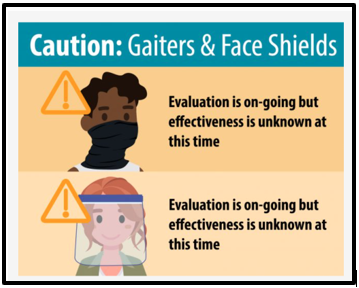
As of this writing[2], there is documented evidence that the CDC is still weighing the advisability of face shields.  Here is what they have to say:

Gaiter and Face Shield infographic


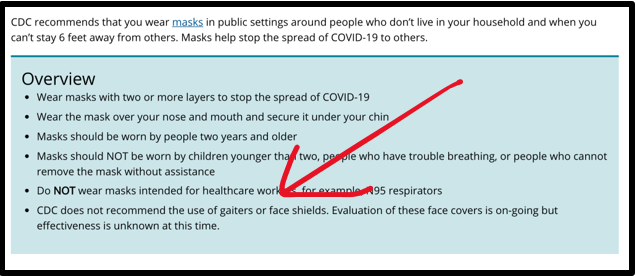
(For the less cartoon-oriented[3], the CDC says it like this:)

CDC mask guidance

Of course, at the same time, as the member points out, the State of New York now allows face shields to "count" as a face cover:

66-3.2 Face-Coverings....

(i) Face-coverings shall include, but are not limited to, cloth masks (e.g. homemade sewn, quick cut, bandana), surgical masks, N-95 respirators, and face shields.


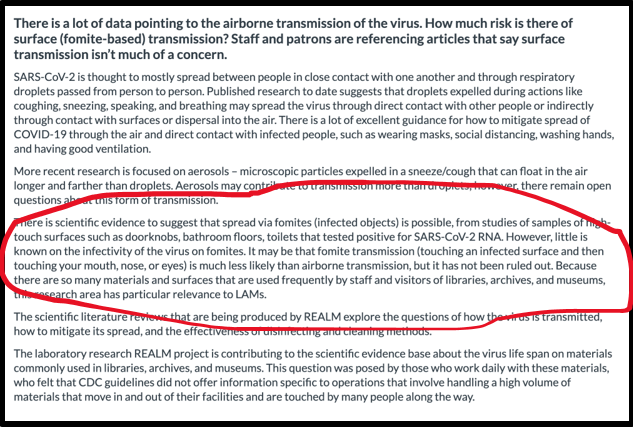
Meanwhile, the REALMS study has hit the library community with THIS cold cup of coffee[4]:

Transmission infographic from Project REALM


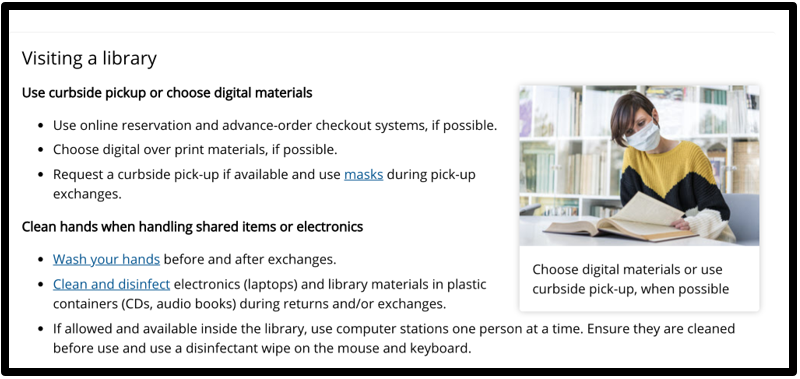
Libraries should be paying attention to all of these evolving resources[5], and should regard their Safety Plan as a "living document" that evolves with that information.  This will help libraries develop a plan that can help them help patrons adhere to CDC guidelines like this one:

CDC Library visit infographic

The bottom line?  If your library bases its access and services on current information, is careful to adhere to its obligations under the ADA, and adheres to a Safety Plan that provides—based on the combined input from such reliable sources—that certain areas may only be accessed by those wearing faces masks (and/or gloves, and/or only if they agree to spray down certain surfaces, and/or only by a certain number of people a day), it may do so.

It all comes down to having a Safety Plan based on your library's unique size, design, staffing capacity, and collection materials.  With a plan that is linked to established factors, the best guidance we can get in uncertain times, and reliable enforcement, anything is possible.[6]

Thanks for an insightful question!


[1] The answer to THIS question is about 15 pages and has 20 footnotes.  Aren't you glad we found a way to make it snappier?

[2] October 16, 2020.  CDC content found at https://www.cdc.gov/coronavirus/2019-ncov/prevent-getting-sick/about-face-coverings.html

[3] I am "cartoon-oriented."  Whenever something can be conveyed effectively via icon or cartoon, it should be.  Of course, as a lawyer, I experience no shortage of words.

[4]  https://www.oclc.org/realm/faq.html.  On a side note, how bad is my DIY mark-up of this content?  It looks like I am trying to draw a squished amoeba. 

[5] My "word of the day," which I learned as I researched this answer, is "fomite" (infected objects). Given what we've all had to deal with in 2020, I am sure I have seen the word before, but was too busy learning the concepts like "zoonotic" & "contact tracing" for it to sink in.

[6] Even wearing a masks while roller skating in a library (but I'd check that one out with your insurance carrier).

What to do if an employee tests positive for COVID-19

Submission Date

Question

We got lucky: an employee, who was asymptomatic at work but tripped one of the screening factors requiring him to stay home, was tested and found NEGATIVE for COVID-19.

Our employee is coming back to work, but I have been wondering...what if the test came back POSITIVE?  If we have to quarantine all our employees, we'd be shut down completely!

Answer

First: that is good news about your employee.

Second: a gold star to your library for having a screening system that works, and for following the requirement to restrict an employee who trips a screening factor from on-site work while waiting for test results.

Third: Let's talk about your alternate scenario (the one where you don't get such good news).

As of August 17, 2020, any library[1] that is up and running should have a Safety Plan as required by both the guidance for "Office-based Work", and "Retail Business Activities" (we'll call this the "Guidance").

The Guidance includes the requirement to fill out a New York Forward Business Affirmation Form, which attests to having a Safety Plan.  It also answers the member’s question about what to do if an employee tests positive for COVID-19.

Here is what the Guidance (as of 8/18/2020) requires:

An individual who screens positive for COVID-19 symptoms must not be allowed to enter the office and must be sent home with instructions to contact their healthcare provider for assessment and testing.

Responsible Parties should remotely provide such individuals with information on healthcare and testing resources.

Responsible Parties must immediately notify the state and local health department about the case if test results are positive for COVID-19.

Responsible Parties should refer to DOH’s “Interim Guidance for Public and Private Employees Returning to Work Following COVID-19 Infection or Exposure”[2] regarding protocols and policies for employees seeking to return to work after a suspected or confirmed case of COVID-19 or after the employee had close or proximate contact with a person with COVID-19.

So, the answer to the member's question: "What if the test came back positive?" is: "[I]immediately notify the state and local health department."

After that, the direction from the local health department may vary, but the Guidance requires:

If an employee has had close or proximate contact[3] with a person with COVID-19 for a prolonged period of time AND is experiencing COVID-19 related symptoms, the employee may return to work upon completing at least 10 days of isolation from the onset of symptoms.

...[and]...

If an employee has had close or proximate contact with a person with COVID-19 for a prolonged period of time AND is not experiencing COVID-19 related symptoms, the employee may return to work upon completing 14 days of self-quarantine.

And after that, things can really vary.  But in a scenario where every employee of the library came within six feet[4] of their (now confirmed as) infected co-worker, the library really could be looking at up to two weeks of employees in self-quarantine...along with any other response required by the local health department.

This is not a feel-good scenario.  But the good news is, the same Guidance that requires a library[5] to require employees to isolate also reduces the likelihood of such a remedy being needed.  This is because the Guidance also requires a host of preventative practices to limit exposure in the first place, including:

  • Staggering shifts to limit "close or proximate contact," between people;
  • Creating and posting clear signage;
  • Consistently enforcing masking, cleaning, and social distancing practices

If a library maps these things out for employees, and consistently enforces them, there will be less need for the "isolation/quarantine" sections.  While right now, there is no magic bullet, the simple elements of your library's Safety Plan can reduce the need for quarantine.

And that's it; thanks for a great question.  I hope this answer never has to come in handy for your library.  But just in case it does: here’s a quick checklist for the steps listed in this response [6]:

"CHECKLIST FOR RESPONDING TO NOTICE OF COVID-19 EXPOSURE AT THE LIBRARY; TO BE USED IN CONJUCTION WITH UPDATED SAFETY PLAN"

  • However the library was notified of the potential close/proximate contact, obtain a copy of the notice in writing (or send a confirmation e-mail to the source);
  • As required by the most recent New York Forward Guidance, notify the library's local public health Department (both in person and in writing), and factor in their response[7];
  • As required by the most recent New York Forward Guidance and the library's Safety Plan, determine who (if anyone) else must be restricted from the workplace, for how long; and if any further testing must be required;
  • Ensure the library is taking steps to protect the privacy of any employees disclosing screening factors (like a high temperature);
  • Ensure the library is taking steps to assess if any employee must be given paid time off or will need assistance to claim short-term disability or Paid Family Leave Act benefits;
  • Generate a short statement reviewing the above check listed factors, summarizing what your library has done for each step, and make sure you retain copies of all documentation showing you completed these steps;
  • Once these actions are taken and these determinations are made, notify your Board of Trustees of the critical aspects of the situation, but take care to respect the privacy of employees.


Here is a template notice to the board, designed to reflect taking the necessary steps, while also protecting employee privacy: 

On ____________, the library received notification of an [individual/employee] testing positive for COVID-19. As required by current guidance from the State, we notified the Health Department immediately.  At this time, the direction from the local health department is _____________________________________[this may be extensive]. 

We have determined that # employees must self-isolate until they DATE. 

We have determined that # employees must self-quarantine until DATE. 

We have confirmed with the health department that as a result of this notice and response, and consultation with the [Executive Committee of the board/full board/board officer/other] we will [close/reduce operations/operate under the status quo], unless the board determines otherwise. 

Our Safety Plan has been followed and we have retained the documentation showing such compliance.


[1] Any library that does not consider itself "operated by a local government or political subdivision", that is, since the New York Forward guidance specifically states that the various Executive Orders' business restrictions do not apply to such libraries.

[2] Found at this link as of 8/17/2020: https://coronavirus.health.ny.gov/system/files/documents/2020/06/doh_covid19_publicprivateemployeereturntowork_053120.pdf

[3] According to the Guidance, "close contact" is "to be someone who was within 6 feet of an infected person for at least 10 minutes starting from 48 hours before illness onset until the time the person was isolated."

[4] This should NOT be happening!

[5] Remember, local governments and political subdivisions may decide not to follow these precise requirements.  That said, if it determines it is operated by a local government or political subdivision, a library must then follow the safety plan set by that local government or political subdivision.

[6] Some of this isn't required by applicable laws or Guidance, but is in there to position a library to easily show it followed applicable laws and Guidance.

[7] While keeping confidentiality at top of mind, libraries need to think carefully about a voluntary system allowing users to log visits for purposes of contact tracing.  A voluntary list of names, dates and times, maintained with all due care for privacy, can position a library to participate in a local health department's contact tracing initiative.  This can in turn help a community reduce its rate of transmission.

[2020 Pandemic Date Specific] Policies for employees returning to work during COVID-19

Submission Date

Question

Public and Association libraries have questions about making policies creating conditions that must be met for library staff to return to work. Can they set policies that exclude vulnerable employees from being able to return to work? Can they set policies requiring non-vulnerable employees to return to work?

Answer

I had initially considered bundling this question with another submission about temporary actions or policies during COVID-19.  After all, both questions relate to policy, and a big goal of “Ask the Lawyer” is to provide legal information efficiently.

But after drafting that answer, and considering this question further, I did away with that notion.  The member has isolated an incredibly critical concern about employee/employer safety and authority.  It is a question that demands—and deserves—its own consideration.

But before we dive into the legalities, let's consider the practical implications of the member’s question.  Why would an employer want to “exclude vulnerable employees” from the work site? On the flip side, why would an employer want to set policies “requiring” a class of employee termed “non-vulnerable” to return to work?

Near as I can figure, the employer would want to do this to promote safety; a laudable goal.

However, that is not precisely the approach an employer in New York State is empowered to take.

Under both the Americans with Disabilities Act (“ADA”) and the New York Human Rights Law (“HRL”), employers are barred from discriminating against employees on the basis of real or perceived disability. This means that a NY employer who knows—or suspects—an employee might be particularly “vulnerable” (in this case, to COVID-19, but in other cases, due to pregnancy, or other medical conditions), is barred from simply labeling that employee “vulnerable” and taking steps to limit or change the terms of their employment on the basis of that conclusion. 

Rather, disability law is set up to empower employees to identify their needs, and then—under the most confidential circumstances possible—work with their employer to receive reasonable accommodations in consideration of those needs.

For example, a person whose medical history means that they might be more vulnerable to COVID-19 would work with their medical provider to provide documentation setting forth the risks and requesting a reasonable accommodation on the basis of those risks.

Employers are always welcome to let employees know the ways in which they may request accommodations. For instance, as libraries, museums, and archives consider limited or full reopening, employers can transmit those plans to their employees, and invite them to submit any request for accommodations based on the anticipated additional exposure to on-site visitors.

Think of it in the same way your institution might think of planning a large event that would invite the maximum number of people possible to your library or a rented venue. When planning for an event that will attract a large number of people, almost every institution will consider the need to accommodate people who use mobility devices. They might not contact those people in advance, even if they know they're coming…rather, the event will be planned with those accommodations in mind.

A good example of this, of relevance to the current COVID-19 crisis, is an employee with a respiratory disability.  As we know, people who have had respiratory illnesses in the past may be especially vulnerable to COVID-19 now.  These are people who may request accommodations—potentially including the ability to work off-site—based on a disability (a good list of accommodations for respiratory issues can be found here, on the Job Accommodation Network).

So, with all that being said, the answer to the member’s questions (Can they set policies that exclude vulnerable employees from being able to return to work? Can they set policies requiring non-vulnerable employees to return to work?) is: NOT AS SUCH.

However.

Employers can most certainly, when otherwise allowed by law, policy, contract, and Executive Order, require employees to return to work.  After that…

Once an employer is able/decides to re-open, in addition to any re-opening conditions, the employer must consider any requests for reasonable accommodations.  This could absolutely include modifications for those whose disabilities render them vulnerable to COVID-19.  The employer can even generally pre-plan to offer those modifications.  Or they can make working from home, or working on-site, optional (if the work can, in the sole determination of the employer, still be done).  But what they can’t do is pre-sort their employees by “vulnerability.”

There is one final critical point to make here, at this time (May 19, 2020).

Institutions re-opening as part of “NY Forward,” may be required to monitor the health of their employees in a way that typically would seem intrusive, and in some contexts, would even be illegal.

For example, here is a sample of the monitoring required under NY Forward, taken from a sample safety plan.  NOTE: this is taken from the NYForward’s Phase One Retail Summary, and is provided as an example, only:

Employees who are sick should stay home or return home, if they become ill at work.

[Employers must] [i]mplement mandatory health screening assessment (e.g. questionnaire, temperature check) before employees begin work each day and for essential visitors (but not customers), asking about (1) COVID-19 symptoms in past 14 days, (2) positive COVID-19 test in past 14 days, and/or (3) close contact with confirmed or suspected COVID-19 case in past 14 days.

Assessment responses must be reviewed every day and such review must be documented.

Employees who present with COVID-19 symptoms should be sent home to contact their health care provider for medical assessment and COVID-19 testing. If tested positive, employee may only return completing a 14-day quarantine. Employees who present with no symptoms but have tested positive in past 14 days may only return to work after completing a 14-day quarantine.

As stated, this is the procedure for Phase 1 re-opening of limited retail operations.  When will libraries subject to closure in NY be able to re-open under NY Forward, and under what terms?  As I write this, the New York Library Association, NYLA, has this on their COVID-19 page, which states[1]:

With input from our partners from the Public Library System Directors Organization (PULISDO), NYLA has been advocating for libraries to be permissively included in phase two.  This would allow libraries to be a phased re-opening processed, to be determined at the local level, as early as when their region enters Phase Two.  The decision on when, as well as the steps and procedures for re-opening, are best determined locally, and in conjunction with the local library system and county Department of Health.

This is a critical service to association and public libraries by NYLA, and every board and director should be monitoring this site for updates.

Of course, some libraries may have determined that the current workforce restrictions don’t apply to them at all (that they are exempt right along with school districts and local governments).  And it is possible some libraries and museums, affiliated with larger institutions, will not be able to open until their region hits “Phase Four” (covering educational institutions).  And it may be that by the point libraries are given the go-ahead, the emergency has abated to the point where monitoring of employees won’t be required. 

But any library contemplating opening, in addition to being ready to consider ADA accommodations for those more vulnerable to COVID-19, needs to be considering these possible employee monitoring requirements, as well as the need to adopt any NY Forward-required Safety Plan, or similar documentation showing they are taking defined, affirmative steps to protect employee and public safety.

Public and association libraries developing the policies they need to re-open have a large, complex task before them.  Thank you for a question that explores a critical consideration of that work.


[1] Just to emphasize: NYLA is a critical resource at this time and all libraries should be monitoring this page daily for updates.


Library Lockdowns

Submission Date

Question

Should an event occur, is it legal in NYS to institute a lockdown in a public library?

Answer

This question brought back a lot of memories for your “Ask the Lawyer” attorney.  

Between 2006 and 2017, I was a full-time in-house attorney on a college campus.  On April 16th, 2007, my time in higher ed was forever changed, when the entire campus froze to watch the reporting from Virginia Tech.  32 people dead.  17 wounded.

Over the years, as incident after incident occurred on schools and college campuses, my colleagues in higher education would wonder “Are we next?”[1]

I was lucky; my campus had no such incident during my time there (or since).  But I was there for the development of our active shooter response protocol, there for our on-campus trainings, and there, as an administrator, for our “incident response” trainings with local, state and federal law enforcement…getting ready for a day when we might not be lucky.

Large (and small) public institutions and facilities like schools, museums, malls, and of course libraries have been struggling with how to prepare for the day someone brings a gun and threatens or perpetrates violence on their property.  It is a horrific thing to contemplate, and a scary prospect to plan for…especially because there is a diversity of opinion as to what the best prevention and training techniques really are.

Some institutions have the benefit of mandates.  In New York, all schools must practice active shooter response, and there are laws, regulations and experts in place to guide those mandated drills.  And college campuses are mandated to prepare for emergency response.

Public libraries, on the other hand, do not have such a state-wide mandate.  Although chartered and operated in connection with a municipality, they are independent operators.  This means that though they may choose to follow whatever policy or procedure their municipality has developed for emergency response, or to adopt their own, that choice requires board approval.[2]

But the member’s precise question is: is it legal in NYS to institute a lockdown in a public library?

First, let’s clarify what is meant by “lockdown.”

Per §155.17 of Chapter 8 of New York’s Rules & Regulations: 

Lock-down means to immediately clear the hallways, lock and/or barricade doors, hide from view, and remain silent while readying a plan of evacuation as a last resort. Lock-down will only end upon physical release from the room or secured area by law enforcement.

To some people, “lockdown” (hiding, barricading) in the face of an active shooter sounds like a really good idea.  Others might prefer to run.  And still others think the best option would be to fight.

According to the New York State Division of Homeland Security and Emergency Services, depending on the situation, any of these could be the right choice.  Watch the video, “480 Seconds” at this link [3]. It depicts, in stark and practical terms, the different “best” responses, depending on an active shooter situation.  http://www.dhses.ny.gov/aware-prepare/step3.cfm

“Lockdown,” as defined in the NYS Education Law, was determined to be the best option for schools because they house a large, vulnerable population of minors.  While many of us only hear about this procedure through our kids (as we try to conceal our terror), school librarians know first-hand that the drills our kids do are only a small part of a system that requires:

  • extensive site analysis;
  • the creation building safety teams;
  • designation of emergency gathering spaces;
  • communications plans; and
  • extensive training of staff. [4]

Any lockdown plan should be this well-developed, because as “480 Seconds” shows, sheltering in a secure place is not the only response to an active shooter situation.  Further, even in a place with a lockdown plan, responses will vary by building type, function, and population served (consideration of people with different disabilities, for instance, requires continually renewed attention).  Given certain variables, a lockdown procedure might be the best option, but even once that has been determined, ensuring doors can be secured, signage is properly posted, and staff are trained, are all critical elements of the plan.

So, is it legal to institute a lockdown procedure in a public library?  Yes. Library boards can (and should [5]) pass emergency response policies, include active shooter policies, and a lockdown plan might be determined to be the best response.  That said, unlike schools entrusted with minors, libraries serve a large population of independent, autonomous adults.  Unlike law enforcement responding at the scene, a staff directive to stay in place will only have the force of library policy…which is different from an order by law enforcement [6].  A person who wants to leave (and whose biology is telling them they MUST leave) might do so.

For me, the most important aspect of this question is not if a lockdown policy at a public library is “legal,” but how a public library develops its active shooter response plan and trains its staff.  This can be no cut-and-paste job; it is a work for a credentialed and experienced expert.  There is grant money and aid out there for not-for-profit libraries to seek this critical input.  And in many places, simply reaching out to local government can put you in touch with all the resources you need. 

Just like “480 Seconds,” the services of an expert [7] will help your library apply the collective wisdom about active shooter situations to the somber but vital act of planning for an actual situation. 

We can never be truly ready for an active shooter incident, but we can be prepared.  Lockdown might be part of that preparation.  Thank you for this important question.


[1] It was probably a false sense of security, but these were the times when I was glad to have ROTC on campus.

[2] There is one exception to this: a public library that rents its property may be required, in its lease, to follow the rules of its Landlord. But that would still mean the board had approved the terms of the lease.

[3] This video is not graphic, but it is very serious.  I suggest you not watch it at your library unless it is part of an in-depth and well-considered training on active shooter response, led by a credentialed and experienced expert (local law enforcement should be able to assist in finding that person).

[4] See NYS Education Law §2801-a.

[5] An emergency response plan, along with plans for an active shooter, is listed as a recommended policy in the NY Library Trustees’ Association’s 2018 Trustee Handbook, page 115.

[6] Of course, some libraries have private security, or coordinate with law enforcement.  If that is the case for your library, their training and level authority must be incorporated into your plan, and that may change the dynamic.

[7] This is very serious: your plan and training should be put in place using a contracted, person with established credentials and experience writing and training on emergency preparedness and active shooter response.  There are many accredited and recommended programs for this.  For a public library, this would be through the usual procurement process.

Sex Offenders in Libraries (NYS)

Submission Date

Question

We have two individuals in our community, within 500 feet on either side of the library, that have been identified as sex offenders on the NYS website. One comes to the library to take out materials. He is an adult and now living and working in the community, but still identified on the NYS website. He is listed at a higher level of offense. He does not come into our children's room, but does check out materials when programs are happening with children of all ages. Our employees are concerned with this individual in the library – he has not posed any threat, but there is still concern. What is the legal course for him coming into the library, coming into the library during certain hours and what action can be taken if something more transpires?


Answer

When considering how to address concerns about registered sex offenders using the library, there are several factors that must be considered at once:

Factor 1: Civil rights

In New York it is against the law to take adverse action against someone simply because of a past conviction, including a conviction leading to them being a registered sex offender. Therefore, preemptive action barring or restricting a library user with that type of criminal record cannot be taken.

That said, if a person has limits on where they can go as a result of sentencing or parole conditions, and those terms are violated, that is a different matter, and such violation should be immediately reported to the appropriate authority as deemed best by the leadership of the library.  So long as the report is in furtherance of library priorities, this is consistent with the legal requirement that library records be kept confidential.

Factor 2: Safety

New York State created the Sex Offender Registry tool to enable communities' awareness of past convictions so they have the information to take allowable actions to protect themselves.  If a library or another organization open to the public with specific areas and programming for children and vulnerable populations believes there is a person who may abuse or exploit those populations (whether they are a convicted sex offender, a person known to have committed another type of crime, or are just a creeper acting inappropriately), a safety plan should be developed (or enhanced).

This safety plan should include having clear policies regarding unaccompanied minors in the library, clear signage setting the terms and rules for different rooms and sections in the library, adequate staffing and security measures to ensure all areas of the library are routinely visited or monitored, a clear protocol for recording incidents and sharing concerns (coordinated with the Code of Conduct), well-defined relationships with local law enforcement to ensure there is a known resource in case the library has concerns, and adequate training for employees so they can recognize and have rehearsed responses to situations that may pose a safety risk, including but not limited to actions by registered sex offenders.

Factor 3: Long-Range Planning

For many libraries with older or nook-and-cranny facilities, or with small budgets, the full use of all the safety plan features I list above are not immediately achievable.  For this reason, long-range plans should include these items so they can be budgeted and planned for.

Factor 4: Coping with Fear

Aside from empowering people to take whatever precautions they are allowed to use if they live or work near someone on the Registry, the Registry creates a lot of fear.  While information can be powerful, fear can be toxic.  For a library facing the scenario in the question, review current the safety plan, identify enhancements that can help employees feel confident about using it, and discuss the way in which the library will honor the civil rights of the patron, while taking policy-driven precautions.

And, returning to the specific question: if the knowledge of a person's past record is posing a concern to certain members of the staff, leadership needs to assess and confirm how it will interface with that patron.  While denying services simply on the basis of a previous conviction is not allowed, there is nothing that says there can't be a protocol that certain patrons are never assisted one-on-one – so long as the library has adequate staffing to ensure that such a policy never leads to denial of service.

NOTE: It is quite possible that an employee with past trauma may experience significant difficulty serving a known registered sex offender.  If a person has anxiety, depression, or another disability impacted by serving a certain type of patron, that should be assessed promptly as a disability accommodation request.

Historic Map with Private Properties

Submission Date

Question

As part of a town bicentennial celebration, the committee wants to create a map of historic properties. There would be a description of the property noting its historic significance, the address, and ideally a photo. Many of the properties are privately owned. Do owners need to give permission for their property to be included? We would publish the address and describe the history of the property, but current owners' names would not be disclosed. We want to share history, but respect privacy. What legalities should we be aware of?

Answer

In addition to being something of a historic preservationist, I am also a design fan, and a booster for my adopted hometown of Buffalo NY.  This means I am on several social media groups that discuss:

  • Historic properties,
  • Design of both private and public buildings, and
  • Issues that impact the built environment (landscaping, planning, urban design).

On these groups, there is regularly a debate about the legalities, ethics, and diplomacy of taking pictures, providing information, and commenting in a public forum about privately owned property.

Issues that are frequently raised include:

  • Privacy
  • Safety
  • Harassment
  • Risk of a claim of defamation
  • Cultivating ill-will

The issue can also take on tension if a person lives in a home they prefer to not have considered "historic," which can place added pressure and actual legal restrictions on the owner of the home.

On the flip side, many who proudly own "historic" or otherwise noteworthy properties glory in their building's appearance and history.  These are people who not only want their structure listed in print and online resources, but carry a jump drive they can distribute easily to make sure the building is described properly.[1]

When it comes to the risks of listing historic properties in a printed or online resource, there are very few direct legal issues.  With the exception of certain high-security locations, it is not illegal in any way to publish information related to real property, its ownership, and its historic nature (or other significant factors).  In fact, although not everybody realizes it, such information is generally available to the public in the form of tax maps, real property deeds, and other information housed by a county clerk.

That said, and in answer to the member's question, legal concerns can arise if a resident or owner can attribute negative consequences directly to the listing. For instance, if a listing suggests that a property is open to the public, when in fact it is not open, a property owner could have legal recourse. Similarly, if a write-up is directly connected to resulting harassment or vandalism, there could be an allegation of legal responsibility[2]--although such allegations would not lead to liability unless a precise set of factors were present.[3]

The stakes can also be higher when the listing is the result of a formal publication by an actual entity, such as a local library, historical society, religious corporation, or not-for-profit corporation.  This is because such organizations typically have a larger platform to communicate from, and are also perceived as having "deep pockets,"[4] as well as insurance.  They are also more vulnerable to public criticism, since they depend on public good will.

How can an organization mitigate such risk?  Here are three steps:

Step 1. If your organization is going to publish a guide, check with the organization's insurance carrier to see if its insurance includes coverage for "advertising injury" and other claims related to publication. While not every "general liability policy" has this feature, it is a fairly common type of coverage, and any group that is regularly publishing brochures or pamphlets--or even listing information on its website--should consider getting coverage for allegations of defamation and copyright infringement.

2.  Early in the initiative, decide what the precise criteria is for inclusion in your directory[5], and if your directory of local historic properties will have an "opt out" for people who don't wish their property to be listed or depicted.

3.  Once the criteria and any option for "opt out" is determined, consider using a form to notify people of the directory, and to allow people to supply information about their property or to opt out.  For instance:

Dear NAME:

[Info about your organization, upcoming event, pleasantries, etc.]

The NAME is preparing a directory of local historic properties, including your historic property at ADDRESS.

The criteria for the listing in the directory are INSERT.  The listing will include the address, a photo taken from the street, and a brief history of the property.  We will ensure there is no automobile with a legible license plate or people in the image.

To personalize this initiative and add depth to our information, we would like to provide you with an opportunity to send us information about the property, including any work you have done to steward it over the years, and any photos or legacy information you may have.  You can send anything you like to INSERT ADDRESS.  By sending information, you are giving the NAME a license to adapt it for use in the directory (both print and online), only.

In addition, because we appreciate that not everyone will want to supply information or have a picture of their property included in the directory, we are providing an "opt out" of the photo depiction.  If you do not want a photo of your property included in the directory, please check the box below:

 Please do NOT include a photo of my property at ________________ in the directory.  I understand this "opt out" is a courtesy and information regarding my property is part of the public record.

The directory text will be finalized by DATE and we anticipate publication by DATE.  Therefore, to be able to include your materials or remove a photo, we appreciate your reply by DATE.

[nice things, etc.]

[signature]

If at all possible, the organization's attorney should review the final letter before it goes out, which will allow the organization to address any concerns specific to the project or the particular locality.

Thank you for submitting an interesting and sensitive question.  Respect for those who steward historic structures is important...as is celebrating the legacy they preserve.

Happy bicentennial!


[1] Woe betide your guide if a "coppice" is mistakenly called a "cornice."

[2] I have never heard of a directory of historic properties being used to "dox" (harass via release of private information) somebody, but I can imagine it happening.

[3] For example, if the write up said "This is the historic Bailey mansion.  Legend has it if you throw a rock through a window, your wish comes true.  Bring a rock and have at it!"

[4] As in, money to pay for damages.

[5] Is it on the state registry, federal registry, or considered "historic" due to a local designation?  Or are the criteria simply that the structure was built before a certain year, hosted a significant event, or was once owned by a noteworthy person?