Board of Trustees

Trustee Addresses for Open Meetings

Submission Date

Question

As you know, Governor Kathy Hochul signed legislation (S.50001/A.40001) extending virtual access to public meetings under New York State's Open Meetings Law, which allows New Yorkers to virtually participate in local government meetings during the COVID-19 pandemic.

My assumption is that library trustees will continue to be required to provide their home address or the location from where they are remotely attending the virtual meeting. Has that law requirement changed with this extension?

Answer

Short answer

There is no requirement to disclose the location of a remote participant under the past Executive Orders or the current modification.


Long answer

I am grateful for this question since it gives me a chance to revisit an earlier answer ("Ask the Lawyer" #120) and clarify something.

The answer in "120" was based on the Executive Order(s) that temporarily modified the Open Meetings Law, allowing proceedings to be entirely virtual in the interests of safety...IF the proceedings could be seen/heard by the public, AND IF they were later transcribed.

This new law--which expires on January 15, 2022--uses legislation to achieve the same (temporary) modification.

So, if it is duplicative, what do I need to clarify?

As the member's question alludes to, before these modifications, any board member who wanted to participate remotely in an OML-governed meeting (which is any library board or committee meeting) had to disclose the address they were calling in from--because, essentially, that location was considered a "satellite" location of the meeting, where members of the public could attend. 

This long-standing approach led to some interesting scenarios over the years.  If the remote link was in an airport, the meeting was being conducted, partially, in an airport.  Or if the remote link was in a person's living room, the meeting was being conducted, partially, in the living room.  And by law and guidance, any person who wanted to physically attend the meeting at the satellite location had the right to do so...which is why the satellite location had to be included in the meeting notice.

But the modifications we are discussing changed that.

While the current guidance and commentary from the New York Committee on Open Government (the "COOG") does not say anything expressly about home addresses,[1] as I read it, neither the Executive Order nor the current legislative modification good through January 2022, require remote participants to disclose the location they are calling/zooming in from.  Further, it certainly doesn't transform the location they are calling from into a "satellite" meeting location....which means, if I choose to attend from my living room, a member of the public can't, by law, demand entry.

So, if the current guidance is silent, why do I believe remote participants' addresses don't need to be provided under the modified law?  While we can debate the competing virtues of physical v. virtual participation,[2] what is clear to me is that the purpose of the modifications--public safety--would be undone if every remote participant became a satellite location and was required to host the public.  And if the public can't demand entry to a remote location, there is no basis to disclose its address.

In my original reply, I didn't drill this point in hard enough[3].  That is why the "short answer" above states my position plainly, and why I am grateful for this chance to clarify.

Thanks for a helpful question.  May all your meetings be safe and fruitful, no matter where they occur.


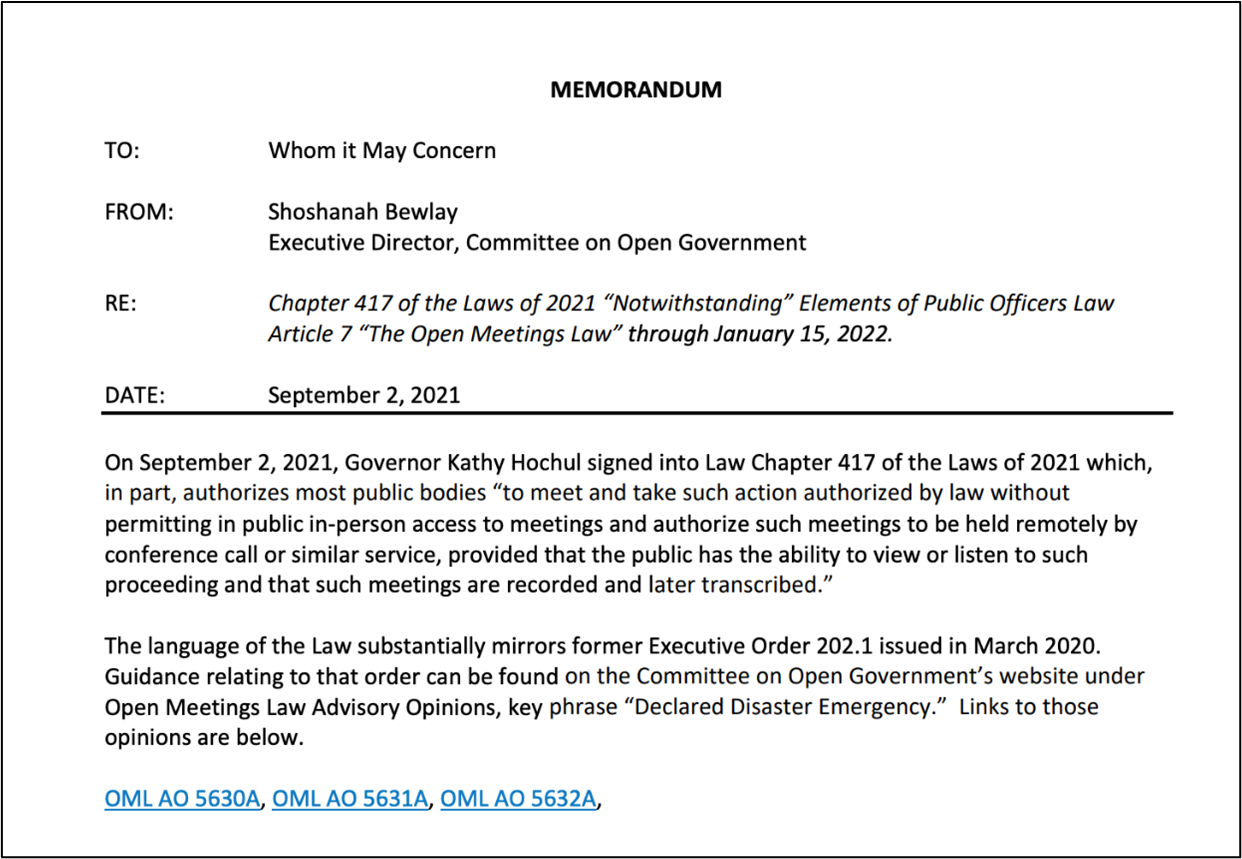
[1] I am putting a screenshot of this guidance below the reply, and the live link, as of October 14, 2021, is here: https://opengovernment.ny.gov/system/files/documents/2021/09/chapter-417-of-laws-of-2021_0.pdf.

[2] Which I hope the COOG does at its next meeting, on October 19th, which I will be attending as an audience member...virtually.

[3] What I said was "While disclosing the exact location of all meeting participants may not be possible (since they will be on the phone), the notice should strive to include as much information as possible that is most useful to the public, including the location of any physical participants."  That last clause should be "...including the location of the physical meeting, if there is one."  This type of slip is why the profession of "editor" is still a vital job, even though the fields of publishing and journalism are changing so rapidly.

Image of memorandum from Commitee on Open Government


Availability of Open Meeting Documents

Submission Date

Question

The Governor signed S1150A/A1228A into law [on] October 19, 2021. Now Chapter 481, this change requires that open meeting documents be available upon request or posted to the public body's website at least 24 hours prior to the open meeting at which the documents will be discussed.  Can you comment?

AND

Several libraries have questions regarding the new Open Meetings Law S1150A/A1228A

The law requires that open meeting documents be available upon request or posted to the public body’s website at least 24 hours prior to the open meeting at which the documents will be discussed. https://nyassembly.gov/leg/?default_fld=&leg_video=&bn=A01228&term=2021&Summary=Y&Memo=Y&Text=Y

Do libraries that furnish the documents upon request also have to post the documents on their websites?

Does a library have to post the documents on their website 24 hours in advance, if no one requests them?

What encompasses agency documents that “will be discussed”? I assume it includes agenda, previous meeting minutes, director’s report, treasurer’s report, proposed annual budget, etc. What about a new personnel manual that is enormous, or, a board member who introduces items under “new business” but does not submit them ahead of time to add to the agenda?

How long does a library have to leave the documents up on their website after the meeting takes place?

Will this new law remain in effect if the Gov. does not extend the modification to Open Meetings Law after January 15, 2022?

Answer

Because there are a lot of layers here, let's start with some bedrock fundamentals.

Bedrock #1: All NY-chartered libraries, including association libraries, must abide by the Open Meetings Law (the "OML"), a New York State law which requires certain meetings be accessible in real time to the general public.[1]

Bedrock #2: While all chartered libraries must follow the OML, only public libraries, as quasi-governmental agencies, are subject to its cousin, the Freedom of Information Law ("FOIL").[2]

Bedrock #3: As the members write, the OML has been changed to require the posting of materials to be reviewed at least 24 hours in advance of a meeting.  For libraries, this means that even if the library is not an "agency" subject to FOIL, the documents to be reviewed at the meeting--unless disclosure is barred for an express reason, such as attorney-client privilege[3]--must be posted.

Okay, with three sturdy bedrocks to build on, let's lay the foundation for the answers.

As stated before, the OML was recently changed to require advance posting of materials to be reviewed at a meeting.[4]

According to the Assembly memo that accompanied the bill, here is the basis for the change:

[S]ection 103 of the Open Meetings Law [currently only] requires agencies to make

any documents to be discussed at an upcoming open meeting available to

the public, "to the extent practicable." This vague phrase has created

loopholes and a way for agencies to bypass this requirement. In an anal-

ysis of 41 local governments conducted by the New York Coalition for

Open Government, 15 percent do not post meeting documents.


COVID-19 has made it apparent that there is technology readily available

for agencies to use in an effort to be more transparent.  Meetings are

only taking place virtually and individuals are at an immense disadvan-

tage because there is no in-person opportunity to request a hard copy of

any documents at the meeting. Therefore, it is even more important that

agencies utilize the technology available to post documents online where

the public can effectively access them.

The exact wording adopted to address these concerns, found in Section 103 of the New York Public Officers Law, goes into effect November 18th, and reads:

Agency records available to the public pursuant to article six of this chapter, as well as any proposed resolution, law, rule, regulation, policy or any amendment thereto, that is scheduled to be the subject of discussion by a public body during an open meeting shall be made available, upon request therefor, to the extent practicable at least twenty-four hours prior to the meeting during which the records will be discussed. Copies of such records may be made available for a reasonable fee, determined in the same manner as provided therefor in article six of this chapter. If the agency in which a public body functions maintains a regularly and routinely updated website and utilizes a high speed internet connection, such records shall be posted on the website to the extent practicable at least twenty-four hours prior to the meeting. An agency may, but shall not be required to, expend additional moneys to implement the provisions of this subdivision.

And with that "the Assembly hath spoken," and we can answer the questions.

Question 1: Do libraries that furnish the documents upon request also have to post the documents on their websites?

If a library "maintains a regularly and routinely updated website and utilizes a high speed internet connection" the documents must be "posted on the website to the extent practicable." 

I take this to read "If your library website has an event calendar you maintain, you need to get your meeting documents up on it at least 24 hours before the meeting."

Question 2: Does a library have to post the documents on their website 24 hours in advance, if no one requests them?

If a library "maintains a regularly and routinely updated website and utilizes a high speed internet connection" the documents must be "posted on the website to the extent practicable" even if no one has requested them.

What encompasses agency documents that “will be discussed”? I assume it includes agenda, previous meeting minutes, director’s report, treasurer’s report, proposed annual budget, etc.

Small note: Even before this change, the minutes should already be available, since Section 106 of the OML expressly requires availability within two weeks of the meeting.

Answer for public libraries: Every document that will be reviewed at the meeting.

Answer for association libraries: If you don't want to be a test case regarding the interaction of FOIL and the OML, post every document that will be reviewed at the meeting.   If you do want to be a test case, cite the slightly imperfect writing that describes what is to be disclosed ("Agency records available to the public pursuant to article six of this chapter")and say that since your library is not an “agency” per Article 6 of the Open Meetings Law, and thus not subject to FOIL (see Bedrock #2), you don't need to provide a darn thing.

I am kidding.  Don't do that.  I am writing the Committee on Open Government to request guidance on this issue, and I am fairly confident they will confirm that the intent is that the entire board packet is required to be posted, even when the subject organization is not subject to FOIL; I will post a follow-up when I get some input.

Question 3: What about a new personnel manual that is enormous, or a board member who introduces items under “new business” but does not submit them ahead of time to add to the agenda?

Large documents should be posted; per the new section of the law, if requested in hard copy, the library can charge a "reasonable fee."

Regarding "new business," if the new business raised is only verbal, there is no problem.  If, however, the "new business" is a letter, article, or proposed policy, the board action should be confined to establishing the next steps to be taken once proper posting can be effected.  And if the "new business" must be handled on an emergency or expedited basis, that can be done via a meeting of the Executive Committee,[5] with any action ratified in a later meeting, with the written content shared in advance as required.

How long does a library have to leave the documents up on their website after the meeting takes place?

I am sure there will be more guidance on this in the future, but for now, I read the law as requiring the posting to be "to the extent practicable," meaning for as long as the content can be posted without causing undue expense or burden on the system.

Will this new law remain in effect if the Gov. does not extend the modification to Open Meetings Law after January 15, 2022?

Unlike the current change to the OML regarding remote attendance (which is currently in effect, and sunsets in January of 2022), this modification of the OML Section 103 goes into effect on November 18th and stays with us until it is struck down by a court (not likely) or changed by the Assembly (not likely, except for slight refinements).

Where we'll see some follow-up and guidance about this new law is from the Committee on Open Government.  The COOG, as they call it, posts notice of its meetings here: https://opengovernment.ny.gov/committee-news.  I'll be sending a question about the scope of document disclosure by association libraries, and if you tune into the next meeting (when it is scheduled), you will likely see me in the WebEx as a mute observer. 

Thanks for a thoughtful and timely array of questions.  Stay tuned.


[1] This is required by Section 260-a of the New York Education Law, which is the law that allows the creation of such libraries.  So public access is baked into a chartered library's DNA.

[2] See the Committee on Open Government advisory opinion at https://docsopengovernment.dos.ny.gov/coog/ftext/f16795.htm, which states: "For purposes of applying the Freedom of Information Law, I do not believe that an association library, a private non-governmental entity, would be subject to that statute; contrarily, a public library, which is established by government and "belongs to the public" [Education Law, §253(2)] would be subject to the Freedom of Information Law." That said, all documentation an association library generates and submits to a governmental agency is subject to a FOIL request to that agency.

[3] My personal favorite disclosure exemption, of course.

[4] This was not the only change; there were also temporary changes regarding remote attendance.  See ATL “Open Meetings Law and end of NYS' Emergency Status - 06/30/2021” for more on that, (we'll also tackle it in one of the questions here).

[5] NOTE: Per the Section 260-a of the Education Law, in cities with a million or more people, even the committee meetings must be open.

Open Meetings Law and Social Distancing Requirements

Submission Date

Question

Now that Open Meetings Law modifications have been lifted, are we still required to maintain physical distancing for board meetings? We have a fifteen member board which makes it difficult to spread our trustees out. I understand that we can ask trustees whether they have been vaccinated: If all are vaccinated, do we have to maintain physical distancing? If some of them are not vaccinated, do we required all the trustees to wear masks? Do we provide physical distancing for the ones who are not fully vaccinated? I would like to host a staff luncheon ( I understand that is now allowable) but some of my staff are not vaccinated. If it is held outside, do we have to maintain physical distancing measures? What about holding the luncheon inside?

Answer

This question comes at a very challenging time.[1]

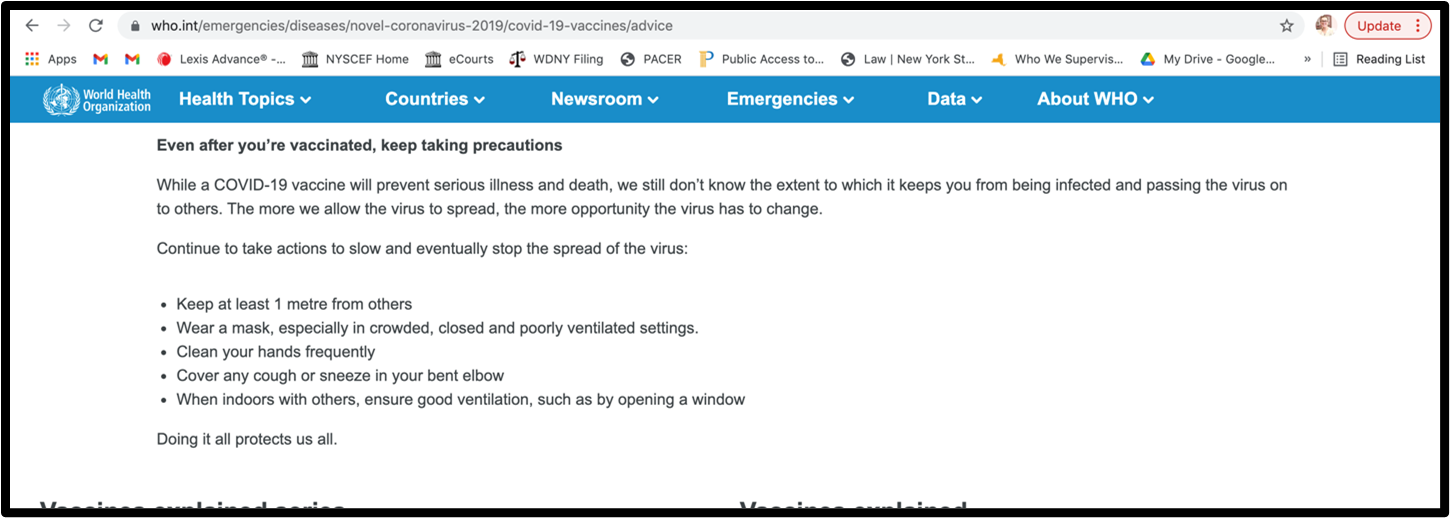
The question is difficult because right now, the World Health Organization is looking at the "Delta Variant" of COVID-19 and telling the world to consider continuing to use masks and social distancing while inside.[2]

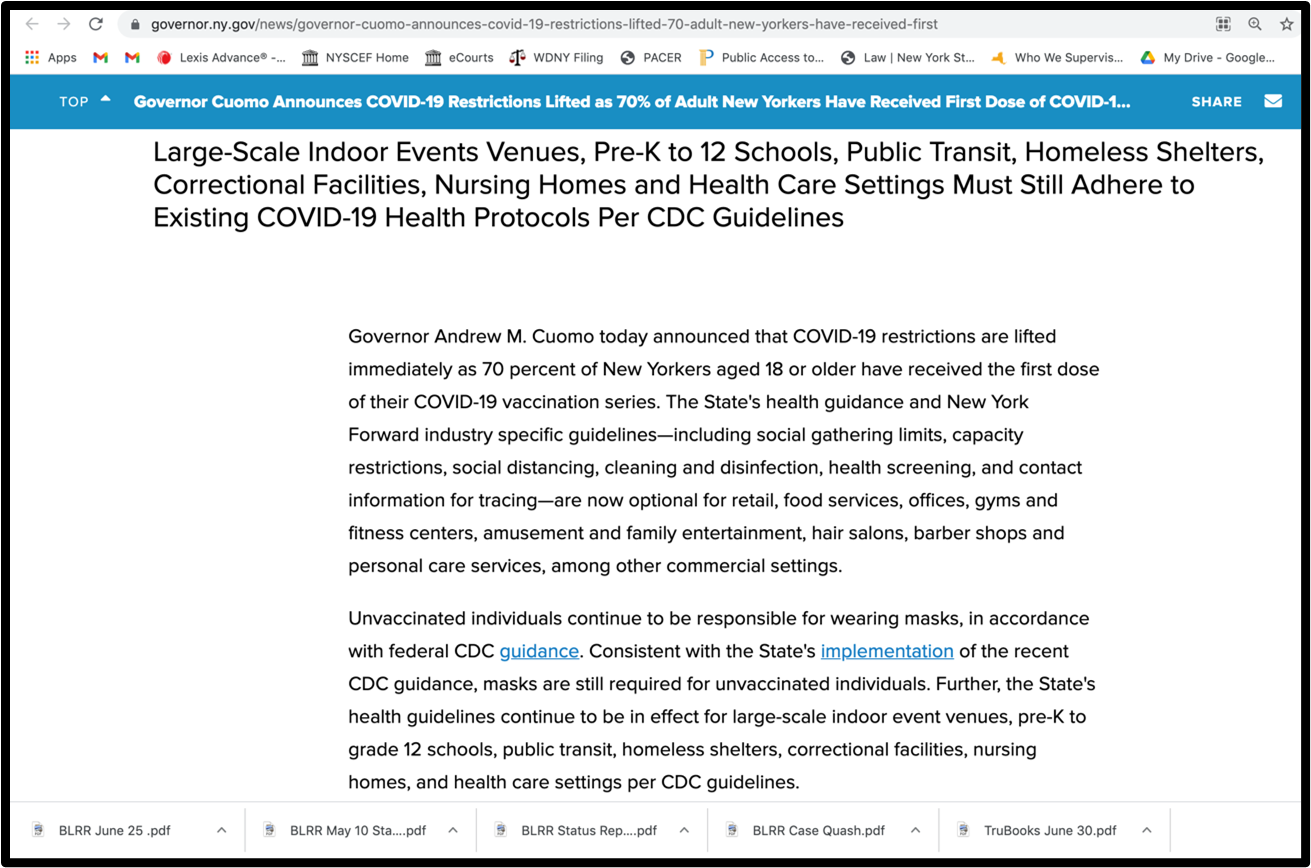
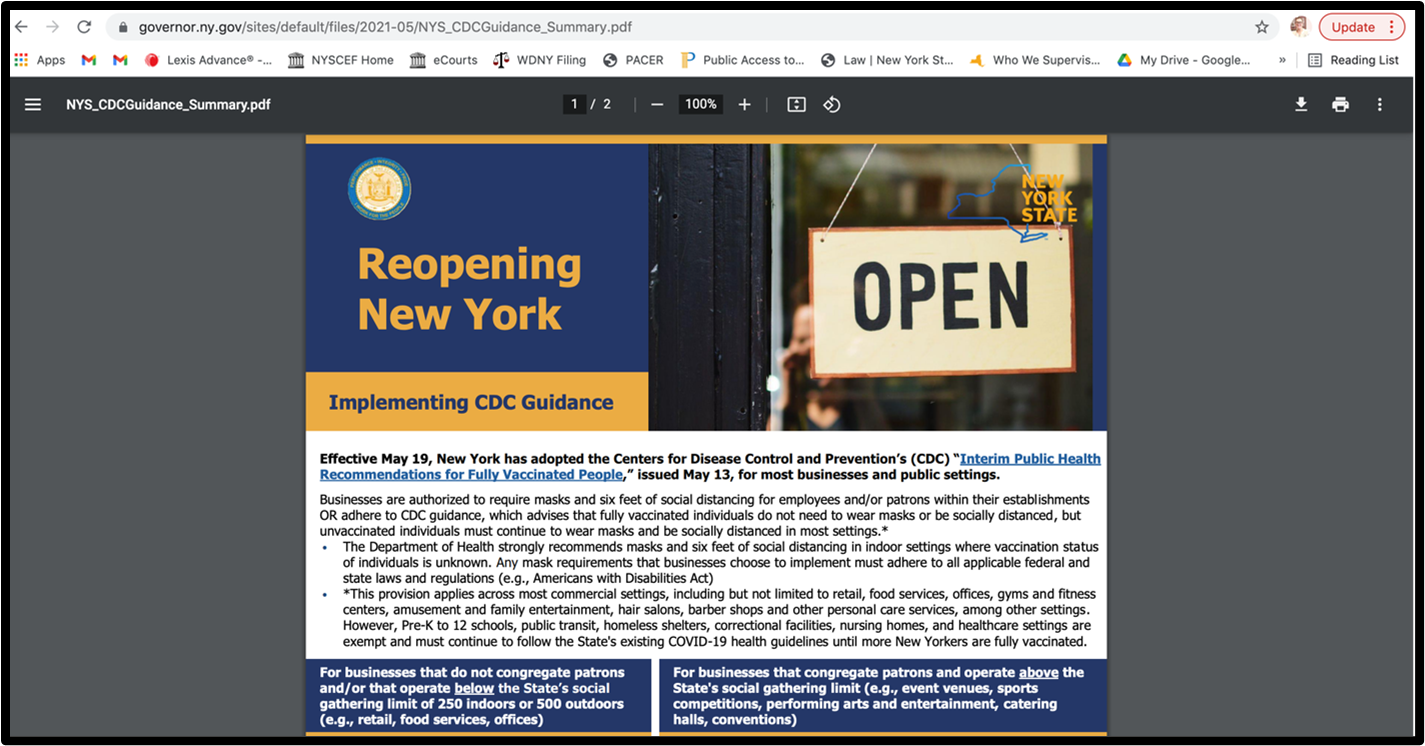
New York, of course, after a 6-day scramble, started following the Center for Disease Control's May 13 "surprise" guidelines stating that vaccinated people no longer need to wear masks or social distance indoors.[3]  And as of July 1, 2021, the state announced that almost all COVID-related restrictions were lifted.[4]

Where does this leave us?

Throughout the Pandemic, when asked about how to interpret and follow law, regulations, and Executive Orders governing the state's COVID response, my watchword has been: "Safety first."

After that, I have listed what is required at that point in time, and then referred libraries and cultural institutions to resources about how they can develop a Safety Plan[5] crafted to suit their unique identity (by "unique identity" I mean things like a large library with outdated HVAC and windows that don't open, has different considerations than a small library with assurance of constant fresh air).

With so much uncertainly at this time, my tired playbook is getting tested.  But I'll use it to try and answer each of the member's questions:

Now that Open Meetings Law modifications have been lifted, are we still required to maintain physical distancing for board meetings?

If your (now optional, but if the board keeps it in place, enforceable) Safety Plan still requires physical distancing, then yes.

We have a fifteen member board which makes it difficult to spread our trustees out. I understand that we can ask trustees whether they have been vaccinated: If all are vaccinated, do we have to maintain physical distancing?

If your Safety Plan has opted to continue using the NYS May 19th guidance, and the meeting is not exceeding the occupancy threshold, no, you do not.  HOWEVER, there is nothing to stop the board from deciding that, in the interest of safety and enabling each trustee to take whatever steps they need to feel safe, they are going to allow some trustees to attend from a remote location.[6]

If some of them are not vaccinated, do we required all the trustees to wear masks?

The WHO would (currently[7]) say: yes.

The CDC and the State of NY would (currently[8]) say: no.

For what it's worth, I tend to follow the most cautious reputable source at any given time (so would say: there is ample ground for your Safety Plan to require this, while there is also ample ground for your board to revise the Safety Plan to require only the bare minimum of advised precautions).

Do we provide physical distancing for the ones who are not fully vaccinated?

If that is at all possible, I strongly support that idea.  Being able to show an institution took the time to consider the best way to keep its community safe is good from any angle: mission, legal compliance, and employee/community relations.

I would like to host a staff luncheon (I understand that is now allowable[9]) but some of my staff are not vaccinated. If it is held outside, do we have to maintain physical distancing measures? What about holding the luncheon inside?

It pains me to say it, but sometimes, the law is not the best guide as to what to do!  Legally, if your library is still using the May 19th NYS Guidance, your Safety Plan can allow for this to happen, if you follow the required prescriptions.

However, it makes sense to me to "read the room" and see if such a luncheon would be a team-building exercise, or (because some employees might not feel at ease eating in close proximity to others) risk bad feelings and alienation.  If everyone cannot attend with the same level of comfort, it might be better to come up with an alternate bonding exercise.[10]

Conclusion

I truly wish I could offer more definite guidance.  The truth is, libraries--even with the return to the strict requirements of the Open Meetings Law--have many options for how to proceed.  So as tired as it may sound, put "safety first," and all things will follow from there.

Coda

Since the Powers That Be out there move quickly, here are some snapshots of the current guidance I am referencing in this answer.

Snapshot of the current WHO Guidance:

Screenshot of WHO guidance ca July 2021

Snapshot of NY's July 1 announcement:

Screenshot of NYS guidance ca July 2021


Snapshot of New York's May 19th Guidance (now largely optional):

Screenshot of NYS guidance ca May 2021


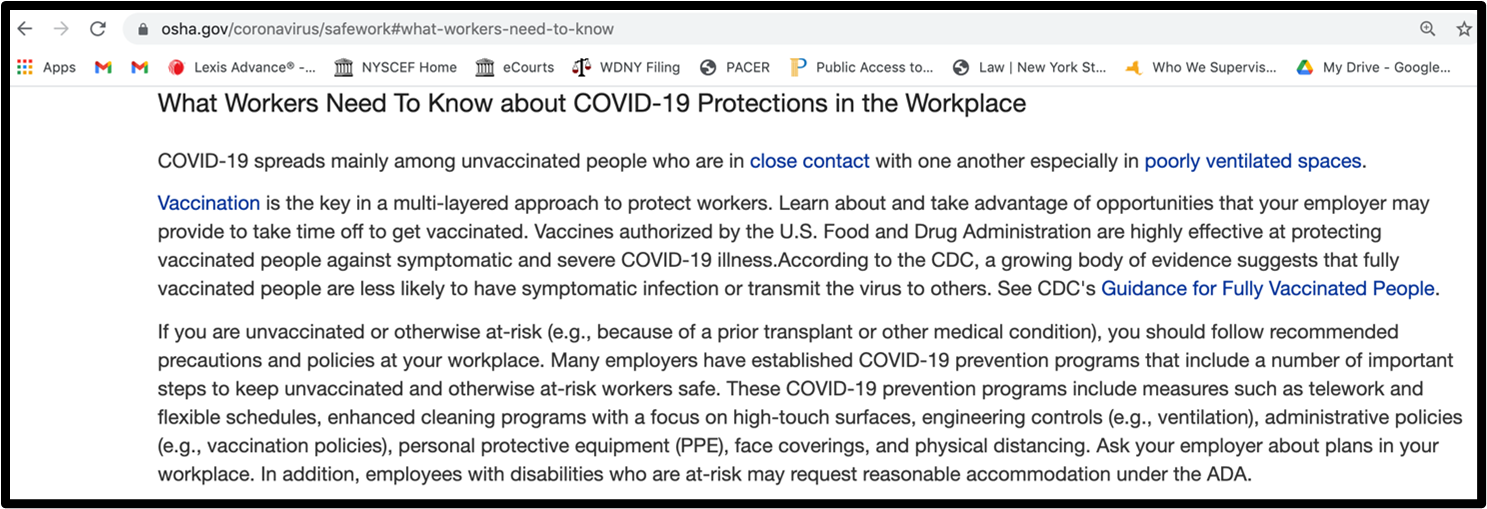
Snapshot of current (June 10) OSHA guidance:

Screenshot of OSHA guidance ca June 2021


[1] Has any date since March of 2020 not been in a "challenging time?"  I have a dim recollection of July of 2020 being semi-okay.

[2] https://www.who.int/emergencies/diseases/novel-coronavirus-2019/covid-19-vaccines/advice

[3] https://www.governor.ny.gov/sites/default/files/2021-05/NYS_CDCGuidance_Summary.pdf

[4] https://www.governor.ny.gov/news/governor-cuomo-announces-covid-19-restrictions-lifted-70-adult-new-yorkers-have-received-first

[5] Whether they were required to have one, or opted to have one.

[6] For more on this, see Open Meetings Law and end of NYS' Emergency Status.

[7] As of July 2, 2021, at 11:30 AM.  Go ahead, WHO, hit me with a change-up, I can take it.

[8] As of July 2, 2021, at 11:30 AM.  Go ahead, CDC and NY Department of Health, hit me with a change-up, I can take it just as well as I could at 11:30!

[9] This answer is complicated enough, I am not going to tackle the fiscal considerations of hosting events for staff!  See 1990 Comptroller Opinion #144 (May 15, 1990)

[10] This part might be a better question for the "Ask the HR Expert" service, since my idea of bonding is listening to Supreme Court Oral argument while providing color commentary (this is why my paralegal plans our events).

Open Meetings Law and end of NYS' Emergency Status

Submission Date

Question

First question: With the expiration of the Executive Orders on June 24th, 2021, including the Order modifying the requirements of the Open Meetings Law, are libraries back to the "old way" of conducting trustee meetings?

Follow-up question: If the answer to the first question is "yes," does this mean that trustees who still want/need to attend remotely from home must disclose their address in the meeting notice?

Answer

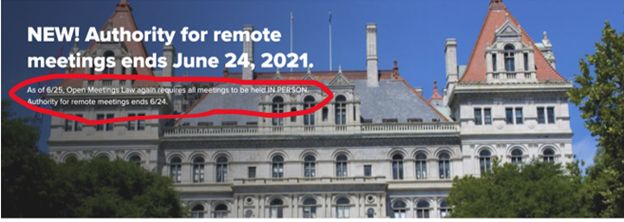
First question: Yes...with the expiration of the Executive Orders on June 24th, including the Order modifying the Open Meetings law,[1] things are "back to normal."

Or, as the Committee on Open Government, the authority on the State's Open Meetings Law (OML), put it:

Image of NY Governor's website showing end of emergency status date


So, does this mean "trustees who still want/need to attend remotely from home must disclose their address in the meeting notice?"

Various case law and commentary about the OML has confirmed that when a public body needs to meet via teleconference, the public must be able to attend from any remote location "calling in" to the meeting, and that location should be part of the meeting notice.[2]

Or, as the COOG put it in Advisory Opinion 5535 in 2018:

"So long as the public is permitted to attend at any location at which a member participates and can observe the members wherever they may be, I believe that the members may participate and be counted for purposes of attaining a quorum and for voting, and that a meeting may validly be held." [emphasis added]

For large public bodies such as the Regents, the New York Power Authority, and other entities that must hold publicly accessible meetings, and whose board members may reside in far-flung areas of the state, the use of publicly accessible call-in sites comes with an IT team and a budget.

For a public library, whose members generally reside within that library's area of service, this "back to normal" pretty much means that you're back to meetings in person.

Of course, under the Not-for-Profit Corporation law (which, along with the Education Law, governs the conduct of library meetings), a library board of trustees is allowed to conduct meetings telephonically.[3]  When coupled with the requirements of the OML, however, that latitude is severely reigned in--since whatever space is used for the remote call-in must be accessible to the public, and included in the notice.

For this reason, unless a library trustee is very comfortable inviting the public into their home, I advise against using the "dial in from home" option.[4]

NOTE:  This answer does not consider if a trustee needs to attend remotely due to it being an accommodation under the ADA.  That is a separate and critical question; for now, I'll simply say that adherence to the OML should not rule out consideration of ADA issues.

The transparency created by Education Law 260-a's requirement that public libraries abide by the Open Meetings Law is laudable--but is also based on older notions of technology.  Now that the State of New York has lived under different rules for over a year, we might see some changes in legislation.

But for now, we're "back to normal."

I hope this is helpful.


[1] Allowing them to be held via teleconference so long as the meeting is accessible to the public, recorded, and transcribed.  For more comments on this, see "Ask the Lawyer" Executive Order 202 and NY Open Meetings Law and Open Meetings Law and COVID.

[2] See https://docs.dos.ny.gov/coog/otext/o5535.html and https://docs.dos.ny.gov/coog/otext/o5575.html.

[3] See NFPCL Section 708(c) "Unless otherwise restricted by the certificate of incorporation or the by-laws, any one or more members of the board or of any committee thereof who is not physically present at a meeting of the board or a committee may participate by means of a conference telephone or similar communications equipment or by electronic video screen communication. Participation by such means shall constitute presence in person at a meeting as long as all persons participating in the meeting can hear each other at the same time and each director can participate in all matters before the board, including, without limitation, the ability to propose, object to, and vote upon a specific action to be taken by the board or committee."

[4] I recently saw a very good presentation on parliamentary procedure for library boards.  The presenter commented that disclosure of home addresses should not be made, due to safety concerns.  I absolutely agree with that caution, but must emphasize that if a trustee calls in from a remote location, with the emergency modification of the law over, the OML requires that all "locations" of the meeting (including a remote call-in site) must be disclosed.

Conflict of interest from legal proceedings

Submission Date

Question

I serve on the board of an association library.

My family has to consider legal proceedings against a school district that provides funds to the library through a public vote (as required by law, when the District puts the ballot out, the amount for the library is separate). Would my personal legal proceedings pose a "conflict of interest" with my position as a trustee? Is there any foreseeable conflict?

Answer

Before I answer, I would like to thank this unnamed trustee for bringing forward this important issue.  Dealing with personal legal matters is rarely easy; remembering to factor in consideration of one's volunteer obligations at the same time is impressive.

On its surface, this question is a fairly simple exercise:[1] does the status of a library trustee as a plaintiff against the district supporting the library create a "conflict of interest" that would violate the library's bylaws, ethics, or the Not-for-Profit Corporation Law ("NFPCL")?

To address that question, one must first understand what is meant by a "conflict of interest."

The concept “conflict of interest” sounds simple, but often quickly gets, as they say these days, “complicated.”

Why is that?  For a library,[2]  the concept of a "conflict of interest" could consist of layered elements like the petals of one, single (but complex) rose...or it could be a complex, multi-variety bouquet.

What can comprise this bouquet?

Let's start with the rose.

Section 715-a of the NFPCL requires every charitable corporation in New York (a category that includes most libraries), to adopt and enforce a policy "to ensure that its directors, officers and key persons act in the corporation's best interest and comply with applicable legal requirements, including but not limited to the requirements set forth in section seven hundred fifteen of [the NFPCL]."

Let's peel back the petals on this first thorny flower.  In one sentence, 715-a lists a broad expectation (acting in "the corporation's best interest"), a broad mandate ("comply with legal requirements"), and one very specific law to follow (NPFCL 715, which bars "related party transactions").[3]

Let's take that last petal first.  What is a "related party transaction?"

According to the NFPCL's "Definitions" section, a "related party transaction" means "any transaction, agreement or any other arrangement in which a related party[4] has a financial interest and in which the corporation or any affiliate of the corporation[5] is a participant..."

Based on the information provided, the trustee submitting the question is not in a "related party transaction".  The suit is not against the library, and in this scenario, the district who will be named in the suit is not an "affiliate" of the library.  Since the district is required to put the tax vote on the ballot (the school board has no control over this; it has to put the ballot up as proposed by the library board), the act of using the district to float the vote to the public does not create a relationship that could serve as the basis of a conflict.

Let's take the middle petal: "legal requirements?"  Is there any "legal requirement" that a trustee not bring an unrelated legal action against a school district who facilitates a library budget vote?  No.[6]

And finally, that first, most fraught petal: "the corporation's best interest?" --We're going to leave that for last.

What other “blooms” could join, and affect, this "conflict of interest" bouquet?

  • The library' bylaws
  • The library's customized "Conflict of Interest" policy[7]
  • An association library's trustee oath of office[8]
  • A grant or other contractual obligation that creates a temporary definition of a conflict
  • The library's strategic plan, or other planning document that would create a conflict as defined by law, bylaw, or policy.[9]

Fortunately, no matter how many blossoms in the "conflict of interest" bouquet, the law requires that when the possibility of a conflict arises, it is the board--not the individual trustee--who must assess it.

The NFPCL does that by requiring a board to pass a conflict of interest policy that:

 ...include[s], at a minimum, the following provisions:

  (1) a definition of the circumstances that constitute a conflict of interest;

  (2) procedures for disclosing a conflict of interest or possible conflict of interest to the board or to a committee of the board, and procedures for the board or committee to determine whether a conflict exists;

  (3) a requirement that the person with the conflict of interest not be present at or participate in board or committee deliberation or vote on the matter giving rise to such conflict, provided that nothing in this section shall prohibit the board or a committee from requesting that the person with the conflict of interest present information as background or answer questions at a committee or board meeting prior to the commencement of deliberations or voting relating thereto;

  (4) a prohibition against any attempt by the person with the conflict to influence improperly the deliberation or voting on the matter giving rise to such conflict;

  (5) a requirement that the existence and resolution of the conflict be documented in the corporation's records, including in the minutes of any meeting at which the conflict was discussed or voted upon....
  

So, at the end of the day, no matter how large the "conflict of Interest" bouquet, it is the board, as a whole, who has to sniff out a problem.[10]

In this case, the rub is in that first petal: the requirement that a trustee always act "in the corporation's best interest."

At the surface, there is no conflict whatsoever in this scenario: the school district is not a partner or contractor with the library, and the school board has no discretion about whether or not to put the library's budget on the ballot (they must put it exactly as the library board requests it).[11] Therefore, even if the contemplated lawsuit by the trustee is not taken kindly by the school district's board, there can be no direct negative impact.

Now, however, for a pragmatic answer: in a world where everything is political, and library budgets all the more so, could an adversarial relationship between an individual library trustee and a school district board be in something other than "in the best interest" of the library?

That consideration--and its answer--is not a legal issue.  In this scenario, there is nothing that violates the law, and I have never seen an oath of office, nor a bylaws provision, that would bar trustee service under such circumstances.  Further, as discussed above, even if the school board takes umbrage, they would be powerless to block the requested ballot item.

However, there is a "soft" consideration here that goes beyond the law.  I categorize these types of concerns not as "legal" issues, but that dreaded concept: "diplomacy."

When it comes to "diplomacy"...could members of a community, including an individual school board member in their individual capacity, decide to take a dim view of a library trustee who is suing their district, and try to punish the library?  They shouldn't, but as individuals, speaking just for themselves, they could...they absolutely could.  And even though their negative actions couldn't block the budget vote, it could influence a vote in non-official ways.

That said, the possibility of such personal vengeance in no way creates a legal conflict of interest.  So, for the reasons set forth above, a board doing an assessment of this situation--unless their policy specifically includes a unique definition or example that bars trustees sowing bad PR, even incidentally--would likely not determine that it constitutes a forbidden conflict.

Of course, a trustee may decide that they have enough on their plate, just being a plaintiff in a stressful lawsuit, and resign to avoid the (real or possible) stress of the situation.  Or the board and trustee may engage in some practical "risk management" and mutually agree that, given a high likelihood it could impact the board-to-board relationship, it is best if the trustee steps down for a time.  But such an option would not be required by law and would be based on pragmatism...and it could only be effected with the consent of the trustee.

And THAT is my answer to this very important question. 

I wish the trustee who posed it both 1) a thoughtful and supportive library board, and 2) a school board with the ability to maturely and completely compartmentalize legal issues from diplomatic ones.

Thank you.


[1] For purposes of this question, we'll assume that the only "support" the district provides to the library is the budget ballot (there is no MOU or even informal agreement for other assistance, like overflow parking, or hosting the annual fund-raiser).

[2] Public or association, in this case.

[3] There is no case law that picks apart how the commas in the sentence impact the interpretation and inter-relation of its required elements; that would be a dream case of mine (not that I wish the need to make that argument on any client of mine).

[4] "Related party" means (i) any director, officer or key person of the corporation or any affiliate of the corporation; (ii) any relative of any individual described in clause (i) of this subparagraph; or (iii) any entity in which any individual described in clauses (i) and (ii) of this subparagraph has a thirty-five percent or greater ownership or beneficial interest or, in the case of a partnership or professional corporation, a direct or indirect ownership interest in excess of five percent. "Relative" of an individual means (i) his or her spouse or domestic partner as defined in section twenty-nine hundred ninety-four-a of the public health law; (ii) his or her ancestors, brothers and sisters (whether whole or half blood), children (whether natural or adopted), grandchildren, great-grandchildren; or (iii) the spouse or domestic partner of his or her brothers, sisters, children, grandchildren, and great-grandchildren.

[5] In this case, the "corporation" is the library.

[6] I have not read every law passed in New York State, but I am willing to go out on a limb for this one.

[7] As you can see in the NFPCL, not-for-profit corporations have the right to define their own notion of "conflict," so long as the policy meets the requirements of the law.

[8] Only an association library might need to consider this, since the oath required of public libraries does not add to the obligation to be free of conflicts of interest (although it does undergird it).

[9] For instance, if the strategic plan called for the library to enter into a contract with the district in the future.

[10] That's right. The next time your board has to assess if the board chair's cousin getting the winning bid to the parking lot resurfacing job is a conflict, just envision being handed a fragrant mass of lilies and roses!

[11] Education law Section 259, found at https://www.nysenate.gov/legislation/laws/EDN/259.

Voting rights for non-trustee members

Submission Date

Question


Our by-laws name certain committees as committees of the corporation --- "No such committee shall have the authority to bind the board. Members of such committees of the corporation, who may be non-trustees, unless otherwise designated, shall be appointed by the President."

Can the non-trustee members of a committee vote if one is called for in the committee? It seems like they could because the committee can't bind the board, however we could see where their vote within a committee might mean that something isn't brought to the full board.

Related to this, should we amend the by-laws to specify them as voting/non-voting members of committees?

Thank you!

Answer

This reply will answer the questions up-front, and then tackle the concern about the full board not seeing a matter since it was voted on in committee in the "background and commentary" section.

The questions:

1.  Can the non-trustee members of a committee vote if one is called for in the committee?

Yes, if a library board has a committee with non-trustee members, those non-trustee members can vote.

2.  Should we amend the by-laws to specify them as voting/non-voting members of committees?

No, there is no need to amend the bylaws.  If the non-trustees are properly appointed committee members, they may vote.  If the non-trustees are not actual committee members but are instead there in an advisory capacity, they should not be referred to as "members" in the first place, and the appointment letter should make that clear.

And now, for some background and commentary.[1]

Back in 2014, the New York Not-for-Profit Corporation law was amended to create two types of board committee:

  • Committees of the Board
  • Committees of the Corporation

As the member points out, "Committees of the Corporation" are committees that--while they might work hard on matters of great importance to the library--cannot "bind" the board...meaning, they can't make "official" decisions final (authorizing a budget, signing a contract, or voting to hire a director).

"Committees of the Board," on the other hand, are authorized to "bind" the board in certain matters, including investments, endowments, employment, and some matters relating to real property.[2]

While this "Committees of the ______" change was quietly revolutionary in many not-for-profit circles,[3] it was already somewhat familiar territory for libraries, because the Education Law already authorized them to have an "Executive Committee" to "transact business of the corporation" between meetings.[4]  In other words, libraries were already used to designating committees with express and binding authority.  This just gave them more options to bring on more participants who were not trustees.

Now, while "Committees of the Corporation" may not be not tasked with the Really Big Decisions, as the member points out, they can still do very important work.

For example: let's say a library has created a "Public Relations Committee" ("of the Corporation") responsible for monitoring and identifying tactics for the library's presence in traditional and social media.  The committee doesn't sign contracts or even write press releases; it simply monitors and issues advice, meeting virtually once a month to review the library's media footprint and track its various metrics.

Based on some observations, the committee decides the library should adopt a "Social Media Policy."[5]  Since the committee can't "bind the board," they can't vote to adopt the policy, but if they vote to do so, they can:

  • Vote to designate a committee member or sub-committee to draft the policy;
  • Draft the policy;
  • Write a memo urging the board to adopt the draft policy;
  • When both are ready, vote to authorize the submission of the draft policy and endorsing memo to the full board.

Now, here's where the member's concern comes in: How does the full board know this work is being done? 

The critical work of committees "of the corporation"--even if they are not "binding" the board--should be connected to that of the full board by a routine report (or meeting minutes) that are "received and filed" by the full board subsequent to every committee meeting.[6] That way, whether or not the committee votes, the board is aware of its work, and what is in the pipeline.  Committee work should never take place in a vacuum; it should always be linked to the operations of the board by reports and minutes.

A high-functioning library board operates like an orchestra--different sections may rehearse separately, and sometimes, there may even be a prima donna moment or two--but the end goal should be harmony. 

A board's various committee types may have different functions, compositions, and authority, but they are all part of that system.  Thank you for a great question that showcases their differences and value.


[1] A valid concern.

[2] They can't do everything, though, so proceed with care!

[3] A wild bunch who brandish the word "fiduciary" the way some people wield the term "linebacker."

[4] https://www.nysenate.gov/legislation/laws/EDN/226

[5] The special focus of a PR committee, by the way, is why a library may want to bring on some non-trustee "ringers" to help with specific issues (a building committee is another great committee where you might want someone for a non-specific set of skills).

[6] Or at least, whenever the committee meets.  Some committees only meet and act once a year; obviously, that committee only needs to submit one report!

Paying Director for Trustee Meeting Attendance

Submission Date

Question

Our Library Director was hired 5 years ago and has always been paid for her attendance at monthly Trustee meetings. In 2021 the Town Supervisor stopped this long-standing practice. Our Town pays our Library Director.
 

Is this legal without letting the Trustees and Director prior to stopping the practice?

Answer

"Is this legal?"  Not likely.

But before I say more, I just want to offer a quick primer on how things work at "Ask the Lawyer."

Since the situation depicted in the question could result in legal claims by the Director, the board, and/or even the Town--or be relevant to an audit by the State Comptroller--this is the type of "Ask the Lawyer" question that can only be answered--really answered--under attorney-client privilege.

Why is that?  Because of how "Ask the Lawyer” works.  When questions like this are submitted (questions that ask for advice and guidance for the requesting member and their council, as joint clients[1]), our typical approach is to a) contact the member, b) get any additional information needed to assess the question, and then c) send an attorney-client privileged answer. [2]

After that, if the member consents to it, we create a "generic" answer, channeling the research gathered into general advice that may be useful for a broad audience (of libraries, museums, historical societies, and other regional council members).

This question, of course, presents an issue mostly relevant to public libraries.  And here is the "generic" answer to the scenario presented:

There are a number of factors an attorney needs to dig into in order to answer this question.

First: is the director an hourly employee, or salaried?  If salaried, this question doesn't make much sense,[3] so we'll go with hourly.

Second: Is the director required as part of their job to attend the meeting?  Since they are mostly there in their professional capacity, let's say "yes."

Third:  Did the director, in the past, report the hours into the payroll system, and receive compensation for them?  Let's again say "yes."

Fourth: Has the board consistently performed the aspects of board authority over the position (making the decision to hire, signing the hiring letter, performing annual reviews, working with Civil Service to amend the job description when needed, effecting disciplinary action and plans of improvement if needed, approving payroll,[4] approving scheduled vacation times, overseeing time off for disability, effecting termination)?  Again, from the scenario, we'll say "yes," which means the board has not laid a foundation for the lines of employment to be blurred (they are undisputedly in charge).

Fifth: Has the previous payroll, which included compensation for attending the meetings, been approved per the requirements of the Civil Service law?[5]  While that may be something happening subtly behind the scenes, based on the scenario, again it is probably "yes."

If we added those details to the scenario, I would see no basis for a town official to be able to unilaterally decide what tasks may or may not be compensated.

In fact, the only way I could see a town official being able to (legitimately) do such a thing is if the library board had expressly delegated all authority for supervision and payroll oversight to the town...something that would be a dangerous practice, since it would seriously undercut the library board's autonomy and authority.

The courts in New York, the State Comptroller,[6] the State Attorney General, and local Civil Service agencies all grasp the nuances of public library boards' authority, but it can be a struggle for newer public officers.  The autonomy and authority of a library board can often feel like a square peg to a public official used to only round holes.  That is why it is important to nurture the relationship routinely, deliberately, and carefully.[7]

What can be done in this case?  To avoid a claim of unpaid wages, a library board would need to develop a plan to put things right.  There are a number of ways to approach this, but I'd start out by enlisting the help of the local Civil Service, who can confirm that the library is a separate employer, with an obligation to confirm their employees' hours.[8] In the alternative, a good resource who may take a similar technical approach could be the municipality's attorney.

Since all that could take some time, if the board wants to vote to adjust the payroll (ensuring the payment is properly subject to taxes and withholding, etc.), the board may also want to enlist the help of the State Comptroller (the authority that audits public library payroll from time-to-time).  How would a library do that?  Prior to any adjustment, it would be a good idea to confirm the basis for the correcting payment in writing with the Comptroller, after which the board could resolve to make the adjusting payment (since the minutes of the meeting, and the meeting itself, are a public record, this is a good exercise in transparency).

Because of the risks involved in compensation-related matters, if at all possible, this type of challenge is a good one to work through with an attorney.[9]


[1] More on this approach, piloted in consultation with Sheryl Knab at WNYLRC (who was very patient as I unpacked all the nuances about attorney ethics and retainer agreements), is described in Hope Dunbar’s excellent article: https://www.tandfonline.com/doi/abs/10.1080/15332748.2018.1443572

[2] Sometimes, if the issue is sensitive enough (and there is no reason to involve them) the answer doesn't even go to the council.

[3] It could be relevant in the sense that the salaried employee was using the meeting time to hit a minimum amount of service for the work-week (say, 37.5 hours).  But that nuance doesn't quite fit the scenario.

[4] Note this says "approving," not "effecting."  A municipality can process the payroll and provide the employment benefits, and the library board of trustees remains the actual employer.

[5] Two great primers on how Civil Service Law impacts hiring library directors in New York are found at: http://www.nysl.nysed.gov/libdev/trustees/handbook/cs101.htm, and https://www.nyla.org/a-librarians-guide-to-civil-service-in-nys-2018/.

[6] The New York State Comptroller has understood the nuances of the library board-municipality relationship for decades.  See 1972 Op St Compt File #402.

[7] See the "Ask the Lawyer" on developing an MOU with your sponsoring municipality: https://www.wnylrc.org/ask-the-lawyer/raqs/166

[8] I realize that might not be the case in some localities.  If that is the case for your library, you may want to skip this step, and head to the Comptroller.

[9] The case at this link, Beers v. Incorporation City of Floral Park, from 1999, shows why! https://casetext.com/case/beers-v-incorporated-village-of-floral-park

Removal of Trustee From Board

Submission Date

Question

Our board meetings are now 100% remote, and one trustee has failed to attend every session since the start of the pandemic.  How can our board address that, if we know the move to virtual meetings (unfamiliarity with Zoom, bad internet, etc.) is the reason for the absence?  Is removal an option?

Answer

Earlier this week I was having a conversation with Brian, one of my paralegals, about the challenges we—our office and our clients—are facing due to the pandemic.  The conversation ranged from the personal (Brian is a musician whose band hasn't been able to play; my father-in-law is in the hospital and we can't go see him), to the professional (how to handle a contract breached because people can’t gather to do the work).  We concluded, in a very non-scientific way, that everything—whether it used to be easy, or was only a little bit difficult—is now "at least 30% harder" than before.[1]

On the flip side, later that day, I spoke via Zoom with a friend about how the increased reliance on Zoom, FB Live, and other virtual fora has done wonders for democracy.  "People are going to meetings they could never get to before," said my friend. "People who would never have had time to get to City Hall, or would have faced actual physical barriers to getting in a building,[2] are now able to attend."  And I optimistically thought: Cool...one thing that isn't 30% harder.

But these current times are not kind to optimists, and this question shows that, for some, even the Zoom-ification of democracy might make life at least 30% harder. 

And with that harsh reality established, let's take a look at the legal considerations of this question.

I.  Meetings during COVID

As "Ask the Lawyer" has addressed a few times[3] since the onset of NY's response to the pandemic,[4] chartered libraries are obligated to conduct their board meetings in compliance with the "Open Meetings Law (the “OML”). When New York went into social-distancing mode, the requirements of that law were modified by Executive Order to allow people to attend remotely, or through a blend of in-person and remote solutions.[5]

The New York Committee on Open Government (the "COOG") addressed some of the practical considerations of these modifications in guidance issued on August 20, 2020 [NOTE: This link was confirmed as no longer active and removed on 02/25/2022  as part of the routine review of "Ask the Lawyer" materials.].  In that opinion, the COOG stated that if a body subject to the OML resumed meeting in person while the executive orders allowing the modifications were effective, a remote attendance alternative must be provided.[6]  As of this writing, modification is good through February 26, 2021.


II.  Attendance as a Trustee During COVID

The Executive Orders and COOG guidance clearly require enabling attendance through remote measures.  What the executive orders and COOG[7] guidance are silent on is the scenario posed by the member: if a library board and community have transitioned to meeting 100% virtually, and one trustee, due to the technology, isn't able to attend, is the board able to address that under the law?[8]

I have found no guidance precisely on point, but below is my legal analysis, and what I hope will be helpful guidance.


III.  Analysis

Library trustee service is governed by the laws of New York and a library's enabling legislation, charter, bylaws, and policies (in that order).  Aside from customized provisions in a charter, bylaws or policy, the law has two means of addressing serial trustee absence:

Means #1: "Unexcused Absence"

Per Section 226(4) of the Education Law,[9] trustees who are absent for three consecutive meetings without a "satisfactory excuse" for missing the meeting are "deemed to have resigned."  That is why, when a trustee lets a board know that they are unable to attend a meeting (virtual or otherwise), and they don’t show up, they are noted on the minutes as "excused," since to do otherwise could put the trustee on a path of resignation-by-law.[10]

Many NY library bylaws have this language in them, but it is not required...since it's in the law.  But what isn't in the law is what a board can regard as a "satisfactory" excuse. Is the excuse of a trustee who can't attend remotely, due entirely to technology, "acceptable"?  Only a board can say.  In a very rural community, it might be.  In a highly wired urban area with free wi-fi, where a trustee could perhaps even borrow some library technology to attend the meeting, it might not. So long as the reason is not discriminatory,[11] and not contrary to the bylaws or being unfairly applied, a board has some discretion in what type of reason they are "satisfied" by.

But I can say this: if the absences aren't noted as "unexcused" on the board minutes, a board should not contemplate this as a basis for implied resignation, since the law is clear that this must be based on absence that is unexcused.

Means #2: "Neglect of Duty"

The other statutory basis for removal of a trustee is found in Section 226 (8) of the Education Law: "Removals and Suspensions,” which states that a board may:

“Remove or suspend from office by a vote of a majority of the entire board any trustee, officer or employee engaged under special contract, on examination and due proof of the truth of a written complaint by any trustee, of misconduct, incapacity or neglect of duty; provided, that at least one week’s previous notice of the proposed action shall have been given to the accused and to each trustee."

As you can see, this section (a provision often replicated in library bylaws) creates a more intricate process than Section 226(4): it requires a written complaint, advance notice, and a majority vote of trustees to confirm a removal. 

To use this provision to address nothing more than repeated absence due to technical issues is probably overkill, unless the board finds that the mounting excuses—while perhaps initially acceptable—are causing real harm to the library or the operations of the board.  Before resorting to this step, it is always good for a board president or other leader to have a conversation with a board member and ask if they would like to offer their resignation (for some, this request may come as a relief).[12]

That said, a "neglect of duty" removal doesn't have to be hostile.  It can simply state that a trustee has failed to attend X number of meetings, has been unable to fulfill their duty as a trustee, and that to ensure the board has the benefit of a fully participating body, the board must consider removal. Give proper notice of the “complaint,” make sure the trustee has a chance to be heard, and vote.


IV.  Guidance

So: Is removal an option?

Yes, removal is an option, but as can be seen, when considering such removal, a board should pay close attention to the documentation that it is basing its decision upon.

I am very glad the member who submitted this question is being so thoughtful about this.  It is clear from the law, the pandemic-related Executive Orders, and the COOG guidance, that it is the public policy of the State of New York to encourage attendance and access to library trustee meetings, even during difficult times. 

While trustees have a different set of rights and obligations than the general public, an effort to orchestrate meetings to be free of pandemic-created impediments to trustee participation is clearly within the spirit, if not the letter of the law. To that end, if a library is open and if it has a Safety Plan that could allow a capacity-limited physical component of a virtual board meeting (perhaps set up in the room where the trustees used to meet, if possible under the Safety Plan), it is worth considering allowing trustees to attend in that manner—even if the rest of the trustees appear virtually. 

But to be clear: that is not what the law requires.  And if everything feels at least 30% harder these days, every library needs every trustee to be giving 100%.  So, if steps need to be taken to ensure a board has its full capacity of engaged trustees, just double-check your bylaws and documentation, and do what's best for the library.

Thanks for a difficult but very important question.


[1] I have heard people used "B.P." as in, "Before Pandemic."  "Pre-COVID" and "pre-pandemic" are also used.  I have floated "ante-Corona," because it sounds so grandiose, but I can't get it to stick.

[2] My friend is an architect, so they tend to see the world in design terms.

[3] In the answers from March 18, 2020November 16, 2020, and December 14, 2020.

[4] "P-Day?" 

[5] The latest extension of this modification is valid until February 26, 2021 per Executive Order 202.92.

[6] What the Executive Director wrote was: "In my opinion, if a public body can possibly anticipate that any persons who may wish to attend a meeting governed by the provisions of the Open Meetings Law cannot be safely physically accommodated in the proposed meeting location ... that public body is required to simulcast to the public, by either video or audio means, the proceedings of the meeting as they are occurring so that all members of the public who wish to “attend” may do so."

[7] Full disclosure: this acronym is a constant test of my maturity level.

[8] For purposes of this scenario, I am accepting the premise that not even attendance via LAN line is possible; something that is certainly feasible in our cord-cutting, cell-reliant society.  Further, I have never seen bylaws that require a trustee to own a computer, or even a phone (you usually just have to be 18 and live in the area of service!).

[9] "If any trustee shall fail to attend three consecutive meetings without excuse accepted as satisfactory by the trustees, he shall be deemed to have resigned, and the vacancy shall be filled."  Please pardon the implication by pronoun "he" that only a male trustee can be subject to this law; I don't write the law, I just research, construe, and quote it. 

[10] Short note for all you minute-takers out there: this is why noting those “excused” and “unexcused” absences is so important.

[11] For instance, if board meetings are always held on Friday night, and the board doesn't excuse the absence of someone who keeps the Jewish sabbath.

[12] I appreciate that if the trustee is truly inaccessible by computer/phone, this might be cumbersome.

Library board authority over staff

Submission Date

Question

The library is seeking information about a law stating that the library board has sole authority over public library staff benefits. The issue that needs to be addressed is a town board's attempt to eliminate a part-time employee's one week of paid leave per year that the library board granted [several years ago]. The town board's position is that since the other part-time town employees do not receive this paid leave, the library staff should not either. Research into the issue included a review of Education Law 226, but that only addresses hiring, firing, and salaries. Benefits such as paid time off, holiday pay, sick leave are not covered.

Answer

I recently had a chance to check in with the New York State Comptroller's legal department[1] on this very topic.

The reason I had to check in is because the most recent on-point authority I could find on this subject was from 1981. 

The input I got from the legal department was re-assuring: no change in guidance in the almost four decades that followed.[2]

Now, that said, the attorney at the Comptroller's gave me the usual disclaimer that I often give in "Ask the Lawyer": It's just an opinion.  The law can change.  Check with your lawyer, since your charter, bylaws, and policies, or even a contract, could change how this applies to you."

But that said, below are the reassuring words of Comptroller Opinion #445, circa 1981.  Since they are a little heavy on the legalese and citation, I've put the important part in bold:

"As a general rule, the town library board of trustees, and not the town board, has the authority to appoint and dismiss library personnel (Education Law, §§ 226(7), 260; 30 Opns St Comp, 1974, p 98). The library board exercises direct control and supervision over library personnel and, for most purposes, including labor negotiations [**486] under the Taylor Law (Civil Service [*2] Law, §§ 200, et seq.), the library board is considered to be the employer of library personnel (County of Erie v. Board of Trustees, 62 Misc 2d 396, 308 NYS2d 515; Binghamton Public Library Unit v. City of Binghamton, 69 Misc 2d 1005, 331 NYS2d 515; Opns St Comp, 1972, No. 72-402, unreported; cf. Retirement and Social Security Law, § 30(c); Opns St Comp, 1980, No. 80-199, as yet unreported; Finkelstein v. Central School District, 34 AD2d 781, 311 NYS2d 243 affd 28 NY2d 705, 320 NYS2d 751). Compensation for library personnel is fixed by the library board and paid from the library fund (Education Law, §§ 226(7), 259(1)). It would then follow that, as between the town board and the library board, it is the library board which determines the vacation and sick leave benefits for library employees. It is our opinion that a library board of trustees has implied authority to provide for sick leaves and vacations for library employees (see Opn No. 80- 199, supra; 1961 Atty Gen [Inf Opns] 105; Education Law, §§ 226(7), 260). We note that expenditures for employer contributions to the New York State Employees' Retirement System for library employees are expenses [*3] incurred for the operation of the library and should be paid from library funds (Opns St Comp, 1975, No. 75-903, unreported; 16 Ed Dep't Rep, 1977, p 416). The same would hold true for employer contributions for social security and unemployment insurance for library employees." [emphasis added].

So, with regard to the member's specific situation, I of course have to say: " It's just an opinion.  The law can change.  Check with your lawyer, since your charter, bylaws, and policies, or even a contract, could change how this applies to you."  But if all of those things have been checked, and there is no provision changing the default, the Comptroller's words from 1981 still apply.

I hope this will help as your library works to retain that one week of paid leave!

Thanks for a great question.


Supplementary Answer

NOTE: For libraries that are running into this type of issue with their sponsoring municipalities, below, please find "some additional input" that I hope can be of help:

As many of you know, my law office has the privilege of working with libraries across New York.  It is work my team and I value highly, because it connects us with a vast "information army" of committed, creative librarians who are dedicated to public service.

This work also gives us an array of windows into what is happening "out there," especially when it comes to public libraries working with their districts and municipalities on issues like the one shown in this question.  And while each specific view from any particular window is confidential, it positions my team to distill a lot of anecdotal information,[3] and to share what we see in the aggregate.

Based on what we are seeing "in the aggregate" the type of issue brought forward by the member has always been an "issue," but with the budget pressures and political theater ushered in by the events of 2020, it appears positioned to become an "Issue" into 2021 and beyond. 

The emergence of this Issue isn't just a by-product of budget woes heightened by pandemic.  It is also the result of a rapidly evolving regime of employment law in New York, making the distinction between government and "private" employers more critical, with every passing day.  This distinction impacts things such as: comp time, overtime, minimum wage, insurance, liability, civil rights claims, labor law claims, and things that may seem mundane, but are actually quite important (such as: "Whose HR manual do we follow?").

If you take a quick scan of the "Ask the Lawyer" searchable index,[4] you'll see that numerous member questions arise from this "Public Library as Employer" divide. And while they relate to different aspects of the library-as-employer, they all touch on one very specific priority: public library board authority.  And it's apparent that this is something some sponsoring municipalities and districts have a challenge grasping.

So, in an effort to provide a short, succinct resource for libraries to direct their government entities to when they try to interfere with hiring, try to control employee benefits, or otherwise try to interrupt the autonomy of duly elected/appointed trustees in the governance of a chartered public library, I am posting this memo on my firm's website at https://www.stephaniecoleadams.com/adamsblog/2021/1/7/comments-on-public-library-board-autonomy, without the usual snarky asides and footnote commentary. 

Hopefully it can help avoid some of the needless argument and hostility that these misunderstandings can create.  If you find it helpful, please let us[5] know.

--Cole


Comments on Library Board Autonomy

Law and current legal authority firmly establish that public library boards are the sole authority regarding employee terms of employment, including hiring, compensation, benefits, evaluation, promotion, discipline, and termination. 

This autonomy is constrained only by a public library board's need to observe the New York Civil Service Law, the New York Education Law, numerous state and federal labor laws, various applicable regulations, and a library's own charter and bylaws. 

The law does allow a public library to use, in whole or in part, the payroll system, policies, and benefits systems of their sponsoring government entity, if such resources are offered to the library by that entity.  Further, the government entity, in making such an offer, may condition such use on the library's cooperation with certain reporting procedures or methods of documentation.  The choice to use such offered resources, however, is ultimately at the discretion of the library's board, who may instead decide to have the library implement its own system. 

And finally, the choice as to how to expend library funds with respect to employees (salary, benefits, paid time off) always rests solely with a public library's board.

The legal authority establishing these considerations is extensive, but a thorough summary is set forth in the links and content below.

https://www.osc.state.ny.us/legal-opinions/opinion-93-15, which states:

"The ultimate control of the use, disposition and expenditure of the library fund moneys is vested in the library board even when the municipal treasurer has custody (1991 Opns St Comp No. 91-57, p 158). Further, even if the treasurer of the sponsoring municipality is custodian of the library fund, the library board would have custody of private source moneys of the library (1988 Opns St Comp No. 88-76, p 145; 1980 Opns St Comp No. 80-340, p 101).

Public libraries are, for most purposes, fiscally autonomous from the sponsoring municipality (see Opn No. 91-57, supra; 1983 Opns St Comp No. 83-32, p 37; Buffalo Library v Erie County, 171 AD2d 369, 577 NYS2d 993 affd 80 NY2d 938, 591 NYS2d 131). In addition, public library officers and employees are often not considered to be officers and employees of the sponsoring municipality or school district (see, e.g., General Municipal Law, §800[5], conflicts of interest; Public Officers Law, §10, official oaths; Binghamton Public Library v City of Binghamton, 69 Misc 2d 1005, 331 NYS2d 515 and County of Erie v Board of Trustees, 62 Misc 2d 396, 308 NYS2d 515, collective bargaining negotiations). In view of the library's fiscal autonomy, it is our opinion that library trustees and the separate library treasurer are not town officers or employees for purposes of Town Law, §123 and, therefore, are not subject to the accounting and auditing provisions of that section.

We note, however, that General Municipal Law, §30(3) requires that an annual report of financial transactions, including those involving private source moneys (Opn No. 88-76, supra), be made by the treasurer of each public library. The report must be certified by the officer making the same and, unless an extension of time is granted, must be filed with the Office of the State Comptroller within 60 days after the close of the library's fiscal year (General Municipal Law, §30[5]). In addition, the Education Law contains certain requirements for public libraries to report to the State Education Department (see Education Law, §§215, 263). Finally, as noted in Opn No. 88-76, supra, the town board, in determining the amount to be raised by taxes for library purposes, may take into account a library's private source funds and, therefore, may request from the library information concerning such funds."

https://www.osc.state.ny.us/legal-opinions/opinion-91-57, which states:

"With respect to library moneys, however, we note that public libraries are, for most purposes, fiscally autonomous from the sponsoring municipality (see, e.g., 1983 Opns St Comp No. 83-32, p 38). Thus, the ultimate control of the use, disposition, and expenditure of those moneys is vested in the library board of trustees even if the municipal treasurer is the custodian of library moneys. (Education Law, §§226[6], 259[1]; 1987 Opns St Comp No. 87-84, p 125; see also Opn No. 87-49, supra; Opn No. 86-54, supra). In addition, it is the library board of trustees which may authorize the investment of library moneys even when the moneys are held in the custody of the municipal treasurer (Opn No. 86-54, supra). Therefore, since the library board controls the use and disposition of library fund moneys, it is our opinion that the library board must consent to any arrangement under which library fund moneys are to be comingled with moneys of the municipality."

https://www.osc.state.ny.us/legal-opinions/opinion-2001-12, regarding indemnification of library trustees, which states:

"PUBLIC OFFICERS LAW §18: There are two alternatives for conferring the benefits of section 18 of the Public Officers Law on employees of a public library: either (1) the board of trustees of the library may elect to confer the benefits of section 18 on library employees as a public library expense; or (2) the governing board of the sponsoring municipality or school district may confer section 18 benefits on library employees as a direct expense of the sponsor."

Comptroller Opinion #445, which states:

"As a general rule, the town library board of trustees, and not the town board, has the authority to appoint and dismiss library personnel (Education Law, §§ 226(7), 260; 30 Opns St Comp, 1974, p 98). The library board exercises direct control and supervision over library personnel and, for most purposes, including labor negotiations [**486] under the Taylor Law (Civil Service [*2] Law, §§ 200, et seq.), the library board is considered to be the employer of library personnel (County of Erie v. Board of Trustees, 62 Misc 2d 396, 308 NYS2d 515; Binghamton Public Library Unit v. City of Binghamton, 69 Misc 2d 1005, 331 NYS2d 515; Opns St Comp, 1972, No. 72-402, unreported; cf. Retirement and Social Security Law, § 30(c); Opns St Comp, 1980, No. 80-199, as yet unreported; Finkelstein v. Central School District, 34 AD2d 781, 311 NYS2d 243 affd 28 NY2d 705, 320 NYS2d 751). Compensation for library personnel is fixed by the library board and paid from the library fund (Education Law, §§ 226(7), 259(1)). It would then follow that, as between the town board and the library board, it is the library board which determines the vacation and sick leave benefits for library employees. It is our opinion that a library board of trustees has implied authority to provide for sick leaves and vacations for library employees (see Opn No. 80- 199, supra; 1961 Atty Gen [Inf Opns] 105; Education Law, §§ 226(7), 260). We note that expenditures for employer contributions to the New York State Employees' Retirement System for library employees are expenses [*3] incurred for the operation of the library and should be paid from library funds (Opns St Comp, 1975, No. 75-903, unreported; 16 Ed Dep't Rep, 1977, p 416). The same would hold true for employer contributions for social security and unemployment insurance for library employees."


I hope this information is of assistance.


[1] This is like a guitar player saying they recently got to jam with John Mayer.

[2] In fact, to bolster the 1981 opinion I found, they sent me an even older opinion.

[3] I appreciate that anecdotal information is not precise data analysis.  For that, I rely on the system, councils, LibDev, and NYLA.  I fall into those data rabbit holes regularly.

[4] I am very gratified to have been doing this long enough to warrant a searchable index.

[5] Write to adams@losapllc.com and jill@losapllc.com.
Open Meetings Law and COVID

Submission Date

Question

A member of my board of trustees would like for us to meet in person. There would be 9 people in the room. They wanted to know if allowing the meeting to be simultaneously on Zoom would satisfy the requirements of open meetings law even though only one member of the public would be able to be physically present in order to stay under the 10-member cap for small gatherings.

Answer

Since the onset of the pandemic, we have had two questions about the impact of Executive Orders on the Open Meetings Law.

The first question, back in March 2020 (remember March 2020?  Ugh.), led to this advice:

... the method you select for sharing the meeting in real time (livestreaming, a broadcast) should be accessible to the general public.

Of course, by Fall 2020, we all became experts at these modified proceedings, and were asking refined questions like:

How long does a library (public or association) or a cooperative public library system have to keep the recording of board or committee meetings?

(Answer: until transcribed.)

This brings us to December, 2020.

On December 2, 2020, the Governor issued Executive Order 202.79,[1] continuing the suspension and temporary modification of the Open Meetings Law through January 1, 2021.[2]  So here we are, still meeting under modified circumstances.[3]

Which brings us to the member's question:

[Does] allowing the meeting to be simultaneously on Zoom ... satisfy the requirements of open meetings law even though only one member of the public would be able to be physically present in order to stay under the 10-member cap for small gatherings[?]

Answer: Yes.

Here is why I can answer this question with one-word confidence.

Back in August, 2020 (remember August, 2020?  Slightly less "ugh.") the Executive Director of the State Committee on Open Government, realizing that different areas have different COVID numbers and are facing different Open Meetings Law compliance challenges, wrote in an Advisory Opinion:[4]

...if a public body is convening an essential meeting, the body must ensure that it adheres to social distancing, masking, and any other administration requirements, and if there is any question about whether it is able to maintain a safe space in which to hold an essential open meeting, it must provide a contemporaneous video or audio broadcast such that members of the public who cannot safely attend in person “ha[ve] the ability to view or listen to such proceeding and that such meetings are recorded and later transcribed.”

Further, the Advisory Opinion went on to emphasize that room capacity and safety concerns should not impede public access to an OML-accessible meeting. "[A] public body may not artificially limit attendance at its meetings – to do so would not be consistent with the requirements of the Open Meetings Law."

The solution posed in the question submitted by the member adequately addresses this concern.   By enabling observation and attendance via Zoom, the proceeding will be virtually accessible even though it has been physically convened.  The key is ensuring access at a time of modified operations.

And what do we do when Executive Order 202.72 expires?

We'll see in the New Year!

Thanks for a thoughtful question, I wish you a productive and safe meeting.


[1] https://www.governor.ny.gov/news/no-20279-continuing-temporary-suspension-and-modification-laws-relating-disaster-emergency.

[2] If you'd like to follow the daisy-chain of executive orders on this, here goes: Executive Order 202.1 first suspended/modified the Open Meetings Law Requirements, and then Executive Orders 202.14, 202.28. 202.38, 202,48, 202.55, 202.60, 202.67, and now, 202.72, kept that suspension/modification going.

[3] There are several legal challenges under way, based on the ability of the Governor to continue the state of emergency and resulting Executive Orders.  I am not commenting on that.

[4] Found at https://www.dos.ny.gov/press/2020/Essential%20Meeting%20OML%20AO.pdf