Board of Trustees

Soliciting Donations for Public Libraries

Submission Date

Question

We are beginning our long-range planning process and are asking patrons to fill out a community survey to assess what the community wants to see in the library now and in the future. Thinking it was a good idea to raffle off gift cards to encourage participation, I gave my board trustees a letter requesting a donation of gift cards. Another director told me I'm not supposed to have the board ask for donations in any form. This is something our Friends group should do. Please advise. Thanks in advance!

Answer

Following our "do not reinvent the wheel" rule for "Ask the Lawyer," prior to diving into this, we checked the "Trustees Handbook" posted at https://www.nysl.nysed.gov/libdev/trustees/handbook/handbook.pdf.  On page 57, it provides an excellent summation of the concern at play in the issue of trustees and fund-raising:

"Public library boards generally take care to separate private fundraising efforts (such as direct personal solicitations, as opposed to seeking grants from foundations or government agencies) from normal library operations and board activities since there are restrictions on the appropriate use of public funds." [emphasis added]

The Handbook then points out that this concern is why many public libraries use "Friends" to personally solicit and raise funds.

To this concern about limits on the use of public funds, I would add that when it comes to raising money, it is very easy for the solicitation to run afoul of charitable regulations, required accounting, and limits on allowed fund-raising activities (such as games of chance).

But does this caution merit a complete bar on such solicitations?

To explore that, let's explore the risks.  And we're also going to talk about "raffles", so hang in there, association libraries...this one's for you, too.

Before a board solicits gifts, it should have a full suite of "fiscal controls" and accounting practices to govern how the solicitation is done.  A policy on soliciting/accepting donations, and policy on fund-raising events, a policy on procurement...if a board ensures that its actions in soliciting gifts are following a legally compliant policy, this mitigates the risk of no-compliance.

Let's take the member's specific situation as an example: Could trustee solicitations of gift cards for a raffle used as an inducement to participate in a survey on library use be done carefully enough to avoid a concern?

Here are the risks in such an endeavor: the library is planning to 1) have trustees ask for donations of gift cards; 2) use the cards as an inducement to fill out a survey; then 3)  "raffle" the donated cards; then 4) use the answers from the survey "to assess what the community wants to see in the library now and in the future."

Of the 4 things listed above, only #1--the solicitation of the cards--doesn't give me pause.  If the library has a good donation acceptance policy, and the cards are donated per that policy, and the library follows the conditions for the donation...then it is just another donation.

#2 poses a risk that is pretty easy to mitigate with a little caution.  In the world of not-for-profits in New York, a "raffle" is a "game of chance".  This means a "raffle" can be considered "charitable gaming" which can require registration and particular accounting (see General Municipal Law of New York (Section 186), and registration).

However, as defined by law, a "raffle" in New York requires the purchase of tickets for payment of money.[1] Since the draw described isn't technically a "raffle" (it's a drawing), to avoid any confusion, it might be good to avoid using that word.[2]

In addition, if you have time, it would be good to call your local County Clerk to make sure they don't regard the use of raffle tickets without payment of money to be a "raffle."[3]

Okay, the "raffle" concern is pretty easy to ameliorate. My concerns about #2 and #4 are a little more subtle and tricky.

As stated, the library is hoping the lisupare[4] will inspire people to fill out a survey to assess what the community wants to.

This means that the library hopes to use the results of the survey to make decisions about such things as programming, collection decisions, and the library facility.  From the sound of it, the input could even be used to develop plans for renovation or new construction funded by a bond or other municipal funding initiative in the future.

I imagine you see where I am going here.  By offering a reward with a defined financial value for participating in the survey, the board would risk the assertion of a direct link between financial compensation and a person filling out the survey a certain way.

I know.  This seems ridiculous.  But complaints have been made about far more innocuous things.

To avoid this, I suggest the library consider a different approach to incentivizing broad community participation in the survey. For instance, each person who completes one gets a leaf ornament or token to hang on a display, so the community can see how many people have taken time out of their day to give their feedback to the library.[5]  In this scenario, the trustees could request donations of the ornaments or display (which can then become part of the library's stock of display materials) can just follow the usual policy for accepting donations.

I am sorry to have to write this; I hate throwing cold water at good ideas.  Further, I am not saying the "raffle" (uh, that's "lisupare") is outright wrong.  But libraries function in large part because of the love and trust they foster in the public.  While the notion of a chance to be selected for a monetary gift for taking the time to complete a library survey is lovely, I think it can be interpreted wrongly--either in the moment, or down the road. 

Thank you for trusting me with this question.[6]


[1] Per GML 186 3-b, a "raffle", when conducted by a not-for-profit in NY, is a " game of chance in which a participant pays money in return for a ticket or other receipt and in which a prize is awarded on the basis of a winning number..." etc.

[2] You could go with a made-up word like "lisupare" ["Lie-soo-puh-ray; noun; definition: a randomly given library survey participation reward.]

[3] To address this, I called the NYS Gaming Commission.  Let's just say that unless you are reporting suspected gaming crimes, the Commission doesn't like to get in touch over the phone.  So, then I scoured their materials on "charitable gaming" at https:/www.gaming.ny.gov/charitablegaming/.  While it is clear the law requires "payment" which is defined as "legal tender, check, or credit card", I didn't find anything ruling out a situation like the one described (people "paying" for a raffle ticket by performing a task).  So, getting assurance from your county clerk, who keeps an eye on local charitable gambling, is a good idea.  Hopefully, they will laugh at the very idea that this could be seen as a "raffle."

[4] See footnote #2.

[5] I am a lawyer, not a professional display-maker, so I have no doubt a library employee with experience making displays can come up with a much, much, MUCH better version of this.

[6] Just so readers know, I spoke with the director who submitted this question, who was very cool about all my agita.
Pride Month Displays

Submission Date

Question

[NOTE: We didn't get this as a submission to "Ask the Lawyer", but we wish we had...]

Our library board is considering a resolution to bar displays celebrating Pride Month.  The ban focuses on, but is not limited to, displays in children's/YA areas.  Is this a legal issue?

Answer

YES. Expressly barring library displays based on categories protected by law, such as sexual orientation and gender, is--among other things--a legal issue.

This is not to say a library can't pass a policy on library displays.  A library could easily implement a policy that requires displays to be timely, that they be reflective of the needs of the community, and that they display an array of materials from different sources.  Such a policy, done thoughtfully and with director and attorney input, could be perfectly appropriate, legal, and in line with the mission of a public library.

In addition, such a policy could address and provide established and well-thought-out procedures for the library to address:

  • Concerns that a library display violates the bar on political activity by a library;
  • Concerns that a library display is age-inappropriate;
  • Concerns that the content in a library display is illegal;
  • Concerns that the display could objected to by members of the community; and
  • Concerns that the display is boring, non-engaging, and/or irrelevant.

But what such a policy could NOT do (without tripping legal concerns) is make blanket rules about display content based on categories that align with identities protected by law[1]

Further, if such decisions are made in a vacuum, without policy (like an ad hoc board resolution), they run the risk of being both discriminatory and "arbitrary and capricious."  Such a ban--especially coupled with the dialogue and community interaction that might precede and follow it--could set the stage for:

  • A claim of discrimination by a trustee;
  • A claim of discrimination by an employee;
  • A civil rights claim by a patron;
  • A report triggering an investigation by the New York Division of Human Rights[2];
  • A really awkward moment at the next sexual harassment training, since in New York, "sexual harassment" includes harassment on the basis of sex, sexual orientation, gender identity and the status of being transgender.

In addition, there are many local municipalities that have their own protections for certain protected categories, including sexual orientation and gender identity and expression.  So there is a risk of implicating not just state and federal, but local law, as well.

Of course, such a ban is FAR MORE that a legal issue.  But amidst everything else, it IS a legal concern.  And while their primary duty is to serve the library's mission, public library trustees also have a fiduciary duty to guard against claims that the library has violated state, federal and local civil rights laws.

How would a library board walk back having taken such a position?  Ideally, very quickly and decisively, with confidential legal advice from their local attorney[3].  This is because in and of itself, such a ban might not be enough to trigger legal action...rather like how just vodka isn't enough to make a martini.  But who knows when the vermouth will show up?

That said, if a board is at this point (and especially if the library director and staff are watching, without being consulted[4]), even after serious consideration of a such a policy or directive, change is possible

After all, each and every library trustee and employee in New York (and even their lawyers) can always learn more about the New York Human Rights Law,[5] federal civil rights law, and perhaps even the protections in their municipality.

And public libraries are there to enable learning by everybody.

Everybody.


[1] In New York, that includes: race, creed, color, national origin, sexual orientation, gender identity or expression, military status, sex, disability, marital status, or status as a victim of domestic violence.

[2] https://www.nysenate.gov/legislation/laws/EXC/296 This links brings the reader to a partial list of barred discriminatory actions.  Here is an excerpt (in other words, there's more): " 2. (a) It shall be an unlawful discriminatory practice for any person, being the owner, lessee, proprietor, manager, superintendent, agent or employee of any place of public accommodation, resort or amusement,
because of the race, creed, color, national origin, sexual orientation, gender identity or expression, military status, sex, disability, marital status, or status as a victim of domestic violence, of any person, directly or indirectly, to refuse, withhold from or deny to such person any of the accommodations, advantages, facilities or privileges thereof, including the extension of credit, or, directly or indirectly, to publish, circulate, issue, display, post or mail any written or printed communication, notice or advertisement, to the effect that any of the accommodations, advantages, facilities and privileges of any such place shall be refused, withheld from or denied to any person on account of race, creed, color, national origin, sexual orientation, gender identity or expression, military status, sex, disability or marital status, or that the patronage or custom thereat of any person of or purporting to be of any particular race, creed, color, national origin, sexual orientation, gender identity or expression, military status, sex or marital status, or having a disability is unwelcome, objectionable or not acceptable, desired or solicited.

[3] And perhaps a check-in with their "directors and officers" insurance carrier.

[4] This type of issue is part of why the author consistently recommends trustees be trained on non-discrimination policies (including sexual harassment).

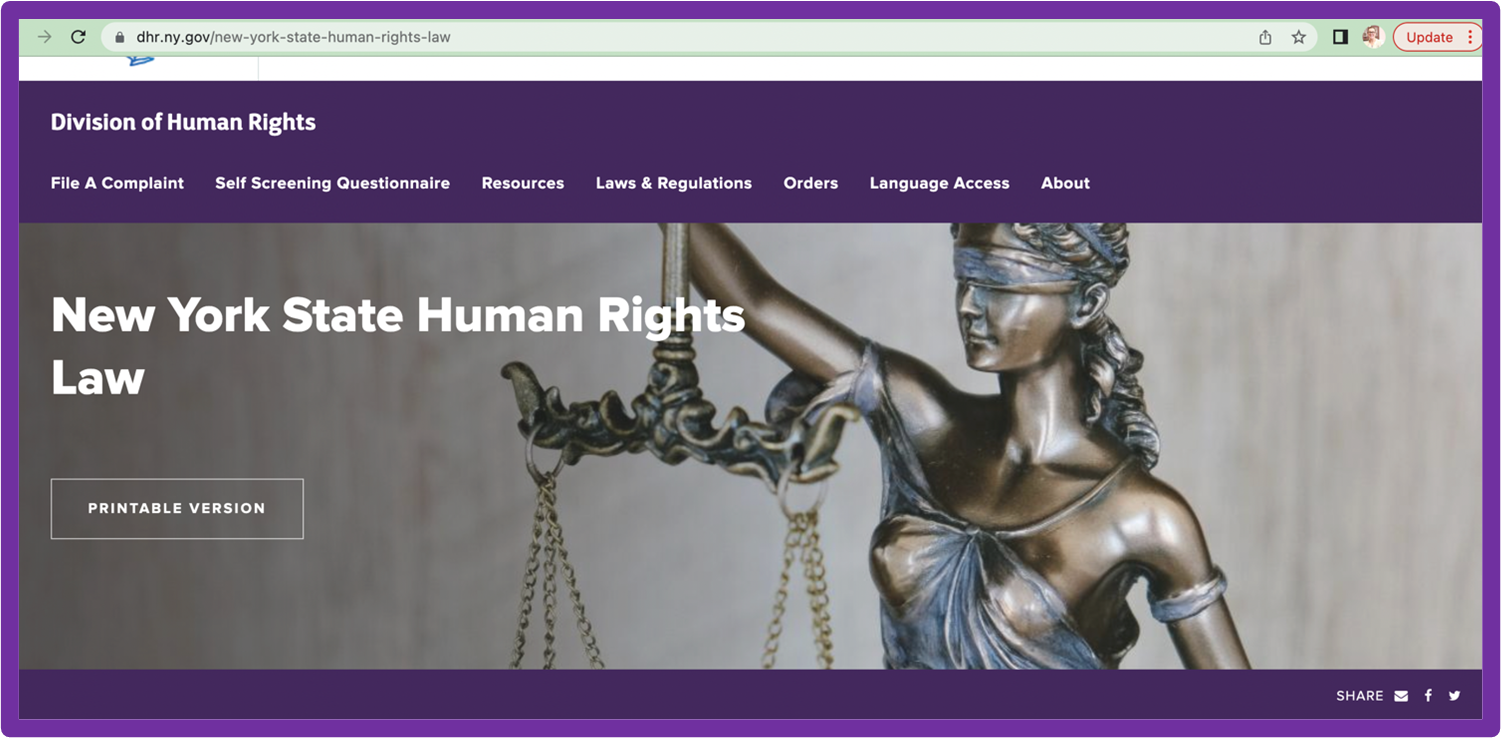
[5] https://dhr.ny.gov/new-york-state-human-rights-law


NYS Human Rights website


Library Employment Contracts

Submission Date

Question

Our Board of Trustees is searching for a new director. Our Library has transitioned from a very small building to a modern, significantly larger building. As a public library, the school district we serve has a population of more than 18,000. Our former director did not have a contract. Some trustees have expressed the desire to make a contract with the candidate selected to serve as the next Library Director. We have received conflicting information about how common such contracts are. We don't want to devote time and energy to drawing up a contract that holds no value in the end. How common and necessary is it to have a Library Director contract for a public library serving a community of our size?

Answer

Regular readers of "Ask the Lawyer" know one of the cardinal rules is: "Do not reinvent the wheel."  So, before working on this reply, we[1] checked the "NY Library Trustees Handbook (2018),"[2] which has a whole section on hiring library directors.

The Handbook does not reference how "common" having a contract for a library director is, but on page 46, it does emphasize the importance of using a "hire letter" or "memorandum" or "contract" to confirm the hiring terms. 

This is wise counsel.  So, before we build on it to answer the member (and we will!), let's (briefly) talk about the difference between hire letters, memorandums,[3] and contracts.

As most readers likely know, New York is an "at will" employment state.  This means that, barring illegal[4] factors, an employer is free to terminate an employee as needed--and similarly, an employee is free to resign.  Most "hire letters" confirm "at-will" employment.[5]

An "employment contract," on the other hand, puts more bells and whistles on the relationship. It can address a range of things, including the parties' ability to terminate the relationship, and can alter (for a particular employee) the application of an employer's policies.[6]

Typical clauses in employment contracts for library directors are:

  • A confirmation of the job description;
  • A probationary period;
  • A routine evaluation method;
  • An assured period of employment (for instance, a 1-year or 5-year contract);
  • Relocation costs;
  • A recital of specific expectations beyond what is in the job description--for instance, if the director is being employed at the beginning of a strategic plan with expansion objectives, and part of the reason for the hire is a requirement to help keep the expansions on track;
  • A benefit structure that differs from other job titles;
  • A base compensation and bonus structure based on clearly articulated and quantifiable performance metrics;
  • A commitment to a certain amount of budgeted funds and time out of the library for professional development;
  • Tuition or professional development reimbursement;
  • A consequence for early resignation;
  • A list of specific reasons the contract can be terminated early by the board "for cause";
  • A list of specific reasons the contract can be terminated early by the director;
  • A buy-out or other provision in the event of early termination by the employer "without cause";
  • A confidentiality clause;
  • A clause regarding support in the event a lawsuit or legal complaint is directed at the employee[7] as a result of the employee performing their duties (similar to what protects a trustee).

Of course, the above-listed items are just examples.

So, how does a library board know when to use a contract?

There are too many factors to list, but here is a tool for assessing if a contract is the right approach to locking in employment terms between a library and director:

Factor

Comment

Yes

No

1. Is your library seeking the stability of a long-term commitment from its director?

Sometimes, even the promise of a year's service can lend stability...and a term can be as long as five years (or more...but five is a nice start).


2. Is the library about to undertake an initiative where the specific candidate’s skills and experience are a necessary asset?

For instance, if the library is overhauling its approach to IT over the next 5 years, and the candidate has specific prior experience with that type of project.


3. Is the search process unusually challenging for your library? (due to geography, etc.)

If every search costs time, money, and (most importantly) impacts services to the community, finding a way to get added stability may be worthwhile not only financially, but for the sake of the library's mission.


4. Are you more likely to retain a desirable director if you offer the protection of a contract?

The possibility of a contract can be an aid to recruitment.  If the job advertisement sets out the potential for greater stability, it might attract a more qualified candidate pool.


5. Will being able to tout having a director under contract help during budget and funding initiatives?

This could be a double-edged sword!  If the contract helps with cost containment, it's a benefit.  If it could be portrayed as excessive or unnecessary, it can backfire.


6. Will the library be channeling extra resources into professional development for the director, and thus want assurance of a return on investment?

This is a consideration where, if done right, the contract creates a win-win (the library director gets the benefit of development, and the library gets stability of an increasingly qualified director).


7. Will it help employee morale to know there is stability in the director role?

This can be another double-edged sword, depending on the relationship between the director and the other employees.


8. Will having the director under contract help with union negotiations? [skip if no union]

This may be a neutral factor, but certainly one to consider if there is an employee union.


9. Does the board want to be able to link compensation to specific objectives in an enforceable way?

A good contract can also serve as a planning tool.


10. [If director already employed by library] Has the director been successfully employed by the library for a while, but the library seeks greater assurance of retaining them?


Converting a successful at-will employee to a contract employee is another way to ensure stability.  If a system of progressive raises or bonuses is used, it can aid retention.


If your library answered "yes" to one or more of the above factors, it might be worth considering using a contract!  This is true even if no other library you know of is doing so (or if they all are).


That said, like all things that create obligations, a contract requires CAUTION.  Here are some factors to consider before a library decides to use a contract:


Factor

Comment

Yes

No

1. Does the board have what it takes to conduct a search that meets the objectives of the contract?

If the candidate pool is not robust, a contract cannot make things better.


2. Does the board have the capacity to pay attention to the compliance factors in the contract?

If the board doesn't follow the contract, it is dangerous to have one!


3. Does your board have the capacity to engage a lawyer to generate a custom contract?

A lawyer will look at the library's unique features, and the objectives of the board, to draft a contract.  The lawyer should also be ready to help the board negotiate.  Ideally, the first draft of the contract should be ready BEFORE the job is posted.


4. Does the library's financial position allow it to make the financial commitments the contract would create?

This should be confirmed by the Treasurer and the auditor before any offer is made.


5. Does Civil Service impact the terms of employment?

If yours is a non-association library, check with your local Civil Service rep to make sure the rules for hiring, discipline, promotion, and compensation are all honored in the contract (the lawyer mentioned in #3, above, can do this for you).


6. Is there anything in the enabling legislation, charter, bylaws, policies, or current Plan of Service that would deter using a contract?

This question is really one for the lawyer drafting the contract, who should review these documents before preparing the draft, but it is worth considering at the starting point of the process.


If the answer to any of the above questions is "no," a board should consider if additional steps need to be taken before deciding to offer a director an employment contract.  Employment contracts are like houseplants; although they largely just sit there, they need attention from time-to-time.

And that's my answer to the member's question; not based so much on what is "common", but definitely based on what might be "necessary" for a particular library.

Thanks for a great question, and good luck with your search.

BONUS CONTENT

If there are three take-aways I hope this answer conveys, they are:

1) a contract for a library director can be a positive and helpful thing for both parties;

2) before offering or requesting a contract, a board or director should know what they want, and why (and if a contract can fulfill that); and

3) never, never, NEVER use a generic contract from the internet...always have a draft contract reviewed by a lawyer[8] before it is offered.

To help emphasize these three take-aways, here are three limericks:

A pro-active library board

Over its strategy pored

"We seek a director

who has it together

Should a contract be offered?"


The board then decided "Why yes,

Our new person must fix quite the mess

So we'll set some terms

That our contract confirms

To address our points of high stress."


The right fit was finally found

A lawyer said the contract was sound

So to the future director,

A contract was sent o'er,

And now they are legally bound!


Did this trio of limericks skip the part of the process where the parties negotiate back and forth, and the contract is (hopefully) signed?  Yes.

But hey... the top 3 take-aways are in bold.  That's what's important. Please let us know if they are helpful.[9]


[1] Who is "we"?  The staff at the law office, and in this case, a call to the director of the council whose member sent in the question.

[2] Found as of June 2, 2022, at https://www.nysl.nysed.gov/libdev/trustees/handbook/index.html.

[3] The term "memorandum" is not a legal term.  If a "memorandum" of hire only confirms that the position is at will, it is at-will.  If the memorandum adds to the rights and/or obligations of the parties, it is a contract.  For this reason, I discourage use of the term "memorandum" to confirm hiring terms.

[4] Like discrimination, retaliation, and contract violation.

[5] These days, they also fulfill state legal requirements to confirm the date of hire, the rate and frequency of compensation, and the identity of the employer. For more on this, see the state's "wage theft" rules explained here: https://dol.ny.gov/system/files/documents/2022/05/p715.pdf.

[6] Most employee handbooks will have language confirming that the board can change the policy at will and nothing in the manual is to be taken as creating a contract; this is to preserve the "at will" arrangement.  Any employment contract should consider how it works with an existing or future employee handbook.

[7] Assurance of such coverage is not needed for most "Directors and Officers" (or "D&O) insurance to cover a director, but considering the extent of D&O coverage is an important annual task for the board.

[8] Who knows about both employment law and libraries.

[9] Feedback can go to info@losapllc.com.

Are scanned electronic signatures legitimate?

Submission Date

Question

I am the Board Secretary.

Is an electronic signature (a real scanned one) OK for approved board meeting minutes that will go up for the public on the web site?

In our case, a paper copy of the minutes that is signed for real will also go into the archives of the library...which leads to the broader question of when such scanned electronic signatures can be used or not?

Many thanks!

Answer

As usual, a regional council member knocks it out of the park with an informed and thoughtful combination of questions.

Here are the answers:

Question 1: "Is an electronic signature (a real scanned one) OK for approved board meeting minutes that will go up for the public on the web site?"

Answer:  YES...unless a library's bylaws or policies state otherwise.

Why is that?

Electronic signatures are permissible in New York State per the "NYS Electronic Signatures and Records Act" ("ESRA").

Because of ESRA, in NY, "the use of an electronic signature shall have the same validity and effect as the use of a signature affixed by hand." [1]

So... what is an "electronic signature?" ESRA defines it as "an electronic sound, symbol or process, attached to or logically associated with an electronic record and executed or adopted by a person with the intent to sign the record".[2] Of particular importance is the phrase "executed and adopted by a person with the intent to sign the record."

Case law has found that "it is up to the signor to make some representation of that intent".[3]  What can show this "intent?"  Among other things, having a routine practice of using a scanned signature (as the question puts it, "a real one"), and a routine of using that to formally to attest to a finalized copy of the minutes.

All that said, I have to unpack this question a bit, because after describing the routine practice of using a scanned signature with intent to signify an actual signature, the member then goes on to add: "...a paper copy of the minutes that is signed for real will also go into the archives of the library." [emphasis added]

I don't see any true bar to having two versions of a signed copy of the minutes, but at best, this practice it is a waste of time and energy, since by law, the use of the electronic signature has already created a document that is sufficient.  Basically...there is no need to create one with a "real" (or as case law puts it, "wet") signature, because the document has already been signed.

Which brings us to...

Question 2: In our case, a paper copy of the minutes that is signed for real will also go into the archives of the library...which leads to the broader question of when such scanned electronic signatures can be used or not?

Because of what I just said at the end of the answer to Question 1, I would advise against creating and archiving a copy that is different from the posted version.  While the scenario that is described--not altering the substantive content of the minutes at all, but authenticating them with a different form of a valid signature--does not pose any immediate issues, if and when those minutes would ever be needed to be used in litigation, it could at the very least pose a complication, since effectively two different authenticated versions have been created.

This aspect of the member’s question is so important, and I think it is worth taking a look at the actual law regarding minutes, as set out in section 106 of the Open Meetings Law:

§ 106. Minutes

1. Minutes shall be taken at all open meetings of a public body which shall consist of a record or summary of all motions, proposals, resolutions and any other matter formally voted upon and the vote thereon.

2. Minutes shall be taken at executive sessions of any action that is taken by formal vote which shall consist of a record or summary of the final determination of such action, and the date and vote thereon; provided, however, that such summary need not include any matter which is not required to be made public by the freedom of information law as added by article six of this chapter.

3. Minutes of meetings of all public bodies shall be available to the public in accordance with the provisions of the freedom of information law within two weeks from the date of such meeting except that minutes taken pursuant to subdivision two of this section shall be available to the public within one week from the date of the executive session. If the agency in which a public body functions maintains a regularly and routinely updated website and utilizes a high speed internet connection, such minutes shall be posted on the website within two weeks from the date of such meeting except that minutes taken pursuant to subdivision two of this section shall be available to the public within one week from the date of the executive session. For purposes of this subdivision unabridged video recordings or unabridged audio recordings or unabridged written transcripts may be deemed to be meeting minutes. Nothing in this section shall require the creation of minutes if the public body would not otherwise take them.

The use of an electronic signature greatly facilitates the ability to abide by the requirement of subsection 3, which requires the posting of minutes (or for minutes not yet approved, "draft" minutes).

So, in summary: there is no need to create two versions of the minutes if the first version was properly e-signed, and in fact, while not illegal, creating two verified versions risks confusion just at the moment when minutes are most critical: FOIL request, litigation, or other intense scrutiny of the public record.[4]

The recent revisions and temporary modification of the Open Meetings Law (which all chartered libraries must follow, with a few modifications[5]), and the ongoing application of the Freedom of Information Law to certain public library records, are inspiring many nuanced questions like these.  The Education Law and the NY Not-for-Profit Corporation Law,[6] which define the powers of library trustees, also impact this issue...but as you see, sub-section 304(2) of the State Technology Law is the star player[7] today.

Thank you for a thoughtful set of questions! 


Image of a sword(my new e-signature symbol)


[1] State Technology Law § 304(2).

[2] State Technology Law § 302(3).   And yes, you read that right.  If you want to adopt a signature sound, like a bell chime, or a special symbol (a book emoji?) to signify a Secretary's affirmation of the minutes, have at it!

[3] See CitiBank v. N.A. Navarez, 73 Misc. 3d 709 *; 155 N.Y.S.3d 686 **; 2021 N.Y. Misc. LEXIS 5138 ***; 2021 NY Slip Op 21271 ****; 2021 WL 4736807

[4] Just to highlight an important distinction: There will be times when a board Secretary needs to create "certified" copies of board resolutions or other documents.  The rules for signature on such documents may vary, especially if they need to be notarized.  So don't throw away all your pens just yet!

[5] See NY Education Law 260-a, and "Ask the Lawyer" ‘Posting recorded meetings under Open Meetings Law’, and ‘Trustee Addresses for Open Meetings’.

[6] Both of which I searched to ensure there was no overlay regarding minutes taken by public and association libraries. 

[7] The "Electronic Signatures in Global and National Commerce Act" ("E-Sign Act") also provides a general rule of validity for electronic records and signatures for transactions in or affecting interstate or foreign commerce, but case law in NY cites to the State Technology Law.

Open Meetings Law 2022 Library Board Chart and Checklist

Submission Date

Question

"Ask the Lawyer" got two questions about the April 9, 2022 changes to the Open Meetings Law ("OML"), which will enable library boards to more easily meet via videoconferencing.  The questions asked for sample resolution language to enable a board to meet via videoconference, and compliance checklists to make sure a board is getting all the new details right.

Answer

To answer these questions, we've created an "Open Meetings Law 2022 Library Board Chart and Checklist" that sets out:

  • The Education Law and OML's basic public access requirements for library trustee meetings;
  • The OML's recent changes regarding meeting materials;
  • The OML's new option for videoconferencing; and
  • Old and new requirements for trustee meeting notices.

Below that are the requested sample resolutions and policies.[1]

Open Meetings Law 2022 Library Board Chart and Checklist

What to do (requirements, tips, and hacks)

Why the board is doing it

How to do it

Did you do it?

Requirement: Your board must meet "at least quarterly."

Because Section 260(5) of New York’s Education Law requires it.


Your board must "fix" the "day and hour" of the meeting; if the meeting is known at least 2 weeks in advance, the notice must go out at least one week in advance.


Requirement: Your library's meetings must be "open to the public."


Because Section 260-a of New York’s Education Law requires it.

Follow the requirements of Article 7 of the NY Public Officers Law, aka, the "OML" (more on that in the rows below).


Requirement:  Your library must notify the public and the news media at least one week in advance of the time and place (including virtual place) of a meeting scheduled at least two weeks in advance.


This timing for notice is a bit different from the timing in the OML; that is because Section 260-a of New York's Education Law modifies the notice requirements for meetings (to be a bit kinder to libraries).

The law doesn't require a specific medium, but the notice should be in writing.  The new requirements include posting the means to attend via videoconference (for more on that, and for a sample notice, see below).


Requirement/Hack: If your library is in a city of "one million or more," your committee meetings should also be open and noticed.

Because Section 260-a of New York’s Education Law specifies that library trustee committee meetings be open in cities with that population.

If your board serves a library serving a city with a population of one million or more (in other words, if you are in NYC), treat your committee meetings like board meetings.


Hack: Your board can create an "Executive Committee" to transact business between meetings.

Because Education Law 226(2) allows your library to do this.

Amend the bylaws to create an Executive Committee "...of not less than five, who, in intervals between meetings of the trustees, may transact such business of the corporation as the trustees may authorize, except to...make removals from office."


Requirements: Make available any "proposed resolution, law, rule, regulation, policy or any amendment thereto", that is scheduled to be the subject of discussion by the board at the meeting, at least 24-hours prior to the meeting.

Because Section 103-e of the “Open Meetings Law" requires your library to do this.

Have the board packet available either in hard copy or upon request. 


NOTE: If your library regularly uses its website, the law also requires that the materials be posted on the website.


Hack: Adopt rules about the location of equipment and personnel used to photograph, broadcast, webcast, or otherwise record an open meeting.

OML 103(2) allows a library (or a public body that follows the OML) to do this so such broadcast is not disruptive (or a tripping hazard).

If your library adopts such a policy, the law requires that the rules "be conspicuously posted during meetings and written copies shall be provided upon request to those in attendance."


A sample policy is below.  (Before adopting such a policy, consider your library's unique space and needs.)


Option: enable trustees to attend via videoconference, while the meeting has only one physical location.

Your board will do this if they want trustees to be able to attend even if caregiving, disability, health, or other compelling reasons prohibit attending in person.

Per the legislation signed by the Governor on April 9, 2022, the way to exercise this option is to:


1.  Adopt procedures consistent with the new law;


2.  Pass a resolution to authorize meeting via videoconference.


A generic bit of advice: before voting on a resolution to authorize meeting via videoconference, the board of trustees should consider whether the additional technical and notice requirements are both desirable and feasible.

For example: the new law requires that any meeting held via videoconference under this new provision must be archived on the library's website for five years. Does your library have that capacity?

For another example: the new law requires that any meeting held via videoconference and archived in this manner must be "transcribed upon request." Does your library have the capacity to transcribe sometimes lengthy meetings upon request?

And as a final example: the new law requires that if the agenda includes a public comment period, those attending via videoconference must be able to comment and participate just as those physically attending. Does your library have the technical capacity to enable that?

None of these examples is a deterrent to videoconferencing, so long as the library has the budget and technical capability to honor the requirements. Since this could have an impact on budget, assessing that capability is critical before deciding to meet this way.

TEMPLATE resolution

(Regarding rules about the location of equipment and personnel used to photograph, broadcast, webcast, or otherwise record a board meeting)

WHEREAS the board of the ABC library recognizes the requirement of the NY State Open Meetings Law to allow the public to photograph, broadcast, and webcast its open public meetings; and

WHEREAS, Section 103(2) of the Open Meetings Law allows public bodies to adopt rules about the location of equipment and personnel used to photograph broadcast webcast or otherwise record a public meeting;

BE IT RESOLVED that the board of trustees of the ABC library adopts the attached rules per Section 103(2) of the Open Meetings Law; and

BE IT FURTHER RESOLVED that as required by law, such rules shall be posted at the location of each meeting and included in the agenda posted at least 24 hours in advance of the meeting so the public attending can have notice of and abide by such rules.

[SAMPLE RULES]

Consistent with the requirements of the Open Meetings Law, attendees at open public meetings of the board of trustees are allowed to photograph, broadcast, webcast and otherwise record those portions of the meeting not in executive session.

To ensure such authorized activity does not disrupt the smooth and safe operation of a trustee meeting, and consistent with Section 103-a of the Open Meetings Law, the following "Rules" shall be posted at the location of each meeting and included on the posted agenda:

  • No extension cords or other potential tripping hazards may be set up;
  • No flash photography or additional lighting may be used;
  • No recording instrument shall be closer than 3 feet of a meeting participant, without that person's express consent;
  • All equipment should be silent enough to not cause a disruption;
  • Equipment must not block aisles or exit and may not impede the view of other attendees;
  • [INSERT]

The privilege to record in this manner at the library is limited to open meetings of the board.

When enforcing this rule with regards to the manner of recording, the ABC library board of trustees shall ensure that the First Amendment of the United States Constitution, and Article I, Section 8 of the New York constitution are honored.

Sample resolution to authorize videoconferencing and adopt policies

WHEREAS on April 9th, 2022, the governor of the state of New York signed into effect chapter 59 of the laws of 2022, in part amending the Open Meetings Law to enable public bodies to meet, under certain circumstances, via videoconference; and

WHEREAS, the board of the ABC Library has duly considered the benefit of this law to its routine operations, and determined that meeting via videoconferencing per the Open Meetings Law with further the operations and mission of the library;

BE IT RESOLVED that consistent with its bylaws and Charter, the board of trustees hereby authorizes the use of videoconferencing for its meetings; and

BE IT FURTHER RESOLVED that the board of trustees hereby adopts the attached written procedure governing member and public attendance at trustee meetings, and confirms each element of that written procedure in this resolution; and

BE IT FURTHER RESOLVED that members of the board of trustees are required to be physically present at any duly noticed meeting unless such member is unable to be physically present due to extraordinary circumstances (including disability, illness, caregiving responsibilities, or any other significant or unexpected factor or event which precludes the member's physical attendance at such meeting); and

BE IT FURTHER RESOLVED that except in the case of executive sessions conducted pursuant to section one hundred five of the Open Meetings Law, and consistent with the requirements of the Not-for-Profit Corporation  law, the trustees shall ensure that members of the public body can be heard, seen and identified, while the  meeting is being conducted, including  but not limited to any motions, proposals, resolutions, and any other matter formally discussed or voted upon; and

BE IT FURTHER RESOLVED that the minutes of the meetings involving videoconferencing shall include which, if any, members participated remotely and shall be available to the public pursuant to section one hundred six of the Open Meetings Law; and

BE IT FURTHER RESOLVED that if videoconferencing is used to conduct a meeting, the public notice for the meeting shall inform the public that videoconferencing will be used, where the public can view and/or participate in such meeting, where required documents and records will be posted or available, and identify the physical location for the meeting where the public can attend; and

BE IT FURTHER RESOLVED that the board of trustees shall provide that each meeting conducted using videoconferencing shall be recorded and such recordings posted or linked

on the library's website within five business days following the meeting, and shall remain so available for a minimum of five years thereafter, and such recordings shall be transcribed upon request; and

BE IT FURTHER RESOLVED if videoconferencing is used to conduct a meeting, the library shall provide the opportunity for members of the public to view such meeting via video, and to participate in proceedings via videoconference in real time where public comment or participation is authorized and shall ensure that videoconferencing authorizes the same public participation or testimony as in person participation or testimony; and

BE IT FURTHER RESOLVED that for so long as the board of trustees elects to utilize videoconferencing to conduct its meetings, the library will maintain an official website; and

BE IT FURTHER RESOLVED that, consistent with the library’s mission to serve its community, the trustees' use of videoconferencing shall utilize technology to permit access by members of the public with disabilities consistent with the 1990 Americans with Disabilities Act (ADA).

Adopted this ___ day of _____, 2022.

Yay:

Nay:

Abstain:


TEMPLATE written procedure

governing member and public attendance at trustee meetings

1.         Members of the board of trustees are required to be physically present at any duly noticed meeting unless such member is unable to be physically present due to extraordinary circumstances (including disability, illness, caregiving responsibilities, or any other significant or unexpected factor or event which precludes the member's physical attendance at such meeting).

2.         Except in the case of executive sessions conducted pursuant to section one hundred five of the Open Meetings Law, and consistent with the requirements of the Not-for-Profit Corporation law, the trustees shall ensure that members of the public body can be heard, seen and identified, while the meeting is being conducted, including but not limited to any motions, proposals, resolutions, and any other matter formally discussed or voted upon.

3.         Minutes of the board meetings involving videoconferencing shall include which, if any, members participated remotely and shall be available to the public pursuant to section one hundred six of the Open Meetings Law.

4.         If videoconferencing is used to conduct a board of trustees meeting, the public notice for the meeting shall inform the public that videoconferencing will be used, where the public can view and/or participate in such meeting, where required documents and records will be posted or available, and identify the physical location for the meeting where the public can attend.

5.         The board of trustees shall provide that each meeting conducted using videoconferencing shall be recorded and such recordings posted or linked on the library's website within five business days following the meeting, and shall remain so available for a minimum of five years thereafter, and such recordings shall be transcribed upon request.

6.         If videoconferencing is used to conduct a meeting, the library shall provide the opportunity for members of the public to view such meeting via video, and to participate in proceedings via videoconference in real time where public comment or participation is authorized and shall ensure that videoconferencing authorizes the same public participation or testimony as in person participation or testimony.

7.         For so long as the board of trustees elects to utilize videoconferencing to conduct its meetings, the library will maintain an official website, which is INSERT ADDRESS.

8.         Consistent with the Library's mission to serve its community, the trustees' use of videoconferencing shall utilize technology to permit access by members of the public with disabilities consistent with the 1990 Americans with Disabilities Act (ADA).


SAMPLE notice of meeting to use videoconferencing

The board of trustees of the ABC Library will hold a meeting at

DAY

HOUR

at

[AT LEAST ONE] PHYSICAL LOCATION

Per the policy of the board, videoconferencing will be used to enable attendance of trustees and public access to the open meeting.

The public can view and/or participate in the meeting by [INSERT].

[If public comment or participation is authorized and noted on the agenda] Those attending via videoconference may engage in the same public participation or testimony as in person participation or testimony by INSERT.

Document and records to be reviewed at that meeting will be posted at INSERT and available by request at INSERT.

The meeting shall be recorded, and the recording shall be posted [or linked] on the library's website (INSERT ADDRESS) within five business days following the meeting, and shall remain so available for a minimum of five years thereafter.   The recording shall be transcribed upon request.

Consistent with the Library's mission to serve its community, the trustees' use of videoconferencing shall utilize technology to permit access by members of the public with disabilities consistent with the 1990 Americans with Disabilities Act (ADA).   Questions regarding accommodations can be directed to INSERT and INSERT.[2]

[Insert rules of broadcasting meeting if applicable]


[1] As with all things template, whenever possible, review this guidance with your library's attorney.

[2] To enhance accessibility, accommodation requests should be able to be made through at least two different mediums; for example, a number to call and via e-mail.

Posting working documents for open meetings

Submission Date

Question

I just read your excellent answer about posting documents per the OML changes in advance of meetings.

I think you are right on target.

My concern is to ask you to add to your questions for the COOG the following: Do working documents being shaped and edited at committee meetings need to be posted in advance of the committee meeting?

The Committee meeting is an open meeting. Let's say the policy committee is going to discuss a draft revision to a policy. Must we really post the draft revision prior to the meeting? The way our board works, the draft is likely revised several times over three or four policy committee meetings before it becomes part of a board packet for a full board meeting. My "gut" tells me that complying at that level would be overkill. A similar situation would be draft versions of a budget.

I think the public has an opportunity to see the documents in question before they are finalized at a full board meeting, so my instinct is that working documents would not need to be posted in advance. But that's not what a strict reading of the law itself and your posting tells me.

So, I am torn and would love clarification.

Lastly, I just want to compliment you on this service that you are providing. it is really great.


Answer

Thank you very much for your kind words!  And for submitting this question.

For "Ask the Lawyer" readers who don't follow the State's "Open Meetings Law" (the “OML”) with regularity, the new rules that the member is referring to are the revised Section 103(e) of the OML.  The "Ask the Lawyer" that the member refers to is "Availability of Open Meeting Documents".

In that RAQ, we discussed the extent of a library board’s new obligation to ensure that certain materials used during open portions of trustee meetings be made available at least 24 hours in advance...and how, if a library routinely uses its website, those advance copies should be posted on it.

Given the new requirements, Tim's question is a practical one: "Do working documents being shaped and edited at committee meetings need to be posted in advance of the committee meeting?"  In other words, if the document is in flux, and subject to change even during the meeting, must a copy be provided in advance?

In considering the answer, I of course checked the law and the latest commentary from New York's "Committee on Open Government" (the "COOG"), which is the arbiter of all things OML. However, since Tim mentioned checking in with his gut, I also checked in with mine.

To do that, I pictured myself as the attendee at a meeting of my city's[1] common council. I envisioned them discussing a policy on the agenda: the formation of a police advisory committee.[2] I then pictured myself checking the meeting packet that was put on the City's web site 24 hours prior to the public meeting, to see if a copy of the policy is in the packet.

Here are five scenarios of what happens:

Scenario 1: I check the packet: there it is! As the committee members discuss the proposed policy, I am able to meaningfully link their commentary to the written document.

Scenario 2: I check the packet: there it is! But then, the Chair of the meeting says "Before we begin, I would like to add that this morning I received a proposed new version of the policy for us to consider.  The new version adds a paragraph to the version that is in your packet.  That version was emailed to council members this morning." As the committee members begin to discuss the proposed policy, and the new paragraph, I am able to meaningfully link their commentary to the written document--except for the new paragraph.

Scenario 3: I check the packet: there it is! But then, the Chair of the meeting says "Before we begin, I would like to add that this morning I received a proposed new version of the policy for us to consider.  The new version adds a paragraph to the version that is in your packet.  That version was emailed to council members this morning, and I am going to ask the clerk to place a version in the video feed [in a way public attendees can see] as a courtesy." As the committee members begin to discuss the proposed policy, and the new paragraph, I am able to meaningfully link their commentary to the written document--even the new paragraph.

Scenario 4: I check the packet: there it is!  Twice?  Hmmm.  As the agenda item is called, the Chair of the meeting says "Before we begin, I would like to clarify that we have two versions in the meeting packet because two versions have been submitted for review and consideration at this meeting." As the committee members begin to discuss the proposed policy, and the two versions, I am able to meaningfully hear their commentary on the precise wording as they discuss intent, concerns, and possible revisions, although I have to toggle between versions to keep up.

Scenario 5: I check the packet: it's NOT there!  When the committee reaches that agenda item, the Chair of the meeting says "Because this policy is under review in various offices, who may submit changes before our next meeting, and there are a few versions under discussion, we haven't posted any version yet." As the committee members begin to discuss the proposed policy, and the different wording, I am unable to meaningfully connect their commentary to the writing they have based it on.

Checking in with my gut: in either "Scenario 2" or "Scenario 5," I might be irritated to the point where my gut might review the law to see--has the council followed the law?

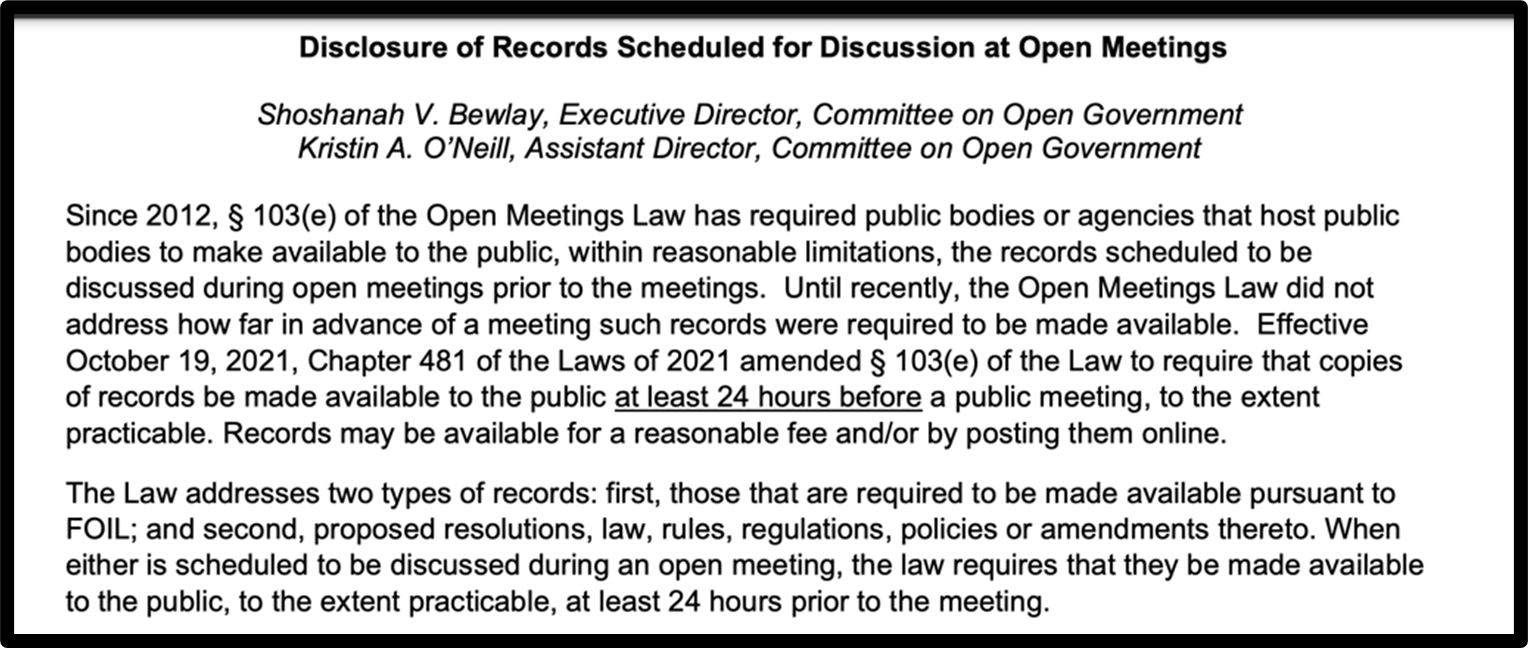
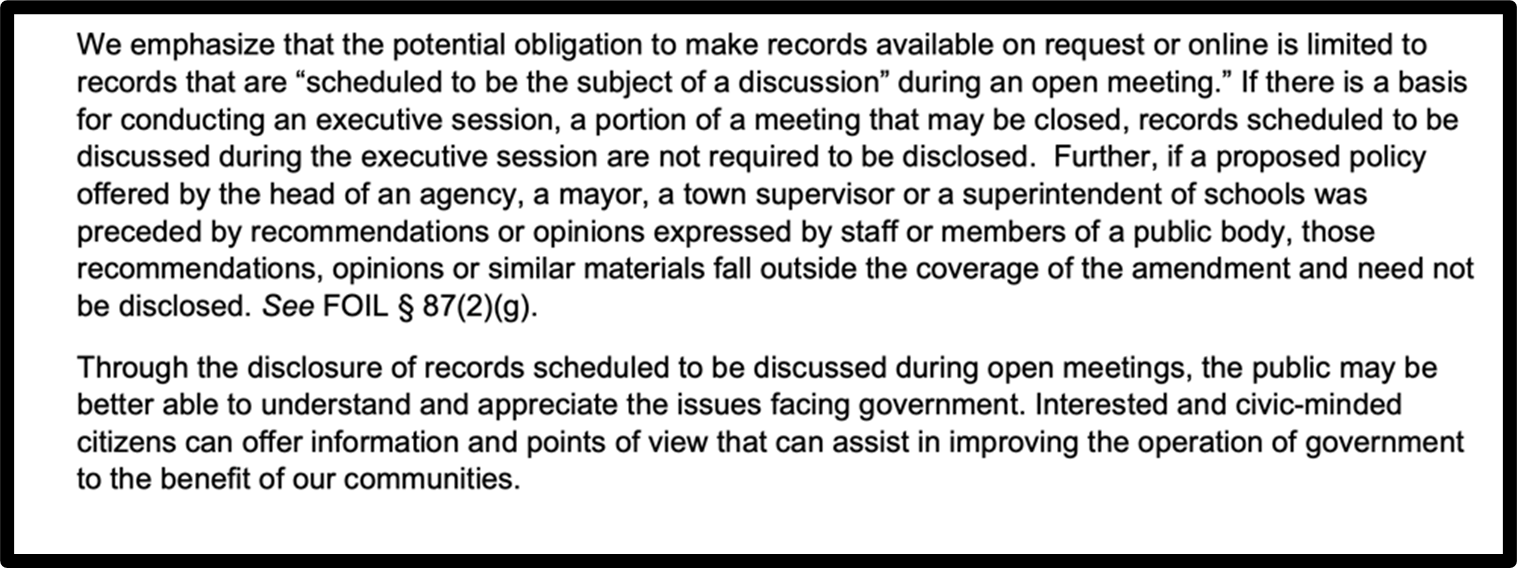
And when my gut checks with the law, I see this commentary from the COOG[3]:

Screenshot of Open Meetings Law discussionContinued screenshot of Open Meetings Law discussion

So with that, I answer the question ""Do working documents being shaped and edited at committee meetings need to be posted in advance of the committee meeting?" as follows:

Even if a policy is in draft form, or if multiple versions are under review, if it is on the agenda of a public meeting for discussion, the version or versions under review should be included in the meeting packet, to allow for meaningful public access to the materials.[4]

That said, recommendations, opinions, or similar materials regarding such policies under development do not have to be shared, and revisions not ready in time for posting (even if discussed at the meeting) do not have to be made available/posted in advance.

Thank you for a subtle and thoughtful question!


[1] The beautiful, if somewhat bedraggled by an industrial past, Buffalo NY.

[2] This was not a huge stretch, as that topic actually is under consideration by Buffalo as of April 2022.

[3] Full text available at https://opengovernment.ny.gov/system/files/documents/2021/11/disclosure-of-records-scheduled-for-discussion-at-open-meetings-112221.pdf as of April 6, 2022.

[4] Although the law does not require it, when doing so, I strongly advise that the version include a header or some type of other indicia showing that it is a draft copy for review only, and the version date (of course, archivists and clerks?).

Posting recorded meetings under Open Meetings Law

Submission Date

Question

With recent updates to the OML in New York state, there is now a requirement both to stream and to make recordings of sessions available via website as described in 103(f).[1] However, the last two sentences of 103(f) seem to limit this requirement only to certain public bodies.

We are trying to understand whether or not this applies to a municipal library board's meetings or not. Certainly we do not have any members appointed by the board, and even if you go up to being chartered by the Board of Regents, Regents are elected by the legislature, so hard to see any applicability there.

Do you see any requirement in the open meetings law for library boards to have video recordings of their meetings posted publicly via the internet? Text of 103(f) below, or online here: https://opengovernment.ny.gov/system/files/documents/2022/02/oml-text-02282022.pdf
 

(f) Open meetings of an agency or authority shall be, to the extent practicable and within available funds, broadcast to the public and maintained as records of the agency or authority. If the agency or authority maintains a website and utilizes a high speed internet connection, such open meeting shall be, to the extent practicable and within available funds, streamed on such website in real-time, and posted on such website within and for a reasonable time
after the meeting. For the purposes of this subdivision, the term “agency” shall mean only a state department, board, bureau, division, council or office and any public corporation the majority of whose members are appointed by the governor. For purposes of this subdivision, the term “authority” shall mean a public authority or public benefit corporation created by or existing under any state law, at least one of whose members is appointed by the governor
(including any subsidiaries of such public authority or public benefit corporation), other than an interstate or international authority or public benefit corporation. [emphasis added]


[1] Editor footnote:  the question slightly mis-states the Open Meeting Law's most recent requirements; we'll address this in the answer.

Answer

Before we dive into the answer, I have to say two things.

First, just a reminder: the reason any chartered library--even an association library--has to follow the State's "Open Meetings Law" and allow public access to trustee meetings, is because Section 260-a of the Education Law requires it.[1]

Second: the timing of this question made it a real pain in the [law].   Here's why:

My first draft answer was written on March 29, 2022.

While the draft was in review, I realized there was a change to the law that I had not factored in.[2]  So I pulled back the draft to revise.

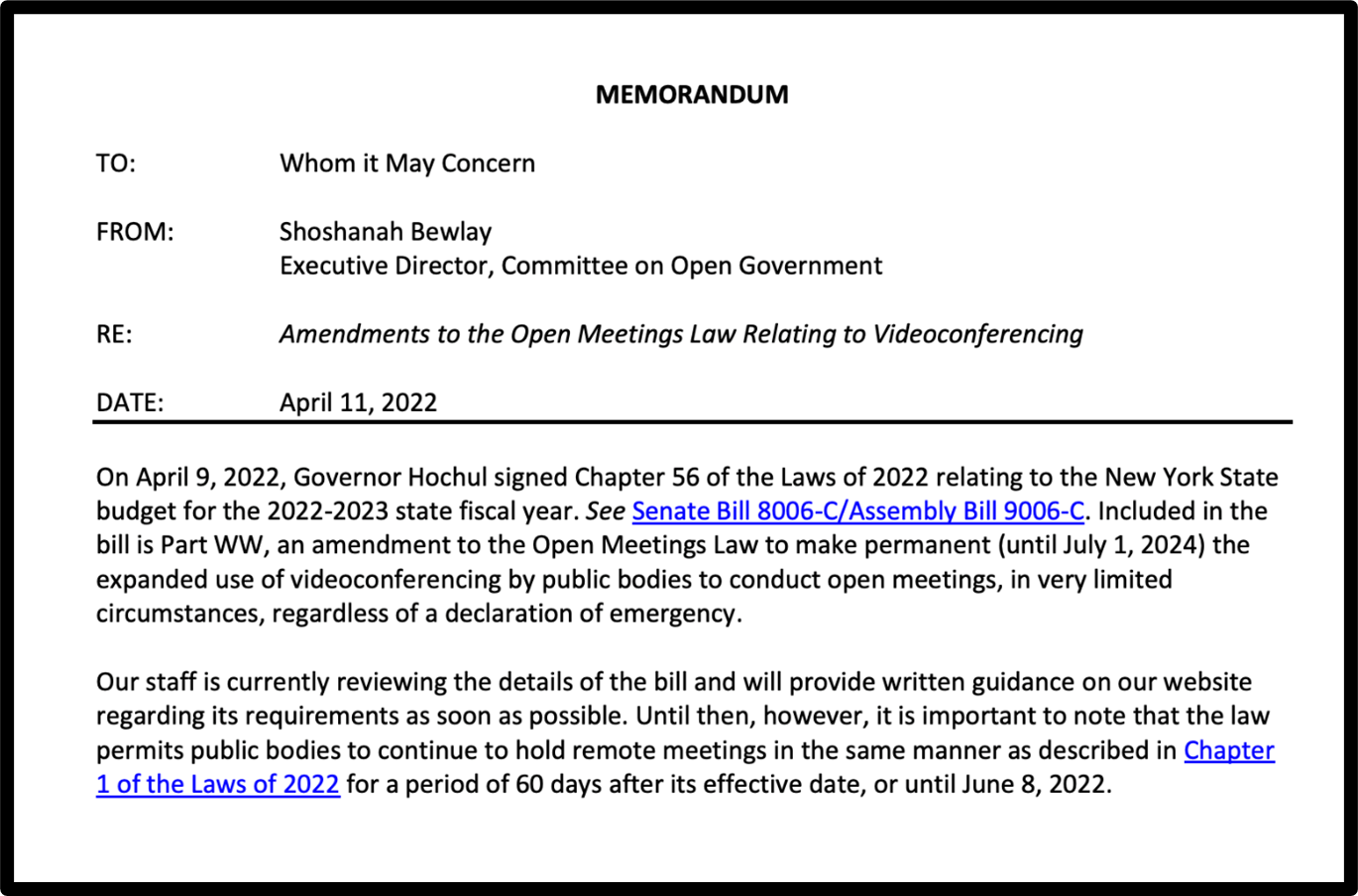
While I was revising, the law was changed again![3]

Amendments to Open Meetings Law for Videoconferencing screenshot

This required yet another re-write.

So now, as of April 13, 2022--at the risk of Governor Hochul punking me with yet another change to the law--here is the short answer to this question:

103-e does NOT require a library board to record and post their meetings; that is limited to authorities and agencies with at least one member appointed by the governor.[4]

However, under OML 103(c), and per a current temporary add-on to the law,[5] trustee meetings must continue to be broadcast/recorded/transcribed, UNLESS the meeting is ONLY taking place in person, AND the community can physically access each site of the meeting.[6]

That said, a library board is certainly welcome to broadcast and archive its in-person meetings, and (critically) a board cannot bar attendees from streaming or otherwise broadcasting in-person (or streamed) board meetings, either.  Further, if capacity or public health concerns mean setting up to allow remote attendance ensures access to the meeting, there is strong incentive to use the (right now) temporary ability to meet via broadcast/record/transcribe.

So, what does this latest (April 9, 2022) change mean?

Right now,[7] if a board meeting is not being broadcast/recorded/transcribed, any remote location from which a board member is attending the meeting is a de facto additional site of the meeting...so the location must be disclosed in the notice for the meeting and the public must be able to attend the meeting at that remote site.

But it looks like this latest change (April 9, 2022) will somewhat change that. So expect (much) more commentary on this...both from me, and others.[8]

Now, for those of you scratching your heads and saying "Wait a minute, you mentioned all these changes in 2022, I KNOW they changed the law back in November 2021!"  --You're right, they did.  That change amended the OML to require that documents to be viewed by the trustees at the meeting be made available (and if possible, posted on the library's web page) at least 24 hours before that meeting.[9]

Thank you to the member for a thoughtful question.  As to the legislature and the Governor[10]....we see where all of this is going (a more accessible and greener OML), but a little dinner and dancing might be nice before you change the law again!

Most recent OML changes (as of April 13, 2022).

Section 1.  Subdivision (c) of section 103 of the public officers law,

    20  as  added  by  chapter  289  of  the laws of 2000, is amended to read as

    21  follows:

    22    (c) A public body [that uses videoconferencing to  conduct  its  meet-

    23  ings]  shall provide an opportunity for the public to attend, listen and

    24  observe [at any sitemeetings in at  least  one  physical  location  at

    25  which a member participates.

    26    §  2. The public officers law is amended by adding a new section 103-a

    27  to read as follows:

    28    § 103-a. Videoconferencing by public bodies.  1.  For the purposes  of

    29  this  section,  "local  public  body" shall mean a public corporation as

    30  defined in section sixty-six of the general construction  law,  a  poli-

    31  tical  subdivision  as  defined  in  section  one hundred of the general

    32  municipal law or a committee or subcommittee or other  similar  body  of

    33  such  entity,  or  any entity for which a quorum is required in order to

    34  conduct public business and which  consists  of  two  or  more  members,

    35  performing  a  governmental  function  for  an  entity  limited  in  the

    36  execution of its official functions to a portion only of the state, or a

    37  political subdivision of the state, or for an agency or department ther-

    38  eof.   For the purposes of this section,  a  public  body  shall  be  as

    39  defined in subdivision two of section one hundred two of this article.

    40    2.  A  public  body  may,  in its discretion, use videoconferencing to

    41  conduct its meetings  pursuant  to  the  requirements  of  this  article

    42  provided  that  a  minimum  number of members are present to fulfill the

    43  public body's quorum  requirement  in  the  same  physical  location  or

    44  locations  where  the  public  can attend and the following criteria are

    45  met:

    46    (a) the governing board of a county, city, town or village has adopted

    47  a local law, or a public body has adopted a resolution,  or  the  senate

    48  and  assembly  have adopted a joint resolution, following a public hear-

    49  ing, authorizing the use of videoconferencing:

    50    (i) for itself and its committees or subcommittees; or,

    51    (ii) specifying that each committee or subcommittee may make  its  own

    52  determination;

    53    (iii)  provided  however,  each community board in a city with a popu-

    54  lation of one million or more shall make its own determination;

        S. 8006--C                         248                        A. 9006--C


     1    (b) the public  body  has  established  written  procedures  governing

     2  member  and  public  attendance  consistent  with this section, and such

     3  written procedures shall be conspicuously posted on the  public  website

     4  of the public body;

     5    (c) members of the public body shall be physically present at any such

     6  meeting  unless  such  member  is unable to be physically present at any

     7  such meeting location due to extraordinary circumstances, as  set  forth

     8  in  the resolution and written procedures adopted pursuant to paragraphs

     9  (a) and (b) of this subdivision, including disability, illness, caregiv-

    10  ing responsibilities, or any other significant or unexpected  factor  or

    11  event which precludes the member's physical attendance at such meeting;

    12    (d)  except  in  the  case of executive sessions conducted pursuant to

    13  section one hundred five of this article, the public body  shall  ensure

    14  that members of the public body can be heard, seen and identified, while

    15  the  meeting  is  being  conducted,  including  but  not  limited to any

    16  motions, proposals, resolutions, and any other matter formally discussed

    17  or voted upon;

    18    (e) the minutes of  the  meetings  involving  videoconferencing  shall

    19  include which, if any, members participated remotely and shall be avail-

    20  able to the public pursuant to section one hundred six of this article;

    21    (f) if  videoconferencing  is  used  to  conduct a meeting, the public

    22  notice for the meeting shall inform the  public  that  videoconferencing

    23  will be used, where the public can view and/or participate in such meet-

    24  ing,  where  required documents and records will be posted or available,

    25  and identify the physical location for the meeting where the public  can

    26  attend;

    27    (g)  the  public  body shall provide that each meeting conducted using

    28  videoconferencing shall be recorded and such recordings posted or linked

    29  on the public website of the  public  body  within  five  business  days

    30  following  the  meeting,  and shall remain so available for a minimum of

    31  five  years  thereafter.  Such  recordings  shall  be  transcribed  upon

    32  request;

    33    (h) if videoconferencing is used to conduct a meeting, the public body

    34  shall  provide  the  opportunity  for members of the public to view such

    35  meeting via video, and to participate in proceedings via videoconference

    36  in real time where public comment or  participation  is  authorized  and

    37  shall  ensure  that videoconferencing authorizes the same public partic-

    38  ipation or testimony as in person participation or testimony; and

    39    (i) a local public  body  electing  to  utilize  videoconferencing  to

    40  conduct its meetings must maintain an official website.

    41    3. The in person participation requirements of paragraph (c) of subdi-

    42  vision two of this section shall not apply during a state disaster emer-

    43  gency  declared  by the governor pursuant to section twenty-eight of the

    44  executive law, or a local state of emergency  proclaimed  by  the  chief

    45  executive  of  a county, city, village or town pursuant to section twen-

    46  ty-four of the executive law, if the public  body  determines  that  the

    47  circumstances  necessitating  the  emergency declaration would affect or

    48  impair the ability of the public body to hold an in person meeting.

    49    4. No later than January first, two thousand twenty-four, the  commit-

    50  tee  on  open government, created by paragraph (a) of subdivision one of

    51  section eighty-nine of this chapter, shall issue a report to the  gover-

    52  nor, the temporary president of the senate, the speaker of the assembly,

    53  the  chair  of  the  senate  standing committee on local government, the

    54  chair of the senate standing committee on investigations and  government

    55  operations,  the  chair  of  the  assembly  standing  committee on local

    56  governments, and the chair of the assembly standing committee on govern-

        S. 8006--C                         249                        A. 9006--C


     1  mental operations concerning the application and implementation of  such

     2  law and any further recommendations governing the use of videoconferenc-

     3  ing by public bodies to conduct meetings pursuant to this section.

     4    5.  Open  meetings  of  any public body that are broadcast or that use

     5  videoconferencing shall utilize technology to permit access  by  members

     6  of  the public with disabilities consistent with the 1990 Americans with

     7  Disabilities Act (ADA), as amended, and  corresponding  guidelines.  For

     8  the  purposes  of  this  section,  "disability"  shall  have the meaning

     9  defined in section two hundred ninety-two of the executive law.

    10    § 3. Notwithstanding the provisions of article 7 of the  public  offi-

    11  cers  law  to  the  contrary, for sixty days after the effective date of

    12  this act any public body shall be  authorized  to  meet  and  take  such

    13  action  authorized  by law without permitting in public-in-person access

    14  to meetings and authorize such meetings to be held remotely  by  confer-

    15  ence  call  or similar service, provided that the public has the ability

    16  to view or listen to such proceeding and that such meetings are recorded

    17  and later transcribed.

    18    § 4. This act shall take effect immediately and shall  expire  and  be

    19  deemed repealed July 1, 2024.


[1] This requirement comes with one modification: " ...notwithstanding the provisions of subdivision one of section ninety-nine of the public officers law, public notice of the time and place of a meeting scheduled at least two weeks prior thereto shall be given to the public and news media at least one week before such meeting."

[2] It happens.  This is why a multi-step review process is a valuable thing.  Many thanks to Rebecca Darling in Ballston for her input!

[3] This time, on April 9, 2022.   The complete notice I have pasted above is posted at https://opengovernment.ny.gov/system/files/documents/2022/04/oml-videoconferencing-amendments-041122.pdf.

[4] Ironically, all the fuss and changes did not change my original answer...just the context I was including.

[5] Chapter 1 of the Laws of 2022.

[6] The OML, before the pandemic, allowed members to attend via teleconference ONLY if their location became an additional site of the meeting, and the public could attend there.

[7] April 13, 2022.

[8] In fact, I'll be doing a training on this for NYLA on Tuesday May 17th, in Albany.  For more info, see https://www.nyla.org/spring-on-the-hill-an-in-person-nyla-advocacy-event/

[9] For more on this, see "Ask the Lawyer" https://wnylrc.org/raq/availability-open-meeting-documents.

[10] The Governor is from my hometown.  She's a hero to many in Buffalo, so I say this with respectful frustration.

Board of Trustees notes retention

Submission Date

Question

I am a Trustee on the Board of our library. I also serve as the Secretary to the Board. As such, I do the note-taking and draft the meeting minutes for every board meeting. Do I need to retain my handwritten notes, once I have transcribed them into document format? If so, how long must they be kept and where? FYI, the minutes are drafted, approved by the Board, then uploaded to the library website where they are available to the public.

Thanks for your consideration. Much appreciated.

Answer

This question comes to "Ask the Lawyer" from a public library.

As quasi-governmental entities, public libraries must follow a precise array of law, regulations, and rules for record-keeping.  We'll delve into that for those factors to answer this question.

What does that mean for association libraries, who can be a bit more free-wheeling in their records management?  This answer doesn't (quite) apply to you, but stick around, we'll make it worth plowing through the next few paragraphs.

Governments and "quasi-governmental"[1] entities, like public libraries, are subject to the requirements of Article 57-A of the New York "Arts and Cultural Affairs Law" ("57-A") which requires officers to "maintain records to adequately document the transaction of public business and the services and programs for which such officer is responsible."

57-A also gives the NY Commissioner of Education the right (and obligation) to set the period of retention for different types of records.  The current collection of these retention periods is the LGS-1, on which "Ask the Lawyer" has written admiringly[2] before.

The LGS-1 does have a specific section for libraries and library systems (rules #590-603, which every public library should be following), but it is silent on the topic of board meeting materials, which means that the more generic section 48, "Meeting files of governing body or board or agency, commission or committee thereof, including agendas, background materials and other records used at meetings" applies.

Rule 48 states that the retention period for "[t]emporary drafts or personal notes that were not circulated, reviewed, or used to make decisions or complete transactions" is ZERO "after no longer needed."

So: as long as the hand-written notes are considered a "temporary draft" or "personal notes" as part of the creation of the actual draft minutes (the retention of which is "PERMANENT" per Rule 47), they may be shredded after the draft minutes are typed up as described by the question.

BUT, I offer caution: if the hand-written draft minutes are used for any purpose other than to create an exact typescript version, including but not limited to interim decision-making before the next board meeting, or to inform the process of passing the official minutes, then they are transformed into something different than personal or temporary notes, and I advise they be retained together with the other permanently retained public library board meeting materials...which also makes them subject to FOIL.

Sounds complicated, right?  Below is a poem to help you remember (association libraries, the last four lines are for you, too...I told you it would be worth sticking around):

public library's records must stay

At the library per A and C Law 57-A;

The retention of those library records is done

For a period set by the LGS-1;

And the public can demand to see

Those records by asking for a FOIL copy.

Chartered libraries of any kind

The Open Meetings Law must mind

And the docs the board will see

Must be shared with the community.[3]

In all of this, personal notes

turned into minutes per trustee votes

When no longer needed, can be disposed

...so long as notes were all they posed.

Hmm.   Maybe it's just easier to read the law and rules?  Just in case, I have put them below.

Thanks for a great question, and thank you for your service as a conscientious trustee and officer!

The law:

§ 57.25. Records retention and disposition

1. It shall be the responsibility of every local officer to maintain records to adequately document the transaction of public business and the services and programs for which such officer is responsible; to retain and have custody of such records for so long as the records are needed for the conduct of the business of the office; to adequately protect such records; to cooperate with the local government’s records management officer on programs for the orderly and efficient management of records including identification and management of inactive records and identification and preservation of records of enduring value; to dispose of records in accordance with legal requirements; and to pass on to his successor records needed for the continuing conduct of business of the office. In towns, records no longer needed for the conduct of the business of the office shall be transferred to the custody of the town clerk for their safekeeping and ultimate disposal.

2. No local officer shall destroy, sell or otherwise dispose of any public record without the consent of the commissioner of education. The commissioner of education shall, after consultation with other state agencies and with local government officers, determine the minimum length of time that records need to be retained. Such commissioner is authorized to develop, adopt by regulation, issue and distribute to local governments records retention and disposition schedules establishing minimum legal retention periods. The issuance of such schedules shall constitute formal consent by the commissioner of education to the disposition of records that have been maintained in excess of the retention periods set forth in the schedules. Such schedules shall be reviewed and adopted by formal resolution of the governing body of a local government prior to the disposition of any records. If any law specifically provides a retention period longer than that established by the records retention and disposition schedule established herein the retention period established by such law shall govern.

The "Meetings/Hearings"  provisions  from LGS-1

47 CO2 1, MU1 1, ED1 1, MI1

1 Official minutes and hearing transcripts of governing body or board, commission or committee thereof, including all records accepted as part of minutes: RETENTION: PERMANENT

48 CO2 3, MU1 3, ED1 3, MI1

Meeting files of governing body or board or agency, commission or committee thereof, including agendas, background materials and other records used at meetings

NOTE: Appraise these records for continuing administrative or historical value prior to disposition. Agendas may have continuing administrative value and may be useful for accessing information in unindexed minutes and for indexing those minutes. Other records prepared for or used at meetings may have administrative or historical value for documenting issues discussed at the meetings and referenced in the minutes.

See item no. 47, above, for records which are accepted as part of the minutes.

a Records not accepted as part of the minutes, including agendas, background materials and other records used at meetings: RETENTION: 1 year

b Temporary drafts or personal notes that were not circulated, reviewed, or used to make decisions or complete transactions: RETENTION: 0 after no longer needed


[1] I use "quasi-governmental" because public libraries fall into (and out of) different categories of "government" or "public" law depending on the legal issue.   For instance, public libraries are subject to the Freedom of Information Law ("FOIL"), which is part of the Public Officers Law, but the board of trustees must also abide by the NY Not-For-Profit Corporation Law.  There are good reasons for this, but it can make things complicated.

[2] Some people are fans of opera, or sports teams.  I am a fan of meticulously categorized retention periods.

[3] For more on the application of the Open Meetings Law and the new(ish) requirements regarding board meeting materials, see "Ask the Lawyer" https://wnylrc.org/raq/availability-open-meeting-documents.

Staff Member Position on Board of Trustees

Submission Date

Question

[My library's] community is calling for a member of the staff to have a seat on the board as a voting member. However, I am searching for something in the trustee handbook or DLD regulations that explicitly states this. I am not aware of any library that has ever had a staff member sit on the board as a voting trustee. I'm not inclined to agree because there are multiple knock-on effects they have not contemplated (e.g. changes to by-laws, number of seats on the board, not to mention the ethicality of a staff member sitting on a body that directs hiring/wages/appointments etc.). Of course, local by-laws are also in effect, but those do not state staff cannot be on the board, it's always just been common knowledge.

Any help/advice you could provide about the ethical question, as well as perhaps the legal one, would be very helpful.

Many thanks.


Answer

There are many reasons a not-for-profit organization, such as a library, may contemplate employee membership--or structured involvement--on the governing board.

Common reasons are:

  • To ensure timely employee involvement in governance matters;
  • To promote transparency and workforce trust in board decisions;
  • To balance or enhance other dynamics that govern the organization.

In this case, the member library's community is calling for a worker-trustee, which means the motivation could be a combination of all three...or that the community just likes the idea.

So, with such laudable objectives, what could be the problem?

The member has flagged the concern.

While the motivations for employee trusteeship can be worthy, anyone who has read a not-for-profit "Conflict of Interest" policy understands the problem: trustees, by law[1], are barred from voting on matters in which they have a financial or other personal interest.  This means that an employee also serving as a trustee would have to recuse themselves from every vote involving budget (since it would cover their payroll), personnel policies (since it would impact their terms of service), and decisions about certain personnel (since it could involve their boss).

This would create such a patchwork of recusals and non-involvement that it would deny the board the benefit of a fully participating member.

To avoid this issue, many boards who want the benefits of employee participation, without the inherent conflicts, use what I'll call "structured involvement."

Examples of "structured involvement" include:

  • An employee serving as an ex-officio non-voting member of the board;
  • An employee serving on a "Workforce Relations" or other personnel-related board committee;
  • A "liaison" role with well-defined access to and expectations for attending board meetings and reporting back to employees.

For this type of "structured involvement" to work, a few things are critical.

First, the purpose of the involvement must be well-defined and crystal-clear.

If the purpose of the employee sitting at the trustee table is to channel ideas about programming and innovations, the employee should be on the committee(s) dealing with programming and innovations.

If the purpose of the employee sitting at the trustee table is to report out board developments to co-workers, the employee should not attend the board meetings, but have designated time and an agreed-upon format for reporting their observations out to the workforce (and the board should have an established mechanism for being assured that the message is getting out as intended).

If the purpose of the employee sitting at the trustee table is to give timely employee input on matters of strategic importance (budget, operations, hours, new services), then the role must be set up in such a way that they feel safe and protected providing that input.

And whenever the employee is required to do any of this work (rather than attending an open meeting[2] as a volunteer), they should be compensated for it.

Yes, I said it.  The elephant in the room on this type of service is whether or not it should be paid.  From the legal perspective, the moment the work has an expectation of a specific type of service (required attendance, writing reports, preparing materials for board review), it should be part of that employee's job. 

On the flip side, if the board simply creates space on every agenda for a 15 minute, voluntary "Employee input" session, and there is no requirement to attend or provide service, it should be on unpaid time.

For libraries with a union, incorporating routine employee involvement in board work and meetings should be supported in the bylaws, and further implemented through the collective bargaining agreement (this is usually where compensation for such work is confirmed).

For libraries without a union, this can be accomplished through bylaws, and a resolution that further clarifies the purpose and structure of the role.

No matter what, before an employee takes on a routine, established role in relationship to a board, that board, the library director, and the employee must have 100% clarity on the way things will work, or there can be trouble ahead.[3]

To achieve this "100% clarity", boards and the workforce should assess what they want...and what they don't want...from the relationship.  Some boards may want the benefit of an employee's specific experience there to call on as they make decisions for the organization.  Others might rely solely on the library director for that but may want to ensure another trusted employee is there to observe board decision-making and report it out to other employees.  Still others may want a non-voting "library professional committee" composed of workers, to balance a dearth of library experience on a board.

Whatever the identified need is, the structure selected (non-voting trustee, committee, committee member, liaison, routine guest) should support the board's articulated goal for the participation--and no more

For this reason, involving employees and board operations is an important undertaking, and one not to be taken lightly. It is appropriate to have several rounds of discussion amongst both board members and interested employees, to identify the mutual goals and achievable benefits of setting such a structure in place. Whenever possible, a lawyer should review the final resolution and documentation that will set the structure in motion, to make sure it is consistent with the library's charter, bylaws, union contract, and policy...and that it doesn't create needless risk of liability.[4]

Once the purpose and structure for employee involvement is well-documented and in motion, it can be an amazingly fruitful model.  Though it can be something of a pain to implement, the rewards can be many.  I encourage any library who thinks there could be a benefit to explore this avenue.

Thanks for a thoughtful question!


[1] New York State Not-for-Profit Corporation Law, Section 715 (NY Not for Profit Corp L § 715 (2015))

[2] Because no matter what type of chartered library, the employees are just as able to attend as the rest of the general public, under the Open Meetings Law.

[3] Big trouble.  As in: trustees not respecting the role, employees thinking they have authority and access they don't, employees voting when they shouldn't, trustees demanding service they aren't entitled to...all of which can lead to a legal mess (and be very tense).

[4] For example, a structure that has an employee seeming to participate in decision-making, if the right legal protections (indemnification and insurance) aren't in place for the employee.


Agenda Changes

Submission Date

Question

Often times, our meeting agenda changes so we would like to add a disclosure at the bottom that reads “Agenda is subject to change.”

Is this something that is allowed, and would it need to be included in our bylaws?

Answer

With the changes to the open meetings law and more attention on library leadership generally, now is a good time to think about the nuances of public library meeting agendas.

Since agendas have to be posted in advance, it is true that sometimes a board may have to make an 11th-hour change.

The typical ways to address the need to switch up the agenda, once it is set and published in advance as required by law, are:

1.  To use the "new business" section to add anything that wasn't announced in advance;

2.  For items on the agenda that, for whatever reason, must be removed/postponed or changed, to do it by motion, such as:

"RESOLVED: Due to the board still receiving active public comments, the comment period has been extended and the agenda item to review and discuss the comments on [TOPIC] is to be rescheduled to the next regular meeting of the board.

OR

"RESOLVED: Due to the confirmation that insurance will cover the damage, the emergency fundraising discussion is no longer needed."

There is no problem with also including on public notices "As board agendas and meeting notices are generally set one week in advance, the board may announce new business or change posted items, as warranted by circumstances and the best interests of the library."

The thing to avoid (because it can leave you open to criticism, not really a huge legal vulnerability) is "unofficial" changes to the agenda.  By using "new business" for unexpected items, and resolutions to change set items, the minutes will reflect proper adjustments that change the agenda.