
Board of Trustees

Transcribing records under Open Meetings Law

Submission Date

Question

Under the executive order, the modifications to Open Meetings Law meant we (I'm asking for several libraries in our system) record our Board meetings.

How long does a library (public or association) or a cooperative public library system have to keep the recording of board or committee meetings ?  Looking at http://www.archives.nysed.gov/records/local-government-records-schedule-browse?combine=meeting+recording, it states:
 "Four months after the transcription or minutes have been created"

Transcribing could be challenging, particularly for smaller libraries, so we were relieved to read that once minutes were created, we might not have to transcribe (hopefully we are reading that correctly).

However - our question is about the placement of the word "or".  Is it:

Option 1: Once transcribed, keep for four months. Once minutes are created and accepted (which might be less than four months - in our case, it would be at the next board meeting), you can delete recording.
Option 2: Whether transcribed or minutes created, keep the recordings for four months. 

Under option 2, it seems like there is a higher standard for meetings.  Pre COVID, our board meetings would occur, open to the public but usually no public in attendance, and the only "evidence" of the meeting would be the minutes.  Now, we are required to keep the recording for at least four months - which isn't a huge hardship but curious about the rationale behind that.

Thank you!

Answer

Before attempting to answer this one, my team and I looked to see if anyone else "out there" has tackled this question.

We scoured the usual places (NYS Empire Development's COVID site, Committee on Open Government, NY Archives, NYLA, etc.), but my staff and I didn't find anything right on point. That said, the COVID landscape changes fast, so please let us know if you find anything, and we'll post an update to this answer.

And with that shameless disclaim/plea on the record, here is my answer:

As I read it, the currently-governing Executive Order[1] requires an entity subject to the Open Meetings Law to keep the recordings until they have been transcribed—not just until the minutes have been created.

Here is my reasoning: Executive Order 202.1[2] changed the Open Meetings Law as follows:

...to the extent necessary to permit any public body to meet and take such actions authorized by the law without permitting in public in-person access to meetings and authorizing such meetings to be held remotely by conference call or similar service, provided that the public has the ability to view or listen to such proceeding and that such meetings are recorded and later transcribed. [emphasis added]

Although the normal application of the LGS-1 would allow for the recording to be erased upon creation of the minutes—just as the member points out—the Executive Order is an overlay that super-cedes (or at least, exceeds) normal record-keeping requirements.

I realize this means a library that can't afford to transcribe the recording any time soon will have to keep the audio around.  It's possible that the state, after considering the fiscal reality of the conditions the "later transcribed" condition imposes, may eventually tinker with the requirement, perhaps simply insisting the audio be retained for a certain time after the minutes are generated.[3]

I am leaning on the side of retention, and not taking the easy way out by swapping it out for creating minutes, because access to the process, in all its glory, is the default purpose of the law.  Further, Committee on Open Government Advisory Opinion has stated that while masks and social distancing remain requirements, entities subject to the Open Meetings Law must be making the proceedings contemporaneously available via audio or video[4].  So with all that, I have to err on the side of retention, access, and transparency.

Fortunately, digital sound file storage is not too costly these days.[5]

Thank you for a thoughtful question.


[1] Found at https://www.governor.ny.gov/news/no-2021-continuing-temporary-suspension-and-modification-laws-relating-disaster-emergency [NOTE: This link was confirmed as no longer active and removed on 02/25/2022 as part of the routine review of "Ask the Lawyer" materials.]

[2] Which as of this writing, is extended through December 3, 2020, by Executive Order #72, found on 11/17/20 at https://www.governor.ny.gov/news/no-20272-continuing-temporary-suspension-and-modification-laws-relating-disaster-emergency [NOTE: This link was confirmed as no longer active and removed on 02/25/2022  as part of the routine review of "Ask the Lawyer" materials.]

[3] This sounds like a nice ask to go out from a library advocacy organization.   "Please, Mr. Governor, can you waive the estimated $[AMOUNT] in estimated transcription fees incurred the same year when many localities are taking COVID-induced hits to their budgets?"  I'd sign that letter in a heartbeat.

[4] Found at https://www.dos.ny.gov/press/2020/Essential%20Meeting%20OML%20AO.pdf [NOTE: This link was confirmed as no longer active and removed on 02/25/2022  as part of the routine review of "Ask the Lawyer" materials.]

[5] Finding the budget to properly compensate qualified people to manage that storage is another question!

Petition Needed for School Ballot Vote

Submission Date

Question

For public libraries seeking school ballot funding, there's some gray area around whether a petition with signatures of eligible school district voters needs to be submitted to the school. Is the petition actually needed and if so, what laws and policies define this process?

Answer

When I started writing “Ask the Lawyer” in 2016, my daughter was two years old.

I would like to be able to answer this question like a two-year-old Molly and say simply (and loudly): “NO!” (you don't need a petition).

But time grinds on, so sadly, I have to answer this question like 9-year-old Molly, saying instead with an eye roll:  “You shouldn't have to do that.  It's not specifically required, and no one has had to do that for ages. But I guess there is some sort of precedent, so maybe do it so you don't get trolled?”[1]

The reasons for this convoluted stance is as complex as the reason why my daughter's “craft corner” is still a mess.[2]

Here they are:

As many of you know, the board of a public library (of any kind) can require a school board to put a vote to “establish or increase” a levy in support of that library per Education Law Section 259(1)(a).

In 2007, the NY Legislature amended [3] 259(1)(a) to specify that such a levy: “shall be submitted to the voters of the district as proposed by the library board of trustees...”

Lest anyone get confused as to why the Legislature would make such a change, the memo in support of the bill explained:

This legislation would amend Section 259 of the education law to clarify the ability of a library board of trustees to place budget proposals before voters for approval. Paragraph a of Subdivision 1 of Section 259 is amended to authorize only budget proposals approved by the library board of trustees to be placed on a ballot. [emphasis added]

This purpose of the amendment is explained in the section of the legislative memo ‘justifying’ the amendment:

JUSTIFICATION:

This bill clarifies and conforms provisions relating to library budget votes. The amendment to paragraph a (budget votes in school district public library) conforms the mechanism for placing a vote on the ballot to that already in Paragraph b (budget votes on municipal funding of other types of libraries). Ensuring endorsement of the proposition by the library board of trustees will eliminate the potential for multiple and conflicting library budget proposals on the same ballot. School budget propositions are currently subject to approval of the school board.

...

 While interpreting statutes is a complex exercise, ‘plain language’ is an important factor.  In this case, the plain language of both the 2007 amendment and its supporting memo indicate that to avoid “multiple and conflicting library budget proposals,” the path to a school district ballot is via the library board, for terms “as proposed by the library board of trustees.” And since this is per Education law 259(1)(a), which clearly states the resolution is “as proposed by the board” no petition is required.

Okay, great.  So the library board can adopt a resolution to propose to the voters of the district, and the voters of the district have the power to say ‘yes’ or ‘no.’

I would love to stop this RAQ there, but there is another wrinkle to consider here: is there a way for the voters to put such a resolution on the school district ballot?

This question is raised by two sections of the Education Law.

First: Section 259(1)(b), pertaining to most[4] municipal ballots, which provides:

1. Except as provided in subparagraph two of this paragraph, whenever qualified voters of a municipality, in a number equal to at least ten per centum of the total number of votes cast in such municipality for governor at the last gubernatorial election, shall so petition and the library board of trustees shall endorse, the question of establishing or increasing the amount of funding of the annual contribution for the operating budget of a registered public or free association library by such municipality to a sum specified in said petition, shall be voted on at the next general election of such municipality, provided that due public notice of the proposed action shall have been given.

Second: Education Law Section 2008, which empowers school district voters to initiate a vote on taxes.

This combo is nicely summarized in an opinion from the New York State Comptroller in 1981, when the authority of a library board to put the appropriation on the ballot was still a bit shaky[5]:

Therefore, it is the opinion of this Department that where a library board requests an appropriation proposition to be placed on the ballot at the annual meeting of a central school district, the board of education must comply. Such a proposition may also be submitted to the voters by petition under section 2008(2) of the Education Law or the board could include such a proposition with a revote called under section 2007.  The notice of any meeting where such a proposition will be voted on should so state. [emphasis added]

But that was back in 1981.  Since the 2007 amendment to Education Law 259 made it very clear that only a budget “endorsed by the library board” can be put to a school district vote, it would follow that the voters no longer have the power to submit a petition under Education 2008 (without the endorsement of the board).

So: is a petition signed by a certain number of voters required to put a budget before the voters of a school district?  No.  Just like a school board, the library board doesn't have to obtain a petition to exercise its authority under 259 and submit a budget for a vote.  And can a group of voters use their powers under Education Law 2008 to force a vote?  Again, the language and history of the law suggests the answer is ‘no.’

The tricky thing with all of this is that while the language is clear, the changes to Education Law 259(1)(a) have not been put to a legal test, and there is enough ambiguity for a school district to want to stick with a tried-and-true (pre-2007) practice and insist that a school district ballot 1) must be initiated by a petition signed by the right number of voters; OR 2) can be initiated by district voters per 2008 without the need for board approval.  What can I say?  Lawyers love precedent.[6]

And now, of course, I have to give a disclaimer.

Sitting here in my lawyer cave, I can argue what the language of the law ‘suggests.’  BUT until we get a test case to settle the issue—like how the 2022 Eisenhauer v. Watertown[7] case settled whether school district taxes can support a municipal library without violating the NY Constitution[8]—we won't have absolute certainty.  So, libraries should work carefully with their counsel, who should work carefully with the counsel for the school district, to confirm the process and language of school district ballots. Clear, open channels of communication between the library, the district, and the town can avoid problems down the road—and of course, libraries should always get a written opinion when budgets and funding are on the line.

Thank you for an important question!


[1] Yes, my daughter talks like both a lawyer and a Youtuber.  Since most people reading this are librarians, there's a strong chance the children in your life talk this way, too.  Yay, reading and multi-media literacy!

[2] “I was going to clean up but I couldn't find anywhere to put the dried mint and the glue gun, so I stuffed all the pipe cleaners in an old shoe box and called it a day.”—Not an exact quote, but a good paraphrase.

[3] Bill #A5107, sponsored by Assemblymember Eddington, and likely worked on by many people you know in “LibraryWorld” (at the time, I was in HigherEdWorld).

[4] The law makes excludes from the term “municipality” a city with a population of one million or more, and includes a county when the public libraries located in such county are members of a federated public library system whose central library is located in a city of more than three hundred thousand inhabitants.

[5] Reporter 1981 N.Y. Comp. LEXIS 726 * | 1981 N.Y. St. Comp. 176 ** Opinion No. 81-167

[6] It's a lawyer's security blanket.

[7] (Matter of Eisenhauer v Watertown City Sch. Dist., 208 AD3d 952 [4th Dept 2022]), appeal dismissed by (Eisenhauer v Watertown City Sch. Dist., 39 NY3d 944 [2022]).  By the way, the case has more going on than just constitutional issues, so give it a read.  It has nice language on the autonomy and independence of municipal libraries.

[8] Personally, I didn't think that question was up for debate, but the decision at all three levels of review (Supreme Court, Appellate Division, and Court of Appeals) now leaves no room for doubt.

Term Breaks for Board of Trustee Members

Submission Date

Question

Can a school district library board mandate that trustees take a one-year break after two terms? It is our understanding that we cannot limit trustee terms, but our bylaws require a year break after serving two three-year terms. We aren't limiting the number of terms a trustee can serve.
Thank you for your input.


Answer

This question is being answered by guest writer and LOSA[1] associate attorney Ben Sachs. 

Thanks Ben!

Many not-for-profit boards impose term limits on trustees. According to a leading source of information on not-for-profit boards,[2] 87.5% of boards have terms, and 54% of those with terms have term limits. Some advantages of term limits include ensuring a source of new ideas and perspectives, avoiding fatigue, breaking up entrenched interests, granting an opportunity for larger community engagement, and more flexibility to adjust to changing needs.

With respect to trustees of public libraries, some aspects are controlled be New York State law. For instance, Education Law § 260 provides that public libraries must have between five and fifteen trustees,[3] the terms of office must be either three or five years, and the terms must be arranged “as nearly as possible” to have “one-third or one-fifth of the members [] expire annually.”[4]

In addition, certain kinds of libraries have restrictions on the terms of trustees. Specifically, cooperative library systems prohibit five-year trustees from serving more than two consecutive terms, and three-year trustees from serving more than three consecutive terms.[5] Reference and research library system trustees only are permitted five-year trustees, and as such they are only allowed to have two consecutive terms.[6]

Outside of the above-mentioned provisions, New York law is open-ended with respect to trustees. Not-For-Profit Corporation Law § 703 permits entities to specify terms of trustees in any manner established in the bylaws or articles of corporation. Thus, it is perfectly acceptable to impose mandatory breaks after a certain number of terms.

If you would like advice about what structure may be the best for your library, or if you have specific questions about trustee appointment, election, terms, or other issues that pertain to your exact type of library, be sure to reach out to an attorney who may offer more directed counsel.

Thank you for the opportunity to answer your question!


[1]The Law Office of Stephanie Adams, PLLC

[2] https://boardsource.org/resources/term-limits/

[3] Or five to twenty-five trustees for joint public libraries.

[4] This only applies to libraries established after April 30, 1921.

[5] New York Education Law § 255.

[6] Id.


Reallocation of Earmarked Library Funds

Submission Date

Question

Is it legal for a library board to approve expenditures (without a referendum) for a capital project from its operating funds (or operating fund balance) to bridge a shortfall in bond monies earmarked for the construction of a new building?

Answer

Before I address this question, let's parse the meaning of "legal."

There's "legal" as in: Is this specifically against the law?

There's "legal" as in: Is this not only not specifically against the law, but generally allowed?

And there's "legal" as in: Is this a cool thing to do?

What the member is proposing in their question is taking previously allocated dollars designated for the operating budget--the budget used to pay routine salaries, utilities, and other planned-for expenses--and applying it to other expenses (in this case, construction).

Is that specifically illegal?  No.[1]  While voters approve budget amounts, how the precise dollars are allocated for otherwise allowable expenses is within a library board's authority.[2]

Is that generally allowed?  Yes.  Boards of public libraries have the authority to set fiscal policies governing accounts, and it could be within the bounds of both bylaws and policy to responsibly re-allocate use of funds.

Is it a cool thing to do?  Hard to say[3], but using allocated operational money as a bridge loan, unless there is a solid plan to replenish it, may not be optimal for a fiduciary.   Meaning: unless there is a clear, actionable plan to ensure there are funds on hand for the operating line before there is a risk of an operating shortfall, it is not a cool thing to do.

This is where "how" something is done is just as important as "what." Some libraries have very conservative fiscal policies that would never allow such a transfer, even with a solid plan for timely replenishment (for instance, if a distribution was due from an endowment).  Some libraries have more liberal policies, but also have trustees who would take a very dim view of such internal "borrowing."  And some have policies and a practice of retaining reserve fund balances that could certainly allow for it.

To document that a board has properly considered and documented the "how," a board would need to show that at all times, their actions were 1) allowed under the bylaws; 2) per duly approved fiscal policy; 3) in the best interests of the library; and 4) that the plan of replenishment was rock-solid, not based on luck or untested hopes of fundraising.

Which brings us back to the first question: is it illegal?

If a governing board makes a financial decision to re-allocate use of certain funds that can't show the above four things[4], it risks recklessly incurring debt and liability, which may be a violation of the fiduciary duties of the trustees...meaning YES, it would be illegal.[5]  To discern that, however, careful analysis of many factors would need to be made.

Fortunately, most governing boards do not engage in financial brinksmanship requiring that level of analysis.

Thank you for a thoughtful question.


[1] But...

[2] Obviously, if the money were "allocated" to buying the board a vacation beach house, or "allocated" to feed a gambling addiction, or "allocated" to supporting a political candidate, such an act would be illegal!

[3] Unless you have full access to the financial records and meeting minutes.  With those, after many hours of analysis, it would be easier to say.

[4] Is it allowed under the bylaws, allowed by policy, best interests of the library, solid plan for fiscal stability.

[5] Not "go to jail"-type illegal, but "be removed as trustee and possibly face civil liability for certain types of debt"-type illegal.


Board of Trustees Approval for Library Reopening Plans

Submission Date

Question

Should a board of trustees vote on their institution’s COVID-19 Safety Plan?  Or should the adoption of the Plan be left entirely to the institution’s director or executive director?

Answer

Who is “in charge” of a library’s safety plan--the trustees, or the director?

It’s tricky, but if you bear with me, you will get an answer.

When it comes to who is “in charge” at an organization, boards must respect the authority of those they employ to lead (the director).  At the same time, the organization, including the director, must be guided by the work of those fiduciaries ultimately responsible for it (the trustees).

This dynamic can play out in many ways, but in a healthy board-director dynamic, the board lives up to its responsibility as a fiduciary by honoring the authority of the director. So to assess a question like this, I start with the board’s responsibility…which is also the responsibility of the library.

What is the responsibility of a library open during COVID-19?  Here’s the lay of the land, straight from the “NY Forward Lookup Tool”:

NY Reopening Guidelines screenshot

The “applicable guidelines”[1] I have so carefully underlined (as found July 6, 2020, at https://www.governor.ny.gov/sites/governor.ny.gov/files/atoms/files/RetailMasterGuidance.pdf)  state, in relevant part:

The Responsible Parties – as defined below – are accountable for adhering to all local, state and federal requirements relative to retail business activities. …

The proprietor/operator… or another party as may be designated by the proprietor/operator (in either case, "the Responsible Parties"), shall be responsible for meeting these standards.”

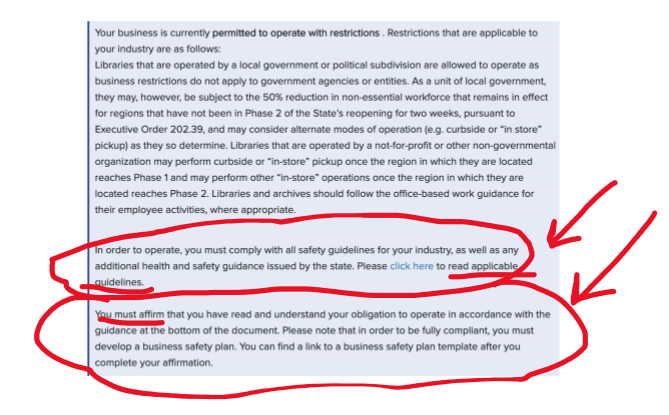
As part of the “applicable guidelines”, the “Responsible Parties” must certify having read and understood the obligation of their institution to “operate in accordance with such guidance,” as shown here[2]:

Image is a screenshot with an arrow pointing to the italicized text mentioning the Responsible Parties. This text can be read on the NY Forward Applicable Guidelines page.

None of this expressly requires that the person signing the certification, or the developer of a Safety Plan, is any particular person or entity.  Rather, the “owner or agent” of the library (who could be an officer of the board with signing authority from the bylaws, the director, another employee, or even an attorney operating on instructions from the library/client) signs the certification, and at some point, they adopt a Safety Plan.  That’s it.

But while there is no prescribed process for the Safety Plan, a look at some of the things the Plan must address is instructive.  For instance, the above-linked guidance states:

Signage should be used to remind employees and customers to:

  • Cover their nose and mouth with a face covering when six feet of social distance cannot be maintained.
  • Properly store and, when necessary, discard PPE.
  • Adhere to physical distancing instructions.
  • Report symptoms of or exposure to COVID-19, and how they should do so.
  • Follow hand hygiene and cleaning and disinfection guidelines.
  • Follow appropriate respiratory hygiene and cough etiquette.

As I have written about elsewhere[3], the requirements listed above, among other things, become temporary modifications to a library’s Code of Conduct.  In order to enforce social distancing and use of PPE in the library as required by the State, a library must ultimately tie a patron’s failure to do so to its Code and process for restricting access to patrons.[4]  For that reason alone (and there are many, many others, including a Plan’s impact on conditions for employees, procurement practices, security procedures, budget, etc.), the board should be the entity that adopts the Plan.

This is not to say that a director with adequate experience to draft a library’s Safety Plan cannot be the primary author of the Plan.  In fact, the director (and other employees with high familiarity with certain operations) is likely the person best situated to envision adjusted floorplans, shift schedules, workflows, signage posting, employee temperature monitoring, and employee training methods (to name just a few), all of which must be addressed in the Safety Plan. 

But because of the many high-stakes areas a Safety Plan impacts, a library’s board should be the entity accountable for adopting it and ensuring it is updated at regular intervals.  On the flip side, after the Plan is adopted, the director will be the authority responsible for seeing that the Plan is followed.

The board has this accountability for passing the Plan because a COVID-19 Safety Plan is not just a tool for safety, but also a mechanism of legal compliance and risk management.  When you stop and think about it, most policies or plans that relate to safety, legal compliance, and risk management—things like workers’ compensation insurance policies, sexual harassment and civil rights policies, and fiscal controls policies—are all things that a board is ultimately accountable for.  While the director may have the authority to ensure compliance with them, they are adopted by a board. And that is as it should be.

Of course, it can be a challenge for a small board to meet as often as needed to keep a COVID-19 Safety Plan evolving in light of new research, evolving library operations, and on-the-ground improvements.[5]  For such situations, it is good to consider an approach like the one set out in the below template resolution:

BE IT RESOLVED that the board hereby adopts the Safety Plan considered at this meeting of DATE; and

BE IT FURTHER RESOLVED that the Plan be posted in the Library, as required by the Plan, within 24 hours of the passage of this Resolution; and

BE IT FURTHER RESOLVED that to ensure the Safety Plan is updated in a manner that is conducive to optimal operations of the Library, the Director, [in consultation with INSERT[6]] is authorized to update the Safety Plan as needed, consistent with CDC and OSHA guidelines, and shall present the current updated version then in effect at each subsequent meeting of the board, to be reviewed and ratified by same.


So, what is the answer to the member’s questions? 

There is no “right” answer to this, but lots of factors point to the board serving as a library’s COVID-19 Safety Plan’s ultimate authority.  That said, in passing such a plan, a board should draw from the experience, and support the executive authority, of the library’s director. 

Like all healthy board-director relationships, this approach requires listening, learning, a good sense of roles and boundaries, and mutual respect.  A tall order in frantic times, but one that good planning and careful consideration[7] can almost always bring about.

Thank you for an important question.


[1] You will no doubt be shocked to learn that my law school did not have a “graphic design” elective for marking up NY State pandemic policy documents.

[2] I imagine many directors and board members have gone through this triad of assurance many times, and are sick of it.

[3] RAQ #138

[4] While Executive Order 206.39 granted any business the right to refuse a person access if they are not wearing a mask (if they can medically tolerate one), I am not comfortable with any lingering consequences for refusal to wear a mask or otherwise abide by the safety plan unless they are tied to the due process in a Code of Conduct.

[5] Larger libraries will have already had a business continuity, disaster recovery, and perhaps even an all-hazards response plan in place.  The approach outlined in this answer is drafted with smaller libraries, who typically don’t have such deep resources, in mind.

[6] The option in brackets here is to allow revisions in consultation with some back-up for the director: a committee of the board, or the chair of the board, or an independent consultant as authorized by the board, or the local Health Department. 

[7] And frequent re-reads of the “Handbook for Library Trustees of New York State,” found at http://www.nysl.nysed.gov/libdev/trustees/handbook/.

Trustees and First Amendment

Submission Date

Question

Our municipal library recently revised its by-laws, and the revisions were approved by four of our five elected trustees. The fifth trustee abstained, and a month later sent the other board members an email saying he thought some of the language was in violation of First Amendment rights. He said three lawyers he talked with concurred.

The language in question were sentences that were copied verbatim from United For Libraries of the American Library Association's Code of Ethics. The same language was found in the New York State Library Trustees Manual, published by the New York Board of Regents.

Specifically, this is the language in the revised by-laws the trustee objected to:

"Trustees must distinguish clearly in their actions and statements between their personal philosophies and attitudes of those of the library, acknowledging and supporting the formal position of the Board even if they disagree."

"When any trustee acts in a manner that is not in the best interests of the library or in a cooperative nature of the Board, the Board Chair shall discuss the issue with the trustee in a direct and constructive manner. Specifically, if a trustee is negligent in attending meetings to an extent that affects the operation of the Board, if a trustee is actively working against the interest of the library or Board decisions, if a trustee acts or speaks on behalf of the Board on any matter without prior approval of the Board, or if a trustee or his/her family benefits personally from any library matters, that trustee may be asked to resign from the Board by majority vote of the trustees. The trustee will be asked to resign from the Board by letter from the Board Chair, and the trustee will be asked to send a letter of resignation to the Board Chair."

The trustee stated, "A public library, with publicly elected trustees cannot in any manner restrict the opinions or comments of any board member, whether in executive session or public meeting, nor can they be compelled to support the decisions of the majority. Such action is a direct infringement on the First Amendment to the Constitution."

QUESTION: Do the passages in quotes
[1] from United for Libraries of the library's new by-laws infringe on First Amendment rights?


[1] NOTE:  The quoted language in the question does not exactly track the language in the 2018 NY Trustee Handbook, nor the United for Libraries Public Library Trustee Ethics Statement.  This reply addresses the language as quoted in the question and does not address the Handbook nor the United for Libraries Public Library Trustee Ethics Statement.


Answer

OPENING NOTE: Before I answer this question, I must stress: while some of it is identical, the quoted language in the question does not exactly track the language in the “2018 Handbook for Library Trustees in New York State,” nor the “United for Libraries Public Library Trustee Ethics Statement.”  This reply addresses the language as quoted in the question and does not address the precise language of the Handbook or the Ethics Statement.

Here are the words of the First Amendment:

Congress shall make no law respecting an establishment of religion, or prohibiting the free exercise thereof; or abridging the freedom of speech, or of the press; or the right of the people peaceably to assemble, and to petition the Government for a redress of grievances.”

I have been thinking a lot about these words, lately.  Business restrictions, social distancing, mask-wearing, protesting…2020 has evoked them, again and again.[2]

For this question, these strong, simple words are contrasted against the laws, regulations, and documents setting the terms of service of a public library board member. 

Let’s review those terms of service:

  • In the State of New York, public and private libraries are chartered by the NY State Education Department, as authorized by Education Law Section 255.
  • Whatever “type”[3] a Regents-chartered library is, it is always considered an “education corporation,”[4] to be governed, in part, by the Not-for-Profit Corporation Law.[5]
  • Although they are “education corporations,” public libraries bear some hallmarks of government entities: trustees must take oaths of office, most employees are part of the Civil Service, and there are significant, government-aligned requirements for procurement, audit, and accounting.
  • And of course, public libraries are subject to the Freedom of Information Law, the Open Meetings Law, the laws of their host municipalities, and the requirements of their own charters, bylaws, and policies.

This elaborate grid of law, regulation, and governance creates not only a public library--it creates the conditions for service by the public library trustee. 

Overarching all of this is the First Amendment, with its shifting assurances of unfettered freedom of speech and association. These shifting assurances include (but are not limited to): the right to say something (“free speech”), the right to not say something (no “compelled speech”), the freedom to attend meetings and gatherings (“association”), and the right to protest and advocate for your point of view (to “peaceably petition the government for redress of grievances”).

I say “shifting assurances,” because as is widely known, the tests for violations of the First Amendment depend on the context of the speech.[6]  Depending on the government interest to be advanced, or the nature of the speech impacted, the Supreme Court has created various tests to assess the Constitutionality of governmental actions impacting expression.[7]  One of those “contexts” is the voluntary acceptance of public library trustee service, which means agreeing to serve in alignment with certain laws. 

Here are just a few examples of how, even though every person on a public library board has First Amendment rights, speech and association of a trustee may be “limited” by law:

  • Trustees must take an Oath of Office,[8] which is arguably “compelled speech” required by the Education Law and the Public Officers Law;
  • Trustees must agree to follow the library’s “Conflict of Interest” policy, which is arguably “compelled speech” required by both the Not-for-Profit Corporation Law and the mandated Oath of Office;
  • Trustees must meet at least quarterly and if individual members do not attend, they may be removed, which is arguably “compelled association” required by the Education Law;
  • Trustees must not divulge communications designated by statute as confidential (whether or not they were discussed at executive session)[9] which is arguably “restricted speech” but is a condition confirmed in a number of judicial and Education Commissioner decisions;
  • Board members must abide by a library board’s code of ethics or risk being removed for misconduct.

Each of these examples is an instance where library trustees must curb or engage in behavior due to their special status as a public library trustee.  Each is a well-established condition, limiting or prescribing actions and expression, voluntarily undertaken as part of a valuable public service.

So, it is clear that library trustees must accept some conditions impacting their First Amendment rights, as a condition of board service.  But what about the language cited by the member’s question?

Most of the language in the question, as presented, does not lend itself to any concerns about the First Amendment; in fact, most of it does just the opposite.  By requiring a board member who is expressing a personal opinion to clarify that they do not speak for the full board or the institution, the language allows a trustee to express their personal position without jeopardizing their duty as a fiduciary who must act solely in the best interests of the institution.  Further, citing “the best interests of the library” and “the cooperative nature of the Board” emphasizes how a board must collaborate in good faith to achieve board decisions based solely in the trustees’ role as fiduciaries, which is consistent with both the Not-for-Profit Corporation law, and the cases construing duties of boards. 

In short, most of the language allows a trustee to perform their duties while exercising their First Amendment rights.

All that said, I have First Amendment concerns about the following phrases:

“…supporting the formal position of the Board even if they disagree.”

“…if a trustee is actively working against the interest of the library or Board decisions …”


What are my concerns with these phrases?

I have concerns because the meaning of these phrases, while evocative of a trustee’s “duty of loyalty”[10] to the library they serve, is ambiguous.   Ambiguity—by which I mean uncertainty about what exactly is being required--does not work well when free speech is implicated; and the uncertainty caused by a term being vague or overbroad creates risk. 

Here is how that risk plays out:

The following are some examples [11] of behavior that could be characterized as a trustee “actively working against the interest of the library or Board decisions…” that would violate the trustee’s duty of loyalty, and thus if punished with removal or censure, would NOT create First Amendment concerns:

  • A trustee knows it is in the best interest of the library to fix the roof in 2020, but publicly advocates waiting until a roofer they personally like (a neighbor or a drinking buddy) is free to perform the work in 2021;
  • A trustee knows that Candidate #1 has the best qualifications for the job, and therefore hiring Candidate #1 is in the best interest of the library, but thinks Candidate #2 will make their friends happier, so publicly endorses and votes for #2;
  • After appropriate due diligence and discussion with legal counsel during executive session, the board votes to buy the lot next door and to roll out news of the decision in a particular way.  A trustee, by virtue of information learned during the process, knows that the decision complies with all applicable laws and regulations, but still organizes a petition asserting the purchase is “illegal.”

Any of these, if proved, could be grounds for removing a trustee for “misconduct” and removal with no First Amendment defense to fight the removal. 

HOWEVER, as I said, the ambiguity of the quoted phrases, and some of their possible implications, concerns me.  To flip my examples around, here are some examples of behavior that could be characterized as a “trustee is actively working against the interest of the library or Board decisions…” that would NOT violate the duty of loyalty, and if punished with removal or censure, COULD create concerns under the First Amendment:

  • A trustee knows it is in the best interest of the library to fix the roof in 2020, but the only roofer to bid on the contract as authorized by the board has an established track record of defective work which is not being considered in the procurement process. In the days before the scheduled vote on the contract, the trustee publicly—and clearly only speaking for themselves—advocates a new procurement process and project timing that will attract roofers with a better record of performance;
  • A trustee sees that the new director, while excellent in many ways, does not have experience organizing a move to a new building, so despite a previous decision by the board to not hire a consultant to assist with the move, re-introduces a resolution to hire a consultant, and publicly (but respectfully) shares their reasons for the procurement;
  • A trustee, by virtue of information learned at executive session, has a genuine concern that a planned land purchase will not comply with all applicable laws and regulations, and reaches out to a private attorney to confidentially share their concerns.  Once those concerns are confirmed, the trustee shares the concerns in another executive session.  The board ignores the concerns, so the trustee—taking care to state that they are speaking personally and not for the board--THEN (without divulging attorney-client privileged information from the sessions) writes to the state Comptroller and the Attorney General for guidance, and writes a letter to the town paper stating simply that they hope to have time to gather further information.

If this seems complicated: it is.[12]  This is why there is a 132-page Handbook for library trustees, why there is currently a state-wide discussion about mandated training for library trustees, and why libraries have lawyers. 

Serving as a public library trustee is truly a role like no other.  To support the people in that role, if I were to word-smith the phrasing I have expressed concerns with, it would read (shown here with tracked changes):

"Trustees must distinguish clearly in their actions and statements between their personal philosophies and attitudes of those of the library, acknowledging and supporting as legitimate the formal actions position of the Board even if they disagree."

"When any trustee acts in a manner that is not in the best interests of the library or is inconsistent with thein a cooperative nature of the Board, the Board Chair shall discuss the issue with the trustee in a direct and constructive manner. Specifically, if a trustee is negligent in attending meetings to an extent that affects the operation of the Board, if a trustee is  engaging in misconduct or neglect of dutyactively working against the interest of the library or Board decisions, if a trustee acts or speaks on behalf of the Board on any matter without prior approval of the Board, or if a trustee or his/her family benefits personally from any library matters, that trustee may be asked to resign from the Board by majority vote of the trustees. The trustee will be asked to resign from the Board by letter from the Board Chair, and the trustee will be asked to send a letter of resignation to the Board Chair."


I suggest adding the words “misconduct” and “neglect of duty” because they come straight from Education Law 226(8), and as such, they are less prone to mis-interpretation.  On the flip side, I suggest removing the phrase, “actively working against,” because that phrase has no basis in law, regulation, or case law;[13] therefore, it risks mis-interpretation.  Since First Amendment decisions often turn on a phrase’s precise meaning (through definition or usage), these are more reliable choices.

To put this plainly: I am concerned that the language, as presented by the member’s question, creates the possibility of a public library chair thinking it is appropriate to tell a public library trustee: “The majority of the board voted to fix the roof this year, it’s a done deal, and now you have to keep quiet about it, or be removed from the board.”  This might not only violate the First Amendment, but could result in a course of action where the trustees are not acting in the best interests of the library.  That is a result to avoid.

At the same time, boards MUST feel empowered to remove members who are disruptive, who refuse to engage in the processes of deliberation and voting, who are disrespectful if they don’t get their own way, who improperly disclose confidential information, who have inappropriate relations with patrons or staff, or who violate board policy...so language emphasizing trustees’ responsibilities should be retained, and should be revisited often. 

Clarity about trustee rights and obligations, board training, and procedures creating a high-functioning board are always in the best interests of a library.

Thank you for a great question.  I hope this answer is helpful. 

CLOSING NOTE: At this closing section of the answer, I would like to re-iterate what was established in the first footnote: Although similar, the quoted language in the question does not exactly track the language in the “2018 Handbook for Library Trustees in New York State” nor the “United for Libraries Public Library Trustee Ethics Statement”.  This reply addresses the language as quoted in the question and does not address the precise language in the Handbook nor the Ethics Statement.


[2] And the year is only half over.

[3] Indian, free association, special district, school district, municipal.

[4] This governance is established through a daisy chain of Education Law sections: 255, 260, 226, and 216-a.

[5] The Education Law carves out several areas where the NFP law does not apply, including provisions related to trustee removal.

[6] Here is a nice summary of some of them: https://www.law.cornell.edu/constitution-conan/amendment-1/government-as-employer-free-expression-generally

[7] Here is a another summary, this time of the “tests”: https://www.law.cornell.edu/constitution-conan/amendment-1/modern-tests-and-standards-vagueness-overbreadth-strict-scrutiny-intermediate-scrutiny-and-effectiveness-of-speech-restrictions

[8] By taking the Oath, a public library trustee has made the sworn commitment to “support the constitution of the United States, and the constitution of the State of New York, and … faithfully discharge the duties of the office of” serving on the board. 

[9] This is a tricky one.  A good “Committee on Open Government” opinion discussing the nuances of this can be found at https://docs.dos.ny.gov/coog/otext/o4258.htm.  Another illustration of the shifting conditions of board service is the discussion in a 2017 NY Commissioner of Education’s decision to not overturn the removal of a school board member who admittedly shared confidential information from an executive session, found here: http://www.counsel.nysed.gov/Decisions/volume57/d17147.

[10] It is worth noting that the phrase “duty of loyalty” does not appear in the Not-for-Profit Corporation Law, but is a creature of case law.

[11] All of these examples were picked to not otherwise be covered by required policies such as Sexual Harassment, Conflict of Interest, Whistleblower, confidentiality of topics duly discussed during Executive Session.

[12] These distinctions may be counter-intuitive to some people used to the operations of not-for-profit boards, which come with a high expectation of service with confidentiality.  A key distinction between library board work and the work of other entities governed by the Not-for-Profit corporation law is that library board work, by law, takes place before the scrutiny of the public.  So, while the “duty of loyalty” held by a typical not-for-profit board member would include not divulging board discussions and board votes, for chartered libraries, this activity takes place with an expectation of disclosure.

[13] To make this assertion, I checked for the phrase “actively working against” in all laws and regulations of New York, and the decisions of the NYS Commissioner of education.  The phrase has no application in any of those contexts, and appears in only six judicial decisions in New York (state and federal), none of which deal with libraries or not-for-profit board service.
 

Sexual Harassment Training

Submission Date

Question

Beginning on October 9, employers in NYS are required to make interactive training which meets state outlined minimum standards to their employees to combat sexual harassment in the workplace. As a cooperative public library system which serves a membership of public libraries including those which employ 1-3 staff members, we would like to support our members by providing the training centrally. We have no governing or financial authority over these independent libraries. Their employees are not our employees.

Can we provide training centrally for the employees of member libraries, as long as the training itself meets the minimum training standards?

Do different levels of employees need to be provided with different training sessions, for instance do library staff persons need to be provided a training space free of the library director?

Do trustees serving on library (or any non-profit) board need to participate in this training and if so, do they need their own session?

It is my understanding that training can only be shared if all the institutions have agreed to the state version of the policy AND been given the state created training module. Is that true?

Thank you!

Answer

The member is right: New York State has taken the huge step of requiring ALL employers—whether  they employ one, or one thousand—to train their people to recognize and report sexual harassment and illegal retaliation.

But this training requirement does not stand alone.  Also as part of the amped-up law:

  • All employers must have a sexual harassment policy meeting new content requirements.
  • All employers must have a sexual harassment reporting form meeting new content requirements.
  • All new employees must be trained about the sexual harassment policy within 30 days.
  • Liability now extends to complaints by independent contractors and “gig” workers[1].
  • Sexual Harassment claims cannot be resolved via mandatory arbitration and non-disclosure clauses (with some exceptions).

The resulting need to revise policies, adopt reporting forms, and organize trainings has hit many strategic plans and budgets hard.[2]  Libraries, who always feel budget pressure, are among the not-for-profits feeling the pinch.

Since this law passed along with the budget this spring, I have been counselling clients that this training requirement should not be viewed as simply another unfunded mandate (although it is), but an opportunity.  What kind of opportunity? An opportunity for library leadership to gather and train their valued people to recognize and reject discriminatory behavior right from the start.

But at the end of the day, no matter how worthy the topic, convening personnel and hiring a qualified trainer costs money.  Which brings us to the member’s great questions (underlined below).

First Question: Can we provide training centrally for the employees of member libraries, as long as the training itself meets the minimum training standards?

My answer to this is…Hold on.  Before we talk about resource-sharing, let’s talk about scope:

Trustees, interns, and volunteers should be part of this training.  [3]

Why trustees? When a small institution has a concern related to sexual harassment, trustees become front-line decision-makers.  Further, trustees are generally the “supervisors” of directors—and the new law specifically requires that supervisors be trained.  And finally—but most critically—library trustees set the tone for mission and leadership at the library.  You cannot change or evolve a library’s culture without trustee involvement.

Why interns and volunteers?  This new law comes with liability for harassment directed even at “gig” workers.  This liability can be caused by any person acting on behalf of the library—even a volunteer.  So every person[4] who works at the direction of your institution should know this law, and how to work within it, together.

With that scope of attendance in mind, based on the guidance from the state thus far[5], if the policy and reporting form track the model policies provided by the state: my answer is YES.

Second Question: Do different levels of employees need to be provided with different training sessions, for instance do library staff persons need to be provided a training space free of the library director?
NO! In fact, I believe a library would lose much of the value of the sessions if it did so.

Why is that?  While the stark requirement of the policy is to review the law, a side benefit of such a training is creating an esprit de corps for combatting bad behavior together.   That can best happen if each level of authority—from trustee, to supervisor, to employee to intern or volunteer—hears and honors the obligations of the other.[6]

If the different authority levels are balkanized into different trainings, a valuable opportunity to build trust and accountability in service to the library’s mission of equal access is lost.


Third Question: Do trustees serving on a library (or any non-profit) board need to participate in this training and if so, do they need their own session?

The new law does not mention training trustees or directors specifically[7].  But since boards generally supervise the Director or Executive Director, and are responsible for a library’s legal compliance in all matters, it is my conclusion that library trustees must be trained. 

And—although my comments above recommend against it—they can be trained separately.[8]

There is a related area, however, where separate training might be appropriate and warranted.  In this day and age, governing boards should know: 1) the library’s insurance coverage for sexual harassment/discrimination claims, 2) the procedure for notifying the insurance carrier of a claim, and 3) how and when to call in third-party investigator to look into a complaint.  Having trustees aware of these things, before a mandatory training under the new law, would be optimal.


Fourth Question: It is my understanding that training can only be shared if all the institutions have agreed to the state version of the policy AND been given the state-created training module. Is that true?

Let’s start this answer with what a library is looking for when arranging the required training—a required element of which is a live, in-person trainer that attendees can ask questions of.

What does the library need from this trainer?  At bare minimum, the trainer needs to provide a session that meets the requirements of the law.  Therefore, my guidance to those arranging trainings for a single entity is that the contract or hire letter contain assurance such as:

On [DATE/S], [PROVIDER] will provide [SINGLE INSTITUTION] with an interactive session based on the State of New York’s “Model Sexual Harassment Prevention Training” guidance and [Institution’s] Sexual Harassment Policy and Reporting Form.  When the training is complete, trainer will certify that all elements for sexual harassment trainings required by applicable NYDOL and NYDHR guidance, and the laws of New York, have been met.

For a multi-institution training organized by a membership alliance or network, I suggest that the contract or hire letter contain some extra details, such as:

On [DATE], [Provider] will provide [Institution]’s members with an interactive session based on the State of New York’s “Model Sexual Harassment Prevention Training” guidance and [Institution’s] Sexual Harassment Policy and Reporting Form.  When the training is complete, trainer will certify to each institution that all elements required by applicable NYDOL and NYDHR guidance, and the laws of New York, have been met.

As this is a multi-institutional training, to enable certification for each attending institution, the following practices will be observed:

  • Registration must be complete no more than [one week] before the session.
  • [Institution] must provide trainer with a copy of each participating institution’s sexual harassment policy and reporting forms, no later than [one week] before the session.
  • Each attendee shall register and sign in on a form that notes if they have a supervisory role.
  • When signing in, each attendee shall be given a copy of their institution’s sexual harassment policy and reporting form, and shall sign to acknowledge receipt.
  • When signing in, each attendee shall be given a name tag that notes their institution, and if they are a supervisor.
  • During the training, each attendee shall be addressed by name and given at least one opportunity to role-play or rehearse recognizing or reporting harassment or retaliation.

Attendance is limited to 5 institutions, 60 attendees.[9]

I based this guidance on what will no doubt be the next chapter in this legal saga: allegations of liability due to failure to properly update policies and train personnel. 

The “certification” approach I am suggesting above is not required by the new law.  Rather, it is designed to help your members, or your institution, create a record that will easily demonstrate that they endeavored to follow that law.  It is designed to show that, even if a system or group had to share resources and do a mass training, a truly interactive and meaningful experience was intended.  This is a key element of limiting liability.[10]


Conclusion

Of course, in a perfect world, people attend sexual harassment trainings not only to limit liability and because they are compelled to, but to learn how to ensure such behavior is rare, quickly called out, and immediately corrected.

The importance of such training cannot be over-stated.  When I was a 16-year-old page at a public library in the 1990’s, I was harassed by a patron.  I was too young and inexperienced to know my rights, or what to do.  Fortunately, I had the good luck to be on shift with an amazing assistant director[11].   When the bad behavior started, this graceful woman walked over to the patron, and simply said, “This has to stop now.”  And despite his displeasure, it did.[12]

Many decades later, her unambiguous, dignified, and immediate action inspires me, as I hope it does you.

Done right, these mandatory trainings are an opportunity for your library’s team to practice this type of skillful handling.  It is also a chance for supervising staff--who now have the term “mandatory reporter” in their job descriptions—to be assured that they are supported and backed up by informed and committed trustees. 

Finding ways to collaborate and share resources to make such training and practice as accessible and rewarding as possible is a great initiative.  Thank you for this excellent array of questions.


[1] Uber drivers who transport your interlibrary loans, for example.

[2] The State’s late issuance of required guidance—released less than 2 months before the effective date—didn’t help, either.

[3] I know, that’s not really the question.  But this is very, very important.

[4] Yes, some of those volunteers might be very young!  It will be the job of your trainer to train your employees both well, and appropriately.

[5] September 26, 2018. A I write this, they are assessing thousands of public comments—including some submitted by me—and that may change the basis of my advice.  So if you are reading this in 2019, please check for updates.

[6] Just so you know, “my firm belief” is based on years of conducting anti-discrimination trainings, ten years as an in-house counsel at a university, and time as an Interim HR Director.  I am not just going with my gut here.

[7] Nor does the current model policy, report form, or training materials. Considering that New York is a hive of corporations, this void is rather mind-boggling, but these State resources were compiled with haste.  I imagine this will be addressed in later versions.

[9] Or some other reasonable number.  This is just a recommendation.  Basically, you don’t want the number of institutions or attendees to make the “interactive” requirement arguably meaningless.

[10] But by no means the only element.  The most important one will be following the new law, and documenting that you are following it!

[11] Bernice Cosgrove. 

[12] The patron was quite upset.  In retrospect, he may have had some mental health concerns.  These matters often come with complications that require tact, diplomacy, and compassion.


Code of Ethics Conflict of Interest

Submission Date

Question

What, if any, are the ramifications if a school district public library board of trustee member refuses to sign the code of ethics and/or the conflict of interest/whistleblower policy?

Answer

I am sure there is a very interesting set of facts, personal convictions, and conversations behind the stark facts presented in this question (there always is).  But we’ll address just the stark facts.

Because a library’s Code of Ethics, Conflict of Interest Policy, and Whistleblower Policy[1] are rooted in different areas of the law, a refusal to sign these documents creates an array of ramifications. We’ll explore each type in turn.

But first, it’s important to establish certain base factors.

Base Factors

In New York, most libraries (unless they are part of a larger institutions like a college or museum) are not-for-profit corporations chartered by the New York Education Department’s Board of Regents.[2]  This means that, just like other not-for-profit corporations registered with the New York Department of State, libraries are subject to the Not-for-Profit Corporations Law (the “NFPCL”).[3]  This includes school district public libraries.

Without getting too technical, this means that all libraries in New York are governed in accordance with not only their charters and bylaws, but the applicable parts of the Education Law and the NFPCL, too.[4]

This governance structure impacts questions related to conflicts of interest, whistleblowing, and codes of ethics. With the basic features established, let’s look at the different type of policy in the member question.

Conflict of Interest Policy

Here is what the law says about a refusal to participate in the “Conflict of Interest” policy, as governed by the NFPCL:

The conflict of interest policy shall require that prior to the initial election of any director[5], and annually thereafter, such director shall complete, sign and submit to the secretary of the corporation or a designated compliance officer a written statement identifying, to the best of the director’s knowledge, any entity of which such director is an officer, director, trustee, member, owner (either as a sole proprietor or a partner), or employee and with which the corporation has a relationship, and any transaction in which the corporation is a participant and in which the director might have a conflicting interest.[6]

So, to give a stark answer to the member’s question, per the law, no person should actually be elected to serve as a trustee until the nominee’s Conflict of Interest statement (the “COI”) is completed and submitted.  In other words, if the COI is not turned in, that person should never initially be elected as a trustee (we’ll pick that back up in a few paragraphs when we discuss the election criteria for school district public library trustees).

Whistleblower Policy

A requirement to “sign” the Whistleblower Policy is a slightly different matter.  Unlike the law related to conflicts of interest, the law requiring any not-for-profit with over 20 employees (or revenue in excess of one million dollars) to have a Whistleblower Policy[7] does not come with a requirement for trustees to sign any document. 

Of course, a refusal to abide by the Whistleblower Policy (for instance, a trustee failing to keep a report confidential), could result in a violation of the law, and the libraries’ bylaws, as well.

Code of Ethics

Public school boards must have Codes of Ethics,[8] but libraries—even school district public libraries—do not. There is no requirement in the NFPCL, nor the Education Law, nor any applicable regulations, that a public library have such a code.

That said, to clearly express and enforce a library’s values, a Code of Ethics is often built into a library’s bylaws or adopted as a stand-alone policy of a library’s board.[9]   The bylaws, or policy itself, could also require that it be signed.  Once it is a requirement of the bylaws or policy, it does not have the force of law, but it can be enforced by the board.

Refusal to Sign

Which brings us to: whether it a requirement of law or policy, the refusal to sign of a board member must be addressed under the library’s charter, bylaws, and the NFPCPL. 

Under NFPCL §706, a board is empowered to remove a board member per the procedures in its bylaws.  Therefore, if a board determines that failure to sign the Code of Ethics or Whistleblower Policy is unacceptable, or that a failure to sign a Code of Ethics makes the library non-compliant with the law, then that board member can be removed, provided the remaining trustees are careful to follow the bylaw’s procedures for doing so. 

This can be a divisive issue, since I imagine someone could present a debatable reason for not signing a Code or other policy,[10] but since a Code of Ethics or mission statement is something every board member must support as part of their service to the library, the root cause of the refusal might be just as serious as the refusal, and in any event, must be resolved. And that is, except for one wrinkle, the lay of the land.

School District Public Library

At school district public libraries, board members are elected per the requirements of Education Law §260. 

§260, and by reference, §2018 of the Education Law, include very precise conditions for the nomination and election of a school district public library board member—none of which is a pre-vote signature on a COI, or a signed acceptance of a Whistleblower Policy or Code of Ethics.

Of course, per Public Officers Law §10, all school district public library trustees must take and file an oath of office “before he[11] shall be entitled to enter upon the discharge of any of his official duties.” This means, somewhere in the “pre-term” area after the election but before the newly elected trustee starts working, there is a zone where they can, based on a refusal to take the oath of office, not be qualified to start the term.[12]

The consequences of a refusal to sign a COI are a little less well-defined, but it is clear that if a board tolerates a refusal, the organization is not in compliance with the NFPCL.  The refusal to sign a Whistleblower Policy is not controlled by law, but the failure to actually follow it is.  And the failure of a board member to sign a Code of Ethics is a matter to be decided by the rest of the governing board.

What Happens Next?

The refusal to sign and participate in critical board policy cannot simply be ignored.  It has to be addressed, and the rest of the board has to follow the rules as they address it.

Barring any obvious provision in the bylaws or wording in a particular policy, what does the board use as a playbook for dealing with this type of challenge?  Upon confirming the factors leading to the refusal, a board’s executive committee,[13] consulting with the library’s lawyer and working from copies of the charter and bylaws, must consider the facts, could develop a solution.  The solution could be a revision of a policy to address a particular concern, or, in the case of an incomplete COI, removal of the member.  In no event should this be done without the input of an attorney, since the stakes are high, and feelings may be strong.

Thank you for an important question.


[1] In their quest to impose order on the universe, lawyers often use capitalization to express when a “thing” is a “Thing.”  For purposes of this answer, the various policies the member references are each Things, and so while certain style guides may disapprove, the capitals are there to stay!

[2] The way corporations are created in New York is a type of legal conjuring.  For more information on this particular type of conjuring, check out the New York State Education Department’s Division of Library Development Guide at http://www.nysl.nysed.gov/libdev/charter/index.html, and Education Law §255.

[3] This application of the NFPCL is set forth in NY Education Law §216-a, which is a fun read on a rainy day. 

[4] Intricate arrangements like this are why people like me have jobs!

[5] In the law, “director,” “board member” or “trustee member” all refer to elected members of the board of trustees.

[6] This is from NFPCL §715-a (c).  This language, or something substantially similar, should be in every library’s Conflict of Interest Policy.

[7] NFPCL §715-b.

[8] §806 Section 1(a) of NY’s General Municipal Law.

[9] Boards of museums and other cultural agencies chartered by the Regents are required to have a code of ethics; see 8 NYCRR § 3.30.

[10] I cannot imagine a good reason for not signing a COI, unless the policy was badly worded, there is confusion about the policy, or the director really does believe they should be allowed to vote for their wife’s company to install the new library floor.

[11] It’s 2019.  We really need to work on the pronouns in our legislation.

[12] As but one example of this, see 2001 Op Comm Ed No. 14,710

[13] Or the trusteeship committee, or the board, working as a committee of the whole…whatever group will ensure thorough assessment and the preparation for, if needed, a removal vote.