Public Libraries

Paid time-off for COVID-19 vaccinations

Submission Date

Question

Are public or private libraries obligated to give paid time off for eligible employees to get the vaccine during work time? A staffer is planning to go upstate for it on a work day and the question came up if they have to use sick time or just "get the day" to take care of this. Thank you!

Answer

Non-governmental employers

Recent changes to the Labor Law make the "private" part of this question easy to answer: since all employers must now offer all employees sick leave (unpaid if the employer has under four employees, paid if five or more), an employee may use that sick leave for the purpose of obtaining medical care, including to get vaccinated.

If a non-government-agency employer would like to go one step further and not require an employee to use accrued sick leave, but instead, give them a day (or two half-days, for the vaccine that requires two shots) for the specific purpose of being vaccinated, that's fine, too, so long as the library considers vaccination of employees to be part of its Safety Plan (making the vaccination a work activity, and not a prohibited gratuity from a charitable entity to a private person).[1]  But there is no obligation to do so.

Small but critically important exception to this rule: if your library employees are in a union and their time off is subject to a collective bargaining agreement, you must check and abide by that agreement, or develop a special provision with the union.


Public libraries

Okay, this is where it gets tricky.  For public libraries that consider their employees to be employees of a "government agency," hang on one second, we'll address what you can do in the paragraph below.  For all other public libraries, who must follow the new sick leave law, the section above applies.


Public Libraries Who are "Government Agencies"

For public libraries whose employees are considered employees of their sponsoring municipalities,[2]  there is no obligation to "give" paid time out of the library to get vaccinated unless it is in a collective bargaining agreement or your government subdivision's response plan.  However, if your library is allotted vaccine as part of a rollout to public employers, and the entity you are getting it through (sponsoring municipality or school district) is encouraging vaccination by allowing it to be done on work time, that is an option to consider.  Further, if your library develops an employee vaccination rollout plan as an addendum to its Safety Plan[3] and would like to offer up to a certain number of hours of paid time out of the office to encourage vaccination, if part of a plan, that can be allowed (but is not required).[4]

Small but very important exception to this rule, just like with "private" libraries: if your library employees are in a union and their time off is subject to a collective bargaining agreement, you must check and abide by that agreement, or develop a special provision with the union.


For All

Issues like this a) affect mission and morale, b) relate deeply to employee and public safety, c) can impact a library's budget, and d) are fraught with compliance concerns, so any decision is best to tie to your library's Safety Plan,[5] and to have trustee approval (confirmed by a vote).

I continue to admire the care for others, tenacity, and attention to detail members of the library community bring to their questions as we get through this pandemic together.


[1] Just to be clear: to avoid a forbidden benefit to an individual, NO charitable entity should "give" a paid day off for vaccination without linking the enhanced safety of workers to its charitable operations (i.e., making it a part of their Safety Plan).

[2] Note: even when this is the case, the library's board of trustees, and only the board of trustees, determines who is hired, how they are compensated, and any matters related to development, discipline, and termination.

[3] This "Ask the Lawyer" addresses how to prioritize vaccine allotments and roll them out through policy: RAQ #193.

[4] At least, it is not required as of 1/21/21.  As with all things COVID, check for updates on this.

[5] And be reviewed by a lawyer, whenever possible.

Vaccine priorities for staff

Submission Date

Question

The governor announced that the vaccine rollout to public employees would be through our unions and health groups, but also said that WE need to prioritize who receives the vaccine first (based upon risk factors/comorbidities) since the supply is limited (as the governor mentioned in Friday's press conference) --it will probably take a few months to vaccinate every staff member who wants one.

How can we organize our internal "prioritization?"  Should we prioritize those with underlying health conditions, or use other criteria? What about HIPAA? I want to do this fairly, but I am also concerned about the ethics.

Answer

The member's caution shows how important it is to get this one right.

Before delving into it, I want to say: for public libraries with a union, this is one to confer with union leadership on. 

For public libraries without a union, it will be good to think about not only your internal prioritization, but the messaging around it. 

And for all libraries connecting their employees to vaccine, this is one to plan in careful coordination with a board committee, your lawyer, and your local health department.

With the right participants at the table[1] and careful consideration of ethics and privacy, finding the right plan for you won't be easy, but you will get it right.

This question is about the "ethics and privacy" part of the process. For a public institution that will be part of this rollout, the State of New York's own ethical statement and guidelines for prioritization are a good place to start.  Here they are:

New York State based its COVID-19 vaccine distribution and administration process on ten guiding principles.

  1. Safety: New York State will only endorse and distribute a COVID-19 vaccine if it is determined to be safe and will only be used according to the indication under which it received its authorization or license. This includes continued monitoring and reporting of adverse events after the vaccine is licensed and administered.
  2. Effectiveness: New York State will only endorse and distribute a COVID-19 vaccine if it is demonstrated to be appropriately effective in the populations intended for use.
  3. Expert approved: New York State will rely on the advice and counsel of recognized clinical experts and scientists to review and approve the safety and effectiveness of every vaccine that is authorized by the federal government for distribution.
  4. Equitable & clinically driven distribution: New York State’s COVID-19 vaccine distribution plan will be based on standards that prioritize people at higher risk of exposure, illness and/or poor outcome. Unrelated factors, such as wealth or status, will not influence distribution.
  5. Transparency: Throughout the COVID-19 crisis, the state’s daily public presentation of facts and reliance on science and medical expertise helped build public trust and confidence in government action. New York State will continue to be transparent regarding all aspects of the COVID-19 vaccine distribution, administration, and monitoring process to ensure New Yorkers are fully informed.
  6. Use of Data: Coordination of a successful vaccination program will require robust tracking, data and analytics capabilities. New York State will use powerful data and information technology platforms to guide all parts of the COVID-19 vaccine distribution and administration process to maximize safety, accuracy, and efficiency and meet all federal reporting requirements — all while maintaining patient privacy.
  7. Privacy and Patient Safety: New York State will ensure all vaccination processes prioritize patient safety, and all information systems guarantee patient privacy. Vaccination does not take away the importance of other public health measures that have served us well in the fight against COVID-19. New Yorkers will be urged to continue to practice social distancing, mask wearing, hand washing, and other measures.
  8. Partnership, Coordination & Public Outreach: New York State recognizes that coordination with local organizations and community providers is essential to the safe and successful distribution and administration of COVID-19 vaccines. The state’s outreach efforts will especially focus on reaching underserved, hard to reach, and vaccine-hesitant populations, as well as those at highest risk for COVID-19 infection and poor outcomes.
  9. State Leadership: New York State expects federal engagement on vaccine vetting, distribution, administration, and funding. However, regardless of the level of federal engagement, New York State will take all necessary steps and require local coordination with the state’s centralized approach to ensure an efficient and organized vaccine distribution.
  10. NEW YORK TOUGH: Throughout this COVID-19 crisis, New Yorkers have shown that there is nothing we cannot do if we work together as one community. Our approach to the COVID-19 vaccine will be tough, strong, united, disciplined, and loving.


Informed by these guiding principles, each library can consider its unique policies, Safety Plan, and if relevant, collective bargaining agreement (union contract), and confirm its own internal method of prioritizing.

While these variables will make each library's position unique, the best way to confirm and follow the method of prioritization they decide on is to:

            1) Adopt a written policy;

            2) Document that it is being followed consistently;

            3) Notify the employees and the public as to how the process will be implemented.

Here are an "example policy" and "example notice" drawn from the State's approach:

[**START EXAMPLE POLICY**]

[NAME] Library Vaccine Distribution Policy [Employees Only]

[**EXAMPLE ONLY**]

Policy

In step with the method of prioritization being applied by the State of New York, [NAME] Library's COVID-19 vaccine employee distribution plan will be based on "levels" that prioritize people at higher risk of exposure, illness and/or poor outcome.

Definitions and Levels

"Higher risk of illness and/or poor outcome" means that a medical condition makes it potentially more likely the employee could become ill, or, if they do become ill, are statistically more likely to experience a poor outcome; such need shall be considered "Level 1(d)." 

"Higher risk of exposure" means those who, working within the parameters of the Library's current safety plan, PPE requirements, and operations:

  • Perform any function or share any criteria required for vaccination during the New York Department of Health's Vaccine Distribution Phases 1a and 1b (including those 65 and older), but did not obtain the vaccine; such need shall be considered "Level 1(a/b)".
  • Must report to work on site and physically interact with the public as part of their routine job duties, and/or handle circulating materials; such need shall also be considered "Level 1".
  • Must report to work on site as part of their job duties; such need shall be considered "Level 2".
  • Performing all work duties 100% remotely; such need shall be considered "Level 3".

Procedure for 1(d) requests

Any Level 1(d) requests for vaccination shall be confidential.  When supplies are available to the Library, employees who self-identify as at "higher risk of illness and/or poor outcome" may request COVID vaccination through the same confidential process used to request and arrange disability accommodations, with the understanding that during this time of extra burden on medical providers, documentation of the condition creating the need may be supplied after vaccination (please supply a note from your physician when you are able).

A request for vaccination may be considered separately or together with accommodations based on disability.


Procedure

Any employee may request vaccination. 

When supply and demand require prioritization, the order of priority shall be:

          Levels 1 (any type): highest priority

          Level 2 and with a member of their immediate household with higher risk of illness and/or poor outcome: second highest priority

          Level 2: third highest priority

          Level 3 and with a member of their immediate household with higher risk of illness and/or poor outcome: fourth highest priority

          Level 3: fifth highest priority

          All others: lowest level of priority


If further prioritization is required to prioritize between Level 1 employees, the order of priority shall be:

          Level 1 (a/b)

          Level 1(d)

          Level 1 (any type) and with a member of their immediate household with higher risk of illness and/or poor outcome

          Level 1


If an employee is selected for vaccination through the library, the employee will be expected to follow all the rules and procedures for vaccination. 

Employees not selected will be placed on a wait list in order of priority.[2]

The Director, or their designee, shall be responsible for compliance with this policy.

         [**END EXAMPLE POLICY**]


[**START EXAMPLE NOTICE**]

[NAME] Library Vaccine Opportunity Notice

[**EXAMPLE ONLY**]

DATE: [INSERT]

The Library has been issued # doses of COVID-19 vaccine.  We expect to be able to initiate vaccinations on DATE.

As determined by the attached policy, the Library will be offering vaccination through our allotment to as many employees as possible. 

Vaccination is voluntary.

Please transmit your interest in being vaccinated and your assessment as to the level of priority you fall into (see the policy) to name@address by DATE.

For example: "I am voluntarily requesting vaccination through the library's allotted doses.  I believe my priority level is "1."

Requests that include medical disclosures will be treated confidentially.

If the library is able to grant your request, we will send you information regarding next steps, and you will be expected to follow all the rules and procedures for vaccination.  Employees not selected will be placed on a wait list in order of priority. 

Supplies are limited.  If you have the opportunity to be vaccinated through another supplier, we encourage you to do so.  Employees may use up to a day of sick leave for each vaccination session.[3]  The library places the highest priority on the health of our employees.

[**END EXAMPLE NOTICE**]


Final notes from the lawyer:

These are early days for the vaccine and vaccination rollout.  While being prepared with a policy is the right move, prior to announcing any prioritization, after adopting a policy, be ready to be flexible, since the situation is changing rapidly. 

As with all major policies, this is one that ideally will be adopted via a vote by your board.[4] Here is a sample resolution for you:

BE IT RESOLVED, that after due consideration of the "guiding principles" of the State of New York and the library's own code of ethics, that the Library adopt the attached "Library Vaccine Distribution Policy" and "Notice;" and

BE IT FURTHER RESOLVED, that the [insert] committee shall work with the Director to monitor the need to revise this policy, based on any new guidance, knowledge, or operational needs.


I wish you good health, strength, and fortitude as we move into this next phase of overcoming the pandemic.


[1] This does not mean your library's (online) meetings about your rollout should have a cast of thousands—or even 5.  A good approach is like a series of waves: a small core group of policy makers (director and one or two board members) reach out to the identified parties to alert them and get initial input, set a time to check in on a final draft, set a tight deadline for final input and final approval by the board.  With the right planning, this can be done in 3-5 business days, and no one should be allowed to sandbag it.

[2] Care should be taken that any Level 1(d) designation is not set forth on a list that can be accessible per FOIL.  Once created, a wait list should simply set forth the names or employee ID numbers in order of priority.

[3] Drafting note: for libraries that must follow the new sick leave law (Labor Law Section 196-b, effective in September 2020), time off for vaccination does qualify as sick leave.  Libraries that regard themselves as being exempt government agencies, and thus not subject to 196-b, should check with their municipal attorney or HR professional to confirm if this meets the requirements for sick leave under municipal policies.

[4] While it is critical that a library board of trustees entrust the day-to-day management of the library to the director, policies are always ideally adopted at the level of highest accountability.  This will also position a board to have a director's back if there is a legal or operational challenge to the vaccine distribution policy.

Staff COVID vaccinations

Submission Date

Question

Can a public library compel staff members to get vaccinations for COVID-19, when they are available? If so, can an employee request an exemption? Do we need waivers of library liability if a staff member chooses not to get vaccinated?

Answer

This is an incredibly sensitive, important, and complex set of questions.  I know a lot of people out there in "library land" are waiting on the answer—from many different perspectives.

So we're going to take it slow, break it down, and unpack the components of the answers one step at a time.

Step 1: Considering requiring immunization to COVID-19 as part of a library's evolving Safety Plan

As I have emphasized in numerous pandemic-related answers, any library operating in any capacity right now should have a trustee-approved Safety Plan tailored to its unique operations.  The plan should evolve as new safety-related information emerges, and as library operations change.

As of this writing,[1] some libraries are open to visit.  Some are doing only curbside.  Some are offering more remote programming.  Some have used their information management and lending capacity to distribute PPE, food, and living supplies.  Because of this diversity of service, they all should have different Safety Plans.

The Safety Plan of a library closed to the public for everything but curbside will be different from the Safety Plan of a library open for socially distant use of computers and lending.  The Safety Plan of a library distributing fresh produce will be different from a library streaming programming from its community room to an audience within its area of service (and beyond).  The Safety Plan of a library operating with ten on-site staff in December should be different from the one they used when there was only one employee on-site in June.

Just like the decision to use a particular mode of sanitization, as a library undertakes and changes its unique services, the decision to require immunization of employees should start with vaccination's role not as a stand-alone solution, but as part of an overall approach to limiting the impact of the pandemic on your library, its employees, and your community.  Do the services your library needs to provide the community warrant immunization of employees?  If so, keep reading.


Step 2:  Wait, so does what you said in "Step 1" mean a public library can go ahead and require employees to be vaccinated?

Yes...and NO.

I say "yes," because under the right conditions, the law does allow employers to impose conditions for safety, and that can include mandatory vaccination.[2]  However, I also say "NO," because the phrase "the right conditions" carries a lot of complexity for three little words.  To be safe, the default assumption of a library[3] should always be that it can't require immunization of its employees...and then work to find the way, if well-informed risk management and an updated Safety Plan warrants it, it can require immunizations (and just as critically, if it should).


Step 3: Assessing if a library can require vaccination of employees

Before a library gets too far into an internal debate about if it should amend its Safety Plan to require vaccination of employees, it should assess if it is in a position to do so.  This means having an experienced HR administrator or attorney look at the organization's bylaws, policies, and employment relationships to see if there are any steps or bars to the requirement.

What could such a bar look like?  The most common impediment a library will run into on this is an employment contract—either for individual employees, or with an entire employee union (a "collective bargaining agreement").  The bottom line on this type of impediment: if there is a contract in play, a library must be very tactical, collaborative, and strategic prior to creating—or even considering—immunization as an employment condition.[4]

Another bar might be language in an employee handbook or a pre-pandemic policy.  Still another might be that "gray area" when library employees are considered employees of a school district, village, or town.

The best overall guidance I can offer on this Step is: assessing if your library is positioned to require immunization is a critical step to using vaccination as a tool in your Safety Plan.  Bring in a ringer to help your library assess the extent of what it can do.


Step 4:  Assessing if a library should require vaccination of employees

Okay, let's say you consulted with the best employment lawyer in your village/town/district, they took a close look at whatever relevant contracts and policies your library has, and they have said: "No problem, you can require this."[5]

The next important thing to consider is: should your library require this?

Compelled immunization[6] is an incredibly sensitive area of policy and law.  Since the time Ben Franklin started insisting on smallpox immunizations,[7] this public health issue has had passionate rhetoric on both sides of the debate. 

I have worked with families whose children have documented contraindications for certain vaccines, and it is not a simple issue.  And right now, a public discussion is happening about why people who are African-American might not trust being offered a first round of vaccination.[8]  These are life-and-death issues.

That said, those on the front lines of public service, during a time of pandemic, are at higher risk of both getting infected, and spreading disease.  Science shows vaccination will mitigate that risk.  Thus, under the right circumstances, encouraging such employees to be vaccinated is the right thing to do, and in some cases, employers have made the decision that requiring vaccination is the right thing to do.

The consideration of this question is classic risk management.  What critical services is your library providing to the community?  What exposure to possible infection do those services create?  Does social distancing, PPE, and sanitization mitigate those risks within acceptable tolerances, or would requiring vaccination of employees demonstrably make those employees and the community safer?  Are there certain duties that merit requiring immunization, and other duties (jobs performed 100% remotely, for instance) that do not?  And critical: is mass employee immunization in step with the approach of your local health department?[9]

There is no cookie-cutter answer to these questions, but a responsible decision to require immunization of employees as part of a well-developed and evolving Safety Plan should answer them all.


Step 5:  Developing a robust policy that includes consideration of civil rights, the ADA[10] and privacy

So, let's say your library has followed Steps "1" through "4" and has decided it can, and should, update its Safety Plan to encourage or require immunization of employees.

The next step is developing a policy that:

  • Demonstrably does not discriminate or have an unintentional disparate impact on any protected class of people (race, religion, sex, etc.);
  • Has appropriate measures for people to opt-out based on a disability accommodation under the ADA or the New York Human Rights Law;
  • Protects the privacy of those who either meet the requirement, are granted an accommodation to not meet the requirement, or who must be terminated due to refusal to meet the requirement.[11]
  • Manages liability through good planning and the transmission of accurate information, not (just) waivers of liability.[12]

I also suggest that the library strongly consider ensuring, well in advance, that: 1) the vaccine is available to employees, and 2) that employees don’t have to pay for it.  This is because 1) once the library has identified that there are risks in its operations that would be best mitigated through immunization, those activities should be limited until the mitigation is in place, and 2) there can be legal complications if the vaccination requires personal expense.  While this advance planning and cost containment is not precisely a legal compliance concern, they are close first cousins, and should be addressed as part of the Safety Plan. 


Step 6: If a library decides to require immunization, develop a PR Plan (optional, but a very good idea)

I don't need to tell a library audience that what a public library does on this topic will be scrutinized, criticized, and eventually, also a model for the rest of your community.[13]  Since any decision on this point will have its critics, and also (hopefully) its fans, be ready to let your public know, simply and straightforwardly, the basis for your library's decision.

I like the classic "FAQ" approach.  Here are two model FAQ's for two libraries that did the legal analysis and safety assessment, and come to the following decisions:

FAQ: I was told the library board is requiring all the employees to be vaccinated for COVID, is that true?

FAQ ANSWER: Since re-opening on DATE, the NAME Library has had a Safety Plan.  Now our Safety Plan does include supporting voluntary immunization of employees.

FAQ:  Voluntary?  So you are not requiring it?

FAQ ANSWER:  Our risk analysis and still-limited operations showed that we could meet the community's needs by requiring masks, social distancing, and routine sanitization.  We have now added supporting employees in getting vaccinated on a voluntary basis.

FAQ:  Will you ever require it?

FAQ ANSWER:  Only if our operations change and an updated risk analysis shows us that it is best for our employees and for the community.

Another "FAQ" example, for a library that came to a different conclusion, is:

FAQ: I was told the board is requiring all the employees to be vaccinated for COVID, is that true?

FAQ ANSWER: Since re-opening on DATE, the NAME Library has had a Safety Plan.  Now our Safety Plan does include mandatory immunization of employees who are able to be vaccinated.

FAQ:  Why is the library requiring employees to get vaccinated?

FAQ ANSWER:  Feedback shows that the community needs us providing critical services right now.  Our risk analysis showed that in addition to requiring masks, social distancing, and sanitizations, immunization by employees would protect their health, and the community's, while we provide those services.

FAQ:  The vaccine is not 100% available yet.  Did your employees have to do this on their own?

FAQ ANSWER:  Our library worked with [INSTITUTION] to make sure our employees had access to this safety measure, without cost to them.

And that's it.[14]

The important take-away I want to emphasize here is that for individual libraries, there are no quick answers to these questions.

Libraries of all types will be assessing their unique legal and risk positions, and will need to make carefully documented and executed decisions.  Libraries within larger institutions may need to fight for consideration separate from other operations.  Public libraries will need to consider the heightened transparency and public accountability they operate under.  Library systems will be thinking about how they can protect their employees while also supporting their members.  And for the employee on the ground, they'll be thinking about keeping themselves, their families, and their communities safe.

By taking careful, deliberate, and well-informed steps, the answers to the member's questions can be found.

Thank you for a vital question.


[1] December 18, 2020.   For many of you, that means you've been shoveling lots of snow (we're looking at you, Binghamton).

[2] See the case Norman v. NYU Health Systems (2020) (SDNY), 2020 U.S. Dist. LEXIS 180990 *; 19 Accom. Disabilities Dec. (CCH) P19-109

[3] And in this case, I use "library" in its broadest sense: public, association, and even libraries operating as part of a larger institution (such as a college, hospital, or museum).  School libraries, in particular, may both fall under the policies of the institution they are within, but might also have different operations, activities, and exposure that warrant independent risk analysis.

[4] I can't be more specific than that, since in some cases, there may be "emergency" management clauses that could easily allow the requirement of further safety measures, while in other cases, there could be language that makes it clear such a requirement will have to be a point of discussion.  The important take-away here is: if there is a contract in play, don't wing it.  Bring in your lawyer.

[5] The actual answer will of course be in writing and will likely be much more extensive than "No problem!"   It should also be included in the records of library leadership to document the appropriate level of risk analysis.

[6] When I say "controversial," I mean legally.  The science is solid: immunization saves lives.

[7] Ironically, Franklin's young son would die of smallpox before he could be immunized, in part because Franklin's wife Deborah was wary of the new treatment.  Franklin was devastated by the loss of his small, precocious son, and some scholars say it caused a rift in his marriage that was never healed.

[8] If you know your history, you know these fears are based in reality.  If you want to learn more, a good place to start is this New York Times article: https://www.nytimes.com/2020/12/06/opinion/blacks-vaccinations-health.html?searchResultPosition=4

[9] Whenever possible, confirming Safety Plans, and significant revisions of Safety Plans, with the local health department is a very good idea.

[10] The ADA is a critical consideration here.  A good place to start for further information on this is the EEOC, at https://www.eeoc.gov/wysk/what-you-should-know-about-covid-19-and-ada-rehabilitation-act-and-other-eeo-laws.  However, this is just a starting place; as you can see by the linked guidance, this part of your policy cannot be a simple cut-and-paste job.

[11] I know, this sounds cold; and it is.  Considering if a library is actually prepared to terminate employees for refusing to meet the requirements should be part of your library's analysis here, too...because once you develop the policy and start requiring it, granting exceptions without justification can create serious legal complications.

[12] The member asks about waivers for employees who decide not to be immunized.  A waiver of liability should only be used if it is part of a well-developed Safety Plan, and customized for the purpose by an attorney.

[13] Although I just did.  Ah, rhetoric.

[14] I could go on with a few more FAQ's to illustrate the diversity of approaches available (they are kind of fun to write), but I trust you get it.

Heavy smells in public library policy

Submission Date

Question

I am an adjunct instructor in a library science program.

We were having a discussion regarding patrons with body odor or heavy smells (such as perfume or cigarette smoke). What really surprised me…. several of my students who work in public libraries said they have an official policy that patrons who smell are not allowed to stay and are to be asked to leave the library. This really surprised me. Legally is this allowed? Who is to decide what an acceptable/unacceptable level of smell.

Overall, I found the notion of kicking out patrons because of smells to be repulsive, disgusting, and a completely against WHY we exist. If this is legal, I want to know how a library could, in good conscience, do this…

Answer

There is a large array of case law,[1] academic articles, industry guidance, and news coverage on the subject of regulating smells in libraries (specifically, the smells of people and/or their belongings in libraries).[2]

Based on those materials—and in particular, the case law—my answer to the question "legally is this allowed?" has to be: YES.  With a carefully considered policy, carefully followed, barring library patrons based on their "disturbing" odor has been ruled to be legal, just like barring other factors that disturb the operations of the library (noise, eating, running) can be.

But just because a library can bar "disturbing odor" doesn't mean I always advise my clients to do it.

Why?  Because this is 2020.

In 2020, we know that the impact of barring people based solely on them being "disturbing" is fraught with risk,[3] both for legal reasons (claims based on the First Amendment, equal protection, due process, disability, etc.) and for reasons related to a library's mission (concerns related to the type of existential considerations raised by the member). [4]

Of course, in 2020, we also know that regardless of where you land on the question of "disturbing odor," this issue poses concerns from the other side, as well; a patron or employee trying to access or work in a library may find a smell (whether caused by another person, or by a condition of the building) to present an actual risk to their health (allergies, chemical sensitivities).  So one person's access to the library may pose a risk to the access of another.

Finally, in 2020, while nothing is a sure bet, it is reasonable to expect that one of these days, one of the legal cases challenging a library's bar to access based on a "disturbing odor" is going to result in a policy or ejection being overturned.  And while that currently-hypothetical case may turn on circumstances unique enough[5] to not bar all such policies, such a ruling could throw the current legal footing into question.

Which is why I offer this: rather than barring people due to "disturbing odor"[6] (which as the member points out, is a conclusion rooted in subjectivity) a library might be wise to consider planning, policies and action to:

  • Create "Scent-free zones" in your library where any perceptible odors, mold, dust, and use of substances associated with chemical sensitivities, are as minimized as possible.  This can address the needs of people who are more sensitive to perfumes, chemical cleaners, and air fresheners...reducing the likelihood of complaints and concerns under the ADA.
  • When planning capital improvements, invest in an HVAC system that circulates fresh air into library spaces (with all due consideration to humidity control for your collection), reducing the accumulation/proliferation of all odors, and in general creating a healthier breathing environment.
  • Place seating near areas with more effective ventilation, and configure spaces to deter concentrations of patrons in less ventilated zones.
  • And most critically: Develop policies to address objective, quantifiable health hazards that might be signaled by smell, rather than barring subjective and hard-to-measure "disturbing odors."

It is this last bullet—related to safety—that I would like to dwell on.

Some smells are just that—smells.  They may be perceived negatively, and perhaps even as a disruption, but to most people, they pose no risk. 

Some smells are not just smells, but "tells"—byproducts indicative of conditions that are experienced by the individual carrying them (like it or not, we all have these).  Some may be linked to a medical condition or disability, but in no way do they pose a safety threat to others.    Many people who are perceived as "smelly" have "tells".

And finally, some smells are indicative of a potential health hazard to those in their proximity; for example: sulfur added to otherwise odorless natural gas, the odor of certain paints as they dry...or the smell of a staph infection in an open wound.  These "evidence of danger" smells are the ones that libraries, who are legally obligated[7] to provide their patrons and employees with a safe environment, need to be concerned about, and should develop policies to address.

Need an anecdote to distinguish the smells from the tells from the hazards?  Here's a scenario:

A man walks to the library.  While walking, he treads in dog poop.

Because decades of smoking cigarettes have dulled the man's sense of smell, he does not notice that his shoe is coated in poop.  However, as soon as he enters the library, a page smells the poop, and points out to the patron that not only is his shoe smelly, but it is leaving fecal residue on the floor.[8]

Because there are many health-related reasons why the library doesn't want dog poop on its floor, the man is asked to leave until his shoe is poop-free.  The man leaves the library and visits his buddy across the street,[9] who lets him hose off his shoe in the back yard.

When the man returns to the library, he shows the page the clean shoe, and it is clear that the dog poop has been eliminated.  However, dog poop being what it is, the smell lingers on the shoe.  But insofar as the library is concerned, it no longer poses an active hazard to toddlers crawling on the Children's Room floor.  The man is allowed to walk into the library, selects the latest John Grisham novel, and leaves, the odor of dog poop lingering in the Circulation Desk breeze.

And that is the difference between using a smell to mitigate a health hazard, and tolerating a potentially disturbing odor in a library.  It is also how a library focuses on providing access and a safe environment for patrons and employees—while avoiding judgments rooted in subjectivity.

In posing this question, it is clear that the instructor is thinking about mission, about a library's role in its community, and about optimizing access to resources for all.  But the instructor has also honed in on this "subjectivity" concern, by asking: "Who is to decide what an acceptable/unacceptable level of smell"?

It is that very subjectivity that brings legal peril to the current scheme of things.  Sooner or later, the right combination of circumstances will arise, and a judge will rule that simply barring someone from a library based on nothing more than a bad stink is a legal violation.

Therefore, as we move past 2020, and into an era that will, all signs show, be more in need of information access and authentication than any era previously, I offer this template policy to "flip the script" on how libraries address the issue of odor. 

The ABC library is committed to access for all.  With regard to odors in the library, this means:

  • We provide a designated scent-free area for patrons with chemical or scent sensitivities;
  • We require any odor that is a sign of a possible health risk (hazardous chemical, fecal matter, rotting food, smoke, communicable infection or any substance that can damage the library or pose a risk to those in it) be addressed, and if a risk is likely to be present, mitigated immediately;
  • We work to find people who may be bothered by certain non-harmful odors, such as perfume, cologne, or "body odor" of other patrons, space in our scent-free area, or near windows or well-ventilated areas.

We appreciate that as humans, our patrons bring a wide array of odors into our space, and not everyone appreciates that smell of others. If you need a scent-free area or well-ventilated area, please let us know.  If you notice any odor or other factor that could be indicative of a health hazard, please immediately alert staff so it can be addressed per our policies.

Meanwhile, the library's Code of Conduct should state some version of: Any activity or substance posing a health hazard to patrons and employees is prohibited.

And finally, internally, I suggest this protocol[10] for addressing reports of smells indicative of potential hazards:

Receive the report.  Note the date, time, person reporting it, and what is reported.  Ensure a qualified person immediately assesses the report.  If there is a possible health hazard, involve the appropriate personnel or outside resources to develop an immediate response/mitigation plan, with all due respect for safety, privacy, access, and due process.

And that's it.  From where I see it, while the status quo is legal, the future of "The Great Library Smell Debate" can shift to focus on two things: access, and safety.[11]  Factors that are subjective or based on personal preference ("bad smells" causing "disruption") are currently legally valid, but there is the possibility of a successful legal challenge.  If a library is concerned about the impact of such policies on mission, and wants to avoid subjective value judgments about smell, developing policies that focus on access and safety might be a more appropriate approach.

That said, to reiterate my honest answer to the question: right now, based on case law, "subjective" policies about "disturbing" odor, if narrowly tailored to serve a valid purpose[12], and executed properly, remain enforceable.  But as I have outlined, they can pose a risk. 

Make no mistake—sometimes odor needs to be addressed, and from many perspectives.  But the law provides many options, and using a focus on access and safety is one of them.

Thank you for a thoughtful question.


[1] The most authoritative and influential are: Lu v. Hulme (2015), Kreimer v. Bureau of Police for the Town of Morristown (1992).

[2] Trusting that an audience of libraries knows how to find research material, I'll simply say that the materials cited in the guide posted here (http://www.homelesslibrary.com/uploads/1/3/0/1/13014906/body_odor_handout.pdf) show the range of coverage and thought on this topic (at "Ask the Lawyer," we don't reinvent the wheel).

[3] This risk springs from the fact that, objectively speaking, every human being "stinks." Of course, for a variety of reasons, sometimes our personal odor is more overtly and broadly perceptible than at other times, and depending on an array of cultural or physiological factors, may or may not be welcome by them.  

[4] For a thorough discussion of the mission-related considerations of imposing odor bans, I recommend the article "It is a Non-Negotiable Order": Public Libraries' Body Odor Bans and the Ableist Politics of Purity."  By no means an unbiased academic exercise, you can easily tell where this author is coming from (they find odor bans antithetical to the purpose of libraries).

[5] These cases turn not only on precise wording, but on how the policy was applied, and the law in that precise locality.

[6] "Disruptive smell" while real, is, of course, subjective, since as I mentioned in footnote 3, all humans, to some degree, "stink," but "stink" is a relative term.  In that regard, I am reminded of the classic scene in Frank Herbert's "Dune," when young Paul Atreides first arrives at the home of his future allies, the Fremen.  Paul perceives their cavernous home, called a "seitch" as having a wretched stink, but just as he is about to show his disgust, his mother says "How rich the odors of your seitch..." saving her son from a fatal social blunder.  Of course, they go on to not only get used to the smell, but to conquer the planet.

[7] By a variety of laws, which can include local health codes, OSHA regulations, labor law, union contracts, local law.

[8] What he actually says is "Um...sir?  Hi, good to see you again. Hey, it looks like maybe you stepped in some dog poop?"  Thank goodness, not all people talk like lawyers.

[9] I bet people who live near libraries collect stories like this.

[10] Some larger libraries, or libraries that operate in close relationship with municipalities, will have well-developed hazard response plans, which this protocol should fit right into.  Others will not have that level of planning, or the resources to involve "qualified" internal personnel in assessing a reported hazard.  For that, it is good to have a relationship with the local county health department.

[11] Can a person bring in a smell so foul and pervasive that, even if it doesn't cause permanent injury, can be considered a "hazard"?  Anything that causes eyes to tear up/swell, retching, headaches, or violent coughing/sneezing in the general population can be considered a "hazard" (which is a term whose definition changes from law to law, but is used in its more generic sense here).  But getting some back-up from the health department is a good way to ensure that you get solid confirmation of this.

[12] Have your lawyer review this policy no less than annually!

Petition Needed for School Ballot Vote

Submission Date

Question

For public libraries seeking school ballot funding, there's some gray area around whether a petition with signatures of eligible school district voters needs to be submitted to the school. Is the petition actually needed and if so, what laws and policies define this process?

Answer

When I started writing “Ask the Lawyer” in 2016, my daughter was two years old.

I would like to be able to answer this question like a two-year-old Molly and say simply (and loudly): “NO!” (you don't need a petition).

But time grinds on, so sadly, I have to answer this question like 9-year-old Molly, saying instead with an eye roll:  “You shouldn't have to do that.  It's not specifically required, and no one has had to do that for ages. But I guess there is some sort of precedent, so maybe do it so you don't get trolled?”[1]

The reasons for this convoluted stance is as complex as the reason why my daughter's “craft corner” is still a mess.[2]

Here they are:

As many of you know, the board of a public library (of any kind) can require a school board to put a vote to “establish or increase” a levy in support of that library per Education Law Section 259(1)(a).

In 2007, the NY Legislature amended [3] 259(1)(a) to specify that such a levy: “shall be submitted to the voters of the district as proposed by the library board of trustees...”

Lest anyone get confused as to why the Legislature would make such a change, the memo in support of the bill explained:

This legislation would amend Section 259 of the education law to clarify the ability of a library board of trustees to place budget proposals before voters for approval. Paragraph a of Subdivision 1 of Section 259 is amended to authorize only budget proposals approved by the library board of trustees to be placed on a ballot. [emphasis added]

This purpose of the amendment is explained in the section of the legislative memo ‘justifying’ the amendment:

JUSTIFICATION:

This bill clarifies and conforms provisions relating to library budget votes. The amendment to paragraph a (budget votes in school district public library) conforms the mechanism for placing a vote on the ballot to that already in Paragraph b (budget votes on municipal funding of other types of libraries). Ensuring endorsement of the proposition by the library board of trustees will eliminate the potential for multiple and conflicting library budget proposals on the same ballot. School budget propositions are currently subject to approval of the school board.

...

 While interpreting statutes is a complex exercise, ‘plain language’ is an important factor.  In this case, the plain language of both the 2007 amendment and its supporting memo indicate that to avoid “multiple and conflicting library budget proposals,” the path to a school district ballot is via the library board, for terms “as proposed by the library board of trustees.” And since this is per Education law 259(1)(a), which clearly states the resolution is “as proposed by the board” no petition is required.

Okay, great.  So the library board can adopt a resolution to propose to the voters of the district, and the voters of the district have the power to say ‘yes’ or ‘no.’

I would love to stop this RAQ there, but there is another wrinkle to consider here: is there a way for the voters to put such a resolution on the school district ballot?

This question is raised by two sections of the Education Law.

First: Section 259(1)(b), pertaining to most[4] municipal ballots, which provides:

1. Except as provided in subparagraph two of this paragraph, whenever qualified voters of a municipality, in a number equal to at least ten per centum of the total number of votes cast in such municipality for governor at the last gubernatorial election, shall so petition and the library board of trustees shall endorse, the question of establishing or increasing the amount of funding of the annual contribution for the operating budget of a registered public or free association library by such municipality to a sum specified in said petition, shall be voted on at the next general election of such municipality, provided that due public notice of the proposed action shall have been given.

Second: Education Law Section 2008, which empowers school district voters to initiate a vote on taxes.

This combo is nicely summarized in an opinion from the New York State Comptroller in 1981, when the authority of a library board to put the appropriation on the ballot was still a bit shaky[5]:

Therefore, it is the opinion of this Department that where a library board requests an appropriation proposition to be placed on the ballot at the annual meeting of a central school district, the board of education must comply. Such a proposition may also be submitted to the voters by petition under section 2008(2) of the Education Law or the board could include such a proposition with a revote called under section 2007.  The notice of any meeting where such a proposition will be voted on should so state. [emphasis added]

But that was back in 1981.  Since the 2007 amendment to Education Law 259 made it very clear that only a budget “endorsed by the library board” can be put to a school district vote, it would follow that the voters no longer have the power to submit a petition under Education 2008 (without the endorsement of the board).

So: is a petition signed by a certain number of voters required to put a budget before the voters of a school district?  No.  Just like a school board, the library board doesn't have to obtain a petition to exercise its authority under 259 and submit a budget for a vote.  And can a group of voters use their powers under Education Law 2008 to force a vote?  Again, the language and history of the law suggests the answer is ‘no.’

The tricky thing with all of this is that while the language is clear, the changes to Education Law 259(1)(a) have not been put to a legal test, and there is enough ambiguity for a school district to want to stick with a tried-and-true (pre-2007) practice and insist that a school district ballot 1) must be initiated by a petition signed by the right number of voters; OR 2) can be initiated by district voters per 2008 without the need for board approval.  What can I say?  Lawyers love precedent.[6]

And now, of course, I have to give a disclaimer.

Sitting here in my lawyer cave, I can argue what the language of the law ‘suggests.’  BUT until we get a test case to settle the issue—like how the 2022 Eisenhauer v. Watertown[7] case settled whether school district taxes can support a municipal library without violating the NY Constitution[8]—we won't have absolute certainty.  So, libraries should work carefully with their counsel, who should work carefully with the counsel for the school district, to confirm the process and language of school district ballots. Clear, open channels of communication between the library, the district, and the town can avoid problems down the road—and of course, libraries should always get a written opinion when budgets and funding are on the line.

Thank you for an important question!


[1] Yes, my daughter talks like both a lawyer and a Youtuber.  Since most people reading this are librarians, there's a strong chance the children in your life talk this way, too.  Yay, reading and multi-media literacy!

[2] “I was going to clean up but I couldn't find anywhere to put the dried mint and the glue gun, so I stuffed all the pipe cleaners in an old shoe box and called it a day.”—Not an exact quote, but a good paraphrase.

[3] Bill #A5107, sponsored by Assemblymember Eddington, and likely worked on by many people you know in “LibraryWorld” (at the time, I was in HigherEdWorld).

[4] The law makes excludes from the term “municipality” a city with a population of one million or more, and includes a county when the public libraries located in such county are members of a federated public library system whose central library is located in a city of more than three hundred thousand inhabitants.

[5] Reporter 1981 N.Y. Comp. LEXIS 726 * | 1981 N.Y. St. Comp. 176 ** Opinion No. 81-167

[6] It's a lawyer's security blanket.

[7] (Matter of Eisenhauer v Watertown City Sch. Dist., 208 AD3d 952 [4th Dept 2022]), appeal dismissed by (Eisenhauer v Watertown City Sch. Dist., 39 NY3d 944 [2022]).  By the way, the case has more going on than just constitutional issues, so give it a read.  It has nice language on the autonomy and independence of municipal libraries.

[8] Personally, I didn't think that question was up for debate, but the decision at all three levels of review (Supreme Court, Appellate Division, and Court of Appeals) now leaves no room for doubt.

Debt Collection and Library Fines

Submission Date

Question

We have become aware that a recent law in New York shortened the statute of limitations to collect consumer debts.  Does this affect our library’s ability to enforce and collect library fines?

Answer

Libraries likely do not have any statute of limitations for collecting overdue or replacement fines because the law does not consider library fines as “debts.” As such, any change to how long a “debt” may be collected does not matter for libraries. This privilege extends to third parties who collect fines on behalf of libraries. Let’s dive in deeper to help understand why.

            In February of 2019, a different WNYLRC member had a question regarding libraries and patron bankruptcy. Part of that answer addressed whether bankruptcy discharged replacement and overdue fines due to the library. We advised the member that it was likely that overdue and replacement fines would not be discharged in bankruptcy because libraries do not engage in the types of “business dealings” that can create a “debt” in the first place. That answer was taking case law on debt collection and applying it to the bankruptcy context. Here, the same case law is much more directly applicable. Understanding the full picture, however, requires a step back to examine why these Federal cases are relevant to interpreting a recent New York State law.

            In 2022, New York’s Consumer Credit Fairness Act (“CCFA”) went into effect. One of the provisions of the CCFA was reduction in the statute of limitations, from six to three years, for most types of consumer debt. The types of transactions the CCFA applies to are “consumer credit transactions.” That term is defined as “a transaction wherein credit is extended to an individual and the money, property, or service which is the subject of the transaction is primarily for personal, family or household purposes.”


            There is no case law or official guidance in New York that directly addresses libraries. There are, however, interpretations of federal statutes, such as the Fair Debt Collection Practices Act (“FDCPA”), which use nearly identical terms to the New York statute. Under the FDCPA, a “debt” is defined as “[a]ny obligation or alleged obligation of a consumer to pay money arising out of a transaction in which the money, property, insurance, or services which are the subject of the transaction are primarily for personal, family, or household purposes.” Almost identical to New York’s definition under the CCFA. Given these similarities, and that most state debt-collection statutes are modeled on the analogous federal statutes, looking at federal interpretations is persuasive.

            Tierney v. Unique is a 2018 federal case originating in South Carolina. There, a collection agency attempting to collect library fines on behalf of a library in Charleston was sued under the FDCPA. The court ruled in favor of the collection agency, holding that

“Plaintiff has failed to allege a proper claim, as he has not sufficiently pled that he has been the object of collection activity arising from ‘consumer debt.’ The borrowing of library materials, and the failure to return or timely return them which results in library fines, does not constitute such a ‘consumer debt.’”

            Notably, in Tierney, the library had added an administrative cost to the fines to offset the expense and having to offload the collection’s effort to a third party. This did not seem to affect the judge’s decision. Tierney also cited a 1997 case from the Northern District of Illinois which provided a full explanation of why library fines are different from consumer debt and credit transactions. This is the case we previously explored in the bankruptcy context. In Riebe v. Juergensmeyer, the Court wrote that 

“we agree with Defendants’ assertion that “public libraries do not engage in business transactions with patrons -- they lend public property to patrons, free of charge.” . . . A library is not a center of commerce but rather a “place dedicated to quiet, to knowledge, and to beauty,” and “a place to test or expand ideas . . . .” . . . Moreover, “an adequate library is essential for the dissemination of knowledge.” . . . “Its very purpose is to aid in the acquisition of knowledge through reading, writing and quiet contemplation.” . . . Unfortunately, when one fails to return library materials, he frustrates this purpose by depriving the public the full-use of the tremendous resources that a library has to offer. . . Consequently, the court finds that the borrowing of a library book is not the type of conduct that the FDCPA considers a transaction. As such, the ensuing obligation to pay for failure to return the book did not create a “debt” under the FDCPA.”

            The takeaway is this: Libraries probably do not have any statute of limitations whatsoever for overdue and replacement fines—whether collected on their own behalf or sold to collection agencies. There are some limitations. For instance, if the library charges an upfront fee for a DVD—that could be outside the scope. For run-of-the-mill overdue and replacement fines, however, courts seem to say that libraries are free to collect such fines by whatever means and by whatever timeline they see fit. Since most library fines are not “debt,” the statutes of limitations that apply to “debt” are simply inapplicable.

            There are two caveats to this answer. First, this reasoning likely applies to commonplace overdue and replacement fines, but not necessarily to every conceivable fine that may be imposed. As such, your library may wish to check its fine/fee/replacement policies and its collection contracts with collectors, to ensure they do not unknowingly create an enforcement limit where it would otherwise not apply. Members who want to ensure their specific policies and contracts do not create limits should confer with their attorneys for a written opinion.

            Second, the fact that a certain action is legal does not mean that it is the right course of action for a particular library. Having libraries as a “free” resource has always been a goal in New York – and the Education Law which establishes the legal footing for libraries expressly states as such. In order to further this goal, some libraries have chosen to move towards a “fine-free” model. A recent article in the American Library Association delves into why this model may be becoming more common. That being said, every library is different, and fines may play a bigger or smaller role in maintaining core services. Any decision about fines and how aggressively to pursue them is ultimately a balancing act that each library must decide for themselves.

Term Breaks for Board of Trustee Members

Submission Date

Question

Can a school district library board mandate that trustees take a one-year break after two terms? It is our understanding that we cannot limit trustee terms, but our bylaws require a year break after serving two three-year terms. We aren't limiting the number of terms a trustee can serve.
Thank you for your input.


Answer

This question is being answered by guest writer and LOSA[1] associate attorney Ben Sachs. 

Thanks Ben!

Many not-for-profit boards impose term limits on trustees. According to a leading source of information on not-for-profit boards,[2] 87.5% of boards have terms, and 54% of those with terms have term limits. Some advantages of term limits include ensuring a source of new ideas and perspectives, avoiding fatigue, breaking up entrenched interests, granting an opportunity for larger community engagement, and more flexibility to adjust to changing needs.

With respect to trustees of public libraries, some aspects are controlled be New York State law. For instance, Education Law § 260 provides that public libraries must have between five and fifteen trustees,[3] the terms of office must be either three or five years, and the terms must be arranged “as nearly as possible” to have “one-third or one-fifth of the members [] expire annually.”[4]

In addition, certain kinds of libraries have restrictions on the terms of trustees. Specifically, cooperative library systems prohibit five-year trustees from serving more than two consecutive terms, and three-year trustees from serving more than three consecutive terms.[5] Reference and research library system trustees only are permitted five-year trustees, and as such they are only allowed to have two consecutive terms.[6]

Outside of the above-mentioned provisions, New York law is open-ended with respect to trustees. Not-For-Profit Corporation Law § 703 permits entities to specify terms of trustees in any manner established in the bylaws or articles of corporation. Thus, it is perfectly acceptable to impose mandatory breaks after a certain number of terms.

If you would like advice about what structure may be the best for your library, or if you have specific questions about trustee appointment, election, terms, or other issues that pertain to your exact type of library, be sure to reach out to an attorney who may offer more directed counsel.

Thank you for the opportunity to answer your question!


[1]The Law Office of Stephanie Adams, PLLC

[2] https://boardsource.org/resources/term-limits/

[3] Or five to twenty-five trustees for joint public libraries.

[4] This only applies to libraries established after April 30, 1921.

[5] New York Education Law § 255.

[6] Id.


NY's paid sick leave law

Submission Date

Question

The state's new paid sick leave law recently went into effect on September 30th. According to the state's website, eligibility requirements are as follows:

"All private-sector employees in New York State are covered, regardless of industry, occupation, part-time status, and overtime exempt status. Federal, state, and local government employees are NOT covered, but employees of charter schools, private schools, and not-for-profit corporations are covered."

As a school district public library, I'm curious to know if we fall into this local government category and so are not covered by the law.  According to the state comptroller's table summary of local government entities [https://www.osc.state.ny.us/local-government/data/local-government-entities] [NOTE: This link was confirmed as no longer active and removed on 02/25/2022 as part of the routine review of "Ask the Lawyer" materials.], public libraries are listed as "Miscellaneous Local Public Organizations".

However, in regards to page 33 of the State's Local Government handbook,

"Local government in New York State comprises counties, cities, towns and villages, which are corporate entities known as municipal corporations. These units of local government provide most local government services. Special purpose governmental units also furnish some basic services, such as sewer and water services. School districts, although defined as municipal corporations, are single-purpose units concerned basically with education in the primary and secondary grades. Fire districts, also considered local governments in New York State, are single-purpose units that provide fire protection in areas of towns. Fire districts are classified as district corporations. There are other governmental entities which have attributes of local governments but which are not local governments. These miscellaneous units or entities are generally special-purpose or administrative units normally providing a single service for a specific geographic area."

I wonder if a school district public library, such as ourselves, doesn't fall under this last category of governmental entity: one which has attributes of local governments but which is not a local government. If this is so, then this new law would seem to apply to us as well.

It's all a little confusing. Maybe you can help!

Answer

I wish I could reply to this excellent question with a plain "yes" or "no." But I cannot.

Why not?  Because, while as the member points out, a public library's "type" is relevant to this question, what may also be relevant is how the employees are being paid.  So answering this question requires a two-factor analysis:

Factor 1: Is the library in question considered a "type" of "governmental agency[1]?"

AND/OR

Factor 2: are the employees of that library compensated as if they were employees of a governmental agency?

If the answer to either question is "yes," Labor Law 196-b (which is the new "sick leave" law) doesn't apply.  If the answer to both is "no," then it may be time for the non-exempt library to draft a new Sick Leave Policy.


Now let's talk about the factors in this "two-factor test."

Factor 1: Is the library in question considered a "type" of "governmental agency?

Most libraries in the state of New York are NOT "governmental agencies" as that term is used in Labor Law Article 6 [2].

Sure, the library has to account for taxpayer money as required by the "General Municipal Law."  And yes, it is subject to parts of the "Public Officers Law."  And yep—it may even have to disclose certain records under the Freedom of Information Law. 

But none of that means they are performing a function of a "governmental agency" as defined under the Labor Law, which is where the new "sick leave" rules come from.  Under the Labor Law, a public library is far more likely to be considered a not-for-profit education corporation required to offer sick leave (and provide Workers' Compensation Insurance, and follow the NY Minimum wage laws...), than an exempt entity like a school district.

Now that being said, even if a library is not a "governmental agency," they may also be exempt from 196-b if their employees are....


Factor 2: "Compensated as if they were employees of a governmental agency"

How can this type of "compensation" happen, if the library itself isn't a "governmental agency?"

In New York, many libraries use their sponsoring municipalities and sponsoring school districts[3] as the "employer" of their employees—even though the library board retains the legal autonomy to hire, discipline, set compensation, promote, or terminate the employees. 

In this type of scenario, the library employees are a) paid directly by the municipality[4], b) are covered by the municipality's insurance[5],  c) get the municipality's benefits, and (most tellingly) are d) eligible for "comp time"[6] otherwise barred by rules requiring mandatory overtime.  In short, under much of the Labor Law,[7] they are treated as municipal/district employees.[8]


So does my public library have to give employees sick leave under the new law, or what?

Sadly, there is no "bright-line" rule.  But!  I have created a handy "Library-Municipality Relationship Type" chart to help you figure it out if it's something your library needs to worry about:

Library-municipality Relationship Type


Hallmarks

Legal impact with regard to employees and labor law

What this means with regard to the new "Sick Leave" law ("196-b").

1. "Total Coupling" Type

The library never separated any functions from the sponsoring entity; all finances, employee compensation, employee benefits, procurements, and property are owned/controlled by the municipal entity.


Ideally, the relationship is confirmed in writing.

In "total coupling," employees of the library, for Labor Law 196-b purposes, are considered municipal/district employees, even though the library board retains the authority to hire, discipline, set compensation, promote, or terminate the employees.

Employees are totally covered by the policies and benefits of the municipality/district, including the sick leave policy, and 196-b does not apply. 

2. "Select support: determinative" Type

The library has separated some functions from the sponsoring entity, but some functions determinative of legal status remain controlled by the municipal entity; for example, if a town still owns the library's building, or payroll and benefits are through a city.


Ideally, the relationship is confirmed in writing.

In a "Select support: determinative" scenario, if "employment" is a determinative factor, employees of the library  are paid by the municipality/district, so for legal purposes the employees might be considered municipal employees, even though the board retains the authority to hire, discipline, set compensation, promote, collectively bargain with, or terminate the employees, and even though the library has de-coupled from the entity in other ways.

IF employees are totally paid by and covered by the benefits of the municipality/district, including their sick leave policy, 196-b does not apply. 

Otherwise, the library must develop a policy under Labor Law 196-b, OR consider itself a separate "governmental agency" to be exempt.


3. "Select support: non-determinative" Type

The library has separated from the sponsoring entity to the degree that any slight collaboration between the library and the municipality does not determine legal status.  For example, the Town may plow the parking lot as a courtesy, but does not own the building, hold the money, or provide payroll/benefits.


Ideally, the relationship is confirmed in writing.

In a "Select support: non-determinative" scenario, the select support related to employees would not risk creating employer-employee status, or influence compensation and benefits, but could still be helpful assistance.  For example: if library employees were allowed to attend town employee trainings and professional development to save money for the library.


Library employees are not paid through the town/district, so the library must develop a policy under Labor Law 196-b, OR consider itself a separate "governmental agency" exempt from the law (which should be confirmed by a lawyer in writing for that specific library).

4. "Totally De-coupled" Type

The library has completely separated functions from any sponsoring entity.  The library owns the building, does all its own procurement and contracting, is the sole administrator of employee-related matters, and takes no extras or freebies from its municipalities/district.


No need to confirm the lack of relationship in writing, but you can exchange New Year's cards.

In a "total de-coupling," there is no select support related to employees. Librarians and municipal/district employees might say "hi," but they don't attend regular trainings or joint work sessions, and they are not in any way co-workers.

Library employees are not paid through the town/district, so the library must develop a policy under Labor Law 196-b[9], OR consider itself a separate "governmental agency" exempt from the law (which should be confirmed by a lawyer in writing for that specific library).


And there you have it.  From what I have seen, every public library in New York State handles its coupling/de-coupling in a different way.  Charter documents, bylaws, MOU's, and political/diplomatic relations can influence this just as much (if not more than) that law.  If you know where your library stands, you can not only assess its obligations under the Labor Law, but many other critical compliance obligations, as well.[10]

The bottom line here is: library employees shouldn't be left in a lurch, especially when it comes to sick leave, family medical leave, short-term disability, workers' compensation, and paid family medical leave—all of which are rooted in the question of "who" their employer is.  This means library trustees should periodically confirm, with certainty and clarity, what policies apply to their workforce.[11]  Regardless of where a library falls on the above chart, this can be accomplished with a confirmed, clear set of policies.

As employment law gets more and more intricate, and as we continue to live with a pandemic, this need for clarity will only get more critical.

I want to say a big "THANK YOU" to  Ben Gocker at Tupper Lake Public Library for submitting this excellent question and bearing with me while I talked through the answer with him.[12] Like all librarians I get to work with on "Ask the Lawyer," Ben is a critical thinker who brought a lot of research and practical experience to his question.  He also exhibited incredible patience as I tried to explain the mutable legal status of bodies defined by the Education Law, operating under the Not-for-Profit Corporation Law, subject to the General Municipal Law, living with the Civil Service law, and of debatable status under the Labor Law.  Thanks again, Ben!

I hope this approach and chart come in handy for public libraries out there struggling with this question. 


[1] I know this sounds like a re-hash of the member's point in the question, but in this case, I mean as that term is defined in Article 6 of the Labor Law, which is the section 196-b is part of. 

[2] Section 190 of the Labor Law, whose definitions apply to 196-b, states: “Employer” includes any person, corporation, limited liability company, or association employing any individual in any occupation, industry, trade, business or service. The term “employer” shall not include a governmental agency."

[3] How this is accomplished will vary, BUT there should always be a written document that sets forth how it is accomplished, and what compensation structure, benefits, and laws apply to the employee.  If there uncertainly about how an employee gets worker's comp, unemployment, or paid family leave, that is a sign the library and entity have to examine things a bit further.

[4] Or school district.

[5] Worker's compensation, unemployment, paid family leave, etc.

[6] "Comp time" is when employees can "bank" time off, rather than get paid time-and-a-half for overtime.  Only municipalities who are exempt from the Fair Labor Standards Act can do that.  For more on that, see "Ask the Lawyer" RAQ #59.

[7] Except the Taylor Law.

[8] I can't emphasize this enough: even when this is the case, the library board retains the authority to hire, discipline, set compensation, promote, collectively bargain with, or terminate the employees.

[9] Just in case you read this and think "Oops—we may need to develop a policy!" A good breakdown and resources for compliance can be found at https://www.ny.gov/programs/new-york-paid-sick-leave

[10] That said, this chart only considers the application of Labor Law 196-b.  If it tackled everything, it would be...very, very long.  For a good case that shows how tricky these “what is a library” issues can be when it comes to employment, check out this case.

[11] It will vary from place to place, but for public libraries, your civil service rep should be a great resource for this.

[12] And another big thank-you for agreeing to be publicly thanked.

Does NYS plastic bag ban apply to libraries?

Submission Date

Question

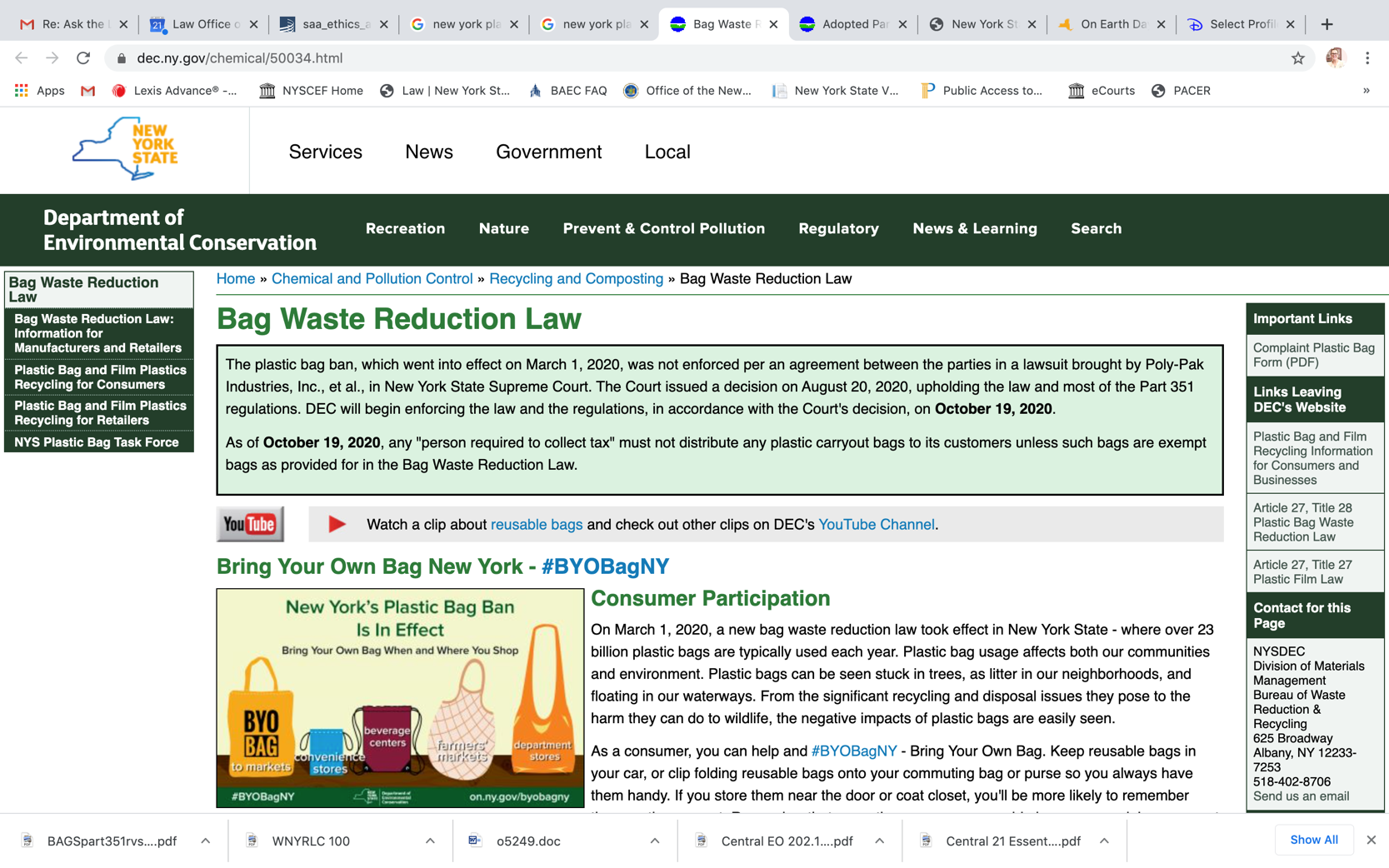
[NOTE: This question relates 6 NYCRR Part 351, which implements the requirements of Titles 27 and 28 of Article 27 of the Environmental Conservation Law, aka "the plastic bag ban" which went into effect March 1, 2020, but was suspended for a variety of reasons until October 19, 2020.  For more information on that, see the graphic at the bottom of this answer.[1]]

Does the NYS plastic ban law apply to libraries using plastic bags for curbside pickup?

We purchased plastic bags to hold library items that patrons request, label the outside with their name and leave the bags on pick up carts in the foyer of the building. This is for patron privacy-others cannot see what a patron has requested. As well as a COVID-19 measure-others are not touching items for pick up to search for their materials.

We are tax-exempt and not selling anything. When our supply is exhausted I will explore other possibilities in order to support less plastic waste, even if the ban does not apply to us. But in the meantime, are we in violation of the plastic bag ban if we continue to distribute materials in plastic bags?


[1] Found on October 21, 2020 at https://www.dec.ny.gov/chemical/50034.html

Answer

The answer for this member is: NO.

Why?

The NYS plastic bag ban does NOT apply to libraries using plastic bags for storage of items pending curbside pick-up, unless the libraries are required to collect sales tax.

So while this member's library can choose to phase out plastic bags[2], since it is not required to collect sales tax ("we're not selling anything"), it is not compelled to do so.

Here is what the new regulations prohibit:

351-2.1 Prohibitions. A person required to collect tax shall not:

(a) distribute any plastic carryout bag to its customers unless the bag is an exempt bag;

...   [emphasis added]

"A person required to collect tax" (as if the term really needs clarification!) is defined as:

(l) ‘Person required to collect tax’ means any vendor of tangible personal property required to collect New York State sales tax pursuant to subdivision (a) of Section 1105 of the New York State Tax Law, “Imposition of sales tax.”

The trick is that the application of the law is not based on the taxability of the sale, but rather, the status of the bag distributor as a "person" required to collect tax. 

This is further borne out by commentary from the NY Department of Environmental Conservation, which states[3]:

As of March 1, 2020, all plastic carryout bags (other than an exempt bag) became banned from distribution by anyone required to collect New York State sales tax. For sales that are tax exempt, plastic carry out bags are still not allowed to be distributed by anyone required to collect New York State sales tax (unless it is an exempt bag). [emphasis added]

So, while the vendors at your library's annual craft fair (if you're able to have a craft fair, sigh), who have to collect sales tax, can no longer use plastic bags, a non-sales tax-collecting library's curbside delivery service can.

Extra credit:

At "Ask the Lawyer," we are not used to being the bearers of good news.  So just to be sure—I mean really, really sure—that we could give the above answer, I also checked the " REVISED REGULATORY FLEXIBILITY ANALYSIS FOR SMALL BUSINESSES AND LOCAL GOVERNMENTS" found on the NY Department of Environmental Conservation's web page at https://www.dec.ny.gov/docs/materials_minerals_pdf/part351rfafinal.pdf.

The "ANALYSIS" is one of the documents that drills a little more into the law, and how it will impact those it covers.  It states:

In 2019, a new Title 28, “Bag Waste Reduction” was added to Article 27 of the ECL. This law bans the distribution of plastic carryout bags to customers, effective March 1, 2020, by any person required to collect tax. (“Person required to collect tax” means any vendor of tangible personal property subject to the tax imposed by New York State Tax Law section 1105(a), “Imposition of sales tax.”)

So, really: unless your library is collecting sales tax (for sales of food, or sales of items like t-shirts, office supplies, or other retail[4]), these new requirements do not apply.  But if your institution is registered to collect sales tax (for anything): beware, and "ban the bag."


Thank you for a great and timely question.

Plastic Bag Ban infographic


[2] Which, as the member states, they intend to do.

[3] On https://www.dec.ny.gov/chemical/50034.html, as of 10/21/2020.

[4] Yes, not-for-profit and education corporations that sell retail items have to collect sales tax (they don't have to pay it, but they have to collect it). For more info on that, see https://www.tax.ny.gov/pdf/publications/sales/pub750.pdf.

Can a public library set up a separate LLC?

Submission Date

Question

A public library is looking at the possibility of taking over the running of a medical loan closet that has been previously run by a church.

The library would find a space through a partner, so it would not be on library property.

The library would be responsible for cataloging the items, tracking their circulation, and applying for grants to help with funding.

The local visiting nurses have volunteered to handle the distribution of equipment, and are willing to continue if the library takes it over from the church.

The library's director and trustees are concerned about insuring the library to protect it in the event that someone gets hurt using a piece of equipment and there is the possibility of a lawsuit. They talked to their insurance agent and the company they use would not cover this.

A discussion came up about starting a separate LLC for the medical loan closet that the library would be openly affiliated with.

Would it be possible for a public library to set up a separate LLC to do this?

Answer

Before I answer, let's talk about why a person or business might create an LLC ("limited liability company").

A primary function of an “LLC”[1] is to do exactly what the member has proposed—to create a separate entity designed to hold the liability associated with a particular venture.

Examples of how an LLC can be used to take on liability (and keep it from flowing to its owner/s) include: ownership of rental properties, operation of restaurants, and yes, collaborative formation of charitable initiatives, like a medical closet operated in affiliation with a library.[2]

This is because, when set up properly, an LLC allows its "members"[3] to have an ownership stake in the company, while minimizing the risk of liability associated with the LLC adhering to other parties (like the members).

For this reason, a lot of property owners and participants in risky ventures[4] use an LLC to contain the liability that could result from the risks of the venture.  This helps with insurance, critical decision-making, and keeping unrelated assets separate from the liabilities of a venture.

Aside from this primary “separation of risk” function, the LLC model also allows creative arrangements for financial operations and tax considerations.  Among many other things that relate to ownership of family businesses, and complex corporate structures, this includes allowing one or multiple 501(c)(3)[5] not-for-profit charitable entities to form an LLC that will have a similar tax status. 

So the "short answer"[6] to the member's question is: YES.

That said, I do have a "long answer" composed of several considerations and caveats, which I hope will be helpful.

Consideration 1: Audit.

While the laws governing public libraries[7] do not forbid--and arguably expressly allow--an education corporation like a public library to own, or partially own, the asset of an LLC[8], a review of various New York State Comptroller audits[9] shows that any assets flowing between the two entities will be considered subject to all the requirements that must be followed by the library.

In other words, if the State Comptroller conducts a fiscal audit of the library (as State Comptrollers are randomly wont to do), the Comptroller will not only look at the books of the library, but also the books of the LLC—subjecting them to the same scrutiny as the library. 

So, to the extent money and resources flow from the library to the LLC, the same constraints on procurement, investment, and other use of assets will be imposed on the LLC.  This could bar or limit the activities of the LLC, so should be a primary consideration when it is formed.

Consideration 2: Operations

By "operations," I mean: who is helping the LLC get the work done?

In the scenario submitted by the member, it is the library who will "be responsible for cataloging the items, tracking their circulation, and applying for grants to help with funding."  Meanwhile "local visiting nurses have volunteered to handle the distribution of equipment."  And finally, as described by the member, the storage/pick-up (the "Closet") will be off-site (not on library property).

This means that the LLC would rent/borrow the space for the Closet, volunteer nurses would work there helping to distribute equipment, and the library would use its personnel to track the lending and equipment.

And although the member doesn't specify, let's say the library doesn't use its own circulation system for this, but instead, buys or builds a custom system—maybe even something as simple as an Excel spreadsheet.[10]

So the library would supply the "time and talent" of its people on an ongoing basis to the LLC, perhaps tracking it as an in-kind support to the charitable venture,[11] and also separately purchase assets that would be solely owned and used by the LLC.

This "time and talent," is where "risk and liability" for the library—even with an LLC housing the operations—truly enter the picture.  Even with a separate entity designed to take the hit, when an entity supplies its own people to staff a venture, there is always some risk that the direct involvement of a third party can lead to an assertion of liability (when people sue, they often look for not only deep, but multiple pockets).

How do you solve that?  It takes two things:

Consideration 3: The Operating Agreement

By law, every LLC must have an "Operating Agreement" that specifies how the "members" run the company.  For small, simple LLC's, an "OA" can be a fairly short document.  For complex ventures with detailed financial goals and complex management structures, an OA can be hundreds of pages.

In the case of a "Medical Loan Closet" LLC meeting the criteria in the member's scenario, the operating agreement would have to address, head-on:

  • The precise responsibilities of each member[12]; and
  • The in-kind services being supplied by each member; and
  • The precise terms under which individuals would contribute their services, including volunteers; and
  • The precise way assets of the LLC are purchased, loaned, and de-accessioned (this is the part the Comptroller would look at); and
  • How the premises of the Closet is managed and insured; and
  • Most critically, the way the LLC would hold harmless and indemnify the participating parties for any assertion of liability against them based on LLC operations.

Which brings us back to...

Consideration 4:  Insurance

At the end of the day, this question is about two things: 1) how to do a good thing for a community; and 2) how to make sure the organizations doing that "good thing" properly manage the risks of doing it.

While much of this can be addressed via good planning, rigorous equipment maintenance,[13] and proper paperwork, as can be seen in "Consideration 3,” and as the member clearly knows, a venture that will be so closely connected to people's physical health must have some form of insurance. The coverage should extend to every person with either a fiduciary, employment, agency, or volunteer relationship with the Closet.

While precise coverage amounts should be determined by the participating parties, my instinct is that there should be at least $1 million of coverage per incident, with no less than $3 million/year aggregate.[14]  But it will depend on many factors.

So, what to do?

Many times, there is a very solid reason to start an LLC.  If the Closet described by the member was going to own real property, have its own employees, apply for grants, and in general, take care of most of its operations in-house, with the support—but not the direct service—of the members, I'd say that was the right solution for this scenario.

However, if the Closet is to be a collaborative effort that will rely on the direct services and assets of the member organization/s (in this case, services by library employees, on library time), in my experience[15], a tightly structured plan that properly establishes the responsibilities of the collaborating parties—and ensures there is proper insurance coverage for all involved—might be the most practical way to move forward. 

This will also position the library to do the right type and amount of "volunteer vetting" and to properly confirm the conditions of (and insurance coverage for) the volunteers.

So, on a practical level, what am I saying?  A library can spend thousands to set up a charitable LLC to run a Medical Loan Closet[16], and then about a thousand or so a year to ensure the proper administration of that LLC--or it can develop the Closet as a program of the library (either stand-alone, or in collaboration with others) and spend the money on additional risk management and insurance. 

After all, we're not talking small engine repair, here.  Lending things—even if it is health-related equipment—is part of any library's core mission.

At the end of the day, many factors will play into the decision to use 1) an LLC, 2) a collaboration agreement[17], or 3) to simply operate the Closet as a new program of the library (with some volunteer agreements for the nurses). 

To get to the part where the library can make the decision, I advise developing an "Operational Plan"[18] for the program, and getting quotes from several insurance carriers as to what the coverage would costs for your library and/or for a new entity to conduct the activities in the Operational Plan.

Since there will be a lot of detail to review, a small ad hoc committee[19] consisting of a board member or two, the library director, any other person whose input will be helpful, and the library's attorney, can then review this information, and come up with a solution to pitch to the board. 

And when that pitch is made, everyone should be confident that there is no "wrong" way to develop a new, life-saving lending initiative—so long as the way selected clearly defines everyone's responsibilities, establishes that clarity in writing, assures legal and fiscal compliance, and ensures everyone helping out is covered by insurance.  With the right attention to detail, this could be an LLC—or another solution.

I wish this venture luck and stout hearts for getting it over the finish line; it sounds like a great asset to any community!


[1] When I write about LLC's, I really struggle with putting "an" before an acronym that begins with a consonant ("LLC").  But the rules on "indefinite articles" assure me it is proper.

[2] There are some questions about the operation of a collaborative 501(c)(3) LLC in New York, but they happen, and haven't been shot down yet.

[3] "Members" is what the New York State Limited Liability Company Law calls owners.

[4] I don’t mean “risky” as in “Don’t drive that Pinto!” In in this context, “risky” applies to any venture that has a risk of exposure to legal claims due to having premises, employees, contractual obligations, or providing goods/services.  In that context, even my own law office (which is a type of LLC) is “risky.”

[5] "501(c)(3)" is a designation from the IRS that allows a library or other charitable organization to accept donations while the donor takes a deduction.

[6] Trust me, this WAS that short answer!  Another business lawyer who reads this will find it pretty skimpy.

[7] The Education Law, the Not-for-Profit Corporation law, the General Municipal Law, the Public Officer's Law.

[8] This is NOT to say that the local library could engage in a hostile takeover of the LLC-operated laundromat next door to ensure the very loud HVAC system is turned off during children's story hour.  A not-for-profit, and a public library, both have extensive rules regarding what assets and investments they can own, and how they can benefit from them.  But it could be done (in my hypothetical, it could be done if either: a portion of the laundromat income was a directed donation used to purchase special collections OR if use of the machines to clean clothes while reading or using library Wi-Fi was a free service to the community tied into the library's Plan of Service.  Which, by the way, would be AWESOME).

[9] When I want to relax, I just pop on over to the Comptroller's "library audits" page at https://www.osc.state.ny.us/local-government/audits/library, and have a jolly good read.

[10] My apologies if my assumption that such a project could be tracked via Excel is laughable.  While I can script out workflow and compliance protocols like a pro, my database programming skills stop with a 4-column chart in "Microsoft Word."

[11] Remember, the assets of both a not-for-profit and a public library come with heavy restrictions.  This includes the "asset" of the workforce.  In this scenario, we're assuming all the right paperwork for "lending" employees to a venture is properly in place...not something to assume lightly in the Real World.

[12] Operating a charitable LLC is fairly simple after the start-up phase, but there are routine tasks that must be kept up with: book-keeping, audit, routine IRS and Charities Bureau filings, compliant procurement, de-accession.  Consider who will be responsible for all these things.

[13] This consideration—about properly maintaining loaned health-related equipment—is addressed in the RAQ response to a question we got back in April 2020 about lending a Telehealth kit, which is found here: https://www.wnylrc.org/ask-the-lawyer/raqs/132.

[14] A great short cut on this would be to find some other medical loan closet programs in New York and ask who their carrier is.  Establish your credentials and tell them why you need the information first, though...places get VERY nervous when you ask who their insurance carrier is!

[15] At this point, I have worked on joint ventures for educational purposes, arts purposes, community gardens, the development of apps for civic transparency, community murals, and just about every feel-good thing you can think of.  I will never be rich, but I love my job.

[16] A word of caution: the phrase "Medical Loan Closet" is part of a name protected by a trademark, the "Wichita Medical Loan Closet" which can be seen here: https://tmsearch.uspto.gov/bin/gate.exe?f=tess&state=4802:iitou7.3.1. When developing a "closet" program here in New York, take care to distinguish your brand so there is no risk of getting a cease-and-desist.

[17] Remember, a “collaboration agreement” is different than an LLC’s “operating agreement.”  A “collaboration agreement” unites the efforts of two or more entities creating the venture, and manages risk WITHOUT creating an LLC. 

[18] The "operational plan" will evolve once you make the decision about the entity type, but to start it is just a description that sets out how the Closet will run.  If the idea is largely to use the same model used by the current operator, that is a fairly simple task, but make sure to include every role and responsibility, simply noting "TBD" is you don't yet have an answer.  An inventory of equipment will be an essential component of this exercise.

[19] Since I have hit you with a lot of detail that could be daunting, I will add this gratuitous advice: if possible, have a meal or fun snack at your planning meetings (even if they have to be via Zoom right now).  I have been working on a charitable planning committee, and by turning it into a convivial experience, we are getting through some fairly obscure stuff while staying in touch with basic human joy.