Streaming

Using Copyrighted Audio in Online Course

Submission Date

Question

[We got a question from an academic library...]

I have a question about using copyrighted materials in my classes.

A few years ago, I purchased and listened to the audio version of a Great Course called "[NAME REDACTED TO AVOID COMPLICATIONS]." Each lecture is about 30 minutes and I thought they would make a great weekly assignment in my "[NAME OF CLASS ALSO REDACTED]" class. I would have students listen to a lecture and then focus their discussion around it.

My question is, what legal ways can I share these lectures with students? I have purchased the video series at thegreatcourses.com (for $29.95). I know I can't take a screen recording of them and post on YouTube public, but could I take a screen recording and post in Brightspace? That way, they would not be able to disseminate it or access it beyond the end of the course."

PS "Brightspace" is course software (Like "BlackBoard")

Answer

The question is: what legal ways can I share these lectures with students?

The answers are:

1.  List the video series in the syllabus as a course material to acquire (I know...."BOOO").

2.  Work with the school's library to buy or license sufficient copies of the series for it to be generally accessible to the class through the library (I know... possibly also "BOOO", since the student has an extra step to access the content, but otherwise a decent option).

After these two, as they say: "I got nuthin'."

I cannot endorse the solution described in the question, since both creating a recording of the series and publishing it via Brightspace could create a possible claim of copyright infringement (even if the likelihood or discovery on a closed network was minimal).

I also cannot endorse playing the series during class, since the TEACH Act, which normally would allow watching a copyright-protected recording in class (either in person or via remote learning), does not apply to materials marketed as "mediated instructional activities" (such as a Great Course).[1]

I cannot even offer a "fair use" as a solution, since what you'd like to do does not meet the test for fair use, even though the purpose would be educational.[2]

This is an area where many instructors are going rogue, because the law does not offer a good solution (I am sure most readers have thought of a few not-so-good solutions by now).  But I cannot offer any guidance based on going rogue (well, not when it comes to copyright).

For more on the TEACH Act and fair use, see previous “Ask the Lawyer” answers including Streaming movies in school and the TEACH Act and Viewing DVD materials with remote-based students.

I hope your academic librarian can assist; this is an interesting challenge.


[1] If you would like to read some interesting commentary about the TEACH Act being a "failure" due to the limits it imposes on online learning, check out the 2021 Congressional record here: https://www.copyright.gov/1201/2021/hearing-transcripts/210419-Section-1201-Public-Hearings-Class-5-14a-14b.pdf.

[2] The "fair use test" balances four factors (only one of which is if the use is educational): https://www.copyright.gov/title17/92chap1.html#107.  When I apply those four factors to this situation, I don't arrive at a fair use defense (and my fair use cup is usually half full).  That said, when the use is academic, the key is to ensure the home institution will have your back if infringement is threatened; many institutions have a "fair use form" for this.  Cornell has a nice breakdown of the factors here:

https://guides.library.cornell.edu/copyright/fair-use, and a handy checklist for doing your own assessment here: https://guides.library.cornell.edu/ld.php?content_id=63936868.  
Rights for music during graduation ceremonies

Submission Date

Question

We have received several questions about setting graduation ceremonies to music and streaming them or recording them and sharing them with students. What are the laws surrounding this? There seems to be a lot of misinformation out there. Below is a question I received:

The slideshow for the [public] high school graduation is complete. [T]he students would like to have songs from “High School Musical” added to the slideshow. Is this possible? If copyright comes into play and we can't there will be no music added to the show. Please advise, We have viewed many other shows from various high schools and at the end of the show it simply states "we do not have rights to this music."

Answer

The need to migrate ceremonies online has created a tsunami of copyright concerns.  What is a ceremony without the right music?  But this question pertains specifically to high school graduations for public schools, so we’ll confine it to those institutions.

Readers, I have to be real with you: a newly minted Supreme Court Case, Allen v. Cooper[1], means public high schools (which are arms of the state) are arguably immune from liability for copyright infringement.  In that case, the court invalidated the “Copyright Remedy Clarification Act (“CRCA”), which had expressly removed state’s “sovereign immunity” to a copyright suit. So on a very pragmatic level, some public schools, colleges, and universities may be adding that to their risk assessment of questions like this.

But professional educators likely don’t want to do the wrong thing simply because they are arguably immune from being punished for it.  As Justice Kagan, writing in Allen and quoting an expert witness put it: “what State, after all, would “want [] to get a reputation as a copyright pirate?”   So we’ll proceed just as the member’s question suggests: that they want to do the right thing.

With that in mind, here is my answer to the question: “[T]he students would like to have songs from “High School Musical” added to the slideshow. Is this possible?

My first bit of guidance is to check the school district’s license with either ASCAP or BMI (this is the license that covers permission to play music at a high school dance). It may be that some streaming rights got thrown into your public performance license. This isn't typical, but you never know, and if you have the right clause in your contract your problem could be solved right away (and in fact, your problem never existed).

If there isn't a contract that already gives your school permission to use the song(s) as the member describes, your school needs permission. This can be done through any number of licensing agencies.

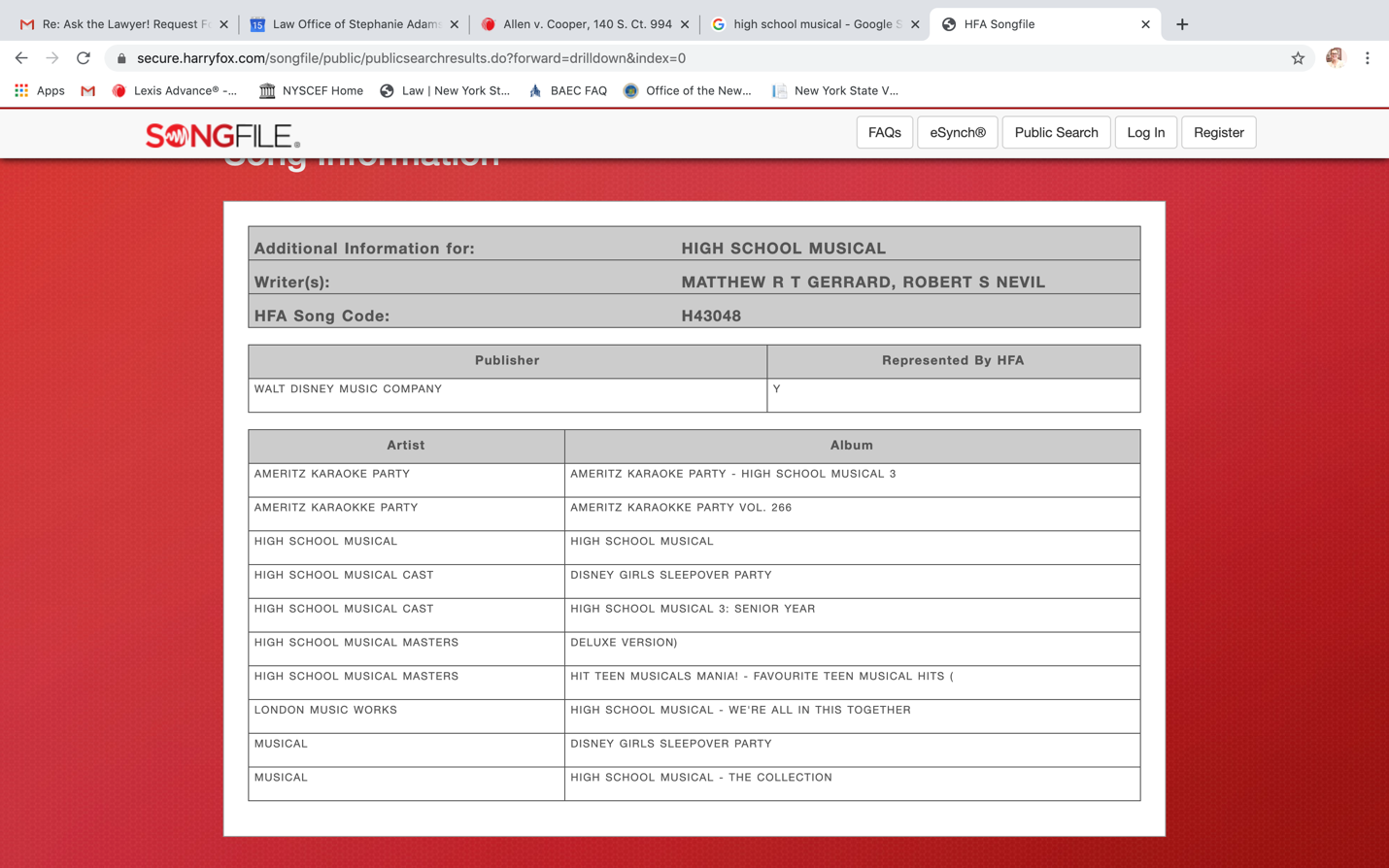
As but one example, the music to “High School Musical” is available for licensed streaming through the Harry Fox Agency:

Songfile permissions screenshot


(As can be seen, your school could even decide to use the karaoke version.)

The bad news is that it’s sort of a pain to obtain the license; you have to register and there is a fee.  Further information can be found at the link here: https://secure.harryfox.com/songfile/faq.jsp#faq2.

[NOTE: since a school district is one legal entity, it is also good to check and see if the district itself has an account already.  Signing up for a service like this does not need to be done on a school-by-school basis. Of course, this brings us to school policy and procurement issues, and for that, I refer to the attorneys serving the BOCES that serves your school!]

I hope the red tape doesn’t get in the way of the students having a good ceremony.  They have been through enough this semester.


[1] You can find the full text of the case and some commentary here: https://www.scotusblog.com/case-files/cases/allen-v-cooper/

Purchasing streaming services in libraries

Submission Date

Question

Is it legal for the library to purchase a Netflix account and install it on a Roku or Firestick and lend that out for patrons to use? See also: Amazon Prime, HBO Max, Disney+, Paramount+, etc. etc.

Answer

When this question came in, our first thought was that it was addressed in answers such as ATL 191 and ATL 104, and even older ATL 55, where we tackled the types of limits streaming services impose on accounts via contract. 

These answers (and others) discussed how most[1] commercial streaming service contracts limit the ability to transfer a personal streaming services account to another person (temporarily or permanently), even if the transfer is limited to one person at a time.

The member replied that we hadn't yet addressed their issue.

This question was submitted in June of 2021, and I have had a chance to chew it over.[2]

As I chewed, I reminded myself of a few things:

  • librarians, as a profession, need to see information flow
  • librarians, as a profession, are innovators;
  • librarians, as a profession, are service-oriented.

This is different from lawyers.  If you say: "An enforceable contract with no loophole means no one gets to borrow a Firestick to access 'If Beale Street Could Talk' during Black History Month," to a lawyer, they will say "Hmm.  When does that contract end?  Let's make a note for future negotiations."

However, from what I've seen, if you say something like that to a librarian, they will reply: "There has to be a way."

This may have something to do with why the librarians have a more popular profession than lawyers.[3]

So...is there a way?  I see three ways.

First way: enable the lending through a stark and deliberate violation of the streaming service's terms.  Just do it.

Of course, choosing to do such a thing runs a heavy risk of potential liability (for both the library and the borrower), so this is a VERY, VERY, VERY, BAD IDEA. Don't do it, unless you have worked with a lawyer on a strategic defense and are planning to use any potential litigation as publicity to negotiate changes to streaming contracts (a sort of contractual "civil disobedience").

Second way: reach out to the streaming service and see if you can negotiate a custom arrangement.  For instance, it would be very interesting to see if a library could negotiate up to 10,000 viewing hours on an annual basis to be on accounts specially created to be shared.  Clever lawyers at the streaming service could even make sure that this was regarded as a charitable donation by a streaming giant, and of course, they would also milk it for positive publicity.

Third way: You need to Go Big.

What do I mean by that?

This question is yet another example of the troubling trend of for-profit content aggregators using their market share to restrict information access.

This used to be the bleeding edge of concerns created by the intersection of copyright/contracts/capitalism, but it is now a firmly established Problem.

In my work, I have consulted with academic libraries and other institutions on how scholarly and public service-oriented content providers can guarantee access is not completely cut off on the basis of money. I have worked on checklists for contract negotiation, and provided model contract terms to help libraries use their market power to ensure big aggregators don't use their market power to stifle access, innovation and collaboration. This is not new work and I am not the first person to say this; it's an issue to which the library community is very much aware, and is closing ranks.

To solve this issue, there are a few ways to go. The best way would be to seek amendments to the copyright law to carve out further protections for libraries who are sharing electronic resources and streaming access in furtherance of their missions. This type of discussion is happening in Washington right now, and it is critical that everyone is rooting for the right revisions to be put into the law.

The second way is of course a version of my second answer above...use contract, and the market share of libraries, as leverage to negotiate for terms that enable the type of access the member is suggesting.  While I am a fan of using contracts to come up with creative solutions, this will not create an even playing field for the different types of institutions who need to benefit from this, so I prefer the legislative option.

I encourage all librarians to monitor this discussion at https://www.copyright.gov/policy/section108/, because the question the member has provided is exactly where the rubber hits the road on that type of legislation.

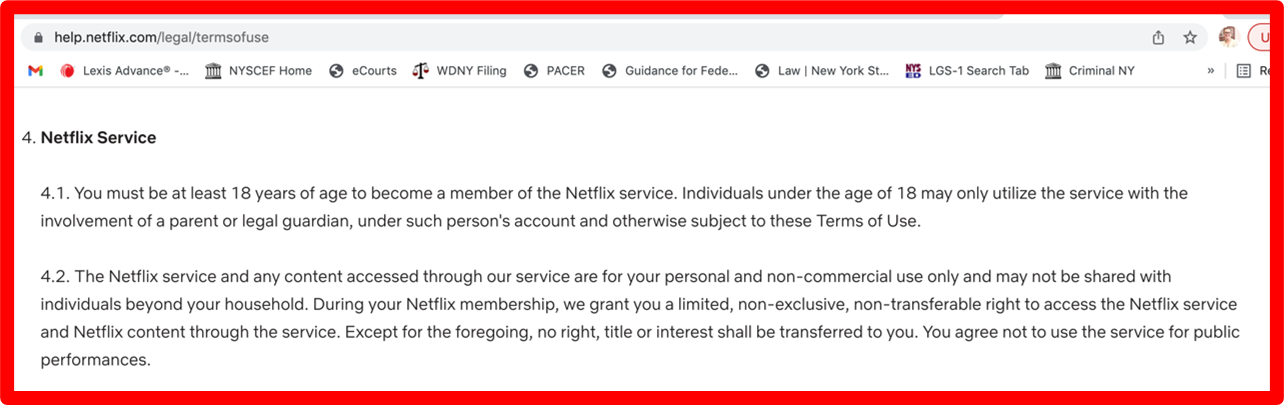
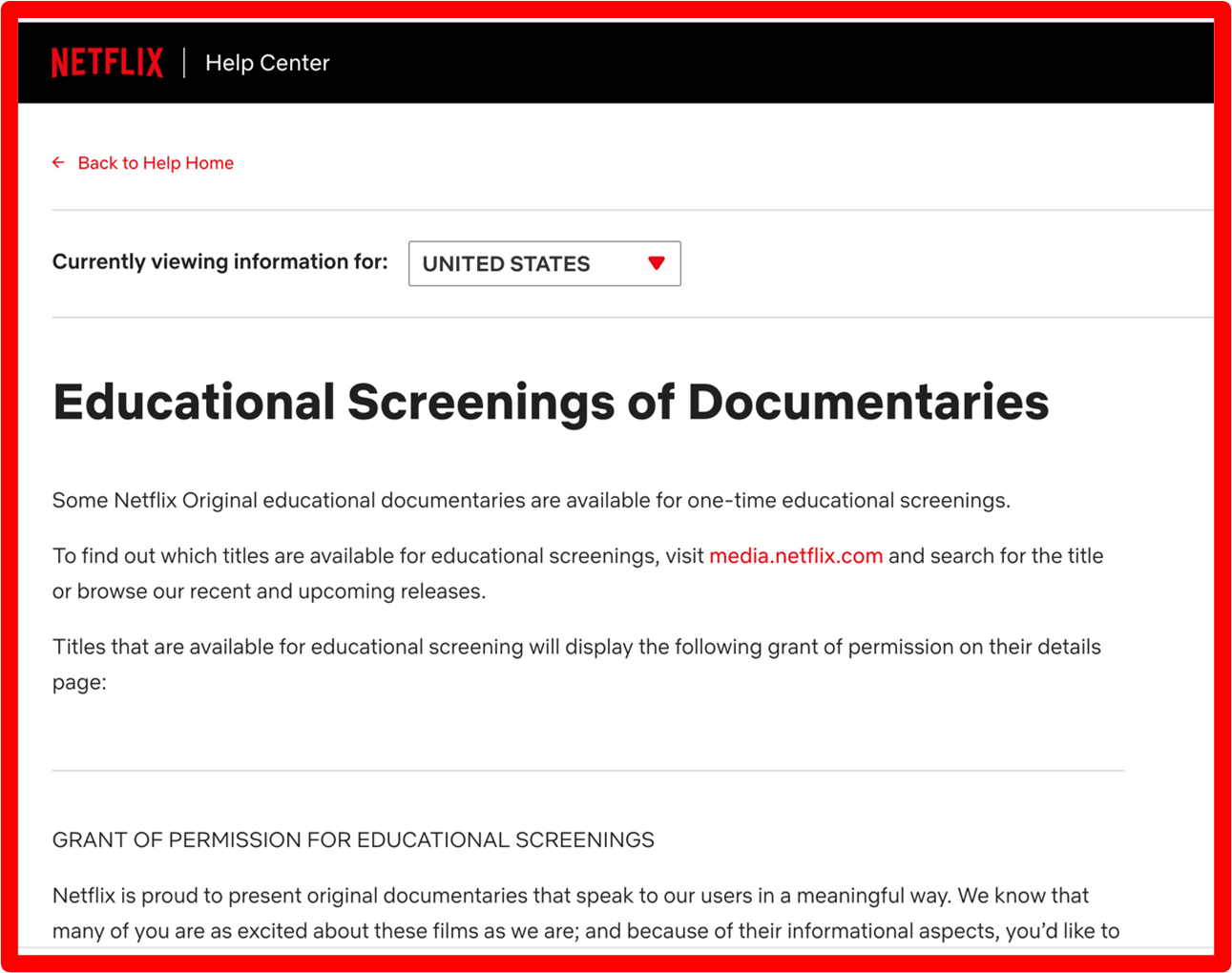
I am putting screenshots of the Netflix terms of service below this answer, which I took on February 11th, 2022, to show that at least as of this date, that particular streaming service continues to restrict access to personal use (first red box), with very limited exceptions for certain educational showing of certain documentaries in educational settings (second red box).

Thank you to the member for your tenacity, and for submitting this question.

Netflix terms of use screenshot


Screenshot of Netflix Educational Screenings help center


[1] Actually, based on what I've seen, "all," but most of the services reserve the right to change the license without notification to the end user, and of course, I am not omniscient, so I'd like to think there's a streaming service out there somewhere with less draconian terms. Hope springs eternal!

[2] And swallow it, digest it, and create this end product.  Many thanks to CLRC and member Hamilton Public Library for your patience!   It took a rain-logged, windy Saturday in February 2022 to get me in the right head space for this.

[3] I took a look, and of course, "National Librarian Day" happens every year in April. As librarians no doubt know, NLD is billed as a chance to "celebrate" your local librarian. Interestingly, April also hosts international "Be Nice to Lawyers Day." That's right...we have ONE day a year when people are told to be "nice" to their lawyer!

Using a YouTube Video to create another video

Submission Date

Question

I am asking this on behalf of the Elementary School in my district. (I work in the library of our district's high school). The Elementary School participates every year in a program called PARP. (Parents As Reading Partners). The teachers and principal always make some sort of video to kick this off this event since pandemic times.

This year the entire school is reading the SAME book: The World According to Humphrey, by Betty G. Birny. (It's a story about a Hamster and how he deals with life issues). My district's teachers want to "borrow" liberally from this Animoto video: https://animoto.com/play/ICom40fpoTdMzDov931aDQ

This video contains four components: 1. Another School (We'll call it School X, an independent school in California essentially doing the same thing), 2. an interview with the author segment, Betty G. Birny, 3. an interview with a store clerk from PetCo and 4. a video of a hamster performing "cute antics" with a voice-over dubbed in called April's Animals. (This individual posts varied animal videos on YouTube)

What my teachers want to do is create their OWN video of teachers and the principal endorsing this book, interspersed with the hamster video from April's Animals. I did observe at the end of the Animoto video, there were credits provided. My school would not use the PetCo interview or the Author Interview or the School X video as those segments are directly related to that specific school. They want to do the same idea and only use the video provided by April's Animals. I didn't know if this would be problematic because we are a public school, this would not be posted on YouTube. It would be shown over our school network to our K-2 classrooms one time only.

Answer

The short answer to this question is: IF the video is only going to include the YouTube animal clips, and IF it is only going to be used in the school for instructional purposes, the proposed use is fine, since copyright section 110(1)[1] allows schools to play videos in class if the topic is related to a class, and YouTube doesn't limit use of its service to "personal" uses.

Now, I say "mostly" fine because, technically, the combination of the YouTube content into another video compilation could be considered the creation of a "derivative work" (like a sequel or a mash-up), instead of just "performing" (playing) the video as allowed by law.  But if the copy truly isn't leaving school grounds, and the "performance" is to promote a reading program in the classroom, and the footage really is just being swapping in and out with interviews with school staff, it would be a stretch for anyone to claim infringement.

With respect to the other issue that I detect in the question--would "School X" have a claim against the school for pinching its idea? I don't think so.  The project you describe is sufficiently different from theirs; after all, they got their author for their endeavor, and your school is focusing on local talent.  You can't copyright an idea[2]...just its expression.

When it comes to a school generating original educational content inspired by others, for use only within that school, the key is to model the type of respect for others that educators want to instill in their students, while taking full advantage of the protections educators have under the law.

In this case, "Respect" means not using pirated copies when a school plays instructional movies, and not using more content than the school is entitled to when the instruction is online.  "Protections," among other things, means that for in-person instruction, videos can be played, and for online instruction, parts of videos can be played, so long as the performance is from legitimate copies.[3]

[NOTE: For schools that want to up their game and start producing original content they will share with the world: this answer is not for you.  If any school out there is thinking of becoming an author/producer/provider of educational materials, don't rely on this answer, and develop a business plan that includes how to respect and protect IP.]

And finally, I have to say: thank you for this question.  First, it got me onto Animoto, which I am totally going to check out.[4]  And second: I love PARP.  Some of my fondest circa-1980 memories are of filling out my PARP form with my folks, after some time reading together on the couch,[5] so this question made me smile.  It's good to see the program is going strong, and the hamsters of the world are showing us how to cope with the ups and downs of life.


[1] 110(1) allows "Performance...of a work by instructors ...in the course of face-to-face teaching activities of a nonprofit educational institution, in a classroom or similar place devoted to instruction, unless, in the case of a motion picture...the performance... is given by means of a copy that was not lawfully made...."

[2] Of course, you can patent certain ideas, so please don't think I'm touting intellectual property anarchy.

[3] This aspect of Copyright Section 110 is different than the issue of streaming services being limited for personal use, and thus not always the best place for educators to get their in-class movies.

[4] I clearly don't get out much.

[5] My parents still have the same couch, which they got in 1964.   They are the greenest people I know.

Popular music in Public K-12 Schools

Submission Date

Question

I am struggling to find information on using popular music in public K-12 schools. I have the following areas I am trying to find information about:
1. Can a teacher use a Spotify account in their classroom?
2. Can a teacher use music with face-to-face instruction?
3. Can a service provider (counselor, therapist, social worker...) use music with students?
4. Can music be played during sporting events
5. Can music be used as part of the morning announcements

Thank you!

Answer

Welcome to "Back to School 2021"...a year unlike any other!

I have weathered many K-12 "back-to-schools."  For instance, second grade back-to-school, for me, was in 1980.  For my son, it was in 2010.  And for my daughter, it was just a few days before I sat down to write this.

That 1980-to-2021 time span has allowed me to realize two things:

Realization #1: Erasers smell the same in 2021 as they did in 1980; and

Realization #2: Back-to-school 2021 kicked off in a world that has gone through a lot of rapid and (at times) de-stabilizing change.[1]

The good news about realization #2 is that the law--which tends to change much more slowly than the world around it-- is much the same.  So, for this answer, where we can, we'll be linking back to prior "Ask the Lawyer" answers, and where there is something new, we'll add it.

QUESTION 1: Can a teacher use a Spotify account in their classroom?

ANSWER: Not unless the license has changed to allow more than "personal use."  For more on that, see Using Streaming Services (Hulu, Netflix) in the Classroom.

QUESTION 2: Can a teacher use music with face-to-face instruction?

ANSWER:  Yes, so long as the music is part of the instruction, and the copy of the song was legally obtained.[2]

QUESTION 3: Can a service provider (counselor, therapist, social worker...) use music with students?

ANSWER:  There is no automatic permission or exception to the copyright law that allows a mental health service provider to use recordings, sheet music, or other copyright-protected property for purposes of licensed service.[3]

QUESTION 4: Can music be played during sporting events?

If the recorded or streamed music is protected by copyright, it should only be played with a license.

NOTE: Public schools will want to consult their lawyers about their risks in this regard now that the U.S. Supreme Court has (arguably) struck down the ability to sue "the state" and its subdivisions for copyright infringement.
 

5. Can music be used as part of the morning announcements?
If the music is protected by copyright, it should only be played with a license. 

NOTE: Public schools will want to consult their lawyers about their risks in this regard now that the U.S. Supreme Court has (arguably) struck down the ability to sue "the state" and its subdivisions for copyright infringement.

And with that, I wish you a joyous back-to-school.


[1] Perhaps this is why I found the familiar aroma of new "Pink Pearl" erasers comforting.

[2] This is allowed per Section 110(1) of the Copyright Act, which states that "performance or display of a work by instructors or pupils in the course of face-to-face teaching activities of a nonprofit educational institution, in a classroom or similar place devoted to instruction" is not infringement. 

[3] As I write that, it strikes me that such services are so important, ensuring the resource can be used legally is important.  There are a number of ways to do that, depending on the precise circumstances.

Fair use and Youtube in Academia

Submission Date

Question

A taskforce at the college is wanting to use a recent song and video on Youtube. This would be a traditional lip dub with a little step up in production as they would use some greenscreen and use some face tracking to animate anti-racist quotes on the faces of the participants. They want to mimic some of the effects in the video as well as add some of our own. So it is transforming the work. Also, this would be a new creation based on the content of the video and use of the music.

In short, they are looking to do a lip dub of the song with their own spin on the video. The college has their own video streaming platform so this would not be on Youtube.
This would be for the campus community but there might be that people could share outside the organization.

The intent is to educate the campus and is part of a greater initiative to promote diversity equity and inclusion.

Answer

This submission is a "fair use”[1] question coming at us from a private college, so before we delve into a reply, I have to emphasize that the specific analysis in this case is limited to that type of entity (a private, accredited school).

Since it can get boring "emphasizing" disclaimers in prose form, I will emphasize it in verse:

          If ye a public library be

          This analysis is not for ye

          If a SUNY or public school

          Do not swim in this legal pool

Okay.  With that out of the way (and for those of you not put off by either the disclaimer, nor the crude verse), here is my answer:

Riffing on, parodying, and building on popular songs can be an effective way to convey a unifying or powerful message to a group.  The use of a known work of art can build on shared familiarity, while modifying it with a unique twist can create a unique and unifying experience. 

The technique described by the member is a very popular approach for higher education institutions, and for unrecorded performances/parodies/riffs that are done live on campus, the school's ASCAP/BMI may even apply (meaning, the site of the performance has permission).

Of course, this is 2021, and that means, it doesn't happen if it isn't on video (or in a picture).  And since we are still in the midst of a pandemic (although things are looking a tad brighter, here in May of 2021), having a video that is an experience customized, created and controlled by the school is a desirable way to build remote cohesion.

When considering the use of copyright-protected content without permission, there are two factors a private institution must consider:

1. Risk management

2. Copyright infringement

"Risk management" is not about the actual legality of one's actions, but the risk that one's actions will be observed and perceived as illegal.

In this case, the additional circumstances the member lists here (not using YouTube to post the final product) enables "risk management" in two ways: a) the resulting video will not be "purged" from YouTube due to a copyright "red flag" (which can happen even if there is a fair use); and b) by hosting it on a less popular server, it is less likely to be seen by services and bots that are "out there"[2] policing copyright laws.

But of course, an educational institution doesn't want to get away with infringement, it wants to not commit it.  And that is the essence of the member's question: is creation of this derivative work[3] a "fair use"?

In their question, the member has walked us through some of the "fair use" factors. The member identifies as an educational institution. The member states that the use of the work will be "transformative." The institution will use all of the audio, and be evocative of but different from the video.  And, although it is not specifically mentioned as such, the described use of the resulting derivative work will (clearly) not be a replacement in the market for the original.

What is missing from the submission is the consideration: why this particular work?  In order to justify a fair use-especially of an entire work (the audio), the use must not only be transformative, but there must be a reason why that particular work is chosen, and the message sent by the "transformed" work must relate to that reason.

In other words, you don't select the underlying work to re-transmit it at face value; you select the works to say something new, that at least in part, relates back to the riffed/parodied work.

The best example I have seen of this lately is a complete, unaltered use of the "Avengers, assemble," scene from the "Endgame."  The clip is exactly as it is in the movie, with no changes to audio or video, except the author puts captions near the various super-heroes as they show up, giving the characters new names, and drawing an analogy to how they saw the protests of 2020 developing. 

The end result of this modified "Avengers, assemble" clip is not only highly transformative--the clip is no longer in any way about the original superheroes--but the author uses the identities of the originals to make comments about both those iconic comic book figures, and the categorical names he ascribed to them.  It's such a good example, it could be used to teach "fair use" in a law school class (you can see it here, or just search "endgame protestors 2020 avengers" and it'll pop right up).

With regard to this use of audio and video, it is this question--why this particular work was selected--that is the missing piece of the puzzle.  So long as that piece fits in, there is a good claim for fair use.

If it is decided that there is a good reason to select the original work, the other thing to be cautious about is how the end result (the new video with the unmodified audio) is used.  If it is used only as described and is built into a structured discussion about equity and inclusion--especially if the lyrics and images are used as focal points in the discussion-there is a strong case that this is an academic, non-commercial use. 

However, we have to remember that at the end of the day, a college is a place where students pay to be.  If the video bleeds into recruitment materials, or is not coupled with the education/discussion, the more likely the use could be found to be commercial. 

So: the more "academic" the end result (and its context) is, and the more the initiative functions as both a comment on the source material, and its own, stand-alone message, the better.  Since fair use is not simply an additive analysis (it's not just one factor vs. another, but rather, how the factors resolve and then inter-relate to each other), every aspect of this is critical.

Within those parameters, and if care is taken so the video is only used in the educational context (not simply sending a link to it out in a newsletter, without the educational content and context), there is a strong case to make that the new video, inspired by the song’s current video and using that unmodified song, is not a copyright infringement. 

I am sorry I could not be more definitive...answers like this are why very often, people just ask for permission![4]


[1] I am going to jump right into this answer with the assumption that the reader knows the basics about fair use (Copyright Act Section 107).  If you don't know the basics of fair use, you can get the gist on in these "Ask the Lawyer" RAQ’s: Educational films without a licenseFair Use and Restrictions of Song Parodies

[2] So I went to find an example of these "bots" and got more than I bargained for; here is an example of not only how video-sharing services shut down fair use on platforms like YouTube and Facebook, but a story about how this blocking is impacting how people film and transmit law enforcement activity: https://www.eff.org/deeplinks/2021/02/cops-using-music-try-stop-being-filmed-just-tip-iceberg

[3] A derivative work is a work that incorporates copyright-protected work.  The right to authorize derivative works is one of the six rights reserved to the owner of a copyright.  Parodies that incorporate or draw heavily from the original risk being "derivative works" (and thus infringement) unless they are 1) done with permission or 2) are a "fair use."

[4] For instance, Weird Al, although he could likely claim fair use for many of his parodies, always gets permission.

Music Performance and Broadcasting on Webpage

Submission Date

Question

A high school band has purchased music with permission to perform. The music teacher has requested that the performance be shared on the school's website. From my understanding, the performance may be shared live / streamed (permission to broadcast) via the school's web page but may not be recorded and then posted to the website. The public performance relates to the site/building and not to the World Wide Web.

Please confirm whether my understanding is correct.

Answer

Your understanding is correct, but there are three additional details it is helpful to consider in this type of situation:

First, when a school confronts a concern like this, it should take a careful look at the license (the permission to use a copyright-protected composition) it purchased. 

This is because a license for sheet music can convey not only permission for on-site performance and broadcast, but also "recording" and "publishing" (posting).  I have observed that the range of these permissions will vary not only between publishers, but even between songs at the same publisher.  So, before recording (or deliberately not recording), check the fine print; you might have more (or less) permission than your district thought.

Second, it is good to consider why the school wants to make the recording and post it on the school website.  Is it to simply showcase the band on a page dedicated to the school's achievements?  Is it for fundraising purposes?  Or is it posted as part of a student newspaper or student club newscast?  If the post is part of an academic endeavor--especially one related to commentary or gathering news--posting part of a recorded performance could be a fair use

And third--though still on the topic of fair use--it is important to remember that "Circular 21" pertaining to "Reproduction of Copyrighted Works by Educators and Librarians" confirms that the Copyright Act allows educators to make:

"A single copy of recordings of performances by students...for evaluation or rehearsal purposes...."

Now, under no circumstances am I saying that this provision gives a school permission to record and publish (post) a copyright-protected musical work.  But a copy that is created incident to streaming[1] can be retained by the school or teacher, and perhaps posted to an intranet, if they plan to use it for rehearsal or evaluation later. 

The important take-away from all of these is: your school may have options from not only within but additional to the license.  By assessing the precise permission your school received, the reasons for recording, and the reasons for posting, a school can consider their full range of options.[2]

Of course, what copyright law can give, contract law can take away.  So, if your school has secured a license with a specific agreement that you will not make and post a recording, remember that's a contract term it agreed to, even if fair use would otherwise authorize the use.[3]

I know, I know, thinking about copyright while planning to make the most of a performance can feel like allegro, adagio, adagio, allegro...

Just andante, like the question models, plan what you need, and you'll find a good pace!
Thank you for a thoughtful question.


[1] I know "streaming" and "recording" are different, but as a technical matter, "streaming" does create a digital copy, even if it is fleeting.

[2] This answer does not consider limited posting on an intranet, although I'd argue that with planning such posting could be consistent with the CONTU guidelines for retaining a copy for rehearsal or evaluation.

[3] This is why people negotiating for license content should always be trained to not negotiate away rights your district has by law.

Producer permission for streaming services

Submission Date

Question

I know we can't use Netflix, Hulu, or Amazon Prime on a normal basis to show movies in our classrooms because when we sign up for their service, we sign a contract stating that our accounts won't be used for public performances (personal use only). I am understanding that it is because Netflix, Hulu, and Amazon Prime do not outright own the content on their platforms and enter into agreements with the owners of the content for personal use only. However, I wanted to find out if a student can use Netflix, Hulu, or Amazon Prime to stream a portion (5 Minutes) of a movie where the student has received written permission from the Producer of a movie to show it as a public performance... I wasn't sure if the Producer permission supersedes the personal account contract of the Streaming Service?

Answer

This question is a good question for the bar exam!  It is a great blend of contract law and copyright.

Well, that's enough positivity for today; time for the answer, which is...

No.

Here’s the simply reason why I say “no”: as the member states, Netflix, Hulu, etc. tend to[1] restrict their content for personal use, meaning: no classroom/board room viewings.  This means that even if the use is "fair" or otherwise non-infringing, non-personal-use viewing is barred by the agreement the account holder has with the service.

The more sophisticated basis for me saying "no," is this: Netflix, Hulu, and their ilk bar group viewing not only because of the contractual obligations they have to their content owners, but also because to do otherwise would mess with their economic model.  In short: it will cost them money.  So even if a copyright owner says it's okay, they might not be inclined to consent to a use contrary to their contract.

That said, to add to the law-school-ness of your question, I'll add to your scenario:

If the student obtains a DVD or finds an online copy of the 5 minutes they need, and plays that copy (not the one from a commercial content service) to the class, if the student truly has proper permission of the copyright owner, then what would otherwise be an infringement is not.[2]

Of course, this requires a DVD,[3] or an online copy from a source that doesn't bar the use via contract.[4]  And of course, my scenario defeats the purpose of your question, which is to view the 5 minutes of the film in the format that is (likely) the most convenient: streaming.

I am sorry to be a bummer.


[1] There are of course exceptions, as these services can feature education-specific content intended for educational use.  But those are the exceptions, not the general rules (at least right now).

[2] Sadly, this hack does not work if you use your personal on-demand account to make the copy.  See how Netflix bars this: "Except as explicitly authorized in these Terms of Use, you agree not to archive, download, reproduce, distribute, modify, display, perform, publish, license, create derivative works from, offer for sale, or use content and information contained on or obtained from or through the Netflix service." Those pesky lawyers think of everything!

[3] Which are quickly on their way to becoming as obsolete as—but not as cool as--vinyl, or cassette tapes.

[4] Which makes it painfully likely the copy is not 100% legit.

Music licensing and on-demand viewing

Submission Date

Question

Is it a violation of Copyright Law to publicly share a video recording of a DJ playing music from his music library for a public library archive and make this available for on-demand viewing?

Answer

My favorite DJ-related story is about how "scratching" a record,[1] as both a musical instrument and an act of composition, evolved in the hip-hop scene of the late 1970's and early 80's.[2]  It is a story of technological innovation, of community culture, and (as all good stories are) controversy.[3]  DJ's, like all contributing figures to culture, make for compelling scholarship.  So I am not surprised to see this question about audio-visual content portraying a DJ on a library archive.

The short answer is: sure, it could be a violation; but there are five things that can keep it on the right side of the law—or at least mitigate the risk if there is an unintentional violation.

Here are those five "things":

First thing

Is the posted video part of a well-developed and organized collection or archive?

If "yes," go on.

Second thing

Does the metadata on the unique video reflect that it is part of a well-developed and organized collection?

If "yes," go on.

Third thing

Is the music part of a recording of an event, or is the music a separate track with all other ambient sound (the crowd, street noise, the DJ talking over the music) removed (or never there)?

Even if "no" go on, but have the next two really, really tight.

Fourth thing

Has your library[4] conducted and documented[5] a "fair use" analysis[6]  of its posting of this particular content, and to the best of its ability, reflected accurate ownership of the item in the metadata and item information on the archive?

If “yes,” go on.

Fifth thing

Does your library have a "notice and takedown" contact point posted on its website, so anyone who believes the content is an infringement can complain, AND has your library registered[7] for "safe harbor" under the Digital Millennium Copyright Act?[8]

If "yes," DJ on!

Why do I have to do the "5-step hustle" to answer what seems like a simple (if compound) question?  Because how and why content is used can transform "infringing use" to non-infringing "fair use."  For a component of a scholarly or historic video archive, this means being able to show that a musical recording incorporated into an audio-visual record is not merely a gratuitous use of the audio content, but rather, a critical element of a work that transcends (and doesn't simply replace) the purpose of the original. 

This is, in some ways, a tall order.  But if you follow steps "1" through "4" above, you significantly increase your likelihood of getting it right. And as for step 5: the DMCA has been in the news, recently, as a part of the national info-tech infrastructure that is due for an overhaul.  But for now, it can protect certain kinds of service providers (like search engines, directories, and other information location tools) from liability for third-party infringement, and it is an essential part of any information database's copyright compliance toolkit.

Thank you for a good question.


[1] Which makes a sound like either "schkud-shckud-shzyaaa" or "hschhzka- hschhzka-zreek" depending on how you translate it into onomatopoeia, along with the skill and intent of the person doing the scratching.

[2] According to his tag in the Cornell University Hip-Hop Collection, scratching was invented by Grandwizzard Theodore.  However, there is some assertion that Grandmaster Flash put Theodore on the path to the scratch.  Either way, it is a good story.

[3] If you are looking for a new era to get obsessed with, early Hip-Hop is a good one.  It is replete with geniuses, scandal, and triumph—and provides insight into cultural and community factors relevant to today.

[4] This 5-step analysis assumes your library is a not-for-profit educational institution (like a public library).

[5] As in: done the analysis in writing (generally a form), and retained the form.

[6] From 17 U.S.C. Section 504(c)(2): "...The court shall remit statutory damages in any case where an infringer believed and had reasonable grounds for believing that his or her use of the copyrighted work was a fair use under section 107, if the infringer was: (i) an employee or agent of a nonprofit educational institution, library, or archives acting within the scope of his or her employment who, or such institution, library, or archives itself, which infringed by reproducing the work in copies or phonorecords..."  Of course, making video "available" can be considered a transmission under certain circumstances (like streaming), so make sure your "fair use" conclusion is solid.

[7] Your institution can register for "safe harbor" in some instances (when it is more of a "provider" than a "publisher") here: https://www.copyright.gov/dmca-directory/

[8] I like the way Creative Commons does it: https://creativecommons.org/dmca/

Transcribing records under Open Meetings Law

Submission Date

Question

Under the executive order, the modifications to Open Meetings Law meant we (I'm asking for several libraries in our system) record our Board meetings.

How long does a library (public or association) or a cooperative public library system have to keep the recording of board or committee meetings ?  Looking at http://www.archives.nysed.gov/records/local-government-records-schedule-browse?combine=meeting+recording, it states:
 "Four months after the transcription or minutes have been created"

Transcribing could be challenging, particularly for smaller libraries, so we were relieved to read that once minutes were created, we might not have to transcribe (hopefully we are reading that correctly).

However - our question is about the placement of the word "or".  Is it:

Option 1: Once transcribed, keep for four months. Once minutes are created and accepted (which might be less than four months - in our case, it would be at the next board meeting), you can delete recording.
Option 2: Whether transcribed or minutes created, keep the recordings for four months. 

Under option 2, it seems like there is a higher standard for meetings.  Pre COVID, our board meetings would occur, open to the public but usually no public in attendance, and the only "evidence" of the meeting would be the minutes.  Now, we are required to keep the recording for at least four months - which isn't a huge hardship but curious about the rationale behind that.

Thank you!

Answer

Before attempting to answer this one, my team and I looked to see if anyone else "out there" has tackled this question.

We scoured the usual places (NYS Empire Development's COVID site, Committee on Open Government, NY Archives, NYLA, etc.), but my staff and I didn't find anything right on point. That said, the COVID landscape changes fast, so please let us know if you find anything, and we'll post an update to this answer.

And with that shameless disclaim/plea on the record, here is my answer:

As I read it, the currently-governing Executive Order[1] requires an entity subject to the Open Meetings Law to keep the recordings until they have been transcribed—not just until the minutes have been created.

Here is my reasoning: Executive Order 202.1[2] changed the Open Meetings Law as follows:

...to the extent necessary to permit any public body to meet and take such actions authorized by the law without permitting in public in-person access to meetings and authorizing such meetings to be held remotely by conference call or similar service, provided that the public has the ability to view or listen to such proceeding and that such meetings are recorded and later transcribed. [emphasis added]

Although the normal application of the LGS-1 would allow for the recording to be erased upon creation of the minutes—just as the member points out—the Executive Order is an overlay that super-cedes (or at least, exceeds) normal record-keeping requirements.

I realize this means a library that can't afford to transcribe the recording any time soon will have to keep the audio around.  It's possible that the state, after considering the fiscal reality of the conditions the "later transcribed" condition imposes, may eventually tinker with the requirement, perhaps simply insisting the audio be retained for a certain time after the minutes are generated.[3]

I am leaning on the side of retention, and not taking the easy way out by swapping it out for creating minutes, because access to the process, in all its glory, is the default purpose of the law.  Further, Committee on Open Government Advisory Opinion has stated that while masks and social distancing remain requirements, entities subject to the Open Meetings Law must be making the proceedings contemporaneously available via audio or video[4].  So with all that, I have to err on the side of retention, access, and transparency.

Fortunately, digital sound file storage is not too costly these days.[5]

Thank you for a thoughtful question.


[1] Found at https://www.governor.ny.gov/news/no-2021-continuing-temporary-suspension-and-modification-laws-relating-disaster-emergency [NOTE: This link was confirmed as no longer active and removed on 02/25/2022 as part of the routine review of "Ask the Lawyer" materials.]

[2] Which as of this writing, is extended through December 3, 2020, by Executive Order #72, found on 11/17/20 at https://www.governor.ny.gov/news/no-20272-continuing-temporary-suspension-and-modification-laws-relating-disaster-emergency [NOTE: This link was confirmed as no longer active and removed on 02/25/2022  as part of the routine review of "Ask the Lawyer" materials.]

[3] This sounds like a nice ask to go out from a library advocacy organization.   "Please, Mr. Governor, can you waive the estimated $[AMOUNT] in estimated transcription fees incurred the same year when many localities are taking COVID-induced hits to their budgets?"  I'd sign that letter in a heartbeat.

[4] Found at https://www.dos.ny.gov/press/2020/Essential%20Meeting%20OML%20AO.pdf [NOTE: This link was confirmed as no longer active and removed on 02/25/2022  as part of the routine review of "Ask the Lawyer" materials.]

[5] Finding the budget to properly compensate qualified people to manage that storage is another question!