Accessibility

Does Title II of the Americans with Disabilities Act apply to born-digital archival collections?

Submission Date

Question

In April 2024, the Federal Register published the US Department of Justice’s final rule on Title II of the Americans with Disabilities Act (ADA). The rule includes specific requirements for state and local governments to ensure that web content and mobile applications are accessible to people with disabilities. My question is related to the applicability of Title II to the online collections of public academic libraries, and more specifically, to born-digital archival collections, i.e., archival collections consisting of materials originating in a computer environment.

According to the rule, state and local entities must follow the technical standard outlined in the Web Content Accessibility Guidelines (WCAG) 2.1 level AA. However, this rule allows for five exceptions: https://www.ecfr.gov/current/title-28/section-35.201.

I understand the updated regulation does not override the existing obligations under Title II to make reasonable modifications on an individual basis, but it is unclear if Title II applies to born-digital archival collections, or if these collections fall under the exceptions linked above.

Answer

Thank you for such a thoughtful (and complex) question.

To answer it, I am going to respond in the form of a dialogue between a lawyer and librarian that will allow other Ask the Lawyer readers at public institutions to assess if their born-digital archives must comply, too.

After establishing the criteria for applicability, the end of dialogue will address this question: Do the new Title II regulations apply to “born-digital” archival collections, and if so, is there any exception for non-compliant content?

Let’s go!

Lawyer: Hello! I see you want to figure out if your library’s archive of “born-digital” content has to follow the new Title II regs.

Let’s start with an easy question:

Is your institution a “public entity” (or part of a public entity) as governed by 42 U.S.C. 1213(1)?

Librarian: Yes / No / I don’t know!

Lawyer: If you don’t know, or want to double-check your answer, here is the definition of a “public entity”[1] in ADA Title II:

(1) Public entity

The term “public entity“ means—

(A) any State or local government;

(B) any department, agency, special purpose district, or other instrumentality of a State or States or local government; and

(C) the National Railroad Passenger Corporation, and any commuter authority (as defined in section 24102(4) [1] of title 49).

Librarian: Aha! / Huh?

Lawyer: If you are still unsure, here is another hint: the term “instrumentality of a state,” as used in 42 U.S.C. § 12131(1)(B), refers to governmental units or units created by them (like town libraries, school district public libraries, community colleges, SUNY, etc.).

Librarian: Okay, I get it. / Ugh, I’ll ask our library’s lawyer.

[Note: If you are a “public entity,” keep reading this dialogue. If aren’t a public entity… Stop! This dialogue is not for you.]

Lawyer: Okay, with just public entities going forward, it’s time for another soul-searching exploration into your institution’s identity. Is the “total population” of your entity over or under 50,000, making you a “large public entity”?

If you’re over 50,000, then your “Start Date” for these regulations is April 24, 2026.

If you’re under 50,000, then your “Start Date” is April 26, 2027.[2]

Librarian: How does a school or library even have a “population?”

Lawyer: This can get tricky for academic libraries, but here are three examples from the new regulations to help you:

  • The total population of a county library is the population of the county of which the library is an instrumentality.
  • A public state university located in a town of 20,000 within a state with a population of 5 million would be considered a large public entity for the purposes of this part because it is an instrumentality of the state.
  • A county community college in the same state where the county has a population of 35,000 would be considered a “small public entity” for the purposes of this part, because the community college is an instrumentality of the county.

Now that you know if you have to follow this, and if so, when you have to follow it, here are the new requirements for web and mobile accessibility:

Web content and mobile apps that your entity provides or makes available directly or through contractual, licensing, or other arrangements must comply with Level A and Level AA success criteria and conformance requirements specified in WCAG 2.1.

Librarian: Got it! / Uh, what does “WCAG 2.1” mean?

Lawyer: WCAG 2.1 is a standard of accessibility that makes sure web content and mobile apps work are compatible with adaptive technology. If you need more information on it, you can check it out at https://www.w3.org/WAI/standards-guidelines/wcag/glance/.

Librarian: Okay, but isn’t this question about exceptions to this rule for “born-digital “content in library archives?

Lawyer: Yes, it is! But to talk about exceptions, it is helpful to talk about requirements.

Librarian: Okay, I get it. But like the question says, aren’t there some exceptions?

Lawyer: Indeed, there are exceptions. Here are some of them from the section[3] quoted by the member:

(1) archived web content;

(2) preexisting conventional electronic documents, unless such documents are currently used to apply for, gain access to, or participate in the public entity's services, programs, or activities;

(3) content posted by a third party, unless the third party is posting due to contractual, licensing, or other arrangements with the public entity;

(4) conventional electronic documents that are about a specific individual, their property, or their account and that are password-protected or otherwise secured; and

(5) preexisting social media posts.

Librarian: Aha! Does “archived web content” cover anything in a public entity’s born-digital archive going forward?

Lawyer: No.

Librarian: Oh. Why not?

Lawyer: Because of how “archived web content” is defined in the new regulations.

With a few modifications for brevity, here are the criteria for archived web content:

(1) Was created before your Start Date, reproduces paper documents created before your Start Date, or reproduces the contents of other physical media created before your Start Date;

(2) Is retained exclusively for reference, research, or recordkeeping;

(3) Is not altered or updated after the date of archiving; and

(4) Is organized and stored in a dedicated area or areas clearly identified as being archived.

Of great importance to the question, this definition does not allow non-compliant born-digital content created after your Start Date, even if it is only on your website or mobile app because it is part of the archive.

Librarian: Okay, but is there another way non-compliant born-digital materials created after our Start Date could be in our online archive?

Lawyer: Yes! The regulations have another exception in a different subsection.[4]

This subsection provides that born-digital content generated by a third party does not have to comply (unless your institution contracted with the third party to provide it).

Here’s an example of how this works:

Let’s say your institution wants to create the archive “Born in Digital Shame: Non-WCAG 2.1-Compliant Materials posted by Public Entities.” You then gathered a bunch of non-WCAG 2.1-compliant content from other public entities, generated after their Start Date, and put it in your archive.

That would be fine. It would be a gallery of non-compliance, but it would be fine.

Librarian: Okay. Can we answer the question now?

Lawyer: Yes, we can now answer the fateful QUESTION: Do the new Title II regulations apply to “born-digital” archival collections, and if so, is there any exception for non-compliant content?

ANSWER: Yes, the new Title II regulations apply to born-digital content, with only the following two exceptions:

1) the content pre-dates your Start Date; or

2) it is from a third party and is on your website only as archival content.[5]

Librarian: That makes sense!

Lawyer: Yes, sometimes federal regulations do make sense… even if you have to write a Socratic dialogue to make sense of them.

Librarian: I need a beverage now![6]

Lawyer: Thank you for a great question!


[1] Definition is at 42 U.S.C. § 12131(1)(B).

[5] This is important. The functional part or your archive—the metadata, the search function, the display, will all have to be WCAG 2.1 compliant by your Start Date. But the material you are archiving does not.

[6] I have found that green tea mixed with a soothing herbal tea is a great blend for ploughing through federal regulations. What I drink after is between me and my bartender.
LED Lighting And Accessibility

Submission Date

Question

A member of the public called me regarding the trend to switch to LED lighting in many libraries, especially rural libraries applying for NYS Public Library Construction Funding. She told me that she suffers from Photosensitive Epilepsy, and LED lights (among other light sources) cause her to have seizures, which result in injuries. She said this disease has limited access to much of what we all take for granted.

The local library, across the street, was the only place she could go because of the older lighting. The library is about to undergo renovation, and LED lighting may be part of the project because of its cost-savings and environmental impact.

She would like the library board to reconsider and asked why the library has not conducted a “reduction of access survey” because public libraries need to maintain or improve access. Are there reasonable accommodations combined to be fiscally responsible?

Thanks.

Answer

This question is at the tip of a large and fast-moving iceberg.

As with many iceberg-type issues, when I started my research, I didn’t know how deep things went.

So, I did my usual thing when a question involves the Americans with Disabilities Act (“ADA”), went to AskJAN.org, to see what they had to say about LEDs and epilepsy.

As it turns out, as of June 6, 2024, AskJAN wasn’t really hip to this issue (LED’s triggering seizures), which--if you perform a simple Google check--you can see is emerging as a “thing.”

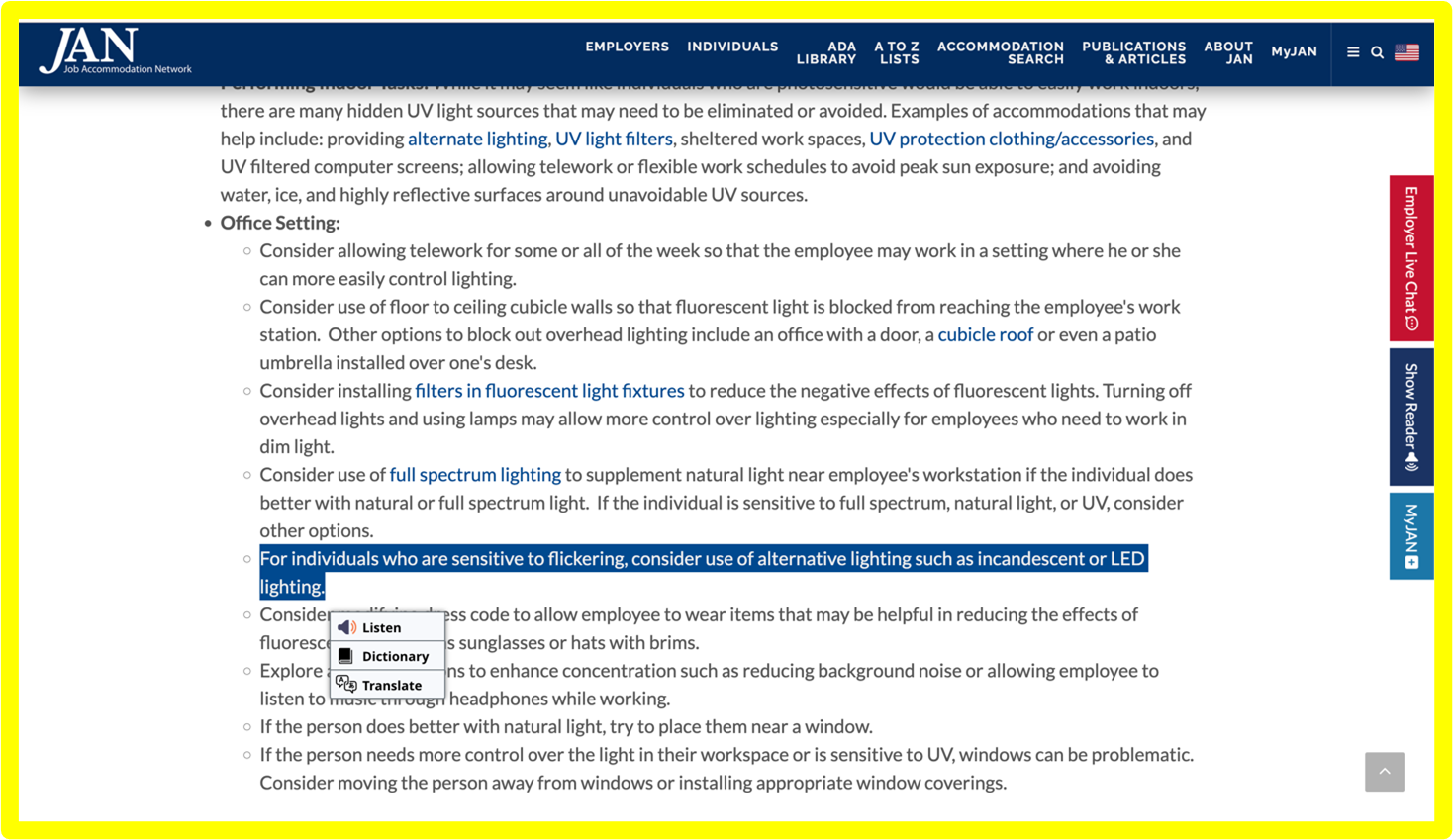
In fact, on their resource page for photosensitivity,[1] LEDs were listed as a possible accommodation, rather than a possible trigger to be mitigated:

 Screenshot from AskJan.org resource page on Photosensitivity. An arrow is highlighting text that reads: "For individuals who are sensitive to flickering, consider use of alternative lighting such as incandescent or LED lighting."

While frustrating, this actually answers the question: when a disability is triggered by environmental conditions (person-made or otherwise), if the need for the accommodation is not broad (like the need caused by limited mobility) it doesn’t become part of design criteria (like ramps designed to address limited mobility). This means it doesn’t automatically get factored in when places of public accommodation are renovated.

Of course, just because something “doesn’t automatically get factored in” doesn’t mean it isn’t considered when a person requests an accommodation. For instance, an employee whose migraines or seizures were triggered by LEDs could request a change in lighting, or to work from an alternate location, and that might be a reasonable accommodation. But again, that is different from a lighting choice during the design phase of a building renovation.

Now, I could leave it there, but we haven’t quite looked at the entire iceberg. So, for those who want to…

  • See some very interesting, annotated background on photosensitivity as a trigger of epilepsy;
  • Get in touch with the groundswell of J.Q. Public’s resistance to LED lighting, not only as a disability concern but a “quality of life” issue; and
  • Get a sense of where the federal government—the primary enforcer of the ADA—sits with LED lights as of May 24, 2024;

… I encourage you to read the U.S. Food & Drug Administration’s reply to the Soft Lights Foundation’s[2] request that the FDA regulate LEDs,[3] a request made in (small) part because there is a growing body of evidence that they can trigger seizures.

The good news is that while they are not required to reject LED lighting on the basis that it could trigger a seizure in a patron, libraries in New York are empowered to make their own decisions about lighting and can take into consideration the potential impact lighting can have on people—employees and patrons—and buy accordingly.[4]


[1] I appreciate that in this case, the photosensitivity is a trigger for epilepsy, not the actual disability. But still.

[2] Yes, there is a “Soft Lights Foundation” whose mission is to advocate “for the protection of people and the environment from the harms of Visible Light radiation emitted by products that use Light Emitting Diodes.” For more information, visit: https://www.softlights.org/about/

[4] Full disclosure: I hate LED lighting. Hate. Hate. Hate. We have some in my office in Buffalo, because it really is efficient, but it’s behind thick panels to dull the de-humanizing impact of its cold, hellish, dystopian lumens.

Accessibility Devices for In-Library Use

Submission Date

Question

We have a large facility. Sometimes patrons have to walk far to get to various programs and spaces. We have had a few patrons in the recent couple of months ask if we have a wheelchair or walker they could use to help them get around. We consulted with our insurance provider about this and he basically said to ask a lawyer. We want to provide accessibility accommodations but are also concerned if doing so opens us up to liability issues. Thanks!

Answer

This is such a beautiful idea! In my experience, there are three things that often impede beautiful ideas:

  1. Insurance concerns;
  2. Legal concerns; and
  3. People who worry that there might be insurance or legal concerns.

This question shows how to protect an idea from these impediments:

  1. Ask the insurance carrier;
  2. Check with legal; and
  3. Be in a position to assure worried people that you've handled the insurance and legal concerns.[1]

As it happens, Ask the Lawyer has addressed this question before, but under slightly different circumstances. In April of 2020,[2] we got a question about lending blood pressure cuffs, pulse oximeters, and forehead thermometers.

The risks assessed in that RAQ are somewhat the same as here, but as these mobility devices are only for on-site use, I will modify the guidance from a 9-step guide to a 3-step guide.

Step 1: Buy Carefully

The equipment purchased per the library's procurement policy and should be under warranty at all times it is in use.

Step 2: Set Clear Terms for Use

The rules and conditions for use of a mobility device should be clearly posted and should be individually agreed to by each user (just once).[3] 


Posted Rules for [Wheelchair/Walker]

This [insert item] may be signed out by any person who has signed the "Equipment Use Agreement" on a first-come, first-serve basis.

The [item] cannot leave [area].

This [item] may be used for up to [#] hours.

The manual for this equipment is at the [insert]. Please review before using.

Please clean the [item] after use; [spray and paper towels][4] are at [insert].

 Equipment Use Acknowledgements and Waiver

I understand the [insert item] may be signed out and used for up to [#] hours.

I have been provided with a copy of or access to the manual for this equipment and agree to use it as set forth in the manual.

Please select:

I agree to clean the [item] after use with the [spray and paper towels] provided.                   

                    OR                   

I request the reasonable accommodation of not having to clean the equipment after use.

I hereby agree to hold harmless the Library and its employees with respect to any injury related to the use of this equipment.

I am at least 18 years of age.

I understand that this agreement is in place until revoked by me in writing.

Reviewed and agreed by _______­­­­­______________ on ____________.

                                        Print name                             Date

Signature:


The Library shall retain a copy of this agreement for six years after its revocation.


Step 3:  Plan, Budget, Train, and Delegate for Function and Cleanliness

As established by Step 1, each mobility device should be carefully selected based on reliability, warranty, and ease of care. 

Step 3 is the other side of that coin: ensuring the mobility devices are maintained as required by the warranty and ready for use by the public.

Since the device will need to be cleaned between each use,[5] budget staff time to quickly check cleanliness and function between uses, and calendar for and log routine evaluation. If there is not sufficient time and budget to do this, it is better to wait and plan to do it in another fiscal year. The routine checking and cleaning of the equipment will be important to both its longevity and to any concerns related to its function (including alleged injury).

Thank you for a great question!


[1] I do not mean to make light of people who rightly point out that initiatives very often have insurance and legal concerns! It just frustrates me when the law and insurance are blamed for the death of an idea, instead of being allowed to support it (which, with proper planning, they can often do).

[2] What, you don't remember reading this one in April 2020?  What could possibly have been distracting you?

[3] This form is as much to be able to regulate use of a limited resource as it is to guard against liability.

[4] Ensure that the cleaning instructions from the warranty are used here.

[5] This is not a legal requirement but a common sense one.

Retention Period for Employee Records

Submission Date

Question

How long should the library retain employee records, payroll records, sales and purchase records, mortgage and loan documents, and other records?

Answer

Several considerations impact the answer to this question:

For a public library, the bare minimum record retention periods are found in a document called "the LGS-1."[1]  The LGS-1 has rules for retention covering everything from your library's charter, to how long you hold onto circulation records.

For an association library, which does not have to follow the LGS-1, those retention rules in the LGS-1 are a good baseline, but you have a bit more latitude.

However, no matter what baseline a library or other cultural organization chooses to adopt, it is good to keep in mind that required retention periods are routinely extended by things like:

  • Insurance policy requirements
  • Union contracts (for personnel records)
  • Grants, and other sponsored funding
  • Lawyers instructing a client to retain records as part of a "litigation hold"

In addition, while it can't be considered a formal "retention period", documents are also "retained" by institutions simply due to a tendency to hoard records.  At times, this can be a healthy tendency (like when letters from a first grade class from 1945, written to thank the local library for a story hour, are found in moisture-resistant storage, and they are turned into an exhibit).  Other times, it is not so healthy (like when borrower records from 5 years prior[2] are accessed during a burglary or hack).

For a large library (or museum, or other cultural institution) with robust funding and a large staff, "records management" per the LGS-1 or a customized "record retention policy" is often part of a person’s (or department's) job description--and is supported in the annual budget.  For a smaller library (or museum, or other cultural institution) with less-than-robust funding, and a smaller staff, "records management" is often an afterthought.  This can cause complications when the records pile up, and there is no person--or budget--to sort through them and make sure they are properly retained/purged.

But this question is about retention periods, not the drama they can cause!  So here is the answer:

For the types of records mentioned in the question ("employee records, payroll records, sales and purchase records, mortgage and loan documents"), the retention periods vary; some are "permanent", and others are as short at 6 years.  The LGS-1 (which will pop up when you search "LGS-1") will give you the breakdown.

For an association library that doesn't want to follow the precise requirements of the LGS-1, but still wants a retention policy, below is a model policy.

Thank you for submitting an important question!


[ABC] ASSOCIATION LIBRARY

RECORD RETENTION AND DISPOSAL POLICY

Items in yellow are to be changed or removed

Policy

The ABC Library retains and disposes of records as required by law, contracts, and based on the board's determination of what is in the operational best interests of the Library.

I.        Records are retained as follows:

-Association Library Charter, bylaws, Plan(s) of Service, Annual Reports: PERMANENT

-All records made available per the Open Meetings Law: PERMANENT

-Deeds: PERMANENT

-Contracts: (includes leases, mortgages, loan documents, vendor contracts, employee benefit contracts, warrantees, use of independent contractors): Seven years after termination of all obligations and rights created by contract; in some cases, PERMANENT. See "Archives."

-Employee-related: Seven years after termination of employee.  See "Archives."

NOTE: This will be impacted by an association library's union contracts, employee manual provisions, and employee-related policies; check these documents to ensure consistency.

-Fiscal & Financial: Seven yearsunless the relevant fiscal policy, document or transaction it is related to requires longer. See "Archives."

-Archives: PERMANENT

-Records pertaining to library operations (based on the LGS-1 to ensure consistency with non-association libraries in the XYZ Library System):

-Accession records: 1 year after accessioning procedure becomes obsolete

NOTE: Some libraries accession manuscripts, rare books and special collections, but not their general library holdings. In these cases, the accession records need to be retained only for the kinds of materials still accessioned.

 -Informational copies of records prepared by and received from public library system, including but not limited to directories, minutes, budgets and reports: 0 after superseded or obsolete

-Directory of public library system and member libraries, prepared by public library system (member library's copy): 0 after superseded or obsolete

-Library card application records: 3 years after card expires or is inactive

-Borrowing or loaning records: 0 after no longer needed

-Interlibrary loan records, including requests to borrow or copy materials from other libraries, receipts for materials, copy logs, accounting records, and circulation records

a) When no copies of original materials are requested: 0 after no longer needed

b) When copies of original materials are requested: 5 years after order is completed

-Catalog of holdings

a) Manuscript or published catalog: PERMANENT

b) Continuously updated catalog: 0 after superseded or obsolete

-Individual title purchase requisition which has been filled or found to be unfillable: 1 year

-Records documenting selection of books and other library materials:

0 after no longer needed

-Library material censorship and complaint records, including evaluations by staff, patrons' complaints and record of final decision: 6 years after last entry NOTE: Appraise these records for historical significance prior to disposition. Some library censorship records deal with serious constitutional issues and may have value for future research.

-Patron's registration for use of rare, valuable or restricted non-circulating materials: 6 years

-Program and exhibit file documenting planning and implementation of programs, services and exhibits sponsored or co-sponsored by the library, including but not limited to photographs, sketches, worksheets, publicity, brochures, exhibit catalogs, inventory lists, loan agreements, correspondence, attendance sheets or registration forms, and parental consent forms:

a) Parental consent records: 6 years, or 3 years after child attains age 18, whichever is longer

NOTE: Photo release records are covered under item no. 68 in General Administration section. Local Government Schedule (LGS-1) Library/Library System

b) Attendance sheets and registration forms, when no fee is charged: 0 after no longer needed

c) All other records: 6 years after exhibit closed or program ended

NOTE: Appraise these records for historical significance or value for collections documentation prior to disposition. Some of these records may have continuing value for historical or other research and should be retained permanently. Contact the State Archives for additional advice

II.       Records are disposed of as follows:

At the end of the retention period, physical copies are purged via shredding as their retention period expires.[3]

At the end of the retention period, electronic records are routinely disposed of by [insert input from your IT professional].

Archives

Prior to purging, all records of the Library are appraised for historical significance or value for collections documentation prior to disposition. Some of these records may have continuing value for historical or other research and should be retained permanently. Records retained permanently due to historic or research value are designated as "Archives."


[1] For more "Ask the Lawyer" on the LGS-1, see Board of Trustees Notes Retention. The 2022 version of the LGS-1 was, as of April 11, 2022, found here: http://www.archives.nysed.gov/common/archives/files/lgs-1-2022.pdf.

[2] I know library systems are very good about ensuring borrower records are purged from ILS once they are no longer needed, as authorized by the LGS-1.  This is just an extreme example to make my point.

[3] For more information on appropriate ways to dispose of physical copies, visit http://www.archives.nysed.gov/common/archives/files/mr_pub41.pdf.

Creating adaptive copies of textbooks using text-to-speech

Submission Date

Question

My institution subscribes to the "Kurzweil Reading Program", a "Text-to-Speech" product for those with reading impairments (dyslexia, English language learners, blind/vision impaired, etc.)

Section 121 indicates these users are "eligible persons" for "fair use", but others, without such disabilities could use the program (like an audiobook in the car!).

We'd be putting TEXTBOOKS up in the program; that fair use violation is what I'm worried about....

Thanks!

Answer

This question reflects the level of savvy "Ask the Lawyer" readers bring to their submissions.  The member submitting the question has already set out (in a manner much more succinct than I usually achieve) the interplay of:

  • Owner's rights (Copyright Act Section 106),
  • Adaptive copies made under "fair use" (Copyright Act Section 107), and
  • Copies made for purposes of accommodations for disability that impacts the ability to read (Copyright Act Section 121).

do have one quibble with the member's phrasing, though, and it is important to this particular issue: Section 121, while it allows copies otherwise barred, does not create a "fair use" right to make a copy.[1]  Rather, the creation of an adaptive copy under Section 121 is a 100% exception to infringement made under highly precise circumstances.

What are those "highly precise circumstances"?

First, as the member writes, the end-user of the copy must be "eligible"--meaning they have a disability that impacts the ability to read (for the three "ways" for a user to be "eligible", see sub-section (d)(3)(A)-(C) of the law, below). 

Second, the copies must:

"(A) not be reproduced or distributed in the United States in a format other than an accessible format exclusively for use by eligible persons;

(B) bear a notice that any further reproduction or distribution in a format other than an accessible format is an infringement; and

(C) include a copyright notice identifying the copyright owner and the date of the original publication."

And third, the maker of the copies must be an "authorized entity" (which is defined in the statute; see the definition, below[2]).

This precise formula, and the right it creates, is why "fair use" is not a part of the issue at hand (adaptive copies specifically for reading-based disabilities).  None of the above-listed requirements are required to claim "fair use" under Section 107[3]. In addition, to make a Section 121 copy, there is no four-factor "balancing" test; rather, a Section 121 use is "inherently noninfringing."[4]

The above-listed Section 121 requirements to include copyright notices are also the key to addressing the member's concern: enforcement.

When an "authorized entity" is creating Section 121-based copies for "eligible" people, the institution must put copyright notices on each copy. This sets up the institution--as either an employer or alma mater--to restrict non-eligible employees and students from using them for non-Section 121 purposes.  Further, in addition to the required notices, the institution can add additional warnings, and if needed, restrict use through technological controls.[5]

Now, how much should an institution police this?  Currently, there is no case law that turns on an alleged infringement that was committed via unauthorized use of a duly made Section 121 copy.  That said, content owners are always looking for new ways to maximize revenues, so taking care to properly designate Section 121-based copies as required by law, and using policy and posted notices to reinforce those restrictions, is a wise idea.

Thank you for a well-informed and nuanced question!

HERE IS SECTION 121 OF THE COPYRIGHT ACT:

(a) Notwithstanding the provisions of section 106, it is not an infringement of copyright for an authorized entity to reproduce or to distribute in the United States copies or phonorecords of a previously published literary work or of a previously published musical work that has been fixed in the form of text or notation if such copies or phonorecords are reproduced or distributed in accessible formats exclusively for use by eligible persons.

(b)

(1) Copies or phonorecords to which this section applies shall—

(A) not be reproduced or distributed in the United States in a format other than an accessible format exclusively for use by eligible persons;

(B) bear a notice that any further reproduction or distribution in a format other than an accessible format is an infringement; and

(C) include a copyright notice identifying the copyright owner and the date of the original publication.

(2) The provisions of this subsection shall not apply to standardized, secure, or norm-referenced tests and related testing material, or to computer programs, except the portions thereof that are in conventional human language (including descriptions of pictorial works) and displayed to users in the ordinary course of using the computer programs.

(c) Notwithstanding the provisions of section 106, it is not an infringement of copyright for a publisher of print instructional materials for use in elementary or secondary schools to create and distribute to the National Instructional Materials Access Center copies of the electronic files described in sections 612(a)(23)(C), 613(a)(6), and section 674(e) of the Individuals with Disabilities Education Act that contain the contents of print instructional materials using the National Instructional Material Accessibility Standard (as defined in section 674(e)(3) of that Act), if—

(1) the inclusion of the contents of such print instructional materials is required by any State educational agency or local educational agency;

(2) the publisher had the right to publish such print instructional materials in print formats; and

(3) such copies are used solely for reproduction or distribution of the contents of such print instructional materials in accessible formats.

(d) For purposes of this section, the term—

(1) “accessible format” means an alternative manner or form that gives an eligible person access to the work when the copy or phonorecord in the accessible format is used exclusively by the eligible person to permit him or her to have access as feasibly and comfortably as a person without such disability as described in paragraph (3);

(2) “authorized entity” means a nonprofit organization or a governmental agency that has a primary mission to provide specialized services relating to training, education, or adaptive reading or information access needs of blind or other persons with disabilities;

(3) “eligible person” means an individual who, regardless of any other disability—

(A) is blind;

(B) has a visual impairment or perceptual or reading disability that cannot be improved to give visual function substantially equivalent to that of a person who has no such impairment or disability and so is unable to read printed works to substantially the same degree as a person without an impairment or disability; or

(C) is otherwise unable, through physical disability, to hold or manipulate a book or to focus or move the eyes to the extent that would be normally acceptable for reading; and

(4) “print instructional materials” has the meaning given under section 674(e)(3)(C) of the Individuals with Disabilities Education Act.

(Added Pub. L. 104–197, title III, §â€¯316(a), Sept. 16, 1996, 110 Stat. 2416; amended Pub. L. 106–379, §â€¯3(b), Oct. 27, 2000, 114 Stat. 1445; Pub. L. 107–273, div. C, title III, §â€¯13210(3)(A), Nov. 2, 2002, 116 Stat. 1909; Pub. L. 108–446, title III, §â€¯306, Dec. 3, 2004, 118 Stat. 2807; Pub. L. 115–261, §â€¯2(a)(1), Oct. 9, 2018, 132 Stat. 3667.)


[1] I'm quibbling, but I want to take this footnote to state that including a "fair use" cite in the question is very reasonable, because fair use is often cited as yet another reason to make adaptive copies that go beyond copies authorized by Section 121. Since the copies in this case are without question for those "eligible" under Section 121 (those with reading-impacting disabilities), we're going to sideline fair use at Section 107 for this question, but it very much is a part of the toolbox of creating adaptive works for non-Section 121-eligible disabilities.

[2] There is controversy, but no definitive authority, on if all not-for-profit educational institutions meet the criteria.  Academic publishers have taken a position that it only applies to institutions for the blind, not just any old school or college.  However, an uncontradicted conclusion in the October 10, 2012 district court decision in Authors Guild V. Hathitrust, 902 F. Supp, 2d 445 (2012) opines that because of their mandate to provide accessibility under the ADA, such institutions all are "authorized entities" under Section 121.  Until I read otherwise, my guidance errs on the side of accessibility (see https://wnylrc.org/index.php/raq/accessibility-options-school-ebooks).

[3] In fact, having to abide by this type of requirement could undercut some of the more vital applications of fair use, such as parody or innovation.

[4] If this distinction intrigues you, check out the commentary at  https://www.copyright.gov/1201/2021/comments/Class%2008_InitialComments_Accessibility%20Petitioners%20II.pdf

[5] I am slightly wary of a system that would force a student to "register" with the library as needing ADA accommodations, but depending on how access is granted, some type of additional log-in or control might be wise.  At higher ed institutions, students and employees arrange accommodation per a policy, and accommodations are generally confirmed in writing, so signing up for access to adaptive copies could be the way to go.  But this will be driven by technology, and care must be taken to not put up any additional hurdles to access.  If any readers out there have solved this issue at your institution, I'd appreciate hearing about it!  Please send that to info@losapllc.com.

Open Meetings Law 2022 Library Board Chart and Checklist

Submission Date

Question

"Ask the Lawyer" got two questions about the April 9, 2022 changes to the Open Meetings Law ("OML"), which will enable library boards to more easily meet via videoconferencing.  The questions asked for sample resolution language to enable a board to meet via videoconference, and compliance checklists to make sure a board is getting all the new details right.

Answer

To answer these questions, we've created an "Open Meetings Law 2022 Library Board Chart and Checklist" that sets out:

  • The Education Law and OML's basic public access requirements for library trustee meetings;
  • The OML's recent changes regarding meeting materials;
  • The OML's new option for videoconferencing; and
  • Old and new requirements for trustee meeting notices.

Below that are the requested sample resolutions and policies.[1]

Open Meetings Law 2022 Library Board Chart and Checklist

What to do (requirements, tips, and hacks)

Why the board is doing it

How to do it

Did you do it?

Requirement: Your board must meet "at least quarterly."

Because Section 260(5) of New York’s Education Law requires it.


Your board must "fix" the "day and hour" of the meeting; if the meeting is known at least 2 weeks in advance, the notice must go out at least one week in advance.


Requirement: Your library's meetings must be "open to the public."


Because Section 260-a of New York’s Education Law requires it.

Follow the requirements of Article 7 of the NY Public Officers Law, aka, the "OML" (more on that in the rows below).


Requirement:  Your library must notify the public and the news media at least one week in advance of the time and place (including virtual place) of a meeting scheduled at least two weeks in advance.


This timing for notice is a bit different from the timing in the OML; that is because Section 260-a of New York's Education Law modifies the notice requirements for meetings (to be a bit kinder to libraries).

The law doesn't require a specific medium, but the notice should be in writing.  The new requirements include posting the means to attend via videoconference (for more on that, and for a sample notice, see below).


Requirement/Hack: If your library is in a city of "one million or more," your committee meetings should also be open and noticed.

Because Section 260-a of New York’s Education Law specifies that library trustee committee meetings be open in cities with that population.

If your board serves a library serving a city with a population of one million or more (in other words, if you are in NYC), treat your committee meetings like board meetings.


Hack: Your board can create an "Executive Committee" to transact business between meetings.

Because Education Law 226(2) allows your library to do this.

Amend the bylaws to create an Executive Committee "...of not less than five, who, in intervals between meetings of the trustees, may transact such business of the corporation as the trustees may authorize, except to...make removals from office."


Requirements: Make available any "proposed resolution, law, rule, regulation, policy or any amendment thereto", that is scheduled to be the subject of discussion by the board at the meeting, at least 24-hours prior to the meeting.

Because Section 103-e of the “Open Meetings Law" requires your library to do this.

Have the board packet available either in hard copy or upon request. 


NOTE: If your library regularly uses its website, the law also requires that the materials be posted on the website.


Hack: Adopt rules about the location of equipment and personnel used to photograph, broadcast, webcast, or otherwise record an open meeting.

OML 103(2) allows a library (or a public body that follows the OML) to do this so such broadcast is not disruptive (or a tripping hazard).

If your library adopts such a policy, the law requires that the rules "be conspicuously posted during meetings and written copies shall be provided upon request to those in attendance."


A sample policy is below.  (Before adopting such a policy, consider your library's unique space and needs.)


Option: enable trustees to attend via videoconference, while the meeting has only one physical location.

Your board will do this if they want trustees to be able to attend even if caregiving, disability, health, or other compelling reasons prohibit attending in person.

Per the legislation signed by the Governor on April 9, 2022, the way to exercise this option is to:


1.  Adopt procedures consistent with the new law;


2.  Pass a resolution to authorize meeting via videoconference.


A generic bit of advice: before voting on a resolution to authorize meeting via videoconference, the board of trustees should consider whether the additional technical and notice requirements are both desirable and feasible.

For example: the new law requires that any meeting held via videoconference under this new provision must be archived on the library's website for five years. Does your library have that capacity?

For another example: the new law requires that any meeting held via videoconference and archived in this manner must be "transcribed upon request." Does your library have the capacity to transcribe sometimes lengthy meetings upon request?

And as a final example: the new law requires that if the agenda includes a public comment period, those attending via videoconference must be able to comment and participate just as those physically attending. Does your library have the technical capacity to enable that?

None of these examples is a deterrent to videoconferencing, so long as the library has the budget and technical capability to honor the requirements. Since this could have an impact on budget, assessing that capability is critical before deciding to meet this way.

TEMPLATE resolution

(Regarding rules about the location of equipment and personnel used to photograph, broadcast, webcast, or otherwise record a board meeting)

WHEREAS the board of the ABC library recognizes the requirement of the NY State Open Meetings Law to allow the public to photograph, broadcast, and webcast its open public meetings; and

WHEREAS, Section 103(2) of the Open Meetings Law allows public bodies to adopt rules about the location of equipment and personnel used to photograph broadcast webcast or otherwise record a public meeting;

BE IT RESOLVED that the board of trustees of the ABC library adopts the attached rules per Section 103(2) of the Open Meetings Law; and

BE IT FURTHER RESOLVED that as required by law, such rules shall be posted at the location of each meeting and included in the agenda posted at least 24 hours in advance of the meeting so the public attending can have notice of and abide by such rules.

[SAMPLE RULES]

Consistent with the requirements of the Open Meetings Law, attendees at open public meetings of the board of trustees are allowed to photograph, broadcast, webcast and otherwise record those portions of the meeting not in executive session.

To ensure such authorized activity does not disrupt the smooth and safe operation of a trustee meeting, and consistent with Section 103-a of the Open Meetings Law, the following "Rules" shall be posted at the location of each meeting and included on the posted agenda:

  • No extension cords or other potential tripping hazards may be set up;
  • No flash photography or additional lighting may be used;
  • No recording instrument shall be closer than 3 feet of a meeting participant, without that person's express consent;
  • All equipment should be silent enough to not cause a disruption;
  • Equipment must not block aisles or exit and may not impede the view of other attendees;
  • [INSERT]

The privilege to record in this manner at the library is limited to open meetings of the board.

When enforcing this rule with regards to the manner of recording, the ABC library board of trustees shall ensure that the First Amendment of the United States Constitution, and Article I, Section 8 of the New York constitution are honored.

Sample resolution to authorize videoconferencing and adopt policies

WHEREAS on April 9th, 2022, the governor of the state of New York signed into effect chapter 59 of the laws of 2022, in part amending the Open Meetings Law to enable public bodies to meet, under certain circumstances, via videoconference; and

WHEREAS, the board of the ABC Library has duly considered the benefit of this law to its routine operations, and determined that meeting via videoconferencing per the Open Meetings Law with further the operations and mission of the library;

BE IT RESOLVED that consistent with its bylaws and Charter, the board of trustees hereby authorizes the use of videoconferencing for its meetings; and

BE IT FURTHER RESOLVED that the board of trustees hereby adopts the attached written procedure governing member and public attendance at trustee meetings, and confirms each element of that written procedure in this resolution; and

BE IT FURTHER RESOLVED that members of the board of trustees are required to be physically present at any duly noticed meeting unless such member is unable to be physically present due to extraordinary circumstances (including disability, illness, caregiving responsibilities, or any other significant or unexpected factor or event which precludes the member's physical attendance at such meeting); and

BE IT FURTHER RESOLVED that except in the case of executive sessions conducted pursuant to section one hundred five of the Open Meetings Law, and consistent with the requirements of the Not-for-Profit Corporation  law, the trustees shall ensure that members of the public body can be heard, seen and identified, while the  meeting is being conducted, including  but not limited to any motions, proposals, resolutions, and any other matter formally discussed or voted upon; and

BE IT FURTHER RESOLVED that the minutes of the meetings involving videoconferencing shall include which, if any, members participated remotely and shall be available to the public pursuant to section one hundred six of the Open Meetings Law; and

BE IT FURTHER RESOLVED that if videoconferencing is used to conduct a meeting, the public notice for the meeting shall inform the public that videoconferencing will be used, where the public can view and/or participate in such meeting, where required documents and records will be posted or available, and identify the physical location for the meeting where the public can attend; and

BE IT FURTHER RESOLVED that the board of trustees shall provide that each meeting conducted using videoconferencing shall be recorded and such recordings posted or linked

on the library's website within five business days following the meeting, and shall remain so available for a minimum of five years thereafter, and such recordings shall be transcribed upon request; and

BE IT FURTHER RESOLVED if videoconferencing is used to conduct a meeting, the library shall provide the opportunity for members of the public to view such meeting via video, and to participate in proceedings via videoconference in real time where public comment or participation is authorized and shall ensure that videoconferencing authorizes the same public participation or testimony as in person participation or testimony; and

BE IT FURTHER RESOLVED that for so long as the board of trustees elects to utilize videoconferencing to conduct its meetings, the library will maintain an official website; and

BE IT FURTHER RESOLVED that, consistent with the library’s mission to serve its community, the trustees' use of videoconferencing shall utilize technology to permit access by members of the public with disabilities consistent with the 1990 Americans with Disabilities Act (ADA).

Adopted this ___ day of _____, 2022.

Yay:

Nay:

Abstain:


TEMPLATE written procedure

governing member and public attendance at trustee meetings

1.         Members of the board of trustees are required to be physically present at any duly noticed meeting unless such member is unable to be physically present due to extraordinary circumstances (including disability, illness, caregiving responsibilities, or any other significant or unexpected factor or event which precludes the member's physical attendance at such meeting).

2.         Except in the case of executive sessions conducted pursuant to section one hundred five of the Open Meetings Law, and consistent with the requirements of the Not-for-Profit Corporation law, the trustees shall ensure that members of the public body can be heard, seen and identified, while the meeting is being conducted, including but not limited to any motions, proposals, resolutions, and any other matter formally discussed or voted upon.

3.         Minutes of the board meetings involving videoconferencing shall include which, if any, members participated remotely and shall be available to the public pursuant to section one hundred six of the Open Meetings Law.

4.         If videoconferencing is used to conduct a board of trustees meeting, the public notice for the meeting shall inform the public that videoconferencing will be used, where the public can view and/or participate in such meeting, where required documents and records will be posted or available, and identify the physical location for the meeting where the public can attend.

5.         The board of trustees shall provide that each meeting conducted using videoconferencing shall be recorded and such recordings posted or linked on the library's website within five business days following the meeting, and shall remain so available for a minimum of five years thereafter, and such recordings shall be transcribed upon request.

6.         If videoconferencing is used to conduct a meeting, the library shall provide the opportunity for members of the public to view such meeting via video, and to participate in proceedings via videoconference in real time where public comment or participation is authorized and shall ensure that videoconferencing authorizes the same public participation or testimony as in person participation or testimony.

7.         For so long as the board of trustees elects to utilize videoconferencing to conduct its meetings, the library will maintain an official website, which is INSERT ADDRESS.

8.         Consistent with the Library's mission to serve its community, the trustees' use of videoconferencing shall utilize technology to permit access by members of the public with disabilities consistent with the 1990 Americans with Disabilities Act (ADA).


SAMPLE notice of meeting to use videoconferencing

The board of trustees of the ABC Library will hold a meeting at

DAY

HOUR

at

[AT LEAST ONE] PHYSICAL LOCATION

Per the policy of the board, videoconferencing will be used to enable attendance of trustees and public access to the open meeting.

The public can view and/or participate in the meeting by [INSERT].

[If public comment or participation is authorized and noted on the agenda] Those attending via videoconference may engage in the same public participation or testimony as in person participation or testimony by INSERT.

Document and records to be reviewed at that meeting will be posted at INSERT and available by request at INSERT.

The meeting shall be recorded, and the recording shall be posted [or linked] on the library's website (INSERT ADDRESS) within five business days following the meeting, and shall remain so available for a minimum of five years thereafter.   The recording shall be transcribed upon request.

Consistent with the Library's mission to serve its community, the trustees' use of videoconferencing shall utilize technology to permit access by members of the public with disabilities consistent with the 1990 Americans with Disabilities Act (ADA).   Questions regarding accommodations can be directed to INSERT and INSERT.[2]

[Insert rules of broadcasting meeting if applicable]


[1] As with all things template, whenever possible, review this guidance with your library's attorney.

[2] To enhance accessibility, accommodation requests should be able to be made through at least two different mediums; for example, a number to call and via e-mail.

Accessibility options for school ebooks

Submission Date

Question

Students in a school are reading a simultaneous use eBook. The students with IEPs[1] have access to a screen reader but this feature is very robotic and doesn't meet their needs. The school librarian and the School Library System searched for an audio version of this book but could not find one for purchase. Several students need a high-quality audio version of the book that is not robotic because of their learning needs. Would the school library be covered under fair use if they recorded a reading of the book for the students and posted it in Google Classroom for the students? This would be in a closed platform and not open to everybody on the internet.


[1] IEP stands for "Individual Education Program, “which is a tool used in elementary and secondary schools to effect ADA accommodations for students.  For more info on that, see https://www2.ed.gov/about/offices/list/ocr/504faq.html.

Answer

The school may be covered by Fair Use but for this scenario, it doesn't need to be in order to make the recording proposed by the member.

Why?

Because Section 121 of the Copyright Act allows "authorized entities" (like schools serving those with IEP's)[1] the right to make a copy in an "accessible format" (like an audio file) for "eligible persons" (like a student with an IEP), without it being an infringement.

Of course, there's always a catch.  In addition to precautions like the one described by the member (limiting access to only those who need it), the exception under Section 121 has other requirements, such as:

  • The accessible copy has to have a copyright notice.
  • The accessible copy has to have a note stating no further copies are authorized.
  • It doesn't apply to computer programs.[2]

I am putting a copy of Section 121, which was most recently amended in 2018, below this answer, so members can review its requirements and consider how it might apply in their institution.

Now, I will say that if there wasn't a Section 121, there is a strong chance the format conversion described by the member would qualify as a Fair Use.  In fact, the 2nd Circuit Court of Appeal, which is the first level of appeal for copyright cases in New York State, has found Section 121's to bolster educational institutions' claims of Fair Use.[3]

But between a rock-solid exemption like Section 121, and a shifting, 4-part formulaic one like Section 107 ("Fair Use"), I say: go for the rock-solid exemption. 

The law takes assured access for those with disabilities seriously, and that regard is important to strengthen through robust and repeated use.

Thanks for a valuable and carefully thought-out question.


Here is the full text of section 121:

(a)

Notwithstanding the provisions of section 106, it is not an infringement of copyright for an authorized entity to reproduce or to distribute in the United States copies or phonorecords of a previously published literary work or of a previously published musical work that has been fixed in the form of text or notation if such copies or phonorecords are reproduced or distributed in accessible formats exclusively for use by eligible persons.


(b)

(1)Copies or phonorecords to which this section applies shall—

(A)  not be reproduced or distributed in the United States in a format other than an accessible format exclusively for use by eligible persons;

(B) bear a notice that any further reproduction or distribution in a format other than an accessible format is an infringement; and

(C) include a copyright notice identifying the copyright owner and the date of the original publication.

(2)The provisions of this subsection shall not apply to standardized, secure, or norm-referenced tests and related testing material, or to computer programs, except the portions thereof that are in conventional human language (including descriptions of pictorial works) and displayed to users in the ordinary course of using the computer programs.


(c)

Notwithstanding the provisions of section 106, it is not an infringement of copyright for a publisher of print instructional materials for use in elementary or secondary schools to create and distribute to the National Instructional Materials Access Center copies of the electronic files described in sections 612(a)(23)(C), 613(a)(6), and section 674(e) of the Individuals with Disabilities Education Act that contain the contents of print instructional materials using the National Instructional Material Accessibility Standard (as defined in section 674(e)(3) of that Act), if—

(1) the inclusion of the contents of such print instructional materials is required by any State educational agency or local educational agency;

(2) the publisher had the right to publish such print instructional materials in print formats; and

(3) such copies are used solely for reproduction or distribution of the contents of such print instructional materials in accessible formats.


(d)For purposes of this section, the term—

(1) “accessible format” means an alternative manner or form that gives an eligible person access to the work when the copy or phonorecord in the accessible format is used exclusively by the eligible person to permit him or her to have access as feasibly and comfortably as a person without such disability as described in paragraph (3);

(2) “authorized entity” means a nonprofit organization or a governmental agency that has a primary mission to provide specialized services relating to training, education, or adaptive reading or information access needs of blind or other persons with disabilities;

(3)“eligible person” means an individual who, regardless of any other disability—

(A) is blind;

(B) has a visual impairment or perceptual or reading disability that cannot be improved to give visual function substantially equivalent to that of a person who has no such impairment or disability and so is unable to read printed works to substantially the same degree as a person without an impairment or disability; or

(C) is otherwise unable, through physical disability, to hold or manipulate a book or to focus or move the eyes to the extent that would be normally acceptable for reading; and

(4) “print instructional materials” has the meaning given under section 674(e)(3)(C) of the Individuals with Disabilities Education Act.


[1] The literal definition of "authorized entity" is "a nonprofit organization or a governmental agency that has a primary mission to provide specialized services relating to training, education, or adaptive reading or information access needs of blind or other persons with disabilities."  The only case law construing this language interprets it to include educational institutions with obligations to provide ADA access.  For more on that, see footnote #4.

[2] An eBook is not a computer program.

[3] In the 2014 Hathi Trust case (Authors Guild, Inc. v Hathi Trust, 755 F3d 87 [2d Cir 2014])), the court opined that an academic library could qualify for 121's exemption because of its obligation to provide access under the ADA.  This was bootstrapped into an allowance for Fair Use, too.  It's not the smoothest finding, but it's there, and it’s the only line of cases citing 121 as of December 19, 2021.

Filling Out Forms for Patrons

Submission Date

Question

We had a patron come in this past week who said that he couldn't see well and also couldn't type or use a mouse, but he needed to certify Unemployment Insurance. He asked the staff member to login with his username and password and do this for him, and the staff member was, understandably, uncomfortable doing it.

I feel like patrons who divulge their personal data to us are doing it of their own accord and our privacy responsibility is to not share that information with others without the consent of the patron.

In this particular case, the patron was offering his information and consenting for us to enter it for him. As such, I don't think this violates any privacy agreement we have made as employees of the library.

The part that I worry about is, could this come back on an employee if they are doing a legal filing for a patron and the filing may be fraudulent? I am optimistic by nature and like to think people have good intentions, but the reality is, I know this happens. I wouldn't want to put an employee in a sticky legal position if they filed what might turn out to be a fraudulent claim for someone.

Do you know of similar situations in other libraries and what, if any, legal ramifications there might be for employees who could be caught in the middle of something like this?

Answer

At first glance, this question seems simple: what are the possible legal risks to a librarian helping a patron fill out a legal document?

But within this question lies another, slightly more complex issue: when does good customer service become an accommodation for a disability?

This "slightly more complex" consideration is brought up by this part of the member's scenario:  "We had a patron come in this past week who said that he couldn't see well...", potentially meaning: the patron could not access the library services (use of the computer and internet) without assistance, because of a disability.

Of course, not every visual limit is a bona fide disability (I have to take off my glasses to read these days, but that does not entitle me, by law, to an accommodation under the ADA).  However, a patron requesting help to access a library service due to "low vision" (meaning that patron cannot view the screen even with corrective lenses), is potentially requesting an accommodation.

This is because "low vision" can be "a physical or mental impairment that substantially limits one or more major life activities," (which is the ADA's definition of a disability).

For patrons with "low vision," an ADA accommodation can take many forms aside from a human-powered solution, including:

  • Ensuring computers have increased operating system font size with large-size computer monitors
  • Screen magnification software
  • Locator dots and/or large print keyboard labels for keyboard navigation
  • External computer screen magnifier[1]

What accommodations a library chooses to offer to someone needing an accommodation to access library services will vary based on that library's size, type, served population, and (of course) budget. [2]  For some libraries, the "human solution" will be the only one available...which creates dilemmas like the one shown in the member's question.

Okay, let's press "pause" on the ADA aspect (we'll come back to it) and return to the original, simple question: what are the possible legal risks of a librarian helping a patron fill out a legal document?

The risks, of course, are that if the patron is accused of fraud, identity theft, or any other illegal activity based on the form's contents, it could lead to complications for the library (and thus, potentially, the employee).

Of course, most types of crimes based on fraud, false personation, and identity theft turn on the awareness and intent of the involved parties. Basically--and this is a big paraphrase--so long as a person can show they had no awareness or intent to help with a crime, they will have a defense against such an accusation...especially if they are performing the action as part of a duty in their job description.

But how can a library avoid such accusations against its employees in the first place?  This is where we take the ADA aspect off "pause," and consider how a library's policies can set firm boundaries for good customer service, while also facilitating accommodations for disability.

How is that done? Many libraries already have a version of this approach, but here's my plain-language version of a policy:

Library employees are here to help patrons use library resources, but librarians and library staff may not interpret, provide guidance, or fill in forms for patrons.

Patrons who need assistance filling in a form or completing a document due to uncertainty about the content are welcome to ask librarians for help locating the instructions or contact information for assistance.

Patrons who need assistance filling in a form or completing a document on the library's computer or other resource as an accommodation for a disability, please alert the Director or [insert alternate, accessible means], so the Library may act on the request per the library's ADA policy.

So, to be clear, my answer to the member's overall question is: to avoid doubt, librarians should never help patrons fill out the answers on legal forms if the help is just part of good customer service.[3]   HOWEVER, librarians absolutely can read the content and type substantive answers on a patron's legal forms if the library decides (and documents) that it is providing the assistance as part of a reasonable accommodation for a disability.

When considering employee-powered assistance as a form of accommodation, part of evaluating the request must be consideration of how it can be fulfilled ethically.  For instance, a person providing an ADA accommodation as an ASL Interpreter must follow the Registry of Interpreters' Code of Ethics[4] (or other professional association).  A person providing an ADA accommodation as a "reader" for a person who is blind or has low vision should not offer guidance or commentary on the content--their role is limited to reading, and perhaps typing, based on verbal prompts from the accommodated party.[5]  A person typing because the library's only keyboard is inaccessible to the patron and the library has no dictation software should similarly only type as an accommodation, and not offer comment or guidance. [6]

Some libraries, looking at the range and requirements for certain types of human-powered accommodations, may decide they do not have the staff capacity to provide such resources.  Others will say (and support by well-developed policy): sure, we can do that, here's how.[7]

The important thing, no matter what the decision is, is to keep a record as to why a library employee (or contractor) would assist a patron with filling out and/or submitting a confidential or legal document.  Since the only reason should be as an accommodation, that reason should be documented in either the policy (for instance, if the library has a standard service) or as an ad hoc request.

Thank you for a very compassionate and thoughtful question.


[1] Many thanks as always to the "AskJAN.org" web site, which lists common disabilities and their accommodations, including the definition and accommodations for "low vision," found here as of June 28,2021: https://askjan.org/disabilities/Low-Vision.cfm.

[2] "Ask the Lawyer" has addressed the various types of libraries’ obligations under the ADA in other answers, such as ADA Compliance When Screening Movies and Oral history transcriptions and the ADA.

[3] Assistance printing, formatting, duplicating, locating a hyperlink, and in general using library technology in furtherance of completing the form is okay.

[4] Found at https://rid.org/ethics/code-of-professional-conduct/.  Are there any libraries with in-house ASL interpreters?  That would be cool.

[5] The National Foundation for the Blind has a helpful article on this here: https://nfb.org//sites/default/files/images/nfb/publications/fr/fr35/1/fr350105.htm.

[6] This is why consideration of ADA access is so critical in procurement of library resources.   As you will see on most ADA-resource sites (like AskJAN.org), most accommodations these days are powered by technology.  Although some still rely on human action (for instance, reading aloud), most do not.  A library that factors these needs into procurement decisions (buying larger screens, or adaptable keyboards) will not only model a practical commitment to ensuring access, but will reduce the need for employees to be the mode of accommodation--lowering the risk of viewing and contributing to the completion and submission of confidential/legal documents.

[7] An example of the types of accommodations offered on the "larger budget" end of things can be seen at NYPL: https://www.nypl.org/accessibility.

Gender neutral restroom signs

Submission Date

Question

Some of my member libraries have questions about the new Gender Neutral Bathroom Legislation:
 

1) Type of signage required to be placed on or near the bathroom door. That is, does the sign have to specify "gender neutral", or, is "bathroom" ok.  Also, can one use a sign that uses symbols (male, female, ADA) rather than sex?


2) Is a library required to have at least one designated male and one designated female bathroom in the building in addition to a gender neutral one? One of my libraries was with 3 bathrooms was told that was the case.


3) Is there a height requirement for braille signs so that individuals who use wheelchairs can reach it?

[This is the part of the legislation that is generating questions: "Such gender neutral bathroom facilities shall be clearly designated by the posting of such on or near the entry door of each facility."]


It will be good to have clarification/interpretation; it sounds like it has to be clearly stated as gender neutral, which likely can be done with signs with the symbols, but you never know.

Thank you in advance for providing clarification on this legislation.

Answer

Above all, "Ask the Lawyer" strives to provide useful, plain-language legal information and analysis for the members of New York's regional library councils.

So before I delve into the background, legal analysis, and compliance tips I would like to offer in response to these questions, here are some useful, plain-language answers:

  • The posted signage must specify that the single-occupancy bathroom is "gender neutral;"
  • Symbols are allowed only if they effectively convey that the bathroom is "gender neutral";
  • Amounts and ratios of toilet facilities depend on the type and size of the library;
  • Yes, there is a defined standard-height requirement for Braille signs designating a public bathroom.

And with that said...let's delve.

Background

First, let's check in with the legislation[1] the member references, which was signed into law in December 2020, and went into effect in March 2021.

Called "AN ACT to amend the civil rights law and the education law, in relation to single-occupancy bathroom facilities," this legislation affects not only bathrooms in public spaces (like bars, restaurants, etc.), but also bathrooms in SUNY, CUNY, and all community colleges.[2]

While the title and the text of the new laws may sound a tad dry, the "legislative memo" that accompanied it left no room for doubt as to the law-makers' aspirations:

Access to public spaces should not be a privilege. A person's sexual orientation and gender identity are not justifications to exclude individuals from public spaces, including bathrooms. The argument that transgender individuals must use the restroom that corresponds with their assigned gender at birth is discriminatory and wrong. New York State has been a safe haven for people from all backgrounds and beliefs, and we must recognize our role as a leader in the fight for transgender rights. Expanding the civil liberties of transgender individuals is a task New York must take up with pride. We must acknowledge that this issue is not about bathrooms, but is instead about fighting for a person's right to exist in the world free from harassment and discrimination. The California legislature recently passed the most progressive bill on bathroom access in the nation. Now is an opportunity for New York to join California in its efforts to protect transgender individuals and expand inclusivity and dignity for all.  Modeled after

California's bill, this act would require all publicly accessible bathrooms, including those in public and private schools, restaurants, bars, mercantile establishments, factories or state-owned or operated buildings, to designate all single occupancy bathrooms as gender neutral.

The memo makes it crystal clear: the intent of the act is to protect civil rights.

This background is important to consider, because as we analyze how to comply with the new laws, the lawmakers' intent--sometimes called the "spirit" of the law--is relevant. 

 Legal Analysis

Any institution that must comply with the Americans with Disabilities Act ("ADA")[3] should use the United States Department of Justice (USDOJ)'s standards for accessible design, including when creating the now-required postings to designate gender-neutral[4]  bathrooms.

The USDOJ's ADA standards are silent about gender-neutral space.  However, they do set parameters for signage, including, as the member writes, use and placement of Braille and signs with "tactile" (can be discerned through touch) elements.

Among what is required (sorry if this language is opaque, I don't write the guidance, I just quote it):

Tactile text descriptors are required for pictograms that are provided to label or identify a permanent room or space. Pictograms that provide information about a room or space, such as "no smoking," occupant logos, and the International Symbol of Accessibility, are not required to have text descriptors.

And

703.4.2 Location. Where a tactile sign is provided at a door, the sign shall be located alongside the door at the latch side. Where a tactile sign is provided at double doors with one active leaf, the sign shall be located on the inactive leaf. Where a tactile sign is provided at double doors with two active leafs, the sign shall be located to the right of the right hand door. Where there is no wall space at the latch side of a single door or at the right side of double doors, signs shall be located on the nearest adjacent wall. Signs containing tactile characters shall be located so that a clear floor space of 18 inches (455 mm) minimum by 18 inches (455 mm) minimum, centered on the tactile characters, is provided beyond the arc of any door swing between the closed position and 45 degree open position.

And

703.4.1 Height Above Finish Floor or Ground. Tactile characters on signs shall be located 48 inches (1220 mm) minimum above the finish floor or ground surface, measured from the baseline of the lowest tactile character and 60 inches (1525 mm) maximum above the finish floor or ground surface, measured from the baseline of the highest tactile character.

Meanwhile, in the State of New York, the State Building Code Section E 107.3 reinforces these signage requirements. [NOTE: This link was confirmed as no longer active and removed on 02/25/2022  as part of the routine review of "Ask the Lawyer" materials.]

What does all this mean?  Ideally, the posted signage designating a gender-neutral, single-occupancy or family assist restroom should have either a pictogram with a tactile element on it, or Braille text descriptors describing the room, and with regard to placement, that sign's center should be no less than four feet and no more than five feet above the floor.

Now, let's talk about symbols (as opposed to words).

What if your library wants to use a symbol (or "pictogram") instead of the phrase "gender-neutral"?  This is a tough one.  If you still have those USDOJ ADA standards open, take a look at how they refer to use of symbols.

First, you'll see that there is a "universal" symbol, set by the International Organization for Standardization (the "ISO"[5]) for designating a bathroom that meets the standards for wheelchair access:[6]

Universal ADA symbol

Use of this "universal" symbol is described in both the USDOJ ADA guidelines, and the NY State Building Code.

Next, you'll see that the ISO does have a symbol they have developed to designate that a bathroom is "unisex":

Universal unisex symbol

Now, this is just me saying this, so take it with a grain of "persnickety lawyer" salt, but "unisex" is not the same as "gender neutral."  Further, a symbol combining the binary designations for "female" and "male" is not quite consistent with an initiative seeking to respect the innate dignity of people who might not identify with either category.[7]

So, until the ISO develops a symbol for "gender-neutral" that doesn't rely on a binary construct of gender, I advise considering not using a symbol at all (for the "gender-neutral") part.  Give the ISO time to craft a more appropriate pictogram.

That said, if you are a library lucky enough to have a bidet in your single-occupancy, gender-neutral, family-assist bathroom, the ISO might still have an option for the "bidet" part:[8]

Bidet symbol

--Just make sure that as required, the pictogram has a tactile element.

Compliance tips

With the legislative record clearly establishing that this change to the law is about civil rights, and with libraries eager to emphasize their missions of access and inclusivity, the signage for a library's gender-neutral bathroom is a good one to demonstrably get right.

However, as you can see from the "Legal Analysis" above, "getting it right" can be complex. 

As just a final example of that complexity (and to delve a bit more into one of the member's questions) here is a section of the New York State Building Code's Section 2902, on the prescribed ratio of plumbing facilities for libraries (including total amount of lavatories, amount for men, and amount for women[9]):


Section of NY building code table 2902.1

What is the take-away from this chart?  If your library is struggling with how to designate, plan, or build the right number and/or type of bathrooms, don't be surprised: this stuff is not simple, and it takes consideration of old/new construction, your status as a tenant or building owner, local law, and a host of other factors.  Which is why (in addition to your lawyer), a local architect, or a planner with experience on civic and public assembly spaces, is a good person to reach out to. 

Architects and planners are the people who live and breathe place-making and ordinal signage.  By design, these are professions that think about how people organize buildings, and how people can feel welcome in spaces.  An architect or planner with experience in your area will know exactly how to not only designate the space, but to order the signage, and assess the required number of facilities.  Since there is no "one size fits all" answer to some of these issues, a library needs to consider a custom fit.

If you aren't sure where to start on a quest for an architect or planner, a call to your local "Permits" officer might yield a name or two, and if there is a local college, their librarian might be able to connect you to the "head of planning." 

Conclusion

I have included a lot of analysis in this answer, because in my experience an audience of information management professionals can handle it.

That said, after all the above analysis and commentary, the answers regarding a gender-neutral, single occupancy/family assist bathroom are simple:

  • The posted signage must expressly specify that the single-occupancy bathroom is "gender neutral;"
  • Symbols are allowed if they convey that the bathroom is gender neutral, but (my thoughts) the "official" symbols out there aren't 100% on point, so proceed with caution;
  • Whether or not a library is required to have at least one designated male and one designated female bathroom in their building depends on the type and size of the library; consult a planner or licensed architect in your area if you are unsure;
  • If you order ADA-compliant signage with Braille or a tactile element, affix the center of the sign between four and five feet from the floor, taking care to select a space that meets the USDOJ's requirements.


Thank you so much for a thoughtful array of questions, I was very grateful to be able to spend some time delving into this topic.


[1] On the NY Assembly site here.

[2] If you're thinking "Hey, they left out public schools!", the law impacting those was passed earlier.

[3] See ADA Compliance When Screening Movies for comments on when a library, museum or other institution must comply with the ADA.

[4] Confession:  it is driving me CRAZY that this legislation did not include a hyphen between "gender" and "neutral."  I refuse to continue the mistake and will use a hyphen unless I am directly quoting the law; to do otherwise would be to be "grammar-neutral" (not to be mistaken for a "grammar neutral" which is someone who mediates grammar disputes).

[5] An organization that is "famous" in the same way the G8 or the IMF is "famous": generally known, and pervasively powerful...but not many people can succinctly define what you do on a daily basis.

[6] Find more guidance on standards for using this symbol at ISO here: www.iso.org/obp/ui/#iso:grs:7001:PI_PF_003; the general search tool for international symbols is: https://www.iso.org/obp/ui/#home

[7] Get it together, ISO!

[8] Seriously, I am not kidding.  It's right here.

[9] Section 2902 also states that any single-occupancy bathroom may be deducted proportionately from gender ratios.  It's almost like they knew what was coming!

Considering accessibility in library statements and purchases

Submission Date

Question

Should our library have an accessibility statement?  And should we consider accessibility when making purchases?

Answer

Yes, and yes.

Every library, historical society, archives, or museum, if open to the public, should have accessibility information posted at its premises, in its printed brochures and fliers, and on its website.

While it can (and often should, based on the size and type of the library), this "accessibility statement" does not have to cite the ADA.[1]  Rather, it can just be a simple statement about your institution's commitment to access, along with some basic information about what common accommodations are on site—and critically, how to get in touch if a person needs more.

Here is some sample language:

The ABC Library is committed to access for all.  We currently [insert all current accessibility features, including ramps, bathrooms, parking, adaptive technology, etc.].  As renovations are planned and new items are purchased, our accessibility grows.

Questions about our resources and any accommodations can be directed to [PERSON] at [PHONE] or [EMAIL].  To ensure timely and thorough assessment of accommodation requests, we will confirm the details of the request with you, assess the request, and let you know the options we can offer as soon as possible.

Requests related to specific events should ideally be received at least two weeks before the event, to allow time for proper assessment and planning.

Some requests might not be within the scope of what we can do, or may be met through alternatives, but the ABC Library board of trustees, director, and employees are committed to making our library the best it can be for everyone in our community.

Further, every library should have an accessibility/universal design section in its purchasing/procurement policy.

Just something simple, like:

When generating Request for Proposals and soliciting quotes, the ABC Library will assess the goods and/or services to be purchased and develop criteria to: 1) assure ADA compliance; 2) incorporate consideration of universal design; and 3) position the library to promote accessibility based on established, current, and properly sourced research.

Why is this important?  Well, aside from being a kind, considerate thing to do[2], it is a form of legal risk management for facilities required to follow the ADA. 

Pre-emptive outreach on accessibility helps people plan visits and find ways to access services, rather than look to the law for alternatives.  And by building accessibility priorities into the earliest phases of procurement, your institution makes sure it thinks about accessibility before a purchase becomes a problem.

Once a library resolves to do these two things, there are endless resources out there on how to write policy, compose statements, and how to consider the ADA when making purchases, designing signage, and updating websites.  But resolving to make these things a priority is the first step.  So...

Should your library have an accessibility statement?  And should your library consider accessibility when making purchases?

Yes, and yes.


[1] A longer "Ask the Lawyer" answer regarding precise ADA obligations is RAQ #153. This is just a sweet and simple guide to some basic concerns.

[2] Even an institution with a 200-year-old building with no elevator on a street with no parking can be welcoming if the right signage and alternate means of accessing services have been communicated and properly arranged beforehand.