Public Libraries

Libraries and NYS Concealed Firearms Law

Submission Date

Question

The NYS law requiring people to demonstrate a reason to conceal carry a weapon has been overturned by the Supreme Court. What this means for libraries. Is there anything we can do to prevent guns in the library?

Answer

When New York’s "proper-cause requirement" for obtaining an unrestricted license to carry a concealed firearm was struck down by the United States Supreme Court on June 23, 2022[1], the New York State Legislature--in a state still reeling from fatal gun violence in Buffalo just weeks before--swiftly passed laws to replace it.[2]

The law they passed on July 1, 2022 was a different approach than "proper cause". Rather than require someone to prove they had a reason to carry a concealed weapon; it removed that SCOTUS-invalidated section from the Penal law, and added Section 265.01-e of the New York State Penal Law: "Criminal possession of a firearm, rifle or shotgun in a sensitive location".

255.01-e goes into effect on September 1, 2022.  It provides:

1. A person is guilty of criminal possession of a firearm, rifle or shotgun in a sensitive location when such person possesses a firearm, rifle or shotgun in or upon a sensitive location, and such person knows or reasonably should know such location is a sensitive location.

2. For the purposes of this section, a sensitive location shall mean:

(a) any place owned or under the control of federal, state or local government, for the purpose of government administration, including courts;

(b) any location providing health, behavioral health, or chemical dependance care or services;

(c) any place of worship or religious observation;

(d) libraries, public playgrounds, public parks, and zoos; ...

Criminal possession of a firearm, rifle or shotgun in a "sensitive location" is a class E felony.  [emphases added; rest of law is below answer]

So, the very plain answer to the member's question is: libraries that inform visitors that the area is a "sensitive location" per Penal Law 255.01-e can bar firearms, rifles, and shotguns on library property.

There are a few practical considerations for this:

1.  Because enforcement of the law requires people to be aware of it, libraries should maintain a map of their property and use it to develop signage that informs those licensed to carry firearms of the applications of the law.

2.  Libraries should work with their local law enforcement and/or private security to be sure their plan for 255.01-e enforcement is well-thought out, is in a written policy passed by the Board, and is practiced plan for enforcement.

3.  Libraries should not rely solely on 255.01-e for assurance of safety, but rather, should consider it another tool in the box (other tools are: a workplace violence prevention policy, an all-hazards response plan, and customized safety measures).

4.  Libraries with shared spaces should meet with their neighbors to assess the application of the law in common areas (note: many of the entities libraries tend to share spaces with--historical societies, community centers, town buildings, etc.--are "sensitive locations" too; see the rest of the list below).

5.  Libraries in areas where local law already restricts firearms in certain areas should explore how this new "sensitive location" law interacts with the laws in their municipality (a job for the library's lawyer).

6.  Libraries in areas immediately adjacent to places where people go hunting should pay particular attention to the 255.01-e's modifications for hunters, and be ready to enforce the law with suitable refinements.[3]

7.  Since enforcement of 255.01-e depends on a person being clearly informed of the area being a "sensitive location", signage should be developed carefully, and reviewed by an attorney before posting.

And now, let's talk about the hard part: diplomacy.

The U.S. Supreme Court's decision to strike down the "proper cause" requirement brought dismay to some, and satisfaction to others.  The reaction to New York's swift response in creating new gun control measures will likely be similarly schismatic. Since a good implementation of 255.01-e will require thorough discussion of it, I think it might be helpful to provide some additional information for perspective.

But before we do that, I will share a small story.

In 2021, I attended a pistol permit class.  A colleague of mind had obtained her permit and invited me to target practice, and since I am a relentless seeker of skills, I wanted to give it a try, and getting a permit was the only way onto the range.

While at my pistol permit class, I learned (or re-learned) several things, the most repeated one being: never point a gun at something you don't want to shoot.[4]

As it turned out, I finished the class, but I didn't apply for a pistol permit. Rather than become a casual weekend target shooter, I opted to learn welding[5], instead.  But I do remember something from the class that is relevant to this answer; when the instructor coached us on how to fill in the application for a pistol permit, he explained how if you wanted to conceal-carry, we would need a special reason (a "proper-cause" as discussed by the Supreme Court)...and then assured the females in the room that for us, it was probably enough of a safety risk that we were women--but the men should be ready with a bit more justification.

If you ever meet me out when I am feeling chatty, we can unpack the implications of this assurance.[6] For now, I'll say, when presented with this, my first thought was: this does not seem consistent with the U.S. Constitution.

It's not every day I find myself aligned with Justice Thomas (who wrote the majority opinion scuttling "proper cause") but for this one, I actually get it.

Which brings me to a cool thing about law, and the reason that despite its ups and downs, I cherish my profession.

In ruling that NY's "proper cause" requirement violated the Second and Fourteenth Amendments, Judge Thomas wrote:

After holding that the Second Amendment protected an individual right to armed self-defense, we also relied on the historical understanding of the Amendment to demark the limits on the exercise of that right. We noted that, “[l]ike most rights, the right secured by the Second Amendment is not unlimited.” Id., at 626. “From Blackstone through the 19th-century cases, commentators and courts routinely explained that the right was not a right to keep and carry any weapon whatsoever in any manner whatsoever and for whatever purpose.”

...

For example, courts can use analogies to “longstanding” “laws forbidding the carrying of firearms in sensitive places such as schools and government buildings” to determine whether modern regulations are constitutionally permissible. Id., at 626. That said, respondents’ attempt to characterize New York’s proper-cause requirement as a “sensitive-place” law lacks merit because there is no historical basis for New York to effectively declare the island of Manhattan a “sensitive place” simply because it is crowded and protected generally by the New York City Police Department. Pp. 17–22.

So, the Supreme Court trashed New York's law as unconstitutional, but while doing it, reinforced other elements of Second Amendment jurisprudence related to "sensitive spaces." 

The NY Legislature, taking Hon. Thomas at his word, has now created a lengthy list of "sensitive spaces"...and while it doesn't quite cover the entire "Isle of Manhattan", it is a very comprehensive list.

          In addition to the "sensitive locations" listed above, it includes:

(e) [licensed child care providers];

(f) nursery schools, preschools, and summer camps;

(g) [programs] for people with developmental disabilities;

(h) the location of any program licensed, regulated, certified, operated, or funded by office of addiction services and supports;

(i) the location of any program licensed, regulated, certified, operated, or funded by the office of mental health;

(j) the location of certain disability assistance programs;

(k) homeless shelters, runaway homeless youth shelters, family shelters, shelters for adults, domestic violence shelters, and emergency shelters, and residential programs for victims of domestic violence;

(l) residential settings licensed, certified, regulated, funded, or operated by the department of health;

(m)  educational institutions;

(n) public transportation...airports, train stations, subway and rail stations, and bus terminals;

(o) [any place where you can consume alcohol or cannibis];

(p)  theaters, stadiums, racetracks, museums, amusement parks, performance venues, concerts, exhibits, conference centers, banquet halls, and gaming facilities and video lottery terminal facilities as licensed by the gaming commission;

(q) any location being used as a polling place;

(r) any public sidewalk or other public area restricted from general public access for a limited time or special event that has been issued a permit for such time or event by a governmental entity, or subject to specific, heightened law enforcement protection, or has otherwise had such access restricted by a governmental entity, provided such location is identified as such by clear and conspicuous signage;

(s) any gathering of individuals to collectively express their constitutional rights to protest or assemble;[7]

(t) the area commonly known as Times Square.[8]

Will this list survive a challenge to the law, with people claiming they have a right to bear arms in some of these locations?  Here is the plain-language personal right that the list is up against;

It is undisputed that petitioners Koch and Nash[9]—two ordinary, law-abiding, adult citizens—are part of “the people” whom the Second Amendment protects. See Heller, 554 U. S., at 580. And no party disputes that handguns are weapons “in common use” today for self-defense. See id., at 627. The Court has little difficulty concluding also that the plain text of the Second Amendment protects Koch’s and Nash’s proposed course of conduct—carrying handguns publicly for self-defense. Nothing in the Second Amendment’s text draws a home/public distinction with respect to the right to keep and bear arms, and the definition of “bear” naturally encompasses public carry. Moreover, the Second Amendment guarantees an “individual right to possess and carry weapons in case of confrontation,” id., at 592, and confrontation can surely take place outside the home. Pp. 23–24

Why do I bring this up?  I am from Central NY (raised in a pro-gun rights area) and my adopted hometown is Buffalo.  I know and respect people on both sides of the gun debate.  This issue isn't going away soon...and libraries that want to implement this law will need to discuss it.

So, when your library decides to adopt a 255.01-e policy and put up some signage, it is worth thinking deeply about the local character of your community, and how they will best absorb and honor this message. The law does not prescribe any particular way to designate how an area is posted as a "sensitive location;" your signage can sound as helpful and friendly--or as formal and stern--as you like. It can quote the law, or, so long as the final text is reviewed by an attorney, it can paraphrase it. The choice is yours, and can reflect the character and needs of your particular community.

Just as critical will be discussing with local law enforcement (or contract security) how this law will be enforced in your libraries.  Training staff to understand and speak knowledgeably about the policy will be critical, too.

Writing this from Buffalo, I wish we lived in the world where we didn't have to address this type of question for something so beautiful as a local library. But we do, and I am grateful for the person who submitted the question, and I wish you well as your libraries work with the new legislation.


[1] The case name is New York State Rifle & Pistol Association Inc. v. Bruen, and it can be found here: https://www.scotusblog.com/case-files/cases/new-york-state-rifle-pistol-association-inc-v-bruen/

[2] Called "AN ACT to amend the penal law, the general business law, the executive law, the civil practice law and rules and the state finance law, in relation to licensing and other provisions relating to firearms", it can be found here.

[3] Other exceptions or limits to the law pertain to: law enforcement; police officers as defined in subdivision thirty-four of section 1.20 of the criminal procedure law; peace officers; retired police officers; security guards as defined by and registered under article seven-A of the general business law, who have been granted a special armed registration card, while at the location of their employment and during their work hours as such a security guard; active-duty military personnel; a government employee under the express written consent of such employee’s supervising government entity for the purposes of natural resource protection and management; persons lawfully engaged in hunting activity, including hunter education training; persons operating a program in a sensitive location out of their residence, as defined by this section, which is licensed, certified, authorized, or funded by the state or a municipality, so long as such possession is in compliance with any rules or regulations applicable to the operation of such program and use or storage of firearms. THIS LIST IS A SUMMARY; check the law when generating policy.

[4] Or as was recited in one of my favorite "Rumpole of the Bailey" stories:  "Never, never let your gun, pointed be at any one; that it might not loaded be, matters not the least to me."

[5] I now have my D1 pre-certification, which means I spent a lot of time welding in 2021 and 2022.

[6] Words like systemic, and sexism, and stereotyping, and violence, and culture will be bandied about.

[7] Prediction: this one will be the one that gets struck down by the Supreme Court in 2026 or so.  It's a First Amendment/Second Amendment bump-set-spike combo. As of this writing, cases are already being brought to challenge the new law.

[8] Don't use this list for research, I tried to pare it down by removing citations and qualifiers.

[9] The men who brought the case up through to the Supreme Court.
First Amendment Audits on Youtube

Submission Date

Question

There are reports of first amendment audits happening in rural towns and villages. Public libraries are limited public forums - how can we stop the filming, as quietly as possible without causing a social media frenzy.

Answer

For a person who hasn't run into this concept yet, a so-called "First Amendment audit" is an increasingly popular trend where people visit government buildings and demand access to information--along with the privilege to film on site--all in the name of the law, democracy and transparency.

As a lawyer and U.S. citizen, I am all for the law, democracy, and transparency.

The concern raised by the member is that so-called "First Amendment auditors" don't just pop by their local town hall to live out a civics lesson.  Most of these folks are "monetized", meaning they post their recordings on YouTube...for money.  And since nothing draws in viewers like controversy, in the quest to get tens of thousands of hits, "First Amendment auditors" often[1] swap law, democracy, and transparency for rhetoric, bullying...and borderline harassment.

How do these YouTubers[2] create this concern?  As can be seen in their videos, they often come out swinging: filming or streaming while walking around as if "casing" a civic building, knowing that for some workers, this will cause concern.  Further, if/when confronted about what they are doing (usually some version of "Can I help you?") the best YouTubers are masters at using standoffish nonchalance, or passive-aggressive behavior, to trigger suspicion and fear.

Sadly, however, it is sometimes the fearful or angry reaction of those being filmed (town clerks, other employees) that tips things into a legal quagmire...and creates "click-worthy" material.

While mainly focused on municipal buildings (town halls, village halls, etc.) a growing sub-set of "First Amendment auditors" are visiting public libraries. I'd put a link in to some of the more egregious examples that have been created in New York in the last year or two, but I don't want to make money for these folks (they are doing just fine without me).  Let's just say that when the YouTuber is able to hit all the right pressure points, they can really tick off a civil servant--including a librarian.

The frustrating thing is that this doesn't have to happen.

Libraries--even those wholly housed within a municipally-owned structure--are, as the member says, "limited public forums" meaning that the library gets to set policy and rules imposing reasonable, operationally-related parameters on speech ("speech" in First Amendment jurisprudence, includes the right to film and access information).

Among other things, this means that libraries can totally bar or limit filming to certain areas of the library.

Of course, such a bar or limit can't be arbitrary--it must be "rationally related" to the operational needs of the library.  But so long as there is a "rational relationship" between the policy and the needs of the library, such a bar can be enforced.[3]

This means that through policy, a library can decide that patron confidentiality, information access, and the library's overall service to the public require limiting recording and/or streaming on site--a rule that can be enforced just like rules to be quiet in certain rooms, to not eat in certain areas, and to not deface any of the books.[4]

This means that the confident swagger many YouTubers bring to their "audit" game can be met, in the field, with a series of rules restricting their behavior--something (from what I've seen) that many YouTubers are not emotionally nor intellectually ready to honor in the moment.  In other words, just because your policy is legal, doesn't mean a YouTuber will magically turn their camera off!

So enforcing such policy requires forethought...especially since most YouTubers know that if they can get in an argument with a librarian, they will double (or triple) their number of hits.

So, as the member asks: "[H]ow can we stop the filming, as quietly as possible without causing a social media frenzy?"

Here are 10 different tactics[5]:

Have a Policy

Have a policy regarding filming in the library, and make sure that any decision to bar filming is rationally related to library priorities such as protecting patron confidentiality, respect for employees, and smooth operations.[6]

Use Good Signage

However your library decides to exercise its rights as a limited public forum, once it is confirmed in a policy, use prominent and effective signage to inform the public about the rules.

Transparency through FOIL

Since claiming the right to film anywhere in a public library is only part of the YouTuber package, make sure your library has a clear policy and process for requesting library records through the New York State Freedom of Information Law (or "FOIL").[7]

Designated Non-Public Areas

All staff rooms, break rooms, and other areas not accessible to the public should be designated as "No Public Access", with appropriate means of securing the area.  Give your employees a place of refuge (and a place for private information to securely reside).

Select Your Library's Response and Non-Escalation Method

As we've discussed, if you argue with a YouTuber, you might as well just hand them money.

So, while there is no one "right" way to resist escalating a situation, each library should pick its own particular brand of how to keep interactions with YouTubers civil, non-confrontational, and above all very, very, very boring.

For those libraries that do allow filming (whether without restriction,[8] or with some limits), but want to be part of the narrative, I like the idea of chatty engagement about the library's mission, services, and budget (and fundraising).  After all, the YouTuber is there to get information...why not provide it?  Think of the YouTuber's visit as a chance to inform the public of the history of the library, to showcase its services, and alert the public as to how they can donate money to support special initiatives (this is a good reason to have a copy of the library's annual report on hand). If YouTube is helping to draw attention to your library, you might as well put your best foot forward!

For those libraries that don't allow filming, or restrict it to certain times/areas, ensuring that a person who is attempting to film in the library is aware of the duly authorized and posted policy is essential.  After that, if a person persists in violating the policy, a response is down to what enforcement method is selected and practiced, which can include a combination of:

  • Policy enforcement in the moment (using practiced security procedures);
  • Policy enforcement after the moment (the recording happens without confrontation, but there is a subsequent action for trespass, or other action under Code of Conduct);
  • Deliberate non-engagement with the YouTuber using pre-determined language ("It is against our policy for you to film in this location"; and/or "You do not have my consent to film me, I consider it harassing; please stop." said once, calmly.[9]);
  • Use of pre-determined, quiet withdrawal of most employees into employee-only areas.

Do not argue. Do not debate. 

And finally, it is important to acknowledge: for some library employees, the visit of a YouTuber can feel threatening (remember, many of these entertainers are trying to get a rise out of people). So as with any other interaction with the public, the clear message to employees must be: Safety First.  If employees are feeling threatened, they should withdraw using the same protocol in place for other safety concerns.[10]

Practice, Practice, Practice

Once there is a policy and clear, engaging signage, set aside time to train employees in the policy, and give them time to practice addressing YouTubers in a non-confrontational manner.  Use role-playing techniques (done right, this can be a fun exercise, even though the actual event might not be so fun).

Coordinate with Security

Not all libraries have private security, but for those that do, make sure they understand what is at stake when dealing with a YouTuber; include security personnel in the practice sessions (if time and budget allow). At the bare minimum, confer with the local police department to know what the response will be if the situation warrants intervention by law enforcement.[11]

Remember: YouTubers are Human, Too

I know it can be hard to recall when someone is pointing a camera in your face and wandering about your library looking like they are creating a map of its security vulnerabilities, but one thing I've learned from working with libraries who have lived through a "First Amendment audit"[12] is that very often the visitor is a member of the community.

In fact, some libraries have received calls from national groups in advance alerting them that a longstanding member of the community will be visiting to film!  (I suspect the "advance warning" was to create an adrenalin rush, but the library was able to use its long-standing relationship with the person to make it a positive interaction.)

So long as a library employee dealing with a YouTuber feels confident about their safety, thinking about the YouTuber as a person who is genuinely curious about your library, and treating them as just another patron on a quest for information, can help cut down on click-bait drama--and serve the mission of the library to provide access to information.

Maintaining that type of perspective is easier if the employee is:

          a) confident that they know the library's policy about filming in the library;

          b) confident that the policy is clearly posted;

          c) confident that the library is on solid legal ground;

          d) confident of how the library as a whole responds to Code of Conduct violations;

          e) confident that the library abides by the law governing access to information; and;

          f) confident about if/how to engage, because they have practiced techniques for positive interactions and non-escalation, and they know leadership will have their back.

And that is how a library can turn YouTube drama into a non-dramatic civics lesson. It is not fool-proof, because if a person is determined to enter a library and create a scene, they will create a scene. But with good policy and practice, a library and its employees won't contribute to it.

Thank you for a great question!


[1] I say "often" because there are some people out there who get this right--and if we are now getting our civics lessons on YouTube, I want to give credit when it is due.

[2] I will not call them "auditors". In my world, an "auditor" reviews your financials, and looks for holes in your fiscal controls.  I call them "YouTubers" or "person recording in the library" because that is a more accurate appellation.

[3] For more on that, see the training video and related materials from the Empire State Library Network's presentation, “Libraries and First Amendment Audits,” which are available through the links found here. This resource also spends a lot more time on the legal underpinnings of what I am summarizing in this "Ask the Lawyer"...so if you want more info on this topic, that's the place to go!

[4] In New York, it is also a crime to deface library books...but it can still also just be a violation of policy!

[5] I urge any library considering any of these to view the ESLN materials, and to discuss their selected tactics with their lawyer.

[6] A model policy is included in the ESLN materials.

[7] For more on that, see the Ask the Lawyer response found here.

[8] At the bare minimum, a policy barring filming of: other patrons without written consent, computer screens, the reference desk, and the circulation area(s) is wise.

[9] This can come in handy later, during efforts to remove a video or to pursue other consequences as a result of the behavior.

[10] If the library currently doesn't have protocols for this, a visit with local law enforcement, private security, or a consultant to develop them is a very high priority. This can go hand-and-and with an OSHA-style "Workplace Violence Prevention Policy."

[11] Only your library can determine what the trigger for calling law enforcement is.  This is something to be discussed and (yes) practiced.

[12] To hear from these libraries, check out the ESLN training materials I keep mentioning!

Soliciting Donations for Public Libraries

Submission Date

Question

We are beginning our long-range planning process and are asking patrons to fill out a community survey to assess what the community wants to see in the library now and in the future. Thinking it was a good idea to raffle off gift cards to encourage participation, I gave my board trustees a letter requesting a donation of gift cards. Another director told me I'm not supposed to have the board ask for donations in any form. This is something our Friends group should do. Please advise. Thanks in advance!

Answer

Following our "do not reinvent the wheel" rule for "Ask the Lawyer," prior to diving into this, we checked the "Trustees Handbook" posted at https://www.nysl.nysed.gov/libdev/trustees/handbook/handbook.pdf.  On page 57, it provides an excellent summation of the concern at play in the issue of trustees and fund-raising:

"Public library boards generally take care to separate private fundraising efforts (such as direct personal solicitations, as opposed to seeking grants from foundations or government agencies) from normal library operations and board activities since there are restrictions on the appropriate use of public funds." [emphasis added]

The Handbook then points out that this concern is why many public libraries use "Friends" to personally solicit and raise funds.

To this concern about limits on the use of public funds, I would add that when it comes to raising money, it is very easy for the solicitation to run afoul of charitable regulations, required accounting, and limits on allowed fund-raising activities (such as games of chance).

But does this caution merit a complete bar on such solicitations?

To explore that, let's explore the risks.  And we're also going to talk about "raffles", so hang in there, association libraries...this one's for you, too.

Before a board solicits gifts, it should have a full suite of "fiscal controls" and accounting practices to govern how the solicitation is done.  A policy on soliciting/accepting donations, and policy on fund-raising events, a policy on procurement...if a board ensures that its actions in soliciting gifts are following a legally compliant policy, this mitigates the risk of no-compliance.

Let's take the member's specific situation as an example: Could trustee solicitations of gift cards for a raffle used as an inducement to participate in a survey on library use be done carefully enough to avoid a concern?

Here are the risks in such an endeavor: the library is planning to 1) have trustees ask for donations of gift cards; 2) use the cards as an inducement to fill out a survey; then 3)  "raffle" the donated cards; then 4) use the answers from the survey "to assess what the community wants to see in the library now and in the future."

Of the 4 things listed above, only #1--the solicitation of the cards--doesn't give me pause.  If the library has a good donation acceptance policy, and the cards are donated per that policy, and the library follows the conditions for the donation...then it is just another donation.

#2 poses a risk that is pretty easy to mitigate with a little caution.  In the world of not-for-profits in New York, a "raffle" is a "game of chance".  This means a "raffle" can be considered "charitable gaming" which can require registration and particular accounting (see General Municipal Law of New York (Section 186), and registration).

However, as defined by law, a "raffle" in New York requires the purchase of tickets for payment of money.[1] Since the draw described isn't technically a "raffle" (it's a drawing), to avoid any confusion, it might be good to avoid using that word.[2]

In addition, if you have time, it would be good to call your local County Clerk to make sure they don't regard the use of raffle tickets without payment of money to be a "raffle."[3]

Okay, the "raffle" concern is pretty easy to ameliorate. My concerns about #2 and #4 are a little more subtle and tricky.

As stated, the library is hoping the lisupare[4] will inspire people to fill out a survey to assess what the community wants to.

This means that the library hopes to use the results of the survey to make decisions about such things as programming, collection decisions, and the library facility.  From the sound of it, the input could even be used to develop plans for renovation or new construction funded by a bond or other municipal funding initiative in the future.

I imagine you see where I am going here.  By offering a reward with a defined financial value for participating in the survey, the board would risk the assertion of a direct link between financial compensation and a person filling out the survey a certain way.

I know.  This seems ridiculous.  But complaints have been made about far more innocuous things.

To avoid this, I suggest the library consider a different approach to incentivizing broad community participation in the survey. For instance, each person who completes one gets a leaf ornament or token to hang on a display, so the community can see how many people have taken time out of their day to give their feedback to the library.[5]  In this scenario, the trustees could request donations of the ornaments or display (which can then become part of the library's stock of display materials) can just follow the usual policy for accepting donations.

I am sorry to have to write this; I hate throwing cold water at good ideas.  Further, I am not saying the "raffle" (uh, that's "lisupare") is outright wrong.  But libraries function in large part because of the love and trust they foster in the public.  While the notion of a chance to be selected for a monetary gift for taking the time to complete a library survey is lovely, I think it can be interpreted wrongly--either in the moment, or down the road. 

Thank you for trusting me with this question.[6]


[1] Per GML 186 3-b, a "raffle", when conducted by a not-for-profit in NY, is a " game of chance in which a participant pays money in return for a ticket or other receipt and in which a prize is awarded on the basis of a winning number..." etc.

[2] You could go with a made-up word like "lisupare" ["Lie-soo-puh-ray; noun; definition: a randomly given library survey participation reward.]

[3] To address this, I called the NYS Gaming Commission.  Let's just say that unless you are reporting suspected gaming crimes, the Commission doesn't like to get in touch over the phone.  So, then I scoured their materials on "charitable gaming" at https:/www.gaming.ny.gov/charitablegaming/.  While it is clear the law requires "payment" which is defined as "legal tender, check, or credit card", I didn't find anything ruling out a situation like the one described (people "paying" for a raffle ticket by performing a task).  So, getting assurance from your county clerk, who keeps an eye on local charitable gambling, is a good idea.  Hopefully, they will laugh at the very idea that this could be seen as a "raffle."

[4] See footnote #2.

[5] I am a lawyer, not a professional display-maker, so I have no doubt a library employee with experience making displays can come up with a much, much, MUCH better version of this.

[6] Just so readers know, I spoke with the director who submitted this question, who was very cool about all my agita.

Liability Waivers for Library Fitness Programs

Submission Date

Question

My hometown library has implemented a fitness waiver for their movement and exercise activity programs. I am wondering if this is a good idea for my library. We provide some exercise classes including chair yoga, Zumba, nature walks, and are looking into another movement class activity. For reference, please copy and paste the form used by my hometown library [redacted for anonymity] into your browser or refer to the attached screenshot. Are we within our legal/ethical practices to implement such a waiver? Will we need to consult an attorney to draw up the waiver for a fee, or can we borrow the language used by [redacted for anonymity]? Thank you.

Answer

I have a lot of fun-loving clients.  Here are some examples of activities I've created liability waivers for:

  • Mechanical bull riding
  • Smashing a car with a sledgehammer for charity
  • A "ToughMudder" event
  • Sword fighting

I have also worked on liability waivers for more commonplace activities like attending a hockey game, horseback riding, and cheerleading.[1]

The purpose of a liability waiver is to limit a person's ability to bring legal action for injuries related to a particular activity.  Therefore, the trick to creating a successful waiver is making sure it is enforceable when a worst-case scenario--an injury related to that particular activity--occurs.

Because of the high stakes--and because the law in New York can have an impact on how much liability can be waived (for instance, a waiver of liability at certain types of pools[2] is invalid, no matter how well-written) -- a waiver should almost always be custom-crafted to the actual activity, at a specific place, and thus not borrowed from another entity.

The waiver for the mechanical bull rider was different from the waiver for the hockey spectator.

The waver for the person venting their rage on a car for charity was different from the waiver for an equestrian.

The waiver for the sword fighter actually had more in common with the waiver for the cheerleader than you might think...but was still different.

Add to this diversity the fact that in New York, the waiver for a municipal library might have to look different from one used by another municipal library, or an association library, and there are a lot of variables to consider.

So, my answer to the question "Will we need to consult an attorney to draw up the waiver for a fee?" is: if your library wants assurance that the waiver actually protects the library from liability, then YES.

But wait, there's more.

I appreciate that for a not-for-profit such as a library, which likely doesn't have a budget to go around hiring lawyers to hand-craft waivers for every separate fitness activity (or if it does, would rather spend that money on materials and programming), bringing in a lawyer every time you want to sponsor a new physical fitness event can be cost-prohibitive.

So here are a few options between commissioning a new waiver for every fitness event, and just scrapping such events in the first place.

Solution 1: Pass the risk of liability on to the instructor

Any physical fitness class being offered by a library should be led by an instructor with the documented qualifications and insurance coverage to limit and cover the risk of injury related to the activity.

For a yoga class, this means the instructor should be able to show they 1) are certified by an acknowledged yoga authority; 2) are willing to accept responsibility for injury caused by their yoga class, and 3) have insurance that will cover such injury (whether the person sues the instructor, or the library, or both).

A contract showing all this will 1) recite the instructor's qualifications; 2) list their insurance (and attach a certificate showing the coverage; and 3) include a "hold harmless" and "indemnification." That means that if there is a claim of liability resulting from the classes, the instructor's insurance coverage will take the heat.

Such an instructor will, usually, have their own waiver that they require participants to sign, tailored to the precise activity.  Further, to most experienced instructors, none of this will be an outlandish requirement.

Does this mean that start-ups and amateur instructors might not be able to offer classes at your library?  Yes...and while it may seem harsh, that is a good thing.  If a person is great at yoga and loves sharing what they've learned, but doesn't have the documented credentials to assure the library that they know how to teach it, or insurance coverage, they should not be selected to offer a fitness class by your library.

The public attending a fitness class will trust that the library has picked the right person; having the ability to demonstrate a bona fide qualification and insurance is a key sign you've made the right selection.

Solution 2: Work with your insurance carrier

Your library likely has some form of general premises liability coverage.[3]  This means that an insurance carrier, on an annual basis, is sending your library a copy of an insurance policy--and the library is paying for it.

Aside from your board and employees, you know who doesn't want your library to get sued for an injury that happens during a fitness activity?  Your insurance carrier.

Now, what I am about to write may, or may not, be helpful.  In my experience, some insurance carriers will bend over backwards to make sure their "insured" doesn't get sued; they will offer training on risk management, they will offer employee screenings, and they will offer to review forms and policies.  Other carriers, on the other hand, will just accept a check for your library's annual premium, and wish you "good luck" with liability.

When your library is contemplating any physical event with a moderate risk (yes, like Zumba), it is a good idea to check in with the insurance carrier for the library.  Do they have waivers they want you to use (even if your instructor has held you harmless)?  Do they have rules they require you to post (even if the rules are pretty obvious)?  Is there an exception in your coverage (does it not cover fitness classes at all)?  All of this is critical to know before your library takes on any risk for a program. 

And who knows...I've actually had clients get the "all clear" from insurance carriers, who confirm "Yes, that is within the scope of your coverage, let the Zumba commence!"  It all depends on what's in the policy.

Solution 3: "One-Waiver-Fits-Most"

With a "one-waiver-fits-most" solution, an organization identifies a suite of low-risk activities, and asks that their lawyer write "one waiver to rule them all,"[4] and only offer that type of activity...saving costly custom waivers for riskier (and likely rarer) activities. 

What is "low risk" activity?  That is up to your lawyer, insurance carrier, and library.  But it in general a "low-risk" activity is one so low-key and mundane, with no heightened or specific risk, that an enforceable waiver covering it wouldn't require any special bells and whistles.[5]

Common examples of such "low risk" activities might include:

  • Nature walks in a town or city park
  • Organized bike ride in public park
  • Local history walking tour
  • Breathing or mindfulness class
  • Croquette, badminton, tennis, Wii[6]

Although they might seem low-risk, I would generally exclude from this list:

  • Yoga (including chair yoga)
  • Dance class
  • Any contact sports
  • Organized bike ride on public streets
  • Anything involving children running

THESE ARE JUST EXAMPLES...each library's list of "low risk" activities to be conducted with a "one-size-fits-most" waiver will change based on the library's type, level of insurance, and tolerance for risk.[7]

While not perfect, the "one-size-fits-most" solution is a cost-effective way to confidently offer programs from a menu of activities, while also protecting the library and not blowing the budget on legal services.

To ask a lawyer to write a "one-size-fits-all" waiver for your library, gather:

  • your insurance policies
  • code of conduct
  • list of typical activities
  • any grants funding the activities
  • Lease (if your library doesn't own the building)

Be ready to meet for maybe half an hour with the lawyer to discuss the fitness events that your library wants to host.  For municipal libraries, be ready to involve the town/village/city attorney at either the beginning, or the end, since depending on building ownership, and some other factors, the municipality may need to have some input on this too.

Mix that all together, and you should get:

  • a list of "low risk" activities,
  • a "one-size-fits-most" waiver;
  • some guidance on when you need an instructor contract;
  • instructions on how low to save signed waivers[8],
  • and a sense of reduced-liability confidence.

Happy Zumba!


[1] Cheerleading may be common, but it is fraught with risk!  P.S. NCAA: it should be considered a sport.

[2] New York Consolidated Laws, General Obligations Law - GOB § 5-326. Agreements exempting pools, gymnasiums, places of public amusement or recreation and similar establishments from liability for negligence void and unenforceable

[3] In my work with libraries, I have found this is not always the case.  One important annual task for trustees is to ensure that the library has adequate insurance.

[4] In writing.  Always confirm legal advice in writing.

[5] An example of a "bell and whistle" would be the specific warning: "horseback riding is inherently dangerous")

[6] Unless played the way my family plays, in which case, there is not enough insurance in the WORLD.

[7] Although I am willing to bet croquette is on the "low-risk" list state-wide.

[8] Yes, they can be signed and/or archived electronically, but confirm the method with the drafting attorney.

Liability Insurance for Notary Services

Submission Date

Question

Should libraries that have Notaries Public on staff have notary liability insurance for those library staff? Or would that be covered by the library's general liability insurance? We don't want our staff who are providing Notary Public services to be putting themselves at risk.

Answer

These are very important questions.

Just in case any reader needs a refresher, a "notary public" in New York performs critical services: administering oaths and affirmations, taking affidavits and depositions, certifying acknowledgements or proof of critical documents (such as real property deeds, mortgages, and powers of attorney), and certifying copies of official documents.

Anyone who has ever had to have a document notarized knows how important finding "a notary" can be.

In New York, the power of notaries is summarized in Article 6 of the Executive Law.

Of relevance to the member's question, that law also imposes penalties for mis-applying a notary’s power:

"For any misconduct by a notary public in the performance of any of his[1] powers such notary public shall be liable to the parties injured for all damages sustained by them."

So, what does "misconduct" by a notary, for which they "shall be liable" look like?

Examples found in the case law of New York include:

  • Inattention to authentication of a signature resulting in allegations of a forged real property deed (Chicago Title Insurance Company v. LaPierre, 2013);
  • "Gross negligence" asserted after a notary allegedly authenticated a forged signature, causing a person not on a lease to be sued for its violation (Independence Leasing Corporation v. Acquino, 1986);
  • A bank suing for "notarial misconduct" when a forged signature led them to rely on a document guaranteeing a loan (Marine Midland Bank v. Stanton, 1990).

In each of these cases, the "liability" led to demands for money related to the alleged misconduct...as well as legal fees for having to sue.

Also of relevance to the member's questions, in addition to personal liability of a notary, case law shows that when misconduct is asserted against a notary who performed the service as part of their employment, the employer was also named (which is what happened in the Independence case listed above).

Of course, not all assertions of notarial misconduct will be found to be valid.  But since even a case brought in error requires a timely and effective defense, an assertion of notarial misconduct can cause expense (and stress!) for the notary (and their employer).   Which is why the member is rightly concerned about protecting a library employee serving as a notary.

With all that as background, to answer the member's questions, here are five critical steps before any employee should serve as a notary public as part of their work for a public (including association) library:

1.  Before offering the notary services of an employee, a library should confirm with their insurance carrier that their coverage includes a claim of "notarial misconduct."

In New York (and throughout the country, but we're focusing on New York here), different insurance policies include (and exclude) different coverage for things.

Because of this, there is no one "type" of coverage I can assure readers that will always cover an assertion of notarial misconduct. 

And because of that, a library should work with its insurance broker and/or insurance advisor, or directly with the carrier, to ensure (and then be assured, in writing) that such coverage is included in their policy (and extends to employees).

This is critical not only when insurance is first obtained, but whenever the carrier issues a new policy (or when there is a change of carriers). 

2.  Before offering the notary services of an employee, the library should confirm that offering notary services is in the employee's job description.

An employee who has taken the time to study the requirements, passed the exam, maintained the license, and operates as a notary as part of their work at the library, is taking on risk to offer something of value to the community. Adding that ability and service to an employee's job description accomplishes two important things.

First, it acknowledges the value of the license held by the employee.

Second, by making it clear that the employee is offering notary service as part of their job, it helps ensure that the library's insurance coverage will cover the employee if there is an assertion of notarial misconduct[2].

If the library cannot amend a job description to include this ability, the provision of notary services should not be a part of library services offered.

Further (and this is critical) if the library can't consider the employee to be offering notary services as a service, the employee should not notarize documents when "on the clock" for the library.

3.  Before offering the notary services of an employee, the library should confirm the adequacy of its internal procedures.

A notary public's function requires several things to ensure compliance: time to perform the function properly, good record-keeping to ensure that the function was properly performed, and consideration of how such records will be kept secure and confidential.

An example of this is found in the new guidelines for remote notary posted at dos.ny.gov/notary-public.

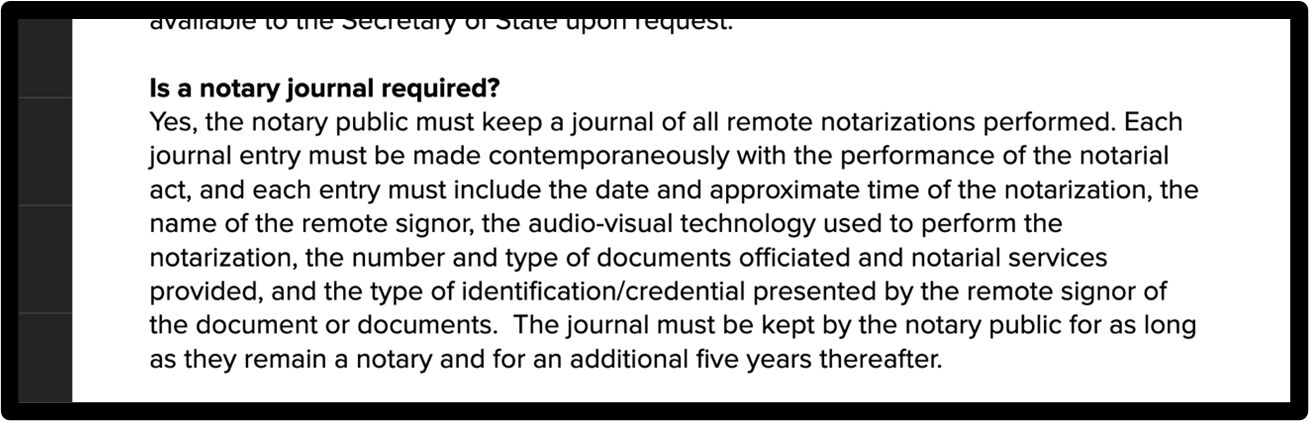
Notary Journal requirements

In addition to what is required by law, the library's insurance carrier may also have some requirements, so a solid internal procedure should include their input, at well.

And of course, whatever is needed should be supported in the library's budget.

4.  Before offering the notary services of an employee, the library should confirm how it promotes awareness of the service.

Section 135-b of the Executive Law also sets some rules for how notary services are advertised!  Because of this, libraries should be careful about how the notary services are promoted.  For more on that, see the rules posted by the New York Department of State at:

https://dos.ny.gov/system/files/documents/2022/04/notary.pdf

And finally...

5.  Please don't let the red tape in this answer stop your library from offering notary service.

I know the considerations of this answer have gone a little further than the specific content of the question.

Further, I know that words like "liability" and "misconduct”, and "insurance" can be intimidating, and signal expense.

However, for anyone out there who has ever had to desperately search for a notary public on a time-sensitive basis, you know that assured notary services are a real boon to a community.

I encourage any library who is offering notary public services, who may read this and think "uh-oh," to consider it a critical community service that is very much worth the time and effort to properly support.

In addition, I urge libraries to support and honor the hard work of any employee who has obtained their notary license by ensuring these steps and make sure they have the proper resources to offer the service confidently.

In that spirit...many thanks to the member for an important set of questions!


[1] This is a verbatim quote.  Although the use of the pronoun "he" suggests there could be a loophole for those who use another pronoun, notarizing is a non-gendered sport for anyone who has attained the age of 18, and charges of misconduct are open to all.

[2] Of course, if the alleged misconduct is willful (for instance, aiding with deliberate fraud) the carrier will likely disclaim coverage of the employee...but may still cover the library (a scenario to discuss with the carrier).

Library Employment Contracts

Submission Date

Question

Our Board of Trustees is searching for a new director. Our Library has transitioned from a very small building to a modern, significantly larger building. As a public library, the school district we serve has a population of more than 18,000. Our former director did not have a contract. Some trustees have expressed the desire to make a contract with the candidate selected to serve as the next Library Director. We have received conflicting information about how common such contracts are. We don't want to devote time and energy to drawing up a contract that holds no value in the end. How common and necessary is it to have a Library Director contract for a public library serving a community of our size?

Answer

Regular readers of "Ask the Lawyer" know one of the cardinal rules is: "Do not reinvent the wheel."  So, before working on this reply, we[1] checked the "NY Library Trustees Handbook (2018),"[2] which has a whole section on hiring library directors.

The Handbook does not reference how "common" having a contract for a library director is, but on page 46, it does emphasize the importance of using a "hire letter" or "memorandum" or "contract" to confirm the hiring terms. 

This is wise counsel.  So, before we build on it to answer the member (and we will!), let's (briefly) talk about the difference between hire letters, memorandums,[3] and contracts.

As most readers likely know, New York is an "at will" employment state.  This means that, barring illegal[4] factors, an employer is free to terminate an employee as needed--and similarly, an employee is free to resign.  Most "hire letters" confirm "at-will" employment.[5]

An "employment contract," on the other hand, puts more bells and whistles on the relationship. It can address a range of things, including the parties' ability to terminate the relationship, and can alter (for a particular employee) the application of an employer's policies.[6]

Typical clauses in employment contracts for library directors are:

  • A confirmation of the job description;
  • A probationary period;
  • A routine evaluation method;
  • An assured period of employment (for instance, a 1-year or 5-year contract);
  • Relocation costs;
  • A recital of specific expectations beyond what is in the job description--for instance, if the director is being employed at the beginning of a strategic plan with expansion objectives, and part of the reason for the hire is a requirement to help keep the expansions on track;
  • A benefit structure that differs from other job titles;
  • A base compensation and bonus structure based on clearly articulated and quantifiable performance metrics;
  • A commitment to a certain amount of budgeted funds and time out of the library for professional development;
  • Tuition or professional development reimbursement;
  • A consequence for early resignation;
  • A list of specific reasons the contract can be terminated early by the board "for cause";
  • A list of specific reasons the contract can be terminated early by the director;
  • A buy-out or other provision in the event of early termination by the employer "without cause";
  • A confidentiality clause;
  • A clause regarding support in the event a lawsuit or legal complaint is directed at the employee[7] as a result of the employee performing their duties (similar to what protects a trustee).

Of course, the above-listed items are just examples.

So, how does a library board know when to use a contract?

There are too many factors to list, but here is a tool for assessing if a contract is the right approach to locking in employment terms between a library and director:

Factor

Comment

Yes

No

1. Is your library seeking the stability of a long-term commitment from its director?

Sometimes, even the promise of a year's service can lend stability...and a term can be as long as five years (or more...but five is a nice start).


2. Is the library about to undertake an initiative where the specific candidate’s skills and experience are a necessary asset?

For instance, if the library is overhauling its approach to IT over the next 5 years, and the candidate has specific prior experience with that type of project.


3. Is the search process unusually challenging for your library? (due to geography, etc.)

If every search costs time, money, and (most importantly) impacts services to the community, finding a way to get added stability may be worthwhile not only financially, but for the sake of the library's mission.


4. Are you more likely to retain a desirable director if you offer the protection of a contract?

The possibility of a contract can be an aid to recruitment.  If the job advertisement sets out the potential for greater stability, it might attract a more qualified candidate pool.


5. Will being able to tout having a director under contract help during budget and funding initiatives?

This could be a double-edged sword!  If the contract helps with cost containment, it's a benefit.  If it could be portrayed as excessive or unnecessary, it can backfire.


6. Will the library be channeling extra resources into professional development for the director, and thus want assurance of a return on investment?

This is a consideration where, if done right, the contract creates a win-win (the library director gets the benefit of development, and the library gets stability of an increasingly qualified director).


7. Will it help employee morale to know there is stability in the director role?

This can be another double-edged sword, depending on the relationship between the director and the other employees.


8. Will having the director under contract help with union negotiations? [skip if no union]

This may be a neutral factor, but certainly one to consider if there is an employee union.


9. Does the board want to be able to link compensation to specific objectives in an enforceable way?

A good contract can also serve as a planning tool.


10. [If director already employed by library] Has the director been successfully employed by the library for a while, but the library seeks greater assurance of retaining them?


Converting a successful at-will employee to a contract employee is another way to ensure stability.  If a system of progressive raises or bonuses is used, it can aid retention.


If your library answered "yes" to one or more of the above factors, it might be worth considering using a contract!  This is true even if no other library you know of is doing so (or if they all are).


That said, like all things that create obligations, a contract requires CAUTION.  Here are some factors to consider before a library decides to use a contract:


Factor

Comment

Yes

No

1. Does the board have what it takes to conduct a search that meets the objectives of the contract?

If the candidate pool is not robust, a contract cannot make things better.


2. Does the board have the capacity to pay attention to the compliance factors in the contract?

If the board doesn't follow the contract, it is dangerous to have one!


3. Does your board have the capacity to engage a lawyer to generate a custom contract?

A lawyer will look at the library's unique features, and the objectives of the board, to draft a contract.  The lawyer should also be ready to help the board negotiate.  Ideally, the first draft of the contract should be ready BEFORE the job is posted.


4. Does the library's financial position allow it to make the financial commitments the contract would create?

This should be confirmed by the Treasurer and the auditor before any offer is made.


5. Does Civil Service impact the terms of employment?

If yours is a non-association library, check with your local Civil Service rep to make sure the rules for hiring, discipline, promotion, and compensation are all honored in the contract (the lawyer mentioned in #3, above, can do this for you).


6. Is there anything in the enabling legislation, charter, bylaws, policies, or current Plan of Service that would deter using a contract?

This question is really one for the lawyer drafting the contract, who should review these documents before preparing the draft, but it is worth considering at the starting point of the process.


If the answer to any of the above questions is "no," a board should consider if additional steps need to be taken before deciding to offer a director an employment contract.  Employment contracts are like houseplants; although they largely just sit there, they need attention from time-to-time.

And that's my answer to the member's question; not based so much on what is "common", but definitely based on what might be "necessary" for a particular library.

Thanks for a great question, and good luck with your search.

BONUS CONTENT

If there are three take-aways I hope this answer conveys, they are:

1) a contract for a library director can be a positive and helpful thing for both parties;

2) before offering or requesting a contract, a board or director should know what they want, and why (and if a contract can fulfill that); and

3) never, never, NEVER use a generic contract from the internet...always have a draft contract reviewed by a lawyer[8] before it is offered.

To help emphasize these three take-aways, here are three limericks:

A pro-active library board

Over its strategy pored

"We seek a director

who has it together

Should a contract be offered?"


The board then decided "Why yes,

Our new person must fix quite the mess

So we'll set some terms

That our contract confirms

To address our points of high stress."


The right fit was finally found

A lawyer said the contract was sound

So to the future director,

A contract was sent o'er,

And now they are legally bound!


Did this trio of limericks skip the part of the process where the parties negotiate back and forth, and the contract is (hopefully) signed?  Yes.

But hey... the top 3 take-aways are in bold.  That's what's important. Please let us know if they are helpful.[9]


[1] Who is "we"?  The staff at the law office, and in this case, a call to the director of the council whose member sent in the question.

[2] Found as of June 2, 2022, at https://www.nysl.nysed.gov/libdev/trustees/handbook/index.html.

[3] The term "memorandum" is not a legal term.  If a "memorandum" of hire only confirms that the position is at will, it is at-will.  If the memorandum adds to the rights and/or obligations of the parties, it is a contract.  For this reason, I discourage use of the term "memorandum" to confirm hiring terms.

[4] Like discrimination, retaliation, and contract violation.

[5] These days, they also fulfill state legal requirements to confirm the date of hire, the rate and frequency of compensation, and the identity of the employer. For more on this, see the state's "wage theft" rules explained here: https://dol.ny.gov/system/files/documents/2022/05/p715.pdf.

[6] Most employee handbooks will have language confirming that the board can change the policy at will and nothing in the manual is to be taken as creating a contract; this is to preserve the "at will" arrangement.  Any employment contract should consider how it works with an existing or future employee handbook.

[7] Assurance of such coverage is not needed for most "Directors and Officers" (or "D&O) insurance to cover a director, but considering the extent of D&O coverage is an important annual task for the board.

[8] Who knows about both employment law and libraries.

[9] Feedback can go to info@losapllc.com.

Public Vote for Library Capital Project

Submission Date

Question

We are a school district public library planning a capital project. The question is whether or not the project has to be approved by a public vote. We have been given money from our assemblyman towards the cost of the construction of one item in the plan. The remainder of the funds will be from the Friends of the Library, a foundation that is raising money in memory of two people and other private donations. We are not asking for tax dollars for the project.

Answer

There are a few scenarios where a capital project, such as a renovation, could start with a vote of the electorate of a school district library.[1]  If the project is subject to a bond, requires a tax levy increase, or is somehow tied to a referendum, the voters' go-ahead might be needed before work[2] can begin.  In addition, if a municipality or district was deeding over a gift of real property, that could require a public vote, as well.

However, in the scenario described by the member, the money is "in the bank" and is not conditioned on obtaining further funds from the taxpayers and no additional real property needs to be purchased or funds need to be levied or raised.

With that, while in library law I make it a rule to "never say never" in this case, I don't see a need for a public vote.  Just follow the rules of procurement![3]


[1] Which is how the phrase "public vote" is used in the question.

[2] "Work" has a variety of meanings in this context; it could include hiring an architect, or purchasing real property, or putting an actual shovel in the ground.

[3] As with other major purchases by public libraries, compliance with competitive bidding requirements in capital projects is key, even if the library is using donated funds.  For more on this, visit https://www.osc.state.ny.us/files/local-government/publications/pdf/seekingcompetition.pdf.

Updating meeting room policies

Submission Date

Question

My library (municipal public library) is working on updating the meeting room policy for a number of reasons. Two major pieces of focus are what types of groups/organizations are able to request use of the meeting rooms. The other piece is requiring all meetings to be open to the public.

Currently the policy indicates that the primary use of meeting rooms are for library-sponsored activities. Any remaining time may be scheduled by nonprofit organizations for educational, cultural, or civic activities on a first-come basis. Use of this room does not constitute endorsement by the Library and must not interfere with or be disruptive to other library users.

Questions #1 - Is there a legal requirement for public libraries to limit to non-profit organizations? If not, what is the basis for limitations?

I am leaning towards shifting the mindset from limiting meeting room use to the above mentioned non-profit organizations (education, civic, cultural, etc.) and to advance public libraries in supporting local businesses and economic development in our communities.

Question #2 - Is it a legal requirement for all meetings to be open to the public?

Question #3 - Is there any benefit for the different type of meeting rooms to have different policies? Why should Large Study Rooms, Conference Rooms, and/or Meeting Rooms policies differ?

Answer

Before I answer this thoughtful array of questions, it is important to establish that aside from law, regulation, and library-specific policy, use of and access to space at public and association libraries can be governed by:

  • Owner-imposed conditions[1]
  • Lease agreements[2]
  • Deed and zoning restrictions[3]
  • Donor conditions[4]
  • Grant agreements[5]
  • Collaboration/affiliation terms[6]

So, before a reader tries to use this answer to tackle issues like those posed by the member, assess if any of those factors are at play in your library.

Okay.  Now, IF NO OTHER CONTRACTUAL OR OTHER RESTRICTIONS IMPACT YOUR LIBRARY, OR A SPACE IN YOUR LIBRARY, here we go:

Questions #1 - Is there a legal requirement for public libraries to limit to non-profit organizations? If not, what is the basis for limitations?

No, there is no legal requirement for public libraries to limit access to space to non-profit organizations.

However, there IS a requirement for any "charitable" entity[7] in New York to not allow any of its assets to “inure” to any one individual, while non-association libraries have to follow an even stricter rule against "aid" to individual people or businesses as set by the NY Constitution (this is why a town library can't use funds to throw a big "bon voyage" party to celebrate a retiring employee, but its not-for-profit "Friends" can).

To avoid tripping over this bar on "inurement" and "aid," many libraries adopted a rule that only charitable entities can use their rooms.[8]  This, however, goes beyond what is required.  Rooms and space can be used by any type of person or organization...but there needs to be a rational basis related to library services and the library's plan of service, and not creating a prohibited benefit, when allowing that access.

How is that done? Examples include:

  • Have a rental policy and use agreement for meeting rooms, with the fee waived for tax-exempt entities, and rental fees channeled back into maintenance of the space[9];
  • Based on the assessed needs of the community, allow card-holding members of the library to reserve and "check out" multi-purpose space on an hourly basis;
  • Create purpose-specific space (telehealth booth, darkroom, soundproof room, etc.) that are "checked out" like other collection assets.

Question #2 - Is it a legal requirement for all meetings to be open to the public?

No, there is no legal requirement for meetings in rented or "borrowed" space in a public library to be open to the public.  However, the library must ensure that renters and borrowers do not restrict access on the basis of any protected category of identity (age, religion, gender, sexual orientation, etc.), or they risk a discrimination claim.

Here is an example of what I mean by "risk a discrimination claim":  If I want to rent a 50-person capacity room at my public library to host a "Women In the Law" monthly meeting, and I publicly advertise the event "For Women Only,"[10] and I let the first 49 people whom I think fit the bill in at the door (while rejecting others), I am creating an exclusionary event that risks a discrimination claim...as well as a PR issue that no library wants to be a part of. [11] In other words: DO NOT DO THIS.

Contrast that with this scenario: I rent the library's 50-person capacity room to stage an event open to the public (no identity-based restrictions), but the topic of the event is a Lincoln-Douglas format "Women Shouldn't Be Lawyers: A Debate."[12] In this example, I risk a similar PR nightmare...but because access to the event is not restricted by a protected category, I do not risk a discrimination complaint based on access.

Question #3 - Is there any benefit for the different type of meeting rooms to have different policies? Why should Large Study Rooms, Conference Rooms, and/or Meeting Rooms policies differ?

Yes, there is a benefit: purpose-built rooms, with purpose-built policies based on identified needs in a library's area of service, justify how the library decides who gets access.  For example, a room with no windows might be designated as the preferred space for a support group for survivor's domestic violence and others that need "discrete" space.  A room with the best wiring might be the space designated for groups gathering to use technology (such as an e-sports club).  A room with the best ventilation might be designated for crafts and chair yoga.  And even though not required, a room could be reserved for only not-for-profit community organizations.

With this approach, a library could have a policy applicable to all rooms (requiring that all attendees follow the library's Code of Conduct), and use room-specific overlays to further set the fair and equally applied terms for access.  This gives the library the flexibility to set different use privileges, while not seeming arbitrary.

Which brings me to the member's comment:

I am leaning towards shifting the mindset from limiting meeting room use to ...non-profit organizations (education, civic, cultural, etc.) and to advance public libraries in supporting local businesses and economic development in our communities.

This is the tricky part.  Remember the bar on "inurement" and "aid"?   It is possible to "support local businesses and economic development" without the benefits accruing specifically to one person--but a library has to be careful.

For instance, say the library wanted to have an "entrepreneur in residence" every week, providing space to new business owners to showcase their products/services, and their story.  

A risky example of this would be: the library provides space in its "Entrepreneur Room," and the entrepreneur charges money for services offered on site for the week.   In that scenario, the library is basically providing free space to a for-profit business, which as we discussed above, is a no-go.

A "go-go" version of this would be: based on a commitment in their plan of service, the library uses data to assess under-served or under-represented members or geographic areas of the business community.

The library then announces to the public that a business owner in the identified zone will be the "Entrepreneur in Residence" in the "Entrepreneur Room" throughout the week, to answer questions about being a business owner in their community.  The library will feature information about the business, as well as its industry.

During their week in the library, the entrepreneur makes connections, showcases their product/service, and gains valuable connections and potential clients...but makes no sales on-site.  However, while sharing their experience with other members of the community, they do get a boost to their business...which the library knows, because it collects follow-up data to show how the program has impacted the local business environment.

This is just one example; there are many ways to do this...and with proper planning, it won't cause issues with either a library's charitable status, or with the New York State Constitution.

Meeting room issues are tough, but a library that bases meeting room[13] access on the commitments in its plan of service, develops space-use programs based on data-derived community needs, and takes care to avoid "inurement" and "aid," can navigate these issues.  Space-specific policies are not required for that, but they can help.

From the care taken by the member in writing this question, it is plain to see: it's worth it.

Thank you for a good set of questions.


[1] Many libraries occupy space they don't own, without a lease.  Aside from many other risks, this can lead to the owner imposing restrictions on space without warning.

[2] A common space restriction in a lease for library space will be a bar on the space being used for anything other than "purposes of conducting library business."

[3] "Deed and zoning restriction" is a catch-all for terms the overall property (the building and land) could be subject to. 

[4] For instance, if a donor leaves money to the library to create the "Needlework Room", and the library accepts the money that comes with the restriction, the room could be confined to books about needlework and related activities.

[5] Just like with donor restrictions, a grant can condition an award of money or assets on specific terms that govern a space.

[6] This is another catch-all: for example, if the library has always housed its Town archives in a room, but the terms were never formalized, is there enough in the record to make this a "restriction?"

[7] All chartered libraries in New York are considered "charitable," per State Education Law 216-a.

[8] Confession: I don't actually know for sure if this is the reason, but it's the only reason I can think of.

[9] If your library rents rooms, check with your accountant to ensure the income won't be considered as derived from "unrelated business activity."

[10] For those of you paying attention to these types of issues, you know this example is just the tip of the iceberg.

[11] If I rent the room for a private event for which I happen to personally invite only female lawyers, but I never publicly articulate a gender-based restriction, I could lessen the chance of a claim of discrimination, but in theory, the risk is still there.

[12] To this notion, I say: Belva Lockwood.

[13] All of this can apply to outdoor space, too.

Contracts for Library Podcasts

Submission Date

Question

The library's podcast (Your Friendly Neighborhood Librarians), hosted by two librarians here, recently started interviewing guests from outside the organization. We are concerned about a few things: what the ramifications are if a guest does not like the way their interview was edited and whether the library owns the rights to the interview and recording. We only edit for clarity and length, and haven't done anything in regards to copyright. Additionally, any advice on whether we should be using some sort of contract or agreement with guests would be helpful. We don't have any sort of agreement in place at present, and are mostly interviewing people who are somewhat library-related. Thank you for your help!

Answer

Some days, I just love my job.  The day I subscribed to "Your Friendly Neighborhood Librarians" (2/4/22) to answer this question was one of those days.

For those of you who haven't checked out the Podcast: it's a forum where hosts (and librarians) Jim and Robyn, based in Rochester, NY, conduct deep and lively interviews with quasi-local authors.  [1]

When it comes to running a Podcast, there's a lot of legal to unpack.  I'll use a recent episode of YFNL (Season 2, Episode 4, January 30, 2022), an interview with photographer Quajay Donnell to illustrate.

When the Podcast starts, the first thing you hear is the YFNL's theme song:

[guitar strumming] "Librarians, librarians, when you've got questions, they're the ones, to help you find what you're looking for..." [more].  It sounds vaguely like the theme to "Spiderman" and is clearly a riff; it's super-cute and fun and brings a smile to my face. Then Jim and Robyn introduce the session's guest and launch into the interview.

The rapport is lively and fun, but Jim and Robyn's deeply prepared interview technique gives Quajay Donnell room to make comments, tell stories, and respond to well-informed prompts to talk not only about his work, but the work of others, and his thoughts on public art (I enjoy Mr. Donnell's comment, after a glowing list of his credentials "I sometimes struggle with the title of 'photographer', I sometimes say 'I'm a picture-taker', or 'I capture moments'."  I appreciate when people resist or explore the purpose of labels).  The show then ends with a cut to a recommendation from a circulation desk worker, Sim, who recommends "Field of Blood" by Joanne Friedman, and a tease for the next episode ("banned and challenged books"), some thanks to various show-helpers,[2] and an instrumental of that great theme song.

So with that background, let's answer the questions:

"[W]hat the ramifications are if a guest does not like the way their interview was edited and whether the library owns the rights to the interview and recording.  Additionally, any advice on whether we should be using some sort of contract or agreement with guests would be helpful. We don't have any sort of agreement in place at present, and are mostly interviewing people who are somewhat library-related."

I wish I could give simple answers to these straightforward questions, but this is "Ask the Lawyer," so I cannot.  But to start, I can say there are three variables that inform the answer to these questions:

Variable "1": Who is creating the Podcast?  Is it "officially" the library, or is it being created through the collaboration of independent individuals?[3]

Variable "2": What is the identity of the Podcast?   Is it 100% entertainment, or is it meant to be investigative journalism, oral history, or serve another documentary purpose?[4]

Variable "3": What is the purpose of the Podcast?  In other words, what is it trying to achieve not only now, but 70 years from now, when it is still protected by copyright, and past consideration of such questions will govern what type of access its intended audience should have?

Here’s how these variables impact the member's questions:

If a library is the creator of the Podcast (meaning the library directed its employees to create the Podcast as part of the work they are hired to do), then the library is the entity responsible for addressing (and bearing the liability for) issues of ethics, ownership, and risk (like defamation and image use).  If an individual or individuals are the creator/owner of the podcast,[5] the responsibility falls on them. 

If the identity of the podcast is light entertainment (that theme song!), then the creator does not have to worry about abiding by, or benefiting from, professional codes of ethics and law pertaining to journalism, academic work, oral history/documentary, or political expression.  But if it aspires to fall into any of those categories (and while it's not my call, I'd say YFNL is at the very least a form of journalism), ethics and certain laws may apply.

If the purpose of the Podcast is to ensure that people listening in 2022, as well as 100 years from now, appreciate home-grown artists in and around Rochester, NY, the creator/owner needs to ensure the work is set up to be controlled in such a way that access for that purpose is ensured.  This is true whether the owner is an entity (like a library), or a person or persons.

So with that as background, let's tackle the member's questions:

For the first question ('"[what] if a guest does not like the way their interview was edited?), the answer is: in a worst-case scenario (say the guest claims the interview was edited to make him sound offensive, and claims it caused him to be "cancelled"), there could be some type of legal claim for damages.  While I won't get too technical, this concern relates to a "tort" claim (like a personal injury) and the member is wise to bring it up, since this is a critical issue.[6]

An attorney advising an entity or person on this would: 1) confirm who the creator, publisher and owner of the content is; 2) ensure the party (or parties) makes good use of a speaker agreement that secures a waiver of liability for the producer and all people affiliated with the podcast; 3) if appropriate,[7] advise a step in the production process that gives participants the right to review and approve release of the final version (in writing).

This plays into the second question: "whether the library owns the rights to the interview and recording."

This should not be an ambiguous issue: either the work is "for hire" (meaning the librarians and other credited helpers are doing it as part of the work they are paid to do, or are working per an additional contract) and is owned by the library, OR the work is owned by the individuals creating it.

The leads to the third question (or rather, factor) listed by the member: We only edit for clarity and length.

This plays into the identity of the podcast. If a podcast or other work isn't using a lot of editing to create a specific dramatic or entertaining effect, and is structured to perform a primarily documentary function, it is worth considering using the established ethics of journalism or oral history to guide the project.

Why? 

In the state of New York, journalists' sources are accorded particular protections under the law, while the identity of the speaker and nature of the communications are relevant to claims of defamation. Also under New York law, the further an unauthorized[8] use of someone's name, likeness, or voice, is from a "commercial use," the less likely a person can sue based on "invasion of privacy." And under federal copyright law, material that incorporates copyright-protected work (perhaps reading part of a poem) for journalistic, academic, or documentary functions will get consideration of that factor if a court needs to determine "fair use."

This next variable I listed is purpose, meaning, what is this work supposed to accomplish, and for how long? Consider that variable in light of the member's statement: "[We] haven't done anything in regards to copyright."

If the purpose of the podcast is to ensure as many people as possible access and appreciate it for as long as possible, what might be more important than registering a copyright is to ensure the work is archived on not only a commercial service such as Apple Podcast (where I found it), but in repositories owned by the public, as part of an institution whose structure ensures some type of longevity.

However, if part of the purpose of the podcast is to ensure for as long as possible that it can never be exploited commercially by anyone, and the owner wants to make sure it will be able to claim damages and attorneys' fees in the event the recording is infringed, registering it is a good idea.

So with that, I get to the last, open-ended question from the member: Additionally, any advice on whether we should be using some sort of contract or agreement with guests would be helpful.

It's important to know at this point that while sometimes I reach out to a member who submits a question to "Ask the Lawyer" (to get a bit more information to enable a more helpful answer), in this case, I did not reach out to Robyn and Jim (although because I really like the podcast, I wanted to!). I thought it would be more important, and in the spirit of their question, to present a generic answer to this part of their question with a generic template that could be of use to other libraries and librarians creating a podcast or other type of audio content.

When creating a podcast, here are the "legal" questions to answer to help you (and your lawyer) address the legal considerations:

Question

Reason it's relevant

Your answer


What is the purpose of the podcast?


It's important to answer this question first, because the purpose of the podcast will drive all the answers following this one.


Are there any professional ethics that apply to the podcast?


This answer is based in part on the "purpose." If the purpose is a type of journalism, the creator may want to consider affirmatively abiding by applicable journalistic ethics. If the purpose is oral history, the ethics of oral historians could apply.


Who "owns" the podcast?


This is a question for a lawyer. However, I can broadly say that if a library or educational institution is directing the podcast to be created, and the people creating it are doing so as part of their jobs, then the podcast is owned by the employer. If everyone involved is unambiguously doing it in their free time, then likely, they are the owners together. And in either case, if there is any grant funding that applies to the podcast, the owner(s) should pay close attention to the terms of the grant, because often grants involve a license or transfer of intellectual property.


What is the end product?


This seems like a pretty straightforward question, it's "podcast recordings," right? However, in just taking a look at "Your Friendly Neighborhood Librarians" I heard a theme song that could be subject to individual copyright, and I see there are really excellent descriptions of each podcast that were authored by somebody. In addition, "Your Friendly Neighborhood Librarians" (a clever brand) could also be subject to trademark. There is also a logo.  And if the content is in its own archive with its own metadata, the metadata could also be proprietary. These are just a few examples, so inventorying the end creation (and if all of the creators are not employees, making sure intellectual property is transferred appropriately) might be bigger than maintaining a list of podcasts.


What are the terms for regular and guest contributors?


For podcasts being created by people as part of their jobs, the expectations, rules and protections for them should be understood between their job description and the rules by which the podcast is operated.


For guests, as the member's question points out, it is best to have a written agreement that sets out the terms, including the right balance of a waiver of liability and the ability to preview the podcast to ensure any editing does not result in a person saying something they didn't intend to say.


(As one example of "rules": if a podcast is being produced by a public library or a not-for-profit organization, there should be a firm rule that no endorsements of political candidates are allowed on the show.)


What other conditions may apply?


For podcasts released on Apple Podcast, this means what are the rules you have to follow under the terms of Apple. For those selecting additional or alternate fora, paying attention to the "terms and conditions" on those resources is also important.  And as mentioned above, grants and donations with conditions that support the content creation should also be considered  (if you are lucky enough to be running a grant-funded podcast).


How do people access the content?


This is critical for ensuring accessibility in both the short and long-term.   Early consideration of this factor also ensures that any legal releases or agreements an owner needs to enter into (like licensing a logo) can accommodate the full plan for accessibility. 


How are any risks being addressed?


I appreciate this is a very open-ended last item. Broadly speaking, if the podcast is being produced by the library, the library's insurance carriers should be consulted to make sure it has insurance coverage for that type of activity. Any aspect of the podcast that is not covered should either be limited or other risk management, such as a waiver of liability, and a process for preview by guests, should be considered.


This last item is addressed by Apple's terms of use for podcasts, which I have included below.


Screenshot of submission disclaimer language

Now, with all that said, I am very aware that some of the answers I have put above may cause more anxiety then resolve curiosity. To help out with that, below is a template for a "podcast guest agreement."

As with any template, a library or podcaster should have their lawyer consider all of the factors I list above before finalizing the template. But hopefully this template can provide a good start.

[Template Podcast Guest Agreement]

RE:  Terms of guest appearance on [PODCAST NAME] on [DATE]

Dear [NAME OF GUEST]:

Thank you for agreeing to be a guest on our show, [NAME] ("the Show") on [DATE TIME] to discuss [TOPIC].

Below are the terms between you and [OWNER NAME] ("Show Publisher") for your appearance on the Show.  Please review the terms, and if you agree, please sign below.

If you have any questions before signing, please contact [NAME] at [CONTACT INFO] to discuss them before sending us the signed copy.

Ownership

You agree that the direct recording (audio and visual) and any subsequent product incorporating it, including but not limited to transcription and any adaptive copies made to enable access by those with a disability, shall be the sole property of Show Owner.

Image Use

You agree that for purposes of promoting, publishing, performing, displaying and making the Show accessible to its audience, Show Owner may use your name, image, and likeness in print and electronic media.  This permission is expressly limited to promoting and publishing the episode of the Show featuring you.  This permission is irrevocable once the Show featuring you has been made available to the public in any medium.

Rules

The rules of participating in the Show are:

Show Owner is committed to creating an experience and show that respects the dignity of all participants and listeners.  If you have any concern at any point regarding your experience working on the Show, please alert [NAME] at [CONTACT INFO].

If at any point during recording you need to take a break, please simply state "I need a break" and we'll stop recording.  This includes if a topic is not one on which you wish to speak.

We edit our show for length and clarity.  You will be given an opportunity to review the edited version prior to it being uploaded to [SITE(s)].  We ask that you write to [NAME] and [EMAIL] with any concerns about edits within [#] days of the final cut being made accessible to you.  If we don't hear anything from you within three days (excluding Saturday and Sunday), we will assume you consent to the publication of the content.

Please refrain from any endorsement of any political candidates during recording.

Please do not accuse any person of a crime, having an STD, or of being incompetent at their job, or marital infidelity, unless such fact is generally known, during recording.  We don't anticipate your appearance will warrant a dip into such a topic, but to avoid claims of defamation, or having to edit out such content, we alert guests to this consideration.

[INSERT CUSTOM RULES]

Hold Harmless

You release and hold harmless Show Owner, its employees, volunteers, and agents from any and all liability, claims of injury, lawsuits, and complaints in association with Show.[9]

Warranties & Representations

You represent and warrant that:

a) No contract or other obligation bars you from appearing on the Show;

b) Any performance on the Show by you will be of your own original work;

c) You are aware that the permission you are granting NAME to use your image, name, and likeness for the limited purposes listed above is irrevocable;

d)  You know the show will be archived by Show Owner and may archived to be available for your lifetime and beyond.

e) You are over the age of 18 and thus able to sign this contract OR your legal guardian has signed below.

Thank you so much for agreeing to be on our show!

Signed on behalf of Show Owner:___________________________

Signed by Guest:______________________________

Guest Date of Birth:_______________________________

Guest preferred pronouns:_____________________________

[if applicable] Signed by Guest's parent or guardian:____________________________


Good wishes for your friendly neighborhood podcasts, true-believers!


[1] For any Western New Yorker lamenting the decreasing number of journalists on the local creative beat, this is a nice antidote.  (BTW...Buffalo/Rochester = WNY.  Syracuse/Rome/Utica = Central NY.  I grew up in Central New York and now live in Western New York, and when this distinction gets blurred, it hurts).

[2] Including two people credited for the theme song.

[3] In my experience, librarians can have a tough time with this one, since they often go above and beyond.  For more on this type of issue, see the "Ask the Lawyer" on LibGuides at https://wnylrc.org/raq/previous-employer-re-assigned-authorship-libguides.

[4] I realize that these categories overlap, especially these days, but we'll talk about why the distinctions are important.

[5] It's official: I am using a lower-case "p" to write "podcast."  Congratulations, podcast, you've been genericized.

[6] It is also very much an "issue de jeur", since the ALA has joined an amicus brief on the rules in the state of New York for suing non-journalists for publishing content in public fora.  For more on that, search "Coleman v. Grand."

[7] This is a major distinction between a cultural or entertainment piece rather than investigative journalism, since professional reporters generally don't give interview subjects the right to approve a final cut.

[8] In this case, "unauthorized" means without written, signed permission.

[9] If you don't have a lawyer look at any other part, have them look at this.  This is a very bare-bones hold harmless intended to not "scare off" guests; a library should have a clause that matches the level of risk it is prepared to take.

Libraries Open to the Public Template for Copiers

Submission Date

Question

We were asked about signage to post over the public copier at a libraries open to the public. Below is some template language with footnotes explaining why they say what they do.  Of course, before posting in your school or library, check with your lawyer!

Answer

MAKING A COPY ON THIS MACHINE

MAY BE SUBJECT TO THE COPYRIGHT LAW OF THE UNITED STATES[1]

This means 4 important things:

1.  Copying a copyright-protected work here could be a copyright violation.[2]

2.  Copying protected works is sometimes allowed under "fair use."[3]  We can't give you legal advice, but if you want to learn more about "fair use," go to https://www.copyright.gov/circs/circ21.pdf or see the [INSTITUTION NAME] Fair Use policy at [LINK].

3.  Copying a copyrighted work to accommodate a disability under the ADA is allowed.   However, to do that, please see the library staff, since adaptive copies have special rules,[4] and we want to help you (or a person you are assisting) exercise your rights.

4. As a library open to the public, there are special circumstances under which we get to make copies (libraries are special).  However, to qualify for that protection, this notice (which we have, by law, placed over the copier right in front of you), has to say what it says in bold at the very top, and we have to operate by this rule:

Any person or group is forbidden to use this machine to engage in the related or concerted reproduction or distribution of multiple copies of the same material, whether made on one occasion or over a period of time, and whether intended for aggregate use by one or more individuals or for separate use by the individual members of a group.

What does that mean? Entire classes should not come here and copy the whole text book for a course![5]  Please don't do that.[6]

The copy machines are here for your use, and we appreciate your consideration of these laws.

Thanks!


[1] This precise language is required by 17 U.S.C. 108 for the library and its employees to be protected against allegations of secondary infringement.

[2] 17 U.S.C. 106 reserves the making of copies to the copyright owner.

[3] 17. U.S.C. 107 allows copying under certain circumstances, but simply "educational" or "not-for-profit" use is not enough.  Read the guide at the link!

[4] See https://www.loc.gov/nls/about/organization/laws-regulations/copyright-law-amendment-1996-pl-104-197/.

[5] This is covered by 17 U.S.C. Section 108(f).  Section 108 also lets libraries make copies for other uses...but that is for libraries, not regular people or students using a copier in a library.

[6] Seriously, if we see you doing that, we have to ask you to stop.