COVID-19

Staff COVID vaccinations

Submission Date

Question

Can a public library compel staff members to get vaccinations for COVID-19, when they are available? If so, can an employee request an exemption? Do we need waivers of library liability if a staff member chooses not to get vaccinated?

Answer

This is an incredibly sensitive, important, and complex set of questions.  I know a lot of people out there in "library land" are waiting on the answer—from many different perspectives.

So we're going to take it slow, break it down, and unpack the components of the answers one step at a time.

Step 1: Considering requiring immunization to COVID-19 as part of a library's evolving Safety Plan

As I have emphasized in numerous pandemic-related answers, any library operating in any capacity right now should have a trustee-approved Safety Plan tailored to its unique operations.  The plan should evolve as new safety-related information emerges, and as library operations change.

As of this writing,[1] some libraries are open to visit.  Some are doing only curbside.  Some are offering more remote programming.  Some have used their information management and lending capacity to distribute PPE, food, and living supplies.  Because of this diversity of service, they all should have different Safety Plans.

The Safety Plan of a library closed to the public for everything but curbside will be different from the Safety Plan of a library open for socially distant use of computers and lending.  The Safety Plan of a library distributing fresh produce will be different from a library streaming programming from its community room to an audience within its area of service (and beyond).  The Safety Plan of a library operating with ten on-site staff in December should be different from the one they used when there was only one employee on-site in June.

Just like the decision to use a particular mode of sanitization, as a library undertakes and changes its unique services, the decision to require immunization of employees should start with vaccination's role not as a stand-alone solution, but as part of an overall approach to limiting the impact of the pandemic on your library, its employees, and your community.  Do the services your library needs to provide the community warrant immunization of employees?  If so, keep reading.


Step 2:  Wait, so does what you said in "Step 1" mean a public library can go ahead and require employees to be vaccinated?

Yes...and NO.

I say "yes," because under the right conditions, the law does allow employers to impose conditions for safety, and that can include mandatory vaccination.[2]  However, I also say "NO," because the phrase "the right conditions" carries a lot of complexity for three little words.  To be safe, the default assumption of a library[3] should always be that it can't require immunization of its employees...and then work to find the way, if well-informed risk management and an updated Safety Plan warrants it, it can require immunizations (and just as critically, if it should).


Step 3: Assessing if a library can require vaccination of employees

Before a library gets too far into an internal debate about if it should amend its Safety Plan to require vaccination of employees, it should assess if it is in a position to do so.  This means having an experienced HR administrator or attorney look at the organization's bylaws, policies, and employment relationships to see if there are any steps or bars to the requirement.

What could such a bar look like?  The most common impediment a library will run into on this is an employment contract—either for individual employees, or with an entire employee union (a "collective bargaining agreement").  The bottom line on this type of impediment: if there is a contract in play, a library must be very tactical, collaborative, and strategic prior to creating—or even considering—immunization as an employment condition.[4]

Another bar might be language in an employee handbook or a pre-pandemic policy.  Still another might be that "gray area" when library employees are considered employees of a school district, village, or town.

The best overall guidance I can offer on this Step is: assessing if your library is positioned to require immunization is a critical step to using vaccination as a tool in your Safety Plan.  Bring in a ringer to help your library assess the extent of what it can do.


Step 4:  Assessing if a library should require vaccination of employees

Okay, let's say you consulted with the best employment lawyer in your village/town/district, they took a close look at whatever relevant contracts and policies your library has, and they have said: "No problem, you can require this."[5]

The next important thing to consider is: should your library require this?

Compelled immunization[6] is an incredibly sensitive area of policy and law.  Since the time Ben Franklin started insisting on smallpox immunizations,[7] this public health issue has had passionate rhetoric on both sides of the debate. 

I have worked with families whose children have documented contraindications for certain vaccines, and it is not a simple issue.  And right now, a public discussion is happening about why people who are African-American might not trust being offered a first round of vaccination.[8]  These are life-and-death issues.

That said, those on the front lines of public service, during a time of pandemic, are at higher risk of both getting infected, and spreading disease.  Science shows vaccination will mitigate that risk.  Thus, under the right circumstances, encouraging such employees to be vaccinated is the right thing to do, and in some cases, employers have made the decision that requiring vaccination is the right thing to do.

The consideration of this question is classic risk management.  What critical services is your library providing to the community?  What exposure to possible infection do those services create?  Does social distancing, PPE, and sanitization mitigate those risks within acceptable tolerances, or would requiring vaccination of employees demonstrably make those employees and the community safer?  Are there certain duties that merit requiring immunization, and other duties (jobs performed 100% remotely, for instance) that do not?  And critical: is mass employee immunization in step with the approach of your local health department?[9]

There is no cookie-cutter answer to these questions, but a responsible decision to require immunization of employees as part of a well-developed and evolving Safety Plan should answer them all.


Step 5:  Developing a robust policy that includes consideration of civil rights, the ADA[10] and privacy

So, let's say your library has followed Steps "1" through "4" and has decided it can, and should, update its Safety Plan to encourage or require immunization of employees.

The next step is developing a policy that:

  • Demonstrably does not discriminate or have an unintentional disparate impact on any protected class of people (race, religion, sex, etc.);
  • Has appropriate measures for people to opt-out based on a disability accommodation under the ADA or the New York Human Rights Law;
  • Protects the privacy of those who either meet the requirement, are granted an accommodation to not meet the requirement, or who must be terminated due to refusal to meet the requirement.[11]
  • Manages liability through good planning and the transmission of accurate information, not (just) waivers of liability.[12]

I also suggest that the library strongly consider ensuring, well in advance, that: 1) the vaccine is available to employees, and 2) that employees don’t have to pay for it.  This is because 1) once the library has identified that there are risks in its operations that would be best mitigated through immunization, those activities should be limited until the mitigation is in place, and 2) there can be legal complications if the vaccination requires personal expense.  While this advance planning and cost containment is not precisely a legal compliance concern, they are close first cousins, and should be addressed as part of the Safety Plan. 


Step 6: If a library decides to require immunization, develop a PR Plan (optional, but a very good idea)

I don't need to tell a library audience that what a public library does on this topic will be scrutinized, criticized, and eventually, also a model for the rest of your community.[13]  Since any decision on this point will have its critics, and also (hopefully) its fans, be ready to let your public know, simply and straightforwardly, the basis for your library's decision.

I like the classic "FAQ" approach.  Here are two model FAQ's for two libraries that did the legal analysis and safety assessment, and come to the following decisions:

FAQ: I was told the library board is requiring all the employees to be vaccinated for COVID, is that true?

FAQ ANSWER: Since re-opening on DATE, the NAME Library has had a Safety Plan.  Now our Safety Plan does include supporting voluntary immunization of employees.

FAQ:  Voluntary?  So you are not requiring it?

FAQ ANSWER:  Our risk analysis and still-limited operations showed that we could meet the community's needs by requiring masks, social distancing, and routine sanitization.  We have now added supporting employees in getting vaccinated on a voluntary basis.

FAQ:  Will you ever require it?

FAQ ANSWER:  Only if our operations change and an updated risk analysis shows us that it is best for our employees and for the community.

Another "FAQ" example, for a library that came to a different conclusion, is:

FAQ: I was told the board is requiring all the employees to be vaccinated for COVID, is that true?

FAQ ANSWER: Since re-opening on DATE, the NAME Library has had a Safety Plan.  Now our Safety Plan does include mandatory immunization of employees who are able to be vaccinated.

FAQ:  Why is the library requiring employees to get vaccinated?

FAQ ANSWER:  Feedback shows that the community needs us providing critical services right now.  Our risk analysis showed that in addition to requiring masks, social distancing, and sanitizations, immunization by employees would protect their health, and the community's, while we provide those services.

FAQ:  The vaccine is not 100% available yet.  Did your employees have to do this on their own?

FAQ ANSWER:  Our library worked with [INSTITUTION] to make sure our employees had access to this safety measure, without cost to them.

And that's it.[14]

The important take-away I want to emphasize here is that for individual libraries, there are no quick answers to these questions.

Libraries of all types will be assessing their unique legal and risk positions, and will need to make carefully documented and executed decisions.  Libraries within larger institutions may need to fight for consideration separate from other operations.  Public libraries will need to consider the heightened transparency and public accountability they operate under.  Library systems will be thinking about how they can protect their employees while also supporting their members.  And for the employee on the ground, they'll be thinking about keeping themselves, their families, and their communities safe.

By taking careful, deliberate, and well-informed steps, the answers to the member's questions can be found.

Thank you for a vital question.


[1] December 18, 2020.   For many of you, that means you've been shoveling lots of snow (we're looking at you, Binghamton).

[2] See the case Norman v. NYU Health Systems (2020) (SDNY), 2020 U.S. Dist. LEXIS 180990 *; 19 Accom. Disabilities Dec. (CCH) P19-109

[3] And in this case, I use "library" in its broadest sense: public, association, and even libraries operating as part of a larger institution (such as a college, hospital, or museum).  School libraries, in particular, may both fall under the policies of the institution they are within, but might also have different operations, activities, and exposure that warrant independent risk analysis.

[4] I can't be more specific than that, since in some cases, there may be "emergency" management clauses that could easily allow the requirement of further safety measures, while in other cases, there could be language that makes it clear such a requirement will have to be a point of discussion.  The important take-away here is: if there is a contract in play, don't wing it.  Bring in your lawyer.

[5] The actual answer will of course be in writing and will likely be much more extensive than "No problem!"   It should also be included in the records of library leadership to document the appropriate level of risk analysis.

[6] When I say "controversial," I mean legally.  The science is solid: immunization saves lives.

[7] Ironically, Franklin's young son would die of smallpox before he could be immunized, in part because Franklin's wife Deborah was wary of the new treatment.  Franklin was devastated by the loss of his small, precocious son, and some scholars say it caused a rift in his marriage that was never healed.

[8] If you know your history, you know these fears are based in reality.  If you want to learn more, a good place to start is this New York Times article: https://www.nytimes.com/2020/12/06/opinion/blacks-vaccinations-health.html?searchResultPosition=4

[9] Whenever possible, confirming Safety Plans, and significant revisions of Safety Plans, with the local health department is a very good idea.

[10] The ADA is a critical consideration here.  A good place to start for further information on this is the EEOC, at https://www.eeoc.gov/wysk/what-you-should-know-about-covid-19-and-ada-rehabilitation-act-and-other-eeo-laws.  However, this is just a starting place; as you can see by the linked guidance, this part of your policy cannot be a simple cut-and-paste job.

[11] I know, this sounds cold; and it is.  Considering if a library is actually prepared to terminate employees for refusing to meet the requirements should be part of your library's analysis here, too...because once you develop the policy and start requiring it, granting exceptions without justification can create serious legal complications.

[12] The member asks about waivers for employees who decide not to be immunized.  A waiver of liability should only be used if it is part of a well-developed Safety Plan, and customized for the purpose by an attorney.

[13] Although I just did.  Ah, rhetoric.

[14] I could go on with a few more FAQ's to illustrate the diversity of approaches available (they are kind of fun to write), but I trust you get it.

Open Meetings Law and COVID

Submission Date

Question

A member of my board of trustees would like for us to meet in person. There would be 9 people in the room. They wanted to know if allowing the meeting to be simultaneously on Zoom would satisfy the requirements of open meetings law even though only one member of the public would be able to be physically present in order to stay under the 10-member cap for small gatherings.

Answer

Since the onset of the pandemic, we have had two questions about the impact of Executive Orders on the Open Meetings Law.

The first question, back in March 2020 (remember March 2020?  Ugh.), led to this advice:

... the method you select for sharing the meeting in real time (livestreaming, a broadcast) should be accessible to the general public.

Of course, by Fall 2020, we all became experts at these modified proceedings, and were asking refined questions like:

How long does a library (public or association) or a cooperative public library system have to keep the recording of board or committee meetings?

(Answer: until transcribed.)

This brings us to December, 2020.

On December 2, 2020, the Governor issued Executive Order 202.79,[1] continuing the suspension and temporary modification of the Open Meetings Law through January 1, 2021.[2]  So here we are, still meeting under modified circumstances.[3]

Which brings us to the member's question:

[Does] allowing the meeting to be simultaneously on Zoom ... satisfy the requirements of open meetings law even though only one member of the public would be able to be physically present in order to stay under the 10-member cap for small gatherings[?]

Answer: Yes.

Here is why I can answer this question with one-word confidence.

Back in August, 2020 (remember August, 2020?  Slightly less "ugh.") the Executive Director of the State Committee on Open Government, realizing that different areas have different COVID numbers and are facing different Open Meetings Law compliance challenges, wrote in an Advisory Opinion:[4]

...if a public body is convening an essential meeting, the body must ensure that it adheres to social distancing, masking, and any other administration requirements, and if there is any question about whether it is able to maintain a safe space in which to hold an essential open meeting, it must provide a contemporaneous video or audio broadcast such that members of the public who cannot safely attend in person “ha[ve] the ability to view or listen to such proceeding and that such meetings are recorded and later transcribed.”

Further, the Advisory Opinion went on to emphasize that room capacity and safety concerns should not impede public access to an OML-accessible meeting. "[A] public body may not artificially limit attendance at its meetings – to do so would not be consistent with the requirements of the Open Meetings Law."

The solution posed in the question submitted by the member adequately addresses this concern.   By enabling observation and attendance via Zoom, the proceeding will be virtually accessible even though it has been physically convened.  The key is ensuring access at a time of modified operations.

And what do we do when Executive Order 202.72 expires?

We'll see in the New Year!

Thanks for a thoughtful question, I wish you a productive and safe meeting.


[1] https://www.governor.ny.gov/news/no-20279-continuing-temporary-suspension-and-modification-laws-relating-disaster-emergency.

[2] If you'd like to follow the daisy-chain of executive orders on this, here goes: Executive Order 202.1 first suspended/modified the Open Meetings Law Requirements, and then Executive Orders 202.14, 202.28. 202.38, 202,48, 202.55, 202.60, 202.67, and now, 202.72, kept that suspension/modification going.

[3] There are several legal challenges under way, based on the ability of the Governor to continue the state of emergency and resulting Executive Orders.  I am not commenting on that.

[4] Found at https://www.dos.ny.gov/press/2020/Essential%20Meeting%20OML%20AO.pdf

Transcribing records under Open Meetings Law

Submission Date

Question

Under the executive order, the modifications to Open Meetings Law meant we (I'm asking for several libraries in our system) record our Board meetings.

How long does a library (public or association) or a cooperative public library system have to keep the recording of board or committee meetings ?  Looking at http://www.archives.nysed.gov/records/local-government-records-schedule-browse?combine=meeting+recording, it states:
 "Four months after the transcription or minutes have been created"

Transcribing could be challenging, particularly for smaller libraries, so we were relieved to read that once minutes were created, we might not have to transcribe (hopefully we are reading that correctly).

However - our question is about the placement of the word "or".  Is it:

Option 1: Once transcribed, keep for four months. Once minutes are created and accepted (which might be less than four months - in our case, it would be at the next board meeting), you can delete recording.
Option 2: Whether transcribed or minutes created, keep the recordings for four months. 

Under option 2, it seems like there is a higher standard for meetings.  Pre COVID, our board meetings would occur, open to the public but usually no public in attendance, and the only "evidence" of the meeting would be the minutes.  Now, we are required to keep the recording for at least four months - which isn't a huge hardship but curious about the rationale behind that.

Thank you!

Answer

Before attempting to answer this one, my team and I looked to see if anyone else "out there" has tackled this question.

We scoured the usual places (NYS Empire Development's COVID site, Committee on Open Government, NY Archives, NYLA, etc.), but my staff and I didn't find anything right on point. That said, the COVID landscape changes fast, so please let us know if you find anything, and we'll post an update to this answer.

And with that shameless disclaim/plea on the record, here is my answer:

As I read it, the currently-governing Executive Order[1] requires an entity subject to the Open Meetings Law to keep the recordings until they have been transcribed—not just until the minutes have been created.

Here is my reasoning: Executive Order 202.1[2] changed the Open Meetings Law as follows:

...to the extent necessary to permit any public body to meet and take such actions authorized by the law without permitting in public in-person access to meetings and authorizing such meetings to be held remotely by conference call or similar service, provided that the public has the ability to view or listen to such proceeding and that such meetings are recorded and later transcribed. [emphasis added]

Although the normal application of the LGS-1 would allow for the recording to be erased upon creation of the minutes—just as the member points out—the Executive Order is an overlay that super-cedes (or at least, exceeds) normal record-keeping requirements.

I realize this means a library that can't afford to transcribe the recording any time soon will have to keep the audio around.  It's possible that the state, after considering the fiscal reality of the conditions the "later transcribed" condition imposes, may eventually tinker with the requirement, perhaps simply insisting the audio be retained for a certain time after the minutes are generated.[3]

I am leaning on the side of retention, and not taking the easy way out by swapping it out for creating minutes, because access to the process, in all its glory, is the default purpose of the law.  Further, Committee on Open Government Advisory Opinion has stated that while masks and social distancing remain requirements, entities subject to the Open Meetings Law must be making the proceedings contemporaneously available via audio or video[4].  So with all that, I have to err on the side of retention, access, and transparency.

Fortunately, digital sound file storage is not too costly these days.[5]

Thank you for a thoughtful question.


[1] Found at https://www.governor.ny.gov/news/no-2021-continuing-temporary-suspension-and-modification-laws-relating-disaster-emergency [NOTE: This link was confirmed as no longer active and removed on 02/25/2022 as part of the routine review of "Ask the Lawyer" materials.]

[2] Which as of this writing, is extended through December 3, 2020, by Executive Order #72, found on 11/17/20 at https://www.governor.ny.gov/news/no-20272-continuing-temporary-suspension-and-modification-laws-relating-disaster-emergency [NOTE: This link was confirmed as no longer active and removed on 02/25/2022  as part of the routine review of "Ask the Lawyer" materials.]

[3] This sounds like a nice ask to go out from a library advocacy organization.   "Please, Mr. Governor, can you waive the estimated $[AMOUNT] in estimated transcription fees incurred the same year when many localities are taking COVID-induced hits to their budgets?"  I'd sign that letter in a heartbeat.

[4] Found at https://www.dos.ny.gov/press/2020/Essential%20Meeting%20OML%20AO.pdf [NOTE: This link was confirmed as no longer active and removed on 02/25/2022  as part of the routine review of "Ask the Lawyer" materials.]

[5] Finding the budget to properly compensate qualified people to manage that storage is another question!

Health assessment screening records

Submission Date

Question

The public libraries in our region have been requiring staff to complete a health self-assessment every day that they report to the building to work. Some of these libraries now have a collection of paper or electronic responses that date back to June.


How long should these records be kept? Two weeks? Two months? Forever?


And, not to complicate matters, but for municipal or school district public libraries, are these records, or portions thereof, subject to FOIL?

Answer

Records management is an art formed by the crossroads of life, law, and data.[1]

As soon as we saw that the state's "Template Safety Plan" required completion of employee health screening, the records management implications were clear. In fact, "Ask the Lawyer" has alluded to this very concern before.[2]  But the member's questions give us a really good focal point.

Here is some background, and then we'll tackle the member's questions:

As librarians know better than most people, information often falls into a variety of "buckets."

One of the biggest "buckets" of records that may sound familiar is the bucket labelled "evidence."  Most people know that when you leave a paper trail, it can (with many exceptions) be used for—or against—you in court.  In the employee data arena, common uses of such evidence are labor law and civil rights claims.

Another big bucket is "health care records" pertaining to individual people.  This type of information is protected by a complex array of state and federal law, rules, and regulations, and the obligations related to it change based on who is retaining them.  In the case of employers, the restrictions are generally rigid.

And of course, there are "municipal records" and "business records" both of which have a vast array of sub-classes and categories, depending on the municipality or the business (I don't know who has it worse, the records management office for a large city, or the records management office for an insurance company[3]).  Municipal employers are always having to balance transparency with accountability, sorting disclosable[4] data from data restricted due to employee privacy.

Very often, the records in one "bucket" also belong in another, which swaps the bucket analogy for your classic Venn Diagram.


Image of confusing Venn diagram with too many circles

The member's question puts us squarely in a Venn Diagram comprised of sets (buckets) of:

  • Employee personnel file records;
  • Employee health-related records;
  • Compliance records;
  • [Possible] municipal records
  • [Possible] evidence.

Because of the different definitions and regulations defining and restricting the information in the buckets, it is critical to know what data you're keeping.  For instance, while employers are allowed to keep CONFIDENTIAL records related to employee health, COVID screening records are not supposed to contain such information—only the fact that a person was screened, and either made it through, or was denied access to the work site due to a screening factor.[5]

And with that....

How long should these records be kept? Two weeks? Two months? Forever?

Records showing that COVID screening and follow-up action[6] is being done as required, with no employee-specific information (like an employee's name coupled with their temperature, symptoms, or a positive diagnosis) included[7], is at the very least a compliance-related record, could be evidence in a lawsuit, and is (debatably) a municipal record.  This means it could be used to show compliance (or lack thereof), to prove liability (or lack thereof), and/or may be subject to FOIL (more on that in a moment).

But despite all that overlap, I can find no clear legal requirement to retain screening data.  The state's Executive Orders and guidance are silent on this, except for some areas where we can extrapolate retention (for instance, records kept for contact tracing must obviously be kept at least three weeks, since the whole point is timely notification within the window of exposure and possible illness).

Because I despise lawyering from a vacuum (I'd almost rather have bad guidance than no guidance) to see if any input could be gleaned from it, I took a long, hard look at the LGS-1[8], the "Local Government Schedule" of the New York Archives, which is the go-to text for questions related to municipal records retention.  

Clocking in at over 400 pages, this document, which went into effect in August, 2020, lists just about every type of municipal record imaginable...except it doesn't list "Executive Order Compliance," or any other category I felt safe basing a reply to this question on.

With no clear bucket and no clear requirements, at this point, I have to answer that retention of proof of screening should be permanent.

And, not to complicate matters, but for municipal or school district public libraries, are these records, or portions thereof, subject to FOIL?

While I imagine most of the readers who have hung on this deep into this answer already know it, I will mention: "FOIL" is New York's "Freedom of Information Law," which requires government agencies to disclose most records[9] related to their operations.

It is well-known that an association library is not subject to FOIL; on the flip side, it is generally held that a public library, which is established by government and "belong[s] to the public" [Education Law, §253(2)] is subject to the Freedom of Information Law. 

So, is the trove of information listed by the member subject to FOIL?  It's highly likely.

Why?

This question by the member brings us full circle on our buckets. While employee health records are most certainly exempt from disclosure under FOIL[10], the impersonal operational records of a FOIL-able library that is simply ensuring screening is happening might not be.

Therefore, a library that knows it is subject to FOIL should be ready to asses if it has to disclose its safety plan compliance records upon request.  However, in no event should such disclosure include employee names and related health information (disclosing a record with the name of the person or team in charge of monitoring compliance would be fine).

And there (complexities and all) you have it.

Thanks for a good records management-gymnastics-inducing question.


APPENDIX

From New York's "Interim COVID-19 Guidance for Curbside and In-Store Pickup Retail Business Activities"; record-generation triggers are highlighted in bold italics.

A. Screening and Testing

• Responsible Parties must implement mandatory daily health screening practices.
o Screening practices may be performed remotely (e.g. by telephone or electronic survey), before the employee reports to the retail location, to the extent possible; or may be performed on site.

o Screening should be coordinated to prevent employees from intermingling in close contact with each other prior to completion of the screening.

o At a minimum, screening should be required of all workers and essential visitors (but not customers) and completed using a questionnaire that determines whether the worker or visitor has:

(a) knowingly been in close or proximate contact in the past 14 days with anyone who has tested positive for COVID-19 or who has or had symptoms of COVID-19,

(b) tested positive for COVID-19 in the past 14 days, or
(c) has experienced any symptoms of COVID-19 in the past 14 days.

• According to CDC guidance on “Symptoms of Coronavirus,” the term “symptomatic” includes employees who have the following symptoms or combinations of symptoms: fever, cough, shortness of breath, or at least two of the following symptoms: fever, chills, repeated shaking with chills, muscle pain, headache, sore throat, or new loss of taste or smell. Responsible Parties should require employees to immediately disclose if and when their responses to any of the aforementioned questions changes, such as if they begin to experience symptoms, including during or outside of work hours.

  • Daily temperature checks may also be conducted per Equal Employment Opportunity Commission or DOH guidelines. Responsible Parties are prohibited from keeping records of employee health data (e.g. temperature data).
  • Responsible Parties must ensure that any personnel performing screening activities, including temperature checks, are appropriately protected from exposure to potentially infectious employees or visitors entering the retail location. Personnel performing screening activities should be trained by employer-identified individuals who are familiar with CDC, DOH, and OSHA protocols.
  • Screeners should be provided and use PPE, including at a minimum, a face mask, and may include gloves, a gown, and/or a face shield.
  • An employee who screens positive for COVID-19 symptoms should not be allowed to enter the worksite and should be sent home with instructions to contact their healthcare provider for assessment and testing. Responsible parties must immediately notify the local health department and DOH about the suspected case. Responsible parties should provide the employee with information on healthcare and testing resources.
  • An employee who has responded that they have had close contact with a person who is confirmed or suspected for COVID-19 may not be allowed to enter the retail location without abiding by the precautions outlined below and the Responsible Parties has documented the employee’s adherence to those precautions.
  • Responsible Parties must review all employee and visitor responses collected by the screening process on a daily basis and maintain a record of such review. Responsible Parties must also identify a contact as the party for employees to inform if they later are experiencing COVID-19-related symptoms, as noted in the questionnaire.
  • Responsible parties must designate a site safety monitor whose responsibilities include continuous compliance with all aspects of the site safety plan.
  • To the extent possible, Responsible Parties should maintain a log of every person, including workers and visitors, who may have close contact with other individuals at the work site or area; excluding deliveries that are performed with appropriate PPE or through contactless means. Log should contain contact information, such that all contacts may be identified, traced and notified in the event an employee is diagnosed with COVID-19. Responsible Parties must cooperate with local health department contact tracing efforts.
  • Responsible parties cannot mandate that customers complete a health screen or provide contact information but may encourage customers to do so. Responsible Parties may provide an option for customers to provide contact information so they can be logged and contacted for contact tracing, if necessary.
  • Employers and employees should take the following actions related to COVID-19 symptoms and contact:

o If an employee has COVID-19 symptoms AND EITHER tests positive for COVID-19 OR did not receive a test, the employee may only return to work after completing a 14-day self-quarantine. If an employee is critical to the operation or safety of a facility, the Responsible Parties may consult their local health department and the most up-to-date CDC and DOH standards on the minimum number of days to quarantine before an employee is safely able to return to work with additional precautions to mitigate the risk of COVID-19 transmission.

o If an employee does NOT have COVID-19 symptoms BUT tests positive for COVID-19, the employee may only return to work after completing a 14-day self-quarantine. If an employee is critical to the operation or safety of a facility, the Responsible Parties may consult their local health department and the most up-to-date CDC and DOH standards on the minimum number of days to quarantine before an employee is safely able to return to work with additional precautions to mitigate the risk of COVID-19 transmission.

o If an employee has had close contact with a person with COVID-19 for a prolonged period of time AND is symptomatic, the employee should notify the Responsible Parties and follow the above protocol for a positive case.

o If an employee has had close contact with a person with COVID-19 for a prolonged period of time AND is NOT symptomatic, the employee should notify the Responsible Parties and adhere to the following practices prior to and during their work shift, which should be documented by the Responsible Parties:

  1.  Regular monitoring: As long as the employee does not have a temperature or symptoms, they should self-monitor under the supervision of their employer’s occupational health program.
  2.  Wear a mask: The employee should wear a face mask at all times while in the workplace for 14 days after last exposure.
  3. Social distance: Employee should continue social distancing practices, including maintaining, at least, six feet distance from others.
  4. Disinfect and clean work spaces: Continue to clean and disinfect all areas such as offices, bathrooms, common areas, and shared electronic equipment routinely.

o If an employee is symptomatic upon arrival at work or becomes sick during the day, the employee must be separated and sent home immediately, following the above protocol for a positive case.

B. Tracing and Tracking

  • Responsible Parties must notify the local health department and DOH immediately upon being informed of any positive COVID-19 test result by a worker at their site.
  • In the case of an employee, visitor, or customer who interacted at the business testing positive, the Responsible Parties must cooperate with the local health department to trace all contacts in the workplace and notify the health department of all employees logged and visitors/customers (as applicable) who entered the retail location dating back to 48 hours before the employee began experiencing COVID-19 symptoms or tested positive, whichever is earlier, but maintain confidentiality as required by federal and state law and regulations.
  • Local health departments will implement monitoring and movement restrictions of infected or exposed persons including home isolation or quarantine.
  • Employees who are alerted that they have come into close or proximate contact with a person with COVID-19, and have been alerted via tracing, tracking or other mechanism, are required to self- report to their employer at the time of alert and shall follow all required protocols as if they had been exposed at work.


[1] I spend a lot of time at this crossroads; so much so that If I ever find myself in line at the DMV next to a Hollywood agent, I have a pitch for a show: An archivist, a lawyer, an IT expert, a chemist, and a rogue town clerk, united by a traumatic loss of data, form an unlikely alliance to fight for justice, truth, and the use of acid-free paper.  Called "For the Record", each episode would start with a Core Reveal (like a surveyor moving property line pins in the dark), while the rest of the episode would show the Team disentangling the plot. While “For the Record” would hinge on plot devices like hidden scrolls, encrypted data, and HVAC systems gone wild, what will really keep audiences coming back for more would of course be an elaborate, over-arching plot line involving the census, adoption records, and the complicated emotional lives of the protagonists. If any agent out there wants to take me up on this, I promise an epic, solid seven-season run.

And with that out of my system, I will answer the question.

[2] See "Ask the Lawyer" RAQ #163 and RAQ #144.

[3] Actually, I do know: the city employee.  There is never enough money in a city budget to manage records properly. 

[4] One of the primary ways such information is subject to disclosure is Article VI of the Public Officer's Law, or FOIL.  There is a big FOIL fight going on right now over law enforcement disciplinary records, and my firm is in the thick of it.

[5] https://www.governor.ny.gov/sites/governor.ny.gov/files/atoms/files/offices-interim-guidance.pdf

[6] By "follow-up action," I mean the things an employer is required to do as a result of screening.  If your library determines that it must follow the NYS requirements for retail, I have put those at the end of this answer, and highlighted in yellow the different COVID SCREENING RECORDS they will generate.

[7] Remember, anything specific to the employee (temperature, a positive diagnosis, disclosure of symptoms) are separate, confidential employee health records and should not be retained, or should be retained in confidence as required by ADA.

[8] Found at: http://www.archives.nysed.gov/common/archives/files/lgs1.pdf.  WARNING!  This is a rabbit hole.  Have coffee and a protein bar on hand if you start reading it.

[9] There are, of course, a ton of exceptions, including health records of employees.

[10] FOIL §89(2)(b).

Request to remove scanned yearbook pages

Submission Date

Question

I received a request from a former student of [a local high school] in which her name appears on a yearbook page citing student activities. As the page is part of a whole PDF of the entire yearbook, "removing her name" would require taking down the entire yearbook.

If the library that scanned and uploaded the yearbook to the internet received permission from the high school to do so (the yearbook is tagged as In Copyright) does the student have a reasonable request?

Answer

At "Ask the Lawyer," we have tackled "yearbook questions" before: in 2018[1] we addressed patron requests to copy physical yearbooks in a library's collection, and in January of 2020[2] we addressed using scanned yearbook images to illustrate a commemorative calendar. [3]

But I have been waiting for this question for quite some time, and I am sure this scenario has a familiar sound to many readers.

"Yearbook scanning"—the creation of digital versions of yearbooks previously available only in hard copy—has been happening for quite a while now.  However formal or informal such efforts might be, the end result (if made accessible) is a searchable, highly accessible collection of images of people in their formative years[4], who for whatever reason, might see the increased access to their former images as problematic.

Although we don't know the motivation of the person asking the member to remove their name from a digitized yearbook, this scenario shows the apex of this concern: a request to be removed.

At this "apex," a person can make a simple, single request to be removed.  Or, they can be persistent about it--making multiple requests, calls, letters, etc.[5]  Or, if they are available, they can make legal arguments.

I can think of several "legal" arguments a person could bring forward to remove their name from a yearbook in the manner described by the member:

  • They are a victim of domestic violence trying to elude an abuser.
  • They are a victim of stalking trying to elude their stalker.
  • They have specific safety concerns based on the general public's easier access to the content.
  • They have legally changed their name and identity for personal reasons.
  • They have informally changed their name and identity for personal reasons.
  • They feel the use of their image is commercial (not likely if the poster is a not-for-profit library that isn't charging for the content).
  • The content is defamatory.[6]
  • The content is the result of a crime.
  • They have been the victim of identity theft and are attempting to optimize their privacy.[7]

Of course, asking for the "legal reason" a person is requesting removal from a digital, online yearbook puts the library in the uncomfortable position of having to evaluate the validity of the answer.  Let' not go there just yet; instead, let's take a closer look at the member's question:

If the library that scanned and uploaded the yearbook to the internet received permission from the high school to do so (the yearbook is tagged as In Copyright)[8] does the student have a reasonable request? [emphasis added]

The member has used a very, very important phrase to frame this question: "a reasonable request."

"Reasonable requests"—that is to say, requests that might not have slam-dunk legal footing, but still might be a good reason for removal—cannot be analyzed in a vacuum.  In this context, to determine if a request is "reasonable," it must be assessed against the backdrop of the hosting institution's mission, the purpose of the digital collection, and the values and ethics governing both.

That is why for libraries, archives, museums, and historical societies digitizing old yearbooks and other content that can impact living, breathing people, I advise every institution adopt a policy that 1) confirms that the goal of a digitization project aligns with the mission of the institution; 2) confirms how the content will be accessed (will it be added to the catalog to be checked out as an e-book, or be openly accessible as an online archive? etc.[9]; 3) confirms the ethics applicable to the project; and 4) creates an ethics-informed process for raising, evaluating, and acting on any concerns about the content.

For readers out there working in established archives, this ethical framework for selecting, preserving, and enabling access to archival content is already built into your institution's DNA.  However, for many libraries or smaller institutions that are now able to create online collections of easily accessed content through scanning, either to hold on their own servers, or to contribute to a larger initiative--with access unmediated by a library card or on-site access--it may be an area ripe for development. 

For those institutions just arriving at this phase, here is a short sample policy to govern the creation of digital content intended for open access:


ABC Library Policy on Institutionally-Generated Digital Unmediated Content[10]


Policy

Although not the primary mission of the Library, from time to time, the ABC Library will create digital versions of content with the intention that such content be made available to the general public via the internet without the mediation of membership in the library or being on the library's premises.  This content can be derived from items in the library's collection, or be generated from material borrowed by the library from another institution as part of a digitization project. 


For purposes of this policy, such content is called "Institutionally-Generated Digital Unmediated Content" or for short, " Unmediated Content". 


The purpose of this policy is to ensure the ABC Library's creation of such Unmediated Content, whether considered part of a collection or later included in an archive, is consistent with the Library's mission, values and ethics.


Mission

The ABC library's mission is to [INSERT].  The ABC Library's creation of Institutionally-Generated Digital Unmediated Content is consistent with this mission because [INSERT].


Code of Ethics

The ABC Library recognizes that due to the broad, direct access it can provide, the impact of Institutionally-Generated Digital Unmediated Content can be different from the impact of library collection content accessed by borrowing on-site access at the library.  Therefore, the Code of Ethics governing the ABC Library's creation of such Unmediated Content is the [NAME's] Code of Ethics.


Procedures

Any concerns related to the ABC Library's creation of Institutionally-Generated Digital Unmediated Content shall be evaluated per the above-listed Code of Ethics. 


Institutionally-Generated Digital Unmediated Content projects with content that depicts (possibly) still-living people, minors, and sensitive subject matter shall be evaluated per the Code of Ethics prior to the creation of the Unmediated Content.


To ensure adherence with these Procedures, ABC Library shall ensure an "Ethics Statement" accompanies all Institutionally-Generated Digital Unmediated Content created by the ABC Library.


Ethics Statement

To ensure awareness and consistent application of the Library's mission and Code of Ethics at all phases of the creation and access to such Unmediated Content, all such content shall be accessible with the statement:


"This content is governed by the [INSERT] Code of Ethics.  Concerns that any content violates the right of any living person, or that Code of Ethics, should be directed to [NAME] at [CONTACT INFO]."


Responsibility

The board of trustees maintains this policy and evaluates and revises it as necessary. 


[INSERT POSITION] is responsible for oversight of this policy and procedure.


All employees and volunteers working on digitization projects must follow this policy and procedure.


Now, with those essential considerations backing us up, here are my thoughts on the member's questions:

A request for removal or redaction of digitized content should be evaluated against the mission and values of the library that created the digital content, the purpose of the digitization project, and the ethics governing the project.

In this case, if the person requested removal without giving a reason aligned with ethics of the library and/or the project, the request should be denied.  On the flip side, if the reason for the request does align with the relevant ethics, it should be redacted or removed.

Here's an easy example of this playing out in the real world:

Every "Code of Ethics" I have seen governing libraries and archives requires that the institution follow the law.  Therefore, if there is a legal reason for removal, it should be done.

Here's a less easy example of this playing out in the real world:

If the request is more vague, like "I just don't want people to be able to find out information about me,"[11] your institution needs to look at the values and ethics it has adopted.  Does personal autonomy and concern for the privacy of living people get a high priority?  If the answer is "yes", there should be a process for redaction or removal.  If the answer is "no," with more priority placed on the integrity of the material, unless there is a legal reason compelling removal, the answer should be, "Sorry, our role is to preserve and make accessible this record in its original form" (or other language regarding integrity of the records, taken from your library’s Code of Ethics).

Personally, although I don't think my yearbooks have anything to hide, I like the option of being able to remove myself from the record until I am dead.[12]  But in saying that, I am expressing a value, not a legal right, and value judgments are harder than legal conclusions.  That is why requests not rooted in solid legal reasons benefit from: a) the library having a strong, consistent guide, like a Code of Ethics; b) applying that guide consistently; and c) ensuring the library has the technical ability[13] to implement your institution's decisions, which are all critical.

Thank you for bearing with me on this answer, I know it is intricate, and perhaps more than you signed on for!  The steps I lay out in this answer are meant to be practical, easy to implement, and designed to help your library document that it is doing its best to balance preservation and access to documents with consideration of privacy and ethics.  That is no simple balancing act, but since requests like the one sent to the member are only likely to increase, it is a good thing to be ready to do.


[1] RAQ #47

[2] RAQ #108

[3] The reply to the 2020 question, after walking the reader through a suggested analysis of the content, states: "This analysis was done because yearbook projects bring up issues of not only copyright risk, but privacy and social issues."

[4] For libraries considering creating a formal archive of digitized yearbooks, this "Ask the Lawyer" answer regarding creating digital archives that include images of children discusses the interplay of legal and ethical issues.  Of course, a yearbook presumes a certain level of both awareness and willing participation, which not all images of minors do.

[5] It pains lawyers to hear this, but not every problem is solved by threatening to sue.  Letter campaigns, online petitions, public shaming, reaching out to people in power...these are non-litigious routes to get relief from problems, too.

[6] I don't just mean that the content makes them look bad, I mean it genuinely meets the criteria for defamation in New York, which is very precise.

[7] One thing the information in old yearbooks can do is help with social engineering of scams to defraud and/or commit identity theft.  "Hi, it's me, Angela, from your high school volleyball team!  Remember, with the red hair?  Yeah, it's me! Hey, can you cash a check for me...?"  Yes, this is exactly how it happens.

[8] Just to confirm: this question has nothing to do with copyright (sounds like the library got the right permission to move ahead with digitization), and has everything to do with the "right to privacy," laws barring use of identity-based content, and ethics.

[9] The difference here is critical!  A yearbook that is digitized and available only as an e-book to be checked out by a patron is very different from an open collection that is available to access and search without borrowing privileges.  This is one reason why archivists have different codes of ethics than librarians.

[10] You will note I do not call this content "archival" content.  As every library council member out there knows, libraries are not archives (although they might have some archives).  That said, in this case, the creation of the digital content is likely to end up in an archive—or a collection that functions like one—and the ethical considerations align almost exactly.  For that reason, the Code of Ethics of a body like the Society of American Archivists might be a good go-to for your policy.  It wouldn't hurt to have a professional archivist on board as a consultant for help evaluating concerns, too.

[11] Remember the person faking being on the volleyball team.  This is not an outlandish concern.

[12] I am already ahead on this.  Having a hatred of head shots, I boycotted my senior picture, a decision that only makes me happier as the years go by.

[13] As the member points out, "removal" in this instance poses a challenge.  In this case, it would be good to explore if "redaction" through an addition of a black bar to the PDF, with an appropriate footnote citing the Statement of Ethics, is possible.

Viewing DVD materials with remote-based students

Submission Date

Question

I've had an interesting question posed to me by two Social Studies teachers and... I have a feeling this may be a more pervasive issue.

A teacher checked out a :50 video (DVD) from the school library he wants to show to his class. Typically, while the students are watching the video, they will answer/respond to a worksheet the teacher has provided to them. How does the teacher show this video to his Remote-Only students at home?

Answer

There are a few ways a teacher may be able to show the remote-only students a specific video.

First: check the license to the video.  It may expressly authorize that type of use.

If that doesn’t give assurance...

Second: check to see if the school is set up to follow the TEACH Act.[1]

The TEACH Act is Section 110(2) of the Copyright Act.  It allows for the transmission of certain copyright-protected material by accredited educational institutions under certain conditions, if the school is set up[2] to follow the law.

For the viewing of videos, those "conditions" are:

  • The video shouldn't be a product intended solely for instruction via digital networks (the product should say this if it is);
  • The copy used must have been obtained legally;
  • You can't show the entire video (but you can show a "reasonable and limited" amount);
  • That the video is part of the curriculum;
  • That only the students enrolled in the class, and the teacher, are watching;
  • That the school itself takes a few steps to guard against infringement.

If these conditions are met, the remote learning can commence!

The TEACH Act was handy before COVID, but these days, it is invaluable.  This is why every school district, accredited private school, college, and university should have a "TEACH Act Policy"—so learning can continue as strongly as possible.


[1] Other "Ask the Lawyer" TEACH Act commentary is at RAQ #74 and RAQ #155

[2]"Set up" means that the school: institutes policies regarding copyright, provides informational materials to faculty, students, and relevant staff members about copyright and copyright protection, and applies technological measures that reasonably prevent the transmitted material from being duplicated/published.  For the full recital of what must be done, see the law at https://www.law.cornell.edu/uscode/text/17/110.

Music used for virtual school Halloween parade

Submission Date

Question

The elementary is planning a virtual Halloween parade this year. The students will parade through the building in costume. As they pass through the entrance hallway, there will be a video camera live-streaming the parade via zoom (to families watching from home). The parade committee would like to play a purchased CD of spooky music in the background of the video.

Does this violate the music copyright?

Answer

In the spirit of the season, and the answer I must give, this answer will be a modified version of a scene from Macbeth.

[Cue sounds of wind, rain, and small children trying to line up while thinking about candy and their itchy "Frozen II Elsa" costume.]

ENTER THREE WITCHES

FIRST WITCH: Educator!  I sense thou wouldst put on a show!  And Zoom it to demesnes beyond thy institution!  But if the music is protected by copyright and the school does not have a license to use the music in that manner it will be a violation of the copyright!!!

SECOND WITCH:  And, Educator, know this, as well! The Zoom terms of use state: "Zoom may deny access to the Services to any User who is alleged to infringe another party's copyright!" So be warned, or you be twice-condemned for the foul deed of infringement, by both the copyright's master, and the Powers of Zoom!!!

[Lightning.  Thunder.]

THIRD WITCH:  Ahem.  Of course, you'd have to get caught, first....

[Pause.  The cauldron bubbles.  FIRST WITCH and SECOND WITCH give THIRD WITCH the side-eye.]

THIRD WITCH:  Ahem.  Of course, you'd have to get caught, first....

FIRST WITCH and SECOND WITCH:  Gasp!

THIRD WITCH: What? We're witches!  We have to be sneaky, why do you think we're camped out here in the woods?  And seriously, do you think in the midst of everything happening on Zoom, someone's going to notice?  The world is going so crazy, I'm expecting it to rain toads at any moment!  Give this poor Educator a break.

FIRST WITCH:  Oh, Alecto, you always were a rebel.

Okay, back in the real world...

Sadly, my three witches are right, and this is the answer I have to give.  Since the parade won't be a part of a class, there is no TEACH Act exception, so transmitting the music via Zoom is just like putting it out over a streaming service or live TV: a no-go without permission[1].

That said, I dug around in my cauldron, and I can offer this possible solution:

Round about the copyright go

In the creative solution throw

Songs that "copyleft" be

Can help thee celebrate Halloween

For works freely used and easy got

Search "Copyleft Halloween Songs," and find a lot.

Not very much toil and trouble

"Copyleft" works make music bubble!


Just in case my Shakespearean verse is too obtuse, what I'm saying is: Hop on your favorite search engine and type "copyleft Halloween songs."[2]

What will this do?

For those of you who don't know: "Copyleft"[3] is slang for: "I could own and control this copyright, but I am so cool, I am letting you use it, so long as you let others use it, too."  Meaning: "copyleft" work is free to use, by anyone, so long as whatever you generate using the work is also free to use.[4]

Now, as with all clever solutions, this one calls for thorough planning.  I listened to a few of the songs I found this way; not all of them are, as they say, "safe for work" (or at least safe for school) so check out the songs before you Zoom them out to parents. But since this is music the authors have proudly composed and released for free use by a wide audience, I suspect at least some of it will meet your needs.[5]

[NOTE: I don't know if it would work for your school, but this one by Frannie Comstock is hilariously clever[6] (and mentions lawyers)!  If nothing else, give it a listen just for a fun 5 minutes.  Here is that YouTube link written out: https://www.youtube.com/watch?v=XzvlAuUiM5s]

Happy Halloween!


[1] I am not weighing if this would be a "fair use."  That said, if the Halloween Parade and the music interacted to make a clever statement or unique medley of work, that could be a possibility.  But I've been to my kids' Halloween parades.  They are darling, they are not ground-breaking, incisive commentary on modern theatre.

[2] Don't search "Copyleft Halloween Music" because for some reason (which I am sure many of you information professionals out there know) it just wasn't as fruitful.

[3] Yes, this is similar to Creative Commons, but it is also different.  For more information, visit https://www.copyleft.org/.

[4] This means that if you make a movie out of the Zoom recording of the parade, using a Copyleft song, that recording needs to be Copyleft, too.

[5] Unless "your needs" involved specifically using the soundtrack to "The Nightmare Before Christmas."  In which case, I cannot help you, because Skellington Productions, Inc. owns all those copyrights, and I don't see them going Copyleft anytime soon.

[6] I don't know Fannie Comstock (is that even a real name?  It sounds like a person who makes candy while panning for gold), and I am not receiving any kickback for this endorsement of her ridiculously clever work.  Which makes sense, since there is no charge to use her highly amusing song.

Archiving images of minors in organizational online collections

Submission Date

Question

Our archive was part of a regional project to initiate, scan, and make available church records from predominantly African American churches within a city. As part of this project, student/graduate assistants went to the particular churches, scanned the historical records as digital files, and provided those files to [our archive] for public access.

My question is in regards to photographs taken of minors and the restrictions for retention and online display. I would not have selected those particular items for retention, but because I was not on-site during the scanning, I have the files as part of the larger record (church programs, organizational records, committees, etc.). We have signed permissions from the church administration for online access and display of their records. In some cases the photographs are from over 20-40 years ago, in some cases they're much more recent. They're taken at private church events, Sunday school classes/activities, and public events--some as part of photo albums and some as individual files.

I'm struggling with how to treat these photographs and any associated records when I know they display minors. Any advice or direction would be greatly appreciated.

Answer

This question is at the vertex of the law and ethics.  What an institution may be positioned to do with archival images legally might not be what our society demands ethically.  And if the issue impacts real people with real feelings, this conflict can lead to legal claims—regardless of solid footing based on precedent and the law.[1]

When it comes to images of children, who can't legally consent to the use of their images, the ethical issues arising from agency, respect, and self-determination are all the more critical.

The member clearly knows this, and is seeking a direction for assessing how to access, catalog, and use them—if at all. The law is often too blunt an instrument to assess ethical questions, but in this case, I believe the legal steps for assessing the use of such such images can provide a framework for the deeper assessment of the ethical considerations[2] .

Below, I will list the "legal" steps an attorney considers when reviewing a museum or archive's acquisition, but focus on the ethical considerations connected to those factors, especially with regard to use of images of children.

1.  Ownership of the Physical Object

This stage is where an institution looks at the provenance of the object and, if that physical object is to be transferred to the institution, addresses the legal priority of making sure the title is "clear."

Ethical considerations: How did the physical object come into existence?  Was the creator a member of the community being documented, an academic, a journalist, or an "outsider?"  Does it appear that parents or guardians were present?  What was the original purpose of the object?  Does any of that information suggest coercion, exploitation, or invasion of privacy?

Or, as the International Council on Archives puts it in Section 7 of their Code:

Archivists...must respect the privacy of individuals who created or are the subjects of records, especially those who had no voice in the use or disposition of the materials.


2.  Ownership of the Copyright

This stage is where an institution looks at the original ownership of the copyright of the image, any transfers of those rights, the use of those rights, if the rights have expired or been transferred to the public domain, and if any of those rights are to be transferred to the institution.

Ethical considerations: Who "owns" the rights to the image?  Are the rights financially valuable?  Have they been put to non-academic, commercial use before, or are they likely to be?  Can your institution accept the rights in a way that limits future commercial exploitation of depicted minors?

Or, as the Society of American Archivists puts it in Section VI of their Code of Ethics:

Archivists may place restrictions on access for the protection of privacy or confidentiality of information in the records.


3.  Manner of Accession

This stage is where an institution looks at the overall package it is acquiring.  In this case, the member has pointed out that the data collection project may have over-stepped some (formal or informal) boundaries.  Other accession challenges can be donor-imposed conditions, environmental factors, and budget concerns.

Or, as the International Council on Archives puts it in Section 2 of their Code of Ethics:

Archivists should appraise records impartially basing their judgment on a thorough knowledge of their institution’s administrative requirements and acquisitions policies.

...and in Section 5 of that same Code:

Archivists negotiating with transferring officials or owners of records should seek fair decisions based on full consideration – when applicable – the following factors: authority to transfer, donate, or sell; financial arrangements and benefits; plans for processing; copyright and conditions of access. Archivists should keep a permanent record documenting accessions, conservation and all archival work done.


4.  Legal Considerations of Content

This stage is where an institution looks for specific concerns caused by the precise content in the materials.  When it comes to pictures of minors, this means assessing if the content is in any way criminal, contains evidence of a crime, if the information suggests they were a ward of the state, if it originated from sealed criminal records, and if the use will in any way be commercial (and thus require permission).

Or, as the Society of American Archives puts it in Section IX of their Code of Ethics:

Archivists must uphold all federal, state, and local laws.


5.  Identity of Person(s) Portrayed

This stage is where an institution looks at the depiction of the real person portrayed in the material and assesses if it poses any additional challenges.

Or, as the Society of American Archives puts it in Section VI of their Code of Ethics:

Archivists strive to promote open and equitable access to their services and the records in their care without discrimination or preferential treatment, and in accordance with legal requirements, cultural sensitivities, and institutional policies.


6.  Alignment with Mission

An archive or museum will always have a mission—or "charitable purpose"—at its core.  This is how it maintains a tax-exempt status, its charter, and its ability to operate.  Does the contemplated use of the content you are focusing on (the images of children) match up with that mission?  Or it is somehow at odds or unaligned with it?

This consideration warrants a repeat of Section 7 of the International Council on Archives Code of Ethics:

Archivists should take care that corporate and personal privacy as well as national security are protected without destroying information, especially in the case of electronic records where updating and erasure are common practice. They must respect the privacy of individuals who created or are the subjects of records, especially those who had no voice in the use or disposition of the materials.


7.  Alignment with Collection Purpose

Just as an archive or museum will always have a mission—or "charitable purpose"—at its core, so will a particular collection have a description that sets out its scope, methods, and purpose.  Does the contemplated use of the content you are focusing on (the images of children) match up with that description?  Or it is somehow extraneous or not quite consistent with it?  If sensitive material is not squarely within the scope of the collection, it shouldn't be there at all.

Or, as the Society of American Archives puts it in Section III of their Code of Ethics:

Archivists should exercise professional judgment in acquiring, appraising, and processing historical materials. They should not allow personal beliefs or perspectives to affect their decisions.


That's great...but what to do?!?

When faced with a sensitive decision like the one posed by the member, a subject-focused analysis based on the above factors is the right way to move ahead, in one of three directions:

  • If there is a decision to accession the materials and facilitate access, a written protocol for handling the sensitivities should be made part of the policies of the collection.
  • If there is a decision to accession but limit access (something archival values generally counsel against) there should be a clear path through the restrictions and a well-documented justification for the limitations.
  • If there is a decision to decline accession, the basis of the decision should be documented in light of the factors impacting the decision.

In this particular case, any of the three above-listed options might be appropriate.  From the brief description provided by the member, it sounds like the photos were joyful documentation of a community by its own members—not exploitive or rooted in dubious practices. 

But even under a "best case scenario"[3] like the one provided by the member, it is appropriate to develop a checklist based on the mission of the institution, and the goals of the collection, to be assured any archival images with minors:

1) will not be subject to commercial exploitation by the institution or a third party accessing the collection (unless there is properly executed permission allowing such use);

2) were not created in a manner inconsistent with the mission, values, and ethics of your institution; or if they were, the collection parameters address those concerns;

3) are included in a manner consistent with the purpose of the collection; and

4) there is a process[4] for any individual or relative to request removal of an image of a depicted minor.  Since such a request would only come after there was a determination that the image was consistent with the values of the institution and fit within the scope of the collection, any evaluation of such a request should be made based on the reasons for the request.


The good news is, the same documentation that shows careful assessment of the ethical factors will help you with any future legal concerns.

And finally, there is one more option for this particular scenario, which is to ask each church to include in their weekly bulletin or routine outreach:

Our church has been selected for inclusion in the ABC institution's online archives. As part of this work, we have provided numerous photos of our events over the years, which include pictures of many of our congregants when they were children. If you have any concerns with your childhood image being included in such a collection, please alert us.  Otherwise, please know that our community records are being preserved for the future!

That way, the church as the original provider of the records can "claw back" any photos that a person might object to, and your archive will have another step in its own records to show it did everything it could to respect people's agency and privacy.

Thank you for a thoughtful question.


[1] A critical example of this issue—use of a person's image in ways that raise question of agency and ethics (to say nothing of basic human decency) is found in the saga of the images of people named Alfred, Fassena, Jem, Renty, Delia, Jack, and Drana, all subjected to enslavement in the 19th century.  The images are commonly called the "Zealey Daguerotypes" and the disputes about them start with how they come into being, as well as how they are used in the present day.  For a good summary of this saga, see https://www.nytimes.com/2020/09/29/books/to-make-their-own-way-in-world-zealy-daguerreotypes.html.

[2] "Established" by recognized authorities, not by me.  My go-to for this will be the Code of Ethics of the Society of American Archivists, found at https://www2.archivists.org/statements/saa-core-values-statement-and-code-of-ethics#code_of_ethics, and the Code of Ethics of the International Council on Archives, found at https://www.ica.org/en/ica-code-ethics.

[3] This "Ask the Lawyer" is only addressing the question about minors...I am not tackling the fact that the rights to the relatively recent photos may be held by still living people, or relatives!

[4] This does not need to be a flagrant "notice and takedown" process; it can be accomplished through a simple statement like: "The ABC Archive [is accredited by/follows the ethics of DEF]; if you are concerned that the depiction of any individual or the inclusion of certain content in this collection is contrary to those ethics, please contact GHI at ### to share your concern."

Does NYS plastic bag ban apply to libraries?

Submission Date

Question

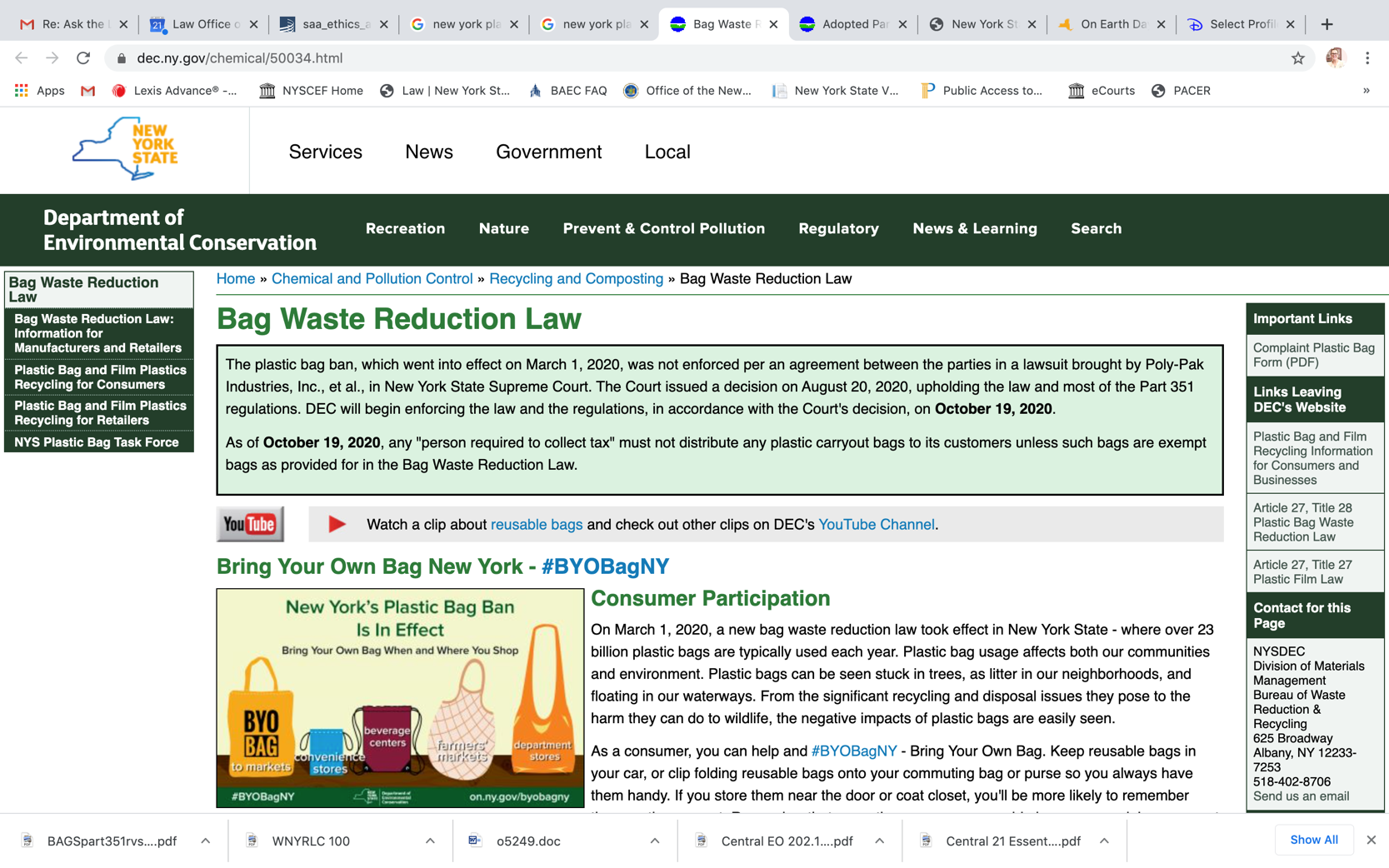
[NOTE: This question relates 6 NYCRR Part 351, which implements the requirements of Titles 27 and 28 of Article 27 of the Environmental Conservation Law, aka "the plastic bag ban" which went into effect March 1, 2020, but was suspended for a variety of reasons until October 19, 2020.  For more information on that, see the graphic at the bottom of this answer.[1]]

Does the NYS plastic ban law apply to libraries using plastic bags for curbside pickup?

We purchased plastic bags to hold library items that patrons request, label the outside with their name and leave the bags on pick up carts in the foyer of the building. This is for patron privacy-others cannot see what a patron has requested. As well as a COVID-19 measure-others are not touching items for pick up to search for their materials.

We are tax-exempt and not selling anything. When our supply is exhausted I will explore other possibilities in order to support less plastic waste, even if the ban does not apply to us. But in the meantime, are we in violation of the plastic bag ban if we continue to distribute materials in plastic bags?


[1] Found on October 21, 2020 at https://www.dec.ny.gov/chemical/50034.html

Answer

The answer for this member is: NO.

Why?

The NYS plastic bag ban does NOT apply to libraries using plastic bags for storage of items pending curbside pick-up, unless the libraries are required to collect sales tax.

So while this member's library can choose to phase out plastic bags[2], since it is not required to collect sales tax ("we're not selling anything"), it is not compelled to do so.

Here is what the new regulations prohibit:

351-2.1 Prohibitions. A person required to collect tax shall not:

(a) distribute any plastic carryout bag to its customers unless the bag is an exempt bag;

...   [emphasis added]

"A person required to collect tax" (as if the term really needs clarification!) is defined as:

(l) ‘Person required to collect tax’ means any vendor of tangible personal property required to collect New York State sales tax pursuant to subdivision (a) of Section 1105 of the New York State Tax Law, “Imposition of sales tax.”

The trick is that the application of the law is not based on the taxability of the sale, but rather, the status of the bag distributor as a "person" required to collect tax. 

This is further borne out by commentary from the NY Department of Environmental Conservation, which states[3]:

As of March 1, 2020, all plastic carryout bags (other than an exempt bag) became banned from distribution by anyone required to collect New York State sales tax. For sales that are tax exempt, plastic carry out bags are still not allowed to be distributed by anyone required to collect New York State sales tax (unless it is an exempt bag). [emphasis added]

So, while the vendors at your library's annual craft fair (if you're able to have a craft fair, sigh), who have to collect sales tax, can no longer use plastic bags, a non-sales tax-collecting library's curbside delivery service can.

Extra credit:

At "Ask the Lawyer," we are not used to being the bearers of good news.  So just to be sure—I mean really, really sure—that we could give the above answer, I also checked the " REVISED REGULATORY FLEXIBILITY ANALYSIS FOR SMALL BUSINESSES AND LOCAL GOVERNMENTS" found on the NY Department of Environmental Conservation's web page at https://www.dec.ny.gov/docs/materials_minerals_pdf/part351rfafinal.pdf.

The "ANALYSIS" is one of the documents that drills a little more into the law, and how it will impact those it covers.  It states:

In 2019, a new Title 28, “Bag Waste Reduction” was added to Article 27 of the ECL. This law bans the distribution of plastic carryout bags to customers, effective March 1, 2020, by any person required to collect tax. (“Person required to collect tax” means any vendor of tangible personal property subject to the tax imposed by New York State Tax Law section 1105(a), “Imposition of sales tax.”)

So, really: unless your library is collecting sales tax (for sales of food, or sales of items like t-shirts, office supplies, or other retail[4]), these new requirements do not apply.  But if your institution is registered to collect sales tax (for anything): beware, and "ban the bag."


Thank you for a great and timely question.

Plastic Bag Ban infographic


[2] Which, as the member states, they intend to do.

[3] On https://www.dec.ny.gov/chemical/50034.html, as of 10/21/2020.

[4] Yes, not-for-profit and education corporations that sell retail items have to collect sales tax (they don't have to pay it, but they have to collect it). For more info on that, see https://www.tax.ny.gov/pdf/publications/sales/pub750.pdf.

Face shields and COVID safety guidelines

Submission Date

Question

New state guidelines list face shields as acceptable face coverings:
https://regs.health.ny.gov/volume-1a-title-10/content/section-66-32-face-coverings [NOTE: This link was confirmed as no longer active and removed on 02/25/2022 as part of the routine review of "Ask the Lawyer" materials.]
However, people often spend quite a bit of time in the library, especially using our computers. We would like to require that they wear actual cloth (or paper surgical) face masks. Are we permitted to make our own safety rules? It seems to me, that just as we can prevent roller skating in the library, we should be able to set other safety rules for the sake of staff and patrons.
Thank you.

Answer

This question came into "Ask the Lawyer" with a request for a quick turnaround, so we'll keep this brief.

Are we permitted to make our own safety rules?

Yes...and no.[1]  But that doesn't matter for this question, because the member's real objective is...

 "We would like to require that they wear actual cloth (or paper surgical) face masks."

...which a library with a well-developed, uniformly applied Safety Plan can absolutely do.

Why is that?

As of this writing[2], there is documented evidence that the CDC is still weighing the advisability of face shields.  Here is what they have to say:

Gaiter and Face Shield infographic


(For the less cartoon-oriented[3], the CDC says it like this:)

CDC mask guidance

Of course, at the same time, as the member points out, the State of New York now allows face shields to "count" as a face cover:

66-3.2 Face-Coverings....

(i) Face-coverings shall include, but are not limited to, cloth masks (e.g. homemade sewn, quick cut, bandana), surgical masks, N-95 respirators, and face shields.


Meanwhile, the REALMS study has hit the library community with THIS cold cup of coffee[4]:

Transmission infographic from Project REALM


Libraries should be paying attention to all of these evolving resources[5], and should regard their Safety Plan as a "living document" that evolves with that information.  This will help libraries develop a plan that can help them help patrons adhere to CDC guidelines like this one:

CDC Library visit infographic

The bottom line?  If your library bases its access and services on current information, is careful to adhere to its obligations under the ADA, and adheres to a Safety Plan that provides—based on the combined input from such reliable sources—that certain areas may only be accessed by those wearing faces masks (and/or gloves, and/or only if they agree to spray down certain surfaces, and/or only by a certain number of people a day), it may do so.

It all comes down to having a Safety Plan based on your library's unique size, design, staffing capacity, and collection materials.  With a plan that is linked to established factors, the best guidance we can get in uncertain times, and reliable enforcement, anything is possible.[6]

Thanks for an insightful question!


[1] The answer to THIS question is about 15 pages and has 20 footnotes.  Aren't you glad we found a way to make it snappier?

[2] October 16, 2020.  CDC content found at https://www.cdc.gov/coronavirus/2019-ncov/prevent-getting-sick/about-face-coverings.html

[3] I am "cartoon-oriented."  Whenever something can be conveyed effectively via icon or cartoon, it should be.  Of course, as a lawyer, I experience no shortage of words.

[4]  https://www.oclc.org/realm/faq.html.  On a side note, how bad is my DIY mark-up of this content?  It looks like I am trying to draw a squished amoeba. 

[5] My "word of the day," which I learned as I researched this answer, is "fomite" (infected objects). Given what we've all had to deal with in 2020, I am sure I have seen the word before, but was too busy learning the concepts like "zoonotic" & "contact tracing" for it to sink in.

[6] Even wearing a masks while roller skating in a library (but I'd check that one out with your insurance carrier).