Templates

Reference Services for Incarcerated Populations

Submission Date

Question

Periodically, our library receives handwritten requests for information from individuals who are incarcerated at prisons and correctional facilities around the country.

We are an academic library at a private institution and our campus does not currently have a prison outreach program. As part of our ongoing social justice efforts within the library, we would like to be more purposeful about the way we handle these reference questions.

What are legal considerations we should keep in mind when providing reference services to incarcerated individuals? Ideally, we would want to treat these questions the same way we would questions from members of the general public. However, our team wants to be sure we understand whether there are ways we could unintentionally put ourselves or our institution at legal risk if we provide information that is somehow deemed problematic.

(Note: We are aware of the Prison Library Support Network and plan to participate in trainings they may offer.)
Thanks!

Answer

As I have written before, a big rule for the "Ask the Lawyer" service is "don't reinvent the wheel!"

So before I answer this, I will reiterate the member's mention of the "Prison Library Support Network", and refer readers to their excellent guide "Reference Letter Writing: A Volunteer Handbook."

The "Volunteer Handbook" reviews a lot of what I would otherwise supply: how to be respectful of an incarcerated person’s needs and personal considerations when responding to a reference request, how to be aware of and work within the larger social dynamics at play, and--critically--the practical considerations of sending mail to incarcerated people (it's also well-written, which is always a plus).

To the "Volunteer Handbook" I would add just a few considerations for a library at a private higher education institution:

First, it is important to recognize that while library services provided in the state of New York by both public libraries and academic libraries are confidential, incarcerated individuals do not have privacy with respect to information they receive via the mail.  Therefore, the normal librarian/library user dynamic is "off."

Here is a sample of the scrutiny mail to a person living in jail or prison will be subject to:

(c) Printed or photocopied materials.

(1) When, in the course of inspection, printed or photocopied materials are found, the entire contents of such correspondence may be delayed through the correspondence unit for up to six days while the materials are subject to media review guidelines (see Part 712 of this Title).

(2) A limit of five pages of printed or photocopied materials (an individual newspaper clipping will be considered one page) may be received within a piece of regular correspondence (except as provided in paragraphs [3] and [4] of this subdivision). In order to facilitate media review, pages or clippings must not be taped, glued, or pasted together or to other papers.

(3) Not to exceed once every four months, an inmate may make a written request to the superintendent to receive in excess of five pages of printed or photocopied legal papers specifically related to the inmate's current legal matter (e.g., legal brief or trial transcript relating to the inmate's active case) within a piece of regular correspondence. The inmate shall make the request in advance...[etc.]

Ugh.  That's a lot of compromised privacy.[1]  So, from the outset, just keep in mind that per 7 CRR-NY 720.4, as well as a facility's customized policies and procedures, the usual rule of confidentiality will not apply.

Aside from that, I add three things:

1.  An academic library should specify via written policy if it offers library privileges to community members within a defined geographic scope (not just students, alumni, and employees).

2.  An academic library should have a policy setting out its capacity and limits for providing hard copy/mailed responses to reference requests.

3.  If a library is going to provide services specifically to incarcerated persons living beyond the geographic scope allowed by their policies (as the member's question says, they get questions "from around the country"), a specific policy should be developed for providing that service, even if the institution doesn't have a fully-developed prison outreach program.

These three policies should be applied evenly, fairly, and with attention to budget and capacity. This means:

With respect to #1, if an academic institution allows residents within 100 miles to have library privileges, and there is a prison within that radius, a person who is incarcerated may have library privileges (although their ability to exercise them may be limited).

With respect to #2, if an academic library provides written, mailed responses to users, there should be time and resource limits on providing that service to users, and those limits should be uniformly applied with respect to both staff hours, and copying/mailing budget.

And with respect to #3, if a private academic institution wants to provide services to persons living in jail or prison beyond the scope of their usual services, but it not able to develop a full prison outreach program, such services should still be done per a specific policy.

Why a specific policy, if there isn't a fully developed outreach program?  A few reasons.  First, it will help set the boundaries for the service, based on the library's capacity.  By establishing those boundaries, the library/institution will be able to show that the resource is being allocated fairly.  And finally, it provides clarity on how such services are provided, who is responsible for providing them, and how much is allocated for the expense associated with them (useful information if your institution ever wants to expand the service through a grant).

Here is a sample policy:[2]

[ABC Library] Policy on Reference Services to Incarcerated Persons

Policy

As part of our mission, the [ABC College Library] provides up to [20 hours per month] of reference services to persons incarcerated anywhere within [the United States].

Procedure

Upon receiving a reference request from a person who is incarcerated, the ABC Library assesses if the inquiry can be answered by the library within [one month (30 days)].[3]

If it can be answered, the question is placed in a queue to be answered in order of receipt, and an answer will be sent via the USPS within 30 days of receipt.

If it cannot be answered, either due to a large queue, or because it is not within the capability of the institution, a reply is sent stating "The ABC Library received your request for reference services, and regrets that answering your question is not within our capability at this time."

The position responsible for reviewing requests, and for assessing and effecting a timely response, is [INSERT]. This responsibility may be delegated, based on capacity.

OPTIONAL: To the greatest extent possible, persons within [NAME Correctional Facility], which is in the Library's area of service, are served per the library's policy on community members, and hours spent serving such users are not counted against the monthly amount allowed under this policy].

I appreciate that for many institutions of higher education, this question is deeply related to mission. Therefore, in adopting even the most informal policy, such as the one above, I also suggest considering a recital of how the work specifically plays into the mission of the institution.

Thank you for a thoughtful question.


[1] I get why, but as someone opposed to the carceral system in general (we can do better), this is just another reason to develop a better system.

[2] [Text in Brackets] in this sample policy indicates places where customization is most needed.

[3] An institution should research what time frame they feel is fair to offer; for some inquiries, sixty, or even ninety days may be reasonable.  This depends on the type of inquiries your institution is receiving...especially since this is a policy for a reactive service, rather than a deliberative outreach program.

Image Use By Previous Employers

Submission Date

Question

This is an issue that's come up in recent conversation. If an individual who no longer works at an institution finds that their picture is still being used by said institution, whether in promotional photos or on staff/faculty pages, does that individual have any legal recourse? It seems wrong for an institution to continue to use photos of faculty, staff, or even students who are no longer affiliated with the institution but it seems to promote the idea that they are. Sometimes it could be carelessness, other times it seems like there is an illusion of diversity being promoted. What could someone do if they find that their image/likeness is still being used by their former employer, for whatever reason?

Answer

This question needs to be answered on a sliding scale.

Here are three scenarios to show how the scale can slide:

Scenario 1: "Scrapbooking"

A museum makes robust use of social media to connect with its community.  At different events, a staffer or two are expected to take lots of photos, including shots of staff and guest speakers interacting with the community.  Members often comment how much they enjoy the images and connectivity.

Since the Museum got in on the ground floor of social media and the practice started on the Museum's website, some of the content is almost 3 decades years old ("born and aging digital"). At this point, some of the employees in the images have not only simply moved on--they've retired.

No written, signed permission to use the employees' images is obtained.


Scenario 2: "Image Crafting"

A library is working to show its commitment to diversity, equity, and inclusion.  The employee in charge of the web site and social media culls through photos of employees and patrons to post selected images on static pages that refer to a DEI commitment; while other use of the website and social media is managed as usual, these pages remain unchanged as stand-alone statements.

No written, signed permission to use the employees' images is obtained.


Scenario 3: "Stone Cold Marketing"

An association library is creating a brochure to kick off a capital campaign to build a new library on a donated piece of property.  The donated land is more centrally located in the library's area of service.  To raise funds for the hoped-for building that will serve a new generation of library users, the library asks all the employees and their kids to attend a photo shoot on the new land.  The idea is they will sit on blankets, reading, on the currently-empty lot, and the library's graphic designer will put a semi-transparent rendering of the future building over them, showing the library of the future.

No written, signed permission to use the employees' images (or their kids' images) is obtained. 


In New York, the law is pretty straightforward on the unauthorized commercial use of living people; NY Civil Rights Law Section 50 "Right of privacy" says "a person, firm or corporation that uses for advertising purposes, or for the purposes of trade, the name, portrait or picture of any living person without having first obtained the written consent of such person, or if a minor of his or her parent or guardian, is guilty of a misdemeanor."

Recently, the law was expanded to restrict the commercial use of the image of deceased "personalities": NY Civil Rights Law Section 50-F 2. a. provides "Any person who uses a deceased personality's name, voice, signature, photograph, or likeness, in any manner, on or in products, merchandise, or goods, or for purposes of advertising or selling, or soliciting purchases of, products, merchandise, goods, or services, without prior consent from the person or persons specified in subdivision four of this section, shall be liable for any damages sustained by the person or persons injured as a result thereof."[1]

"Ask the Lawyer" has addressed this issue a bit before: see https://wnylrc.org/raq/employee-privacy-and-image-use and https://wnylrc.org/raq/posting-patron-images-facebook-when-image-release-required, but we haven't focused on solutions to the question posed by the member: If an individual who no longer works at an institution finds that their picture is still being used by said institution, whether in promotional photos or on staff/faculty pages, does that individual have any legal recourse?

This is where our scenarios come in.

If the use is what I've called "scrapbooking" in the first scenario--part of a collection documenting events as they unfolded, and not featured or linked in a way that advertises the institution or asks for money--the law does not have much recourse.   That said, a former employee can always ask for an image to be removed as an act of courtesy, and if there is a compelling reason (safety, emotional well-being, not wanting to be affiliated with the institution any more) an attorney could help the person isolate and make a convincing argument for removal.

As the scale continues to slide, if the use is what I've called "image crafting" (the use referenced by the member in the question), if written permission was not granted, there may be grounds for demanding removal under the law.  A current or former employee who feels strongly about this should consider working with a lawyer, since the first request should accurately set out the basis for the requested removal.

On the final end of the scale, when the use is clearly for "advertising purposes, or for the purposes of trade" (like a posting soliciting a capital donation), written permission should have been obtained, and a former or current employee--unless their job description includes serving as a model or posing for published pictures--has a strong basis to demand removal under the law.

What can a cultural institution do to avoid the risk of unauthorized commercial use of an employee's image?  A few things:

First, unless it is part of the employee's job description, do not require use of the employee’s image on print publications and social media.  If the institution has determined that, for the sake of public relations and service, all public-facing employees will have their picture on the website, it should ensure that due attention to safety and privacy is factored into the requirement.[2]

Second, even when an employee seems "okay" with being featured in a publication (print or online), it is good to get written permission. While not all uses will qualify as "commercial" and thus risk violation of the law, it shows respect and proper attention to employee agency and safety.

Third, if feasible, consider a default position that every employee, unless it is in their job description, has "opted out" for use of employee images on institutional publications.  Then ask who would want to be featured.  For example: "To respect employee privacy, the library does not intentionally use the name and images of employees except to the extent they are listed on the website and in published board materials.  If you would like to be featured in library social media and publications, please alert the Director, so we can obtain a written image release.  This is not a requirement!"

Fourth, if your library or other cultural institution needs to rely on the personality and persona of an employee to the point where use of their name and image in association with the library is part of their job, consider putting that in their job description.  For example, "The [insert title] position is a community-facing position and in addition to routine interaction with the public, will be required to interface with the public via materials published by the [library] from time to time, including use of their name, signature, and recorded images of their likeness and voice."

And fifth, when in doubt, get an image release.

An image release can come in many forms; to be on the safe side, an image release should be custom-written for your institution, and the use it plans to make of authorized images.

That said, here is a sample:

Image Release

NAME, who is at least 18 years of age, consents to the use of their image, name, and likeness, as governed by New York Civil Rights Law 50 for purposes of informing the public about events, opportunities, and initiatives of the XYZ Library, including fundraising initiatives.  As an employee, I understand that such consent is not a requirement of my position, and I may revoke this consent at any time by sending a written request to make no further use of my image under this Image Release. I understand that "revoking consent" means no further use will be made of my image, but that past use will not be removed. Unless revoked by me personally, this release shall be binding on my heirs and cover the institution's use of my "right of personality" as covered by New York Civil Rights Law 50-F.


DATE:______________

SIGNATURE:______________________

WITNESS:____________________________


Records retention period of this release: PERMANENT.


A well-written release can cover you whether you are "scrapbooking", "image crafting", or engaging in "stone cold marketing."

Thank you for a thoughtful question!


[1] I won't list them all here, but there are many exceptions to this law for use by artists, journalists, etc.  If you are just learning about Civil Rights Law 50-F in this RAQ, please don't let it stifle your archive, art, or journalism! You can find the list of exceptions here: https://www.nysenate.gov/legislation/laws/CVR/50-F.

[2] I could write a whole chapter on this consideration, but we'll leave it there for now.

Open Meetings Law 2022 Library Board Chart and Checklist

Submission Date

Question

"Ask the Lawyer" got two questions about the April 9, 2022 changes to the Open Meetings Law ("OML"), which will enable library boards to more easily meet via videoconferencing.  The questions asked for sample resolution language to enable a board to meet via videoconference, and compliance checklists to make sure a board is getting all the new details right.

Answer

To answer these questions, we've created an "Open Meetings Law 2022 Library Board Chart and Checklist" that sets out:

  • The Education Law and OML's basic public access requirements for library trustee meetings;
  • The OML's recent changes regarding meeting materials;
  • The OML's new option for videoconferencing; and
  • Old and new requirements for trustee meeting notices.

Below that are the requested sample resolutions and policies.[1]

Open Meetings Law 2022 Library Board Chart and Checklist

What to do (requirements, tips, and hacks)

Why the board is doing it

How to do it

Did you do it?

Requirement: Your board must meet "at least quarterly."

Because Section 260(5) of New York’s Education Law requires it.


Your board must "fix" the "day and hour" of the meeting; if the meeting is known at least 2 weeks in advance, the notice must go out at least one week in advance.


Requirement: Your library's meetings must be "open to the public."


Because Section 260-a of New York’s Education Law requires it.

Follow the requirements of Article 7 of the NY Public Officers Law, aka, the "OML" (more on that in the rows below).


Requirement:  Your library must notify the public and the news media at least one week in advance of the time and place (including virtual place) of a meeting scheduled at least two weeks in advance.


This timing for notice is a bit different from the timing in the OML; that is because Section 260-a of New York's Education Law modifies the notice requirements for meetings (to be a bit kinder to libraries).

The law doesn't require a specific medium, but the notice should be in writing.  The new requirements include posting the means to attend via videoconference (for more on that, and for a sample notice, see below).


Requirement/Hack: If your library is in a city of "one million or more," your committee meetings should also be open and noticed.

Because Section 260-a of New York’s Education Law specifies that library trustee committee meetings be open in cities with that population.

If your board serves a library serving a city with a population of one million or more (in other words, if you are in NYC), treat your committee meetings like board meetings.


Hack: Your board can create an "Executive Committee" to transact business between meetings.

Because Education Law 226(2) allows your library to do this.

Amend the bylaws to create an Executive Committee "...of not less than five, who, in intervals between meetings of the trustees, may transact such business of the corporation as the trustees may authorize, except to...make removals from office."


Requirements: Make available any "proposed resolution, law, rule, regulation, policy or any amendment thereto", that is scheduled to be the subject of discussion by the board at the meeting, at least 24-hours prior to the meeting.

Because Section 103-e of the “Open Meetings Law" requires your library to do this.

Have the board packet available either in hard copy or upon request. 


NOTE: If your library regularly uses its website, the law also requires that the materials be posted on the website.


Hack: Adopt rules about the location of equipment and personnel used to photograph, broadcast, webcast, or otherwise record an open meeting.

OML 103(2) allows a library (or a public body that follows the OML) to do this so such broadcast is not disruptive (or a tripping hazard).

If your library adopts such a policy, the law requires that the rules "be conspicuously posted during meetings and written copies shall be provided upon request to those in attendance."


A sample policy is below.  (Before adopting such a policy, consider your library's unique space and needs.)


Option: enable trustees to attend via videoconference, while the meeting has only one physical location.

Your board will do this if they want trustees to be able to attend even if caregiving, disability, health, or other compelling reasons prohibit attending in person.

Per the legislation signed by the Governor on April 9, 2022, the way to exercise this option is to:


1.  Adopt procedures consistent with the new law;


2.  Pass a resolution to authorize meeting via videoconference.


A generic bit of advice: before voting on a resolution to authorize meeting via videoconference, the board of trustees should consider whether the additional technical and notice requirements are both desirable and feasible.

For example: the new law requires that any meeting held via videoconference under this new provision must be archived on the library's website for five years. Does your library have that capacity?

For another example: the new law requires that any meeting held via videoconference and archived in this manner must be "transcribed upon request." Does your library have the capacity to transcribe sometimes lengthy meetings upon request?

And as a final example: the new law requires that if the agenda includes a public comment period, those attending via videoconference must be able to comment and participate just as those physically attending. Does your library have the technical capacity to enable that?

None of these examples is a deterrent to videoconferencing, so long as the library has the budget and technical capability to honor the requirements. Since this could have an impact on budget, assessing that capability is critical before deciding to meet this way.

TEMPLATE resolution

(Regarding rules about the location of equipment and personnel used to photograph, broadcast, webcast, or otherwise record a board meeting)

WHEREAS the board of the ABC library recognizes the requirement of the NY State Open Meetings Law to allow the public to photograph, broadcast, and webcast its open public meetings; and

WHEREAS, Section 103(2) of the Open Meetings Law allows public bodies to adopt rules about the location of equipment and personnel used to photograph broadcast webcast or otherwise record a public meeting;

BE IT RESOLVED that the board of trustees of the ABC library adopts the attached rules per Section 103(2) of the Open Meetings Law; and

BE IT FURTHER RESOLVED that as required by law, such rules shall be posted at the location of each meeting and included in the agenda posted at least 24 hours in advance of the meeting so the public attending can have notice of and abide by such rules.

[SAMPLE RULES]

Consistent with the requirements of the Open Meetings Law, attendees at open public meetings of the board of trustees are allowed to photograph, broadcast, webcast and otherwise record those portions of the meeting not in executive session.

To ensure such authorized activity does not disrupt the smooth and safe operation of a trustee meeting, and consistent with Section 103-a of the Open Meetings Law, the following "Rules" shall be posted at the location of each meeting and included on the posted agenda:

  • No extension cords or other potential tripping hazards may be set up;
  • No flash photography or additional lighting may be used;
  • No recording instrument shall be closer than 3 feet of a meeting participant, without that person's express consent;
  • All equipment should be silent enough to not cause a disruption;
  • Equipment must not block aisles or exit and may not impede the view of other attendees;
  • [INSERT]

The privilege to record in this manner at the library is limited to open meetings of the board.

When enforcing this rule with regards to the manner of recording, the ABC library board of trustees shall ensure that the First Amendment of the United States Constitution, and Article I, Section 8 of the New York constitution are honored.

Sample resolution to authorize videoconferencing and adopt policies

WHEREAS on April 9th, 2022, the governor of the state of New York signed into effect chapter 59 of the laws of 2022, in part amending the Open Meetings Law to enable public bodies to meet, under certain circumstances, via videoconference; and

WHEREAS, the board of the ABC Library has duly considered the benefit of this law to its routine operations, and determined that meeting via videoconferencing per the Open Meetings Law with further the operations and mission of the library;

BE IT RESOLVED that consistent with its bylaws and Charter, the board of trustees hereby authorizes the use of videoconferencing for its meetings; and

BE IT FURTHER RESOLVED that the board of trustees hereby adopts the attached written procedure governing member and public attendance at trustee meetings, and confirms each element of that written procedure in this resolution; and

BE IT FURTHER RESOLVED that members of the board of trustees are required to be physically present at any duly noticed meeting unless such member is unable to be physically present due to extraordinary circumstances (including disability, illness, caregiving responsibilities, or any other significant or unexpected factor or event which precludes the member's physical attendance at such meeting); and

BE IT FURTHER RESOLVED that except in the case of executive sessions conducted pursuant to section one hundred five of the Open Meetings Law, and consistent with the requirements of the Not-for-Profit Corporation  law, the trustees shall ensure that members of the public body can be heard, seen and identified, while the  meeting is being conducted, including  but not limited to any motions, proposals, resolutions, and any other matter formally discussed or voted upon; and

BE IT FURTHER RESOLVED that the minutes of the meetings involving videoconferencing shall include which, if any, members participated remotely and shall be available to the public pursuant to section one hundred six of the Open Meetings Law; and

BE IT FURTHER RESOLVED that if videoconferencing is used to conduct a meeting, the public notice for the meeting shall inform the public that videoconferencing will be used, where the public can view and/or participate in such meeting, where required documents and records will be posted or available, and identify the physical location for the meeting where the public can attend; and

BE IT FURTHER RESOLVED that the board of trustees shall provide that each meeting conducted using videoconferencing shall be recorded and such recordings posted or linked

on the library's website within five business days following the meeting, and shall remain so available for a minimum of five years thereafter, and such recordings shall be transcribed upon request; and

BE IT FURTHER RESOLVED if videoconferencing is used to conduct a meeting, the library shall provide the opportunity for members of the public to view such meeting via video, and to participate in proceedings via videoconference in real time where public comment or participation is authorized and shall ensure that videoconferencing authorizes the same public participation or testimony as in person participation or testimony; and

BE IT FURTHER RESOLVED that for so long as the board of trustees elects to utilize videoconferencing to conduct its meetings, the library will maintain an official website; and

BE IT FURTHER RESOLVED that, consistent with the library’s mission to serve its community, the trustees' use of videoconferencing shall utilize technology to permit access by members of the public with disabilities consistent with the 1990 Americans with Disabilities Act (ADA).

Adopted this ___ day of _____, 2022.

Yay:

Nay:

Abstain:


TEMPLATE written procedure

governing member and public attendance at trustee meetings

1.         Members of the board of trustees are required to be physically present at any duly noticed meeting unless such member is unable to be physically present due to extraordinary circumstances (including disability, illness, caregiving responsibilities, or any other significant or unexpected factor or event which precludes the member's physical attendance at such meeting).

2.         Except in the case of executive sessions conducted pursuant to section one hundred five of the Open Meetings Law, and consistent with the requirements of the Not-for-Profit Corporation law, the trustees shall ensure that members of the public body can be heard, seen and identified, while the meeting is being conducted, including but not limited to any motions, proposals, resolutions, and any other matter formally discussed or voted upon.

3.         Minutes of the board meetings involving videoconferencing shall include which, if any, members participated remotely and shall be available to the public pursuant to section one hundred six of the Open Meetings Law.

4.         If videoconferencing is used to conduct a board of trustees meeting, the public notice for the meeting shall inform the public that videoconferencing will be used, where the public can view and/or participate in such meeting, where required documents and records will be posted or available, and identify the physical location for the meeting where the public can attend.

5.         The board of trustees shall provide that each meeting conducted using videoconferencing shall be recorded and such recordings posted or linked on the library's website within five business days following the meeting, and shall remain so available for a minimum of five years thereafter, and such recordings shall be transcribed upon request.

6.         If videoconferencing is used to conduct a meeting, the library shall provide the opportunity for members of the public to view such meeting via video, and to participate in proceedings via videoconference in real time where public comment or participation is authorized and shall ensure that videoconferencing authorizes the same public participation or testimony as in person participation or testimony.

7.         For so long as the board of trustees elects to utilize videoconferencing to conduct its meetings, the library will maintain an official website, which is INSERT ADDRESS.

8.         Consistent with the Library's mission to serve its community, the trustees' use of videoconferencing shall utilize technology to permit access by members of the public with disabilities consistent with the 1990 Americans with Disabilities Act (ADA).


SAMPLE notice of meeting to use videoconferencing

The board of trustees of the ABC Library will hold a meeting at

DAY

HOUR

at

[AT LEAST ONE] PHYSICAL LOCATION

Per the policy of the board, videoconferencing will be used to enable attendance of trustees and public access to the open meeting.

The public can view and/or participate in the meeting by [INSERT].

[If public comment or participation is authorized and noted on the agenda] Those attending via videoconference may engage in the same public participation or testimony as in person participation or testimony by INSERT.

Document and records to be reviewed at that meeting will be posted at INSERT and available by request at INSERT.

The meeting shall be recorded, and the recording shall be posted [or linked] on the library's website (INSERT ADDRESS) within five business days following the meeting, and shall remain so available for a minimum of five years thereafter.   The recording shall be transcribed upon request.

Consistent with the Library's mission to serve its community, the trustees' use of videoconferencing shall utilize technology to permit access by members of the public with disabilities consistent with the 1990 Americans with Disabilities Act (ADA).   Questions regarding accommodations can be directed to INSERT and INSERT.[2]

[Insert rules of broadcasting meeting if applicable]


[1] As with all things template, whenever possible, review this guidance with your library's attorney.

[2] To enhance accessibility, accommodation requests should be able to be made through at least two different mediums; for example, a number to call and via e-mail.

Contracts for Library Podcasts

Submission Date

Question

The library's podcast (Your Friendly Neighborhood Librarians), hosted by two librarians here, recently started interviewing guests from outside the organization. We are concerned about a few things: what the ramifications are if a guest does not like the way their interview was edited and whether the library owns the rights to the interview and recording. We only edit for clarity and length, and haven't done anything in regards to copyright. Additionally, any advice on whether we should be using some sort of contract or agreement with guests would be helpful. We don't have any sort of agreement in place at present, and are mostly interviewing people who are somewhat library-related. Thank you for your help!

Answer

Some days, I just love my job.  The day I subscribed to "Your Friendly Neighborhood Librarians" (2/4/22) to answer this question was one of those days.

For those of you who haven't checked out the Podcast: it's a forum where hosts (and librarians) Jim and Robyn, based in Rochester, NY, conduct deep and lively interviews with quasi-local authors.  [1]

When it comes to running a Podcast, there's a lot of legal to unpack.  I'll use a recent episode of YFNL (Season 2, Episode 4, January 30, 2022), an interview with photographer Quajay Donnell to illustrate.

When the Podcast starts, the first thing you hear is the YFNL's theme song:

[guitar strumming] "Librarians, librarians, when you've got questions, they're the ones, to help you find what you're looking for..." [more].  It sounds vaguely like the theme to "Spiderman" and is clearly a riff; it's super-cute and fun and brings a smile to my face. Then Jim and Robyn introduce the session's guest and launch into the interview.

The rapport is lively and fun, but Jim and Robyn's deeply prepared interview technique gives Quajay Donnell room to make comments, tell stories, and respond to well-informed prompts to talk not only about his work, but the work of others, and his thoughts on public art (I enjoy Mr. Donnell's comment, after a glowing list of his credentials "I sometimes struggle with the title of 'photographer', I sometimes say 'I'm a picture-taker', or 'I capture moments'."  I appreciate when people resist or explore the purpose of labels).  The show then ends with a cut to a recommendation from a circulation desk worker, Sim, who recommends "Field of Blood" by Joanne Friedman, and a tease for the next episode ("banned and challenged books"), some thanks to various show-helpers,[2] and an instrumental of that great theme song.

So with that background, let's answer the questions:

"[W]hat the ramifications are if a guest does not like the way their interview was edited and whether the library owns the rights to the interview and recording.  Additionally, any advice on whether we should be using some sort of contract or agreement with guests would be helpful. We don't have any sort of agreement in place at present, and are mostly interviewing people who are somewhat library-related."

I wish I could give simple answers to these straightforward questions, but this is "Ask the Lawyer," so I cannot.  But to start, I can say there are three variables that inform the answer to these questions:

Variable "1": Who is creating the Podcast?  Is it "officially" the library, or is it being created through the collaboration of independent individuals?[3]

Variable "2": What is the identity of the Podcast?   Is it 100% entertainment, or is it meant to be investigative journalism, oral history, or serve another documentary purpose?[4]

Variable "3": What is the purpose of the Podcast?  In other words, what is it trying to achieve not only now, but 70 years from now, when it is still protected by copyright, and past consideration of such questions will govern what type of access its intended audience should have?

Here’s how these variables impact the member's questions:

If a library is the creator of the Podcast (meaning the library directed its employees to create the Podcast as part of the work they are hired to do), then the library is the entity responsible for addressing (and bearing the liability for) issues of ethics, ownership, and risk (like defamation and image use).  If an individual or individuals are the creator/owner of the podcast,[5] the responsibility falls on them. 

If the identity of the podcast is light entertainment (that theme song!), then the creator does not have to worry about abiding by, or benefiting from, professional codes of ethics and law pertaining to journalism, academic work, oral history/documentary, or political expression.  But if it aspires to fall into any of those categories (and while it's not my call, I'd say YFNL is at the very least a form of journalism), ethics and certain laws may apply.

If the purpose of the Podcast is to ensure that people listening in 2022, as well as 100 years from now, appreciate home-grown artists in and around Rochester, NY, the creator/owner needs to ensure the work is set up to be controlled in such a way that access for that purpose is ensured.  This is true whether the owner is an entity (like a library), or a person or persons.

So with that as background, let's tackle the member's questions:

For the first question ('"[what] if a guest does not like the way their interview was edited?), the answer is: in a worst-case scenario (say the guest claims the interview was edited to make him sound offensive, and claims it caused him to be "cancelled"), there could be some type of legal claim for damages.  While I won't get too technical, this concern relates to a "tort" claim (like a personal injury) and the member is wise to bring it up, since this is a critical issue.[6]

An attorney advising an entity or person on this would: 1) confirm who the creator, publisher and owner of the content is; 2) ensure the party (or parties) makes good use of a speaker agreement that secures a waiver of liability for the producer and all people affiliated with the podcast; 3) if appropriate,[7] advise a step in the production process that gives participants the right to review and approve release of the final version (in writing).

This plays into the second question: "whether the library owns the rights to the interview and recording."

This should not be an ambiguous issue: either the work is "for hire" (meaning the librarians and other credited helpers are doing it as part of the work they are paid to do, or are working per an additional contract) and is owned by the library, OR the work is owned by the individuals creating it.

The leads to the third question (or rather, factor) listed by the member: We only edit for clarity and length.

This plays into the identity of the podcast. If a podcast or other work isn't using a lot of editing to create a specific dramatic or entertaining effect, and is structured to perform a primarily documentary function, it is worth considering using the established ethics of journalism or oral history to guide the project.

Why? 

In the state of New York, journalists' sources are accorded particular protections under the law, while the identity of the speaker and nature of the communications are relevant to claims of defamation. Also under New York law, the further an unauthorized[8] use of someone's name, likeness, or voice, is from a "commercial use," the less likely a person can sue based on "invasion of privacy." And under federal copyright law, material that incorporates copyright-protected work (perhaps reading part of a poem) for journalistic, academic, or documentary functions will get consideration of that factor if a court needs to determine "fair use."

This next variable I listed is purpose, meaning, what is this work supposed to accomplish, and for how long? Consider that variable in light of the member's statement: "[We] haven't done anything in regards to copyright."

If the purpose of the podcast is to ensure as many people as possible access and appreciate it for as long as possible, what might be more important than registering a copyright is to ensure the work is archived on not only a commercial service such as Apple Podcast (where I found it), but in repositories owned by the public, as part of an institution whose structure ensures some type of longevity.

However, if part of the purpose of the podcast is to ensure for as long as possible that it can never be exploited commercially by anyone, and the owner wants to make sure it will be able to claim damages and attorneys' fees in the event the recording is infringed, registering it is a good idea.

So with that, I get to the last, open-ended question from the member: Additionally, any advice on whether we should be using some sort of contract or agreement with guests would be helpful.

It's important to know at this point that while sometimes I reach out to a member who submits a question to "Ask the Lawyer" (to get a bit more information to enable a more helpful answer), in this case, I did not reach out to Robyn and Jim (although because I really like the podcast, I wanted to!). I thought it would be more important, and in the spirit of their question, to present a generic answer to this part of their question with a generic template that could be of use to other libraries and librarians creating a podcast or other type of audio content.

When creating a podcast, here are the "legal" questions to answer to help you (and your lawyer) address the legal considerations:

Question

Reason it's relevant

Your answer


What is the purpose of the podcast?


It's important to answer this question first, because the purpose of the podcast will drive all the answers following this one.


Are there any professional ethics that apply to the podcast?


This answer is based in part on the "purpose." If the purpose is a type of journalism, the creator may want to consider affirmatively abiding by applicable journalistic ethics. If the purpose is oral history, the ethics of oral historians could apply.


Who "owns" the podcast?


This is a question for a lawyer. However, I can broadly say that if a library or educational institution is directing the podcast to be created, and the people creating it are doing so as part of their jobs, then the podcast is owned by the employer. If everyone involved is unambiguously doing it in their free time, then likely, they are the owners together. And in either case, if there is any grant funding that applies to the podcast, the owner(s) should pay close attention to the terms of the grant, because often grants involve a license or transfer of intellectual property.


What is the end product?


This seems like a pretty straightforward question, it's "podcast recordings," right? However, in just taking a look at "Your Friendly Neighborhood Librarians" I heard a theme song that could be subject to individual copyright, and I see there are really excellent descriptions of each podcast that were authored by somebody. In addition, "Your Friendly Neighborhood Librarians" (a clever brand) could also be subject to trademark. There is also a logo.  And if the content is in its own archive with its own metadata, the metadata could also be proprietary. These are just a few examples, so inventorying the end creation (and if all of the creators are not employees, making sure intellectual property is transferred appropriately) might be bigger than maintaining a list of podcasts.


What are the terms for regular and guest contributors?


For podcasts being created by people as part of their jobs, the expectations, rules and protections for them should be understood between their job description and the rules by which the podcast is operated.


For guests, as the member's question points out, it is best to have a written agreement that sets out the terms, including the right balance of a waiver of liability and the ability to preview the podcast to ensure any editing does not result in a person saying something they didn't intend to say.


(As one example of "rules": if a podcast is being produced by a public library or a not-for-profit organization, there should be a firm rule that no endorsements of political candidates are allowed on the show.)


What other conditions may apply?


For podcasts released on Apple Podcast, this means what are the rules you have to follow under the terms of Apple. For those selecting additional or alternate fora, paying attention to the "terms and conditions" on those resources is also important.  And as mentioned above, grants and donations with conditions that support the content creation should also be considered  (if you are lucky enough to be running a grant-funded podcast).


How do people access the content?


This is critical for ensuring accessibility in both the short and long-term.   Early consideration of this factor also ensures that any legal releases or agreements an owner needs to enter into (like licensing a logo) can accommodate the full plan for accessibility. 


How are any risks being addressed?


I appreciate this is a very open-ended last item. Broadly speaking, if the podcast is being produced by the library, the library's insurance carriers should be consulted to make sure it has insurance coverage for that type of activity. Any aspect of the podcast that is not covered should either be limited or other risk management, such as a waiver of liability, and a process for preview by guests, should be considered.


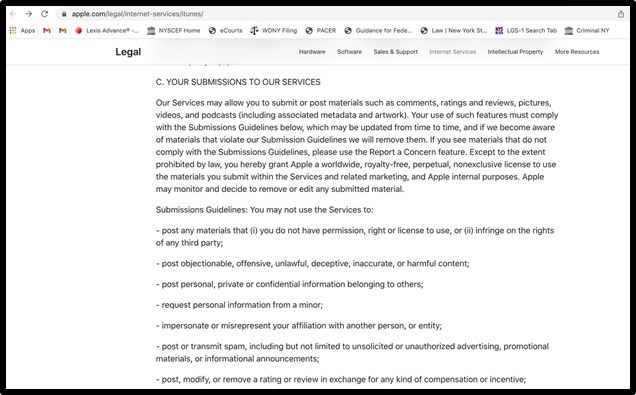
This last item is addressed by Apple's terms of use for podcasts, which I have included below.


Screenshot of submission disclaimer language

Now, with all that said, I am very aware that some of the answers I have put above may cause more anxiety then resolve curiosity. To help out with that, below is a template for a "podcast guest agreement."

As with any template, a library or podcaster should have their lawyer consider all of the factors I list above before finalizing the template. But hopefully this template can provide a good start.

[Template Podcast Guest Agreement]

RE:  Terms of guest appearance on [PODCAST NAME] on [DATE]

Dear [NAME OF GUEST]:

Thank you for agreeing to be a guest on our show, [NAME] ("the Show") on [DATE TIME] to discuss [TOPIC].

Below are the terms between you and [OWNER NAME] ("Show Publisher") for your appearance on the Show.  Please review the terms, and if you agree, please sign below.

If you have any questions before signing, please contact [NAME] at [CONTACT INFO] to discuss them before sending us the signed copy.

Ownership

You agree that the direct recording (audio and visual) and any subsequent product incorporating it, including but not limited to transcription and any adaptive copies made to enable access by those with a disability, shall be the sole property of Show Owner.

Image Use

You agree that for purposes of promoting, publishing, performing, displaying and making the Show accessible to its audience, Show Owner may use your name, image, and likeness in print and electronic media.  This permission is expressly limited to promoting and publishing the episode of the Show featuring you.  This permission is irrevocable once the Show featuring you has been made available to the public in any medium.

Rules

The rules of participating in the Show are:

Show Owner is committed to creating an experience and show that respects the dignity of all participants and listeners.  If you have any concern at any point regarding your experience working on the Show, please alert [NAME] at [CONTACT INFO].

If at any point during recording you need to take a break, please simply state "I need a break" and we'll stop recording.  This includes if a topic is not one on which you wish to speak.

We edit our show for length and clarity.  You will be given an opportunity to review the edited version prior to it being uploaded to [SITE(s)].  We ask that you write to [NAME] and [EMAIL] with any concerns about edits within [#] days of the final cut being made accessible to you.  If we don't hear anything from you within three days (excluding Saturday and Sunday), we will assume you consent to the publication of the content.

Please refrain from any endorsement of any political candidates during recording.

Please do not accuse any person of a crime, having an STD, or of being incompetent at their job, or marital infidelity, unless such fact is generally known, during recording.  We don't anticipate your appearance will warrant a dip into such a topic, but to avoid claims of defamation, or having to edit out such content, we alert guests to this consideration.

[INSERT CUSTOM RULES]

Hold Harmless

You release and hold harmless Show Owner, its employees, volunteers, and agents from any and all liability, claims of injury, lawsuits, and complaints in association with Show.[9]

Warranties & Representations

You represent and warrant that:

a) No contract or other obligation bars you from appearing on the Show;

b) Any performance on the Show by you will be of your own original work;

c) You are aware that the permission you are granting NAME to use your image, name, and likeness for the limited purposes listed above is irrevocable;

d)  You know the show will be archived by Show Owner and may archived to be available for your lifetime and beyond.

e) You are over the age of 18 and thus able to sign this contract OR your legal guardian has signed below.

Thank you so much for agreeing to be on our show!

Signed on behalf of Show Owner:___________________________

Signed by Guest:______________________________

Guest Date of Birth:_______________________________

Guest preferred pronouns:_____________________________

[if applicable] Signed by Guest's parent or guardian:____________________________


Good wishes for your friendly neighborhood podcasts, true-believers!


[1] For any Western New Yorker lamenting the decreasing number of journalists on the local creative beat, this is a nice antidote.  (BTW...Buffalo/Rochester = WNY.  Syracuse/Rome/Utica = Central NY.  I grew up in Central New York and now live in Western New York, and when this distinction gets blurred, it hurts).

[2] Including two people credited for the theme song.

[3] In my experience, librarians can have a tough time with this one, since they often go above and beyond.  For more on this type of issue, see the "Ask the Lawyer" on LibGuides at https://wnylrc.org/raq/previous-employer-re-assigned-authorship-libguides.

[4] I realize that these categories overlap, especially these days, but we'll talk about why the distinctions are important.

[5] It's official: I am using a lower-case "p" to write "podcast."  Congratulations, podcast, you've been genericized.

[6] It is also very much an "issue de jeur", since the ALA has joined an amicus brief on the rules in the state of New York for suing non-journalists for publishing content in public fora.  For more on that, search "Coleman v. Grand."

[7] This is a major distinction between a cultural or entertainment piece rather than investigative journalism, since professional reporters generally don't give interview subjects the right to approve a final cut.

[8] In this case, "unauthorized" means without written, signed permission.

[9] If you don't have a lawyer look at any other part, have them look at this.  This is a very bare-bones hold harmless intended to not "scare off" guests; a library should have a clause that matches the level of risk it is prepared to take.

School Libraries Template for Copiers

Submission Date

Question

We were asked about signage to post over the copier at a schools where educational materials are copied. Below is some template language with footnotes explaining why they say what they do.  Of course, before posting in your school or library, check with your lawyer!

Answer

MAKING A COPY ON THIS MACHINE

MAY BE SUBJECT TO THE COPYRIGHT LAW OF THE UNITED STATES

This means 4 important things:

1.  Copying a copyright-protected work here could be a copyright violation[1].

2.  Copying protected works is sometimes allowed under "fair use."[2]  Our school's fair use policy is posted INSERT.

3.  Copying a copyrighted work to accommodate a disability under the ADA is allowed.   However, to do that, please see the [insert office for disability services] staff, since adaptive copies have special rules,[3] and we want to help you (or a person you are assisting) exercise your rights.

4.   Under the TEACH Act,[4] you may display or perform certain copyright-protected content in class, but that does not allow you to make additional copies for in-class or online instruction.  Please don't make copies that exceed the permission obtained by the school (unless you use our policy to determine it is fair use).

The copy machines are here for your use, and we appreciate your consideration of these laws.

Thanks!


[1] 17 U.S.C. 106 reserves the making of copies to the copyright owner.

[2] 17. U.S.C. 107 allows copying under certain circumstances, but simply "educational" or "not-for-profit"  use is not enough.  Read the guide at the link!

[3] See https://www.loc.gov/nls/about/organization/laws-regulations/copyright-law-amendment-1996-pl-104-197/.

[4] Section 110 of the Copyright Act.

Libraries Open to the Public Template for Copiers

Submission Date

Question

We were asked about signage to post over the public copier at a libraries open to the public. Below is some template language with footnotes explaining why they say what they do.  Of course, before posting in your school or library, check with your lawyer!

Answer

MAKING A COPY ON THIS MACHINE

MAY BE SUBJECT TO THE COPYRIGHT LAW OF THE UNITED STATES[1]

This means 4 important things:

1.  Copying a copyright-protected work here could be a copyright violation.[2]

2.  Copying protected works is sometimes allowed under "fair use."[3]  We can't give you legal advice, but if you want to learn more about "fair use," go to https://www.copyright.gov/circs/circ21.pdf or see the [INSTITUTION NAME] Fair Use policy at [LINK].

3.  Copying a copyrighted work to accommodate a disability under the ADA is allowed.   However, to do that, please see the library staff, since adaptive copies have special rules,[4] and we want to help you (or a person you are assisting) exercise your rights.

4. As a library open to the public, there are special circumstances under which we get to make copies (libraries are special).  However, to qualify for that protection, this notice (which we have, by law, placed over the copier right in front of you), has to say what it says in bold at the very top, and we have to operate by this rule:

Any person or group is forbidden to use this machine to engage in the related or concerted reproduction or distribution of multiple copies of the same material, whether made on one occasion or over a period of time, and whether intended for aggregate use by one or more individuals or for separate use by the individual members of a group.

What does that mean? Entire classes should not come here and copy the whole text book for a course![5]  Please don't do that.[6]

The copy machines are here for your use, and we appreciate your consideration of these laws.

Thanks!


[1] This precise language is required by 17 U.S.C. 108 for the library and its employees to be protected against allegations of secondary infringement.

[2] 17 U.S.C. 106 reserves the making of copies to the copyright owner.

[3] 17. U.S.C. 107 allows copying under certain circumstances, but simply "educational" or "not-for-profit" use is not enough.  Read the guide at the link!

[4] See https://www.loc.gov/nls/about/organization/laws-regulations/copyright-law-amendment-1996-pl-104-197/.

[5] This is covered by 17 U.S.C. Section 108(f).  Section 108 also lets libraries make copies for other uses...but that is for libraries, not regular people or students using a copier in a library.

[6] Seriously, if we see you doing that, we have to ask you to stop.

Staff Expectations for Emergency Preparedness Training

Submission Date

Question

We are planning an emergency preparedness training for library staff to include CPR, First Aid, Stop the Bleed, and Narcan training. We have heard from librarians that some boards are concerned about the implications of having staff trained. We would like to have some commonly asked questions addressed so that we can answer them if they come up.

1. If staff are trained, do they incur a duty to act? Would they personally or the library as institution become liable should they freeze up and not intervene?

2. If staff are trained but inadvertently cause harm in the process of administering aid, are they covered by any kind of Good Samaritan law?

3. Can a library have a policy of requiring all staff to undergo these types of trainings?

4. Are there any other legal implications or obligations that should be considered that the average person may not think of?

Answer

Because the training and resources described in the question can save lives, I will both a) quickly answer the questions and b) provide an answer in a format suitable to share with a library board.

Quick answers:

1. If staff are trained, do they incur a duty to act?

No, they will not incur a duty to act, unless the library adds that expectation to a job description, or adopts a policy requiring such action (which it should not do without careful planning).

1.5 Would they personally or the library as institution become liable should they freeze up and not intervene?

No, they will not incur liability for failure to provide first aid or emergency treatment, unless the library adds that expectation to a job description or adopts a policy requiring such action (which it should not do without careful planning).

2. If staff are trained but inadvertently cause harm in the process of administering aid, are they covered by any kind of Good Samaritan law?

Yes, except in cases of "gross negligence" (more on that below) they are shielded from liability by New York State's "Good Samaritan" law (Section 3000-a of the Public Health Law).

3. Can a library have a policy of requiring all staff to undergo these types of trainings?

Mandatory training, which could imply that providing first aid or emergency treatment is a job requirement (and thus outside the scope of the Good Samaritan protection), should not be required unless there is a careful program that considers the factors set forth in the guidance below.

Voluntary training, howevereven on staff time—does not remove the Good Samaritan protection. 

4. Are there any other legal implications or obligations that should be considered that the average person may not think of?

Yes (see below).  But none that should get in the way of a library helping library employees and volunteers feel better prepared to provide first aid and emergency treatment!

Analysis

NOTE: This "Analysis" is composed in a format that could be presented to a board with concerns regarding this type of training or capability in their library.

First Aid at Your Public Library

A Guide for Public Library Boards in New York

Stephanie A. Adams, Esq.

The Law Office of Stephanie Adams, PLLC

Library trustees know that as free and open places of public accommodation, public libraries can often be the location of a medical emergency.

Because of this, many public libraries opt to prepare by:

  • Having first aid kits on site
  • Having Narcan on site (with or without staff training)
  • Installing an AED[1] on site (to be used by EMS upon arrival after calling 911)
  • Using posters in multiple languages to alert people to important considerations during a medical emergency
  • Arranging training in first aid, CPR, and "Stop the Bleed" for staff and volunteers
  • Implementing private security with some level of emergency response training
  • Implementing policies for addressing medical emergencies in the library

Of course, a good board of trustees not only considers how to address potential medical emergencies in the library but also considers how the resources and tactics selected could put library employees, volunteers, the public, and the library itself at legal risk

This guide addresses the fundamental considerations of such an analysis and provides three immediate assurances so long-range planning doesn't slow down steps that may be immediately implementable.

Immediate Assurance #1: New York Law's "Good Samaritan Law" protects those who voluntarily provide first aid and emergency treatment.

In New York, Public Health Law 3000-a provides that any person who "voluntarily and without expectation of monetary compensation renders first aid or emergency treatment at the scene of an accident or other emergency outside a hospital, doctor’s office or any other place having proper and necessary medical equipment, to a person who is unconscious, ill, or injured, shall not be liable for damages for injuries alleged to have been sustained by such person or for damages for the death of such person alleged to have occurred by reason of an act or omission in the rendering of such emergency treatment unless it is established that such injuries were or such death was caused by gross negligence[2] on the part of such person."

Immediate Assurance #2: New York Law Protects Libraries that enable access to and use of Narcan (naloxone).

2.  In New York, Public Health Law Section 3309 provides that the "use of an opioid antagonist [such as Narcan] ... shall be considered first aid or emergency treatment for the purpose of any statute relating to liability...[and] an...entity, or any person employed by the person or entity, acting reasonably and in good faith in compliance with this section, shall not be subject to criminal, civil or administrative liability solely by reason of such action."

In 2016, this section of the Public Health Law was revised to specifically include a public library in the definition of a protected "entity."  So, without a doubt, a library providing access to Narcan, or whose employees administer Narcan, are protected by the law (so long as they avoid "gross negligence" as required by the law).

Immediate Assurance #3: Neither staff training nor on-site equipment creates an obligation to provide first aid or emergency treatment.

This is true even if the location is required by law to have an AED and a person trained to use it.[3]

So long as the first aid or emergency treatment is provided "voluntarily and without expectation of monetary compensation" (and without gross negligence) the person is protected by Public Health Law 3000-a.

First Legal Consideration: Voluntary Training, Voluntary Action

While the protection of the Good Samaritan law is clear, it is also clear that the help being provided must be "voluntary."

Because of that, unless a library has a) a carefully planned first aid/medical event program with b) well-developed policy, and c) language in job descriptions, all d) coordinated with the right insurance coverage, and the e) written plan for implementing that program has been f) reviewed by a lawyer issuing a g) written opinion as to how liability is mitigated, the training provided to staff should be documented as voluntary, with no express or implied requirement that an employee attend.

Second Legal Consideration:  Alternate or Added Medical Event Planning

In a medical emergency, quick response time is key.  So, in addition to or in lieu of training staff, some libraries may benefit from better contracts, Memoranda of Understanding, or other connections with local first responders. 

If your library has first responders stationed or residing nearby, it may be better to train staff on recognizing different signs of medical distress and to practice calling 911.  Then work with the local first responders on what type of training could be useful when even a quick response time might not be quick enough.

Third Legal Consideration:  Insurance

Every board should review, on an annual basis, its library's coverage for personal injury, and be aware of the different protections the library has for on-site injury, which should include:

  • Workers’ Compensation Insurance
  • General Premises Liability
  • Coverage as an "additional insured" (if there is a contractor or other professional physically working on site)

As part of this assessment, the board should be confident that the library has a clear process for 1) documenting on-site injury; 2) promptly alerting relevant insurance carriers about on-site injury; and 3) following up with carriers to ensure the library is making maximum use of the coverage it pays for.

Fourth Legal Consideration:  Commitment to Continuous Improvement

In addition to assessing what equipment and training the library may need for first aid and emergency treatment, a board may also want to consider the results of a medical incident.  While this goes beyond just considering the "legal" aspects, whenever there is a serious medical event in the library, the board should ensure the library has the resources to:

  • Consider if the situation warrants improvements to on-site safety[4];
  • Consider if there is a need to address employee well-being and morale; and
  • Consider if the incident can have an impact on reputation.

With these assurances and considerations in mind, library leadership can effectuate immediate steps to address medical events in the library and initiate an overall plan for mitigating and managing associated risks.  This is good for your community, good for your mission, and good for your workers... and consistent with the fiduciary duties of a library board.


[1] "Automatic Electronic Defibrillator".  Good starter information on installing an AED at your library can be found at https://www.health.ny.gov/professionals/ems/pdf/07-04.pdf.  Another resource is your county health department.

[2] Gross negligence "differs in kind, not only degree, from claims of ordinary negligence" (Colnaghi, U.S.A. v. Jewelers Protection Servs., 81 N.Y.2d 821, 823, 595 N.Y.S.2d 381, 611 N.E.2d 282; see Goldstein v. Carnell Assoc., Inc., 74 A.D.3d 745, 746, 906 N.Y.S.2d 905). "To constitute gross negligence, a party's conduct must smack of intentional wrongdoing or evince a reckless indifference to the rights of others" (Ryan v. IM Kapco, Inc., 88 A.D.3d 682, 683, 930 N.Y.S.2d 627 [internal quotation marks and brackets omitted] ). "Stated differently, a party is grossly negligent when it fails to exercise even slight care or slight diligence" (id. at 683, 930 N.Y.S.2d 627 [internal quotation marks omitted]; see Goldstein v. Carnell Assoc., Inc., 74 A.D.3d at 747, 906 N.Y.S.2d 905). Ordinarily, the question of gross negligence is a matter to be determined by the trier of fact (see Food Pageant v. Consolidated Edison Co., 54 N.Y.2d 167, 172-173, 445 N.Y.S.2d 60, 429 N.E.2d 738).

[3] Miglino v Bally Total Fitness of Greater NY, Inc., 20 NY3d 342 (2013)

[4] Many places worry that making improvements after an on-site injury can contribute to a finding of liability.  Such a concern should never get in the way of making safety improvements; if that is a concern, it should be promptly addressed with your library's lawyer, who will research the latest case law on this issue andunless there is a radical change in the lawadvise that any potential hazards be mitigated.

Patron Privacy and Police

Submission Date

Question

Local police walked through our Library earlier today with no explanation. Later on, we noticed 2 teens on premises, who we assume should have been in school. We thought the police may have been looking for them as truants, but that is not confirmed. The question is, if the police were to ask if we saw the teens, are we able to answer or is that considered a violation of patron privacy as it is with patron information and records?

Answer

There is no one right answer to this question, but there is a formula for any library to come up with its own, unique answer.

Here is the formula:

[Situation] x [Ethics + Law] / [POLICY/Precedent] = YES or NO

Let me break this approach down.  And trust me, I will give a clear reply to the member's question at the end of all this.

The formula starts with the situation.  In the scenario we have here:

"Local police walked through our Library earlier today with no explanation. Later on, we noticed 2 teens on premises, who we assume should have been in school. We thought the police may have been looking for them as truants, but that is not confirmed."

There is a lot that can be said about this description, but one important aspect of it is the library's care to not reach a conclusion about why the teens were at the library instead of school (while the member describes an "assumption," there is no action on that assumption).  And as noted, law enforcement was not called; rather they "walked through...with no explanation."

This situation is then multiplied by the combined factor of ethics and law.  Both the ALA and NYLA Codes of ethics emphasize patron confidentiality.  Meanwhile, New York's Civil Practice Law and Rules ("CPLR") Section 4509,[1] the state law requiring a subpoena or judicial order before a user's library records can be shared without that patron's consent, does not define "library records" other than to state that they include "personally identifying details."  This is why whatever the situation, ethics, and law are, the answer must be assessed under a library's policy governing patron records (while considering past applications of the policy, to ensure consistent application).

It is at this last factor--policy--where things can get complicated.  With the advent of (sorta) new technologies, the definition of "library records" is not just internet searches and checked-out materials.  It could be what a person printed on a 3D printer, or their image on a surveillance camera, or their use of library wi-fi.  None of these things, right now, are listed in CPLR 4509, but many library professionals would consider them to be library records.

The trick is making sure that when a library takes a position about library records (especially with regard to records that, at first glance, are not about library services, but more about security), it is supported by their policy.

Okay, I know I promised a "clear answer".  So let's re-state the question: "if the police were to ask if we saw the teens, are we able to answer or is that considered a violation of patron privacy as it is with patron information and records?"

Based on a fictitious library consulting a fictitious lawyer, here is one possible answer:

To the ABC Library:

You have requested legal advice regarding whether a library may provide a substantive answer in response to law enforcement enquiring about the presence of a patron in the library.

Your concern is that such a disclosure, based on the visual observations of library employees rather than written/recorded records, could still be considered a violation of patron privacy.  You confirmed that at the time of the inquiry, the library had no operational need to release any such information.

I have reviewed the library's policy on patron confidentiality, and based on the below clause, I advise to not release such information unless there is a subpoena or judicial order:

"Consistent with the ALA and NYLA Codes of Ethics, the ABC library considers any record or information that indicates an individual's use of library services and/or facilities to be a library record under CPLR 4509, unless specifically excluded[2] by this policy."

Therefore, I advise not providing such information without a subpoena or judicial order, unless the requestor accurately points out that a specific law requires it.

Thank you for trusting me with this question.

Very truly yours,

A. Hypothetical Lawyer, Esq.

Of course, as the "formula" at the start of this answer points out, the "situation" may vary from time to time.   And CPLR 4509 does leave room for mandatory disclosure "when otherwise required by statute." [3] Those are the times when a library may want to consult a local attorney to obtain quick advice in the moment.

Since this formulaic balancing of facts, ethics, legal obligations, and policy can be difficult to keep in mind,[4] it may be helpful to summarize it to library trustees, employees, and volunteers this way: “A patron's use of the library and our services are confidential.  If anyone asks about a patron using or being at the library, our standard reply is 'Since patron information is confidential, I need to refer you to [the Director].’”[5]

Thanks for a very thought-provoking question.


[1] As of November 12, 2021, here is the text of CPLR 4509: "Library records, which contain names or other personally identifying details regarding the users of public, free association, school, college and university libraries and library systems of this state, including but not limited to records related to the circulation of library materials, computer database searches, interlibrary loan transactions, reference queries, requests for photocopies of library materials, title reserve requests, or the use of audio-visual materials, films or records, shall be confidential and shall not be disclosed except that such records may be disclosed to the extent necessary for the proper operation of such library and shall be disclosed upon request or consent of the user or pursuant to subpoena, court order or where otherwise required by statute."

[2] What are examples of things to exclude?  If a library is in shared space with a shared security surveillance system, that should be excluded (unless the library has confirmed via written contract that the footage of the library will only be reviewed per the policy).  If the library has a snack bar or gift shop and wants to monitor the point of sale for theft, that could be excluded.  Security footage of a community room used by third-party groups (not individuals) under a space rental agreement is another possible example. 

[3] Such as FERPA. For more on this, see the “Ask the Lawyer” posted here: Patron Confidentiality in School Libraries

[4] Even lawyers need to look this stuff up sometimes.  Just like I don't have some of the finer points of the Domestic Relations Law at my fingertips, not all lawyers can recite the requirements of CPLR 4509.

[5] Or designated positions with regular training and/or adequate experience to appreciate the fine points of the library's policy.

Handling Funds for Friends of the Library

Submission Date

Question

There seems to be a trend for libraries that have Friends groups to hold fundraisers, donations, and membership drives at the library. In some instances, the library collects money for the Friends and pays it to them at a later date. Considering the cash handling procedures libraries have to worry about, is it allowable for libraries to collect Friends membership dues and donations then pay it back to the Friends?

Answer

Ideally, a public library does NOT handle the money of another entity, even for "Friends."  Ever.

That said, there is no law barring a library from helping out a partner or organization with cash handling for events; this "never" rule comes from risk management, not the law.  

What risks are managed by this "never" rule?  All the risks that come with handling funds, including:

  • The risk that cash is not properly counted;
  • The risk that the cash is misplaced or stolen;
  • The risk that cash is from sales requiring sales tax;
  • Accusations (even if unfounded) of mis-handling or theft;
  • Improper attribution of income to the library;
  • Consumer or regulatory agency confusion about who transactions were with.

None of these are risks that can be totally eliminated, but they can be mitigated.  Sometimes, there may be very compelling reasons to break the "never" rule so the library can help another entity (including Friends) and mitigate the risk as best as possible.

So my answer to the question "...is it allowable for libraries to collect Friends membership dues and donations then pay it back to the Friends?" is: YES, but it should only be done for the right purpose, with the right preparation, and per the right policy.

What is "the right purpose?"  That is up to your library and its policies.  But certainly, helping Friends or other affiliated organizations support the mission of the library can qualify.

What is "the right preparation?"  It starts with the "right policy."

If the limited capacity of the Friends (or another allied organization) means the library must help with cash handling (facilitating sales, accepting donations, forwarding the monies to the Friends), there should be a policy at both organizations addressing this approach.

A sample policy for the library is:

Fiscal Controls When Collaborating with Another Entity

To reduce costs and avoid risk, whenever possible, the Library will not support or serve as the agent for collecting donations or revenue for another entity with which it is jointly providing programming.

However, from time to time, the Library may help present an event that requires the coordinated payment, acceptance, and transfer of money or in-kind donations between the Library and the collaborating party.  When that is the case, to ensure adherence to all relevant laws, regulations, and policies, every such event shall be governed by written, signed terms for the handling of such monies.  Such written, signed terms shall be tailored to the specific circumstances of the event and shall set out the manner in which the parties will abide by all relevant policies, including but not limited to:

  • Conflict of Interest
  • Fiscal Controls (including those governing cash handling, acceptance of payment, payments, approved credit card use, acceptance of credit cards/PCI compliance, deposit, remission of funds, and accounting)
  • Bar on political activity
  • Relevant tax considerations

The written agreement shall be reviewed and approved by the Treasurer before being signed by the Director, no less than two weeks before the event.

For entities that frequently collaborate with the Library (local charities, Friends, etc.), a standing agreement reviewed once per year by the respective organizations may be used, so long as it contemplates all forms of accepting and remitting money and confirms the process for the sharing or remission of the same.


A sample Letter Agreement is:

RE:  [NAME OF EVENT]

Dear [Treasurer of Friends]:

The Library is looking forward to the event on DATE at the Library.

At the event, the Friends will be accepting donations via cash, credit card, and check.  While the credit card transactions will be completed via a service maintained by the Friends, the Library staff will be assisting with the acceptance of cash and checks by providing a secure location to store them until deposit per the Library's process for securely holding cash.

Per Library policy, at no point will one Library employee be responsible for receiving, counting, and securing cash on site (all transactions must include two Library employees). 

The Treasurer of the Friends will sign an acknowledgement confirming the amount of cash and number of checks turned over to the Friend's Treasurer for deposit.  The receipt will be retained by the Library for a minimum of 6 years.

If such sales are made as part of the event, the Friends will be responsible for collecting and remitting any sales tax owed for any sales of retail items.


All of this being said, it is the sign of a strong "Friends"—or any type of not-for-profit organization—for the organization to have its own fiscal control policies and to be ready to competently receive and account for donations.

While it is not the "sexy" part of a charitable mission, fiscal controls (and the ability to security accept money) is a critical infrastructure. So, when recruiting leadership for "Friends," taking the time to find a few volunteers who are familiar with accounting is a worthwhile investment!

Thank you for an important and nuanced question.

Protecting Against Misconduct

Submission Date

Question

In light of recent accusations of alleged misconduct by community organization volunteers utilizing public library facilities, how should libraries protect themselves moving forward?

Many of our libraries have community rooms that are reserved at no cost, or minimal cost, for service organizations, community groups, or private events. Typically these events are not monitored by library staff, and often occur outside of normal library operating hours. Although community room use by the public may be limited based on scheduling and other parameters, discrimination based on the type of program/service is generally prohibited.

What best practice measures should libraries implement to reduce liability? Is there particular language that we should include in our community room rental agreements or policies?

On a related note, what about other library visitors that make use of library common space on a regular basis for tutoring or counseling that doesn't constitute a library sponsored program or group? Library staff cannot always monitor what occurs out of view of staff workstations, and cameras don't typically capture every secluded space within the building.

Finally, what about staff who often work alone in the library, or alone in the children’s' room? Even with policies regarding unattended children under a particular age, those age limits are often well below adulthood and library staff are in a one-on-one situation for extended periods of time.

This concern is primarily related to accusations of sexual misconduct and abuse of minors, but could apply to anyone, at any time, for any reason.

Answer

In 2012, I was an in-house attorney at a university when the "Penn State Scandal"[1] broke.  Along with the nation, I was horrified to learn about the serial sexual abuse of children by a powerful coach in an NCAA Division I football program--and just as critically, the system that allowed the abuse to go unchecked for so long.

If I hadn't been before, at that point I became acutely aware of the responsibility of an institution to safeguard the vulnerable populations it serves—even when only hosting or renting a part of its facility.[2]  I looked to the law and other guidance for solutions, and spent time working on contracts, policies, and trainings for safeguarding minors--and avoid liability for failing to do so.

As the member's questions point out, in a busy, community-oriented library, that liability can enter the scene in many ways.  Let's tackle their questions one-by-one.

Member question: Many of our libraries have community rooms that are reserved at no cost, or minimal cost, for service organizations, community groups, or private events. What best practice measures should libraries implement to reduce liability? Is there particular language that we should include in our community room rental agreements or policies?
I have spent a lot of time over the last four years[3] reviewing various library policies.  And if there is one thing I have learned, it's that almost every library governs the use of its space by outside organizations differently. 

This makes a uniform approach to this question difficult, but I think I can give you some good initial food for thought by providing two answers:

ANSWER #1: adopt a “Protection of Minors” addendum to written policies and (ahem[4]) "handshake procedures" for allowing use of your facilities for one-time (or very rare) use by outside groups.

Thank you for using the ABC Library for your gathering! 

At the ABC Library, our mission is based on service to the community, and that includes a commitment to practices that keep our community safe.

Therefore, a representative of your organization must fill out this "Assurance Regarding Minors" before granting you permission to use the space.

1.  Will your event include minors (children under the age of 18)?  YES     NO

If "NO", we're all set, please sign and date below.

If "YES", please continue

2.  Will your event require the guardian or parent of any minors attending to be present?

YES     NO

If "YES", we're all set, please sign and date below.

If "NO", please continue

3.  If minors unaccompanied by a parent or guardian will be at your event, please list the adults responsible for the well-being of the minors, and how your organization has confirmed they do not pose a risk to the minors.

Name

Role in your organization

Method of risk assessment


Thank you for filling out this assurance.

DATE: ________________


SIGNATURE: _______________________

PRINT NAME: ________________________

ADDRESS: ____________________________


WITNESS: _______________________

PRINT NAME: ________________________

ADDRESS: ____________________________


ANSWER #2: Add a "Protection of Minors" provision to the standard contract your library uses  to set the terms of regular/routine use of your facilities by outside groups.

[NOTE: A "Facility Use Agreement" should name the organization in the contract,[5] set out the rules for use, confirm if the use is paid, bar use for political purposes,[6] and—critically—if there is a heightened risk to the activity,[7] require insurance.  What I have set out below is just the provision related to minors.  A template facility use agreement is on "Ask the Lawyer" at RAQ #167]

Protection of Minors

The ABC Library expressly forbids abuse or sexual abuse of minors on its premises. 

As a condition of using space in the Library, ORGANIZATION represents and warrants:

a.  ORGANIZATION has verified, and shall verify every six months, that all employees and volunteers who will be at the Library per this Facility Use Agreement are not listed on the New York State Sex Offender Registry.

b.  ORGANIZATION maintains a policy barring sexual abuse within its operations, and requires all employees and volunteers to report instances of sexual abuse to law enforcement within 24 hours of observation or receiving a report of sexual abuse; a copy of the policy is attached.

c.  The indemnification and insurance provisions in this agreement expressly include indemnification and coverage of the Library, its trustees, officers, employees, volunteers and agents for any complaint, claim, or cause of action related to alleged sexual abuse.


Next member question: On a related note, what about other library visitors that make use of library common space on a regular basis for tutoring or counseling that doesn't constitute a library sponsored program or group?

This is a very tough one, because the risk will vary based on the design and capacity of your library.

Libraries with space in wide-open areas near circulation and reference desks obviously have an advantage in this regard: there is lots of space for people to meet as described in the question, without the seclusion that can provide protective cover for illegal behavior. 

That said, libraries also provide secluded areas so people have places for quiet contemplation.  Quiet contemplation being one of the things we need more of in this world, I imagine most libraries are not considering totally getting rid of it any time soon.

There is no perfect solution to this issue, but here is the best input I can offer: once every few years (at least), a library should review its floorplan, policies, and any and all safety-related concerns with the library's insurance carrier.  They will be in a position to help the library assess its unique position in this regard.


Finally, what about staff who often work alone in the library, or alone in the children's room? Even with policies regarding unattended children under a particular age, those age limits are often well below adulthood and library staff are in a one-on-one situation for extended periods of time.
At least once a year, staff—especially staff who work alone or in isolated areas—should be trained on practices to keep themselves and others safe.  This should include:

  • Security protocols
  • Emergency response plan
  • Recognizing warning signs and preventing violence in the workplace
  • Appropriate boundaries in the workplace
  • Addressing and responding to medical emergencies (including mental health emergencies)
  • Enforcing the Code of Conduct
  • Generating documentation of incidents

For some libraries, this training will draw on a large collection of formal policies.  For others, it will simply be running through a series of standard operating procedures.

The goal of such training--and the answer to the member's question--is to develop and enforce good boundaries (set by written policy or a well-articulated "standard operating procedure"[8] or "SOP") that includes a clear set of rules[9] for how to interact with minors, and every person and co-worker in the library.  By developing such rules/procedures while focusing on the entire spectrum of how a library keeps its employees and patrons safe, the energy spent on training and thinking about safety-related best practices will be maximized.

  • Requiring groups routinely using library space to give critical assurances and supply insurance;[10]
  • Requiring less routine users to at least give written assurance as to how they ensure safety;[11]
  • Training employees regularly to be aware of and ready to enforce policies related to safety;

...positions a library to both diminish the risk of child abuse at its premises, and to have the documentation to show the library did the best it could to diminish that risk.  This reduces both the likelihood of harm, and liability.

And as always when it comes to managing risk and liability, as often as is practical, invite your attorney and your insurance carrier to participate in these efforts--they are critical partners in such initiatives. 

Thank you for a very important set of questions.


[1] I am sure you can Google it, but here is a link to a thorough summary: https://www.chronicle.com/package/penn-state-scandal/

[2] I am also a parent. However, you'll only get the cool, rational lawyer part of my brain for this answer, since the "parent" part of my brain does not think about this issue either coolly or rationally. 

[3] That's right, "Ask the Lawyer" has been around for almost four years! 

[4] Since COVID has killed the handshake, we'll just call these "unwritten policies."

[5] In the sample language, I am calling the organization using the library's room "ORGANIZATION."

[6] For more on this political issue, see RAQ #95.

[7] Like learning how to make stained glass (which can lead to nasty palm cuts), and leading a group of minors (which requires consideration of how an organization guards against abuse).

[8] Like, for instance, not having physical contact with patrons (no matter what their age).  Of course, such a protocol is a lot easier to enforce in COVID-times.

[9] If I ran your library, those rules would be: no physical contact with patrons (regardless of age), no unaccompanied minors under 16 allowed if the library only has one employee on staff, no leaving the circulation desk when patrons are in the library if there is only one employee on hand, no being in a room alone with an unaccompanied minor.  It would also be a rule that these rules are consistently applied.

[10] Answer #2.

[11] Answer #1.