Policy

Use of Meeting Room Space Question Mash-Up

Submission Date

Question

We recently received 2 questions that raised related issues, so we've merged them in this "Ask the Lawyer Meeting Room Question Mash-Up" RAQ.

Here is question 1:

"Students frequently meet in the library with tutors. This typically happens in the open areas of the library but also in a few small study rooms. These rooms are available to everyone, restricted only by number of people and available for 1 hour on a first come, first served basis. Individuals and groups may stay longer in a particular room if no one else is waiting for the space. Rooms are not available to book ahead of time.

Some of the tutors are likely charging for their time, though many are not (studying with friends or similar). We have always considered the library's service to the students as paramount over any benefit to the tutor but is this an allowable use of library space due to the possible inurement and aid to an individual?"

Here is question 2:

"I've just finished viewing the first amendment audit webinar.... Such a great resource. Thank you!! I was wondering about meeting spaces and the language we can use to protect patrons in areas that they have been reserved for private meetings (scouting group in the meeting room, deposition in a tutoring room, tutoring, tele-med sessions, supervised visits etc.)"

Answer

These meeting-room related submissions to "Ask the Lawyer" were inspired by two separate resources: the first one, an "Ask the Lawyer" RAQ on meeting room policies, and the second, an ESLN-sponsored training.

If you've read the questions, you know they will not have the same answer.  So, as recent viewers of the new Spider-Man movie may have asked,[1] why the mash-up?

Because the answers share the same foundation: the rules around community access to space.

The first question is based on a concern we addressed in the RAQ on meeting room policies.  Here is the part that inspired the question:

"No, there is no legal requirement for public libraries to limit access to space to non-profit organizations.

However, there IS a requirement for any "charitable" entity[7] in New York to not allow any of its assets to “inure” to any one individual, while non-association libraries have to follow an even stricter rule against "aid" to individual people or businesses as set by the NY Constitution (this is why a town library can't use funds to throw a big "bon voyage" party to celebrate a retiring employee, but its not-for-profit "Friends" can)."

The second question is asking for model language, within the framework of what is allowed, to protect the rights of those using the rooms.

So, like a webslinger arcing majestically from issue to issue, let's do this.

The First Question

Is a person using free resources at the library for personal gain violating the law against "inurements"?  Most likely: no.

The resources at public libraries can often serve as the first, critical building blocks of a small business.  A person wanting to research an idea, create a 3-D printing of a product prototype, select neutral ground to meet a potential investor, or offer compensated services (such as tutoring) can often find what they need--for free--at the library.

The dawn of the co-working space might be changing this for people who can afford to rent space in a co-working facility that will supply desk space, internet, and even a mailing address.  But for fledging entrepreneurs on a budget, the free resources and information provided by libraries can be essential.

And why doesn't such use of library resources for a business/personal gain risk tripping the bar on "inurements"?

Because the resource is available to the community equally, per library policy.  In the member's scenario, the library is providing first-come, first-served space suitable for, among other things: group work, a political discussion, or tutoring (with or without compensation).  The library is providing a place for people to sit and talk, so long as they arrive in time to gain access to a finite resource.

Once people are availing themselves of library services, a library can't set further rules about the relationship between the parties; so long as their interaction remains within library policy (not disruptive, not in excess of established time limits, etc.). In other words, the relationship between the parties, or an activity that fits within authorized use, can't change the otherwise compliant use of the library space.

Where the member's scenario could get out of hand would be if:

  • The tutor starts advertising for services and uses the library as a business address;
  • The tutor starts "camping" (holding the space past established limits) in violation of the policy;
  • The tutor is an employee or independent contractor whose company specifically requires offering the services in the library;
  • The library has a policy against any compensated activity, whatsoever, being conducted on site.[2]

In each of the above examples, the service is exceeding the use generally available to any person using the library.  This is where the "inurement" can begin, and the use of public library resources for unambiguously private gain would begin.  But so long as no one is claiming or actually using the resource in excess of what is generally allowed, there is no issue.

The Second Question

Now that we've reviewed that "what applies to one must apply to all," we can turn to the other question: how can a library designate space used per policy and by reservation as "private," to avoid meeting crashers?[3]

Below this answer is listed a myriad of resources from the ALA[4] on this topic.  I urge readers to review these, as each one sets out important considerations on the use of library space.  But for now, we're dealing with this single, incremental question in the State of New York.

Once a library policy sets the terms of community access to private meeting space, here is language for signage at the entrance to the meeting space:

When reserved, this space is for designated users only.  To reserve this space, or to obtain a copy of the rules and contract for reservation, please visit [INSERT] or [INSERT].

A library can make this posted language as friendly ("This room is only for reserved events, and is private when in use.  Visit our circulation desk for more information!) or imposing ("Reserved, please do not enter without permission.") as it likes. The important thing is that the rules and terms of use are consistent with the law,[5] clearly established by a board-approved policy, and uniformly applied.

And there we go!

Thanks to both members for their insightful questions.

Additional Resources

For those of you who wanting more at the intersection of law, libraries, and meeting rooms, paralegal Klara in the LOSA[6] assembled this list of resources from ALA:

1. Meeting Rooms: An Interpretation of the Library Bill of Rights

- overview on library meeting rooms, suggestions for policies

2. Meeting Rooms Q&A

- includes standard definitions for terms included in policies

- lists what meeting room policies should cover

3. Guidelines for the Development of Policies and Procedures Regarding User Behavior and Library Usage

4. The Library's Legal Answers for Meeting Rooms and Displays

- an ALA eBook by Mary Minow, Tomas Lipinski, Gretchen McCord

- limited public forum vs. designated public forum vs. nonpublic forum

- lists legal cases relevant to library meeting rooms and exhibit spaces

5. OIF Blog - Library Meeting Rooms for All, by James LaRue (former director of the ALA Office for Intellectual Freedom)


[1] The answer to the Spider-Man part of this is of course obvious: because it’s a witty convergence of web-slingers.  Of course, as a Gen X nerd (b. 1973), I was a target demographic.  Well played, Marvel.

[2] Such a policy would be far too overbroad. If a paid babysitter takes the kids to the library regularly, would that be a violation?  If an accountant uses a library computer to check the tax code, would that be a violation?  If a professional writer uses the reading room every day to write/think/draft, would that be a violation?  That said, a policy against the sale or distribution of material items makes sense.

[3] Including those identifying as "First Amendment auditors"...a term I am loath to use.  I am a huge fan of the First Amendment, but those claiming to “audit” for it often demonstrate a less-than-fully developed familiarity with the Constitution. To me, people trying to film in a library while asking questions about budget, etc. are just "people who want to record in the library," and they warrant the same respect, and must follow the same rules, as other people who may want to record in the library.

[4] ALA is the national go-to for information on library matters, and we try not to replicate materials already available.  At "Ask the Lawyer" we deal with the legal nitty-gritty in New York, only.

[5] For more on that, see that meeting room RAQ HERE

[6] "LOSA" = The Law Office of Stephanie Adams, PLLC.

Napping in library

Submission Date

Question

Sometimes, people nap in the library, particularly people who we believe might not have stable or sufficient housing. We feel that a library should not exclude people who need a secure place to rest, so long as there is no interference with library operations, but are there any legal considerations to this issue?

Answer

This is a VERY sensitive issue. There are many factors that could contribute to a person sleeping in a public space, including:

  • An undiagnosed medical condition
  • A diagnosed medical condition
  • Non-medical factors impacting behaviors
  • Temporary or serial lack of a safe, stable place to rest
  • Simply wanting to take a nap[1]
  • Any combination of the above-listed factors

Each one of these brings their own array of legal (and ethical, and moral) considerations.

But before we get into all that, let's discuss: for purposes of this question, what is "sleep"?

For purposes of this question, let's call "sleep" a "state of healthy, restful, and restorative unconsciousness."  In other words, "sleep" is that great thing we all do when our eyes get heavy, we yawn, and lie down, dozing into blissful unawareness.

Sleep: we all do it, and many of us love it.[2]

Now, let's talk about what sleep isn't for purpose of this question.  "Sleep" isn't, for purposes of this question; the result  of a concussion, a seizure, a stroke, an opioid overdose, or dangerously low blood sugar.   And yet, to the untrained eye, any one of these dangerous conditions could be mistaken for "sleep."[3]

Because of this, no matter how much my bleeding heart and sense compassion want to say, "Just let the person sleep in the library, and don't say anything," I can't.  I just can't bring myself to normalize ignoring what could be "sleep" one day, and a diabetic coma the next.[4]

That said, because it could be related to a real or perceived medical condition and/or disability, denying or restricting library services (including the right to simply be present in the library) on the basis of simply falling asleep could pose risks of disability discrimination.  Sleep happens, folks, and sometimes people can't help it.

So, what is the solution, here?

Well, as with many things, there is no one "right" answer.  But I will say:

1.  Every library should have a policy, or at least a "standard operating procedure" (or "SOP"), regarding "Suspected or Actual Medical Events in The Library."   That policy should address (among other things) what to do about perceived loss of consciousness or coherence by library users.[5]

2.  A" Suspected or Actual Medical Events in the Library" policy or SOP can also address incidental (meaning unintended) and deliberate use of the library for napping.
3.  This is where a library's discretion and autonomy kick in.

A library can decide if it is going to normalize sleeping in the library, or not.

If a library decides NOT to normalize sleep in the library, a simple statement such as "For assurance of safety, the library is a no-nap, no-sleep zone.  Thank you for helping us maintain this rule.  We understand that sleep happens; if you need to request ADA accommodations due to this rule, please contact NAME at INFO."   Then, as a rule, patrons who fall asleep should be awoken (just as patrons who bring food in might be asked to remove it, or patrons who don't wear shoes might be asked to put some on).

On the flip side, if a library decides, as a matter of policy, to allow users to sleep in the library[6], such a policy can also create the protocol for "safe napping," with those planning to sleep notifying staff, so the nap is not mistaken for an overdose, seizure, etc.

NOTE: Before selecting this option, a library should check with its general liability insurance carrier to make sure it is consistent with the library's risk threshold and coverage.

What does a "Suspected or Actual Medical Events in the Library" with a "sleeping" section look like?  Here is an example (with both a "sleep okay" and "no sleep" option at the end):

The XYZ Community Library is a welcoming, service-oriented, and inclusive space for all. To promote the health and safety of those using our library, the following possible medical events will result in the staff calling 911:

  • Any perceived or actual loss of sustained coherence or consciousness;
  • Any library user exhibiting signs that they may require emergency medical attention,

who does not expressly instruct staff that immediate medical attention is not required;

  • Any person requesting emergency medical response.

Definitions

For this policy, "loss of sustained coherence or consciousness" is the inability to communicate meaningfully with library employees in the user's primary language.

For this policy, express instructions to staff that "immediate medical attention is not required" may be disregarded at the considered discretion of the library employees; such a decision will be based on consideration of: the specific facts of the situation, respect for the agency of the user, and respect for the mission and operational needs of the library.

ADA

If a library user has a medical condition that can potentially result in perceived or actual loss of coherence or consciousness, you may use the library's ADA Accommodations policy to arrange reasonable accommodations so your library experience is not unnecessarily impacted by this policy. For example, if a library user has narcolepsy and wishes to be woken in the event, they fall asleep, the library can consider a reasonable accommodation such as allowing the user to use a specific type of alarm in an otherwise quiet space.

Specific Situations

Whenever possible, the library uses the following specific guidelines from the CDC with respect to common medical events that can impact coherence or consciousness:

Seizures

Seizures do not usually require emergency medical attention. Only call 911 if one or more of these are true:

  • The person has never had a seizure before;
  • The person has difficulty breathing or waking after the seizure;
  • The seizure lasts longer than 5 minutes;
  • The person has another seizure soon after the first one;
  • The person is hurt during the seizure;
  • The seizure happens in water;
  • The person has a health condition like diabetes, heart disease, or is pregnant.

Suspected opioid overdose
Call 911 if an overdose is suspected.

Recognizing an opioid overdose may be difficult. If it is unclear, treat the situation like an overdose and proceed with treatment. Even if the patient wakes up or seems better after one or two doses of naloxone, emergency medical assistance is still necessary.

Severely Low Blood Sugar

Blood sugar below 55 mg/dL is considered severely low. If any of the following happens, you should call 911:

  • A person with low blood sugar passes out;
  • A person with low blood sugar needs a second dose of glucagon;
  • A person with low blood sugar had glucagon but are still confused;
  • A person with low blood sugar stays too low 20 minutes after treatment or doesn’t respond to the usual treatments.

Concussion
Signs and symptoms of a dangerous concussion can include:

  • One pupil larger than the other;
  • Drowsiness or inability to wake up;
  • A headache that gets worse and does not go away;
  • Slurred speech, weakness, numbness, or decreased coordination;
  • Repeated vomiting or nausea, convulsions or seizures (shaking or twitching);
  • Unusual behavior, increased confusion, restlessness, or agitation;
  • Loss of consciousness (passed out/knocked out). Even a brief loss of consciousness should be taken seriously.

Call 911.

This policy, and sleeping in the Library

CHOICE 1: USE IF THE LIBRARY DECIDES TO NOT ALLOW PEOPLE TO SLEEP IN THE LIBRARY Because loss of consciousness can be a sign of a medical emergency, library users are asked not to deliberately sleep or nap in the library.

If a library user is asleep in the library, staff are instructed to wake them.

In applying this rule, the library will follow the requirements of the ADA; if a library user has a medical condition that can cause uncontrollable sleep, at that library user's discretion, they may alert staff so accommodations can be made (see "ADA" above).

CHOICE 2: USE IF THE LIBRARY DECIDES TO ALLOW PEOPLE TO SLEEP IN THE LIBRARY

If you have a medical condition that can cause uncontrollable sleep, at your discretion, you may alert staff so accommodations can be made (see "ADA" above).

If you simply find that the library is a nice, quiet place for you to take a nap, please alert us that you "Plan to take a nap" so our staff knows that you are asleep by desire, and not experiencing a medical emergency causing loss of consciousness or coherence. We'll give you a nice arrangement of purple flowers[7] to keep near where you're sitting so staff know you're deliberately using the library space to rest and restore yourself.

Users must limit planned napping in the library to no later than one half-hour before close, so you have time to gather your thoughts and energy before it is time for us to close up the building.[8]

If your nap creates loud snoring or other disruption, we may have to wake you! Please be gracious to staff who are responsible for making sure the library is a welcoming and inclusive space for all.

As with any template, before adopting a policy based on this one, review the final version with your lawyer (and, as noted above, your library's insurance carrier).

And a final note: I truly wish I had a better answer to this question.  As I said at the beginning, this is a VERY sensitive issue.  But if a commitment to library access, safety, and mission guide the decision, your library can find the best answer for  YOUR library.

Thank you for this tough question.


[1] This bullet might be more properly be phrased “Sometimes people just want to take a damn nap,” meaning that forces that get in the way of said nap are unreasonable.  I have to disagree in this case, but I get it.

[2] And if you suffer from insomnia, you may not do it enough.  I feel you, fellow lying-awake-at-2AM-person.

[3] If you are a trained medical professional qualified to diagnose of a concussion, a seizure, a stroke, an opioid overdose, or dangerously low blood sugar, this statement obviously doesn't apply to you.

[4] One of my children has Type 1 Diabetes (the kind where you can't make your own insulin, because your immune system attacked the Beta cells in your pancreas) so this issue hits close to home.

[5] When in doubt, call 911.

[6] Just in case it isn't readily apparent, I am truly neutral on whether or not to "normalize" sleeping in a library.  Truly, I can see the benefit to a decision either way; the point is to make a deliberate decision based on a commitment to access, safety, and smooth library operations.

[7] It doesn't need to be flowers (purple or otherwise), that’s just me being cute.  The point is having a signifier or system, so employees know the lack of consciousness didn't start as a medical issue.

[8] I worked on this question while sitting in my back yard on a sunny day in May. I asked my 7-year-old neighbor, Matt, who is possessed of both a wise spirit and a blunt nature, if he thought people should be able to sleep in the library.  "No," he said, after a moment’s reflection.  "They might not be seen and could get locked in for the night."  He then asked me: "You do this for your work?" Kids are the best.

Reference Services for Incarcerated Populations

Submission Date

Question

Periodically, our library receives handwritten requests for information from individuals who are incarcerated at prisons and correctional facilities around the country.

We are an academic library at a private institution and our campus does not currently have a prison outreach program. As part of our ongoing social justice efforts within the library, we would like to be more purposeful about the way we handle these reference questions.

What are legal considerations we should keep in mind when providing reference services to incarcerated individuals? Ideally, we would want to treat these questions the same way we would questions from members of the general public. However, our team wants to be sure we understand whether there are ways we could unintentionally put ourselves or our institution at legal risk if we provide information that is somehow deemed problematic.

(Note: We are aware of the Prison Library Support Network and plan to participate in trainings they may offer.)
Thanks!

Answer

As I have written before, a big rule for the "Ask the Lawyer" service is "don't reinvent the wheel!"

So before I answer this, I will reiterate the member's mention of the "Prison Library Support Network", and refer readers to their excellent guide "Reference Letter Writing: A Volunteer Handbook."

The "Volunteer Handbook" reviews a lot of what I would otherwise supply: how to be respectful of an incarcerated person’s needs and personal considerations when responding to a reference request, how to be aware of and work within the larger social dynamics at play, and--critically--the practical considerations of sending mail to incarcerated people (it's also well-written, which is always a plus).

To the "Volunteer Handbook" I would add just a few considerations for a library at a private higher education institution:

First, it is important to recognize that while library services provided in the state of New York by both public libraries and academic libraries are confidential, incarcerated individuals do not have privacy with respect to information they receive via the mail.  Therefore, the normal librarian/library user dynamic is "off."

Here is a sample of the scrutiny mail to a person living in jail or prison will be subject to:

(c) Printed or photocopied materials.

(1) When, in the course of inspection, printed or photocopied materials are found, the entire contents of such correspondence may be delayed through the correspondence unit for up to six days while the materials are subject to media review guidelines (see Part 712 of this Title).

(2) A limit of five pages of printed or photocopied materials (an individual newspaper clipping will be considered one page) may be received within a piece of regular correspondence (except as provided in paragraphs [3] and [4] of this subdivision). In order to facilitate media review, pages or clippings must not be taped, glued, or pasted together or to other papers.

(3) Not to exceed once every four months, an inmate may make a written request to the superintendent to receive in excess of five pages of printed or photocopied legal papers specifically related to the inmate's current legal matter (e.g., legal brief or trial transcript relating to the inmate's active case) within a piece of regular correspondence. The inmate shall make the request in advance...[etc.]

Ugh.  That's a lot of compromised privacy.[1]  So, from the outset, just keep in mind that per 7 CRR-NY 720.4, as well as a facility's customized policies and procedures, the usual rule of confidentiality will not apply.

Aside from that, I add three things:

1.  An academic library should specify via written policy if it offers library privileges to community members within a defined geographic scope (not just students, alumni, and employees).

2.  An academic library should have a policy setting out its capacity and limits for providing hard copy/mailed responses to reference requests.

3.  If a library is going to provide services specifically to incarcerated persons living beyond the geographic scope allowed by their policies (as the member's question says, they get questions "from around the country"), a specific policy should be developed for providing that service, even if the institution doesn't have a fully-developed prison outreach program.

These three policies should be applied evenly, fairly, and with attention to budget and capacity. This means:

With respect to #1, if an academic institution allows residents within 100 miles to have library privileges, and there is a prison within that radius, a person who is incarcerated may have library privileges (although their ability to exercise them may be limited).

With respect to #2, if an academic library provides written, mailed responses to users, there should be time and resource limits on providing that service to users, and those limits should be uniformly applied with respect to both staff hours, and copying/mailing budget.

And with respect to #3, if a private academic institution wants to provide services to persons living in jail or prison beyond the scope of their usual services, but it not able to develop a full prison outreach program, such services should still be done per a specific policy.

Why a specific policy, if there isn't a fully developed outreach program?  A few reasons.  First, it will help set the boundaries for the service, based on the library's capacity.  By establishing those boundaries, the library/institution will be able to show that the resource is being allocated fairly.  And finally, it provides clarity on how such services are provided, who is responsible for providing them, and how much is allocated for the expense associated with them (useful information if your institution ever wants to expand the service through a grant).

Here is a sample policy:[2]

[ABC Library] Policy on Reference Services to Incarcerated Persons

Policy

As part of our mission, the [ABC College Library] provides up to [20 hours per month] of reference services to persons incarcerated anywhere within [the United States].

Procedure

Upon receiving a reference request from a person who is incarcerated, the ABC Library assesses if the inquiry can be answered by the library within [one month (30 days)].[3]

If it can be answered, the question is placed in a queue to be answered in order of receipt, and an answer will be sent via the USPS within 30 days of receipt.

If it cannot be answered, either due to a large queue, or because it is not within the capability of the institution, a reply is sent stating "The ABC Library received your request for reference services, and regrets that answering your question is not within our capability at this time."

The position responsible for reviewing requests, and for assessing and effecting a timely response, is [INSERT]. This responsibility may be delegated, based on capacity.

OPTIONAL: To the greatest extent possible, persons within [NAME Correctional Facility], which is in the Library's area of service, are served per the library's policy on community members, and hours spent serving such users are not counted against the monthly amount allowed under this policy].

I appreciate that for many institutions of higher education, this question is deeply related to mission. Therefore, in adopting even the most informal policy, such as the one above, I also suggest considering a recital of how the work specifically plays into the mission of the institution.

Thank you for a thoughtful question.


[1] I get why, but as someone opposed to the carceral system in general (we can do better), this is just another reason to develop a better system.

[2] [Text in Brackets] in this sample policy indicates places where customization is most needed.

[3] An institution should research what time frame they feel is fair to offer; for some inquiries, sixty, or even ninety days may be reasonable.  This depends on the type of inquiries your institution is receiving...especially since this is a policy for a reactive service, rather than a deliberative outreach program.

Updating meeting room policies

Submission Date

Question

My library (municipal public library) is working on updating the meeting room policy for a number of reasons. Two major pieces of focus are what types of groups/organizations are able to request use of the meeting rooms. The other piece is requiring all meetings to be open to the public.

Currently the policy indicates that the primary use of meeting rooms are for library-sponsored activities. Any remaining time may be scheduled by nonprofit organizations for educational, cultural, or civic activities on a first-come basis. Use of this room does not constitute endorsement by the Library and must not interfere with or be disruptive to other library users.

Questions #1 - Is there a legal requirement for public libraries to limit to non-profit organizations? If not, what is the basis for limitations?

I am leaning towards shifting the mindset from limiting meeting room use to the above mentioned non-profit organizations (education, civic, cultural, etc.) and to advance public libraries in supporting local businesses and economic development in our communities.

Question #2 - Is it a legal requirement for all meetings to be open to the public?

Question #3 - Is there any benefit for the different type of meeting rooms to have different policies? Why should Large Study Rooms, Conference Rooms, and/or Meeting Rooms policies differ?

Answer

Before I answer this thoughtful array of questions, it is important to establish that aside from law, regulation, and library-specific policy, use of and access to space at public and association libraries can be governed by:

  • Owner-imposed conditions[1]
  • Lease agreements[2]
  • Deed and zoning restrictions[3]
  • Donor conditions[4]
  • Grant agreements[5]
  • Collaboration/affiliation terms[6]

So, before a reader tries to use this answer to tackle issues like those posed by the member, assess if any of those factors are at play in your library.

Okay.  Now, IF NO OTHER CONTRACTUAL OR OTHER RESTRICTIONS IMPACT YOUR LIBRARY, OR A SPACE IN YOUR LIBRARY, here we go:

Questions #1 - Is there a legal requirement for public libraries to limit to non-profit organizations? If not, what is the basis for limitations?

No, there is no legal requirement for public libraries to limit access to space to non-profit organizations.

However, there IS a requirement for any "charitable" entity[7] in New York to not allow any of its assets to “inure” to any one individual, while non-association libraries have to follow an even stricter rule against "aid" to individual people or businesses as set by the NY Constitution (this is why a town library can't use funds to throw a big "bon voyage" party to celebrate a retiring employee, but its not-for-profit "Friends" can).

To avoid tripping over this bar on "inurement" and "aid," many libraries adopted a rule that only charitable entities can use their rooms.[8]  This, however, goes beyond what is required.  Rooms and space can be used by any type of person or organization...but there needs to be a rational basis related to library services and the library's plan of service, and not creating a prohibited benefit, when allowing that access.

How is that done? Examples include:

  • Have a rental policy and use agreement for meeting rooms, with the fee waived for tax-exempt entities, and rental fees channeled back into maintenance of the space[9];
  • Based on the assessed needs of the community, allow card-holding members of the library to reserve and "check out" multi-purpose space on an hourly basis;
  • Create purpose-specific space (telehealth booth, darkroom, soundproof room, etc.) that are "checked out" like other collection assets.

Question #2 - Is it a legal requirement for all meetings to be open to the public?

No, there is no legal requirement for meetings in rented or "borrowed" space in a public library to be open to the public.  However, the library must ensure that renters and borrowers do not restrict access on the basis of any protected category of identity (age, religion, gender, sexual orientation, etc.), or they risk a discrimination claim.

Here is an example of what I mean by "risk a discrimination claim":  If I want to rent a 50-person capacity room at my public library to host a "Women In the Law" monthly meeting, and I publicly advertise the event "For Women Only,"[10] and I let the first 49 people whom I think fit the bill in at the door (while rejecting others), I am creating an exclusionary event that risks a discrimination claim...as well as a PR issue that no library wants to be a part of. [11] In other words: DO NOT DO THIS.

Contrast that with this scenario: I rent the library's 50-person capacity room to stage an event open to the public (no identity-based restrictions), but the topic of the event is a Lincoln-Douglas format "Women Shouldn't Be Lawyers: A Debate."[12] In this example, I risk a similar PR nightmare...but because access to the event is not restricted by a protected category, I do not risk a discrimination complaint based on access.

Question #3 - Is there any benefit for the different type of meeting rooms to have different policies? Why should Large Study Rooms, Conference Rooms, and/or Meeting Rooms policies differ?

Yes, there is a benefit: purpose-built rooms, with purpose-built policies based on identified needs in a library's area of service, justify how the library decides who gets access.  For example, a room with no windows might be designated as the preferred space for a support group for survivor's domestic violence and others that need "discrete" space.  A room with the best wiring might be the space designated for groups gathering to use technology (such as an e-sports club).  A room with the best ventilation might be designated for crafts and chair yoga.  And even though not required, a room could be reserved for only not-for-profit community organizations.

With this approach, a library could have a policy applicable to all rooms (requiring that all attendees follow the library's Code of Conduct), and use room-specific overlays to further set the fair and equally applied terms for access.  This gives the library the flexibility to set different use privileges, while not seeming arbitrary.

Which brings me to the member's comment:

I am leaning towards shifting the mindset from limiting meeting room use to ...non-profit organizations (education, civic, cultural, etc.) and to advance public libraries in supporting local businesses and economic development in our communities.

This is the tricky part.  Remember the bar on "inurement" and "aid"?   It is possible to "support local businesses and economic development" without the benefits accruing specifically to one person--but a library has to be careful.

For instance, say the library wanted to have an "entrepreneur in residence" every week, providing space to new business owners to showcase their products/services, and their story.  

A risky example of this would be: the library provides space in its "Entrepreneur Room," and the entrepreneur charges money for services offered on site for the week.   In that scenario, the library is basically providing free space to a for-profit business, which as we discussed above, is a no-go.

A "go-go" version of this would be: based on a commitment in their plan of service, the library uses data to assess under-served or under-represented members or geographic areas of the business community.

The library then announces to the public that a business owner in the identified zone will be the "Entrepreneur in Residence" in the "Entrepreneur Room" throughout the week, to answer questions about being a business owner in their community.  The library will feature information about the business, as well as its industry.

During their week in the library, the entrepreneur makes connections, showcases their product/service, and gains valuable connections and potential clients...but makes no sales on-site.  However, while sharing their experience with other members of the community, they do get a boost to their business...which the library knows, because it collects follow-up data to show how the program has impacted the local business environment.

This is just one example; there are many ways to do this...and with proper planning, it won't cause issues with either a library's charitable status, or with the New York State Constitution.

Meeting room issues are tough, but a library that bases meeting room[13] access on the commitments in its plan of service, develops space-use programs based on data-derived community needs, and takes care to avoid "inurement" and "aid," can navigate these issues.  Space-specific policies are not required for that, but they can help.

From the care taken by the member in writing this question, it is plain to see: it's worth it.

Thank you for a good set of questions.


[1] Many libraries occupy space they don't own, without a lease.  Aside from many other risks, this can lead to the owner imposing restrictions on space without warning.

[2] A common space restriction in a lease for library space will be a bar on the space being used for anything other than "purposes of conducting library business."

[3] "Deed and zoning restriction" is a catch-all for terms the overall property (the building and land) could be subject to. 

[4] For instance, if a donor leaves money to the library to create the "Needlework Room", and the library accepts the money that comes with the restriction, the room could be confined to books about needlework and related activities.

[5] Just like with donor restrictions, a grant can condition an award of money or assets on specific terms that govern a space.

[6] This is another catch-all: for example, if the library has always housed its Town archives in a room, but the terms were never formalized, is there enough in the record to make this a "restriction?"

[7] All chartered libraries in New York are considered "charitable," per State Education Law 216-a.

[8] Confession: I don't actually know for sure if this is the reason, but it's the only reason I can think of.

[9] If your library rents rooms, check with your accountant to ensure the income won't be considered as derived from "unrelated business activity."

[10] For those of you paying attention to these types of issues, you know this example is just the tip of the iceberg.

[11] If I rent the room for a private event for which I happen to personally invite only female lawyers, but I never publicly articulate a gender-based restriction, I could lessen the chance of a claim of discrimination, but in theory, the risk is still there.

[12] To this notion, I say: Belva Lockwood.

[13] All of this can apply to outdoor space, too.

Posting working documents for open meetings

Submission Date

Question

I just read your excellent answer about posting documents per the OML changes in advance of meetings.

I think you are right on target.

My concern is to ask you to add to your questions for the COOG the following: Do working documents being shaped and edited at committee meetings need to be posted in advance of the committee meeting?

The Committee meeting is an open meeting. Let's say the policy committee is going to discuss a draft revision to a policy. Must we really post the draft revision prior to the meeting? The way our board works, the draft is likely revised several times over three or four policy committee meetings before it becomes part of a board packet for a full board meeting. My "gut" tells me that complying at that level would be overkill. A similar situation would be draft versions of a budget.

I think the public has an opportunity to see the documents in question before they are finalized at a full board meeting, so my instinct is that working documents would not need to be posted in advance. But that's not what a strict reading of the law itself and your posting tells me.

So, I am torn and would love clarification.

Lastly, I just want to compliment you on this service that you are providing. it is really great.


Answer

Thank you very much for your kind words!  And for submitting this question.

For "Ask the Lawyer" readers who don't follow the State's "Open Meetings Law" (the “OML”) with regularity, the new rules that the member is referring to are the revised Section 103(e) of the OML.  The "Ask the Lawyer" that the member refers to is "Availability of Open Meeting Documents".

In that RAQ, we discussed the extent of a library board’s new obligation to ensure that certain materials used during open portions of trustee meetings be made available at least 24 hours in advance...and how, if a library routinely uses its website, those advance copies should be posted on it.

Given the new requirements, Tim's question is a practical one: "Do working documents being shaped and edited at committee meetings need to be posted in advance of the committee meeting?"  In other words, if the document is in flux, and subject to change even during the meeting, must a copy be provided in advance?

In considering the answer, I of course checked the law and the latest commentary from New York's "Committee on Open Government" (the "COOG"), which is the arbiter of all things OML. However, since Tim mentioned checking in with his gut, I also checked in with mine.

To do that, I pictured myself as the attendee at a meeting of my city's[1] common council. I envisioned them discussing a policy on the agenda: the formation of a police advisory committee.[2] I then pictured myself checking the meeting packet that was put on the City's web site 24 hours prior to the public meeting, to see if a copy of the policy is in the packet.

Here are five scenarios of what happens:

Scenario 1: I check the packet: there it is! As the committee members discuss the proposed policy, I am able to meaningfully link their commentary to the written document.

Scenario 2: I check the packet: there it is! But then, the Chair of the meeting says "Before we begin, I would like to add that this morning I received a proposed new version of the policy for us to consider.  The new version adds a paragraph to the version that is in your packet.  That version was emailed to council members this morning." As the committee members begin to discuss the proposed policy, and the new paragraph, I am able to meaningfully link their commentary to the written document--except for the new paragraph.

Scenario 3: I check the packet: there it is! But then, the Chair of the meeting says "Before we begin, I would like to add that this morning I received a proposed new version of the policy for us to consider.  The new version adds a paragraph to the version that is in your packet.  That version was emailed to council members this morning, and I am going to ask the clerk to place a version in the video feed [in a way public attendees can see] as a courtesy." As the committee members begin to discuss the proposed policy, and the new paragraph, I am able to meaningfully link their commentary to the written document--even the new paragraph.

Scenario 4: I check the packet: there it is!  Twice?  Hmmm.  As the agenda item is called, the Chair of the meeting says "Before we begin, I would like to clarify that we have two versions in the meeting packet because two versions have been submitted for review and consideration at this meeting." As the committee members begin to discuss the proposed policy, and the two versions, I am able to meaningfully hear their commentary on the precise wording as they discuss intent, concerns, and possible revisions, although I have to toggle between versions to keep up.

Scenario 5: I check the packet: it's NOT there!  When the committee reaches that agenda item, the Chair of the meeting says "Because this policy is under review in various offices, who may submit changes before our next meeting, and there are a few versions under discussion, we haven't posted any version yet." As the committee members begin to discuss the proposed policy, and the different wording, I am unable to meaningfully connect their commentary to the writing they have based it on.

Checking in with my gut: in either "Scenario 2" or "Scenario 5," I might be irritated to the point where my gut might review the law to see--has the council followed the law?

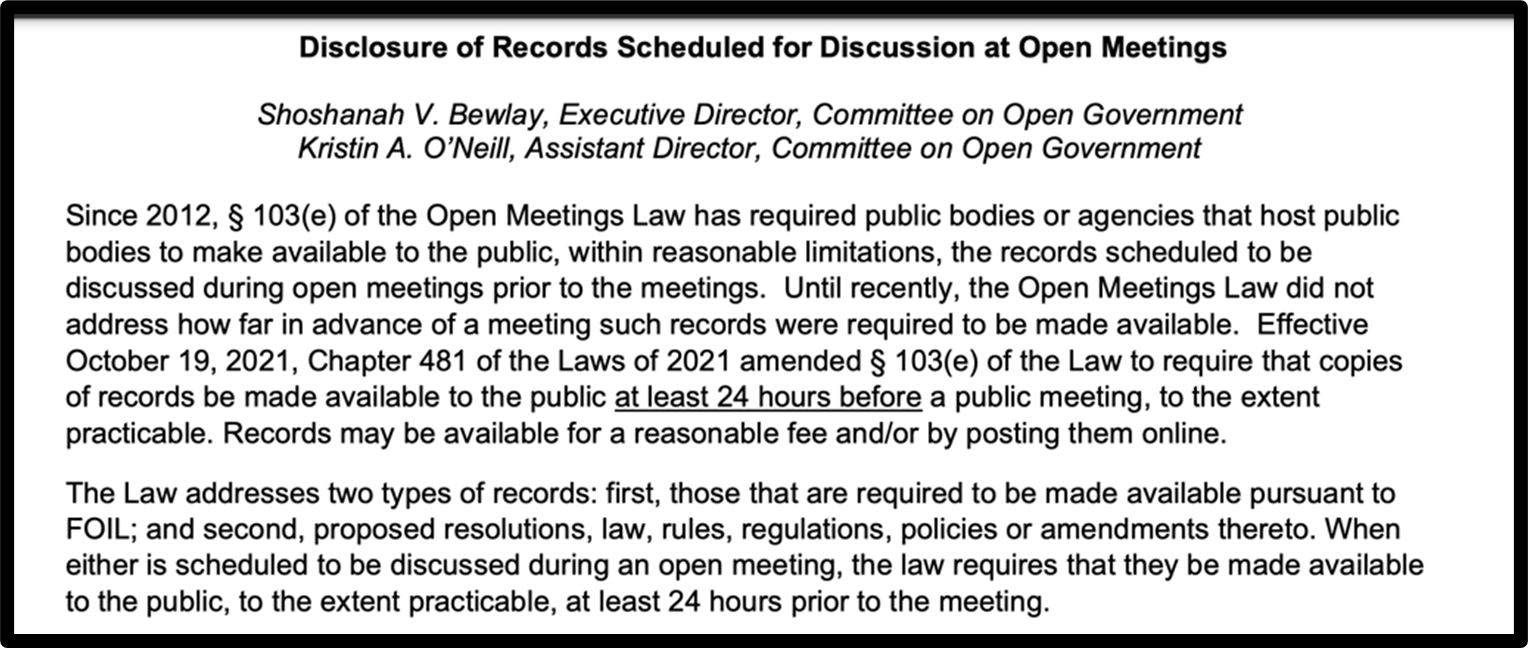
And when my gut checks with the law, I see this commentary from the COOG[3]:

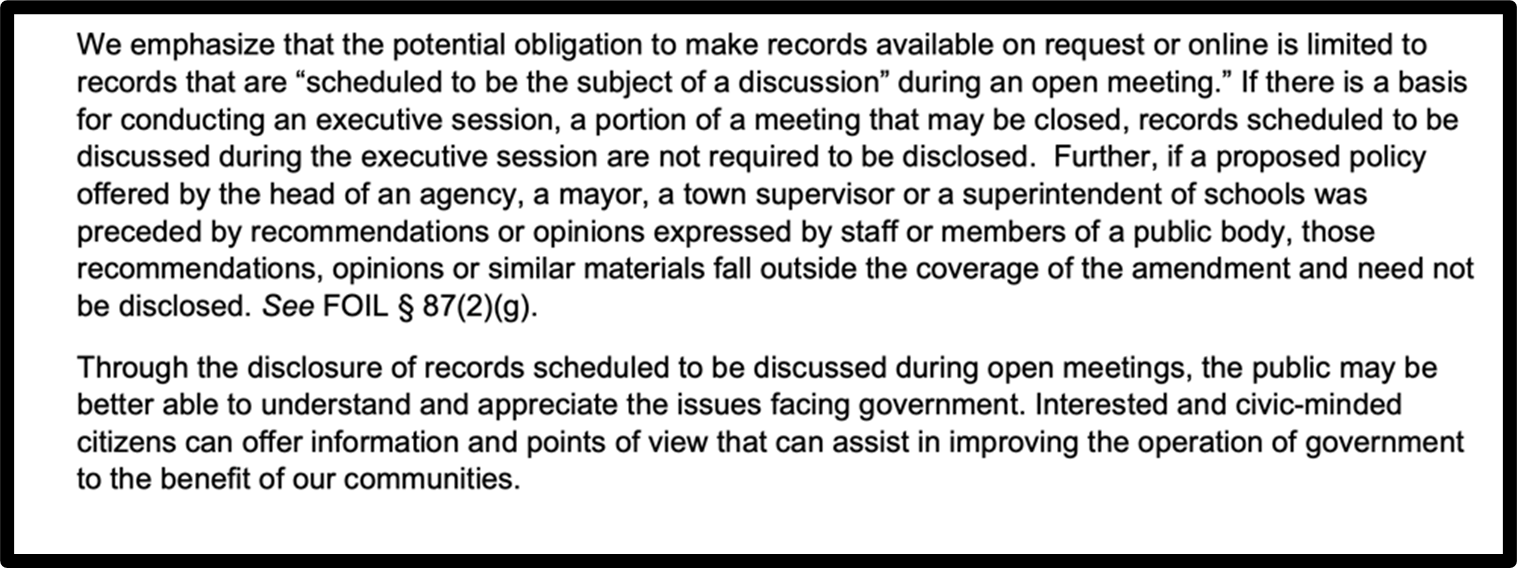
Screenshot of Open Meetings Law discussionContinued screenshot of Open Meetings Law discussion

So with that, I answer the question ""Do working documents being shaped and edited at committee meetings need to be posted in advance of the committee meeting?" as follows:

Even if a policy is in draft form, or if multiple versions are under review, if it is on the agenda of a public meeting for discussion, the version or versions under review should be included in the meeting packet, to allow for meaningful public access to the materials.[4]

That said, recommendations, opinions, or similar materials regarding such policies under development do not have to be shared, and revisions not ready in time for posting (even if discussed at the meeting) do not have to be made available/posted in advance.

Thank you for a subtle and thoughtful question!


[1] The beautiful, if somewhat bedraggled by an industrial past, Buffalo NY.

[2] This was not a huge stretch, as that topic actually is under consideration by Buffalo as of April 2022.

[3] Full text available at https://opengovernment.ny.gov/system/files/documents/2021/11/disclosure-of-records-scheduled-for-discussion-at-open-meetings-112221.pdf as of April 6, 2022.

[4] Although the law does not require it, when doing so, I strongly advise that the version include a header or some type of other indicia showing that it is a draft copy for review only, and the version date (of course, archivists and clerks?).

Employee privacy and image use

Submission Date

Question

My concern is about employee privacy and image use. Since it is so easy to take a picture these days, and many employee meetings are happening over videoconference, what are the laws governing the use of employee images and materials generated by a library employer?   What stops the participants in an online meeting from taking and using screenshots of attendees?  I know that being a librarian often means working with the public, but when it comes to an employer using an employee's picture and other digital captures of their image, what does the law say?   Can an employee attending an online meeting be compelled to turn on their camera?

Answer

This is one of those questions that a thoughtful attorney, wishing to be thorough, could write a book about. However, "Ask the Lawyer" is not a book, so we'll see what I can do in about one thousand words!

To give some useful answers, and also stick within our word limit:

1.  If a library/employer needs to convene a meeting of employees and decides it will use videoconferencing tech to do so, and then states an expectation that all participating employees will turn their cameras on during the meeting, no law in New York bars such a requirement.

2.  If employees of a library/employer that requires, as a matter of policy, that participants in a video conference must turn their cameras on, decide to demand via a collective bargaining agreement, or through policy, that keeping a camera "off" should be an option for an employee, that could become a negotiated or policy-based term of employment.  But an employer could say "no" when this is asked/demanded (and then take the hit on employee morale and/or union relations).

3.  If a solitary employee of an employer who requires participants in a video conference to turn their cameras on decides being on-camera is unacceptable to them, and they request an exception to the rule, that is a reasonable request--but there is no obligation on the part of the employer to honor it (and in fact, special exceptions could cause issues...more on that in a bit).

4.  If an employee has a disability that prevents them from working effectively while on camera, that employee could request keeping the camera "off" as a disability accommodation, and the employer would have to consider the request per their disability accommodations policy (Based on the particular circumstances, this may or may not result in a decision to grant the requested accommodation).

5.  Now, with respect to the use of pictures: if an employer uses an employee's image--taken as either a photograph, a screenshot, or through any other means--for commercial purposes without the employees' permission, that could potentially be a violation of the law.  This is why employers who wish to use their employees' images in catalogs, advertising campaigns, and other publications as part of commercial operations should obtain written permission for such use.[1]

6.  Library/employers who wish to be proactive about protecting employee privacy, while also acknowledging that a library's workforce does often play a public role in their community, should use thoughtfully developed policies to find the balance between public relations and employee safety and privacy. A well thought-out and routinely re-evaluated use of a "Social Networking Policy," a "Media Relations Policy," and a "Branding and Promotions Policy"[2] can achieve this balance.

7.  And now, for some thoughts on how this all fits together.

[Clears throat, steps on soapbox]

There is no one right way to do any of the above-listed items, but because having a solid process that respects the privacy of employees is part of attracting, developing, and retaining a qualified and dedicated workforce--as well as promoting the operations of the library--it is important that a library/employer find the way that works for them.

On the employee side, for library employees who are concerned about their privacy, or about being compelled to turn a camera on, if at all possible, raising the issues gently with management prior to any type of crisis point is a good idea.[3] For libraries that are using name tags, or have specific policies related to employee safety/privacy, or use of cameras on site, any of those policies are good entry points for consideration of these issues.

Law aside, as a business owner, and as the participant in (now) more online meetings than I can count,[4] I have found that it is very important to set the norms for online meetings[5] so that employees know what the expectations are.

How is that done?  When convening a meeting, at least until a group knows what the norms are, it is good to give a few of the ground rules. For instance, a good set of opening ground rules could be:

 "Thanks everyone for gathering today. While we can't be together in person, it is good to be together for this important topic. For this meeting, cameras are optional, but we ask that if your camera is off, you use a picture of your face for ease of communication. This meeting is not being recorded, and we ask that you refrain from taking screenshots unless you ask first. If you have questions during the discussion, feel free to put them in the chat. Our note-taker today is [Person], and if you have items that you want to make sure end up in the notes, please put those in the chat as we meet. The notes for the meeting will go out by tomorrow."

Another example, very different but just as enforceable, would be:

Thanks everyone for gathering today.  While we can't be together in person, it is good to be together for this important topic. For this meeting, we do ask that you keep your camera on, so we are all using the same modes of communication. Also, so we have a good record of the information we'll review and the decisions we'll make, this meeting is being recorded. As a courtesy, please do not take a screenshot unless you ask first. If you need to make a comment, please raise your hand, and I as moderator will get you in the queue. We don't have a note-taker for today, so please make your own notes for any points to follow-up, or ask [Person] for the recording. As with all our meetings, the recording will be considered confidential and not for release to anyone who was not in attendance."

...and the combinations could go on.

By being thoughtful about the nuances of privacy and the norms for meetings, a library/employer can both set the tone for a graceful meeting, and also position themselves to proactively address any employee concerns about the chosen norm for meetings overall. This is particularly important if an employer is insisting that cameras be on at all times; while there may be compelling reasons for this type of rule, if a library/employer is relying on employees who are working from home, there may also be compelling reasons to give employees the option of attending with their camera "off"; a well thought-out and routinely expressed set of norms will help with compliance, will make sure exceptions to "camera-on" rules are not perceived by others as unfair, and will create space for feedback in case employees want to request that the rule or norm be changed.

Thank you very much to the member for a compelling set of questions that are very much of the times. As with all "Recently Asked Questions" posted on "Ask the Lawyer, we invite feedback on this one (sent to info@losapllc.com or through the "Ask the Lawyer" submission page).  This is an evolving topic, and I am sure many library council members out there have thoughts on this!


[1] For more on image rights, see the “Ask the Lawyer” here: https://wnylrc.org/raq/posting-patron-images-facebook-when-image-release-required.

[2] There is no one name for this type of policy...some libraries call it "marketing," while others resist that label as too commercial-sounding.  If it didn't sound so cute, I'd say call it the "Who We Are and What We're Doing" policy, since that is really what it's for.

[3] I appreciate that not all employees are in situations where they feel empowered to raise this type of concern--gently, or at all. 

[4] In 2022, who can't claim this breadth of experience?  That said, because of my work, I have met with now hundreds of clients via telecon, so have seen a wide array of how business conduct online meetings.

[5] This is important for in-person meetings, too...but the norms may be a bit different.

Contracts for Library Podcasts

Submission Date

Question

The library's podcast (Your Friendly Neighborhood Librarians), hosted by two librarians here, recently started interviewing guests from outside the organization. We are concerned about a few things: what the ramifications are if a guest does not like the way their interview was edited and whether the library owns the rights to the interview and recording. We only edit for clarity and length, and haven't done anything in regards to copyright. Additionally, any advice on whether we should be using some sort of contract or agreement with guests would be helpful. We don't have any sort of agreement in place at present, and are mostly interviewing people who are somewhat library-related. Thank you for your help!

Answer

Some days, I just love my job.  The day I subscribed to "Your Friendly Neighborhood Librarians" (2/4/22) to answer this question was one of those days.

For those of you who haven't checked out the Podcast: it's a forum where hosts (and librarians) Jim and Robyn, based in Rochester, NY, conduct deep and lively interviews with quasi-local authors.  [1]

When it comes to running a Podcast, there's a lot of legal to unpack.  I'll use a recent episode of YFNL (Season 2, Episode 4, January 30, 2022), an interview with photographer Quajay Donnell to illustrate.

When the Podcast starts, the first thing you hear is the YFNL's theme song:

[guitar strumming] "Librarians, librarians, when you've got questions, they're the ones, to help you find what you're looking for..." [more].  It sounds vaguely like the theme to "Spiderman" and is clearly a riff; it's super-cute and fun and brings a smile to my face. Then Jim and Robyn introduce the session's guest and launch into the interview.

The rapport is lively and fun, but Jim and Robyn's deeply prepared interview technique gives Quajay Donnell room to make comments, tell stories, and respond to well-informed prompts to talk not only about his work, but the work of others, and his thoughts on public art (I enjoy Mr. Donnell's comment, after a glowing list of his credentials "I sometimes struggle with the title of 'photographer', I sometimes say 'I'm a picture-taker', or 'I capture moments'."  I appreciate when people resist or explore the purpose of labels).  The show then ends with a cut to a recommendation from a circulation desk worker, Sim, who recommends "Field of Blood" by Joanne Friedman, and a tease for the next episode ("banned and challenged books"), some thanks to various show-helpers,[2] and an instrumental of that great theme song.

So with that background, let's answer the questions:

"[W]hat the ramifications are if a guest does not like the way their interview was edited and whether the library owns the rights to the interview and recording.  Additionally, any advice on whether we should be using some sort of contract or agreement with guests would be helpful. We don't have any sort of agreement in place at present, and are mostly interviewing people who are somewhat library-related."

I wish I could give simple answers to these straightforward questions, but this is "Ask the Lawyer," so I cannot.  But to start, I can say there are three variables that inform the answer to these questions:

Variable "1": Who is creating the Podcast?  Is it "officially" the library, or is it being created through the collaboration of independent individuals?[3]

Variable "2": What is the identity of the Podcast?   Is it 100% entertainment, or is it meant to be investigative journalism, oral history, or serve another documentary purpose?[4]

Variable "3": What is the purpose of the Podcast?  In other words, what is it trying to achieve not only now, but 70 years from now, when it is still protected by copyright, and past consideration of such questions will govern what type of access its intended audience should have?

Here’s how these variables impact the member's questions:

If a library is the creator of the Podcast (meaning the library directed its employees to create the Podcast as part of the work they are hired to do), then the library is the entity responsible for addressing (and bearing the liability for) issues of ethics, ownership, and risk (like defamation and image use).  If an individual or individuals are the creator/owner of the podcast,[5] the responsibility falls on them. 

If the identity of the podcast is light entertainment (that theme song!), then the creator does not have to worry about abiding by, or benefiting from, professional codes of ethics and law pertaining to journalism, academic work, oral history/documentary, or political expression.  But if it aspires to fall into any of those categories (and while it's not my call, I'd say YFNL is at the very least a form of journalism), ethics and certain laws may apply.

If the purpose of the Podcast is to ensure that people listening in 2022, as well as 100 years from now, appreciate home-grown artists in and around Rochester, NY, the creator/owner needs to ensure the work is set up to be controlled in such a way that access for that purpose is ensured.  This is true whether the owner is an entity (like a library), or a person or persons.

So with that as background, let's tackle the member's questions:

For the first question ('"[what] if a guest does not like the way their interview was edited?), the answer is: in a worst-case scenario (say the guest claims the interview was edited to make him sound offensive, and claims it caused him to be "cancelled"), there could be some type of legal claim for damages.  While I won't get too technical, this concern relates to a "tort" claim (like a personal injury) and the member is wise to bring it up, since this is a critical issue.[6]

An attorney advising an entity or person on this would: 1) confirm who the creator, publisher and owner of the content is; 2) ensure the party (or parties) makes good use of a speaker agreement that secures a waiver of liability for the producer and all people affiliated with the podcast; 3) if appropriate,[7] advise a step in the production process that gives participants the right to review and approve release of the final version (in writing).

This plays into the second question: "whether the library owns the rights to the interview and recording."

This should not be an ambiguous issue: either the work is "for hire" (meaning the librarians and other credited helpers are doing it as part of the work they are paid to do, or are working per an additional contract) and is owned by the library, OR the work is owned by the individuals creating it.

The leads to the third question (or rather, factor) listed by the member: We only edit for clarity and length.

This plays into the identity of the podcast. If a podcast or other work isn't using a lot of editing to create a specific dramatic or entertaining effect, and is structured to perform a primarily documentary function, it is worth considering using the established ethics of journalism or oral history to guide the project.

Why? 

In the state of New York, journalists' sources are accorded particular protections under the law, while the identity of the speaker and nature of the communications are relevant to claims of defamation. Also under New York law, the further an unauthorized[8] use of someone's name, likeness, or voice, is from a "commercial use," the less likely a person can sue based on "invasion of privacy." And under federal copyright law, material that incorporates copyright-protected work (perhaps reading part of a poem) for journalistic, academic, or documentary functions will get consideration of that factor if a court needs to determine "fair use."

This next variable I listed is purpose, meaning, what is this work supposed to accomplish, and for how long? Consider that variable in light of the member's statement: "[We] haven't done anything in regards to copyright."

If the purpose of the podcast is to ensure as many people as possible access and appreciate it for as long as possible, what might be more important than registering a copyright is to ensure the work is archived on not only a commercial service such as Apple Podcast (where I found it), but in repositories owned by the public, as part of an institution whose structure ensures some type of longevity.

However, if part of the purpose of the podcast is to ensure for as long as possible that it can never be exploited commercially by anyone, and the owner wants to make sure it will be able to claim damages and attorneys' fees in the event the recording is infringed, registering it is a good idea.

So with that, I get to the last, open-ended question from the member: Additionally, any advice on whether we should be using some sort of contract or agreement with guests would be helpful.

It's important to know at this point that while sometimes I reach out to a member who submits a question to "Ask the Lawyer" (to get a bit more information to enable a more helpful answer), in this case, I did not reach out to Robyn and Jim (although because I really like the podcast, I wanted to!). I thought it would be more important, and in the spirit of their question, to present a generic answer to this part of their question with a generic template that could be of use to other libraries and librarians creating a podcast or other type of audio content.

When creating a podcast, here are the "legal" questions to answer to help you (and your lawyer) address the legal considerations:

Question

Reason it's relevant

Your answer


What is the purpose of the podcast?


It's important to answer this question first, because the purpose of the podcast will drive all the answers following this one.


Are there any professional ethics that apply to the podcast?


This answer is based in part on the "purpose." If the purpose is a type of journalism, the creator may want to consider affirmatively abiding by applicable journalistic ethics. If the purpose is oral history, the ethics of oral historians could apply.


Who "owns" the podcast?


This is a question for a lawyer. However, I can broadly say that if a library or educational institution is directing the podcast to be created, and the people creating it are doing so as part of their jobs, then the podcast is owned by the employer. If everyone involved is unambiguously doing it in their free time, then likely, they are the owners together. And in either case, if there is any grant funding that applies to the podcast, the owner(s) should pay close attention to the terms of the grant, because often grants involve a license or transfer of intellectual property.


What is the end product?


This seems like a pretty straightforward question, it's "podcast recordings," right? However, in just taking a look at "Your Friendly Neighborhood Librarians" I heard a theme song that could be subject to individual copyright, and I see there are really excellent descriptions of each podcast that were authored by somebody. In addition, "Your Friendly Neighborhood Librarians" (a clever brand) could also be subject to trademark. There is also a logo.  And if the content is in its own archive with its own metadata, the metadata could also be proprietary. These are just a few examples, so inventorying the end creation (and if all of the creators are not employees, making sure intellectual property is transferred appropriately) might be bigger than maintaining a list of podcasts.


What are the terms for regular and guest contributors?


For podcasts being created by people as part of their jobs, the expectations, rules and protections for them should be understood between their job description and the rules by which the podcast is operated.


For guests, as the member's question points out, it is best to have a written agreement that sets out the terms, including the right balance of a waiver of liability and the ability to preview the podcast to ensure any editing does not result in a person saying something they didn't intend to say.


(As one example of "rules": if a podcast is being produced by a public library or a not-for-profit organization, there should be a firm rule that no endorsements of political candidates are allowed on the show.)


What other conditions may apply?


For podcasts released on Apple Podcast, this means what are the rules you have to follow under the terms of Apple. For those selecting additional or alternate fora, paying attention to the "terms and conditions" on those resources is also important.  And as mentioned above, grants and donations with conditions that support the content creation should also be considered  (if you are lucky enough to be running a grant-funded podcast).


How do people access the content?


This is critical for ensuring accessibility in both the short and long-term.   Early consideration of this factor also ensures that any legal releases or agreements an owner needs to enter into (like licensing a logo) can accommodate the full plan for accessibility. 


How are any risks being addressed?


I appreciate this is a very open-ended last item. Broadly speaking, if the podcast is being produced by the library, the library's insurance carriers should be consulted to make sure it has insurance coverage for that type of activity. Any aspect of the podcast that is not covered should either be limited or other risk management, such as a waiver of liability, and a process for preview by guests, should be considered.


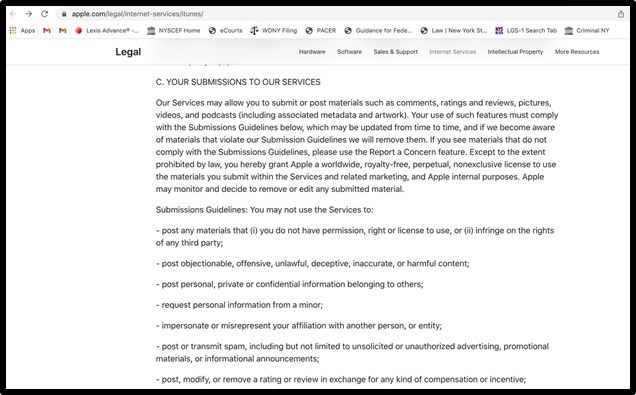
This last item is addressed by Apple's terms of use for podcasts, which I have included below.


Screenshot of submission disclaimer language

Now, with all that said, I am very aware that some of the answers I have put above may cause more anxiety then resolve curiosity. To help out with that, below is a template for a "podcast guest agreement."

As with any template, a library or podcaster should have their lawyer consider all of the factors I list above before finalizing the template. But hopefully this template can provide a good start.

[Template Podcast Guest Agreement]

RE:  Terms of guest appearance on [PODCAST NAME] on [DATE]

Dear [NAME OF GUEST]:

Thank you for agreeing to be a guest on our show, [NAME] ("the Show") on [DATE TIME] to discuss [TOPIC].

Below are the terms between you and [OWNER NAME] ("Show Publisher") for your appearance on the Show.  Please review the terms, and if you agree, please sign below.

If you have any questions before signing, please contact [NAME] at [CONTACT INFO] to discuss them before sending us the signed copy.

Ownership

You agree that the direct recording (audio and visual) and any subsequent product incorporating it, including but not limited to transcription and any adaptive copies made to enable access by those with a disability, shall be the sole property of Show Owner.

Image Use

You agree that for purposes of promoting, publishing, performing, displaying and making the Show accessible to its audience, Show Owner may use your name, image, and likeness in print and electronic media.  This permission is expressly limited to promoting and publishing the episode of the Show featuring you.  This permission is irrevocable once the Show featuring you has been made available to the public in any medium.

Rules

The rules of participating in the Show are:

Show Owner is committed to creating an experience and show that respects the dignity of all participants and listeners.  If you have any concern at any point regarding your experience working on the Show, please alert [NAME] at [CONTACT INFO].

If at any point during recording you need to take a break, please simply state "I need a break" and we'll stop recording.  This includes if a topic is not one on which you wish to speak.

We edit our show for length and clarity.  You will be given an opportunity to review the edited version prior to it being uploaded to [SITE(s)].  We ask that you write to [NAME] and [EMAIL] with any concerns about edits within [#] days of the final cut being made accessible to you.  If we don't hear anything from you within three days (excluding Saturday and Sunday), we will assume you consent to the publication of the content.

Please refrain from any endorsement of any political candidates during recording.

Please do not accuse any person of a crime, having an STD, or of being incompetent at their job, or marital infidelity, unless such fact is generally known, during recording.  We don't anticipate your appearance will warrant a dip into such a topic, but to avoid claims of defamation, or having to edit out such content, we alert guests to this consideration.

[INSERT CUSTOM RULES]

Hold Harmless

You release and hold harmless Show Owner, its employees, volunteers, and agents from any and all liability, claims of injury, lawsuits, and complaints in association with Show.[9]

Warranties & Representations

You represent and warrant that:

a) No contract or other obligation bars you from appearing on the Show;

b) Any performance on the Show by you will be of your own original work;

c) You are aware that the permission you are granting NAME to use your image, name, and likeness for the limited purposes listed above is irrevocable;

d)  You know the show will be archived by Show Owner and may archived to be available for your lifetime and beyond.

e) You are over the age of 18 and thus able to sign this contract OR your legal guardian has signed below.

Thank you so much for agreeing to be on our show!

Signed on behalf of Show Owner:___________________________

Signed by Guest:______________________________

Guest Date of Birth:_______________________________

Guest preferred pronouns:_____________________________

[if applicable] Signed by Guest's parent or guardian:____________________________


Good wishes for your friendly neighborhood podcasts, true-believers!


[1] For any Western New Yorker lamenting the decreasing number of journalists on the local creative beat, this is a nice antidote.  (BTW...Buffalo/Rochester = WNY.  Syracuse/Rome/Utica = Central NY.  I grew up in Central New York and now live in Western New York, and when this distinction gets blurred, it hurts).

[2] Including two people credited for the theme song.

[3] In my experience, librarians can have a tough time with this one, since they often go above and beyond.  For more on this type of issue, see the "Ask the Lawyer" on LibGuides at https://wnylrc.org/raq/previous-employer-re-assigned-authorship-libguides.

[4] I realize that these categories overlap, especially these days, but we'll talk about why the distinctions are important.

[5] It's official: I am using a lower-case "p" to write "podcast."  Congratulations, podcast, you've been genericized.

[6] It is also very much an "issue de jeur", since the ALA has joined an amicus brief on the rules in the state of New York for suing non-journalists for publishing content in public fora.  For more on that, search "Coleman v. Grand."

[7] This is a major distinction between a cultural or entertainment piece rather than investigative journalism, since professional reporters generally don't give interview subjects the right to approve a final cut.

[8] In this case, "unauthorized" means without written, signed permission.

[9] If you don't have a lawyer look at any other part, have them look at this.  This is a very bare-bones hold harmless intended to not "scare off" guests; a library should have a clause that matches the level of risk it is prepared to take.
Book Challenges and Records Retention

Submission Date

Question

In a local school district, multiple books have been challenged recently. This week, the School Board received an email from a community member referencing record keeping for library materials and electronic records retention. The district Superintendent wants to make sure that the district is keeping the right kind of library records, and that they are keeping them for the legal amount of time. Attached are two documents to review. In the first document titled District Records, under #15, it advised that districts should keep a list of book lists and school library reports. With this, should the district have kept a list of all books in their libraries in any given year?

Answer

In speaking to different libraries about being prepared for book challenges, I have repeatedly stressed one very important element: have your policies ready.

This question shows the depth of consideration that goes into that simple requirement.

In this case, that "depth" is found in the rocky chasm of the LGS-1, New York's end-all, be-all rules for public document management.  Need to know how long to keep records for a bingo game authorized by a village?[1]  Or how long to keep a record of exhumation?[2]  Or how long we hang onto bridge inspection records?[3] It's all in the LGS-1.

The documents the member references are sections of the LGS-1.

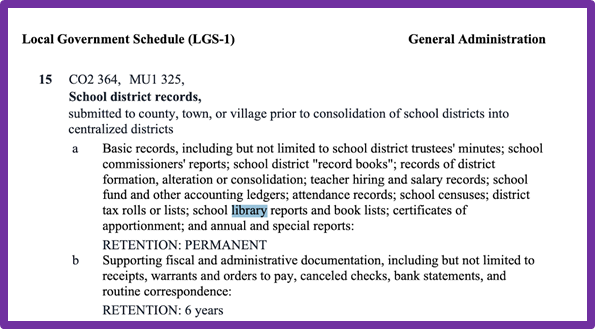
They look like this:

LGS-1 Screenshot of school district records law

and

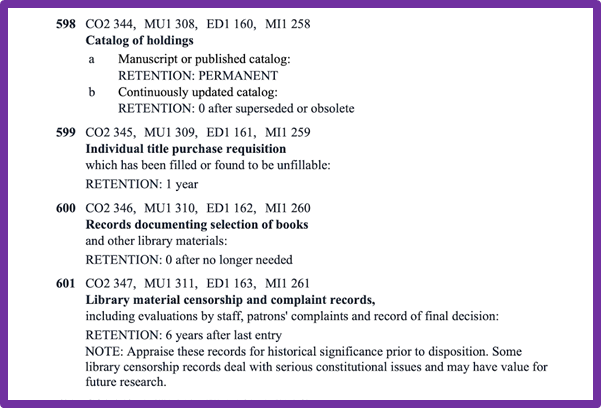
Screenshot of LGS-1 guidance for schools

Looking at these requirements, the member's question is: "[S]hould the district have kept a list of all books in their libraries in any given year?"

The answer is: MAYBE, but not DEFINITELY.

Here is why:

The first section referenced by the member, at first blush, looks like it requires the retention of "book lists" for six years.  But examining that precise section, you will see the requirement is limited to records submitted prior to the "consolidation of school districts." 

So, outside of a district consolidation, section LGS-1 15, does not require compiling a list of books.

The next sections, LGS-1 598 and 599, refer to a school district maintaining records related to a "Catalog of holdings" and "Individual title purchase requisition," respectively.

We'll tackle 598 first.

598 requires that a "Manuscript or published catalog" of "holdings" must be retained "permanently."  It then requires that a "Continuously updated catalog" be retained until it is "superseded" or "obsolete."

This means that a district library's "catalog of holdings" that exists in a static form (like a print or PDF list) must be retained permanently, but a list of holdings that is ever-changing (like an ILS) is only retained until it changes form--or that form stops being useful.[4]

In practical terms, this does mean that if the library produces a static list (in print or electronic form), it must be retained forever.  That obligation, however, does not obligate the library to create such a list in the first place.  Meaning, in other words: if the library only uses an ever-changing catalog, it doesn't need to retain any particular copy.

This brings us to 599, which requires that an "[i]ndividual title purchase requisition" (the documentation showing a school library bought a book) must be retained for one year.

Again, in practical terms: while per 598, a school library is not obligated to compile a printed list showing that "Not All Boys are Blue" is in its library's collection, per 599, it does have to retain (and produce, if not otherwise accessible through FOIL) a school’s requisition to purchase "Not All Boys are Blue" if requested.

This gets more interesting as one considers that LGS-1 600 (also seen in the purple-bordered excerpt above), regarding "Records documenting selection of books" sets no minimum retention period.  Meanwhile, LGS-1 601, regarding "Library material censorship and complaint records" mandates such records be retained for at least six years (and encourages considering saving them for much longer, which strikes me as a good idea).

The upshot of these various rules creates a regime where a district is empowered to pick and choose, to some degree, what records it wants to create...but once created, imposes a very particular set of parameters for retaining, purging, and disclosing them.  This is why my answer to the member's question must be so ambiguous.

It is also why it is very important that a district have a well-developed policy on this issue.

Below are some examples of what, depending on the records a district elects to create, a district can say in answer to the question: "I want to make sure I approve of all the books my taxes paid for this year.  Can I have a list of all the books?"

[If the library maintains a published list and wants to be friendly.] "Sure thing.  We compile and publish a list of books in our collection every year as of the first Monday of September.  Do you want the one showing all the books in one particular library, or all the books in the district?"

[If the library doesn't maintain a published list, but has a continuously updated catalog, feels friendly, and allows access to library computers.] "No, we don't publish such a list.  But we do have a continuously updated catalog you can search on this terminal."

[If the library doesn't maintain a published list, has a continuously updated catalog, doesn't allow just anybody access to its computers, but feels somewhat helpful.] "No, we don't publish such a list.  But we do have a continuously updated catalog you can request a copy of."

[If the library doesn't maintain a published list, doesn't allow access to computers, and doesn't feel helpful, but does feel puckish.] "No, but if requested, we can supply you with a copy of every book requisitioned last year."[5]

[If the library doesn't maintain a published list, and doesn't want to offer alternative ways to share the information.] "No, we don't have that."

[If the library doesn't maintain a published list, and is okay risking a spat.]

"No."

Optional rider to all the above answers: "Here is a copy of our FOIL policy so you know the process for requesting our public records through our FOIL officer, and can be aware of our copying charges and the process for requesting electronic copies."

Now, as any veteran of public relations battles over school district policy knows, there's a time to be helpful, and there's a time to say "no."  I am not endorsing any particular answer, but based on a district's policy, it should know what records it keeps (and doesn't keep), and how people can access them.

From my perspective, if there isn't a need to compile information, it shouldn't be compiled.  Further, FOIL does not create the obligation to compile information if it is not already compiled.  On the other hand, waffling and appearing to dodge the question when concerned citizens are on the hunt for "objectionable material" might not be the best way to fight the battle for intellectual freedom.  "We don't have a list but we have a continuously updated database" strikes me as a glove-slap; it invites a fight...but nevertheless, if accurate, might be a perfectly valid response.

From my high horse over here in law-law land, a district should proceed from the presumption that if a book is in a school library's catalog, it belongs there; this is the stance that supports intellectual freedom, while also setting a good example for the students (but I am not the one who has to deal with angry community members storming a school board meeting).

Regardless of my personal thoughts on the diplomatic aspects of this issue, from the perspective of intellectual freedom, information access, education law, the LGS-1, and the First Amendment, here is what's important: have a sound policy governing 1) how library books are selected; 2) how library books are cataloged;[6] 3) how library books are challenged; and 4) how library books are removed, and follow that policy.

If, as part of that policy, a district has the desire and capacity to create an annual (or decennial, or whatever time span it wants) list of books in the school library catalog, great, but if such a list is created, it must be kept forever.  And if the district only uses a continuously updated library catalog, it should be clear from the policy who can access it, and how (at the school?  By appointment?  Remotely?).  And all of this turns on the district having a designated FOIL officer and process for timely responding to, assessing, and meeting FOIL requests.

So, there is my answer...and I know it rests on a dangerous triangle of law, practicality, diplomacy.   This stuff isn't easy.

I wish you a clear head, a steady heart, and a ready wit as you face whatever challenges come your way.


[1] 8 NYCRR §185.15 (2020); see schedule items 562-564.

[2] 8 NYCRR §185.15 (2020); see schedule item 136.

[3] 8 NYCRR §185.15 (2020); see schedule item 1085.   By the way, it's "6 years after structure no longer in use or inspected features have been replaced," which I find rather terrifying.

[4] Kind of whimsically sad notion: "You are needed, until you change or you aren't needed."  I would love to meet the person who wrote this part of the LGS-1; they had to be a philosophy major.

[5] I don't advise using this one.

[6] Including having a published list, or simply having a continuously updated database.

Libraries Open to the Public Template for Copiers

Submission Date

Question

We were asked about signage to post over the public copier at a libraries open to the public. Below is some template language with footnotes explaining why they say what they do.  Of course, before posting in your school or library, check with your lawyer!

Answer

MAKING A COPY ON THIS MACHINE

MAY BE SUBJECT TO THE COPYRIGHT LAW OF THE UNITED STATES[1]

This means 4 important things:

1.  Copying a copyright-protected work here could be a copyright violation.[2]

2.  Copying protected works is sometimes allowed under "fair use."[3]  We can't give you legal advice, but if you want to learn more about "fair use," go to https://www.copyright.gov/circs/circ21.pdf or see the [INSTITUTION NAME] Fair Use policy at [LINK].

3.  Copying a copyrighted work to accommodate a disability under the ADA is allowed.   However, to do that, please see the library staff, since adaptive copies have special rules,[4] and we want to help you (or a person you are assisting) exercise your rights.

4. As a library open to the public, there are special circumstances under which we get to make copies (libraries are special).  However, to qualify for that protection, this notice (which we have, by law, placed over the copier right in front of you), has to say what it says in bold at the very top, and we have to operate by this rule:

Any person or group is forbidden to use this machine to engage in the related or concerted reproduction or distribution of multiple copies of the same material, whether made on one occasion or over a period of time, and whether intended for aggregate use by one or more individuals or for separate use by the individual members of a group.

What does that mean? Entire classes should not come here and copy the whole text book for a course![5]  Please don't do that.[6]

The copy machines are here for your use, and we appreciate your consideration of these laws.

Thanks!


[1] This precise language is required by 17 U.S.C. 108 for the library and its employees to be protected against allegations of secondary infringement.

[2] 17 U.S.C. 106 reserves the making of copies to the copyright owner.

[3] 17. U.S.C. 107 allows copying under certain circumstances, but simply "educational" or "not-for-profit" use is not enough.  Read the guide at the link!

[4] See https://www.loc.gov/nls/about/organization/laws-regulations/copyright-law-amendment-1996-pl-104-197/.

[5] This is covered by 17 U.S.C. Section 108(f).  Section 108 also lets libraries make copies for other uses...but that is for libraries, not regular people or students using a copier in a library.

[6] Seriously, if we see you doing that, we have to ask you to stop.

Offering Travel Grants to Members

Submission Date

Question

A director of a library resources council asks…

I know we have policy and procedures in place for our staff travel, but what if we were to reimburse or give grants for personal auto travel to members.

Example: could we offer a monetary amount for our members to travel to Albany for NYLA Legislative Day? Would our [library]council be liable if the person gets in an accident?

We also offer Professional Development grants. If travel is included in the grant we award are we liable for supporting that trip if the person is in an accident or injured?


Answer

This is the right question at the right time.  As we wrap up 2022, remote work, work travel, work-from-home, work abroad...all these are evolving in a tangle of legal considerations.

Whenever an employer adopts policies or practices that can impact the physical situation of an employee, questions about liability must be addressed.  The same is true for an organization that offers grants.

Liability is only one consideration among many, however.  When the terms for compensation or funding are being set, equally important are: support for institutional mission, individual well-being, and meaningful assessment of how funds are spent.

Fortunately, consideration of liability can be harmonized with these other priorities, by considering the purpose of the funding, and the way it is awarded.

Here are some examples of this balance, based on the member's scenarios:

Scenario 1 (regarding travel to Albany): "To promote member and professional participation in NYLA Legislative Day, member organizations can apply for travel grants up to [AMOUNT].  Member organizations who apply must submit a copy of their lobbying policy to demonstrate they are set up to properly receive, administer, and report lobbying-related funds."

Scenario 2 (regarding professional development): "To promote professional capacity-building at member organizations, member organizations can apply for professional development grants of up to [AMOUNT].  Recipient members will be required to send a short report describing the use of funds so professional capacity-building can be assessed."

How does this limit liability?  In both of the above examples, the grant recipient is the member organization, not the acting/receiving individual.  This would be emphasized further in the grant application and award conditions[1], which would require the funds be spent in a certain way (emphasizing mission and assessment), but would rely on the member-recipient to administer the funds to their employee, as a term of employment.

This separation reduces the chance for liability to be directed at the grant funder, while the chance for liability between the employee and the employer remains the same (unless the grant is conditioning funding on something inherently dangerous, like sky-diving into Albany, or professional development as an underwater welder).

On the flip side of this arrangement is the fact that any time an employee is travelling or engaging in any activity for business--whether the trip is specially funded by a grant, or to promote the employee's individual professional development--the trip or activity may result in an injury that could result in worker's compensation claim.

This is true whether the employee is at the employer's office, a home office, an off-site work location, or travelling for business, and is true whether or not the activity is grant-funded, or funded out of general operating expenses.[2]

Such injury, when incurred by an employee, should be reported promptly to the employer, so the employer can file the appropriate claim for workers' compensation insurance.  If the incident involved injury to another, or injury to property or assets, the matter might involve other types of insurance.[3]

Of course, there are some professional development opportunities and grants that may go straight from a grant-giving organization to an individual, rather than to that individual's employer.  When that is the case, the application materials and recipient award notice (which should double as a "terms of acceptance" document) must make it clear that the funded tasks are not being performed by the recipient as an employee, agent, or contractor of the donor.  That is another task for a lawyer.


Thank you for a nuanced question!


[1] This is why grant application and award notices should be reviewed by a lawyer when newly issued or revised.

[2] Please bear in mind, this is the default condition, and many things could happen to change it (including the contract between the grantee and grantor).  The bottom line: if an employee is injured, prompt reporting is essential to ensure they receive the protection and coverage they may be entitled to.

[3] Examples include but aren't limited to: general liability insurance, commercial liability insurance, professional liability insurance, automobile insurance, marine insurance (if the incident happened on a boat).